


Glorious Revolution (Spain)

Encyclopedia
Spain
Spain , officially the Kingdom of Spain languages]] under the European Charter for Regional or Minority Languages. In each of these, Spain's official name is as follows:;;;;;;), is a country and member state of the European Union located in southwestern Europe on the Iberian Peninsula...
in 1868, resulting in the deposition of Queen Isabella II
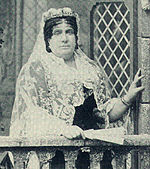
Isabella II of Spain
Isabella II was the only female monarch of Spain in modern times. She came to the throne as an infant, but her succession was disputed by the Carlists, who refused to recognise a female sovereign, leading to the Carlist Wars. After a troubled reign, she was deposed in the Glorious Revolution of...
.
An 1866 rebellion led by General Juan Prim
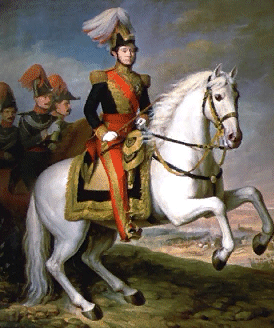
Juan Prim
Don Juan or Joan Prim, Marquis of los Castillejos, Grandee of Spain, Count of Reus, Viscount of the Bruch was a Spanish general and statesman.-Life:...
and a revolt of the sergeants at San Gil barracks, in Madrid
Madrid
Madrid is the capital and largest city of Spain. The population of the city is roughly 3.3 million and the entire population of the Madrid metropolitan area is calculated to be 6.271 million. It is the third largest city in the European Union, after London and Berlin, and its metropolitan...
, sent a signal to Spanish liberals and republicans that there was serious unrest with the state of affairs in Spain that could be harnessed if it were properly led. Liberals and republican exiles abroad made agreements at Ostend
Ostend
Ostend is a Belgian city and municipality located in the Flemish province of West Flanders. It comprises the boroughs of Mariakerke , Stene and Zandvoorde, and the city of Ostend proper – the largest on the Belgian coast....
in 1866 and Brussels
Brussels
Brussels , officially the Brussels Region or Brussels-Capital Region , is the capital of Belgium and the de facto capital of the European Union...
in 1867. These agreements laid the framework for a major uprising, this time not merely to replace the Prime Minister with a Liberal, but to overthrow Isabella herself, whom Spanish liberals and republicans began to see as the source of Spain's inefficacy.
Her continual vacillation between liberal and conservative quarters had, by 1868, outraged the moderates, the progressives and the members of the Unión Liberal, and enabled a front that crossed party lines. Leopoldo O'Donnell's death in 1867 caused the Unión Liberal to unravel; many of its supporters, who had crossed party lines to create the party initially, joined the growing movement to overthrow Isabella in favor of a more effective regime.
The die was cast in September 1868, when naval forces under admiral Juan Bautista Topete
Juan Bautista Topete
Juan Bautista Topete y Carballo , Spanish naval commander and politician, was born in San Andrés Tuxtla, Mexico.His father and grandfather were also Spanish admirals...
mutinied in Cadiz
Cádiz
Cadiz is a city and port in southwestern Spain. It is the capital of the homonymous province, one of eight which make up the autonomous community of Andalusia....
, the same place that Rafael del Riego
Rafael del Riego
Rafael del Riego y Nuñez was a Spanish general and liberal politician, who played a key role in the outbreak of the Liberal Triennium .-Early life and action in the Peninsular War:...
had launched his coup against Isabella
Isabella II of Spain
Isabella II was the only female monarch of Spain in modern times. She came to the throne as an infant, but her succession was disputed by the Carlists, who refused to recognise a female sovereign, leading to the Carlist Wars. After a troubled reign, she was deposed in the Glorious Revolution of...
's father a half-century before. Narváez deserted the queen, as did her chief minister, Luis González Bravo. Generals Prim and Francisco Serrano denounced the government and much of the army defected to the revolutionary generals on their arrival in Spain. The queen made a brief show of force at the Battle of Alcolea, where her loyal moderado generals under Manuel Pavia were defeated by General Serrano. Isabella, then, crossed into France and retired from Spanish politics to Paris
Paris
Paris is the capital and largest city in France, situated on the river Seine, in northern France, at the heart of the Île-de-France region...
, where she would remain until her death in 1904.
Cortes Generales
The Cortes Generales is the legislature of Spain. It is a bicameral parliament, composed of the Congress of Deputies and the Senate . The Cortes has power to enact any law and to amend the constitution...
initially rejected the notion of a republic; Serrano was named regent while a search was launched for a suitable monarch to lead the country. A truly liberal constitution was written and successfully promulgated by the cortes in 1869 – the first such constitution in Spain since 1812.
The search for a suitable king proved to be quite problematic for the Cortes. The republicans were, on the whole, willing to accept a monarch if he was capable and abided by a constitution. Prim, a perennial rebel against the Isabelline governments, was named regent in 1869. The aged Espartero was brought up as an option, still having considerable sway among the progressives; even after he rejected the notion of being named king, he still gained eight votes for his coronation in the final tally. Many proposed Isabella's young son Alfonso (the future Alfonso XII of Spain
Alfonso XII of Spain
Alfonso XII was king of Spain, reigning from 1874 to 1885, after a coup d'état restored the monarchy and ended the ephemeral First Spanish Republic.-Early life and paternity:Alfonso was the son of Queen Isabella II of Spain, and...
), but many thought that he would be dominated by his mother and inherit her flaws. Ferdinand of Saxe-Coburg, the former regent of neighboring Portugal
Portugal
Portugal , officially the Portuguese Republic is a country situated in southwestern Europe on the Iberian Peninsula. Portugal is the westernmost country of Europe, and is bordered by the Atlantic Ocean to the West and South and by Spain to the North and East. The Atlantic archipelagos of the...
, was sometimes raised as a possibility. A nomination offered to Prince Leopold of Hohenzollern-Sigmaringen would trigger the Franco-Prussian War
Franco-Prussian War
The Franco-Prussian War or Franco-German War, often referred to in France as the 1870 War was a conflict between the Second French Empire and the Kingdom of Prussia. Prussia was aided by the North German Confederation, of which it was a member, and the South German states of Baden, Württemberg and...
.
In August 1870, an Italian prince, Amadeo of Savoy
Amadeo I of Spain
Amadeo I was the only King of Spain from the House of Savoy...
, was selected. The younger son of Victor Emmanuel II of Italy
Victor Emmanuel II of Italy
Victor Emanuel II was king of Sardinia from 1849 and, on 17 March 1861, he assumed the title King of Italy to become the first king of a united Italy since the 6th century, a title he held until his death in 1878...
, Amadeo had less of the troublesome political baggage that a German or French claimant would bring, and his liberal credentials were strong. He was duly elected King as Amadeo I of Spain
Amadeo I of Spain
Amadeo I was the only King of Spain from the House of Savoy...
on November 3, 1870. He landed in Cartagena
Cartagena, Spain
Cartagena is a Spanish city and a major naval station located in the Region of Murcia, by the Mediterranean coast, south-eastern Spain. As of January 2011, it has a population of 218,210 inhabitants being the Region’s second largest municipality and the country’s 6th non-Province capital...
on November 27, the same day that Juan Prim was assassinated while leaving the Cortes. Amadeo swore upon the general's corpse that he would uphold Spain's constitution. He only lasted two years, leading to the establishment of the first Spanish Republic
First Spanish Republic
The First Spanish Republic was the political regime that existed in Spain between the parliamentary proclamation on 11 February 1873 and 29 December 1874 when General Arsenio Martínez-Campos's pronunciamento marked the beginning of the Bourbon Restoration in Spain...
. That in turn also lasted two years, but no political force was willing to restore Isabella; instead Isabella's son was proclaimed King Alfonso XII
Alfonso XII of Spain
Alfonso XII was king of Spain, reigning from 1874 to 1885, after a coup d'état restored the monarchy and ended the ephemeral First Spanish Republic.-Early life and paternity:Alfonso was the son of Queen Isabella II of Spain, and...
in 1875.