


Baklava

Encyclopedia
Baklava is a rich, sweet pastry
made of layers of filo pastry filled with chopped nut
s and sweetened with syrup
or honey
. It is characteristic of the cuisine
s of the former Ottoman Empire
and much of central
and southwest
Asia
.
Turkic
origin, with its current form being developed in the imperial kitchens of the Topkapı Palace
.
Many Ottoman sweets are similar to Byzantine
sweets, using dough, sesame, wheat, nuts and fruits, and some were similar to the Ottoman börek
, halva
, and so on. Indeed, Vryonis identifies the ancient Greek gastris (γάστρις), kopte (κοπτὴ σησαμίς), kopton (κοπτόν), or koptoplakous (κοπτοπλακοῦς), mentioned in the Deipnosophistae
, as baklava, and calls it a "Byzantine
favorite". But though gastris contained a filling of nuts and honey, its outer layers did not include any dough, but rather a honey and ground sesame
mixture similar to modern pasteli or halva
.
Perry assembles evidence to show that layered breads were created by Turkic peoples
in Central Asia, and argues that the "missing link" between the Central Asian folded or layered breads (which did not include nuts) and modern phyllo-based pastries like baklava is the Azerbaijan
i dish Bakı
pakhlavası, which involves layers of dough and nuts. The traditional Uzbek
pakhlava, puskal or yupka and Tatar
yoka, sweet and salty savories (boreks) prepared with 10-12 layers of dough, are other early examples of layered dough style in Turkic regions.
The thin phyllo dough as used today was probably developed in the kitchens of the Topkapı Palace. Indeed, the sultan presented trays of baklava to the Janissaries every 15th of the month of Ramadan
in a ceremonial procession called the Baklava Alayı. Zibart claims that the Persians added the syrup
and nut
s.
Other claims about baklava's origins include: that it dates back to ancient Mesopotamia
, and was mentioned in a Mesopotamian cookbook on walnut
dishes; that al-Baghdadi
describes it in his 13th-century cookbook; that it was a popular Byzantine dessert. But Claudia Roden and Andrew Dalby find no evidence for it in Arab
, Greek
, or Byzantine
sources before the Ottoman period
.
One of the oldest known recipes for a sort of proto-baklava is found in a Chinese
cookbook written in 1330 under the Yuan (Mongol) dynasty
under the name güllach. "Güllaç
" is found in Turkish cuisine. Layers of phyllo dough are put one by one in warmed up milk with sugar. It is served with walnut and fresh pomegranate and generally eaten during Ramadan.
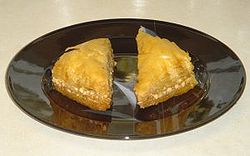
, Gaziantep
is famous for its pistachio baklava and regarded there as its native city, though it only appears to have been introduced to Gaziantep from Damascus in 1871. In 2008, the Turkish patent office registered a geographical indication certificate for Antep Baklava.
Baklava from Aleppo
is made with the local pistachios and samna
from Hama
.
In the Balkans, it is generally only eaten on special occasions; by Muslims, mostly during the holy month of Ramadan
and Eid ul-Fitr
. In Albania
, baklava is very popular dessert. The dough may include egg yolks, and the filling uses walnuts.
In Iran
, a drier version of baklava is cooked and presented in smaller diamond-shaped cuts flavored with rose water. The city of Yazd
is famous for its baklava, which is widely distributed in Iran. Persian baklava uses a combination of chopped almonds and pistachios spiced with cardamom and a rose water-scented syrup and is lighter than other Middle Eastern versions.
In Azerbaijan
, pakhlava is mostly prepared during the Novruz festivity. After preparation the pakhlava is cut into diamond shapes and each piece is garnished with an almond or a walnut.
In Afghanistan
and Cyprus
, baklava is prepared into triangle-shaped pieces and is lightly covered in crushed pistachio
nuts.
In Armenia
, baklava is made with cinnamon
and cloves.
In Syria
, baklava is prepared from phyllo dough sheets, butter, walnuts and sugar syrup. It is cut into lozenge pieces.
باقلوا /bɑːklɑvɑː/. The name baklava is used in many languages with minor phonetic and spelling variations.
The ultimate origin of the name is unclear.
Buell argues that the word "baklava" may come from the Mongolian
root baγla- 'to tie, wrap up, pile up' composed with the Turkic
verbal ending -v; baγla- itself in Mongolian is a Turkic loanword. The Armenian linguist Sevan Nişanyan traces the word to its Proto-Turkic
forms of baklağı or baklağu, but offers no conjecture of how those words came to be associated with this dish.
Though the suffix -vā might suggest a Persian origin, the baqla- part does not appear be Persian.
Another form of the word is also recorded in Persian, باقلبا (bāqlabā).
The Arabic name is doubtless a borrowing from Turkish, though a folk etymology, unsupported by Wehr's dictionary
, connects it to Arabic بقلة /baqlah/ 'bean'.
Pastry
Pastry is the name given to various kinds of baked products made from ingredients such as flour, sugar, milk, butter, shortening, baking powder and/or eggs. Small cakes, tarts and other sweet baked products are called "pastries."...
made of layers of filo pastry filled with chopped nut
Nut (fruit)
A nut is a hard-shelled fruit of some plants having an indehiscent seed. While a wide variety of dried seeds and fruits are called nuts in English, only a certain number of them are considered by biologists to be true nuts...
s and sweetened with syrup
Syrup
In cooking, a syrup is a thick, viscous liquid consisting primarily of a solution of sugar in water, containing a large amount of dissolved sugars but showing little tendency to deposit crystals...
or honey
Honey
Honey is a sweet food made by bees using nectar from flowers. The variety produced by honey bees is the one most commonly referred to and is the type of honey collected by beekeepers and consumed by humans...
. It is characteristic of the cuisine
Cuisine
Cuisine is a characteristic style of cooking practices and traditions, often associated with a specific culture. Cuisines are often named after the geographic areas or regions that they originate from...
s of the former Ottoman Empire
Ottoman cuisine
Ottoman cuisine is the cuisine of the Ottoman Empire and its successors in Anatolia, the Balkans, and much of the Middle East.- Description :...
and much of central
Central Asia
Central Asia is a core region of the Asian continent from the Caspian Sea in the west, China in the east, Afghanistan in the south, and Russia in the north...
and southwest
Southwest Asia
Western Asia, West Asia, Southwest Asia or Southwestern Asia are terms that describe the westernmost portion of Asia. The terms are partly coterminous with the Middle East, which describes a geographical position in relation to Western Europe rather than its location within Asia...
Asia
Asia
Asia is the world's largest and most populous continent, located primarily in the eastern and northern hemispheres. It covers 8.7% of the Earth's total surface area and with approximately 3.879 billion people, it hosts 60% of the world's current human population...
.
History
The history of baklava is not well documented. It has been claimed by many ethnic groups, but there is strong evidence that it is of Central AsianCentral Asian cuisine
The Central Asian cuisines include:* Afghan cuisine* Iranian cuisine* Mongolian cuisine* Cuisine of Kashmir* Kazakh cuisine* Kashmiri cuisine* Kyrgyz cuisine* Pakistani cuisine * Tajik cuisine* Tibetan cuisine* Turkmen cuisine...
Turkic
Turkic peoples
The Turkic peoples are peoples residing in northern, central and western Asia, southern Siberia and northwestern China and parts of eastern Europe. They speak languages belonging to the Turkic language family. They share, to varying degrees, certain cultural traits and historical backgrounds...
origin, with its current form being developed in the imperial kitchens of the Topkapı Palace
Topkapi Palace
The Topkapı Palace is a large palace in Istanbul, Turkey, that was the primary residence of the Ottoman Sultans for approximately 400 years of their 624-year reign....
.
Many Ottoman sweets are similar to Byzantine
Byzantine cuisine
Byzantine cuisine was marked by a merger of Greek and Roman gastronomy. The development of the Byzantine Empire and trade brought in spices, sugar and new vegetables to Greece. Cooks experimented with new combinations of food, creating two styles in the process...
sweets, using dough, sesame, wheat, nuts and fruits, and some were similar to the Ottoman börek
Börek
Börek is a family of baked or fried filled pastries made of a thin flaky dough known as yufka . It can be filled with cheese, often feta, sirene or kaşar; minced meat, or vegetables...
, halva
Halva
Halva refers to many types of dense, sweet confections, served across the Middle East, South Asia, Central Asia, West Asia, North Africa, the Horn of Africa, the Balkans, Eastern Europe, Malta and the Jewish world.The term halva ,...
, and so on. Indeed, Vryonis identifies the ancient Greek gastris (γάστρις), kopte (κοπτὴ σησαμίς), kopton (κοπτόν), or koptoplakous (κοπτοπλακοῦς), mentioned in the Deipnosophistae
Deipnosophistae
The Deipnosophistae may be translated as The Banquet of the Learned or Philosophers at Dinner or The Gastronomers...
, as baklava, and calls it a "Byzantine
Byzantine
Byzantine usually refers to the Roman Empire during the Middle Ages.Byzantine may also refer to:* A citizen of the Byzantine Empire, or native Greek during the Middle Ages...
favorite". But though gastris contained a filling of nuts and honey, its outer layers did not include any dough, but rather a honey and ground sesame
Sesame
Sesame is a flowering plant in the genus Sesamum. Numerous wild relatives occur in Africa and a smaller number in India. It is widely naturalized in tropical regions around the world and is cultivated for its edible seeds, which grow in pods....
mixture similar to modern pasteli or halva
Halva
Halva refers to many types of dense, sweet confections, served across the Middle East, South Asia, Central Asia, West Asia, North Africa, the Horn of Africa, the Balkans, Eastern Europe, Malta and the Jewish world.The term halva ,...
.
Perry assembles evidence to show that layered breads were created by Turkic peoples
Turkic peoples
The Turkic peoples are peoples residing in northern, central and western Asia, southern Siberia and northwestern China and parts of eastern Europe. They speak languages belonging to the Turkic language family. They share, to varying degrees, certain cultural traits and historical backgrounds...
in Central Asia, and argues that the "missing link" between the Central Asian folded or layered breads (which did not include nuts) and modern phyllo-based pastries like baklava is the Azerbaijan
Azerbaijan
Azerbaijan , officially the Republic of Azerbaijan is the largest country in the Caucasus region of Eurasia. Located at the crossroads of Western Asia and Eastern Europe, it is bounded by the Caspian Sea to the east, Russia to the north, Georgia to the northwest, Armenia to the west, and Iran to...
i dish Bakı
Baku
Baku , sometimes spelled as Baki or Bakou, is the capital and largest city of Azerbaijan, as well as the largest city on the Caspian Sea and of the Caucasus region. It is located on the southern shore of the Absheron Peninsula, which projects into the Caspian Sea. The city consists of two principal...
pakhlavası, which involves layers of dough and nuts. The traditional Uzbek
Uzbeks
The Uzbeks are a Turkic ethnic group in Central Asia. They comprise the majority population of Uzbekistan, and large populations can also be found in Afghanistan, Tajikstan, Kyrgyzstan, Turkmenistan, Kazakhstan, Russia, Pakistan, Mongolia and the Xinjiang Uyghur Autonomous Region of China...
pakhlava, puskal or yupka and Tatar
Tatars
Tatars are a Turkic speaking ethnic group , numbering roughly 7 million.The majority of Tatars live in the Russian Federation, with a population of around 5.5 million, about 2 million of which in the republic of Tatarstan.Significant minority populations are found in Uzbekistan, Kazakhstan,...
yoka, sweet and salty savories (boreks) prepared with 10-12 layers of dough, are other early examples of layered dough style in Turkic regions.
The thin phyllo dough as used today was probably developed in the kitchens of the Topkapı Palace. Indeed, the sultan presented trays of baklava to the Janissaries every 15th of the month of Ramadan
Ramadan
Ramadan is the ninth month of the Islamic calendar, which lasts 29 or 30 days. It is the Islamic month of fasting, in which participating Muslims refrain from eating, drinking, smoking and sex during daylight hours and is intended to teach Muslims about patience, spirituality, humility and...
in a ceremonial procession called the Baklava Alayı. Zibart claims that the Persians added the syrup
Syrup
In cooking, a syrup is a thick, viscous liquid consisting primarily of a solution of sugar in water, containing a large amount of dissolved sugars but showing little tendency to deposit crystals...
and nut
Nut (fruit)
A nut is a hard-shelled fruit of some plants having an indehiscent seed. While a wide variety of dried seeds and fruits are called nuts in English, only a certain number of them are considered by biologists to be true nuts...
s.
Other claims about baklava's origins include: that it dates back to ancient Mesopotamia
Mesopotamia
Mesopotamia is a toponym for the area of the Tigris–Euphrates river system, largely corresponding to modern-day Iraq, northeastern Syria, southeastern Turkey and southwestern Iran.Widely considered to be the cradle of civilization, Bronze Age Mesopotamia included Sumer and the...
, and was mentioned in a Mesopotamian cookbook on walnut
Walnut
Juglans is a plant genus of the family Juglandaceae, the seeds of which are known as walnuts. They are deciduous trees, 10–40 meters tall , with pinnate leaves 200–900 millimetres long , with 5–25 leaflets; the shoots have chambered pith, a character shared with the wingnuts , but not the hickories...
dishes; that al-Baghdadi
Muhammad bin Hasan al-Baghdadi
', usually called al-Baghdadi was the compiler of an early Arabic language cookbook of the Abbasid period, كتاب الطبيخ , written in 1226....
describes it in his 13th-century cookbook; that it was a popular Byzantine dessert. But Claudia Roden and Andrew Dalby find no evidence for it in Arab
Arab
Arab people, also known as Arabs , are a panethnicity primarily living in the Arab world, which is located in Western Asia and North Africa. They are identified as such on one or more of genealogical, linguistic, or cultural grounds, with tribal affiliations, and intra-tribal relationships playing...
, Greek
Greece
Greece , officially the Hellenic Republic , and historically Hellas or the Republic of Greece in English, is a country in southeastern Europe....
, or Byzantine
Byzantine
Byzantine usually refers to the Roman Empire during the Middle Ages.Byzantine may also refer to:* A citizen of the Byzantine Empire, or native Greek during the Middle Ages...
sources before the Ottoman period
Ottoman Empire
The Ottoman EmpireIt was usually referred to as the "Ottoman Empire", the "Turkish Empire", the "Ottoman Caliphate" or more commonly "Turkey" by its contemporaries...
.
One of the oldest known recipes for a sort of proto-baklava is found in a Chinese
China
Chinese civilization may refer to:* China for more general discussion of the country.* Chinese culture* Greater China, the transnational community of ethnic Chinese.* History of China* Sinosphere, the area historically affected by Chinese culture...
cookbook written in 1330 under the Yuan (Mongol) dynasty
Yuan Dynasty
The Yuan Dynasty , or Great Yuan Empire was a ruling dynasty founded by the Mongol leader Kublai Khan, who ruled most of present-day China, all of modern Mongolia and its surrounding areas, lasting officially from 1271 to 1368. It is considered both as a division of the Mongol Empire and as an...
under the name güllach. "Güllaç
Güllaç
Güllaç is a Turkish dessert made with milk, pomegranate and a special kind of pastry. It is consumed especially during Ramadan.Güllaç is mentioned as being the first version of baklava. The similarities among the two desserts are many, such as the use of thin layers of dough and nuts in between....
" is found in Turkish cuisine. Layers of phyllo dough are put one by one in warmed up milk with sugar. It is served with walnut and fresh pomegranate and generally eaten during Ramadan.
Local versions
In TurkeyTurkey
Turkey , known officially as the Republic of Turkey , is a Eurasian country located in Western Asia and in East Thrace in Southeastern Europe...
, Gaziantep
Gaziantep
Gaziantep , Ottoman Turkish: Ayintab) previously and still informally called Antep; ʻayn tāb is a city in southeast Turkey and amongst the oldest continually inhabited cities in the world. The city is located 185 kilometres northeast of Adana and 127 kilometres by road north of Aleppo, Syria...
is famous for its pistachio baklava and regarded there as its native city, though it only appears to have been introduced to Gaziantep from Damascus in 1871. In 2008, the Turkish patent office registered a geographical indication certificate for Antep Baklava.
Baklava from Aleppo
Aleppo
Aleppo is the largest city in Syria and the capital of Aleppo Governorate, the most populous Syrian governorate. With an official population of 2,301,570 , expanding to over 2.5 million in the metropolitan area, it is also one of the largest cities in the Levant...
is made with the local pistachios and samna
Clarified butter
Clarified butter is milk fat rendered from butter to separate the milk solids and water from the butterfat. Typically, it is produced by melting butter and allowing the different components to separate by density...
from Hama
Hama
Hama is a city on the banks of the Orontes River in west-central Syria north of Damascus. It is the provincial capital of the Hama Governorate. Hama is the fourth-largest city in Syria—behind Aleppo, Damascus, and Homs—with a population of 696,863...
.
In the Balkans, it is generally only eaten on special occasions; by Muslims, mostly during the holy month of Ramadan
Ramadan
Ramadan is the ninth month of the Islamic calendar, which lasts 29 or 30 days. It is the Islamic month of fasting, in which participating Muslims refrain from eating, drinking, smoking and sex during daylight hours and is intended to teach Muslims about patience, spirituality, humility and...
and Eid ul-Fitr
Eid ul-Fitr
Eid ul-Fitr, Eid al-Fitr, Id-ul-Fitr, or Id al-Fitr , often abbreviated to Eid, is a Muslim holiday that marks the end of Ramadan, the Islamic holy month of fasting . Eid is an Arabic word meaning "festivity," while Fiṭr means "breaking the fast"...
. In Albania
Albania
Albania , officially known as the Republic of Albania , is a country in Southeastern Europe, in the Balkans region. It is bordered by Montenegro to the northwest, Kosovo to the northeast, the Republic of Macedonia to the east and Greece to the south and southeast. It has a coast on the Adriatic Sea...
, baklava is very popular dessert. The dough may include egg yolks, and the filling uses walnuts.
In Iran
Iran
Iran , officially the Islamic Republic of Iran , is a country in Southern and Western Asia. The name "Iran" has been in use natively since the Sassanian era and came into use internationally in 1935, before which the country was known to the Western world as Persia...
, a drier version of baklava is cooked and presented in smaller diamond-shaped cuts flavored with rose water. The city of Yazd
Yazd
Yazd is the capital of Yazd Province in Iran, and a centre of Zoroastrian culture. The city is located some 175 miles southeast of Isfahan. At the 2006 census, the population was 423,006, in 114,716 families....
is famous for its baklava, which is widely distributed in Iran. Persian baklava uses a combination of chopped almonds and pistachios spiced with cardamom and a rose water-scented syrup and is lighter than other Middle Eastern versions.
In Azerbaijan
Azerbaijan
Azerbaijan , officially the Republic of Azerbaijan is the largest country in the Caucasus region of Eurasia. Located at the crossroads of Western Asia and Eastern Europe, it is bounded by the Caspian Sea to the east, Russia to the north, Georgia to the northwest, Armenia to the west, and Iran to...
, pakhlava is mostly prepared during the Novruz festivity. After preparation the pakhlava is cut into diamond shapes and each piece is garnished with an almond or a walnut.
In Afghanistan
Afghanistan
Afghanistan , officially the Islamic Republic of Afghanistan, is a landlocked country located in the centre of Asia, forming South Asia, Central Asia and the Middle East. With a population of about 29 million, it has an area of , making it the 42nd most populous and 41st largest nation in the world...
and Cyprus
Cyprus
Cyprus , officially the Republic of Cyprus , is a Eurasian island country, member of the European Union, in the Eastern Mediterranean, east of Greece, south of Turkey, west of Syria and north of Egypt. It is the third largest island in the Mediterranean Sea.The earliest known human activity on the...
, baklava is prepared into triangle-shaped pieces and is lightly covered in crushed pistachio
Pistachio
The pistachio, Pistacia vera in the Anacardiaceae family, is a small tree originally from Persia , which now can also be found in regions of Syria, Lebanon, Turkey, Greece, Kyrgyzstan, Turkmenistan, India, Pakistan, Egypt, Sicily and possibly Afghanistan , as well as in the United States,...
nuts.
In Armenia
Armenia
Armenia , officially the Republic of Armenia , is a landlocked mountainous country in the Caucasus region of Eurasia...
, baklava is made with cinnamon
Cinnamon
Cinnamon is a spice obtained from the inner bark of several trees from the genus Cinnamomum that is used in both sweet and savoury foods...
and cloves.
In Syria
Syria
Syria , officially the Syrian Arab Republic , is a country in Western Asia, bordering Lebanon and the Mediterranean Sea to the West, Turkey to the north, Iraq to the east, Jordan to the south, and Israel to the southwest....
, baklava is prepared from phyllo dough sheets, butter, walnuts and sugar syrup. It is cut into lozenge pieces.
Etymology
The word baklava is first attested in English in 1653, a borrowing from Ottoman TurkishOttoman Turkish language
The Ottoman Turkish language or Ottoman language is the variety of the Turkish language that was used for administrative and literary purposes in the Ottoman Empire. It borrows extensively from Arabic and Persian, and was written in a variant of the Perso-Arabic script...
باقلوا /bɑːklɑvɑː/. The name baklava is used in many languages with minor phonetic and spelling variations.
The ultimate origin of the name is unclear.
Buell argues that the word "baklava" may come from the Mongolian
Mongolian language
The Mongolian language is the official language of Mongolia and the best-known member of the Mongolic language family. The number of speakers across all its dialects may be 5.2 million, including the vast majority of the residents of Mongolia and many of the Mongolian residents of the Inner...
root baγla- 'to tie, wrap up, pile up' composed with the Turkic
Turkic languages
The Turkic languages constitute a language family of at least thirty five languages, spoken by Turkic peoples across a vast area from Eastern Europe and the Mediterranean to Siberia and Western China, and are considered to be part of the proposed Altaic language family.Turkic languages are spoken...
verbal ending -v; baγla- itself in Mongolian is a Turkic loanword. The Armenian linguist Sevan Nişanyan traces the word to its Proto-Turkic
Proto-Turkic language
The Proto-Turkic language is the proto-language of the family of Turkic languages that predates the separation of the Turkic peoples and separation into Oguz and Ogur branches. The Ogur languages are characterized by sound correspondences such as Oguric r versus Common Turkic z and Oguric l versus...
forms of baklağı or baklağu, but offers no conjecture of how those words came to be associated with this dish.
Though the suffix -vā might suggest a Persian origin, the baqla- part does not appear be Persian.
Another form of the word is also recorded in Persian, باقلبا (bāqlabā).
The Arabic name is doubtless a borrowing from Turkish, though a folk etymology, unsupported by Wehr's dictionary
Dictionary of Modern Written Arabic
The Dictionary of Modern Written Arabic is an Arabic-English dictionary compiled by Hans Wehr and edited by J Milton Cowan.First published in 1961 by Otto Harrassowitz in Wiesbaden, Germany, it was an enlarged and revised English version of Wehr's German Arabisches Wörterbuch für die Schriftsprache...
, connects it to Arabic بقلة /baqlah/ 'bean'.