

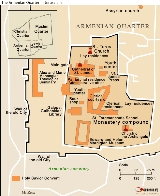
Armenian Quarter

Encyclopedia
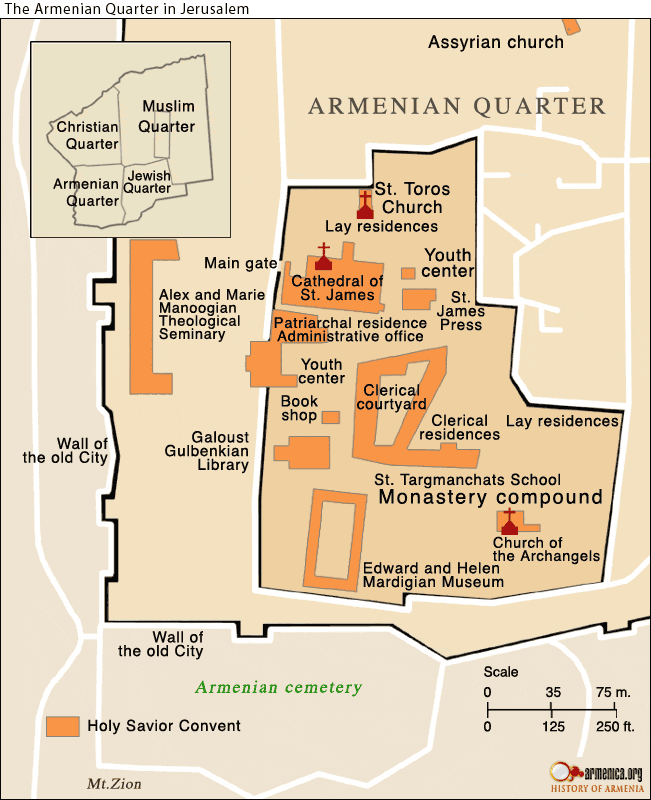
In 2001, there were about 2,500 Armenian
Armenians
Armenian people or Armenians are a nation and ethnic group native to the Armenian Highland.The largest concentration is in Armenia having a nearly-homogeneous population with 97.9% or 3,145,354 being ethnic Armenian....
s living in Jerusalem, most of them living in and around the Patriarchate
Armenian Patriarchate of Jerusalem
The Armenian Patriarchate of Jerusalem also known as the Armenian Patriarchate of St. James is located in the Armenian Quarter of Jerusalem. The Armenian Patriarch of Jerusalem remains under the authority of the Catholicos of Armenia and of all Armenians of the Armenian Apostolic Church...
at the St. James Monastery, which occupies most of the Armenian Quarter.
Establishment of the Armenian community in Jerusalem: 95 BC–AD 640
ArmeniansArmenians
Armenian people or Armenians are a nation and ethnic group native to the Armenian Highland.The largest concentration is in Armenia having a nearly-homogeneous population with 97.9% or 3,145,354 being ethnic Armenian....
have inhabited parts of modern Turkey
Turkey
Turkey , known officially as the Republic of Turkey , is a Eurasian country located in Western Asia and in East Thrace in Southeastern Europe...
, Iran
Iran
Iran , officially the Islamic Republic of Iran , is a country in Southern and Western Asia. The name "Iran" has been in use natively since the Sassanian era and came into use internationally in 1935, before which the country was known to the Western world as Persia...
and the Caucasus Mountains
Caucasus Mountains
The Caucasus Mountains is a mountain system in Eurasia between the Black Sea and the Caspian Sea in the Caucasus region .The Caucasus Mountains includes:* the Greater Caucasus Mountain Range and* the Lesser Caucasus Mountains....
for more than four thousand years. The first known instance of an Armenian to come anywhere near Jerusalem arrived in 95 BC under King Tigranes II of Armenia
Armenia
Armenia , officially the Republic of Armenia , is a landlocked mountainous country in the Caucasus region of Eurasia...
. The Armenian armies traveled to several cities in Judea
Judea
Judea or Judæa was the name of the mountainous southern part of the historic Land of Israel from the 8th century BCE to the 2nd century CE, when Roman Judea was renamed Syria Palaestina following the Jewish Bar Kokhba revolt.-Etymology:The...
before leaving Israel
Israel
The State of Israel is a parliamentary republic located in the Middle East, along the eastern shore of the Mediterranean Sea...
. It was at this time that Jews may have come to trade with Armenia
Armenia
Armenia , officially the Republic of Armenia , is a landlocked mountainous country in the Caucasus region of Eurasia...
and settle in that far away land when likewise some Armenians came to know of the lands around Jerusalem and may have traded with Israel
Israel
The State of Israel is a parliamentary republic located in the Middle East, along the eastern shore of the Mediterranean Sea...
. Following the destruction of Jerusalem in AD 70 the Romans imported "Armenian traders, artisans, Legionaries and government administrators". At precisely this time Thaddeus
Saint Jude
Jude was one of the Twelve Apostles of Jesus. He is generally identified with Thaddeus, and is also variously called Jude of James, Jude Thaddaeus, Judas Thaddaeus or Lebbaeus...
and Bartholomew
Bartholomew
Bartholomew was one of the Twelve Apostles of Jesus, and is usually identified as Nathaniel . He was introduced to Christ through St. Philip, another of the twelve apostles as per , where the name Nathaniel first appears. He is also mentioned as “Nathaniel of Cana in Galilee” in...
, both Christian
Christian
A Christian is a person who adheres to Christianity, an Abrahamic, monotheistic religion based on the life and teachings of Jesus of Nazareth as recorded in the Canonical gospels and the letters of the New Testament...
apostles, arrived in Armenia
Armenia
Armenia , officially the Republic of Armenia , is a landlocked mountainous country in the Caucasus region of Eurasia...
to preach to the Armenians and the small Jewish community there. Subsequently Christianity
Christianity
Christianity is a monotheistic religion based on the life and teachings of Jesus as presented in canonical gospels and other New Testament writings...
spread to the higher echelons of Armenian royalty
Royal family
A royal family is the extended family of a king or queen regnant. The term imperial family appropriately describes the extended family of an emperor or empress, while the terms "ducal family", "grand ducal family" or "princely family" are more appropriate to describe the relatives of a reigning...
. In AD 301, Armenia was proclaimed a "Christian state" under its King Terdat III, the first Christian country historically. During this period it is believed Armenian pilgrims
Pilgrims
Pilgrims , or Pilgrim Fathers , is a name commonly applied to early settlers of the Plymouth Colony in present-day Plymouth, Massachusetts, United States...
were already making their way to and from Jerusalem on pilgrimages. Armenian folk history
History of Armenia
Armenia lies in the highlands surrounding the Biblical mountains of Ararat. The original Armenian name for the country was Hayk, later Hayastan , translated as the land of Haik, and consisting of the name Haik and the suffix '-stan' ....
also tells that already a small "upper room" of a house on Mount Zion
Mount Zion
Mount Zion is a place name for a site in Jerusalem, the location of which has shifted several times in history. According to the Hebrew Bible's Book of Samuel, it was the site of the Jebusite fortress called the "stronghold of Zion" that was conquered by King David, becoming his palace in the City...
was being used as a church, thus the later Armenian claim to a quarter near Mount Zion
Mount Zion
Mount Zion is a place name for a site in Jerusalem, the location of which has shifted several times in history. According to the Hebrew Bible's Book of Samuel, it was the site of the Jebusite fortress called the "stronghold of Zion" that was conquered by King David, becoming his palace in the City...
where the St. James Cathedral
Cathedral of St. James, Jerusalem
The Cathedral of St. James is a 12th century Armenian church in the Armenian Quarter of Jerusalem, near the quarter's entry gate. The cathedral is dedicated to Christian Saints: James the Greater and James the Less .- External links :...
would later be built.
The Edict of Milan
Edict of Milan
The Edict of Milan was a letter signed by emperors Constantine I and Licinius that proclaimed religious toleration in the Roman Empire...
in AD 313 made Christianity
Christianity
Christianity is a monotheistic religion based on the life and teachings of Jesus as presented in canonical gospels and other New Testament writings...
an acceptable religion in the Roman Empire
Roman Empire
The Roman Empire was the post-Republican period of the ancient Roman civilization, characterised by an autocratic form of government and large territorial holdings in Europe and around the Mediterranean....
. From this time forward it became easier for Armenian Christian
Christian
A Christian is a person who adheres to Christianity, an Abrahamic, monotheistic religion based on the life and teachings of Jesus of Nazareth as recorded in the Canonical gospels and the letters of the New Testament...
s to settle and build homes in Jerusalem. Empress Helena came to the Holy land in AD 326 and began to excavate holy sites, including Golgotha, The Nativity in Bethlehem
Bethlehem
Bethlehem is a Palestinian city in the central West Bank of the Jordan River, near Israel and approximately south of Jerusalem, with a population of about 30,000 people. It is the capital of the Bethlehem Governorate of the Palestinian National Authority and a hub of Palestinian culture and tourism...
and the birthplace of Mary. At this time the Church of the Holy Sepulchre
Church of the Holy Sepulchre
The Church of the Holy Sepulchre, also called the Church of the Resurrection by Eastern Christians, is a church within the walled Old City of Jerusalem. It is a few steps away from the Muristan....
was built. Between the fourth and eighth centuries Armenians built as many as seventy monasteries throughout the Holy Land
Holy Land
The Holy Land is a term which in Judaism refers to the Kingdom of Israel as defined in the Tanakh. For Jews, the Land's identifiction of being Holy is defined in Judaism by its differentiation from other lands by virtue of the practice of Judaism often possible only in the Land of Israel...
, although how many of them might have been in Jerusalem is open to debate. By the 6th century AD Armenian Bishop
Bishop
A bishop is an ordained or consecrated member of the Christian clergy who is generally entrusted with a position of authority and oversight. Within the Catholic Church, Eastern Orthodox, Oriental Orthodox Churches, in the Assyrian Church of the East, in the Independent Catholic Churches, and in the...
s were located in Jerusalem around what they called "Mount Zion", indicating that a substantial Armenian community existed in the city and that the community was settling continuously in a particular area.
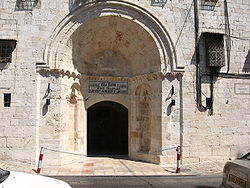
Armenian alphabet
The Armenian alphabet is an alphabet that has been used to write the Armenian language since the year 405 or 406. It was devised by Saint Mesrop Mashtots, an Armenian linguist and ecclesiastical leader, and contained originally 36 letters. Two more letters, օ and ֆ, were added in the Middle Ages...
in 405 certainly helped the Armenian community by allowing them to keep records in their native language. This alphabet has helped spawn the more than four thousand ancient manuscripts kept by the Armenians in the St. Toros Church
St. Toros Church
St. Toros Church is an Armenian church in the Armenian Quarter of Jerusalem, Israel. It is located next to the St. James Cathedral. More than 4 thousand ancient manuscripts kept by Armenians remain at St. Toros church.- References :...
next to the St. James Cathedral
Cathedral of St. James, Jerusalem
The Cathedral of St. James is a 12th century Armenian church in the Armenian Quarter of Jerusalem, near the quarter's entry gate. The cathedral is dedicated to Christian Saints: James the Greater and James the Less .- External links :...
. In the 19th century when breaking ground for the Russian
Russian Orthodox Church
The Russian Orthodox Church or, alternatively, the Moscow Patriarchate The ROC is often said to be the largest of the Eastern Orthodox churches in the world; including all the autocephalous churches under its umbrella, its adherents number over 150 million worldwide—about half of the 300 million...
monastery on the Mount of Olives
Mount of Olives
The Mount of Olives is a mountain ridge in East Jerusalem with three peaks running from north to south. The highest, at-Tur, rises to 818 meters . It is named for the olive groves that once covered its slopes...
, six mosaic
Mosaic
Mosaic is the art of creating images with an assemblage of small pieces of colored glass, stone, or other materials. It may be a technique of decorative art, an aspect of interior decoration, or of cultural and spiritual significance as in a cathedral...
floors were uncovered to reveal Armenian writing, once again testifying to the presence of Armenians in and around Jerusalem from that period. A similar mosaic was uncovered in the Musrara
Musrara, Jerusalem
Musrara also known by its Hebrew name, Morasha is a neighborhood in Jerusalem. It is bordered by Meah Shearim and Beit Yisrael on the north, the Old City on the south and east, and the Russian Compound and Kikar Safra to the west.-History:...
neighborhood (200 meters from the Damascus Gate
Damascus Gate
Damascus Gate is the main entrance to the Old City of Jerusalem. It is located in the wall on the city's northwest side where the highway leads out to Nablus, and from there, in times past, to the capital of Syria, Damascus; as such, its modern English name is Damascus Gate, and its modern Hebrew...
) and was purchased by the Armenian patriarchate in 1912.
One of the central reasons for the existence of an Armenian quarter is the religion and ethnicity of the Armenians. Armenians, unlike the majority of Christians in Israel
Israel
The State of Israel is a parliamentary republic located in the Middle East, along the eastern shore of the Mediterranean Sea...
, are not Arab
Arab
Arab people, also known as Arabs , are a panethnicity primarily living in the Arab world, which is located in Western Asia and North Africa. They are identified as such on one or more of genealogical, linguistic, or cultural grounds, with tribal affiliations, and intra-tribal relationships playing...
, rather they are ethnically and religiously Armenian. They have remained a homogeneous group, intermarrying over the years and keeping their culture intact.
The reason for the development of a separate Armenian Church
Armenian Apostolic Church
The Armenian Apostolic Church is the world's oldest National Church, is part of Oriental Orthodoxy, and is one of the most ancient Christian communities. Armenia was the first country to adopt Christianity as its official religion in 301 AD, in establishing this church...
is slightly more complicated. At the time Armenia
Armenia
Armenia , officially the Republic of Armenia , is a landlocked mountainous country in the Caucasus region of Eurasia...
converted to Christianity
Christianity
Christianity is a monotheistic religion based on the life and teachings of Jesus as presented in canonical gospels and other New Testament writings...
there was only one church. However in AD 431 the Third Ecumenical Council at Ephesus split the church between Nestorians (today’s Assyrian
Assyrian Church of the East
The Assyrian Church of the East, officially the Holy Apostolic Catholic Assyrian Church of the East ʻIttā Qaddishtā w-Shlikhāitā Qattoliqi d-Madnĕkhā d-Āturāyē), is a Syriac Church historically centered in Mesopotamia. It is one of the churches that claim continuity with the historical...
and Chaldean Christians
Chaldean Christians
Chaldean Christians are ethnic Assyrian adherents of the Chaldean Catholic Church, most of whom entered communion with the Catholic Church from the Church of the East, which was already Catholic, but most wanted to stray away from the Catholic Church, causing the split in the 17th and 18th...
) and the rest of Christianity. Then in 451 the Fourth Ecumenical Council split Christianity again into Monophysites and Dyophysites. The Armenians thereby joined the Coptic
Coptic Christianity
The Coptic Orthodox Church of Alexandria is the official name for the largest Christian church in Egypt and the Middle East. The Church belongs to the Oriental Orthodox family of churches, which has been a distinct church body since the Council of Chalcedon in AD 451, when it took a different...
, Ethiopian
Ethiopia
Ethiopia , officially known as the Federal Democratic Republic of Ethiopia, is a country located in the Horn of Africa. It is the second-most populous nation in Africa, with over 82 million inhabitants, and the tenth-largest by area, occupying 1,100,000 km2...
and Syrian
Demographics of Syria
Syrians today are an overall indigenous Levantine people. While modern-day Syrians are commonly described as Arabs by virtue of their modern-day language and bonds to Arab culture and history...
churches in the Monophysite movement, whereas the Byzantine/Orthodox Church (Greek Orthodox
Church of Greece
The Church of Greece , part of the wider Greek Orthodox Church, is one of the autocephalous churches which make up the communion of Orthodox Christianity...
, Russian Orthodox etc.) became Dyophysite. It would take until 1054 for the Latin (Catholic
Catholic
The word catholic comes from the Greek phrase , meaning "on the whole," "according to the whole" or "in general", and is a combination of the Greek words meaning "about" and meaning "whole"...
) Church and the Eastern (Orthodox Church) to split (East-West Schism
East-West Schism
The East–West Schism of 1054, sometimes known as the Great Schism, formally divided the State church of the Roman Empire into Eastern and Western branches, which later became known as the Eastern Orthodox Church and the Roman Catholic Church, respectively...
), and then until the Reformation
Protestant Reformation
The Protestant Reformation was a 16th-century split within Western Christianity initiated by Martin Luther, John Calvin and other early Protestants. The efforts of the self-described "reformers", who objected to the doctrines, rituals and ecclesiastical structure of the Roman Catholic Church, led...
in the 16th century to split the Latin (Catholic
Catholic
The word catholic comes from the Greek phrase , meaning "on the whole," "according to the whole" or "in general", and is a combination of the Greek words meaning "about" and meaning "whole"...
) Church, before one could see all the factions that exist today in the old city.
Byzantine
Byzantine Empire
The Byzantine Empire was the Eastern Roman Empire during the periods of Late Antiquity and the Middle Ages, centred on the capital of Constantinople. Known simply as the Roman Empire or Romania to its inhabitants and neighbours, the Empire was the direct continuation of the Ancient Roman State...
Emperor Justinian
Justinian I
Justinian I ; , ; 483– 13 or 14 November 565), commonly known as Justinian the Great, was Byzantine Emperor from 527 to 565. During his reign, Justinian sought to revive the Empire's greatness and reconquer the lost western half of the classical Roman Empire.One of the most important figures of...
(527–565) persecuted the Monophysite
Monophysitism
Monophysitism , or Monophysiticism, is the Christological position that Jesus Christ has only one nature, his humanity being absorbed by his Deity...
churches and the Armenians found themselves speaking on behalf of the Syriac
Syriac Orthodox Church
The Syriac Orthodox Church; is an autocephalous Oriental Orthodox church based in the Eastern Mediterranean, with members spread throughout the world. The Syriac Orthodox Church claims to derive its origin from one of the first Christian communities, established in Antioch by the Apostle St....
, Coptic and Ethiopian
Ethiopian Orthodox Tewahedo Church
The Ethiopian Orthodox Tewahedo Church is the predominant Oriental Orthodox Christian church in Ethiopia. The Ethiopian Church was administratively part of the Coptic Orthodox Church until 1959, when it was granted its own Patriarch by Coptic Orthodox Pope of Alexandria and Patriarch of All...
churches, a leadership role the Armenian Patriarchate of Jerusalem
Armenian Patriarchate of Jerusalem
The Armenian Patriarchate of Jerusalem also known as the Armenian Patriarchate of St. James is located in the Armenian Quarter of Jerusalem. The Armenian Patriarch of Jerusalem remains under the authority of the Catholicos of Armenia and of all Armenians of the Armenian Apostolic Church...
still assumes. Thus from AD 451 the Armenian church became separate from the other Christian churches in Jerusalem, a fact that would have major ramifications in the ensuing struggle with fellow Christians during the Crusader
Crusades
The Crusades were a series of religious wars, blessed by the Pope and the Catholic Church with the main goal of restoring Christian access to the holy places in and near Jerusalem...
and Ottoman
Ottoman Empire
The Ottoman EmpireIt was usually referred to as the "Ottoman Empire", the "Turkish Empire", the "Ottoman Caliphate" or more commonly "Turkey" by its contemporaries...
periods.
Islamic conquest 638–1099
The Persian conquest and sacking of Jerusalem in 614 and the subsequent Islamic conquest in 638 found the Armenians under siege from their Byzantine masters and they therefore welcomed the invaders as a way to get back the Church property confiscated under Emperor Justinian, and which they had been forbidden from entering. The Armenians now became subject to the Pact of Omar and they became Dhimmis. They would pay a special poll taxPoll tax
A poll tax is a tax of a portioned, fixed amount per individual in accordance with the census . When a corvée is commuted for cash payment, in effect it becomes a poll tax...
called Jizya
Jizya
Under Islamic law, jizya or jizyah is a per capita tax levied on a section of an Islamic state's non-Muslim citizens, who meet certain criteria...
, and not be allowed to construct new Christian buildings.
The Armenians lived under different Muslim
Muslim
A Muslim, also spelled Moslem, is an adherent of Islam, a monotheistic, Abrahamic religion based on the Quran, which Muslims consider the verbatim word of God as revealed to prophet Muhammad. "Muslim" is the Arabic term for "submitter" .Muslims believe that God is one and incomparable...
dynasties between 638 and the coming of the Crusaders
First Crusade
The First Crusade was a military expedition by Western Christianity to regain the Holy Lands taken in the Muslim conquest of the Levant, ultimately resulting in the recapture of Jerusalem...
in 1099. The Umayyads based in Damascus were followed by a smooth transition to the Abbasids (750–1258) based in Baghdad
Baghdad
Baghdad is the capital of Iraq, as well as the coterminous Baghdad Governorate. The population of Baghdad in 2011 is approximately 7,216,040...
, and the subsequent more destructive and intolerant reigns of Fatimids in 969 and finally the Seljuk Turks who pillaged the city in 1071.
The Crusader Periods 1099–1187, 1229–1244
In 1009 the Fatamid ruler Al-Hakim bi-Amr AllahAl-Hakim bi-Amr Allah
Abu ‘Ali Mansur Tāriqu l-Ḥākim, called Al-Hakim bi Amr al-Lāh , was the sixth Fatimid caliph and 16th Ismaili imam .- History :...
demolished the Church of the Holy Sepulchre, an act that would help spark the Crusades. Pope Urban II
Pope Urban II
Pope Urban II , born Otho de Lagery , was Pope from 12 March 1088 until his death on July 29 1099...
called on Christians throughout Europe
Europe
Europe is, by convention, one of the world's seven continents. Comprising the westernmost peninsula of Eurasia, Europe is generally 'divided' from Asia to its east by the watershed divides of the Ural and Caucasus Mountains, the Ural River, the Caspian and Black Seas, and the waterways connecting...
to unite and drive out the Seljuks, who had been harassing and suppressing Christians trying to live in, and make pilgrimages to, the Holy Land. The Pope's call was taken up and the heavily armed crusaders set off across Europe, through the Balkans
Balkans
The Balkans is a geopolitical and cultural region of southeastern Europe...
, past the Byzantine Empire and even wandered in sight of the Armenian Kingdom of Cilicia
Armenian Kingdom of Cilicia
The Armenian Kingdom of Cilicia , also known as the Cilician Armenia, Kingdom of Cilician Armenia or New Armenia, was an independent principality formed during the High Middle Ages by Armenian refugees fleeing the Seljuk invasion of Armenia...
on their way to Jerusalem. Although the Catholic crusaders did not eliminate their co-religionists they brought a mandate that Jerusalem would be "Latin". The Armenians at this time had acquired much of the land in today’s Armenian quarter and by 1165 had finished constructing St. James Cathedral which became the most important building of the quarter and remains so today. It was about this same time that the Church of the Holy Sepulcher was given its modern shape.
The Armenian Quarter itself, centered around St. James, also included housing and one holy Christian site, the prison of Jesus. Only the southern part of the area described as the Armenian Quarter today was actually inhabited by Armenians at this time. During this time the Quarter became dominated by non-Armenian churches including the Church of St. Thomas in the southern area, a Greek Church in the north part of the quarter, the Church of St. James Intercisus in the extreme north near David’s Street and the Church of St. Mark bordering today’s Jewish Quarter. As yet another testament to the steadfastness of the Armenian community is that the only church still remaining in the hands of the same owners from this time is the complex of St. James Cathedral. The majority of the other churches from the Crusader period have become mosques, houses or been turned over to other Christian orders. At the same time the Armenians came to possess for a short time the Church of the Nativity
Church of the Nativity
The Church of the Nativity in Bethlehem is one of the oldest continuously operating churches in the world. The structure is built over the cave that tradition marks as the birthplace of Jesus of Nazareth, and thus it is considered sacred by Christians...
in Bethlehem
Bethlehem
Bethlehem is a Palestinian city in the central West Bank of the Jordan River, near Israel and approximately south of Jerusalem, with a population of about 30,000 people. It is the capital of the Bethlehem Governorate of the Palestinian National Authority and a hub of Palestinian culture and tourism...
, leaving the Patriarch Abraham IV’s (in office 1205–1218) name carved on the front door of the church.
One must remark that the Armenians proved themselves more welcome in Jerusalem due to their not being belligerents in the wars against the Muslim powers of the day. The Crusades had been a Catholic affair. Likewise the continuing war against the Orthodox power of Byzantium and the inheritor of that power, the Russians
Russians
The Russian people are an East Slavic ethnic group native to Russia, speaking the Russian language and primarily living in Russia and neighboring countries....
, meant that Muslims were suspicious of the Catholic and Orthodox interests in Jerusalem. However, Armenia had long ceased to be independent, so though a million or more Armenians lived in eastern Asia Minor
Asia Minor
Asia Minor is a geographical location at the westernmost protrusion of Asia, also called Anatolia, and corresponds to the western two thirds of the Asian part of Turkey...
(modern Turkey) they posed no political military challenge to the Muslim Mamluks or Ottomans.
Mamluk period 1260–1517
The coming of the Slave Army of the Mamluks in 1260, replacing the short lived late Muslim Ayyubid rulers (1244–1260) had little effect on the Armenians but great effect on the other Christian communities, many of whom were viewed as being part of the Crusader mentality. The Armenian Patriarch Sarkis I(1281–1313) met the Mamluke governor and subsequently returned to his community in Jerusalem, hoping to usher in a period of peace for his people after the convulsions of the crusades. The community at this time had a significant community in EgyptEgypt
Egypt , officially the Arab Republic of Egypt, Arabic: , is a country mainly in North Africa, with the Sinai Peninsula forming a land bridge in Southwest Asia. Egypt is thus a transcontinental country, and a major power in Africa, the Mediterranean Basin, the Middle East and the Muslim world...
and it happened that Patriarch
Patriarch
Originally a patriarch was a man who exercised autocratic authority as a pater familias over an extended family. The system of such rule of families by senior males is called patriarchy. This is a Greek word, a compound of πατριά , "lineage, descent", esp...
s would travel to Cairo
Cairo
Cairo , is the capital of Egypt and the largest city in the Arab world and Africa, and the 16th largest metropolitan area in the world. Nicknamed "The City of a Thousand Minarets" for its preponderance of Islamic architecture, Cairo has long been a centre of the region's political and cultural life...
from time to time to meet with the Mamluke rulers and their constituents. The result of these contacts can be inferred by the fact that in the 1340s the Armenians were permitted to build a wall around their quarter. This was a significant sign that the Mamluke rulers felt the quarter did not pose a threat, since the tearing down of walls had been a staple of Mamluke governance as a way to ensure the crusaders did not return. The Mamluke government also engraved the following declaration in Arabic on the western entrance to the quarter:
- The order of our master Sultan Jaqmaq which stipulates that the taxes levied recently by the town governor regarding the payment by the Armenian enclosure be cancelled and it has been requested that this cancellation be recorded in the Honored Books in the year 854 of the HijraHijri yearThe Hijri year is year numbering system used in the Islamic calendar. It commemorates the Hijra , or emigration of Muhammad and his followers to the city of Medina in 622 CE. In Arabic, AH is symbolized by the letter هـ...
(1451). Anyone who renews the payment or again takes any tax of extortionExtortionExtortion is a criminal offence which occurs when a person unlawfully obtains either money, property or services from a person, entity, or institution, through coercion. Refraining from doing harm is sometimes euphemistically called protection. Extortion is commonly practiced by organized crime...
is damned, son of the damned, and the curse of AllahAllahAllah is a word for God used in the context of Islam. In Arabic, the word means simply "God". It is used primarily by Muslims and Bahá'ís, and often, albeit not exclusively, used by Arabic-speaking Eastern Catholic Christians, Maltese Roman Catholics, Eastern Orthodox Christians, Mizrahi Jews and...
will be upon him.
The Armenian quarter in this period kept creating "facts on the ground
Facts on the ground
Facts on the ground is a diplomatic term that means the situation in reality as opposed to in the abstract. It originated in discussions of the Israeli–Palestinian conflict, where it was used to refer to Israeli settlements built in the occupied West Bank, which were intended to establish permanent...
" by the constant small expansions and solidifications. In the 1380s Patriarch Krikor IV built a priests' dining room across from the St. James Cathedral. Around 1415 the olive grove
Olive
The olive , Olea europaea), is a species of a small tree in the family Oleaceae, native to the coastal areas of the eastern Mediterranean Basin as well as northern Iran at the south end of the Caspian Sea.Its fruit, also called the olive, is of major agricultural importance in the...
near the Garden of Gethsemane was purchased. But all was not achievements, for in 1439 Armenians were removed from the Golgotha chapel, but the Patriarch Mardiros I(1412–1450) purchased the "opposite area" and named it second Golgotha; this remains in the Patriarch's possession to this day. In the same period, in 1311 the first Armenian Patriarch was appointed. This Patriarch augmented the other Armenian Patriarch in Armenia and together with the two Supreme Patriarchs (one for Lebanon
Lebanon
Lebanon , officially the Republic of LebanonRepublic of Lebanon is the most common term used by Lebanese government agencies. The term Lebanese Republic, a literal translation of the official Arabic and French names that is not used in today's world. Arabic is the most common language spoken among...
/Cyprus
Cyprus
Cyprus , officially the Republic of Cyprus , is a Eurasian island country, member of the European Union, in the Eastern Mediterranean, east of Greece, south of Turkey, west of Syria and north of Egypt. It is the third largest island in the Mediterranean Sea.The earliest known human activity on the...
/Syria
Syria
Syria , officially the Syrian Arab Republic , is a country in Western Asia, bordering Lebanon and the Mediterranean Sea to the West, Turkey to the north, Iraq to the east, Jordan to the south, and Israel to the southwest....
and one for Armenia/Jerusalem and everywhere else) made up the highest officials in the church.
Ottoman period 1517–1917
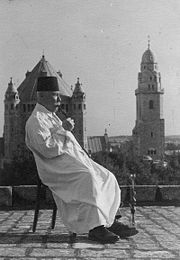
The most important aspect during this time was the increase in the Armenian demographics of their quarter and the struggle for control of the holy sites. Ottoman Jizya or tax records for 1562 and 1690 are the most accurate because they are confirmed to have actually been updated in those years to reflect the actual people living in Jerusalem, rather than passed down from former tax records. Further work was done on the records, since they originally only contained the numbers of non-Muslim adult men who were not registered as full time "religious" people, which is to say monk
Monk
A monk is a person who practices religious asceticism, living either alone or with any number of monks, while always maintaining some degree of physical separation from those not sharing the same purpose...
s and priest
Priest
A priest is a person authorized to perform the sacred rites of a religion, especially as a mediatory agent between humans and deities. They also have the authority or power to administer religious rites; in particular, rites of sacrifice to, and propitiation of, a deity or deities...
s. In the 1562–63 record only 189 Armenians are counted, whereas 640 are counted in 1690, an increase of 239%. Some have attributed this demographic ballooning to a "process of urbanization
Urbanization
Urbanization, urbanisation or urban drift is the physical growth of urban areas as a result of global change. The United Nations projected that half of the world's population would live in urban areas at the end of 2008....
" experienced by the Armenians and other Christians in particular. Thus Armenians came to make up 22.9% of Jerusalem's Christians by 1690, becoming the second largest Christian community.
Armenians were overwhelmingly engaged in the occupation of craftmaking at this time, with smaller numbers engaged in trade and services. One must recall that the Armenians who were engaged in religious activities exclusively are not recorded in these records of occupation since they were exempted for reasons of being completely pious in nature. When one examines the actual tax rates of the Armenians we find that they made up the highest numbers of those in the "medium" tax bracket while their rivals for control of some of the holy sites made up the "lower" tax bracket. This financial situation, heavily buttressed by Armenians' donations from their home country, certainly contributed to the communities demographic and financial clout in the old city. This is certainly yet another reason that the community was able to expand and control an entire quarter of the city. The other myriad Christian communities at this time were meanwhile living in their historic areas around the Church of the Holy Sepulchre.
Outside the Armenian quarter and its residential neighborhood and imposing St. James cathedral, the Armenians vied for control of the Church of the Holy Sepulchre. Armenians are described as the "second most important shareholder" of the Church, the Greek Orthodox
Church of Greece
The Church of Greece , part of the wider Greek Orthodox Church, is one of the autocephalous churches which make up the communion of Orthodox Christianity...
being the most important. The Armenians controlled the Chapel of Parting of the Raiment, Chapel of Saint Helena
Chapel of Saint Helena, Jerusalem
The Chapel of Saint Helena is a 12th century Armenian church in the lower level of the Church of the Holy Sepulcher in Jerusalem.In the south east of the chapel there is a chair which was reputed to be a seat that was sat in by Saint Helena, the mother of the Emperor Constantine when she was...
, the Chapel of St. John and the Chapel of the Three Marys, as well as the second floor above the main entrance. The Church itself then was divided between the Greek Orthodox, the Armenians and the Franciscan
Franciscan
Most Franciscans are members of Roman Catholic religious orders founded by Saint Francis of Assisi. Besides Roman Catholic communities, there are also Old Catholic, Anglican, Lutheran, ecumenical and Non-denominational Franciscan communities....
s (Catholic) sects of Christianity.
Following the Peace of Karlowitz in 1699 the Ottoman Empire devolved into the "sick man of Europe
Sick man of Europe
"Sick man of Europe" is a nickname that has been used to describe a European country experiencing a time of economic difficulty and/or impoverishment...
" and "the question of the Holy Sites started transforming from an internal Ottoman problem, to an external diplomatic one". This was to prove a major disadvantage since Western Armenia had been gobbled up by the Ottomans and then in 1828, the Eastern half was swept into the Russia
Russia
Russia or , officially known as both Russia and the Russian Federation , is a country in northern Eurasia. It is a federal semi-presidential republic, comprising 83 federal subjects...
n empire. Whereas most of the other Churches had patron nations, such as France
France
The French Republic , The French Republic , The French Republic , (commonly known as France , is a unitary semi-presidential republic in Western Europe with several overseas territories and islands located on other continents and in the Indian, Pacific, and Atlantic oceans. Metropolitan France...
for the Catholics and Russia for the Orthodox, the Armenians now found themselves alone among Christian giants. The subsequent decline during this period of the Egyptian Coptic and Ethiopia
Ethiopia
Ethiopia , officially known as the Federal Democratic Republic of Ethiopia, is a country located in the Horn of Africa. It is the second-most populous nation in Africa, with over 82 million inhabitants, and the tenth-largest by area, occupying 1,100,000 km2...
n church holdings in the city were also part of this sequence of events that deprived the Monophysite churches of powerful nation-state backers.
Despite the setbacks, the Armenians hung on, tenuously and doggedly, to their quarter. The treatment of Christians in Jerusalem was not always good and certainly was not always respectful. For instance, there were many complaints surrounding the "inspections" whereby Ottoman "officials" would come into the Holy sites, particularly the Holy Sepulchre, and say "You have added to your churches and monasteries. In these (places) or adjacent to them are mosques. Therefore pay us large sums of money, or else we will carry out inspections and report you."
These were no idle threats, for various Churches and synagogues were seized after parts of them had collapsed or been damaged and the "masses" would riot
Riot
A riot is a form of civil disorder characterized often by what is thought of as disorganized groups lashing out in a sudden and intense rash of violence against authority, property or people. While individuals may attempt to lead or control a riot, riots are thought to be typically chaotic and...
claiming that the non-Muslims were building "new" sites. It was likewise common practice for Muslims to "find" holy sites near non-Muslim buildings and to build mosques as close as possible to them. Later the Muslims would conveniently claim that the Church was encroaching on the mosque. Nevertheless, although Armenian church holdings may have suffered this degradation, the Armenian quarter remained largely unencumbered by the marginalization of non-Muslim Jerusalem, more than likely owing to the Armenian farsightedness in self-containing their quarter as much as possible, so that outsiders were not able to claim suddenly that they required a Mosque in that area. While the Church of the Nativity
Church of the Nativity
The Church of the Nativity in Bethlehem is one of the oldest continuously operating churches in the world. The structure is built over the cave that tradition marks as the birthplace of Jesus of Nazareth, and thus it is considered sacred by Christians...
was forced at this time to house Muslim travelers due to the Pact of Omar, the Armenians retreated inside their quarter, safe to most extents from the harassment and daily travails of not being the master of one's own land.
The Armenian Patriarchate itself became politicized at this time by struggles within the Armenian church. Suffice it to say that the Armenian Patriarchate, due to its proximity to the Holy places and isolation from the main Armenian population, played an important role in the schism that began to affect the Armenian leaderships in Constantinople
Constantinople
Constantinople was the capital of the Roman, Eastern Roman, Byzantine, Latin, and Ottoman Empires. Throughout most of the Middle Ages, Constantinople was Europe's largest and wealthiest city.-Names:...
and Etchmiaddzin (seat of the Armenian church). Significantly Bishop Eghiazar, assumed the Armenian Patriarchate of Jerusalem
Armenian Patriarchate of Jerusalem
The Armenian Patriarchate of Jerusalem also known as the Armenian Patriarchate of St. James is located in the Armenian Quarter of Jerusalem. The Armenian Patriarch of Jerusalem remains under the authority of the Catholicos of Armenia and of all Armenians of the Armenian Apostolic Church...
and in 1644 declared himself "Catholicos" ("Leader") of all the Armenian church. These types of struggles within the church hierarchy diminished the amount of the time the Church could spend on similar struggles with the Greek Orthodox and the Holy Sites.
Struggles over the holy sites
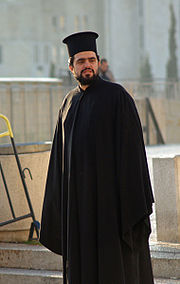
As time wore on and the Ottoman Empire weakened, the issues facing the Armenians of Jerusalem remained mostly unchanged. One of their concerns regarded the pilgrim
Pilgrim
A pilgrim is a traveler who is on a journey to a holy place. Typically, this is a physical journeying to some place of special significance to the adherent of a particular religious belief system...
s coming and going from Jerusalem. The same waqf
Waqf
A waqf also spelled wakf formally known as wakf-alal-aulad is an inalienable religious endowment in Islamic law, typically denoting a building or plot of land for Muslim religious or charitable purposes. The donated assets are held by a charitable trust...
that today administers the Muslim holy sites was in charge of taxing the Christians during the Ottoman period. Because the Christian buildings could not be enlarged, and the abuse of the pilgrims by "fake" tax officials, the pilgrimage numbers declined. With this decline the Ottomans began to lose money and the waqf began to lose money. Subsequently the Christians explained that in return for being allowed to modify and enlarge their buildings the pilgrims might be encouraged to return.
Thus in the 17th century the Armenians were allowed after much pleading to enlarge the St. James Monastery. At the same time the Armenian Patriarch Hovhannes VII purchased a "large parcel" of land south of the St. James cathedral called “Cham Tagh”. One interesting issue regarding the Armenian residential areas in their quarter was that upon purchasing houses they traditionally would tear them down and then rebuild them. This was due to a Muslim custom that allowed a Muslim to redeem a sold possession within three generations. Thus Armenians had found out that property bought in the 7th century was redeemed in the 8th by the seller's descendants. To circumvent the tradition the original dwelling was demolished and replaced, voiding the descendants' claim to the property. By 1752 the Hagop Nalian was busy renovating the entire quarter, and in 1828 further renovations took place after an earthquake
Earthquake
An earthquake is the result of a sudden release of energy in the Earth's crust that creates seismic waves. The seismicity, seismism or seismic activity of an area refers to the frequency, type and size of earthquakes experienced over a period of time...
. In 1850 the Seminary complex at the south end of the St. James convent was completed.
Other changes to the Quarter in this period included the walls of Suleiman the Magnificent
Suleiman the Magnificent
Suleiman I was the tenth and longest-reigning Sultan of the Ottoman Empire, from 1520 to his death in 1566. He is known in the West as Suleiman the Magnificent and in the East, as "The Lawgiver" , for his complete reconstruction of the Ottoman legal system...
finished in 1527. These walls, along with the internal walls built by the Armenians, came to determine the outline of the quarter. The Ottoman period created what is known as the "status quo" for Jerusalem. This idea meant that certain statuses for the Holy Sites would be kept and were recognized as being permanent or at least the way things should be. The City was divided into four quarters. The Temple Mount
Temple Mount
The Temple Mount, known in Hebrew as , and in Arabic as the Haram Ash-Sharif , is one of the most important religious sites in the Old City of Jerusalem. It has been used as a religious site for thousands of years...
became a Muslim
Muslim
A Muslim, also spelled Moslem, is an adherent of Islam, a monotheistic, Abrahamic religion based on the Quran, which Muslims consider the verbatim word of God as revealed to prophet Muhammad. "Muslim" is the Arabic term for "submitter" .Muslims believe that God is one and incomparable...
holy place, and the Church of the Holy Sepulchre
Church of the Holy Sepulchre
The Church of the Holy Sepulchre, also called the Church of the Resurrection by Eastern Christians, is a church within the walled Old City of Jerusalem. It is a few steps away from the Muristan....
as well as other various Christian
Christian
A Christian is a person who adheres to Christianity, an Abrahamic, monotheistic religion based on the life and teachings of Jesus of Nazareth as recorded in the Canonical gospels and the letters of the New Testament...
sites were recognized as belonging to the Christian world. Despite the arguments over who would control what aspects of these sites, the status quo has remained largely intact from the 17th century to the present. Although claims that this status quo was being violated led to vicious rioting in 1929, it has not been changed, and the quarters and areas remain roughly as they have been inside Suleiman's walls.
In the beginning of 1831 Jerusalem’s 9,000 residents celebrated the coming of Mohammad Ali
Muhammad Ali of Egypt
Muhammad Ali Pasha al-Mas'ud ibn Agha was a commander in the Ottoman army, who became Wāli, and self-declared Khedive of Egypt and Sudan...
and his Egyptian army. The Armenian community, reduced along with the rest of Jerusalem due to the poverty and neglect of the Ottomans also celebrated. Numerous sources mention the individual nature of the Armenian quarter in this period, its “distinct ethnic with its particular language and culture, intent on retaining its separate identity and unity, minimizing the contacts with Arab
Arab
Arab people, also known as Arabs , are a panethnicity primarily living in the Arab world, which is located in Western Asia and North Africa. They are identified as such on one or more of genealogical, linguistic, or cultural grounds, with tribal affiliations, and intra-tribal relationships playing...
s and the Ottoman authorities.”
Armenians embraced the modern era with high hopes. As the Armenian diaspora
Armenian diaspora
The Armenian diaspora refers to the Armenian communities outside the Republic of Armenia and self proclaimed de facto independent Nagorno-Karabakh Republic...
spread throughout Europe and America many came into wealth once again. Their status as craftsmen and traders and their dispersal allowed them to excel in international trade and business. Thus the oil man Calouste Gulbenkian
Calouste Gulbenkian
Calouste Sarkis Gulbenkian was an Armenian businessman and philanthropist. He played a major role in making the petroleum reserves of the Middle East available to Western development...
, known as "Mr. 5 Percent" for his dealings, came to endow the Gulbenkian Library in the Armenian quarter, today holding one of the great collection of ancient Armenian manuscripts including endless copies of the various Firmens, Ottoman edicts that granted the quarter protection and rights under Muslim rule. In 1833 the Armenians established the city’s first printing press
Printing press
A printing press is a device for applying pressure to an inked surface resting upon a print medium , thereby transferring the ink...
and opened a theological seminary in 1843. In 1866 the Armenians had inaugurated the first photographic studio
Photography
Photography is the art, science and practice of creating durable images by recording light or other electromagnetic radiation, either electronically by means of an image sensor or chemically by means of a light-sensitive material such as photographic film...
and their first newspaper
Newspaper
A newspaper is a scheduled publication containing news of current events, informative articles, diverse features and advertising. It usually is printed on relatively inexpensive, low-grade paper such as newsprint. By 2007, there were 6580 daily newspapers in the world selling 395 million copies a...
in Jerusalem. In 1908 the Armenian community built two large buildings on the north-western side of the Old City along Jaffa Street. Armenians themselves began to brave life outside the walls, but one young husband petitioned the Patriarch, complaining “It is impossible for me to
With the outbreak of World War I
World War I
World War I , which was predominantly called the World War or the Great War from its occurrence until 1939, and the First World War or World War I thereafter, was a major war centred in Europe that began on 28 July 1914 and lasted until 11 November 1918...
, the Armenians found themselves cut off from their sources of support among the western powers. In 1915, using the excuse that the Armenians were allied with the Russians, the Young Turks
Young Turks
The Young Turks , from French: Les Jeunes Turcs) were a coalition of various groups favouring reformation of the administration of the Ottoman Empire. The movement was against the absolute monarchy of the Ottoman Sultan and favoured a re-installation of the short-lived Kanûn-ı Esâsî constitution...
ordered all Armenians expelled from Armenia in north eastern Turkey, which was used as a pretext in the Armenian Genocide
Armenian Genocide
The Armenian Genocide—also known as the Armenian Holocaust, the Armenian Massacres and, by Armenians, as the Great Crime—refers to the deliberate and systematic destruction of the Armenian population of the Ottoman Empire during and just after World War I...
. The Soviets
Soviet Union
The Soviet Union , officially the Union of Soviet Socialist Republics , was a constitutionally socialist state that existed in Eurasia between 1922 and 1991....
meanwhile marched into the newly formed Democratic Republic of Armenia
Democratic Republic of Armenia
The Democratic Republic of Armenia was the first modern establishment of an Armenian state...
and annexed it as a Soviet Socialist Republic. Armenians may have been influential in the communist movement, among them Anastas Mikoyan
Anastas Mikoyan
Anastas Ivanovich Mikoyan was an Armenian Old Bolshevik and Soviet statesman during the rules of Vladimir Lenin, Joseph Stalin, Nikita Khrushchev, and Leonid Brezhnev....
, but these atheistic types would prove no help to pious Armenians of Jerusalem. Thus the Patriarch in Jerusalem seemed orphaned, a church without a homeland. Then one day towards the end of Hanukkah
Hanukkah
Hanukkah , also known as the Festival of Lights, is an eight-day Jewish holiday commemorating the rededication of the Holy Temple in Jerusalem at the time of the Maccabean Revolt of the 2nd century BCE...
, in December 1917 the Union Flag
Union Flag
The Union Flag, also known as the Union Jack, is the flag of the United Kingdom. It retains an official or semi-official status in some Commonwealth Realms; for example, it is known as the Royal Union Flag in Canada. It is also used as an official flag in some of the smaller British overseas...
was run up outside the old city, as the Turks fled the British and General Allenby entered the city. For the first time in almost 800 years a Christian power had returned to the Holy Land. Unfortunately for the Armenians it was not to last, and it was to be another 80 years before an independent Armenia would play a role in the church again.
British Mandate period 1917–1948
The British authorities, with their years of colonial experience, were quick to embrace the Status Quo, despite the Balfour Declaration declaring the need for the creation of a Jewish Homeland. The British looked to the Status Quo of 1852 for guidance, keeping the four quarters of the Old City while at the same time allowing a major building program outside the city walls.By the 1920s, most of the Armenian quarter had “European style gable roofs” as opposed to the domes preferred in the Muslim quarter. In 1922 Armenians made up 8% of Jerusalem’s Christians, bringing their total number to about 2,480 people. It is also noted that non-Armenians found comfort in the protection of the walled Armenian "compound". Though events moved at a fast pace outside the city and the dark clouds of World War Two
World War II
World War II, or the Second World War , was a global conflict lasting from 1939 to 1945, involving most of the world's nations—including all of the great powers—eventually forming two opposing military alliances: the Allies and the Axis...
gathered and were then cleared away, the Armenian quarter changed little in this period. The destruction brought by the Armenian Genocide
Armenian Genocide
The Armenian Genocide—also known as the Armenian Holocaust, the Armenian Massacres and, by Armenians, as the Great Crime—refers to the deliberate and systematic destruction of the Armenian population of the Ottoman Empire during and just after World War I...
left the Patriarchate with financial backing to be found mostly in the wealthy American diaspora community. During this time the quarter was renovated, but the various Christian communities could not come to an agreement on the renovations at the Church of the Holy Sepulchre.
1948 Arab-Israeli War
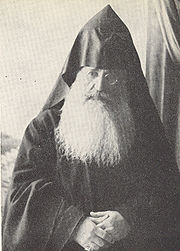
United Kingdom
The United Kingdom of Great Britain and Northern IrelandIn the United Kingdom and Dependencies, other languages have been officially recognised as legitimate autochthonous languages under the European Charter for Regional or Minority Languages...
were set to leave Palestine, the U.N agreed to partition Palestine
Palestine
Palestine is a conventional name, among others, used to describe the geographic region between the Mediterranean Sea and the Jordan River, and various adjoining lands....
, and Israel
Israel
The State of Israel is a parliamentary republic located in the Middle East, along the eastern shore of the Mediterranean Sea...
declared its independence. Under the U.N. resolution Jerusalem was planned to become an international city, but the invasion of the Jordanian legion made this plan impossible. Later historians such as Rashid Khalidi
Rashid Khalidi
Rashid Ismail Khalidi , born 1948, a Palestinian-American historian of the Middle East, is the Edward Said Professor of Modern Arab Studies at Columbia University, and director of the Middle East Institute of Columbia's School of International and Public Affairs.-Family, education and...
would stress the “de-sectarian nature” of the Palestinians, exhibiting Christians such as George Habash
George Habash
George Habash also known by his laqab "al-Hakim" was a Palestinian nationalist. Habash, a Palestinian Christian, founded the Popular Front for the Liberation of Palestine, which pioneered the hijacking of airplanes as a Middle East militant tactic...
as model Arabs. Yet for the Armenians, who were neither Arab nor Jewish, they were Armenian and were neutral. Thus although the Armenians deployed a small militia
Militia
The term militia is commonly used today to refer to a military force composed of ordinary citizens to provide defense, emergency law enforcement, or paramilitary service, in times of emergency without being paid a regular salary or committed to a fixed term of service. It is a polyseme with...
to protect their quarter they closed their gates and hoped for the best, while the Jordanians shelled the Jewish areas and the Jewish defenders tried their best to relieve their comrades, under siege in the neighboring Jewish Quarter.
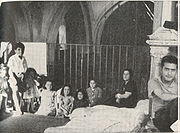
Folke Bernadotte
Folke Bernadotte, Count of Wisborg was a Swedish diplomat and nobleman noted for his negotiation of the release of about 31,000 prisoners from German concentration camps during World War II, including 450 Danish Jews from Theresienstadt released on 14 April 1945...
to help negotiate protection for the holy places, but it was to no avail. The Count would later be assassinated
Assassination
To carry out an assassination is "to murder by a sudden and/or secret attack, often for political reasons." Alternatively, assassination may be defined as "the act of deliberately killing someone, especially a public figure, usually for hire or for political reasons."An assassination may be...
by a splinter group of Jewish militants who did not want him conceding most of the land to Arabs, and the shelling of the Jewish neighborhoods by the Arab Legions dragged on through September. The Armenian quarter was hit several times in this period. The numbers of Armenians residing in Jerusalem and in the holy land in 1948 is disputed. One source cites a total population “never exceeding” 10,000 and a total of 8,000 in all of British Mandate at the time. One must remember that as recently as 1870 only 14,000–22,000 people lived in Jerusalem, making even a small Armenian presence a significant minority of the population.
Jordanian rule 1948–1967
In 1962 the Armenians agreed with the Catholics and Orthodox to begin renovating the Church of the Holy Sepulchre. The renovations continue to this day. As the Armenians were now separated from their holdings in Israel, the Patriarch began to lease these buildings out to the Jerusalem municipality and to developers.1967–present
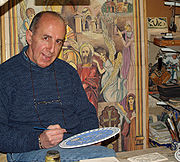
Six-Day War
The Six-Day War , also known as the June War, 1967 Arab-Israeli War, or Third Arab-Israeli War, was fought between June 5 and 10, 1967, by Israel and the neighboring states of Egypt , Jordan, and Syria...
of 1967 is remembered by some in the Armenian community as a "miracle", because two unexploded bombs were later found inside the Armenian monastery. Nevertheless it is also believed, absent hard statistics, that more than 20,000 Armenians lived in Israel
Israel
The State of Israel is a parliamentary republic located in the Middle East, along the eastern shore of the Mediterranean Sea...
and Jordan
Jordan
Jordan , officially the Hashemite Kingdom of Jordan , Al-Mamlaka al-Urduniyya al-Hashemiyya) is a kingdom on the East Bank of the River Jordan. The country borders Saudi Arabia to the east and south-east, Iraq to the north-east, Syria to the north and the West Bank and Israel to the west, sharing...
before the 1967 war. Today more than 3,000 Armenians live in Jerusalem. The Armenian quarter is home to roughly 500 of them, some of whom are temporary residents studying at the seminary or serving the church in various functions. The Patriarchate owns the entire quarter, as well as other assets in West Jerusalem and elsewhere. Finances for the quarter receive assistance from the prosperous Armenian communities in America. In 1975 a seminary school was completed inside the quarter.
Following the 1967 war the Israeli government gave compensation for repairing any churches or holy sites damaged in the fighting, regardless of who had caused the damage. In 1980 a source claimed 1,500 Armenians resided in the city of Jerusalem.
In 1987 Naomi Shepherd reported that “The Armenian and Syrian Orthodox clergy are present and correct, but are not on speaking terms.” At this time she also reported that only 14,000 Christians lived in the city of Jerusalem.
The Armenian Patriarchate still owned its “valuable property in West Jerusalem and in the area west of the Old City walls”, much of which is leased to the JNF or developers. Subsequently Armenian Archbishop Shahe Ajamian sold the properties west of the Old City walls to the government of Israel to allow for the current picturesque landscaping.
Literature
- Kevork Hintlian: History of The Armenians in The Holy Land, 2nd edition, Armenian Patriarchate Printing Press, Jerusalem 1989