

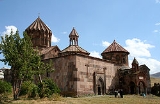
Haritchavank Monastery

Encyclopedia
The Monastery of Harich or Harichavank is 7th century Armenian monastery
located near the village of Harich (Armenian: Հառիճ) in the Shirak Province of the Republic of Armenia. The village is 3 km southeast of the town of Artik
. The monastery's name also transliterates as Harijavank or Harichavank, and is a compound made of the words "Harich" and "վանք/vank" (Armenian for monastery
).
. Archaeological excavations of 1966 indicate that Harich was in existence during the 2nd century BC, and was one of the more well known fortress towns in Armenia.
The oldest part of this Armenian monastery is the Church of St. Gregory the Enlightener
(Սբ. Գրիգոր Լուսավորիչ); it is a domed structure that is usually placed in the category of so-called "Mastara-style" churches (named after the seventh century church of St. Hovhannes
in the village of Mastara, in the southern part of Shirak). The founding date of the monastery is unknown, but probably it was built no later than the 7th century, when St. Gregory was erected.
The Cathedral of the Holy Mother of God (Սբ. Աստվածածին) that dominates the monastic complex was built by the orders of Zakare Zakarian
, Amirspasalar (commander-in-chief) and Prince who ruled Eastern Armenia in the 13th century together with his brother Ivane Zakarian
. Prince Zakare
started the Cathedral after he bought Harich from a family representing the Pahlavuni dynasty.
 The Cathedral is a cruciform church with two-story sacristies in each of the four extensions of the building. The tall 20-hedral drum of the cupola is of original style. Initially tent-roofed, it acquired triple columns on its facets and large rosettes in the piers which, together with platbands, form an unusual decorative girder around the middle of the drum height. Later, the cupola drum of the Gandzasar Monastery
(1216-1238) was decorated in the same way.
The eastern facade of the Cathedral features a relief carving depicting the Zakarian
brothers holding a model of the Cathedral in their hands. This theme can be found in many other Armenian churches of the time e.g. on the Memorial Cathedral of the Dadivank Monastery
in Nagorno Karabakh, as well as on main churches of the Sanahin
and Haghartsin monasteries in Armenia. This relief was covered in 1895 with a marble plaque featuring Madonna
; when the plaque was removed, the original carving showed beneath.
Haritchavank’s Cathedral belongs to the category of "Gandzasar
-style" ecclesiastical edifices that were built approximately at the same time in different parts of Armenia, and were endowed with similar compositional and decorative characteristics (another example—Cathedral of the Hovhannavank Monastery
). Those include umbrella-shaped dome, cruciform floor plan, narthex
(often with stalactite-ornamented ceiling), and high-relief of a large cross on one of church’s walls.
The privileges granted by the princes to the monastery contributed towards its becoming a large cultural and enlightenment center of medieval Armenia. At the end of the 12th and the beginning of the 13th century, two monumental gavits (narthexes) were built of big stones, some measuring 3.5 meters. The larger narthex
(gavit) is adjacent to the western facade of the Cathedral and is linked to the northern apse of the Church of St. Gregory. It is a rectangular building supported by four pillars, with a stalactite carving in the central part of the ceiling.
Over 800 years the monastery was repeatedly reconstructed. Damages inflicted on it were repaired and small annexes and chapels were added to it at various times. The largest of these dates back to the second half of the 19th century, when Harich was made the summer audience of the Katholikos of Echmiadzin
in 1850. The monastery grounds expanded northwards and were encircled with walls and towers. New one- and two-storey structures were erected: Katholikos’ offices, a refectory with a kitchen and a bakery, a school, a hostel for monks and disciples, an inn, stores and cattlesheds. Greenery was planted in the yards.
South of the monastery, on a steep cliff, stands the Hermitage Chapel. In the cemetery there are ruins of a small single-nave basilica of the fifth century with annexes in the sides of the altar apse and interesting tombstones with ornamented slabs dating from the 5th-6th centuries (now at Armenia’s State History Museum in Yerevan).
Armenian architecture
Armenian architecture is an architectural style developed over the last 4,500 years of human habitation in the Armenian Highland and used principally by the Armenian people.- Common characteristics of Armenian architecture:...
located near the village of Harich (Armenian: Հառիճ) in the Shirak Province of the Republic of Armenia. The village is 3 km southeast of the town of Artik
Artik
Artik is a city located in the Shirak province of Armenia. It has a population of 14,949 people, down from the 25,100 reported in the 1989 census....
. The monastery's name also transliterates as Harijavank or Harichavank, and is a compound made of the words "Harich" and "վանք/vank" (Armenian for monastery
Monastery
Monastery denotes the building, or complex of buildings, that houses a room reserved for prayer as well as the domestic quarters and workplace of monastics, whether monks or nuns, and whether living in community or alone .Monasteries may vary greatly in size – a small dwelling accommodating only...
).
History
Harichavank known as one of the most famous monastic centers in Armenia and it was especially renowned for its school and scriptoriumScriptorium
Scriptorium, literally "a place for writing", is commonly used to refer to a room in medieval European monasteries devoted to the copying of manuscripts by monastic scribes...
. Archaeological excavations of 1966 indicate that Harich was in existence during the 2nd century BC, and was one of the more well known fortress towns in Armenia.
The oldest part of this Armenian monastery is the Church of St. Gregory the Enlightener
Gregory the Illuminator
Saint Gregory the Illuminator or Saint Gregory the Enlightener is the patron saint and first official head of the Armenian Apostolic Church...
(Սբ. Գրիգոր Լուսավորիչ); it is a domed structure that is usually placed in the category of so-called "Mastara-style" churches (named after the seventh century church of St. Hovhannes
Church of St. John, Mastara
The Church of St. John , also known as Mastara Church, in Mastara, Armenia dates from the 5th century. It features a variation of the cruciform plan and central cupola'd church. In accordance with its square plan, the four projecting apses, inward-facing circular and outward facing polygonal, offer...
in the village of Mastara, in the southern part of Shirak). The founding date of the monastery is unknown, but probably it was built no later than the 7th century, when St. Gregory was erected.
The Cathedral of the Holy Mother of God (Սբ. Աստվածածին) that dominates the monastic complex was built by the orders of Zakare Zakarian
Zakarid-Mxargrzeli
The Zakarid , also known by their Georgian language moniker as Mkhargrdzeli , were a noble family prominent in medieval Armenia and Georgia. Their name in Georgian, Mkhargrdzeli, or in , meant long-armed. A family legend says that this name was a reference to their Achaemenid ancestor Artaxerxes...
, Amirspasalar (commander-in-chief) and Prince who ruled Eastern Armenia in the 13th century together with his brother Ivane Zakarian
Zakarid-Mxargrzeli
The Zakarid , also known by their Georgian language moniker as Mkhargrdzeli , were a noble family prominent in medieval Armenia and Georgia. Their name in Georgian, Mkhargrdzeli, or in , meant long-armed. A family legend says that this name was a reference to their Achaemenid ancestor Artaxerxes...
. Prince Zakare
Zakarid-Mxargrzeli
The Zakarid , also known by their Georgian language moniker as Mkhargrdzeli , were a noble family prominent in medieval Armenia and Georgia. Their name in Georgian, Mkhargrdzeli, or in , meant long-armed. A family legend says that this name was a reference to their Achaemenid ancestor Artaxerxes...
started the Cathedral after he bought Harich from a family representing the Pahlavuni dynasty.
Gandzasar monastery
Gandzasar monastery is a 10-13th century Armenian monastery situated in the Mardakert region of Nagorno-Karabakh, near the village of Vank. "Gandzasar" means treasure mountain or hilltop treasure in Armenian. The monastery holds relics believed to belong to St. John the Baptist and St Zechariah,...
(1216-1238) was decorated in the same way.
The eastern facade of the Cathedral features a relief carving depicting the Zakarian
Zakarid-Mxargrzeli
The Zakarid , also known by their Georgian language moniker as Mkhargrdzeli , were a noble family prominent in medieval Armenia and Georgia. Their name in Georgian, Mkhargrdzeli, or in , meant long-armed. A family legend says that this name was a reference to their Achaemenid ancestor Artaxerxes...
brothers holding a model of the Cathedral in their hands. This theme can be found in many other Armenian churches of the time e.g. on the Memorial Cathedral of the Dadivank Monastery
Dadivank Monastery
Dadivank Monastery also Khutavank is an Armenian Monastery in the Shahumian Region of the Nagorno-Karabakh Republic. It was built between the 9th and 13th century.-History and architecture:...
in Nagorno Karabakh, as well as on main churches of the Sanahin
Sanahin
Sanahin is a village in the northern province of Lori in Armenia, now considered part of the city of Alaverdi...
and Haghartsin monasteries in Armenia. This relief was covered in 1895 with a marble plaque featuring Madonna
Mary (mother of Jesus)
Mary , commonly referred to as "Saint Mary", "Mother Mary", the "Virgin Mary", the "Blessed Virgin Mary", or "Mary, Mother of God", was a Jewish woman of Nazareth in Galilee...
; when the plaque was removed, the original carving showed beneath.
Haritchavank’s Cathedral belongs to the category of "Gandzasar
Gandzasar monastery
Gandzasar monastery is a 10-13th century Armenian monastery situated in the Mardakert region of Nagorno-Karabakh, near the village of Vank. "Gandzasar" means treasure mountain or hilltop treasure in Armenian. The monastery holds relics believed to belong to St. John the Baptist and St Zechariah,...
-style" ecclesiastical edifices that were built approximately at the same time in different parts of Armenia, and were endowed with similar compositional and decorative characteristics (another example—Cathedral of the Hovhannavank Monastery
Hovhannavank Monastery
Hovhannavank is an Armenian Apostolic Church monastery located in the village of Ohanavan in the Aragatsotn Province of Armenia. It is situated atop a steep gorge carved by the Kasagh river...
). Those include umbrella-shaped dome, cruciform floor plan, narthex
Narthex
The narthex of a church is the entrance or lobby area, located at the end of the nave, at the far end from the church's main altar. Traditionally the narthex was a part of the church building, but was not considered part of the church proper...
(often with stalactite-ornamented ceiling), and high-relief of a large cross on one of church’s walls.
The privileges granted by the princes to the monastery contributed towards its becoming a large cultural and enlightenment center of medieval Armenia. At the end of the 12th and the beginning of the 13th century, two monumental gavits (narthexes) were built of big stones, some measuring 3.5 meters. The larger narthex
Narthex
The narthex of a church is the entrance or lobby area, located at the end of the nave, at the far end from the church's main altar. Traditionally the narthex was a part of the church building, but was not considered part of the church proper...
(gavit) is adjacent to the western facade of the Cathedral and is linked to the northern apse of the Church of St. Gregory. It is a rectangular building supported by four pillars, with a stalactite carving in the central part of the ceiling.
Over 800 years the monastery was repeatedly reconstructed. Damages inflicted on it were repaired and small annexes and chapels were added to it at various times. The largest of these dates back to the second half of the 19th century, when Harich was made the summer audience of the Katholikos of Echmiadzin
Echmiadzin
Mother Cathedral of Holy Etchmiadzin is a 4th century Armenian church in the town of Ejmiatsin, Armenia. It is also the central cathedral of the Mother See of Holy Etchmiadzin of the Armenian Apostolic Church....
in 1850. The monastery grounds expanded northwards and were encircled with walls and towers. New one- and two-storey structures were erected: Katholikos’ offices, a refectory with a kitchen and a bakery, a school, a hostel for monks and disciples, an inn, stores and cattlesheds. Greenery was planted in the yards.
South of the monastery, on a steep cliff, stands the Hermitage Chapel. In the cemetery there are ruins of a small single-nave basilica of the fifth century with annexes in the sides of the altar apse and interesting tombstones with ornamented slabs dating from the 5th-6th centuries (now at Armenia’s State History Museum in Yerevan).