


British nationality law

Encyclopedia
British nationality law is the law of the United Kingdom
that concerns citizenship
and other categories of British nationality
. The law is complex because of the United Kingdom's former status as an imperial power
.
and Scots law
have always distinguished between the Monarch's subjects and aliens. Until 1914 British nationality law was uncodified. The British Nationality and Status of Aliens Act 1914 codified existing common law and statute, with a few minor changes.
With the development of the modern British Commonwealth of Nations in the 20th century, some deemed the single Imperial status of British subject
as increasingly inadequate to deal with the realities of a Commonwealth with independent member states. In 1948, the Commonwealth Heads of Government
agreed that each member would adopt a national citizenship, but that the existing status of the British subject would continue as a common status held by all Commonwealth citizen
s.
The British Nationality Act 1948
established the status of Citizen of the United Kingdom and Colonies (CUKC), the national citizenship of the United Kingdom and those places that were still British colonies
on 1 January 1949, when the 1948 Act came into force. However, until the early 1960s there was little difference, if any, in United Kingdom law between the rights of CUKCs and other British subjects, all of whom had the right at any time to enter and live in the United Kingdom.
Independence Acts passed when the various remaining colonies were granted independence also contained nationality provisions. In general, these provisions withdrew the status of CUKC from anyone who became citizens of the newly independent country, unless one had a connection with the UK or a remaining colony (e.g. through birth in the UK). Exceptions were sometimes made in cases where the colonies did not become independent. (Notable cases include Penang
and Malacca
, which were made part of the Federation of Malaya
and Hong Kong
, which became part of the People's Republic of China
. CUKC status was not withdrawn from CUKCs from Penang and Malacca, and a new British nationality status was created for Hong Kong.)
Between 1962 and 1971, as a result of fears about increasing immigration by Commonwealth citizens from Asia
and Africa
, the United Kingdom gradually tightened controls on immigration by British subjects from other parts of the Commonwealth. The Immigration Act 1971
introduced the concept of patriality, by which only British subjects with sufficiently strong links to the British Islands
(i.e. the United Kingdom, the Channel Islands
and the Isle of Man
) had right of abode, the right to live and work in the United Kingdom and Islands.
Although there have been several amendments to the 1971 Act in the intervening years, the principal British nationality law today is the British Nationality Act 1981
, which established the current system of multiple categories of British nationality, viz. British citizens, British Overseas Territories citizens, British Overseas citizens, British Nationals (Overseas), British subjects and British protected persons. Only British citizenship includes the automatic right of abode in the United Kingdom.
The 1981 Act also ceased to recognise Commonwealth citizens as British subjects. There remain only two categories of people who are still British subjects: some people (formerly known as British subjects without citizenship) who originally acquired British nationality through a connection with former British India, and also a number of people connected with the Republic of Ireland before 1949 who have made a declaration to retain British nationality. Those British subjects connected with former British India lose British nationality if they acquire any other.
In spite of the fact that BNA 1981 repealed most of the provisions of BNA 1948 and the nationality clauses in subsequent independence acts, the acquisition of new categories of British nationality created by BNA 1981 was often dependent on one's nationality status prior to 1 Jan 1983, the date BNA 1981 came into effect. This therefore means that many of the original provisions of BNA 1948 and subsequent independence acts are still relevant today. Not taking into account of this subtlety might lead one to the erroneous conclusion, for example, that BNA 1981's repeal of the nationality clauses in the Kenya Independence Act of 1963 restored British nationality to those who lost their CUKC status as a result of Kenya
's independence in 1963. This is one of the reasons for the complexity of British nationality law; in complicated cases, determining one's British nationality status or lack thereof requires an examination of several nationality acts in their original form.
British citizens
British Overseas Territories citizen
s (formerly British Dependent Territories citizenship) (BOTC)
British Overseas citizen
s (BOC)
British subject
s
British Nationals (Overseas)
(BNO)
British protected person
s (BPP)
Of the various classes of British nationality and BPP status, all except British citizenship and British Overseas Territories citizenship are residual categories. This means they become extinct with the passage of time, as they can only be passed down to the national's children in exceptional circumstances, e.g., if the child would otherwise be stateless. There is, consequently, little provision for the acquisition of these classes of nationality by people who do not already have them.
Of all the six classes of British nationality, only the status of British citizen carries with it the right of abode somewhere (in this case the UK), and all British passports include a note to this effect. However, in practice, BOTCs (except those associated with the Sovereign bases in Cyprus) were granted full British citizenship in 2002, BN(O)s have right of abode in Hong Kong
, BSs and BPPs lose their statuses upon acquisition of another nationality (except BSs connected the Republic of Ireland, who have the right to live and work in the UK anyway because of EU treaties) and so should be eligible for registration as British Citizens under the Nationality, Immigration and Asylum Act 2002
.
This makes British Overseas Citizens unique in that their nationality status is not associated with the right of residence anywhere in the world.
For nationality purposes, the Channel Islands
and Isle of Man
are generally treated as if they were part of the United Kingdom
.
Leaflets and advice that describe how British citizenship and other kinds of British nationality can be held, applied for, or renounced are available from the Home Office UK Border Agency (formerly known as Border and Immigration Agency or BIA). Information is also available from the Home Office on provisions for reducing statelessness.
Persons acquiring citizenship by method (2) are called citizens by descent, while citizens acquiring citizenship by methods (1), (3) or (5) are called citizens otherwise than by descent. British citizens by registration, method (4), may be either, depending on the circumstances. Only citizens otherwise than by descent can pass on their citizenship to their children born outside the UK automatically; citizens by descent can only pass on citizenship to their non-UK born children by registering them.
Before 1983, birth in the UK was sufficient in itself to confer British nationality irrespective of the status of parents, with an exception only for children of diplomats and enemy aliens. This exception did not apply to most visiting forces, so, in general, children born in the UK before 1983 to visiting military personnel (e.g. US forces stationed in the UK) are British citizens by birth.
.)
With effect from 20 July 2009, the Borders, Citizenship and Immigration Act 2009
provides that a person born outside the UK to a British mother may be entitled to register as a British citizen by descent if that person was born before 1 January 1983. Before the 2009 changes, only persons born after 7 February 1961 and before 1 January 1983 were eligible for this provision that came into force in April 2003. However those with permanent resident status in the UK, or who are entitled to the right of abode, may prefer naturalisation as a British citizen, which gives transmissible British citizenship otherwise than by descent. Requirements for successful registration with form UKM are that the applicant be a child of a British mother born before 1983 and be of good character and attend a citizenship ceremony. As of 22 Nov 2010, there is no longer an application fee (of £540). Applicants do however still have to pay £80 for the citizenship ceremony.
This difference in application for a passport and also nationality has been criticised by the National Council for Civil Liberties on the basis of alleged discrimination on the basis of age and gender based on descent through a mother or a father.
In both cases, at least one adoptive parent must be a British citizen on the date of the adoption.
In all other cases, an application for registration of the child as a British citizen must be made before the child is age 18. Usually this is granted provided the Secretary of State accepts the adoption is bona fide and the child would have been a British citizen if the natural child of the adopters. Usually the adoption must have taken place under the law of a 'designated country' (most developed nations along with some others are 'designated' for this purpose) and be recognised in the UK. This is the standard method for children adopted by British citizens permanently resident overseas to acquire British citizenship.
The cancellation or annulment of an adoption order does not cause loss of British citizenship acquired by that adoption.
British children adopted by non-British nationals do not lose British nationality, even if they acquire a foreign nationality as a result of the adoption.
(i.e., in practice, his or her officials). The Home Secretary may grant British citizenship to anyone they "think fit". Although the Home Office sets down a number of official requirements for naturalisation, the Home Office may waive any of these, or may conversely refuse citizenship to a person even if they meet all of the requirements. However, applications for naturalisation are normally granted if the requirements are met.
The requirements for naturalisation as a British citizen depend on whether or not one is the spouse or civil partner of a British citizen.
For those married to or in a civil partnership with a British citizen, the applicant must:
For those not married to or in a civil partnership with a British citizen, the requirements are:
Those applying for British citizenship in the Channel Islands and Isle of Man (where the application is mainly based on residence in the Crown Dependencies rather than the UK) do not have to sit the Life in the UK Test. Instead, in the Isle of Man, there is a Life in the Isle of Man Test, consisting of certain questions taken from the Life in the UK Test syllabus and certain questions taken from a separate syllabus relating to matters specific to the Isle of Man. In due course, it is expected that Regulations will be introduced to that effect in the Channel Islands. The provisions for proving knowledge of English, Welsh or Scottish Gaelic remain unchanged until that date for applicants in the Crown Dependencies. In the rare cases where an applicant is able to apply for naturalisation from outside the United Kingdom, a paper based version of the Life in the UK Test may be available at a British diplomatic mission. Details (pdf)
As of 11 February 2009, wait times for naturalization applications were reportedly significant, taking up to 6 months to complete. The UK Border Agency stated that this was occurring because of the widespread changes proposed to the UK Immigration Laws likely to take effect in late 2009.
As of 6 April 2011, the fee for naturalisation (including Citizenship ceremony fee) is £836 for single applications, and £850 for joint application, for husband and wife (or civil partners living together) if applying at the same time.
states and Switzerland
has varied since 1983. This is important in terms of eligibility for naturalisation, and whether the UK-born child of such a person is a British citizen. Details (pdf)
states are not generally considered "settled" in the UK unless they apply for and obtain permanent residency. This is relevant in terms of eligibility to apply for naturalisation or obtaining British citizenship for UK born children (born on or after 2 October 2000).
automatically acquire permanent residence after 5 years resident in the United Kingdom exercising Treaty rights.
Children born in the United Kingdom from this to EEA/Swiss parents are normally British citizens automatically, if at least one parent has been exercising Treaty rights for five years. If the parents have lived in the United Kingdom for less than five years when the child is born, the child may be registered as British under s1(3) of the British Nationality Act once the parents complete five years residence in the United Kingdom.
Children born between 2 October 2000 and 29 April 2006 may be registered as British citizens as soon as one parent has completed 5 years residence exercising Treaty rights in the United Kingdom.
provisions between the UK and Ireland, are exempt from these restrictions and are normally treated as "settled" in the United Kingdom immediately upon taking up residence.
are accorded EEA
rights in the United Kingdom.
A separate entitlement exists for any such UK-born child registered as British if they live in the United Kingdom until age 10, regardless of their or their parent's immigration status.
British nationals (other than British citizens) who have indefinite leave to remain in the UK or right of abode, are eligible for British citizenship by registration after five years' residence in the United Kingdom. This is an entitlement under s4 of the 1981 Act (section 4 registration).
Other cases where persons may be entitled to registration (either as a matter of law or policy) include:
contains provisions for acquisition and loss of British Dependent Territories citizenship (BDTC) (renamed as British Overseas Territories citizen
ship (BOTC) in 2002) on a broadly similar basis to those for British citizenship.
The Home Secretary has delegated his powers to grant BOTC to the Governors of the Overseas Territories. Only in exceptional cases is a person registered or naturalised as a BOTC by the Home Office in the United Kingdom.
On 21 May 2002 any BOTC who did not hold British citizenship (except those from the Sovereign Base Areas) automatically acquired it under the British Overseas Territories Act 2002. Those acquiring BOTC after that date are entitled to register as British citizens under s4A of the 1981 Act.
The Nationality, Immigration and Asylum Act 2002
granted British Overseas Citizens, British Subjects and British Protected Persons the right to register as British citizens if they have no other citizenship or nationality and have not after 4 July 2002 renounced, voluntarily relinquished or lost through action or inaction any citizenship or nationality. Previously such persons would have not had the right of abode in any country, and would have thus been de facto stateless. Despite strong resistance from senior officials at the Home Office, the then Home Secretary, David Blunkett
, said on 3 July 2002 that this would "right a historic wrong" that left stateless tens of thousands of Asian people who had worked closely with British colonial administrations.
ship is generally held by persons connected with former British colonies and who for some reason did not lose their British Nationality upon the independence of those colonies.
), British Overseas citizens, or solely citizens of the PRC. (The deadline for registering as a British National (Overseas) passed in 1997.) There is no provision to acquire British National (Overseas) although stateless children born to such persons may be entitled to British Overseas citizenship and can apply to register as British citizens.
In some cases, former BDTCs from Hong Kong have been able to acquire British citizenship (BC status) under special legislation passed in 1990, 1996 and 1997. In other cases, some former Hong Kong BDTCs hold British citizenship as a matter of entitlement or through acquisition under normal rules.
Most of these British nationals (BCs and BN(O)s) aforementioned have been recognized by the People's Republic of China
as its citizens before and after the handover of Hong Kong. These PRC citizens of Hong Kong origin have been categorised differently from other PRC nationals from Macau
and Mainland China
. See the articles HKSAR passport
, Home Return Permit
and Chinese nationality law.
In February 2006, in response to extensive representations made by Lord Avebury and Tameem Ebrahim, British authorities announced that six hundred British citizenship applications of ethnic minority children of Indian descent from Hong Kong were wrongly refused. The applications dated from the period July 1997 onwards. Where applicants in such cases confirm that they still wish to receive British citizenship, the decision is reconsidered on request. No additional fee is required in such cases. A template to request reconsideration is available for those who want a prior application reconsidered.
Approximately 800,000 persons born before 1949 and connected with the Republic of Ireland remain entitled to claim British subject status under section 31 of the 1981 Act.
and Sophia Naturalization Act 1705
Renunciations made to other authorities are invalid: e.g., a general renunciation made upon taking up U.S. citizenship. The forms must be sent through the UK Border Agency's citizenship renunciation process.
There are provisions for the resumption of British citizenship or British overseas territories citizenship renounced for the purpose of gaining or retaining another citizenship. This can generally only be done once as a matter of entitlement. Further opportunities to resume British citizenship are discretionary.
British subjects, British Overseas citizens and British Nationals (Overseas) cannot under any circumstances resume their British nationality after renunciation.
, British nationals can be deprived of their citizenship if the Secretary of State is satisfied "deprivation is conducive to the public good". This provision has been in force since 16 June 2006 when the Immigration, Nationality and Asylum Act 2006 (Commencement No 1) Order 2006 came into force. This provision only applies to dual nationals, and does not operate to render a person stateless.
Previously, since 2003, under amendments made by the Nationality, Immigration and Asylum Act 2002
, British nationals could be deprived of their citizenship if the Secretary of State is satisfied they are responsible for acts seriously prejudicial to the vital interests of the United Kingdom or an Overseas Territory.
British nationals who are naturalised or registered may have their certificates revoked (and hence lose British nationality) if British nationality was obtained by fraud or concealment of a material fact.
Different rules apply in the cases of British protected persons and certain British subjects. A person who is a British subject other than by connection with the Republic of Ireland loses that status on acquiring any other nationality or citizenship. Similarly, a British protected person is no longer a British protected person on acquiring any other nationality or citizenship. Although British Overseas citizens are not subject to loss of citizenship, British Overseas citizens may lose an entitlement to register as a British citizen under s4B of the 1981 Act if they acquire any other citizenship.
Many other countries, however, do not allow dual nationality (see Multiple citizenship
). If a person has British nationality, and is also a national of a country that does not allow dual nationality, the authorities of that country may either regard the person as having lost that nationality or may refuse to recognize the British nationality. British nationals who acquire the nationality of a country that does not allow dual nationality may be required by the other country to renounce British nationality to retain the other citizenship.
Under international law, the Master Nationality Rule
states that a State may not give diplomatic protection
to one of its nationals in a country where the person also holds citizenship. For example, a person who is both British and American cannot receive diplomatic help from a British Consul
in the United States.
A British person who acquired foreign citizenship by naturalisation before 1949 may have lost British nationality at the time. No specific provisions were made in the 1948 legislation for such former British subjects to acquire or otherwise resume British nationality, and hence such a person would not be a British citizen today. However, women who lost British nationality on marriage to a foreign man before 1949 were deemed to have reacquired British subject status immediately before the coming into force of the 1948 act.
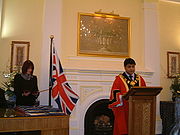 From 1 January 2004, all new applicants for British citizenship by naturalisation or registration aged 18 or over if their application is successful must attend a citizenship ceremony and either make an affirmation or take an oath of allegiance to the monarch, and also make a pledge to the United Kingdom.
Citizenship ceremonies are normally organised by:
Persons from the Republic of Ireland
(born before 1949) reclaiming British subject
status under section 31 of the 1981 Act do not need to attend a citizenship ceremony. However, should such a person subsequently apply for British citizenship by registration or naturalisation, attendance at a ceremony is required.
For those who applied for British citizenship before 2004:
are European Union citizens
under European Union law
.
However, by virtue of a special provision in the UK Accession Treaty, British citizens who are connected with the Channel Islands
and Isle of Man
(i.e. considered "Channel Islanders and Manxmen") do not have the right to live in other European Union
countries (except the Republic of Ireland
, through the long-established Common Travel Area
) unless they have connections through descent or residence in the United Kingdom
.
United Kingdom
The United Kingdom of Great Britain and Northern IrelandIn the United Kingdom and Dependencies, other languages have been officially recognised as legitimate autochthonous languages under the European Charter for Regional or Minority Languages...
that concerns citizenship
Citizenship
Citizenship is the state of being a citizen of a particular social, political, national, or human resource community. Citizenship status, under social contract theory, carries with it both rights and responsibilities...
and other categories of British nationality
Nationality
Nationality is membership of a nation or sovereign state, usually determined by their citizenship, but sometimes by ethnicity or place of residence, or based on their sense of national identity....
. The law is complex because of the United Kingdom's former status as an imperial power
British Empire
The British Empire comprised the dominions, colonies, protectorates, mandates and other territories ruled or administered by the United Kingdom. It originated with the overseas colonies and trading posts established by England in the late 16th and early 17th centuries. At its height, it was the...
.
History
English lawEnglish law
English law is the legal system of England and Wales, and is the basis of common law legal systems used in most Commonwealth countries and the United States except Louisiana...
and Scots law
Scots law
Scots law is the legal system of Scotland. It is considered a hybrid or mixed legal system as it traces its roots to a number of different historical sources. With English law and Northern Irish law it forms the legal system of the United Kingdom; it shares with the two other systems some...
have always distinguished between the Monarch's subjects and aliens. Until 1914 British nationality law was uncodified. The British Nationality and Status of Aliens Act 1914 codified existing common law and statute, with a few minor changes.
With the development of the modern British Commonwealth of Nations in the 20th century, some deemed the single Imperial status of British subject
British subject
In British nationality law, the term British subject has at different times had different meanings. The current definition of the term British subject is contained in the British Nationality Act 1981.- Prior to 1949 :...
as increasingly inadequate to deal with the realities of a Commonwealth with independent member states. In 1948, the Commonwealth Heads of Government
Head of government
Head of government is the chief officer of the executive branch of a government, often presiding over a cabinet. In a parliamentary system, the head of government is often styled prime minister, chief minister, premier, etc...
agreed that each member would adopt a national citizenship, but that the existing status of the British subject would continue as a common status held by all Commonwealth citizen
Commonwealth citizen
A Commonwealth citizen, which replaces the former category of British subject, is generally a person who is a national of any country within the Commonwealth of Nations....
s.
The British Nationality Act 1948
British Nationality Act 1948
The British Nationality Act 1948 was an Act of the Parliament of the United Kingdom that created the status of "Citizen of the United Kingdom and Colonies" as the national citizenship of the United Kingdom and its colonies....
established the status of Citizen of the United Kingdom and Colonies (CUKC), the national citizenship of the United Kingdom and those places that were still British colonies
Crown colony
A Crown colony, also known in the 17th century as royal colony, was a type of colonial administration of the English and later British Empire....
on 1 January 1949, when the 1948 Act came into force. However, until the early 1960s there was little difference, if any, in United Kingdom law between the rights of CUKCs and other British subjects, all of whom had the right at any time to enter and live in the United Kingdom.
Independence Acts passed when the various remaining colonies were granted independence also contained nationality provisions. In general, these provisions withdrew the status of CUKC from anyone who became citizens of the newly independent country, unless one had a connection with the UK or a remaining colony (e.g. through birth in the UK). Exceptions were sometimes made in cases where the colonies did not become independent. (Notable cases include Penang
Penang
Penang is a state in Malaysia and the name of its constituent island, located on the northwest coast of Peninsular Malaysia by the Strait of Malacca. It is bordered by Kedah in the north and east, and Perak in the south. Penang is the second smallest Malaysian state in area after Perlis, and the...
and Malacca
Malacca
Malacca , dubbed The Historic State or Negeri Bersejarah among locals) is the third smallest Malaysian state, after Perlis and Penang. It is located in the southern region of the Malay Peninsula, on the Straits of Malacca. It borders Negeri Sembilan to the north and the state of Johor to the south...
, which were made part of the Federation of Malaya
Federation of Malaya
The Federation of Malaya is the name given to a federation of 11 states that existed from 31 January 1948 until 16 September 1963. The Federation became independent on 31 August 1957...
and Hong Kong
Hong Kong
Hong Kong is one of two Special Administrative Regions of the People's Republic of China , the other being Macau. A city-state situated on China's south coast and enclosed by the Pearl River Delta and South China Sea, it is renowned for its expansive skyline and deep natural harbour...
, which became part of the People's Republic of China
People's Republic of China
China , officially the People's Republic of China , is the most populous country in the world, with over 1.3 billion citizens. Located in East Asia, the country covers approximately 9.6 million square kilometres...
. CUKC status was not withdrawn from CUKCs from Penang and Malacca, and a new British nationality status was created for Hong Kong.)
Between 1962 and 1971, as a result of fears about increasing immigration by Commonwealth citizens from Asia
Asia
Asia is the world's largest and most populous continent, located primarily in the eastern and northern hemispheres. It covers 8.7% of the Earth's total surface area and with approximately 3.879 billion people, it hosts 60% of the world's current human population...
and Africa
Africa
Africa is the world's second largest and second most populous continent, after Asia. At about 30.2 million km² including adjacent islands, it covers 6% of the Earth's total surface area and 20.4% of the total land area...
, the United Kingdom gradually tightened controls on immigration by British subjects from other parts of the Commonwealth. The Immigration Act 1971
Immigration Act 1971
The Immigration Act 1971 is an Act of the Parliament of the United Kingdom concerning immigration.The Act, as with the Commonwealth Immigrants Act 1962, and that of 1968, restricted immigration, especially primary immigration into the UK....
introduced the concept of patriality, by which only British subjects with sufficiently strong links to the British Islands
British Islands
British Islands is a term within the law of the United Kingdom which since 1889 has referred collectively to the following four states:*the United Kingdom of Great Britain and Northern Ireland ;...
(i.e. the United Kingdom, the Channel Islands
Channel Islands
The Channel Islands are an archipelago of British Crown Dependencies in the English Channel, off the French coast of Normandy. They include two separate bailiwicks: the Bailiwick of Guernsey and the Bailiwick of Jersey...
and the Isle of Man
Isle of Man
The Isle of Man , otherwise known simply as Mann , is a self-governing British Crown Dependency, located in the Irish Sea between the islands of Great Britain and Ireland, within the British Isles. The head of state is Queen Elizabeth II, who holds the title of Lord of Mann. The Lord of Mann is...
) had right of abode, the right to live and work in the United Kingdom and Islands.
Although there have been several amendments to the 1971 Act in the intervening years, the principal British nationality law today is the British Nationality Act 1981
British Nationality Act 1981
The British Nationality Act 1981 was an Act of Parliament passed by the British Parliament concerning British nationality. It has been the basis of British nationality law since 1 January 1983.-History:...
, which established the current system of multiple categories of British nationality, viz. British citizens, British Overseas Territories citizens, British Overseas citizens, British Nationals (Overseas), British subjects and British protected persons. Only British citizenship includes the automatic right of abode in the United Kingdom.
The 1981 Act also ceased to recognise Commonwealth citizens as British subjects. There remain only two categories of people who are still British subjects: some people (formerly known as British subjects without citizenship) who originally acquired British nationality through a connection with former British India, and also a number of people connected with the Republic of Ireland before 1949 who have made a declaration to retain British nationality. Those British subjects connected with former British India lose British nationality if they acquire any other.
In spite of the fact that BNA 1981 repealed most of the provisions of BNA 1948 and the nationality clauses in subsequent independence acts, the acquisition of new categories of British nationality created by BNA 1981 was often dependent on one's nationality status prior to 1 Jan 1983, the date BNA 1981 came into effect. This therefore means that many of the original provisions of BNA 1948 and subsequent independence acts are still relevant today. Not taking into account of this subtlety might lead one to the erroneous conclusion, for example, that BNA 1981's repeal of the nationality clauses in the Kenya Independence Act of 1963 restored British nationality to those who lost their CUKC status as a result of Kenya
Kenya
Kenya , officially known as the Republic of Kenya, is a country in East Africa that lies on the equator, with the Indian Ocean to its south-east...
's independence in 1963. This is one of the reasons for the complexity of British nationality law; in complicated cases, determining one's British nationality status or lack thereof requires an examination of several nationality acts in their original form.
Classes of British nationality
There are currently six classes of British national:British citizens
- British Citizens usually hold this status through a connection with the United KingdomUnited KingdomThe United Kingdom of Great Britain and Northern IrelandIn the United Kingdom and Dependencies, other languages have been officially recognised as legitimate autochthonous languages under the European Charter for Regional or Minority Languages...
, Channel IslandsChannel IslandsThe Channel Islands are an archipelago of British Crown Dependencies in the English Channel, off the French coast of Normandy. They include two separate bailiwicks: the Bailiwick of Guernsey and the Bailiwick of Jersey...
and Isle of ManIsle of ManThe Isle of Man , otherwise known simply as Mann , is a self-governing British Crown Dependency, located in the Irish Sea between the islands of Great Britain and Ireland, within the British Isles. The head of state is Queen Elizabeth II, who holds the title of Lord of Mann. The Lord of Mann is...
("United Kingdom and Islands"). Former Citizens of the United Kingdom and Colonies (CUKCs) who possessed right of abodeRight of Abode (United Kingdom)The right of abode is a status under United Kingdom immigration law that gives an unrestricted right to live in the United Kingdom. It was introduced by the Immigration Act 1971.-British citizens:...
under the Immigration Act 1971Immigration Act 1971The Immigration Act 1971 is an Act of the Parliament of the United Kingdom concerning immigration.The Act, as with the Commonwealth Immigrants Act 1962, and that of 1968, restricted immigration, especially primary immigration into the UK....
through a connection with the United Kingdom and Islands generally became British citizens on 1 January 1983.
- British citizenship is the most common type of British nationality, and the only one that automatically carries a right of abode in the United Kingdom.
- However, other rights can vary according to how the British citizenship was acquired. In particular there are restrictions for 'British citizens by descent' transmitting British citizenship to their children born outside the UK. These restrictions don't apply to 'British citizens other than by descent'.
British Overseas Territories citizen
British Overseas Territories citizen
The status of British Overseas Territories citizen relates to persons holding British nationality by virtue of a connection with a British Overseas Territory.-British Nationality Act 1981:...
s (formerly British Dependent Territories citizenship) (BOTC)
- BOTC (formerly BDTC) is the form of British nationality held by connection with an existing overseas territoryBritish overseas territoriesThe British Overseas Territories are fourteen territories of the United Kingdom which, although they do not form part of the United Kingdom itself, fall under its jurisdiction. They are remnants of the British Empire that have not acquired independence or have voted to remain British territories...
. Nearly all are now also British citizens as a result of the British Overseas Territories Act 2002British Overseas Territories Act 2002The British Overseas Territories Act 2002 is an Act of the Parliament of the United Kingdom, which superseded parts of the British Nationality Act 1981...
. It is possible to hold BOTC and British citizenship simultaneously.
British Overseas citizen
British Overseas citizen
In British nationality law, the status of British Overseas citizen is one of several categories of British national. A British Overseas citizen does not have an automatic right to live in the United Kingdom.-British Nationality Act 1981:...
s (BOC)
- BOCs are those former CUKCs who did not qualify for either British citizenship or British Dependent Territories citizenship. Most of these derived their status as CUKCs from former colonies, such as Malaysia and KenyaKenyaKenya , officially known as the Republic of Kenya, is a country in East Africa that lies on the equator, with the Indian Ocean to its south-east...
, because of various quirks and exceptions in the law that resulted in them retaining CUKC status in spite of the independence of their colonies. Note that this is fairly uncommon: most CUKCs (including those from Malaysia and Kenya) lost their CUKC status upon independence.
British subject
British subject
In British nationality law, the term British subject has at different times had different meanings. The current definition of the term British subject is contained in the British Nationality Act 1981.- Prior to 1949 :...
s
- British subjects (as defined in the 1981 Act) are those British subjects who were not CUKCs or citizens of any other Commonwealth country. Most of these derived their status as British subjects from British IndiaBritish RajBritish Raj was the British rule in the Indian subcontinent between 1858 and 1947; The term can also refer to the period of dominion...
or the Republic of IrelandRepublic of IrelandIreland , described as the Republic of Ireland , is a sovereign state in Europe occupying approximately five-sixths of the island of the same name. Its capital is Dublin. Ireland, which had a population of 4.58 million in 2011, is a constitutional republic governed as a parliamentary democracy,...
as they existed before 1949.
British Nationals (Overseas)
British National (Overseas)
British National , commonly known as BN, is one of the major classes of British nationality under British nationality law. Holders of this nationality are British nationals and Commonwealth citizens, but not British Citizens...
(BNO)
- The status of BNO did not originally exist under the 1981 scheme, but was created by the Hong Kong Act 1985 and the British Nationality (Hong Kong) Order 1986. BNOs are those former Hong KongHong KongHong Kong is one of two Special Administrative Regions of the People's Republic of China , the other being Macau. A city-state situated on China's south coast and enclosed by the Pearl River Delta and South China Sea, it is renowned for its expansive skyline and deep natural harbour...
BDTCs who applied for the status of BNO before the handover of Hong Kong to the People's Republic of ChinaPeople's Republic of ChinaChina , officially the People's Republic of China , is the most populous country in the world, with over 1.3 billion citizens. Located in East Asia, the country covers approximately 9.6 million square kilometres...
. Hong Kong BDTCs who did not apply to become BNOs, and who did not gain PRC nationality after the handover, became BOCs if they did not have any other nationality.
British protected person
British protected person
A British protected person is a member of class of certain persons under the British Nationality Act 1981 associated with former protected states, protectorates, mandated and trust territories under British control...
s (BPP)
- BPPs derive from parts of the British EmpireBritish EmpireThe British Empire comprised the dominions, colonies, protectorates, mandates and other territories ruled or administered by the United Kingdom. It originated with the overseas colonies and trading posts established by England in the late 16th and early 17th centuries. At its height, it was the...
that were protectorateProtectorateIn history, the term protectorate has two different meanings. In its earliest inception, which has been adopted by modern international law, it is an autonomous territory that is protected diplomatically or militarily against third parties by a stronger state or entity...
s or protected states with nominally independent rulers under the "protection" of the British Crown and not officially part of the Crown's dominions. The status of BPP is sui generisSui generisSui generis is a Latin expression, literally meaning of its own kind/genus or unique in its characteristics. The expression is often used in analytic philosophy to indicate an idea, an entity, or a reality which cannot be included in a wider concept....
BPPs are not Commonwealth citizens (British subjects, in the old sense) and were not traditionally considered British nationals, but are not aliens either.
Of the various classes of British nationality and BPP status, all except British citizenship and British Overseas Territories citizenship are residual categories. This means they become extinct with the passage of time, as they can only be passed down to the national's children in exceptional circumstances, e.g., if the child would otherwise be stateless. There is, consequently, little provision for the acquisition of these classes of nationality by people who do not already have them.
Of all the six classes of British nationality, only the status of British citizen carries with it the right of abode somewhere (in this case the UK), and all British passports include a note to this effect. However, in practice, BOTCs (except those associated with the Sovereign bases in Cyprus) were granted full British citizenship in 2002, BN(O)s have right of abode in Hong Kong
Hong Kong
Hong Kong is one of two Special Administrative Regions of the People's Republic of China , the other being Macau. A city-state situated on China's south coast and enclosed by the Pearl River Delta and South China Sea, it is renowned for its expansive skyline and deep natural harbour...
, BSs and BPPs lose their statuses upon acquisition of another nationality (except BSs connected the Republic of Ireland, who have the right to live and work in the UK anyway because of EU treaties) and so should be eligible for registration as British Citizens under the Nationality, Immigration and Asylum Act 2002
Nationality, Immigration and Asylum Act 2002
The Nationality, Immigration and Asylum Act 2002 is an Act of the Parliament of the United Kingdom. It received Royal Assent on 7 November 2002....
.
This makes British Overseas Citizens unique in that their nationality status is not associated with the right of residence anywhere in the world.
Acquisition of British citizenship
British Citizenship can be acquired in the following ways:- : By birth in the United Kingdom to a parent who is a British citizen at the time of the birth, or to a parent who is settled in the United Kingdom
- : By birth abroad, which constitutes "by descent" if one of the parents is a British citizen otherwise than by descent (for example by birth, adoption, registration or naturalisation in the United Kingdom). British citizenship by descent is only transferable to one generation down from the parent who is a British citizen otherwise than by descent, if the child is born abroad.
- By naturalisation
- By registration
- By adoption
For nationality purposes, the Channel Islands
Channel Islands
The Channel Islands are an archipelago of British Crown Dependencies in the English Channel, off the French coast of Normandy. They include two separate bailiwicks: the Bailiwick of Guernsey and the Bailiwick of Jersey...
and Isle of Man
Isle of Man
The Isle of Man , otherwise known simply as Mann , is a self-governing British Crown Dependency, located in the Irish Sea between the islands of Great Britain and Ireland, within the British Isles. The head of state is Queen Elizabeth II, who holds the title of Lord of Mann. The Lord of Mann is...
are generally treated as if they were part of the United Kingdom
United Kingdom
The United Kingdom of Great Britain and Northern IrelandIn the United Kingdom and Dependencies, other languages have been officially recognised as legitimate autochthonous languages under the European Charter for Regional or Minority Languages...
.
Leaflets and advice that describe how British citizenship and other kinds of British nationality can be held, applied for, or renounced are available from the Home Office UK Border Agency (formerly known as Border and Immigration Agency or BIA). Information is also available from the Home Office on provisions for reducing statelessness.
Persons acquiring citizenship by method (2) are called citizens by descent, while citizens acquiring citizenship by methods (1), (3) or (5) are called citizens otherwise than by descent. British citizens by registration, method (4), may be either, depending on the circumstances. Only citizens otherwise than by descent can pass on their citizenship to their children born outside the UK automatically; citizens by descent can only pass on citizenship to their non-UK born children by registering them.
British citizenship by birth in the United Kingdom
Under the law in effect from 1 January 1983, a child born in the UK to a parent who is a British citizen or 'settled' in the UK is automatically a British citizen by birth.- Only one parent needs to meet this requirement, either the father or the mother.
- "Settled" status in this context usually means the parent is resident in the United Kingdom and has the right of abode, holds Indefinite Leave to RemainIndefinite leave to remainIndefinite leave to remain is an immigration status granted to a person who does not hold right of abode in the United Kingdom , but who has been admitted to the UK without any time limit on his or her stay and who is free to take up employment or study, without restriction...
(ILR), or is the citizen of an EU/EEA country and has permanent residence. Irish citizens in the UK are also deemed settled for this purpose. - Special rules exist for cases where a parent of a child is a citizen of a European UnionEuropean UnionThe European Union is an economic and political union of 27 independent member states which are located primarily in Europe. The EU traces its origins from the European Coal and Steel Community and the European Economic Community , formed by six countries in 1958...
or European Economic AreaEuropean Economic AreaThe European Economic Area was established on 1 January 1994 following an agreement between the member states of the European Free Trade Association and the European Community, later the European Union . Specifically, it allows Iceland, Liechtenstein and Norway to participate in the EU's Internal...
member state, or SwitzerlandSwitzerlandSwitzerland name of one of the Swiss cantons. ; ; ; or ), in its full name the Swiss Confederation , is a federal republic consisting of 26 cantons, with Bern as the seat of the federal authorities. The country is situated in Western Europe,Or Central Europe depending on the definition....
. The law in this respect was changed on 2 October 2000 and again on 30 April 2006. See below for details. - For children born before 1 July 2006, if only the father meets this requirement, the parents must be married. Marriage subsequent to the birth is normally enough to confer British citizenship from that point.
- Where the father is not married to the mother, the Home Office usually registers the child as British provided an application is made and the child would have been British otherwise. The child must be under 18 on the date of application.
- Where a parent subsequently acquires British citizenship or "settled" status, the child can be registered as British provided he or she is still aged under 18.
- If the child lives in the UK until age 10 there is a lifetime entitlement to register as a British citizen. The immigration status of the child and his/her parents is irrelevant.
- Special provisions may apply for the child to acquire British citizenship if a parent is a British Overseas citizen or British subject, or if the child is stateless.
Before 1983, birth in the UK was sufficient in itself to confer British nationality irrespective of the status of parents, with an exception only for children of diplomats and enemy aliens. This exception did not apply to most visiting forces, so, in general, children born in the UK before 1983 to visiting military personnel (e.g. US forces stationed in the UK) are British citizens by birth.
British Citizenship by descent
'British Citizenship by descent' is the category for the children born outside the UK to a British citizen. Rules for acquiring British citizenship by descent depend on when the person was born.From 1983
A child born outside the UK on or after 1 January 1983 automatically acquires British citizenship by descent if either parent is a British citizen other than by descent at the time of the birth.- Only one parent—father or mother—must be British otherwise than by descent.
- As a general rule, an unmarried father cannot pass on British citizenship automatically in the case of children born before 1 July 2006. However, if the parents marry subsequent to the birth, the child normally becomes a British citizen at that point if legitimated by the marriage and the father was eligible to pass on British citizenship. Further, if the unmarried British father was domiciled in a country that treated (at the date of birth of the child born before 1 July 2006) a child born to unmarried parents in the same way as a child born to married parents, then the father passed on British citizenship automatically to his child, even though the child was born before 1 July 2006 to unmarried parents. Such countries are listed in UK Immigration and Passport Services publication "Legitimation and Domicile". Failing that, the child can be registered as British if it would have been British if parents were married and application is made before the child is 18.
- Where the parent is a British citizen by descent additional requirements apply. In the most common scenario, the parent is normally expected to have lived in the UK for three consecutive years and apply to register the child as a British citizen while the child is a minor (clause 43, Borders, Citizenship and Immigration Act 2009Borders, Citizenship and Immigration Act 2009The Borders, Citizenship and Immigration Act 2009 is an Act of the Parliament of the United Kingdom.Prior to the Act, residents who had spent five years living in the United Kingdom were able to apply for Indefinite Leave to Remain...
, effective from 13 January 2010). Prior to this date, the age limit was 12 months. - For British nationality purposes, the Isle of ManIsle of ManThe Isle of Man , otherwise known simply as Mann , is a self-governing British Crown Dependency, located in the Irish Sea between the islands of Great Britain and Ireland, within the British Isles. The head of state is Queen Elizabeth II, who holds the title of Lord of Mann. The Lord of Mann is...
and Channel IslandsChannel IslandsThe Channel Islands are an archipelago of British Crown Dependencies in the English Channel, off the French coast of Normandy. They include two separate bailiwicks: the Bailiwick of Guernsey and the Bailiwick of Jersey...
are treated as though they were part of the UK. - Before 21 May 2002, British Overseas Territories were treated as 'overseas' for nationality purposes. The exceptions were GibraltarGibraltarGibraltar is a British overseas territory located on the southern end of the Iberian Peninsula at the entrance of the Mediterranean. A peninsula with an area of , it has a northern border with Andalusia, Spain. The Rock of Gibraltar is the major landmark of the region...
who were British citizens per the British Nationality Act 1981British Nationality Act 1981The British Nationality Act 1981 was an Act of Parliament passed by the British Parliament concerning British nationality. It has been the basis of British nationality law since 1 January 1983.-History:...
; and the Falkland Islands who were granted British citizenship following the Falklands WarFalklands WarThe Falklands War , also called the Falklands Conflict or Falklands Crisis, was fought in 1982 between Argentina and the United Kingdom over the disputed Falkland Islands and South Georgia and the South Sandwich Islands...
per the British Nationality (Falkland Islands) Act 1983British Nationality (Falkland Islands) Act 1983The British Nationality Act 1983 was an Act of Parliament passed by the Parliament of the United Kingdom on 28 March 1983...
. For children born on or after 21 May 2002 in a British Overseas Territory (other than the Sovereign Base Areas of Cyprus) there is an entitlement to British citizenship on the same basis as UK-born children. - Children born overseas to parents on Crown Service are normally granted British citizenship otherwise than by descent. In other words, their status is the same as it would have been had they been born in the UK.
- In exceptional cases, the Home Secretary may register a child of parents who are British by descent as a British citizen under discretionary provisions, for example if the child is stateless.
Before 1983
Before 1983, as a general rule British nationality could only be transmitted from the father through one generation only, and parents were required to be married. (See History of British nationality lawHistory of British nationality law
- Early English and British nationality law :British nationality law has its origins in medieval England. There has always been a distinction in English law between the subjects of the monarch and aliens: the monarch's subjects owed him allegiance, and included those born in his dominions and...
.)
With effect from 20 July 2009, the Borders, Citizenship and Immigration Act 2009
Borders, Citizenship and Immigration Act 2009
The Borders, Citizenship and Immigration Act 2009 is an Act of the Parliament of the United Kingdom.Prior to the Act, residents who had spent five years living in the United Kingdom were able to apply for Indefinite Leave to Remain...
provides that a person born outside the UK to a British mother may be entitled to register as a British citizen by descent if that person was born before 1 January 1983. Before the 2009 changes, only persons born after 7 February 1961 and before 1 January 1983 were eligible for this provision that came into force in April 2003. However those with permanent resident status in the UK, or who are entitled to the right of abode, may prefer naturalisation as a British citizen, which gives transmissible British citizenship otherwise than by descent. Requirements for successful registration with form UKM are that the applicant be a child of a British mother born before 1983 and be of good character and attend a citizenship ceremony. As of 22 Nov 2010, there is no longer an application fee (of £540). Applicants do however still have to pay £80 for the citizenship ceremony.
Children born abroad to British mothers before 1983
At present there are two entirely different paths through which children of British mothers and children of British fathers born abroad before 1983 can acquire a passport. The differences also have a bearing on costs. Children of British mothers born before 1983 may require a nationality registration fee, which (as of 22 Nov 2010) is free (although they must pay £80 for a citizenship ceremony). They also must undergo a background check into their eligibility and be of "good character" and attend the citizenship ceremony.Children born abroad after 1982 to British mothers or to British fathers before or after 1983
Those born abroad to a British father before or after 1983 or born after 1982 to a British mother need not pay any nationality registration fees, undergo a good character check, or attend a civil ceremony as they are considered automatically British and can apply for a passport directly through the Identity and Passport Services (IPS). Again, this only applies if your parents have been married or marry.This difference in application for a passport and also nationality has been criticised by the National Council for Civil Liberties on the basis of alleged discrimination on the basis of age and gender based on descent through a mother or a father.
British citizenship by adoption
A child adopted by a British citizen only acquires British citizenship automatically if:- the adoption order is made by a court in the United Kingdom, Channel Islands, Isle of Man or Falkland Islands on or after 1 January 1983, or in another British Overseas Territory on or after 21 May 2002; or
- it is a Convention adoption under the 1993 Hague ConventionHague Convention on Protection of Children and Co-operation in Respect of Intercountry AdoptionThe Hague Convention on Protection of Children and Co-operation in Respect of Intercountry Adoption is an international convention dealing with international adoption, child laundering, and child trafficking...
on Intercountry Adoption effected on or after 1 June 2003 and the adopters are habitually resident in the United Kingdom on that date.
In both cases, at least one adoptive parent must be a British citizen on the date of the adoption.
In all other cases, an application for registration of the child as a British citizen must be made before the child is age 18. Usually this is granted provided the Secretary of State accepts the adoption is bona fide and the child would have been a British citizen if the natural child of the adopters. Usually the adoption must have taken place under the law of a 'designated country' (most developed nations along with some others are 'designated' for this purpose) and be recognised in the UK. This is the standard method for children adopted by British citizens permanently resident overseas to acquire British citizenship.
The cancellation or annulment of an adoption order does not cause loss of British citizenship acquired by that adoption.
British children adopted by non-British nationals do not lose British nationality, even if they acquire a foreign nationality as a result of the adoption.
British citizenship by naturalisation
Naturalisation as a British citizen is at the discretion of the Home SecretaryHome Secretary
The Secretary of State for the Home Department, commonly known as the Home Secretary, is the minister in charge of the Home Office of the United Kingdom, and one of the country's four Great Offices of State...
(i.e., in practice, his or her officials). The Home Secretary may grant British citizenship to anyone they "think fit". Although the Home Office sets down a number of official requirements for naturalisation, the Home Office may waive any of these, or may conversely refuse citizenship to a person even if they meet all of the requirements. However, applications for naturalisation are normally granted if the requirements are met.
The requirements for naturalisation as a British citizen depend on whether or not one is the spouse or civil partner of a British citizen.
For those married to or in a civil partnership with a British citizen, the applicant must:
- Hold indefinite leave to remainIndefinite leave to remainIndefinite leave to remain is an immigration status granted to a person who does not hold right of abode in the United Kingdom , but who has been admitted to the UK without any time limit on his or her stay and who is free to take up employment or study, without restriction...
in the UK (or an "equivalent" (for this purpose) such as the right of abode, Irish citizenshipIrish nationality lawIrish nationality law is the law of the Republic of Ireland governing citizenship. A person may be an Irish citizen through birth, descent, marriage to an Irish citizen or through naturalisation. Irish nationality law is currently contained in the provisions of the Irish Nationality and Citizenship...
, or permanent residency as a citizen or family member of an EU/EEA) - Have lived legally in the UK for three years
- Be of "good character", as deemed by the Home Office (in practice the Home Office carries out checks with the police and with other Government departments)
- show sufficient knowledge of life in the UK, either by passing the Life in the United Kingdom testLife in the United Kingdom testThe Life in the United Kingdom test is a computer-based test for individuals seeking Indefinite Leave to Remain in the UK or naturalisation as a British citizen...
or by attending combined English language and citizenship classes. Proof of this must be supplied with one's application for naturalisation. Exemption from this and the language requirement (see below) is normally granted for those aged 65 or over, and may be granted to those aged between 60 and 65. Note that this is required to remain in the country, not just for citizenship, and married partners will be deported if they are unable to pass the test. - Meet specified EnglishEnglish languageEnglish is a West Germanic language that arose in the Anglo-Saxon kingdoms of England and spread into what was to become south-east Scotland under the influence of the Anglian medieval kingdom of Northumbria...
, WelshWelsh languageWelsh is a member of the Brythonic branch of the Celtic languages spoken natively in Wales, by some along the Welsh border in England, and in Y Wladfa...
or Scottish Gaelic languageScottish Gaelic languageScottish Gaelic is a Celtic language native to Scotland. A member of the Goidelic branch of the Celtic languages, Scottish Gaelic, like Modern Irish and Manx, developed out of Middle Irish, and thus descends ultimately from Primitive Irish....
competence standards. Those who pass the Life in the UK test are deemed to meet English language requirements
For those not married to or in a civil partnership with a British citizen, the requirements are:
- Five years legal residence in the UK
- Indefinite leave to remain or "equivalent" for this purpose (see above) must have been held for 12 months
- the applicant must intend to continue to live in the UK or work overseas for the UK government or a British corporation or association
- the same "good character" standards apply as for those married to British citizens
- the same language and knowledge of life in the UK standards apply as for those married to British citizens
Those applying for British citizenship in the Channel Islands and Isle of Man (where the application is mainly based on residence in the Crown Dependencies rather than the UK) do not have to sit the Life in the UK Test. Instead, in the Isle of Man, there is a Life in the Isle of Man Test, consisting of certain questions taken from the Life in the UK Test syllabus and certain questions taken from a separate syllabus relating to matters specific to the Isle of Man. In due course, it is expected that Regulations will be introduced to that effect in the Channel Islands. The provisions for proving knowledge of English, Welsh or Scottish Gaelic remain unchanged until that date for applicants in the Crown Dependencies. In the rare cases where an applicant is able to apply for naturalisation from outside the United Kingdom, a paper based version of the Life in the UK Test may be available at a British diplomatic mission. Details (pdf)
As of 11 February 2009, wait times for naturalization applications were reportedly significant, taking up to 6 months to complete. The UK Border Agency stated that this was occurring because of the widespread changes proposed to the UK Immigration Laws likely to take effect in late 2009.
As of 6 April 2011, the fee for naturalisation (including Citizenship ceremony fee) is £836 for single applications, and £850 for joint application, for husband and wife (or civil partners living together) if applying at the same time.
Citizens of EEA States and Switzerland
The immigration status for citizens of European Economic AreaEuropean Economic Area
The European Economic Area was established on 1 January 1994 following an agreement between the member states of the European Free Trade Association and the European Community, later the European Union . Specifically, it allows Iceland, Liechtenstein and Norway to participate in the EU's Internal...
states and Switzerland
Switzerland
Switzerland name of one of the Swiss cantons. ; ; ; or ), in its full name the Swiss Confederation , is a federal republic consisting of 26 cantons, with Bern as the seat of the federal authorities. The country is situated in Western Europe,Or Central Europe depending on the definition....
has varied since 1983. This is important in terms of eligibility for naturalisation, and whether the UK-born child of such a person is a British citizen. Details (pdf)
Before 2 October 2000
In general, before 2 October 2000, any EEA citizen exercising Treaty rights in the United Kingdom was deemed "settled" in the United Kingdom. Hence a child born to that person in the United Kingdom would normally be a British citizen by birth.2 October 2000 to 29 April 2006
The Immigration (European Economic Area) Regulations provided that with only a few exceptions, citizens of EU and European Economic AreaEuropean Economic Area
The European Economic Area was established on 1 January 1994 following an agreement between the member states of the European Free Trade Association and the European Community, later the European Union . Specifically, it allows Iceland, Liechtenstein and Norway to participate in the EU's Internal...
states are not generally considered "settled" in the UK unless they apply for and obtain permanent residency. This is relevant in terms of eligibility to apply for naturalisation or obtaining British citizenship for UK born children (born on or after 2 October 2000).
30 April 2006 onwards
A further change took place on 30 April 2006 with the coming into force of the Immigration (European Economic Area) Regulations 2006. These provide that citizens of EEA states and SwitzerlandSwitzerland
Switzerland name of one of the Swiss cantons. ; ; ; or ), in its full name the Swiss Confederation , is a federal republic consisting of 26 cantons, with Bern as the seat of the federal authorities. The country is situated in Western Europe,Or Central Europe depending on the definition....
automatically acquire permanent residence after 5 years resident in the United Kingdom exercising Treaty rights.
Children born in the United Kingdom from this to EEA/Swiss parents are normally British citizens automatically, if at least one parent has been exercising Treaty rights for five years. If the parents have lived in the United Kingdom for less than five years when the child is born, the child may be registered as British under s1(3) of the British Nationality Act once the parents complete five years residence in the United Kingdom.
Children born between 2 October 2000 and 29 April 2006 may be registered as British citizens as soon as one parent has completed 5 years residence exercising Treaty rights in the United Kingdom.
Irish citizens
Irish citizens, because of the Common Travel AreaCommon Travel Area
The Common Travel Area is a passport-free zone that comprises the islands of Ireland, Great Britain, the Isle of Man and the Channel Islands. The area's internal borders are subject to minimal or non-existent border controls and can normally be crossed by Irish and British citizens with only...
provisions between the UK and Ireland, are exempt from these restrictions and are normally treated as "settled" in the United Kingdom immediately upon taking up residence.
Swiss citizens
From 1 June 2002, citizens of SwitzerlandSwitzerland
Switzerland name of one of the Swiss cantons. ; ; ; or ), in its full name the Swiss Confederation , is a federal republic consisting of 26 cantons, with Bern as the seat of the federal authorities. The country is situated in Western Europe,Or Central Europe depending on the definition....
are accorded EEA
European Economic Area
The European Economic Area was established on 1 January 1994 following an agreement between the member states of the European Free Trade Association and the European Community, later the European Union . Specifically, it allows Iceland, Liechtenstein and Norway to participate in the EU's Internal...
rights in the United Kingdom.
Citizens of Greece, Spain and Portugal
Greek citizens did not acquire full Treaty rights in the United Kingdom until 1 January 1988 and citizens of Spain and Portugal did not acquire these rights until 1 January 1992 .Ten year rule
Non-British children with an EEA/Swiss parent may be registered as British once the parent becomes "settled" in the United Kingdom under the terms of the Immigration Regulations dealing with EEA citizens.A separate entitlement exists for any such UK-born child registered as British if they live in the United Kingdom until age 10, regardless of their or their parent's immigration status.
Registration as a British citizen
Registration is a simpler method of acquiring citizenship than naturalisation, but only certain people are eligible for it.British nationals (other than British citizens) who have indefinite leave to remain in the UK or right of abode, are eligible for British citizenship by registration after five years' residence in the United Kingdom. This is an entitlement under s4 of the 1981 Act (section 4 registration).
Other cases where persons may be entitled to registration (either as a matter of law or policy) include:
- Children born in the UK where a parent obtains British citizenship or indefinite leave to remain after the child is born
- Children born in the UK who live in the UK until age 10.
- Children born to a British father who is not married to the mother
- British Overseas citizens, British subjects and British protected persons who have no other nationality
- Certain British nationals from Hong Kong who meet the requirements of the Hong Kong (War Wives and Widows) Act 1996 or the British Nationality (Hong Kong) Act 1997
- British Nationals (Overseas) who do not hold any other citizenship or nationality before 19 March 2009 (see Borders, Citizenship and Immigration Act 2009Borders, Citizenship and Immigration Act 2009The Borders, Citizenship and Immigration Act 2009 is an Act of the Parliament of the United Kingdom.Prior to the Act, residents who had spent five years living in the United Kingdom were able to apply for Indefinite Leave to Remain...
regarding the extension of Section 4B of the British Nationality Act 1981) - Persons born outside the UK to a British born or naturalised mother.
- Certain children born outside the UK to a British citizen by descent
- Certain children born in the UK who are stateless
- Persons who acquire British overseas territories citizenship after 21 May 2002 (except those connected solely with the Sovereign Base Areas of Cyprus)
- Children under 18 who are adopted outside the United Kingdom by British citizens
- Former British citizens who renounced British citizenship
Acquisition of British Overseas Territories citizenship
The British Nationality Act 1981History of British nationality law
- Early English and British nationality law :British nationality law has its origins in medieval England. There has always been a distinction in English law between the subjects of the monarch and aliens: the monarch's subjects owed him allegiance, and included those born in his dominions and...
contains provisions for acquisition and loss of British Dependent Territories citizenship (BDTC) (renamed as British Overseas Territories citizen
British Overseas Territories citizen
The status of British Overseas Territories citizen relates to persons holding British nationality by virtue of a connection with a British Overseas Territory.-British Nationality Act 1981:...
ship (BOTC) in 2002) on a broadly similar basis to those for British citizenship.
The Home Secretary has delegated his powers to grant BOTC to the Governors of the Overseas Territories. Only in exceptional cases is a person registered or naturalised as a BOTC by the Home Office in the United Kingdom.
On 21 May 2002 any BOTC who did not hold British citizenship (except those from the Sovereign Base Areas) automatically acquired it under the British Overseas Territories Act 2002. Those acquiring BOTC after that date are entitled to register as British citizens under s4A of the 1981 Act.
Acquisition of other categories of British nationality
It is currently unusual for a person to be able to acquire British Overseas citizenship, British National (Overseas), British subject or British protected person status. They are not generally transmissible by descent, and nor are they open to acquisition by registration, except for certain instances to prevent statelessness.The Nationality, Immigration and Asylum Act 2002
Nationality, Immigration and Asylum Act 2002
The Nationality, Immigration and Asylum Act 2002 is an Act of the Parliament of the United Kingdom. It received Royal Assent on 7 November 2002....
granted British Overseas Citizens, British Subjects and British Protected Persons the right to register as British citizens if they have no other citizenship or nationality and have not after 4 July 2002 renounced, voluntarily relinquished or lost through action or inaction any citizenship or nationality. Previously such persons would have not had the right of abode in any country, and would have thus been de facto stateless. Despite strong resistance from senior officials at the Home Office, the then Home Secretary, David Blunkett
David Blunkett
David Blunkett is a British Labour Party politician and the Member of Parliament for Sheffield Brightside and Hillsborough, having represented Sheffield Brightside from 1987 to 2010...
, said on 3 July 2002 that this would "right a historic wrong" that left stateless tens of thousands of Asian people who had worked closely with British colonial administrations.
Persons connected with former British colonies
British Overseas citizenBritish Overseas citizen
In British nationality law, the status of British Overseas citizen is one of several categories of British national. A British Overseas citizen does not have an automatic right to live in the United Kingdom.-British Nationality Act 1981:...
ship is generally held by persons connected with former British colonies and who for some reason did not lose their British Nationality upon the independence of those colonies.
British National (Overseas) and Hong Kong
Most former BDTCs, by virtue of a connection with the former dependent territory of Hong Kong are now either British Nationals (Overseas) (with or without citizenship of the People's Republic of ChinaPeople's Republic of China
China , officially the People's Republic of China , is the most populous country in the world, with over 1.3 billion citizens. Located in East Asia, the country covers approximately 9.6 million square kilometres...
), British Overseas citizens, or solely citizens of the PRC. (The deadline for registering as a British National (Overseas) passed in 1997.) There is no provision to acquire British National (Overseas) although stateless children born to such persons may be entitled to British Overseas citizenship and can apply to register as British citizens.
In some cases, former BDTCs from Hong Kong have been able to acquire British citizenship (BC status) under special legislation passed in 1990, 1996 and 1997. In other cases, some former Hong Kong BDTCs hold British citizenship as a matter of entitlement or through acquisition under normal rules.
Most of these British nationals (BCs and BN(O)s) aforementioned have been recognized by the People's Republic of China
People's Republic of China
China , officially the People's Republic of China , is the most populous country in the world, with over 1.3 billion citizens. Located in East Asia, the country covers approximately 9.6 million square kilometres...
as its citizens before and after the handover of Hong Kong. These PRC citizens of Hong Kong origin have been categorised differently from other PRC nationals from Macau
Macau
Macau , also spelled Macao , is, along with Hong Kong, one of the two special administrative regions of the People's Republic of China...
and Mainland China
Mainland China
Mainland China, the Chinese mainland or simply the mainland, is a geopolitical term that refers to the area under the jurisdiction of the People's Republic of China . According to the Taipei-based Mainland Affairs Council, the term excludes the PRC Special Administrative Regions of Hong Kong and...
. See the articles HKSAR passport
HKSAR Passport
The Hong Kong Special Administrative Region Passport is issued to permanent residents of Hong Kong who are citizens of the People's Republic of China...
, Home Return Permit
Home Return Permit
A ‘Home Return Permit’ , also referred to as a ‘Home Visit Permit’ or ‘China Back Home Pass’ , is the colloquial name for the national identity document officially known as the Mainland Travel Permit for Hong Kong and Macao Residents issued to PRC citizens who are permanent residents of Hong Kong...
and Chinese nationality law.
In February 2006, in response to extensive representations made by Lord Avebury and Tameem Ebrahim, British authorities announced that six hundred British citizenship applications of ethnic minority children of Indian descent from Hong Kong were wrongly refused. The applications dated from the period July 1997 onwards. Where applicants in such cases confirm that they still wish to receive British citizenship, the decision is reconsidered on request. No additional fee is required in such cases. A template to request reconsideration is available for those who want a prior application reconsidered.
Persons born in the Republic of Ireland
Approximately 800,000 persons born before 1949 and connected with the Republic of Ireland remain entitled to claim British subject status under section 31 of the 1981 Act.
Descendants of the Electress Sophia of Hanover
Eligible descendants from the Electress Sophia of Hanover may hold British Overseas citizenship based on their status as British subjects before 1949. Where such a person acquired a right of abode in the UK before 1983, it is possible for British citizenship to have been acquired. See also History of British nationality lawHistory of British nationality law
- Early English and British nationality law :British nationality law has its origins in medieval England. There has always been a distinction in English law between the subjects of the monarch and aliens: the monarch's subjects owed him allegiance, and included those born in his dominions and...
and Sophia Naturalization Act 1705
Renunciation and resumption of British nationality
All categories of British nationality can be renounced by a declaration made to the Home Secretary. A person ceases to be a British national on the date the Home Secretary registers the declaration of renunciation. If a declaration is registered in the expectation of acquiring another citizenship, but one is not acquired within six months of the registration, it does not take effect and the person is considered to have remained a British national.Renunciations made to other authorities are invalid: e.g., a general renunciation made upon taking up U.S. citizenship. The forms must be sent through the UK Border Agency's citizenship renunciation process.
There are provisions for the resumption of British citizenship or British overseas territories citizenship renounced for the purpose of gaining or retaining another citizenship. This can generally only be done once as a matter of entitlement. Further opportunities to resume British citizenship are discretionary.
British subjects, British Overseas citizens and British Nationals (Overseas) cannot under any circumstances resume their British nationality after renunciation.
Automatic loss of British nationality
British subjects (other than British subjects by virtue of a connection with the Republic of Ireland) and British protected persons lose British nationality upon acquiring any other form of nationality, whether British, Commonwealth or foreign.- These provisions do not apply to British citizens.
- British Overseas Territories citizens (BOTCs) who acquire another nationality do not lose BOTC status. However they may be liable to lose Belonger statusBelonger statusBelonger status is a legal classification normally associated with British overseas territories. It refers to people who have close ties to a specific territory, normally by birth and/or ancestry...
in their home territory under its immigration laws. Such persons are advised to contact the Governor of that territory for information. - British Overseas citizens (BOC) do not lose BOC upon acquisition of another citizenship. However any entitlement to registration as a British citizen on the grounds of having no other nationality no longer exist after acquiring another citizenship.
Deprivation of British nationality
Under amendments made by the Immigration, Asylum and Nationality Act 2006Immigration, Asylum and Nationality Act 2006
The Immigration, Asylum and Nationality Act 2006 is an Act of the Parliament of the United Kingdom.It is the fifth major piece of legislation relating to immigration and asylum since 1993.-Commencement Orders:...
, British nationals can be deprived of their citizenship if the Secretary of State is satisfied "deprivation is conducive to the public good". This provision has been in force since 16 June 2006 when the Immigration, Nationality and Asylum Act 2006 (Commencement No 1) Order 2006 came into force. This provision only applies to dual nationals, and does not operate to render a person stateless.
Previously, since 2003, under amendments made by the Nationality, Immigration and Asylum Act 2002
Nationality, Immigration and Asylum Act 2002
The Nationality, Immigration and Asylum Act 2002 is an Act of the Parliament of the United Kingdom. It received Royal Assent on 7 November 2002....
, British nationals could be deprived of their citizenship if the Secretary of State is satisfied they are responsible for acts seriously prejudicial to the vital interests of the United Kingdom or an Overseas Territory.
British nationals who are naturalised or registered may have their certificates revoked (and hence lose British nationality) if British nationality was obtained by fraud or concealment of a material fact.
Dual nationality and dual citizenship
Since the British Nationality Act of 1948, there is in general no restriction, in United Kingdom law, on a British national being a citizen of another country as well. So, if a British national acquires another nationality, they do not automatically lose British nationality. Similarly, a person does not need to give up any other nationality when they become British.Different rules apply in the cases of British protected persons and certain British subjects. A person who is a British subject other than by connection with the Republic of Ireland loses that status on acquiring any other nationality or citizenship. Similarly, a British protected person is no longer a British protected person on acquiring any other nationality or citizenship. Although British Overseas citizens are not subject to loss of citizenship, British Overseas citizens may lose an entitlement to register as a British citizen under s4B of the 1981 Act if they acquire any other citizenship.
Many other countries, however, do not allow dual nationality (see Multiple citizenship
Multiple citizenship
Multiple citizenship is a status in which a person is concurrently regarded as a citizen under the laws of more than one state. Multiple citizenships exist because different countries use different, and not necessarily mutually exclusive, citizenship requirements...
). If a person has British nationality, and is also a national of a country that does not allow dual nationality, the authorities of that country may either regard the person as having lost that nationality or may refuse to recognize the British nationality. British nationals who acquire the nationality of a country that does not allow dual nationality may be required by the other country to renounce British nationality to retain the other citizenship.
Under international law, the Master Nationality Rule
Master Nationality Rule
The Master Nationality Rule is a consequence of Article 4 of The Hague Convention on Certain Questions Relating to the Conflict of Nationality Laws of 1930.This provides that;The United Kingdom Home Office explains:...
states that a State may not give diplomatic protection
Diplomatic protection
In international law, diplomatic protection is a means for a State to take diplomatic and other action against another State on behalf of its national whose rights and interests have been injured by the other State...
to one of its nationals in a country where the person also holds citizenship. For example, a person who is both British and American cannot receive diplomatic help from a British Consul
Consul
Consul was the highest elected office of the Roman Republic and an appointive office under the Empire. The title was also used in other city states and also revived in modern states, notably in the First French Republic...
in the United States.
A British person who acquired foreign citizenship by naturalisation before 1949 may have lost British nationality at the time. No specific provisions were made in the 1948 legislation for such former British subjects to acquire or otherwise resume British nationality, and hence such a person would not be a British citizen today. However, women who lost British nationality on marriage to a foreign man before 1949 were deemed to have reacquired British subject status immediately before the coming into force of the 1948 act.
British citizenship ceremonies
Citizenship ceremonies are normally organised by:
- local councils in England, Scotland, and Wales
- the Northern Ireland Office
- the governments of the Isle of ManIsle of ManThe Isle of Man , otherwise known simply as Mann , is a self-governing British Crown Dependency, located in the Irish Sea between the islands of Great Britain and Ireland, within the British Isles. The head of state is Queen Elizabeth II, who holds the title of Lord of Mann. The Lord of Mann is...
, JerseyJerseyJersey, officially the Bailiwick of Jersey is a British Crown Dependency off the coast of Normandy, France. As well as the island of Jersey itself, the bailiwick includes two groups of small islands that are no longer permanently inhabited, the Minquiers and Écréhous, and the Pierres de Lecq and...
and GuernseyGuernseyGuernsey, officially the Bailiwick of Guernsey is a British Crown dependency in the English Channel off the coast of Normandy.The Bailiwick, as a governing entity, embraces not only all 10 parishes on the Island of Guernsey, but also the islands of Herm, Jethou, Burhou, and Lihou and their islet... - the Governors of British Overseas Territories
- British consular offices outside the United Kingdom and territories.
Persons from the Republic of Ireland
Republic of Ireland
Ireland , described as the Republic of Ireland , is a sovereign state in Europe occupying approximately five-sixths of the island of the same name. Its capital is Dublin. Ireland, which had a population of 4.58 million in 2011, is a constitutional republic governed as a parliamentary democracy,...
(born before 1949) reclaiming British subject
British subject
In British nationality law, the term British subject has at different times had different meanings. The current definition of the term British subject is contained in the British Nationality Act 1981.- Prior to 1949 :...
status under section 31 of the 1981 Act do not need to attend a citizenship ceremony. However, should such a person subsequently apply for British citizenship by registration or naturalisation, attendance at a ceremony is required.
For those who applied for British citizenship before 2004:
- the oath of allegiance was administered privately through signing a witnessed form in front of a solicitor or other accredited person
- those who already held British nationality (other than British protected personBritish protected personA British protected person is a member of class of certain persons under the British Nationality Act 1981 associated with former protected states, protectorates, mandated and trust territories under British control...
s) were exempt, as were those citizens of countries with the Queen as Head of State (such as AustraliaAustraliaAustralia , officially the Commonwealth of Australia, is a country in the Southern Hemisphere comprising the mainland of the Australian continent, the island of Tasmania, and numerous smaller islands in the Indian and Pacific Oceans. It is the world's sixth-largest country by total area...
or CanadaCanadaCanada is a North American country consisting of ten provinces and three territories. Located in the northern part of the continent, it extends from the Atlantic Ocean in the east to the Pacific Ocean in the west, and northward into the Arctic Ocean...
).
European citizenship
British nationals who are "United Kingdom nationals for European Union purposes", namely:- British citizens;
- British subjects with the right of abode; and
- British Overseas Territories citizens connected to GibraltarGibraltarGibraltar is a British overseas territory located on the southern end of the Iberian Peninsula at the entrance of the Mediterranean. A peninsula with an area of , it has a northern border with Andalusia, Spain. The Rock of Gibraltar is the major landmark of the region...
are European Union citizens
Citizenship of the European Union
Citizenship of the European Union was introduced by the Maastricht Treaty . European citizenship is supplementary to national citizenship and affords rights such as the right to vote in European elections, the right to free movement and the right to consular protection from other EU states'...
under European Union law
European Union law
European Union law is a body of treaties and legislation, such as Regulations and Directives, which have direct effect or indirect effect on the laws of European Union member states. The three sources of European Union law are primary law, secondary law and supplementary law...
.
However, by virtue of a special provision in the UK Accession Treaty, British citizens who are connected with the Channel Islands
Channel Islands
The Channel Islands are an archipelago of British Crown Dependencies in the English Channel, off the French coast of Normandy. They include two separate bailiwicks: the Bailiwick of Guernsey and the Bailiwick of Jersey...
and Isle of Man
Isle of Man
The Isle of Man , otherwise known simply as Mann , is a self-governing British Crown Dependency, located in the Irish Sea between the islands of Great Britain and Ireland, within the British Isles. The head of state is Queen Elizabeth II, who holds the title of Lord of Mann. The Lord of Mann is...
(i.e. considered "Channel Islanders and Manxmen") do not have the right to live in other European Union
European Union
The European Union is an economic and political union of 27 independent member states which are located primarily in Europe. The EU traces its origins from the European Coal and Steel Community and the European Economic Community , formed by six countries in 1958...
countries (except the Republic of Ireland
Republic of Ireland
Ireland , described as the Republic of Ireland , is a sovereign state in Europe occupying approximately five-sixths of the island of the same name. Its capital is Dublin. Ireland, which had a population of 4.58 million in 2011, is a constitutional republic governed as a parliamentary democracy,...
, through the long-established Common Travel Area
Common Travel Area
The Common Travel Area is a passport-free zone that comprises the islands of Ireland, Great Britain, the Isle of Man and the Channel Islands. The area's internal borders are subject to minimal or non-existent border controls and can normally be crossed by Irish and British citizens with only...
) unless they have connections through descent or residence in the United Kingdom
United Kingdom
The United Kingdom of Great Britain and Northern IrelandIn the United Kingdom and Dependencies, other languages have been officially recognised as legitimate autochthonous languages under the European Charter for Regional or Minority Languages...
.
Statistics on British Citizenship: 1998 to 2009
The Home Office Research and Statistics Division publishes an annual report with statistics on grants of British citizenship broken down by type and former nationality. Since 2003, the report has also included research on take-up rates for British citizenship.See also
- British Nationality ActBritish Nationality ActBritish Nationality Act is a stock short title used for legislation in the United Kingdom relating to nationality.The Bill for an Act with this short title will have been known as a British Nationality Bill during its passage through Parliament.-List:...
- Citizen Information ProjectCitizen Information ProjectIn the United Kingdom, the Citizen Information Project was a plan by the Office for National Statistics to build a national population register....
- Immigration to the United Kingdom since 1922Immigration to the United Kingdom since 1922Immigration to the United Kingdom of Great Britain and Northern Ireland since 1922 has been substantial, in particular from Ireland and the former colonies and other territories of the British Empire - such as India, Bangladesh, Pakistan, the Caribbean, South Africa, Kenya and Hong Kong - under...
- Sanjay ShahSanjay ShahSanjay Shah is a former Kenyan national. In 2004 he gave up his Kenyan passport and flew to the UK on a British Overseas citizen passport which permits temporary entry but not residence....
, a British Overseas citizen passport holder, spent thirteen months living in the duty free section of Nairobi's Jomo Kenyatta airport, petitioning for full British Citizenship.
External links
- British Nationality (Falkland Islands) Act 1983
- Home Office Nationality Instructions (British nationality policy and background notes)
- British Nationality Acts: 1981, 1965, 1964, 1958, 1948, 1772, 1730
- Registration of a Child of an Unmarried British Father as a British Citizen (information from British High Commission, Canberra)
- 1971: UK restricts Commonwealth migrants
- SUBMISSION TO LORD GOLDSMITH FOR THE CITIZENSHIP REVIEW: THE DIFFERENT CATEGORIES OF BRITISH NATIONALITY, Immigration Law Practitioners' Association
- Persons Granted British Citizenship, 2009 (pdf)
- Persons Granted British Citizenship, 2008 (pdf)
- Persons Granted British Citizenship, 2007 (pdf)
- Persons Granted British Citizenship, 2006 (pdf)
- Persons Granted British Citizenship, 2005 (pdf)
- Persons Granted British Citizenship, 2004 (pdf)
- Persons Granted British Citizenship, 2003 (pdf)
- Persons Granted British Citizenship, 2002 (pdf)
- Persons Granted British Citizenship, 2001 (pdf)
- Persons Granted British Citizenship, 2000 (pdf)
- Persons Granted British Citizenship, 1999 (pdf)
- Persons Granted British Citizenship, 1998 (pdf)