
Owain Glyndŵr (ˈoʊain ɡlɨ̞nˈduːr), or
Owain Glyn Dŵr, anglicised by
William ShakespeareWilliam Shakespeare was an English poet and playwright, widely regarded as the greatest writer in the English language and the world's pre-eminent dramatist. He is often called England's national poet and the "Bard of Avon"...
as
Owen Glendower (c. 1349 or 1359 – c. 1416), was a
WelshWales is a country that is part of the United Kingdom and the island of Great Britain, bordered by England to its east and the Atlantic Ocean and Irish Sea to its west. It has a population of three million, and a total area of 20,779 km²...
ruler and the last native
WelshmanThe Welsh people are an ethnic group and nation associated with Wales and the Welsh language.John Davies argues that the origin of the "Welsh nation" can be traced to the late 4th and early 5th centuries, following the Roman departure from Britain, although Brythonic Celtic languages seem to have...
to hold the title
Prince of WalesPrince of Wales is a title traditionally granted to the heir apparent to the reigning monarch of the United Kingdom of Great Britain and Northern Ireland and the 15 other independent Commonwealth realms...
. He instigated a fierce but ultimately unsuccessful (in terms of parliament rule - the fight to drive the English army out saw the Kings armies retreat as far as the South of Birmingham) but long-running revolt against the
EnglishEngland is a country that is part of the United Kingdom. It shares land borders with Scotland to the north and Wales to the west; the Irish Sea is to the north west, the Celtic Sea to the south west, with the North Sea to the east and the English Channel to the south separating it from continental...
rule of
WalesWales is a country that is part of the United Kingdom and the island of Great Britain, bordered by England to its east and the Atlantic Ocean and Irish Sea to its west. It has a population of three million, and a total area of 20,779 km²...
.
Glyndŵr was a descendant of the Princes of
Powys from his father
Gruffydd Fychan IIGruffudd Fychan II was Lord of Glyndyfrdwy and Lord of Cynllaith Owain c.1330-1369. As such, he had a claim to be hereditary prince of Powys Fadog.- Ancestry :...
, hereditary
TywysogTywysog , in modern Welsh, means "Prince", although historically it referred to a broader category of rulers. The feminine form is Tywysoges. The work Brut y Tywysogion is the Annals of the Princes of Wales and is a historical narrative of the deeds of the various rulers of the kingdoms, large and...
of
Powys FadogPowys Fadog or Lower Powys was the northern portion of the former princely realm of Powys which split in two following the death of Madog ap Maredudd of Powys in 1160...
and Lord of
GlyndyfrdwyGlyndyfrdwy , or sometimes Glyn Dyfrdwy, is a village in the modern county of Denbighshire, Wales. It is situated on the A5 road half way between Corwen and Llangollen in the Dee Valley .-Owain Glyndwr:...
, and of those of
Deheubarth through his mother Elen ferch Tomas ap Llywelyn. On 16 September 1400, Glyndŵr instigated the Welsh Revolt against the rule of
Henry IV of EnglandHenry IV was King of England and Lord of Ireland . He was the ninth King of England of the House of Plantagenet and also asserted his grandfather's claim to the title King of France. He was born at Bolingbroke Castle in Lincolnshire, hence his other name, Henry Bolingbroke...
. Although successful in terms of uniting the Welsh against their oppressors, the uprising eventually ran out of pace due to key home ground lost whilst chasing the English army towards London — Glyndŵr was last seen in 1412 and was never captured nor tempted by royal pardons and never betrayed. His final years are a mystery.
Glyndŵr has remained a notable figure in the popular culture of both Wales and England, portrayed in Shakespeare's play
Henry IV, Part 1Henry IV, Part 1 is a history play by William Shakespeare, believed to have been written no later than 1597. It is the second play in Shakespeare's tetralogy dealing with the successive reigns of Richard II, Henry IV , and Henry V...
(as Owen Glendower) as a wild and exotic man ruled by magic and emotion ("at my nativity, The front of heaven was full of fiery shapes, Of burning cressets, and at my birth The frame and huge foundation of the earth Shaked like a coward." —
Henry IV, Part 1, Act 3, scene 1). In the late 19th century the
Cymru FyddThe Cymru Fydd movement was founded in 1886 by some of the London Welsh, including J. E. Lloyd, O. M. Edwards, T. E. Ellis , Beriah Gwynfe Evans and Alfred Thomas. Initially it was a purely London-based society, later expanding to cities in England with a large Welsh population...
movement recreated him as the father of
Welsh nationalismWelsh nationalism emphasises the distinctiveness of Welsh language, culture, and history, and calls for more self-determination for Wales, which may include more Devolved powers for the Welsh Assembly or full independence from the United Kingdom.-Conquest:...
, revising the historical image of him and joining him in popular memory as a national hero on par with
King ArthurKing Arthur is a legendary British leader of the late 5th and early 6th centuries, who, according to Medieval histories and romances, led the defence of Britain against Saxon invaders in the early 6th century. The details of Arthur's story are mainly composed of folklore and literary invention, and...
.
In 2000, celebrations were held all over Wales to commemorate the 600th anniversary of the Glyndŵr rising. Owain has since been voted in at 23rd in a poll of
100 Greatest Britons100 Greatest Britons was broadcast in 2002 by the BBC. The programme was the result of a vote conducted to determine whom the United Kingdom public considers the greatest British people in history. The series, Great Britons, included individual programmes on the top ten, with viewers having further...
in 2002.
Early life
Glyndŵr was born circa 1354 (possibly 1359) to a prosperous landed family, part of the Anglo-Welsh
gentryGentry denotes "well-born and well-bred people" of high social class, especially in the past....
of the
Welsh MarchesThe Welsh Marches is a term which, in modern usage, denotes an imprecisely defined area along and around the border between England and Wales in the United Kingdom. The precise meaning of the term has varied at different periods...
(the border between England and Wales) in northeast Wales. This group moved easily between Welsh and English societies and languages, occupying important offices for the
Marcher LordsA Marcher Lord was a strong and trusted noble appointed by the King of England to guard the border between England and Wales.A Marcher Lord is the English equivalent of a margrave...
while maintaining their position as
uchelwyr — nobles descended from the pre-conquest Welsh royal dynasties — in traditional Welsh society. His father,
Gruffydd Fychan IIGruffudd Fychan II was Lord of Glyndyfrdwy and Lord of Cynllaith Owain c.1330-1369. As such, he had a claim to be hereditary prince of Powys Fadog.- Ancestry :...
, hereditary Tywysog of Powys Fadog and Lord of Glyndyfrdwy, died some time before 1370 leaving Glyndŵr's mother Elen ferch Tomas ap Llywelyn of
Deheubarth a widow and Owain a young man of maybe 16 years at most. Owain probably had an elder brother called Madog, but he may have died young.
The young Owain ap Gruffydd was possibly fostered at the home of
David HanmerDavid Hanmer, SL was an English judge who lived in Wales, and is best-known as the father-in-law of Owain Glyndŵr.- Border family :...
, a rising lawyer shortly to be a justice of the Kings Bench, or at the home of Richard FitzAlan, 3rd Earl of Arundel. Owain is then thought to have been sent to London to study law at the
Inns of CourtThe Inns of Court in London are the professional associations for barristers in England and Wales. All such barristers must belong to one such association. They have supervisory and disciplinary functions over their members. The Inns also provide libraries, dining facilities and professional...
. He probably studied as a legal apprentice for seven years. He was possibly in
LondonLondon is the capital city of :England and the :United Kingdom, the largest metropolitan area in the United Kingdom, and the largest urban zone in the European Union by most measures. Located on the River Thames, London has been a major settlement for two millennia, its history going back to its...
during the
Peasants' RevoltThe Peasants' Revolt, Wat Tyler's Rebellion, or the Great Rising of 1381 was one of a number of popular revolts in late medieval Europe and is a major event in the history of England. Tyler's Rebellion was not only the most extreme and widespread insurrection in English history but also the...
of 1381. By 1383, he had returned to Wales, where he married David Hanmer's daughter,
MargaretMargaret Hanmer , sometimes known by her Welsh name of Marred ferch Dafydd, was the wife of Owain Glyndŵr and was thus, technically, Princess of Wales for the time her husband was known by the title of Prince of Wales...
, started his large family and established himself as the Squire of
SycharthSycharth is a small hamlet in the community of Llangedwyn in Powys in eastern Wales near Llansilin, 7 miles west of Oswestry.- Location :Sycharth sits in the valley of the River Cynllaith, a tributary of the Afon Tanat...
and Glyndyfrdwy, with all the responsibilities that entailed.
Glyndŵr entered the English king's military service in 1384 when he undertook garrison duty under the renowned 'Welshman' Sir Gregory Sais, or Sir Degory Sais, on the English–Scottish border at
Berwick-upon-TweedBerwick-upon-Tweed or simply Berwick is a town in the county of Northumberland and is the northernmost town in England, on the east coast at the mouth of the River Tweed. It is situated 2.5 miles south of the Scottish border....
. In August 1385, served King Richard under the command of John of Gaunt again in
ScotlandScotland is a country that is part of the United Kingdom. Occupying the northern third of the island of Great Britain, it shares a border with England to the south and is bounded by the North Sea to the east, the Atlantic Ocean to the north and west, and the North Channel and Irish Sea to the...
. On 3 September 1386, he was called to give evidence in the
Scrope v. GrosvenorScrope v. Grosvenor was one of the earliest heraldic law cases brought in England. The case resulted from the fact that two different families were using the same undifferenced coat of arms. In the 12th and 13th centuries, the composition of coats of arms was very simple...
trial at Chester. In March 1387, Owain was in southeast England under
Richard Fitzalan, 11th Earl of ArundelRichard FitzAlan, 11th Earl of Arundel and 9th Earl of Surrey KG was an English medieval nobleman and military commander.-Lineage:...
in the Channel at the defeat of a Franco-Spanish-Flemish fleet off the coast of Kent. Upon the death of his father-in-law, Sir David Hanmer, in late 1387, knighted earlier that very year by Richard II, Glyndŵr returned to Wales as executor of his estate. He possibly served as a squire to Henry Bolingbroke (later
Henry IV of EnglandHenry IV was King of England and Lord of Ireland . He was the ninth King of England of the House of Plantagenet and also asserted his grandfather's claim to the title King of France. He was born at Bolingbroke Castle in Lincolnshire, hence his other name, Henry Bolingbroke...
), son of John of Gaunt, at the short, sharp
Battle of Radcot BridgeThe Battle of Radcot Bridge was fought on 19 December 1387 at Radcot Bridge in England, a bridge over the River Thames now in Oxfordshire but then the boundary between Oxfordshire and Berkshire...
in December 1387. He had gained three years concentrated military experience in different theatres and seen at first hand some key events and people.
King Richard was distracted in growing conflict with the
Lords AppellantThe Lords Appellant were a group of nobles in the reign of King Richard II who sought to impeach some five of the King's favourites in order to restrain what was seen as tyrannical and capricious rule. The word appellant simply means '[one who is] appealing [in a legal sense]'...
from this time on. Glyndŵr's opportunities were further limited by the death of Sir Gregory Sais in 1390 and the sidelining of Richard Fitzalan, Earl of Arundel, and he probably returned to his stable Welsh estates, living there quietly for ten years during his forties. The
bardIn medieval Gaelic and British culture a bard was a professional poet, employed by a patron, such as a monarch or nobleman, to commemorate the patron's ancestors and to praise the patron's own activities.Originally a specific class of poet, contrasting with another class known as fili in Ireland...
Iolo GochIolo Goch , , was a medieval Welsh poet or bard who composed poems addressed to Owain Glyndŵr, among others.- Lineage :...
("Red Iolo"), himself a Welsh lord, visited him in the 1390s and wrote a number of odes to Owain, praising Owain's liberality, and writing of
SycharthSycharth is a small hamlet in the community of Llangedwyn in Powys in eastern Wales near Llansilin, 7 miles west of Oswestry.- Location :Sycharth sits in the valley of the River Cynllaith, a tributary of the Afon Tanat...
, "Rare was it there / to see a latch or a lock."
Siblings
The names and number of Owain Glyndŵr's siblings cannot be certainly known. The following are given by the Chevalier J Y W Lloyd:
- Brother Tudur
Tudur ap Gruffudd was a brother of Owain Glyndŵr, the Welsh rebel leader crowned Prince of Wales, and a son of Gruffudd Fychan, Lord of Gwyddelwern. He participated in his brother's rebellion....
, Lord of Gwyddelwern, born about 1362, died March 11, 1405 at a battle in Brecknockshire in the wars of his brother.
- Brother Gruffudd who had a daughter and heiress, Eva.
- Sister Lowri, also spelled Lowry, married Robert Puleston
Robert Puleston was a brother-in-law and supporter of Owain Glyndŵr, at the time of his rebellion against King Henry IV of England in the early 15th century and afterwards.- Lineage :He was from a well established Welsh Marcher family...
of Emral.
- Sister Isabel married Adda ap Iorwerth Ddu of Llys Pengwern
- Sister Morfudd married Sir Richard Croft of Croft Castle
Croft Castle is a manor house and associated buildings near the village of Yarpole in Herefordshire, England some to the north-west of Leominster .-11th century origin:...
, in Herefordshire and, secondly, David ab Ednyfed Gam of Llys Pengwern.
- Sister Gwenllian.
Tudur, Isabel and Lowri are given as his siblings by the more cautious Prof. R R Davies. That Owain Glyndŵr had another brother Gruffudd is likely; that he possibly had a third, Maredudd, is suggested by one reference.
The Welsh revolt, 1400 - 1415
In the late 1390s, a series of events occurred that began to push Owain towards rebellion, in what was later to be called the Welsh Revolt, the Glyndŵr Rising or the Last War of Independence. His neighbour,
Baron Grey de RuthynReginald Grey, 3rd Baron Grey de Ruthyn , a powerful Welsh marcher lord, succeeded to the title on his father Reginald's death in July 1388.- Lineage :...
, had seized control of some land, for which Glyndŵr appealed to the English Parliament. In 1400, Lord Grey informed Glyndŵr too late of a royal command to levy feudal troops for Scottish border service, thus being able to call the Welshman a traitor in London court circles. Lord Grey was a personal crony of the recently usurping King Henry IV. Glyndŵr lost the legal case, and was under personal threat. The deposed king, Richard II, had support in Wales, and in January 1400, serious civil disorder broke out in the English border city of Chester, after the public execution of an officer of Richard II.
These events led to Owain being proclaimed Prince of Wales on 16 September 1400, by a small band of followers which included his eldest son, his brothers-in-law, and the Dean of St Asaph in the town of Corwen, possibly in the church of SS Mael & Sulien.
After a number of initial confrontations between King Henry IV and Owain's followers in September and October 1400, the revolt began to spread in 1401. Much of northern and central Wales went over to Owain. Henry IV appointed Henry Percy – the famous ‘Hotspur’ – to bring the country to order. Hotspur issued an amnesty in March which applied to all rebels with the exception of Owain and his cousins,
Rhys ap TudurRhys ap Tudur was a Welsh nobleman and a key figure in the revolt of Owain Glyndŵr. A descendant of Ednyfed Fychan, he was escheator and sheriff of Anglesey before the revolt, and served as esquire of Richard II in the 1390s. He held the offices of sheriff and escheator of Anglesey as well as the...
and Gwilym ap Tudur, sons of Tudur ap Gronw (forefather of King
Henry VII of EnglandHenry VII was King of England and Lord of Ireland from his seizing the crown on 22 August 1485 until his death on 21 April 1509, as the first monarch of the House of Tudor....
). Both the Tudors were pardoned after their capture of
Edward IEdward I , also known as Edward Longshanks and the Hammer of the Scots, was King of England from 1272 to 1307. The first son of Henry III, Edward was involved early in the political intrigues of his father's reign, which included an outright rebellion by the English barons...
’s great castle at
ConwyConwy is a walled market town and community in Conwy County Borough on the north coast of Wales. The town, which faces Deganwy across the River Conwy, formerly lay in Gwynedd and prior to that in Caernarfonshire. Conwy has a population of 14,208...
.
In June, Owain scored his first major victory in the field at Mynydd Hyddgen on Pumlumon. Retaliation by Henry IV on the
Strata Florida AbbeyStrata Florida Abbey Flowers. Ystrad corrupts into Strata, while Fflur is the name of the nearby river. After the region around St. David's was firmly occupied by the Norman Marcher lordship of Pembroke by the early 12th century, with St...
followed, but eventually led to Henry's retreat.
In 1402, the English Parliament issued the Penal Laws against Wales, anti-Welsh legislation designed to establish English dominance in Wales, but actually pushing many Welshmen into the rebellion.
In the same year, Owain captured his arch enemy, Baron Grey de Ruthyn. He was to hold him for almost a year until he received a substantial ransom from Henry.
In June 1402, Sir
Edmund MortimerEdmund Mortimer , was the second son of Edmund Mortimer, 3rd Earl of March by his wife Philippa Plantagenet, and is the best-known of the various Edmund Mortimers because of his role in the rebellion of Owain Glyndŵr...
, the uncle of the
Earl of MarchThe title The Earl of March has been created several times in the Peerage of Scotland and the Peerage of England. The title derived from the "marches" or boundaries between England and either Wales or Scotland , and was held by several great feudal families which owned lands in those border...
, was captured. Glyndŵr offered to release Mortimer for a large ransom but, in sharp contrast to his attitude to de Grey, Henry IV refused to pay. Mortimer's nephew could be said to have had a greater claim to the English throne than Henry himself, so his speedy release was not an option. In response, Mortimer negotiated an alliance with Owain and married one of Owain's daughters.
It is also in 1402 that mention of the
FrenchThe French are a nation that share a common French culture and speak the French language as a mother tongue. Historically, the French population are descended from peoples of Celtic, Latin and Germanic origin, and are today a mixture of several ethnic groups...
and
BretonsBrittany is a cultural and administrative region in the north-west of France. Previously a kingdom and then a duchy, Brittany was united to the Kingdom of France in 1532 as a province. Brittany has also been referred to as Less, Lesser or Little Britain...
helping Owain was first heard. The French were certainly hoping to use Wales as they had used Scotland as a base to fight the English.
1403 marks the year when the revolt became truly national in Wales. Royal officials continued to report that Welsh students at Oxford University were leaving their studies to join Owain, and Welsh labourers and craftsmen were abandoning their employers in England and returning to Wales. Owain could also draw on Welsh troops seasoned by the English campaigns in France and Scotland. Hundreds of Welsh
archersArchery is the art, practice, or skill of propelling arrows with the use of a bow, from Latin arcus. Archery has historically been used for hunting and combat; in modern times, however, its main use is that of a recreational activity...
and experienced men-at-arms left English service to join the rebellion.
In 1404, to demonstrate his seriousness as a ruler, Owain held court at
HarlechHarlech is a town and seaside resort in Gwynedd, within the historical boundaries of Merionethshire in northwest Wales. Lying on Tremadog Bay and within the Snowdonia National Park, it has a population of 1,952, of whom 59% speak Welsh...
and appointed the brilliant
Gruffydd YoungGruffydd Young was a cleric and a close supporter of Owain Glyndwr during his Welsh rebellion against the English King Henry IV between 1400 and 1412.- Winning favour :...
as his
ChancellorChancellor is the title of various official positions in the governments of many nations. The original chancellors were the Cancellarii of Roman courts of justice—ushers who sat at the cancelli or lattice work screens of a basilica or law court, which separated the judge and counsel from the...
. Soon afterwards, he called his first Parliament (or more properly or "gathering") of all Wales at
MachynllethMachynlleth is a market town in Powys, Wales. It is in the Dyfi Valley at the intersection of the A487 and the A489 roads.Machynlleth was the seat of Owain Glyndŵr's Welsh Parliament in 1404, and as such claims to be the "ancient capital of Wales". However, it has never held any official...
where he was crowned
Prince of WalesPrince of Wales is a title traditionally granted to the heir apparent to the reigning monarch of the United Kingdom of Great Britain and Northern Ireland and the 15 other independent Commonwealth realms...
and announced his national programme. He declared his vision of an independent Welsh state with a parliament and separate Welsh church. There would be two national
universitiesA university is an institution of higher education and research, which grants academic degrees in a variety of subjects. A university is an organisation that provides both undergraduate education and postgraduate education...
(one in the south and one in the north) and return to the
traditional lawWelsh law was the system of law practised in Wales before the 16th century. According to tradition it was first codified by Hywel Dda during the period between 942 and 950 when he was king of most of Wales; as such it is usually called Cyfraith Hywel, the Law of Hywel, in Welsh...
of
Hywel DdaHywel Dda , was the well-thought-of king of Deheubarth in south-west Wales, who eventually came to rule Wales from Prestatyn to Pembroke. As a descendant of Rhodri Mawr, through his father Cadell, Hywel was a member of the Dinefwr branch of the dynasty and is also named Hywel ap Cadell...
. Senior churchmen and important members of society flocked to his banner. English resistance was reduced to a few isolated castles, walled towns and fortified manor houses.
Tripartite indenture and the year of the French
Owain demonstrated his new status by negotiating the "Tripartite Indenture" with Edmund Mortimer and
Henry Percy, Earl of NorthumberlandHenry Percy, 1st Earl of Northumberland, 4th Baron Percy, titular King of Mann, KG, Lord Marshal was the son of Henry de Percy, 3rd Baron Percy and a descendent of Henry III of England. His mother was Mary of Lancaster, daughter of Henry, 3rd Earl of Lancaster, son of Edmund, Earl of Leicester and...
. The Indenture agreed to divide England and Wales among the three of them. Wales would extend as far as the rivers
SevernThe River Severn is the longest river in Great Britain, at about , but the second longest on the British Isles, behind the River Shannon. It rises at an altitude of on Plynlimon, Ceredigion near Llanidloes, Powys, in the Cambrian Mountains of mid Wales...
and
MerseyThe River Mersey is a river in North West England. It is around long, stretching from Stockport, Greater Manchester, and ending at Liverpool Bay, Merseyside. For centuries, it formed part of the ancient county divide between Lancashire and Cheshire....
including most of
CheshireCheshire is a ceremonial county in North West England. Cheshire's county town is the city of Chester, although its largest town is Warrington. Other major towns include Widnes, Congleton, Crewe, Ellesmere Port, Runcorn, Macclesfield, Winsford, Northwich, and Wilmslow...
,
ShropshireShropshire is a county in the West Midlands region of England. For Eurostat purposes, the county is a NUTS 3 region and is one of four counties or unitary districts that comprise the "Shropshire and Staffordshire" NUTS 2 region. It borders Wales to the west...
and
HerefordshireHerefordshire is a historic and ceremonial county in the West Midlands region of England. For Eurostat purposes it is a NUTS 3 region and is one of three counties that comprise the "Herefordshire, Worcestershire and Gloucestershire" NUTS 2 region. It also forms a unitary district known as the...
. The
MortimerMortimer is a popular English name, used both as a surname and a given name.- Norman origins :The origin of the name is almost certainly Norman, but the details are disputed....
Lords of March would take all of southern and western England and the
PercysThe House of Percy were the most powerful noble family in Northern England for much of the Middle Ages, having descended from William de Percy who crossed from Normandy to England with William I in early December 1067 and was rebuilding York Castle in 1070...
would take the north of England. Although most historians have dismissed the terms of the Indenture as being highly ambitious and fanciful, R. R. Davies noted that certain internal features underscore the rootedness of Glyndŵr's political philosophy in Welsh mythology: in it, the three men invoke prophecy, and the boundaries of Wales are defined according to Merlinic literature.
Things were improving on the international front too. Although negotiations with the
ScotsThe Scottish people , or Scots, are a nation and ethnic group native to Scotland. Historically they emerged from an amalgamation of the Picts and Gaels, incorporating neighbouring Britons to the south as well as invading Germanic peoples such as the Anglo-Saxons and the Norse.In modern use,...
and the lords of
IrelandIreland is an island to the northwest of continental Europe. It is the third-largest island in Europe and the twentieth-largest island on Earth...
were unsuccessful, Owain had reasons to hope that the French and Bretons might be more welcoming. Quickly Owain dispatched
Gruffydd YoungGruffydd Young was a cleric and a close supporter of Owain Glyndwr during his Welsh rebellion against the English King Henry IV between 1400 and 1412.- Winning favour :...
and his brother-in-law, John
HanmerHanmer is a village and a local government community, the lowest tier of local government, part of Wrexham County Borough in Wales. At the 2001 Census the population of the Hanmer community area, which includes Hanmer village itself, Horseman's Green and Arowry along with a number of small hamlets,...
, to negotiate with the French. The result was a formal treaty that promised French aid to Owain and the Welsh. The immediate effect seems to have been that joint Welsh and Franco-Breton forces attacked and laid siege to
Kidwelly CastleKidwelly Castle is an Norman castle overlooking the river Gwendraeth and the town of Kidwelly, Carmarthenshire, Wales.The present remains of the castle include work from about 1200 to about 1476. Created as a defence against the Welsh, the castle fell to the Welsh several times in the twelfth...
. The Welsh could also count on semi-official fraternal aid from their fellow Celts in the then independent
BrittanyBrittany is a cultural and administrative region in the north-west of France. Previously a kingdom and then a duchy, Brittany was united to the Kingdom of France in 1532 as a province. Brittany has also been referred to as Less, Lesser or Little Britain...
and
ScotlandScotland is a country that is part of the United Kingdom. Occupying the northern third of the island of Great Britain, it shares a border with England to the south and is bounded by the North Sea to the east, the Atlantic Ocean to the north and west, and the North Channel and Irish Sea to the...
. Scots and French
privateerA privateer is a private person or ship authorized by a government by letters of marque to attack foreign shipping during wartime. Privateering was a way of mobilizing armed ships and sailors without having to spend public money or commit naval officers...
s were operating around Wales throughout Owain’s war. Scottish ships had raided English settlements on the Llyn Peninsula in 1400 and 1401. In 1403, a Breton squadron defeated the English in the Channel and devastated
JerseyJersey, officially the Bailiwick of Jersey is a British Crown Dependency off the coast of Normandy, France. As well as the island of Jersey itself, the bailiwick includes two groups of small islands that are no longer permanently inhabited, the Minquiers and Écréhous, and the Pierres de Lecq and...
,
GuernseyGuernsey, officially the Bailiwick of Guernsey is a British Crown dependency in the English Channel off the coast of Normandy.The Bailiwick, as a governing entity, embraces not only all 10 parishes on the Island of Guernsey, but also the islands of Herm, Jethou, Burhou, and Lihou and their islet...
and
PlymouthPlymouth is a city and unitary authority area on the coast of Devon, England, about south-west of London. It is built between the mouths of the rivers Plym to the east and Tamar to the west, where they join Plymouth Sound...
while the French made a landing on the
Isle of WightThe Isle of Wight is a county and the largest island of England, located in the English Channel, on average about 2–4 miles off the south coast of the county of Hampshire, separated from the mainland by a strait called the Solent...
. By 1404, they were raiding the coast of England, with Welsh troops on board, setting fire to
DartmouthDartmouth is a town and civil parish in the English county of Devon. It is a tourist destination set on the banks of the estuary of the River Dart, which is a long narrow tidal ria that runs inland as far as Totnes...
and devastating the coast of
DevonDevon is a large county in southwestern England. The county is sometimes referred to as Devonshire, although the term is rarely used inside the county itself as the county has never been officially "shired", it often indicates a traditional or historical context.The county shares borders with...
.
1405 was the "Year of the French" in Wales. A formal
treatyA treaty is an express agreement under international law entered into by actors in international law, namely sovereign states and international organizations. A treaty may also be known as an agreement, protocol, covenant, convention or exchange of letters, among other terms...
between Wales and France was negotiated. On the continent the French pressed the English as the French army invaded English
AquitaineAquitaine , archaic Guyenne/Guienne , is one of the 27 regions of France, in the south-western part of metropolitan France, along the Atlantic Ocean and the Pyrenees mountain range on the border with Spain. It comprises the 5 departments of Dordogne, :Lot et Garonne, :Pyrénées-Atlantiques, Landes...
. Simultaneously, the French landed in force at
Milford HavenMilford Haven is a town and community in Pembrokeshire, Wales. It is situated on the north side of the Milford Haven Waterway, a natural harbour used as a port since the Middle Ages. The town was founded in 1790 on the north side of the Waterway, from which it takes its name...
in
west WalesWest Wales is the western area of Wales.Some definitions of West Wales include only Pembrokeshire, Ceredigion and Carmarthenshire, an area which historically comprised the Welsh principality of Deheubarth., an area called "South West Wales" in the Nomenclature of Territorial Units for Statistics....
. They marched through
HerefordshireHerefordshire is a historic and ceremonial county in the West Midlands region of England. For Eurostat purposes it is a NUTS 3 region and is one of three counties that comprise the "Herefordshire, Worcestershire and Gloucestershire" NUTS 2 region. It also forms a unitary district known as the...
and on into
WorcestershireWorcestershire is a non-metropolitan county, established in antiquity, located in the West Midlands region of England. For Eurostat purposes it is a NUTS 3 region and is one of three counties that comprise the "Herefordshire, Worcestershire and Warwickshire" NUTS 2 region...
. They met the English army just ten miles from
WorcesterThe City of Worcester, commonly known as Worcester, , is a city and county town of Worcestershire in the West Midlands of England. Worcester is situated some southwest of Birmingham and north of Gloucester, and has an approximate population of 94,000 people. The River Severn runs through the...
. The armies took up battle positions daily and viewed each other from a mile without any major action for eight days. Then, for reasons that have never become clear, the English retreated, and so did the French shortly afterwards.
The rebellion founders
By 1406, most French forces had withdrawn after politics shifted in
ParisParis is the capital and largest city in France, situated on the river Seine, in northern France, at the heart of the Île-de-France region...
toward the peace party. Owain's "
PennalPennal is a village on the A493 road in southern Gwynedd, Wales, on the north bank of the Afon Dyfi/River Dovey, near Machynlleth.It lies in the former county of Merionethshire/Sir Feirionnydd, and is within the Snowdonia National Park.-Roman Fort:...
Letter", in which he promised
Charles VI of FranceCharles VI , called the Beloved and the Mad , was the King of France from 1380 to 1422, as a member of the House of Valois. His bouts with madness, which seem to have begun in 1392, led to quarrels among the French royal family, which were exploited by the neighbouring powers of England and Burgundy...
and Avignon Pope Benedict XIII to shift the allegiance of the Welsh Church from
RomeRome is the capital of Italy and the country's largest and most populated city and comune, with over 2.7 million residents in . The city is located in the central-western portion of the Italian Peninsula, on the Tiber River within the Lazio region of Italy.Rome's history spans two and a half...
to
AvignonAvignon is a French commune in southeastern France in the départment of the Vaucluse bordered by the left bank of the Rhône river. Of the 94,787 inhabitants of the city on 1 January 2010, 12 000 live in the ancient town centre surrounded by its medieval ramparts.Often referred to as the...
, produced no effect due to the commitment of his senior aides to the conflict.
There were other signs the revolt was encountering problems. Early in the year, Owain’s forces suffered a smattering of defeats - which was a bad sign as to date, the rebellion had seen many easy defeats of the English. King Henry made a pact that showed that the English were committed to engage in more and more ruthless tactics. English forces landed in
AngleseyAnglesey , also known by its Welsh name Ynys Môn , is an island and, as Isle of Anglesey, a county off the north west coast of Wales...
from Ireland and would over time push the Welsh back due to the sheer numbers of the soldiers - rather than tactical superiority - until the resistance in Anglesey formally ended toward the end of 1406.
At the same time, the English were adopting a different strategy. Rather than focusing on punitive expeditions favoured by his father, the young
Henry of MonmouthHenry V was King of England from 1413 until his death at the age of 35 in 1422. He was the second monarch belonging to the House of Lancaster....
adopted a strategy of economic blockade. Using the castles that remained in English control he gradually began to retake Wales while cutting off trade and the supply of weapons. By 1407 this strategy was beginning to bear fruit, even though by this point Owains rebel soldiers had concluded successful battles with the Kings men as far as Birmingham, where the English were in full retreat. However, with Owains eye off the real prize - the independence of Wales, one by one due to brutal torture techniques and bribery, the lordships began to surrender. In the autumn, Owain’s
Aberystwyth CastleAberystwyth Castle is an Edwardian fortress located in Aberystwyth, Ceredigion, Mid Wales that was built during the First Welsh War in the late 13th century. It was begun during Edward I's first Welsh campaign at the same time as work started at Flint, Rhuddlan and Builth...
surrendered - whilst he was out fighting for the land it stood on. In 1409, it was the turn of
Harlech CastleHarlech Castle, located in Harlech, Gwynedd, Wales, is a concentric castle, constructed atop a cliff close to the Irish Sea. Architecturally, it is particularly notable for its massive gatehouse....
. Edmund Mortimer died in the final battle and Owain’s wife Margaret along with two of his daughters (including Catrin) and three of Mortimer's grand-daughters were taken prisoner and incarcerated in the
Tower of LondonHer Majesty's Royal Palace and Fortress, more commonly known as the Tower of London, is a historic castle on the north bank of the River Thames in central London, England. It lies within the London Borough of Tower Hamlets, separated from the eastern edge of the City of London by the open space...
. They were all to die in the Tower before 1415.
Owain remained free but even though his campaign had been successful, and the English armies feared both him and the French - he had lost his ancestral home and was a hunted prince. The revolt continued with the celtic spirit burning strong but Owains heart was lost due to the loss of his wife. In 1410, after a
suicideSuicide is the act of intentionally causing one's own death. Suicide is often committed out of despair or attributed to some underlying mental disorder, such as depression, bipolar disorder, schizophrenia, alcoholism, or drug abuse...
raid into
ShropshireShropshire is a county in the West Midlands region of England. For Eurostat purposes, the county is a NUTS 3 region and is one of four counties or unitary districts that comprise the "Shropshire and Staffordshire" NUTS 2 region. It borders Wales to the west...
which took many English lives, some of the leading rebellion figures were thought to have been captured.
In 1412, Owain led one of the final successful raiding parties with his most faithful solders and cut through the Kings men, and consequently captured, and later ransomed, a leading Welsh supporter of King Henry's,
Dafydd GamDafydd ap Llewelyn ap Hywel , better known as Dafydd Gam or Davy Gam, was a Welsh medieval nobleman, a prominent opponent of Owain Glyndŵr, who died at the Battle of Agincourt fighting for King Henry V, King of England in that victory against the French...
("Crooked David"), in an ambush in
BreconBrecon is a long-established market town and community in southern Powys, Mid Wales, with a population of 7,901. It was the county town of the historic county of Brecknockshire; although its role as such was eclipsed with the formation of Powys, it remains an important local centre...
. This was the last time that Owain was seen alive by his enemies. As late as 1414, there were rumours that the
HerefordshireHerefordshire is a historic and ceremonial county in the West Midlands region of England. For Eurostat purposes it is a NUTS 3 region and is one of three counties that comprise the "Herefordshire, Worcestershire and Gloucestershire" NUTS 2 region. It also forms a unitary district known as the...
-based Lollard leader, Sir
John OldcastleSir John Oldcastle , English Lollard leader, was son of Sir Richard Oldcastle of Almeley in northwest Herefordshire and grandson of another Sir John Oldcastle....
, was communicating with Owain and reinforcements were sent to the major castles in the north and south.
But by then things were changing. Henry IV died in 1413 and his son
King Henry VHenry V was King of England from 1413 until his death at the age of 35 in 1422. He was the second monarch belonging to the House of Lancaster....
began to adopt a more conciliatory attitude to the Welsh. Royal pardons were offered to the major leaders of the revolt and other opponents of his father's regime.
Disappearance and legacy
Nothing certain is known of Owain after 1412. Despite enormous rewards being offered, he was never captured nor betrayed. He ignored royal pardons. Tradition has it that he died and was buried possibly in Corwen church of SS Mael & Sulien close to his home, or possibly at his estate in
SycharthSycharth is a small hamlet in the community of Llangedwyn in Powys in eastern Wales near Llansilin, 7 miles west of Oswestry.- Location :Sycharth sits in the valley of the River Cynllaith, a tributary of the Afon Tanat...
or on the estates of his daughters' husbands —
KentchurchKentchurch is a small village in Herefordshire, England. It is located some south-west of Hereford and north-east of Abergavenny, beside the River Monnow and adjoining the boundary between England and Wales...
in south
HerefordshireHerefordshire is a historic and ceremonial county in the West Midlands region of England. For Eurostat purposes it is a NUTS 3 region and is one of three counties that comprise the "Herefordshire, Worcestershire and Gloucestershire" NUTS 2 region. It also forms a unitary district known as the...
or Monnington in west Herefordshire. Owain's daughter,
AlysAlys ferch Owain Glyndŵr was one of the daughters of Margaret Hanmer and Owain Glyndŵr, the disinherited prince of the old Welsh royal house of Powys Fadog who led a major revolt in Wales between 1400 and ca...
, had married, secretly, Sir John Scudamore, the King's appointed Sheriff of Herefordshire. Somehow he had weathered the rebellion and remained in office. It was rumoured that Owain finally retreated to their home at Kentchurch. In his book
The Mystery of Jack of Kent and the Fate of Owain Glyndŵr, Alex Gibbon argues that the folk hero Jack of Kent, also known as Siôn Cent – the family
chaplainTraditionally, a chaplain is a minister in a specialized setting such as a priest, pastor, rabbi, or imam or lay representative of a religion attached to a secular institution such as a hospital, prison, military unit, police department, university, or private chapel...
of the Scudamore family – was in fact Owain Glyndŵr himself. Gibbon points out a number of similarities between
Siôn CentSiôn Cent , was a Welsh language poet, and is an important figure in Medieval Welsh literature.-Similarity to other persons:...
and Glyndŵr (including physical appearance, age, education, character) and claims that Owain spent his last years living with Alys passing himself off as an aging
FranciscanMost Franciscans are members of Roman Catholic religious orders founded by Saint Francis of Assisi. Besides Roman Catholic communities, there are also Old Catholic, Anglican, Lutheran, ecumenical and Non-denominational Franciscan communities....
friarA friar is a member of one of the mendicant orders.-Friars and monks:...
and family tutor. There are many folktales of Glyndŵr donning disguises to gain advantage over opponents during the rebellion.
A grandchild of the Scudamores was
Sir John DonneSir John Donne was a Welsh courtier, diplomat and soldier, a notable figure of the Yorkist party. In the 1470s he commissioned the Donne Triptych, an triptych altarpiece by Hans Memling now in the National Gallery, London. It contains portraits of him, his wife Elizabeth and a daughter...
of
KidwellyKidwelly is a town in Carmarthenshire, west Wales, approximately north-west of the main town of Llanelli.It lies on the River Gwendraeth Fach above Carmarthen Bay. The town is twinned with French village St Jacut de la Mer.-History:...
, a successful Yorkist courtier, diplomat and soldier, who after 1485 made an accommodation with his fellow Welshman,
Henry VIIHenry VII was King of England and Lord of Ireland from his seizing the crown on 22 August 1485 until his death on 21 April 1509, as the first monarch of the House of Tudor....
. Through the Donne family, many prominent English families are then descended from Owain, including the De Vere family, successive holders of the title
Earl of OxfordEarl of Oxford is a dormant title in the Peerage of England, held for several centuries by the de Vere family from 1141 until the death of the 20th earl in 1703. The Veres were also hereditary holders of the office of master or Lord Great Chamberlain from 1133 until the death of the 18th Earl in 1625...
, and the
CavendishCavendish is the surname of a British noble family, also known as the House of Cavendish, descended from Sir John Cavendish of Cavendish in the county of Suffolk Cavendish is the surname of a British noble family, also known as the House of Cavendish, descended from Sir John Cavendish of Cavendish...
family as
Duke of DevonshireDuke of Devonshire is a title in the peerage of England held by members of the Cavendish family. This branch of the Cavendish family has been one of the richest and most influential aristocratic families in England since the 16th century, and have been rivalled in political influence perhaps only...
.
In 2006, Adrien Jones, the president of the Owain Glyndŵr Society, said, "Four years ago we visited a direct descendant of Glyndŵr (Sir John Scudamore), at Kentchurch Court, near Abergavenny. "He took us to Monnington Straddel, in Herefordshire, where one of Glyndŵr's daughters, Alice (Alys), had lived. (He) told us that he (Glyndŵr) spent his last days there and eventually died there. It was a family secret for 600 years and even (Sir John's) mother, who died shortly before we visited, refused to reveal the secret. There's even a mound where he is believed to be buried at Monnington Straddel."
Adam of UskAdam of Usk was a Welsh priest, canonist, and late medieval historian and chronicler.- Patronage :Born at Usk in what is now Monmouthshire, southeast Wales, Adam received the patronage of Edmund Mortimer, 3rd Earl of March, who inherited the Lordship of Usk through his wife Philippa...
, a one-time supporter of Glyndŵr, made the following entry in his Chronicle under the year 1415:
After four years in hiding, from the king and the realm, Owain Glyndŵr died, and was buried by his followers in the darkness of night. His grave was discovered by his enemies, however, so he had to be re-buried, though it is impossible to discover where he was laid.
Marriage
Owain married
Margaret HanmerMargaret Hanmer , sometimes known by her Welsh name of Marred ferch Dafydd, was the wife of Owain Glyndŵr and was thus, technically, Princess of Wales for the time her husband was known by the title of Prince of Wales...
, also known by her
WelshWales is a country that is part of the United Kingdom and the island of Great Britain, bordered by England to its east and the Atlantic Ocean and Irish Sea to its west. It has a population of three million, and a total area of 20,779 km²...
name Marred ferch Dafydd, daughter of Sir
David HanmerDavid Hanmer, SL was an English judge who lived in Wales, and is best-known as the father-in-law of Owain Glyndŵr.- Border family :...
of Hanmer, early in his life.
Issue
According to lloyd, Owain and Margaret had five sons and four (p. 211) or five (p. 199) daughters:
- Gruffudd
Gruffudd ab Owain Glyndŵr Gruffudd ab Owain Glyndŵr Gruffudd ab Owain Glyndŵr (c.1375-c.1412 was the eldest son of Margaret Hanmer and Owain Glyndŵr the disinherited Prince of the old Royal house of Powys Fadog who led a major revolt in Wales between 1400 and c.1416.- Early life :...
, born about 1375, was captured and confined by the English in Nottington Castle and taken to the Tower of LondonHer Majesty's Royal Palace and Fortress, more commonly known as the Tower of London, is a historic castle on the north bank of the River Thames in central London, England. It lies within the London Borough of Tower Hamlets, separated from the eastern edge of the City of London by the open space...
in 1410. He died in prison of bubonic plaguePlague is a deadly infectious disease that is caused by the enterobacteria Yersinia pestis, named after the French-Swiss bacteriologist Alexandre Yersin. Primarily carried by rodents and spread to humans via fleas, the disease is notorious throughout history, due to the unrivaled scale of death...
about 1412.
- Madog
- Maredudd
Maredudd ab Owain Glyndŵr was a son of Margaret Hanmer and Owain Glyndŵr. He is thought to have participated in revolt raised by Glyndŵr in Wales between 1400 and c.1416.-Early life:...
, whose date of birth is unknown, was still living in 1421 when he accepted a pardonClemency means the forgiveness of a crime or the cancellation of the penalty associated with it. It is a general concept that encompasses several related procedures: pardoning, commutation, remission and reprieves...
.
- Thomas
- John
- Alice
Alys ferch Owain Glyndŵr was one of the daughters of Margaret Hanmer and Owain Glyndŵr, the disinherited prince of the old Welsh royal house of Powys Fadog who led a major revolt in Wales between 1400 and ca...
married Sir John Scudamore. She was lady of GlynDyfrdwy and Cynllaith, and heiress of the Principalities of Powys, South Wales, and Gwynedd.
- Jane, who married Lord Grey de Ruthin.
- Janet, who married Sir John de Croft of Croft Castle, in Herefordshire.
- Margaret, who married Sir Richard Monnington of Monnington, in Herefordshire.
Although not named by Lloyd, a fifth daughter,
CatrinCatrin ferch Owain Glyndŵr was one of the daughters of Margaret Hanmer and Owain Glyndŵr.- Lineage :Glyndŵr, a prince of the old Welsh royal house of Powys Fadog of the Mathrafal line, led a major revolt in Wales between 1400 and c.1416, taking the title of "Prince of Wales".Little is known about...
, is recorded elsewhere. She married
Edmund MortimerEdmund Mortimer , was the second son of Edmund Mortimer, 3rd Earl of March by his wife Philippa Plantagenet, and is the best-known of the various Edmund Mortimers because of his role in the rebellion of Owain Glyndŵr...
, son of Edmund Mortimer, 3rd Earl of March, and died in 1413.
Owain's sons were either taken prisoner or died in battle and had no issue. Owain had additional illegitimate children: David, Gwenllian, Ieuan, and Myfanwy.
Modern legacy
Owain is perhaps best remembered outside Wales as the mysterious Welshman of 'Owen Glendower' in
Shakespeare'sWilliam Shakespeare was an English poet and playwright, widely regarded as the greatest writer in the English language and the world's pre-eminent dramatist. He is often called England's national poet and the "Bard of Avon"...
Henry IV, Part 1Henry IV, Part 1 is a history play by William Shakespeare, believed to have been written no later than 1597. It is the second play in Shakespeare's tetralogy dealing with the successive reigns of Richard II, Henry IV , and Henry V...
who claims to be able to "call spirits from the vasty deep," and proves later on that he can, at least, summon unearthly music. In common with the myth of
MerlinMerlin is a legendary figure best known as the wizard featured in the Arthurian legend. The standard depiction of the character first appears in Geoffrey of Monmouth's Historia Regum Britanniae, written c. 1136, and is based on an amalgamation of previous historical and legendary figures...
this places Owain as a
druidA druid was a member of the priestly class in Britain, Ireland, and Gaul, and possibly other parts of Celtic western Europe, during the Iron Age....
ic mystic.
After Owain's death, there was little resistance to English rule until, in the 16th century, the
Tudor dynastyThe Tudor dynasty or House of Tudor was a European royal house of Welsh origin that ruled the Kingdom of England and its realms, including the Lordship of Ireland, later the Kingdom of Ireland, from 1485 until 1603. Its first monarch was Henry Tudor, a descendant through his mother of a legitimised...
, whilst allowing Welshmen to become more prominent in English society, saw Owain's revolt as a catastrophe for Wales. In
Henry IV Shakespeare portrays him as wild and exotic; a man ruled by magic and tradition in sharp contrast to the more logical but highly emotional Hotspur. It was not until the late 19th century that Owain's reputation was revived. The "
Young WalesThe Cymru Fydd movement was founded in 1886 by some of the London Welsh, including J. E. Lloyd, O. M. Edwards, T. E. Ellis , Beriah Gwynfe Evans and Alfred Thomas. Initially it was a purely London-based society, later expanding to cities in England with a large Welsh population...
" movement recreated him as the father of Welsh nationalism. The discovery of Owain's Great Seal and his letters to the French in the
Bibliothèque NationaleThe is the National Library of France, located in Paris. It is intended to be the repository of all that is published in France. The current president of the library is Bruno Racine.-History:...
helped revise historical images of him as a purely local leader. In the First World War, the Welsh
Prime MinisterA prime minister is the most senior minister of cabinet in the executive branch of government in a parliamentary system. In many systems, the prime minister selects and may dismiss other members of the cabinet, and allocates posts to members within the government. In most systems, the prime...
,
David Lloyd GeorgeDavid Lloyd George, 1st Earl Lloyd-George of Dwyfor OM, PC was a British Liberal politician and statesman...
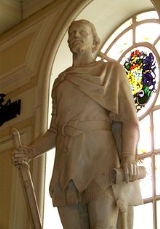
, unveiled a statue to him in
Cardiff City HallCity Hall is a civic building in Cathays Park, Cardiff, Wales. Built of Portland stone, it became the fifth building to serve as Cardiff's centre of local government when it opened in October 1906. The competition to design a town hall and adjacent law courts for Cardiff was won in 1897 by the firm...
and a postcard showing Owain at the
Battle of Mynydd HyddgenThe Battle of Mynydd Hyddgen was part of the Welsh revolt led by Owain Glyndwr against English rule that lasted from 1400 to 1415 and the battle occurred in June 1401...
was sold to raise money for wounded Welsh soldiers. Folk memory in Wales had always held him in high regard and almost every parish has some landmark or story about Owain. However, there is no road sign indicating the scene of one of his greatest battles at Bryn Glas in 1415.
In 1808, the
Royal NavyThe Royal Navy is the naval warfare service branch of the British Armed Forces. Founded in the 16th century, it is the oldest service branch and is known as the Senior Service...
launched a 36-gun
Fifth RateIn Britain's Royal Navy during the classic age of fighting sail, a fifth rate was the penultimate class of warships in a hierarchal system of six "ratings" based on size and firepower.-Rating:...
frigate, which it named the
HMS Owen GlendowerHMS Owen Glendower was a Royal Navy 36-gun fifth-rate Apollo class frigate launched in 1808 and disposed of in 1884...
. She served in the Baltic during the
Gunboat WarThe Gunboat War was the naval conflict between Denmark–Norway and the British Navy during the Napoleonic Wars. The war's name is derived from the Danish tactic of employing small gunboats against the conventional Royal Navy...
where she participated in the seizure of
AnholtAnholt is a Danish island in the Kattegat, midway between Jutland and Sweden, with 171 permanent residents as of 1 January 2010. It is seven miles long and about four miles wide at its widest and covers an area of 21,75 km². Anholt is part of Norddjurs municipality in Region Midtjylland...
Island, and the Channel. Between 1822 and 1824, she served in the
West Africa SquadronThe Royal Navy established the West Africa Squadron at substantial expense in 1808 after Parliament passed the Slave Trade Act of 1807. The squadron's task was to suppress the Atlantic slave trade by patrolling the coast of West Africa...
(or 'Preventative Squadron') chasing down slave ships, capturing at least two.
He is now remembered as a national hero on a par with
King ArthurKing Arthur is a legendary British leader of the late 5th and early 6th centuries, who, according to Medieval histories and romances, led the defence of Britain against Saxon invaders in the early 6th century. The details of Arthur's story are mainly composed of folklore and literary invention, and...
and numerous small groups have adopted his symbolism to advocate independence or nationalism for Wales. For example, during the 1980s, a group calling themselves "
Meibion GlyndŵrMeibion Glyndŵr was a Welsh nationalist movement violently opposed to the loss of Welsh culture and language. They were formed in response to the housing crisis precipitated by large numbers of houses being bought by wealthy English people for use as holiday homes, pushing up house prices beyond...
" claimed responsibility for the burning of English holiday homes in Wales. However, perhaps ironically, Glyndŵr was part English himself. Welsh legend states that when Wales is threatened again he will rise from his unknown resting place in order to lead the defence of Wales, quite like the legend of King Arthur. The creation of the
National Assembly for WalesThe National Assembly for Wales is a devolved assembly with power to make legislation in Wales. The Assembly comprises 60 members, who are known as Assembly Members, or AMs...
brought him back into the spotlight and in 2000 celebrations were held all over Wales to commemorate the 600th anniversary of the rising. Stamps were issued with his likeness and streets, parks, and public squares were named after him throughout Wales. Owain’s personal standard — the quartered arms of Powys and Deheubarth rampant — began to be seen all over Wales, especially at
rugby unionRugby union, often simply referred to as rugby, is a full contact team sport which originated in England in the early 19th century. One of the two codes of rugby football, it is based on running with the ball in hand...
matches against the English. An energetic campaign exists to make 16 September, the date Owain raised his standard, a
national holidayA public holiday, national holiday or legal holiday is a holiday generally established by law and is usually a non-working day during the year....
in Wales. An annual award for achievement in the arts and literature, the
Glyndŵr AwardThe Glyndŵr Award is made for an Outstanding Contribution to the Arts in Wales. It is given by the Machynlleth Tabernacle Trust to pre-eminent figures in music, art and literature in rotation...
, is named after him. In 2007, popular Welsh musicians the
Manic Street PreachersManic Street Preachers are a Welsh alternative rock band, formed in 1986. They are James Dean Bradfield, Nicky Wire, Richey Edwards and Sean Moore. The band are part of the Cardiff music scene, and were at their most prominent during the 1990s...
wrote a song entitled "1404" based on Owain Glyndŵr. The song can be found on the CD single for '
Autumnsong"Autumnsong" is a song by Manic Street Preachers and the second single taken from the album Send Away the Tigers. It was released on 23 July 2007....
'. A statue of Owain Glyndŵr on horseback was installed in 2007 in The Square in
CorwenCorwen is a town and community in the county of Denbighshire in Wales; it was previously part of the county of Meirionnydd). Corwen stands on the banks of the River Dee beneath the Berwyn mountains. The town is situated west of Llangollen and south of Ruthin...
,
DenbighshireDenbighshire is a county in north-east Wales. It is named after the historic county of Denbighshire, but has substantially different borders. Denbighshire has the distinction of being the oldest inhabited part of Wales. Pontnewydd Palaeolithic site has remains of Neanderthals from 225,000 years...
to commemorate his life and his lasting influence on Wales. Also located on the Square in Corwen is the
Owain Glyndwr HotelOwain Glyndwr Hotel is a historical inn in Corwen, Denbighshire, northeastern Wales. It was built in 1329 and is named after the Welsh hero Owain Glyndwr. The hotel was originally a monastery in the grounds of the nearby church and was extended in 1789 to accommodate the Welsh Eisteddfod. At that...
. The waymarked long distance footpath
Glyndŵr's WayGlyndŵr's Way is a long distance footpath in mid Wales. It runs for in an extended loop through Powys between Knighton and Welshpool.- History :...
runs through
Mid WalesMid Wales is the name given to the central region of Wales. The Mid Wales Regional Committee of the National Assembly for Wales covered the counties of Ceredigion and Powys and the area of Gwynedd that had previously been the district of Meirionydd. A similar definition is used by the BBC...
near to his homelands.
In 2008, Glyndŵr University was established in
WrexhamWrexham is a town in Wales. It is the administrative centre of the wider Wrexham County Borough, and the largest town in North Wales, located in the east of the region. It is situated between the Welsh mountains and the lower Dee Valley close to the border with Cheshire, England...
, Wales. Originally established as the Wrexham School of Science and Art in 1887, it was until the name change known as the North East Wales Institute or "NEWI". Glyndŵr was born and lived much of his life around Wrexham and the Welsh Marches.
In 2011
North WalesNorth Wales is the northernmost unofficial region of Wales. It is bordered to the south by the counties of Ceredigion and Powys in Mid Wales and to the east by the counties of Shropshire in the West Midlands and Cheshire in North West England...
Welsh/Gaelic artist Santino Cara
CaernarfonCaernarfon is a Royal town, community and port in Gwynedd, Wales, with a population of 9,611. It lies along the A487 road, on the east banks of the Menai Straits, opposite the Isle of Anglesey. The city of Bangor is to the northeast, while Snowdonia fringes Caernarfon to the east and southeast...
LlandudnoLlandudno is a seaside resort and town in Conwy County Borough, Wales. In the 2001 UK census it had a population of 20,090 including that of Penrhyn Bay and Penrhynside, which are within the Llandudno Community...
painted two depictions of Owain Glyndŵr
William ShakespeareWilliam Shakespeare was an English poet and playwright, widely regarded as the greatest writer in the English language and the world's pre-eminent dramatist. He is often called England's national poet and the "Bard of Avon"...
Henry IVHenry IV may refer to:* Henry IV, Holy Roman Emperor , King of The Romans and Holy Roman Emperor* Henry IV, Duke of Brabant * Henry IV Probus , Duke of Wrocław* Heinrich IV Dusemer von Arfberg Henry IV may refer to:* Henry IV, Holy Roman Emperor (1050–1106), King of The Romans and Holy Roman...
. 1400 and
Y Mab DaroganY Mab Darogan is a messianic figure of Welsh legend, destined to force the Anglo-Saxons out of Britain and reclaim it for its Celtic inhabitants. A number of figures have been called Y Mab Darogan in history...
Son of Prophecy were painted in
LlandudnoLlandudno is a seaside resort and town in Conwy County Borough, Wales. In the 2001 UK census it had a population of 20,090 including that of Penrhyn Bay and Penrhynside, which are within the Llandudno Community...
and were released and unveiled in July 2011 to a world wide audience on the world wide web. Articles featured in the
Daily PostThe Daily Post was a London daily paper founded in 1719 by writer Daniel Defoe. It was printed by J. Meres in the Old Baily, near Ludgate. The post consisted of articles that spoke of current events, important dates, inventions, advances in modern sciences, and other things of that nature and such...
and the North Wales Pioneer.
Glendower Residence, at the
University of Cape TownThe University of Cape Town is a public research university located in Cape Town in the Western Cape province of South Africa. UCT was founded in 1829 as the South African College, and is the oldest university in South Africa and the second oldest extant university in Africa.-History:The roots of...
in South Africa was named after Owain Glyndŵr. The residence was opened in 1993 having previously been the Glendower Hotel. It now houses 139 male and female undergraduate students.
Fiction
As well as in Shakespeare, Glyndŵr, has been featured in a number of works of literature and is the subject of several historical novels, including:
- John Cowper Powys
-Biography:Powys was born in Shirley, Derbyshire, in 1872, the son of the Reverend Charles Francis Powys , who was vicar of Montacute, Somerset for thirty-two years, and Mary Cowper Johnson, a descendent of the poet William Cowper. He came from a family of eleven children, many of whom were also...
: Owen GlendowerOwen Glendower is a historical novel by John Cowper Powys, first published in 1940.-Plot introduction:The book tells the story of the rebellion of Owain Glyndŵr, as seen through the eyes of his young relation, Rhisiart ab Owen of Hereford...
(1940)
- Edith Pargeter
Edith Mary Pargeter, OBE, BEM , also known by her nom de plume Ellis Peters, was a British author of works in many categories, especially history and historical fiction, and was also honoured for her translations of Czech classics; she is probably best known for her murder mysteries, both...
: A Bloody Field by Shrewsbury (1972)
- Rosemary Hawley Jarman
Rosemary Hawley Jarman is an English novelist and writer of short stories. She was born in Worcester April 27, 1935. She was educated first at Saint Mary's Convent and then at The Alice Ottley School, leaving at eighteen to study singing in London for the next three years, having developed a fine...
: Crown in Candlelight (1978)
- Malcolm Pryce
For the footballer, see Malcolm Price.Malcolm Pryce is a British author, mostly known for his noir detective novels.Born in Shrewsbury, England, Pryce moved at the age of nine to Aberystwyth, where he later attended Penglais Comprehensive School before leaving to do some travelling. After working...
: A Dragon to Agincourt - Y Lolfa ISBN 0-86243-684-2
He is also a character in Shakespeare's
Henry IV, Part 1 and was the hero of James Hill's UK TV movie
Owain, Prince of Wales, broadcast in 1983 in the early days of Channel 4/S4C.
He also has a small role as a past Knight of the Word and a ghost who serves the Lady in
Terry BrooksTerence Dean "Terry" Brooks is an American writer of fantasy fiction. He writes mainly epic fantasy, and has also written two movie novelizations. He has written 23 New York Times bestsellers during his writing career, and has over 21 million copies of his books in print...
'
Word/VoidThe Word & Void series by Terry Brooks is a trilogy of dark urban fantasy novels primarily set in Illinois in the late 20th and early 21st century....
trilogy. In the books, he is John Ross' ancestor.
He appeared as an agent of the Light in
Susan CooperSusan Mary Cooper is an English author best known for The Dark Is Rising, an award-winning five-volume saga set in and around England and Wales. The books incorporate traditional British mythology, such as Arthurian and other Welsh elements with original material ; these books were adapted into a...
's book
Silver on the Tree, part of
The Dark is Rising SequenceThe Dark Is Rising is the name of a five-book series of children's contemporary fantasy novels by Susan Cooper, published in 1965–1977, which depicts the struggle between the forces of good, called The Light, and the forces of evil, known as The Dark...
.
For a study of the various ways Glyndŵr has been portrayed in Welsh-language literature of the modern period, see E. Wyn James,
Glyndŵr a Gobaith y Genedl: Agweddau ar y Portread o Owain Glyndŵr yn Llenyddiaeth y Cyfnod Modern (
English: Glyndower and the Hope of the Nation: Attitudes to the Portrait of Owen Glyndower in Modern Age Literature) (Aberystwyth: Cymdeithas Llyfrau Ceredigion, 2007).
A chef takes the name of Glyndŵr in "Gorgon's Wood", an episode of
Jonathan CreekJonathan Creek is a British mystery series produced by the BBC and written by David Renwick. Primarily a crime drama, the show is also peppered with broadly comic touches...
.
External links