

Welsh nationalism

Encyclopedia
Welsh nationalism emphasises the distinctiveness of Welsh language
, culture
, and history
, and calls for more self-determination
for Wales
, which may include more Devolved powers for the Welsh Assembly or full independence
from the United Kingdom
.
 Through most of its history
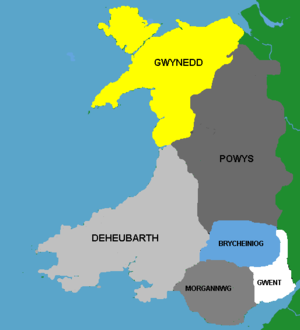
before the Anglo-Norman Conquest, Wales was divided into several kingdoms. From time to time, rulers such as Hywel Dda
and Rhodri the Great
managed to unify many of the kingdoms, but their lands were divided on their deaths. Incursions from the English and Normans
also amplified divisions between the kingdoms. In the 12th century, Norman king Henry II of England
exploited differences between the three most powerful Welsh kingdoms, Gwynedd
, Powys, and Deheubarth, allowing him to make great gains in Wales. He defeated and then allied with Madog ap Maredudd
of Powys in 1157, and used this alliance to overwhelm Owain Gwynedd
. He then turned on Rhys ap Gruffydd
of Deheubarth, who finally submitted to him in 1171, effectively subjugating much of Wales to Henry's Angevin Empire
. By 1282, only Gwynedd stood out, whose ruler was accorded the title Prince of Wales
. Following the defeat of Llywelyn the Last
by Edward I
Wales lost its last independent kingdom and became subject to the English crown, either directly or indirectly. It retained some vestiges of distinction from its neighbour however, retaining the Welsh language
, law
, and culture
.
Until the victory of Henry VII
at Bosworth in 1485, the Welsh on many occasions revolted against English
rule in an attempt to gain their independence. The greatest such revolt was that of Owain Glyndŵr
, who gained popular support in 1400, and defeated an English force at Plynlimon
in 1401. In response, the English parliament passed repressive measures that included denying the Welsh the right of assembly. Glyndŵr was proclaimed Prince of Wales, and sought assistance from Charles VI of France
, but by 1409 his forces were scattered under the attacks of King Henry IV of England
and further repressive measures imposed on the Welsh. Glyndŵr himself vanished, and his final resting place remains a mystery.
kept alive the dream of independence. In what was known as the canu brud (prophetic poetry), the idea of the coming of a messiah
-like figure, known as Y Mab Darogan (The Son of Destiny
), who would not only remove the English yoke but win back the whole of the Great Britain
for the Britons
(i.e. the Welsh). In the Welsh-born Henry VII
the Welsh believed that "the Son of Destiny" had come and there were no more revolts or talk of revolt – the people of Wales became as loyal as any of the King's other subjects.
During the reign of Henry VIII
the Laws in Wales Acts were passed, formally integrating Wales into the English legal system. The repressive measures against the Welsh that had been in place since the revolt of Owain Glyndŵr
over a century earlier were removed. It also gave political representation at the Westminster Parliament for Wales. Wales continues to share a legal identity with England to a large degree as the joint entity known simply as England until 1967 and England and Wales
since then. The laws also finished the partitioning of Wales into counties that was begun in 1282 and established local government on the English model. The laws had the effect of making English
the language to be used for all official purposes, thus effectively excluding non-English speakers from formal office.
On the whole the Welsh who had a way of expressing an opinion welcomed these moves and saw them as further proof that Henry VII and his descendants were the long-awaited sons of destiny and that Wales had regained what it had lost at the conquest of 1282. Patriotism
, or a non-politicised form of nationalism, remained a strong force in Wales with pride in its language, customs and history common amongst all levels of society.
the effects of the French Revolution
were felt in Wales. It brought to the forefront a small minority of Welsh people who sympathised with revolution
ary ideas: people such as Richard Price
(1723–1791), Iolo Morganwg
(1747–1826), and Morgan John Rhys
(1760–1804).
In the meantime, counter-revolutionary ideas flourished amongst the leaders of the Welsh Methodist revival
, but the consequences of turning Wales into a nation with a nonconformist
majority was to create a new sense of Welshness.
and adjoining areas, gave rise to strong and radical
Welsh working class
movements which led to the Merthyr Rising
of 1831, the widespread support for Chartism
, and the Newport Rising
of 1839.
With the establishment of the Presbyterian Church of Wales
nonconformism
triumphed in Wales, and gradually the previously majority of conservative
voices within it allied themselves with the more radical and liberal
voices within the older dissenting churches of the Baptists and Congregationalists
. This radicalism was exemplified by the Congregationalist minister David Rees
of Llanelli
who edited the radical magazine Y Diwygiwr (The Reformer) from 1835 until 1865. But he was not a lone voice: William Rees
(also known as Gwilym Hiraethog) established the radical Yr Amserau (The Times) in 1843, and in the same year Samuel Roberts also established another radical magazine, Y Cronicl (The Chronicle). Both were Congregationalist pastors.
The growth of radicalism and the gradual politicisation of Welsh life did not see any successful attempt to establish a separate political vehicle for promoting Welsh nationalism. But voices did appear within the Liberal Party
, which made great gains in Wales in the nineteenth century with the extension of the franchise
and the tacit support of Welsh nonconformity. An intended independence movement established on the pattern of Young Ireland
, Cymru Fydd
, was established in 1886 but was short lived.
For the majority in Wales, however, the important question was not one of independence or self-government, but of the disestablishment of the Church of England
in Wales. Nevertheless, their non-political nationalism was strong enough to establish national institiutions such as the University of Wales
in 1893, and the National Library of Wales
and the National Museum of Wales in 1907.
" in 1847. The reports found the education system in Wales to be in a dreadful state, although the Commissioners were exclusively English-speaking while the education system was then largely conducted in Welsh. However, they concluded that the Welsh as a people were dirty, ignorant, lazy, drunk, superstitious, lying, and cheating because they were Nonconformists
and spoke Welsh
. Very quickly, because of its blue covers, the report was labelled Brad y Llyfrau Gleision, or in English, "The Treachery of the Blue Books
".
(1822–1898) and Emrys ap Iwan
(1848–1906). Inspired by the Revolutions of 1848
and the growth of Irish nationalism
they saw that Wales was different from England
in having its own language which the majority of its residents spoke and in holding to a nonconformist form of the Christian religion which faced many disabilities in the face of the state church.
 Nationalism grew as an influence in twentieth-century Wales. At various times both the Labour Party
and the Liberal Party
took up the cause of Welsh home rule
, or devolution
. It was with the establishment of Plaid Cymru
(The Party of Wales) in 1925, however that Welsh independence from the UK was first advocated.
The election of a Labour Government in 1997 included a commitment to hold a referendum
on the establishment of a Welsh Assembly. The referendum was narrowly won, with Plaid Cymru, the Liberal Democrats
and much of Welsh civic society
supporting the Labour Government's proposals.
A 2007 survey by BBC Wales Newsnight found that 20% of Welsh people surveyed favoured Wales becoming independent of the United Kingdom.
The Archbishop of Wales
, Dr Barry Morgan
renewed his call, in 2009, for the National Assembly
to be granted full law-making powers,
calling for a 'greater degree of self-determination' for Wales.
was founded in the 1920s by Saunders Lewis
and existing organisations Byddin Ymreolwyr Cymru and Y Mudiad Cymreig. Plaid Cymru returned its first Member of Parliament
, Gwynfor Evans
, in 1966 in the Carmarthen by-election
, and today has three such representatives, along with fifteen Members of the 60 strong Welsh Assembly. Traditionally, support for the party is concentrated in rural Welsh-speaking areas of north and west Wales, whence all its MPs hail. In the late 1960s and 1990s the party enjoyed brief surges in support.
movement, Y Gweriniaethwyr (The Republicans), were the first to use violence when they made an unsuccessful attempt to blow up a pipeline
leading from the Claerwen dam in mid Wales
to Birmingham
.
In the 1960s two movements were established in protest against the drowning of the Tryweryn valley and the 1969 investiture of Charles, Prince of Wales
: Mudiad Amddiffyn Cymru
('Movement for the Defence of Wales', also known as MAC) and the "Free Wales Army
" (also known as FWA, in Welsh Byddin Rhyddid Cymru). MAC were responsible for numerous bombing attacks on water pipelines and power lines
across Wales. On the eve of the investiture two members of MAC, Alwyn Jones and George Taylor, died as the bomb they were planting on the railway line to be used by the Royal Train
exploded.
The late 1970s and the 1980s saw an organisation calling itself Meibion Glyndŵr
(the sons of Glyndŵr) responsible for a spate of arson
attacks against holiday homes throughout Wales. In the 1970s, a Welsh Socialist Republican Army arose, whose initials in Welsh spelt out the English word "DAWN".
Welsh language
Welsh is a member of the Brythonic branch of the Celtic languages spoken natively in Wales, by some along the Welsh border in England, and in Y Wladfa...
, culture
Culture of Wales
Wales has a distinctive culture including its own language, customs, holidays and music.Wales is primarily represented by the symbol of the red Welsh Dragon, but other national emblems include the leek and daffodil. The Welsh words for leeks and daffodils Wales has a distinctive culture including...
, and history
History of Wales
The history of Wales begins with the arrival of human beings in the region thousands of years ago. Neanderthals lived in what is now Wales, or Cymru in Welsh, at least 230,000 years ago, while Homo sapiens arrived by about 29,000 years ago...
, and calls for more self-determination
Self-determination
Self-determination is the principle in international law that nations have the right to freely choose their sovereignty and international political status with no external compulsion or external interference...
for Wales
Wales
Wales is a country that is part of the United Kingdom and the island of Great Britain, bordered by England to its east and the Atlantic Ocean and Irish Sea to its west. It has a population of three million, and a total area of 20,779 km²...
, which may include more Devolved powers for the Welsh Assembly or full independence
Welsh independence
Welsh independence is a political ideal advocated by some people in Wales that would see Wales secede from the United Kingdom and become an independent sovereign state. This ideology is promoted mainly by the Welsh nationalist party, Plaid Cymru.-History:...
from the United Kingdom
United Kingdom
The United Kingdom of Great Britain and Northern IrelandIn the United Kingdom and Dependencies, other languages have been officially recognised as legitimate autochthonous languages under the European Charter for Regional or Minority Languages...
.
Conquest
History of Wales
The history of Wales begins with the arrival of human beings in the region thousands of years ago. Neanderthals lived in what is now Wales, or Cymru in Welsh, at least 230,000 years ago, while Homo sapiens arrived by about 29,000 years ago...
before the Anglo-Norman Conquest, Wales was divided into several kingdoms. From time to time, rulers such as Hywel Dda
Hywel Dda
Hywel Dda , was the well-thought-of king of Deheubarth in south-west Wales, who eventually came to rule Wales from Prestatyn to Pembroke. As a descendant of Rhodri Mawr, through his father Cadell, Hywel was a member of the Dinefwr branch of the dynasty and is also named Hywel ap Cadell...
and Rhodri the Great
Rhodri the Great
Rhodri the Great was King of Gwynedd from 844 until his death. He was the first Welsh ruler to be called 'Great', and the first to rule most of present-day Wales...
managed to unify many of the kingdoms, but their lands were divided on their deaths. Incursions from the English and Normans
Normans
The Normans were the people who gave their name to Normandy, a region in northern France. They were descended from Norse Viking conquerors of the territory and the native population of Frankish and Gallo-Roman stock...
also amplified divisions between the kingdoms. In the 12th century, Norman king Henry II of England
Henry II of England
Henry II ruled as King of England , Count of Anjou, Count of Maine, Duke of Normandy, Duke of Aquitaine, Duke of Gascony, Count of Nantes, Lord of Ireland and, at various times, controlled parts of Wales, Scotland and western France. Henry, the great-grandson of William the Conqueror, was the...
exploited differences between the three most powerful Welsh kingdoms, Gwynedd
Kingdom of Gwynedd
Gwynedd was one petty kingdom of several Welsh successor states which emerged in 5th-century post-Roman Britain in the Early Middle Ages, and later evolved into a principality during the High Middle Ages. It was based on the former Brythonic tribal lands of the Ordovices, Gangani, and the...
, Powys, and Deheubarth, allowing him to make great gains in Wales. He defeated and then allied with Madog ap Maredudd
Madog ap Maredudd
Madog ap Maredudd was the last Prince of the entire Kingdom of Powys, Wales and for a time held the Fitzalan Lordship of Oswestry.Madog was the son of Maredudd ap Bleddyn and grandson of Bleddyn ap Cynfyn. He followed his father on the throne of Powys in 1132...
of Powys in 1157, and used this alliance to overwhelm Owain Gwynedd
Owain Gwynedd
Owain Gwynedd ap Gruffydd , in English also known as Owen the Great, was King of Gwynedd from 1137 until his death in 1170. He is occasionally referred to as "Owain I of Gwynedd"; and as "Owain I of Wales" on account of his claim to be King of Wales. He is considered to be the most successful of...
. He then turned on Rhys ap Gruffydd
Rhys ap Gruffydd
Rhys ap Gruffydd or ap Gruffudd was the ruler of the kingdom of Deheubarth in south Wales. He is commonly known as The Lord Rhys, in Welsh Yr Arglwydd Rhys, but this title may not have been used in his lifetime...
of Deheubarth, who finally submitted to him in 1171, effectively subjugating much of Wales to Henry's Angevin Empire
Angevin Empire
The term Angevin Empire is a modern term describing the collection of states once ruled by the Angevin Plantagenet dynasty.The Plantagenets ruled over an area stretching from the Pyrenees to Ireland during the 12th and early 13th centuries, located north of Moorish Iberia. This "empire" extended...
. By 1282, only Gwynedd stood out, whose ruler was accorded the title Prince of Wales
Prince of Wales
Prince of Wales is a title traditionally granted to the heir apparent to the reigning monarch of the United Kingdom of Great Britain and Northern Ireland and the 15 other independent Commonwealth realms...
. Following the defeat of Llywelyn the Last
Llywelyn the Last
Llywelyn ap Gruffydd or Llywelyn Ein Llyw Olaf , sometimes rendered as Llywelyn II, was the last prince of an independent Wales before its conquest by Edward I of England....
by Edward I
Edward I of England
Edward I , also known as Edward Longshanks and the Hammer of the Scots, was King of England from 1272 to 1307. The first son of Henry III, Edward was involved early in the political intrigues of his father's reign, which included an outright rebellion by the English barons...
Wales lost its last independent kingdom and became subject to the English crown, either directly or indirectly. It retained some vestiges of distinction from its neighbour however, retaining the Welsh language
Welsh language
Welsh is a member of the Brythonic branch of the Celtic languages spoken natively in Wales, by some along the Welsh border in England, and in Y Wladfa...
, law
Welsh law
Welsh law was the system of law practised in Wales before the 16th century. According to tradition it was first codified by Hywel Dda during the period between 942 and 950 when he was king of most of Wales; as such it is usually called Cyfraith Hywel, the Law of Hywel, in Welsh...
, and culture
Culture of Wales
Wales has a distinctive culture including its own language, customs, holidays and music.Wales is primarily represented by the symbol of the red Welsh Dragon, but other national emblems include the leek and daffodil. The Welsh words for leeks and daffodils Wales has a distinctive culture including...
.
Until the victory of Henry VII
Henry VII of England
Henry VII was King of England and Lord of Ireland from his seizing the crown on 22 August 1485 until his death on 21 April 1509, as the first monarch of the House of Tudor....
at Bosworth in 1485, the Welsh on many occasions revolted against English
England
England is a country that is part of the United Kingdom. It shares land borders with Scotland to the north and Wales to the west; the Irish Sea is to the north west, the Celtic Sea to the south west, with the North Sea to the east and the English Channel to the south separating it from continental...
rule in an attempt to gain their independence. The greatest such revolt was that of Owain Glyndŵr
Owain Glyndwr
Owain Glyndŵr , or Owain Glyn Dŵr, anglicised by William Shakespeare as Owen Glendower , was a Welsh ruler and the last native Welshman to hold the title Prince of Wales...
, who gained popular support in 1400, and defeated an English force at Plynlimon
Plynlimon
Plynlimon is the highest point of the Cambrian Mountains in Wales, and the highest point in Mid Wales. It is a massif that dominates the countryside of northern Ceredigion....
in 1401. In response, the English parliament passed repressive measures that included denying the Welsh the right of assembly. Glyndŵr was proclaimed Prince of Wales, and sought assistance from Charles VI of France
Charles VI of France
Charles VI , called the Beloved and the Mad , was the King of France from 1380 to 1422, as a member of the House of Valois. His bouts with madness, which seem to have begun in 1392, led to quarrels among the French royal family, which were exploited by the neighbouring powers of England and Burgundy...
, but by 1409 his forces were scattered under the attacks of King Henry IV of England
Henry IV of England
Henry IV was King of England and Lord of Ireland . He was the ninth King of England of the House of Plantagenet and also asserted his grandfather's claim to the title King of France. He was born at Bolingbroke Castle in Lincolnshire, hence his other name, Henry Bolingbroke...
and further repressive measures imposed on the Welsh. Glyndŵr himself vanished, and his final resting place remains a mystery.
Annexation
Throughout the period of conquest the Welsh poetsWelsh poetry
Welsh poetry may refer to poetry in the Welsh language, Anglo-Welsh poetry, or other poetry written in Wales or by Welsh poets.-History:Wales has one of the earliest literary traditions in Northern Europe, stretching back to the days of Aneirin Welsh poetry may refer to poetry in the Welsh...
kept alive the dream of independence. In what was known as the canu brud (prophetic poetry), the idea of the coming of a messiah
Messiah
A messiah is a redeemer figure expected or foretold in one form or another by a religion. Slightly more widely, a messiah is any redeemer figure. Messianic beliefs or theories generally relate to eschatological improvement of the state of humanity or the world, in other words the World to...
-like figure, known as Y Mab Darogan (The Son of Destiny
Destiny
Destiny or fate refers to a predetermined course of events. It may be conceived as a predetermined future, whether in general or of an individual...
), who would not only remove the English yoke but win back the whole of the Great Britain
Great Britain
Great Britain or Britain is an island situated to the northwest of Continental Europe. It is the ninth largest island in the world, and the largest European island, as well as the largest of the British Isles...
for the Britons
Britons (historical)
The Britons were the Celtic people culturally dominating Great Britain from the Iron Age through the Early Middle Ages. They spoke the Insular Celtic language known as British or Brythonic...
(i.e. the Welsh). In the Welsh-born Henry VII
Henry VII of England
Henry VII was King of England and Lord of Ireland from his seizing the crown on 22 August 1485 until his death on 21 April 1509, as the first monarch of the House of Tudor....
the Welsh believed that "the Son of Destiny" had come and there were no more revolts or talk of revolt – the people of Wales became as loyal as any of the King's other subjects.
During the reign of Henry VIII
Henry VIII of England
Henry VIII was King of England from 21 April 1509 until his death. He was Lord, and later King, of Ireland, as well as continuing the nominal claim by the English monarchs to the Kingdom of France...
the Laws in Wales Acts were passed, formally integrating Wales into the English legal system. The repressive measures against the Welsh that had been in place since the revolt of Owain Glyndŵr
Owain Glyndwr
Owain Glyndŵr , or Owain Glyn Dŵr, anglicised by William Shakespeare as Owen Glendower , was a Welsh ruler and the last native Welshman to hold the title Prince of Wales...
over a century earlier were removed. It also gave political representation at the Westminster Parliament for Wales. Wales continues to share a legal identity with England to a large degree as the joint entity known simply as England until 1967 and England and Wales
England and Wales
England and Wales is a jurisdiction within the United Kingdom. It consists of England and Wales, two of the four countries of the United Kingdom...
since then. The laws also finished the partitioning of Wales into counties that was begun in 1282 and established local government on the English model. The laws had the effect of making English
English language
English is a West Germanic language that arose in the Anglo-Saxon kingdoms of England and spread into what was to become south-east Scotland under the influence of the Anglian medieval kingdom of Northumbria...
the language to be used for all official purposes, thus effectively excluding non-English speakers from formal office.
On the whole the Welsh who had a way of expressing an opinion welcomed these moves and saw them as further proof that Henry VII and his descendants were the long-awaited sons of destiny and that Wales had regained what it had lost at the conquest of 1282. Patriotism
Patriotism
Patriotism is a devotion to one's country, excluding differences caused by the dependencies of the term's meaning upon context, geography and philosophy...
, or a non-politicised form of nationalism, remained a strong force in Wales with pride in its language, customs and history common amongst all levels of society.
Revolutionary ideas
Along with the rest of EuropeEurope
Europe is, by convention, one of the world's seven continents. Comprising the westernmost peninsula of Eurasia, Europe is generally 'divided' from Asia to its east by the watershed divides of the Ural and Caucasus Mountains, the Ural River, the Caspian and Black Seas, and the waterways connecting...
the effects of the French Revolution
French Revolution
The French Revolution , sometimes distinguished as the 'Great French Revolution' , was a period of radical social and political upheaval in France and Europe. The absolute monarchy that had ruled France for centuries collapsed in three years...
were felt in Wales. It brought to the forefront a small minority of Welsh people who sympathised with revolution
Revolution
A revolution is a fundamental change in power or organizational structures that takes place in a relatively short period of time.Aristotle described two types of political revolution:...
ary ideas: people such as Richard Price
Richard Price
Richard Price was a British moral philosopher and preacher in the tradition of English Dissenters, and a political pamphleteer, active in radical, republican, and liberal causes such as the American Revolution. He fostered connections between a large number of people, including writers of the...
(1723–1791), Iolo Morganwg
Iolo Morganwg
Edward Williams, better known by his bardic name Iolo Morganwg , was an influential Welsh antiquarian, poet, collector, and literary forger. He was widely considered a leading collector and expert on medieval Welsh literature in his day, but after his death it was revealed that he had forged a...
(1747–1826), and Morgan John Rhys
Morgan John Rhys
Morgan John Rhys was a Baptist minister who preached the principles of the French Revolution, against slavery, and in favour of the reform of parliament....
(1760–1804).
In the meantime, counter-revolutionary ideas flourished amongst the leaders of the Welsh Methodist revival
Welsh Methodist revival
The Welsh Methodist revival was an evangelical revival that revitalised Christianity in Wales during the 18th century. Methodist preachers such as Griffith Jones, William Williams and Howell Harris were such powerful speakers that they converted thousands of people back to the church...
, but the consequences of turning Wales into a nation with a nonconformist
Nonconformism
Nonconformity is the refusal to "conform" to, or follow, the governance and usages of the Church of England by the Protestant Christians of England and Wales.- Origins and use:...
majority was to create a new sense of Welshness.
Nineteenth century
The rapid industrialisation of parts of Wales, especially Merthyr TydfilMerthyr Tydfil
Merthyr Tydfil is a town in Wales, with a population of about 30,000. Although once the largest town in Wales, it is now ranked as the 15th largest urban area in Wales. It also gives its name to a county borough, which has a population of around 55,000. It is located in the historic county of...
and adjoining areas, gave rise to strong and radical
Radicalism (historical)
The term Radical was used during the late 18th century for proponents of the Radical Movement. It later became a general pejorative term for those favoring or seeking political reforms which include dramatic changes to the social order...
Welsh working class
Working class
Working class is a term used in the social sciences and in ordinary conversation to describe those employed in lower tier jobs , often extending to those in unemployment or otherwise possessing below-average incomes...
movements which led to the Merthyr Rising
Merthyr Rising 1831
The Merthyr Rising of 1831 was the violent climax to many years of simmering unrest among the large working class population of Merthyr Tydfil in South Wales and the surrounding area....
of 1831, the widespread support for Chartism
Chartism
Chartism was a movement for political and social reform in the United Kingdom during the mid-19th century, between 1838 and 1859. It takes its name from the People's Charter of 1838. Chartism was possibly the first mass working class labour movement in the world...
, and the Newport Rising
Newport Rising
The Newport Rising was the last large-scale armed rebellion against authority in mainland Britain, when on 4 November 1839, somewhere between 1,000 and 5,000 Chartist sympathisers, including many coal-miners, most with home-made arms, led by John Frost, marched on the town of Newport,...
of 1839.
With the establishment of the Presbyterian Church of Wales
Presbyterian Church of Wales
The Presbyterian Church of Wales , also known as The Calvinistic Methodist Church , is a denomination of Protestant Christianity. It was born out of the Welsh Methodist revival and the preaching of Hywel Harris Howell Harris in the 18th century and seceded from the Church of England in 1811...
nonconformism
Nonconformism
Nonconformity is the refusal to "conform" to, or follow, the governance and usages of the Church of England by the Protestant Christians of England and Wales.- Origins and use:...
triumphed in Wales, and gradually the previously majority of conservative
Conservatism
Conservatism is a political and social philosophy that promotes the maintenance of traditional institutions and supports, at the most, minimal and gradual change in society. Some conservatives seek to preserve things as they are, emphasizing stability and continuity, while others oppose modernism...
voices within it allied themselves with the more radical and liberal
Liberalism
Liberalism is the belief in the importance of liberty and equal rights. Liberals espouse a wide array of views depending on their understanding of these principles, but generally, liberals support ideas such as constitutionalism, liberal democracy, free and fair elections, human rights,...
voices within the older dissenting churches of the Baptists and Congregationalists
Congregational church
Congregational churches are Protestant Christian churches practicing Congregationalist church governance, in which each congregation independently and autonomously runs its own affairs....
. This radicalism was exemplified by the Congregationalist minister David Rees
David Rees (Y Cynhyrfwr)
The Reverend David Rees was a Welsh Congregational minister of Capel Als chapel Llanelli, Carmarthenshire, and an editor of a radical Welsh language Nonconformist periodical titled Y Diwygiwr [The Reformer]...
of Llanelli
Llanelli
Llanelli , the largest town in both the county of Carmarthenshire and the preserved county of Dyfed , Wales, sits on the Loughor estuary on the West Wales coast, approximately west-north-west of Swansea and south-east of the county town, Carmarthen. The town is famous for its proud rugby...
who edited the radical magazine Y Diwygiwr (The Reformer) from 1835 until 1865. But he was not a lone voice: William Rees
William Rees (Gwilym Hiraethog)
The Rev. William Rees , usually known in Wales by his bardic name of Gwilym Hiraethog, was a Welsh poet and author, one of the major figures of Welsh literature during the 19th century....
(also known as Gwilym Hiraethog) established the radical Yr Amserau (The Times) in 1843, and in the same year Samuel Roberts also established another radical magazine, Y Cronicl (The Chronicle). Both were Congregationalist pastors.
The growth of radicalism and the gradual politicisation of Welsh life did not see any successful attempt to establish a separate political vehicle for promoting Welsh nationalism. But voices did appear within the Liberal Party
Liberal Party (UK)
The Liberal Party was one of the two major political parties of the United Kingdom during the 19th and early 20th centuries. It was a third party of negligible importance throughout the latter half of the 20th Century, before merging with the Social Democratic Party in 1988 to form the present day...
, which made great gains in Wales in the nineteenth century with the extension of the franchise
Suffrage
Suffrage, political franchise, or simply the franchise, distinct from mere voting rights, is the civil right to vote gained through the democratic process...
and the tacit support of Welsh nonconformity. An intended independence movement established on the pattern of Young Ireland
Young Ireland
Young Ireland was a political, cultural and social movement of the mid-19th century. It led changes in Irish nationalism, including an abortive rebellion known as the Young Irelander Rebellion of 1848. Many of the latter's leaders were tried for sedition and sentenced to penal transportation to...
, Cymru Fydd
Cymru Fydd
The Cymru Fydd movement was founded in 1886 by some of the London Welsh, including J. E. Lloyd, O. M. Edwards, T. E. Ellis , Beriah Gwynfe Evans and Alfred Thomas. Initially it was a purely London-based society, later expanding to cities in England with a large Welsh population...
, was established in 1886 but was short lived.
For the majority in Wales, however, the important question was not one of independence or self-government, but of the disestablishment of the Church of England
Church of England
The Church of England is the officially established Christian church in England and the Mother Church of the worldwide Anglican Communion. The church considers itself within the tradition of Western Christianity and dates its formal establishment principally to the mission to England by St...
in Wales. Nevertheless, their non-political nationalism was strong enough to establish national institiutions such as the University of Wales
University of Wales
The University of Wales was a confederal university founded in 1893. It had accredited institutions throughout Wales, and formerly accredited courses in Britain and abroad, with over 100,000 students, but in October 2011, after a number of scandals, it withdrew all accreditation, and it was...
in 1893, and the National Library of Wales
National Library of Wales
The National Library of Wales , Aberystwyth, is the national legal deposit library of Wales; one of the Welsh Government sponsored bodies.Welsh is its main medium of communication...
and the National Museum of Wales in 1907.
Treachery of the Blue Books
This feeling of difference was exacerbated by the results of the publication of the "Reports of the commissioners of enquiry into the state of education in WalesEducation in Wales
Education in Wales differs in certain respects from education elsewhere in the United Kingdom. For example, a significant number of students all over Wales are educated either wholly or largely through the medium of Welsh: in 2008/09, 22 per cent of classes in maintained primary schools used Welsh...
" in 1847. The reports found the education system in Wales to be in a dreadful state, although the Commissioners were exclusively English-speaking while the education system was then largely conducted in Welsh. However, they concluded that the Welsh as a people were dirty, ignorant, lazy, drunk, superstitious, lying, and cheating because they were Nonconformists
Nonconformism
Nonconformity is the refusal to "conform" to, or follow, the governance and usages of the Church of England by the Protestant Christians of England and Wales.- Origins and use:...
and spoke Welsh
Welsh language
Welsh is a member of the Brythonic branch of the Celtic languages spoken natively in Wales, by some along the Welsh border in England, and in Y Wladfa...
. Very quickly, because of its blue covers, the report was labelled Brad y Llyfrau Gleision, or in English, "The Treachery of the Blue Books
Treachery of the Blue Books
The Treachery of the Blue Books or Treason of the Blue Books was the name given in Wales to the Reports of the commissioners of enquiry into the state of education in Wales published in 1847. The term Brad y Llyfrau Gleision was coined by the author R. J...
".
Influence of European nationalism
Two nineteenth-century figures are associated with the beginnings of Welsh nationalism in the specific political sense, Michael D. JonesMichael D. Jones
Michael Daniel Jones was a Welsh Congregationalist minister and principal of a theological college, but is best remembered as a founder of the Welsh settlement in Patagonia known as Y Wladfa and as one of the fathers of modern Welsh nationalism.Jones was born in Llanuwchllyn, Merioneth in 1822...
(1822–1898) and Emrys ap Iwan
Emrys ap Iwan
Emrys Ap-Iwan , was born Robert Ambrose Jones in Abergele, Conwy . He was a literary critic and writer on politics and religion. He is often seen as one of the most important forerunners of modern Welsh nationalism.Emrys was the son of a gardener who was employed on a nearby estate...
(1848–1906). Inspired by the Revolutions of 1848
Revolutions of 1848
The European Revolutions of 1848, known in some countries as the Spring of Nations, Springtime of the Peoples or the Year of Revolution, were a series of political upheavals throughout Europe in 1848. It was the first Europe-wide collapse of traditional authority, but within a year reactionary...
and the growth of Irish nationalism
Irish nationalism
Irish nationalism manifests itself in political and social movements and in sentiment inspired by a love for Irish culture, language and history, and as a sense of pride in Ireland and in the Irish people...
they saw that Wales was different from England
England
England is a country that is part of the United Kingdom. It shares land borders with Scotland to the north and Wales to the west; the Irish Sea is to the north west, the Celtic Sea to the south west, with the North Sea to the east and the English Channel to the south separating it from continental...
in having its own language which the majority of its residents spoke and in holding to a nonconformist form of the Christian religion which faced many disabilities in the face of the state church.
20th and 21st centuries
Wales Labour Party
Welsh Labour is the part of the United Kingdom Labour Party that operates in Wales. Labour is the largest and most successful political party in modern Welsh politics, having won the largest share of the vote at every UK General Election since 1922, every Welsh Assembly election since 1999, and...
and the Liberal Party
Liberal Party (UK)
The Liberal Party was one of the two major political parties of the United Kingdom during the 19th and early 20th centuries. It was a third party of negligible importance throughout the latter half of the 20th Century, before merging with the Social Democratic Party in 1988 to form the present day...
took up the cause of Welsh home rule
Home rule
Home rule is the power of a constituent part of a state to exercise such of the state's powers of governance within its own administrative area that have been devolved to it by the central government....
, or devolution
Devolution
Devolution is the statutory granting of powers from the central government of a sovereign state to government at a subnational level, such as a regional, local, or state level. Devolution can be mainly financial, e.g. giving areas a budget which was formerly administered by central government...
. It was with the establishment of Plaid Cymru
Plaid Cymru
' is a political party in Wales. It advocates the establishment of an independent Welsh state within the European Union. was formed in 1925 and won its first seat in 1966...
(The Party of Wales) in 1925, however that Welsh independence from the UK was first advocated.
The election of a Labour Government in 1997 included a commitment to hold a referendum
Wales referendum, 1997
The 1979 referendum had been such a resounding defeat that it killed off any prospects of devolution for Wales for a generation. Although the Welsh Liberal Party and Plaid Cymru became committed to a Welsh parliament by 1983 it was not until 1992 that a Welsh Assembly with executive powers was put...
on the establishment of a Welsh Assembly. The referendum was narrowly won, with Plaid Cymru, the Liberal Democrats
Liberal Democrats
The Liberal Democrats are a social liberal political party in the United Kingdom which supports constitutional and electoral reform, progressive taxation, wealth taxation, human rights laws, cultural liberalism, banking reform and civil liberties .The party was formed in 1988 by a merger of the...
and much of Welsh civic society
Civil society
Civil society is composed of the totality of many voluntary social relationships, civic and social organizations, and institutions that form the basis of a functioning society, as distinct from the force-backed structures of a state , the commercial institutions of the market, and private criminal...
supporting the Labour Government's proposals.
A 2007 survey by BBC Wales Newsnight found that 20% of Welsh people surveyed favoured Wales becoming independent of the United Kingdom.
The Archbishop of Wales
Archbishop of Wales
The post of Archbishop of Wales was created in 1920 when the Church in Wales was separated from the Church of England , and disestablished...
, Dr Barry Morgan
Barry Morgan
Barry Cennydd Morgan has been the Archbishop of the Church in Wales since 2003.-Early life:Morgan was born in Gwaun-Cae-Gurwen, Neath Port Talbot and studied history at University College, London and theology at Selwyn College, Cambridge...
renewed his call, in 2009, for the National Assembly
National Assembly for Wales
The National Assembly for Wales is a devolved assembly with power to make legislation in Wales. The Assembly comprises 60 members, who are known as Assembly Members, or AMs...
to be granted full law-making powers,
calling for a 'greater degree of self-determination' for Wales.
Plaid Cymru
Plaid CymruPlaid Cymru
' is a political party in Wales. It advocates the establishment of an independent Welsh state within the European Union. was formed in 1925 and won its first seat in 1966...
was founded in the 1920s by Saunders Lewis
Saunders Lewis
Saunders Lewis was a Welsh poet, dramatist, historian, literary critic, and political activist. He was a prominent Welsh nationalist and a founder of the Welsh National Party...
and existing organisations Byddin Ymreolwyr Cymru and Y Mudiad Cymreig. Plaid Cymru returned its first Member of Parliament
Member of Parliament
A Member of Parliament is a representative of the voters to a :parliament. In many countries with bicameral parliaments, the term applies specifically to members of the lower house, as upper houses often have a different title, such as senate, and thus also have different titles for its members,...
, Gwynfor Evans
Gwynfor Evans
Dr Richard Gwynfor Evans , was a Welsh politician, lawyer and author. President of Plaid Cymru for thirty six years, he was the first Member of Parliament to represent Plaid Cymru at Westminster ....
, in 1966 in the Carmarthen by-election
Carmarthen by-election, 1966
The Carmarthen by-election, was held in Carmarthen, Wales on 14 July 1966. The contest was significant in that it resulted in the election of Gwynfor Evans, the first ever Plaid Cymru Member of Parliament...
, and today has three such representatives, along with fifteen Members of the 60 strong Welsh Assembly. Traditionally, support for the party is concentrated in rural Welsh-speaking areas of north and west Wales, whence all its MPs hail. In the late 1960s and 1990s the party enjoyed brief surges in support.
Other nationalist parties and movements
- Cymru GochCymru GochCymru Goch was a left wing nationalist organisation in Wales. It was founded in 1987 and fought for what it described as a Free Socialist Wales...
("Red Wales" or "Welsh Socialists"). Cymru Goch was founded in 1987 to fight for a free and socialist Wales. It published the monthly magazine Y Faner Goch (The Red Flag). In 2003, it became part of Forward Wales. - Cymru AnnibynnolCymru AnnibynnolCymru Annibynnol, the Independent Wales Party is a small political party operating in Wales. They were formed as a splinter from Plaid Cymru in January 2000, when that party's leader Ieuan Wyn Jones distanced Plaid from supporting Welsh independence....
(Independent Wales). A political party founded in 2000 by some former members of Plaid CymruPlaid Cymru' is a political party in Wales. It advocates the establishment of an independent Welsh state within the European Union. was formed in 1925 and won its first seat in 1966...
under the leadership of John Humphries, a former journalist and editor of the Western Mail. The party fought the 2003 National Assembly elections by putting up candidates for the regional seats. Shortly after the election they dissolved. The main reason for its existence was unhappiness with the level of Plaid Cymru's commitment to independence. - Cymdeithas yr Iaith Gymraeg (The Welsh Language Society). Established in 1962 by members of Plaid Cymru, it is a pressure group campaigning for Welsh language rights. It uses non-violent direct action in its campaigning, and sees itself as part of the global resistance movement.
- CymunedCymunedCymuned is a Welsh communities pressure group. Established in 2001, the group campaigns on behalf of local communities in Wales, particularly Welsh-speaking and rural ones, which it perceives to be under threat due to demographic change.Cymuned has campaigned on issues of housing, incomers, and...
(Community). A pressure group campaigning for Welsh language rights established in 2001, it mainly concentrates its efforts in the western parts of Wales where Welsh is the main community language. Also sees itself as part of global movements for the rights of indigenous peoplesIndigenous rightsIndigenous rights are those rights that exist in recognition of the specific condition of the indigenous peoples. This includes not only the most basic human rights of physical survival and integrity, but also the preservation of their land, language, religion and other elements of cultural...
. - Cymdeithas Cyfamod y Cymry Rhydd (The Society of the Covenant of the Free WelshSociety of the Covenant of the Free WelshThe Society of the Covenant of the Free Welsh was established in 1987 because of unhappiness with the level of Plaid Cymru's commitment to independence for Wales. They achieved publicity by producing their own Welsh passports....
). Established in 1987, again because of unhappiness with the level of Plaid Cymru's commitment to independence. They achieved publicity by producing their own Welsh passportPassportA passport is a document, issued by a national government, which certifies, for the purpose of international travel, the identity and nationality of its holder. The elements of identity are name, date of birth, sex, and place of birth....
s. - Mudiad AdferMudiad AdferMudiad Adfer was a splinter group of Cymdeithas yr Iaith Gymraeg in the 1970s. Taking its Welsh-only philosophy from the works and teachings of Owain Owain and Emyr Llewelyn, it believed in the creation of "Y Fro Gymraeg" - a monoglot region based on the existing Welsh language heartlands in the...
was a splinter group of Cymdeithas yr Iaith Gymraeg (the Welsh language Society) in the 1970s. Taking its Welsh-only philosophy from the works and teachings of Owain OwainOwain OwainOwain Owain was a Welsh novelist, short story writer and poet. He also founded Tafod y Ddraig which became the Welsh Language Society's main voice from its birth in the 1960s to the present day....
and Emyr LlewelynEmyr LlewelynEmyr Llewelyn Jones is a Welsh political activist, who was active during the 1960s and 1970s. Mudiad Adfer was established based on his philosophies, and those of Owain Owain and Professor J. R. Jones. Commonly known as Emyr Llewelyn, he is also known as Emyr Llew. He is the son of author and poet T...
, it believed in the creation of "Y Fro Gymraeg" - a monoglot region based on the existing Welsh language heartlands in the west of Wales. Adfer slowly disappeared from the scene in the late 1980s. - Mudiad Rhyddhad Cymru (Cymru Liberation Movement): A meeting took place in Flintshire on 10 January 2004 between representatives of Balchder CymruBalchder CymruBalchder Cymru is a Welsh political campaigning group first formed in 2000. It was led by Dennis Coslett as a figurehead. A meeting took place in Flintshire on 10 January 2004 between representatives of Balchder Cymru, Cymru 1400, Medi 16, and the RDM...
, Cymru 1400, Medi 16, and the RDMRDMThe abbreviation RDM may refer to:* Radar Doppler Multifunction, a stopgap radar for the Mirage 2000 French fighter, also known as the Cyrano 5, an evolution of the Cyrano 4 used on the older Mirage F-1* Radarman, a former rank of the U.S...
. It was agreed during the meeting that all four organisations should amalgamate to form a stronger nationalist / republican movement. It is believed that such a move will strengthen the struggle for an independent Welsh republic. The new movement has been named 'Mudiad Rhyddhad Cymru' (MRC). Aims: a. To campaign for an independent Welsh republic; b. To defend Cymru, its language and culture.
Violent nationalism
Though mainstream nationalism in Wales has been constitutional, there have been violent movements associated with it. In 1952 a small republicanRepublicanism
Republicanism is the ideology of governing a nation as a republic, where the head of state is appointed by means other than heredity, often elections. The exact meaning of republicanism varies depending on the cultural and historical context...
movement, Y Gweriniaethwyr (The Republicans), were the first to use violence when they made an unsuccessful attempt to blow up a pipeline
Pipeline transport
Pipeline transport is the transportation of goods through a pipe. Most commonly, liquids and gases are sent, but pneumatic tubes that transport solid capsules using compressed air are also used....
leading from the Claerwen dam in mid Wales
Mid Wales
Mid Wales is the name given to the central region of Wales. The Mid Wales Regional Committee of the National Assembly for Wales covered the counties of Ceredigion and Powys and the area of Gwynedd that had previously been the district of Meirionydd. A similar definition is used by the BBC...
to Birmingham
Birmingham
Birmingham is a city and metropolitan borough in the West Midlands of England. It is the most populous British city outside the capital London, with a population of 1,036,900 , and lies at the heart of the West Midlands conurbation, the second most populous urban area in the United Kingdom with a...
.
In the 1960s two movements were established in protest against the drowning of the Tryweryn valley and the 1969 investiture of Charles, Prince of Wales
Charles, Prince of Wales
Prince Charles, Prince of Wales is the heir apparent and eldest son of Queen Elizabeth II and Prince Philip, Duke of Edinburgh. Since 1958 his major title has been His Royal Highness The Prince of Wales. In Scotland he is additionally known as The Duke of Rothesay...
: Mudiad Amddiffyn Cymru
Mudiad Amddiffyn Cymru
Mudiad Amddiffyn Cymru , abbreviated as MAC, was a paramilitary Welsh nationalist organisation, which was responsible for a number of bombing incidents between 1963 and 1969....
('Movement for the Defence of Wales', also known as MAC) and the "Free Wales Army
Free Wales Army
The Free Wales Army was a paramilitary Welsh nationalist organisation, formed in Lampeter, Mid Wales, by William Julian Cayo-Evans in 1963. Its objective was to establish an independent Welsh republic.-History:...
" (also known as FWA, in Welsh Byddin Rhyddid Cymru). MAC were responsible for numerous bombing attacks on water pipelines and power lines
Electric power transmission
Electric-power transmission is the bulk transfer of electrical energy, from generating power plants to Electrical substations located near demand centers...
across Wales. On the eve of the investiture two members of MAC, Alwyn Jones and George Taylor, died as the bomb they were planting on the railway line to be used by the Royal Train
Royal Train
A royal train is a set of carriages dedicated for the use of the monarch or other members of that particular royal family. Most monarchies with a railway system employ a set of royal carriages.-Australia:...
exploded.
The late 1970s and the 1980s saw an organisation calling itself Meibion Glyndŵr
Meibion Glyndwr
Meibion Glyndŵr was a Welsh nationalist movement violently opposed to the loss of Welsh culture and language. They were formed in response to the housing crisis precipitated by large numbers of houses being bought by wealthy English people for use as holiday homes, pushing up house prices beyond...
(the sons of Glyndŵr) responsible for a spate of arson
Arson
Arson is the crime of intentionally or maliciously setting fire to structures or wildland areas. It may be distinguished from other causes such as spontaneous combustion and natural wildfires...
attacks against holiday homes throughout Wales. In the 1970s, a Welsh Socialist Republican Army arose, whose initials in Welsh spelt out the English word "DAWN".
See also
- Meibion GlyndŵrMeibion GlyndwrMeibion Glyndŵr was a Welsh nationalist movement violently opposed to the loss of Welsh culture and language. They were formed in response to the housing crisis precipitated by large numbers of houses being bought by wealthy English people for use as holiday homes, pushing up house prices beyond...
- Irish nationalismIrish nationalismIrish nationalism manifests itself in political and social movements and in sentiment inspired by a love for Irish culture, language and history, and as a sense of pride in Ireland and in the Irish people...
- Scottish independenceScottish independenceScottish independence is a political ambition of political parties, advocacy groups and individuals for Scotland to secede from the United Kingdom and become an independent sovereign state, separate from England, Wales and Northern Ireland....
- Irish republicanismIrish RepublicanismIrish republicanism is an ideology based on the belief that all of Ireland should be an independent republic.In 1801, under the Act of Union, the Kingdom of Great Britain and the Kingdom of Ireland merged to form the United Kingdom of Great Britain and Ireland...
- Ulster nationalismUlster nationalismUlster nationalism is the name given to a school of thought in Northern Irish politics that seeks the independence of Northern Ireland from the United Kingdom without becoming part of the Republic of Ireland, thereby becoming an independent sovereign state separate from England, Scotland and Wales...
- Cornish self-government movementCornish self-government movementCornish nationalism is an umbrella term that refers to a cultural, political and social movement based in Cornwall, the most southwestern part of the island of Great Britain, which has for centuries been administered as part of England, within the United Kingdom...
- English nationalismEnglish nationalismEnglish nationalism refers to a nationalist outlook or political stance applied to England. In a general sense, it comprises political and social movements and sentiment inspired by a love for English culture, language and history, and a sense of pride in England and the English people...
- Breton nationalismBreton nationalismBreton nationalism is the nationalism of the traditional province of Brittany in France. Brittany is considered to be one of the six Celtic nations...
(BrittanyBrittanyBrittany is a cultural and administrative region in the north-west of France. Previously a kingdom and then a duchy, Brittany was united to the Kingdom of France in 1532 as a province. Brittany has also been referred to as Less, Lesser or Little Britain...
) - Pan-CelticismPan-CelticismPan-Celticism is the name given to various political and cultural movements and organisations that promote greater contact between the Celtic nations.-Types of Pan-Celticism:Pan-Celticism can operate on one or all of the following levels listed below:...
- Modern CeltsModern CeltsA Celtic identity emerged in the "Celtic" nations of Western Europe, following the identification of the native peoples of the Atlantic fringe as "Celts" by Edward Lhuyd in the 18th century and during the course of the 19th-century Celtic Revival, taking the form of ethnic nationalism particularly...
- Celtic CongressCeltic CongressThe International Celtic Congress is a cultural organisation that seeks to promote the Celtic languages of the nations of Ireland, Scotland, Wales, Brittany, Cornwall and the Isle of Man. It was formed out of previously existing bodies that had sought to advance the same goals such as the Celtic...
- Celtic League (political organisation)Celtic League (political organisation)The Celtic League is a non-governmental organisation that promotes self-determination and Celtic identity and culture in Ireland, Scotland, Wales, Brittany, Cornwall and the Isle of Man, known as the Celtic nations. It places particular emphasis on the indigenous Celtic languages...
- List of active autonomist and secessionist movements
- Gethin ap GruffyddGethin ap GruffyddGethin ap Gruffydd is a Welsh political and cultural activist, born in Merthyr Tydfil to a father from a Gilfach mining family, and a mother whose family had been hardrock miners for generations...
Sources/bibliography
- Clewes, Roy (1980), To dream of freedom: the struggle of M.A.C. and the Free Wales Army. Talybont: Y Lolfa. ISBN 0-904864-95-2.
- Davies, John (Ed.) (1981), Cymru'n deffro: hanes y Blaid Genedlaethol, 1925-75. Talybont: Y Lolfa. ISBN 0-86243-011-9. A series of essays on the history of the first fifty years of Plaid Cymru.
- Davies, R. R (1997) The Revolt of Owain Glyn Dwr. Oxford, OUP, ISBN 0-19-285336-8.
- Morgan, K. O. (1971), 'Radicalism and nationalism'. In A. J. Roderick (Ed.), Wales through the ages. Vol II: Modern Wales, pp. 193–200. Llandybïe: Christopher Davies (Publishers) Ltd. ISBN 0-7154-0292-7.
- Williams, G. A, When Was Wales?: A History of the Welsh. London. Black Raven Press, ISBN 0-85159-003-9
- Humphries, John, "Freedom Fighters: Wales' forgotten war, 1963-1993," Cardiff, University of Wales Press, ISBN 978-0-7083-2177-5.