


Infocom

Encyclopedia
Infocom was a software company, based in Cambridge, Massachusetts
, that produced numerous works of interactive fiction
. They also produced one notable business application, a relational database
called Cornerstone
.
Infocom was founded on June 22, 1979 by MIT
staff and students led by Dave Lebling
, Marc Blank
, Albert Vezza
, and Joel Berez and lasted as an independent company until 1986 when it was bought by Activision
. Activision finally shut down the Infocom division in 1989, although they released some titles in the 1990s under the Infocom Zork
brand. Activision abandoned the Infocom trademark in 2002.
The name was later registered by Oliver Klaeffling of Germany in 2007, which itself was abandoned the following year. The Infocom trademark is currently held by Pete Hottelet's Omni Consumer Products
, who registered the name around the same time as Klaeffling in 2007.
Infocom games were written using a roughly LISP
-like programming language called ZIL (Zork Implementation Language or Zork Interactive Language—it was referred to as both) that compiled into a byte code able to run on a standardized virtual machine
called the Z-machine
. As the games were text based and used variants of the same Z-machine interpreter, the interpreter had to be ported to new computer architecture
s only once per architecture, rather than once per game. Each game file included a sophisticated parser which allowed the user to type complex instructions to the game. Unlike earlier works of interactive fiction which only understood commands of the form 'verb noun', Infocom's parser could understand a wider variety of sentences. For instance one might "go west", or "go to festeron".
With the Z-machine, Infocom was able to release most of their games for most popular home computer
s of the day simultaneously—the Apple II family, Atari 800
, IBM PC compatible
s, Amstrad CPC
/PCW
(one disc worked on both machines), Commodore 64
, Commodore Plus/4
, Commodore 128
, Kaypro
CP/M
, Texas Instruments TI-99/4A
, the Mac, Atari ST
, the Commodore Amiga
and the Radio Shack TRS-80
. The company was also known for shipping creative props, or "feelies" (and even "smellies"), with its games.
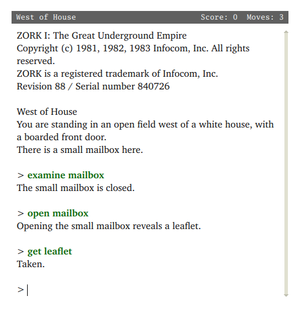 Inspired by Colossal Cave
, Marc Blank and Dave Lebling created what was to become the first Infocom game, Zork
, in 1977 at MIT
's Laboratory for Computer Science. Despite the development of a revolutionary virtual memory system that allowed games to be much larger than the average personal computer's normal capacity, the enormous mainframe-developed game had to be split into three roughly equal parts. Zork I was released originally for the TRS-80
in 1980 and eventually sold more than a million copies across several platforms. Even though Microsoft released a cheap version of Adventure with its initial version of MS-DOS 1.0 for IBM PC
s, Zork I was still a popular seller for the PC, thanks to the superior quality of its writing and packaging.
Lebling and Blank each authored several more games and additional game writers (or "Implementors") were hired, notably including Steve Meretzky
. Other popular and inventive titles included the rest of the Zork series, The Hitchhiker's Guide to the Galaxy
by Douglas Adams
, and A Mind Forever Voyaging
.
In its first few years of operation, text adventures proved to be a huge revenue stream for the company. Whereas most computer games of the era would achieve initial success and then suffer a significant drop-off in sales, Infocom titles continued to sell for years and years. Employee Tim Anderson
said of their situation, "It was phenomenal — we had a basement that just printed money."
Next, Infocom titles featured strong storytelling and rich descriptions, eschewing the day's primitive graphic capabilities, allowing users to use their own imaginations for the lavish and exotic locations the games described. Infocom's puzzles were unique in that they were usually tightly integrated into the storyline, and rarely did gamers feel like they were being made to jump through one arbitrary hoop after another, as was the case in many of the competitors' games. The puzzles were logical but also required close attention to the clues and hints given in the story, causing most gamers to keep copious notes as they went along.
Sometimes, though, Infocom threw in puzzles just for the humor of it—if the user never ran into these, they could still finish the game just fine. But discovering these early Easter Eggs was satisfying for some fans of the games. For example, one popular Easter egg was in the Enchanter
game, which involved collecting magic spells to use in accomplishing the quest. One of these was a summoning spell, which the player needed to use to summon certain characters at different parts of the game. At one point the game mentions the "Implementer
s" who were responsible for creating the land of Zork. If the player tried to summon the Implementers, the game would suddenly produce a vision of Dave Lebling
and Marc Blank
at their computers, surprised at this "bug" in the game and working feverishly to fix it.
Third, the inclusion of "feelies"—imaginative props and extras tied to the game's theme—provided some copy protection against pirating
. Some games were unsolvable without the extra content provided with the boxed game. And because of the cleverness and uniqueness of the feelies, users rarely felt like they were an intrusion or inconvenience, as was the case with most of the other copy-protection schemes of the time.
Although Infocom started out with Zork, and although the Zork world was the centerpiece of their product line throughout the Zork and Enchanter series, the company quickly branched out into a wide variety of story lines: fantasy, science-fiction, mystery, horror, historical adventure, children's stories, and others that defied categories. In an attempt to reach out to females, Infocom also produced Plundered Hearts
, which required the gamer to take the part of a heroine in a swashbuckling adventure on the high seas, and which required the heroine to use more feminine tactics to win the game, since hacking-and-slashing was not a very lady-like way to behave. And to compete with the Leisure Suit Larry
style games that were also appearing, Infocom also came out with Leather Goddesses of Phobos
in 1986, which featured "tame", "suggestive", and "lewd" playing modes, and that was notable for including among its "feelies" a "scratch-and-sniff" card with six odors that corresponded to six cues during the game.
The pay-per-hint service eventually led to the development of InvisiClues
: books with hints, maps, clues and solutions for puzzles in the games. The answers to the puzzles were printed in invisible ink that only became visible with a special marker that was provided with each book. Usually, two or more answers were given for each question that a gamer might have. The first answer would provide a subtle hint, the second a less subtle hint, and so forth until the last one gave an explicit answer. Gamers could thus reveal only the hints that they needed to have to play the game. To prevent the mere questions (printed in normal ink) from giving away too much information about the game, a certain number of misleading fake questions were included in every InvisiClues book. The InvisClues books were regularly ranked in near the top of best seller lists for computer books.
In the Solid Gold line or re-releases InvisiClues were integrated into the game. By typing "HINT" twice the player would open up a screen of possible topics where they could then reveal one hint at a time for each puzzle, just like the books.
series, every couple of pages the book would give the reader the chance to make a choice, such as which direction they wanted to go or how they wanted to respond to another character. The reader would then choose one of the given answers and turn to the appropriate page. These books, however, never did sell particularly well, and quickly disappeared from the bookshelves.
product, Cornerstone
, aimed at capturing the then booming database market for small business. Though this application was hailed upon its release for ease of use, it sold only 10,000 copies; not enough to cover the development expenses.
The program failed for a number of reasons. Although it was packaged in a slick hard plastic carrying case and was a very good database for personal and home use, it was originally priced at USD
$495 per copy and used copy-protected disks. Another serious miscalculation was that the program did not include any kind of scripting language
, so it was not promoted by any of the database consultants that small businesses typically hired to create and maintain their DB applications. Reviewers were also consistently disappointed that Infocom—noted for the natural language syntax of their games—did not include a natural language query ability, which was the most expected feature for this database. And a final disappointment was that Cornerstone was available only for IBM PC
s and not any of the other platforms that Infocom supported for their games; while Cornerstone had been programmed with its own virtual machine for maximum portability, that feature had become essentially irrelevant. Cornerstone used the virtual machine for its processing, resulting in lackluster performance.
And finally, the game market itself was shifting into graphic games. The 1990s, though, were a turbulent time for graphics development, as the computer industry was collapsing, with long-time computer makers such as Tandy/Radio Shack
, Atari
, and Commodore
/Amiga
disappearing, and the PC and Macintosh markets were fighting for dominance. Development of graphics technology was very aggressive during this time, which made it very expensive and risky to create cutting-edge, high-performance graphics, and many companies came and went in this period. Many people were buying new, more powerful computers expressly for games, and the days were long-gone when people would be satisfied with simple vectored line drawings, such as those that made the Wizardry
games famous, or with the blocky graphics that were used in Sierra Entertainment
's King's Quest
games. Gamers in particular were most unforgiving when the graphics did not live up to their expectations. In this climate, Infocom's history of text-based adventures and story-centered gaming did not help much in making the transition to graphics.
with Activision
on 13 June 1986. While relations were cordial between the two companies at first, the departure of Jim Levy
from Activision left Bruce Davis
in charge. Davis believed that his company had paid too much for Infocom and initiated a lawsuit against them to recoup some of the cost, along with changing the way Infocom was run. For example:
, followed in 1992 by The Lost Treasures of Infocom II
. These compilations featured nearly every game produced by Infocom before 1988. (Leather Goddesses of Phobos
was not included in either bundle, but could be ordered via a coupon included with Lost Treasures II.) In 1996, these were followed by Classic Text Adventure Masterpieces of Infocom
, a single CD-ROM which contained the works of both collections. This release, however, was missing The Hitchiker's Guide to the Galaxy and Shogun because the licenses from Douglas Adams' and James Clavell
's estates had expired.
source code, a Z-machine
story file and as various native source ports. Many Infocom titles can be downloaded via the Internet
, but only in violation of the copyright. There are currently at least four Infocom sampler and demos available from the IF Archive as Z-machine
story files which require a Z-machine interpreter
to play. Interpreters are available for most computer platforms, the most widely used being the Frotz, Zip, and Nitfol interpreters.
Five games (Zork I, Planetfall, The Hitchhiker's Guide to the Galaxy, Wishbringer and Leather Goddesses of Phobos) were re-released in Solid Gold format. The Solid Gold versions of those games include a built-in InvisiClues hint system.
Zork made a cameo appearance as an easter egg in Activision and Treyarch
's Call of Duty: Black Ops
. It can be accessed during the main menu and runs much like a DOS program.
Cambridge, Massachusetts
Cambridge is a city in Middlesex County, Massachusetts, United States, in the Greater Boston area. It was named in honor of the University of Cambridge in England, an important center of the Puritan theology embraced by the town's founders. Cambridge is home to two of the world's most prominent...
, that produced numerous works of interactive fiction
Interactive fiction
Interactive fiction, often abbreviated IF, describes software simulating environments in which players use text commands to control characters and influence the environment. Works in this form can be understood as literary narratives and as video games. In common usage, the term refers to text...
. They also produced one notable business application, a relational database
Relational database
A relational database is a database that conforms to relational model theory. The software used in a relational database is called a relational database management system . Colloquial use of the term "relational database" may refer to the RDBMS software, or the relational database itself...
called Cornerstone
Cornerstone (software)
Cornerstone is a relational database for DOS by Infocom in 1985. It was widely hailed upon its release for its ease of use, but is generally considered one of the leading factors that led to the demise of the company.-History and development:...
.
Infocom was founded on June 22, 1979 by MIT
Massachusetts Institute of Technology
The Massachusetts Institute of Technology is a private research university located in Cambridge, Massachusetts. MIT has five schools and one college, containing a total of 32 academic departments, with a strong emphasis on scientific and technological education and research.Founded in 1861 in...
staff and students led by Dave Lebling
Dave Lebling
P. David Lebling is an interactive fiction game designer and programmer who has worked at various companies, including Infocom and Avid....
, Marc Blank
Marc Blank
Marc Blank is an American game developer and software engineer. He is best known as part of the team that created one of the first hit text adventure computer games, Zork....
, Albert Vezza
Albert Vezza
Al Vezza was a computer science professor and a founder of Infocom, one of the earliest computer game companies.Vezza was the assistant director of MIT's Laboratory for Computer Science and in charge of LCS's Dynamic Modeling group in the late 1970s when group members Dave Lebling, Marc Blank,...
, and Joel Berez and lasted as an independent company until 1986 when it was bought by Activision
Activision
Activision is an American publisher, majority owned by French conglomerate Vivendi SA. Its current CEO is Robert Kotick. It was founded on October 1, 1979 and was the world's first independent developer and distributor of video games for gaming consoles...
. Activision finally shut down the Infocom division in 1989, although they released some titles in the 1990s under the Infocom Zork
Zork
Zork was one of the first interactive fiction computer games and an early descendant of Colossal Cave Adventure. The first version of Zork was written in 1977–1979 on a DEC PDP-10 computer by Tim Anderson, Marc Blank, Bruce Daniels, and Dave Lebling, and implemented in the MDL programming language...
brand. Activision abandoned the Infocom trademark in 2002.
The name was later registered by Oliver Klaeffling of Germany in 2007, which itself was abandoned the following year. The Infocom trademark is currently held by Pete Hottelet's Omni Consumer Products
Omni Consumer Products (company)
Omni Consumer Products, founded in 2006 by graphic designer Pete Hottelet, is a company that creates "real-world" versions of certain products created in movies. The company takes its name from the fictional corporation of the same name featured in the RoboCop movie and television franchise...
, who registered the name around the same time as Klaeffling in 2007.
Overview
Infocom games are text adventures where users direct the action by entering short strings of words to give commands when prompted. Generally the program will respond by describing the results of the action, often the contents of a room if the player has moved within the virtual world. The user reads this information, decides what to do, and enters another short series of words. Examples include "go west" or "take flashlight".Infocom games were written using a roughly LISP
Lisp
A lisp is a speech impediment, historically also known as sigmatism. Stereotypically, people with a lisp are unable to pronounce sibilants , and replace them with interdentals , though there are actually several kinds of lisp...
-like programming language called ZIL (Zork Implementation Language or Zork Interactive Language—it was referred to as both) that compiled into a byte code able to run on a standardized virtual machine
Virtual machine
A virtual machine is a "completely isolated guest operating system installation within a normal host operating system". Modern virtual machines are implemented with either software emulation or hardware virtualization or both together.-VM Definitions:A virtual machine is a software...
called the Z-machine
Z-machine
The Z-machine is a virtual machine that was developed by Joel Berez and Marc Blank in 1979 and used by Infocom for its text adventure games. Infocom compiled game code to files containing Z-machine instructions , and could therefore port all its text adventures to a new platform simply by writing a...
. As the games were text based and used variants of the same Z-machine interpreter, the interpreter had to be ported to new computer architecture
Computer architecture
In computer science and engineering, computer architecture is the practical art of selecting and interconnecting hardware components to create computers that meet functional, performance and cost goals and the formal modelling of those systems....
s only once per architecture, rather than once per game. Each game file included a sophisticated parser which allowed the user to type complex instructions to the game. Unlike earlier works of interactive fiction which only understood commands of the form 'verb noun', Infocom's parser could understand a wider variety of sentences. For instance one might "go west", or "go to festeron".
With the Z-machine, Infocom was able to release most of their games for most popular home computer
Home computer
Home computers were a class of microcomputers entering the market in 1977, and becoming increasingly common during the 1980s. They were marketed to consumers as affordable and accessible computers that, for the first time, were intended for the use of a single nontechnical user...
s of the day simultaneously—the Apple II family, Atari 800
Atari 8-bit family
The Atari 8-bit family is a series of 8-bit home computers manufactured from 1979 to 1992. All are based on the MOS Technology 6502 CPU and were the first home computers designed with custom coprocessor chips...
, IBM PC compatible
IBM PC compatible
IBM PC compatible computers are those generally similar to the original IBM PC, XT, and AT. Such computers used to be referred to as PC clones, or IBM clones since they almost exactly duplicated all the significant features of the PC architecture, facilitated by various manufacturers' ability to...
s, Amstrad CPC
Amstrad CPC
The Amstrad CPC is a series of 8-bit home computers produced by Amstrad between 1984 and 1990. It was designed to compete in the mid-1980s home computer market dominated by the Commodore 64 and the Sinclair ZX Spectrum, where it successfully established itself primarily in the United Kingdom,...
/PCW
Amstrad PCW
The Amstrad PCW series was a range of personal computers produced by British company Amstrad from 1985 to 1998, and also sold under licence in Europe as the "Joyce" by the German electronics company Schneider in the early years of the series' life. When it was launched, the cost of a PCW system was...
(one disc worked on both machines), Commodore 64
Commodore 64
The Commodore 64 is an 8-bit home computer introduced by Commodore International in January 1982.Volume production started in the spring of 1982, with machines being released on to the market in August at a price of US$595...
, Commodore Plus/4
Commodore Plus/4
The Commodore Plus/4 was a home computer released by Commodore International in 1984. The "Plus/4" name refers to the four-application ROM resident office suite ; it was billed as "the productivity computer with software built-in"...
, Commodore 128
Commodore 128
The Commodore 128 home/personal computer was the last 8-bit machine commercially released by Commodore Business Machines...
, Kaypro
Kaypro
Kaypro Corporation, commonly called Kaypro, was an American home/personal computer manufacturer of the 1980s. The company was founded by Non-Linear Systems to develop computers to compete with the then-popular Osborne 1 portable microcomputer...
CP/M
CP/M
CP/M was a mass-market operating system created for Intel 8080/85 based microcomputers by Gary Kildall of Digital Research, Inc...
, Texas Instruments TI-99/4A
Texas Instruments TI-99/4A
The Texas Instruments TI-99/4A was an early home computer, released in June 1981, originally at a price of USD $525. It was an enhanced version of the less-successful—and quite rare—TI-99/4 model, which was released in late 1979 at a price of $1,150...
, the Mac, Atari ST
Atari ST
The Atari ST is a home/personal computer that was released by Atari Corporation in 1985 and commercially available from that summer into the early 1990s. The "ST" officially stands for "Sixteen/Thirty-two", which referred to the Motorola 68000's 16-bit external bus and 32-bit internals...
, the Commodore Amiga
Amiga
The Amiga is a family of personal computers that was sold by Commodore in the 1980s and 1990s. The first model was launched in 1985 as a high-end home computer and became popular for its graphical, audio and multi-tasking abilities...
and the Radio Shack TRS-80
TRS-80
TRS-80 was Tandy Corporation's desktop microcomputer model line, sold through Tandy's Radio Shack stores in the late 1970s and early 1980s. The first units, ordered unseen, were delivered in November 1977, and rolled out to the stores the third week of December. The line won popularity with...
. The company was also known for shipping creative props, or "feelies" (and even "smellies"), with its games.
The beginning
Colossal Cave Adventure
Colossal Cave Adventure gave its name to the computer adventure game genre . It was originally designed by Will Crowther, a programmer and caving enthusiast who based the layout on part of the Mammoth Cave system in Kentucky...
, Marc Blank and Dave Lebling created what was to become the first Infocom game, Zork
Zork
Zork was one of the first interactive fiction computer games and an early descendant of Colossal Cave Adventure. The first version of Zork was written in 1977–1979 on a DEC PDP-10 computer by Tim Anderson, Marc Blank, Bruce Daniels, and Dave Lebling, and implemented in the MDL programming language...
, in 1977 at MIT
Massachusetts Institute of Technology
The Massachusetts Institute of Technology is a private research university located in Cambridge, Massachusetts. MIT has five schools and one college, containing a total of 32 academic departments, with a strong emphasis on scientific and technological education and research.Founded in 1861 in...
's Laboratory for Computer Science. Despite the development of a revolutionary virtual memory system that allowed games to be much larger than the average personal computer's normal capacity, the enormous mainframe-developed game had to be split into three roughly equal parts. Zork I was released originally for the TRS-80
TRS-80
TRS-80 was Tandy Corporation's desktop microcomputer model line, sold through Tandy's Radio Shack stores in the late 1970s and early 1980s. The first units, ordered unseen, were delivered in November 1977, and rolled out to the stores the third week of December. The line won popularity with...
in 1980 and eventually sold more than a million copies across several platforms. Even though Microsoft released a cheap version of Adventure with its initial version of MS-DOS 1.0 for IBM PC
IBM PC
The IBM Personal Computer, commonly known as the IBM PC, is the original version and progenitor of the IBM PC compatible hardware platform. It is IBM model number 5150, and was introduced on August 12, 1981...
s, Zork I was still a popular seller for the PC, thanks to the superior quality of its writing and packaging.
Lebling and Blank each authored several more games and additional game writers (or "Implementors") were hired, notably including Steve Meretzky
Steve Meretzky
Steven Eric Meretzky is an American computer game developer, with dozens of titles to his credit. He has been involved in almost every aspect of game development, from design to production to quality assurance and box design...
. Other popular and inventive titles included the rest of the Zork series, The Hitchhiker's Guide to the Galaxy
The Hitchhiker's Guide to the Galaxy (computer game)
The Hitchhiker's Guide to the Galaxy is an interactive fiction computer game based on the comedic science fiction series of the same name. It was designed by series creator Douglas Adams and Infocom's Steve Meretzky, and was first released in 1984 for the Apple II, Macintosh, Commodore 64, DOS,...
by Douglas Adams
Douglas Adams
Douglas Noel Adams was an English writer and dramatist. He is best known as the author of The Hitchhiker's Guide to the Galaxy, which started life in 1978 as a BBC radio comedy before developing into a "trilogy" of five books that sold over 15 million copies in his lifetime, a television...
, and A Mind Forever Voyaging
A Mind Forever Voyaging
A Mind Forever Voyaging is an interactive fiction game designed and implemented by Steve Meretzky and published by Infocom in 1985...
.
In its first few years of operation, text adventures proved to be a huge revenue stream for the company. Whereas most computer games of the era would achieve initial success and then suffer a significant drop-off in sales, Infocom titles continued to sell for years and years. Employee Tim Anderson
Tim Anderson (Zork)
Tim Anderson is a computer programmer who helped create the adventure game Zork, one of the first works of interactive fiction and an early descendant of ADVENT . The first version of Zork was written in 1977–1979 in the MDL programming language on a DEC PDP-10 computer by Anderson, Marc Blank,...
said of their situation, "It was phenomenal — we had a basement that just printed money."
Reception
Three components proved key to Infocom's success: marketing strategy, rich storytelling and feelies. Whereas most game developers sold their games mainly in software stores, Infocom also distributed their games via bookstores. Since their games were text-based, patrons of bookstores were drawn to the Infocom games as they were already interested in reading. Unlike most computer software, Infocom titles were distributed under a no-returns policy, which allowed them to make money from a single game for a longer period of time.Next, Infocom titles featured strong storytelling and rich descriptions, eschewing the day's primitive graphic capabilities, allowing users to use their own imaginations for the lavish and exotic locations the games described. Infocom's puzzles were unique in that they were usually tightly integrated into the storyline, and rarely did gamers feel like they were being made to jump through one arbitrary hoop after another, as was the case in many of the competitors' games. The puzzles were logical but also required close attention to the clues and hints given in the story, causing most gamers to keep copious notes as they went along.
Sometimes, though, Infocom threw in puzzles just for the humor of it—if the user never ran into these, they could still finish the game just fine. But discovering these early Easter Eggs was satisfying for some fans of the games. For example, one popular Easter egg was in the Enchanter
Enchanter (computer game)
Enchanter is a 1983 interactive fiction computer game written by Marc Blank and Dave Lebling and published by Infocom. It belongs to the fantasy genre and was the first fantasy game published by Infocom after the Zork trilogy...
game, which involved collecting magic spells to use in accomplishing the quest. One of these was a summoning spell, which the player needed to use to summon certain characters at different parts of the game. At one point the game mentions the "Implementer
Implementer
Implementer was originally the self-given name of the creators of the Infocom text adventure series Zork. Implementor, often shortened to Imp, became the title given to game designers and programmers at Infocom. Implementers were inserted as minor characters in several Infocom games...
s" who were responsible for creating the land of Zork. If the player tried to summon the Implementers, the game would suddenly produce a vision of Dave Lebling
Dave Lebling
P. David Lebling is an interactive fiction game designer and programmer who has worked at various companies, including Infocom and Avid....
and Marc Blank
Marc Blank
Marc Blank is an American game developer and software engineer. He is best known as part of the team that created one of the first hit text adventure computer games, Zork....
at their computers, surprised at this "bug" in the game and working feverishly to fix it.
Third, the inclusion of "feelies"—imaginative props and extras tied to the game's theme—provided some copy protection against pirating
Copyright infringement of software
Copyright infringement of software=The copyright infringement of software refers to several practices which involve the unauthorized copying of computer software. Copyright infringement of this kind varies globally...
. Some games were unsolvable without the extra content provided with the boxed game. And because of the cleverness and uniqueness of the feelies, users rarely felt like they were an intrusion or inconvenience, as was the case with most of the other copy-protection schemes of the time.
Although Infocom started out with Zork, and although the Zork world was the centerpiece of their product line throughout the Zork and Enchanter series, the company quickly branched out into a wide variety of story lines: fantasy, science-fiction, mystery, horror, historical adventure, children's stories, and others that defied categories. In an attempt to reach out to females, Infocom also produced Plundered Hearts
Plundered Hearts
Plundered Hearts is an interactive fiction computer game created by Amy Briggs and published by Infocom in 1987. It was released simultaneously for several popular computer platforms of the time, such as the PC and Commodore 64. Plundered Hearts was Infocom's first game in the "romance" genre...
, which required the gamer to take the part of a heroine in a swashbuckling adventure on the high seas, and which required the heroine to use more feminine tactics to win the game, since hacking-and-slashing was not a very lady-like way to behave. And to compete with the Leisure Suit Larry
Leisure Suit Larry
Leisure Suit Larry is a series of adventure games written by Al Lowe and published by Sierra from 1987 to 2009. The main character, whose full name is Larry Laffer, is a balding, dorky, double entendre-speaking, leisure suit-wearing "loser" in his 40s...
style games that were also appearing, Infocom also came out with Leather Goddesses of Phobos
Leather Goddesses of Phobos
Leather Goddesses of Phobos is an interactive fiction computer game written by Steve Meretzky and published by Infocom in 1986. Like many other Infocom titles, it was released for the IBM PC , Atari 8-bit, Amiga, Apple II, Apple Macintosh, Atari ST and Commodore 64 computers...
in 1986, which featured "tame", "suggestive", and "lewd" playing modes, and that was notable for including among its "feelies" a "scratch-and-sniff" card with six odors that corresponded to six cues during the game.
Invisiclues
Originally, hints for the game were provided as a "pay-per-hint" service created by Mike Dornbrook called the Zork User's Group (ZUG). Dornbrook also started Infocom's customer newsletter called The New Zork Times to discuss game hints and preview and showcase new products.The pay-per-hint service eventually led to the development of InvisiClues
InvisiClues
InvisiClues were hint booklets sold by Infocom to help players solve puzzles in their interactive fiction computer games.Before Infocom's games exploded in popularity, players could request hints by mail and receive a type-written sheet in response. When the number of requests proved...
: books with hints, maps, clues and solutions for puzzles in the games. The answers to the puzzles were printed in invisible ink that only became visible with a special marker that was provided with each book. Usually, two or more answers were given for each question that a gamer might have. The first answer would provide a subtle hint, the second a less subtle hint, and so forth until the last one gave an explicit answer. Gamers could thus reveal only the hints that they needed to have to play the game. To prevent the mere questions (printed in normal ink) from giving away too much information about the game, a certain number of misleading fake questions were included in every InvisiClues book. The InvisClues books were regularly ranked in near the top of best seller lists for computer books.
In the Solid Gold line or re-releases InvisiClues were integrated into the game. By typing "HINT" twice the player would open up a screen of possible topics where they could then reveal one hint at a time for each puzzle, just like the books.
Interactive fiction
Infocom also released a small number of "interactive fiction paperbacks" (gamebooks), which were based on the games and featured the ability to choose a different path through the story. Similar to the Choose Your Own AdventureChoose Your Own Adventure
Choose Your Own Adventure is a series of children's gamebooks where each story is written from a second-person point of view, with the reader assuming the role of the protagonist and making choices that determine the main character's actions and the plot's outcome. The series was based on a...
series, every couple of pages the book would give the reader the chance to make a choice, such as which direction they wanted to go or how they wanted to respond to another character. The reader would then choose one of the given answers and turn to the appropriate page. These books, however, never did sell particularly well, and quickly disappeared from the bookshelves.
Cornerstone
In 1984 Infocom started putting resources into a new division to produce business products. In 1985 they released a databaseRelational database
A relational database is a database that conforms to relational model theory. The software used in a relational database is called a relational database management system . Colloquial use of the term "relational database" may refer to the RDBMS software, or the relational database itself...
product, Cornerstone
Cornerstone (software)
Cornerstone is a relational database for DOS by Infocom in 1985. It was widely hailed upon its release for its ease of use, but is generally considered one of the leading factors that led to the demise of the company.-History and development:...
, aimed at capturing the then booming database market for small business. Though this application was hailed upon its release for ease of use, it sold only 10,000 copies; not enough to cover the development expenses.
The program failed for a number of reasons. Although it was packaged in a slick hard plastic carrying case and was a very good database for personal and home use, it was originally priced at USD
United States dollar
The United States dollar , also referred to as the American dollar, is the official currency of the United States of America. It is divided into 100 smaller units called cents or pennies....
$495 per copy and used copy-protected disks. Another serious miscalculation was that the program did not include any kind of scripting language
Scripting language
A scripting language, script language, or extension language is a programming language that allows control of one or more applications. "Scripts" are distinct from the core code of the application, as they are usually written in a different language and are often created or at least modified by the...
, so it was not promoted by any of the database consultants that small businesses typically hired to create and maintain their DB applications. Reviewers were also consistently disappointed that Infocom—noted for the natural language syntax of their games—did not include a natural language query ability, which was the most expected feature for this database. And a final disappointment was that Cornerstone was available only for IBM PC
IBM PC
The IBM Personal Computer, commonly known as the IBM PC, is the original version and progenitor of the IBM PC compatible hardware platform. It is IBM model number 5150, and was introduced on August 12, 1981...
s and not any of the other platforms that Infocom supported for their games; while Cornerstone had been programmed with its own virtual machine for maximum portability, that feature had become essentially irrelevant. Cornerstone used the virtual machine for its processing, resulting in lackluster performance.
Changing marketplace
Whereas Infocom's games had benefited significantly from the portability offered by running on top of a virtual machine, this strategy did not prove to be a significant advantage for Cornerstone; in fact, the virtual machine significantly slowed the database's execution speed. Businesses were moving en masse to the IBM PC platform by that time, so portability was no longer a significant differentiator. Infocom had sunk much of the money from games sales into Cornerstone; this, in addition to a slump in computer game sales, left the company in a very precarious financial position. By the time Infocom removed the copy-protection and reduced the price to less than $100, it was too late, and the market had moved on to other database solutions.And finally, the game market itself was shifting into graphic games. The 1990s, though, were a turbulent time for graphics development, as the computer industry was collapsing, with long-time computer makers such as Tandy/Radio Shack
Tandy Corporation
Tandy Corporation was a family-owned leather goods company based in Fort Worth, Texas. Tandy was founded in 1919 as a leather supply store, and acquired RadioShack in 1963. The Tandy name was dropped in May 2000, when RadioShack Corporation was made the official name.-History:Tandy began in 1919...
, Atari
Atari
Atari is a corporate and brand name owned by several entities since its inception in 1972. It is currently owned by Atari Interactive, a wholly owned subsidiary of the French publisher Atari, SA . The original Atari, Inc. was founded in 1972 by Nolan Bushnell and Ted Dabney. It was a pioneer in...
, and Commodore
Commodore International
Commodore is the commonly used name for Commodore Business Machines , the U.S.-based home computer manufacturer and electronics manufacturer headquartered in West Chester, Pennsylvania, which also housed Commodore's corporate parent company, Commodore International Limited...
/Amiga
Amiga
The Amiga is a family of personal computers that was sold by Commodore in the 1980s and 1990s. The first model was launched in 1985 as a high-end home computer and became popular for its graphical, audio and multi-tasking abilities...
disappearing, and the PC and Macintosh markets were fighting for dominance. Development of graphics technology was very aggressive during this time, which made it very expensive and risky to create cutting-edge, high-performance graphics, and many companies came and went in this period. Many people were buying new, more powerful computers expressly for games, and the days were long-gone when people would be satisfied with simple vectored line drawings, such as those that made the Wizardry
Wizardry
Wizardry is a series of computer role-playing games, developed by Sir-Tech, which were highly influential in the development of modern console and computer role playing games. The original Wizardry was a significant influence to early console RPGs, such as Dragon Warrior and Final Fantasy. ...
games famous, or with the blocky graphics that were used in Sierra Entertainment
Sierra Entertainment
Sierra Entertainment Inc. was an American video-game developer and publisher founded in 1979 as On-Line Systems by Ken and Roberta Williams...
's King's Quest
King's Quest
King's Quest is an adventure game series created by the American software company Sierra Entertainment. It is widely considered a classic series from the golden era of adventure games. Following the success of its first installment, the series was primarily responsible for building the reputation...
games. Gamers in particular were most unforgiving when the graphics did not live up to their expectations. In this climate, Infocom's history of text-based adventures and story-centered gaming did not help much in making the transition to graphics.
Activision takeover
A lack of offers for the company led to a reverse triangular mergerReverse takeover
A reverse takeover or reverse merger is the acquisition of a public company by a private company so that the private company can bypass the lengthy and complex process of going public...
with Activision
Activision
Activision is an American publisher, majority owned by French conglomerate Vivendi SA. Its current CEO is Robert Kotick. It was founded on October 1, 1979 and was the world's first independent developer and distributor of video games for gaming consoles...
on 13 June 1986. While relations were cordial between the two companies at first, the departure of Jim Levy
Jim Levy
Jim Levy was initially a music industry executive, but he is known better for his efforts as the founding Chief Executive Officer for Activision.. , Gamasutra. , Billboard ...
from Activision left Bruce Davis
Bruce Davis (video game industry)
Bruce L. Davis is an American businessman, currently CEO and chairman of Digimarc. Formerly the head of both Imagic and Activision, he is known for his role in the development of the video game industry....
in charge. Davis believed that his company had paid too much for Infocom and initiated a lawsuit against them to recoup some of the cost, along with changing the way Infocom was run. For example:
- Davis required they use Activision's packaging plant instead of their own in-house one, raising the cost of each package from $0.45 to over $0.90. In addition, the Activision plant made numerous mistakes in packaging where the Infocom one almost never did.
- Infocom had a successful marketing approach that kept all their games in store inventories for years. Because of this, older titles' sales often kept pace with sales of newer games. For example, because Zork was available for years after its initial release in 1980, it continued to top charts in sales well into the mid-1980s. Activision preferred to market Infocom's games the way they marketed their other titles: replacing older titles with newer ones. While this made sense for the graphically intensive games that made up the rest of Activision's catalog, since Infocom games were text based, it didn't make sense - the newer games didn't have improved text. This marketing approach cut off potential revenue for numerous Infocom titles that had consistently brought in money for several years.
- Davis required the struggling developer to produce eight titles a year. Infocom had traditionally produced about four games per year with more staff than they had post-merger.
- Davis pushed Infocom to release more graphical games, but the one they did release, FooblitzkyFooblitzkyFooblitzky is a board game-style computer game published by Infocom in 1985 and designed by a team including interactive fiction authors Marc Blank and Michael Berlyn. It is unique among Infocom titles because it was the first game Infocom released to incorporate graphics beyond ASCII characters...
, bombed. This was, in part, due to Infocom's long-standing rule of maximum portability; a game that could display graphics on a number of different systems couldn't take advantage of the strengths of any of them. - The cost of acquisition was amortized by deducting it from Infocom's operating revenue during the next several years.
Closure and afterward
Rising costs and falling profits, exacerbated by the lack of new products in 1988 and technical issues with its MS-DOS products, caused Activision finally to pull the plug on Infocom in 1989. For a few years, Activision continued to market Infocom's classic games in collections (usually by genre, such as the Science Fiction collection); in 1991, they published The Lost Treasures of InfocomThe Lost Treasures of Infocom
The Lost Treasures of Infocom is a collection of 20 computer games from interactive fiction pioneer Infocom, released in 1991. It was available in MS-DOS, Apple Macintosh, Amiga, and Apple IIGS versions, as well as a cross-platform CD-ROM version. Infocom was closed in 1989 by its then-parent...
, followed in 1992 by The Lost Treasures of Infocom II
The Lost Treasures of Infocom
The Lost Treasures of Infocom is a collection of 20 computer games from interactive fiction pioneer Infocom, released in 1991. It was available in MS-DOS, Apple Macintosh, Amiga, and Apple IIGS versions, as well as a cross-platform CD-ROM version. Infocom was closed in 1989 by its then-parent...
. These compilations featured nearly every game produced by Infocom before 1988. (Leather Goddesses of Phobos
Leather Goddesses of Phobos
Leather Goddesses of Phobos is an interactive fiction computer game written by Steve Meretzky and published by Infocom in 1986. Like many other Infocom titles, it was released for the IBM PC , Atari 8-bit, Amiga, Apple II, Apple Macintosh, Atari ST and Commodore 64 computers...
was not included in either bundle, but could be ordered via a coupon included with Lost Treasures II.) In 1996, these were followed by Classic Text Adventure Masterpieces of Infocom
Classic Text Adventure Masterpieces of Infocom
Classic Text Adventure Masterpieces of Infocom is a collection of 33 computer games from interactive fiction pioneer Infocom, and the top 6 winners of the 1995 Interactive Fiction Competition, released in 1996...
, a single CD-ROM which contained the works of both collections. This release, however, was missing The Hitchiker's Guide to the Galaxy and Shogun because the licenses from Douglas Adams' and James Clavell
James Clavell
James Clavell, born Charles Edmund DuMaresq Clavell was an Australian-born, British novelist, screenwriter, director and World War II veteran and prisoner of war...
's estates had expired.
Interactive fiction
- The ZorkZorkZork was one of the first interactive fiction computer games and an early descendant of Colossal Cave Adventure. The first version of Zork was written in 1977–1979 on a DEC PDP-10 computer by Tim Anderson, Marc Blank, Bruce Daniels, and Dave Lebling, and implemented in the MDL programming language...
series:- The original Zork Trilogy (Marc Blank & Dave Lebling):
- Zork IZork IZork: The Great Underground Empire - Part I, later known as Zork I, is an interactive fiction computer game written by Marc Blank, Dave Lebling, Bruce Daniels and Tim Anderson and published by Infocom in 1980. It was the first game in the popular Zork trilogy and was released for a wide range of...
: The Great Underground Empire (1980) - Zork IIZork IIZork II: The Wizard of Frobozz is an interactive fiction computer game published by Infocom in 1981. It was written by Marc Blank, Dave Lebling, Bruce Daniels and Tim Anderson. It was the second game in the popular Zork trilogy and was released for a wide range of computer systems. It begins where...
: The Wizard of Frobozz (1981) - Zork IIIZork IIIZork III: The Dungeon Master is an interactive fiction computer game written by Marc Blank, Dave Lebling, Bruce Daniels and Tim Anderson and published by Infocom in 1982. It was the third game in the popular Zork trilogy and was released for a wide range of computer systems...
: The Dungeon Master (1982)
- Zork I
- The Enchanter Trilogy:
- Enchanter (1983, Marc Blank and Dave Lebling)
- Sorcerer (1984, Steve MeretzkySteve MeretzkySteven Eric Meretzky is an American computer game developer, with dozens of titles to his credit. He has been involved in almost every aspect of game development, from design to production to quality assurance and box design...
) - SpellbreakerSpellbreakerSpellbreaker is an interactive fiction computer game written by Dave Lebling and released by Infocom in 1985, the third and final game in the "Enchanter Trilogy". Like most of Infocom's games, it was released for many of the time's popular computer platforms, such as the Commodore 64, Atari ST and...
(1985, Dave Lebling)
- Mini Zork I: The Great Underground Empire (1987, Marc Blank & Dave Lebling, free cut-down, single load tape version of game, covermounted on UK'sUnited KingdomThe United Kingdom of Great Britain and Northern IrelandIn the United Kingdom and Dependencies, other languages have been officially recognised as legitimate autochthonous languages under the European Charter for Regional or Minority Languages...
ZZAP!64Zzap!64Zzap!64 was a computer games magazine covering games on the Commodore International series of computers, especially the Commodore 64 . It was published in the UK by Newsfield Publications Ltd and later by Europress Impact....
magazine) - Beyond Zork: The Coconut of QuendorBeyond ZorkBeyond Zork was an interactive fiction computer game written by Brian Moriarty and released by Infocom in 1987...
(1987, Brian MoriartyBrian MoriartyBrian Moriarty is an American video game developer who authored three of the original Infocom interactive fiction titles, Wishbringer , Trinity and Beyond Zork: The Coconut of Quendor ....
) - Zork Zero: The Revenge of MegabozZork ZeroZork Zero: The Revenge of Megaboz is an interactive fiction computer game, written by Steve Meretzky over nearly 18 months and published by Infocom in 1988, with an original retail price of $59.95...
(1988, Steve Meretzky) - Zork: The Undiscovered UndergroundZork: The Undiscovered UndergroundZork: The Undiscovered Underground is an interactive fiction computer game written by former Infocom Implementors Marc Blank and Michael Berlyn and implemented by G. Kevin Wilson using the Inform language. The game was released by Activision on August 28, 1997 for free to coincide with the release...
(1997, Michael BerlynMichael BerlynMichael Berlyn is an American computer game designer and writer. He is best known as an Implementor at Infocom, part of the text adventure game design team....
and Marc Blank)
- The original Zork Trilogy (Marc Blank & Dave Lebling):
- The PlanetfallPlanetfallPlanetfall is a science fiction interactive fiction computer game written by Steve Meretzky, and the eighth title published by Infocom in 1983. Like most Infocom games, thanks to the portable Z-machine, it was released for several platforms simultaneously. The original release included versions...
series:- PlanetfallPlanetfallPlanetfall is a science fiction interactive fiction computer game written by Steve Meretzky, and the eighth title published by Infocom in 1983. Like most Infocom games, thanks to the portable Z-machine, it was released for several platforms simultaneously. The original release included versions...
(1983, Steve Meretzky) - StationfallStationfallStationfall is an interactive fiction computer game written by Steve Meretzky and released by Infocom in 1987. Like the majority of Infocom's works, it was released simultaneously for several popular computer platforms of the time, such as the Commodore 64, Apple II, and PC. The game is a sequel to...
(1987, Steve Meretzky)
- Planetfall
- Deadline (1982, Marc Blank)
- Starcross (1982, Dave Lebling)
- Suspended: A Cryogenic NightmareSuspendedSuspended: A Cryogenic Nightmare is an interactive fiction computer game written by Michael Berlyn and published by Infocom in 1983. Like most Infocom titles, it was available on most popular personal computers of the day, such as the Apple II, PC, Atari ST and Commodore 64...
(1983, Michael Berlyn) - Infidel (1983, Michael Berlyn)
- The Witness (1983, Stu GalleyStu GalleyStu Galley is an American developer of interactive fiction who was an Implementor at Infocom. He also served as corporate clerk from incorporation in 1979 to merging with Activision in 1986. He wrote three of Infocom's original interactive fiction titles, The Witness , Seastalker and Moonmist...
) - Cutthroats (1984, Michael Berlyn & Jerry Wolper)
- The Hitchhiker's Guide to the GalaxyThe Hitchhiker's Guide to the Galaxy (computer game)The Hitchhiker's Guide to the Galaxy is an interactive fiction computer game based on the comedic science fiction series of the same name. It was designed by series creator Douglas Adams and Infocom's Steve Meretzky, and was first released in 1984 for the Apple II, Macintosh, Commodore 64, DOS,...
(1984, Steve Meretzky & Douglas AdamsDouglas AdamsDouglas Noel Adams was an English writer and dramatist. He is best known as the author of The Hitchhiker's Guide to the Galaxy, which started life in 1978 as a BBC radio comedy before developing into a "trilogy" of five books that sold over 15 million copies in his lifetime, a television...
) - SeastalkerSeastalkerSeastalker is an interactive fiction computer game designed by Stu Galley and Jim Lawrence and published by Infocom in 1984. Like most of Infocom's works, it was released simultaneously for several popular computer platforms of the time, such as the Commodore 64, Apple II, and IBM PC. The game was...
(1984, Stu GalleyStu GalleyStu Galley is an American developer of interactive fiction who was an Implementor at Infocom. He also served as corporate clerk from incorporation in 1979 to merging with Activision in 1986. He wrote three of Infocom's original interactive fiction titles, The Witness , Seastalker and Moonmist...
& Jim Lawrence) - Suspect (1984, Dave Lebling)
- A Mind Forever VoyagingA Mind Forever VoyagingA Mind Forever Voyaging is an interactive fiction game designed and implemented by Steve Meretzky and published by Infocom in 1985...
(1985, Steve Meretzky) - Wishbringer: The Magick Stone of DreamsWishbringerWishbringer: The Magick Stone of Dreams is an interactive fiction computer game written by Brian Moriarty and published by Infocom in 1985. It was intended to be an easier game to solve than the typical Infocom release, and provide a good introduction to interactive fiction for inexperienced players...
(1985, Brian Moriarty) - Ballyhoo (1986, Jeff O'Neill)
- Hollywood HijinxHollywood HijinxHollywood Hijinx is an interactive fiction computer game written by "Hollywood" Dave Anderson and Liz Cyr-Jones and published by Infocom in 1986. Implemented using Infocom's Z-Machine, the game was released over a wide variety of platforms, including the Apple II, Atari 8-bit and Commodore 64...
(1986, "Hollywood" Dave Anderson) - Leather Goddesses of PhobosLeather Goddesses of PhobosLeather Goddesses of Phobos is an interactive fiction computer game written by Steve Meretzky and published by Infocom in 1986. Like many other Infocom titles, it was released for the IBM PC , Atari 8-bit, Amiga, Apple II, Apple Macintosh, Atari ST and Commodore 64 computers...
(1986, Steve Meretzky) - MoonmistMoonmistMoonmist is an interactive fiction computer game implemented by Stu Galley and published by Infocom in 1986. By using Infocom's portable Z-machine, the game was released simultaneously for many popular platforms, including the IBM PC, Apple II, Amiga, Atari ST and Commodore 64...
(1986, Stu GalleyStu GalleyStu Galley is an American developer of interactive fiction who was an Implementor at Infocom. He also served as corporate clerk from incorporation in 1979 to merging with Activision in 1986. He wrote three of Infocom's original interactive fiction titles, The Witness , Seastalker and Moonmist...
& Jim Lawrence) - Trinity (1986, Brian Moriarty)
- Border ZoneBorder ZoneBorder Zone is an interactive fiction computer game written by Marc Blank and published by Infocom in 1987. It was released for most popular personal computers of the day, such as the IBM PC, Apple II, and Commodore 64. Unlike most other purely text-based games, however, Border Zone incorporated...
(1987, Marc Blank) - Bureaucracy (1987, Infocom & Douglas Adams)
- The Lurking HorrorThe Lurking HorrorThe Lurking Horror is an interactive fiction computer game released by Infocom in 1987. The game was written by Dave Lebling and inspired by the horror writings of H. P. Lovecraft...
(1987, Dave Lebling) - Nord and Bert Couldn't Make Head or Tail of ItNord and Bert Couldn't Make Head or Tail of ItNord and Bert Couldn't Make Head or Tail of It is an interactive fiction computer game written by Jeff O'Neill and published by Infocom in 1987. It was released simultaneously for several popular computer platforms of the time, such as the PC and Commodore 64. Nord and Bert was unique among Infocom...
(1987, Jeff O'Neill) - Plundered HeartsPlundered HeartsPlundered Hearts is an interactive fiction computer game created by Amy Briggs and published by Infocom in 1987. It was released simultaneously for several popular computer platforms of the time, such as the PC and Commodore 64. Plundered Hearts was Infocom's first game in the "romance" genre...
(1987, Amy BriggsAmy BriggsAmy R. Briggs is known for creating Plundered Hearts, an interactive fiction computer game published by Infocom in 1987. A Minnesota native, she graduated from Macalester College in 1984 with a B.A. in English, specializing in British literature. Already a fan of Infocom's games, Briggs joined the...
) - Sherlock: The Riddle of the Crown JewelsSherlock: The Riddle of the Crown JewelsSherlock: The Riddle of the Crown Jewels is an interactive fiction computer game designed by Bob Bates and published by Infocom in 1988. Like most titles Infocom produced, the use of ZIL made it possible to release the game simultaneously for many popular computer platforms, including the Apple II,...
(1988, Bob BatesBob BatesRobert Bates , better known as Bob Bates, is an American computer games designer. Starting as a designer in the 1980s for Infocom, he was later co-founder of Legend Entertainment, designing games such as Timequest and Eric the Unready...
) - Arthur: The Quest for ExcaliburArthur: The Quest for ExcaliburArthur: The Quest for Excalibur is an interactive fiction computer game written by Bob Bates and published by Infocom in 1989. Typically for an Infocom title, it was released for many popular computer platforms of the time, such as the Macintosh, PC, and the Apple II series...
(1989, Bob Bates) - James Clavell's ShogunJames Clavell's ShogunJames Clavell's Shōgun is an interactive fiction computer game written by Dave Lebling and released by Infocom in 1989. Like most of Infocom's games, it was released for several popular computer platforms of the time, such as the Apple II and PC. As the title indicates, the game is based on the...
(1989, Dave Lebling) - Journey (1989, Marc Blank)
Other titles
- Graphic Adventures
- Leather Goddesses of Phobos 2: Gas Pump Girls Meet the Pulsating Inconvenience from Planet X!Leather Goddesses of Phobos 2: Gas Pump Girls Meet the Pulsating Inconvenience from Planet X!Leather Goddesses of Phobos 2: Gas Pump Girls Meet the Pulsating Inconvenience from Planet X! is a graphic adventure game written by Steve Meretzky and published by Activision in 1992 under the Infocom label...
(1992, Steve Meretzky) - Return to ZorkReturn to ZorkReturn to Zork is a 1993 adventure game in the Zork series. It was developed by Activision and was the final Zork game to be published under the Infocom label.-Gameplay:...
(1993, Doug BarnettDoug BarnettDouglas Shirl Barnett, Jr. is a former American football center in the National Football League for the Washington Redskins, the Los Angeles Rams, and the Atlanta Falcons. He played college football at Azusa Pacific University.Currently, Barnett is the athletic director for Bakersfield Christian...
) - Zork: NemesisZork: NemesisZork Nemesis: The Forbidden Lands is a 1996 graphical adventure game developed by Zombie Studios and published/edited by Activision. It is the eleventh game in the Zork series, and the first such title not to appear under the Infocom label...
(1996) - Zork Grand InquisitorZork Grand InquisitorZork: Grand Inquisitor is a graphical adventure game, developed by Activision and released in 1997 for the IBM compatible PC and Macintosh . It builds upon the Zork and Enchanter series of interactive fiction computer games originally released by Infocom. The cast includes Erick Avari, Dirk...
(1997)
- Leather Goddesses of Phobos 2: Gas Pump Girls Meet the Pulsating Inconvenience from Planet X!
- BattleTechBattleTechBattleTech is a wargaming and science fiction franchise launched by FASA Corporation in 1984, acquired by WizKids in 2000, and owned since 2003 by Topps. The series began with FASA's debut of the board game BattleTech by Jordan Weisman and L...
Games- BattleTech: The Crescent Hawk's InceptionBattleTech: The Crescent Hawk's InceptionBattleTech: The Crescent Hawk's Inception is a turn-based adventure/RPG game released in 1988 by Westwood Studios and based on the BattleTech franchise...
(1988, developed by Westwood StudiosWestwood StudiosWestwood Studios was a computer and video game developer, based in Las Vegas, Nevada. It was founded by Brett Sperry and Louis Castle in as Westwood Associates, and renamed to Westwood Studios when it merged with Virgin Interactive in...
) - BattleTech: The Crescent Hawk's RevengeBattleTech: The Crescent Hawk's RevengeBattleTech: The Crescent Hawk's Revenge is a real-time strategy game based in the FASA BattleTech universe. Developed by Westwood Studios for Mediagenic, and produced by Scott Berfield, it is a major milestone in the gaming industry in that the game serves as the prototype for what later became...
(1991, developed by Westwood Studios)
- BattleTech: The Crescent Hawk's Inception
- Other Games
- FooblitzkyFooblitzkyFooblitzky is a board game-style computer game published by Infocom in 1985 and designed by a team including interactive fiction authors Marc Blank and Michael Berlyn. It is unique among Infocom titles because it was the first game Infocom released to incorporate graphics beyond ASCII characters...
(1985, Marc Blank, Mike Berlyn, Poh Lim & Paula Maxwell) - Quarterstaff: The Tomb of SetmothQuarterstaff: The Tomb of SetmothQuarterstaff: The Tomb of Setmoth is an interactive fiction computer role-playing game developed by Scott Schmitz and Ken Updike and released by Infocom for Macintosh in 1988...
(1988, Scott Schmitz, Ken Updike & Amy Briggs) - Mines of TitanMines of TitanMines of Titan is a single-player role-playing video game, developed by Westwood Associates , and released by Infocom in 1989 for PC, MS-DOS and Apple II.-Remake:...
(1988, Louis CastleLouis Castle-Career:Castle co-founded Westwood Studios with Brett Sperry in 1985. Castle remained with Westwood when it was bought by Electronic Arts in 1998 and he was a vice president and General Manager of EA's Blueprint Studio...
& Brett SperryBrett Sperry-Career:Sperry co-founded Westwood Studios with Louis Castle in 1985, when both were in their early 20s.Sperry has been credited with the roles of design, production, support and box and content...
) - Tombs & TreasureTombs & TreasureTombs & Treasure is an adventure game originally developed by Nihon Falcom in 1987 for the PC-8801, PC-9801, FM-7, and X1 Japanese systems. An English-language NES version, published by Infocom in 1989, was altered to be more story-based, and featured new music and role-playing elements...
(1989, developed by Nihon Falcom) - Circuit's EdgeCircuit's EdgeCircuit's Edge is a computer game developed by Westwood Studios and released by Infocom in 1989. It was based on George Alec Effinger's 1987 novel When Gravity Fails...
(1989, developed by Westwood StudiosWestwood StudiosWestwood Studios was a computer and video game developer, based in Las Vegas, Nevada. It was founded by Brett Sperry and Louis Castle in as Westwood Associates, and renamed to Westwood Studios when it merged with Virgin Interactive in...
)
- Fooblitzky
- Infocomics
- Lane Mastodon vs. the Blubbermen (1988, Steve Meretzky)
- Gamma Force in Pit of a Thousand Screams (1988, Amy Briggs)
- ZorkQuest: Assault on Egreth Castle (1988, Elizabeth Langosy)
- ZorkQuest II: The Crystal of Doom (1988, Elizabeth Langosy)
Collections
- The Zork Trilogy (1986; contained Zork I, Zork II & Zork III)
- The Enchanter Trilogy (1986; contained Enchanter, Sorcerer & Spellbreaker)
- The Lost Treasures of InfocomThe Lost Treasures of InfocomThe Lost Treasures of Infocom is a collection of 20 computer games from interactive fiction pioneer Infocom, released in 1991. It was available in MS-DOS, Apple Macintosh, Amiga, and Apple IIGS versions, as well as a cross-platform CD-ROM version. Infocom was closed in 1989 by its then-parent...
(1991; contained 20 of Infocom's interactive fiction games) - The Lost Treasures of Infocom IIThe Lost Treasures of InfocomThe Lost Treasures of Infocom is a collection of 20 computer games from interactive fiction pioneer Infocom, released in 1991. It was available in MS-DOS, Apple Macintosh, Amiga, and Apple IIGS versions, as well as a cross-platform CD-ROM version. Infocom was closed in 1989 by its then-parent...
(1992; contained 11 interactive fiction games) - The Zork Anthology (1994; contained Zork I, Zork II, Zork III, Beyond Zork & Zork Zero)
- The Mystery Collection (1995; contained Deadline, Lurking Horror, Moonmist, Sherlock: The Riddle of the Crown Jewels, Suspect and The Witness. Zork Zero and Planetfall were a bonus in some packages)
- The Adventure Collection (1995; contained Border Zone, Plundered Hearts, Cutthroats, Trinity and Infidel)
- The Comedy Collection (1995; contained Bureaucracy, Hollywood Hijinx and Nord and Bert Couldn't Make Head or Tail of It)
- The Fantasy Collection (1995; contained Spellbreaker, Enchanter, Sorcerer, Seastalker and Wishbringer)
- The Science Fiction Collection (1995; contained Suspended, A Mind Forever Voyaging, Starcross, Stationfall and Hitchhikers Guide to the Galaxy)
- Classic Text Adventure Masterpieces of InfocomClassic Text Adventure Masterpieces of InfocomClassic Text Adventure Masterpieces of Infocom is a collection of 33 computer games from interactive fiction pioneer Infocom, and the top 6 winners of the 1995 Interactive Fiction Competition, released in 1996...
(1996; contained 33 Infocom games plus six winners of the SPAG Interactive Fiction Contest not affiliated with Infocom) - Zork Special Edition (1997; contained Zork I, Zork II, Zork III, Beyond Zork, Zork Zero, Return to Zork, Zork: Nemesis, and Planetfall)
- Zork Classics: Interactive Fiction (2000)
- The Zork Legacy Collection (2002; contained The Zork Anthology, Return to Zork, and Zork Nemesis)
Legacy
With the exception of The Hitchhiker's Guide to the Galaxy and Shogun, the copyrights to the Infocom games are believed to be still held by Activision. Dungeon, the mainframe precursor to the commercial Zork trilogy, is generally assumed to be in the public domain and is available from The Interactive Fiction Archive as original FORTRANFortran
Fortran is a general-purpose, procedural, imperative programming language that is especially suited to numeric computation and scientific computing...
source code, a Z-machine
Z-machine
The Z-machine is a virtual machine that was developed by Joel Berez and Marc Blank in 1979 and used by Infocom for its text adventure games. Infocom compiled game code to files containing Z-machine instructions , and could therefore port all its text adventures to a new platform simply by writing a...
story file and as various native source ports. Many Infocom titles can be downloaded via the Internet
Internet
The Internet is a global system of interconnected computer networks that use the standard Internet protocol suite to serve billions of users worldwide...
, but only in violation of the copyright. There are currently at least four Infocom sampler and demos available from the IF Archive as Z-machine
Z-machine
The Z-machine is a virtual machine that was developed by Joel Berez and Marc Blank in 1979 and used by Infocom for its text adventure games. Infocom compiled game code to files containing Z-machine instructions , and could therefore port all its text adventures to a new platform simply by writing a...
story files which require a Z-machine interpreter
Interpreter (computing)
In computer science, an interpreter normally means a computer program that executes, i.e. performs, instructions written in a programming language...
to play. Interpreters are available for most computer platforms, the most widely used being the Frotz, Zip, and Nitfol interpreters.
Five games (Zork I, Planetfall, The Hitchhiker's Guide to the Galaxy, Wishbringer and Leather Goddesses of Phobos) were re-released in Solid Gold format. The Solid Gold versions of those games include a built-in InvisiClues hint system.
Zork made a cameo appearance as an easter egg in Activision and Treyarch
Treyarch
Treyarch is an American video game developer company, founded in 1996 by Peter Akemann and Doğan Köslü , and acquired by Activision in 2001...
's Call of Duty: Black Ops
Call of Duty: Black Ops
Call of Duty: Black Ops is a first-person shooter video game developed by Treyarch, published by Activision and released worldwide on November 9, for Microsoft Windows, Xbox 360, PlayStation 3, Wii consoles, with a separate version for Nintendo DS developed by n-Space. Announced on April 30, 2010,...
. It can be accessed during the main menu and runs much like a DOS program.
See also
- 69,10569105 (number)The number 69,105 was used as an in-joke at the United States computer game manufacturer Infocom. It has occasionally appeared in later computer games as a tribute to Infocom.-Significance of the number:...
, a number commonly found as an in-joke in many Infocom titles.
Articles about Infocom
- Infocom company profile from MobyGamesMobyGames-Platforms not yet included:- Further reading :* Rusel DeMaria, Johnny L. Wilson, High Score!: The Illustrated History of Electronic Games, McGraw-Hill/Osborne Media; 2 edition , ISBN 0-07-223172-6...
- Interactive Text In An Animated Age: Infocom Faces The Challenge article, an interview with Joel Berez and Marc Blank from Compute!COMPUTE!Compute! was an American computer magazine that was published from 1979 to 1994, though it can trace its origin to 1978 in Len Lindsay's PET Gazette, one of the first magazines for the Commodore PET computer. In its 1980s heyday Compute! covered all major platforms, and several single-platform...
magazine in January 1988. - Milliways: Infocom's Unreleased Sequel to Hitchhiker's Guide to the Galaxy
Detailed Infocom & game information
- Infocom-The Master Storytellers Infocom history, authors, etc.; often updated with any news from Activision
- INFOCOM, Imagination sold and serviced here; Homepage by Peter Scheyen An enthusiast's home page, containing, among many other resources, a timeline of Infocom's founding, releases and eventual dissolution.
- Down From the Top of Its Game: The Story of Infocom, Inc.—A report from MITMassachusetts Institute of TechnologyThe Massachusetts Institute of Technology is a private research university located in Cambridge, Massachusetts. MIT has five schools and one college, containing a total of 32 academic departments, with a strong emphasis on scientific and technological education and research.Founded in 1861 in...
which offers a very detailed examination of Infocom's creative successes and marketing failures.
Game details
- Infocom Documentation Project - Group working with Activision's permission to recreate manuals for Infocom games in PDF and text formats.
- The Infocom Gallery with photos of all game boxes, feelies, instruction manuals and extra game contents.
- The Gallery of Zork an updated version of the Infocom Gallery with higher-resolution photos, more material, such as more photos of earlier packaging, and online playable versions of the Infocom games.
- Covers of the Infocom boxes from Retrology: Gregor's retro-video games website
- Reviews and ratings of Infocom's games at the Interactive Fiction Database, The web's most active Interactive Fiction community.
- Infocom Fact-sheet Contains extensive information on various releases including different versions and packaging. Also includes a timeline of Infocom.