All Topics  
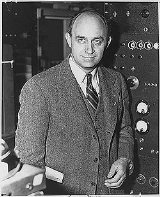
Enrico Fermi

 
Enrico Fermi

   Email Print
   Bookmark   Link


Enrico Fermi


Enrico Fermi (29 September 1901 – 28 November 1954) was an Italian physicist most noted for his work on the development of the first nuclear reactor
Nuclear reactor

A nuclear reactor is a device in which nuclear chain reactions are initiated, controlled, and sustained at a steady rate, as opposed to a nuclear bomb, in which the chain reaction occurs in a fraction of a second and is uncontrolled causing an explosion....
, and for his contributions to the development of quantum theory
Quantum mechanics

Quantum mechanics is a set of principles underlying the most fundamental known description of all physical systems at the microscopic scale . Notable amongst these principles are both a dual wave-like and particle-like behavior of matter and radiation, and prediction of probabilities in situations where classical physics predicts certaintie...
, nuclear
Nuclear physics

Nuclear physics is the field of physics that studies the building blocks and interactions of atomic nuclei.The most commonly known applications of nuclear physics are nuclear power and nuclear weapons, but the research field is also the basis for a far wider range of applications, including in the medical sector , in materials engineering...
 and particle physics
Particle physics

Particle physics is a branch of physics that studies the elementary particle constituents of matter and radiation, and the interactions between them....
, and statistical mechanics
Statistical mechanics

Statistical mechanics is the application of probability theory, which includes Mathematics tools for dealing with large populations, to the field of mechanics, which is concerned with the motion of particles or objects when subjected to a force....
. Fermi was awarded the Nobel Prize in Physics
Nobel Prize in Physics

The Nobel Prize in Physics is awarded once a year by the Royal Swedish Academy of Sciences. It is one of the five Nobel Prizes established by the will of Alfred Nobel in 1895 and awarded since 1901; the others are the Nobel Prize in chemistry, Nobel Prize in literature, Nobel Peace Prize, and Nobel Prize in physiology or medicine....
 in 1938 for his work on induced radioactivity
Induced radioactivity

Induced radioactivity is when a previously stable material has been made radioactive by exposure to specific radiation. Most radioactivity does not induce other material to become radioactive....
 and is today regarded as one of the top scientists of the 20th century. He is acknowledged as a unique physicist who was highly accomplished in both theory and experiment.


Discussion
Ask a question about 'Enrico Fermi'
Start a new discussion about 'Enrico Fermi'
Answer questions from other users
Full Discussion Forum


Recent Posts


Quotations


I cannot think of a single one, not even intelligence.

When asked what characteristics Nobel prize winning physicists had in common. As quoted in Physics Today (October 1994)

I hope it won't take long.

Comment to Eugene Wigner, ten days before his death from cancer, as quoted in The collected works of Eugene Paul Wigner (1992), p. 108

There are two possible outcomes: if the result confirms the hypothesis, then you've made a measurement. If the result is contrary to the hypothesis, then you've made a discovery.

As quoted in Nuclear Principles in Engineering (2005) by Tatjana Jevremovic, p. 397


Encyclopedia


Enrico Fermi (29 September 1901 – 28 November 1954) was an Italian physicist most noted for his work on the development of the first nuclear reactor
Nuclear reactor

A nuclear reactor is a device in which nuclear chain reactions are initiated, controlled, and sustained at a steady rate, as opposed to a nuclear bomb, in which the chain reaction occurs in a fraction of a second and is uncontrolled causing an explosion....
, and for his contributions to the development of quantum theory
Quantum mechanics

Quantum mechanics is a set of principles underlying the most fundamental known description of all physical systems at the microscopic scale . Notable amongst these principles are both a dual wave-like and particle-like behavior of matter and radiation, and prediction of probabilities in situations where classical physics predicts certaintie...
, nuclear
Nuclear physics

Nuclear physics is the field of physics that studies the building blocks and interactions of atomic nuclei.The most commonly known applications of nuclear physics are nuclear power and nuclear weapons, but the research field is also the basis for a far wider range of applications, including in the medical sector , in materials engineering...
 and particle physics
Particle physics

Particle physics is a branch of physics that studies the elementary particle constituents of matter and radiation, and the interactions between them....
, and statistical mechanics
Statistical mechanics

Statistical mechanics is the application of probability theory, which includes Mathematics tools for dealing with large populations, to the field of mechanics, which is concerned with the motion of particles or objects when subjected to a force....
. Fermi was awarded the Nobel Prize in Physics
Nobel Prize in Physics

The Nobel Prize in Physics is awarded once a year by the Royal Swedish Academy of Sciences. It is one of the five Nobel Prizes established by the will of Alfred Nobel in 1895 and awarded since 1901; the others are the Nobel Prize in chemistry, Nobel Prize in literature, Nobel Peace Prize, and Nobel Prize in physiology or medicine....
 in 1938 for his work on induced radioactivity
Induced radioactivity

Induced radioactivity is when a previously stable material has been made radioactive by exposure to specific radiation. Most radioactivity does not induce other material to become radioactive....
 and is today regarded as one of the top scientists of the 20th century. He is acknowledged as a unique physicist who was highly accomplished in both theory and experiment. Fermium
Fermium

Fermium is a synthetic element with the symbol Fm and atomic number 100. A highly radioactive metallic transuranic element of the actinide series, fermium is made by bombarding plutonium with neutrons and is named after nuclear physicist Enrico Fermi....
, a synthetic element
Synthetic element

In chemistry, the chemical elements labeled as synthetic are too unstable to be found naturally on Earth. These synthetic elements possess half-lifes so short, relative to the age of the Earth, that any atoms of these elements that may have existed when the Earth formed have long since decayed away....
 created in 1952 is named after him.

Biography


Early years

Enrico Fermi was born on September 29, 1901 in Rome
Rome

Rome is the capital city of Italy and Lazio, and is Italy's largest and most populous city, with 2,724,347 residents in an urban area of some ....
, Italy
Italy

Italy , officially the Italian Republic , is a country located on the Italian Peninsula in Southern Europe and on the two largest islands in the Mediterranean Sea, Sicily and Sardinia....
 to Alberto Fermi, a Chief Inspector of the Ministry of Communications, and Ida de Gattis, an elementary school teacher. As a young boy he enjoyed learning physics
Physics

Physics is the natural science which examines basic concepts such as energy, force, and spacetime and all that derives from these, such as mass, charge, matter and its Motion ....
 and mathematics
Mathematics

Mathematics is the study of quantity, structure, space, change, and related topics of pattern and form. Mathematicians seek out patterns whether found in numbers, space, natural science, computers, imaginary abstractions, or elsewhere....
 and shared his interests with his older brother, Giulio. When Giulio died unexpectedly of a throat abscess in 1915, Enrico was distraught, and immersed himself in scientific study to distract himself. According to his own account, each day he would walk in front of the hospital where Giulio died until he became inured to the pain. One of the first sources for the study of physics was a book found at the local market of Campo de' Fiori
Campo de' Fiori

Campo dei Fiori is a rectangular piazza near Piazza Navona in Rome, on the border of Rioni of Rome Parione and Regola . Campo dei Fiori, translated literally from Italian language, means "field of flowers." The name was first given during the Middle Ages when the area was actually a Field ....
 in Roma. The 900 page book, entitled Elementorum physicae mathematicae, was written in Latin by Father Andrea Caraffa, a professor at the Collegio Romano, covered subjects like mathematics
Mathematics

Mathematics is the study of quantity, structure, space, change, and related topics of pattern and form. Mathematicians seek out patterns whether found in numbers, space, natural science, computers, imaginary abstractions, or elsewhere....
, classical mechanics
Classical mechanics

Classical mechanics is used for describing the motion of macroscopic objects, from projectiles to parts of machinery, as well as astronomical objects, such as spacecraft, planets, stars, and galaxies....
, astronomy
Astronomy

Astronomy is the science of Astronomical object and Phenomenon that originate outside the Earth's atmosphere . It is concerned with the evolution, physics, chemistry, meteorology, and motion of celestial objects, as well as the physical cosmology....
, optics
Optics

Optics is the study of the behavior and properties of light including its optical phenomena with matter and its imaging by optical instruments....
, and acoustics
Acoustics

Acoustics is the interdisciplinary science that deals with the study of sound, ultrasound and infrasound . A scientist who works in the field of acoustics is an acoustician....
. Notes found in the book indicate Fermi studied it intensely. Later, Enrico befriended another scientifically inclined student named Enrico Persico
Enrico Persico

Enrico Persico is an Italian physicist notable for propagating the field of quantum mechanics in Italy. He was a professor at the University of Turin and is also notable as the doctoral advisor of Ugo Fano....
, and the two worked together on scientific projects such as building gyroscope
Gyroscope

A gyroscope is a device for measuring or maintaining orientation , based on the principles of angular momentum. The device is a spinning wheel or disk whose axle is free to take any orientation....
s, and measuring the earth's magnetic field
Magnetic field

A magnetism field is a vector field which can exert a magnetic force on moving electric charges and on magnetic dipoles . When placed in a magnetic field, magnetic dipoles tend to align their axes parallel to the magnetic field....
. Fermi's interest in physics was further encouraged by a friend of his father, Adolfo Amidei, who gave him several books on physics and mathematics, which he read and quickly assimilated.

Scuola Normale Superiore in Pisa

In 1918 Fermi enrolled at the Scuola Normale Superiore in Pisa
Pisa

Pisa is a city in Tuscany, central Italy, on the right bank of the mouth of the Arno River on the Ligurian Sea. It is the capital city of the Province of Pisa....
, where he was later to receive his undergraduate and doctoral degree. In order to enter the Institute, candidates had to take an entrance exam which included an essay. For his essay on the given theme Characteristics of Sound, 17-year-old Fermi chose to derive and solve the Fourier analysis based partial differential
Partial derivative

In mathematics, a partial derivative of a function of several variables is its derivative with respect to one of those variables with the others held constant ....
 equation for waves on a string. The examiner, Prof. Giulio Pittato, interviewed Fermi and concluded that his essay would have been commendable even for a doctoral degree. Enrico Fermi ended up at the first place in the classification of the entrance exam. During the years at the Scuola Normale Superiore, Fermi teamed up with a fellow student named Franco Rasetti
Franco Rasetti

Franco Dino Rasetti was an Italy scientist. Together with Enrico Fermi, discovered key processes leading to nuclear fission. Rasetti refused to work on the Manhattan Project, however, on moral grounds....
 with whom he used to indulge in light-hearted pranks. Later, Rasetti became Fermi's close friend and collaborator.

Beside attending the classes, Enrico Fermi found the time to work on his extracurricular activities, particularly with the help of his friend Enrico Persico, who remained in Rome to attend the university. Between 1919 and 1923 Fermi studied general relativity
General relativity

General relativity or the general theory of relativity is the Geometry Theoretical physics of gravitation published by Albert Einstein in 1916....
, quantum mechanics
Quantum mechanics

Quantum mechanics is a set of principles underlying the most fundamental known description of all physical systems at the microscopic scale . Notable amongst these principles are both a dual wave-like and particle-like behavior of matter and radiation, and prediction of probabilities in situations where classical physics predicts certaintie...
 and atomic physics
Atomic physics

Atomic physics is the field of physics that studies atoms as an isolated system of electrons and an atomic nuclei. It is primarily concerned with the Electron configuration and...
.

His knowledge of quantum mechanics reached such a high level that the head of the Physics Institute, Prof. Luigi Puccianti
Luigi Puccianti

Luigi Puccianti, is notable for having constructed a highly sensitive spectrograph, with which he studied the infrared absorption of manycompounds and attempted to correlate the spectra with molecular structure....
, asked him to organize seminars about that topic. During this time he learned tensor calculus, a mathematical instrument invented by Gregorio Ricci and Tullio Levi-Civita
Tullio Levi-Civita

Tullio Levi-Civita was an Italy mathematician, most famous for his work on absolute differential calculus and its applications to the theory of relativity but who also made significant contributions in other areas....
, and needed to demonstrate the principles of general relativity
General relativity

General relativity or the general theory of relativity is the Geometry Theoretical physics of gravitation published by Albert Einstein in 1916....
. In 1921, his third year at the university, he published his first scientific works in the Italian magazine Nuovo Cimento: the first was entitled: "On the dynamic of a solid system of electrical charges in transient conditions"; the second: "On the electrostatic of a uniform gravitational field of electromagnetic charges and on the weight of electromagnetic charges". At first glance, the first paper seemed to point out a contradiction between the electrodynamic theory and the relativistic one concerning the calculation of the electromagnetic masses. After one year with a work entitled "Correction of severe discrepancy between electrodynamic theory and the relativistic one of electromagnetic charges. Inertia and weight of electricity", Enrico Fermi showed the correctness of his paper. This last publication was so successful that was translated into German and published in the famous German scientific magazine "Physikalische Zeitschrift".

In 1922 he published his first important scientific work in the Italian magazine I Rendiconti dell'Accademia dei Lincei entitled "On the phenomena that happen close to the line of time", where he introduces for the first time the so-called "Fermi's coordinates", and proves that when close to the time line, space behaves as an euclidean one. In 1922 Fermi graduated from Scuola Normale Superiore.

In 1923, while writing the appendix for the Italian edition of the book "The Mathematical Theory of Relativity" written by A. Kopff, Enrico Fermi pointed out, for the first time, the fact that hidden inside the famous Einstein equation , there was a enormous amount of energy (nuclear energy) to be exploited.

Fermi's Ph.D advisor was Luigi Puccianti
Luigi Puccianti

Luigi Puccianti, is notable for having constructed a highly sensitive spectrograph, with which he studied the infrared absorption of manycompounds and attempted to correlate the spectra with molecular structure....
. In 1924 Fermi spent a semester in Göttingen
Göttingen

G?ttingen is a college town in Lower Saxony, Germany. It is the Capital of the district of G?ttingen . The Leine river runs through the town. In 2006 the population was 129,686....
, and then stayed for a few months in Leiden
Leiden

Media:Nl-Leiden.ogg is a city and municipality in the province of South Holland in the Netherlands and has 118,000 inhabitants. It forms a single urban area with Oegstgeest, Leiderdorp, Voorschoten, Valkenburg, Rijnsburg and Katwijk, with 254,000 inhabitants....
 with Paul Ehrenfest
Paul Ehrenfest

Paul Ehrenfest was an Austrian physicist and mathematician, who obtained Netherlands citizenship on March 24, 1922. He made major contributions to the field of statistical mechanics and its relations with quantum physics, including the theory of phase transition and the Ehrenfest theorem....
. From January 1925 to the autumn of 1926, he stayed at the University of Florence
University of Florence

The University of Florence is one of the largest and oldest university in Italy. It consists of 12 facultiesand has currently about 60,000 students enrolled....
. In this period he wrote his work on the Fermi-Dirac statistics
Fermi-Dirac statistics

Fermi-Dirac statistics is a part of the science of physics, that applies to a system comprised of many particles that obey the Pauli Exclusion Principle....
.

Professor in Rome

Aged 24, Fermi took a professorship at the University of Rome
University of Rome La Sapienza

Sapienza University of Rome is a coeducational, autonomous state university in Rome, Italy. It is the largest European university and the most ancient of the city's three state-funded universities; Sapienza was founded in 1303, University of Rome Tor Vergata in 1982, and Third University of Rome in 1992....
 (first in atomic physics
Atomic physics

Atomic physics is the field of physics that studies atoms as an isolated system of electrons and an atomic nuclei. It is primarily concerned with the Electron configuration and...
 in Italy) which he won in a competition held by Professor Orso Mario Corbino, director of the Institute of Physics. Corbino helped Fermi in selecting his team, which soon was joined by notable minds like Edoardo Amaldi
Edoardo Amaldi

Edoardo Amaldi was an Italy physicist.He was the co-founder of CERN, ESA, and the Italian National Institute of Nuclear Physics....
, Bruno Pontecorvo
Bruno Pontecorvo

Bruno Pontecorvo Russian: ????? ?????????? ?????????? was an Italy-born atomic physics, an early assistant of Enrico Fermi and then the author of numerous studies in high energy physics, especially on neutrinos....
, Franco Rasetti
Franco Rasetti

Franco Dino Rasetti was an Italy scientist. Together with Enrico Fermi, discovered key processes leading to nuclear fission. Rasetti refused to work on the Manhattan Project, however, on moral grounds....
 and Emilio Segrč. For the theoretical studies only, Ettore Majorana
Ettore Majorana

Ettore Majorana was an Italy theoretical physicist who began promising work on neutrino masses. He Missing person suddenly in mysterious circumstances....
 also took part in what was soon nicknamed "the Via Panisperna boys
Via Panisperna boys

The Via Panisperna boys were a group of young scientists led by Enrico Fermi. In Rome in 1934, they made the famous discovery of slow neutrons which made later possible the nuclear reactor, and than the construction of the first atomic bomb....
" (after the name of the road in which the Institute had its labs). The group went on with its now famous experiments, but in 1933 Rasetti left Italy for Canada
Canada

Canada is a country occupying most of northern North America, extending from the Atlantic Ocean in the east to the Pacific Ocean in the west and northward into the Arctic Ocean....
 and the United States
United States

The United States of America is a Federal government constitutional republic comprising U.S. state and a federal district. The country is situated mostly in central North America, where its Contiguous United States and Washington, D.C., the Capital districts and territories, lie between the Pacific Ocean and Atlantic Oceans, Borders of the U...
, Pontecorvo went to France
France

France , officially the French Republic , is a country whose Metropolitan France is located in Western Europe and that also comprises various Overseas departments and territories of France....
 and Segrč left to teach in Palermo
Palermo

Palermo is a historic city in southern Italy, the Capital of the autonomous region Sicily and the province of Palermo. The city is noted for its rich history, culture, architecture and gastronomy, playing an important role throughout much of its existence; it is over 2,700 years old....
.

During their time in Rome, Fermi and his group made important contributions to many practical and theoretical aspects of physics. These include the theory of beta decay
Beta decay

In nuclear physics, beta decay is a type of radioactive decay in which a beta particle is emitted. In the case of electron emission, it is referred to as beta minus , while in the case of a positron emission as beta plus ....
, and the discovery of slow neutrons, which was to prove pivotal for the working of nuclear reactors. His group systematically bombarded elements with slow neutron
Neutron

The neutron is a subatomic particle with no net electric charge and a mass slightly larger than that of a proton.Neutrons are usually found in atomic nucleus....
s, and during their experiments with uranium
Uranium

Uranium is a silvery-gray metallic chemical element in the actinide series of the periodic table that has the chemical symbol U and atomic number 92....
, narrowly missed observing nuclear fission
Nuclear fission

In nuclear physics and nuclear chemistry, nuclear fission is a nuclear reaction in which the atomic nucleus of an atom splits into smaller parts, often producing free neutrons and lighter atomic nucleus, which may eventually produce photons ....
. At that time, fission was thought to be improbable if not impossible, mostly on theoretical grounds. While people expected elements with higher atomic number
Atomic number

In chemistry and physics, the atomic number is the number of protons found in the atomic nucleus of an atom. It is conventionally represented by the symbol Z....
 to form from neutron bombardment of lighter elements, nobody expected neutrons to have enough energy to actually split a heavier atom
Atom

|-! bgcolor=gray | Properties|-||}The atom is a basic unit of matter consisting of a dense, central atomic nucleus surrounded by a electron cloud of electric charge electrons....
 into two light element fragments. However, the chemist
Chemist

A chemist is a scientist trained in the science of chemistry. Chemists study the composition of matter and its properties such as density, acidity, size and shape....
 Ida Noddack
Ida Noddack

Ida Noddack , n?e Ida Tacke, was a German chemist and physicist. She was among the first physicists to propose nuclear fission. With her husband Walter Noddack she discovered element 75 rhenium....
 had criticised Fermi's work and had suggested that some of his experiments could have produced lighter elements. At the time, Fermi dismissed this possibility on the basis of calculations.

Fermi was well-known for his simplicity in solving problems. He began his inquiries with the simplest lines of mathematical reasoning, then later produced complete solutions to the problems he deemed worth pursuing. His abilities as a great scientist, combining theoretical and applied nuclear physics, were acknowledged by all. He influenced many physicists who worked with him, such as Hans Bethe
Hans Bethe

Hans Albrecht Bethe was a Germany-United States physicist, and Nobel laureate in Nobel Prize in Physics for his work on the theory of stellar nucleosynthesis....
, who spent two semesters working with Fermi in the early 1930s. From the time he was a boy, Fermi meticulously recorded his calculations in notebooks, and later used to solve many new problems that he encountered based on these earlier known problems.

When Fermi submitted his famous paper on beta decay
Beta decay

In nuclear physics, beta decay is a type of radioactive decay in which a beta particle is emitted. In the case of electron emission, it is referred to as beta minus , while in the case of a positron emission as beta plus ....
 to the prestigious journal Nature
Nature (journal)

Nature is a prominent scientific journal, first published on 4 November 1869. Although most scientific journals are now highly specialized, Nature is one of the few journals, along with other weekly journals such as Science and Proceedings of the National Academy of Sciences, that still publishes original research articles ac...
, the journal's editor
Editing

Editing is the process of preparing language, s, sound, video, or film through correction, condensation, organization, and other modifications in various media....
 turned it down because "it contained speculations which were too remote from reality". Thus Fermi saw the theory published in Italian
Italian language

Italian is a Romance languages spoken by about 63 million people as a first language, primarily in Italy. In Switzerland, Italian is one of four Linguistic geography of Switzerlands....
 and in German
German language

German is a West Germanic languages, thus related to and classified alongside English language and Dutch language. It is one of the world's world language and the most widely spoken mother tongue in the European Union....
 before it was published in English
English language

English is a West Germanic language that originated in Anglo-Saxon England and has lingua franca status in many parts of the world as a result of the military, economic, scientific, political and cultural influence of the British Empire in the 18th, 19th and early 20th centuries and that of the United States from the mid 20th century onwa...
. Nature
Nature (journal)

Nature is a prominent scientific journal, first published on 4 November 1869. Although most scientific journals are now highly specialized, Nature is one of the few journals, along with other weekly journals such as Science and Proceedings of the National Academy of Sciences, that still publishes original research articles ac...
 eventually did publish Fermi's report on beta decay on January 16, 1939.

Fermi remained in Rome until 1938.

The Manhattan Project


In 1938, Fermi won the Nobel Prize in Physics
Nobel Prize in Physics

The Nobel Prize in Physics is awarded once a year by the Royal Swedish Academy of Sciences. It is one of the five Nobel Prizes established by the will of Alfred Nobel in 1895 and awarded since 1901; the others are the Nobel Prize in chemistry, Nobel Prize in literature, Nobel Peace Prize, and Nobel Prize in physiology or medicine....
 at the age of 37 for his "demonstrations of the existence of new radioactive elements produced by neutron irradiation
Irradiation

Irradiation is the process by which an item is exposed to radiation. The exposure can be intentional, sometimes to serve a specific purpose, or it can be accidental....
, and for his related discovery of nuclear reaction
Nuclear reaction

In nuclear physics, a nuclear reaction is the process in which two atomic nucleus or subatomic particles collide to produce products different from the initial particles....
s brought about by slow neutrons".

Chicagopileteam
After Fermi received the Nobel Prize
Nobel Prize

The Nobel Prize , established in the 1895 will of Swedish chemist Alfred Nobel; it was first awarded in Nobel Prize in Physics, Nobel Prize in Chemistry, Nobel Prize in Physiology or Medicine, Nobel Prize in Literature, and Nobel Peace Prize in 1901....
 in Stockholm
Stockholm

is the capital and largest city of Sweden. It is the site of the national Swedish Government of Sweden, the Parliament of Sweden, and the official residence of the Swedish Monarchy of Sweden....
, he, his wife Laura, and their children emigrated to New York
New York

The State of New York is a U.S. state in the Mid-Atlantic States and Northeastern United States regions of the United States and is the nation's List of U.S....
. This was mainly because of the anti-Semitic
Anti-Semitism

Antisemitism is prejudice against or hostility towards Jews.This prejudice or hostility is usually characterized by a combination of Religion, Race , cultural and ethnic group biases....
 laws promulgated by the fascist regime of Benito Mussolini
Benito Mussolini

Benito Amilcare Andrea Mussolini, Order of the Bath Sovereign Military Order of Malta Order of the Tower and Sword was an Italy politician who led the National Fascist Party and is credited with being one of the key figures in the creation of Fascism....
 which threatened Laura, who was Jewish. Also, the new laws put most of Fermi's research assistants out of work.

Soon after his arrival in New York, Fermi began working at Columbia University
Columbia University

Columbia University in the City of New York , is a private university in the United States and a member of the Ivy League. Columbia's main campus lies in the Morningside Heights, Manhattan neighborhood in the borough of Manhattan, in New York City....
.

In December 1938, the German chemists Otto Hahn
Otto Hahn

Otto Hahn was a German chemist and Nobel laureate who pioneered the fields of radioactivity and radiochemistry. He is regarded as "the father of nuclear chemistry" and the "founder of the atomic age"....
 and Fritz Strassmann
Fritz Strassmann

Friedrich Wilhelm "Fritz" Strassmann was a Germany chemistry who, with Otto Hahn in 1938, identified barium in the residue after bombarding uranium with neutrons, which led to the interpretation of their results as being from nuclear fission....
 sent a manuscript to Naturwissenschaften
Die Naturwissenschaften

Die Naturwissenschaften is a weekly publication of the Max-Planck-Gesellschaft. The publication has the subtitle Wochenschrift f?r die Fortschritte der Naturwissenschaften, der Medizin und der Technik ....
 reporting they had detected the element barium
Barium

Barium is a chemical element. It has the symbol Ba, and atomic number 56. Barium is a soft silvery metallic alkaline earth metal. It is never found in nature in its pure form due to its reactivity with Earth's atmosphere....
 after bombarding uranium
Uranium

Uranium is a silvery-gray metallic chemical element in the actinide series of the periodic table that has the chemical symbol U and atomic number 92....
 with neutrons; simultaneously, they communicated these results to Lise Meitner
Lise Meitner

Lise Meitner was an Austrian-born, later Sweden physics who studied radioactivity and nuclear physics....
. Meitner, and her nephew Otto Robert Frisch
Otto Robert Frisch

Otto Robert Frisch , Austrian-United Kingdom physicist. With his collaborator Rudolf Peierls he designed the first theoretical mechanism for the detonation of an atomic bomb in 1940....
, correctly interpreted these results as being nuclear fission
Nuclear fission

In nuclear physics and nuclear chemistry, nuclear fission is a nuclear reaction in which the atomic nucleus of an atom splits into smaller parts, often producing free neutrons and lighter atomic nucleus, which may eventually produce photons ....
. Frisch confirmed this experimentally on 13 January 1939. In 1944, Hahn received the Nobel Prize for Chemistry for the discovery of nuclear fission. Some historians have documented the history of the discovery of nuclear fission and believe Meitner should have been awarded the Nobel Prize with Hahn.

Meitner’s and Frisch’s interpretation of the work of Hahn and Strassmann crossed the Atlantic Ocean with Niels Bohr
Niels Bohr

Niels Henrik David Bohr was a Denmark physicist who made fundamental contributions to understanding atomic structure and quantum mechanics, for which he received the Nobel Prize in Physics in 1922....
, who was to lecture at Princeton University
Princeton University

Princeton University is a private university university located in Princeton, New Jersey, New Jersey, United States. The school is one of the eight universities of the Ivy League and has the largest per-student Financial endowment in the world....
. Isidor Isaac Rabi
Isidor Isaac Rabi

Isidor Isaac Rabi was a Galicia -born American physicist and Nobel laureate recognised in 1944 for his discovery of nuclear magnetic resonance....
 and Willis Lamb
Willis Lamb

Willis Eugene Lamb, Jr. was a physicist who won the Nobel Prize in Physics in 1955 "for his discoveries concerning the fine structure of the hydrogen spectrum"....
, two Columbia University
Columbia University

Columbia University in the City of New York , is a private university in the United States and a member of the Ivy League. Columbia's main campus lies in the Morningside Heights, Manhattan neighborhood in the borough of Manhattan, in New York City....
 physicists working at Princeton, heard the news and carried it back to Columbia. Rabi said he told Enrico Fermi; Fermi gave credit to Lamb. Bohr soon thereafter went from Princeton to Columbia to see Fermi. Not finding Fermi in his office, Bohr went down to the cyclotron area and found Herbert L. Anderson
Herbert L. Anderson

Herbert L. Anderson was an United States nuclear physicist who contributed to the Manhattan Project. He was also a member of the team which made the first demonstration of nuclear fission in the United States, in the basement of Pupin Hall at Columbia University....
. Bohr grabbed him by the shoulder and said: “Young man, let me explain to you about something new and exciting in physics.” It was clear to a number of scientists at Columbia that they should try to detect the energy released in the nuclear fission of uranium from neutron bombardment. On 25 January 1939, a Columbia University team conducted the first nuclear fission experiment in the United States, which was done in the basement of Pupin Hall
Pupin Hall

Pupin Physics Laboratories, also known as Pupin Hall is home to the Columbia University Physics Department and astronomy departments at Columbia University in New York City and a National Historic Landmark....
; the members of the team were Herbert L. Anderson
Herbert L. Anderson

Herbert L. Anderson was an United States nuclear physicist who contributed to the Manhattan Project. He was also a member of the team which made the first demonstration of nuclear fission in the United States, in the basement of Pupin Hall at Columbia University....
, Eugene T. Booth
Eugene T. Booth

Eugene Theodore Booth was an United States nuclear physicist. He was a member of the historic Columbia University team which made the first demonstration of nuclear fission in the United States....
, John R. Dunning
John R. Dunning

John Ray Dunning was an United States physicist who played key roles in the development of the atomic bomb. He specialized in neutron physics and did pioneering work in gaseous diffusion for isotope separation....
, Enrico Fermi, G. Norris Glasoe, and Francis G. Slack
Francis G. Slack

Francis Goddard Slack was an United States physicist. He was a physics teacher, researcher, and administrator in academia who was renowned for placing equal emphasis on teaching and on research....
. The next day, the Fifth Washington Conference on Theoretical Physics began in Washington, D.C.
Washington, D.C.

Washington, D.C. , formally the District of Columbia and commonly referred to as Washington, the District, or simply D.C., is the Capital of the United States, founded on July 16, 1790....
 under the joint auspices of The George Washington University and the Carnegie Institution of Washington. There, the news on nuclear fission was spread even further, which fostered many more experimental demonstrations.

Fermi then went to the University of Chicago
University of Chicago

The University of Chicago is a private university located principally in the Hyde Park, Chicago neighborhood of Chicago. Although an older university by the same name existed prior to its founding, the modern University of Chicago credits its founding to the oil magnate John D....
 and began studies that led to the construction of the first nuclear pile Chicago Pile-1
Chicago Pile-1

Chicago Pile-1 was the world's first artificial nuclear reactor. CP-1 was built on a racquets court, under the abandoned west stands of the original Alonzo Stagg Field stadium, at the University of Chicago....
.

Fermi recalled the beginning of the project in a speech given in 1954 when he retired as President of the American Physical Society
American Physical Society

The American Physical Society was founded in 1899 and is the world's second largest organization of physicists, behind the Deutsche Physikalische Gesellschaft....
:

Enrico Fermi Id Badge
:"I remember very vividly the first month, January, 1939, that I started working at the Pupin Laboratories because things began happening very fast. In that period, Niels Bohr
Niels Bohr

Niels Henrik David Bohr was a Denmark physicist who made fundamental contributions to understanding atomic structure and quantum mechanics, for which he received the Nobel Prize in Physics in 1922....
 was on a lecture engagement at the Princeton University
Princeton University

Princeton University is a private university university located in Princeton, New Jersey, New Jersey, United States. The school is one of the eight universities of the Ivy League and has the largest per-student Financial endowment in the world....
 and I remember one afternoon Willis Lamb
Willis Lamb

Willis Eugene Lamb, Jr. was a physicist who won the Nobel Prize in Physics in 1955 "for his discoveries concerning the fine structure of the hydrogen spectrum"....
 came back very excited and said that Bohr had leaked out great news. The great news that had leaked out was the discovery of fission
Nuclear fission

In nuclear physics and nuclear chemistry, nuclear fission is a nuclear reaction in which the atomic nucleus of an atom splits into smaller parts, often producing free neutrons and lighter atomic nucleus, which may eventually produce photons ....
 and at least the outline of its interpretation. Then, somewhat later that same month, there was a meeting in Washington
Washington, D.C.

Washington, D.C. , formally the District of Columbia and commonly referred to as Washington, the District, or simply D.C., is the Capital of the United States, founded on July 16, 1790....
 where the possible importance of the newly discovered phenomenon of fission was first discussed in semi-jocular earnest as a possible source of nuclear power
Nuclear power

Nuclear power is any nuclear technology designed to extract usable energy from atomic nucleus via controlled nuclear reactions. The only method in use today is through nuclear fission, though other methods might one day include nuclear fusion and radioactive decay ....
."

Fermi Szilard Neutronic Reactor   Figure 38
In August 1939 Leó Szilárd
Leó Szilárd

Le? Szil?rd was a Hungary-United States physicist who conceived the nuclear chain reaction and worked on the Manhattan Project. He was born in Budapest under the Austro-Hungarian Empire, and died in La Jolla, California, California....
 prepared and Albert Einstein
Albert Einstein

Albert Einstein was a Germany-born theoretical physics. He is best known for his theory of relativity and specifically mass?energy equivalence, expressed by the equation E = mc2....
 signed the famous letter
Einstein-Szilárd letter

The Einstein-Szil?rd letter was a letter sent to United States President of the United States Franklin D. Roosevelt on August 2, 1939, that was signed by Albert Einstein but largely written by Le? Szil?rd in consultation with fellow Hungary physicists Edward Teller and Eugene Wigner....
 warning President Franklin D. Roosevelt
Franklin D. Roosevelt

Franklin Delano Roosevelt , often referred to by his initials FDR, was the List of Presidents of the United States President of the United States....
 of the probability that the Nazis were planning to build an atomic bomb. Because of Hitler's September 1 invasion
Invasion

An invasion is a Offensive consisting of all, or large parts of the armed forces of one geopolitics entity aggressively entering territory controlled by another such entity, generally with the objective of either conquering, liberating or re-establishing control or authority over a territory, altering the established government or gaining c...
 of Poland
Poland

Poland , officially the Republic of Poland , is a country in Central Europe. Poland is bordered by Germany to the west; the Czech Republic and Slovakia to the south; Ukraine, Belarus and Lithuania to the east; and the Baltic Sea and Kaliningrad Oblast, a Russian Enclave and exclave, to the north....
, it was October before they could arrange for the letter to be personally delivered. Roosevelt was concerned enough that the Uranium Committee was assembled, and awarded Columbia University
Columbia University

Columbia University in the City of New York , is a private university in the United States and a member of the Ivy League. Columbia's main campus lies in the Morningside Heights, Manhattan neighborhood in the borough of Manhattan, in New York City....
 the first atomic energy
Atomic energy

Atomic energy is energy produced by atoms.*Nuclear energy, the energy resulting of potential difference of the nuclear force*Nuclear reaction, a process in which two nuclei or nuclear particles collide, to produce different products than the initial products; see also nuclear fission and nuclear fusion....
 funding of US$6,000. However, due to bureaucratic fears of foreigners doing secret research, the money was not actually issued until Szilárd implored Einstein to send a second letter to the president in the spring of 1940. The money was used in studies which led to the first nuclear reactor
Nuclear reactor

A nuclear reactor is a device in which nuclear chain reactions are initiated, controlled, and sustained at a steady rate, as opposed to a nuclear bomb, in which the chain reaction occurs in a fraction of a second and is uncontrolled causing an explosion....
 — Chicago Pile-1
Chicago Pile-1

Chicago Pile-1 was the world's first artificial nuclear reactor. CP-1 was built on a racquets court, under the abandoned west stands of the original Alonzo Stagg Field stadium, at the University of Chicago....
, a massive "atomic pile" of graphite
Graphite

The mineral graphite is one of the allotropes of carbon. It was named by Abraham Gottlob Werner in 1789 from the Greek language ??afe?? : "to draw/write", for its use in pencils, where it is commonly called lead, as distinguished from the actual metallic element lead....
 bricks and uranium
Uranium

Uranium is a silvery-gray metallic chemical element in the actinide series of the periodic table that has the chemical symbol U and atomic number 92....
 fuel which went critical
Critical Mass

Critical Mass is a bicycling event typically held on the last Friday of every month in over 300 city around the world. While the ride was originally founded in 1992 with the idea of drawing attention to how unfriendly the city was to bicyclists, the leaderless structure of Critical Mass makes it impossible to assign it any one specific goal...
 on December 2, 1942, built in a hard racquets court under Stagg Field
Stagg Field

Alonzo Stagg Field is the name of two different American football fields for the University of Chicago. The earliest Stagg Field is probably best remembered for its role in a landmark scientific achievement by Enrico Fermi during the Manhattan Project....
, the football
American football

American football, known in the United States and Canada simply as football, is a competitive team sport known for mixing strategy with physical play....
 stadium at the University of Chicago
University of Chicago

The University of Chicago is a private university located principally in the Hyde Park, Chicago neighborhood of Chicago. Although an older university by the same name existed prior to its founding, the modern University of Chicago credits its founding to the oil magnate John D....
. Due to a mistranslation, Soviet reports on Enrico Fermi claimed that his work was performed in a converted "pumpkin
Pumpkin

Pumpkin is a gourd-like Squash of the genus Cucurbita and the family Cucurbitaceae . It is a common name of or can refer to cultivars of any one of the following species: Cucurbita pepo, Cucurbita mixta, Cucurbita maxima, and Cucurbita moschata....
 field" instead of a "squash court
Squash (sport)

Squash is a racquet sport game played by two players in a four-walled court with a small, hollow rubber ball. Squash is characterized as a "high-impact" exercise that can place strain on the joints, notably the knees....
", squash being an offshoot of hard racquets. This experiment was a landmark in the quest for energy, and it was typical of Fermi's brilliance. Every step had been carefully planned, every calculation meticulously done by him. When the first self-sustained nuclear chain reaction was achieved, a coded phone call was made by one of the physicists, Arthur Compton
Arthur Compton

Arthur Holly Compton was an American physicist and Nobel Prize in Physics in physics for his discovery of the Compton effect. He served as Chancellor of Washington University in St....
, to James Conant
James Bryant Conant

James Bryant Conant was a chemist, educational administrator, and government official. He was born in Dorchester, Massachusetts in 1893 and graduated from the Roxbury Latin School in West Roxbury, Massachusetts in 1910....
, chairman of the National Defense Research Committee. The conversation was in impromptu code:

Compton: The Italian navigator has landed in the New World.
Conant: How were the natives?
Compton: Very friendly.


This successful initiation of a chain-reacting pile was important not only for its help in assessing the properties of fission — needed for understanding the internal workings of an atomic bomb — but also because it would serve as a pilot plant for the massive reactors which would be created in Hanford, Washington
Hanford Site

The Hanford Site is a decommissioned Nuclear technology production complex on the Columbia River in the U.S. state of Washington, operated by the Federal government of the United States....
, which would then be used to produce the plutonium
Plutonium

Plutonium is a rare transuranic radioactive chemical element. It is an actinide metal of silvery-white appearance that tarnishes when exposed to air, forming a dull coating when plutonium oxide....
 needed for the bombs used at the Trinity site and Nagasaki. Eventually Fermi and Szilárd's reactor work was folded into the Manhattan Project
Manhattan Project

The Manhattan Project was the project to develop the first atomic weapon during World War II; involving the United States, the United Kingdom, and Canada....
.

Fermi moved to Los Alamos
Los Alamos

Los Alamos usually refers to the Los Alamos National Laboratory in New Mexico, United States.It may also refer to:*Los Alamos, California*Los Alamos, New Mexico — the city where the laboratory is located...
 in the later stages of the Manhattan Project to serve as a general consultant
Consultant

A consultant is a professional who provides advice in a particular area of expertise such as management, accountancy, the environmental consulting, entertainment, technology, law , human resources, marketing, medicine, finance, economics, Public administration, communication, engineering, Audio engineering, graphic design, or waste managemen...
. He was sitting in the control room of the Hanford B Reactor when it first went critical in 1944. His broad knowledge of many fields of physics was useful in solving problems that were of an interdisciplinary nature.

He became a naturalized citizen of the United States of America in 1944.

Fermi was present as an observer of the Trinity test
Trinity test

Trinity was the first Nuclear testing of technology for a nuclear weapon. It was conducted by the United States on July 16, 1945, at a location 35 miles southeast of Socorro, New Mexico, New Mexico, on what is now White Sands Missile Range, headquartered near Alamogordo, New Mexico....
 on July 16, 1945. Engineer Jack Aeby
Jack Aeby

Jack W. Aeby is an United States engineer most famous for having taken the only well-exposed color photograph of the first detonation of a nuclear weapon on July 16, 1945 at the Trinity site, New Mexico....
 saw Fermi at work:

Fermi's strips-of-paper estimate was ten kilotons of TNT; the actual yield was about 19 kilotons

Post-war work

In Fermi's 1954 address to the APS he also said, "Well, this brings us to Pearl Harbor
Attack on Pearl Harbor

The attack on Pearl Harbor was a surprise military strike conducted by the Empire of Japan Imperial Japanese Navy against the United States' naval base at Pearl Harbor, Hawaii, on the morning of Sunday, December 7, 1941, later resulting in the United States becoming militarily involved in World War II....
. That is the time when I left Columbia University, and after a few months of commuting between Chicago and New York, eventually moved to Chicago to keep up the work there, and from then on, with a few notable exceptions, the work at Columbia was concentrated on the isotope separation
Isotope separation

Isotope separation is the process of concentrating specific isotopes of a chemical element by removing other isotopes, for example separating natural uranium into enriched uranium and depleted uranium....
 phase of the atomic energy project, initiated by Booth, Dunning and Urey about 1940".

Fermi was widely regarded as the only physicist of the twentieth century who excelled both theoretically and experimentally. The well-known historian of physics, C. P. Snow
C. P. Snow

Charles Percy Snow, Baron Snow Order of the British Empire was an England physicist and novelist, who also served several important positions in the Government of the United Kingdom....
, says about him, "If Fermi had been born a few years earlier, one could well imagine him discovering Rutherford's
Ernest Rutherford

Ernest Rutherford, 1st Baron Rutherford of Nelson, Order of Merit , Royal Society was a New Zealand-born British chemist who became known as the father of nuclear physics....
 atomic nucleus, and then developing Bohr's theory
Bohr model

In atomic physics, the Bohr model created by Niels Bohr depicts the atom as a small, positively charged atomic nucleus surrounded by electrons that travel in circular orbits around the nucleus—similar in structure to the solar system, but with electrostatic forces providing attraction, rather than gravity....
 of the hydrogen atom. If this sounds like hyperbole, anything about Fermi is likely to sound like hyperbole". Fermi's ability and success stemmed as much from his appraisal of the art of the possible, as from his innate skill and intelligence. He disliked complicated theories, and while he had great mathematical ability, he would never use it when the job could be done much more simply. He was famous for getting quick and accurate answers to problems which would stump other people. An instance of this was seen during the first atomic bomb test in New Mexico
New Mexico

New Mexico is a U. S. State located in the Southwestern United States of the United States. Inhabited by Native Americans in the United States populations for many centuries, it has also has been part of the Spanish Empire viceroyalty of New Spain, part of Mexico, and a U.S....
 on July 16 1945. As the blast wave reached him, Fermi dropped bits of paper. By measuring the distance they were blown, he could compare to a previously computed table and thus estimate the bomb energy yield. He estimated that the blast was greater than 10 kilotons of TNT
Trinitrotoluene

Trinitrotoluene , or more specifically, 2,4,6-trinitrotoluene, is a chemical compound with the formula C6H23CH3....
, the measured result was 18.6. (Rhodes, page 674). Later on, this method of getting approximate and quick answers through back-of-the-envelope calculations became informally known as the 'Fermi method'.
Viaenricofermi
Fermi's most disarming trait was his great modesty, and his ability to do any kind of work, whether creative or routine. It was this quality that made him popular and liked among people of all strata, from other Nobel Laureates to technicians. Henry DeWolf Smyth
Henry DeWolf Smyth

Henry DeWolf Smyth was an United States physicist, diplomat, and a bureaucrat who played a number of key roles in the early development of nuclear energy....
, who was Chairman of the Princeton Physics department, had once invited Fermi over to do some experiments with the Princeton cyclotron
Cyclotron

A cyclotron is a type of particle accelerator. Cyclotrons accelerate charged particles using a high-frequency, alternating voltage . A perpendicular magnetic field causes the particles to spiral almost in a circle so that they re-encounter the accelerating voltage many times....
. Walking into the lab one day, Smyth saw the distinguished scientist helping a graduate student move a table, under another student's directions. Another time, a Du Pont executive made a visit to see him at Columbia. Not finding him either in his lab or his office, the executive was surprised to find the Nobel Laureate in the machine shop, cutting sheets of tin with a big pair of shears.

After the war, Fermi served for a short time on the General Advisory Committee of the Atomic Energy Commission
United States Atomic Energy Commission

The United States Atomic Energy Commission was an agency of the United States government established after World War II by United States Congress to foster and control the peace time development of atomic science and technology....
, a scientific committee chaired by J. Robert Oppenheimer which advised the commission on nuclear matters and policy. After the detonation of the first Soviet fission bomb in August 1949, he, along with Isidor Rabi, wrote a strongly-worded report for the committee which opposed the development of a hydrogen bomb on moral and technical grounds. But Fermi also participated in preliminary work on the hydrogen bomb at Los Alamos as a consultant, and along with Stanislaw Ulam, calculated that the amount of tritium
Tritium

Tritium is a radioactive isotope of hydrogen. The atomic nucleus of tritium contains one proton and two neutrons, whereas the nucleus of Hydrogen atom contains one proton and no neutrons....
 needed for Edward Teller's
Edward Teller

Edward Teller was a Jewish-Hungarian-American theoretical physics physicist, known colloquially as "the father of the hydrogen bomb", even though he claimed that he did not care for the title....
 model of a thermonuclear weapon would be prohibitive, and a fusion reaction
Nuclear fusion

In nuclear physics and nuclear chemistry, nuclear fusion is the process by which multiple like-charged atomic nuclei join together to form a heavier nucleus....
 could not be assured to propagate even with this large quantity of tritium.

In his later years, Fermi did important work in particle physics, especially related to pions and muons. He was also known to be an inspiring teacher at the University of Chicago
University of Chicago

The University of Chicago is a private university located principally in the Hyde Park, Chicago neighborhood of Chicago. Although an older university by the same name existed prior to its founding, the modern University of Chicago credits its founding to the oil magnate John D....
, and was known for his attention to detail, simplicity, and careful preparation for a lecture. Later, his lecture notes, especially those for quantum mechanics
Quantum mechanics

Quantum mechanics is a set of principles underlying the most fundamental known description of all physical systems at the microscopic scale . Notable amongst these principles are both a dual wave-like and particle-like behavior of matter and radiation, and prediction of probabilities in situations where classical physics predicts certaintie...
, nuclear physics
Nuclear physics

Nuclear physics is the field of physics that studies the building blocks and interactions of atomic nuclei.The most commonly known applications of nuclear physics are nuclear power and nuclear weapons, but the research field is also the basis for a far wider range of applications, including in the medical sector , in materials engineering...
, and thermodynamics
Thermodynamics

In physics, thermodynamics is the study of the conversion of heat energy into different forms of energy ; different energy conversions into heat energy; and its relation to macroscopic variables such as temperature, pressure, and volume....
, were transcribed into books which are still in print.

Also in these later years he mused about a proposition which is now referred to as the "Fermi Paradox
Fermi paradox

The Fermi paradox is the apparent contradiction between high estimates of the probability of the existence of Extraterrestrial life and the lack of evidence for, or contact with, such civilizations....
". This contradiction or proposition is this: that with the billions and billions of star systems in the universe, one would think that intelligent life would have contacted our civilization by now.

Fermi died at age 53 of stomach cancer and was interred at Oak Woods Cemetery
Oak Woods Cemetery

Oak Woods Cemetery was established in 1854 ? five years earlier than Rosehill Cemetery and Calvary Cemetery ? on an area of 74 Hectare located at 1035 E....
 in Chicago
Chicago

Chicago is the largest city in the U.S. state of Illinois and the Midwestern United States, as well as the List of United States cities by population city in the United States with more than 2.8 million residents....
, Illinois
Illinois

The State of Illinois is a U.S. state of the United States, the 21st to be admitted to the United States. Illinois is the most populous and demographically diverse Midwestern United States state and the fifth most populous state in the nation....
. Two of his graduate students who assisted him in working on or near the nuclear pile also died of cancer. Fermi and his team knew that such work carried considerable risk but they considered the outcome so vital that they forged ahead with little regard for their own personal safety.

As Eugene Wigner wrote: "Ten days before Fermi had died he told me, 'I hope it won't take long.' He had reconciled himself perfectly to his fate".

A recent poll by Time
Time (magazine)

Time is a weekly United States newsmagazine, similar to Newsweek and U.S. News & World Report. A European edition is published from London....
 magazine listed Fermi among the top twenty scientists of the century.

The Fermilab
Fermilab

Fermi National Accelerator Laboratory , located in Batavia, Illinois near Chicago, Illinois, is a U.S. United States Department of Energy United States Department of Energy National Labs specializing in high-energy particle physics....
 particle accelerator and physics lab in Batavia, Illinois
Batavia, Illinois

Batavia is a city in DuPage County, Illinois and Kane County, Illinois Counties in the U.S. state of Illinois. The population was 23,866 at the 2000 census....
, is named after him in loving memory from the physics community.

Three nuclear reactor installations have been named after Fermi:

  • Fermi 1 & Fermi 2 nuclear power
    Nuclear power

    Nuclear power is any nuclear technology designed to extract usable energy from atomic nucleus via controlled nuclear reactions. The only method in use today is through nuclear fission, though other methods might one day include nuclear fusion and radioactive decay ....
     plants in Newport, Michigan
    Michigan

    Michigan is a Midwestern United States U.S. state of the United States of America. It was named after Lake Michigan, whose name is a French adaptation of the Anishinaabe language term mishigama, meaning "large water" or "large lake"....
  • Enrico Fermi Nuclear Power Plant (Italy)
    Enrico Fermi Nuclear Power Plant (Italy)

    Enrico Fermi Nuclear Power Plant was a nuclear power plant at Trino , in north-west Italy.Consisting of one 260MWe PWR, it operated from 1964 until 1990, when it was closed following the Italian nuclear power referendum, 1987 of November 1987....
    .
  • RA-1 Enrico Fermi
    RA-1 Enrico Fermi

    RA-1 Enrico Fermi is a research reactor in Argentina and the first nuclear reactor to be built in that country. Construction started April 1957, with first criticality 17 January 1958....
    , a research reactor in Argentina
    Argentina

    Argentina, officially the Argentine Republic , is a country in South America, constituted as a federation of 23 provinces and an autonomous city....
    .


Many schools are also named after him, such as Enrico Fermi High School in Enfield, Connecticut
Enfield, Connecticut

Enfield is a New England town located in Hartford County, Connecticut, Connecticut, United States. The population was 45,212 at the 2000 United States Census....
.

Fermi Court in Deep River, Ontario
Deep River, Ontario

Deep River is a town in Renfrew County, Ontario, Ontario, Canada. Located along the Ottawa River, it lies about 200 kilometres north-west of Ottawa on the Trans-Canada Highway....
 is named in his honour.

In 1952, element 100 on the periodic table of elements was isolated from the debris of a nuclear test. In honor of Fermi's contributions to the scientific community, it was named fermium
Fermium

Fermium is a synthetic element with the symbol Fm and atomic number 100. A highly radioactive metallic transuranic element of the actinide series, fermium is made by bombarding plutonium with neutrons and is named after nuclear physicist Enrico Fermi....
 after him.

Since the 1950s, the United States Atomic Energy Commission has named its highest honour, the Fermi Award, after him. Recipients of the award include well-known scientists like Otto Hahn
Otto Hahn

Otto Hahn was a German chemist and Nobel laureate who pioneered the fields of radioactivity and radiochemistry. He is regarded as "the father of nuclear chemistry" and the "founder of the atomic age"....
, J. Robert Oppenheimer, Freeman Dyson
Freeman Dyson

Freeman John Dyson Fellow of the Royal Society is a British-born American theoretical physicist and mathematician, famous for his work in quantum field theory, solid-state physics, and nuclear engineering....
, John Wheeler
John Archibald Wheeler

John Archibald Wheeler was an eminent United States theoretical physicist. One of the later collaborators of Albert Einstein, he tried to achieve Einstein's vision of a unified field theory....
 and Hans Bethe
Hans Bethe

Hans Albrecht Bethe was a Germany-United States physicist, and Nobel laureate in Nobel Prize in Physics for his work on the theory of stellar nucleosynthesis....
.

Legacy

Enrico Fermi's mother built her own pressure cooker and perhaps this inspired Enrico to build the first nuclear reactor in 1942. (A pressure cooker is a vessel which confines steam pressure, allowing a higher temperature to be reached.) Enrico's pile was graphite containing uranium from exploding (copyright Olivia Fermi 2001-2008, unpublished manuscript). In 1928, Fermi married Laura Capon. They had two children while living in Rome, Italy: a daughter Nella Fermi Weiner, PhD (1931–1995), artist and feminist; and a son Giulio ("Judd") Fermi, PhD (1936–1997). Laura and Enrico's son Giulio worked with the Nobel laureate Max Perutz
Max Perutz

Max Ferdinand Perutz, Order of Merit was an Austrian-United Kingdom molecular biologist, who was awarded the Nobel Prize for Chemistry in 1962, shared with John Kendrew for their studies of the structures of hemoglobin and globular proteins....
 on the structure of hemoglobin
Hemoglobin

Hemoglobin is the iron-containing oxygen-transport metalloprotein in the red blood cells of vertebrates, and the tissues of some invertebrates....
.

Toward the end of his life, Fermi questioned his faith in society at large to make wise choices about nuclear technology. He said:

"Some of you may ask, what is the good of working so hard merely to collect a few facts which will bring no pleasure except to a few long-haired professors who love to collect such things and will be of no use to anybody because only few specialists at best will be able to understand them? In answer to such question[s] I may venture a fairly safe prediction.


History of science and technology has consistently taught us that scientific advances in basic understanding have sooner or later led to technical and industrial applications that have revolutionized our way of life. It seems to me improbable that this effort to get at the structure of matter should be an exception to this rule. What is less certain, and what we all fervently hope, is that man will soon grow sufficiently adult to make good use of the powers that he acquires over nature."


His wife, Laura Fermi (1907–1977), early environmentalist, systems thinker, prolific writer and New York Times bestselling author of "Atoms in the Family: Life with Enrico Fermi, Architect of the Atomic Age" said, of our nuclear dilemma:

"But above all, there were the moral questions. I knew scientists had hoped that the bomb would not be possible, but there it was and it had already killed and destroyed so much. Was war or was science to be blamed? Should the scientists have stopped the work once they realized that a bomb was feasible? Would there always be war in the future? To these kinds of questions there is no simple answer."


Rachel Fermi (1964–), photographer and teacher, Laura and Enrico Fermi's 3rd grandchild, continued to question the sanity of nuclear weapons in her book, "Picturing the Bomb". The authors juxtapose photos from the top secret world of the Manhattan Project with family photos from Los Alamos and Hanford.

Olivia Fermi (1957–), formerly Alice Caton, M.A. A.B.S. - Leadership in Human Systems, ConRes Cert, photoartist, writer and business consultant, Laura and Enrico's first grandchild, is currently researching the legacy of her grandparents for a series of books she plans to publish. On September 29, 2001, shortly after the destruction of the World Trade Center in New York City, Olivia flew to Rome, Italy to deliver a speech to the International Conference: Enrico Fermi and the Universe of Physics. She had been invited to speak to this gathering of physicists as a representative of the Laura and Enrico Fermi family. Olivia said:

"All of us alive today, and all who will come after us, are heirs to Enrico Fermi’s scientific legacy. We all have a stake in it. Since the end of World War II, humanity has had knowledge of nuclear energy and its incredible potential for benefit as well as harm.


"Enrico Fermi gave us a lot. And there is more to be done. Enrico Fermi’s work, and the work of other scientists, exists in a world full of people who, in a certain way, are like Enrico... [funny anecdotes about occasional Enrico errors]... He, like all of us, was both brilliant and fallible.


"We have a collective, developmental task. We must learn to integrate our scientific knowledge and our human experience to find the answers to the nuclear dilemma, and to the many other dilemmas facing us today. ... Our world has yet to find the right nuclear recipe – how to harness nuclear power for the benefit of all living things.


"We will need all of our human gifts to survive and flourish on this planet. From here, it looks to me like Enrico contributed all of his gifts. Now it’s up to us to contribute ours. We can look back to Enrico for inspiration, if we look to ourselves for the future."


The two male grandchildren of Laura and Enrico are Olivia's brother, Paul Weiner, PhD (1959–), mathematician and professor; and Rachel's brother, Daniel Fermi (1971–). Between Paul and Rachel, there are four great-grandchildren.

Patents


See also

  • Fermion
    Fermion

    In particle physics, fermions are subatomic particle which obey Fermi-Dirac statistics; they are named after Enrico Fermi. In contrast to bosons, which have Bose-Einstein statistics, only one fermion can occupy a quantum state at a given time; this is the Pauli Exclusion Principle....
  • Fermion field
  • Fermi Gamma-ray Space Telescope
  • Fermi's golden rule
    Fermi's golden rule

    In quantum physics, Fermi's golden rule is a way to calculate the transition rate from one energy eigenstate of a quantum system into a continuum of energy eigenstates, due to a Perturbation theory ....
  • Fermi hole
    Fermi hole

    The idea of a Fermi hole requires some background in the idea of anti-symmetrized wavefunctions. The Pauli exclusion principle is the "rule" that no more than two electrons can be in the same orbital....
  • Fermi level
  • Fermi linux
    Fermi Linux

    Fermi Linux is the generic name for Linux distributions that are created and used at Fermilab. These releases have gone through different names: Fermi Linux, Fermi Linux LTS, LTS, Scientific Linux Fermi, SLF....
  • Fermi paradox
    Fermi paradox

    The Fermi paradox is the apparent contradiction between high estimates of the probability of the existence of Extraterrestrial life and the lack of evidence for, or contact with, such civilizations....
  • Fermi problem
    Fermi problem

    In physics, particularly in physics education, a Fermi problem, Fermi question, or Fermi estimate is an estimation problem designed to teach dimensional analysis, approximation, and the importance of clearly identifying one's assumptions....
  • Scuola Normale Superiore


Bibliography

  • * , United States Department of Energy
    United States Department of Energy

    The United States Department of Energy is a United States Cabinet-level department of the United States government of the United States responsible for Energy policy of the United States and nuclear safety....
    , (December 1982).
  • Fermi, E. , United States Department of Energy
    United States Department of Energy

    The United States Department of Energy is a United States Cabinet-level department of the United States government of the United States responsible for Energy policy of the United States and nuclear safety....
     (through predecessor agency the Atomic Energy Commission
    Atomic Energy Commission

    Many countries have or have had an Atomic Energy Commission. These include:* Australian Atomic Energy Commission * Danish Atomic Energy Commission ...
    , (May 1946).
  • Jones, E.M. , Los Alamos National Laboratory
    Los Alamos National Laboratory

    Los Alamos National Laboratory is a United States Department of Energy United States Department of Energy National Labs, managed and operated by Los Alamos National Security, LLC , located in Los Alamos, New Mexico....
     (LANL), United States Department of Energy
    United States Department of Energy

    The United States Department of Energy is a United States Cabinet-level department of the United States government of the United States responsible for Energy policy of the United States and nuclear safety....
    , (March 1, 1985).
  • Myers, W.D. & W.J. Swiatecki. , Lawrence Berkeley National Laboratory
    Lawrence Berkeley National Laboratory

    The Ernest Orlando Lawrence Berkeley National Laboratory , is a United States Department of Energy United States Department of Energy National Labs conducting unclassified scientific research....
     (LBNL), United States Department of Energy
    United States Department of Energy

    The United States Department of Energy is a United States Cabinet-level department of the United States government of the United States responsible for Energy policy of the United States and nuclear safety....
    , (August 1, 1994).
  • Beckerley, J.G. , United States Department of Energy
    United States Department of Energy

    The United States Department of Energy is a United States Cabinet-level department of the United States government of the United States responsible for Energy policy of the United States and nuclear safety....
     (through predecessor agency the Atomic Energy Commission
    Atomic Energy Commission

    Many countries have or have had an Atomic Energy Commission. These include:* Australian Atomic Energy Commission * Danish Atomic Energy Commission ...
    ), (October 1951).
  • Fermi, E. , Fermi National Accelerator Laboratory, United States Department of Energy
    United States Department of Energy

    The United States Department of Energy is a United States Cabinet-level department of the United States government of the United States responsible for Energy policy of the United States and nuclear safety....
     (through predecessor agency the Atomic Energy Commission
    Atomic Energy Commission

    Many countries have or have had an Atomic Energy Commission. These include:* Australian Atomic Energy Commission * Danish Atomic Energy Commission ...
    ), (June 1943).
  • Fermi, E., Pasta, J. & S. Ulam. , Los Alamos National Laboratory
    Los Alamos National Laboratory

    Los Alamos National Laboratory is a United States Department of Energy United States Department of Energy National Labs, managed and operated by Los Alamos National Security, LLC , located in Los Alamos, New Mexico....
     (through predecessor agency Los Alamos Scientific Laboratory, (May 1955).
  • Fermi, E. , Los Alamos National Laboratory
    Los Alamos National Laboratory

    Los Alamos National Laboratory is a United States Department of Energy United States Department of Energy National Labs, managed and operated by Los Alamos National Security, LLC , located in Los Alamos, New Mexico....
     (through predecessor agency Los Alamos Scientific Laboratory, (September 1951).
  • Compton, A. H. , United States Department of Energy
    United States Department of Energy

    The United States Department of Energy is a United States Cabinet-level department of the United States government of the United States responsible for Energy policy of the United States and nuclear safety....
     (through predecessor agency the Atomic Energy Commission
    Atomic Energy Commission

    Many countries have or have had an Atomic Energy Commission. These include:* Australian Atomic Energy Commission * Danish Atomic Energy Commission ...
    , (September 1942).


External links

  • , from the Office of Scientific and Technical Information
    Office of Scientific and Technical Information

    The Office of Scientific and Technical Information is a component of the Office of Science within the U.S. Department of Energy ....
    , United States Department of Energy
    United States Department of Energy

    The United States Department of Energy is a United States Cabinet-level department of the United States government of the United States responsible for Energy policy of the United States and nuclear safety....
  • (in Italian)
  • Samuel Abraham Goudsmit
    Samuel Abraham Goudsmit

    Samuel Abraham Goudsmit was a Dutch-American physicist famous for jointly proposing the concept of electron spin with George Eugene Uhlenbeck....
     on the
  • at The Franklin Institute with info about his contributions to theoretical and experimental physics.
  • by Valentine L. Telegdi