

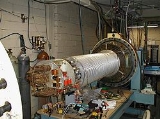
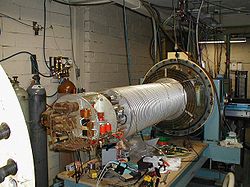
Particle accelerator

Encyclopedia
Electromagnetic field
An electromagnetic field is a physical field produced by moving electrically charged objects. It affects the behavior of charged objects in the vicinity of the field. The electromagnetic field extends indefinitely throughout space and describes the electromagnetic interaction...
s to propel charged
Electric charge
Electric charge is a physical property of matter that causes it to experience a force when near other electrically charged matter. Electric charge comes in two types, called positive and negative. Two positively charged substances, or objects, experience a mutual repulsive force, as do two...
particle
Particle
A particle is, generally, a small localized object to which can be ascribed physical properties. It may also refer to:In chemistry:* Colloidal particle, part of a one-phase system of two or more components where the particles aren't individually visible.In physics:* Subatomic particle, which may be...
s to high speeds and to contain them in well-defined beams. An ordinary CRT
Cathode ray tube
The cathode ray tube is a vacuum tube containing an electron gun and a fluorescent screen used to view images. It has a means to accelerate and deflect the electron beam onto the fluorescent screen to create the images. The image may represent electrical waveforms , pictures , radar targets and...
television set is a simple form of accelerator. There are two basic types: electrostatic
Electrostatics
Electrostatics is the branch of physics that deals with the phenomena and properties of stationary or slow-moving electric charges....
and oscillating field accelerators.
In the early 20th century, cyclotron
Cyclotron
In technology, a cyclotron is a type of particle accelerator. In physics, the cyclotron frequency or gyrofrequency is the frequency of a charged particle moving perpendicularly to the direction of a uniform magnetic field, i.e. a magnetic field of constant magnitude and direction...
s were commonly referred to as atom smashers. Despite the fact that modern colliders actually propel subatomic particles—atoms themselves now being relatively simple to disassemble without an accelerator—the term persists in popular usage when referring to particle accelerators in general.
Rolf Widerøe is considered the "grandfather of modern particle accelerators".
Uses


GEV
GEV or GeV may stand for:*GeV or gigaelectronvolt, a unit of energy equal to billion electron volts*GEV or Grid Enabled Vehicle that is fully or partially powered by the electric grid, see plug-in electric vehicle...
of the sort which are the main focus of this article. Of the rest, about 44% are for radiotherapy, 41% for ion implantation, 9% for industrial processing and research, and 4% for biomedical and other low-energy research.
For the most basic inquiries into the dynamics and structure of matter, space, and time, physicists seek the simplest kinds of interactions at the highest possible energies.
These typically entail particle energies of many GeV
GEV
GEV or GeV may stand for:*GeV or gigaelectronvolt, a unit of energy equal to billion electron volts*GEV or Grid Enabled Vehicle that is fully or partially powered by the electric grid, see plug-in electric vehicle...
, and the interactions of the simplest kinds of particles: lepton
Lepton
A lepton is an elementary particle and a fundamental constituent of matter. The best known of all leptons is the electron which governs nearly all of chemistry as it is found in atoms and is directly tied to all chemical properties. Two main classes of leptons exist: charged leptons , and neutral...
s (e.g. electrons and positron
Positron
The positron or antielectron is the antiparticle or the antimatter counterpart of the electron. The positron has an electric charge of +1e, a spin of ½, and has the same mass as an electron...
s) and quark
Quark
A quark is an elementary particle and a fundamental constituent of matter. Quarks combine to form composite particles called hadrons, the most stable of which are protons and neutrons, the components of atomic nuclei. Due to a phenomenon known as color confinement, quarks are never directly...
s for the matter, or photon
Photon
In physics, a photon is an elementary particle, the quantum of the electromagnetic interaction and the basic unit of light and all other forms of electromagnetic radiation. It is also the force carrier for the electromagnetic force...
s and gluon
Gluon
Gluons are elementary particles which act as the exchange particles for the color force between quarks, analogous to the exchange of photons in the electromagnetic force between two charged particles....
s for the field quanta
Quantum field theory
Quantum field theory provides a theoretical framework for constructing quantum mechanical models of systems classically parametrized by an infinite number of dynamical degrees of freedom, that is, fields and many-body systems. It is the natural and quantitative language of particle physics and...
. Since isolated quarks are experimentally unavailable due to color confinement, the simplest available experiments involve the interactions of, first, leptons with each other, and second, of leptons with nucleon
Nucleon
In physics, a nucleon is a collective name for two particles: the neutron and the proton. These are the two constituents of the atomic nucleus. Until the 1960s, the nucleons were thought to be elementary particles...
s, which are composed of quarks and gluons. To study the collisions of quarks with each other, scientists resort to collisions of nucleons, which at high energy may be usefully considered as essentially 2-body interactions
Parton (particle physics)
In particle physics, the parton model was proposed by Richard Feynman in 1969 as a way to analyze high-energy hadron collisions. It was later recognized that partons describe the same objects now more commonly referred to as quarks and gluons...
of the quarks and gluons of which they are composed. Thus elementary particle physicists tend to use machines creating beams of electrons, positrons, protons, and anti-protons, interacting with each other or with the simplest nuclei (e.g., hydrogen
Hydrogen
Hydrogen is the chemical element with atomic number 1. It is represented by the symbol H. With an average atomic weight of , hydrogen is the lightest and most abundant chemical element, constituting roughly 75% of the Universe's chemical elemental mass. Stars in the main sequence are mainly...
or deuterium
Deuterium
Deuterium, also called heavy hydrogen, is one of two stable isotopes of hydrogen. It has a natural abundance in Earth's oceans of about one atom in of hydrogen . Deuterium accounts for approximately 0.0156% of all naturally occurring hydrogen in Earth's oceans, while the most common isotope ...
) at the highest possible energies, generally hundreds of GeV or more. Nuclear physicists and cosmologists may use beams of bare atomic nuclei
Atomic nucleus
The nucleus is the very dense region consisting of protons and neutrons at the center of an atom. It was discovered in 1911, as a result of Ernest Rutherford's interpretation of the famous 1909 Rutherford experiment performed by Hans Geiger and Ernest Marsden, under the direction of Rutherford. The...
, stripped of electrons, to investigate the structure, interactions, and properties of the nuclei themselves, and of condensed matter
Condensed Matter
Condensed matter may refer to several things*Condensed matter physics, the study of the physical properties of condensed phases of matter*European Physical Journal B: Condensed Matter and Complex Systems, a scientific journal published by EDP sciences...
at extremely high temperatures and densities, such as might have occurred in the first moments of the Big Bang
Big Bang
The Big Bang theory is the prevailing cosmological model that explains the early development of the Universe. According to the Big Bang theory, the Universe was once in an extremely hot and dense state which expanded rapidly. This rapid expansion caused the young Universe to cool and resulted in...
. These investigations often involve collisions of heavy nuclei of atoms like iron
Iron
Iron is a chemical element with the symbol Fe and atomic number 26. It is a metal in the first transition series. It is the most common element forming the planet Earth as a whole, forming much of Earth's outer and inner core. It is the fourth most common element in the Earth's crust...
or gold
Gold
Gold is a chemical element with the symbol Au and an atomic number of 79. Gold is a dense, soft, shiny, malleable and ductile metal. Pure gold has a bright yellow color and luster traditionally considered attractive, which it maintains without oxidizing in air or water. Chemically, gold is a...
at energies of several GeV per nucleon
Nucleon
In physics, a nucleon is a collective name for two particles: the neutron and the proton. These are the two constituents of the atomic nucleus. Until the 1960s, the nucleons were thought to be elementary particles...
. At lower energies, beams of accelerated nuclei are also used in medicine, as for the treatment of cancer.
Besides being of fundamental interest, high energy electrons may be coaxed into emitting extremely bright and coherent beams of high energy photons ultraviolet and X ray via synchrotron radiation
Synchrotron radiation
The electromagnetic radiation emitted when charged particles are accelerated radially is called synchrotron radiation. It is produced in synchrotrons using bending magnets, undulators and/or wigglers...
, which photons have numerous uses in the study of atomic structure, chemistry, condensed matter physics, biology, and technology. Examples include the ESRF in Europe, which has recently been used to extract detailed 3-dimensional images of insects trapped in amber. Thus there is a great demand for electron accelerators of moderate (GeV) energy and high intensity.
Low-energy machines
Everyday examples of particle accelerators are cathode ray tubeCathode ray tube
The cathode ray tube is a vacuum tube containing an electron gun and a fluorescent screen used to view images. It has a means to accelerate and deflect the electron beam onto the fluorescent screen to create the images. The image may represent electrical waveforms , pictures , radar targets and...
s found in television sets and X-ray
X-ray
X-radiation is a form of electromagnetic radiation. X-rays have a wavelength in the range of 0.01 to 10 nanometers, corresponding to frequencies in the range 30 petahertz to 30 exahertz and energies in the range 120 eV to 120 keV. They are shorter in wavelength than UV rays and longer than gamma...
generators. These low-energy accelerators use a single pair of electrode
Electrode
An electrode is an electrical conductor used to make contact with a nonmetallic part of a circuit...
s with a DC
Direct current
Direct current is the unidirectional flow of electric charge. Direct current is produced by such sources as batteries, thermocouples, solar cells, and commutator-type electric machines of the dynamo type. Direct current may flow in a conductor such as a wire, but can also flow through...
voltage of a few thousand volts between them. In an X-ray generator, the target itself is one of the electrodes. A low-energy particle accelerator called an ion implanter is used in the manufacture of integrated circuit
Integrated circuit
An integrated circuit or monolithic integrated circuit is an electronic circuit manufactured by the patterned diffusion of trace elements into the surface of a thin substrate of semiconductor material...
s.
High-energy machines
DC accelerator types capable of accelerating particles to speeds sufficient to cause nuclear reactions are Cockcroft-Walton generatorCockcroft-Walton generator
The Cockcroft–Walton generator, or multiplier, is an electric circuit which generates a high DC voltage from a low voltage AC or pulsing DC input...
s or voltage multiplier
Voltage multiplier
thumb|right|280px|Villard cascade voltage multiplier.A voltage multiplier is an electrical circuit that converts AC electrical power from a lower voltage to a higher DC voltage, typically by means of a network of capacitors and diodes....
s, which convert AC to high voltage DC, or Van de Graaff generator
Van de Graaff generator
A Van de Graaff generator is an electrostatic generator which uses a moving belt to accumulate very high voltages on a hollow metal globe on the top of the stand. It was invented in 1929 by American physicist Robert J. Van de Graaff. The potential differences achieved in modern Van de Graaff...
s that use static electricity carried by belts.
The largest and most powerful particle accelerators, such as the RHIC, the Large Hadron Collider
Large Hadron Collider
The Large Hadron Collider is the world's largest and highest-energy particle accelerator. It is expected to address some of the most fundamental questions of physics, advancing the understanding of the deepest laws of nature....
(LHC) at CERN (which came on-line in mid-November 2009) and the Tevatron
Tevatron
The Tevatron is a circular particle accelerator in the United States, at the Fermi National Accelerator Laboratory , just east of Batavia, Illinois, and is the second highest energy particle collider in the world after the Large Hadron Collider...
, are used for experimental particle physics
Particle physics
Particle physics is a branch of physics that studies the existence and interactions of particles that are the constituents of what is usually referred to as matter or radiation. In current understanding, particles are excitations of quantum fields and interact following their dynamics...
.
Particle accelerators can also produce proton beams, which can produce proton-rich medical or research isotope
Isotope
Isotopes are variants of atoms of a particular chemical element, which have differing numbers of neutrons. Atoms of a particular element by definition must contain the same number of protons but may have a distinct number of neutrons which differs from atom to atom, without changing the designation...
s as opposed to the neutron-rich ones made in fission reactors; however, recent work has shown how to make 99Mo
Molybdenum
Molybdenum , is a Group 6 chemical element with the symbol Mo and atomic number 42. The name is from Neo-Latin Molybdaenum, from Ancient Greek , meaning lead, itself proposed as a loanword from Anatolian Luvian and Lydian languages, since its ores were confused with lead ores...
, usually made in reactors, by accelerating isotopes of hydrogen, although this method still requires a reactor to produce tritium
Tritium
Tritium is a radioactive isotope of hydrogen. The nucleus of tritium contains one proton and two neutrons, whereas the nucleus of protium contains one proton and no neutrons...
. An example of this type of machine is LANSCE at Los Alamos
Los Alamos National Laboratory
Los Alamos National Laboratory is a United States Department of Energy national laboratory, managed and operated by Los Alamos National Security , located in Los Alamos, New Mexico...
.
Electrostatic particle accelerators
Historically, the first accelerators used simple technology of a single static high voltage to accelerate charged particles. While this method is still extremely popular today, with the electrostatic accelerators greatly out-numbering any other type, they are more suited to lower energy studies owing to the practical voltage limit of about 30 MV (when the accelerator is placed in a gas with high dielectric strengthDielectric strength
In physics, the term dielectric strength has the following meanings:*Of an insulating material, the maximum electric field strength that it can withstand intrinsically without breaking down, i.e., without experiencing failure of its insulating properties....
, such as sulfur hexafluoride
Sulfur hexafluoride
Sulfur hexafluoride is an inorganic, colorless, odorless, and non-flammable greenhouse gas. has an octahedral geometry, consisting of six fluorine atoms attached to a central sulfur atom. It is a hypervalent molecule. Typical for a nonpolar gas, it is poorly soluble in water but soluble in...
, allowing the high voltage). The same high voltage can be used twice in a tandem accelerator if the charge of the particles can be reversed while they are inside the terminal; this is possible with the acceleration of atomic nuclei by first adding an extra electron or forming an anionic (negatively charged) chemical compound, and then putting the beam through a thin foil to strip off electrons inside the high voltage conducting terminal, making a beam of positive charge.
Although electrostatic accelerators accelerate particles along a straight line, the term linear accelerator is more often associated with accelerators that use oscillating rather than static electric fields. Thus, many accelerators arranged in a straight line are not termed "linear accelerators" but rather "electrostatic accelerators" to differentiate the two cases.
Oscillating field particle accelerators
Due to the high voltage ceiling imposed by electrical discharge, in order to accelerate particles to higher energies, techniques involving more than one lower, but oscillating, high voltage sources are used. The electrodes can either be arranged to accelerate particles in a line or circle, depending on whether the particles are subject to a magnetic field while they are accelerated, causing their trajectories to arc.Linear particle accelerators
In a linear accelerator (linac), particles are accelerated in a straight line with a target of interest at one end. They are often used to provide an initial low-energy kick to particles before they are injected into circular accelerators. The longest linac in the world is the Stanford Linear AcceleratorStanford Linear Accelerator Center
The SLAC National Accelerator Laboratory, originally named Stanford Linear Accelerator Center, is a United States Department of Energy National Laboratory operated by Stanford University under the programmatic direction of the U.S...
, SLAC, which is 3 km (1.9 mi) long. SLAC is an electron
Electron
The electron is a subatomic particle with a negative elementary electric charge. It has no known components or substructure; in other words, it is generally thought to be an elementary particle. An electron has a mass that is approximately 1/1836 that of the proton...
-positron
Positron
The positron or antielectron is the antiparticle or the antimatter counterpart of the electron. The positron has an electric charge of +1e, a spin of ½, and has the same mass as an electron...
collider.
Linear high-energy accelerators use a linear array of plates (or drift tubes) to which an alternating high-energy field is applied. As the particles approach a plate they are accelerated towards it by an opposite polarity charge applied to the plate. As they pass through a hole in the plate, the polarity is switched so that the plate now repels them and they are now accelerated by it towards the next plate. Normally a stream of "bunches" of particles are accelerated, so a carefully controlled AC voltage is applied to each plate to continuously repeat this process for each bunch.
As the particles approach the speed of light the switching rate of the electric fields becomes so high that they operate at microwave frequencies, and so RF cavity resonators are used in higher energy machines instead of simple plates.
Linear accelerators are also widely used in medicine, for radiotherapy and radiosurgery
Radiosurgery
Radiosurgery is a medical procedure that allows non-invasive treatment of benign and malignant tumors. It is also known as stereotactic radiotherapy, when used to target lesions in the brain, and stereotactic body radiotherapy when used to target lesions in the body...
. Medical grade LINACs accelerate electrons using a klystron
Klystron
A klystron is a specialized linear-beam vacuum tube . Klystrons are used as amplifiers at microwave and radio frequencies to produce both low-power reference signals for superheterodyne radar receivers and to produce high-power carrier waves for communications and the driving force for modern...
and a complex bending magnet arrangement which produces a beam of 6-30 million electron-volt (MeV
MEV
MeV and meV are multiples and submultiples of the electron volt unit referring to 1,000,000 eV and 0.001 eV, respectively.Mev or MEV may refer to:In entertainment:* Musica Elettronica Viva, an Italian musical group...
) energy. The electrons can be used directly or they can be collided with a target to produce a beam of X-rays. The reliability, flexibility and accuracy of the radiation beam produced has largely supplanted the older use of Cobalt-60
Cobalt-60
Cobalt-60, , is a synthetic radioactive isotope of cobalt. Due to its half-life of 5.27 years, is not found in nature. It is produced artificially by neutron activation of . decays by beta decay to the stable isotope nickel-60...
therapy as a treatment tool.
Accelerator pioneers
- John CockcroftJohn CockcroftSir John Douglas Cockcroft OM KCB CBE FRS was a British physicist. He shared the Nobel Prize in Physics for splitting the atomic nucleus with Ernest Walton, and was instrumental in the development of nuclear power....
worked on linear accelerators - Robert J. Van de GraaffRobert J. Van de GraaffRobert Jemison Van de Graaff, was an American physicist, noted for his design and construction of high voltage generators, who taught at Princeton University and MIT.-Biography:...
at Princeton UniversityPrinceton UniversityPrinceton University is a private research university located in Princeton, New Jersey, United States. The school is one of the eight universities of the Ivy League, and is one of the nine Colonial Colleges founded before the American Revolution....
initially used Tesla coils and then in 1929 migrated to Van De Graff generators.
Circular or cyclic accelerators
In the circular accelerator, particles move in a circle until they reach sufficient energy. The particle track is typically bent into a circle using electromagnetElectromagnet
An electromagnet is a type of magnet in which the magnetic field is produced by the flow of electric current. The magnetic field disappears when the current is turned off...
s. The advantage of circular accelerators over linear accelerators (linacs) is that the ring topology allows continuous acceleration, as the particle can transit indefinitely. Another advantage is that a circular accelerator is smaller than a linear accelerator of comparable power (i.e. a linac would have to be extremely long to have the equivalent power of a circular accelerator).
Depending on the energy and the particle being accelerated, circular accelerators suffer a disadvantage in that the particles emit synchrotron radiation
Synchrotron radiation
The electromagnetic radiation emitted when charged particles are accelerated radially is called synchrotron radiation. It is produced in synchrotrons using bending magnets, undulators and/or wigglers...
. When any charged particle is accelerated, it emits electromagnetic radiation
Electromagnetic radiation
Electromagnetic radiation is a form of energy that exhibits wave-like behavior as it travels through space...
and secondary emission
Secondary emission
Secondary emission in physics is a phenomenon where primary incident particles of sufficient energy, when hitting a surface or passing through some material, induce the emission of secondary particles. The primary particles are often charged particles like electrons or ions. If the secondary...
s. As a particle traveling in a circle is always accelerating towards the center of the circle, it continuously radiates towards the tangent of the circle. This radiation is called synchrotron light
Synchrotron light
A synchrotron light source is a source of electromagnetic radiation produced by a synchrotron, which is artificially produced for scientific and technical purposes by specialized particle accelerators, typically accelerating electrons...
and depends highly on the mass of the accelerating particle. For this reason, many high energy electron accelerators are linacs. Certain accelerators (synchrotron
Synchrotron
A synchrotron is a particular type of cyclic particle accelerator in which the magnetic field and the electric field are carefully synchronised with the travelling particle beam. The proton synchrotron was originally conceived by Sir Marcus Oliphant...
s) are however built specially for producing synchrotron light (X-ray
X-ray
X-radiation is a form of electromagnetic radiation. X-rays have a wavelength in the range of 0.01 to 10 nanometers, corresponding to frequencies in the range 30 petahertz to 30 exahertz and energies in the range 120 eV to 120 keV. They are shorter in wavelength than UV rays and longer than gamma...
s).
Since the special theory of relativity requires that matter always travels slower than the speed of light in a vacuum
Vacuum
In everyday usage, vacuum is a volume of space that is essentially empty of matter, such that its gaseous pressure is much less than atmospheric pressure. The word comes from the Latin term for "empty". A perfect vacuum would be one with no particles in it at all, which is impossible to achieve in...
, in high-energy accelerators, as the energy increases the particle speed approaches the speed of light as a limit, but never attains it. Therefore particle physicists do not generally think in terms of speed, but rather in terms of a particle's energy
Energy
In physics, energy is an indirectly observed quantity. It is often understood as the ability a physical system has to do work on other physical systems...
or momentum
Momentum
In classical mechanics, linear momentum or translational momentum is the product of the mass and velocity of an object...
, usually measured in electron volts (eV). An important principle for circular accelerators, and particle beam
Particle beam
A particle beam is a stream of charged or neutral particles which may be directed by magnets and focused by electrostatic lenses, although they may also be self-focusing ....
s in general, is that the curvature
Curvature
In mathematics, curvature refers to any of a number of loosely related concepts in different areas of geometry. Intuitively, curvature is the amount by which a geometric object deviates from being flat, or straight in the case of a line, but this is defined in different ways depending on the context...
of the particle trajectory is proportional to the particle charge and to the magnetic field, but inversely proportional to the (typically relativistic
Special relativity
Special relativity is the physical theory of measurement in an inertial frame of reference proposed in 1905 by Albert Einstein in the paper "On the Electrodynamics of Moving Bodies".It generalizes Galileo's...
) momentum
Momentum
In classical mechanics, linear momentum or translational momentum is the product of the mass and velocity of an object...
.
Cyclotrons
The earliest circular accelerators were cyclotronCyclotron
In technology, a cyclotron is a type of particle accelerator. In physics, the cyclotron frequency or gyrofrequency is the frequency of a charged particle moving perpendicularly to the direction of a uniform magnetic field, i.e. a magnetic field of constant magnitude and direction...
s, invented in 1929 by Ernest O. Lawrence at the University of California, Berkeley
University of California, Berkeley
The University of California, Berkeley , is a teaching and research university established in 1868 and located in Berkeley, California, USA...
. Cyclotrons have a single pair of hollow 'D'-shaped plates to accelerate the particles and a single large dipole magnet
Dipole magnet
A dipole magnet, in particle accelerators, is a magnet constructed to create a homogeneous magnetic field over some distance. Particle motion in that field will be circular in a plane perpendicular to the field and collinear to the direction of particle motion and free in the direction orthogonal...
to bend their path into a circular orbit. It is a characteristic property of charged particles in a uniform and constant magnetic field B that they orbit with a constant period, at a frequency called the cyclotron frequency, so long as their speed is small compared to the speed of light c. This means that the accelerating D's of a cyclotron can be driven at a constant frequency by a radio frequency (RF) accelerating power source, as the beam spirals outwards continuously. The particles are injected in the centre of the magnet and are extracted at the outer edge at their maximum energy.
Cyclotrons reach an energy limit because of relativistic effects whereby the particles effectively become more massive, so that their cyclotron frequency drops out of synch with the accelerating RF. Therefore simple cyclotrons can accelerate protons only to an energy of around 15 million electron volts (15 MeV, corresponding to a speed of roughly 10% of c), because the protons get out of phase with the driving electric field. If accelerated further, the beam would continue to spiral outward to a larger radius but the particles would no longer gain enough speed to complete the larger circle in step with the accelerating RF. To accommodate relativistic effects the magnetic field needs to be increased to higher radii like it is done in isochronous cyclotron
Isochronous cyclotron
In particle accelerators an Isochronous cyclotron is a cyclotron that maintains a constant RF driving frequency, and compensates for the relativistic mass gain of the accelerated particles by alternating field gradient in space but constant in time...
s. An example for an isochronous cyclotron is the PSI Ring cyclotron which is providing protons at the energy of 590 MeV which corresponds to roughly 80% of the speed of light. The advantage of such a cyclotron is the maximum achievable extracted proton current which is currently 2.2 mA. The energy and current correspond to 1.3 MW beam power which is the highest of any accelerator currently existing.
Synchrocyclotrons and isochronous cyclotrons

Another possibility, the synchrocyclotron, accelerates the particles in bunches, in a constant B field, but reduces the RF accelerating field's frequency so as to keep the particles in step as they spiral outward. This approach suffers from low average beam intensity due to the bunching, and again from the need for a huge magnet of large radius and constant field over the larger orbit demanded by high energy.
FFAG accelerators
FFAG acceleratorFFAG accelerator
A Fixed-Field Alternating Gradient accelerator is a type of circular particle accelerator being developed for potential applications in physics, medicine, national security, and energy production, that has features of cyclotrons and synchrotrons...
s, in which a very strong radial field gradient, combined with strong focusing
Strong focusing
In accelerator physics strong focusing or alternating-gradient focusing is the principle that the net effect on a particle beam of charged particles passing through alternating field gradients is to make the beam converge...
, allows the beam to be confined to a narrow ring, are an extension of the isochronous cyclotron idea that is lately under development. They use RF accelerating sections between the magnets, and so are isochronous for relativistic particles like electrons (which achieve essentially the speed of light at only a few MeV), but only over a limited energy range for protons and heavier particles at sub-relativistic energies. Like the isochronous cyclotrons they achieve continuous beam operation, but without the need for a huge dipole bending magnet covering the entire radius of the orbits.
Betatrons
Another type of circular accelerator, invented in 1940 for accelerating electronElectron
The electron is a subatomic particle with a negative elementary electric charge. It has no known components or substructure; in other words, it is generally thought to be an elementary particle. An electron has a mass that is approximately 1/1836 that of the proton...
s, is the Betatron
Betatron
A betatron is a cyclotron developed by Donald Kerst at the University of Illinois in 1940 to accelerate electrons, but the concepts ultimately originate from Rolf Widerøe and previous development occurred in Germany through Max Steenbeck in the 1930s. The betatron is essentially a transformer with...
, a concept which originates ultimately from Norwegian-German scientist Rolf Widerøe. These machines, like synchrotrons, use a donut-shaped ring magnet (see below) with a cyclically increasing B field, but accelerate the particles by induction from the increasing magnetic field, as if they were the secondary winding in a transformer, due to the changing magnetic flux through the orbit.
Achieving constant orbital radius while supplying the proper accelerating electric field requires that the magnetic flux linking the orbit be somewhat independent of the magnetic field on the orbit, bending the particles into a constant radius curve. These machines have in practice been limited by the large radiative losses suffered by the electrons moving at nearly the speed of light in a relatively small radius orbit.
Synchrotrons

GEV
GEV or GeV may stand for:*GeV or gigaelectronvolt, a unit of energy equal to billion electron volts*GEV or Grid Enabled Vehicle that is fully or partially powered by the electric grid, see plug-in electric vehicle...
), it is necessary to use a synchrotron
Synchrotron
A synchrotron is a particular type of cyclic particle accelerator in which the magnetic field and the electric field are carefully synchronised with the travelling particle beam. The proton synchrotron was originally conceived by Sir Marcus Oliphant...
. This is an accelerator in which the particles are accelerated in a ring of constant radius. An immediate advantage over cyclotrons is that the magnetic field need only be present over the actual region of the particle orbits, which is very much narrower than the diameter of the ring. (The largest cyclotron built in the US had a 184 inches (4.7 m) magnet pole, whereas the diameter of the LEP and LHC
Large Hadron Collider
The Large Hadron Collider is the world's largest and highest-energy particle accelerator. It is expected to address some of the most fundamental questions of physics, advancing the understanding of the deepest laws of nature....
is nearly 10 km. The aperture of the two beams of the LHC is of the order of a millimeter.)
However, since the particle momentum increases during acceleration, it is necessary to turn up the magnetic field B in proportion to maintain constant curvature of the orbit. In consequence synchrotrons cannot accelerate particles continuously, as cyclotrons can, but must operate cyclically, supplying particles in bunches, which are delivered to a target or an external beam in beam "spills" typically every few seconds.
Since high energy synchrotrons do most of their work on particles that are already traveling at nearly the speed of light c, the time to complete one orbit of the ring is nearly constant, as is the frequency of the RF cavity resonators used to drive the acceleration.
Note also a further point about modern synchrotrons: because the beam aperture is small and the magnetic field does not cover the entire area of the particle orbit as it does for a cyclotron, several necessary functions can be separated. Instead of one huge magnet, one has a line of hundreds of bending magnets, enclosing (or enclosed by) vacuum connecting pipes. The design of synchrotrons was revolutionized in the early 1950s with the discovery of the strong focusing
Strong focusing
In accelerator physics strong focusing or alternating-gradient focusing is the principle that the net effect on a particle beam of charged particles passing through alternating field gradients is to make the beam converge...
concept. The focusing of the beam is handled independently by specialized quadrupole magnets, while the acceleration itself is accomplished in separate RF sections, rather similar to short linear accelerators. Also, there is no necessity that cyclic machines be circular, but rather the beam pipe may have straight sections between magnets where beams may collide, be cooled, etc. This has developed into an entire separate subject, called "beam physics" or "beam optics".
More complex modern synchrotrons such as the Tevatron
Tevatron
The Tevatron is a circular particle accelerator in the United States, at the Fermi National Accelerator Laboratory , just east of Batavia, Illinois, and is the second highest energy particle collider in the world after the Large Hadron Collider...
, LEP, and LHC
Large Hadron Collider
The Large Hadron Collider is the world's largest and highest-energy particle accelerator. It is expected to address some of the most fundamental questions of physics, advancing the understanding of the deepest laws of nature....
may deliver the particle bunches into storage ring
Storage ring
A storage ring is a type of circular particle accelerator in which a continuous or pulsed particle beam may be kept circulating for a long period of time, up to many hours. Storage of a particular particle depends upon the mass, energy and usually charge of the particle being stored...
s of magnets with constant B, where they can continue to orbit for long periods for experimentation or further acceleration. The highest-energy machines such as the Tevatron and LHC are actually accelerator complexes, with a cascade of specialized elements in series, including linear accelerators for initial beam creation, one or more low energy synchrotrons to reach intermediate energy, storage rings where beams can be accumulated or "cooled" (reducing the magnet aperture required and permitting tighter focusing; see beam cooling
Stochastic cooling
Stochastic cooling is a form of particle beam cooling. It is used in some particle accelerators and storage rings to control the emittance of the particle beams in the machine. This process uses the electrical signals that the individual charged particles generate in a feedback loop to reduce the...
), and a last large ring for final acceleration and experimentation.
Electron synchrotrons
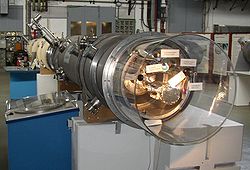
A large number of electron synchrotrons have been built in the past two decades, specialized to be synchrotron light sources, of ultraviolet light and X rays; see below.
Storage rings
For some applications, it is useful to store beams of high energy particles for some time (with modern high vacuumVacuum
In everyday usage, vacuum is a volume of space that is essentially empty of matter, such that its gaseous pressure is much less than atmospheric pressure. The word comes from the Latin term for "empty". A perfect vacuum would be one with no particles in it at all, which is impossible to achieve in...
technology, up to many hours) without further acceleration. This is especially true for colliding beam accelerators
Collider
A collider is a type of a particle accelerator involving directed beams of particles.Colliders may either be ring accelerators or linear accelerators.-Explanation:...
, in which two beams moving in opposite directions are made to collide with each other, with a large gain in effective collision energy. Because relatively few collisions occur at each pass through the intersection point of the two beams, it is customary to first accelerate the beams to the desired energy, and then store them in storage rings, which are essentially synchrotron rings of magnets, with no significant RF power for acceleration.
Synchrotron radiation sources
Some circular accelerators have been built to deliberately generate radiation (called synchrotron lightSynchrotron light
A synchrotron light source is a source of electromagnetic radiation produced by a synchrotron, which is artificially produced for scientific and technical purposes by specialized particle accelerators, typically accelerating electrons...
) as X-rays also called synchrotron radiation, for example the Diamond Light Source
Diamond Light Source
Diamond Light Source is the UK's national synchrotron science facility in Oxfordshire, United Kingdom. Its purpose is to produce intense beams of light whose special characteristics are useful in many areas of scientific research...
which has been built at the Rutherford Appleton Laboratory
Rutherford Appleton Laboratory
The Rutherford Appleton Laboratory is one of the national scientific research laboratories in the UK operated by the Science and Technology Facilities Council . It is located on the Harwell Science and Innovation Campus at Chilton near Didcot in Oxfordshire, United Kingdom...
in England
England
England is a country that is part of the United Kingdom. It shares land borders with Scotland to the north and Wales to the west; the Irish Sea is to the north west, the Celtic Sea to the south west, with the North Sea to the east and the English Channel to the south separating it from continental...
or the Advanced Photon Source
Advanced Photon Source
The Advanced Photon Source at Argonne National Laboratory is a national synchrotron-radiation light source research facility funded by the United States Department of Energy Office of Science...
at Argonne National Laboratory
Argonne National Laboratory
Argonne National Laboratory is the first science and engineering research national laboratory in the United States, receiving this designation on July 1, 1946. It is the largest national laboratory by size and scope in the Midwest...
in Illinois
Illinois
Illinois is the fifth-most populous state of the United States of America, and is often noted for being a microcosm of the entire country. With Chicago in the northeast, small industrial cities and great agricultural productivity in central and northern Illinois, and natural resources like coal,...
, USA. High-energy X-rays are useful for X-ray spectroscopy
X-ray spectroscopy
X-ray spectroscopy is a gathering name for several spectroscopic techniques for characterization of materials by using x-ray excitation.-Characteristic X-ray Spectroscopy:...
of protein
Protein
Proteins are biochemical compounds consisting of one or more polypeptides typically folded into a globular or fibrous form, facilitating a biological function. A polypeptide is a single linear polymer chain of amino acids bonded together by peptide bonds between the carboxyl and amino groups of...
s or X-ray absorption fine structure
X-ray absorption fine structure
X-ray absorption fine structure is a specific structure observed in X-ray absorption spectroscopy . By analyzing the XAFS, information can be acquired on the local structure and on the unoccupied electronic states.-Spectra:...
(XAFS) for example.
Synchrotron radiation is more powerfully emitted by lighter particles, so these accelerators are invariably electron
Electron
The electron is a subatomic particle with a negative elementary electric charge. It has no known components or substructure; in other words, it is generally thought to be an elementary particle. An electron has a mass that is approximately 1/1836 that of the proton...
accelerators. Synchrotron radiation allows for better imaging as researched and developed at SLAC's SPEAR
Stanford Linear Accelerator Center
The SLAC National Accelerator Laboratory, originally named Stanford Linear Accelerator Center, is a United States Department of Energy National Laboratory operated by Stanford University under the programmatic direction of the U.S...
.
History
Lawrence's first cyclotron was a mere 4 inches (100 mm) in diameter. Later he built a machine with a 60 in diameter pole face, and planned one with a 184-inch diameter, which was, however, taken over for World War IIWorld War II
World War II, or the Second World War , was a global conflict lasting from 1939 to 1945, involving most of the world's nations—including all of the great powers—eventually forming two opposing military alliances: the Allies and the Axis...
-related work connected with uranium isotope separation
Isotope separation
Isotope separation is the process of concentrating specific isotopes of a chemical element by removing other isotopes, for example separating natural uranium into enriched uranium and depleted uranium. This is a crucial process in the manufacture of uranium fuel for nuclear power stations, and is...
; after the war it continued in service for research and medicine over many years.
The first large proton synchrotron
Synchrotron
A synchrotron is a particular type of cyclic particle accelerator in which the magnetic field and the electric field are carefully synchronised with the travelling particle beam. The proton synchrotron was originally conceived by Sir Marcus Oliphant...
was the Cosmotron
Cosmotron
The Cosmotron was a particle accelerator, specifically a proton synchrotron, at Brookhaven National Laboratory. Its construction was approved by the U.S. Atomic Energy Commission in 1948, it reached its full energy in 1953, and it continued running until 1968...
at Brookhaven National Laboratory
Brookhaven National Laboratory
Brookhaven National Laboratory , is a United States national laboratory located in Upton, New York on Long Island, and was formally established in 1947 at the site of Camp Upton, a former U.S. Army base...
, which accelerated protons to about 3 GeV
GEV
GEV or GeV may stand for:*GeV or gigaelectronvolt, a unit of energy equal to billion electron volts*GEV or Grid Enabled Vehicle that is fully or partially powered by the electric grid, see plug-in electric vehicle...
. The Bevatron
Bevatron
The Bevatron was a historic particle accelerator — specifically, a weak-focusing proton synchrotron — at Lawrence Berkeley National Laboratory, U.S.A., which began operating in 1954. The antiproton was discovered there in 1955, resulting in the 1959 Nobel Prize in physics for Emilio...
at Berkeley, completed in 1954, was specifically designed to accelerate protons to sufficient energy to create antiprotons, and verify the particle-antiparticle symmetry
Antimatter
In particle physics, antimatter is the extension of the concept of the antiparticle to matter, where antimatter is composed of antiparticles in the same way that normal matter is composed of particles...
of nature, then only strongly suspected. The Alternating Gradient Synchrotron
Alternating Gradient Synchrotron
The Alternating Gradient Synchrotron is a particle accelerator located at the Brookhaven National Laboratory in Long Island, New York, USA....
(AGS) at Brookhaven was the first large synchrotron with alternating gradient, "strong focusing
Strong focusing
In accelerator physics strong focusing or alternating-gradient focusing is the principle that the net effect on a particle beam of charged particles passing through alternating field gradients is to make the beam converge...
" magnets, which greatly reduced the required aperture of the beam, and correspondingly the size and cost of the bending magnets. The Proton Synchrotron
Proton Synchrotron
The Proton Synchrotron is the first major particle accelerator at CERN, built as a 28 GeV proton accelerator in the late 1950s and put into operation in 1959. It takes the protons from the Proton Synchrotron Booster at a kinetic energy of 1.4 GeV and lead ions from the Low Energy Ion Ring at 72...
, built at CERN
CERN
The European Organization for Nuclear Research , known as CERN , is an international organization whose purpose is to operate the world's largest particle physics laboratory, which is situated in the northwest suburbs of Geneva on the Franco–Swiss border...
, was the first major European particle accelerator and generally similar to the AGS.
The Stanford Linear Accelerator, SLAC, became operational in 1966, accelerating electrons to 30 GeV in a 3 km long waveguide, buried in a tunnel and powered by hundreds of large klystron
Klystron
A klystron is a specialized linear-beam vacuum tube . Klystrons are used as amplifiers at microwave and radio frequencies to produce both low-power reference signals for superheterodyne radar receivers and to produce high-power carrier waves for communications and the driving force for modern...
s. It is still the largest linear accelerator in existence, and has been upgraded with the addition of storage rings and an electron-positron collider facility. It is also an X-ray and UV synchrotron photon source.
The Fermilab Tevatron
Tevatron
The Tevatron is a circular particle accelerator in the United States, at the Fermi National Accelerator Laboratory , just east of Batavia, Illinois, and is the second highest energy particle collider in the world after the Large Hadron Collider...
has a ring with a beam path of 4 miles (6.4 km). It has received several upgrades, and has functioned as a proton-antiproton collider until it was shut down due to budget cuts on September 30, 2011. The largest circular accelerator ever built was the LEP synchrotron
Synchrotron
A synchrotron is a particular type of cyclic particle accelerator in which the magnetic field and the electric field are carefully synchronised with the travelling particle beam. The proton synchrotron was originally conceived by Sir Marcus Oliphant...
at CERN with a circumference 26.6 kilometers, which was an electron/positron
Positron
The positron or antielectron is the antiparticle or the antimatter counterpart of the electron. The positron has an electric charge of +1e, a spin of ½, and has the same mass as an electron...
collider. It achieved an energy of 209 GeV before it was dismantled in 2000 so that the underground tunnel could be used for the Large Hadron Collider
Large Hadron Collider
The Large Hadron Collider is the world's largest and highest-energy particle accelerator. It is expected to address some of the most fundamental questions of physics, advancing the understanding of the deepest laws of nature....
(LHC). The LHC is a proton collider, and currently the world's largest and highest-energy accelerator, expected to achieve 7 TeV energy per beam, and currently operating at half that.
The aborted Superconducting Super Collider
Superconducting Super Collider
The Superconducting Super Collider was a particle accelerator complex under construction in the vicinity of Waxahachie, Texas that was set to be world's largest and most energetic, surpassing the current record held by the Large Hadron Collider. Its planned ring circumference was with an energy...
(SSC) in Texas
Texas
Texas is the second largest U.S. state by both area and population, and the largest state by area in the contiguous United States.The name, based on the Caddo word "Tejas" meaning "friends" or "allies", was applied by the Spanish to the Caddo themselves and to the region of their settlement in...
would have had a circumference of 87 km. Construction was started in 1991, but abandoned in 1993. Very large circular accelerators are invariably built in underground tunnels a few metres wide to minimize the disruption and cost of building such a structure on the surface, and to provide shielding against intense secondary radiations that occur, which are extremely penetrating at high energies.
Current accelerators such as the Spallation Neutron Source
Spallation Neutron Source
The Spallation Neutron Source is an accelerator-based neutron source facility that provides the most intense pulsed neutron beams in the world for scientific research and industrial development...
, incorporate superconducting cryomodule
Cryomodule
A cryomodule is that section, or sections of a linear particle accelerator composed of superconducting RF cavities used in a linear accelerator, or linac....
s. The Relativistic Heavy Ion Collider
Relativistic Heavy Ion Collider
The Relativistic Heavy Ion Collider is one of two existing heavy-ion colliders, and the only spin-polarized proton collider in the world. It is located at Brookhaven National Laboratory in Upton, New York and operated by an international team of researchers...
, and Large Hadron Collider
Large Hadron Collider
The Large Hadron Collider is the world's largest and highest-energy particle accelerator. It is expected to address some of the most fundamental questions of physics, advancing the understanding of the deepest laws of nature....
also make use of superconducting
Superconductivity
Superconductivity is a phenomenon of exactly zero electrical resistance occurring in certain materials below a characteristic temperature. It was discovered by Heike Kamerlingh Onnes on April 8, 1911 in Leiden. Like ferromagnetism and atomic spectral lines, superconductivity is a quantum...
magnets and RF cavity resonators to accelerate particles.
Targets and detectors
The output of a particle accelerator can generally be directed towards multiple lines of experiments, one at a given time, by means of a deviating electromagnetElectromagnet
An electromagnet is a type of magnet in which the magnetic field is produced by the flow of electric current. The magnetic field disappears when the current is turned off...
. This makes it possible to operate multiple experiments without needing to move things around or shutting down the entire accelerator beam. Except for synchrotron radiation sources, the purpose of an accelerator is to generate high-energy particles for interaction with matter.
This is usually a fixed target, such as the phosphor
Phosphor
A phosphor, most generally, is a substance that exhibits the phenomenon of luminescence. Somewhat confusingly, this includes both phosphorescent materials, which show a slow decay in brightness , and fluorescent materials, where the emission decay takes place over tens of nanoseconds...
coating on the back of the screen in the case of a television tube; a piece of uranium
Uranium
Uranium is a silvery-white metallic chemical element in the actinide series of the periodic table, with atomic number 92. It is assigned the chemical symbol U. A uranium atom has 92 protons and 92 electrons, of which 6 are valence electrons...
in an accelerator designed as a neutron source; or a tungsten target for an X-ray generator. In a linac, the target is simply fitted to the end of the accelerator. The particle track in a cyclotron is a spiral outwards from the centre of the circular machine, so the accelerated particles emerge from a fixed point as for a linear accelerator.
For synchrotrons, the situation is more complex. Particles are accelerated to the desired energy. Then, a fast acting dipole magnet is used to switch the particles out of the circular synchrotron tube and towards the target.
A variation commonly used for particle physics
Particle physics
Particle physics is a branch of physics that studies the existence and interactions of particles that are the constituents of what is usually referred to as matter or radiation. In current understanding, particles are excitations of quantum fields and interact following their dynamics...
research is a collider
Collider
A collider is a type of a particle accelerator involving directed beams of particles.Colliders may either be ring accelerators or linear accelerators.-Explanation:...
, also called a storage ring collider. Two circular synchrotrons are built in close proximity usually on top of each other and using the same magnets (which are then of more complicated design to accommodate both beam tubes). Bunches of particles travel in opposite directions around the two accelerators and collide at intersections between them. This can increase the energy enormously; whereas in a fixed-target experiment the energy available to produce new particles is proportional to the square root of the beam energy, in a collider the available energy is linear.
Higher energies
At present the highest energy accelerators are all circular colliders, but it is likely that limits have been reached in respect of compensating for synchrotron radiation losses for electron accelerators, and the next generation will probably be linear accelerators 10 times the current length. An example of such a next generation electron accelerator is the 40 km long International Linear ColliderInternational Linear Collider
The International Linear Collider is a proposed linear particle accelerator. It is planned to have a collision energy of 500 GeV initially, and, if approved after the project has published its Technical Design Report, planned for 2012, could be completed in the late 2010s. A later upgrade to 1000...
, due to be constructed between 2015-2020.
As of 2005, it is believed that plasma wakefield acceleration
Plasma acceleration
Plasma Wakefield acceleration is a technique for accelerating charged particles, such as electrons, positrons and ions, using an electric field associated with an electron plasma wave. The wave is created either using electron pulses or through the passage of a very brief laser pulses, a technique...
in the form of electron-beam 'afterburners' and standalone laser pulsers will provide dramatic increases in efficiency within two to three decades. In plasma wakefield accelerators, the beam cavity is filled with a plasma (rather than vacuum). A short pulse of electrons or laser light either constitutes or immediately trails the particles that are being accelerated. The pulse disrupts the plasma, causing the charged particles in the plasma to integrate into and move toward the rear of the bunch of particles that are being accelerated. This process transfers energy to the particle bunch, accelerating it further, and continues as long as the pulse is coherent.
Energy gradients as steep as 200 GeV/m have been achieved over millimeter-scale distances using laser pulsers and gradients approaching 1 GeV/m are being produced on the multi-centimeter-scale with electron-beam systems, in contrast to a limit of about 0.1 GeV/m for radio-frequency acceleration alone. Existing electron accelerators such as SLAC could use electron-beam afterburners to greatly increase the energy of their particle beams, at the cost of beam intensity. Electron systems in general can provide tightly collimated, reliable beams; laser systems may offer more power and compactness. Thus, plasma wakefield accelerators could be used — if technical issues can be resolved — to both increase the maximum energy of the largest accelerators and to bring high energies into university laboratories and medical centres.
Black hole production and public safety concerns
In the future, the possibility of black holeBlack hole
A black hole is a region of spacetime from which nothing, not even light, can escape. The theory of general relativity predicts that a sufficiently compact mass will deform spacetime to form a black hole. Around a black hole there is a mathematically defined surface called an event horizon that...
production at the highest energy accelerators may arise if certain predictions of superstring theory
Superstring theory
Superstring theory is an attempt to explain all of the particles and fundamental forces of nature in one theory by modelling them as vibrations of tiny supersymmetric strings...
are accurate. This and other exotic possibilities have led to public safety concerns that have been widely reported in connection with the LHC
LHC
LHC may refer to:* Large Hadron Collider, a particle accelerator and collider located on the Franco-Swiss border near Geneva, SwitzerlandLHC also may refer to:* La hora Chanante, a Spanish comedy television show...
, which began operation in 2008. The various possible dangerous scenarios have been assessed as presenting "no conceivable danger" in the latest risk assessment produced by the LHC Safety Assessment Group. If they are produced, it is theoretically predicted that such small black holes should evaporate extremely quickly via Bekenstein-Hawking radiation, but which is as yet experimentally unconfirmed. If colliders can produce black holes, cosmic ray
Cosmic ray
Cosmic rays are energetic charged subatomic particles, originating from outer space. They may produce secondary particles that penetrate the Earth's atmosphere and surface. The term ray is historical as cosmic rays were thought to be electromagnetic radiation...
s (and particularly ultra-high-energy cosmic ray
Ultra-high-energy cosmic ray
In astroparticle physics, an ultra-high-energy cosmic ray or extreme-energy cosmic ray is a cosmic ray with an extreme kinetic energy, far beyond both its rest mass and energies typical of other cosmic rays....
s, UHECRs) must have been producing them for eons, but they have yet to harm us. It has been argued that to conserve energy and momentum, any black holes created in a collision between an UHECR and local matter would necessarily be produced moving at relativistic speed with respect to the Earth, and should escape into space, as their accretion and growth rate should be very slow, while black holes produced in colliders (with components of equal mass) would have some chance of having a velocity less than Earth escape velocity, 11.2 km per sec, and would be liable to capture and subsequent growth. Yet even on such scenarios the collisions of UHECRs with white dwarfs and neutron stars would lead to their rapid destruction, but these bodies are observed to be common astronomical objects. Thus if stable micro black holes should be produced, they must grow far too slowly to cause any noticeable macroscopic effects within the natural lifetime of the solar system.
External links
- What are particle accelerators used for?
- Stanley Humphries (1999) Principles of Charged Particle Acceleration
- Particle Accelerators around the world
- Wolfgang K. H. Panofsky: The Evolution of Particle Accelerators & Colliders, (PDF), Stanford, 1997
- P.J. Bryant, A Brief History and Review of Accelerators (PDF), CERNCERNThe European Organization for Nuclear Research , known as CERN , is an international organization whose purpose is to operate the world's largest particle physics laboratory, which is situated in the northwest suburbs of Geneva on the Franco–Swiss border...
, 1994. - David Kestenbaum, Massive Particle Accelerator Revving Up NPR's Morning Edition article on 9 April 2007
- Fred's World of Science
- Annotated bibliography for particle accelerators from the Alsos Digital Library for Nuclear Issues