

List of nuclear tests

Encyclopedia
The following is a list of nuclear test
series designations, organized first by country
and then by date. For more information on countries with nuclear weapons, see List of countries with nuclear weapons. For more information on nuclear weapon arsenals, see List of nuclear weapons.
conducted 715 nuclear tests (by official count) between 1949 and 1990, including 219 atmospheric, underwater, and space tests. Most of them took place at the Semipalatinsk Test Site
in Kazakhstan
and the Northern Test Site at Novaya Zemlya
. Additional tests were conducted at various locations in Russia and Kazakhstan, while a small number of tests were conducted in Ukraine
, Uzbekistan
, and Turkmenistan
.
Some significant Soviet tests include:
The last Soviet test took place on October 24, 1990. After the dissolution of the USSR in 1992, Russia inherited their former nuclear stockpile, but has not conducted any nuclear tests.
has conducted 45 tests (21 in Australian territory, including 9 in mainland South Australia
at Maralinga
and Emu Field
, many others in the U.S. as part of joint test series). Tests include:
Last test: Julin Bristol
, November 26, 1991, vertical shaft.
Atmospheric tests involving nuclear material but conventional explosions:
conducted 210 nuclear tests between February 13, 1960 and January 27, 1996.
conducted 45 tests (23 atmospheric and 22 underground, all conducted at Lop Nur
Nuclear Weapons Test Base, in Malan
, Xinjiang
)
firstly publicly reported conducted a test of single device in 1974 near at the Pakistan's eastern border
under the codename Operation Smiling Buddha. After 24 years, India publicly announced the 5 nuclear tests on May 11 and May 13 of 1998 respectively. The official number of Indian nuclear tests are 6, conducted under two different code-names and in different time intervals.
conducted 6 official tests, under 2 different code names, in the end week of May 1998. From 1983 to 1994, around 24 nuclear cold tests were carried out by Pakistan; these remains unannounced and classified until 2000. In May 1998, Pakistan responded publicly by testing 6 nuclear devices.
announced they had conducted a nuclear test in North Hamgyong province on the northeast coast at 10:36 AM (11:30 AEST). There was a 3.58 magnitude earthquake reported in South Korea
. There was a 4.2 magnitude tremor detected 240 miles north of P'yongyang. The low estimates on the yield of the test — potentially less than a kiloton in strength — have led to speculation as to whether it was a fizzle (unsuccessful test), or a genuine nuclear test at all.
On May 25, 2009, North Korea announced having conducted a second nuclear test. A tremor, with magnitude reports ranging from 4.7 to 5.3, was detected 233 miles northeast of P'yongyang, within a few kilometers of the 2006 test location. While estimates as to yield are still uncertain, with reports ranging from 3 to 20 kilotons, the stronger tremor indicates a significantly larger yield than the 2006 test.
being able to test a nuclear weapon in Korea on August 12, 1945, a few days after the atomic bombings of Hiroshima and Nagasaki
on August 6 and 9, and three days before the Japanese surrender on August 15, but this is seen as being highly unlikely by mainstream historians.
, some country may have detonated a nuclear device on September 22, 1979 in the Indian Ocean, according to satellite data. It is not certain whether there was actually a test, or if it was who would have been responsible for it although France
, Israel
or South Africa
are sometimes named.
In their book, The Nuclear Express, authors Thomas Reed and Danny Stillman also allege that the People's Republic of China
allowed Pakistan
to detonate a nuclear weapon at its Lop Nur
test site in 1990, eight years before Pakistan held its first official weapons test.
However, senior scientist Dr. Abdul Qadeer Khan
strongly rejected the claim in May of 1998. According to Khan, due to its sensitivity, no country allows another country to use their tests site to explode the devices. Such an agreement only existed between the United States
and the United Kingdom
during 1940s, when the Manhattan Project
was in effect. Dr. Samar Mubarakmand
, another senior scientist, also confirmed Dr. Khan's statement and acknowledged that cold tests were carried out, under codename Kirana-I, in a test site which was built by the Corps of Engineers
under the guidance of the PAEC
.
, a book published in German by the historian Rainer Karlsch
in 2005, has alleged that there is evidence that Nazi Germany
performed some sort of test of a "nuclear device" (a hybrid fusion
device unlike any modern nuclear weapons) in March 1945, though the evidence for this has not yet been fully evaluated, and has been doubted by many historians.
 Missiles and nuclear warheads have usually been tested separately, because testing them together is considered highly dangerous (they are the most extreme type of live fire exercise
). The only US live test of an operational missile was the following:
Other live tests with the nuclear explosive delivered by rocket by the USA include:
The Soviet Union tested a number of nuclear explosives on rockets as part of their development of a localised anti-ballistic missile
system in the 1960s. Some of the Soviet nuclear tests with warheads delivered by rocket include:
The People's Republic of China conducted a test with a Dongfeng-2 rocket launch in October 27, 1966. The warhead exploded with a yield of 12 kt.
Nuclear testing
Nuclear weapons tests are experiments carried out to determine the effectiveness, yield and explosive capability of nuclear weapons. Throughout the twentieth century, most nations that have developed nuclear weapons have tested them...
series designations, organized first by country
Country
A country is a region legally identified as a distinct entity in political geography. A country may be an independent sovereign state or one that is occupied by another state, as a non-sovereign or formerly sovereign political division, or a geographic region associated with a previously...
and then by date. For more information on countries with nuclear weapons, see List of countries with nuclear weapons. For more information on nuclear weapon arsenals, see List of nuclear weapons.
United States of America
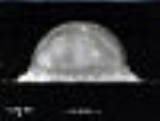
The United States conducted around 1,054 nuclear tests (by official count) between 1945 and 1992. Some significant tests conducted by the United States include:- The "TrinityTrinity testTrinity was the code name of the first test of a nuclear weapon. This test was conducted by the United States Army on July 16, 1945, in the Jornada del Muerto desert about 35 miles southeast of Socorro, New Mexico, at the new White Sands Proving Ground, which incorporated the Alamogordo Bombing...
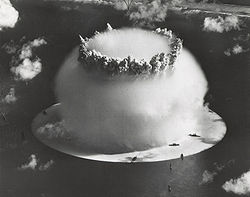
" test on 16 July 1945, was the first-ever test of a nuclear weapon (yield of around 20 kt). - The Operation CrossroadsOperation CrossroadsOperation Crossroads was a series of nuclear weapon tests conducted by the United States at Bikini Atoll in mid-1946. It was the first test of a nuclear weapon after the Trinity nuclear test in July 1945...
series in July 1946, was the first postwar test series and one of the largest military operations in U.S. history. - The Operation GreenhouseOperation GreenhouseOperation Greenhouse was the fifth American nuclear test series, the second conducted in 1951 and the first to test principles that would lead to developing thermonuclear weapons . Conducted at the new Pacific Proving Ground, all of the devices were mounted in large steel towers, to simulate air...
shots of May 1951 included the first boosted fission weaponBoosted fission weaponA boosted fission weapon usually refers to a type of nuclear bomb that uses a small amount of fusion fuel to increase the rate, and thus yield, of a fission reaction. The neutrons released by the fusion reactions add to the neutrons released in the fission, as well as inducing the fission reactions...
test ("Item") and a scientific test which proved the feasibility of thermonuclear weapons ("George"). - The "Ivy MikeIvy MikeIvy Mike was the codename given to the first United States test of a thermonuclear weapon, in which a major part of the explosive yield came from nuclear fusion. It was detonated on November 1, 1952 by the United States at on Enewetak, an atoll in the Pacific Ocean, as part of Operation Ivy...
" shot of 1 November 1952, was the first full test of a Teller-Ulam designTeller-Ulam designThe Teller–Ulam design is the nuclear weapon design concept used in most of the world's nuclear weapons. It is colloquially referred to as "the secret of the hydrogen bomb" because it employs hydrogen fusion, though in most applications the bulk of its destructive energy comes from uranium fission,...
"staged" hydrogen bomb, with a yield of 10 megatons. It was not a deployable weapon, however — with its full cryogenic equipment it weighed some 82 tons. - The "Castle BravoCastle BravoCastle Bravo was the code name given to the first U.S. test of a dry fuel thermonuclear hydrogen bomb device, detonated on March 1, 1954 at Bikini Atoll, Marshall Islands, as the first test of Operation Castle. Castle Bravo was the most powerful nuclear device ever detonated by the United States ,...
" shot of 1 March 1954, was the first test of a deployable (solid fuel) thermonuclear weapon, and also (accidentally) the largest weapon ever tested by the United States (15 megatons). It was also the single largest U.S. radiological accident in connection with nuclear testing. The unanticipated yield, and a change in the weather, resulted in nuclear falloutNuclear falloutFallout is the residual radioactive material propelled into the upper atmosphere following a nuclear blast, so called because it "falls out" of the sky after the explosion and shock wave have passed. It commonly refers to the radioactive dust and ash created when a nuclear weapon explodes...
spreading eastward onto the inhabited RongelapRongelap AtollRongelap Atoll or Namorik Atoll is a coral atoll of 61 islands in the Pacific Ocean, and forms a legislative district of the Ralik Chain of the Marshall Islands. Its total land area is only , but it encloses a lagoon with an area of...
and RongerikRongerik AtollRongerik Atoll or Rongdrik Atoll is a coral atoll of 17 islands in the Pacific Ocean, and is located in the Ralik Chain of the Marshall Islands, approximately east of Bikini Atoll. Its total land area is only , but it encloses a lagoon of .-History:Rongerik Atoll was claimed by the Empire of...
atolls, which were soon evacuated. Many of the Marshall IslandsMarshall IslandsThe Republic of the Marshall Islands , , is a Micronesian nation of atolls and islands in the middle of the Pacific Ocean, just west of the International Date Line and just north of the Equator. As of July 2011 the population was 67,182...
natives have since suffered from birth defectsCongenital disorderA congenital disorder, or congenital disease, is a condition existing at birth and often before birth, or that develops during the first month of life , regardless of causation...
and have received some compensation from the federal governmentFederal government of the United StatesThe federal government of the United States is the national government of the constitutional republic of fifty states that is the United States of America. The federal government comprises three distinct branches of government: a legislative, an executive and a judiciary. These branches and...
. A JapanJapanJapan is an island nation in East Asia. Located in the Pacific Ocean, it lies to the east of the Sea of Japan, China, North Korea, South Korea and Russia, stretching from the Sea of Okhotsk in the north to the East China Sea and Taiwan in the south...
ese fishing boat, the Fifth Lucky DragonDaigo Fukuryu Maruwas a Japanese tuna fishing boat, which was exposed to and contaminated by nuclear fallout from the United States' Castle Bravo thermonuclear device test on Bikini Atoll, on 1 March 1954....
, also came into contact with the fallout, which caused many of the crew to grow ill; one eventually died. - Shot "Argus I" of Operation ArgusOperation ArgusOperation Argus was a series of nuclear weapons tests and missile tests secretly conducted during August and September 1958 over the South Atlantic Ocean by the United States's Defense Nuclear Agency, in conjunction with the Explorer 4 space mission. Operation Argus was conducted between the...
, on 27 August 1958, was the first detonation of a nuclear weapon in outer spaceOuter spaceOuter space is the void that exists between celestial bodies, including the Earth. It is not completely empty, but consists of a hard vacuum containing a low density of particles: predominantly a plasma of hydrogen and helium, as well as electromagnetic radiation, magnetic fields, and neutrinos....
when a 1.7-kiloton warhead was detonated at 200 kilometers' altitude during a series of high altitude nuclear explosionHigh altitude nuclear explosionHigh-altitude nuclear explosions have historically been nuclear explosions which take place above altitudes of 30 km, still inside the Earth's atmosphere. Such explosions have been tests of nuclear weapons, used to determine the effects of the blast and radiation in the exoatmospheric...
s. - Shot "Frigate Bird" of Operation Dominic IOperation Dominic I and IIOperation Dominic was a series of 105 nuclear test explosions conducted in 1962 by the United States. Those conducted in the Pacific are sometimes called Dominic I. The blasts in Nevada are known as Dominic II. This test series was scheduled quickly, in order to respond in kind to the Soviet...
on 6 May 1962, was the only U.S. test of an operational ballistic missileBallistic missileA ballistic missile is a missile that follows a sub-orbital ballistic flightpath with the objective of delivering one or more warheads to a predetermined target. The missile is only guided during the relatively brief initial powered phase of flight and its course is subsequently governed by the...
with a live nuclear warhead (yield of 600 kilotons), at Christmas IslandChristmas IslandThe Territory of Christmas Island is a territory of Australia in the Indian Ocean. It is located northwest of the Western Australian city of Perth, south of the Indonesian capital, Jakarta, and ENE of the Cocos Islands....
. In general, missile systems were tested without live warheads and warheads were tested separately for safety concerns. In the early 1960s, however, there mounted technical questions about how the systems would behave under combat conditions (when they were "mated", in military parlance), and this test was meant to dispel these concerns. However, the warhead had to be somewhat modified before its use, and the missile was only a SLBMSubmarine-launched ballistic missileA submarine-launched ballistic missile is a ballistic missile capable of delivering a nuclear warhead that can be launched from submarines. Modern variants usually deliver multiple independently targetable reentry vehicles each of which carries a warhead and allows a single launched missile to...
(and not an ICBMIntercontinental ballistic missileAn intercontinental ballistic missile is a ballistic missile with a long range typically designed for nuclear weapons delivery...
), so by itself it did not satisfy all concerns. - Shot "SedanSedan (nuclear test)Storax Sedan was a shallow underground nuclear test conducted in Area 10 of Yucca Flat at the Nevada National Security Site on 6 July 1962 as part of Operation Plowshare, a program to investigate the use of nuclear weapons for mining, cratering, and other civilian purposes...
" of Operation StoraxOperation StoraxOperation Storax was a series of 48 American nuclear tests which took place in 1962 and 1963, including the Sedan blast, which was part of the Plowshare program.The individual blasts were: NameDateSize SEDAN July 6 104 kilotons...
on 6 July 1962 (yield of 104 kilotons), was an attempt at showing the feasibility of using nuclear weapons for "civilian" and "peaceful" purposes as part of Operation PlowshareOperation PlowshareProject Plowshare was the overall United States term for the development of techniques to use nuclear explosives for peaceful construction purposes...
. In this instance, a 1280-feet-in-diameter and 320-feet-deep craterSubsidence craterA subsidence crater is a hole or depression left on the surface of an area which has had an underground explosion. Many such craters are present at the Nevada Test Site, which is no longer in use for nuclear testing....
was created at the Nevada Test Site.
Soviet Union
The Soviet UnionSoviet Union
The Soviet Union , officially the Union of Soviet Socialist Republics , was a constitutionally socialist state that existed in Eurasia between 1922 and 1991....
conducted 715 nuclear tests (by official count) between 1949 and 1990, including 219 atmospheric, underwater, and space tests. Most of them took place at the Semipalatinsk Test Site
Semipalatinsk Test Site
The Semipalatinsk Test Site was the primary testing venue for the Soviet Union's nuclear weapons. It is located on the steppe in northeast Kazakhstan , south of the valley of the Irtysh River...
in Kazakhstan
Kazakhstan
Kazakhstan , officially the Republic of Kazakhstan, is a transcontinental country in Central Asia and Eastern Europe. Ranked as the ninth largest country in the world, it is also the world's largest landlocked country; its territory of is greater than Western Europe...
and the Northern Test Site at Novaya Zemlya
Novaya Zemlya
Novaya Zemlya , also known in Dutch as Nova Zembla and in Norwegian as , is an archipelago in the Arctic Ocean in the north of Russia and the extreme northeast of Europe, the easternmost point of Europe lying at Cape Flissingsky on the northern island...
. Additional tests were conducted at various locations in Russia and Kazakhstan, while a small number of tests were conducted in Ukraine
Ukraine
Ukraine is a country in Eastern Europe. It has an area of 603,628 km², making it the second largest contiguous country on the European continent, after Russia...
, Uzbekistan
Uzbekistan
Uzbekistan , officially the Republic of Uzbekistan is a doubly landlocked country in Central Asia and one of the six independent Turkic states. It shares borders with Kazakhstan to the west and to the north, Kyrgyzstan and Tajikistan to the east, and Afghanistan and Turkmenistan to the south....
, and Turkmenistan
Turkmenistan
Turkmenistan , formerly also known as Turkmenia is one of the Turkic states in Central Asia. Until 1991, it was a constituent republic of the Soviet Union, the Turkmen Soviet Socialist Republic . Turkmenistan is one of the six independent Turkic states...
.
Some significant Soviet tests include:
- Operation First Lightning/RDS-1Joe 1The RDS-1 , also known as First Lightning , was the Soviet Union's first nuclear weapon test. In the west, it was code-named Joe-1, in reference to Joseph Stalin. It was test-exploded on 29 August 1949, at Semipalatinsk, Kazakh SSR, after a top-secret R&D project...
(known as Joe 1Joe 1The RDS-1 , also known as First Lightning , was the Soviet Union's first nuclear weapon test. In the west, it was code-named Joe-1, in reference to Joseph Stalin. It was test-exploded on 29 August 1949, at Semipalatinsk, Kazakh SSR, after a top-secret R&D project...
in the West), August 29, 1949 — first Soviet nuclear test. - RDS-6sJoe 4Joe 4 was an American nickname for the first Soviet test of a thermonuclear weapon on August 12, 1953. It utilized a scheme in which fission and fusion fuel were "layered", a design known as the Sloika model in the Soviet Union...
(known as Joe 4Joe 4Joe 4 was an American nickname for the first Soviet test of a thermonuclear weapon on August 12, 1953. It utilized a scheme in which fission and fusion fuel were "layered", a design known as the Sloika model in the Soviet Union...
in the West), August 12, 1953 — first Soviet thermonuclear test (not a "true" hydrogen bomb). - RDS-37RDS-37RDS-37 was the Soviet Union's first "true" hydrogen bomb, first tested on November 22, 1955. The weapon had a nominal yield of approximately 3 megatons. It was scaled down to 1.6 megatons for the live test....
, November 22, 1955 — first Soviet multi-megaton, "true" hydrogen bomb test. - Tsar BombaTsar BombaTsar Bomba is the nickname for the AN602 hydrogen bomb, the most powerful nuclear weapon ever detonated. It was also referred to as Kuz'kina Mat , in this usage meaning "something that has not been seen before"....
, October 30, 1961 — largest nuclear weapon ever detonated, with a yield of 50 Mt. - ChaganChagan (nuclear test)Chagan was a Soviet underground nuclear test conducted at the Semipalatinsk Test Site on January 15, 1965.Chagan was the first and largest of the 124 detonations in the Nuclear Explosions for the National Economy program, designed to produce peaceful nuclear explosions for earth-moving purposes...
, January 15, 1965 — large cratering experiment as part of Nuclear Explosions for the National EconomyNuclear Explosions for the National EconomyNuclear Explosions for the National Economy , was a Soviet program to investigate peaceful nuclear explosions . It was analogous to the US program Operation Plowshare....
program.
The last Soviet test took place on October 24, 1990. After the dissolution of the USSR in 1992, Russia inherited their former nuclear stockpile, but has not conducted any nuclear tests.
United Kingdom
The United KingdomUnited Kingdom
The United Kingdom of Great Britain and Northern IrelandIn the United Kingdom and Dependencies, other languages have been officially recognised as legitimate autochthonous languages under the European Charter for Regional or Minority Languages...
has conducted 45 tests (21 in Australian territory, including 9 in mainland South Australia
South Australia
South Australia is a state of Australia in the southern central part of the country. It covers some of the most arid parts of the continent; with a total land area of , it is the fourth largest of Australia's six states and two territories.South Australia shares borders with all of the mainland...
at Maralinga
British nuclear tests at Maralinga
British nuclear tests at Maralinga occurred between 1955 and 1963 at the Maralinga site, part of the Woomera Prohibited Area, in South Australia. A total of seven major nuclear tests were performed, with approximate yields ranging from 1 to 27 kilotons of TNT equivalent...
and Emu Field
Emu Field
Emu Field is located in the desert of South Australia, at . Variously known as Emu Field, Emu Junction or Emu, it was the site of the Operation Totem pair of nuclear tests conducted by the British government in October 1953.The site was surveyed by Len Beadell in 1952...
, many others in the U.S. as part of joint test series). Tests include:
- Operation HurricaneOperation HurricaneOperation Hurricane was the test of the first British atomic device on 3 October 1952. A plutonium implosion device was detonated in the lagoon between the Montebello Islands, Western Australia....
, October 3, 1952 (first atomic bomb) - Operation TotemOperation TotemOperation Totem was a pair of British atmospheric nuclear tests which took place on 15th October 1953. The only ones conducted at a temporary site in Australia, Emu Field, they followed the Operation Hurricane test of the first British atomic bomb which had taken place at the Montebello Islands a...
, 1953 - Operation MosaicOperation MosaicOperation Mosaic was a series of two atmospheric nuclear tests conducted by Britain in the Montebello Islands off the north-west coast of Australia in 1956...
, 1956 - Operation BuffaloOperation BuffaloOperation Buffalo may refer to:* The breakout from the Operation Shingle Anzio beachhead by the U.S. VI Corps commencing on 23 May 1944* Four open-air British nuclear tests at Maralinga in South Australia in late 1956...
, 1956 - Operation Antler, 1957
- Operation GrappleOperation GrappleOperation Grapple, and operations Grapple X, Grapple Y and Grapple Z, were the names of British nuclear tests of the hydrogen bomb. They were held 1956—1958 at Malden Island and Christmas Island in the central Pacific Ocean. Nine nuclear detonations took place during the trials, resulting in...
, 1957–1958 (first hydrogen bomb)
Last test: Julin Bristol
Julin Bristol
Julin Bristol was the last British nuclear test, and took place at the Nevada Test Site on 26 November 1991. With a yield of less than 20 kilotons it may have been a proof test of some aspect of the British-designed warheads fitted to those Trident missiles in the British arsenal, possibly of a...
, November 26, 1991, vertical shaft.
Atmospheric tests involving nuclear material but conventional explosions:
- Operation Kittens, 1953-1961 (initiator tests using conventional explosive)
- Operation Rats, 1956-1960 (conventional explosions to study dispersal of uranium)
- Operation Tims, 1955-1963 (conventional explosions for tamper, plutonium compression trials)
- Operation Vixen, 1959-1963 (effects of accidental fire or explosion on nuclear weapons)
France
FranceFrance
The French Republic , The French Republic , The French Republic , (commonly known as France , is a unitary semi-presidential republic in Western Europe with several overseas territories and islands located on other continents and in the Indian, Pacific, and Atlantic oceans. Metropolitan France...
conducted 210 nuclear tests between February 13, 1960 and January 27, 1996.
- Operation Gerboise bleue, February 13, 1960 (first atomic bomb) and three more — RegganeRegganeReggane from berber argan is a town in the Adrar Province of central Algeria, in the Sahara Desert. It is the southernmost town of the Tuat....
, AlgeriaAlgeriaAlgeria , officially the People's Democratic Republic of Algeria , also formally referred to as the Democratic and Popular Republic of Algeria, is a country in the Maghreb region of Northwest Africa with Algiers as its capital.In terms of land area, it is the largest country in Africa and the Arab...
; in the atmosphere; final test reputed to be more intended to prevent the weapon from falling into the hands of generals rebelling against Charles de GaulleCharles de GaulleCharles André Joseph Marie de Gaulle was a French general and statesman who led the Free French Forces during World War II. He later founded the French Fifth Republic in 1958 and served as its first President from 1959 to 1969....
than for testing purposes. - Operation Agathe, November 7, 1961 and 12 more — In Ekker, Hoggar Algeria; underground
- Operation Aldébaran, July 2, 1966 and 45 more — Mururoa and FangataufaFangataufaFangataufa is a small, low, narrow, coral atoll in the eastern side of the Tuamotu Archipelago. Along with its neighboring atoll, Moruroa, it has been the site of approximately 200 nuclear bomb tests....
, French PolynesiaFrench PolynesiaFrench Polynesia is an overseas country of the French Republic . It is made up of several groups of Polynesian islands, the most famous island being Tahiti in the Society Islands group, which is also the most populous island and the seat of the capital of the territory...
; in the atmosphere;- first hydrogen bomb: August 28, 1968 CanopusCanopus (nuclear test)Canopus was the code name for France's first two-stage thermonuclear test, conducted on August 24, 1968 at Fangataufa atoll...
(Fangataufa)
- first hydrogen bomb: August 28, 1968 Canopus
- Operation Achille June 5, 1975 and 146 more — Mururoa and Fangataufa, French PolynesiaFrench PolynesiaFrench Polynesia is an overseas country of the French Republic . It is made up of several groups of Polynesian islands, the most famous island being Tahiti in the Society Islands group, which is also the most populous island and the seat of the capital of the territory...
; underground- last test: January 27, 1996 Operation Xouthos (Fangataufa)
China
The People's Republic of ChinaPeople's Republic of China
China , officially the People's Republic of China , is the most populous country in the world, with over 1.3 billion citizens. Located in East Asia, the country covers approximately 9.6 million square kilometres...
conducted 45 tests (23 atmospheric and 22 underground, all conducted at Lop Nur
Lop Nur
Lop Lake or Lop Nur is a group of small, now seasonal salt lake sand marshes between the Taklamakan and Kuruktag deserts in the Bayingolin Mongol Autonomous Prefecture, southeastern portion of Xinjiang Uygur Autonomous Region in the People's Republic of China.The lake system into which the Tarim...
Nuclear Weapons Test Base, in Malan
Malan
-People:*César Malan*David Malan*Lucio Malan , Italian politician*Solomon Caesar Malan*William Gerald Malan, Missouri bankerMembers of the prominent South African Malan family:*F. S...
, Xinjiang
Xinjiang
Xinjiang is an autonomous region of the People's Republic of China. It is the largest Chinese administrative division and spans over 1.6 million km2...
)
- First test: "596596 (nuclear test)596 is the codename of the People's Republic of China's first nuclear weapons test, detonated on October 16, 1964 at the Lop Nur test site. It was a uranium-235 implosion fission device and had a yield of 22 kilotons...
" — October 16, 1964 - First hydrogen bomb test: "Test No. 6" - June 17, 1967
- 200kT-1MT atmospheric test, June 17, 1974 (16th test)
- Last atmospheric test: October 16, 1980. This would also be the last atmospheric nuclear test by any other country
- Last test: July 29, 1996, underground.
India
IndiaIndia
India , officially the Republic of India , is a country in South Asia. It is the seventh-largest country by geographical area, the second-most populous country with over 1.2 billion people, and the most populous democracy in the world...
firstly publicly reported conducted a test of single device in 1974 near at the Pakistan's eastern border
Pokhran
Pokhran is a city and a municipality located in Jaisalmer district in the Indian state of Rajasthan. It is a remote location in the Thar Desert region and served as the test site for India's first underground nuclear weapon detonation.-Geography:Pokhran http://marupradesh.org/ located at...
under the codename Operation Smiling Buddha. After 24 years, India publicly announced the 5 nuclear tests on May 11 and May 13 of 1998 respectively. The official number of Indian nuclear tests are 6, conducted under two different code-names and in different time intervals.
- May 18, 1974 — Operation Smiling Buddha (type: implosion, plutonium and underground). One underground test horizontal-shaft around 107m long under the long-constructed Indian Army Pokhran Test Range (IA-PTR) in the Thar DesertThar DesertThe Thar Desert |Punjab]] province. The Cholistan Desert adjoins the Thar desert spreading into Pakistani Punjab province.-Location and description:...
, eastern border of Pakistan. The Indian Meteorological DepartmentIndia Meteorological DepartmentThe India Meteorological Department , also referred to as the Met Office, is an agency of the Ministry of Earth Sciences of the Government of India. It is the principal agency responsible for meteorological observations, weather forecasting and seismology...
and the Atomic Energy CommissionAtomic Energy Commission of IndiaThe Atomic Energy Commission is a governing body functioning under the Department of Atomic Energy , Government of India. The DAE is under the direct charge of the Prime Minister.- History :...
announced the yield of the weapon 12kt. Other Western sources claimed the yield at around 2~12kt. However, the claim was dismissed by the Bulletin of the Atomic ScientistsBulletin of the Atomic ScientistsThe Bulletin of the Atomic Scientists is a nontechnical online magazine that covers global security and public policy issues, especially related to the dangers posed by nuclear and other weapons of mass destruction...
and it was later reported to be 8kt. - May 11, 1998 — Operation Shakti, (type: Implosion, 3 uranium and 2 plutonium devices, and all underground): Atomic Energy CommissionAtomic Energy Commission of IndiaThe Atomic Energy Commission is a governing body functioning under the Department of Atomic Energy , Government of India. The DAE is under the direct charge of the Prime Minister.- History :...
(AEC) of India, and the Defence Research and Development OrganisationDefence Research and Development OrganisationThe Defence Research and Development Organisation is a agency of the Republic of India, responsible for the development of technology for use by the military, headquartered in New Delhi, India...
(DRDO) publicly simultaneously conducted with test of three nuclear devices at the long constructed Indian ArmyIndian ArmyThe Indian Army is the land based branch and the largest component of the Indian Armed Forces. With about 1,100,000 soldiers in active service and about 1,150,000 reserve troops, the Indian Army is the world's largest standing volunteer army...
Pokhran Test Range (IAPTR) on May 11 of 1998. On May 13, two days after these recent tests, the AEC and DRDO carried out the test of two nuclear devices, detonated simultaneously. During this operation, AEC India claimed to to have tested the three-stage thermonuclear device (Teller-Ulam designTeller-Ulam designThe Teller–Ulam design is the nuclear weapon design concept used in most of the world's nuclear weapons. It is colloquially referred to as "the secret of the hydrogen bomb" because it employs hydrogen fusion, though in most applications the bulk of its destructive energy comes from uranium fission,...
) but the yield of tests were significantly lower than the thermonuclear devices are expected to produce. In 2009, K. Santhanam, senior nuclear scientists who witnessed the tests, reportedly told the press that the 1998 tests were not as successful as the then BJP government had claimed they were, and the thermonuclear device was failed to produced any significant data expected by the seismologists. However, the claims were widely dismissed by nuclear physicist dr. Abdul Kalam, who cited evidence and data to prove his point.
Pakistan
PakistanPakistan
Pakistan , officially the Islamic Republic of Pakistan is a sovereign state in South Asia. It has a coastline along the Arabian Sea and the Gulf of Oman in the south and is bordered by Afghanistan and Iran in the west, India in the east and China in the far northeast. In the north, Tajikistan...
conducted 6 official tests, under 2 different code names, in the end week of May 1998. From 1983 to 1994, around 24 nuclear cold tests were carried out by Pakistan; these remains unannounced and classified until 2000. In May 1998, Pakistan responded publicly by testing 6 nuclear devices.
- March 11, 1983, — Kirana-I (type: implosion, non-fissioned (plutonium)Reactor grade plutonium nuclear testReactor-grade plutonium is found in spent nuclear fuel that a nuclear reactor has irradiated for years instead of weeks or months, leading to transmutation of much of the fissile, relatively long half-life isotope 239Pu into other isotopes of plutonium that are less fissile or more...
and underground). The 24 underground cold-tests of nuclear devices were experimentally performed at near the Sargodha Air Force BaseSargodha AirbasePAF Base Mushaf is a Pakistan Air Force airbase located at Sargodha in the Punjab province of Pakistan. It is the headquarters of the PAF Central Air Command....
. Due to serious political repercussionsEconomic sanctionsEconomic sanctions are domestic penalties applied by one country on another for a variety of reasons. Economic sanctions include, but are not limited to, tariffs, trade barriers, import duties, and import or export quotas...
, Pakistan did not announce the results of the tests or even the yield of the first weapon still remains classified. Because it was a cold test, the Pakistan Atomic Scientists Foundation (PASF) estimated the yield at no more than around 12–25 kilotonnes.
- May 28, 1998 — Chagai-IChagai-IThe Chagai-I was a codename referring to the five underground nuclear tests conducted by Pakistan at 15:15hrs in 28th May of 1998. It was named Chagai-I, as the tests were conducted in the Chagai District...
(type: implosion, HEU and underground). One underground horizontal-shaft tunnel test (inside a granite mountain) of boosted fission devices at Koh Kambaran in the Ras KohRas KohThe Ras Koh Hills is a range of granite hills forming part of the Sulaiman Mountain Range in the Chagai District in Pakistan's Balochistan province. The word "Ras" means "gateway" and the word "Koh" means "mountain" in Urdu...
Hills in Chagai District of Balochistan Province. The announced yield of the five devices was a total of 40–45 kilotonnes with the largest having a yield of approximately 30–45 kilotonnes. - May 30, 1998 — Chagai-II (type: implosion, plutonium device and underground). One underground vertical-shaft tunnel test of a miniaturized fission device having an announced yield of approximately 18–20 kilotonnes in the Kharan DesertKharan DesertThe Kharan Desert is a sand desert situated in the Balochistan province of Pakistan.Kharan desert is Pakistan's second nuclear test site, and the second nuclear test — Codename Chagai-II — was conducted and supervised by the Pakistan Atomic Energy Commission in May 30, 1998.The desert is...
in Kharan DistrictKharan DistrictKharan is a district in the north-west of Balochistan province of Pakistan. Kharan was notified as a district in 1951 and the Deputy Commissioner’s office started functioning on March 15, 1952. The Deputy Commissioner directly supervises all activities in the district and the functions of all...
of Balochistan Province.
North Korea
On October 9, 2006 North KoreaNorth Korea
The Democratic People’s Republic of Korea , , is a country in East Asia, occupying the northern half of the Korean Peninsula. Its capital and largest city is Pyongyang. The Korean Demilitarized Zone serves as the buffer zone between North Korea and South Korea...
announced they had conducted a nuclear test in North Hamgyong province on the northeast coast at 10:36 AM (11:30 AEST). There was a 3.58 magnitude earthquake reported in South Korea
South Korea
The Republic of Korea , , is a sovereign state in East Asia, located on the southern portion of the Korean Peninsula. It is neighbored by the People's Republic of China to the west, Japan to the east, North Korea to the north, and the East China Sea and Republic of China to the south...
. There was a 4.2 magnitude tremor detected 240 miles north of P'yongyang. The low estimates on the yield of the test — potentially less than a kiloton in strength — have led to speculation as to whether it was a fizzle (unsuccessful test), or a genuine nuclear test at all.
On May 25, 2009, North Korea announced having conducted a second nuclear test. A tremor, with magnitude reports ranging from 4.7 to 5.3, was detected 233 miles northeast of P'yongyang, within a few kilometers of the 2006 test location. While estimates as to yield are still uncertain, with reports ranging from 3 to 20 kilotons, the stronger tremor indicates a significantly larger yield than the 2006 test.
Alleged tests
There have been a number of significant alleged/disputed/unacknowledged accounts of countries testing nuclear explosives. Their status is either not certain or entirely disputed by most mainstream experts.Japan
There is a disputed report about the Japanese atomic programJapanese atomic program
The Japanese program to develop nuclear weapons was conducted during World War II. Like the German nuclear weapons program, it suffered from an array of problems, and was ultimately unable to progress beyond the laboratory stage before the atomic bombings of Hiroshima and Nagasaki and the Japanese...
being able to test a nuclear weapon in Korea on August 12, 1945, a few days after the atomic bombings of Hiroshima and Nagasaki
Atomic bombings of Hiroshima and Nagasaki
During the final stages of World War II in 1945, the United States conducted two atomic bombings against the cities of Hiroshima and Nagasaki in Japan, the first on August 6, 1945, and the second on August 9, 1945. These two events are the only use of nuclear weapons in war to date.For six months...
on August 6 and 9, and three days before the Japanese surrender on August 15, but this is seen as being highly unlikely by mainstream historians.
Vela incident
In what is known as the Vela IncidentVela Incident
The Vela Incident was an unidentified "double flash" of light that was detected by an American Vela Hotel satellite on September 22, 1979....
, some country may have detonated a nuclear device on September 22, 1979 in the Indian Ocean, according to satellite data. It is not certain whether there was actually a test, or if it was who would have been responsible for it although France
France
The French Republic , The French Republic , The French Republic , (commonly known as France , is a unitary semi-presidential republic in Western Europe with several overseas territories and islands located on other continents and in the Indian, Pacific, and Atlantic oceans. Metropolitan France...
, Israel
Israel
The State of Israel is a parliamentary republic located in the Middle East, along the eastern shore of the Mediterranean Sea...
or South Africa
South Africa
The Republic of South Africa is a country in southern Africa. Located at the southern tip of Africa, it is divided into nine provinces, with of coastline on the Atlantic and Indian oceans...
are sometimes named.
Pakistan
Because Pakistan's nuclear development was established and development under extreme secrecy that it raised concerns in Soviet Union and India, who suspected that since 1974 test, it will inevitable that Pakistan will developed the counter-programme. The pro-Soviet newspaper, The Patriot, reported that "Pakistan has exploded a nuclear device in the range of 20 to 50 kilotons in 1983. But it was widely dismissed by Western diplomats as it was pointed out that The Patriot has previously engaged in spreading disinformation on several occasions. In 1983, India and Soviet Union both investigated secret testings but, due to lack of any scientific data, these statements were widely dismissed.In their book, The Nuclear Express, authors Thomas Reed and Danny Stillman also allege that the People's Republic of China
People's Republic of China
China , officially the People's Republic of China , is the most populous country in the world, with over 1.3 billion citizens. Located in East Asia, the country covers approximately 9.6 million square kilometres...
allowed Pakistan
Pakistan
Pakistan , officially the Islamic Republic of Pakistan is a sovereign state in South Asia. It has a coastline along the Arabian Sea and the Gulf of Oman in the south and is bordered by Afghanistan and Iran in the west, India in the east and China in the far northeast. In the north, Tajikistan...
to detonate a nuclear weapon at its Lop Nur
Lop Nur
Lop Lake or Lop Nur is a group of small, now seasonal salt lake sand marshes between the Taklamakan and Kuruktag deserts in the Bayingolin Mongol Autonomous Prefecture, southeastern portion of Xinjiang Uygur Autonomous Region in the People's Republic of China.The lake system into which the Tarim...
test site in 1990, eight years before Pakistan held its first official weapons test.
However, senior scientist Dr. Abdul Qadeer Khan
Abdul Qadeer Khan
Abdul Qadeer Khan , also known in Pakistan as Mohsin-e-Pakistan , D.Eng, Sc.D, HI, NI , FPAS; more widely known as Dr. A. Q...
strongly rejected the claim in May of 1998. According to Khan, due to its sensitivity, no country allows another country to use their tests site to explode the devices. Such an agreement only existed between the United States
United States
The United States of America is a federal constitutional republic comprising fifty states and a federal district...
and the United Kingdom
United Kingdom
The United Kingdom of Great Britain and Northern IrelandIn the United Kingdom and Dependencies, other languages have been officially recognised as legitimate autochthonous languages under the European Charter for Regional or Minority Languages...
during 1940s, when the Manhattan Project
Manhattan Project
The Manhattan Project was a research and development program, led by the United States with participation from the United Kingdom and Canada, that produced the first atomic bomb during World War II. From 1942 to 1946, the project was under the direction of Major General Leslie Groves of the US Army...
was in effect. Dr. Samar Mubarakmand
Samar Mubarakmand
Samar Mubarakmand , , is a Pakistani nuclear physicist, who served as the founding chairman of National Engineering and Scientific Commission from 2001 till 2007. Samar Mubarak-Mand launched the Missile Integration Programme in 1987 which was successfully completed in 2005...
, another senior scientist, also confirmed Dr. Khan's statement and acknowledged that cold tests were carried out, under codename Kirana-I, in a test site which was built by the Corps of Engineers
Pakistan Army Corps of Engineers
The Pakistan Army Corps of Engineers, , is an active military administrative staff corps, and a major science and technology command of the Pakistan Army...
under the guidance of the PAEC
Pakistan Atomic Energy Commission
The Pakistan Atomic Energy Commission, , is an administrative governmental and autonomous science and technology governmental department of Pakistan, responsible for development of nuclear energy and development of nuclear power sector in Pakistan...
.
North Korea
On September 9, 2004 it was reported by South Korean media that there had been a large explosion at the Chinese/North Korean border. This explosion left a crater visible by satellite and precipitated a large (2 mile diameter) mushroom cloud. The United States and South Korea quickly downplayed this, explaining it away as a forest fire that had nothing to do with the DPRK's nuclear weapons program.Germany
Hitlers BombeHitlers Bombe
Hitlers Bombe is a nonfiction book by the German historian Rainer Karlsch published in March 2005, which claims to have evidence concerning the development and testing of a possible "nuclear weapon" by Nazi Germany in 1945...
, a book published in German by the historian Rainer Karlsch
Rainer Karlsch
Rainer Karlsch is a German historian and author.He studied economic history at the Humboldt University of Berlin. He graduated in 1986 as a Doctor of Economics.From 1992-1994, assistant to the Historical commission on...
in 2005, has alleged that there is evidence that Nazi Germany
Nazi Germany
Nazi Germany , also known as the Third Reich , but officially called German Reich from 1933 to 1943 and Greater German Reich from 26 June 1943 onward, is the name commonly used to refer to the state of Germany from 1933 to 1945, when it was a totalitarian dictatorship ruled by...
performed some sort of test of a "nuclear device" (a hybrid fusion
Nuclear fusion
Nuclear fusion is the process by which two or more atomic nuclei join together, or "fuse", to form a single heavier nucleus. This is usually accompanied by the release or absorption of large quantities of energy...
device unlike any modern nuclear weapons) in March 1945, though the evidence for this has not yet been fully evaluated, and has been doubted by many historians.
Tests of live warheads on rockets
Live fire exercise
A live fire exercise or LFX is any exercise in which a realistic scenario for the use of specific equipment is simulated. In the popular lexicon this is applied primarily to tests of weapons or weapon systems that are associated with the various branches of a nation's armed forces, although the...
). The only US live test of an operational missile was the following:
- Frigate Bird — on May 6, 1962, a UGM-27 PolarisUGM-27 PolarisThe Polaris missile was a two-stage solid-fuel nuclear-armed submarine-launched ballistic missile built during the Cold War by Lockheed Corporation of California for the United States Navy....
A-2 missile with a live 600 kt W47 warhead was launched from the USS Ethan AllenUSS Ethan Allen (SSBN-608)USS Ethan Allen , lead ship of her class, was the second ship of the United States Navy to be named for American Revolutionary War hero Ethan Allen....
; it flew 1900 km, re-entered the atmosphere, and detonated at an altitude of 3.4 km over the South Pacific. The test was part of Operation Dominic IOperation Dominic I and IIOperation Dominic was a series of 105 nuclear test explosions conducted in 1962 by the United States. Those conducted in the Pacific are sometimes called Dominic I. The blasts in Nevada are known as Dominic II. This test series was scheduled quickly, in order to respond in kind to the Soviet...
. Planned as a method to dispel doubts about whether the USA's nuclear missiles would actually function in practice, it had less effect than was hoped, as the stockpile warhead was substantially modified prior to testing, and the missile tested was a relatively low-flying SLBM and not a high-flying ICBM.
Other live tests with the nuclear explosive delivered by rocket by the USA include:
- On August 1, 1958, Redstone rocket #CC50 launched nuclear test TeakHardtack TeakHARDTACK-Teak was an exoatmospheric high altitude nuclear weapon test performed during Operation Hardtack I. It was launched from Johnston Island on a Redstone missile. On 1 August 1958, the 3.8 Mt shot detonated at an altitude of 76.8 km. Teak caused communications impairment over a...
that detonated at an altitude of 77.8-km. On August 12, 1958, Redstone #CC51 launched nuclear test Orange to a detonation altitude of 43 km. Both were part of Operation Hardtack IOperation Hardtack IOperation Hardtack I was a series of 35 nuclear tests conducted by the United States in 1958 in the Pacific Ocean.Operation Newsreel was a series of three high-altitude nuclear tests conducted as part of Hardtack I. The individual tests in the series were Orange, Teak and Yucca.-Test Blasts:-...
and had a yield of 3.75 Mt - Operation ArgusOperation ArgusOperation Argus was a series of nuclear weapons tests and missile tests secretly conducted during August and September 1958 over the South Atlantic Ocean by the United States's Defense Nuclear Agency, in conjunction with the Explorer 4 space mission. Operation Argus was conducted between the...
— three tests, August 27, August 30, and September 6, 1958 - On July 9, 1962, Thor missilePGM-17 ThorThor was the first operational ballistic missile of the U.S. Air Force . Named after the Norse god of thunder, it was deployed in the United Kingdom between 1959 and September 1963 as an intermediate range ballistic missile with thermonuclear warheads. Thor was in height and in diameter. It was...
195 launched a Mk4 reentry vehicle containing a W49 thermonuclear warhead to an altitude of 248 miles (400 km). The warhead detonated with a yield of 1.45 Mt. This was the Starfish PrimeStarfish PrimeStarfish Prime was a high-altitude nuclear test conducted by the United States of America on July 9, 1962, a joint effort of the Atomic Energy Commission and the Defense Atomic Support Agency ....
event of nuclear test operation Dominic-FishbowlOperation Dominic I and IIOperation Dominic was a series of 105 nuclear test explosions conducted in 1962 by the United States. Those conducted in the Pacific are sometimes called Dominic I. The blasts in Nevada are known as Dominic II. This test series was scheduled quickly, in order to respond in kind to the Soviet... - In the Dominic-Fishbowl series in 1962: Checkmate, Bluegill, Kingfish, and Tightrope
The Soviet Union tested a number of nuclear explosives on rockets as part of their development of a localised anti-ballistic missile
Anti-ballistic missile
An anti-ballistic missile is a missile designed to counter ballistic missiles .A ballistic missile is used to deliver nuclear, chemical, biological or conventional warheads in a ballistic flight trajectory. The term "anti-ballistic missile" describes any antimissile system designed to counter...
system in the 1960s. Some of the Soviet nuclear tests with warheads delivered by rocket include:
- Operation Baikal (February 2, 1956, at Aralsk) - one test, with a R-5M rocket launch from Kapustin Yar.
- Operation ZUR-215 (January 19, 1957, at Kapustin YarKapustin YarKapustin Yar is a Russian rocket launch and development site in Astrakhan Oblast, between Volgograd and Astrakhan. Known today as Znamensk , it was established 13 May 1946 and in the beginning used technology, material, and scientific support from defeated Germany...
) - one test, with a rocket launch from Kapustin Yar. - Operation Groza (September 6, 1961, at Kapustin Yar) - one test, with a rocket launch from Kapustin Yar.
- Operation Grom (October 6, 1961, at Kapustin Yar) - one test, with a rocket launch from Kapustin Yar.
- Operation Volga (September, 1961, at Novaya ZemlyaNovaya ZemlyaNovaya Zemlya , also known in Dutch as Nova Zembla and in Norwegian as , is an archipelago in the Arctic Ocean in the north of Russia and the extreme northeast of Europe, the easternmost point of Europe lying at Cape Flissingsky on the northern island...
) - two tests, with R-11M rockets launch from RogachevoRogachevoRogachevo is a military air base on Novaya Zemlya, Russia located 9 km northeast of Belushya Guba. It was originally used as a staging base for intercontinental Long Range Aviation bomber flights...
. - Operation Roza (September, 1961, at Novaya Zemlya) - two tests, with R-12R-12The R-12 Dvina was a theatre ballistic missile developed and deployed by the Soviet Union during the Cold War. Its GRAU designation was 8K63, and it was given the NATO reporting name SS-4 Sandal...
rockets launch from VorkutaVorkutaVorkuta is a coal-mining town in the Komi Republic, Russia, situated just north of the Arctic Circle in the Pechora coal basin at the Usa River. Population: - Labor camp origins :...
. - RadugaRaduga (nuclear test)Raduga is the codename of a Soviet thermonuclear test, conducted in October 20, 1961, in Mityushikha Bay, Severny Island of Novaya Zemlya....
(October 20, 1961, at Novaya Zemlya) - one test, with a R-13R-13The R-13 was a submarine-launched ballistic missile developed by the Soviet Union starting around 1955. It was assigned the NATO reporting name SS-N-4 Sark and carried the GRAU index 4K50.-History:...
rocket launch. - Operation Tyulpan (September, 1962, at Novaya Zemlya) - probabily two tests, with R-14 rockets launch from ChitaChita-Places:* Chita, Aichi, a city in Aichi Prefecture, Japan* Chita District, Aichi, in Aichi Prefecture, Japan* Chita Peninsula, in Aichi Prefecture, Japan* Chita, Zabaykalsky Krai, a city in Russia...
. - Operation KThe K ProjectThe K Project, or also Operation K, was a series of five high altitude nuclear explosions, nuclear tests performed by the Soviet Union during the years 1961 and 1962. Their purpose was to test the performance of anti-ballistic missiles of the ABM System A and their resistance against nuclear blasts...
(1961 and 1962, at Sary-Shagan) - five tests, with rockets launch from Kapustin Yar.
The People's Republic of China conducted a test with a Dongfeng-2 rocket launch in October 27, 1966. The warhead exploded with a yield of 12 kt.
List of most powerful nuclear tests
The following incomplete list contains nuclear tests conducted with a yield of over 10 Mt TNT.| Date | Yield | Test mode | Country | Test Site | Remarks |
|---|---|---|---|---|---|
| October 30, 1961 | 50 Mt | air-drop | Soviet Union | Novaya Zemlya Novaya Zemlya Novaya Zemlya , also known in Dutch as Nova Zembla and in Norwegian as , is an archipelago in the Arctic Ocean in the north of Russia and the extreme northeast of Europe, the easternmost point of Europe lying at Cape Flissingsky on the northern island... |
Tsar Bomba Tsar Bomba Tsar Bomba is the nickname for the AN602 hydrogen bomb, the most powerful nuclear weapon ever detonated. It was also referred to as Kuz'kina Mat , in this usage meaning "something that has not been seen before".... |
| December 24, 1962 | 24.2 Mt | air-drop | Soviet Union | Novaya Zemlya | Test 219 Test 219 Test 219 was a nuclear test conducted by the Soviet Union in the atmosphere via air drop. The test was performed on December 24, 1962 over at the Novaya Zemlya test range. The yield was 24.2 Mt making it the second largest thermonuclear explosion in history..... |
| August 5, 1961 | 21.1 Mt | air-drop | Soviet Union | Novaya Zemlya | |
| September 25, 1962 | 19.1 Mt | air-drop | Soviet Union | Novaya Zemlya | |
| February 28, 1954 | 15 Mt | ground | USA | Bikini Atoll Bikini Atoll Bikini Atoll is an atoll, listed as a World Heritage Site, in the Micronesian Islands of the Pacific Ocean, part of Republic of the Marshall Islands.... |
Castle Bravo Castle Bravo Castle Bravo was the code name given to the first U.S. test of a dry fuel thermonuclear hydrogen bomb device, detonated on March 1, 1954 at Bikini Atoll, Marshall Islands, as the first test of Operation Castle. Castle Bravo was the most powerful nuclear device ever detonated by the United States ,... |
| May 5, 1954 | 13.5 Mt | sea surface | USA | Bikini Atoll | Castle Yankee Castle Yankee Castle Yankee was the code name given to one of the tests in the Operation Castle series of American tests of thermonuclear bombs.-Jughead:... |
| October 23, 1961 | 12.5 Mt | air-drop | Soviet Union | Novaya Zemlya | |
| March 26, 1954 | 11 Mt | sea surface | USA | Bikini Atoll | Castle Romeo Castle Romeo Castle Romeo was the code name given to one of the tests in the Operation Castle series of American nuclear tests. It was the first test of the TX-17 thermonuclear weapon , the first deployed U.S... |
| November 1, 1952 | 10.4 Mt | ground | USA | Eniwetok | Ivy Mike Ivy Mike Ivy Mike was the codename given to the first United States test of a thermonuclear weapon, in which a major part of the explosive yield came from nuclear fusion. It was detonated on November 1, 1952 by the United States at on Enewetak, an atoll in the Pacific Ocean, as part of Operation Ivy... |
| September 27, 1962 | 10 Mt | air-drop | Soviet Union | Novaya Zemlya |