


Ivy Mike

Encyclopedia
Ivy Mike was the codename
given to the first United States
test of a thermonuclear weapon, in which a major part of the explosive yield
came from nuclear fusion
. It was detonated on November 1, 1952 by the United States
at 11.6709°N 162.1980°E on Enewetak, an atoll
in the Pacific Ocean
, as part of Operation Ivy
. The device was the first full test of the Teller-Ulam design
, a staged fusion bomb, and was the first successful test of a hydrogen bomb.
Due to its physical size and fusion fuel type (cryogenic liquid deuterium
) the Mike device was not suitable for use as a thermonuclear weapon; it was intended as an extremely conservative experiment to validate the concepts used for multi-megaton detonations. A simplified and lightened bomb version (the EC-16
) was prepared, and scheduled to be tested in operation Castle Yankee
, as a backup in case the non-cryogenic "Shrimp" fusion device (tested in Castle Bravo
) failed to work; that test was cancelled when the Bravo device was tested successfully, making the cryogenic designs obsolete.
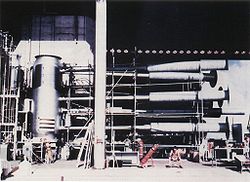 The 62-ton "Mike" device was essentially a building that resembled a factory rather than a weapon. It has been reported that Russian engineers derisively referred to Mike as a "thermonuclear installation". At its center, a very large cylindrical thermos
flask or cryostat
, held the cryogenic deuterium
fusion fuel. A regular fission
bomb (the "primary") at one end was used to create the conditions needed to initiate the fusion reaction.
The device was designed by Richard Garwin
, a student of Enrico Fermi
, on the suggestion of Edward Teller
. It had been decided that nothing other than a full-scale test would validate the idea of the Teller-Ulam design
, and Garwin was instructed to use very conservative estimates when designing the test, and that it need not be small and light enough to be deployed by air.
The primary stage was a TX-5 boosted fission bomb in a separate space atop the assembly (so it would not freeze, rendering it inoperable). The "secondary" fusion stage used liquid deuterium despite the difficulty of handling this material, because this fuel simplified the experiment, and made the results easier to analyze. Running down the center of the flask which held it, was a cylindrical rod of plutonium
(the "sparkplug") to ignite the fusion reaction. Surrounding this assembly was a five-ton (4.5 tonne) natural uranium
"tamper". The exterior of the tamper was lined with sheets of lead
and polyethylene
foam, which formed a radiation
channel to conduct X-rays from the primary to secondary. (The function of the X-rays was to hydrodynamically compress the secondary, increasing the density and temperature of the deuterium to the level needed to sustain a thermonuclear reaction, and compress the sparkplug to supercriticality ignition.) The outermost layer was a steel casing 10-12 inches (25-30 cm) thick. The entire assembly, nicknamed "Sausage", measured 80 inches (2.03 m) in diameter and 244 inches (6.19 m) in height and weighed about 54 tons.
The entire Mike device (including cryogenic equipment) weighed 82 short ton
s (73.8 metric tonnes), and was housed in a large corrugated-aluminium building called a "shot cab" which was set up on the Pacific island of Elugelab
, part of the Enewetak
atoll.
A 9,000-foot (2.7 km) artificial causeway connected the islands of Elugelab, Teiter, Bogairikk, and Bogon. Atop this causeway was an aluminium
-sheathed plywood
tube (named a "Krause-Ogle box") filled with helium
ballonet
s. This allowed gamma
and neutron
radiation
to pass uninhibited to an unmanned detection station housed in a bunker on Bogon.
In total, 9,350 military and 2,300 civilian personnel were involved in the Mike shot. A large cryogenics plant was installed on Parry Island, at the South end of the Eniwetak atoll, to produce the liquid hydrogen (used for cooling the device) and deuterium needed for the test.
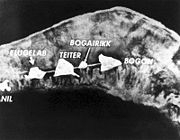
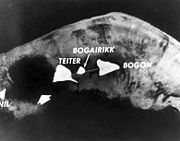 The test was carried out at 07:15 A.M local time on November 1, 1952 (19:15 October 31 GMT
). It produced a yield estimated in the range of 10.4–12 Megatons
. However, 77% of the final yield came from fast fission
of the uranium tamper, which meant that the device produced large amounts of fallout
.
The fireball was approximately 3.25 miles (5.2 km) wide, and the mushroom cloud rose to an altitude of 57,000 feet (17.0 km) in less than 90 seconds. One minute later it had reached 108,000 feet (33.0 km), before stabilizing at 136,000 feet (25 miles or 37.0 km) with the top eventually spreading out to a diameter of 100 miles (161 km) with a stem 20 miles (32 km) wide.
The blast created a crater 6,240 feet (1.9 km) in diameter and 164 feet (50 m) deep where Elugelab had once been; the blast and water waves from the explosion (some waves up to twenty feet high) stripped the test islands clean of vegetation, as observed by a helicopter survey within 60 minutes after the test, by which time the mushroom cloud and steam were blown away. Radioactive coral debris fell upon ships positioned 30 miles (48 km) from the blast, and the immediate area around the atoll was heavily contaminated for some time. Produced by intensely concentrated neutron flux about the detonation site were two new elements, einsteinium
and fermium
.
The entire shot was documented by the filmmakers of Lookout Mountain studios
. The film was accompanied by powerful, Wagner
-esque music featured on many test films of that period and was hosted by actor Reed Hadley
. After the test a private screening was given to President Dwight D. Eisenhower
. It was later released to the public after censoring, and was for many days played continually on many television channels.
Edward Teller
, perhaps the most ardent supporter of the development of the hydrogen bomb, was in Berkeley, California
at the time of the shot. He was able to receive first notice that the test was successful by observing a seismometer
, which picked up the shock wave
that traveled through the earth from the Western Pacific
test site. In his memoirs, Teller wrote that he immediately sent an unclassified telegram to his colleagues at Los Alamos
which contained only the words — for security purposes — "It's a boy."
Code name
A code name or cryptonym is a word or name used clandestinely to refer to another name or word. Code names are often used for military purposes, or in espionage...
given to the first United States
United States
The United States of America is a federal constitutional republic comprising fifty states and a federal district...
test of a thermonuclear weapon, in which a major part of the explosive yield
Nuclear weapon yield
The explosive yield of a nuclear weapon is the amount of energy discharged when a nuclear weapon is detonated, expressed usually in the equivalent mass of trinitrotoluene , either in kilotons or megatons , but sometimes also in terajoules...
came from nuclear fusion
Nuclear fusion
Nuclear fusion is the process by which two or more atomic nuclei join together, or "fuse", to form a single heavier nucleus. This is usually accompanied by the release or absorption of large quantities of energy...
. It was detonated on November 1, 1952 by the United States
United States
The United States of America is a federal constitutional republic comprising fifty states and a federal district...
at 11.6709°N 162.1980°E on Enewetak, an atoll
Atoll
An atoll is a coral island that encircles a lagoon partially or completely.- Usage :The word atoll comes from the Dhivehi word atholhu OED...
in the Pacific Ocean
Pacific Ocean
The Pacific Ocean is the largest of the Earth's oceanic divisions. It extends from the Arctic in the north to the Southern Ocean in the south, bounded by Asia and Australia in the west, and the Americas in the east.At 165.2 million square kilometres in area, this largest division of the World...
, as part of Operation Ivy
Operation Ivy
Operation Ivy was the eighth series of American nuclear tests, coming after Tumbler-Snapper and before Upshot-Knothole. Its purpose was to help upgrade the U.S. arsenal of nuclear weapons in response to the Soviet nuclear weapons program...
. The device was the first full test of the Teller-Ulam design
Teller-Ulam design
The Teller–Ulam design is the nuclear weapon design concept used in most of the world's nuclear weapons. It is colloquially referred to as "the secret of the hydrogen bomb" because it employs hydrogen fusion, though in most applications the bulk of its destructive energy comes from uranium fission,...
, a staged fusion bomb, and was the first successful test of a hydrogen bomb.
Due to its physical size and fusion fuel type (cryogenic liquid deuterium
Deuterium
Deuterium, also called heavy hydrogen, is one of two stable isotopes of hydrogen. It has a natural abundance in Earth's oceans of about one atom in of hydrogen . Deuterium accounts for approximately 0.0156% of all naturally occurring hydrogen in Earth's oceans, while the most common isotope ...
) the Mike device was not suitable for use as a thermonuclear weapon; it was intended as an extremely conservative experiment to validate the concepts used for multi-megaton detonations. A simplified and lightened bomb version (the EC-16
Mark 16 nuclear bomb
The Mark 16 nuclear bomb was a large thermonuclear bomb, based on the design of the Ivy Mike, the first hydrogen bomb test fired. The Mark 16 is more properly designated TX-16/EC-16 as it only existed in Experimental/Emergency Capability versions....
) was prepared, and scheduled to be tested in operation Castle Yankee
Castle Yankee
Castle Yankee was the code name given to one of the tests in the Operation Castle series of American tests of thermonuclear bombs.-Jughead:...
, as a backup in case the non-cryogenic "Shrimp" fusion device (tested in Castle Bravo
Castle Bravo
Castle Bravo was the code name given to the first U.S. test of a dry fuel thermonuclear hydrogen bomb device, detonated on March 1, 1954 at Bikini Atoll, Marshall Islands, as the first test of Operation Castle. Castle Bravo was the most powerful nuclear device ever detonated by the United States ,...
) failed to work; that test was cancelled when the Bravo device was tested successfully, making the cryogenic designs obsolete.
Device design and preparations
Vacuum flask
A vacuum flask is an insulating storage vessel which keeps its contents hotter or cooler than its surroundings. Invented by Sir James Dewar in 1892, the vacuum flask consists of two flasks, placed one within the other and joined at the neck...
flask or cryostat
Cryostat
A cryostat is a device used to maintain cold cryogenic temperatures. Low temperatures may be maintained within a cryostat by using various refrigeration methods, most commonly using cryogenic fluid bath such as liquid helium. Hence it is usually assembled into a vessel, similar in construction...
, held the cryogenic deuterium
Deuterium
Deuterium, also called heavy hydrogen, is one of two stable isotopes of hydrogen. It has a natural abundance in Earth's oceans of about one atom in of hydrogen . Deuterium accounts for approximately 0.0156% of all naturally occurring hydrogen in Earth's oceans, while the most common isotope ...
fusion fuel. A regular fission
Nuclear fission
In nuclear physics and nuclear chemistry, nuclear fission is a nuclear reaction in which the nucleus of an atom splits into smaller parts , often producing free neutrons and photons , and releasing a tremendous amount of energy...
bomb (the "primary") at one end was used to create the conditions needed to initiate the fusion reaction.
The device was designed by Richard Garwin
Richard Garwin
Richard Lawrence Garwin , is an American physicist. He received his bachelor's degree from the Case Institute of Technology in 1947 and obtained his Doctor of Philosophy from the University of Chicago in 1949, where he worked in the lab of Enrico Fermi.Garwin is IBM Fellow Emeritus at the Thomas J...
, a student of Enrico Fermi
Enrico Fermi
Enrico Fermi was an Italian-born, naturalized American physicist particularly known for his work on the development of the first nuclear reactor, Chicago Pile-1, and for his contributions to the development of quantum theory, nuclear and particle physics, and statistical mechanics...
, on the suggestion of Edward Teller
Edward Teller
Edward Teller was a Hungarian-American theoretical physicist, known colloquially as "the father of the hydrogen bomb," even though he did not care for the title. Teller made numerous contributions to nuclear and molecular physics, spectroscopy , and surface physics...
. It had been decided that nothing other than a full-scale test would validate the idea of the Teller-Ulam design
Teller-Ulam design
The Teller–Ulam design is the nuclear weapon design concept used in most of the world's nuclear weapons. It is colloquially referred to as "the secret of the hydrogen bomb" because it employs hydrogen fusion, though in most applications the bulk of its destructive energy comes from uranium fission,...
, and Garwin was instructed to use very conservative estimates when designing the test, and that it need not be small and light enough to be deployed by air.
The primary stage was a TX-5 boosted fission bomb in a separate space atop the assembly (so it would not freeze, rendering it inoperable). The "secondary" fusion stage used liquid deuterium despite the difficulty of handling this material, because this fuel simplified the experiment, and made the results easier to analyze. Running down the center of the flask which held it, was a cylindrical rod of plutonium
Plutonium
Plutonium is a transuranic radioactive chemical element with the chemical symbol Pu and atomic number 94. It is an actinide metal of silvery-gray appearance that tarnishes when exposed to air, forming a dull coating when oxidized. The element normally exhibits six allotropes and four oxidation...
(the "sparkplug") to ignite the fusion reaction. Surrounding this assembly was a five-ton (4.5 tonne) natural uranium
Uranium
Uranium is a silvery-white metallic chemical element in the actinide series of the periodic table, with atomic number 92. It is assigned the chemical symbol U. A uranium atom has 92 protons and 92 electrons, of which 6 are valence electrons...
"tamper". The exterior of the tamper was lined with sheets of lead
Lead
Lead is a main-group element in the carbon group with the symbol Pb and atomic number 82. Lead is a soft, malleable poor metal. It is also counted as one of the heavy metals. Metallic lead has a bluish-white color after being freshly cut, but it soon tarnishes to a dull grayish color when exposed...
and polyethylene
Polyethylene
Polyethylene or polythene is the most widely used plastic, with an annual production of approximately 80 million metric tons...
foam, which formed a radiation
Radiation
In physics, radiation is a process in which energetic particles or energetic waves travel through a medium or space. There are two distinct types of radiation; ionizing and non-ionizing...
channel to conduct X-rays from the primary to secondary. (The function of the X-rays was to hydrodynamically compress the secondary, increasing the density and temperature of the deuterium to the level needed to sustain a thermonuclear reaction, and compress the sparkplug to supercriticality ignition.) The outermost layer was a steel casing 10-12 inches (25-30 cm) thick. The entire assembly, nicknamed "Sausage", measured 80 inches (2.03 m) in diameter and 244 inches (6.19 m) in height and weighed about 54 tons.
The entire Mike device (including cryogenic equipment) weighed 82 short ton
Short ton
The short ton is a unit of mass equal to . In the United States it is often called simply ton without distinguishing it from the metric ton or the long ton ; rather, the other two are specifically noted. There are, however, some U.S...
s (73.8 metric tonnes), and was housed in a large corrugated-aluminium building called a "shot cab" which was set up on the Pacific island of Elugelab
Elugelab
Elugelab was an island, part of the Enewetak atoll in the Marshall Islands. It was destroyed by the world's first test of a hydrogen bomb on 1 November 1952, as part of Operation Ivy...
, part of the Enewetak
Enewetak
Enewetak Atoll is a large coral atoll of 40 islands in the Pacific Ocean, and forms a legislative district of the Ralik Chain of the Marshall Islands. Its land area totals less than , surrounding a deep central lagoon, in circumference...
atoll.
A 9,000-foot (2.7 km) artificial causeway connected the islands of Elugelab, Teiter, Bogairikk, and Bogon. Atop this causeway was an aluminium
Aluminium
Aluminium or aluminum is a silvery white member of the boron group of chemical elements. It has the symbol Al, and its atomic number is 13. It is not soluble in water under normal circumstances....
-sheathed plywood
Plywood
Plywood is a type of manufactured timber made from thin sheets of wood veneer. It is one of the most widely used wood products. It is flexible, inexpensive, workable, re-usable, and can usually be locally manufactured...
tube (named a "Krause-Ogle box") filled with helium
Helium
Helium is the chemical element with atomic number 2 and an atomic weight of 4.002602, which is represented by the symbol He. It is a colorless, odorless, tasteless, non-toxic, inert, monatomic gas that heads the noble gas group in the periodic table...
ballonet
Ballonet
A Ballonet is a air-filled flexible container that is located inside the envelope of a non-rigid or semi-rigid airship. Such an airship can have one or more ballonets, commonly one fore and one aft...
s. This allowed gamma
Gamma
Gamma is the third letter of the Greek alphabet. In the system of Greek numerals it has a value of 3. It was derived from the Phoenician letter Gimel . Letters that arose from Gamma include the Roman C and G and the Cyrillic letters Ge Г and Ghe Ґ.-Greek:In Ancient Greek, gamma represented a...
and neutron
Neutron
The neutron is a subatomic hadron particle which has the symbol or , no net electric charge and a mass slightly larger than that of a proton. With the exception of hydrogen, nuclei of atoms consist of protons and neutrons, which are therefore collectively referred to as nucleons. The number of...
radiation
Radiation
In physics, radiation is a process in which energetic particles or energetic waves travel through a medium or space. There are two distinct types of radiation; ionizing and non-ionizing...
to pass uninhibited to an unmanned detection station housed in a bunker on Bogon.
In total, 9,350 military and 2,300 civilian personnel were involved in the Mike shot. A large cryogenics plant was installed on Parry Island, at the South end of the Eniwetak atoll, to produce the liquid hydrogen (used for cooling the device) and deuterium needed for the test.
Detonation
Greenwich Mean Time
Greenwich Mean Time is a term originally referring to mean solar time at the Royal Observatory in Greenwich, London. It is arguably the same as Coordinated Universal Time and when this is viewed as a time zone the name Greenwich Mean Time is especially used by bodies connected with the United...
). It produced a yield estimated in the range of 10.4–12 Megatons
TNT equivalent
TNT equivalent is a method of quantifying the energy released in explosions. The ton of TNT is a unit of energy equal to 4.184 gigajoules, which is approximately the amount of energy released in the detonation of one ton of TNT...
. However, 77% of the final yield came from fast fission
Fast fission
Fast fission is fission that occurs when a heavy atom absorbs a high-energy neutron, called a fast neutron, and splits. Most fissionable materials need thermal neutrons, which move slower.-Fast reactors vs. thermal reactors:...
of the uranium tamper, which meant that the device produced large amounts of fallout
Nuclear fallout
Fallout is the residual radioactive material propelled into the upper atmosphere following a nuclear blast, so called because it "falls out" of the sky after the explosion and shock wave have passed. It commonly refers to the radioactive dust and ash created when a nuclear weapon explodes...
.
The fireball was approximately 3.25 miles (5.2 km) wide, and the mushroom cloud rose to an altitude of 57,000 feet (17.0 km) in less than 90 seconds. One minute later it had reached 108,000 feet (33.0 km), before stabilizing at 136,000 feet (25 miles or 37.0 km) with the top eventually spreading out to a diameter of 100 miles (161 km) with a stem 20 miles (32 km) wide.
The blast created a crater 6,240 feet (1.9 km) in diameter and 164 feet (50 m) deep where Elugelab had once been; the blast and water waves from the explosion (some waves up to twenty feet high) stripped the test islands clean of vegetation, as observed by a helicopter survey within 60 minutes after the test, by which time the mushroom cloud and steam were blown away. Radioactive coral debris fell upon ships positioned 30 miles (48 km) from the blast, and the immediate area around the atoll was heavily contaminated for some time. Produced by intensely concentrated neutron flux about the detonation site were two new elements, einsteinium
Einsteinium
Einsteinium is a synthetic element with the symbol Es and atomic number 99. It is the seventh transuranic element, and an actinide.Einsteinium was discovered in the debris of the first hydrogen bomb explosion in 1952, and named after Albert Einstein...
and fermium
Fermium
Fermium is a synthetic element with the symbol Fm. It is the 100th element in the periodic table and a member of the actinide series. It is the heaviest element that can be formed by neutron bombardment of lighter elements, and hence the last element that can be prepared in macroscopic quantities,...
.
The entire shot was documented by the filmmakers of Lookout Mountain studios
Lookout Mountain Air Force Station
The Lookout Mountain Air Force Station located on Wonderland Avenue, Los Angeles, California, provided in-service production of classified motion picture and still photographs to the U.S...
. The film was accompanied by powerful, Wagner
Richard Wagner
Wilhelm Richard Wagner was a German composer, conductor, theatre director, philosopher, music theorist, poet, essayist and writer primarily known for his operas...
-esque music featured on many test films of that period and was hosted by actor Reed Hadley
Reed Hadley
Reed Hadley was an American movie, television and radio actor.Reed Hadley was born Reed Herring in Petrolia in Clay County near Wichita Falls, Texas, to Bert Herring, an oil well driller, and his wife Minnie. Hadley had one sister, Bess Brenner. He was reared in Buffalo, New York...
. After the test a private screening was given to President Dwight D. Eisenhower
Dwight D. Eisenhower
Dwight David "Ike" Eisenhower was the 34th President of the United States, from 1953 until 1961. He was a five-star general in the United States Army...
. It was later released to the public after censoring, and was for many days played continually on many television channels.
Edward Teller
Edward Teller
Edward Teller was a Hungarian-American theoretical physicist, known colloquially as "the father of the hydrogen bomb," even though he did not care for the title. Teller made numerous contributions to nuclear and molecular physics, spectroscopy , and surface physics...
, perhaps the most ardent supporter of the development of the hydrogen bomb, was in Berkeley, California
Berkeley, California
Berkeley is a city on the east shore of the San Francisco Bay in Northern California, United States. Its neighbors to the south are the cities of Oakland and Emeryville. To the north is the city of Albany and the unincorporated community of Kensington...
at the time of the shot. He was able to receive first notice that the test was successful by observing a seismometer
Seismometer
Seismometers are instruments that measure motions of the ground, including those of seismic waves generated by earthquakes, volcanic eruptions, and other seismic sources...
, which picked up the shock wave
Shock wave
A shock wave is a type of propagating disturbance. Like an ordinary wave, it carries energy and can propagate through a medium or in some cases in the absence of a material medium, through a field such as the electromagnetic field...
that traveled through the earth from the Western Pacific
Oceania
Oceania is a region centered on the islands of the tropical Pacific Ocean. Conceptions of what constitutes Oceania range from the coral atolls and volcanic islands of the South Pacific to the entire insular region between Asia and the Americas, including Australasia and the Malay Archipelago...
test site. In his memoirs, Teller wrote that he immediately sent an unclassified telegram to his colleagues at Los Alamos
Los Alamos National Laboratory
Los Alamos National Laboratory is a United States Department of Energy national laboratory, managed and operated by Los Alamos National Security , located in Los Alamos, New Mexico...
which contained only the words — for security purposes — "It's a boy."