


Operation Crossroads

Encyclopedia
Operation Crossroads was a series of nuclear weapon
tests conducted by the United States at Bikini Atoll
in mid-1946. It was the first test of a nuclear weapon after the Trinity nuclear test in July 1945. Its purpose was to investigate the effect of nuclear weapons on naval ships.
Crossroads consisted of two detonations, each with a yield of 23 kilotons: Able was detonated at an altitude of 520 feet (158 m) on July 1, 1946; Baker was detonated 90 feet (27 m) underwater on July 25, 1946. A third burst, Charlie, planned for 1947, was canceled primarily because of the Navy's inability to decontaminate the target ship
s after the Baker test. Crossroads Charlie was rescheduled as Operation Wigwam
, a deep water shot conducted in 1955 off the California coast,.
The Crossroads tests were the fourth and fifth nuclear explosions conducted by the United States (following the Trinity test
and the bombings of Hiroshima and Nagasaki
). They were the first of many nuclear tests held in the Marshall Islands
and the first to be publicly announced beforehand and observed by an invited audience, including a large press
corps.
The test resulted in the radioactive contamination
of all the target ships by the underwater Baker shot. It was the first case of immediate, concentrated local radioactive fallout from a nuclear explosion. (The fallout from an air burst is global, held in the stratosphere
for days and widely dispersed.) Chemist Glenn Seaborg
, the longest-serving chairman of the Atomic Energy Commission
, called Baker "the world's first nuclear disaster."
To prepare the atoll for Crossroads, Bikini's native residents agreed to evacuate the island of Bikini. Many were moved by the LST 861 to the island of Rongerik. Later, in the 1950s, a series of large thermonuclear tests rendered Bikini unfit for subsistence farming and fishing
. Because of radioactive contamination, Bikini remains uninhabited as of 2011, though it is occasionally visited by sport divers. Although there are claims that participants in the Crossroads tests were well protected against radiation sickness
, the Oscar-nominated documentary Radio Bikini
showed footage of Navy sailors wearing little or no protection during their inspection of the target ships only hours after the explosions, even though some of the observer ships were caught in the fallout of the Baker explosion. In addition, the documentary revealed that Navy ships used contaminated water from the area for drinking and bathing purposes after the blast. One study showed that the life expectancy of participants was reduced by an average of three months.
. In an internal memo to Secretary of the Navy James Forrestal
, Strauss argued, "If such a test is not made, there will be loose talk to the effect that the fleet is obsolete in the face of this new weapon and this will militate against appropriations to preserve a postwar Navy of the size now planned." With very few bombs available, he suggested a large number of targets widely dispersed over a large area. A quarter century earlier, in 1921, the Navy had suffered a public relations
disaster when General Billy Mitchell's bombers sank every target ship the Navy provided for the Project B ship-versus-bomb tests. The Strauss test would be designed to demonstrate ship survivability
, at least in theory; in the end, the entire target fleet would be effectively destroyed by radioactivity.
Nine days later, Senator Brien McMahon
, who within a year would write the Atomic Energy Act
and organize and chair the Congressional Joint Committee on Atomic Energy
, made the first public proposal for such a test, but one designed to demonstrate the vulnerability
, rather than survivability, of ships. He proposed dropping an atomic bomb on captured Japanese ships and suggested, "The resulting explosion should prove to us just how effective the atomic bomb is when used against the giant naval ships." On September 19, the Army Air Forces (USAAF) chief, General Henry H. Arnold
, asked the Navy to save ten of the thirty-eight captured Japanese ships for use in the test proposed by McMahon.
Meanwhile, the Navy proceeded with its own plan, revealed on October 27 by Admiral Ernest King
at a press conference. It involved between 80 and 100 target ships, most of them surplus U.S. ships. As the Army and the Navy maneuvered for control of the tests, Assistant Secretary of War Howard C. Peterson observed, "To the public, the test looms as one in which the future of the Navy is at stake,. .. if the Navy withstands [the tests] better than the public imagines it will, in the public mind the Navy will have 'won.'"
The Navy won the contest to design and control the tests, and on January 11, 1946, Admiral William H. P. Blandy
was appointed head of Army/Navy Joint Task Force One (JTF-1), newly created to conduct the tests which he named Operation Crossroads. The Army's candidate to direct the tests, General Leslie Groves
, head of the wartime Manhattan Project
that built the bombs, did not get the job.
Under pressure from the Army, Admiral Blandy agreed to crowd more ships into the immediate target area than the Navy wanted, but he refused AAF General Curtis LeMay
's demand that, "every ship must have a full loading of oil
, ammunition
, and fuel
." Blandy's argument was that fires and internal explosions might sink ships that would otherwise remain afloat and be available for damage evaluation. When Blandy proposed an all-Navy board to evaluate the results, Senator McMahon complained to President Harry Truman that the Navy should not be "solely responsible for conducting operations which might well indeed determine its very existence." Truman acknowledged that "reports were getting around that these tests were not going to be entirely on the level." He imposed a civilian review panel on Operation Crossroads to "convince the public it was objective."
advocates.
Secretary of State James Byrnes
, who a year earlier had told physicist Leo Szilard
that a public demonstration of the bomb might make Russia "more manageable" in Europe, now argued the opposite: that further display of U.S. nuclear power could harden Russia's position against acceptance of the Acheson–Lilienthal Plan. At a March 22 cabinet meeting he said, "from the standpoint of international relations it would be very helpful if the test could be postponed or never held at all." He prevailed on Truman to postpone the first test for six weeks, from May 15 to July 1. For public consumption, the postponement was explained as an opportunity for more Congressional observers to attend during their summer recess.
When Congressional critics complained about the destruction of $450 million worth of target ships, Admiral Blandy replied that their true cost was their scrap value at $10 per ton, only $3.7 million. Veterans and legislators from New York and Pennsylvania requested to keep their namesake battleship
s as museum ship
s, as Texas had done with its battleship, but the JTF-1 replied, "... it is regretted that such ships as the New York
cannot be spared."
Timing became critical because Navy manpower required to move the ships was being released from active duty, and civilian scientists knowledgeable about atomic weapons were leaving federal employment for college teaching positions.
On January 24, Admiral Blandy named the Bikini Lagoon as the site for the two 1946 detonations, Able and Baker. The deep underwater test, Charlie scheduled for the spring of 1947, would take place in the ocean west of Bikini. Of the possible places given serious consideration, including Ecuador
's Galápagos Islands
, Bikini offered the most remote location with a large protected anchorage, suitable weather, and a small, easily-moved population. It had come under exclusive United States control on January 15, when Truman declared the United States to be the sole trustee of all the Pacific islands captured from Japan during the war. On February 6, the survey ship Sumner
began blasting channels through the Bikini reef
into the lagoon
. The local residents were not told why.
The 167 Bikini islanders first learned their fate four days later, on Sunday, February 10, when Navy Commodore Ben H. Wyatt, United States military governor
of the Marshall Islands
, arrived by seaplane from Kwajalein
. Referring to Biblical stories which they had learned from Protestant missionaries, he compared them to "the children of Israel whom the Lord saved from their enemy and led into the Promised Land." He also claimed it was "for the good of mankind and to end all world wars." There was no signed agreement, but he reported by cable "their local chieftain
, referred to as King Juda, arose and said that the natives of Bikini were very proud to be part of this wonderful undertaking." On March 6, Commodore Wyatt attempted to stage a filmed reenactment of the February 10 meeting in which the Bikinians had given away their atoll. Despite repeated promptings and at least seven retakes, Juda confined his on-camera remarks to, "We are willing to go. Everything is in God's hands." The next day, a Navy LST moved them and their belongings 128 miles (206 km) east to the uninhabited Rongerik Atoll
, to begin a so-far permanent exile. Three Bikini families returned in 1974 but were evacuated again in 1978 because of radioactivity in their bodies from four years of eating contaminated food. As of 2010, the atoll remains unpopulated.
were used to remove coral
heads from Bikini Lagoon. On the grounds of the David Taylor Model Basin
outside Washington, D.C., dress rehearsals for Baker were conducted with dynamite and model ships in a pond named "Little Bikini."
A fleet of 95 target vessels was assembled in Bikini Lagoon. At the center of the target cluster, the density was 20 ships per square mile (7.7 per km²), three to five times greater than military doctrine
would allow. The stated goal was not to duplicate a realistic anchorage, but to measure damage as a function of distance from the blast center, at as many different distances as possible. The arrangement also reflected the outcome of the Army/Navy disagreement about how many ships should be allowed to sink.
The target fleet included four obsolete U.S. battleship
s, two aircraft carrier
s, two cruiser
s, eleven destroyer
s, eight submarine
s, numerous auxiliary and amphibious
vessels, and three surrendered German and Japanese ships. The ships carried sample amounts of fuel and ammunition plus scientific instruments to measure air pressure, ship movement, and radiation
. The live animals on some of the target ships were supplied by support ship , which brought 200 pig
s, 60 guinea pig
s, 204 goat
s, 5,000 rat
s, 200 mice
, and grains containing insects to be studied for genetic effects by the National Cancer Institute
. Amphibious target ships were berthed
on Bikini Island.
A support fleet of more than 150 ships provided quarters, experimental stations, and workshops for most of the 42,000 men (more than 37,000 of whom were Navy personnel) and the 37 women nurses. Additional personnel were located on nearby atolls such as Eniwetok and Kwajalein
. Navy personnel were allowed to extend their service obligation for one year if they wanted to participate in the tests and see an atomic bomb explode. The islands of the Bikini Atoll
were used as instrumentation sites and, until Baker contaminated them, as recreation sites.
s were installed in eight B-17 bombers, converting them into remote-controlled drones
which were then loaded with automatic cameras, radiation detectors, and air sample collectors. Their pilots operated them from mother planes at a safe distance from the detonations. The drones were able to fly into radiation environments, such as Able's mushroom cloud
, which would be lethal to live crew members.
All the land-based detonation-sequence photographs were taken by remote control from tall towers erected on several islands of the atoll. In all, Bikini cameras would take 50,000 still pictures and 1,500,000 feet (457 km) of motion picture film. One of the cameras could shoot 1,000 frames per second.
Before the first test, all personnel were evacuated from the target fleet and Bikini Atoll. They boarded ships of the support fleet, which took safe positions at least 10 nautical miles (18.5 km) east of the atoll. Test personnel were issued special dark glasses to protect their eyes, but a decision was made shortly before test Able that the glasses might not be adequate. Personnel were instructed to turn away from the blast, shut their eyes, and cradle their arm across their face for additional protection. A few observers who disregarded the recommended precautions advised the others when the bomb detonated. Most shipboard observers reported feeling a slight concussion and hearing a disappointing little "poom".
, used from 1941 until 1956. "Alpha" and "Bravo" are their counterparts in the current NATO phonetic alphabet. "Charlie" is the third letter in both systems. According to eyewitness accounts, the time of detonation for each test was announced as "H" or "How" hour; in the official JTF-1 history, the term "M" or "Mike" hour is used instead.
The two bombs were copies of the plutonium
-implosion Fat Man
bomb dropped on Nagasaki. The Able bomb was called Gilda and decorated with the likeness of Rita Hayworth
, star of the 1946 movie Gilda
. The Baker bomb was Helen of Bikini. This femme-fatale theme for nuclear weapons, combining seduction and destruction, is epitomized by the use in all languages, starting in 1946, of bikini
as the name for a woman's two-piece bathing suit.
The plutonium core used in Gilda had been previously nicknamed the "Demon core
" by scientists at Los Alamos after it twice went critical
in experiments in 1945 and 1946. In each instance it killed a scientist (Harry K. Daghlian, Jr.
and Louis Slotin
).
At 9 a.m. on July 1 the weapon was dropped from the B-29 Superfortress
Dave's Dream (formerly Big Stink of the 509th Composite Group
) and detonated 520 feet (158 m) above the target fleet, with a yield of 23 kilotons. Five ships were sunk. Two attack transports sank immediately, two destroyers within hours, and one Japanese cruiser the following day.
Some of the 114 press observers expressed disappointment at the effect on ships. The New York Times reported, prematurely, that "only two were sunk, one capsized, and eighteen damaged." The next day, the Times carried an explanation by Secretary of the Navy James Forrestal
that "heavily built and heavily armored ships are difficult to sink unless they sustain underwater damage."
However, the main cause of less-than-expected ship carnage was that the bomb missed its aim point by 710 yards (649 m). The ship the bomb was aimed at failed to sink. The miss resulted in a government investigation of the flight crew of the B-29 bomber. Eventually, it was agreed that a flaw in the bomb's tail stabilizer had caused the miss, and the flight crew was cleared of responsibility.
The battleship Nevada
had been designated as the aim point for Able and was painted red, with white gun barrels and gunwales, to make it stand out in the central cluster of target ships. There were eight ships within 400 yards (366 m) of it. Had the bomb exploded over the Nevada as planned, at least nine ships, including two battleships and an aircraft carrier, would likely have sunk. The actual detonation point, west-northwest of the target, was closer to the attack transport Gilliam
, in much less crowded water.
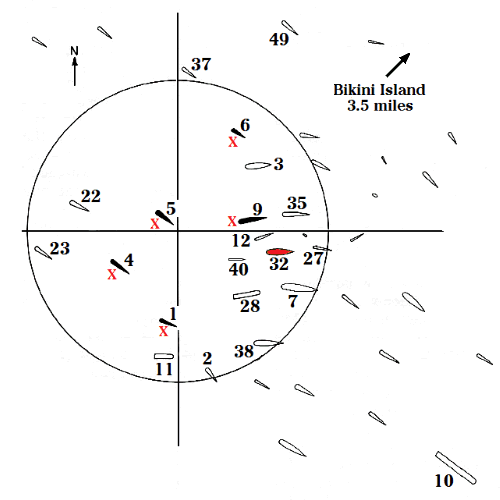
In addition to the five ships that sank, fourteen were judged to have serious damage or worse, most due to the bomb's air-pressure shock wave. All but three were located within 1000 yards (914 m) of the detonation. Inside that radius, orientation to the bomb was a factor in shock wave
impact. For example, ship #6, the destroyer Lamson
, which sank, was farther away than seven ships that stayed afloat. Lamson was broadside
to the blast, taking the full impact on its port side, while the seven closer ships were anchored with their stern
s toward the blast, somewhat protecting the most vulnerable part of the hull.
The only large ship inside the 1,000-yard radius which sustained moderate, rather than serious, damage was the sturdily built Japanese battleship Nagato
, ship #7, whose stern-on orientation to the bomb gave it some protection. Also, unrepaired damage from World War II may have complicated damage analysis. As the ship from which the Pearl Harbor attack had been commanded, Nagato was positioned near the aim point to guarantee its being sunk. Since the Able bomb missed its target, that symbolic sinking would come three weeks later, in the Baker shot.
Serious damage to ship #10, the aircraft carrier Saratoga
, more than a mile (1.6 km) from the blast, was due to fire. For test purposes, all the ships carried sample amounts of fuel and ordnance, plus airplanes. Most warships carried a seaplane
on deck, which could be lowered into the water by crane, but the Saratoga carried several airplanes with highly volatile aviation fuel
, both on deck and in the hangar
s below. The fire was extinguished and the Saratoga was kept afloat for use in the Baker shot.
For a "soft
" urban target like Hiroshima, anything as close to the bomb as the Saratoga would be on the edge of the 5 psi lethal area, inside a firestorm
over 2 miles (3.2 km) wide. Warship
s, other than aircraft carriers, are extremely resistant to blast and fire.
(Hiroshima), and Fat Man
(Nagasaki) – the Crossroads Able shot was an air burst, detonating high enough in the air to prevent surface materials from being drawn into the fireball. With an air burst, the radioactive fission products rise into the stratosphere
and become part of the global, rather than the local, environment. Air bursts were officially described as "self-cleansing." There was no significant local fallout
.
 There was, however, an intense transitory burst of fireball radiation lasting a few seconds. Many of the closer ships received doses of neutron
and gamma radiation that could have been lethal to anyone on the ship, but the ships themselves did not become radioactive, except by neutron activation
of materials in the ships, which was judged to be a minor problem (by the standards of the time). Within a day nearly all the surviving target ships had been reboarded. The ship inspections, instrument recoveries, and moving and remooring of ships for the Baker test proceeded on schedule.
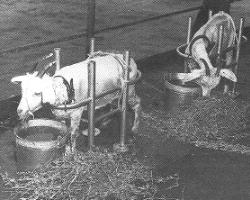
Fifty-seven guinea pigs, 109 mice, 146 pigs, 176 goats, and 3,030 white rats had been placed on 22 target ships in stations normally occupied by people. 10% of the animals were killed by the air blast, 15% were killed by fireball radiation, and 10% were killed during later study. Altogether, 35% of the animals died as a direct result of blast or radiation exposure. The most famous survivor was Pig 311, which was found swimming in the lagoon after the blast and was brought back to Washington, D.C. to the Smithsonian's National Zoological Park.
The high rate of test animal survival was due in part to the nature of single-pulse radiation. As with the two Los Alamos criticality accident
s involving the demon/Able core
, victims who were close enough to receive a lethal dose died, those farther away recovered and survived. Also, all the rats were placed outside the expected lethal zone in order to study possible mutation
s in future generations. Since rats made up 86% of the total, and only 65% of the animals survived, some of the rats were killed.
Although the Able bomb missed its target, the Nevada
, by nearly half a mile and it failed to sink or to contaminate the battleship, goat #119, tethered inside a gun turret
and shielded by armor plate, received enough fireball radiation to die four days later of radiation sickness
(having survived two days longer than goat #53, which was on the deck, unshielded). Had the Nevada been fully manned, she would likely have become a floating coffin, dead in the water for lack of a live crew.
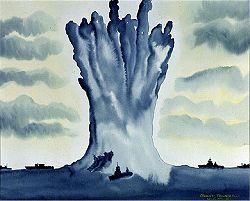 In Baker on July 25, the weapon was suspended beneath landing craft LSM-60
anchored in the midst of the target fleet. Baker was detonated 90 feet (27 m) underwater, halfway to the bottom in water 180 feet (54 m) deep. How/Mike Hour was 0835. No identifiable part of LSM-60 was ever found; it was presumably vaporized by the nuclear fireball. Ten ships were sunk, including the German heavy cruiser Prinz Eugen
, which sank in December, five months after the test, because radioactivity prevented repairs to a leak in the hull.
Photographs of Baker are unique among nuclear detonation pictures. The blinding flash that usually obscures the target area took place underwater and was barely seen. The clear image of ships in the foreground and background gives a sense of scale. The large Wilson cloud and the vertical water column are distinctive Baker shot features, making the pictures easily identifiable. The most notable picture shows a mark where the 27,000 ton battleship Arkansas
was.
As with Able, any ships that remained afloat within 1,000 yards of the detonation were seriously damaged, but this time the damage came from below, from water pressure rather than air pressure. The greatest difference between the two shots, however, was the radioactive contamination of all the target ships by Baker. Regardless of the degree of damage, only nine surviving Baker target ships were eventually decontaminated and sold for scrap. The rest were sunk at sea after decontamination efforts failed.
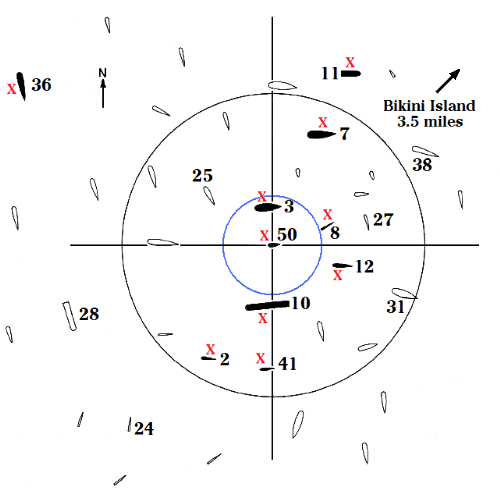
The German
heavy cruiser
Prinz Eugen
survived both the Able and Baker tests but was too radioactive to have leaks repaired. In September 1946 she was towed to Kwajalein Atoll where she capsized in shallow water on December 22, 1946, five months after Baker. She remains there today, with starboard propeller blades in the air.
The submarine Skipjack
was the only sunken ship successfully raised at Bikini. She was towed to California and sunk again, as a target ship
off the coast, two years later.
Three other ships, all in sinking condition, were towed ashore at Bikini and beached: attack transport Fallon
, ship #25; destroyer Hughes
, ship #27; and submarine Dentuda
, ship #24. Dentuda, being submerged (thus avoiding the base surge) and outside the 1,000-yard circle, escaped serious contamination and hull damage and was successfully decontaminated, repaired, and briefly returned to service.
The underwater fireball took the form of a rapidly expanding hot "gas bubble" that pushed against the water, generating a supersonic
hydraulic shock wave
which crushed the hulls of nearby ships as it spread out. Eventually it slowed to the speed of sound in water, which is one mile per second, five times faster than that of sound in air. On the surface, the shock wave was visible as the leading edge of a rapidly expanding ring of dark water, called the "slick" for its resemblance to an oil slick. Close behind the slick was a visually more dramatic, but less destructive whitening of the water surface called the "crack."
When the gas bubble's diameter equaled the water depth, 180 feet (55 m), it hit the sea floor and the sea surface simultaneously. At the bottom, it started digging a shallow crater
, ultimately 30 feet (9 m) deep and 2000 feet (610 m) wide. At the top, it pushed the water above it into a "spray dome," which burst through the surface like a geyser
. Elapsed time since detonation was four milliseconds.
During the first full second, the expanding bubble removed all the water within a 500 feet (152 m) radius and lifted two million tons of spray and seabed sand into the air. As the bubble rose at 2500 feet per second (762 m/s), it stretched the spray dome into a hollow cylinder or chimney of spray called the "column," 6000 feet (1,829 m) tall, 2000 feet (610 m) wide, and with walls 300 feet (91 m) thick.
As soon as the bubble reached the air, it started a supersonic atmospheric shock wave which, like the crack, was more visually dramatic than destructive. Brief low pressure behind the shock wave caused instant fog which shrouded the developing column in a "Wilson cloud", also called a "condensation cloud", obscuring it from view for two seconds. The Wilson cloud started out hemispherical, expanded into a disk which lifted from the water revealing the fully developed spray column, then expanded into a doughnut and vanished. The Able shot also produced a Wilson cloud, but heat from the fireball dried it out more quickly.
By the time the Wilson cloud vanished, the top of the column had become a "cauliflower," and all the spray in the column and its cauliflower was moving down, back into the lagoon. Although cloudlike in shape, the cauliflower was more like the top of a geyser where water stops moving up and starts to fall. There was no mushroom cloud
; nothing rose into the stratosphere
.
Meanwhile, lagoon water rushing back into the space vacated by the rising gas bubble started a tsunami
-like water wave which lifted the ships as it passed under them. At 11 seconds after detonation, the first wave was 1000 feet (305 m) from surface zero and 94 feet (28.7 m) high. By the time it reached the Bikini Island beach, 3.5 miles (6 km) away, it was a nine-wave set with shore breakers up to 15 feet (5 m) high, which tossed landing craft
onto the beach and filled them with sand.
Twelve seconds after detonation, falling water from the column started to create a 900 feet (274 m) tall "base surge" resembling the mist at the bottom of a large waterfall
. Unlike the water wave, the base surge rolled over rather than under the ships. Of all the bomb's effects, the base surge had the greatest consequence for most of the target ships, because it painted them with radioactivity that could not be removed.
was the closest ship to the bomb other than the ship from which it was suspended. The underwater shock wave crushed the starboard side of its hull, which faced the bomb, and rolled the battleship over onto its port side. It also ripped off the two starboard side propeller
s and their shafts, along with the rudder
and part of the stern
, shortening the hull by 25 feet (7.6 m). Some target ships carried gyroscopic pitch and roll
recorders; if the Arkansas had any such devices they were not retrieved. There is no record of what happened to the ship during the two seconds when the Wilson cloud blocked any view of the site.
At 562 feet (171.3 m) long, the battleship was three times as long as the water is deep. When the Wilson cloud lifted, the Arkansas was apparently bow-pinned to the sea floor with its truncated stern 350 feet (106.7 m) in the air. Unable to sink straight down in the relatively shallow lagoon, she toppled backward into the water curtain of the spray column.
She was next seen by Navy divers, the same year, lying upside down with her bow on the rim of the underwater bomb crater and stern angled toward the center. There was no sign of the superstructure
or the big guns. The first diver to reach the Arkansas sank up to his armpits in radioactive mud. When National Park Service divers returned in 1989 and 1990, the bottom was again firm-packed sand, and the mud was gone. They were able to see the barrels of the forward guns, which had not been visible in 1946.
All large naval gunships are top heavy and settle upside down when they sink, a notable exception being the Bismarck
, which sank upside down but righted itself after its turrets fell out on the way to the bottom. The Arkansas settled upside down, but a 1989 diver's sketch of the wreck shows hardly any of the starboard side of the hull, making it look like the ship is lying on its side. Most of the starboard side is there, but severely compacted.
The superstructure has not been found. It was either stripped off and swept away or is lying under the hull, crushed and buried under sand which flowed back into the crater, partially refilling it. The only diver access to the inside is a tight squeeze through the port side casemate
, called the "aircastle." The National Park Service
divers practiced on the similar aircastle of battleship Texas
, a museum ship
, before entering the Arkansas in 1990.
sank eight hours after the underwater shock wave opened up leaks in the hull. Immediately after the shock wave passed, the water wave lifted the stern 43 feet (13.1 m) and the bow 29 feet (8.8 m), rocked the ship side to side, and crashed over it, sweeping all five moored airplanes off the flight deck
and knocking the stack over onto the deck. She remained upright and outside the spray column, but close enough to be drenched by radioactive water from the collapsing cauliflower head as well as by the base surge.
Admiral Blandy ordered tugs to tow the carrier to Enyu island for beaching, but Saratoga and the surrounding water remained too radioactive for close approach until after she sank. She settled upright on the bottom, with the top of her mast 40 feet (12.2 m) below the surface. Today, with radioactivity at safe levels for sport diving, Saratoga is the star attraction of a struggling, high-end sport diving industry. (The 2009 diving season was canceled because of fuel costs, unreliable airline service to the island, and a decline in the Bikini Islanders' trust fund which subsidized the operation.)
Independence
survived Able with spectacular damage to the flight deck. She was moored far enough away from Baker to avoid further physical damage, but was severely contaminated. She was towed to San Francisco, where four years of decontamination experiments at the Hunters Point Naval Shipyard failed to produce satisfactory results. On January 29, 1951, she was scuttled in the ocean near the Farallon Islands
.
s in the local environment. It was not "self-cleansing." The result was radioactive contamination
of the lagoon and the target ships. While anticipated, it caused far greater problems than were expected.
The Baker explosion produced about three pounds of fission products. These fission products were thoroughly mixed with the two million tons of spray and seabed sand that were lifted into the spray column and its cauliflower head and then dumped back into the lagoon. Most of it stayed in the lagoon and settled to the bottom or was carried out to sea by the lagoon's internal tidal and wind-driven currents.
A small fraction of the contaminated spray was thrown back into the air as the base surge. Unlike the Wilson cloud, a meteorological phenomenon in clean air, the base surge was a heavy fog
bank of radioactive mist
that rolled across all the target ships, painting their surfaces with fission products. When the mist in the base surge evaporated, the base surge became invisible but continued to move away, contaminating ships several miles from the detonation point.
Unmanned drone boats were the first vessels to enter the lagoon. Onboard instruments allowed remote-controlled radiation measurements to be made. When support ships entered the lagoon for evaluation, decontamination, and salvage activities, they steered clear of lagoon water hot spots detected by the drone boats. The standard for radiation exposure to personnel was the same as that used by the Manhattan Project
, 0.1 roentgens per day. Because of this constraint, only the five most distant target ships could be boarded on the first day. The closer-in ships were hosed down by Navy fireboat
s using saltwater and foamite. The first hosing reduced radioactivity by half, but subsequent hosings were ineffective. For most of the ships, reboarding had to wait until the short-lived radioisotopes decayed; ten days elapsed before the last of the targets could be boarded.
In the first six days after Baker, when radiation levels were highest, 4,900 men boarded target ships. Sailors tried to scrub off the radioactivity with brushes, water, soap, and lye. Nothing worked, short of sandblasting to bare metal.
Since much of the public interest in Crossroads had focused on the fate of the test animals, in September Admiral Blandy asserted that radiation death is not painful: "The animal merely languishes and recovers or dies a painless death. Suffering among the animals as a whole was negligible." This was clearly not true. While the well-documented suffering of Harry Daglian
and Louis Slotin
as they died of radiation injury at Los Alamos was still secret, the widely reported radiation deaths at Hiroshima and Nagasaki had not been painless. In 1908, Dr. Charles Allen Porter had stated in an academic paper, "the agony of inflamed X-ray lesions is almost unequaled in any other disease."
, along with the fission products and unfissioned plutonium. In the underwater Baker detonation, the neutrons were captured by seawater
in the lagoon. Of the four major elements in seawater – hydrogen
, oxygen
, sodium
, and chlorine
– only sodium takes on intense, short-term radioactivity with the addition of a single neutron to its nucleus: Common sodium-23 becomes radioactive sodium-24, with a 15-hour half-life. (In six days its intensity drops a thousandfold, but the flip side of short half-life is high initial intensity.)
A small fraction of one pound of radioactive sodium was produced, but unlike fission products, which are heavy and eventually sank to the bottom of the lagoon, the sodium stayed in solution. It contaminated the hulls and onboard saltwater systems of support ships that entered the lagoon, and it contaminated the water used in decontamination.
Plutonium could not be detected by the film badges and Geiger counters used by people who boarded the target ships. It was assumed to be present in the environment wherever fission product radiation was detected. The decontamination plan was to scrub the target ships free of fission products and assume the plutonium would be washed away in the process. To see if this plan was working, samples of paint, rust, and other target ship surface materials were taken back to a laboratory on the support ship Haven and examined for plutonium. The results of these plutonium detection tests, and of tests performed on fish caught in the lagoon, caused all decontamination work to be abruptly terminated on August 10, effectively shutting down Operation Crossroads for safety reasons.
Warren had been Chief of the Medical Section of the Manhattan Project, and was in charge of radiation safety at the first nuclear test, Trinity, in New Mexico, as well as of the on-ground inspections at Hiroshima and Nagasaki after the bombings. At Crossroads, it was his job to keep the sailors safe during the cleanup, and to avoid giving them grounds to sue the Navy if health problems developed later.
The cleanup was hampered by two significant factors: the unexpected base surge, and the lack of a viable cleanup plan. It was understood that if the water column fell back into the lagoon, which it did, any ships that were drenched by falling water might be contaminated beyond redemption. Nobody expected that to be the fate of virtually the entire target fleet, which it was because of the base surge. No decontamination procedures had been tested in advance to see if they would work and to measure the potential risk to personnel. In the absence of a decontamination protocol, the ships were cleaned using traditional Navy deck-scrubbing methods: hoses, mops, and brushes, with water, soap, and lye. The sailors had no protective clothing.
By August 3, Colonel Warren concluded the entire effort was futile and dangerous. The unprotected sailors were stirring up radioactive material and contaminating their skin, clothing, and, presumably, their lungs. When they returned to their support ship living quarters, they contaminated the shower stalls, laundry facilities, and everything they touched. Warren demanded an immediate halt to the entire cleanup operation. He was especially concerned about plutonium, which by weight made up 78% of the contaminating material and was undetectable on site.
Warren also observed that the radsafe procedures were not being followed correctly. Fire boats got too close to the target ships they were hosing and drenched their crews with radioactive spray. One fire boat had to be taken out of service. Film badges showed 67 overdoses between August 6 and 9. More than half of the 320 Geiger counters available shorted out and became unavailable. The crews of two target ships, Wainright
and Carteret
, moored far from the detonation site, had moved back on board and become overexposed. They were immediately evacuated back to the United States.
Captain L. H. Bibby, commanding officer of the apparently undamaged battleship New York
accused Warren's radsafe monitors of holding their Geiger counters too close to the deck. He wanted to reboard his ship and sail it home. The steadily dropping radiation counts on the target ships gave an illusion that the cleanup was working, but Warren explained that although fission products were losing some of their gamma ray potency through radioactive decay the ships were still contaminated. The danger of ingesting microscopic particles remained.
 Admiral Blandy ordered Colonel Warren to report to the support ship Wichita
and explain his position to 1,400 skeptical officers and sailors. Some found him persuasive, but it was August 9 before he convinced Blandy. That was the date when Blandy realized, for the first time, that Geiger counters could not detect plutonium. Blandy was aware of the health problems of radium dial painters
who ingested microscopic amounts of radium in the 1920s, and the fact that plutonium was assumed to have a similar biological effect. When plutonium was discovered in the captain's quarters of the Prinz Eugen
, unaccompanied by fission products, Blandy realized that plutonium could be anywhere.
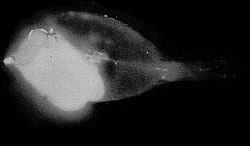
The following day, August 10, Warren showed Blandy an autoradiograph
of a fish, an x-ray picture made by radiation coming from the fish. The outline of the fish was made by alpha radiation from the fish scales, evidence that plutonium, mimicking calcium, had been distributed throughout the fish, out to the scales. Blandy announced his decision, "then we call it all to a halt." He ordered that all further decontamination work be discontinued. Warren wrote home, "A self x ray of a fish . . . did the trick."
The decontamination failure ended plans to outfit some of the target ships for the spring 1947 Charlie shot and to sail the rest home in triumph. The immediate public relations problem was to avoid any perception that the entire target fleet had been destroyed. On August 6, in anticipation of this development, Blandy had told his staff that ships sunk or destroyed more than 30 days after the Baker shot "will not be considered as sunk by the bomb." By then, public interest in Crossroads was waning, and the reporters had gone home. The failure of decontamination did not make news until the final reports came out a year later.
.
, which sank in the Kwajalien lagoon on December 22. The rest were kept afloat long enough to be deliberately sunk or dismantled. After the August 10 decision to stop decontamination work at Bikini, the surviving target fleet was towed to Kwajalein Atoll where the live ammunition and fuel could be offloaded in uncontaminated water. The move was accomplished during the remainder of August and September.
Eight of the major ships and two submarines were towed back to the United States and Hawaii for radiological inspection. Twelve target ships were so lightly contaminated that they were remanned and sailed back to the United States by their crews. Ultimately, only nine target ships were able to be scrapped rather than scuttled. The remaining target ships were destroyed by sinking off Bikini or Kwajalein Atolls, or near the Hawaiian Islands or the California coast during 1946–1948.
The support ships were decontaminated as necessary and received a radiological clearance before they could return to the fleet. This required a great deal of experimentation at Navy shipyards in the United States, primarily at San Francisco, California
. The destroyer Laffey
required "sandblasting and painting of all underwater surfaces, and acid washing and partial replacement of salt-water piping and evaporators."
Finally, a formal resurvey was conducted in the summer of 1947 to study long-term effects of the Crossroads tests. According to the official report, decontamination efforts "revealed conclusively that removal of radioactive contamination of the type encountered in the target vessels in test Baker cannot be accomplished successfully."
On August 11, 1947, Life
Magazine summarized the report in a 14-page article with 33 pictures. The article stated, "If all the ships at Bikini had been fully manned, the Baker Day bomb would have killed 35,000 crewmen. If such a bomb were dropped below New York's Battery in a stiff south wind, 2 million people would die." Although it was accurately written, a casual reader of the article may have confused the grisly effects of Able's transitory fireball radiation on the close-in test animals with the equally deadly but more widespread and persistent contamination from Baker's base surge. Aside from the Life article, the report received little public attention.
The contamination problem was not widely appreciated by the general public until 1948, when No Place to Hide, a best-selling book by David Bradley, M.D.
, was serialized in the Atlantic Monthly, condensed by the Reader's Digest
, and selected by the Book of the Month Club
. In his preface, Bradley, a key member of the Radiological Safety Section at Bikini known as the "Geiger men," asserted that "the accounts of the actual explosions, however well intended, were liberally seasoned with fantasy and superstition, and the results of the tests have remained buried in the vaults of military security." His description of the Baker test and its aftermath brought to world attention the problem of radioactive fallout from nuclear weapons.
Radioactively "hot" areas were predicted in advance, and then checked with Geiger counters, sometimes by remote control, to see if they were safe. The level of measured gamma radiation determined how long personnel could operate in them without exceeding the allowable daily dose.
Instant gamma readings were taken by radiation safety specialists, but film-badge dosimeters, which could be read at the end of the day, were issued to all personnel believed to be at the greatest radiological risk. Anyone whose badge showed more than 0.1 R / day exposure was removed for one or more days from areas and activities of possible exposure. The maximum accumulated exposure recorded was 3.72 R, received by a radiation safety specialist.
A percentage of each group working in less contaminated areas was badged. Eventually, 18,875 film-badge dosimeter
s were issued to about 15% of the total work force. On the basis of this sampling, a theoretical total exposure was calculated for each person who did not have a personal badge. As expected, exposures for target ship crews that reboarded their ships after Baker were higher than those for support ship crews. However, the hulls of support ships that entered the lagoon after Baker became so hot that sleeping quarters were moved toward the center of each ship.
Of the total mass of radioactive particles
scattered by each explosion, 85% was unfissioned plutonium
which produces alpha radiation not detected by film badges or Geiger counters. There was no method of detecting plutonium in a timely fashion, and participants were not monitored for ingestion of it.
A summary of film badge readings (in roentgens) for July and August, when the largest number of personnel was involved, is listed below:
In 1996, a government-sponsored mortality study of Crossroads veterans showed that, by 1992, 46 years after the tests, veterans had experienced a 4.6% higher mortality than a control group of non-veterans. There were 200 more deaths among Crossroads veterans than in the similar control group (12,520 vs. 12,320), implying a life-span reduction of about three months for Crossroads veterans. For the main expected causes of this increased mortality, leukemia
and other cancer
s, the incidence was not significantly higher than normal. Death by those diseases was tabulated on the assumption that if radiation exposure had a life-shortening effect it would likely show up there; it did not. Not enough data were gathered on other causes of death to determine the reason for this increase in all-cause mortality, and it remains a mystery. The mortality increase was higher, 5.7%, for those who boarded target ships after the tests than for those who did not, whose mortality increase was only 4.3%.
prior to Crossroads proved unable to feed themselves in their new environment. Visitors to Rongerik reported the islanders were facing potential starvation
by January 1947, suffering malnutrition
by July, and were emaciated by January 1948. In March 1948 they were evacuated to Kwajalein Atoll, and then settled onto another uninhabited island, Kili
, in November. With only one third of a square mile, Kili has one tenth the land area of Bikini and, more important, has no lagoon and no protected harbor. Unable to practice their native culture of lagoon fishing
, they have been dependent on food shipments ever since. Their four thousand descendents today are living on several islands and in foreign countries.
Their desire to return to Bikini was thwarted indefinitely by the U.S. decision to resume nuclear testing at Bikini in 1954. During the spring and summer months of 1954, 1956, and 1958, twenty-one more nuclear bombs were detonated at Bikini, yielding a total of 75 megatons, equivalent to more than three thousand Baker bombs. Only one was a "self cleansing" air burst, the 3.8 megaton Redwing Cherokee
test. The rest were surface bursts producing massive local fallout
. The first after Crossroads was the dirtiest: the 15 megaton Bravo
shot of Operation Castle
on March 1, 1954, the largest-ever U.S. test. Fallout from Bravo caused radiation injury to Bikini islanders who were living on Rongelap Atoll
at the time.
The brief attempt to resettle Bikini from 1974 until 1978 was aborted when health problems from radioactivity in the food supply caused the atoll to be evacuated again. Sport divers who visit Bikini to dive on the shipwreck
s must eat imported food. The local government elected to close the lagoon to sport divers in 2008, but reopened for only one season in 2011. A combination of high fuel prices, an unreliable airline service was the stated reason for its closure.
equipped newly constructed ships with a CounterMeasure WashDown System (CMWDS) of piping and nozzles to cover exterior surfaces of the ship with a spray of salt water from the firefighting system when nuclear attack appeared imminent. The film of flowing water would theoretically prevent contaminants from settling into cracks and crevices.
The name "Bikini" was adopted for bikini
swimwear during Operation Crossroads; a coincidence
of explosive shock perhaps ("like the bomb, the bikini is small and devastating"), and the realization that "atom bombs reduce everybody to primitive costume
."
The 1976 Bruce Conner
film Crossroads
uses research footage coupled with a Terry Riley
soundtrack.
The 1988 film Radio Bikini
was nominated for the Best Documentary Feature Oscar
. Directed by Robert Stone, it recounts the story of Operation Crossroads, concentrating on how it affected the Bikini islanders and the servicemen who took part in the operation. The film uses archival footage almost exclusively, much of it in color. Film of the Crossroads Baker explosion is among the most often shown examples of a nuclear explosion
, and exists in many sources.
Author Theodore Taylor
wrote a novel called The Bomb
, which is about a teenaged boy who attempts to stop the tests by using himself as a human shield.
SpongeBob SquarePants
has referred to the Baker shot in three of its episodes, "Dying For Pie", "The Krusty Plate", and more recently "Frozen Face-off". Some episodes that shown the footage played at different speeds.
The Baker shot was also used in the movie Godzilla (1998), mistaken for French nuclear tests in French Polynesia
, mainly which is the main idea of the opening credits to the film.
Nuclear weapon
A nuclear weapon is an explosive device that derives its destructive force from nuclear reactions, either fission or a combination of fission and fusion. Both reactions release vast quantities of energy from relatively small amounts of matter. The first fission bomb test released the same amount...
tests conducted by the United States at Bikini Atoll
Bikini Atoll
Bikini Atoll is an atoll, listed as a World Heritage Site, in the Micronesian Islands of the Pacific Ocean, part of Republic of the Marshall Islands....
in mid-1946. It was the first test of a nuclear weapon after the Trinity nuclear test in July 1945. Its purpose was to investigate the effect of nuclear weapons on naval ships.
Crossroads consisted of two detonations, each with a yield of 23 kilotons: Able was detonated at an altitude of 520 feet (158 m) on July 1, 1946; Baker was detonated 90 feet (27 m) underwater on July 25, 1946. A third burst, Charlie, planned for 1947, was canceled primarily because of the Navy's inability to decontaminate the target ship
Target ship
A target ship is a vessel — typically an obsolete or captured warship — used for naval gunnery practice or for weapons testing.-Rationale:Sinking redundant warships is an effective way of testing new weapons and warships in as realistic a manner as possible. Whilst practice torpedoes are fired...
s after the Baker test. Crossroads Charlie was rescheduled as Operation Wigwam
Operation Wigwam
Operation Wigwam involved a single test of the Mark 90 Betty nuclear bomb. It was conducted between Operation Teapot and Operation Redwing on May 14, 1955, about 500 miles southwest of San Diego, California. 6,800 personnel aboard 30 ships were involved in Wigwam...
, a deep water shot conducted in 1955 off the California coast,.
The Crossroads tests were the fourth and fifth nuclear explosions conducted by the United States (following the Trinity test
Trinity test
Trinity was the code name of the first test of a nuclear weapon. This test was conducted by the United States Army on July 16, 1945, in the Jornada del Muerto desert about 35 miles southeast of Socorro, New Mexico, at the new White Sands Proving Ground, which incorporated the Alamogordo Bombing...
and the bombings of Hiroshima and Nagasaki
Atomic bombings of Hiroshima and Nagasaki
During the final stages of World War II in 1945, the United States conducted two atomic bombings against the cities of Hiroshima and Nagasaki in Japan, the first on August 6, 1945, and the second on August 9, 1945. These two events are the only use of nuclear weapons in war to date.For six months...
). They were the first of many nuclear tests held in the Marshall Islands
Marshall Islands
The Republic of the Marshall Islands , , is a Micronesian nation of atolls and islands in the middle of the Pacific Ocean, just west of the International Date Line and just north of the Equator. As of July 2011 the population was 67,182...
and the first to be publicly announced beforehand and observed by an invited audience, including a large press
News media
The news media are those elements of the mass media that focus on delivering news to the general public or a target public.These include print media , broadcast news , and more recently the Internet .-Etymology:A medium is a carrier of something...
corps.
The test resulted in the radioactive contamination
Radioactive contamination
Radioactive contamination, also called radiological contamination, is radioactive substances on surfaces, or within solids, liquids or gases , where their presence is unintended or undesirable, or the process giving rise to their presence in such places...
of all the target ships by the underwater Baker shot. It was the first case of immediate, concentrated local radioactive fallout from a nuclear explosion. (The fallout from an air burst is global, held in the stratosphere
Stratosphere
The stratosphere is the second major layer of Earth's atmosphere, just above the troposphere, and below the mesosphere. It is stratified in temperature, with warmer layers higher up and cooler layers farther down. This is in contrast to the troposphere near the Earth's surface, which is cooler...
for days and widely dispersed.) Chemist Glenn Seaborg
Glenn T. Seaborg
Glenn Theodore Seaborg was an American scientist who won the 1951 Nobel Prize in Chemistry for "discoveries in the chemistry of the transuranium elements", contributed to the discovery and isolation of ten elements, and developed the actinide concept, which led to the current arrangement of the...
, the longest-serving chairman of the Atomic Energy Commission
United States Atomic Energy Commission
The United States Atomic Energy Commission was an agency of the United States government established after World War II by Congress to foster and control the peace time development of atomic science and technology. President Harry S...
, called Baker "the world's first nuclear disaster."
To prepare the atoll for Crossroads, Bikini's native residents agreed to evacuate the island of Bikini. Many were moved by the LST 861 to the island of Rongerik. Later, in the 1950s, a series of large thermonuclear tests rendered Bikini unfit for subsistence farming and fishing
Fishing
Fishing is the activity of trying to catch wild fish. Fish are normally caught in the wild. Techniques for catching fish include hand gathering, spearing, netting, angling and trapping....
. Because of radioactive contamination, Bikini remains uninhabited as of 2011, though it is occasionally visited by sport divers. Although there are claims that participants in the Crossroads tests were well protected against radiation sickness
Radiation Sickness
Radiation Sickness is a VHS by the thrash metal band Nuclear Assault. The video is a recording of a concert at the Hammersmith Odeon, London in 1988. It was released in 1991...
, the Oscar-nominated documentary Radio Bikini
Radio Bikini
Radio Bikini is a 1988 American documentary film directed by Robert Stone. It was nominated for an Academy Award in 1988 for Best Documentary Feature....
showed footage of Navy sailors wearing little or no protection during their inspection of the target ships only hours after the explosions, even though some of the observer ships were caught in the fallout of the Baker explosion. In addition, the documentary revealed that Navy ships used contaminated water from the area for drinking and bathing purposes after the blast. One study showed that the life expectancy of participants was reduced by an average of three months.
Background
The first proposal to test nuclear weapons against naval warships was made on August 16, 1945, by Lewis Strauss, future chairman of the Atomic Energy CommissionUnited States Atomic Energy Commission
The United States Atomic Energy Commission was an agency of the United States government established after World War II by Congress to foster and control the peace time development of atomic science and technology. President Harry S...
. In an internal memo to Secretary of the Navy James Forrestal
James Forrestal
James Vincent Forrestal was the last Cabinet-level United States Secretary of the Navy and the first United States Secretary of Defense....
, Strauss argued, "If such a test is not made, there will be loose talk to the effect that the fleet is obsolete in the face of this new weapon and this will militate against appropriations to preserve a postwar Navy of the size now planned." With very few bombs available, he suggested a large number of targets widely dispersed over a large area. A quarter century earlier, in 1921, the Navy had suffered a public relations
Public relations
Public relations is the actions of a corporation, store, government, individual, etc., in promoting goodwill between itself and the public, the community, employees, customers, etc....
disaster when General Billy Mitchell's bombers sank every target ship the Navy provided for the Project B ship-versus-bomb tests. The Strauss test would be designed to demonstrate ship survivability
Survivability
Survivability is the ability to remain alive or continue to exist. The term has more specific meaning in certain contexts.-Engineering:In engineering, survivability is the quantified ability of a system, subsystem, equipment, process, or procedure to continue to function during and after a natural...
, at least in theory; in the end, the entire target fleet would be effectively destroyed by radioactivity.
Nine days later, Senator Brien McMahon
Brien McMahon
Brien McMahon, born James O'Brien McMahon was an American lawyer and politician who served in the United States Senate from 1945 to 1952...
, who within a year would write the Atomic Energy Act
Atomic Energy Act of 1946
The Atomic Energy Act of 1946 determined how the United States federal government would control and manage the nuclear technology it had jointly developed with its wartime allies...
and organize and chair the Congressional Joint Committee on Atomic Energy
United States Congress Joint Committee on Atomic Energy
The Joint Committee on Atomic Energy was a United States congressional committee that was tasked with exclusive jurisdiction over "all bills, resolutions, and other matters" related to civilian and military aspects of nuclear power from 1946 through 1977...
, made the first public proposal for such a test, but one designed to demonstrate the vulnerability
Vulnerability
Vulnerability refer to the susceptibility of a person, group, society, sex or system to physical or emotional injury or attack. The term can also refer to a person who lets their guard down, leaving themselves open to censure or criticism...
, rather than survivability, of ships. He proposed dropping an atomic bomb on captured Japanese ships and suggested, "The resulting explosion should prove to us just how effective the atomic bomb is when used against the giant naval ships." On September 19, the Army Air Forces (USAAF) chief, General Henry H. Arnold
Henry H. Arnold
Henry Harley "Hap" Arnold was an American general officer holding the grades of General of the Army and later General of the Air Force. Arnold was an aviation pioneer, Chief of the Air Corps , Commanding General of the U.S...
, asked the Navy to save ten of the thirty-eight captured Japanese ships for use in the test proposed by McMahon.
Meanwhile, the Navy proceeded with its own plan, revealed on October 27 by Admiral Ernest King
Ernest King
Fleet Admiral Ernest Joseph King was Commander in Chief, United States Fleet and Chief of Naval Operations during World War II. As COMINCH, he directed the United States Navy's operations, planning, and administration and was a member of the Joint Chiefs of Staff. He was the U.S...
at a press conference. It involved between 80 and 100 target ships, most of them surplus U.S. ships. As the Army and the Navy maneuvered for control of the tests, Assistant Secretary of War Howard C. Peterson observed, "To the public, the test looms as one in which the future of the Navy is at stake,. .. if the Navy withstands [the tests] better than the public imagines it will, in the public mind the Navy will have 'won.'"
The Navy won the contest to design and control the tests, and on January 11, 1946, Admiral William H. P. Blandy
William H. P. Blandy
William Henry Purnell Blandy , known to friends as "Spike", was an admiral in the United States Navy during World War II.-Biography:...
was appointed head of Army/Navy Joint Task Force One (JTF-1), newly created to conduct the tests which he named Operation Crossroads. The Army's candidate to direct the tests, General Leslie Groves
Leslie Groves
Lieutenant General Leslie Richard Groves, Jr. was a United States Army Corps of Engineers officer who oversaw the construction of the Pentagon and directed the Manhattan Project that developed the atomic bomb during World War II. As the son of a United States Army chaplain, Groves lived at a...
, head of the wartime Manhattan Project
Manhattan Project
The Manhattan Project was a research and development program, led by the United States with participation from the United Kingdom and Canada, that produced the first atomic bomb during World War II. From 1942 to 1946, the project was under the direction of Major General Leslie Groves of the US Army...
that built the bombs, did not get the job.
Under pressure from the Army, Admiral Blandy agreed to crowd more ships into the immediate target area than the Navy wanted, but he refused AAF General Curtis LeMay
Curtis LeMay
Curtis Emerson LeMay was a general in the United States Air Force and the vice presidential running mate of American Independent Party candidate George Wallace in 1968....
's demand that, "every ship must have a full loading of oil
Oil
An oil is any substance that is liquid at ambient temperatures and does not mix with water but may mix with other oils and organic solvents. This general definition includes vegetable oils, volatile essential oils, petrochemical oils, and synthetic oils....
, ammunition
Ammunition
Ammunition is a generic term derived from the French language la munition which embraced all material used for war , but which in time came to refer specifically to gunpowder and artillery. The collective term for all types of ammunition is munitions...
, and fuel
Fuel
Fuel is any material that stores energy that can later be extracted to perform mechanical work in a controlled manner. Most fuels used by humans undergo combustion, a redox reaction in which a combustible substance releases energy after it ignites and reacts with the oxygen in the air...
." Blandy's argument was that fires and internal explosions might sink ships that would otherwise remain afloat and be available for damage evaluation. When Blandy proposed an all-Navy board to evaluate the results, Senator McMahon complained to President Harry Truman that the Navy should not be "solely responsible for conducting operations which might well indeed determine its very existence." Truman acknowledged that "reports were getting around that these tests were not going to be entirely on the level." He imposed a civilian review panel on Operation Crossroads to "convince the public it was objective."
Opposition
Pressure to cancel Operation Crossroads altogether came from scientists and diplomats. Manhattan Project scientists who had argued for a public test of the bomb in lieu of dropping it on a Japanese city now argued that further testing was unnecessary and environmentally dangerous. A Los Alamos study warned "the water near a recent surface explosion will be a witch's brew" of radioactivity. When they complained that the tests might demonstrate ship survivability while ignoring the effect of radiation on sailors, Admiral Blandy responded by adding test animals to some of the ships, thereby generating protests from animal rightsAnimal rights
Animal rights, also known as animal liberation, is the idea that the most basic interests of non-human animals should be afforded the same consideration as the similar interests of human beings...
advocates.
Secretary of State James Byrnes
James F. Byrnes
James Francis Byrnes was an American statesman from the state of South Carolina. During his career, Byrnes served as a member of the House of Representatives , as a Senator , as Justice of the Supreme Court , as Secretary of State , and as the 104th Governor of South Carolina...
, who a year earlier had told physicist Leo Szilard
Leó Szilárd
Leó Szilárd was an Austro-Hungarian physicist and inventor who conceived the nuclear chain reaction in 1933, patented the idea of a nuclear reactor with Enrico Fermi, and in late 1939 wrote the letter for Albert Einstein's signature that resulted in the Manhattan Project that built the atomic bomb...
that a public demonstration of the bomb might make Russia "more manageable" in Europe, now argued the opposite: that further display of U.S. nuclear power could harden Russia's position against acceptance of the Acheson–Lilienthal Plan. At a March 22 cabinet meeting he said, "from the standpoint of international relations it would be very helpful if the test could be postponed or never held at all." He prevailed on Truman to postpone the first test for six weeks, from May 15 to July 1. For public consumption, the postponement was explained as an opportunity for more Congressional observers to attend during their summer recess.
When Congressional critics complained about the destruction of $450 million worth of target ships, Admiral Blandy replied that their true cost was their scrap value at $10 per ton, only $3.7 million. Veterans and legislators from New York and Pennsylvania requested to keep their namesake battleship
Battleship
A battleship is a large armored warship with a main battery consisting of heavy caliber guns. Battleships were larger, better armed and armored than cruisers and destroyers. As the largest armed ships in a fleet, battleships were used to attain command of the sea and represented the apex of a...
s as museum ship
Museum ship
A museum ship, or sometimes memorial ship, is a ship that has been preserved and converted into a museum open to the public, for educational or memorial purposes...
s, as Texas had done with its battleship, but the JTF-1 replied, "... it is regretted that such ships as the New York
USS New York (BB-34)
USS New York was a United States Navy battleship, the lead ship of her class of two . She was the fifth ship to carry her name....
cannot be spared."
Preparation
A series of three tests was recommended to study the effects of nuclear weapons on ships, equipment, and materiel. Test site requirements were specified:- A protected anchorage at least six miles (10 km) wide
- A site which was uninhabited, or nearly so
- A location at least 300 miles (480 km) from the nearest city
- Weather patterns without severe cold and violent storms
- Predictable winds directionally uniform from sea level to 60,000 feet (18,000 m)
- Predictable water currents away from shipping lanes, fishing areas, and inhabited shores
- Controlled by the United States
Timing became critical because Navy manpower required to move the ships was being released from active duty, and civilian scientists knowledgeable about atomic weapons were leaving federal employment for college teaching positions.
On January 24, Admiral Blandy named the Bikini Lagoon as the site for the two 1946 detonations, Able and Baker. The deep underwater test, Charlie scheduled for the spring of 1947, would take place in the ocean west of Bikini. Of the possible places given serious consideration, including Ecuador
Ecuador
Ecuador , officially the Republic of Ecuador is a representative democratic republic in South America, bordered by Colombia on the north, Peru on the east and south, and by the Pacific Ocean to the west. It is one of only two countries in South America, along with Chile, that do not have a border...
's Galápagos Islands
Galápagos Islands
The Galápagos Islands are an archipelago of volcanic islands distributed around the equator in the Pacific Ocean, west of continental Ecuador, of which they are a part.The Galápagos Islands and its surrounding waters form an Ecuadorian province, a national park, and a...
, Bikini offered the most remote location with a large protected anchorage, suitable weather, and a small, easily-moved population. It had come under exclusive United States control on January 15, when Truman declared the United States to be the sole trustee of all the Pacific islands captured from Japan during the war. On February 6, the survey ship Sumner
USS Sumner (AGS-5)
USS Sumner was a survey ship in the United States Navy. She was named in honor of Thomas Sumner. She was originally commissioned as a submarine tender as USS Bushnell , in honor of David Bushnell, the inventor of the first American submarine.- USS Bushnell :Bushnell was launched 9 February 1915 by...
began blasting channels through the Bikini reef
Reef
In nautical terminology, a reef is a rock, sandbar, or other feature lying beneath the surface of the water ....
into the lagoon
Lagoon
A lagoon is a body of shallow sea water or brackish water separated from the sea by some form of barrier. The EU's habitat directive defines lagoons as "expanses of shallow coastal salt water, of varying salinity or water volume, wholly or partially separated from the sea by sand banks or shingle,...
. The local residents were not told why.
The 167 Bikini islanders first learned their fate four days later, on Sunday, February 10, when Navy Commodore Ben H. Wyatt, United States military governor
Governor
A governor is a governing official, usually the executive of a non-sovereign level of government, ranking under the head of state...
of the Marshall Islands
Marshall Islands
The Republic of the Marshall Islands , , is a Micronesian nation of atolls and islands in the middle of the Pacific Ocean, just west of the International Date Line and just north of the Equator. As of July 2011 the population was 67,182...
, arrived by seaplane from Kwajalein
Kwajalein
Kwajalein Atoll , is part of the Republic of the Marshall Islands . The southernmost and largest island in the atoll is named Kwajalein Island. English-speaking residents of the U.S...
. Referring to Biblical stories which they had learned from Protestant missionaries, he compared them to "the children of Israel whom the Lord saved from their enemy and led into the Promised Land." He also claimed it was "for the good of mankind and to end all world wars." There was no signed agreement, but he reported by cable "their local chieftain
Chieftain
Chieftain may refer to:The leader or head of a group:* a tribal chief or a village head.* a member of the 'House of chiefs'.* a captain, to which 'chieftain' is etymologically related.* Clan chief, the head of a Scottish clan....
, referred to as King Juda, arose and said that the natives of Bikini were very proud to be part of this wonderful undertaking." On March 6, Commodore Wyatt attempted to stage a filmed reenactment of the February 10 meeting in which the Bikinians had given away their atoll. Despite repeated promptings and at least seven retakes, Juda confined his on-camera remarks to, "We are willing to go. Everything is in God's hands." The next day, a Navy LST moved them and their belongings 128 miles (206 km) east to the uninhabited Rongerik Atoll
Rongerik Atoll
Rongerik Atoll or Rongdrik Atoll is a coral atoll of 17 islands in the Pacific Ocean, and is located in the Ralik Chain of the Marshall Islands, approximately east of Bikini Atoll. Its total land area is only , but it encloses a lagoon of .-History:Rongerik Atoll was claimed by the Empire of...
, to begin a so-far permanent exile. Three Bikini families returned in 1974 but were evacuated again in 1978 because of radioactivity in their bodies from four years of eating contaminated food. As of 2010, the atoll remains unpopulated.
Ships
To make room for the target ships, 100 tons of dynamiteDynamite
Dynamite is an explosive material based on nitroglycerin, initially using diatomaceous earth , or another absorbent substance such as powdered shells, clay, sawdust, or wood pulp. Dynamites using organic materials such as sawdust are less stable and such use has been generally discontinued...
were used to remove coral
Coral
Corals are marine animals in class Anthozoa of phylum Cnidaria typically living in compact colonies of many identical individual "polyps". The group includes the important reef builders that inhabit tropical oceans and secrete calcium carbonate to form a hard skeleton.A coral "head" is a colony of...
heads from Bikini Lagoon. On the grounds of the David Taylor Model Basin
David Taylor Model Basin
The David Taylor Model Basin is one of the largest ship model basins — test facilities for the development of ship design — in the world...
outside Washington, D.C., dress rehearsals for Baker were conducted with dynamite and model ships in a pond named "Little Bikini."
A fleet of 95 target vessels was assembled in Bikini Lagoon. At the center of the target cluster, the density was 20 ships per square mile (7.7 per km²), three to five times greater than military doctrine
Military doctrine
Military doctrine is the concise expression of how military forces contribute to campaigns, major operations, battles, and engagements.It is a guide to action, not hard and fast rules. Doctrine provides a common frame of reference across the military...
would allow. The stated goal was not to duplicate a realistic anchorage, but to measure damage as a function of distance from the blast center, at as many different distances as possible. The arrangement also reflected the outcome of the Army/Navy disagreement about how many ships should be allowed to sink.
The target fleet included four obsolete U.S. battleship
Battleship
A battleship is a large armored warship with a main battery consisting of heavy caliber guns. Battleships were larger, better armed and armored than cruisers and destroyers. As the largest armed ships in a fleet, battleships were used to attain command of the sea and represented the apex of a...
s, two aircraft carrier
Aircraft carrier
An aircraft carrier is a warship designed with a primary mission of deploying and recovering aircraft, acting as a seagoing airbase. Aircraft carriers thus allow a naval force to project air power worldwide without having to depend on local bases for staging aircraft operations...
s, two cruiser
Cruiser
A cruiser is a type of warship. The term has been in use for several hundreds of years, and has had different meanings throughout this period...
s, eleven destroyer
Destroyer
In naval terminology, a destroyer is a fast and maneuverable yet long-endurance warship intended to escort larger vessels in a fleet, convoy or battle group and defend them against smaller, powerful, short-range attackers. Destroyers, originally called torpedo-boat destroyers in 1892, evolved from...
s, eight submarine
Submarine
A submarine is a watercraft capable of independent operation below the surface of the water. It differs from a submersible, which has more limited underwater capability...
s, numerous auxiliary and amphibious
Amphibious warfare ship
Amphibious warfare ship, often shortened to amphibs or phibs and popularly known as gator freighters, denotes a range of classes of warship employed to land and support ground forces, such as marines, on enemy territory during an amphibious assault...
vessels, and three surrendered German and Japanese ships. The ships carried sample amounts of fuel and ammunition plus scientific instruments to measure air pressure, ship movement, and radiation
Radiation
In physics, radiation is a process in which energetic particles or energetic waves travel through a medium or space. There are two distinct types of radiation; ionizing and non-ionizing...
. The live animals on some of the target ships were supplied by support ship , which brought 200 pig
Pig
A pig is any of the animals in the genus Sus, within the Suidae family of even-toed ungulates. Pigs include the domestic pig, its ancestor the wild boar, and several other wild relatives...
s, 60 guinea pig
Guinea pig
The guinea pig , also called the cavy, is a species of rodent belonging to the family Caviidae and the genus Cavia. Despite their common name, these animals are not in the pig family, nor are they from Guinea...
s, 204 goat
Goat
The domestic goat is a subspecies of goat domesticated from the wild goat of southwest Asia and Eastern Europe. The goat is a member of the Bovidae family and is closely related to the sheep as both are in the goat-antelope subfamily Caprinae. There are over three hundred distinct breeds of...
s, 5,000 rat
Rat
Rats are various medium-sized, long-tailed rodents of the superfamily Muroidea. "True rats" are members of the genus Rattus, the most important of which to humans are the black rat, Rattus rattus, and the brown rat, Rattus norvegicus...
s, 200 mice
Mouse
A mouse is a small mammal belonging to the order of rodents. The best known mouse species is the common house mouse . It is also a popular pet. In some places, certain kinds of field mice are also common. This rodent is eaten by large birds such as hawks and eagles...
, and grains containing insects to be studied for genetic effects by the National Cancer Institute
National Cancer Institute
The National Cancer Institute is part of the National Institutes of Health , which is one of 11 agencies that are part of the U.S. Department of Health and Human Services. The NCI coordinates the U.S...
. Amphibious target ships were berthed
Berth (moorings)
A berth is a location in a port or harbour used specifically for mooring vessels while not at sea.-Locations in a port:Berth is the term used in ports and harbors to define a specific location where a vessel may be berthed, usually for the purposes of loading and unloading.Most berths will be...
on Bikini Island.
A support fleet of more than 150 ships provided quarters, experimental stations, and workshops for most of the 42,000 men (more than 37,000 of whom were Navy personnel) and the 37 women nurses. Additional personnel were located on nearby atolls such as Eniwetok and Kwajalein
Kwajalein
Kwajalein Atoll , is part of the Republic of the Marshall Islands . The southernmost and largest island in the atoll is named Kwajalein Island. English-speaking residents of the U.S...
. Navy personnel were allowed to extend their service obligation for one year if they wanted to participate in the tests and see an atomic bomb explode. The islands of the Bikini Atoll
Bikini Atoll
Bikini Atoll is an atoll, listed as a World Heritage Site, in the Micronesian Islands of the Pacific Ocean, part of Republic of the Marshall Islands....
were used as instrumentation sites and, until Baker contaminated them, as recreation sites.
Cameras
Radio-controlled autopilotAutopilot
An autopilot is a mechanical, electrical, or hydraulic system used to guide a vehicle without assistance from a human being. An autopilot can refer specifically to aircraft, self-steering gear for boats, or auto guidance of space craft and missiles...
s were installed in eight B-17 bombers, converting them into remote-controlled drones
Unmanned aerial vehicle
An unmanned aerial vehicle , also known as a unmanned aircraft system , remotely piloted aircraft or unmanned aircraft, is a machine which functions either by the remote control of a navigator or pilot or autonomously, that is, as a self-directing entity...
which were then loaded with automatic cameras, radiation detectors, and air sample collectors. Their pilots operated them from mother planes at a safe distance from the detonations. The drones were able to fly into radiation environments, such as Able's mushroom cloud
Mushroom cloud
A mushroom cloud is a distinctive pyrocumulus mushroom-shaped cloud of condensed water vapor or debris resulting from a very large explosion. They are most commonly associated with nuclear explosions, but any sufficiently large blast will produce the same sort of effect. They can be caused by...
, which would be lethal to live crew members.
All the land-based detonation-sequence photographs were taken by remote control from tall towers erected on several islands of the atoll. In all, Bikini cameras would take 50,000 still pictures and 1,500,000 feet (457 km) of motion picture film. One of the cameras could shoot 1,000 frames per second.
Before the first test, all personnel were evacuated from the target fleet and Bikini Atoll. They boarded ships of the support fleet, which took safe positions at least 10 nautical miles (18.5 km) east of the atoll. Test personnel were issued special dark glasses to protect their eyes, but a decision was made shortly before test Able that the glasses might not be adequate. Personnel were instructed to turn away from the blast, shut their eyes, and cradle their arm across their face for additional protection. A few observers who disregarded the recommended precautions advised the others when the bomb detonated. Most shipboard observers reported feeling a slight concussion and hearing a disappointing little "poom".
Nicknames
"Able" and "Baker" are the first two letters of the Joint Army/Navy Phonetic AlphabetJoint Army/Navy Phonetic Alphabet
The Joint Army/Navy Phonetic Alphabet was a radio alphabet developed in 1941 and was used by all branches of the United States military until the promulgation of the ICAO spelling alphabet in 1956, which replaced it...
, used from 1941 until 1956. "Alpha" and "Bravo" are their counterparts in the current NATO phonetic alphabet. "Charlie" is the third letter in both systems. According to eyewitness accounts, the time of detonation for each test was announced as "H" or "How" hour; in the official JTF-1 history, the term "M" or "Mike" hour is used instead.
The two bombs were copies of the plutonium
Plutonium
Plutonium is a transuranic radioactive chemical element with the chemical symbol Pu and atomic number 94. It is an actinide metal of silvery-gray appearance that tarnishes when exposed to air, forming a dull coating when oxidized. The element normally exhibits six allotropes and four oxidation...
-implosion Fat Man
Fat Man
"Fat Man" is the codename for the atomic bomb that was detonated over Nagasaki, Japan, by the United States on August 9, 1945. It was the second of the only two nuclear weapons to be used in warfare to date , and its detonation caused the third man-made nuclear explosion. The name also refers more...
bomb dropped on Nagasaki. The Able bomb was called Gilda and decorated with the likeness of Rita Hayworth
Rita Hayworth
Rita Hayworth was an American film actress and dancer who attained fame during the 1940s as one of the era's top stars...
, star of the 1946 movie Gilda
Gilda
Gilda is a 1946 American black-and-white film noir directed by Charles Vidor. It stars Glenn Ford and Rita Hayworth in her signature role as the ultimate femme fatale. The film was noted for cinematographer Rudolph Mate's lush photography, costume designer Jean Louis' wardrobe for Hayworth , and...
. The Baker bomb was Helen of Bikini. This femme-fatale theme for nuclear weapons, combining seduction and destruction, is epitomized by the use in all languages, starting in 1946, of bikini
Bikini
The bikini is typically a women's two-piece swimsuit. One part of the attire covers the breasts and the other part covers the crotch and part of or the entire buttocks, leaving an uncovered area between the two. Merriam–Webster describes the bikini as "a woman's scanty two-piece bathing suit" or "a...
as the name for a woman's two-piece bathing suit.
The plutonium core used in Gilda had been previously nicknamed the "Demon core
Demon core
The Demon core was the nickname given to a subcritical mass of plutonium that accidentally went briefly critical in two separate accidents at the Los Alamos laboratory in 1945 and 1946. Each incident resulted in the acute radiation poisoning and subsequent death of a scientist...
" by scientists at Los Alamos after it twice went critical
Criticality accident
A criticality accident, sometimes referred to as an excursion or a power excursion, is an accidental increase of nuclear chain reactions in a fissile material, such as enriched uranium or plutonium...
in experiments in 1945 and 1946. In each instance it killed a scientist (Harry K. Daghlian, Jr.
Harry K. Daghlian, Jr.
Haroutune Krikor Daghlian, Jr. was an Armenian-American physicist with the Manhattan Project who accidentally irradiated himself on August 21, 1945, during a critical mass experiment at the remote Omega Site facility at Los Alamos National Laboratory in New Mexico, resulting in his death 25 days...
and Louis Slotin
Louis Slotin
Louis Alexander Slotin was a Canadian physicist and chemist who took part in the Manhattan Project, the secret US program during World War II that developed the atomic bomb....
).
Test Able
At 9 a.m. on July 1 the weapon was dropped from the B-29 Superfortress
B-29 Superfortress
The B-29 Superfortress is a four-engine propeller-driven heavy bomber designed by Boeing that was flown primarily by the United States Air Forces in late-World War II and through the Korean War. The B-29 was one of the largest aircraft to see service during World War II...
Dave's Dream (formerly Big Stink of the 509th Composite Group
509th Operations Group
The 509th Operations Group is the flying component of the United States Air Force 509th Bomb Wing , assigned to Whiteman Air Force Base, Missouri. It is equipped with all 20 of the USAF's B-2 Spirit stealth bombers...
) and detonated 520 feet (158 m) above the target fleet, with a yield of 23 kilotons. Five ships were sunk. Two attack transports sank immediately, two destroyers within hours, and one Japanese cruiser the following day.
Some of the 114 press observers expressed disappointment at the effect on ships. The New York Times reported, prematurely, that "only two were sunk, one capsized, and eighteen damaged." The next day, the Times carried an explanation by Secretary of the Navy James Forrestal
James Forrestal
James Vincent Forrestal was the last Cabinet-level United States Secretary of the Navy and the first United States Secretary of Defense....
that "heavily built and heavily armored ships are difficult to sink unless they sustain underwater damage."
However, the main cause of less-than-expected ship carnage was that the bomb missed its aim point by 710 yards (649 m). The ship the bomb was aimed at failed to sink. The miss resulted in a government investigation of the flight crew of the B-29 bomber. Eventually, it was agreed that a flaw in the bomb's tail stabilizer had caused the miss, and the flight crew was cleared of responsibility.
The battleship Nevada
USS Nevada (BB-36)
USS Nevada , the second United States Navy ship to be named after the 36th state, was the lead ship of the two Nevada-class battleships; her sister ship was...
had been designated as the aim point for Able and was painted red, with white gun barrels and gunwales, to make it stand out in the central cluster of target ships. There were eight ships within 400 yards (366 m) of it. Had the bomb exploded over the Nevada as planned, at least nine ships, including two battleships and an aircraft carrier, would likely have sunk. The actual detonation point, west-northwest of the target, was closer to the attack transport Gilliam
USS Gilliam (APA-57)
USS Gilliam , named for Gilliam County in Oregon, was the lead ship in the her class of attack transports serving in the United States Navy during World War II....
, in much less crowded water.
Able target array
| # | Name | Type | Yards from surface zero |
|---|---|---|---|
| 5 | Gilliam USS Gilliam (APA-57) USS Gilliam , named for Gilliam County in Oregon, was the lead ship in the her class of attack transports serving in the United States Navy during World War II.... |
Transport | 50 |
| 9 | Sakawa Japanese cruiser Sakawa |-External links: tabular record: * * with some history* with detailed account of Sakawa* * with details from Operation Crossroads... |
Japanese Cruiser | 420 |
| 4 | Carlisle USS Carlisle (APA-69) USS Carlisle was a Gilliam-class attack transport that served with the US Navy during World War II. Arriving late in the war, she was initially assigned to transport missions and consequently did not participate in any combat operations.... |
Transport | 430 |
| 1 | Anderson USS Anderson (DD-411) USS Anderson was a in the United States Navy. She was named for Rear Admiral Edwin Alexander Anderson, Jr., a Medal of Honor recipient.... |
Destroyer | 600 |
| 6 | Lamson USS Lamson (DD-367) The third USS Lamson was a Mahan-class destroyer in the United States Navy during World War II. She was named for Roswell Hawkes Lamson.-History:... |
Destroyer | 760 |
| # | Name | Type | Yards from zero |
|---|---|---|---|
| 40 | Skate USS Skate (SS-305) USS Skate was a United States Navy Balao-class submarine named for the skate, a type of ray.Skate was laid down at the Mare Island Naval Shipyard of Vallejo, California, 1 August 1942. She was launched on 4 March 1943, sponsored by Mrs. George P. Shamer and commissioned on 15 April with Commander... |
Submarine | 400 |
| 12 | YO-160 | Yard Oiler | 520 |
| 28 | Independence USS Independence (CVL-22) The fourth USS Independence was a United States Navy light aircraft carrier, lead ship of her class.-Construction and deployment:... |
A/C Carrier | 560 |
| 22 | Crittenden USS Crittenden (APA-77) USS Crittenden was a Gilliam-class attack transport that served with the US Navy during World War II. Commissioned late in the war, she was initially assigned to transport duties and consequently did not participate in combat operations.... |
Transport | 595 |
| 32 | Nevada USS Nevada (BB-36) USS Nevada , the second United States Navy ship to be named after the 36th state, was the lead ship of the two Nevada-class battleships; her sister ship was... |
Battleship | 615 |
| 3 | Arkansas USS Arkansas (BB-33) USS Arkansas , a was the third ship of the United States Navy named in honor of the 25th state.A dreadnought battleship, Arkansas was laid down on 25 January 1910 at Camden, New Jersey, by the New York Shipbuilding Corporation. She was launched on 14 January 1911 sponsored by Miss Nancy Louise... |
Battleship | 620 |
| 35 | Pensacola USS Pensacola (CA-24) USS Pensacola of the United States Navy was the lead ship of her class of heavy cruiser. The third Navy ship to be named after the city of Pensacola, Florida, she was nicknamed the "Grey Ghost" by Tokyo Rose. She received 13 battle stars for her service.She was laid down by the New York Navy Yard... |
Cruiser | 710 |
| 11 | ARDC-13 | Drydock | 825 |
| 23 | Dawson USS Dawson (APA-79) USS Dawson was a that served with the US Navy during World War II. Commissioned late in the war, she was initially assigned to transport duties and consequently did not participate in combat operations.... |
Transport | 855 |
| 38 | Salt Lake City USS Salt Lake City (CA-25) USS Salt Lake City of the United States Navy was a Pensacola-class heavy cruiser sometimes known as "Swayback Maru". She had the distinction of having taken part in more engagements than any other ship in the fleet... |
Cruiser | 895 |
| 27 | Hughes USS Hughes (DD-410) USS Hughes was a World War II-era in the service of the United States Navy, named after Commander Edward Merritt Hughes.Hughes was laid down on 15 September 1937 by Bath Iron Works, Bath, Maine; launched on 17 June 1939; sponsored by Mrs. Edward M... |
Destroyer | 920 |
| 37 | Rhind USS Rhind (DD-404) USS Rhind was a Benham-class destroyer in the United States Navy. She was named for Alexander Colden Rhind.Rhind was laid down 22 September 1937 at the Philadelphia Navy Yard; launched 28 July 1938; sponsored by Mrs. Frederick S. Camp; and commissioned 10 November 1939, Commander G. R... |
Destroyer | 1,012 |
| 49 | LST-52 | LST | 1,530 |
| 10 | Saratoga USS Saratoga (CV-3) USS Saratoga was the second aircraft carrier of the United States Navy and the fifth ship to bear her name. She was commissioned one month earlier than her sister and class leader, , which is the third actually commissioned after and Saratoga... |
A/C Carrier | 2,265 |
In addition to the five ships that sank, fourteen were judged to have serious damage or worse, most due to the bomb's air-pressure shock wave. All but three were located within 1000 yards (914 m) of the detonation. Inside that radius, orientation to the bomb was a factor in shock wave
Shock wave
A shock wave is a type of propagating disturbance. Like an ordinary wave, it carries energy and can propagate through a medium or in some cases in the absence of a material medium, through a field such as the electromagnetic field...
impact. For example, ship #6, the destroyer Lamson
USS Lamson (DD-367)
The third USS Lamson was a Mahan-class destroyer in the United States Navy during World War II. She was named for Roswell Hawkes Lamson.-History:...
, which sank, was farther away than seven ships that stayed afloat. Lamson was broadside
Broadside
A broadside is the side of a ship; the battery of cannon on one side of a warship; or their simultaneous fire in naval warfare.-Age of Sail:...
to the blast, taking the full impact on its port side, while the seven closer ships were anchored with their stern
Stern
The stern is the rear or aft-most part of a ship or boat, technically defined as the area built up over the sternpost, extending upwards from the counter rail to the taffrail. The stern lies opposite of the bow, the foremost part of a ship. Originally, the term only referred to the aft port section...
s toward the blast, somewhat protecting the most vulnerable part of the hull.
The only large ship inside the 1,000-yard radius which sustained moderate, rather than serious, damage was the sturdily built Japanese battleship Nagato
Japanese battleship Nagato
Nagato was a battleship of the Imperial Japanese Navy; the lead ship of her class. She was the first battleship in the world to mount 16 inch guns, her armour protection and speed made her one of the most powerful capital ships at the time of her commissioning.She was the flagship of Admiral...
, ship #7, whose stern-on orientation to the bomb gave it some protection. Also, unrepaired damage from World War II may have complicated damage analysis. As the ship from which the Pearl Harbor attack had been commanded, Nagato was positioned near the aim point to guarantee its being sunk. Since the Able bomb missed its target, that symbolic sinking would come three weeks later, in the Baker shot.
Serious damage to ship #10, the aircraft carrier Saratoga
USS Saratoga (CV-3)
USS Saratoga was the second aircraft carrier of the United States Navy and the fifth ship to bear her name. She was commissioned one month earlier than her sister and class leader, , which is the third actually commissioned after and Saratoga...
, more than a mile (1.6 km) from the blast, was due to fire. For test purposes, all the ships carried sample amounts of fuel and ordnance, plus airplanes. Most warships carried a seaplane
Seaplane
A seaplane is a fixed-wing aircraft capable of taking off and landing on water. Seaplanes that can also take off and land on airfields are a subclass called amphibian aircraft...
on deck, which could be lowered into the water by crane, but the Saratoga carried several airplanes with highly volatile aviation fuel
Aviation fuel
Aviation fuel is a specialized type of petroleum-based fuel used to power aircraft. It is generally of a higher quality than fuels used in less critical applications, such as heating or road transport, and often contains additives to reduce the risk of icing or explosion due to high temperatures,...
, both on deck and in the hangar
Hangar
A hangar is a closed structure to hold aircraft or spacecraft in protective storage. Most hangars are built of metal, but other materials such as wood and concrete are also sometimes used...
s below. The fire was extinguished and the Saratoga was kept afloat for use in the Baker shot.
For a "soft
Soft target
Soft target is a military term referring to unarmored/undefended targets needing to be destroyed. For example, a soft target would be an automobile, a house, or assembly of people while a hard target could be a main battle tank or a well defended installation...
" urban target like Hiroshima, anything as close to the bomb as the Saratoga would be on the edge of the 5 psi lethal area, inside a firestorm
Firestorm
A firestorm is a conflagration which attains such intensity that it creates and sustains its own wind system. It is most commonly a natural phenomenon, created during some of the largest bushfires, forest fires, and wildfires...
over 2 miles (3.2 km) wide. Warship
Warship
A warship is a ship that is built and primarily intended for combat. Warships are usually built in a completely different way from merchant ships. As well as being armed, warships are designed to withstand damage and are usually faster and more maneuvrable than merchant ships...
s, other than aircraft carriers, are extremely resistant to blast and fire.
Radiation
As with all three previous nuclear detonations – Trinity, Little BoyLittle Boy
"Little Boy" was the codename of the atomic bomb dropped on Hiroshima on August 6, 1945 by the Boeing B-29 Superfortress Enola Gay, piloted by Colonel Paul Tibbets of the 393rd Bombardment Squadron, Heavy, of the United States Army Air Forces. It was the first atomic bomb to be used as a weapon...
(Hiroshima), and Fat Man
Fat Man
"Fat Man" is the codename for the atomic bomb that was detonated over Nagasaki, Japan, by the United States on August 9, 1945. It was the second of the only two nuclear weapons to be used in warfare to date , and its detonation caused the third man-made nuclear explosion. The name also refers more...
(Nagasaki) – the Crossroads Able shot was an air burst, detonating high enough in the air to prevent surface materials from being drawn into the fireball. With an air burst, the radioactive fission products rise into the stratosphere
Stratosphere
The stratosphere is the second major layer of Earth's atmosphere, just above the troposphere, and below the mesosphere. It is stratified in temperature, with warmer layers higher up and cooler layers farther down. This is in contrast to the troposphere near the Earth's surface, which is cooler...
and become part of the global, rather than the local, environment. Air bursts were officially described as "self-cleansing." There was no significant local fallout
Fallout
Fallout or nuclear fallout is the residual radiation hazard from a nuclear explosion.Fallout may also refer to:*Fallout , a 1997 post-apocalyptic computer role-playing game released by Interplay Entertainment...
.
Neutron radiation
Neutron radiation is a kind of ionizing radiation which consists of free neutrons. A result of nuclear fission or nuclear fusion, it consists of the release of free neutrons from atoms, and these free neutrons react with nuclei of other atoms to form new isotopes, which, in turn, may produce...
and gamma radiation that could have been lethal to anyone on the ship, but the ships themselves did not become radioactive, except by neutron activation
Neutron activation
Neutron activation is the process in which neutron radiation induces radioactivity in materials, and occurs when atomic nuclei capture free neutrons, becoming heavier and entering excited states. The excited nucleus often decays immediately by emitting particles such as neutrons, protons, or alpha...
of materials in the ships, which was judged to be a minor problem (by the standards of the time). Within a day nearly all the surviving target ships had been reboarded. The ship inspections, instrument recoveries, and moving and remooring of ships for the Baker test proceeded on schedule.
Fifty-seven guinea pigs, 109 mice, 146 pigs, 176 goats, and 3,030 white rats had been placed on 22 target ships in stations normally occupied by people. 10% of the animals were killed by the air blast, 15% were killed by fireball radiation, and 10% were killed during later study. Altogether, 35% of the animals died as a direct result of blast or radiation exposure. The most famous survivor was Pig 311, which was found swimming in the lagoon after the blast and was brought back to Washington, D.C. to the Smithsonian's National Zoological Park.
The high rate of test animal survival was due in part to the nature of single-pulse radiation. As with the two Los Alamos criticality accident
Criticality accident
A criticality accident, sometimes referred to as an excursion or a power excursion, is an accidental increase of nuclear chain reactions in a fissile material, such as enriched uranium or plutonium...
s involving the demon/Able core
Demon core
The Demon core was the nickname given to a subcritical mass of plutonium that accidentally went briefly critical in two separate accidents at the Los Alamos laboratory in 1945 and 1946. Each incident resulted in the acute radiation poisoning and subsequent death of a scientist...
, victims who were close enough to receive a lethal dose died, those farther away recovered and survived. Also, all the rats were placed outside the expected lethal zone in order to study possible mutation
Mutation
In molecular biology and genetics, mutations are changes in a genomic sequence: the DNA sequence of a cell's genome or the DNA or RNA sequence of a virus. They can be defined as sudden and spontaneous changes in the cell. Mutations are caused by radiation, viruses, transposons and mutagenic...
s in future generations. Since rats made up 86% of the total, and only 65% of the animals survived, some of the rats were killed.
Although the Able bomb missed its target, the Nevada
USS Nevada (BB-36)
USS Nevada , the second United States Navy ship to be named after the 36th state, was the lead ship of the two Nevada-class battleships; her sister ship was...
, by nearly half a mile and it failed to sink or to contaminate the battleship, goat #119, tethered inside a gun turret
Gun turret
A gun turret is a weapon mount that protects the crew or mechanism of a projectile-firing weapon and at the same time lets the weapon be aimed and fired in many directions.The turret is also a rotating weapon platform...
and shielded by armor plate, received enough fireball radiation to die four days later of radiation sickness
Radiation Sickness
Radiation Sickness is a VHS by the thrash metal band Nuclear Assault. The video is a recording of a concert at the Hammersmith Odeon, London in 1988. It was released in 1991...
(having survived two days longer than goat #53, which was on the deck, unshielded). Had the Nevada been fully manned, she would likely have become a floating coffin, dead in the water for lack of a live crew.
Test Baker
USS LSM-60
USS LSM-60 was a World War II era landing ship, medium amphibious assault ship of the United States Navy. It was notable for being used as the float to suspend a fission bomb underwater during the Operation Crossroads BAKER test, becoming the first naval vessel to use a nuclear weapon.- World War...
anchored in the midst of the target fleet. Baker was detonated 90 feet (27 m) underwater, halfway to the bottom in water 180 feet (54 m) deep. How/Mike Hour was 0835. No identifiable part of LSM-60 was ever found; it was presumably vaporized by the nuclear fireball. Ten ships were sunk, including the German heavy cruiser Prinz Eugen
German cruiser Prinz Eugen
Prinz Eugen was an Admiral Hipper-class heavy cruiser, the third member of the class of five vessels. She served with the German Kriegsmarine during World War II. The ship was laid down in April 1936 and launched August 1938; Prinz Eugen entered service after the outbreak of war, in August 1940...
, which sank in December, five months after the test, because radioactivity prevented repairs to a leak in the hull.
Photographs of Baker are unique among nuclear detonation pictures. The blinding flash that usually obscures the target area took place underwater and was barely seen. The clear image of ships in the foreground and background gives a sense of scale. The large Wilson cloud and the vertical water column are distinctive Baker shot features, making the pictures easily identifiable. The most notable picture shows a mark where the 27,000 ton battleship Arkansas
USS Arkansas (BB-33)
USS Arkansas , a was the third ship of the United States Navy named in honor of the 25th state.A dreadnought battleship, Arkansas was laid down on 25 January 1910 at Camden, New Jersey, by the New York Shipbuilding Corporation. She was launched on 14 January 1911 sponsored by Miss Nancy Louise...
was.
As with Able, any ships that remained afloat within 1,000 yards of the detonation were seriously damaged, but this time the damage came from below, from water pressure rather than air pressure. The greatest difference between the two shots, however, was the radioactive contamination of all the target ships by Baker. Regardless of the degree of damage, only nine surviving Baker target ships were eventually decontaminated and sold for scrap. The rest were sunk at sea after decontamination efforts failed.
Baker target array
| # | Name | Type | Yards from surface zero |
|---|---|---|---|
| 50 | LSM-60 USS LSM-60 USS LSM-60 was a World War II era landing ship, medium amphibious assault ship of the United States Navy. It was notable for being used as the float to suspend a fission bomb underwater during the Operation Crossroads BAKER test, becoming the first naval vessel to use a nuclear weapon.- World War... |
Amphibious | 0 |
| 3 | Arkansas USS Arkansas (BB-33) USS Arkansas , a was the third ship of the United States Navy named in honor of the 25th state.A dreadnought battleship, Arkansas was laid down on 25 January 1910 at Camden, New Jersey, by the New York Shipbuilding Corporation. She was launched on 14 January 1911 sponsored by Miss Nancy Louise... |
Battleship | 170 |
| 8 | Pilotfish USS Pilotfish (SS-386) USS Pilotfish , a Balao-class submarine, was a ship of the United States Navy named for the pilotfish, a carangoid fish, often seen in warm latitudes in company with sharks.... |
Submarine | 363 |
| 10 | Saratoga USS Saratoga (CV-3) USS Saratoga was the second aircraft carrier of the United States Navy and the fifth ship to bear her name. She was commissioned one month earlier than her sister and class leader, , which is the third actually commissioned after and Saratoga... |
A/C Carrier | 450 |
| 12 | YO-160 | Yard Oiler | 520 |
| 7 | Nagato Japanese battleship Nagato Nagato was a battleship of the Imperial Japanese Navy; the lead ship of her class. She was the first battleship in the world to mount 16 inch guns, her armour protection and speed made her one of the most powerful capital ships at the time of her commissioning.She was the flagship of Admiral... |
Battleship | 770 |
| 41 | Skipjack USS Skipjack (SS-184) USS Skipjack , a Salmon-class submarine, wasthe second ship of the United States Navy to be named after the fish. Her keel was laid down by the Electric Boat Company in Groton, Connecticut, on 22 July 1936... |
Submarine | 800 |
| 2 | Apogon USS Apogon (SS-308) USS Apogon , a Balao-class submarine, was a ship of the United States Navy named for the apogon, a group of large-headed salt water fishes with oblong compressed bodies found in tropical or subtropical waters... |
Submarine | 850 |
| 11 | ARDC-13 | Drydock | 1,150 |
The German
Kriegsmarine
The Kriegsmarine was the name of the German Navy during the Nazi regime . It superseded the Kaiserliche Marine of World War I and the post-war Reichsmarine. The Kriegsmarine was one of three official branches of the Wehrmacht, the unified armed forces of Nazi Germany.The Kriegsmarine grew rapidly...
heavy cruiser
Heavy cruiser
The heavy cruiser was a type of cruiser, a naval warship designed for long range, high speed and an armament of naval guns roughly 203mm calibre . The heavy cruiser can be seen as a lineage of ship design from 1915 until 1945, although the term 'heavy cruiser' only came into formal use in 1930...
Prinz Eugen
German cruiser Prinz Eugen
Prinz Eugen was an Admiral Hipper-class heavy cruiser, the third member of the class of five vessels. She served with the German Kriegsmarine during World War II. The ship was laid down in April 1936 and launched August 1938; Prinz Eugen entered service after the outbreak of war, in August 1940...
survived both the Able and Baker tests but was too radioactive to have leaks repaired. In September 1946 she was towed to Kwajalein Atoll where she capsized in shallow water on December 22, 1946, five months after Baker. She remains there today, with starboard propeller blades in the air.
The submarine Skipjack
USS Skipjack (SS-184)
USS Skipjack , a Salmon-class submarine, wasthe second ship of the United States Navy to be named after the fish. Her keel was laid down by the Electric Boat Company in Groton, Connecticut, on 22 July 1936...
was the only sunken ship successfully raised at Bikini. She was towed to California and sunk again, as a target ship
Target ship
A target ship is a vessel — typically an obsolete or captured warship — used for naval gunnery practice or for weapons testing.-Rationale:Sinking redundant warships is an effective way of testing new weapons and warships in as realistic a manner as possible. Whilst practice torpedoes are fired...
off the coast, two years later.
Three other ships, all in sinking condition, were towed ashore at Bikini and beached: attack transport Fallon
USS Fallon (APA-81)
USS Fallon was a Gilliam-class attack transport that served with the US Navy during World War II. Commissioned late in the war, she was initially assigned to transport duties and consequently did not participate in combat operations....
, ship #25; destroyer Hughes
USS Hughes (DD-410)
USS Hughes was a World War II-era in the service of the United States Navy, named after Commander Edward Merritt Hughes.Hughes was laid down on 15 September 1937 by Bath Iron Works, Bath, Maine; launched on 17 June 1939; sponsored by Mrs. Edward M...
, ship #27; and submarine Dentuda
USS Dentuda (SS-335)
USS Dentuda , originally named Capidoli, was renamed Dentuda on 24 September 1942, launched on 10 September 1944 by Electric Boat Company, Groton, Connecticut; sponsored by Mrs. T. W. Hogan, wife of Commander Hogan; and commissioned on 30 December 1944, Commander John S. McCain, Jr., in command...
, ship #24. Dentuda, being submerged (thus avoiding the base surge) and outside the 1,000-yard circle, escaped serious contamination and hull damage and was successfully decontaminated, repaired, and briefly returned to service.
Sequence of blast events
The Baker shot produced so many unusual phenomena that two months later a conference was held to standardize nomenclature and define new terms for use in descriptions and analysis.The underwater fireball took the form of a rapidly expanding hot "gas bubble" that pushed against the water, generating a supersonic
Supersonic
Supersonic speed is a rate of travel of an object that exceeds the speed of sound . For objects traveling in dry air of a temperature of 20 °C this speed is approximately 343 m/s, 1,125 ft/s, 768 mph or 1,235 km/h. Speeds greater than five times the speed of sound are often...
hydraulic shock wave
Shock wave
A shock wave is a type of propagating disturbance. Like an ordinary wave, it carries energy and can propagate through a medium or in some cases in the absence of a material medium, through a field such as the electromagnetic field...
which crushed the hulls of nearby ships as it spread out. Eventually it slowed to the speed of sound in water, which is one mile per second, five times faster than that of sound in air. On the surface, the shock wave was visible as the leading edge of a rapidly expanding ring of dark water, called the "slick" for its resemblance to an oil slick. Close behind the slick was a visually more dramatic, but less destructive whitening of the water surface called the "crack."
When the gas bubble's diameter equaled the water depth, 180 feet (55 m), it hit the sea floor and the sea surface simultaneously. At the bottom, it started digging a shallow crater
Explosion crater
An explosion crater is a characteristically shaped hole formed when material is ejected from the surface of the ground by an explosive event just above, at, or below the surface....
, ultimately 30 feet (9 m) deep and 2000 feet (610 m) wide. At the top, it pushed the water above it into a "spray dome," which burst through the surface like a geyser
Geyser
A geyser is a spring characterized by intermittent discharge of water ejected turbulently and accompanied by a vapour phase . The word geyser comes from Geysir, the name of an erupting spring at Haukadalur, Iceland; that name, in turn, comes from the Icelandic verb geysa, "to gush", the verb...
. Elapsed time since detonation was four milliseconds.
During the first full second, the expanding bubble removed all the water within a 500 feet (152 m) radius and lifted two million tons of spray and seabed sand into the air. As the bubble rose at 2500 feet per second (762 m/s), it stretched the spray dome into a hollow cylinder or chimney of spray called the "column," 6000 feet (1,829 m) tall, 2000 feet (610 m) wide, and with walls 300 feet (91 m) thick.
As soon as the bubble reached the air, it started a supersonic atmospheric shock wave which, like the crack, was more visually dramatic than destructive. Brief low pressure behind the shock wave caused instant fog which shrouded the developing column in a "Wilson cloud", also called a "condensation cloud", obscuring it from view for two seconds. The Wilson cloud started out hemispherical, expanded into a disk which lifted from the water revealing the fully developed spray column, then expanded into a doughnut and vanished. The Able shot also produced a Wilson cloud, but heat from the fireball dried it out more quickly.
By the time the Wilson cloud vanished, the top of the column had become a "cauliflower," and all the spray in the column and its cauliflower was moving down, back into the lagoon. Although cloudlike in shape, the cauliflower was more like the top of a geyser where water stops moving up and starts to fall. There was no mushroom cloud
Mushroom cloud
A mushroom cloud is a distinctive pyrocumulus mushroom-shaped cloud of condensed water vapor or debris resulting from a very large explosion. They are most commonly associated with nuclear explosions, but any sufficiently large blast will produce the same sort of effect. They can be caused by...
; nothing rose into the stratosphere
Stratosphere
The stratosphere is the second major layer of Earth's atmosphere, just above the troposphere, and below the mesosphere. It is stratified in temperature, with warmer layers higher up and cooler layers farther down. This is in contrast to the troposphere near the Earth's surface, which is cooler...
.
Meanwhile, lagoon water rushing back into the space vacated by the rising gas bubble started a tsunami
Tsunami
A tsunami is a series of water waves caused by the displacement of a large volume of a body of water, typically an ocean or a large lake...
-like water wave which lifted the ships as it passed under them. At 11 seconds after detonation, the first wave was 1000 feet (305 m) from surface zero and 94 feet (28.7 m) high. By the time it reached the Bikini Island beach, 3.5 miles (6 km) away, it was a nine-wave set with shore breakers up to 15 feet (5 m) high, which tossed landing craft
Landing craft
Landing craft are boats and seagoing vessels used to convey a landing force from the sea to the shore during an amphibious assault. Most renowned are those used to storm the beaches of Normandy, the Mediterranean, and many Pacific islands during WWII...
onto the beach and filled them with sand.
Twelve seconds after detonation, falling water from the column started to create a 900 feet (274 m) tall "base surge" resembling the mist at the bottom of a large waterfall
Waterfall
A waterfall is a place where flowing water rapidly drops in elevation as it flows over a steep region or a cliff.-Formation:Waterfalls are commonly formed when a river is young. At these times the channel is often narrow and deep. When the river courses over resistant bedrock, erosion happens...
. Unlike the water wave, the base surge rolled over rather than under the ships. Of all the bomb's effects, the base surge had the greatest consequence for most of the target ships, because it painted them with radioactivity that could not be removed.
Arkansas
ArkansasUSS Arkansas (BB-33)
USS Arkansas , a was the third ship of the United States Navy named in honor of the 25th state.A dreadnought battleship, Arkansas was laid down on 25 January 1910 at Camden, New Jersey, by the New York Shipbuilding Corporation. She was launched on 14 January 1911 sponsored by Miss Nancy Louise...
was the closest ship to the bomb other than the ship from which it was suspended. The underwater shock wave crushed the starboard side of its hull, which faced the bomb, and rolled the battleship over onto its port side. It also ripped off the two starboard side propeller
Propeller
A propeller is a type of fan that transmits power by converting rotational motion into thrust. A pressure difference is produced between the forward and rear surfaces of the airfoil-shaped blade, and a fluid is accelerated behind the blade. Propeller dynamics can be modeled by both Bernoulli's...
s and their shafts, along with the rudder
Rudder
A rudder is a device used to steer a ship, boat, submarine, hovercraft, aircraft or other conveyance that moves through a medium . On an aircraft the rudder is used primarily to counter adverse yaw and p-factor and is not the primary control used to turn the airplane...
and part of the stern
Stern
The stern is the rear or aft-most part of a ship or boat, technically defined as the area built up over the sternpost, extending upwards from the counter rail to the taffrail. The stern lies opposite of the bow, the foremost part of a ship. Originally, the term only referred to the aft port section...
, shortening the hull by 25 feet (7.6 m). Some target ships carried gyroscopic pitch and roll
Flight dynamics
Flight dynamics is the science of air vehicle orientation and control in three dimensions. The three critical flight dynamics parameters are the angles of rotation in three dimensions about the vehicle's center of mass, known as pitch, roll and yaw .Aerospace engineers develop control systems for...
recorders; if the Arkansas had any such devices they were not retrieved. There is no record of what happened to the ship during the two seconds when the Wilson cloud blocked any view of the site.
At 562 feet (171.3 m) long, the battleship was three times as long as the water is deep. When the Wilson cloud lifted, the Arkansas was apparently bow-pinned to the sea floor with its truncated stern 350 feet (106.7 m) in the air. Unable to sink straight down in the relatively shallow lagoon, she toppled backward into the water curtain of the spray column.
She was next seen by Navy divers, the same year, lying upside down with her bow on the rim of the underwater bomb crater and stern angled toward the center. There was no sign of the superstructure
Superstructure
A superstructure is an upward extension of an existing structure above a baseline. This term is applied to various kinds of physical structures such as buildings, bridges, or ships...
or the big guns. The first diver to reach the Arkansas sank up to his armpits in radioactive mud. When National Park Service divers returned in 1989 and 1990, the bottom was again firm-packed sand, and the mud was gone. They were able to see the barrels of the forward guns, which had not been visible in 1946.
All large naval gunships are top heavy and settle upside down when they sink, a notable exception being the Bismarck
German battleship Bismarck
Bismarck was the first of two s built for the German Kriegsmarine during World War II. Named after Chancellor Otto von Bismarck, the primary force behind the German unification in 1871, the ship was laid down at the Blohm & Voss shipyard in Hamburg in July 1936 and launched nearly three years later...
, which sank upside down but righted itself after its turrets fell out on the way to the bottom. The Arkansas settled upside down, but a 1989 diver's sketch of the wreck shows hardly any of the starboard side of the hull, making it look like the ship is lying on its side. Most of the starboard side is there, but severely compacted.
The superstructure has not been found. It was either stripped off and swept away or is lying under the hull, crushed and buried under sand which flowed back into the crater, partially refilling it. The only diver access to the inside is a tight squeeze through the port side casemate
Casemate
A casemate, sometimes rendered casement, is a fortified gun emplacement or armored structure from which guns are fired. originally a vaulted chamber in a fortress.-Origin of the term:...
, called the "aircastle." The National Park Service
National Park Service
The National Park Service is the U.S. federal agency that manages all national parks, many national monuments, and other conservation and historical properties with various title designations...
divers practiced on the similar aircastle of battleship Texas
USS Texas (BB-35)
USS Texas , the second ship of the United States Navy named in honor of the U.S. state of Texas, is a . The ship was launched on 18 May 1912 and commissioned on 12 March 1914....
, a museum ship
Museum ship
A museum ship, or sometimes memorial ship, is a ship that has been preserved and converted into a museum open to the public, for educational or memorial purposes...
, before entering the Arkansas in 1990.
Aircraft carriers
SaratogaUSS Saratoga (CV-3)
USS Saratoga was the second aircraft carrier of the United States Navy and the fifth ship to bear her name. She was commissioned one month earlier than her sister and class leader, , which is the third actually commissioned after and Saratoga...
sank eight hours after the underwater shock wave opened up leaks in the hull. Immediately after the shock wave passed, the water wave lifted the stern 43 feet (13.1 m) and the bow 29 feet (8.8 m), rocked the ship side to side, and crashed over it, sweeping all five moored airplanes off the flight deck
Flight deck
The flight deck of an aircraft carrier is the surface from which its aircraft take off and land, essentially a miniature airfield at sea. On smaller naval ships which do not have aviation as a primary mission, the landing area for helicopters and other VTOL aircraft is also referred to as the...
and knocking the stack over onto the deck. She remained upright and outside the spray column, but close enough to be drenched by radioactive water from the collapsing cauliflower head as well as by the base surge.
Admiral Blandy ordered tugs to tow the carrier to Enyu island for beaching, but Saratoga and the surrounding water remained too radioactive for close approach until after she sank. She settled upright on the bottom, with the top of her mast 40 feet (12.2 m) below the surface. Today, with radioactivity at safe levels for sport diving, Saratoga is the star attraction of a struggling, high-end sport diving industry. (The 2009 diving season was canceled because of fuel costs, unreliable airline service to the island, and a decline in the Bikini Islanders' trust fund which subsidized the operation.)
Independence
USS Independence (CVL-22)
The fourth USS Independence was a United States Navy light aircraft carrier, lead ship of her class.-Construction and deployment:...
survived Able with spectacular damage to the flight deck. She was moored far enough away from Baker to avoid further physical damage, but was severely contaminated. She was towed to San Francisco, where four years of decontamination experiments at the Hunters Point Naval Shipyard failed to produce satisfactory results. On January 29, 1951, she was scuttled in the ocean near the Farallon Islands
Farallon Islands
The Farallon Islands, or Farallones , are a group of islands and sea stacks in the Gulf of the Farallones, off the coast of San Francisco, California, USA. They lie outside the Golden Gate and south of Point Reyes, and are visible from the mainland on clear days...
.
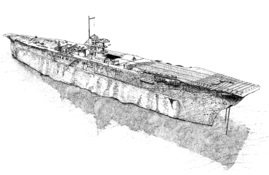 |
_burning.png) |
Fission-product radioactivity
Baker was the first nuclear explosion close enough to the surface to keep the radioactive fission productFission product
Nuclear fission products are the atomic fragments left after a large atomic nucleus fissions. Typically, a large nucleus like that of uranium fissions by splitting into two smaller nuclei, along with a few neutrons and a large release of energy in the form of heat , gamma rays and neutrinos. The...
s in the local environment. It was not "self-cleansing." The result was radioactive contamination
Radioactive contamination
Radioactive contamination, also called radiological contamination, is radioactive substances on surfaces, or within solids, liquids or gases , where their presence is unintended or undesirable, or the process giving rise to their presence in such places...
of the lagoon and the target ships. While anticipated, it caused far greater problems than were expected.
The Baker explosion produced about three pounds of fission products. These fission products were thoroughly mixed with the two million tons of spray and seabed sand that were lifted into the spray column and its cauliflower head and then dumped back into the lagoon. Most of it stayed in the lagoon and settled to the bottom or was carried out to sea by the lagoon's internal tidal and wind-driven currents.
A small fraction of the contaminated spray was thrown back into the air as the base surge. Unlike the Wilson cloud, a meteorological phenomenon in clean air, the base surge was a heavy fog
Fog
Fog is a collection of water droplets or ice crystals suspended in the air at or near the Earth's surface. While fog is a type of stratus cloud, the term "fog" is typically distinguished from the more generic term "cloud" in that fog is low-lying, and the moisture in the fog is often generated...
bank of radioactive mist
Mist
Mist is a phenomenon of small droplets suspended in air. It can occur as part of natural weather or volcanic activity, and is common in cold air above warmer water, in exhaled air in the cold, and in a steam room of a sauna. It can also be created artificially with aerosol canisters if the...
that rolled across all the target ships, painting their surfaces with fission products. When the mist in the base surge evaporated, the base surge became invisible but continued to move away, contaminating ships several miles from the detonation point.
Unmanned drone boats were the first vessels to enter the lagoon. Onboard instruments allowed remote-controlled radiation measurements to be made. When support ships entered the lagoon for evaluation, decontamination, and salvage activities, they steered clear of lagoon water hot spots detected by the drone boats. The standard for radiation exposure to personnel was the same as that used by the Manhattan Project
Manhattan Project
The Manhattan Project was a research and development program, led by the United States with participation from the United Kingdom and Canada, that produced the first atomic bomb during World War II. From 1942 to 1946, the project was under the direction of Major General Leslie Groves of the US Army...
, 0.1 roentgens per day. Because of this constraint, only the five most distant target ships could be boarded on the first day. The closer-in ships were hosed down by Navy fireboat
Fireboat
A fireboat is a specialized watercraft and with pumps and nozzles designed for fighting shoreline and shipboard fires. The first fireboats, dating to the late 18th century, were tugboats, retrofitted with firefighting equipment....
s using saltwater and foamite. The first hosing reduced radioactivity by half, but subsequent hosings were ineffective. For most of the ships, reboarding had to wait until the short-lived radioisotopes decayed; ten days elapsed before the last of the targets could be boarded.
In the first six days after Baker, when radiation levels were highest, 4,900 men boarded target ships. Sailors tried to scrub off the radioactivity with brushes, water, soap, and lye. Nothing worked, short of sandblasting to bare metal.
Test animals
Only pigs and rats were used in the Baker test. All the pigs and most of the rats died. Radiation from a contaminated environment is continuous and cumulative. With the Able test, lethality was determined by proximity to the fireball and its pulse of radiation. With Baker, lethality was determined by the amount of time spent aboard contaminated ships. Several days elapsed before sailors were able to reboard the target ships where test animals were located; during that time the accumulated doses from the gamma rays produced by fission products became lethal for the animals.Since much of the public interest in Crossroads had focused on the fate of the test animals, in September Admiral Blandy asserted that radiation death is not painful: "The animal merely languishes and recovers or dies a painless death. Suffering among the animals as a whole was negligible." This was clearly not true. While the well-documented suffering of Harry Daglian
Harry K. Daghlian, Jr.
Haroutune Krikor Daghlian, Jr. was an Armenian-American physicist with the Manhattan Project who accidentally irradiated himself on August 21, 1945, during a critical mass experiment at the remote Omega Site facility at Los Alamos National Laboratory in New Mexico, resulting in his death 25 days...
and Louis Slotin
Louis Slotin
Louis Alexander Slotin was a Canadian physicist and chemist who took part in the Manhattan Project, the secret US program during World War II that developed the atomic bomb....
as they died of radiation injury at Los Alamos was still secret, the widely reported radiation deaths at Hiroshima and Nagasaki had not been painless. In 1908, Dr. Charles Allen Porter had stated in an academic paper, "the agony of inflamed X-ray lesions is almost unequaled in any other disease."
Induced radioactivity
The Baker explosion ejected into the environment about twice as many free neutrons as there were fission events. In an air burst, most of these environmental neutrons are absorbed by superheated air which rises into the stratosphereStratosphere
The stratosphere is the second major layer of Earth's atmosphere, just above the troposphere, and below the mesosphere. It is stratified in temperature, with warmer layers higher up and cooler layers farther down. This is in contrast to the troposphere near the Earth's surface, which is cooler...
, along with the fission products and unfissioned plutonium. In the underwater Baker detonation, the neutrons were captured by seawater
Seawater
Seawater is water from a sea or ocean. On average, seawater in the world's oceans has a salinity of about 3.5% . This means that every kilogram of seawater has approximately of dissolved salts . The average density of seawater at the ocean surface is 1.025 g/ml...
in the lagoon. Of the four major elements in seawater – hydrogen
Hydrogen
Hydrogen is the chemical element with atomic number 1. It is represented by the symbol H. With an average atomic weight of , hydrogen is the lightest and most abundant chemical element, constituting roughly 75% of the Universe's chemical elemental mass. Stars in the main sequence are mainly...
, oxygen
Oxygen
Oxygen is the element with atomic number 8 and represented by the symbol O. Its name derives from the Greek roots ὀξύς and -γενής , because at the time of naming, it was mistakenly thought that all acids required oxygen in their composition...
, sodium
Sodium
Sodium is a chemical element with the symbol Na and atomic number 11. It is a soft, silvery-white, highly reactive metal and is a member of the alkali metals; its only stable isotope is 23Na. It is an abundant element that exists in numerous minerals, most commonly as sodium chloride...
, and chlorine
Chlorine
Chlorine is the chemical element with atomic number 17 and symbol Cl. It is the second lightest halogen, found in the periodic table in group 17. The element forms diatomic molecules under standard conditions, called dichlorine...
– only sodium takes on intense, short-term radioactivity with the addition of a single neutron to its nucleus: Common sodium-23 becomes radioactive sodium-24, with a 15-hour half-life. (In six days its intensity drops a thousandfold, but the flip side of short half-life is high initial intensity.)
A small fraction of one pound of radioactive sodium was produced, but unlike fission products, which are heavy and eventually sank to the bottom of the lagoon, the sodium stayed in solution. It contaminated the hulls and onboard saltwater systems of support ships that entered the lagoon, and it contaminated the water used in decontamination.
Unfissioned plutonium
The 10.6 pounds (4.8 kg) of plutonium which did not undergo fission were scattered along with the three pounds (1.4 kg) of fission products. Plutonium produces alpha radiation which cannot penetrate skin, and is not a biological hazard unless ingested or inhaled. However, once inside the body it is significantly toxic both radiologically and chemically, having a heavy metal toxicity on a par with that of arsenic. Estimates based on the Manhattan Project's "tolerance dose" of one microgram of plutonium per worker put 10.6 pounds at the equivalent of about five billion tolerable doses. With a radioactive half-life of 24,200 years, plutonium loses none of its potency during a human lifespan.Plutonium could not be detected by the film badges and Geiger counters used by people who boarded the target ships. It was assumed to be present in the environment wherever fission product radiation was detected. The decontamination plan was to scrub the target ships free of fission products and assume the plutonium would be washed away in the process. To see if this plan was working, samples of paint, rust, and other target ship surface materials were taken back to a laboratory on the support ship Haven and examined for plutonium. The results of these plutonium detection tests, and of tests performed on fish caught in the lagoon, caused all decontamination work to be abruptly terminated on August 10, effectively shutting down Operation Crossroads for safety reasons.
The failed Baker cleanup and program termination
The program termination on August 10, sixteen days after Baker, was the result of a showdown between Dr. Stafford Warren, the Army colonel in charge of radiation safety for Operation Crossroads, and Admiral Blandy. One of Warren's radsafe monitors later described him as "the only Army colonel who ever sank a Navy flotilla."Warren had been Chief of the Medical Section of the Manhattan Project, and was in charge of radiation safety at the first nuclear test, Trinity, in New Mexico, as well as of the on-ground inspections at Hiroshima and Nagasaki after the bombings. At Crossroads, it was his job to keep the sailors safe during the cleanup, and to avoid giving them grounds to sue the Navy if health problems developed later.
The cleanup was hampered by two significant factors: the unexpected base surge, and the lack of a viable cleanup plan. It was understood that if the water column fell back into the lagoon, which it did, any ships that were drenched by falling water might be contaminated beyond redemption. Nobody expected that to be the fate of virtually the entire target fleet, which it was because of the base surge. No decontamination procedures had been tested in advance to see if they would work and to measure the potential risk to personnel. In the absence of a decontamination protocol, the ships were cleaned using traditional Navy deck-scrubbing methods: hoses, mops, and brushes, with water, soap, and lye. The sailors had no protective clothing.
By August 3, Colonel Warren concluded the entire effort was futile and dangerous. The unprotected sailors were stirring up radioactive material and contaminating their skin, clothing, and, presumably, their lungs. When they returned to their support ship living quarters, they contaminated the shower stalls, laundry facilities, and everything they touched. Warren demanded an immediate halt to the entire cleanup operation. He was especially concerned about plutonium, which by weight made up 78% of the contaminating material and was undetectable on site.
Warren also observed that the radsafe procedures were not being followed correctly. Fire boats got too close to the target ships they were hosing and drenched their crews with radioactive spray. One fire boat had to be taken out of service. Film badges showed 67 overdoses between August 6 and 9. More than half of the 320 Geiger counters available shorted out and became unavailable. The crews of two target ships, Wainright
USS Wainwright (DD-419)
USS Wainwright was a World War II-era Sims-class destroyer in the service of the United States Navy. The ship was named to honor Jonathan Mayhew Wainwright, his son, Master Jonathan Wainwright, Jr., his cousin, Commander Richard Wainwright, and also Rear Admiral Richard WainwrightWainwright was...
and Carteret
USS Carteret (APA-70)
USS Carteret was a Gilliam-class attack transport that served with the US Navy during World War II.Carteret was named after a county in North Carolina. She was launched 15 August 1944 by Consolidated Steel at Wilmington, California, under a Maritime Commission contract; acquired by the Navy 2...
, moored far from the detonation site, had moved back on board and become overexposed. They were immediately evacuated back to the United States.
Captain L. H. Bibby, commanding officer of the apparently undamaged battleship New York
USS New York (BB-34)
USS New York was a United States Navy battleship, the lead ship of her class of two . She was the fifth ship to carry her name....
accused Warren's radsafe monitors of holding their Geiger counters too close to the deck. He wanted to reboard his ship and sail it home. The steadily dropping radiation counts on the target ships gave an illusion that the cleanup was working, but Warren explained that although fission products were losing some of their gamma ray potency through radioactive decay the ships were still contaminated. The danger of ingesting microscopic particles remained.
USS Wichita (CA-45)
USS Wichita was a heavy cruiser of the United States Navy. The lead ship and only member of her class, she was the first ship named after the city of Wichita, Kansas...
and explain his position to 1,400 skeptical officers and sailors. Some found him persuasive, but it was August 9 before he convinced Blandy. That was the date when Blandy realized, for the first time, that Geiger counters could not detect plutonium. Blandy was aware of the health problems of radium dial painters
Radium Girls
The Radium Girls were female factory workers who contracted radiation poisoning from painting watch dials with glow-in-the-dark paint at the United States Radium factory in Orange, New Jersey around 1917....
who ingested microscopic amounts of radium in the 1920s, and the fact that plutonium was assumed to have a similar biological effect. When plutonium was discovered in the captain's quarters of the Prinz Eugen
German cruiser Prinz Eugen
Prinz Eugen was an Admiral Hipper-class heavy cruiser, the third member of the class of five vessels. She served with the German Kriegsmarine during World War II. The ship was laid down in April 1936 and launched August 1938; Prinz Eugen entered service after the outbreak of war, in August 1940...
, unaccompanied by fission products, Blandy realized that plutonium could be anywhere.
The following day, August 10, Warren showed Blandy an autoradiograph
Autoradiograph
An autoradiograph is an image on an x-ray film or nuclear emulsion produced by the pattern of decay emissions from a distribution of a radioactive substance...
of a fish, an x-ray picture made by radiation coming from the fish. The outline of the fish was made by alpha radiation from the fish scales, evidence that plutonium, mimicking calcium, had been distributed throughout the fish, out to the scales. Blandy announced his decision, "then we call it all to a halt." He ordered that all further decontamination work be discontinued. Warren wrote home, "A self x ray of a fish . . . did the trick."
The decontamination failure ended plans to outfit some of the target ships for the spring 1947 Charlie shot and to sail the rest home in triumph. The immediate public relations problem was to avoid any perception that the entire target fleet had been destroyed. On August 6, in anticipation of this development, Blandy had told his staff that ships sunk or destroyed more than 30 days after the Baker shot "will not be considered as sunk by the bomb." By then, public interest in Crossroads was waning, and the reporters had gone home. The failure of decontamination did not make news until the final reports came out a year later.
Test Charlie
Charlie was to explode deep under the surface in the lee of the atoll to test effects on unmoored ships. Charlie, originally scheduled for the spring of 1947, would have tested the effects of using nuclear weapons as depth charges. Technical support personnel were unavailable because of the unanticipated decontamination delay following test Baker. There were no uncontaminated target ships available for use in Charlie. The official reason for canceling Charlie was that it was felt unnecessary after the success of the Able and Baker tests, and it was deemed less pressing when the entire US arsenal had only a handful of such weapons. The test intended for Charlie was conducted in 1955 as Operation WigwamOperation Wigwam
Operation Wigwam involved a single test of the Mark 90 Betty nuclear bomb. It was conducted between Operation Teapot and Operation Redwing on May 14, 1955, about 500 miles southwest of San Diego, California. 6,800 personnel aboard 30 ships were involved in Wigwam...
.
Crossroads follow-up
All ships leak and require the regular operation of bilge pumps to stay afloat. If their bilge pumps could not be operated, the target ships would eventually sink. Only one target ship suffered this fate, the Prinz EugenGerman cruiser Prinz Eugen
Prinz Eugen was an Admiral Hipper-class heavy cruiser, the third member of the class of five vessels. She served with the German Kriegsmarine during World War II. The ship was laid down in April 1936 and launched August 1938; Prinz Eugen entered service after the outbreak of war, in August 1940...
, which sank in the Kwajalien lagoon on December 22. The rest were kept afloat long enough to be deliberately sunk or dismantled. After the August 10 decision to stop decontamination work at Bikini, the surviving target fleet was towed to Kwajalein Atoll where the live ammunition and fuel could be offloaded in uncontaminated water. The move was accomplished during the remainder of August and September.
Eight of the major ships and two submarines were towed back to the United States and Hawaii for radiological inspection. Twelve target ships were so lightly contaminated that they were remanned and sailed back to the United States by their crews. Ultimately, only nine target ships were able to be scrapped rather than scuttled. The remaining target ships were destroyed by sinking off Bikini or Kwajalein Atolls, or near the Hawaiian Islands or the California coast during 1946–1948.
The support ships were decontaminated as necessary and received a radiological clearance before they could return to the fleet. This required a great deal of experimentation at Navy shipyards in the United States, primarily at San Francisco, California
San Francisco, California
San Francisco , officially the City and County of San Francisco, is the financial, cultural, and transportation center of the San Francisco Bay Area, a region of 7.15 million people which includes San Jose and Oakland...
. The destroyer Laffey
USS Laffey (DD-724)
USS Laffey , an , was the 2nd ship of the United States Navy to be named for Bartlett Laffey. Seaman Laffey was awarded the Medal of Honor for his stand against Confederate forces on 5 March 1864...
required "sandblasting and painting of all underwater surfaces, and acid washing and partial replacement of salt-water piping and evaporators."
Finally, a formal resurvey was conducted in the summer of 1947 to study long-term effects of the Crossroads tests. According to the official report, decontamination efforts "revealed conclusively that removal of radioactive contamination of the type encountered in the target vessels in test Baker cannot be accomplished successfully."
On August 11, 1947, Life
Life (magazine)
Life generally refers to three American magazines:*A humor and general interest magazine published from 1883 to 1936. Time founder Henry Luce bought the magazine in 1936 solely so that he could acquire the rights to its name....
Magazine summarized the report in a 14-page article with 33 pictures. The article stated, "If all the ships at Bikini had been fully manned, the Baker Day bomb would have killed 35,000 crewmen. If such a bomb were dropped below New York's Battery in a stiff south wind, 2 million people would die." Although it was accurately written, a casual reader of the article may have confused the grisly effects of Able's transitory fireball radiation on the close-in test animals with the equally deadly but more widespread and persistent contamination from Baker's base surge. Aside from the Life article, the report received little public attention.
The contamination problem was not widely appreciated by the general public until 1948, when No Place to Hide, a best-selling book by David Bradley, M.D.
David J. Bradley, M.D. (author, skier)
David John Bradley was an American writer, surgeon, politician and champion skier. His best-selling 1948 book No Place to Hide, a memoir of the Bikini atomic bomb tests, alerted the world to the dangers of radioactive fallout from nuclear weapon explosions...
, was serialized in the Atlantic Monthly, condensed by the Reader's Digest
Reader's Digest
Reader's Digest is a general interest family magazine, published ten times annually. Formerly based in Chappaqua, New York, its headquarters is now in New York City. It was founded in 1922, by DeWitt Wallace and Lila Bell Wallace...
, and selected by the Book of the Month Club
Book of the Month Club
The Book of the Month Club is a United States mail-order book sales club that offers a new book each month to customers.The Book of the Month Club is part of a larger company that runs many book clubs in the United States and Canada. It was formerly the flagship club of Book-of-the-Month Club, Inc...
. In his preface, Bradley, a key member of the Radiological Safety Section at Bikini known as the "Geiger men," asserted that "the accounts of the actual explosions, however well intended, were liberally seasoned with fantasy and superstition, and the results of the tests have remained buried in the vaults of military security." His description of the Baker test and its aftermath brought to world attention the problem of radioactive fallout from nuclear weapons.
Exposure to personnel
All Crossroads operations were designed to keep personnel from being exposed to more than 0.1 roentgen (R) per day. At the time, this was considered to be an amount of radiation that could be tolerated for long periods without any harmful effects on health. Since there was no special clothing or radiation shielding available, the protection plan relied on managing who went where, when, and for how long.Radioactively "hot" areas were predicted in advance, and then checked with Geiger counters, sometimes by remote control, to see if they were safe. The level of measured gamma radiation determined how long personnel could operate in them without exceeding the allowable daily dose.
Instant gamma readings were taken by radiation safety specialists, but film-badge dosimeters, which could be read at the end of the day, were issued to all personnel believed to be at the greatest radiological risk. Anyone whose badge showed more than 0.1 R / day exposure was removed for one or more days from areas and activities of possible exposure. The maximum accumulated exposure recorded was 3.72 R, received by a radiation safety specialist.
A percentage of each group working in less contaminated areas was badged. Eventually, 18,875 film-badge dosimeter
Dosimeter
Dosimeters measure an individual's or an object'sexposure to something in the environment — particularly to a hazard inflicting cumulative impact over long periods of time, or over a lifetime...
s were issued to about 15% of the total work force. On the basis of this sampling, a theoretical total exposure was calculated for each person who did not have a personal badge. As expected, exposures for target ship crews that reboarded their ships after Baker were higher than those for support ship crews. However, the hulls of support ships that entered the lagoon after Baker became so hot that sleeping quarters were moved toward the center of each ship.
Of the total mass of radioactive particles
Hot particle
A hot particle is a small, highly radioactive object, with significant content of radionuclides. Because radioactivity can be inherent to a substance or induced, and there are many initial sources of radioactivity, hot particles can originate from a multitude of sources.- Attributes :Hot particles...
scattered by each explosion, 85% was unfissioned plutonium
Plutonium
Plutonium is a transuranic radioactive chemical element with the chemical symbol Pu and atomic number 94. It is an actinide metal of silvery-gray appearance that tarnishes when exposed to air, forming a dull coating when oxidized. The element normally exhibits six allotropes and four oxidation...
which produces alpha radiation not detected by film badges or Geiger counters. There was no method of detecting plutonium in a timely fashion, and participants were not monitored for ingestion of it.
A summary of film badge readings (in roentgens) for July and August, when the largest number of personnel was involved, is listed below:
Actual film badge readings
| Readings | Total | 0 | 0.001–0.1 | 0.101–1.0 | 1.001–10.0 |
|---|---|---|---|---|---|
| July | 3,767 (100%) | 2,843 (75%) | 689 (18%) | 232 (6%) | 3 (<0.1%) |
| August | 6,664 (100%) | 3,947 (59%) | 2,139 (32%) | 570 (9%) | 8 (0.1%) |
In 1996, a government-sponsored mortality study of Crossroads veterans showed that, by 1992, 46 years after the tests, veterans had experienced a 4.6% higher mortality than a control group of non-veterans. There were 200 more deaths among Crossroads veterans than in the similar control group (12,520 vs. 12,320), implying a life-span reduction of about three months for Crossroads veterans. For the main expected causes of this increased mortality, leukemia
Leukemia
Leukemia or leukaemia is a type of cancer of the blood or bone marrow characterized by an abnormal increase of immature white blood cells called "blasts". Leukemia is a broad term covering a spectrum of diseases...
and other cancer
Cancer
Cancer , known medically as a malignant neoplasm, is a large group of different diseases, all involving unregulated cell growth. In cancer, cells divide and grow uncontrollably, forming malignant tumors, and invade nearby parts of the body. The cancer may also spread to more distant parts of the...
s, the incidence was not significantly higher than normal. Death by those diseases was tabulated on the assumption that if radiation exposure had a life-shortening effect it would likely show up there; it did not. Not enough data were gathered on other causes of death to determine the reason for this increase in all-cause mortality, and it remains a mystery. The mortality increase was higher, 5.7%, for those who boarded target ships after the tests than for those who did not, whose mortality increase was only 4.3%.
Bikini after Crossroads
The 167 Bikini residents who were moved to the uninhabited Rongerik AtollRongerik Atoll
Rongerik Atoll or Rongdrik Atoll is a coral atoll of 17 islands in the Pacific Ocean, and is located in the Ralik Chain of the Marshall Islands, approximately east of Bikini Atoll. Its total land area is only , but it encloses a lagoon of .-History:Rongerik Atoll was claimed by the Empire of...
prior to Crossroads proved unable to feed themselves in their new environment. Visitors to Rongerik reported the islanders were facing potential starvation
Starvation
Starvation is a severe deficiency in caloric energy, nutrient and vitamin intake. It is the most extreme form of malnutrition. In humans, prolonged starvation can cause permanent organ damage and eventually, death...
by January 1947, suffering malnutrition
Malnutrition
Malnutrition is the condition that results from taking an unbalanced diet in which certain nutrients are lacking, in excess , or in the wrong proportions....
by July, and were emaciated by January 1948. In March 1948 they were evacuated to Kwajalein Atoll, and then settled onto another uninhabited island, Kili
Kili Island
Kili Island or Kili Atoll is a coral atoll located in the Pacific Ocean, and forms a legislative district of the Ralik Chain of the Marshall Islands. It is approximately southwest of Jaluit...
, in November. With only one third of a square mile, Kili has one tenth the land area of Bikini and, more important, has no lagoon and no protected harbor. Unable to practice their native culture of lagoon fishing
Fishing
Fishing is the activity of trying to catch wild fish. Fish are normally caught in the wild. Techniques for catching fish include hand gathering, spearing, netting, angling and trapping....
, they have been dependent on food shipments ever since. Their four thousand descendents today are living on several islands and in foreign countries.
Their desire to return to Bikini was thwarted indefinitely by the U.S. decision to resume nuclear testing at Bikini in 1954. During the spring and summer months of 1954, 1956, and 1958, twenty-one more nuclear bombs were detonated at Bikini, yielding a total of 75 megatons, equivalent to more than three thousand Baker bombs. Only one was a "self cleansing" air burst, the 3.8 megaton Redwing Cherokee
Operation Redwing
Operation Redwing was a United States series of 17 nuclear test detonations from May to July 1956. They were conducted at Bikini and Enewetak atolls. The entire operation followed Operation Wigwam and preceded Operation Plumbbob. The primary intention was to test new, second-generation...
test. The rest were surface bursts producing massive local fallout
Fallout
Fallout or nuclear fallout is the residual radiation hazard from a nuclear explosion.Fallout may also refer to:*Fallout , a 1997 post-apocalyptic computer role-playing game released by Interplay Entertainment...
. The first after Crossroads was the dirtiest: the 15 megaton Bravo
Castle Bravo
Castle Bravo was the code name given to the first U.S. test of a dry fuel thermonuclear hydrogen bomb device, detonated on March 1, 1954 at Bikini Atoll, Marshall Islands, as the first test of Operation Castle. Castle Bravo was the most powerful nuclear device ever detonated by the United States ,...
shot of Operation Castle
Operation Castle
Operation Castle was a United States series of high-energy nuclear tests by Joint Task Force SEVEN at Bikini Atoll beginning in March 1954...
on March 1, 1954, the largest-ever U.S. test. Fallout from Bravo caused radiation injury to Bikini islanders who were living on Rongelap Atoll
Rongelap Atoll
Rongelap Atoll or Namorik Atoll is a coral atoll of 61 islands in the Pacific Ocean, and forms a legislative district of the Ralik Chain of the Marshall Islands. Its total land area is only , but it encloses a lagoon with an area of...
at the time.
The brief attempt to resettle Bikini from 1974 until 1978 was aborted when health problems from radioactivity in the food supply caused the atoll to be evacuated again. Sport divers who visit Bikini to dive on the shipwreck
Shipwreck
A shipwreck is what remains of a ship that has wrecked, either sunk or beached. Whatever the cause, a sunken ship or a wrecked ship is a physical example of the event: this explains why the two concepts are often overlapping in English....
s must eat imported food. The local government elected to close the lagoon to sport divers in 2008, but reopened for only one season in 2011. A combination of high fuel prices, an unreliable airline service was the stated reason for its closure.
Legacy
Following test Baker decontamination problems, the United States NavyUnited States Navy
The United States Navy is the naval warfare service branch of the United States Armed Forces and one of the seven uniformed services of the United States. The U.S. Navy is the largest in the world; its battle fleet tonnage is greater than that of the next 13 largest navies combined. The U.S...
equipped newly constructed ships with a CounterMeasure WashDown System (CMWDS) of piping and nozzles to cover exterior surfaces of the ship with a spray of salt water from the firefighting system when nuclear attack appeared imminent. The film of flowing water would theoretically prevent contaminants from settling into cracks and crevices.
The name "Bikini" was adopted for bikini
Bikini
The bikini is typically a women's two-piece swimsuit. One part of the attire covers the breasts and the other part covers the crotch and part of or the entire buttocks, leaving an uncovered area between the two. Merriam–Webster describes the bikini as "a woman's scanty two-piece bathing suit" or "a...
swimwear during Operation Crossroads; a coincidence
Coincidence
A coincidence is an event notable for its occurring in conjunction with other conditions, e.g. another event. As such, a coincidence occurs when something uncanny, accidental and unexpected happens under conditions named, but not under a defined relationship...
of explosive shock perhaps ("like the bomb, the bikini is small and devastating"), and the realization that "atom bombs reduce everybody to primitive costume
Costume
The term costume can refer to wardrobe and dress in general, or to the distinctive style of dress of a particular people, class, or period. Costume may also refer to the artistic arrangement of accessories in a picture, statue, poem, or play, appropriate to the time, place, or other circumstances...
."
The 1976 Bruce Conner
Bruce Conner
Bruce Conner was an American artist renowned for his work in assemblage, film, drawing, sculpture, painting, collage, and photography, among other disciplines.-Early life:...
film Crossroads
Crossroads (1976 film)
Crossroads is a 1976 short film directed by Bruce Conner. It features extreme slow-motion replays of the July 25, 1946 Operation Crossroads Baker underwater nuclear test at Bikini Atoll in the Pacific....
uses research footage coupled with a Terry Riley
Terry Riley
Terrence Mitchell Riley, is an American composer intrinsically associated with the minimalist school of Western classical music and was a pioneer of the movement...
soundtrack.
The 1988 film Radio Bikini
Radio Bikini
Radio Bikini is a 1988 American documentary film directed by Robert Stone. It was nominated for an Academy Award in 1988 for Best Documentary Feature....
was nominated for the Best Documentary Feature Oscar
Academy Award for Documentary Feature
The Academy Award for Documentary Feature is among the most prestigious awards for documentary films.- Winners and nominees:Following the Academy's practice, films are listed below by the award year...
. Directed by Robert Stone, it recounts the story of Operation Crossroads, concentrating on how it affected the Bikini islanders and the servicemen who took part in the operation. The film uses archival footage almost exclusively, much of it in color. Film of the Crossroads Baker explosion is among the most often shown examples of a nuclear explosion
Nuclear explosion
A nuclear explosion occurs as a result of the rapid release of energy from an intentionally high-speed nuclear reaction. The driving reaction may be nuclear fission, nuclear fusion or a multistage cascading combination of the two, though to date all fusion based weapons have used a fission device...
, and exists in many sources.
Author Theodore Taylor
Theodore Taylor (author)
Theodore Taylor was an American author of more than 50 fiction and non-fiction books for young adult readers, including The Cay, The Weirdo , Ice Drift, Timothy of the Cay, The Bomb, Sniper, and Rogue...
wrote a novel called The Bomb
The Bomb (novel)
The Bomb is a 1995 novel by Theodore Taylor written to protest against nuclear testing on Bikini Atoll after the natives are forced to move. It was first published by Harcourt Children's Books in October 1995. The book won the 1996 Scott O'Dell Award for Historical Fiction.-Plot summary:Sorry...
, which is about a teenaged boy who attempts to stop the tests by using himself as a human shield.
SpongeBob SquarePants
SpongeBob SquarePants
SpongeBob SquarePants is an American animated television series, created by marine biologist and animator Stephen Hillenburg. Much of the series centers on the exploits and adventures of the title character and his various friends in the underwater city of "Bikini Bottom"...
has referred to the Baker shot in three of its episodes, "Dying For Pie", "The Krusty Plate", and more recently "Frozen Face-off". Some episodes that shown the footage played at different speeds.
The Baker shot was also used in the movie Godzilla (1998), mistaken for French nuclear tests in French Polynesia
French Polynesia
French Polynesia is an overseas country of the French Republic . It is made up of several groups of Polynesian islands, the most famous island being Tahiti in the Society Islands group, which is also the most populous island and the seat of the capital of the territory...
, mainly which is the main idea of the opening credits to the film.
See also
- Human experimentation in the United StatesHuman experimentation in the United StatesThere have been numerous experiments performed on human test subjects in the United States that have been considered unethical, and were often performed illegally, without the knowledge, consent, or informed consent of the test subjects....
- Underwater explosionUnderwater explosionAn underwater explosion, also known as an UNDEX, is an explosion beneath the surface of water. The type of explosion may be chemical or nuclear...
- Special Delivery, a propaganda film made about the testing.
External links
- A series of watercolour paintings, made by U.S. Military combat artists, as a report of the tests.
- US Navy and Nuclear Weapons Testing
- Manhattan Project – Operation Crossroads (DOE History)
- Links to a clip from a film from the U.S. Department of Energy about the Able shot.
- Links to a clip from a film from the U.S. Department of Energy about the Baker shot.
- Newsreel footage of the Able blast.
- dtra.mil: Analysis of Radiation Exposure for Naval Units of Operation Crossroads – Volume I-Basic Report
- dtra.mil: Analysis of Radiation Exposure for Naval Units of Operation Crossroads – Volume II-(Appendix A) Target Ships
- The Archeology of the Atomic Bomb – A Submerged Cultural Resources Assessment of the Sunken Fleet of Operation Crossroads at Bikini and Kwajalein Atoll Lagoons (1991)
- dtra.mil: Internal Dose Assessment – Operation Crossroads
- Wikimapia link showing Bikini Atoll and, particularly, the Castle Bravo crater
- The Smithsonian scientists involved in surveying Bikini before and after the tests