

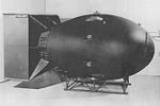
Fat Man

Encyclopedia
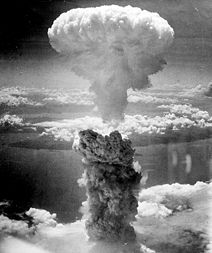
"Fat Man" is the codename for the atomic bomb that was detonated over Nagasaki
, Japan, by the United States on August 9, 1945. It was the second of the only two nuclear weapons to be used in warfare to date (the other being "Little Boy
"), and its detonation caused the third man-made nuclear explosion. The name also refers more generically to the early nuclear weapon design
s of U.S. weapons based on the "Fat Man" model. It was an implosion-type
weapon with a plutonium core, similar to "The gadget", the experimental device detonated only a month earlier in New Mexico.
"Fat Man" was possibly named after Winston Churchill
, though Robert Serber
said in his memoirs that as the "Fat Man" bomb was round and fat, he named it after Sydney Greenstreet
's character of "Kasper Gutman" in The Maltese Falcon
.
"Fat Man" was dropped from the B-29 bomber Bockscar
, piloted by Major Charles Sweeney
of the 393d Bombardment Squadron, Heavy
, and exploded at 11:02 AM (JST), at an altitude of about 1650 feet (502.9 m), with a yield of about 21 ktonTNT. Because of poor visibility due to cloud cover, the bomb missed its intended detonation point, and damage was somewhat less extensive than that in Hiroshima
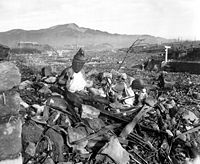
. An estimated 39,000 people were killed outright by the bombing at Nagasaki, and a further 25,000 were injured. Thousands more died later from related blast and burn injuries, and hundreds more from radiation illnesses
from exposure to the bomb's initial radiation. The bombing raid on Nagasaki had the third highest fatality rate in World War II after the nuclear strike on Hiroshima
and the March 9/10 1945 fire bombing raid on Tokyo
.
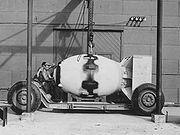
 It was 128 inches (325.1 cm) long, 5 feet (1.5 m) in diameter, and weighed 10200 lbs. In accordance with the name, it was more than twice as wide as Little Boy
, which was dropped on Hiroshima
three days earlier; however, the mass was only 15% more than that of Little Boy.
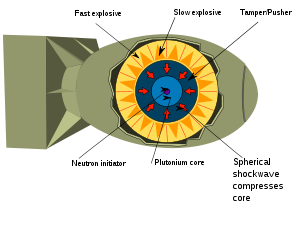
"Fat Man" was an implosion-type device using plutonium-239
. A subcritical sphere of plutonium was placed in the center of a hollow sphere of high explosives. Thirty-two pairs of detonators
located on the surface of the high explosive were fired simultaneously to produce a powerful inward pressure
on the core, squeezing it and increasing its density
, resulting in a supercritical condition and a nuclear initiation.
At first it was thought that two pieces of subcritical plutonium (Pu-239) could simply be shot into one another to create a nuclear explosion, and a plutonium gun-type design of this sort (known as the "Thin Man" bomb) was worked on for some time during the Manhattan Project. In April 1944, Emilio Segrè discovered that plutonium created for the bomb in the nuclear reactor
s at Hanford, Washington
—even though it was supergrade plutonium containing only about 0.9% Pu-240—was not as pure as the initial samples of plutonium developed at the cyclotron
s at Ernest O. Lawrence's Radiation Laboratory
in Berkeley, California
. Because of the presence of the Pu-240 isotope, reactor-bred plutonium had a much higher rate of spontaneous neutron emission
than was previously thought, and if a gun-type device was used it would most likely pre-initiate and result in a messy and costly "fizzle
". The spontaneous fission
rate of Pu-240 is 40,000 times greater than that of Pu-239, so that in a gun-type plutonium device of the sort planned during the Manhattan Project, the last few centimeters would have to be traveled in less than 40 microseconds. After this problem was realized, the entire Los Alamos
laboratory re-organized around the problem of the implosion bomb, the "Fat Man" starting in June 1944.

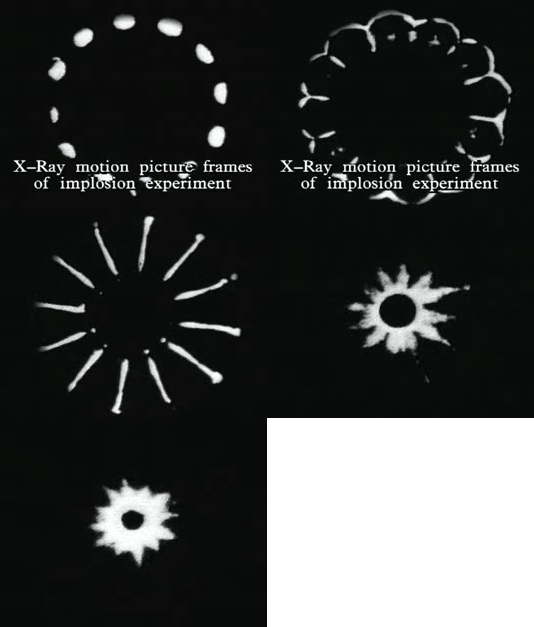 The difficulty in the design of an implosion device lay primarily in properly compressing the plutonium core into a near-perfect sphere; if the compression was not symmetrical it would cause the plutonium to be ejected from the weapon, making it an inefficient "dirty bomb
". In order to accomplish the compression, the high explosive system had to be carefully designed as a series of explosive lens
es which used alternating fast- and slow-burning explosives to shape the explosive shock wave
into the desired spherical shape. An early idea of this sort had been raised by physicist
Richard Tolman during early discussions of possible bomb designs, specifically in having many pieces of fissile material attached to explosives that would then assemble them in a spherical fashion. This idea was further developed by Seth Neddermeyer
, who attempted to find a way to collapse a hollow sphere of plutonium onto a solid sphere of it inside itself. Neither of these ideas relied on compression of the plutonium, and neither would assemble the device fast enough to avoid preinitiation (see discussion below).
The idea of using shaped charge
s came from James L. Tuck and was developed by mathematician John von Neumann
, and the idea that under such pressures the plutonium metal itself would be compressed may have come about from conversations with Edward Teller
, whose knowledge of how dense metals behaved under heavy pressure was influenced by his theoretical studies of the Earth's core with George Gamow
. Von Neumann and George Kistiakowsky
eventually became the principal architects behind the lens system. Robert Christy
is credited with doing the final calculations that showed that a solid subcritical sphere of plutonium could be compressed to a critical state greatly simplifying the task since earlier efforts had attempted the more difficult compression of 3D shapes like spherical shells. After Christy's report, the solid-plutonium core weapon was referred to as the "Christy Gadget".
Because of its complicated firing mechanism, and the need for previously untested synchronization of explosives and precision design, it was felt that a full test of the concept was needed before the scientists and military representatives could be confident it would perform correctly under combat conditions. On July 16, 1945, a device using a similar mechanism (called the "gadget" for security reasons) detonated in a test explosion
at a remote site in New Mexico
, known as the "Trinity
" test. It gave about 20 kt (80 TJ), 2 to 4 times the expected yield.
The gun-type method, though inadequate for plutonium, could still be used for highly enriched uranium
, and was employed in the "Little Boy
" device, used against Hiroshima
. The implosion method is more efficient than the gun-type method, and also far safer, as a perfect synchronization of the explosion lenses is required for the core to properly detonate, greatly reducing the chances of an accidental nuclear initiation. After the success of the first implosion "gadget", almost all subsequent American fission designs utilized implosion, with a rare few that used the gun-type design out of special design requirements (like extreme narrowness of weapon, such as nuclear artillery
).
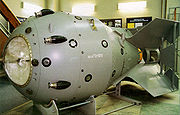 The Soviet Union's first nuclear weapon
detonated at Operation First Lightning (known as "Joe 1
" in the West) was closely based on the "Fat Man" device, on which they had obtained detailed information from the spies Klaus Fuchs
, Theodore Hall
, and David Greenglass
.
The names for all three projects ("Fat Man", "Thin Man", and "Little Boy") were allegedly created by Robert Serber
, a former student of Los Alamos director Robert Oppenheimer
who worked on the project, according to Serber. According to his later memoirs, he chose them based on their design shapes; the "Thin Man" would be a very long device, and the name came from the Dashiell Hammett
detective novel
and series of movies
by the same name; the "Fat Man" bomb would be round and fat and was named after Sidney Greenstreet's "Kasper Gutman" character in The Maltese Falcon
. "Little Boy" would come last and be named only to contrast to the "Thin Man" bomb.
Other sources say the names originated with the Army Air Forces. According to this version, the B-29 bombers would need certain modifications to enable them to carry the weapons. A cover story was created that the modifications were to fit out two B-29s as transportation aircraft for President Franklin D. Roosevelt
and British Prime Minister Winston Churchill
. The "Fat Man" was supposedly Churchill, the "Thin Man", Roosevelt. When it was discovered that the gun-bomb could be shorter than first thought, "Thin Man" was renamed "Little Boy."
After the war, the Fat Man (technically the model 1561 Fat Man) was modified—improved detonators, a more reliable firing system, and other minor changes. It thus emerged as the Mark III (or Mark 3) atomic bomb. Approximately 100 units were added to the arsenal before retirement by 1950.
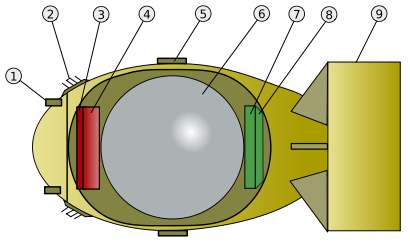
Below is a diagram of the main parts of the "Fat Man" device itself, followed by a more detailed look at the different materials used in the physics package of the device (the part responsible for the nuclear initiation).
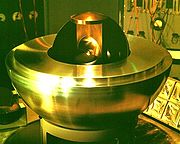
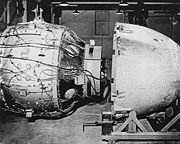
 To allow insertion of the 3.62 inch (92 mm) diameter plutonium pit, containing the 0.83 inch (21 mm) diameter "Urchin" initiator, as late as possible in the device's assembly, the spherical 8.75 inch (222 mm) diameter U-238 tamper surrounded by a 0.125 inch (3.2 mm) thick shell of boron impregnated plastic had a 5 inch (130 mm) diameter cylindrical hole running through it, like the hole in a cored apple. The missing U-238 tamper cylinder, containing the plutonium pit, could be slipped in through a hole in the surrounding 18.5 inch (470 mm) diameter aluminium
pusher.
In August 1945, it was assembled on Tinian Island. When the physics package was fully assembled and wired, it was placed inside its ellipsoidal aerodynamic bombshell and wheeled to the bomb bay of the B-29 Superfortress
named "Bockscar
", after its normally assigned command pilot, Fred Bock (who flew a different plane on the Nagasaki mission).
In 2003, these concentric spheres and cylinder were recreated as the centerpiece of an art installation called Critical Assembly by sculptor Jim Sanborn. Using non-nuclear materials, he replicated the internal components of the "Trinity" device, which had the same design as Fat Man. Critical Assembly was first displayed at the Corcoran Gallery of Art
, in Washington, DC.
The plutonium must be compressed to twice its normal density before free neutrons are added to start the fission chain reaction:
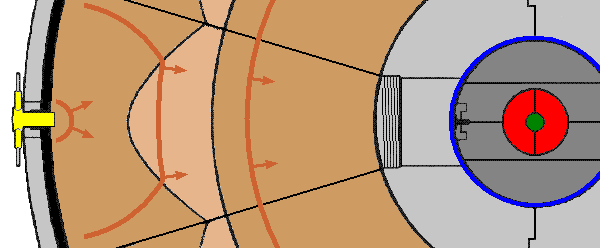 The result was that in the Fat Man bomb, about 1 kilograms (2.2 lb) of the 6.2 kilograms (13.7 lb) of plutonium in the pit (about 17%) fissioned
. In this process 1 gram (0.035273962105112 oz) of matter
in the bomb was converted into the active energy of heat and radiation (see mass-energy equivalence
for detail), releasing the energy equivalent of 21 ktonTNT.
Atomic bombings of Hiroshima and Nagasaki
During the final stages of World War II in 1945, the United States conducted two atomic bombings against the cities of Hiroshima and Nagasaki in Japan, the first on August 6, 1945, and the second on August 9, 1945. These two events are the only use of nuclear weapons in war to date.For six months...
, Japan, by the United States on August 9, 1945. It was the second of the only two nuclear weapons to be used in warfare to date (the other being "Little Boy
Little Boy
"Little Boy" was the codename of the atomic bomb dropped on Hiroshima on August 6, 1945 by the Boeing B-29 Superfortress Enola Gay, piloted by Colonel Paul Tibbets of the 393rd Bombardment Squadron, Heavy, of the United States Army Air Forces. It was the first atomic bomb to be used as a weapon...
"), and its detonation caused the third man-made nuclear explosion. The name also refers more generically to the early nuclear weapon design
Nuclear weapon design
Nuclear weapon designs are physical, chemical, and engineering arrangements that cause the physics package of a nuclear weapon to detonate. There are three basic design types...
s of U.S. weapons based on the "Fat Man" model. It was an implosion-type
Nuclear weapon design
Nuclear weapon designs are physical, chemical, and engineering arrangements that cause the physics package of a nuclear weapon to detonate. There are three basic design types...
weapon with a plutonium core, similar to "The gadget", the experimental device detonated only a month earlier in New Mexico.
"Fat Man" was possibly named after Winston Churchill
Winston Churchill
Sir Winston Leonard Spencer-Churchill, was a predominantly Conservative British politician and statesman known for his leadership of the United Kingdom during the Second World War. He is widely regarded as one of the greatest wartime leaders of the century and served as Prime Minister twice...
, though Robert Serber
Robert Serber
Robert Serber was an American physicist who participated in the Manhattan Project. He was born in Philadelphia, Pennsylvania; he was the eldest son of David Serber and Rose Frankel. He married Charlotte Leof in 1933. Rose Serber died in 1922; David married Charlotte's cousin Frances Leof in...
said in his memoirs that as the "Fat Man" bomb was round and fat, he named it after Sydney Greenstreet
Sydney Greenstreet
Sydney Hughes Greenstreet was an English actor. He is best known for his Warner Bros. films with Humphrey Bogart and Peter Lorre, which include The Maltese Falcon and Casablanca .-Biography:...
's character of "Kasper Gutman" in The Maltese Falcon
The Maltese Falcon (1941 film)
The Maltese Falcon is a 1941 Warner Bros. film based on the novel of the same name by Dashiell Hammett and a remake of the 1931 film of the same name...
.
"Fat Man" was dropped from the B-29 bomber Bockscar
Bockscar
Bockscar, sometimes called Bock's Car or Bocks Car, is the name of the United States Army Air Forces B-29 bomber that dropped the "Fat Man" nuclear weapon over Nagasaki on 9 August 1945, the second atomic weapon used against Japan....
, piloted by Major Charles Sweeney
Charles Sweeney
Major General Charles W. Sweeney was an officer in the U.S. Army Air Forces during World War II and the pilot who flew the "Fat Man" atomic bomb to Nagasaki on August 9, 1945...
of the 393d Bombardment Squadron, Heavy
393d Bomb Squadron
The 393d Bomb Squadron is part of the 509th Bomb Wing at Whiteman Air Force Base, Missouri.-History:Activated as a B-29 Superfortress squadron in early 1944; trained under Second Air Force. Training delayed as engineering flaws being worked out of the B-29...
, and exploded at 11:02 AM (JST), at an altitude of about 1650 feet (502.9 m), with a yield of about 21 ktonTNT. Because of poor visibility due to cloud cover, the bomb missed its intended detonation point, and damage was somewhat less extensive than that in Hiroshima
Hiroshima
is the capital of Hiroshima Prefecture, and the largest city in the Chūgoku region of western Honshu, the largest island of Japan. It became best known as the first city in history to be destroyed by a nuclear weapon when the United States Army Air Forces dropped an atomic bomb on it at 8:15 A.M...
. An estimated 39,000 people were killed outright by the bombing at Nagasaki, and a further 25,000 were injured. Thousands more died later from related blast and burn injuries, and hundreds more from radiation illnesses
Radiation poisoning
Acute radiation syndrome also known as radiation poisoning, radiation sickness or radiation toxicity, is a constellation of health effects which occur within several months of exposure to high amounts of ionizing radiation...
from exposure to the bomb's initial radiation. The bombing raid on Nagasaki had the third highest fatality rate in World War II after the nuclear strike on Hiroshima
Atomic bombings of Hiroshima and Nagasaki
During the final stages of World War II in 1945, the United States conducted two atomic bombings against the cities of Hiroshima and Nagasaki in Japan, the first on August 6, 1945, and the second on August 9, 1945. These two events are the only use of nuclear weapons in war to date.For six months...
and the March 9/10 1945 fire bombing raid on Tokyo
Bombing of Tokyo in World War II
The bombing of Tokyo, often referred to as a "firebombing", was conducted by the United States Army Air Forces during the Pacific campaigns of World War II. The U.S. mounted a small-scale raid on Tokyo in April 1942, with large morale effects...
.
Technology
Little Boy
"Little Boy" was the codename of the atomic bomb dropped on Hiroshima on August 6, 1945 by the Boeing B-29 Superfortress Enola Gay, piloted by Colonel Paul Tibbets of the 393rd Bombardment Squadron, Heavy, of the United States Army Air Forces. It was the first atomic bomb to be used as a weapon...
, which was dropped on Hiroshima
Hiroshima
is the capital of Hiroshima Prefecture, and the largest city in the Chūgoku region of western Honshu, the largest island of Japan. It became best known as the first city in history to be destroyed by a nuclear weapon when the United States Army Air Forces dropped an atomic bomb on it at 8:15 A.M...
three days earlier; however, the mass was only 15% more than that of Little Boy.
"Fat Man" was an implosion-type device using plutonium-239
Plutonium-239
Plutonium-239 is an isotope of plutonium. Plutonium-239 is the primary fissile isotope used for the production of nuclear weapons, although uranium-235 has also been used and is currently the secondary isotope. Plutonium-239 is also one of the three main isotopes demonstrated usable as fuel in...
. A subcritical sphere of plutonium was placed in the center of a hollow sphere of high explosives. Thirty-two pairs of detonators
Exploding-bridgewire detonator
The exploding-bridgewire detonator is a type of detonator used to initiate the detonation reaction in explosive materials, similar to a blasting cap in that it is fired using an electric current...
located on the surface of the high explosive were fired simultaneously to produce a powerful inward pressure
Pressure
Pressure is the force per unit area applied in a direction perpendicular to the surface of an object. Gauge pressure is the pressure relative to the local atmospheric or ambient pressure.- Definition :...
on the core, squeezing it and increasing its density
Density
The mass density or density of a material is defined as its mass per unit volume. The symbol most often used for density is ρ . In some cases , density is also defined as its weight per unit volume; although, this quantity is more properly called specific weight...
, resulting in a supercritical condition and a nuclear initiation.
At first it was thought that two pieces of subcritical plutonium (Pu-239) could simply be shot into one another to create a nuclear explosion, and a plutonium gun-type design of this sort (known as the "Thin Man" bomb) was worked on for some time during the Manhattan Project. In April 1944, Emilio Segrè discovered that plutonium created for the bomb in the nuclear reactor
Nuclear reactor
A nuclear reactor is a device to initiate and control a sustained nuclear chain reaction. Most commonly they are used for generating electricity and for the propulsion of ships. Usually heat from nuclear fission is passed to a working fluid , which runs through turbines that power either ship's...
s at Hanford, Washington
Hanford Site
The Hanford Site is a mostly decommissioned nuclear production complex on the Columbia River in the U.S. state of Washington, operated by the United States federal government. The site has been known by many names, including Hanford Works, Hanford Engineer Works or HEW, Hanford Nuclear Reservation...
—even though it was supergrade plutonium containing only about 0.9% Pu-240—was not as pure as the initial samples of plutonium developed at the cyclotron
Cyclotron
In technology, a cyclotron is a type of particle accelerator. In physics, the cyclotron frequency or gyrofrequency is the frequency of a charged particle moving perpendicularly to the direction of a uniform magnetic field, i.e. a magnetic field of constant magnitude and direction...
s at Ernest O. Lawrence's Radiation Laboratory
Lawrence Berkeley National Laboratory
The Lawrence Berkeley National Laboratory , is a U.S. Department of Energy national laboratory conducting unclassified scientific research. It is located on the grounds of the University of California, Berkeley, in the Berkeley Hills above the central campus...
in Berkeley, California
Berkeley, California
Berkeley is a city on the east shore of the San Francisco Bay in Northern California, United States. Its neighbors to the south are the cities of Oakland and Emeryville. To the north is the city of Albany and the unincorporated community of Kensington...
. Because of the presence of the Pu-240 isotope, reactor-bred plutonium had a much higher rate of spontaneous neutron emission
Neutron emission
Neutron emission is a type of radioactive decay of atoms containing excess neutrons, in which a neutron is simply ejected from the nucleus. Two examples of isotopes which emit neutrons are helium-5 and beryllium-13...
than was previously thought, and if a gun-type device was used it would most likely pre-initiate and result in a messy and costly "fizzle
Fizzle (nuclear test)
In nuclear weapons, a fizzle occurs when the testing of a nuclear bomb fails to meet its expected yield. The reason for the failure can be linked to improper bomb design, poor construction, or lack of expertise. All countries that have had a nuclear weapons testing program have experienced fizzles...
". The spontaneous fission
Spontaneous fission
Spontaneous fission is a form of radioactive decay characteristic of very heavy isotopes. Because the nuclear binding energy reaches a maximum at a nuclear mass greater than about 60 atomic mass units , spontaneous breakdown into smaller nuclei and single particles becomes possible at heavier masses...
rate of Pu-240 is 40,000 times greater than that of Pu-239, so that in a gun-type plutonium device of the sort planned during the Manhattan Project, the last few centimeters would have to be traveled in less than 40 microseconds. After this problem was realized, the entire Los Alamos
Los Alamos National Laboratory
Los Alamos National Laboratory is a United States Department of Energy national laboratory, managed and operated by Los Alamos National Security , located in Los Alamos, New Mexico...
laboratory re-organized around the problem of the implosion bomb, the "Fat Man" starting in June 1944.
Dirty bomb
A dirty bomb is a speculative radiological weapon that combines radioactive material with conventional explosives. The purpose of the weapon is to contaminate the area around the explosion with radioactive material, hence the attribute "dirty"....
". In order to accomplish the compression, the high explosive system had to be carefully designed as a series of explosive lens
Explosive lens
An explosive lens—as used, for example, in nuclear weapons—is a highly specialized explosive charge, a special type of a shaped charge. In general, it is a device composed of several explosive charges that are shaped in such a way as to change the shape of the detonation wave passing through it,...
es which used alternating fast- and slow-burning explosives to shape the explosive shock wave
Shock wave
A shock wave is a type of propagating disturbance. Like an ordinary wave, it carries energy and can propagate through a medium or in some cases in the absence of a material medium, through a field such as the electromagnetic field...
into the desired spherical shape. An early idea of this sort had been raised by physicist
Physicist
A physicist is a scientist who studies or practices physics. Physicists study a wide range of physical phenomena in many branches of physics spanning all length scales: from sub-atomic particles of which all ordinary matter is made to the behavior of the material Universe as a whole...
Richard Tolman during early discussions of possible bomb designs, specifically in having many pieces of fissile material attached to explosives that would then assemble them in a spherical fashion. This idea was further developed by Seth Neddermeyer
Seth Neddermeyer
Seth Henry Neddermeyer was an American physicist who co-discovered the muon, and later championed the implosion design of the plutonium atomic bomb, at the Manhattan Project....
, who attempted to find a way to collapse a hollow sphere of plutonium onto a solid sphere of it inside itself. Neither of these ideas relied on compression of the plutonium, and neither would assemble the device fast enough to avoid preinitiation (see discussion below).
The idea of using shaped charge
Shaped charge
A shaped charge is an explosive charge shaped to focus the effect of the explosive's energy. Various types are used to cut and form metal, to initiate nuclear weapons, to penetrate armor, and in the oil and gas industry...
s came from James L. Tuck and was developed by mathematician John von Neumann
John von Neumann
John von Neumann was a Hungarian-American mathematician and polymath who made major contributions to a vast number of fields, including set theory, functional analysis, quantum mechanics, ergodic theory, geometry, fluid dynamics, economics and game theory, computer science, numerical analysis,...
, and the idea that under such pressures the plutonium metal itself would be compressed may have come about from conversations with Edward Teller
Edward Teller
Edward Teller was a Hungarian-American theoretical physicist, known colloquially as "the father of the hydrogen bomb," even though he did not care for the title. Teller made numerous contributions to nuclear and molecular physics, spectroscopy , and surface physics...
, whose knowledge of how dense metals behaved under heavy pressure was influenced by his theoretical studies of the Earth's core with George Gamow
George Gamow
George Gamow , born Georgiy Antonovich Gamov , was a Russian-born theoretical physicist and cosmologist. He discovered alpha decay via quantum tunneling and worked on radioactive decay of the atomic nucleus, star formation, stellar nucleosynthesis, Big Bang nucleosynthesis, cosmic microwave...
. Von Neumann and George Kistiakowsky
George Kistiakowsky
George Bogdan Kistiakowsky was a Ukrainian-American chemistry professor at Harvard who participated in the Manhattan Project and later served as President Eisenhower's Science Advisor...
eventually became the principal architects behind the lens system. Robert Christy
Robert Christy
Robert F. Christy is an American theoretical physicist and later astrophysicist who worked on the Manhattan Project. He was also briefly president of Caltech....
is credited with doing the final calculations that showed that a solid subcritical sphere of plutonium could be compressed to a critical state greatly simplifying the task since earlier efforts had attempted the more difficult compression of 3D shapes like spherical shells. After Christy's report, the solid-plutonium core weapon was referred to as the "Christy Gadget".
Because of its complicated firing mechanism, and the need for previously untested synchronization of explosives and precision design, it was felt that a full test of the concept was needed before the scientists and military representatives could be confident it would perform correctly under combat conditions. On July 16, 1945, a device using a similar mechanism (called the "gadget" for security reasons) detonated in a test explosion
Nuclear testing
Nuclear weapons tests are experiments carried out to determine the effectiveness, yield and explosive capability of nuclear weapons. Throughout the twentieth century, most nations that have developed nuclear weapons have tested them...
at a remote site in New Mexico
New Mexico
New Mexico is a state located in the southwest and western regions of the United States. New Mexico is also usually considered one of the Mountain States. With a population density of 16 per square mile, New Mexico is the sixth-most sparsely inhabited U.S...
, known as the "Trinity
Trinity test
Trinity was the code name of the first test of a nuclear weapon. This test was conducted by the United States Army on July 16, 1945, in the Jornada del Muerto desert about 35 miles southeast of Socorro, New Mexico, at the new White Sands Proving Ground, which incorporated the Alamogordo Bombing...
" test. It gave about 20 kt (80 TJ), 2 to 4 times the expected yield.
The gun-type method, though inadequate for plutonium, could still be used for highly enriched uranium
Uranium
Uranium is a silvery-white metallic chemical element in the actinide series of the periodic table, with atomic number 92. It is assigned the chemical symbol U. A uranium atom has 92 protons and 92 electrons, of which 6 are valence electrons...
, and was employed in the "Little Boy
Little Boy
"Little Boy" was the codename of the atomic bomb dropped on Hiroshima on August 6, 1945 by the Boeing B-29 Superfortress Enola Gay, piloted by Colonel Paul Tibbets of the 393rd Bombardment Squadron, Heavy, of the United States Army Air Forces. It was the first atomic bomb to be used as a weapon...
" device, used against Hiroshima
Hiroshima
is the capital of Hiroshima Prefecture, and the largest city in the Chūgoku region of western Honshu, the largest island of Japan. It became best known as the first city in history to be destroyed by a nuclear weapon when the United States Army Air Forces dropped an atomic bomb on it at 8:15 A.M...
. The implosion method is more efficient than the gun-type method, and also far safer, as a perfect synchronization of the explosion lenses is required for the core to properly detonate, greatly reducing the chances of an accidental nuclear initiation. After the success of the first implosion "gadget", almost all subsequent American fission designs utilized implosion, with a rare few that used the gun-type design out of special design requirements (like extreme narrowness of weapon, such as nuclear artillery
Nuclear artillery
Nuclear artillery is a subset of limited-yield tactical nuclear weapons, in particular those weapons that are launched from the ground at battlefield targets...
).
Soviet atomic bomb project
The Soviet project to develop an atomic bomb , was a clandestine research and development program began during and post-World War II, in the wake of the Soviet Union's discovery of the United States' nuclear project...
detonated at Operation First Lightning (known as "Joe 1
Joe 1
The RDS-1 , also known as First Lightning , was the Soviet Union's first nuclear weapon test. In the west, it was code-named Joe-1, in reference to Joseph Stalin. It was test-exploded on 29 August 1949, at Semipalatinsk, Kazakh SSR, after a top-secret R&D project...
" in the West) was closely based on the "Fat Man" device, on which they had obtained detailed information from the spies Klaus Fuchs
Klaus Fuchs
Klaus Emil Julius Fuchs was a German theoretical physicist and atomic spy who in 1950 was convicted of supplying information from the American, British and Canadian atomic bomb research to the USSR during and shortly after World War II...
, Theodore Hall
Theodore Hall
Theodore Alvin Hall was an American physicist and an atomic spy for the Soviet Union, who, during his work on US efforts to develop the first atomic bomb during World War II , gave a detailed description of the "Fat Man" plutonium bomb, and of processes for purifying plutonium, to Soviet...
, and David Greenglass
David Greenglass
David Greenglass was an atomic spy for the Soviet Union who worked in the Manhattan project. He was the brother of Ethel Rosenberg.-Biography:...
.
The names for all three projects ("Fat Man", "Thin Man", and "Little Boy") were allegedly created by Robert Serber
Robert Serber
Robert Serber was an American physicist who participated in the Manhattan Project. He was born in Philadelphia, Pennsylvania; he was the eldest son of David Serber and Rose Frankel. He married Charlotte Leof in 1933. Rose Serber died in 1922; David married Charlotte's cousin Frances Leof in...
, a former student of Los Alamos director Robert Oppenheimer
Robert Oppenheimer
Julius Robert Oppenheimer was an American theoretical physicist and professor of physics at the University of California, Berkeley. Along with Enrico Fermi, he is often called the "father of the atomic bomb" for his role in the Manhattan Project, the World War II project that developed the first...
who worked on the project, according to Serber. According to his later memoirs, he chose them based on their design shapes; the "Thin Man" would be a very long device, and the name came from the Dashiell Hammett
Dashiell Hammett
Samuel Dashiell Hammett was an American author of hard-boiled detective novels and short stories, and political activist. Among the enduring characters he created are Sam Spade , Nick and Nora Charles , and the Continental Op .In addition to the significant influence his novels and stories had on...
detective novel
The Thin Man
The Thin Man is a detective novel by Dashiell Hammett, originally published in Redbook. Although he never wrote a sequel, the book became the basis for a successful six-part film series which also began in 1934 with The Thin Man and starred William Powell and Myrna Loy...
and series of movies
The Thin Man (film)
The Thin Man is a 1934 American comic detective film starring William Powell and Myrna Loy as Nick and Nora Charles, a flirtatious married couple who banter wittily as they solve crimes with ease. Nick is a hard drinking retired detective and Nora a wealthy heiress...
by the same name; the "Fat Man" bomb would be round and fat and was named after Sidney Greenstreet's "Kasper Gutman" character in The Maltese Falcon
The Maltese Falcon (1941 film)
The Maltese Falcon is a 1941 Warner Bros. film based on the novel of the same name by Dashiell Hammett and a remake of the 1931 film of the same name...
. "Little Boy" would come last and be named only to contrast to the "Thin Man" bomb.
Other sources say the names originated with the Army Air Forces. According to this version, the B-29 bombers would need certain modifications to enable them to carry the weapons. A cover story was created that the modifications were to fit out two B-29s as transportation aircraft for President Franklin D. Roosevelt
Franklin D. Roosevelt
Franklin Delano Roosevelt , also known by his initials, FDR, was the 32nd President of the United States and a central figure in world events during the mid-20th century, leading the United States during a time of worldwide economic crisis and world war...
and British Prime Minister Winston Churchill
Winston Churchill
Sir Winston Leonard Spencer-Churchill, was a predominantly Conservative British politician and statesman known for his leadership of the United Kingdom during the Second World War. He is widely regarded as one of the greatest wartime leaders of the century and served as Prime Minister twice...
. The "Fat Man" was supposedly Churchill, the "Thin Man", Roosevelt. When it was discovered that the gun-bomb could be shorter than first thought, "Thin Man" was renamed "Little Boy."
After the war, the Fat Man (technically the model 1561 Fat Man) was modified—improved detonators, a more reliable firing system, and other minor changes. It thus emerged as the Mark III (or Mark 3) atomic bomb. Approximately 100 units were added to the arsenal before retirement by 1950.
Interior of bomb
The original blueprints of the interior of both Fat Man and Little Boy have been classified since World War II. However, much information about the main parts is available in the unclassified public literature. Of particular interest is a description of Fat Man sent to Moscow by Soviet spies at Los Alamos in 1945. It was released by the Russian government in 1992.Below is a diagram of the main parts of the "Fat Man" device itself, followed by a more detailed look at the different materials used in the physics package of the device (the part responsible for the nuclear initiation).
 |
|
Assembly
Aluminium
Aluminium or aluminum is a silvery white member of the boron group of chemical elements. It has the symbol Al, and its atomic number is 13. It is not soluble in water under normal circumstances....
pusher.
In August 1945, it was assembled on Tinian Island. When the physics package was fully assembled and wired, it was placed inside its ellipsoidal aerodynamic bombshell and wheeled to the bomb bay of the B-29 Superfortress
B-29 Superfortress
The B-29 Superfortress is a four-engine propeller-driven heavy bomber designed by Boeing that was flown primarily by the United States Air Forces in late-World War II and through the Korean War. The B-29 was one of the largest aircraft to see service during World War II...
named "Bockscar
Bockscar
Bockscar, sometimes called Bock's Car or Bocks Car, is the name of the United States Army Air Forces B-29 bomber that dropped the "Fat Man" nuclear weapon over Nagasaki on 9 August 1945, the second atomic weapon used against Japan....
", after its normally assigned command pilot, Fred Bock (who flew a different plane on the Nagasaki mission).
In 2003, these concentric spheres and cylinder were recreated as the centerpiece of an art installation called Critical Assembly by sculptor Jim Sanborn. Using non-nuclear materials, he replicated the internal components of the "Trinity" device, which had the same design as Fat Man. Critical Assembly was first displayed at the Corcoran Gallery of Art
Corcoran Gallery of Art
The Corcoran Gallery of Art is the largest privately supported cultural institution in Washington, DC. The museum's main focus is American art. The permanent collection includes works by Rembrandt, Eugène Delacroix, Edgar Degas, Thomas Gainsborough, John Singer Sargent, Claude Monet, Pablo...
, in Washington, DC.
The plutonium must be compressed to twice its normal density before free neutrons are added to start the fission chain reaction:
Nuclear fission
In nuclear physics and nuclear chemistry, nuclear fission is a nuclear reaction in which the nucleus of an atom splits into smaller parts , often producing free neutrons and photons , and releasing a tremendous amount of energy...
. In this process 1 gram (0.035273962105112 oz) of matter
Matter
Matter is a general term for the substance of which all physical objects consist. Typically, matter includes atoms and other particles which have mass. A common way of defining matter is as anything that has mass and occupies volume...
in the bomb was converted into the active energy of heat and radiation (see mass-energy equivalence
Mass-energy equivalence
In physics, mass–energy equivalence is the concept that the mass of a body is a measure of its energy content. In this concept, mass is a property of all energy, and energy is a property of all mass, and the two properties are connected by a constant...
for detail), releasing the energy equivalent of 21 ktonTNT.
See also
- Atomic bombings of Hiroshima and NagasakiAtomic bombings of Hiroshima and NagasakiDuring the final stages of World War II in 1945, the United States conducted two atomic bombings against the cities of Hiroshima and Nagasaki in Japan, the first on August 6, 1945, and the second on August 9, 1945. These two events are the only use of nuclear weapons in war to date.For six months...
- BockscarBockscarBockscar, sometimes called Bock's Car or Bocks Car, is the name of the United States Army Air Forces B-29 bomber that dropped the "Fat Man" nuclear weapon over Nagasaki on 9 August 1945, the second atomic weapon used against Japan....
- Enola GayEnola GayEnola Gay is a Boeing B-29 Superfortress bomber, named after Enola Gay Tibbets, mother of the pilot, then-Colonel Paul Tibbets. On August 6, 1945, during the final stages of World War II, it became the first aircraft to drop an atomic bomb as a weapon of war...
- Fat Man and Little BoyFat Man and Little BoyFat Man and Little Boy is a 1989 film that reenacts the Manhattan Project, the secret Allied endeavor to develop the first nuclear weapons during World War II. The film is named after the nuclear weapons known by the code names "Fat Man" and "Little Boy". The code names can be taken for joking...
, a 1989 film that reenacts the Manhattan Project - The gadget
- Little BoyLittle Boy"Little Boy" was the codename of the atomic bomb dropped on Hiroshima on August 6, 1945 by the Boeing B-29 Superfortress Enola Gay, piloted by Colonel Paul Tibbets of the 393rd Bombardment Squadron, Heavy, of the United States Army Air Forces. It was the first atomic bomb to be used as a weapon...
- RDS-1, the first SovietSoviet UnionThe Soviet Union , officially the Union of Soviet Socialist Republics , was a constitutionally socialist state that existed in Eurasia between 1922 and 1991....
atomic device, closely modeled after "Fat Man" - Thin Man nuclear bombThin Man nuclear bombThe "Thin Man" nuclear bomb was a proposed plutonium gun-type nuclear bomb which the United States was developing during the Manhattan Project...
- Trinity testTrinity testTrinity was the code name of the first test of a nuclear weapon. This test was conducted by the United States Army on July 16, 1945, in the Jornada del Muerto desert about 35 miles southeast of Socorro, New Mexico, at the new White Sands Proving Ground, which incorporated the Alamogordo Bombing...
- Tsar BombaTsar BombaTsar Bomba is the nickname for the AN602 hydrogen bomb, the most powerful nuclear weapon ever detonated. It was also referred to as Kuz'kina Mat , in this usage meaning "something that has not been seen before"....
aka Kuzka's mother
External links
- thorough descriptions of Gadget ("a great deal of tissue paper and Scotch tape were used to make everything fit snugly") and Fat Man at Nuclear Weapons Archive
- The Design of Gadget, Fat Man, and "Joe 1" (RDS-1)
- Fat Man Model in QuickTime VR format
- Naming of "Fat Man" & "Thin Man" after Churchill, Roosevelt
- The final bomb design, with pictures
- Atomic John: A truck driver uncovers secrets about the first nuclear bombs. Essay and interview with John Coster-Mullen by David Samuels in the New Yorker, December 15, 2008 issue. Coster-Mullen is the author of Atom Bombs: The Top Secret Inside Story of Little Boy and Fat Man, 2003 (first printed in 1996, self-published), considered a definitive text about Fat Man; illustrations from which are used in the Physics Package section above.