

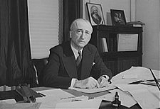
James F. Byrnes

Encyclopedia
James Francis Byrnes was an American statesman from the state of South Carolina
. During his career, Byrnes served as a member of the House of Representatives
(1911–1925), as a Senator
(1931–1941), as Justice of the Supreme Court
(1941–1942), as Secretary of State
(1945–1947), and as the 104th Governor of South Carolina
(1951–1955). He therefore became one of very few politicians to be active in all three branches of the federal government while also being active in state government. He was also a confidant of President Franklin D. Roosevelt
, and was one of the most powerful men in American domestic and foreign policy in the mid-1940s.
, South Carolina. Byrnes' mother was an Irish-American dressmaker; Byrnes' father died shortly after Byrnes was born. At age 14 he left St. Patrick's Catholic School to work in a law office, and became a court stenographer. In 1906 he married Maude Perkins Busch of Aiken, South Carolina
, and became an Episcopalian. Though they had no children, he was the godparent of James Christopher Connor.
Byrnes never attended high school, college or law school, but apprenticed to a lawyer – a not uncommon practice then – and was admitted to the bar in 1903. In 1910 he narrowly won the state's third Congressional District
in the Democratic primary, which was tantamount to election
. Byrnes proved a brilliant legislator, working behind the scenes to form coalitions and avoiding the high-profile oratory that characterized much of Southern politics. He was a champion of the "good roads" movement that attracted motorists, and politicians, to large-scale roadbuilding programs in the 1920s. He became a close ally to President Woodrow Wilson
, and Wilson often entrusted important political tasks to the capable young Congressman, rather than turning to more experienced lawmakers on Capitol Hill. Byrnes was also a protege of "Pitchfork" Ben Tillman, and often had a moderating influence on the fiery segregationist Senator.
, Byrnes lost the 1924 Senate primary to Coleman Blease, often considered a notorious demagogue. Out of office, he moved his law practice to Spartanburg
, in the industrializing Piedmont region. Between his law practice and investment advice from friends such as Bernard Baruch
, Byrnes became a wealthy man, but he never took his eyes off of a return to politics. He used his new base to gain the support of factory workers, and he defeated Blease in 1930.
He had long been friends with Franklin D. Roosevelt
, whom he supported for the Democratic nomination in 1932, and made himself the President's spokesman on the Senate floor, where he guided much of the early New Deal
legislation to passage. He won easy reelection in 1936, promising:
Since the colonial era, South Carolina's politicians had dreamed of an inland waterway system that would not only aid commerce, but also control flooding. By the 1930s, Byrnes took up the cause for a massive dam building project, the Santee Cooper
, that would not only accomplish those tasks, but also electrify the entire state with hydroelectric power. With South Carolina financially strapped by the Great Depression
, Senator Byrnes managed to get the Federal government to authorize a loan for the entire project, which was completed and put into operation in February 1942. The loan was later paid back to the Federal government with full interest and at no cost to the South Carolina taxpayers. Santee Cooper has continued to be a model for public owned electrical utilities world-wide.
In 1937 he supported Roosevelt on the highly controversial court packing plan
, but voted against the minimum wage law of 1938 that would have made, as he argued, the textile mills in his state uncompetitive. He opposed Roosevelt's efforts to purge conservative Democrats in the 1938 primary elections. On foreign policy, however, he was a champion of Roosevelt's positions of helping Great Britain and France against Germany in 1939–41, and of maintaining a hard diplomatic line against Japan.
In part as a reward for his crucial support on many issues, Byrnes was named as an Associate Justice of the Supreme Court by FDR in 1940, a role which quickly bored him at a time when the country was about to go to war. He only served in that position for a year and a half from 1941 to 1942, whereupon he resigned in order to serve Roosevelt in a new, and in many ways unprecedented, capacity.
 Byrnes left the Supreme Court to head Roosevelt's Economic Stabilization Office, which dealt with the vitally important issues of prices and taxes. How powerful the new office would become depended entirely on Byrnes's political skills, and Washington insiders soon reported he was in full charge. In May 1943 he also became head of the Office of War Mobilization
. Thanks to his political experience, his probing intellect, his close friendship with Roosevelt, and in no small part to his own personal charm, Byrnes was soon exerting influence over many facets of the war effort which were not technically under his departmental jurisdiction. Many in Congress and the press began referring to Byrnes as the "Assistant President."
Because of his closeness to President Roosevelt as the "assistant President", it was expected that he would be the next vice-presidential candidate on the Democratic ballot with Franklin Roosevelt in 1944. Indeed, Byrnes was a seriously considered possibility to replace Henry A. Wallace Jr. as vice president in 1944. However, Byrnes was regarded as too conservative for the labor unions, big city bosses vetoed any ex-Catholic (Byrnes, a former Catholic, was regarded as a deserter to the faith of his father), and blacks were wary of his opposition to racial integration
. The nomination went to Senator Harry S. Truman
. Roosevelt brought Byrnes to the Yalta Conference
in early 1945, where he seemed to favor Soviet plans. Written in shorthand, his notes comprise one of the most complete records of the "Big Three" Yalta meetings.
Upon his succession to the presidency after Roosevelt's death on April 12, 1945, Truman relied heavily on Byrnes's counsel, Byrnes having been a mentor to Truman from Truman's earliest days in the U.S. Senate. Indeed, Jimmy Byrnes was one of the first people whom Truman saw on the first day of his presidency. It was Byrnes, who shared information with the new President on the atomic bomb project (Truman had known nothing about the Manhattan Project
beforehand). When Truman met Roosevelt's coffin in Washington, he asked Byrnes and former vice-president Henry A. Wallace
, the two other men who might well have been FDR's successor, to join him at the train station. Truman, originally, intended that both men would play leading roles in his administration, signaling continuity with Roosevelt's policies. While Truman quickly fell out with Wallace, he retained a good working relationship with Byrnes and increasingly turned to him for support.
Truman appointed Byrnes as Secretary of State
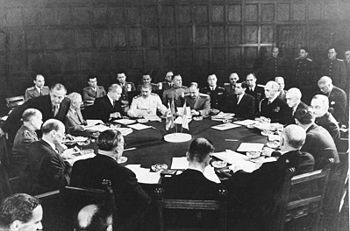
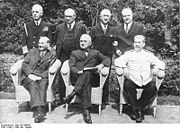
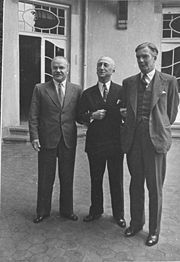
on July 3, 1945. He played a major role at the Potsdam Conference
, the Paris Peace Conference
, and other major postwar conferences. According to historian Robert H. Ferrell, Byrnes knew little more about foreign relations than Truman. He made decisions after consulting a few advisors, such as Donald S. Russell
and Benjamin V. Cohen, and Byrnes and his small group paid little attention to the department and similarly ignored the president.
Although Byrnes's tough position against the Soviets paralleled the feelings of the President, personal relations between the two men grew strained, particularly when Truman felt that Byrnes was attempting to set foreign policy by himself, and only informing the President afterward. An early instance of this friction was the Moscow Conference
in December 1945. Truman considered the “successes” of the conference to be “unreal” and was highly critical of Byrnes’s failure to protect Iran, which was not mentioned in the final communiqué. “I had been left in the dark about the Moscow conference,” Truman told Byrnes bluntly. In a subsequent letter to Byrnes, Truman took a harder line in reference to Iran, saying in part, "Without these supplies furnished by the United States, Russia would have been ignominiously defeated. Yet now Russia stirs up rebellion and keeps troops on the soil of her friend and ally—Iran… Unless Russia is faced with an iron fist and strong language another war is in the making. Only one language do they understand—“how many divisions do you have?” I do not think we should play compromise any longer …I am tired of babying the Soviets". This led to the Iran crisis of 1946, and Byrnes took an increasingly hardline position in opposition to Stalin, culminating in the speech held in Stuttgart
September 6, 1946. "Restatement of Policy on Germany
", also known as the "Speech of hope" it set the tone of future U.S. policy as it repudiated the Morgenthau Plan
economic policies and gave the Germans hope for the future. Byrnes was named TIME Man of the Year. Truman and others believed that Byrnes had grown resentful that he had not been FDR's running mate and Oval Office successor, and in his resentment he was disrespecting Truman. Whether this was true or not, Byrnes felt compelled to resign from the Cabinet in 1947 with some feelings of bitterness.
, serving from 1951 to 1955, in which capacity he vigorously criticized the Supreme Court's decision in Brown v. Board of Education
.
Ironically, Byrnes was initially seen as a strong moderate voice for Negro rights. Recognizing that the South could not continue with its entrenched segregationist policies much longer, but fearful of Congress imposing sweeping civil rights upon the South, he opted for a course of change from within. To that end, he sought to at last fulfill the Supreme Court's promise of "separate but equal," particularly in regard to public education, and he poured state money into improving Negro schools, buying new textbooks and new buses, and hiring additional teachers. He also sought to curb the power of the Ku Klux Klan
by passing a law that prohibited adults from wearing a mask in public on any day other than Halloween
; by this measure, he knew that many Klansmen feared exposure, and would not appear in public in their robes unless their faces were hidden as well. Byrnes hoped to make South Carolina an example for other Southern states to modify their "Jim Crow" policies. That didn't stop the NAACP from filing a suit against South Carolina to force the state to desegregate its schools. Byrnes turned to Kansas
, a Northern state which also segregated its schools, to provide a "friend of the court" statement supporting the right of school segregation on his state's behalf in the trial. This gave the NAACP's lawyer, Thurgood Marshall
, the idea to shift the suit from South Carolina over to Kansas, which led directly to Brown v. Board of Education
.
The South Carolina state constitution limited governors to one four-year term, and Byrnes retired from active political life following the 1954 election.
" for granted at election time, yet otherwise ignored the region and its needs), and to realign it with the Republican Party. This was despite the fact that Byrnes remained a Democrat for much of the rest of his life.
Byrnes endorsed Dwight D. Eisenhower
in 1952 and 1956, Richard Nixon
in 1960 and 1968 and Barry Goldwater
in 1964. He gave his private blessing to South Carolina Senator Strom Thurmond
to bolt the Democratic Party in '64 and declare himself a Republican, but Byrnes himself remained a Democrat that year. He eventually switched formal allegiances to the Republican Party. In 1968, he secretly advised Nixon on how to win over old-time Southern Democrats to the Republican Party.
He is interred in the churchyard at Trinity Episcopal Church in Columbia, South Carolina.
in Columbia
, South Carolina, and former U.S. ambassador to South Korea
, Richard L. Walker
, was the James F. Byrnes Professor Emeritus of International Studies there. An auditorium is named after him at Winthrop University
in Rock Hill
, South Carolina. A dormitory on the east campus of Clemson University
in Clemson
, South Carolina is named for him and he was on the board of trustees there. A high school in Duncan, South Carolina
, James F. Byrnes High School
, is also named after him, as well as a school in Quinby, South Carolina
, called James F. Byrnes Academy (renamed The Byrnes Schools around 2000). In 1948, Byrnes and his wife established The James F. Byrnes Foundation Scholarships and since then more than 1,000 young South Carolinians have been assisted in obtaining a college education. His papers are in the Special Collections of the Clemson University Libraries
.
South Carolina
South Carolina is a state in the Deep South of the United States that borders Georgia to the south, North Carolina to the north, and the Atlantic Ocean to the east. Originally part of the Province of Carolina, the Province of South Carolina was one of the 13 colonies that declared independence...
. During his career, Byrnes served as a member of the House of Representatives
United States House of Representatives
The United States House of Representatives is one of the two Houses of the United States Congress, the bicameral legislature which also includes the Senate.The composition and powers of the House are established in Article One of the Constitution...
(1911–1925), as a Senator
United States Senate
The United States Senate is the upper house of the bicameral legislature of the United States, and together with the United States House of Representatives comprises the United States Congress. The composition and powers of the Senate are established in Article One of the U.S. Constitution. Each...
(1931–1941), as Justice of the Supreme Court
Supreme Court of the United States
The Supreme Court of the United States is the highest court in the United States. It has ultimate appellate jurisdiction over all state and federal courts, and original jurisdiction over a small range of cases...
(1941–1942), as Secretary of State
United States Secretary of State
The United States Secretary of State is the head of the United States Department of State, concerned with foreign affairs. The Secretary is a member of the Cabinet and the highest-ranking cabinet secretary both in line of succession and order of precedence...
(1945–1947), and as the 104th Governor of South Carolina
Governor of South Carolina
The Governor of the State of South Carolina is the head of state for the State of South Carolina. Under the South Carolina Constitution, the Governor is also the head of government, serving as the chief executive of the South Carolina executive branch. The Governor is the ex officio...
(1951–1955). He therefore became one of very few politicians to be active in all three branches of the federal government while also being active in state government. He was also a confidant of President Franklin D. Roosevelt
Franklin D. Roosevelt
Franklin Delano Roosevelt , also known by his initials, FDR, was the 32nd President of the United States and a central figure in world events during the mid-20th century, leading the United States during a time of worldwide economic crisis and world war...
, and was one of the most powerful men in American domestic and foreign policy in the mid-1940s.
Early life and Career
James Francis Byrnes was born and raised in CharlestonCharleston, South Carolina
Charleston is the second largest city in the U.S. state of South Carolina. It was made the county seat of Charleston County in 1901 when Charleston County was founded. The city's original name was Charles Towne in 1670, and it moved to its present location from a location on the west bank of the...
, South Carolina. Byrnes' mother was an Irish-American dressmaker; Byrnes' father died shortly after Byrnes was born. At age 14 he left St. Patrick's Catholic School to work in a law office, and became a court stenographer. In 1906 he married Maude Perkins Busch of Aiken, South Carolina
Aiken, South Carolina
Aiken is a city in and the county seat of Aiken County, South Carolina, United States. With Augusta, Georgia, it is one of the two largest cities of the Central Savannah River Area. It is part of the Augusta-Richmond County Metropolitan Statistical Area. Aiken is home to the University of South...
, and became an Episcopalian. Though they had no children, he was the godparent of James Christopher Connor.
Byrnes never attended high school, college or law school, but apprenticed to a lawyer – a not uncommon practice then – and was admitted to the bar in 1903. In 1910 he narrowly won the state's third Congressional District
South Carolina's 3rd congressional district
The 3rd Congressional District of South Carolina is a congressional district in western South Carolina bordering both Georgia and North Carolina. It includes all of Abbeville, Anderson, Edgefield, Greenwood, Laurens, McCormick, Oconee, Pickens and Saluda counties and approximately half of Aiken...
in the Democratic primary, which was tantamount to election
Tantamount to election
"Tantamount to election" is a phrase to describe a situation in which one political party so dominates the demographics of a voting district, that the person winning the party nomination for a race will virtually be assured of winning the general election...
. Byrnes proved a brilliant legislator, working behind the scenes to form coalitions and avoiding the high-profile oratory that characterized much of Southern politics. He was a champion of the "good roads" movement that attracted motorists, and politicians, to large-scale roadbuilding programs in the 1920s. He became a close ally to President Woodrow Wilson
Woodrow Wilson
Thomas Woodrow Wilson was the 28th President of the United States, from 1913 to 1921. A leader of the Progressive Movement, he served as President of Princeton University from 1902 to 1910, and then as the Governor of New Jersey from 1911 to 1913...
, and Wilson often entrusted important political tasks to the capable young Congressman, rather than turning to more experienced lawmakers on Capitol Hill. Byrnes was also a protege of "Pitchfork" Ben Tillman, and often had a moderating influence on the fiery segregationist Senator.
United States Senate and Supreme Court
Thanks largely to the opposition of his candidacy by the Ku Klux KlanKu Klux Klan
Ku Klux Klan, often abbreviated KKK and informally known as the Klan, is the name of three distinct past and present far-right organizations in the United States, which have advocated extremist reactionary currents such as white supremacy, white nationalism, and anti-immigration, historically...
, Byrnes lost the 1924 Senate primary to Coleman Blease, often considered a notorious demagogue. Out of office, he moved his law practice to Spartanburg
Spartanburg, South Carolina
thgSpartanburg is the largest city in and the county seat of Spartanburg County, South Carolina, United States. It is the second-largest city of the three primary cities in the Upstate region of South Carolina, and is located northwest of Columbia, west of Charlotte, and about northeast of...
, in the industrializing Piedmont region. Between his law practice and investment advice from friends such as Bernard Baruch
Bernard Baruch
Bernard Mannes Baruch was an American financier, stock-market speculator, statesman, and political consultant. After his success in business, he devoted his time toward advising U.S. Presidents Woodrow Wilson and Franklin D. Roosevelt on economic matters and became a philanthropist.-Early life...
, Byrnes became a wealthy man, but he never took his eyes off of a return to politics. He used his new base to gain the support of factory workers, and he defeated Blease in 1930.
He had long been friends with Franklin D. Roosevelt
Franklin D. Roosevelt
Franklin Delano Roosevelt , also known by his initials, FDR, was the 32nd President of the United States and a central figure in world events during the mid-20th century, leading the United States during a time of worldwide economic crisis and world war...
, whom he supported for the Democratic nomination in 1932, and made himself the President's spokesman on the Senate floor, where he guided much of the early New Deal
New Deal
The New Deal was a series of economic programs implemented in the United States between 1933 and 1936. They were passed by the U.S. Congress during the first term of President Franklin D. Roosevelt. The programs were Roosevelt's responses to the Great Depression, and focused on what historians call...
legislation to passage. He won easy reelection in 1936, promising:
"I admit I am a New Dealer, and if [the New Deal] takes money from the few who have controlled the country and gives it back to the average man, I am going to Washington to help the President work for the people of South Carolina and the country."
Since the colonial era, South Carolina's politicians had dreamed of an inland waterway system that would not only aid commerce, but also control flooding. By the 1930s, Byrnes took up the cause for a massive dam building project, the Santee Cooper
Santee Cooper
Santee Cooper, also known officially from the 1930s as the South Carolina Public Service Authority, is South Carolina's state-owned electric and water utility that came into being during the New Deal as both a rural electrification and public works project that created two lakes and cleared large...
, that would not only accomplish those tasks, but also electrify the entire state with hydroelectric power. With South Carolina financially strapped by the Great Depression
Great Depression
The Great Depression was a severe worldwide economic depression in the decade preceding World War II. The timing of the Great Depression varied across nations, but in most countries it started in about 1929 and lasted until the late 1930s or early 1940s...
, Senator Byrnes managed to get the Federal government to authorize a loan for the entire project, which was completed and put into operation in February 1942. The loan was later paid back to the Federal government with full interest and at no cost to the South Carolina taxpayers. Santee Cooper has continued to be a model for public owned electrical utilities world-wide.
In 1937 he supported Roosevelt on the highly controversial court packing plan
Judiciary Reorganization Bill of 1937
The Judicial Procedures Reform Bill of 1937, frequently called the court-packing plan, was a legislative initiative proposed by U.S. President Franklin Roosevelt to add more justices to the U.S. Supreme Court. Roosevelt's purpose was to obtain favorable rulings regarding New Deal legislation that...
, but voted against the minimum wage law of 1938 that would have made, as he argued, the textile mills in his state uncompetitive. He opposed Roosevelt's efforts to purge conservative Democrats in the 1938 primary elections. On foreign policy, however, he was a champion of Roosevelt's positions of helping Great Britain and France against Germany in 1939–41, and of maintaining a hard diplomatic line against Japan.
In part as a reward for his crucial support on many issues, Byrnes was named as an Associate Justice of the Supreme Court by FDR in 1940, a role which quickly bored him at a time when the country was about to go to war. He only served in that position for a year and a half from 1941 to 1942, whereupon he resigned in order to serve Roosevelt in a new, and in many ways unprecedented, capacity.
World War II and beginning of the Cold War
Office of War Mobilization
The Office of War Mobilization was an independent agency of the United States government headed by Former Supreme Court Justice James F. Byrnes that coordinated all government agencies involved in the war effort during World War II...
. Thanks to his political experience, his probing intellect, his close friendship with Roosevelt, and in no small part to his own personal charm, Byrnes was soon exerting influence over many facets of the war effort which were not technically under his departmental jurisdiction. Many in Congress and the press began referring to Byrnes as the "Assistant President."
Because of his closeness to President Roosevelt as the "assistant President", it was expected that he would be the next vice-presidential candidate on the Democratic ballot with Franklin Roosevelt in 1944. Indeed, Byrnes was a seriously considered possibility to replace Henry A. Wallace Jr. as vice president in 1944. However, Byrnes was regarded as too conservative for the labor unions, big city bosses vetoed any ex-Catholic (Byrnes, a former Catholic, was regarded as a deserter to the faith of his father), and blacks were wary of his opposition to racial integration
Racial integration
Racial integration, or simply integration includes desegregation . In addition to desegregation, integration includes goals such as leveling barriers to association, creating equal opportunity regardless of race, and the development of a culture that draws on diverse traditions, rather than merely...
. The nomination went to Senator Harry S. Truman
Harry S. Truman
Harry S. Truman was the 33rd President of the United States . As President Franklin D. Roosevelt's third vice president and the 34th Vice President of the United States , he succeeded to the presidency on April 12, 1945, when President Roosevelt died less than three months after beginning his...
. Roosevelt brought Byrnes to the Yalta Conference
Yalta Conference
The Yalta Conference, sometimes called the Crimea Conference and codenamed the Argonaut Conference, held February 4–11, 1945, was the wartime meeting of the heads of government of the United States, the United Kingdom, and the Soviet Union, represented by President Franklin D...
in early 1945, where he seemed to favor Soviet plans. Written in shorthand, his notes comprise one of the most complete records of the "Big Three" Yalta meetings.
Upon his succession to the presidency after Roosevelt's death on April 12, 1945, Truman relied heavily on Byrnes's counsel, Byrnes having been a mentor to Truman from Truman's earliest days in the U.S. Senate. Indeed, Jimmy Byrnes was one of the first people whom Truman saw on the first day of his presidency. It was Byrnes, who shared information with the new President on the atomic bomb project (Truman had known nothing about the Manhattan Project
Manhattan Project
The Manhattan Project was a research and development program, led by the United States with participation from the United Kingdom and Canada, that produced the first atomic bomb during World War II. From 1942 to 1946, the project was under the direction of Major General Leslie Groves of the US Army...
beforehand). When Truman met Roosevelt's coffin in Washington, he asked Byrnes and former vice-president Henry A. Wallace
Henry A. Wallace
Henry Agard Wallace was the 33rd Vice President of the United States , the Secretary of Agriculture , and the Secretary of Commerce . In the 1948 presidential election, Wallace was the nominee of the Progressive Party.-Early life:Henry A...
, the two other men who might well have been FDR's successor, to join him at the train station. Truman, originally, intended that both men would play leading roles in his administration, signaling continuity with Roosevelt's policies. While Truman quickly fell out with Wallace, he retained a good working relationship with Byrnes and increasingly turned to him for support.
Truman appointed Byrnes as Secretary of State
United States Secretary of State
The United States Secretary of State is the head of the United States Department of State, concerned with foreign affairs. The Secretary is a member of the Cabinet and the highest-ranking cabinet secretary both in line of succession and order of precedence...
on July 3, 1945. He played a major role at the Potsdam Conference
Potsdam Conference
The Potsdam Conference was held at Cecilienhof, the home of Crown Prince Wilhelm Hohenzollern, in Potsdam, occupied Germany, from 16 July to 2 August 1945. Participants were the Soviet Union, the United Kingdom, and the United States...
, the Paris Peace Conference
Paris Peace Treaties, 1947
The Paris Peace Conference resulted in the Paris Peace Treaties signed on February 10, 1947. The victorious wartime Allied powers negotiated the details of treaties with Italy, Romania, Hungary, Bulgaria, and Finland .The...
, and other major postwar conferences. According to historian Robert H. Ferrell, Byrnes knew little more about foreign relations than Truman. He made decisions after consulting a few advisors, such as Donald S. Russell
Donald S. Russell
Donald Stuart Russell was a Democratic Senator from South Carolina. He served from 1965 to 1966. He also served as the 107th Governor of South Carolina, 1963-1965. Russell was a protege of former Secretary of State James F. Byrnes and served as Assistant Secretary of State for Administration...
and Benjamin V. Cohen, and Byrnes and his small group paid little attention to the department and similarly ignored the president.
Although Byrnes's tough position against the Soviets paralleled the feelings of the President, personal relations between the two men grew strained, particularly when Truman felt that Byrnes was attempting to set foreign policy by himself, and only informing the President afterward. An early instance of this friction was the Moscow Conference
Moscow Conference (1945)
The Moscow Conference of Foreign Ministers of the United States , the United Kingdom , and the Soviet Union met in December 1945 to discuss the problems of occupation, establishing peace, and other Far East issues.The Communique issued after the Conference on December 27,...
in December 1945. Truman considered the “successes” of the conference to be “unreal” and was highly critical of Byrnes’s failure to protect Iran, which was not mentioned in the final communiqué. “I had been left in the dark about the Moscow conference,” Truman told Byrnes bluntly. In a subsequent letter to Byrnes, Truman took a harder line in reference to Iran, saying in part, "Without these supplies furnished by the United States, Russia would have been ignominiously defeated. Yet now Russia stirs up rebellion and keeps troops on the soil of her friend and ally—Iran… Unless Russia is faced with an iron fist and strong language another war is in the making. Only one language do they understand—“how many divisions do you have?” I do not think we should play compromise any longer …I am tired of babying the Soviets". This led to the Iran crisis of 1946, and Byrnes took an increasingly hardline position in opposition to Stalin, culminating in the speech held in Stuttgart
Stuttgart
Stuttgart is the capital of the state of Baden-Württemberg in southern Germany. The sixth-largest city in Germany, Stuttgart has a population of 600,038 while the metropolitan area has a population of 5.3 million ....
September 6, 1946. "Restatement of Policy on Germany
Restatement of Policy on Germany
"Restatement of Policy on Germany" is a famous speech by James F. Byrnes, the United States Secretary of State, held in Stuttgart on September 6, 1946.Also known as the "Speech of hope" it set the tone of future U.S...
", also known as the "Speech of hope" it set the tone of future U.S. policy as it repudiated the Morgenthau Plan
Morgenthau Plan
The Morgenthau Plan, proposed by United States Secretary of the Treasury Henry Morgenthau, Jr., advocated that the Allied occupation of Germany following World War II include measures to eliminate Germany's ability to wage war.-Overview:...
economic policies and gave the Germans hope for the future. Byrnes was named TIME Man of the Year. Truman and others believed that Byrnes had grown resentful that he had not been FDR's running mate and Oval Office successor, and in his resentment he was disrespecting Truman. Whether this was true or not, Byrnes felt compelled to resign from the Cabinet in 1947 with some feelings of bitterness.
Governor of South Carolina
At an age when most of his contemporaries were retiring from political life, Byrnes was not yet ready to give up public service, and at age 68 he was elected governor of South CarolinaSouth Carolina
South Carolina is a state in the Deep South of the United States that borders Georgia to the south, North Carolina to the north, and the Atlantic Ocean to the east. Originally part of the Province of Carolina, the Province of South Carolina was one of the 13 colonies that declared independence...
, serving from 1951 to 1955, in which capacity he vigorously criticized the Supreme Court's decision in Brown v. Board of Education
Brown v. Board of Education
Brown v. Board of Education of Topeka, 347 U.S. 483 , was a landmark decision of the United States Supreme Court that declared state laws establishing separate public schools for black and white students unconstitutional. The decision overturned the Plessy v. Ferguson decision of 1896 which...
.
Ironically, Byrnes was initially seen as a strong moderate voice for Negro rights. Recognizing that the South could not continue with its entrenched segregationist policies much longer, but fearful of Congress imposing sweeping civil rights upon the South, he opted for a course of change from within. To that end, he sought to at last fulfill the Supreme Court's promise of "separate but equal," particularly in regard to public education, and he poured state money into improving Negro schools, buying new textbooks and new buses, and hiring additional teachers. He also sought to curb the power of the Ku Klux Klan
Ku Klux Klan
Ku Klux Klan, often abbreviated KKK and informally known as the Klan, is the name of three distinct past and present far-right organizations in the United States, which have advocated extremist reactionary currents such as white supremacy, white nationalism, and anti-immigration, historically...
by passing a law that prohibited adults from wearing a mask in public on any day other than Halloween
Halloween
Hallowe'en , also known as Halloween or All Hallows' Eve, is a yearly holiday observed around the world on October 31, the night before All Saints' Day...
; by this measure, he knew that many Klansmen feared exposure, and would not appear in public in their robes unless their faces were hidden as well. Byrnes hoped to make South Carolina an example for other Southern states to modify their "Jim Crow" policies. That didn't stop the NAACP from filing a suit against South Carolina to force the state to desegregate its schools. Byrnes turned to Kansas
Kansas
Kansas is a US state located in the Midwestern United States. It is named after the Kansas River which flows through it, which in turn was named after the Kansa Native American tribe, which inhabited the area. The tribe's name is often said to mean "people of the wind" or "people of the south...
, a Northern state which also segregated its schools, to provide a "friend of the court" statement supporting the right of school segregation on his state's behalf in the trial. This gave the NAACP's lawyer, Thurgood Marshall
Thurgood Marshall
Thurgood Marshall was an Associate Justice of the United States Supreme Court, serving from October 1967 until October 1991...
, the idea to shift the suit from South Carolina over to Kansas, which led directly to Brown v. Board of Education
Brown v. Board of Education
Brown v. Board of Education of Topeka, 347 U.S. 483 , was a landmark decision of the United States Supreme Court that declared state laws establishing separate public schools for black and white students unconstitutional. The decision overturned the Plessy v. Ferguson decision of 1896 which...
.
The South Carolina state constitution limited governors to one four-year term, and Byrnes retired from active political life following the 1954 election.
Later political career
In his later years, Byrnes foresaw the South as a much more important player in national politics, and to hasten that development, he sought to end the South's automatic support of the Democratic Party (which Byrnes felt had grown too liberal, and which took the "Solid SouthSolid South
Solid South is the electoral support of the Southern United States for the Democratic Party candidates for nearly a century from 1877, the end of Reconstruction, to 1964, during the middle of the Civil Rights era....
" for granted at election time, yet otherwise ignored the region and its needs), and to realign it with the Republican Party. This was despite the fact that Byrnes remained a Democrat for much of the rest of his life.
Byrnes endorsed Dwight D. Eisenhower
Dwight D. Eisenhower
Dwight David "Ike" Eisenhower was the 34th President of the United States, from 1953 until 1961. He was a five-star general in the United States Army...
in 1952 and 1956, Richard Nixon
Richard Nixon
Richard Milhous Nixon was the 37th President of the United States, serving from 1969 to 1974. The only president to resign the office, Nixon had previously served as a US representative and senator from California and as the 36th Vice President of the United States from 1953 to 1961 under...
in 1960 and 1968 and Barry Goldwater
Barry Goldwater
Barry Morris Goldwater was a five-term United States Senator from Arizona and the Republican Party's nominee for President in the 1964 election. An articulate and charismatic figure during the first half of the 1960s, he was known as "Mr...
in 1964. He gave his private blessing to South Carolina Senator Strom Thurmond
Strom Thurmond
James Strom Thurmond was an American politician who served as a United States Senator. He also ran for the Presidency of the United States in 1948 as the segregationist States Rights Democratic Party candidate, receiving 2.4% of the popular vote and 39 electoral votes...
to bolt the Democratic Party in '64 and declare himself a Republican, but Byrnes himself remained a Democrat that year. He eventually switched formal allegiances to the Republican Party. In 1968, he secretly advised Nixon on how to win over old-time Southern Democrats to the Republican Party.
He is interred in the churchyard at Trinity Episcopal Church in Columbia, South Carolina.
Legacy
Today, a building housing international programs is named after Byrnes at the University of South CarolinaUniversity of South Carolina
The University of South Carolina is a public, co-educational research university located in Columbia, South Carolina, United States, with 7 surrounding satellite campuses. Its historic campus covers over in downtown Columbia not far from the South Carolina State House...
in Columbia
Columbia, South Carolina
Columbia is the state capital and largest city in the U.S. state of South Carolina. The population was 129,272 according to the 2010 census. Columbia is the county seat of Richland County, but a portion of the city extends into neighboring Lexington County. The city is the center of a metropolitan...
, South Carolina, and former U.S. ambassador to South Korea
South Korea
The Republic of Korea , , is a sovereign state in East Asia, located on the southern portion of the Korean Peninsula. It is neighbored by the People's Republic of China to the west, Japan to the east, North Korea to the north, and the East China Sea and Republic of China to the south...
, Richard L. Walker
Richard L. Walker
Richard Louis "Dixie" Walker was an American scholar, author, and ambassador to South Korea. He was married to the late Celeno Kenly Walker for 45 years and had three children. His Chinese name was 吳克 and in Korean was transliterated as 리처드 워커 .Walker was born in Bellefonte, Pennsylvania. He...
, was the James F. Byrnes Professor Emeritus of International Studies there. An auditorium is named after him at Winthrop University
Winthrop University
Winthrop University is a public, four-year liberal arts university in Rock Hill, South Carolina, USA. In 2006-07, Winthrop University had an enrollment of 6,292 students. The University has been recognized as South Carolina's top-rated university according to evaluations conducted by the South...
in Rock Hill
Rock Hill, South Carolina
Rock Hill is the largest city in York County, South Carolina and the fourth-largest city in the state. It is also the third-largest city of the Charlotte metropolitan area, behind Charlotte and Concord, North Carolina. The population was 71,459 as of . Rock Hill has undergone rapid growth between...
, South Carolina. A dormitory on the east campus of Clemson University
Clemson University
Clemson University is an American public, coeducational, land-grant, sea-grant, research university located in Clemson, South Carolina, United States....
in Clemson
Clemson, South Carolina
Clemson is a college town located in Pickens County in the U.S. state of South Carolina. The population was 11,939 at the 2000 census and center of an urban cluster with a total population of 42,199...
, South Carolina is named for him and he was on the board of trustees there. A high school in Duncan, South Carolina
Duncan, South Carolina
Duncan is a town in Spartanburg County, South Carolina, United States. The population was 3,181 at the 2010 census.-Geography:Duncan is located at ....
, James F. Byrnes High School
James F. Byrnes High School
James F. Byrnes High School is located in Duncan, South Carolina. The school has 2289 students enrolled as of the 2008–2009 school year. It is the only high school in Spartanburg District 5. The James F. Byrnes Freshman Academy is located at the former D. R. Hill Middle School. Currently, there are...
, is also named after him, as well as a school in Quinby, South Carolina
Quinby, South Carolina
Quinby is a town in Florence County, South Carolina, United States. The population was 842 at the 2000 census. It is part of the Florence Metropolitan Statistical Area.-Geography:Quinby is located at ....
, called James F. Byrnes Academy (renamed The Byrnes Schools around 2000). In 1948, Byrnes and his wife established The James F. Byrnes Foundation Scholarships and since then more than 1,000 young South Carolinians have been assisted in obtaining a college education. His papers are in the Special Collections of the Clemson University Libraries
Clemson University
Clemson University is an American public, coeducational, land-grant, sea-grant, research university located in Clemson, South Carolina, United States....
.
See also
- Demographics of the Supreme Court of the United StatesDemographics of the Supreme Court of the United StatesThe demographics of the Supreme Court of the United States encompass the gender, ethnic, religious, geographic, and economic backgrounds of the 112 justices appointed to the Supreme Court. Certain of these characteristics have been raised as an issue since the Court was established in 1789. For its...
- List of Justices of the Supreme Court of the United States by court composition
- List of Justices of the Supreme Court of the United States by education
- List of Justices of the Supreme Court of the United States by time in office
- List of law clerks of the Supreme Court of the United States
- List of United States Chief Justices by time in office
- United States Supreme Court cases during the Stone Court
Primary sources
- Byrnes, James. Speaking Frankly (1947)
- Byrnes, James. All in One Lifetime (1958).
Further reading
- Abraham, Henry J., Justices and Presidents: A Political History of Appointments to the Supreme Court. 3d. ed. (New York: Oxford University PressOxford University PressOxford University Press is the largest university press in the world. It is a department of the University of Oxford and is governed by a group of 15 academics appointed by the Vice-Chancellor known as the Delegates of the Press. They are headed by the Secretary to the Delegates, who serves as...
, 1992). ISBN 0-19-506557-3. - Cushman, Clare, The Supreme Court Justices: Illustrated Biographies,1789–1995 (2nd ed.) (Supreme Court Historical Society), (Congressional QuarterlyCongressional QuarterlyCongressional Quarterly, Inc., or CQ, is a privately owned publishing company that produces a number of publications reporting primarily on the United States Congress...
Books, 2001) ISBN 1568021267; ISBN 9781568021263. - Frank, John P., The Justices of the United States Supreme Court: Their Lives and Major Opinions (Leon Friedman and Fred L. Israel, editors) (Chelsea House Publishers: 1995) ISBN 0791013774, ISBN 978-0791013779.
- Martin, Fenton S. and Goehlert, Robert U., The U.S. Supreme Court: A Bibliography, (Congressional Quarterly Books, 1990). ISBN 0871875543.
- Urofsky, Melvin I., The Supreme Court Justices: A Biographical Dictionary (New York: Garland Publishing 1994). 590 pp. ISBN 0815311761; ISBN 978-0815311768.
External links
- Excerpts from Speaking Frankly on the subjects of: (Yalta Conference), (Potsdam Conference) ("Flash Player" is required)
- James Francis Byrnes and U.S. Policy towards Germany 1945–1947 Deutsch-Amerikanische Zentrum / James-F.-Byrnes-Institut e.V
- Text of the famous "Stuttgart speech", September 6, 1946 The speech marked the change in U.S. occupation policy in Germany towards reconstruction.
- Time Magazine, September 16, 1946. "Journey to Stuttgart"
- SCIway Biography of James Francis Byrnes
- NGA Biography of James Francis Byrnes
- James F. Byrnes at Find-A-Grave