

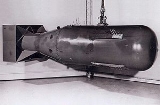
Little Boy

Encyclopedia
"Little Boy" was the codename of the atomic bomb dropped on Hiroshima on August 6, 1945 by the Boeing B-29 Superfortress
Enola Gay
, piloted by Colonel
Paul Tibbets
of the 393rd Bombardment Squadron, Heavy, of the United States Army Air Forces
. It was the first atomic bomb to be used as a weapon. The second, the "Fat Man
", was dropped three days later on Nagasaki.
The weapon was developed by the Manhattan Project
during World War II
. It derived its explosive power from the nuclear fission
of uranium 235. The Hiroshima bombing
was the second artificial nuclear explosion
in history, after the Trinity test, and the first uranium
-based detonation. Approximately 600 to 860 milligrams of matter
in the bomb was converted into the active energy of heat and radiation (see mass-energy equivalence
for detail). It exploded with an energy between 13 ktonTNT (estimates vary). It has been estimated that 130,000 to 150,000 persons had died by the end of December 1945. Its design was not tested in advance, unlike the more complex plutonium bomb (Fat Man
). The available supply of enriched uranium
was very small at that time, and it was felt that the simple design of a uranium "gun" type bomb was so sure to work that there was no need to test it at full scale.
, a former student of Los Alamos director Robert Oppenheimer
who worked on the project, according to Serber. According to his later memoirs, he chose them based on their design shapes; the "Thin Man" would be a very long device, and the name came from the Dashiell Hammett
detective novel
and series of movies
by the same name; the "Fat Man" bomb would be round and fat and was named after Sidney Greenstreet's "Kasper Gutman" character in The Maltese Falcon
. "Little Boy" would come last and be named only to contrast to the "Thin Man" bomb. The original "Thin Man" had been expected to be as long as 17 feet, but when it was discovered that U-235 would require a slower projectile speed than first measurements had indicated, it was realized that the gun-design could be shortened to 6 feet, and this design was named "Little Boy" in contrast. However, in his memoirs, Paul Tibbets
, commander of the 509th Composite Group
said the code names were part of an Air Force cover story. According to Tibbets, Project Silverplate
, the Air Force program to modify the B-29 to carry atomic bombs, was given the cover story of existing to modify the B-29 into a passenger plane. One plane was allegedly for the use of Winston Churchill, 'the fat man', and the other for Franklin Roosevelt, 'the thin man.'
An extremely large six-ton conventional-explosive bomb developed by the British, operational in mid-1944, had been named the Tallboy, at a length of 21 ft (6.35m).
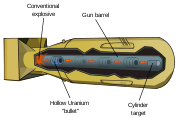 The Mk I "Little Boy" was 120 inches (304.8 cm) in length, 28 inches (71.1 cm) in diameter and weighed approximately 9700 pounds (4,399.8 kg). The design used the gun method to explosively force a hollow sub-critical mass of uranium
-235 and a solid target cylinder together into a super-critical mass, initiating a nuclear chain reaction
. This was accomplished by shooting one piece of the uranium onto the other by means of chemical explosives. It contained 64 kg (141.1 lb) of uranium, of which less than a kilogram underwent nuclear fission
, and of this mass only 0.6 g (0.0211643772630672 oz) was transformed into energy.
No full test of a gun-type nuclear weapon had occurred before the "Little Boy" device was dropped over Hiroshima
. The only test explosion
of a nuclear weapon had been of an implosion-type weapon using plutonium
as its fissionable material, on July 16, 1945 at the Trinity test
. There were several reasons for not testing the "Little Boy" device. Primarily, there was little uranium-235 compared with the relatively large amount of plutonium which, it was expected, could be produced by the Hanford
reactors. Additionally, the weapon design was simple enough that it was only deemed necessary to do laboratory tests with the gun-type assembly (known during the war as "tickling the dragon's tail"). Unlike the implosion design, which required sophisticated coordination of shaped explosive charges, the gun-type design was considered almost certain to work.
Although occasionally used in later experimental devices, the design was only used once as a weapon because of the danger of accidental detonation. Little Boy's design was unsafe when compared to modern nuclear weapons, which incorporate safety features to endure various accident scenarios. The main objective of Little Boy was to create a weapon that was absolutely guaranteed to work. Consequently, Little Boy incorporated only basic safety mechanisms, thus an accidental detonation could easily occur during one or more of the following scenarios:
because they could still be used to create a viable nuclear weapon. Even so, many sources have speculated as to the design, relying on limited photographic evidence, interviews with former Manhattan Project personnel, and piecing together information from declassified sources to reconstruct its internal dimensions.
According to the website Nuclear Weapon Archive, inside the weapon, the uranium-235 material was divided into two parts, following the gun principle: the "projectile" and the "target". The projectile was a hollow cylinder with 60% of the total mass (38.5 kg (84.9 lb)). It consisted of a stack of 9 uranium rings, each 6.25 inches (158.8 mm) with a 4 inches (101.6 mm) hole in the center and a total length of 7 inches (177.8 mm), pressed together into the front end of a thin-walled projectile 16.25 inches (412.8 mm) long. Filling in the remainder of the space behind these rings in the projectile was a tungsten carbide disc and a steel back. At detonation, the projectile was pushed 42 inches (1,066.8 mm) down a 72 inches (1,828.8 mm), 6.5 inches (165.1 mm) smooth-bore gun barrel. The target "insert" was a 4 inches (101.6 mm) cylinder, 7 inches (177.8 mm) long with a 1 inches (25.4 mm) hole in the center comprising 40% of the total mass (25.6 kg (56.4 lb)). This insert was composed of a stack of 6 washer-like uranium discs somewhat thicker than the projectile rings that were slid over a 1 inches (25.4 mm) rod. This rod then extended forward through the tungsten carbide tamper plug, impact absorbing anvil, and nose plug backstop eventually protruding out the front of the bomb casing. This entire target assembly was secured at both ends with locknuts.
When the hollow-front projectile reached the target and slid over the target insert, the assembled super-critical mass of uranium would be completely surrounded by a tamper and neutron reflector of tungsten carbide and steel, both materials having a combined mass of 2300 kg (5,070.6 lb). Neutron generators at the base of the projectile would be activated by the impact.
The "L-11" combat Little Boy and the assembled projectile containing the U-235 rings were delivered to Tinian
Island on July 26, 1945, by the USS Indianapolis
. The six target rings arrived July 28 and 29 on three aircraft.
Because the Enola Gay weaponeer "Deak" Parsons
was concerned about the possibility of an accidental detonation he did not load the four cordite
powder bags into the gun breech until the aircraft was in flight on the mission. Before climbing to high altitude close to the target Parsons' assistant Morris R. Jeppson
removed three safety plugs from the electrical connection between the internal battery and the firing mechanism.
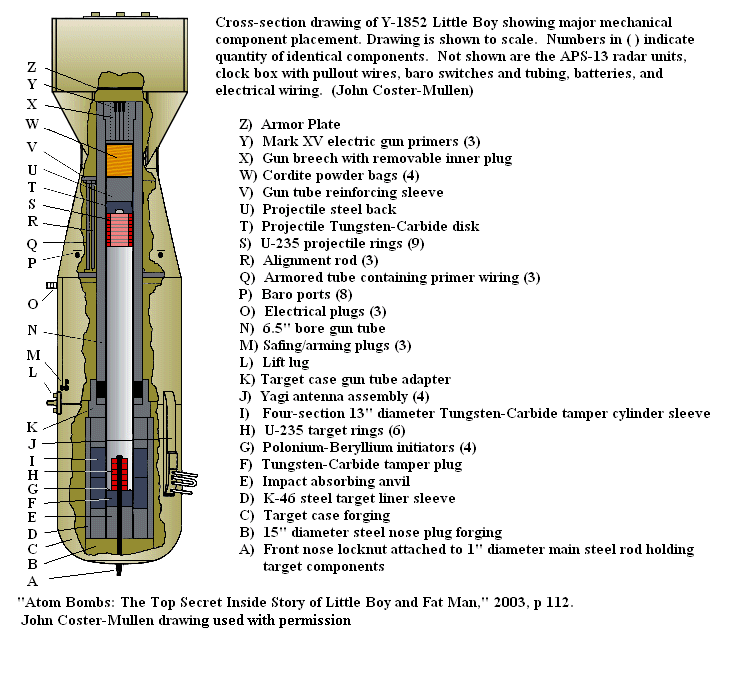
. To avoid criticality by means of shape, a hole in the center dispersed the mass and increased the surface area, allowing more fission neutrons to escape, preventing further fission and a chain reaction.
It was also important for the larger piece to have minimal contact with the neutron-reflecting tungsten carbide tamper until detonation. Thus only the projectile's back end was in contact with tungsten carbide (see drawing above). The rest of the tungsten carbide surrounded the target cylinder (called the "insert" by designers) with air space between it and the insert. This arrangement packs the maximum amount of fissile material into a gun-assembly design.
Comparing this yield to the observed damage produced a rule of thumb called the 5 psi
lethal area rule. The number of immediate fatalities will approximately equal the number of people inside the lethal area.
The damage came from three main effects: blast, fire, and radiation.
-heated air (the fireball) sending a shock/pressure wave in all directions at a velocity greater than the speed of sound (aka, the "Mach-Stem"), analogous to thunder generated by lightning. Most knowledge about nuclear weapon urban blast destruction originates from studies of Little Boy at Hiroshima. Data from the explosion at Nagasaki offers less insight, since hilly terrain deflected the blast and generated a more complicated pattern of destruction.
 At Hiroshima, severe structural damage to buildings extended about 1 miles (1.6 km) in radius from ground zero
, making a circle of destruction 2 miles (3.2 km) in diameter. The blast sent out a hyper-intensified shock wave
which travelled at (slightly above) the speed of sound
, turning buildings into shrapnel
. There was little or no structural damage outside of this one-mile (1.6 km) radius. At one mile (1.6 km), the force of the blast wave was 5 psi, with enough duration to implode houses and reduce them to kindling.
Later test explosions of nuclear weapons with houses and other test structures nearby confirmed that 5 psi (34,473.8 Pa) is an important threshold. Ordinary urban buildings experiencing it will be crushed, toppled, or gutted by the force of air pressure. The picture at right shows the effects of a nuclear-bomb-generated 5 psi pressure wave on a test structure in Nevada in 1953.
The most important effect of this kind of structural damage was that it created fuel for a firestorm
. For this reason, the 5 psi contour defines the lethal area for blast and fire.
 The Hiroshima firestorm was roughly two miles (3.2 km) in diameter, corresponding closely to the severe blast damage zone. (See the USSBS map, right.) Blast-damaged buildings provided fuel for the fire. Structural lumber and furniture were splintered and scattered about. Debris-choked roads obstructed fire fighters. Broken gas pipes fueled the fire, and broken water pipes rendered hydrants useless.
As the map shows, the firestorm jumped natural firebreaks (river channels), as well as prepared firebreaks. The spread of fire stopped only when it reached the edge of the blast-damaged area, encountering less available fuel.
Accurate casualty figures are impossible to determine, because many victims were cremated by the firestorm. For the same reason, the proportion of firestorm victims who survived the blast and died of fire can never be known. Casualty figures are based on the estimated population inside the lethal area when the bomb detonated.
is dust and ash from a bomb crater, contaminated with radioactive fission products. It falls to earth downwind of the crater and can produce, with radiation alone, a lethal area much larger than that from blast and fire. With an air burst
, the fission products rise into the stratosphere
, where they dissipate and become part of the global environment. Because Little Boy was an air burst 1900 feet (579.1 m) above the ground, there was no bomb crater and no local radioactive fallout.
Intense neutron
and gamma radiation came directly from the fireball. Most people close enough to receive lethal doses of direct radiation died in the firestorm before their radiation injuries would have become apparent. Survivors on the edge of the lethal area and beyond suffered injuries from radiation.
Some who initially survived died soon afterward due to acute radiation sickness, but most of the radiation effects are evident only statistically, as increases in the incidence rates of cancer, leukemia and certain non-cancer diseases over the lifetimes of the survivors and their children who were exposed in utero
. To date, no radiation-related evidence of heritable diseases have been observed among the survivors' children.
 The "Little Boy" bomb was constructed through the Manhattan Project
during World War II
. Because enriched uranium was known to be fissionable, it was the first approach to bomb development pursued. The vast majority of the work in constructing "Little Boy" came in the form of the isotope enrichment of the uranium necessary for the weapon. Enrichment at Oak Ridge, Tennessee
began in February 1943, after many years of research.
The development of the first prototypes and the experimental work started in early 1943, at the time when the Los Alamos Design Laboratory
became operational in the framework of the Manhattan Project. Originally gun-type designs were pursued for both a uranium and plutonium weapon (the "Thin Man" design), but in April 1944 it was discovered that the spontaneous fission rate for plutonium was too great to use in a gun-type weapon. In July 1944, almost all research at Los Alamos was redirected to the implosion plutonium weapon. In contrast, the uranium bomb was straight-forward if not trivial to design.
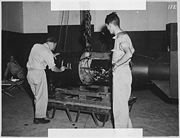 With plutonium found unsuitable for the gun-type design, the team working on the gun weapon (led by A. Francis Birch
), faced another problem: the bomb was simple, but they lacked the quantity of uranium-235 necessary for its production. Enough fissile material was not going to be available before mid-1945. Despite this, Birch managed to convince others that this concept was worth pursuing, so that in case of a failure of the plutonium bomb, it would still be possible to use the gun principle. In February 1945, the specifications were completed (model 1850). The bomb, except for the uranium payload, was ready at the beginning of May 1945.
Most of the uranium necessary for the production of the bomb came from the Shinkolobwe
mine and was made available thanks to the foresight of the CEO of the High Katanga Mining Union
, Edgar Sengier
, who had 1000 tons of uranium ore transported to a New York warehouse in 1939. A small amount may have come from a captured German submarine, U-234, after the German surrender in May 1945. Other sources state that at least part of the 1100 tons of uranium ore and uranium oxide captured by US troops in the second half of April 1945 in Stassfurt, Germany, became 235U for the bomb.
The majority of the uranium for Little Boy was enriched in Oak Ridge, Tennessee, primarily by means of electromagnetic separation in calutron
s and through gaseous diffusion
plants, with a small amount contributed by the cyclotron
s at Ernest O. Lawrence's Radiation Laboratory. The core of Little Boy contained 64 kg of uranium, of which 50 kg was enriched to 88%, and the remaining 14 kg at 50%. With enrichment averaging 82.68%, it could reach about 2.5 critical mass
es. "Fat Man" and the Trinity "gadget", by way of comparison, had five critical masses.
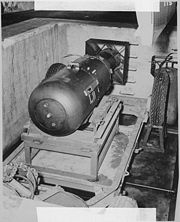 On July 14, 1945 a train left Los Alamos carrying several "bomb units" (the major non-nuclear parts of a gun-type bomb) together with a single completed uranium projectile; the uranium target was still incomplete. The consignment was delivered to the San Francisco Naval Shipyard
at Hunters Point
in San Francisco, California
. There, two hours before the successful test of Little Boy's plutonium-implosion brother at the Trinity test
in New Mexico, the bomb units and the projectile were loaded aboard the heavy cruiser USS Indianapolis
. Indianapolis steamed at record speed to the airbase at Tinian
island in the Mariana Islands
, delivering them ten days later on the 26th. (While returning from this mission Indianapolis was sunk by a Japanese submarine, with great loss of life due to delayed rescue.) Also on the 26th the three sections of the uranium target assembly were shipped from Kirtland Air Force Base
near Albuquerque, New Mexico
in three C-54 Skymaster
aircraft operated by the 509th Composite Group
's Green Hornet squadron. With all the necessary components delivered to Tinian, bomb unit L11 was chosen, and the final Little Boy weapon was assembled and ready by August 1.
Handling the completed Little Boy was particularly dangerous. Once cordite
was loaded in the breech, any firing of the explosive would at worst cause a nuclear chain reaction
and at best a contamination of the explosion zone. The mere contact of the two uranium masses could have caused an explosion with dire consequences, from a simple "fizzle" explosion to an explosion large enough to destroy Tinian (including the 500 B-29s based there, and their supporting infrastructure and personnel). Water was also a risk, since it could serve as a moderator
between the fissile materials and cause a violent dispersal of the nuclear material. The uranium projectile could only be inserted with an apparatus that produced a force of 300,000 newtons (67,000 lbf, over 30 tons). For safety reasons, the weaponeer, Captain William Sterling Parsons
, decided to load the bags of cordite only after take-off.
system that was designed to detonate the bomb at the most destructive altitude. Calculations showed that for the largest destructive effect, the bomb should explode at an altitude of 580 meters (1,900 feet). The resultant fuze
design was a three-stage interlock system:
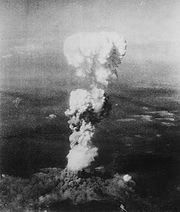
The bomb was armed in flight 31000 feet (9,448.8 m) above the city, then dropped at approximately 08:15 (JST) August 6, 1945. After falling for 44.4 seconds, the time and barometric triggers started the firing mechanism. The detonation happened at an altitude of 1968 feet (599.8 m). With a yield of 13 to 18 kilotons
, it was less powerful than "Fat Man", which was dropped on Nagasaki (21–23 kt). The official yield
estimate of "Little Boy" was about 16 kilotons of TNT equivalent in explosive force, i.e. 6.3 × 10¹³ joule
s = 63 TJ (tera-joules). However, the damage and the number of victims at Hiroshima were much higher, as Hiroshima was on flat terrain, while the hypocenter
of Nagasaki lay in a small valley.
According to figures published in 1945, 66,000 people were killed as a direct result of the Hiroshima blast, and 69,000 were injured to varying degrees.
The U.S. Department of Energy
gives this account of the death toll of the bombing of Hiroshima:
The success of the bombing was reported with great enthusiasm in the United States in the days following the attacks. See Atomic bombings of Hiroshima and Nagasaki
for discussion of contemporary support vs. opposition to the bombings, on both moral and military grounds.
B-29 Superfortress
The B-29 Superfortress is a four-engine propeller-driven heavy bomber designed by Boeing that was flown primarily by the United States Air Forces in late-World War II and through the Korean War. The B-29 was one of the largest aircraft to see service during World War II...
Enola Gay
Enola Gay
Enola Gay is a Boeing B-29 Superfortress bomber, named after Enola Gay Tibbets, mother of the pilot, then-Colonel Paul Tibbets. On August 6, 1945, during the final stages of World War II, it became the first aircraft to drop an atomic bomb as a weapon of war...
, piloted by Colonel
Colonel (United States)
In the United States Army, Air Force, and Marine Corps, colonel is a senior field grade military officer rank just above the rank of lieutenant colonel and just below the rank of brigadier general...
Paul Tibbets
Paul Tibbets
Paul Warfield Tibbets, Jr. was a brigadier general in the United States Air Force, best known for being the pilot of the Enola Gay, the first aircraft to drop an atomic bomb in the history of warfare. The bomb, code-named Little Boy, was dropped on the Japanese city of Hiroshima...
of the 393rd Bombardment Squadron, Heavy, of the United States Army Air Forces
United States Army Air Forces
The United States Army Air Forces was the military aviation arm of the United States of America during and immediately after World War II, and the direct predecessor of the United States Air Force....
. It was the first atomic bomb to be used as a weapon. The second, the "Fat Man
Fat Man
"Fat Man" is the codename for the atomic bomb that was detonated over Nagasaki, Japan, by the United States on August 9, 1945. It was the second of the only two nuclear weapons to be used in warfare to date , and its detonation caused the third man-made nuclear explosion. The name also refers more...
", was dropped three days later on Nagasaki.
The weapon was developed by the Manhattan Project
Manhattan Project
The Manhattan Project was a research and development program, led by the United States with participation from the United Kingdom and Canada, that produced the first atomic bomb during World War II. From 1942 to 1946, the project was under the direction of Major General Leslie Groves of the US Army...
during World War II
World War II
World War II, or the Second World War , was a global conflict lasting from 1939 to 1945, involving most of the world's nations—including all of the great powers—eventually forming two opposing military alliances: the Allies and the Axis...
. It derived its explosive power from the nuclear fission
Nuclear fission
In nuclear physics and nuclear chemistry, nuclear fission is a nuclear reaction in which the nucleus of an atom splits into smaller parts , often producing free neutrons and photons , and releasing a tremendous amount of energy...
of uranium 235. The Hiroshima bombing
Atomic bombings of Hiroshima and Nagasaki
During the final stages of World War II in 1945, the United States conducted two atomic bombings against the cities of Hiroshima and Nagasaki in Japan, the first on August 6, 1945, and the second on August 9, 1945. These two events are the only use of nuclear weapons in war to date.For six months...
was the second artificial nuclear explosion
Nuclear explosion
A nuclear explosion occurs as a result of the rapid release of energy from an intentionally high-speed nuclear reaction. The driving reaction may be nuclear fission, nuclear fusion or a multistage cascading combination of the two, though to date all fusion based weapons have used a fission device...
in history, after the Trinity test, and the first uranium
Uranium
Uranium is a silvery-white metallic chemical element in the actinide series of the periodic table, with atomic number 92. It is assigned the chemical symbol U. A uranium atom has 92 protons and 92 electrons, of which 6 are valence electrons...
-based detonation. Approximately 600 to 860 milligrams of matter
Matter
Matter is a general term for the substance of which all physical objects consist. Typically, matter includes atoms and other particles which have mass. A common way of defining matter is as anything that has mass and occupies volume...
in the bomb was converted into the active energy of heat and radiation (see mass-energy equivalence
Mass-energy equivalence
In physics, mass–energy equivalence is the concept that the mass of a body is a measure of its energy content. In this concept, mass is a property of all energy, and energy is a property of all mass, and the two properties are connected by a constant...
for detail). It exploded with an energy between 13 ktonTNT (estimates vary). It has been estimated that 130,000 to 150,000 persons had died by the end of December 1945. Its design was not tested in advance, unlike the more complex plutonium bomb (Fat Man
Fat Man
"Fat Man" is the codename for the atomic bomb that was detonated over Nagasaki, Japan, by the United States on August 9, 1945. It was the second of the only two nuclear weapons to be used in warfare to date , and its detonation caused the third man-made nuclear explosion. The name also refers more...
). The available supply of enriched uranium
Enriched uranium
Enriched uranium is a kind of uranium in which the percent composition of uranium-235 has been increased through the process of isotope separation. Natural uranium is 99.284% 238U isotope, with 235U only constituting about 0.711% of its weight...
was very small at that time, and it was felt that the simple design of a uranium "gun" type bomb was so sure to work that there was no need to test it at full scale.
Naming
The names for all three atomic bomb design projects during WW II ("Fat Man", "Thin Man", and "Little Boy") were allegedly created by Robert SerberRobert Serber
Robert Serber was an American physicist who participated in the Manhattan Project. He was born in Philadelphia, Pennsylvania; he was the eldest son of David Serber and Rose Frankel. He married Charlotte Leof in 1933. Rose Serber died in 1922; David married Charlotte's cousin Frances Leof in...
, a former student of Los Alamos director Robert Oppenheimer
Robert Oppenheimer
Julius Robert Oppenheimer was an American theoretical physicist and professor of physics at the University of California, Berkeley. Along with Enrico Fermi, he is often called the "father of the atomic bomb" for his role in the Manhattan Project, the World War II project that developed the first...
who worked on the project, according to Serber. According to his later memoirs, he chose them based on their design shapes; the "Thin Man" would be a very long device, and the name came from the Dashiell Hammett
Dashiell Hammett
Samuel Dashiell Hammett was an American author of hard-boiled detective novels and short stories, and political activist. Among the enduring characters he created are Sam Spade , Nick and Nora Charles , and the Continental Op .In addition to the significant influence his novels and stories had on...
detective novel
The Thin Man
The Thin Man is a detective novel by Dashiell Hammett, originally published in Redbook. Although he never wrote a sequel, the book became the basis for a successful six-part film series which also began in 1934 with The Thin Man and starred William Powell and Myrna Loy...
and series of movies
The Thin Man (film)
The Thin Man is a 1934 American comic detective film starring William Powell and Myrna Loy as Nick and Nora Charles, a flirtatious married couple who banter wittily as they solve crimes with ease. Nick is a hard drinking retired detective and Nora a wealthy heiress...
by the same name; the "Fat Man" bomb would be round and fat and was named after Sidney Greenstreet's "Kasper Gutman" character in The Maltese Falcon
The Maltese Falcon (1941 film)
The Maltese Falcon is a 1941 Warner Bros. film based on the novel of the same name by Dashiell Hammett and a remake of the 1931 film of the same name...
. "Little Boy" would come last and be named only to contrast to the "Thin Man" bomb. The original "Thin Man" had been expected to be as long as 17 feet, but when it was discovered that U-235 would require a slower projectile speed than first measurements had indicated, it was realized that the gun-design could be shortened to 6 feet, and this design was named "Little Boy" in contrast. However, in his memoirs, Paul Tibbets
Paul Tibbets
Paul Warfield Tibbets, Jr. was a brigadier general in the United States Air Force, best known for being the pilot of the Enola Gay, the first aircraft to drop an atomic bomb in the history of warfare. The bomb, code-named Little Boy, was dropped on the Japanese city of Hiroshima...
, commander of the 509th Composite Group
509th Composite Group
The 509th Composite Group was a United States Army Air Forces unit created during World War II, and tasked with operational deployment of nuclear weapons...
said the code names were part of an Air Force cover story. According to Tibbets, Project Silverplate
Silverplate
Silverplate was the code reference for the United States Army Air Forces participation in the Manhattan Project during World War II. Originally the name for the aircraft modification project for the B-29 Superfortress to enable it to drop an atomic weapon, Silverplate eventually came to identify...
, the Air Force program to modify the B-29 to carry atomic bombs, was given the cover story of existing to modify the B-29 into a passenger plane. One plane was allegedly for the use of Winston Churchill, 'the fat man', and the other for Franklin Roosevelt, 'the thin man.'
An extremely large six-ton conventional-explosive bomb developed by the British, operational in mid-1944, had been named the Tallboy, at a length of 21 ft (6.35m).
Basic weapon design
Uranium
Uranium is a silvery-white metallic chemical element in the actinide series of the periodic table, with atomic number 92. It is assigned the chemical symbol U. A uranium atom has 92 protons and 92 electrons, of which 6 are valence electrons...
-235 and a solid target cylinder together into a super-critical mass, initiating a nuclear chain reaction
Nuclear chain reaction
A nuclear chain reaction occurs when one nuclear reaction causes an average of one or more nuclear reactions, thus leading to a self-propagating number of these reactions. The specific nuclear reaction may be the fission of heavy isotopes or the fusion of light isotopes...
. This was accomplished by shooting one piece of the uranium onto the other by means of chemical explosives. It contained 64 kg (141.1 lb) of uranium, of which less than a kilogram underwent nuclear fission
Nuclear fission
In nuclear physics and nuclear chemistry, nuclear fission is a nuclear reaction in which the nucleus of an atom splits into smaller parts , often producing free neutrons and photons , and releasing a tremendous amount of energy...
, and of this mass only 0.6 g (0.0211643772630672 oz) was transformed into energy.
No full test of a gun-type nuclear weapon had occurred before the "Little Boy" device was dropped over Hiroshima
Hiroshima
is the capital of Hiroshima Prefecture, and the largest city in the Chūgoku region of western Honshu, the largest island of Japan. It became best known as the first city in history to be destroyed by a nuclear weapon when the United States Army Air Forces dropped an atomic bomb on it at 8:15 A.M...
. The only test explosion
Nuclear testing
Nuclear weapons tests are experiments carried out to determine the effectiveness, yield and explosive capability of nuclear weapons. Throughout the twentieth century, most nations that have developed nuclear weapons have tested them...
of a nuclear weapon had been of an implosion-type weapon using plutonium
Plutonium
Plutonium is a transuranic radioactive chemical element with the chemical symbol Pu and atomic number 94. It is an actinide metal of silvery-gray appearance that tarnishes when exposed to air, forming a dull coating when oxidized. The element normally exhibits six allotropes and four oxidation...
as its fissionable material, on July 16, 1945 at the Trinity test
Trinity test
Trinity was the code name of the first test of a nuclear weapon. This test was conducted by the United States Army on July 16, 1945, in the Jornada del Muerto desert about 35 miles southeast of Socorro, New Mexico, at the new White Sands Proving Ground, which incorporated the Alamogordo Bombing...
. There were several reasons for not testing the "Little Boy" device. Primarily, there was little uranium-235 compared with the relatively large amount of plutonium which, it was expected, could be produced by the Hanford
Hanford Site
The Hanford Site is a mostly decommissioned nuclear production complex on the Columbia River in the U.S. state of Washington, operated by the United States federal government. The site has been known by many names, including Hanford Works, Hanford Engineer Works or HEW, Hanford Nuclear Reservation...
reactors. Additionally, the weapon design was simple enough that it was only deemed necessary to do laboratory tests with the gun-type assembly (known during the war as "tickling the dragon's tail"). Unlike the implosion design, which required sophisticated coordination of shaped explosive charges, the gun-type design was considered almost certain to work.
Although occasionally used in later experimental devices, the design was only used once as a weapon because of the danger of accidental detonation. Little Boy's design was unsafe when compared to modern nuclear weapons, which incorporate safety features to endure various accident scenarios. The main objective of Little Boy was to create a weapon that was absolutely guaranteed to work. Consequently, Little Boy incorporated only basic safety mechanisms, thus an accidental detonation could easily occur during one or more of the following scenarios:
- a crash could drive the hollow "bullet" onto the "target" cylinder resulting in a massive release of radiation, or possibly nuclear detonation.
- an electrical short circuitShort circuitA short circuit in an electrical circuit that allows a current to travel along an unintended path, often where essentially no electrical impedance is encountered....
of some sort. - the danger of misfire was greater over water. If the force of a crash did not trigger the bomb, water leakage into the system could short it out, possibly leading to detonation. The British Red BeardRed Beard (nuclear weapon)Red Beard was the first British tactical nuclear weapon. It was carried by the English Electric Canberra and the V bombers of the Royal Air Force, and by the Blackburn Buccaneers, Sea Vixens and Supermarine Scimitars of the Royal Navy's Fleet Air Arm...
nuclear weapon also suffered from this design flaw. - FireFireFire is the rapid oxidation of a material in the chemical process of combustion, releasing heat, light, and various reaction products. Slower oxidative processes like rusting or digestion are not included by this definition....
. - LightningLightningLightning is an atmospheric electrostatic discharge accompanied by thunder, which typically occurs during thunderstorms, and sometimes during volcanic eruptions or dust storms...
strike.
Assembly details
The exact specifications of the "Little Boy" bomb remain classifiedClassified information
Classified information is sensitive information to which access is restricted by law or regulation to particular groups of persons. A formal security clearance is required to handle classified documents or access classified data. The clearance process requires a satisfactory background investigation...
because they could still be used to create a viable nuclear weapon. Even so, many sources have speculated as to the design, relying on limited photographic evidence, interviews with former Manhattan Project personnel, and piecing together information from declassified sources to reconstruct its internal dimensions.
According to the website Nuclear Weapon Archive, inside the weapon, the uranium-235 material was divided into two parts, following the gun principle: the "projectile" and the "target". The projectile was a hollow cylinder with 60% of the total mass (38.5 kg (84.9 lb)). It consisted of a stack of 9 uranium rings, each 6.25 inches (158.8 mm) with a 4 inches (101.6 mm) hole in the center and a total length of 7 inches (177.8 mm), pressed together into the front end of a thin-walled projectile 16.25 inches (412.8 mm) long. Filling in the remainder of the space behind these rings in the projectile was a tungsten carbide disc and a steel back. At detonation, the projectile was pushed 42 inches (1,066.8 mm) down a 72 inches (1,828.8 mm), 6.5 inches (165.1 mm) smooth-bore gun barrel. The target "insert" was a 4 inches (101.6 mm) cylinder, 7 inches (177.8 mm) long with a 1 inches (25.4 mm) hole in the center comprising 40% of the total mass (25.6 kg (56.4 lb)). This insert was composed of a stack of 6 washer-like uranium discs somewhat thicker than the projectile rings that were slid over a 1 inches (25.4 mm) rod. This rod then extended forward through the tungsten carbide tamper plug, impact absorbing anvil, and nose plug backstop eventually protruding out the front of the bomb casing. This entire target assembly was secured at both ends with locknuts.
When the hollow-front projectile reached the target and slid over the target insert, the assembled super-critical mass of uranium would be completely surrounded by a tamper and neutron reflector of tungsten carbide and steel, both materials having a combined mass of 2300 kg (5,070.6 lb). Neutron generators at the base of the projectile would be activated by the impact.
The "L-11" combat Little Boy and the assembled projectile containing the U-235 rings were delivered to Tinian
Tinian
Tinian is one of the three principal islands of the Commonwealth of the Northern Mariana Islands.-Geography:Tinian is about 5 miles southwest of its sister island, Saipan, from which it is separated by the Saipan Channel. It has a land area of 39 sq.mi....
Island on July 26, 1945, by the USS Indianapolis
USS Indianapolis (CA-35)
USS Indianapolis was a of the United States Navy. She holds a place in history due to the circumstances of her sinking, which led to the greatest single loss of life at sea in the history of the U.S. Navy...
. The six target rings arrived July 28 and 29 on three aircraft.
Because the Enola Gay weaponeer "Deak" Parsons
William Sterling Parsons
Rear Admiral William Sterling "Deak" Parsons was a naval officer who worked as an ordnance expert on the Manhattan Project during World War II...
was concerned about the possibility of an accidental detonation he did not load the four cordite
Cordite
Cordite is a family of smokeless propellants developed and produced in the United Kingdom from 1889 to replace gunpowder as a military propellant. Like gunpowder, cordite is classified as a low explosive because of its slow burning rates and consequently low brisance...
powder bags into the gun breech until the aircraft was in flight on the mission. Before climbing to high altitude close to the target Parsons' assistant Morris R. Jeppson
Morris R. Jeppson
Morris Richard Jeppson was born in Logan, Utah and was a Second Lieutenant in the Army Air Forces during World War II. He served as assistant weaponeer on the Enola Gay, which dropped the first atomic bomb on Hiroshima, Japan on August 6, 1945.-Early life:Jeppson studied physics at the University...
removed three safety plugs from the electrical connection between the internal battery and the firing mechanism.
Counter-intuitive design
For the first fifty years after 1945, every published description and drawing of the Little Boy mechanism assumed that a small, solid projectile was fired into the center of a larger target. However, critical mass considerations dictated that in Little Boy the larger, hollow piece would be the projectile. For the assembled fissile core to have more than two critical masses of U-235, one of the two pieces would need to have more than one critical massCritical mass
A critical mass is the smallest amount of fissile material needed for a sustained nuclear chain reaction. The critical mass of a fissionable material depends upon its nuclear properties A critical mass is the smallest amount of fissile material needed for a sustained nuclear chain reaction. The...
. To avoid criticality by means of shape, a hole in the center dispersed the mass and increased the surface area, allowing more fission neutrons to escape, preventing further fission and a chain reaction.
It was also important for the larger piece to have minimal contact with the neutron-reflecting tungsten carbide tamper until detonation. Thus only the projectile's back end was in contact with tungsten carbide (see drawing above). The rest of the tungsten carbide surrounded the target cylinder (called the "insert" by designers) with air space between it and the insert. This arrangement packs the maximum amount of fissile material into a gun-assembly design.
Physical effects of the bomb
After being selected in April 1945, Hiroshima was spared conventional bombing to serve as a pristine target, where the effects of a nuclear bomb on an undamaged city could be observed. While damage could be studied later, the energy yield of the untested Little Boy design could be determined only at the moment of detonation, using instruments dropped by parachute from a plane flying in formation with the one that dropped the bomb. Radio-transmitted data from these instruments indicated a yield of about 15 kilotons.Comparing this yield to the observed damage produced a rule of thumb called the 5 psi
Pounds per square inch
The pound per square inch or, more accurately, pound-force per square inch is a unit of pressure or of stress based on avoirdupois units...
lethal area rule. The number of immediate fatalities will approximately equal the number of people inside the lethal area.
The damage came from three main effects: blast, fire, and radiation.
Blast
The blast from a nuclear bomb is the result of X-rayX-ray
X-radiation is a form of electromagnetic radiation. X-rays have a wavelength in the range of 0.01 to 10 nanometers, corresponding to frequencies in the range 30 petahertz to 30 exahertz and energies in the range 120 eV to 120 keV. They are shorter in wavelength than UV rays and longer than gamma...
-heated air (the fireball) sending a shock/pressure wave in all directions at a velocity greater than the speed of sound (aka, the "Mach-Stem"), analogous to thunder generated by lightning. Most knowledge about nuclear weapon urban blast destruction originates from studies of Little Boy at Hiroshima. Data from the explosion at Nagasaki offers less insight, since hilly terrain deflected the blast and generated a more complicated pattern of destruction.
Ground zero
The term ground zero describes the point on the Earth's surface closest to a detonation...
, making a circle of destruction 2 miles (3.2 km) in diameter. The blast sent out a hyper-intensified shock wave
Shock wave
A shock wave is a type of propagating disturbance. Like an ordinary wave, it carries energy and can propagate through a medium or in some cases in the absence of a material medium, through a field such as the electromagnetic field...
which travelled at (slightly above) the speed of sound
Speed of sound
The speed of sound is the distance travelled during a unit of time by a sound wave propagating through an elastic medium. In dry air at , the speed of sound is . This is , or about one kilometer in three seconds or approximately one mile in five seconds....
, turning buildings into shrapnel
Fragmentation (weaponry)
Fragmentation is the process by which the casing of an artillery shell, bomb, grenade, etc. is shattered by the detonating high explosive filling. The correct technical terminology for these casing pieces is fragments , although shards or splinters can be used for non-preformed fragments...
. There was little or no structural damage outside of this one-mile (1.6 km) radius. At one mile (1.6 km), the force of the blast wave was 5 psi, with enough duration to implode houses and reduce them to kindling.
Later test explosions of nuclear weapons with houses and other test structures nearby confirmed that 5 psi (34,473.8 Pa) is an important threshold. Ordinary urban buildings experiencing it will be crushed, toppled, or gutted by the force of air pressure. The picture at right shows the effects of a nuclear-bomb-generated 5 psi pressure wave on a test structure in Nevada in 1953.
The most important effect of this kind of structural damage was that it created fuel for a firestorm
Firestorm
A firestorm is a conflagration which attains such intensity that it creates and sustains its own wind system. It is most commonly a natural phenomenon, created during some of the largest bushfires, forest fires, and wildfires...
. For this reason, the 5 psi contour defines the lethal area for blast and fire.
Fire
The first effect of the explosion was blinding light, accompanied by radiant heat from the fireball. The Hiroshima fireball was 1200 feet (365.8 m) in diameter, with a temperature of 7200 °F (3,982.2 °C). Near ground zero, everything flammable burst into flame, glass products and sand melted into molten glass. Contrary to popular opinion, nobody would have been vapourised by the burst - the detonation occurred at over 500 m altitude and the fireball did not reach the ground. The thermal pulse, while being hot enough to ignite flammable material at distance, was short in duration and these fires went out immediately after the flash or were blown out by the blast wave. The ensuing firestorm was caused by things like damaged fuel or gas pipes and tanks, overturned stoves, destroyed furnaces etc. One famous, anonymous Hiroshima victim left only a "shadow", permanently etched into stone steps near a bank building. Again, converse to popular knowledge, the "shadow" is not the remains or ash of the victim, but in fact it was the area around the shadow, not obscured by the person's silhouette that was lightened by X-rays from the burst, leaving a dark "negative" shadow.As the map shows, the firestorm jumped natural firebreaks (river channels), as well as prepared firebreaks. The spread of fire stopped only when it reached the edge of the blast-damaged area, encountering less available fuel.
Accurate casualty figures are impossible to determine, because many victims were cremated by the firestorm. For the same reason, the proportion of firestorm victims who survived the blast and died of fire can never be known. Casualty figures are based on the estimated population inside the lethal area when the bomb detonated.
Radiation
Local falloutNuclear fallout
Fallout is the residual radioactive material propelled into the upper atmosphere following a nuclear blast, so called because it "falls out" of the sky after the explosion and shock wave have passed. It commonly refers to the radioactive dust and ash created when a nuclear weapon explodes...
is dust and ash from a bomb crater, contaminated with radioactive fission products. It falls to earth downwind of the crater and can produce, with radiation alone, a lethal area much larger than that from blast and fire. With an air burst
Air burst
An air burst is the detonation of an explosive device such as an anti-personnel artillery shell or a nuclear weapon in the air instead of on contact with the ground or target or a delayed armor piercing explosion....
, the fission products rise into the stratosphere
Stratosphere
The stratosphere is the second major layer of Earth's atmosphere, just above the troposphere, and below the mesosphere. It is stratified in temperature, with warmer layers higher up and cooler layers farther down. This is in contrast to the troposphere near the Earth's surface, which is cooler...
, where they dissipate and become part of the global environment. Because Little Boy was an air burst 1900 feet (579.1 m) above the ground, there was no bomb crater and no local radioactive fallout.
Intense neutron
Neutron radiation
Neutron radiation is a kind of ionizing radiation which consists of free neutrons. A result of nuclear fission or nuclear fusion, it consists of the release of free neutrons from atoms, and these free neutrons react with nuclei of other atoms to form new isotopes, which, in turn, may produce...
and gamma radiation came directly from the fireball. Most people close enough to receive lethal doses of direct radiation died in the firestorm before their radiation injuries would have become apparent. Survivors on the edge of the lethal area and beyond suffered injuries from radiation.
Some who initially survived died soon afterward due to acute radiation sickness, but most of the radiation effects are evident only statistically, as increases in the incidence rates of cancer, leukemia and certain non-cancer diseases over the lifetimes of the survivors and their children who were exposed in utero
In utero
In utero is a Latin term literally meaning "in the womb". In biology, the phrase describes the state of an embryo or fetus. In legal contexts, the phrase is used to refer to unborn children. Under common law, unborn children are still considered to exist for property transfer purposes.-See also:*...
. To date, no radiation-related evidence of heritable diseases have been observed among the survivors' children.
Development of the bomb
Manhattan Project
The Manhattan Project was a research and development program, led by the United States with participation from the United Kingdom and Canada, that produced the first atomic bomb during World War II. From 1942 to 1946, the project was under the direction of Major General Leslie Groves of the US Army...
during World War II
World War II
World War II, or the Second World War , was a global conflict lasting from 1939 to 1945, involving most of the world's nations—including all of the great powers—eventually forming two opposing military alliances: the Allies and the Axis...
. Because enriched uranium was known to be fissionable, it was the first approach to bomb development pursued. The vast majority of the work in constructing "Little Boy" came in the form of the isotope enrichment of the uranium necessary for the weapon. Enrichment at Oak Ridge, Tennessee
Oak Ridge, Tennessee
Oak Ridge is a city in Anderson and Roane counties in the eastern part of the U.S. state of Tennessee, about west of Knoxville. Oak Ridge's population was 27,387 at the 2000 census...
began in February 1943, after many years of research.
The development of the first prototypes and the experimental work started in early 1943, at the time when the Los Alamos Design Laboratory
Los Alamos National Laboratory
Los Alamos National Laboratory is a United States Department of Energy national laboratory, managed and operated by Los Alamos National Security , located in Los Alamos, New Mexico...
became operational in the framework of the Manhattan Project. Originally gun-type designs were pursued for both a uranium and plutonium weapon (the "Thin Man" design), but in April 1944 it was discovered that the spontaneous fission rate for plutonium was too great to use in a gun-type weapon. In July 1944, almost all research at Los Alamos was redirected to the implosion plutonium weapon. In contrast, the uranium bomb was straight-forward if not trivial to design.
Francis Birch (geophysicist)
Albert Francis Birch was an American geophysicist best known for his experimental work on the properties of Earth-forming minerals at high pressure and temperature, in 1952 he published a well-known paper in the Journal of Geophysical Research ,where he demonstrated that the mantle is chiefly...
), faced another problem: the bomb was simple, but they lacked the quantity of uranium-235 necessary for its production. Enough fissile material was not going to be available before mid-1945. Despite this, Birch managed to convince others that this concept was worth pursuing, so that in case of a failure of the plutonium bomb, it would still be possible to use the gun principle. In February 1945, the specifications were completed (model 1850). The bomb, except for the uranium payload, was ready at the beginning of May 1945.
Most of the uranium necessary for the production of the bomb came from the Shinkolobwe
Shinkolobwe
Shinkolobwe is the name of a town and a mine in the Katanga province of the Democratic Republic of the Congo , located near the larger town of Likasi and about 120 miles northwest of Lubumbashi. The former mine was located in the centre of a 400 kilometre long belt of uranified minerals, stretching...
mine and was made available thanks to the foresight of the CEO of the High Katanga Mining Union
Union Minière du Haut Katanga
The Union Minière du Haut Katanga was a Belgian mining company, once operating in Katanga, in what is now the Democratic Republic of the Congo...
, Edgar Sengier
Edgar Sengier
Edgar Sengier was the director of the Belgian Union Minière du Haut Katanga during World War II. Sengier is credited with giving the American government access to much of the uranium necessary for the Manhattan Project...
, who had 1000 tons of uranium ore transported to a New York warehouse in 1939. A small amount may have come from a captured German submarine, U-234, after the German surrender in May 1945. Other sources state that at least part of the 1100 tons of uranium ore and uranium oxide captured by US troops in the second half of April 1945 in Stassfurt, Germany, became 235U for the bomb.
The majority of the uranium for Little Boy was enriched in Oak Ridge, Tennessee, primarily by means of electromagnetic separation in calutron
Calutron
A calutron is a mass spectrometer used for separating the isotopes of uranium. It was developed by Ernest O. Lawrence during the Manhattan Project and was similar to the cyclotron invented by Lawrence. Its name is a concatenation of Cal. U.-tron, in tribute to the University of California,...
s and through gaseous diffusion
Gaseous diffusion
Gaseous diffusion is a technology used to produce enriched uranium by forcing gaseous uranium hexafluoride through semi-permeable membranes. This produces a slight separation between the molecules containing uranium-235 and uranium-238 . By use of a large cascade of many stages, high separations...
plants, with a small amount contributed by the cyclotron
Cyclotron
In technology, a cyclotron is a type of particle accelerator. In physics, the cyclotron frequency or gyrofrequency is the frequency of a charged particle moving perpendicularly to the direction of a uniform magnetic field, i.e. a magnetic field of constant magnitude and direction...
s at Ernest O. Lawrence's Radiation Laboratory. The core of Little Boy contained 64 kg of uranium, of which 50 kg was enriched to 88%, and the remaining 14 kg at 50%. With enrichment averaging 82.68%, it could reach about 2.5 critical mass
Critical mass
A critical mass is the smallest amount of fissile material needed for a sustained nuclear chain reaction. The critical mass of a fissionable material depends upon its nuclear properties A critical mass is the smallest amount of fissile material needed for a sustained nuclear chain reaction. The...
es. "Fat Man" and the Trinity "gadget", by way of comparison, had five critical masses.
Construction and delivery
San Francisco Naval Shipyard
The San Francisco Naval Shipyard was a United States Navy shipyard in San Francisco, California, located on of waterfront at Hunters Point in the southeast corner of the city...
at Hunters Point
Hunters Point, San Francisco, California
Bayview-Hunters Point or The Bayview, is a neighborhood in the southeastern corner of San Francisco, California, United States. The decommissioned Hunters Point Naval Shipyard is located within its boundaries and Candlestick Park is on the southern edge....
in San Francisco, California
San Francisco, California
San Francisco , officially the City and County of San Francisco, is the financial, cultural, and transportation center of the San Francisco Bay Area, a region of 7.15 million people which includes San Jose and Oakland...
. There, two hours before the successful test of Little Boy's plutonium-implosion brother at the Trinity test
Trinity test
Trinity was the code name of the first test of a nuclear weapon. This test was conducted by the United States Army on July 16, 1945, in the Jornada del Muerto desert about 35 miles southeast of Socorro, New Mexico, at the new White Sands Proving Ground, which incorporated the Alamogordo Bombing...
in New Mexico, the bomb units and the projectile were loaded aboard the heavy cruiser USS Indianapolis
USS Indianapolis (CA-35)
USS Indianapolis was a of the United States Navy. She holds a place in history due to the circumstances of her sinking, which led to the greatest single loss of life at sea in the history of the U.S. Navy...
. Indianapolis steamed at record speed to the airbase at Tinian
Tinian
Tinian is one of the three principal islands of the Commonwealth of the Northern Mariana Islands.-Geography:Tinian is about 5 miles southwest of its sister island, Saipan, from which it is separated by the Saipan Channel. It has a land area of 39 sq.mi....
island in the Mariana Islands
Mariana Islands
The Mariana Islands are an arc-shaped archipelago made up by the summits of 15 volcanic mountains in the north-western Pacific Ocean between the 12th and 21st parallels north and along the 145th meridian east...
, delivering them ten days later on the 26th. (While returning from this mission Indianapolis was sunk by a Japanese submarine, with great loss of life due to delayed rescue.) Also on the 26th the three sections of the uranium target assembly were shipped from Kirtland Air Force Base
Kirtland Air Force Base
Kirtland Air Force Base is a United States Air Force base located in the southeast quadrant of the Albuquerque, New Mexico urban area, adjacent to the Albuquerque International Sunport. The base was named for the early Army aviator Col. Roy C. Kirtland...
near Albuquerque, New Mexico
Albuquerque, New Mexico
Albuquerque is the largest city in the state of New Mexico, United States. It is the county seat of Bernalillo County and is situated in the central part of the state, straddling the Rio Grande. The city population was 545,852 as of the 2010 Census and ranks as the 32nd-largest city in the U.S. As...
in three C-54 Skymaster
C-54 Skymaster
The Douglas C-54 Skymaster was a four-engined transport aircraft used by the United States Army Air Forces and British forces in World War II and the Korean War. Besides transport of cargo, it also carried presidents, British heads of government, and military staff...
aircraft operated by the 509th Composite Group
509th Operations Group
The 509th Operations Group is the flying component of the United States Air Force 509th Bomb Wing , assigned to Whiteman Air Force Base, Missouri. It is equipped with all 20 of the USAF's B-2 Spirit stealth bombers...
's Green Hornet squadron. With all the necessary components delivered to Tinian, bomb unit L11 was chosen, and the final Little Boy weapon was assembled and ready by August 1.
Handling the completed Little Boy was particularly dangerous. Once cordite
Cordite
Cordite is a family of smokeless propellants developed and produced in the United Kingdom from 1889 to replace gunpowder as a military propellant. Like gunpowder, cordite is classified as a low explosive because of its slow burning rates and consequently low brisance...
was loaded in the breech, any firing of the explosive would at worst cause a nuclear chain reaction
Nuclear chain reaction
A nuclear chain reaction occurs when one nuclear reaction causes an average of one or more nuclear reactions, thus leading to a self-propagating number of these reactions. The specific nuclear reaction may be the fission of heavy isotopes or the fusion of light isotopes...
and at best a contamination of the explosion zone. The mere contact of the two uranium masses could have caused an explosion with dire consequences, from a simple "fizzle" explosion to an explosion large enough to destroy Tinian (including the 500 B-29s based there, and their supporting infrastructure and personnel). Water was also a risk, since it could serve as a moderator
Neutron moderator
In nuclear engineering, a neutron moderator is a medium that reduces the speed of fast neutrons, thereby turning them into thermal neutrons capable of sustaining a nuclear chain reaction involving uranium-235....
between the fissile materials and cause a violent dispersal of the nuclear material. The uranium projectile could only be inserted with an apparatus that produced a force of 300,000 newtons (67,000 lbf, over 30 tons). For safety reasons, the weaponeer, Captain William Sterling Parsons
William Sterling Parsons
Rear Admiral William Sterling "Deak" Parsons was a naval officer who worked as an ordnance expert on the Manhattan Project during World War II...
, decided to load the bags of cordite only after take-off.
Fuse system
The bomb employed a fusingFuse
The word fuse has several meanings:* Fuse , a device used in electrical systems to protect against excessive current....
system that was designed to detonate the bomb at the most destructive altitude. Calculations showed that for the largest destructive effect, the bomb should explode at an altitude of 580 meters (1,900 feet). The resultant fuze
Fuze
Fuze Beverage, commercially referred to as just Fuze , is a manufacturer of teas and non-carbonated fruit drinks enriched with vitamins. Currently the brand consists of five vitamin-infused lines: Slenderize, Refresh, Tea, Defensify, and Vitalize...
design was a three-stage interlock system:
- A timer ensured that the bomb would not explode until at least fifteen seconds after release, one-quarter of the predicted fall time, to ensure safety of the aircraft. The timer was activated when the electrical pullout plugs connecting it to the airplane were pulled loose as the bomb fell, switching it to internal (24V battery) power and starting the timer. At the end of the 15 seconds the batteries then powered the radar system and passed responsibility to the barometric stage.
- The purpose of the barometric stage was to delay activating the radar altimeter firing command circuit until near detonation altitude. A thin metallic membrane was gradually deformed as ambient air pressure increased during descent. The barometric fuze was not considered accurate enough to detonate the bomb at the precise ignition height, because air pressure varies with local conditions. When the bomb reached the design height for this stage (reportedly 2,000 meters) the membrane closed a circuit, activating the circuit between the radar altimeters and the projectile gun. The barometric stage was added because of a worry that external radar signals might detonate the bomb too early.
- Two or more redundantRedundancy (engineering)In engineering, redundancy is the duplication of critical components or functions of a system with the intention of increasing reliability of the system, usually in the case of a backup or fail-safe....
radar altimeters were used to reliably detect descent. When the altimeters sensed the correct height, the firing switch closed, igniting the three BuOrd Mk15, Mod 1 Navy gun primers in the breech plug, which set off the charge consisting of four silk powder bags each containing two pounds of WM slotted-tube cordite. This launched the uranium projectile towards the opposite end of the gun barrel at an eventual muzzle velocityMuzzle velocityMuzzle velocity is the speed a projectile has at the moment it leaves the muzzle of the gun. Muzzle velocities range from approximately to in black powder muskets , to more than in modern rifles with high-performance cartridges such as the .220 Swift and .204 Ruger, all the way to for tank guns...
of 1000 feet per second (300 meters per second). Approximately 10 milliseconds later the chain reaction occurred, lasting less than 1 μs. The radar altimeters used were modified U.S. Army Air Corps APS-13 fighter tail warning radarMonica tail warning radarMonica was a range-only tail warning radar for bombers, introduced by the RAF in the spring of 1942. Officially known as ARI 5664, it operated at frequencies of around 300 MHz...
s, nicknamed "Archie", originally designed to warn a pilot of another plane approaching from behind.
The bombing of Hiroshima
The bomb was armed in flight 31000 feet (9,448.8 m) above the city, then dropped at approximately 08:15 (JST) August 6, 1945. After falling for 44.4 seconds, the time and barometric triggers started the firing mechanism. The detonation happened at an altitude of 1968 feet (599.8 m). With a yield of 13 to 18 kilotons
Ton
The ton is a unit of measure. It has a long history and has acquired a number of meanings and uses over the years. It is used principally as a unit of weight, and as a unit of volume. It can also be used as a measure of energy, for truck classification, or as a colloquial term.It is derived from...
, it was less powerful than "Fat Man", which was dropped on Nagasaki (21–23 kt). The official yield
Nuclear weapon yield
The explosive yield of a nuclear weapon is the amount of energy discharged when a nuclear weapon is detonated, expressed usually in the equivalent mass of trinitrotoluene , either in kilotons or megatons , but sometimes also in terajoules...
estimate of "Little Boy" was about 16 kilotons of TNT equivalent in explosive force, i.e. 6.3 × 10¹³ joule
Joule
The joule ; symbol J) is a derived unit of energy or work in the International System of Units. It is equal to the energy expended in applying a force of one newton through a distance of one metre , or in passing an electric current of one ampere through a resistance of one ohm for one second...
s = 63 TJ (tera-joules). However, the damage and the number of victims at Hiroshima were much higher, as Hiroshima was on flat terrain, while the hypocenter
Hypocenter
The hypocenter refers to the site of an earthquake or a nuclear explosion...
of Nagasaki lay in a small valley.
According to figures published in 1945, 66,000 people were killed as a direct result of the Hiroshima blast, and 69,000 were injured to varying degrees.
The U.S. Department of Energy
United States Department of Energy
The United States Department of Energy is a Cabinet-level department of the United States government concerned with the United States' policies regarding energy and safety in handling nuclear material...
gives this account of the death toll of the bombing of Hiroshima:
The success of the bombing was reported with great enthusiasm in the United States in the days following the attacks. See Atomic bombings of Hiroshima and Nagasaki
Atomic bombings of Hiroshima and Nagasaki
During the final stages of World War II in 1945, the United States conducted two atomic bombings against the cities of Hiroshima and Nagasaki in Japan, the first on August 6, 1945, and the second on August 9, 1945. These two events are the only use of nuclear weapons in war to date.For six months...
for discussion of contemporary support vs. opposition to the bombings, on both moral and military grounds.
See also
- Atomic bombings of Hiroshima and NagasakiAtomic bombings of Hiroshima and NagasakiDuring the final stages of World War II in 1945, the United States conducted two atomic bombings against the cities of Hiroshima and Nagasaki in Japan, the first on August 6, 1945, and the second on August 9, 1945. These two events are the only use of nuclear weapons in war to date.For six months...
- Debate over the atomic bombings of Hiroshima and NagasakiDebate over the atomic bombings of Hiroshima and NagasakiThe debate over the atomic bombings of Hiroshima and Nagasaki concerns the ethical, legal and military controversies surrounding the United States' atomic bombings of Hiroshima and Nagasaki on 6 August and 9 August 1945 at the close of the Second World War...
- Enola GayEnola GayEnola Gay is a Boeing B-29 Superfortress bomber, named after Enola Gay Tibbets, mother of the pilot, then-Colonel Paul Tibbets. On August 6, 1945, during the final stages of World War II, it became the first aircraft to drop an atomic bomb as a weapon of war...
- Fat ManFat Man"Fat Man" is the codename for the atomic bomb that was detonated over Nagasaki, Japan, by the United States on August 9, 1945. It was the second of the only two nuclear weapons to be used in warfare to date , and its detonation caused the third man-made nuclear explosion. The name also refers more...
- Fat Man and Little BoyFat Man and Little BoyFat Man and Little Boy is a 1989 film that reenacts the Manhattan Project, the secret Allied endeavor to develop the first nuclear weapons during World War II. The film is named after the nuclear weapons known by the code names "Fat Man" and "Little Boy". The code names can be taken for joking...
, a 1989 film that re-enacts the Manhattan Project - The gadget
- List of nuclear weapons
- Manhattan ProjectManhattan ProjectThe Manhattan Project was a research and development program, led by the United States with participation from the United Kingdom and Canada, that produced the first atomic bomb during World War II. From 1942 to 1946, the project was under the direction of Major General Leslie Groves of the US Army...
- Nuclear weapon designNuclear weapon designNuclear weapon designs are physical, chemical, and engineering arrangements that cause the physics package of a nuclear weapon to detonate. There are three basic design types...
- Thin Man nuclear bombThin Man nuclear bombThe "Thin Man" nuclear bomb was a proposed plutonium gun-type nuclear bomb which the United States was developing during the Manhattan Project...
- Trinity testTrinity testTrinity was the code name of the first test of a nuclear weapon. This test was conducted by the United States Army on July 16, 1945, in the Jornada del Muerto desert about 35 miles southeast of Socorro, New Mexico, at the new White Sands Proving Ground, which incorporated the Alamogordo Bombing...
- Upshot-Knothole GrableUpshot-Knothole GrableUpshot-Knothole Grable was a nuclear weapons test conducted by the United States as part of Operation Upshot-Knothole. Detonation of the associated nuclear weapon occurred shortly after its deployment at 8:30am PDT on May 25, 1953, in Area 5 of the Nevada Test Site...
- White Light/Black Rain: The Destruction of Hiroshima and NagasakiWhite Light/Black Rain: The Destruction of Hiroshima and NagasakiWhite Light/Black Rain: The Destruction of Hiroshima and Nagasaki is an HBO documentary film that was directed and produced by Steven Okazaki and was released on August 6, 2007 on HBO, marking the 62nd anniversary of the first atomic bombing...
External links
- Footage of Hiroshima Atomic Bomb Attack
- White Light/Black Rain official website documentary filmDocumentary filmDocumentary films constitute a broad category of nonfictional motion pictures intended to document some aspect of reality, primarily for the purposes of instruction or maintaining a historical record...
about the atomic bombings of Hiroshima and NagasakiAtomic bombings of Hiroshima and NagasakiDuring the final stages of World War II in 1945, the United States conducted two atomic bombings against the cities of Hiroshima and Nagasaki in Japan, the first on August 6, 1945, and the second on August 9, 1945. These two events are the only use of nuclear weapons in war to date.For six months... - Little Boy description at Carey Sublette's NuclearWeaponArchive.org
- Nuclear Files.org Definition and explanation of 'Little Boy'
- The Nuclear Weapon Archive
- History of Enola Gay
- A little known episode of the Manhattan Project Factitious tests of bombs and problems in aerodynamism
- Development of Little Boy and Fat Man (translated from French)
- Functioning de Little Boy et Fat Man (in French)
- Little Boy : a macabre irony (in French)
- Little Boy 3D Model
- Hiroshima & Nagasaki Remembered information about preparation and dropping the Little Boy bomb
- Models of Hiroshima city center before and after In the Hiroshima Peace Memorial MuseumHiroshima Peace Memorial MuseumHiroshima Peace Memorial Museum is located in Hiroshima Peace Memorial Park, in central Hiroshima, Japan.It was established in August 1955 with the Hiroshima Peace Memorial Hall ....
- Atomic John: A truck driver uncovers secrets about the first nuclear bombs. Essay and interview with John Coster-Mullen by David Samuels in the New Yorker, December 15, 2008 issue. Coster-Mullen is the author of Atom Bombs: The Top Secret Inside Story of Little Boy and Fat Man, 2003 (first printed in 1996, self-published), considered a definitive text about Little Boy; illustrations from which are used in the Assembly details section above.