

Scottish independence

Encyclopedia
Scottish independence is a political ambition of political parties, advocacy groups and individuals for Scotland
to secede from the United Kingdom
and become an independent
sovereign state
, separate from England
, Wales
and Northern Ireland
.
Supporters of Scottish independence claim that Scotland's inability fully to control its own affairs, both nationally and internationally, is detrimental to Scottish interests. They argue that, as the British government acts primarily in the interest of the entire United Kingdom (of which England is by far the most populated part), it is to the detriment of Scottish interests to remain in the United Kingdom
. Those who oppose Scottish independence and endorse the continuation of a form of union believe being part of the United Kingdom to be in the Scottish national interest
, and argue that there are benefits enjoyed by Scotland as part of a great power
, which do not compromise its distinctive national identity
.
in 1822 and the subsequent rise in tartanry
did much to reinvigorate a sense of a specifically Scottish national identity, which had been split between the Episcopalian
and Roman Catholic-dominated Highlands
and the Presbyterian
-dominated Lowlands
since the Glorious Revolution
in 1688, and continued during the 18th century through the Jacobite risings, the Act of Proscription
and subsequent process of Highland Clearances
by landlords.
From the mid-19th century, calls for the devolution
of control over Scottish affairs began to be raised, but support for full independence remained limited. The "home rule" movement for a Scottish Assembly
was first taken up in 1853 by a body close to the Conservative Party
, complaining about the fact that Ireland received more support from the British Government than Scotland and soon began to receive Liberal Party
backing, In 1885, the Post of Secretary for Scotland and the Scottish Office
were re-established to promote Scotland's interests and voice its grievances to the British Parliament. In 1886, however, William Ewart Gladstone
introduced the Irish Home Rule Bill
. When many Scots compared what they had to the Irish offer of Home Rule, this was considered inadequate. It was not an immediate constitutional priority however, especially after the Irish Home Rule Bill was defeated in the House of Commons, and by the time a Scottish home rule bill was first presented to parliament in 1913, its progress, along with that of the Irish Home Rule Act 1914
, was interrupted by World War I
and subsequently became overshadowed by the Easter Rising
and Irish War of Independence
, although the Scottish Office was relocated to St. Andrew's House
in Edinburgh during the 1930s.
The Scottish National Party itself was formed in 1934 after the union of the National Party of Scotland
and the Scottish Party
. The SNP did not support all-out independence for Scotland, but rather the establishment of a devolved Scottish Assembly, within the United Kingdom. This became the party's initial position on the constitutional status of Scotland as a result of a compromise between the NPS, who did support independence, and the Scottish Party who were devolutionists. However, the SNP quickly reverted to the original NPS stance of supporting full independence for Scotland. The interwar period
proved difficult years for the SNP, with the rise of undemocratic nationalist forces in Europe in the shape of fascism in Italy and Spain and national socialism
in Germany. The alleged similarity between SNP and foreign nationalists, combined with other factors such as a lack of profile in mainstream media, made it difficult for the SNP to grow.
The concept of full independence, or less controversial home rule
, did not re-enter the Scottish mainstream until the 1960s, with the famous Wind of Change
speech by Harold Macmillan
, which marked the high point of decolonisation and the decline of the British Empire
, which had already suffered the humiliation of the 1956 Suez Crisis
. For many in Scotland, this served to undermine one of the principal raisons d'être of the United Kingdom
and also symbolised the end of popular imperialism
and imperial unity which had united the prominent Scottish Unionist Party, which subsequently entered a steady decline in support. The SNP won a Parliamentary seat in 1967, when Winnie Ewing
was the surprise winner of the Hamilton by-election, 1967
. This brought the SNP to national prominence, leading to Edward Heath
's 1968 Declaration of Perth
and the establishment of the Kilbrandon Commission
.
off the east coast of Scotland further invigorated the debate over Scottish independence. The Scottish National Party
organised a hugely successful campaign entitled "It's Scotland's oil
", emphasising the way in which the discovery of oil could benefit Scotland's then-struggling deindustrialising
economy and its populace. In the February 1974 general election
seven SNP MPs were returned. The failure of the Labour Party to secure an overall majority prompted them to quickly return to the polls. In the subsequent October 1974
election, the SNP performed even better than they had done earlier in the year, winning 11 MPs and managing to garner over 30% of the total vote in Scotland.
In 1974, the Conservative government commissioned the McCrone report
, written by professor Gavin McCrone, a leading government economist, to report on the viability of an independent Scotland. He concluded that oil would have given an independent Scotland one of the strongest currencies in Europe. The report went on to say that officials advised government ministers on how to take "the wind out of the SNP sails". Handed over to the incoming Labour administration and classified as secret because of Labour fears over the surge in Scottish National Party popularity, the document came to light only in 2005, when the SNP obtained the report under the Freedom of Information Act 2000
.
The Labour Party under Harold Wilson
had won the election by a tiny majority of only three seats. Following their election to parliament, the SNP's MPs pressed for the creation of a Scottish Assembly, which was given added credibility after the conclusions of the Kilbrandon Commission. However, opponents demanded that a referendum be held on the issue. Although the Labour Party
and the Scottish National Party both officially supported devolution, support was split in both parties. Labour was divided between those who favoured devolution and those who wanted to maintain a full central Westminster government. In the SNP, there was division between those who saw devolution as a stepping stone to independence and those who feared it might actually distract from that ultimate goal.
The resignation of Harold Wilson brought James Callaghan
to power, however his small majority was eroded with several by-election losses and the government became increasingly unpopular during the Winter of Discontent
, although an arrangement was negotiated in 1977 with the Liberals
known as the Lib-Lab pact
and a succession of deals with the Scottish National Party and Plaid Cymru
to hold referendums on devolution in exchange for their support, had helped to prolong the government's life.
The result of the referendum in Scotland was a narrow majority in favour of devolution (52% to 48%). However, a condition of the referendum was that 40% of the total electorate should vote in favour in order to make it valid. Thus, with a turnout of 63.6%, only 32.9% had voted "Yes". The Scotland Act 1978
was consequently repealed in March 1979 by a vote of 301-206 in parliament. In the wake of the referendum the supporters of the bill conducted a protest campaign under the slogan "Scotland said yes". They argued that the 40% rule was undemocratic and that the referendum results justified the establishment of the assembly. However, campaigners for a "No" vote countered that voters had been told before the referendum that failing to vote itself was as good as a "No". It was therefore incorrect to conclude that the 36.4% who did not vote, was entirely down to voter apathy
.
In protest, the Scottish National Party MPs withdrew their support from the government. A motion of no confidence
was then tabled by the Conservatives and supported by the SNP, the Liberals and Ulster Unionists
. It passed by one vote on 28 March 1979, forcing the May 1979 general election
, which was won by Margaret Thatcher
, effectively ending the Post-war consensus
. The Labour Prime Minister, James Callaghan
, famously described this decision by the SNP as that of 'turkeys voting for Christmas
'. The SNP returned only two MPs in the 1979 election, leading to the formation of the controversial 79 Group
within the SNP.
 Supporters of Scottish independence continued to hold mixed views on the Home Rule
movement which included many supporters of union who wanted devolution within the framework of the United Kingdom
. Some saw it as a stepping stone to independence, while others wanted to go straight for independence.
In the years of the Conservative government after 1979, the Campaign for a Scottish Assembly
was established, eventually publishing the Claim of Right 1989
. This then led to the Scottish Constitutional Convention
. The convention promoted consensus on devolution on a cross-party basis, though the Conservative Party refused to co-operate and the Scottish National Party withdrew from the discussions when it became clear that the convention was unwilling to discuss Scottish independence as a constitutional option. Arguments against devolution and the Scottish Parliament, levelled mainly by the Conservative Party, were that the Parliament would create a "slippery slope" to Scottish independence and provide the pro-independence Scottish National Party with a route to government. John Major
, the Conservative prime minister before May 1997, campaigned during the 1997 general election on the slogan "72 hours to save the union".
The Labour Party won the 1997 general election
and Donald Dewar
as Secretary of State for Scotland
agreed to the proposals for a Scottish Parliament
. A referendum was held in September of that year and 74.3% of those who voted approved the devolution plan (44.87% of the electorate). The Parliament of the United Kingdom
subsequently approved the Scotland Act 1998
which created an elected Scottish Parliament
with control over most domestic policy. In May 1999, Scotland held its first election
for a devolved parliament and in July the Scottish Parliament held session for the first time since the previous parliament had been adjourned in 1707.
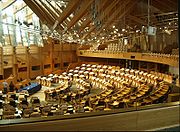
The Scottish Parliament is a unicameral legislature
comprising 129 Members, 73 of whom represent individual constituencies and are elected on a first past the post system; 56 are elected in eight different electoral regions by the additional member system, serving for a four year period. The Queen appoints one Member of the Scottish Parliament
, on the nomination of the Parliament, to be First Minister
with the convention being that the leader of the party with the largest number of seats is appointed First Minister although any member which can command the confidence of the chamber could conceivably be appointed First Minister. All other Ministers are appointed and dismissed by the First Minister and together they make up the Scottish Government, the executive
arm of government
.
The Labour Party's Donald Dewar became the First Minister of Scotland
, while the Scottish National Party became the main opposition party. With the approval of all parties, the egalitarian song "A Man's A Man for A' That
", by Robert Burns
, was performed at the opening ceremony of the Scottish Parliament.
The Scottish Parliament has legislative authority for all non-reserved matters
relating to Scotland, and has a limited power to vary income tax, nicknamed the Tartan Tax
, a power it has yet to exercise. The Scottish Parliament can refer devolved matters back to Westminster to be considered as part of United Kingdom-wide legislation by passing a Legislative Consent Motion if United Kingdom-wide legislation is considered to be more appropriate for certain issues. The programmes of legislation enacted by the Scottish Parliament since 1999 have seen a divergence in the provision of public services
compared to the rest of the United Kingdom. For instance, the costs of a university education, and care services for the elderly are free at point of use in Scotland, while fees are paid in the rest of the UK. Scotland was the first country in the UK to ban smoking in enclosed public places.
Scotland is also represented in the British House of Commons
by 59 MPs elected from territory-based Scottish constituencies.
the Scottish National Party
became the single largest party by a margin of one seat. Lacking an overall majority
, the Scottish National Party formed a minority government
, installing leader Alex Salmond
as First Minister of Scotland
.
The Scottish National Party
went on to win the 2011 Scottish General Election with an overall majority of 69 out of 129 seats in the Scottish Parliament and around 45% of all votes cast; enough to hold a referendum on independence from the United Kingdom
.
had a manifesto commitment of holding an independence referendum
by 2010. After winning the 2007 election
, the SNP-controlled Scottish Government published a White Paper entitled Choosing Scotland's Future
, which outlines options for the future of Scotland, including independence. However, in September 2010, the Scottish Government announced that no referendum would occur before the 2011 elections.
At the time, Scottish Labour, the Scottish Conservatives and Scottish Liberal Democrats
opposed a referendum offering independence as an option. The former Prime Minister Gordon Brown
has also publicly attacked the independence option. Based on a subsequent debate in the Scottish Parliament
, the three main parties opposed to independence formed the Calman Commission
. This will review devolution and consider all constitutional options bar independence.
However, Wendy Alexander
had been seen as straying from the established anti-referendum position held by Labour while she was the leader of the Scottish Labour
group of MSPs. In May 2008, she called for an independence referendum within 12 months, saying the SNP should have the "courage of its convictions". In a subsequent Prime Minister's Questions
time, Gordon Brown denied that Alexander's statement was intended to contradict party policy. Alexander's words also caused concern amongst the other founders of the Calman Commission
. In response to Alexander, SNP First Minister Alex Salmond
told the Scottish Parliament
that he would be sticking to the SNP manifesto commitment of a 2010 referendum. Alexander's resignation as leader of the Labour MSPs (as a result of a controversy over illegal donations) ultimately saw Labour's position reversed again, and her successor Iain Gray
reverted to Labour's previous policy of opposing any referendum.
Tavish Scott
, the former leader of the Scottish Liberal Democrats
, suggested after being elected to the position in 2008 that he might consider backing a multi-option referendum with independence as one choice.
In August 2009, the SNP announced that the Referendum (Scotland) Bill, 2010
would be part of its third legislative programme for 2009-10, which would detail the question and conduct of a possible referendum on the issue of independence. The Bill was to be published on 25 January 2010, Burns Night
, with the referendum proposed for on or around 30 November 2010, St. Andrew's Day
. The Bill was not, however, expected to be passed, because of the SNP's status as a minority government, and the opposition of all the major parties in the Parliament.
Following the Scottish National Party's victory in the 2011 Holyrood election, which gave the party an overall majority in the Scottish parliament, First Minister Alex Salmond
stated his desire to hold a referendum "in the second half of the parliament" which would place it in 2014 or 2015. However, on November 10, David Cameron
considered plans for a UK-led referendum "to prevent the Scottish Nationalists from setting the terms, question and timing to suit themselves".
for Scottish independence or a bill of the Scottish Parliament
seeking to change the constitutional status of Scotland would not, under the British constitution, be legally binding on the UK government, because all UK referenda are only advisory. The British parliament claims absolute parliamentary sovereignty
, but this is disputed by those who contend that the Scottish people, rather than the Scottish Parliament, are the legal sovereign authority in Scotland, a status explicitly proclaimed in the 1320 Declaration of Arbroath
and reasserted by the all-party Claim of Right 1989
. This position was legally supported by the Lord President of the Court of Session
, Lord Cooper of Cardross, in the case of McCormick v The Lord Advocate (1953), in which Lord Cooper confirmed that "the principle of the unlimited sovereignty of (the Westminster) Parliament is a distinctively English principle which has no counterpart in Scottish Constitutional Law." The United Nations Charter
also enshrines the right of peoples to self-determination while the Universal Declaration of Human Rights
also guarantees their right to change nationality, and the UK is a signatory to both documents with the UK Parliament having no power to unilaterally revoke them.
Any changes to constitutional status are one of the reserved matters
for Westminster under the Scotland Act 1998
. At any time Westminster could amend the Scotland Act
, changing the powers of the Scottish Parliament and allowing Westminster to legally block any bill for independence brought by the Scottish Government. Westminster has previously amended the Scotland Act to maintain the number of MSPs
, which would otherwise have been reduced in line with the reduction of Scottish MPs in the 2005 UK general election
. However, such powers with regard to a referendum on Scottish independence would be conditional on both the UK Parliament's absolute sovereignty being accepted, and it being deemed to take precedence over the rights guaranteed by the UN Charter and Declaration of Human Rights, issues which might be subject to dispute in the event of a vote for independence.
The legality of any British component country attaining de facto
independence (in the same manner as the origins of the Irish Republic
) or declaring unilateral independence outside the framework of British constitutional convention is uncertain. Some legal opinion following the precedent set by the Supreme Court of Canada's decision on what steps Quebec would need to take to secede (Reference re Secession of Quebec
) is that Scotland would be unable to unilaterally declare independence under international law if the British government permitted a referendum on an unambiguous question on secession. It is uncertain how the unilateral 2008 Kosovo declaration of independence
and subsequent recognition by the UK and some EU member states has affected this legal position. Former British Prime Ministers John Major
and Margaret Thatcher
have recognised a right of the Scottish people
to determine their own future
.
formed in 1921 as a body primarily based in London
seeking Scottish independence, largely influenced by Sinn Féin
. They established the Scots Independent newspaper in 1926 and in 1928 they helped the Glasgow University Scottish Nationalist Association
form the National Party of Scotland
, aiming at a separate Scottish state. One of the founders was Hugh MacDiarmid
, a poet who had begun promoting a Scottish literature, while others had Labour Party links.
It cooperated with the Scottish Party
, a home rule organisation formed in 1932 by former members of the Conservative Party
, and merged in 1934 to form the Scottish National Party
, which at first supported only home rule but later changed to supporting independence. It suffered a setback in the 1930s when the name of nationalism became associated with the National Socialists
in Germany
, but Scottish nationalism is based more on civic nationalism
than on ethnic or ultra-nationalism. The SNP enjoyed a number of election successes in the 1960s, and the discovery of North Sea
oil in the 1970s countered concerns about the economic viability of an independent Scotland. The discovery of North Sea oil and the subsequent revenues that went to the United Kingdom treasury have been argued to have benefited Scotland little, with some estimates suggesting over £200 billion of revenue have been amassed thus far. There are also a number of other organisations with a primarily nationalist ideological orientation, from Siol nan Gaidheal
, which seeks to revitalise the independence movement through primarily cultural means, to the militant Scottish National Liberation Army
.
, this is not Scottish National Party
policy. The SNP styles itself as an inclusive institution, subordinating ideological tensions to the primary goal of securing independence, with Scotland becoming a Commonwealth realm
, similar to Canada
or Australia
, if independence should occur. This would effectively return Scotland to its previous constitutional state of dynastic union
, after the Union of the Crowns in 1603. Queen Elizabeth II of the United Kingdom is not only the descendent of the Kings and Queens of England but also through the Kings and Queens of Scotland, before the two nations' union in 1707. The situation would become like between 1603 and 1707 where the countries were separate yet shared the same monarch. Proportional representation has led to the election to the Scottish Parliament of smaller parties with various political positions but which have independence as a goal; in the 2003 Scottish Parliament election
the gains made by the Scottish Green Party
and the Scottish Socialist Party
boosted the number of pro-independence MSPs. The Scottish Socialist Party has led republican protests and authored the Declaration of Calton Hill
, calling for an independent republic.
which seeks "Firstly, to create a forum for those of all political persuasions and none who support independence; and secondly, to be a national catalyst for Scottish independence." Another being Independence First
, a pro-referendum pressure group which has organised public demonstrations.
, but other parties also have pro-independence policies. Those who have had elected representatives in either the Scottish Parliament or local councils in recent years are the Scottish Green Party
, the Scottish Socialist Party
and Solidarity
.
Seventy-two of the seats in the Scottish Parliament are now held by parties/members who have expressed pro-independence sentiments, over 55% of the total. These are the 69 Scottish National Party members, the two Green members and Margo MacDonald
, an independent politician.
, Wales
, and Northern Ireland
, represented by the three main British political parties. Within the Scottish Parliament
, the Union is supported by the Scottish Labour Party
, Scottish Conservative Party and Scottish Liberal Democrats
. Opposition to Scottish independence is also held by many individual figures such as George Galloway
and smaller political parties such as the Scottish Unionist Party
and the United Kingdom Independence Party
. Unionism ranges from those who support a centralised unitary state
governed exclusively by the Parliament of the United Kingdom
, to those who support varying degrees of devolution to the Scottish Parliament
, including federalism
.
Opponents of independence argue that the economy of Scotland
has performed well in recent years, with consistent economic growth, urban regeneration
, a growing population, historically low unemployment rates, Edinburgh's position as Europe's fifth largest financial centre and Scottish GDP
per capita being the largest of any part of the United Kingdom after Greater London
and South East England
. Opponents of independence therefore believe Scotland is economically stronger as a part of the UK economy
and that Scotland is better able to prosper in a globalised
economy with the international influence and stability derived from being part of a larger state. Opponents of independence have also contested claims by the SNP that Scotland currently underperforms economically, relative to other small countries in the region.
David Maddox, writing for The Scotsman
claims that Scotland's levels of public spending
(higher in relation to the rest of the UK) would be difficult to sustain after independence, without raising taxes, as North Sea oil
revenues will decline
in the longer-term. Some wish to reduce public spending and devolve more fiscal powers to the Scottish Parliament in order to address this issue within the broader framework of the Union.
Another argument in favour of a continued union is that as part of a unitary British state, Scotland has more influence on international affairs
and diplomacy, both politically
and militarily
, as part of NATO, the G8
and as a permanent member of the UN Security Council. Opponents of further integration
of the European Union
claim that independence within Europe outside the EU three
would, paradoxically, mean that Scotland would be more marginalised because, as a relatively small independent country applying to join the EU, Scotland would be unable to resist the whims and demands of larger member nations, such as being obliged to adopt the euro
and have no greater influence over the formation of treaties like the Common Fisheries Policy
. However this is contested by some, as currently Scotland is considered a region within the UK, thus receiving 6 MEPs. While other countries with significantly smaller populations have similar representation; Luxembourg
being an example with a population of around 500,000, receiving MEPs. Countries with a similar population to Scotland (e.g. Ireland
, Norway
, Denmark
) have around 13 MEPs. Thus if independent then Scotland would have more MEPs, effectively doubling EU representation. In addition to this every individual EU country gains a member to the Council of Europe. Scotland, as part of the UK doesn't have a dedicated representative, while as an independent nation would have one.
Bruce Anderson, writing for the Independent
, claimed that a desire for independence is symptomatic of the so-called parochial
"Scottish cringe
" and assert that some nationalists are bigoted
or Anglophobic chauvinists
in their attitude towards England. Many unionists emphasise the historical and contemporary cultural ties between Scotland and the rest of the UK, from the Reformation
and Union of Crowns, to Scottish involvement in the growth and development of the British Empire
and contribution of the Scottish Enlightenment
and Industrial Revolution
. Contemporary popular culture
is also shared, primarily through the prevalence of the English language
. Almost half of the Scottish population have relatives in England, almost a million Scoto-English live and work in England and 400,000 Anglo-Scots now live in Scotland. There are also significant economic links with the Scottish military-industrial complex
as well as close links within the financial sector.
, including amongst those who support the continuation of the union. Most opinion polls performed have a figure of in-principle support for a referendum around 70–75%.
In March 2009, The Sunday Times published the results of a YouGov
survey on Scottish support for independence (mirroring the earlier 2007 poll). Support for a referendum in principle was found to have fallen to 57% of respondents, with 53% of respondents stating they would vote against independence and 33% stating they would support independence. The Times reported that the fall in support for independence was likely linked to economic recession.
In August 2009, a YouGov
survey with the Daily Mail asking if Scottish voters would support independence found that 28% would vote Yes, 57% would vote No, 11% did not know and 5% would not vote.
Another YouGov
Opinion poll in October 2010 showed 34% saying Yes, and 50% not in favour of independence, with the other 16% not sure how they would vote.
A December 2010 face-to-face poll by TNS-BMRB showed 40% supporting independence, 44% opposing, and 16% unsure.
In June 2011, after the SNP majority election win, a poll by TNS-BMRB, with a 1,022 sample, showed independence support up 6% from 18 months previously, with 37% favouring independence in a potential referendum, with 45% against the proposal, and 18% not sure. The poll indicated 46% of people in Glasgow, and 51% of people under 24 supporting independence.
In September 2011, according to a TNS-BMRB/Herald
poll, support for independence overtook opposition to independence for the first time since 2008, with 39% of voters saying they would vote yes, 38% saying they would vote no and the remainder of 23% was undecided or refused to say. This poll was the first one out of a series of ten conducted which all showed support for independence greater than outright opposition and as such was celebrated by the SNP as a positive sign that they may be able to reach the 50% mark.
An ICM poll in November 2006 found a high level of support in England and Scotland for Scottish independence.
Scotland
Scotland is a country that is part of the United Kingdom. Occupying the northern third of the island of Great Britain, it shares a border with England to the south and is bounded by the North Sea to the east, the Atlantic Ocean to the north and west, and the North Channel and Irish Sea to the...
to secede from the United Kingdom
United Kingdom
The United Kingdom of Great Britain and Northern IrelandIn the United Kingdom and Dependencies, other languages have been officially recognised as legitimate autochthonous languages under the European Charter for Regional or Minority Languages...
and become an independent
Independence
Independence is a condition of a nation, country, or state in which its residents and population, or some portion thereof, exercise self-government, and usually sovereignty, over its territory....
sovereign state
Sovereign state
A sovereign state, or simply, state, is a state with a defined territory on which it exercises internal and external sovereignty, a permanent population, a government, and the capacity to enter into relations with other sovereign states. It is also normally understood to be a state which is neither...
, separate from England
England
England is a country that is part of the United Kingdom. It shares land borders with Scotland to the north and Wales to the west; the Irish Sea is to the north west, the Celtic Sea to the south west, with the North Sea to the east and the English Channel to the south separating it from continental...
, Wales
Wales
Wales is a country that is part of the United Kingdom and the island of Great Britain, bordered by England to its east and the Atlantic Ocean and Irish Sea to its west. It has a population of three million, and a total area of 20,779 km²...
and Northern Ireland
Northern Ireland
Northern Ireland is one of the four countries of the United Kingdom. Situated in the north-east of the island of Ireland, it shares a border with the Republic of Ireland to the south and west...
.
Supporters of Scottish independence claim that Scotland's inability fully to control its own affairs, both nationally and internationally, is detrimental to Scottish interests. They argue that, as the British government acts primarily in the interest of the entire United Kingdom (of which England is by far the most populated part), it is to the detriment of Scottish interests to remain in the United Kingdom
United Kingdom
The United Kingdom of Great Britain and Northern IrelandIn the United Kingdom and Dependencies, other languages have been officially recognised as legitimate autochthonous languages under the European Charter for Regional or Minority Languages...
. Those who oppose Scottish independence and endorse the continuation of a form of union believe being part of the United Kingdom to be in the Scottish national interest
National interest
The national interest, often referred to by the French expression raison d'État , is a country's goals and ambitions whether economic, military, or cultural. The concept is an important one in international relations where pursuit of the national interest is the foundation of the realist...
, and argue that there are benefits enjoyed by Scotland as part of a great power
Great power
A great power is a nation or state that has the ability to exert its influence on a global scale. Great powers characteristically possess military and economic strength and diplomatic and cultural influence which may cause small powers to consider the opinions of great powers before taking actions...
, which do not compromise its distinctive national identity
Scottish national identity
Scottish national identity is a term referring to the sense of national identity and common culture of Scottish people and is shared by a considerable majority of the people of Scotland....
.
Scottish home rule
The Visit of King George IV to ScotlandVisit of King George IV to Scotland
The 1822 visit of King George IV to Scotland was the first visit of a reigning monarch to Scotland since 1650. Government ministers had pressed the King to bring forward a proposed visit to Scotland, to divert him from diplomatic intrigue at the Congress of Verona.The visit increased his popularity...
in 1822 and the subsequent rise in tartanry
Tartanry
Tartanry is a word used to describe the kitsch elements of Scottish culture that have been over-emphasized or super-imposed on the country first by the emergent Scottish tourist industry in the 18th and 19th centuries, and later by an American film industry...
did much to reinvigorate a sense of a specifically Scottish national identity, which had been split between the Episcopalian
Scottish Episcopal Church
The Scottish Episcopal Church is a Christian church in Scotland, consisting of seven dioceses. Since the 17th century, it has had an identity distinct from the presbyterian Church of Scotland....
and Roman Catholic-dominated Highlands
Scottish Highlands
The Highlands is an historic region of Scotland. The area is sometimes referred to as the "Scottish Highlands". It was culturally distinguishable from the Lowlands from the later Middle Ages into the modern period, when Lowland Scots replaced Scottish Gaelic throughout most of the Lowlands...
and the Presbyterian
Presbyterianism
Presbyterianism refers to a number of Christian churches adhering to the Calvinist theological tradition within Protestantism, which are organized according to a characteristic Presbyterian polity. Presbyterian theology typically emphasizes the sovereignty of God, the authority of the Scriptures,...
-dominated Lowlands
Scottish Lowlands
The Scottish Lowlands is a name given to the Southern half of Scotland.The area is called a' Ghalldachd in Scottish Gaelic, and the Lawlands ....
since the Glorious Revolution
Glorious Revolution
The Glorious Revolution, also called the Revolution of 1688, is the overthrow of King James II of England by a union of English Parliamentarians with the Dutch stadtholder William III of Orange-Nassau...
in 1688, and continued during the 18th century through the Jacobite risings, the Act of Proscription
Act of Proscription 1746
The Act of Proscription was an Act of the Parliament of Great Britain, which came into effect in Scotland on 1 August 1746. It was part of a series of efforts to assimilate the Scottish Highlands, ending their ability to revolt, and the first of the 'King's laws' which sought to crush the Clan...
and subsequent process of Highland Clearances
Highland Clearances
The Highland Clearances were forced displacements of the population of the Scottish Highlands during the 18th and 19th centuries. They led to mass emigration to the sea coast, the Scottish Lowlands, and the North American colonies...
by landlords.
From the mid-19th century, calls for the devolution
Devolution
Devolution is the statutory granting of powers from the central government of a sovereign state to government at a subnational level, such as a regional, local, or state level. Devolution can be mainly financial, e.g. giving areas a budget which was formerly administered by central government...
of control over Scottish affairs began to be raised, but support for full independence remained limited. The "home rule" movement for a Scottish Assembly
Scottish Assembly
The Scottish Assembly was a proposed legislature for Scotland that would have devolved a set list of powers from the Parliament of the United Kingdom...
was first taken up in 1853 by a body close to the Conservative Party
Conservative Party (UK)
The Conservative Party, formally the Conservative and Unionist Party, is a centre-right political party in the United Kingdom that adheres to the philosophies of conservatism and British unionism. It is the largest political party in the UK, and is currently the largest single party in the House...
, complaining about the fact that Ireland received more support from the British Government than Scotland and soon began to receive Liberal Party
Liberal Party (UK)
The Liberal Party was one of the two major political parties of the United Kingdom during the 19th and early 20th centuries. It was a third party of negligible importance throughout the latter half of the 20th Century, before merging with the Social Democratic Party in 1988 to form the present day...
backing, In 1885, the Post of Secretary for Scotland and the Scottish Office
Scottish Office
The Scottish Office was a department of the United Kingdom Government from 1885 until 1999, exercising a wide range of government functions in relation to Scotland under the control of the Secretary of State for Scotland...
were re-established to promote Scotland's interests and voice its grievances to the British Parliament. In 1886, however, William Ewart Gladstone
William Ewart Gladstone
William Ewart Gladstone FRS FSS was a British Liberal statesman. In a career lasting over sixty years, he served as Prime Minister four separate times , more than any other person. Gladstone was also Britain's oldest Prime Minister, 84 years old when he resigned for the last time...
introduced the Irish Home Rule Bill
Irish Government Bill 1886
The Government of Ireland Bill 1886, commonly known as the First Home Rule Bill, was the first major attempt made by a British government to enact a law creating home rule for part of the United Kingdom of Great Britain and Ireland...
. When many Scots compared what they had to the Irish offer of Home Rule, this was considered inadequate. It was not an immediate constitutional priority however, especially after the Irish Home Rule Bill was defeated in the House of Commons, and by the time a Scottish home rule bill was first presented to parliament in 1913, its progress, along with that of the Irish Home Rule Act 1914
Home Rule Act 1914
The Government of Ireland Act 1914 , also known as the Third Home Rule Bill, was an Act passed by the Parliament of the United Kingdom intended to provide self-government for Ireland within the United Kingdom of Great Britain and Ireland.The Act was the first law ever passed by the Parliament of...
, was interrupted by World War I
World War I
World War I , which was predominantly called the World War or the Great War from its occurrence until 1939, and the First World War or World War I thereafter, was a major war centred in Europe that began on 28 July 1914 and lasted until 11 November 1918...
and subsequently became overshadowed by the Easter Rising
Easter Rising
The Easter Rising was an insurrection staged in Ireland during Easter Week, 1916. The Rising was mounted by Irish republicans with the aims of ending British rule in Ireland and establishing the Irish Republic at a time when the British Empire was heavily engaged in the First World War...
and Irish War of Independence
Irish War of Independence
The Irish War of Independence , Anglo-Irish War, Black and Tan War, or Tan War was a guerrilla war mounted by the Irish Republican Army against the British government and its forces in Ireland. It began in January 1919, following the Irish Republic's declaration of independence. Both sides agreed...
, although the Scottish Office was relocated to St. Andrew's House
St. Andrew's House
St. Andrew's House is a large, Category 'A' listed Art Deco-influenced building on the southern flank of Calton Hill in Edinburgh, Scotland. Its southern side looks out over Waverley station, the Canongate and Holyrood Park....
in Edinburgh during the 1930s.
The Scottish National Party itself was formed in 1934 after the union of the National Party of Scotland
National Party of Scotland
The National Party of Scotland was a political party in Scotland and a forerunner of the current Scottish National Party.The NPS was formed in 1928 after John MacCormick of the Glasgow University Scottish Nationalist Association called a meeting of all those favouring the establishment of a party...
and the Scottish Party
Scottish Party
The Scottish Party was formed in 1930 by a group of members of the Unionist Party who favoured the establishment of a Dominion Scottish Parliament within the British Empire and Commonwealth...
. The SNP did not support all-out independence for Scotland, but rather the establishment of a devolved Scottish Assembly, within the United Kingdom. This became the party's initial position on the constitutional status of Scotland as a result of a compromise between the NPS, who did support independence, and the Scottish Party who were devolutionists. However, the SNP quickly reverted to the original NPS stance of supporting full independence for Scotland. The interwar period
Interwar period
Interwar period can refer to any period between two wars. The Interbellum is understood to be the period between the end of the Great War or First World War and the beginning of the Second World War in Europe....
proved difficult years for the SNP, with the rise of undemocratic nationalist forces in Europe in the shape of fascism in Italy and Spain and national socialism
Nazism
Nazism, the common short form name of National Socialism was the ideology and practice of the Nazi Party and of Nazi Germany...
in Germany. The alleged similarity between SNP and foreign nationalists, combined with other factors such as a lack of profile in mainstream media, made it difficult for the SNP to grow.
The concept of full independence, or less controversial home rule
Home rule
Home rule is the power of a constituent part of a state to exercise such of the state's powers of governance within its own administrative area that have been devolved to it by the central government....
, did not re-enter the Scottish mainstream until the 1960s, with the famous Wind of Change
Wind of Change (speech)
The Wind of Change speech was a historically important address made by British Prime Minister Harold Macmillan to the Parliament of South Africa, on 3 February 1960 in Cape Town. He had spent a month in Africa visiting a number of British colonies, as they were at the time...
speech by Harold Macmillan
Harold Macmillan
Maurice Harold Macmillan, 1st Earl of Stockton, OM, PC was Conservative Prime Minister of the United Kingdom from 10 January 1957 to 18 October 1963....
, which marked the high point of decolonisation and the decline of the British Empire
British Empire
The British Empire comprised the dominions, colonies, protectorates, mandates and other territories ruled or administered by the United Kingdom. It originated with the overseas colonies and trading posts established by England in the late 16th and early 17th centuries. At its height, it was the...
, which had already suffered the humiliation of the 1956 Suez Crisis
Suez Crisis
The Suez Crisis, also referred to as the Tripartite Aggression, Suez War was an offensive war fought by France, the United Kingdom, and Israel against Egypt beginning on 29 October 1956. Less than a day after Israel invaded Egypt, Britain and France issued a joint ultimatum to Egypt and Israel,...
. For many in Scotland, this served to undermine one of the principal raisons d'être of the United Kingdom
United Kingdom
The United Kingdom of Great Britain and Northern IrelandIn the United Kingdom and Dependencies, other languages have been officially recognised as legitimate autochthonous languages under the European Charter for Regional or Minority Languages...
and also symbolised the end of popular imperialism
Imperialism
Imperialism, as defined by Dictionary of Human Geography, is "the creation and/or maintenance of an unequal economic, cultural, and territorial relationships, usually between states and often in the form of an empire, based on domination and subordination." The imperialism of the last 500 years,...
and imperial unity which had united the prominent Scottish Unionist Party, which subsequently entered a steady decline in support. The SNP won a Parliamentary seat in 1967, when Winnie Ewing
Winnie Ewing
Winifred Margaret 'Winnie' Ewing is a Scottish nationalist, lawyer and prominent SNP politician who was formerly a Member of Parliament , Member of the European Parliament and Member of the Scottish Parliament...
was the surprise winner of the Hamilton by-election, 1967
Hamilton by-election, 1967
The Hamilton by-election, in Hamilton, South Lanarkshire, Scotland, which took place on the 2nd of November 1967, was a milestone in the politics of Scotland...
. This brought the SNP to national prominence, leading to Edward Heath
Edward Heath
Sir Edward Richard George "Ted" Heath, KG, MBE, PC was a British Conservative politician who served as Prime Minister of the United Kingdom and as Leader of the Conservative Party ....
's 1968 Declaration of Perth
Declaration of Perth
The Declaration of Perth was a statement made by British Conservative Party leader Edward Heath at the party conference in Perth, Scotland in 1968, which committed the party to supporting some form of Scottish devolution.- Background :...
and the establishment of the Kilbrandon Commission
Royal Commission on the Constitution (United Kingdom)
The Royal Commission on the Constitution, also referred to as the Kilbrandon Commission or Kilbrandon Report, was a long-running royal commission set up by Harold Wilson's Labour government to examine the structures of the constitution of the United Kingdom and the British Islands and the...
.
1970s resurgence
The discovery of North Sea oilNorth Sea oil
North Sea oil is a mixture of hydrocarbons, comprising liquid oil and natural gas, produced from oil reservoirs beneath the North Sea.In the oil industry, the term "North Sea" often includes areas such as the Norwegian Sea and the area known as "West of Shetland", "the Atlantic Frontier" or "the...
off the east coast of Scotland further invigorated the debate over Scottish independence. The Scottish National Party
Scottish National Party
The Scottish National Party is a social-democratic political party in Scotland which campaigns for Scottish independence from the United Kingdom....
organised a hugely successful campaign entitled "It's Scotland's oil
It's Scotland's oil
It's Scotland's oil was a widely publicised political slogan used by the Scottish National Party during the 1970s in making their economic case for Scottish independence...
", emphasising the way in which the discovery of oil could benefit Scotland's then-struggling deindustrialising
Deindustrialization
Deindustrialization is a process of social and economic change caused by the removal or reduction of industrial capacity or activity in a country or region, especially heavy industry or manufacturing industry. It is an opposite of industrialization.- Multiple interpretations :There are multiple...
economy and its populace. In the February 1974 general election
United Kingdom general election, February 1974
The United Kingdom's general election of February 1974 was held on the 28th of that month. It was the first of two United Kingdom general elections held that year, and the first election since the Second World War not to produce an overall majority in the House of Commons for the winning party,...
seven SNP MPs were returned. The failure of the Labour Party to secure an overall majority prompted them to quickly return to the polls. In the subsequent October 1974
United Kingdom general election, October 1974
The United Kingdom general election of October 1974 took place on 10 October 1974 to elect 635 members to the British House of Commons. It was the second general election of that year and resulted in the Labour Party led by Harold Wilson, winning by a tiny majority of 3 seats.The election of...
election, the SNP performed even better than they had done earlier in the year, winning 11 MPs and managing to garner over 30% of the total vote in Scotland.
In 1974, the Conservative government commissioned the McCrone report
McCrone report
The McCrone report was a dossier written in 1974 by Professor Gavin McCrone, a leading government economist, for the Conservative UK government into the viability of an independent Scotland....
, written by professor Gavin McCrone, a leading government economist, to report on the viability of an independent Scotland. He concluded that oil would have given an independent Scotland one of the strongest currencies in Europe. The report went on to say that officials advised government ministers on how to take "the wind out of the SNP sails". Handed over to the incoming Labour administration and classified as secret because of Labour fears over the surge in Scottish National Party popularity, the document came to light only in 2005, when the SNP obtained the report under the Freedom of Information Act 2000
Freedom of Information Act 2000
The Freedom of Information Act 2000 is an Act of Parliament of the Parliament of the United Kingdom that creates a public "right of access" to information held by public authorities. It is the implementation of freedom of information legislation in the United Kingdom on a national level...
.
The Labour Party under Harold Wilson
Harold Wilson
James Harold Wilson, Baron Wilson of Rievaulx, KG, OBE, FRS, FSS, PC was a British Labour Member of Parliament, Leader of the Labour Party. He was twice Prime Minister of the United Kingdom during the 1960s and 1970s, winning four general elections, including a minority government after the...
had won the election by a tiny majority of only three seats. Following their election to parliament, the SNP's MPs pressed for the creation of a Scottish Assembly, which was given added credibility after the conclusions of the Kilbrandon Commission. However, opponents demanded that a referendum be held on the issue. Although the Labour Party
Labour Party (UK)
The Labour Party is a centre-left democratic socialist party in the United Kingdom. It surpassed the Liberal Party in general elections during the early 1920s, forming minority governments under Ramsay MacDonald in 1924 and 1929-1931. The party was in a wartime coalition from 1940 to 1945, after...
and the Scottish National Party both officially supported devolution, support was split in both parties. Labour was divided between those who favoured devolution and those who wanted to maintain a full central Westminster government. In the SNP, there was division between those who saw devolution as a stepping stone to independence and those who feared it might actually distract from that ultimate goal.
The resignation of Harold Wilson brought James Callaghan
James Callaghan
Leonard James Callaghan, Baron Callaghan of Cardiff, KG, PC , was a British Labour politician, who was Prime Minister of the United Kingdom from 1976 to 1979 and Leader of the Labour Party from 1976 to 1980...
to power, however his small majority was eroded with several by-election losses and the government became increasingly unpopular during the Winter of Discontent
Winter of Discontent
The "Winter of Discontent" is an expression, popularised by the British media, referring to the winter of 1978–79 in the United Kingdom, during which there were widespread strikes by local authority trade unions demanding larger pay rises for their members, because the Labour government of...
, although an arrangement was negotiated in 1977 with the Liberals
Liberal Party (UK)
The Liberal Party was one of the two major political parties of the United Kingdom during the 19th and early 20th centuries. It was a third party of negligible importance throughout the latter half of the 20th Century, before merging with the Social Democratic Party in 1988 to form the present day...
known as the Lib-Lab pact
Lib-Lab pact
In British politics, a Lib-Lab pact is a working arrangement between the Liberal Democrats and the Labour Party.There have been four such arrangements, and one alleged proposal, at the national level...
and a succession of deals with the Scottish National Party and Plaid Cymru
Plaid Cymru
' is a political party in Wales. It advocates the establishment of an independent Welsh state within the European Union. was formed in 1925 and won its first seat in 1966...
to hold referendums on devolution in exchange for their support, had helped to prolong the government's life.
The result of the referendum in Scotland was a narrow majority in favour of devolution (52% to 48%). However, a condition of the referendum was that 40% of the total electorate should vote in favour in order to make it valid. Thus, with a turnout of 63.6%, only 32.9% had voted "Yes". The Scotland Act 1978
Scotland Act 1978
The Scotland Act 1978 was an Act of the Parliament of the United Kingdom intended to establish a Scottish Assembly as a devolved legislature for Scotland...
was consequently repealed in March 1979 by a vote of 301-206 in parliament. In the wake of the referendum the supporters of the bill conducted a protest campaign under the slogan "Scotland said yes". They argued that the 40% rule was undemocratic and that the referendum results justified the establishment of the assembly. However, campaigners for a "No" vote countered that voters had been told before the referendum that failing to vote itself was as good as a "No". It was therefore incorrect to conclude that the 36.4% who did not vote, was entirely down to voter apathy
Voter fatigue
In politics, voter fatigue is the apathy that the electorate can experience when they are required to vote too often.It is often used as a criticism of the direct democracy system, in which voters are constantly asked to decide on policy via referenda...
.
In protest, the Scottish National Party MPs withdrew their support from the government. A motion of no confidence
Motion of no confidence
A motion of no confidence is a parliamentary motion whose passing would demonstrate to the head of state that the elected parliament no longer has confidence in the appointed government.-Overview:Typically, when a parliament passes a vote of no...
was then tabled by the Conservatives and supported by the SNP, the Liberals and Ulster Unionists
Ulster Unionist Party
The Ulster Unionist Party – sometimes referred to as the Official Unionist Party or, in a historic sense, simply the Unionist Party – is the more moderate of the two main unionist political parties in Northern Ireland...
. It passed by one vote on 28 March 1979, forcing the May 1979 general election
United Kingdom general election, 1979
The United Kingdom general election of 1979 was held on 3 May 1979 to elect 635 members to the British House of Commons. The Conservative Party, led by Margaret Thatcher ousted the incumbent Labour government of James Callaghan with a parliamentary majority of 43 seats...
, which was won by Margaret Thatcher
Margaret Thatcher
Margaret Hilda Thatcher, Baroness Thatcher, was Prime Minister of the United Kingdom from 1979 to 1990...
, effectively ending the Post-war consensus
Post-war consensus
The post-war consensus is a name given by historians to an era in British political history which lasted from the end of World War II in 1945 to the election of Margaret Thatcher as Prime Minister of the United Kingdom in 1979....
. The Labour Prime Minister, James Callaghan
James Callaghan
Leonard James Callaghan, Baron Callaghan of Cardiff, KG, PC , was a British Labour politician, who was Prime Minister of the United Kingdom from 1976 to 1979 and Leader of the Labour Party from 1976 to 1980...
, famously described this decision by the SNP as that of 'turkeys voting for Christmas
Turkeys voting for Christmas
Turkeys voting for Christmas is a cliché used as a metaphor or simile in reference to a suicidal political act, especially a vote.The Oxford Dictionary of Quotations writes that a commentator in the Independent Magazine traced the...
'. The SNP returned only two MPs in the 1979 election, leading to the formation of the controversial 79 Group
79 Group
The 79 Group was an internal faction within the Scottish National Party , named after the fact that it was formed in 1979. The group sought to persuade the SNP to take an active left-wing stance, arguing that it would win more support, and were highly critical of the established SNP leaders...
within the SNP.
Devolution
Scottish Assembly
The Scottish Assembly was a proposed legislature for Scotland that would have devolved a set list of powers from the Parliament of the United Kingdom...
movement which included many supporters of union who wanted devolution within the framework of the United Kingdom
United Kingdom
The United Kingdom of Great Britain and Northern IrelandIn the United Kingdom and Dependencies, other languages have been officially recognised as legitimate autochthonous languages under the European Charter for Regional or Minority Languages...
. Some saw it as a stepping stone to independence, while others wanted to go straight for independence.
In the years of the Conservative government after 1979, the Campaign for a Scottish Assembly
Campaign for a Scottish Assembly
The Campaign for a Scottish Assembly was formed in the aftermath of the 1979 referendum that failed to establish a devolved Scottish Assembly....
was established, eventually publishing the Claim of Right 1989
Claim of Right 1989
A Claim of Right for Scotland was a document crafted by the Scottish Constitutional Convention in 1988, declaring the sovereignty of the Scottish people...
. This then led to the Scottish Constitutional Convention
Scottish Constitutional Convention
The Scottish Constitutional Convention was an association of Scottish political parties, churches and other civic groups, that developed a framework for a Scottish devolution. It is credited as having paved the way for the establishment of the Scottish Parliament in 1999.The Convention was...
. The convention promoted consensus on devolution on a cross-party basis, though the Conservative Party refused to co-operate and the Scottish National Party withdrew from the discussions when it became clear that the convention was unwilling to discuss Scottish independence as a constitutional option. Arguments against devolution and the Scottish Parliament, levelled mainly by the Conservative Party, were that the Parliament would create a "slippery slope" to Scottish independence and provide the pro-independence Scottish National Party with a route to government. John Major
John Major
Sir John Major, is a British Conservative politician, who served as Prime Minister of the United Kingdom and Leader of the Conservative Party from 1990–1997...
, the Conservative prime minister before May 1997, campaigned during the 1997 general election on the slogan "72 hours to save the union".
The Labour Party won the 1997 general election
United Kingdom general election, 1997
The United Kingdom general election, 1997 was held on 1 May 1997, more than five years after the previous election on 9 April 1992, to elect 659 members to the British House of Commons. The Labour Party ended its 18 years in opposition under the leadership of Tony Blair, and won the general...
and Donald Dewar
Donald Dewar
Donald Campbell Dewar was a British politician who served as a Labour Party Member of Parliament in Scotland from 1966-1970, and then again from 1978 until his death in 2000. He served in Tony Blair's cabinet as Secretary of State for Scotland from 1997-1999 and was instrumental in the creation...
as Secretary of State for Scotland
Secretary of State for Scotland
The Secretary of State for Scotland is the principal minister of Her Majesty's Government in the United Kingdom with responsibilities for Scotland. He heads the Scotland Office , a government department based in London and Edinburgh. The post was created soon after the Union of the Crowns, but was...
agreed to the proposals for a Scottish Parliament
Scottish Parliament
The Scottish Parliament is the devolved national, unicameral legislature of Scotland, located in the Holyrood area of the capital, Edinburgh. The Parliament, informally referred to as "Holyrood", is a democratically elected body comprising 129 members known as Members of the Scottish Parliament...
. A referendum was held in September of that year and 74.3% of those who voted approved the devolution plan (44.87% of the electorate). The Parliament of the United Kingdom
Parliament of the United Kingdom
The Parliament of the United Kingdom of Great Britain and Northern Ireland is the supreme legislative body in the United Kingdom, British Crown dependencies and British overseas territories, located in London...
subsequently approved the Scotland Act 1998
Scotland Act 1998
The Scotland Act 1998 is an Act of the Parliament of the United Kingdom. It is the Act which established the devolved Scottish Parliament.The Act will be amended by the Scotland Bill 2011, if and when it receives royal assent.-History:...
which created an elected Scottish Parliament
Scottish Parliament
The Scottish Parliament is the devolved national, unicameral legislature of Scotland, located in the Holyrood area of the capital, Edinburgh. The Parliament, informally referred to as "Holyrood", is a democratically elected body comprising 129 members known as Members of the Scottish Parliament...
with control over most domestic policy. In May 1999, Scotland held its first election
Scottish Parliament election, 1999
The Scottish Parliament election, 1999 was the first general election of the Scottish Parliament, with voting taking place on 6 May 1999 to elect 129 members...
for a devolved parliament and in July the Scottish Parliament held session for the first time since the previous parliament had been adjourned in 1707.
The Scottish Parliament is a unicameral legislature
Legislature
A legislature is a kind of deliberative assembly with the power to pass, amend, and repeal laws. The law created by a legislature is called legislation or statutory law. In addition to enacting laws, legislatures usually have exclusive authority to raise or lower taxes and adopt the budget and...
comprising 129 Members, 73 of whom represent individual constituencies and are elected on a first past the post system; 56 are elected in eight different electoral regions by the additional member system, serving for a four year period. The Queen appoints one Member of the Scottish Parliament
Member of the Scottish Parliament
Member of the Scottish Parliament is the title given to any one of the 129 individuals elected to serve in the Scottish Parliament.-Methods of Election:MSPs are elected in one of two ways:...
, on the nomination of the Parliament, to be First Minister
First Minister of Scotland
The First Minister of Scotland is the political leader of Scotland and head of the Scottish Government. The First Minister chairs the Scottish Cabinet and is primarily responsible for the formulation, development and presentation of Scottish Government policy...
with the convention being that the leader of the party with the largest number of seats is appointed First Minister although any member which can command the confidence of the chamber could conceivably be appointed First Minister. All other Ministers are appointed and dismissed by the First Minister and together they make up the Scottish Government, the executive
Executive (government)
Executive branch of Government is the part of government that has sole authority and responsibility for the daily administration of the state bureaucracy. The division of power into separate branches of government is central to the idea of the separation of powers.In many countries, the term...
arm of government
Government
Government refers to the legislators, administrators, and arbitrators in the administrative bureaucracy who control a state at a given time, and to the system of government by which they are organized...
.
The Labour Party's Donald Dewar became the First Minister of Scotland
First Minister of Scotland
The First Minister of Scotland is the political leader of Scotland and head of the Scottish Government. The First Minister chairs the Scottish Cabinet and is primarily responsible for the formulation, development and presentation of Scottish Government policy...
, while the Scottish National Party became the main opposition party. With the approval of all parties, the egalitarian song "A Man's A Man for A' That
A Man's A Man for A' That
"Is There for Honest Poverty", commonly known as "A Man's a Man for A' That", is a 1795 Scots song by Robert Burns, famous for its expression of egalitarian ideas of society, which may be seen as anticipating the ideas of liberalism that arose in the 18th century, and those of socialism which arose...
", by Robert Burns
Robert Burns
Robert Burns was a Scottish poet and a lyricist. He is widely regarded as the national poet of Scotland, and is celebrated worldwide...
, was performed at the opening ceremony of the Scottish Parliament.
The Scottish Parliament has legislative authority for all non-reserved matters
Reserved matters
In the United Kingdom reserved matters and excepted matters are the areas of government policy where Parliament had kept the power to make laws in Scotland, Northern Ireland and Wales....
relating to Scotland, and has a limited power to vary income tax, nicknamed the Tartan Tax
Tartan tax
The Scottish Variable Rate is a mechanism which enables the Scottish Government to vary the basic rate of UK income tax by up to 3p in the pound...
, a power it has yet to exercise. The Scottish Parliament can refer devolved matters back to Westminster to be considered as part of United Kingdom-wide legislation by passing a Legislative Consent Motion if United Kingdom-wide legislation is considered to be more appropriate for certain issues. The programmes of legislation enacted by the Scottish Parliament since 1999 have seen a divergence in the provision of public services
Public services
Public services is a term usually used to mean services provided by government to its citizens, either directly or by financing private provision of services. The term is associated with a social consensus that certain services should be available to all, regardless of income...
compared to the rest of the United Kingdom. For instance, the costs of a university education, and care services for the elderly are free at point of use in Scotland, while fees are paid in the rest of the UK. Scotland was the first country in the UK to ban smoking in enclosed public places.
Scotland is also represented in the British House of Commons
British House of Commons
The House of Commons is the lower house of the Parliament of the United Kingdom, which also comprises the Sovereign and the House of Lords . Both Commons and Lords meet in the Palace of Westminster. The Commons is a democratically elected body, consisting of 650 members , who are known as Members...
by 59 MPs elected from territory-based Scottish constituencies.
SNP government
In the 2007 Scottish parliament electionScottish Parliament election, 2007
The 2007 Scottish Parliament election was held on Thursday 3 May 2007 to elect members to the Scottish Parliament. It was the third general election to the devolved Scottish Parliament since it was created in 1999...
the Scottish National Party
Scottish National Party
The Scottish National Party is a social-democratic political party in Scotland which campaigns for Scottish independence from the United Kingdom....
became the single largest party by a margin of one seat. Lacking an overall majority
Majority government
A majority government is when the governing party has an absolute majority of seats in the legislature or parliament in a parliamentary system. This is as opposed to a minority government, where even the largest party wins only a plurality of seats and thus must constantly bargain for support from...
, the Scottish National Party formed a minority government
Minority government
A minority government or a minority cabinet is a cabinet of a parliamentary system formed when a political party or coalition of parties does not have a majority of overall seats in the parliament but is sworn into government to break a Hung Parliament election result. It is also known as a...
, installing leader Alex Salmond
Alex Salmond
Alexander Elliot Anderson "Alex" Salmond MSP is a Scottish politician and current First Minister of Scotland. He became Scotland's fourth First Minister in May 2007. He is the Leader of the Scottish National Party , having served as Member of the Scottish Parliament for Gordon...
as First Minister of Scotland
First Minister of Scotland
The First Minister of Scotland is the political leader of Scotland and head of the Scottish Government. The First Minister chairs the Scottish Cabinet and is primarily responsible for the formulation, development and presentation of Scottish Government policy...
.
The Scottish National Party
Scottish National Party
The Scottish National Party is a social-democratic political party in Scotland which campaigns for Scottish independence from the United Kingdom....
went on to win the 2011 Scottish General Election with an overall majority of 69 out of 129 seats in the Scottish Parliament and around 45% of all votes cast; enough to hold a referendum on independence from the United Kingdom
United Kingdom
The United Kingdom of Great Britain and Northern IrelandIn the United Kingdom and Dependencies, other languages have been officially recognised as legitimate autochthonous languages under the European Charter for Regional or Minority Languages...
.
Proposed referendum
The SNPScottish National Party
The Scottish National Party is a social-democratic political party in Scotland which campaigns for Scottish independence from the United Kingdom....
had a manifesto commitment of holding an independence referendum
Referendum
A referendum is a direct vote in which an entire electorate is asked to either accept or reject a particular proposal. This may result in the adoption of a new constitution, a constitutional amendment, a law, the recall of an elected official or simply a specific government policy. It is a form of...
by 2010. After winning the 2007 election
Scottish Parliament election, 2007
The 2007 Scottish Parliament election was held on Thursday 3 May 2007 to elect members to the Scottish Parliament. It was the third general election to the devolved Scottish Parliament since it was created in 1999...
, the SNP-controlled Scottish Government published a White Paper entitled Choosing Scotland's Future
Choosing Scotland's Future
Choosing Scotland's Future is a white paper published on 14 August 2007, by the Scottish Government.As a tagline, it uses Parnell's:-External links:*, Scottish Government website*, Scottish Government website...
, which outlines options for the future of Scotland, including independence. However, in September 2010, the Scottish Government announced that no referendum would occur before the 2011 elections.
At the time, Scottish Labour, the Scottish Conservatives and Scottish Liberal Democrats
Scottish Liberal Democrats
The Scottish Liberal Democrats are one of the three state parties within the federal Liberal Democrats; the others being the Welsh Liberal Democrats and the Liberal Democrats in England...
opposed a referendum offering independence as an option. The former Prime Minister Gordon Brown
Gordon Brown
James Gordon Brown is a British Labour Party politician who was the Prime Minister of the United Kingdom and Leader of the Labour Party from 2007 until 2010. He previously served as Chancellor of the Exchequer in the Labour Government from 1997 to 2007...
has also publicly attacked the independence option. Based on a subsequent debate in the Scottish Parliament
Scottish Parliament
The Scottish Parliament is the devolved national, unicameral legislature of Scotland, located in the Holyrood area of the capital, Edinburgh. The Parliament, informally referred to as "Holyrood", is a democratically elected body comprising 129 members known as Members of the Scottish Parliament...
, the three main parties opposed to independence formed the Calman Commission
Commission on Scottish Devolution
The Commission on Scottish Devolution, also referred to as the Calman Commission, Scottish Parliament Commission or Review was established by an opposition Labour Party motion passed by the Scottish Parliament on 6 December 2007, with the support of the Conservatives and Liberal Democrats...
. This will review devolution and consider all constitutional options bar independence.
However, Wendy Alexander
Wendy Alexander
Wendy Alexander is a Scottish politician and the former Member of the Scottish Parliament for Paisley North. She held various Scottish Government cabinet posts and was the leader of the Labour Party group in the Scottish Parliament from 2007-2008...
had been seen as straying from the established anti-referendum position held by Labour while she was the leader of the Scottish Labour
Scottish Labour Party
The Scottish Labour Party is the section of the British Labour Party which operates in Scotland....
group of MSPs. In May 2008, she called for an independence referendum within 12 months, saying the SNP should have the "courage of its convictions". In a subsequent Prime Minister's Questions
Prime Minister's Questions
Prime minister's questions is a constitutional convention in the United Kingdom that takes place every Wednesday during which the prime minister spends half an hour answering questions from members of parliament...
time, Gordon Brown denied that Alexander's statement was intended to contradict party policy. Alexander's words also caused concern amongst the other founders of the Calman Commission
Commission on Scottish Devolution
The Commission on Scottish Devolution, also referred to as the Calman Commission, Scottish Parliament Commission or Review was established by an opposition Labour Party motion passed by the Scottish Parliament on 6 December 2007, with the support of the Conservatives and Liberal Democrats...
. In response to Alexander, SNP First Minister Alex Salmond
Alex Salmond
Alexander Elliot Anderson "Alex" Salmond MSP is a Scottish politician and current First Minister of Scotland. He became Scotland's fourth First Minister in May 2007. He is the Leader of the Scottish National Party , having served as Member of the Scottish Parliament for Gordon...
told the Scottish Parliament
Scottish Parliament
The Scottish Parliament is the devolved national, unicameral legislature of Scotland, located in the Holyrood area of the capital, Edinburgh. The Parliament, informally referred to as "Holyrood", is a democratically elected body comprising 129 members known as Members of the Scottish Parliament...
that he would be sticking to the SNP manifesto commitment of a 2010 referendum. Alexander's resignation as leader of the Labour MSPs (as a result of a controversy over illegal donations) ultimately saw Labour's position reversed again, and her successor Iain Gray
Iain Gray
Iain Gray is a Scottish politician and the Leader of Scottish Labour Party Opposition in the Scottish Parliament. Gray was elected as the Member of the Scottish Parliament for the East Lothian constituency in 2007 having previously represented Edinburgh Pentlands from 1999 to 2003.-Background and...
reverted to Labour's previous policy of opposing any referendum.
Tavish Scott
Tavish Scott
Tavish Hamilton Scott MSP is a Scottish politician and MSP for Shetland. He was Leader of the Scottish Liberal Democrats from 2008 to 2011...
, the former leader of the Scottish Liberal Democrats
Scottish Liberal Democrats
The Scottish Liberal Democrats are one of the three state parties within the federal Liberal Democrats; the others being the Welsh Liberal Democrats and the Liberal Democrats in England...
, suggested after being elected to the position in 2008 that he might consider backing a multi-option referendum with independence as one choice.
In August 2009, the SNP announced that the Referendum (Scotland) Bill, 2010
Referendum (Scotland) Bill, 2010
A referendum of the Scottish electorate on the issue of independence from the United Kingdom shall be held in either 2014 or 2015. The Referendum Bills are proposed Scottish Government bills to set out the arrangements for this referendum....
would be part of its third legislative programme for 2009-10, which would detail the question and conduct of a possible referendum on the issue of independence. The Bill was to be published on 25 January 2010, Burns Night
Burns supper
A Burns supper is a celebration of the life and poetry of the poet Robert Burns, author of many Scots poems. The suppers are normally held on or near the poet's birthday, 25 January, sometimes also known as Robert Burns Day or Burns Night , although they may in principle be held at any time of the...
, with the referendum proposed for on or around 30 November 2010, St. Andrew's Day
St. Andrew's Day
St Andrew's Day is the feast day of Saint Andrew. It is celebrated on 30 November.Saint Andrew is the patron saint of Scotland, and St Andrew's Day is Scotland's official national day...
. The Bill was not, however, expected to be passed, because of the SNP's status as a minority government, and the opposition of all the major parties in the Parliament.
Following the Scottish National Party's victory in the 2011 Holyrood election, which gave the party an overall majority in the Scottish parliament, First Minister Alex Salmond
Alex Salmond
Alexander Elliot Anderson "Alex" Salmond MSP is a Scottish politician and current First Minister of Scotland. He became Scotland's fourth First Minister in May 2007. He is the Leader of the Scottish National Party , having served as Member of the Scottish Parliament for Gordon...
stated his desire to hold a referendum "in the second half of the parliament" which would place it in 2014 or 2015. However, on November 10, David Cameron
David Cameron
David William Donald Cameron is the current Prime Minister of the United Kingdom, First Lord of the Treasury, Minister for the Civil Service and Leader of the Conservative Party. Cameron represents Witney as its Member of Parliament ....
considered plans for a UK-led referendum "to prevent the Scottish Nationalists from setting the terms, question and timing to suit themselves".
Legality
A referendumReferendums in the United Kingdom
Referendums are only occasionally held by the government of the United Kingdom. Eleven referendums have been held so far , the first in 1973; only two of these covered the whole UK...
for Scottish independence or a bill of the Scottish Parliament
Scottish Parliament
The Scottish Parliament is the devolved national, unicameral legislature of Scotland, located in the Holyrood area of the capital, Edinburgh. The Parliament, informally referred to as "Holyrood", is a democratically elected body comprising 129 members known as Members of the Scottish Parliament...
seeking to change the constitutional status of Scotland would not, under the British constitution, be legally binding on the UK government, because all UK referenda are only advisory. The British parliament claims absolute parliamentary sovereignty
Parliamentary sovereignty
Parliamentary sovereignty is a concept in the constitutional law of some parliamentary democracies. In the concept of parliamentary sovereignty, a legislative body has absolute sovereignty, meaning it is supreme to all other government institutions—including any executive or judicial bodies...
, but this is disputed by those who contend that the Scottish people, rather than the Scottish Parliament, are the legal sovereign authority in Scotland, a status explicitly proclaimed in the 1320 Declaration of Arbroath
Declaration of Arbroath
The Declaration of Arbroath is a declaration of Scottish independence, made in 1320. It is in the form of a letter submitted to Pope John XXII, dated 6 April 1320, intended to confirm Scotland's status as an independent, sovereign state and defending Scotland's right to use military action when...
and reasserted by the all-party Claim of Right 1989
Claim of Right 1989
A Claim of Right for Scotland was a document crafted by the Scottish Constitutional Convention in 1988, declaring the sovereignty of the Scottish people...
. This position was legally supported by the Lord President of the Court of Session
Lord President of the Court of Session
The Lord President of the Court of Session is head of the judiciary in Scotland, and presiding judge of the College of Justice and Court of Session, as well as being Lord Justice General of Scotland and head of the High Court of Justiciary, the offices having been combined in 1836...
, Lord Cooper of Cardross, in the case of McCormick v The Lord Advocate (1953), in which Lord Cooper confirmed that "the principle of the unlimited sovereignty of (the Westminster) Parliament is a distinctively English principle which has no counterpart in Scottish Constitutional Law." The United Nations Charter
United Nations Charter
The Charter of the United Nations is the foundational treaty of the international organization called the United Nations. It was signed at the San Francisco War Memorial and Performing Arts Center in San Francisco, United States, on 26 June 1945, by 50 of the 51 original member countries...
also enshrines the right of peoples to self-determination while the Universal Declaration of Human Rights
Universal Declaration of Human Rights
The Universal Declaration of Human Rights is a declaration adopted by the United Nations General Assembly . The Declaration arose directly from the experience of the Second World War and represents the first global expression of rights to which all human beings are inherently entitled...
also guarantees their right to change nationality, and the UK is a signatory to both documents with the UK Parliament having no power to unilaterally revoke them.
Any changes to constitutional status are one of the reserved matters
Reserved matters
In the United Kingdom reserved matters and excepted matters are the areas of government policy where Parliament had kept the power to make laws in Scotland, Northern Ireland and Wales....
for Westminster under the Scotland Act 1998
Scotland Act 1998
The Scotland Act 1998 is an Act of the Parliament of the United Kingdom. It is the Act which established the devolved Scottish Parliament.The Act will be amended by the Scotland Bill 2011, if and when it receives royal assent.-History:...
. At any time Westminster could amend the Scotland Act
Scotland Act 1998
The Scotland Act 1998 is an Act of the Parliament of the United Kingdom. It is the Act which established the devolved Scottish Parliament.The Act will be amended by the Scotland Bill 2011, if and when it receives royal assent.-History:...
, changing the powers of the Scottish Parliament and allowing Westminster to legally block any bill for independence brought by the Scottish Government. Westminster has previously amended the Scotland Act to maintain the number of MSPs
Member of the Scottish Parliament
Member of the Scottish Parliament is the title given to any one of the 129 individuals elected to serve in the Scottish Parliament.-Methods of Election:MSPs are elected in one of two ways:...
, which would otherwise have been reduced in line with the reduction of Scottish MPs in the 2005 UK general election
United Kingdom general election, 2005
The United Kingdom general election of 2005 was held on Thursday, 5 May 2005 to elect 646 members to the British House of Commons. The Labour Party under Tony Blair won its third consecutive victory, but with a majority of 66, reduced from 160....
. However, such powers with regard to a referendum on Scottish independence would be conditional on both the UK Parliament's absolute sovereignty being accepted, and it being deemed to take precedence over the rights guaranteed by the UN Charter and Declaration of Human Rights, issues which might be subject to dispute in the event of a vote for independence.
The legality of any British component country attaining de facto
De facto
De facto is a Latin expression that means "concerning fact." In law, it often means "in practice but not necessarily ordained by law" or "in practice or actuality, but not officially established." It is commonly used in contrast to de jure when referring to matters of law, governance, or...
independence (in the same manner as the origins of the Irish Republic
Irish Republic
The Irish Republic was a revolutionary state that declared its independence from Great Britain in January 1919. It established a legislature , a government , a court system and a police force...
) or declaring unilateral independence outside the framework of British constitutional convention is uncertain. Some legal opinion following the precedent set by the Supreme Court of Canada's decision on what steps Quebec would need to take to secede (Reference re Secession of Quebec
Reference re Secession of Quebec
Reference re Secession of Quebec, [1998] 2 S.C.R. 217 was an opinion of the Supreme Court of Canada regarding the legality, under both Canadian and international law, of a unilateral secession of Quebec from Canada....
) is that Scotland would be unable to unilaterally declare independence under international law if the British government permitted a referendum on an unambiguous question on secession. It is uncertain how the unilateral 2008 Kosovo declaration of independence
2008 Kosovo declaration of independence
The 2008 Kosovo declaration of independence was adopted on 17 February 2008 by individual members of the Assembly of Kosovo acting in personal capacity and not binding to the Assembly itself...
and subsequent recognition by the UK and some EU member states has affected this legal position. Former British Prime Ministers John Major
John Major
Sir John Major, is a British Conservative politician, who served as Prime Minister of the United Kingdom and Leader of the Conservative Party from 1990–1997...
and Margaret Thatcher
Margaret Thatcher
Margaret Hilda Thatcher, Baroness Thatcher, was Prime Minister of the United Kingdom from 1979 to 1990...
have recognised a right of the Scottish people
Scottish people
The Scottish people , or Scots, are a nation and ethnic group native to Scotland. Historically they emerged from an amalgamation of the Picts and Gaels, incorporating neighbouring Britons to the south as well as invading Germanic peoples such as the Anglo-Saxons and the Norse.In modern use,...
to determine their own future
Self-determination
Self-determination is the principle in international law that nations have the right to freely choose their sovereignty and international political status with no external compulsion or external interference...
.
Nationalism
The Scots National LeagueScots National League
The Scots National League were a body seeking Scottish independence in the early 1920s. They were formed in 1921 largely at the efforts of Ruairidh Erskine of Mar and William Gillies....
formed in 1921 as a body primarily based in London
London
London is the capital city of :England and the :United Kingdom, the largest metropolitan area in the United Kingdom, and the largest urban zone in the European Union by most measures. Located on the River Thames, London has been a major settlement for two millennia, its history going back to its...
seeking Scottish independence, largely influenced by Sinn Féin
Sinn Féin
Sinn Féin is a left wing, Irish republican political party in Ireland. The name is Irish for "ourselves" or "we ourselves", although it is frequently mistranslated as "ourselves alone". Originating in the Sinn Féin organisation founded in 1905 by Arthur Griffith, it took its current form in 1970...
. They established the Scots Independent newspaper in 1926 and in 1928 they helped the Glasgow University Scottish Nationalist Association
Glasgow University Scottish Nationalist Association
The Glasgow University Scottish Nationalist Association is a student organisation formed in 1927 at the University of Glasgow which supports Scottish independence....
form the National Party of Scotland
National Party of Scotland
The National Party of Scotland was a political party in Scotland and a forerunner of the current Scottish National Party.The NPS was formed in 1928 after John MacCormick of the Glasgow University Scottish Nationalist Association called a meeting of all those favouring the establishment of a party...
, aiming at a separate Scottish state. One of the founders was Hugh MacDiarmid
Hugh MacDiarmid
Hugh MacDiarmid is the pen name of Christopher Murray Grieve , a significant Scottish poet of the 20th century. He was instrumental in creating a Scottish version of modernism and was a leading light in the Scottish Renaissance of the 20th century...
, a poet who had begun promoting a Scottish literature, while others had Labour Party links.
It cooperated with the Scottish Party
Scottish Party
The Scottish Party was formed in 1930 by a group of members of the Unionist Party who favoured the establishment of a Dominion Scottish Parliament within the British Empire and Commonwealth...
, a home rule organisation formed in 1932 by former members of the Conservative Party
Conservative Party (UK)
The Conservative Party, formally the Conservative and Unionist Party, is a centre-right political party in the United Kingdom that adheres to the philosophies of conservatism and British unionism. It is the largest political party in the UK, and is currently the largest single party in the House...
, and merged in 1934 to form the Scottish National Party
Scottish National Party
The Scottish National Party is a social-democratic political party in Scotland which campaigns for Scottish independence from the United Kingdom....
, which at first supported only home rule but later changed to supporting independence. It suffered a setback in the 1930s when the name of nationalism became associated with the National Socialists
National Socialist German Workers Party
The National Socialist German Workers' Party , commonly known in English as the Nazi Party, was a political party in Germany between 1920 and 1945. Its predecessor, the German Workers' Party , existed from 1919 to 1920...
in Germany
Germany
Germany , officially the Federal Republic of Germany , is a federal parliamentary republic in Europe. The country consists of 16 states while the capital and largest city is Berlin. Germany covers an area of 357,021 km2 and has a largely temperate seasonal climate...
, but Scottish nationalism is based more on civic nationalism
Civic nationalism
Liberal Nationalism is a kind of nationalism identified by political philosophers who believe in a non-xenophobic form of nationalism compatible with liberal values of freedom, tolerance, equality, and individual rights. Ernest Renan and John Stuart Mill are often thought to be early liberal...
than on ethnic or ultra-nationalism. The SNP enjoyed a number of election successes in the 1960s, and the discovery of North Sea
North Sea
In the southwest, beyond the Straits of Dover, the North Sea becomes the English Channel connecting to the Atlantic Ocean. In the east, it connects to the Baltic Sea via the Skagerrak and Kattegat, narrow straits that separate Denmark from Norway and Sweden respectively...
oil in the 1970s countered concerns about the economic viability of an independent Scotland. The discovery of North Sea oil and the subsequent revenues that went to the United Kingdom treasury have been argued to have benefited Scotland little, with some estimates suggesting over £200 billion of revenue have been amassed thus far. There are also a number of other organisations with a primarily nationalist ideological orientation, from Siol nan Gaidheal
Siol nan Gaidheal
-Name:The name, properly spelled Sìol nan Gàidheal is Scottish Gaelic for Seed of the Gaels. The term sìol has numerous meanings, most commonly translated as "breed, brood, lineage, progeny, seed"....
, which seeks to revitalise the independence movement through primarily cultural means, to the militant Scottish National Liberation Army
Scottish National Liberation Army
The Scottish National Liberation Army , sometimes dubbed the 'Tartan Terrorists', is a militant group, which aims to bring about Scottish independence from the United Kingdom. The SNLA has been proscribed by the British government...
.
Form of government
The independence movement is a disparate one that covers varied political standpoints. While many are republicanRepublicanism
Republicanism is the ideology of governing a nation as a republic, where the head of state is appointed by means other than heredity, often elections. The exact meaning of republicanism varies depending on the cultural and historical context...
, this is not Scottish National Party
Scottish National Party
The Scottish National Party is a social-democratic political party in Scotland which campaigns for Scottish independence from the United Kingdom....
policy. The SNP styles itself as an inclusive institution, subordinating ideological tensions to the primary goal of securing independence, with Scotland becoming a Commonwealth realm
Commonwealth Realm
A Commonwealth realm is a sovereign state within the Commonwealth of Nations that has Elizabeth II as its monarch and head of state. The sixteen current realms have a combined land area of 18.8 million km² , and a population of 134 million, of which all, except about two million, live in the six...
, similar to Canada
Canada
Canada is a North American country consisting of ten provinces and three territories. Located in the northern part of the continent, it extends from the Atlantic Ocean in the east to the Pacific Ocean in the west, and northward into the Arctic Ocean...
or Australia
Australia
Australia , officially the Commonwealth of Australia, is a country in the Southern Hemisphere comprising the mainland of the Australian continent, the island of Tasmania, and numerous smaller islands in the Indian and Pacific Oceans. It is the world's sixth-largest country by total area...
, if independence should occur. This would effectively return Scotland to its previous constitutional state of dynastic union
Dynastic union
A dynastic union is the combination by which two different states are governed by the same dynasty, while their boundaries, their laws and their interests remain distinct...
, after the Union of the Crowns in 1603. Queen Elizabeth II of the United Kingdom is not only the descendent of the Kings and Queens of England but also through the Kings and Queens of Scotland, before the two nations' union in 1707. The situation would become like between 1603 and 1707 where the countries were separate yet shared the same monarch. Proportional representation has led to the election to the Scottish Parliament of smaller parties with various political positions but which have independence as a goal; in the 2003 Scottish Parliament election
Scottish Parliament election, 2003
The Scottish Parliament election, 2003, was the second general election of the Scottish Parliament. It was held on 1 May 2003 and it brought no change in terms of control of the Scottish Executive...
the gains made by the Scottish Green Party
Scottish Green Party
The Scottish Green Party is a green party in Scotland. It has two MSPs in the devolved Scottish Parliament, Alison Johnstone, representing Lothian, and Patrick Harvie, for Glasgow.-Organisation:...
and the Scottish Socialist Party
Scottish Socialist Party
The Scottish Socialist Party is a left-wing Scottish political party. Positioning itself significantly to the left of Scotland's centre-left parties, the SSP campaigns on a socialist economic platform and for Scottish independence....
boosted the number of pro-independence MSPs. The Scottish Socialist Party has led republican protests and authored the Declaration of Calton Hill
Declaration of Calton Hill
The Declaration of Calton Hill was a declaration calling for an independent Scottish Republic. It was declared on October 9, 2004, at Calton Hill in Edinburgh New Town, at the same time that Queen Elizabeth II was officially opening the new Scottish Parliament building at Holyrood.This was the...
, calling for an independent republic.
Self-determination
A number of cross party groupings have been established with the aim of widening the scope of the pro-independence viewpoint and campaigning for a referendum on the issue. The most significant being the Independence ConventionIndependence Convention
The Independence Convention is a new umbrella grouping for supporters of Scottish independence, also known as Interim Forum for an Independence Convention...
which seeks "Firstly, to create a forum for those of all political persuasions and none who support independence; and secondly, to be a national catalyst for Scottish independence." Another being Independence First
Independence First
Independence First or Independence 1st is a political movement in Scotland, first proposed through internet discussions in September 2004, then formally constituted on 19 February 2005...
, a pro-referendum pressure group which has organised public demonstrations.
Political parties
Scottish independence is supported most prominently by the Scottish National PartyScottish National Party
The Scottish National Party is a social-democratic political party in Scotland which campaigns for Scottish independence from the United Kingdom....
, but other parties also have pro-independence policies. Those who have had elected representatives in either the Scottish Parliament or local councils in recent years are the Scottish Green Party
Scottish Green Party
The Scottish Green Party is a green party in Scotland. It has two MSPs in the devolved Scottish Parliament, Alison Johnstone, representing Lothian, and Patrick Harvie, for Glasgow.-Organisation:...
, the Scottish Socialist Party
Scottish Socialist Party
The Scottish Socialist Party is a left-wing Scottish political party. Positioning itself significantly to the left of Scotland's centre-left parties, the SSP campaigns on a socialist economic platform and for Scottish independence....
and Solidarity
Solidarity (Scotland)
Solidarity is a political party in Scotland, launched on September 3, 2006 as a breakaway from the Scottish Socialist Party in the aftermath of Tommy Sheridan's libel action...
.
Seventy-two of the seats in the Scottish Parliament are now held by parties/members who have expressed pro-independence sentiments, over 55% of the total. These are the 69 Scottish National Party members, the two Green members and Margo MacDonald
Margo MacDonald
Margo MacDonald MSP is a Scottish politician and former Scottish National Party MP and Deputy Leader...
, an independent politician.
Opposition
There is also a mainstream body of opinion opposed to Scottish independence and in favour of the continuation of the union with EnglandEngland
England is a country that is part of the United Kingdom. It shares land borders with Scotland to the north and Wales to the west; the Irish Sea is to the north west, the Celtic Sea to the south west, with the North Sea to the east and the English Channel to the south separating it from continental...
, Wales
Wales
Wales is a country that is part of the United Kingdom and the island of Great Britain, bordered by England to its east and the Atlantic Ocean and Irish Sea to its west. It has a population of three million, and a total area of 20,779 km²...
, and Northern Ireland
Northern Ireland
Northern Ireland is one of the four countries of the United Kingdom. Situated in the north-east of the island of Ireland, it shares a border with the Republic of Ireland to the south and west...
, represented by the three main British political parties. Within the Scottish Parliament
Scottish Parliament
The Scottish Parliament is the devolved national, unicameral legislature of Scotland, located in the Holyrood area of the capital, Edinburgh. The Parliament, informally referred to as "Holyrood", is a democratically elected body comprising 129 members known as Members of the Scottish Parliament...
, the Union is supported by the Scottish Labour Party
Scottish Labour Party
The Scottish Labour Party is the section of the British Labour Party which operates in Scotland....
, Scottish Conservative Party and Scottish Liberal Democrats
Scottish Liberal Democrats
The Scottish Liberal Democrats are one of the three state parties within the federal Liberal Democrats; the others being the Welsh Liberal Democrats and the Liberal Democrats in England...
. Opposition to Scottish independence is also held by many individual figures such as George Galloway
George Galloway
George Galloway is a British politician, author, journalist and broadcaster who was a Member of Parliament from 1987 to 2010. He was formerly an MP for the Labour Party, first for Glasgow Hillhead and later for Glasgow Kelvin, before his expulsion from the party in October 2003, the same year...
and smaller political parties such as the Scottish Unionist Party
Scottish Unionist Party
The Scottish Unionist Party is a name used to refer to two organisations, one now subsumed into the UK Conservative Party, and the other being a recent creation in response to the Conservative Party's support of the Anglo-Irish Agreement:...
and the United Kingdom Independence Party
United Kingdom Independence Party
The United Kingdom Independence Party is a eurosceptic and right-wing populist political party in the United Kingdom. Whilst its primary goal is the UK's withdrawal from the European Union, the party has expanded beyond its single-issue image to develop a more comprehensive party platform.UKIP...
. Unionism ranges from those who support a centralised unitary state
Unitary state
A unitary state is a state governed as one single unit in which the central government is supreme and any administrative divisions exercise only powers that their central government chooses to delegate...
governed exclusively by the Parliament of the United Kingdom
Parliament of the United Kingdom
The Parliament of the United Kingdom of Great Britain and Northern Ireland is the supreme legislative body in the United Kingdom, British Crown dependencies and British overseas territories, located in London...
, to those who support varying degrees of devolution to the Scottish Parliament
Scottish Parliament
The Scottish Parliament is the devolved national, unicameral legislature of Scotland, located in the Holyrood area of the capital, Edinburgh. The Parliament, informally referred to as "Holyrood", is a democratically elected body comprising 129 members known as Members of the Scottish Parliament...
, including federalism
Federation
A federation , also known as a federal state, is a type of sovereign state characterized by a union of partially self-governing states or regions united by a central government...
.
Opponents of independence argue that the economy of Scotland
Economy of Scotland
The economy of Scotland is closely linked with the rest of the United Kingdom and the wider European Economic Area. Scotland has the second largest GVA per capita of countries in the United Kingdom after England, though it is still lower than the average of the United Kingdom as a whole...
has performed well in recent years, with consistent economic growth, urban regeneration
Urban renewal
Urban renewal is a program of land redevelopment in areas of moderate to high density urban land use. Renewal has had both successes and failures. Its modern incarnation began in the late 19th century in developed nations and experienced an intense phase in the late 1940s – under the rubric of...
, a growing population, historically low unemployment rates, Edinburgh's position as Europe's fifth largest financial centre and Scottish GDP
Gross domestic product
Gross domestic product refers to the market value of all final goods and services produced within a country in a given period. GDP per capita is often considered an indicator of a country's standard of living....
per capita being the largest of any part of the United Kingdom after Greater London
Greater London
Greater London is the top-level administrative division of England covering London. It was created in 1965 and spans the City of London, including Middle Temple and Inner Temple, and the 32 London boroughs. This territory is coterminate with the London Government Office Region and the London...
and South East England
South East England
South East England is one of the nine official regions of England, designated in 1994 and adopted for statistical purposes in 1999. It consists of Berkshire, Buckinghamshire, East Sussex, Hampshire, Isle of Wight, Kent, Oxfordshire, Surrey and West Sussex...
. Opponents of independence therefore believe Scotland is economically stronger as a part of the UK economy
Economy of the United Kingdom
The economy of the United Kingdom is the sixth-largest national economy in the world measured by nominal GDP and seventh-largest measured by purchasing power parity , and the third-largest in Europe measured by nominal GDP and second-largest measured by PPP...
and that Scotland is better able to prosper in a globalised
Globalization
Globalization refers to the increasingly global relationships of culture, people and economic activity. Most often, it refers to economics: the global distribution of the production of goods and services, through reduction of barriers to international trade such as tariffs, export fees, and import...
economy with the international influence and stability derived from being part of a larger state. Opponents of independence have also contested claims by the SNP that Scotland currently underperforms economically, relative to other small countries in the region.
David Maddox, writing for The Scotsman
The Scotsman
The Scotsman is a British newspaper, published in Edinburgh.As of August 2011 it had an audited circulation of 38,423, down from about 100,000 in the 1980s....
claims that Scotland's levels of public spending
Public finance
Public finance is the revenue and expenditure of public authoritiesThe purview of public finance is considered to be threefold: governmental effects on efficient allocation of resources, distribution of income, and macroeconomic stabilization.-Overview:The proper role of government provides a...
(higher in relation to the rest of the UK) would be difficult to sustain after independence, without raising taxes, as North Sea oil
North Sea oil
North Sea oil is a mixture of hydrocarbons, comprising liquid oil and natural gas, produced from oil reservoirs beneath the North Sea.In the oil industry, the term "North Sea" often includes areas such as the Norwegian Sea and the area known as "West of Shetland", "the Atlantic Frontier" or "the...
revenues will decline
Peak oil
Peak oil is the point in time when the maximum rate of global petroleum extraction is reached, after which the rate of production enters terminal decline. This concept is based on the observed production rates of individual oil wells, projected reserves and the combined production rate of a field...
in the longer-term. Some wish to reduce public spending and devolve more fiscal powers to the Scottish Parliament in order to address this issue within the broader framework of the Union.
Another argument in favour of a continued union is that as part of a unitary British state, Scotland has more influence on international affairs
Foreign relations of the United Kingdom
The diplomatic foreign relations of the United Kingdom are implemented by the United Kingdom's Foreign and Commonwealth Office. The UK was the world's foremost power during the 19th and early 20th centuries. Throughout history it has wielded significant influence upon other nations via the British...
and diplomacy, both politically
Soft power
Soft power is the ability to obtain what one wants through co-option and attraction. It can be contrasted with 'hard power', that is the use of coercion and payment...
and militarily
Hard power
Hard power is a term describing political power obtained from the use of military and/or economic coercion to influence the behavior or interests of other political bodies...
, as part of NATO, the G8
G8
The Group of Eight is a forum, created by France in 1975, for the governments of seven major economies: Canada, France, Germany, Italy, Japan, the United Kingdom, and the United States. In 1997, the group added Russia, thus becoming the G8...
and as a permanent member of the UN Security Council. Opponents of further integration
United States of Europe
Since the 1950s, European integration has seen the development of a supranational system of governance, as its institutions move further from the concept of simple intergovernmentalism. However, with the Maastricht Treaty of 1993, new intergovernmental elements have been introduced alongside the...
of the European Union
European Union
The European Union is an economic and political union of 27 independent member states which are located primarily in Europe. The EU traces its origins from the European Coal and Steel Community and the European Economic Community , formed by six countries in 1958...
claim that independence within Europe outside the EU three
EU three
The EU 3 refers to France, Germany and the United Kingdom, with relation to the status, power and influence of these three nations within the European Union...
would, paradoxically, mean that Scotland would be more marginalised because, as a relatively small independent country applying to join the EU, Scotland would be unable to resist the whims and demands of larger member nations, such as being obliged to adopt the euro
Euro
The euro is the official currency of the eurozone: 17 of the 27 member states of the European Union. It is also the currency used by the Institutions of the European Union. The eurozone consists of Austria, Belgium, Cyprus, Estonia, Finland, France, Germany, Greece, Ireland, Italy, Luxembourg,...
and have no greater influence over the formation of treaties like the Common Fisheries Policy
Common Fisheries Policy
The Common Fisheries Policy is the fisheries policy of the European Union . It sets quotas for which member states are allowed to catch what amounts of each type of fish, as well as encouraging the fishing industry by various market interventions...
. However this is contested by some, as currently Scotland is considered a region within the UK, thus receiving 6 MEPs. While other countries with significantly smaller populations have similar representation; Luxembourg
Luxembourg
Luxembourg , officially the Grand Duchy of Luxembourg , is a landlocked country in western Europe, bordered by Belgium, France, and Germany. It has two principal regions: the Oesling in the North as part of the Ardennes massif, and the Gutland in the south...
being an example with a population of around 500,000, receiving MEPs. Countries with a similar population to Scotland (e.g. Ireland
Ireland
Ireland is an island to the northwest of continental Europe. It is the third-largest island in Europe and the twentieth-largest island on Earth...
, Norway
Norway
Norway , officially the Kingdom of Norway, is a Nordic unitary constitutional monarchy whose territory comprises the western portion of the Scandinavian Peninsula, Jan Mayen, and the Arctic archipelago of Svalbard and Bouvet Island. Norway has a total area of and a population of about 4.9 million...
, Denmark
Denmark
Denmark is a Scandinavian country in Northern Europe. The countries of Denmark and Greenland, as well as the Faroe Islands, constitute the Kingdom of Denmark . It is the southernmost of the Nordic countries, southwest of Sweden and south of Norway, and bordered to the south by Germany. Denmark...
) have around 13 MEPs. Thus if independent then Scotland would have more MEPs, effectively doubling EU representation. In addition to this every individual EU country gains a member to the Council of Europe. Scotland, as part of the UK doesn't have a dedicated representative, while as an independent nation would have one.
Bruce Anderson, writing for the Independent
The Independent
The Independent is a British national morning newspaper published in London by Independent Print Limited, owned by Alexander Lebedev since 2010. It is nicknamed the Indy, while the Sunday edition, The Independent on Sunday, is the Sindy. Launched in 1986, it is one of the youngest UK national daily...
, claimed that a desire for independence is symptomatic of the so-called parochial
Parochialism
Parochialism means being provincial, being narrow in scope, or considering only small sections of an issue. It may, particularly when used pejoratively, be contrasted to universalism....
"Scottish cringe
Scottish cringe
The Scottish cringe is a cultural cringe relating to Scotland, and claimed to exist by politicians and commentators.These Scottish cultural commentators claim that a sense of cultural inferiority is felt by many Scots, particularly in relation to a perceived dominance of English culture, partly due...
" and assert that some nationalists are bigoted
Bigotry
A bigot is a person obstinately or intolerantly devoted to his or her own opinions and prejudices, especially one exhibiting intolerance, and animosity toward those of differing beliefs...
or Anglophobic chauvinists
Chauvinism
Chauvinism, in its original and primary meaning, is an exaggerated, bellicose patriotism and a belief in national superiority and glory. It is an eponym of a possibly fictional French soldier Nicolas Chauvin who was credited with many superhuman feats in the Napoleonic wars.By extension it has come...
in their attitude towards England. Many unionists emphasise the historical and contemporary cultural ties between Scotland and the rest of the UK, from the Reformation
Scottish Reformation
The Scottish Reformation was Scotland's formal break with the Papacy in 1560, and the events surrounding this. It was part of the wider European Protestant Reformation; and in Scotland's case culminated ecclesiastically in the re-establishment of the church along Reformed lines, and politically in...
and Union of Crowns, to Scottish involvement in the growth and development of the British Empire
British Empire
The British Empire comprised the dominions, colonies, protectorates, mandates and other territories ruled or administered by the United Kingdom. It originated with the overseas colonies and trading posts established by England in the late 16th and early 17th centuries. At its height, it was the...
and contribution of the Scottish Enlightenment
Scottish Enlightenment
The Scottish Enlightenment was the period in 18th century Scotland characterised by an outpouring of intellectual and scientific accomplishments. By 1750, Scots were among the most literate citizens of Europe, with an estimated 75% level of literacy...
and Industrial Revolution
Industrial Revolution
The Industrial Revolution was a period from the 18th to the 19th century where major changes in agriculture, manufacturing, mining, transportation, and technology had a profound effect on the social, economic and cultural conditions of the times...
. Contemporary popular culture
Popular culture
Popular culture is the totality of ideas, perspectives, attitudes, memes, images and other phenomena that are deemed preferred per an informal consensus within the mainstream of a given culture, especially Western culture of the early to mid 20th century and the emerging global mainstream of the...
is also shared, primarily through the prevalence of the English language
English language
English is a West Germanic language that arose in the Anglo-Saxon kingdoms of England and spread into what was to become south-east Scotland under the influence of the Anglian medieval kingdom of Northumbria...
. Almost half of the Scottish population have relatives in England, almost a million Scoto-English live and work in England and 400,000 Anglo-Scots now live in Scotland. There are also significant economic links with the Scottish military-industrial complex
Military-industrial complex
Military–industrial complex , or Military–industrial-congressional complex is a concept commonly used to refer to policy and monetary relationships between legislators, national armed forces, and the industrial sector that supports them...
as well as close links within the financial sector.
Public opinion
Polls show a consistent support for a referendumReferendum
A referendum is a direct vote in which an entire electorate is asked to either accept or reject a particular proposal. This may result in the adoption of a new constitution, a constitutional amendment, a law, the recall of an elected official or simply a specific government policy. It is a form of...
, including amongst those who support the continuation of the union. Most opinion polls performed have a figure of in-principle support for a referendum around 70–75%.
In March 2009, The Sunday Times published the results of a YouGov
YouGov
YouGov, formerly known as PollingPoint in the United States, is an international internet-based market research firm launched in the UK in May 2000 by Stephan Shakespeare, now Chief Executive Officer, and Nadhim Zahawi...
survey on Scottish support for independence (mirroring the earlier 2007 poll). Support for a referendum in principle was found to have fallen to 57% of respondents, with 53% of respondents stating they would vote against independence and 33% stating they would support independence. The Times reported that the fall in support for independence was likely linked to economic recession.
In August 2009, a YouGov
YouGov
YouGov, formerly known as PollingPoint in the United States, is an international internet-based market research firm launched in the UK in May 2000 by Stephan Shakespeare, now Chief Executive Officer, and Nadhim Zahawi...
survey with the Daily Mail asking if Scottish voters would support independence found that 28% would vote Yes, 57% would vote No, 11% did not know and 5% would not vote.
Another YouGov
YouGov
YouGov, formerly known as PollingPoint in the United States, is an international internet-based market research firm launched in the UK in May 2000 by Stephan Shakespeare, now Chief Executive Officer, and Nadhim Zahawi...
Opinion poll in October 2010 showed 34% saying Yes, and 50% not in favour of independence, with the other 16% not sure how they would vote.
A December 2010 face-to-face poll by TNS-BMRB showed 40% supporting independence, 44% opposing, and 16% unsure.
In June 2011, after the SNP majority election win, a poll by TNS-BMRB, with a 1,022 sample, showed independence support up 6% from 18 months previously, with 37% favouring independence in a potential referendum, with 45% against the proposal, and 18% not sure. The poll indicated 46% of people in Glasgow, and 51% of people under 24 supporting independence.
In September 2011, according to a TNS-BMRB/Herald
The Herald (Glasgow)
The Herald is a broadsheet newspaper published Monday to Saturday in Glasgow, and available throughout Scotland. As of August 2011 it had an audited circulation of 47,226, giving it a lead over Scotland's other 'quality' national daily, The Scotsman, published in Edinburgh.The 1889 to 1906 editions...
poll, support for independence overtook opposition to independence for the first time since 2008, with 39% of voters saying they would vote yes, 38% saying they would vote no and the remainder of 23% was undecided or refused to say. This poll was the first one out of a series of ten conducted which all showed support for independence greater than outright opposition and as such was celebrated by the SNP as a positive sign that they may be able to reach the 50% mark.
An ICM poll in November 2006 found a high level of support in England and Scotland for Scottish independence.
See also
- Cornish nationalism
- English independenceEnglish independenceEnglish independence is a political ideal advocated by some English people that England, the largest and most populous country within the United Kingdom, should secede from the UK and become an independent sovereign state, separate from Scotland, Wales and Northern Ireland...
, English nationalismEnglish nationalismEnglish nationalism refers to a nationalist outlook or political stance applied to England. In a general sense, it comprises political and social movements and sentiment inspired by a love for English culture, language and history, and a sense of pride in England and the English people...
, Devolved English parliamentDevolved English parliamentA devolved English parliament or assembly, giving separate decision-making powers to representatives for voters in England similar to the representation given by the National Assembly for Wales, Scottish Parliament and the Northern Ireland Assembly, is currently a growing issue in the politics of... - Irish nationalismIrish nationalismIrish nationalism manifests itself in political and social movements and in sentiment inspired by a love for Irish culture, language and history, and as a sense of pride in Ireland and in the Irish people...
, United IrelandUnited IrelandA united Ireland is the term used to refer to the idea of a sovereign state which covers all of the thirty-two traditional counties of Ireland. The island of Ireland includes the territory of two independent sovereign states: the Republic of Ireland, which covers 26 counties of the island, and the... - Welsh nationalismWelsh nationalismWelsh nationalism emphasises the distinctiveness of Welsh language, culture, and history, and calls for more self-determination for Wales, which may include more Devolved powers for the Welsh Assembly or full independence from the United Kingdom.-Conquest:...
, Welsh independenceWelsh independenceWelsh independence is a political ideal advocated by some people in Wales that would see Wales secede from the United Kingdom and become an independent sovereign state. This ideology is promoted mainly by the Welsh nationalist party, Plaid Cymru.-History:... - List of active autonomist and secessionist movements
- Prehistoric settlement of the British Isles
- Prehistoric ScotlandPrehistoric ScotlandArchaeology and geology continue to reveal the secrets of prehistoric Scotland, uncovering a complex and dramatic past before the Romans brought Scotland into the scope of recorded history...
- Timeline of prehistoric ScotlandTimeline of prehistoric ScotlandThis timeline of prehistoric Scotland is a chronologically ordered list of important archaeological sites in Scotland and of major events affecting Scotland's human inhabitants and culture during the prehistoric period. The period of prehistory prior to occupation by the genus Homo is part of the...
External links
- Scottish Independence Convention
- Scottish North Sea Oil and the Union
- Scottish Independence Guide
- Precious Few Heroes: The Case For Scottish Independence (Documentary Film)
Pro-independence party websites
- Scottish National Party
- Scottish Green Party
- Scottish Socialist Party
- Solidarity Scotland
- Scottish Democratic Alliance