

Economy of the United Kingdom

Encyclopedia
The economy of the United Kingdom
is the sixth-largest national economy in the world measured by nominal GDP and seventh-largest measured by purchasing power parity
(PPP), and the third-largest in Europe
measured by nominal GDP (after Germany
and France
) and second-largest measured by PPP (after Germany). The UK's GDP per capita is the 20th highest in the world in nominal terms and the 17th highest measured by PPP. The British economy comprises (in descending order of size) the economies of the countries of England
, Scotland
, Wales
and Northern Ireland
. The UK is a member of the Commonwealth of Nations
, the European Union
, the G7, the G8
, the G20
, the International Monetary Fund
, the Organisation for Economic Co-operation and Development
, the World Bank
, the World Trade Organisation and the United Nations
.
In the 18th century the UK was the first country in the world to industrialise
, and during the 19th century possessed a dominant role in the global economy. From the late 19th century the Second Industrial Revolution
in the United States
and the German Empire
presented an increasing challenge to Britain's role as leader of the global economy. Despite victory, the costs of fighting both the First World War
and Second World War
further weakened the relative economic position of the UK, and by 1945 Britain had been superseded by the United States as the world's dominant economic power. However, the UK still maintains a significant role in the world economy.
The UK is one of the world's most globalised
countries. London is the world's largest financial centre alongside New York
and has the largest city GDP in Europe. As of December 2010 the UK had the third-largest stock of both inward and outward foreign direct investment
(in each case after the United States and France). The aerospace industry of the UK is the second- or third-largest national aerospace industry, depending upon the method of measurement. The pharmaceutical industry
plays an important role in the UK economy and the country has the third-highest share of global pharmaceutical R&D expenditures (after the United States
and Japan
). The British economy is boosted by North Sea oil and gas
reserves, valued at an estimated £250 billion in 2007. The UK is currently ranked fourth in the world (and first in Europe) in the World Bank
's Ease of Doing Business Index
.
, West Germany
and Italy
.
However, following the severe shock of the 1973 oil crisis
and the 1973–1974 stock market crash, the British economy had fallen into recession by the time Edward Heath's
Conservative Party
government had been ousted by the Labour Party
as Harold Wilson
moved into office for the second time, forming a minority government on 4 March after the general election on 28 February
ended in a hung parliament
, and then securing a three-seat majority in a second election in October that year
.
GDP had fallen by 1.1%, recording weaker growth than other European nations in the 1970s overall; even when the recession ended in 1975, the economy was still blighted by double-digit inflation and unemployment was rising. Overall economic picture deteriorated with accelerating inflation and slumping pound sterling pushing the UK to accept an IMF rescue to the tune of £2.3bn loan (£12.5bn in today's currency). The IMF forced Chancellor Denis Healey into harsh public spending cuts and austere economic measures as part of reforms put through to improve the economic situation and as a condition to the rescue package. Soon enough, in 1979 the government fell.
economics began in 1979 with the election of Margaret Thatcher
, who won the general election
on 3 May that year to return the Conservative Party to government after five years of Labour rule.
During the 1980s most state-owned enterprises were privatised, taxes cut and markets deregulated. GDP fell 5.9% at first but growth rose to 5% at its peak in 1988, one of the highest rates of any European nation.
However, Mrs Thatcher's modernisation of the British economy was far from trouble free; her battle against inflation resulted in mass unemployment with the jobless count passing 3,000,000 by the start of 1982 compared to 1,500,000 three years previously. This was in part due to the closure of outdated factories and coalpits which were no longer economically viable; this process continued for most of the rest of the decade. Unemployment peaked at nearly 3,300,000 during 1984 before falling dramatically in the final three years of the decade, standing at just over 1,600,000 by the end of 1989. However, the British economy slid into another recession during the second half of 1990, concurrent with a global recession, and caused the economy to shrink by a total of 8% from peak to trough and unemployment to increase from around 1,600,000 to nearly 3,000,000 by early 1993, when the recession ended, and the subsequent economic recovery was extremely strong. Unlike the early 1980s recession the recovery saw a rapid and substantial fall in unemployment, which was down to 1,700,000 by 1997.
The Labour Party, led by Tony Blair, returned to power in May 1997 after 18 years in opposition. During Blair's 10 years in office there were 40 successive quarters of economic growth, lasting until the second quarter of 2008. The previous 15 years had seen one of the highest economic growth rates of major developed economies during that time and certainly the strongest of any European nation. GDP growth had briefly reached 4% in the early 1990s, gently declining thereafter. Peak growth was relatively anaemic compared to prior decades, such as the 6.5% peak in the early 1970s, although growth was smoother and more consistent. Annual growth rates averaged 2.68% between 1992–2007 according to the IMF, with the finance sector growth contributing a greater part than previously. This extended period of growth ended in 2008 when the United Kingdom suddenly entered a recession
– its first for nearly two decades – brought about by the global financial crisis. Beginning with the collapse of Northern Rock
, which was taken into public ownership in February 2008, other banks had to be partly nationalised. The Royal Bank of Scotland Group, which at its peak was the fifth-largest in the world by market capitalisation, was effectively nationalised on 13 October 2008. By mid 2009, HM Treasury had a 70.33% controlling shareholding in RBS, and a 43% shareholding through UK Financial Investments Limited of Lloyds Banking Group
. The recession saw unemployment rise from just over 1,600,000 in January 2008 to nearly 2,500,000 in October 2009.
The UK economy had been one of the strongest EU economies in terms of inflation
, interest rate
s and unemployment
, all of which remained relatively low until the 2008–09 recession. Unemployment has since reached a peak of just under 2.5 million (7.8%), the highest level since early 1990s, although still far lower than some other European nations. However, interest rates have been slashed to 0.5%. During August 2008 the IMF warned that the UK economic outlook had worsened due to a twin shock: financial turmoil as well as rising commodity prices. Both developments harm the UK more than most developed countries, as the UK obtains revenue from exporting financial services while recording deficits in finished goods and commodities, including food. In 2007, the UK had the world's third largest current account deficit, due mainly to a large deficit in manufactured goods. During May 2008, the IMF advised the UK government to broaden the scope of fiscal policy to promote external balance. Although the UK's "labour productivity per person employed" has been progressing well over the last two decades and has overtaken productivity in Germany, it still lags around 20% behind France's level, where workers have a 35-hour working week. The UK's "labour productivity per hour worked" is currently on a par with the average for the "old" EU (15 countries). In 2010, the United Kingdom ranked 26th on the Human Development Index
.
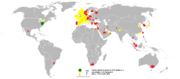 The UK entered a recession in Q2 of 2008, according to the UK Office of National Statistics (ONS) and exited it in Q4 of 2009. The revised ONS figures of November 2009 showed that the UK had suffered six consecutive quarters of negative growth. As of the end of November 2009, the economy had shrunk by 4.9%, making the 2008–2009 recession the longest since records began. In December 2009, the Office of National Statistics revised figures for the third quarter of 2009 showed that the economy shrank by 0.2%, compared to a 0.6% fall the previous quarter.
On 23 January 2009, Government figures from the Office for National Statistics showed that the UK was officially in recession for the first time since 1991. It entered a recession in the final quarter of 2008, accompanied by rising unemployment
which increased from 5.2% in May 2008 to 7.6% in May 2009. The unemployment rate among 18 to 24-year-olds has risen from 11.9% to 17.3%. Though initially Britain lagged behind other major economies including Germany, France, Japan, and the US which all returned to growth in the second quarter of 2009, the country eventually returned to growth in the last quarter of 2009. On 26 January 2010, it was confirmed that the U.K. had left its recession, the last major economy in the world to do so. In the 3 months to February 2010 the U.K. economy grew yet again by 0.4%. In Q2 of 2010 the economy grew by 1.2% the fastest rate of growth in 9 years. In Q3 of 2010 figures released showed the UK economy grew by 0.8%; this was the fastest Q3 growth in 10 years.
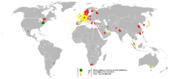 It has been suggested that the UK initially lagged behind its European neighbours because the UK entered the 2008 recession later. However, German GDP fell 4.7% year on year compared to the UK's 5.1%, and Germany has now posted a second quarterly gain in GDP. Commentators suggest that the UK suffered a slightly longer recession than other large European countries, as a result of government policy dating back to the policies of the Thatcher government of 1979, in which UK governments have moved away from supporting manufacturing and focused on the financial sector. The OECD predicts that the UK will grow 1.6% in 2010. The unemployment rate recorded by the Labour Force Survey
fell in the fourth quarter of 2009, the first of the big 3 economies in the EU to do so.
Gross Domestic Product (GDP) decreased by a (second revision) figure of 0.2% in the third quarter of 2009, after a decrease of 0.6% in the second quarter, according to the Office for National Statistics
(ONS). There was a 2.4% decline in the first quarter of 2009. The economy has now contracted 5.9% from its peak before the recession began, the BBC reports.
In October 2007, the International Monetary Fund
(IMF) had forecast British GDP to grow by 3.1% in 2007 and 2.3% in 2008. However, GDP growth slowed to a fall of 0.1% in the April–June (second) quarter of 2008 (revised down from zero). In September 2008, the OECD forecast contraction for at least two quarters for the UK economy, possibly severe, placing its predicted performance last in the G7 of leading economies. Six quarters later the UK economy was still contracting, placing a question mark over OECD forecasting methods.
It has been argued that heavy government borrowing over the past cycle has led to a severe structural deficit, reminiscent of previous crises, which will inevitably exacerbate the situation and place the UK economy in an unfavourable position compared to its OECD partners as attempts are made to stimulate recovery, other OECD nations having allowed greater room for manoeuvre thanks to contrasting policies of relatively tighter fiscal control prior to the global downturn.
In May 2009 the European Commission (EC) stated: "The UK economy is now clearly experiencing one of its worst recessions in recent history." The EC expected GDP to decline 3.8pc in 2009 and projected that growth will remain negative for the first three quarters of 2009. It predicted two quarters of "virtual stagnation" in late 2009-early 2010, followed by a gradual return to "slight positive growth by late 2010".
The FTSE 100 and FTSE 250 rose to their highest levels in a year on 9 September 2009 with the FTSE 100 breaking through 5,000 and the FTSE 250 breaking through 9,000. On 8 September the National Institute of Economic and Social Research believed that the economy had grown by 0.2% in the three months to August, but was proved wrong. In its eyes the UK recession was officially over, although it did warn that "normal economic conditions" had not returned. On the same day, figures also showed UK manufacturing output rising at its fastest rate in 18 months in July. On 15 September 2009 the EU incorrectly predicted the UK is expected to grow by 0.2% between July and September, on the same day the governor of the Bank of England, Mervyn King said the UK GDP is now growing. Unemployment has recently fallen in Wales.
Many commentators in the UK were certain that the UK would leave recession officially in Q3, believing that all the signs showed that growth was extremely likely, although in fact government spending had been insufficient to rescue the economy from recession at that point. Figures in fact showed no growth in retail sales in September 2009, and a 2.5% decline in industrial output in August. The revised UK figures confirmed that the economy shrank in Q3 of 2009 by 0.2%, although government spending on cash for the car scrappage scheme helped.
Yet this temporary lapse was followed by a solid 0.4% growth in the Q4.
UK manufacturers' body, the EEF, appealed for more cash from the government: "Without an extension of support for business investment in the pre-Budget statement next month, it will be difficult to see where the momentum for growth will come from."
Moody's
, an American credit rating organisation, gave the UK an AAA credit rating in September 2010, forecasting stable finances largely driven by governmental action. It also reported that the economy is flexible to grow in the future and that household debts and poor exports were large growth-reducing factors, as well as its financial sector.
The UK entered its worst recession
since World War II in 2008. However the UK economy grew by 1.2% in Q2 of 2010 and 0.8% in Q3, the fastest consecutive growth in over 10 years, accelerating from the 0.4% growth recorded in Q1 of 2010 and 0.4% growth in Q4 of 2009. However, the UK economy shrunk 0.5% in Q4 of 2010 after the UK had its coldest December on record. The UK economy grew by 0.4% in the first three months of 2011, reducing the risk of a double-dip recession. Q2 brought little growth of first 0.3% but then revised down to 0.1%. This was followed by 0.5% in Q3. In 2011 the UK's economy has grown only 1.0%.
For purchasing power parity
comparisons, the US Dollar is exchanged at £0.66.
is intensive, highly mechanised
, and efficient by Europe
an standards, producing about 60% of food needs, with less than 1.6% of the labor force (535,000 workers). It contributes around 0.6% of British national value added
. Around two-thirds of the production is devoted to livestock
, one-third to arable
crops. Agriculture is subsidised by the European Union's Common Agricultural Policy
.
The UK retains a significant, though reduced, fishing
industry. Its fleets, based in towns such as Kingston upon Hull
, Grimsby
, Fleetwood
, Great Yarmouth
, Peterhead
, Fraserburgh
, and Lowestoft
, bring home fish ranging from sole
to herring
.
The Blue Book 2006 (page 110) reports that "agriculture, hunting, forestry and fishing" added gross value of £10,323 million (at 2006 prices) to the UK economy in 2004.
 In 2009 the UK manufacturing sector generated approximately £140 billion in gross value added and employed around 2.6 million people. Of the approximately £16 billion invested in R&D by UK businesses in 2008, approximately £12 billion was by manufacturing businesses. In 2008, the UK was the sixth-largest manufacturer in the world measured by value of output.
In 2008 around 180,000 people in the UK were directly employed in the UK automotive manufacturing sector. In that year the sector had a turnover of £52.5 billion, generated £26.6 billion of exports and produced around 1.45 million passenger vehicles and 203,000 commercial vehicles. The UK is a major centre for engine manufacturing, and in 2008 around 3.16 million engines were produced in the country.
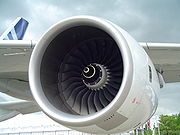
The aerospace industry of the UK is the second- or third-largest aerospace industry in the world, depending upon the method of measurement. The industry employs around 113,000 people directly and around 276,000 indirectly and has an annual turnover of around £20 billion. British companies with a major presence in the industry include BAE Systems
(the world's second-largest defence contractor) and Rolls-Royce
(the world's second-largest aircraft engine maker). Foreign aerospace companies active in the UK include EADS
and its Airbus
subsidiary, which employs over 13,000 people in the UK.
The pharmaceutical industry
employs around 67,000 people in the UK and in 2007 contributed £8.4 billion to the UK's GDP and invested a total of £3.9 billion in research and development
. In 2007 exports of pharmaceutical products from the UK totalled £14.6 billion, creating a trade surplus in pharmaceutical products of £4.3 billion. The UK is home to GlaxoSmithKline
and AstraZeneca
, respectively the world's third- and seventh-largest pharmaceutical companies.
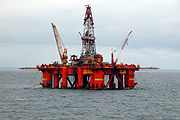 The Blue Book 2006 reports that this sector added gross value of £21,876 million to the UK economy in 2004. In 2007 the UK had a total energy output of 9.5 quadrillion Btus
, of which the composition was oil (38%), natural gas (36%), coal (13%), nuclear (11%) and other renewables (2%). In 2009, the UK produced 1.5 million barrels per day (bbl/d) of oil and consumed 1.7 million bbl/d. Production is now in decline and the UK has been a net importer of oil since 2005. As of 2010 the UK has around 3.1 billion barrels of proven crude oil reserves, the largest of any EU member state.
In 2009 the UK was the 13th largest producer of natural gas in the world and the largest producer in the EU. Production is now in decline and the UK has been a net importer of natural gas since 2004. In 2009 the UK produced 19.7 million tons of coal and consumed 60.2 million tons. In 2005 it had proven recoverable coal reserves of 171 million tons. It has been estimated that identified onshore areas have the potential to produce between 7 billion tonnes and 16 billion tonnes of coal through underground coal gasification (UCG)
. Based on current UK coal consumption, these volumes represent reserves that could last the UK between 200 and 400 years.
The UK is home to a number of large energy companies, including two of the six oil and gas "supermajor
s" – BP
and Royal Dutch Shell
– and BG Group
.
accounted for 7% GVA in 2005 and grew at an average of 6% per annum between 1997 and 2005. Key areas include London and Manchester
which are the two largest creative industry clusters in Europe respectively.
In 2008 health and social work had a gross value added of around £93.7 billion. In the UK the majority of the heathcare sector consists of the state funded and operated National Health Service
(NHS), which accounts for over 80% of all healthcare spending in the UK and has a workforce of around 1.5 million, making it the largest employer in Europe. The NHS operates independently in each of the four constituent countries
of the UK. The NHS in England
is by far the largest of the four parts and had a turnover of £92.5 billion in 2008.
In 2008 education had a gross value added of around £76.4 billion. In 2007/08 higher education institutions in the UK had a total income of £23.4 billion and employed a total of 169,995 staff. In 2007/08 there were 2,306,105 higher education students in the UK (1,922,180 in England, 210,180 in Scotland, 125,540 in Wales and 48,200 in Northern Ireland).
.
London is a major centre for international business
and commerce and is one of the three "command centres" of the global economy
(alongside New York City
and Tokyo
). There are over 500 banks with offices in London, and it is the leading international centre for banking, insurance, Eurobond
s, foreign exchange
trading and energy futures
. London's financial services industry is primarily based in the City of London
and Canary Wharf
. The City houses the London Stock Exchange
, the London International Financial Futures and Options Exchange
, the London Metal Exchange
, Lloyds of London, and the Bank of England
. Canary Wharf began development in the 1980s and is now home to major financial institutions such as Barclays Bank, Citigroup
and HSBC
, as well as the UK Financial Services Authority
.) London is also a major centre for other business and professional services, and four of the six largest law firms in the world are headquartered there.
Several other major UK cities have large financial sectors and related services. Edinburgh
has one of the large financial centres in Europe
and is home to the headquarters of the Royal Bank of Scotland Group and Standard Life
. Leeds
is now the UK's largest centre for business and financial services outside London, and the largest centre for legal services in the UK after London.
The UK property market boomed for the seven years up to 2008 and in some areas property trebled in value over that period. The increase in property prices had a number of causes: low interest rates, credit growth, economic growth, rapid growth in buy to-let property investment, foreign property investment in London and planning restrictions
on the supply of new housing.
is very important to the British economy. With over 27 million tourists arriving in 2004, the United Kingdom is ranked as the sixth major tourist destination in the world. London, by a considerable margin, is the most visited city in the world with 15.6 million visitors in 2006, ahead of 2nd placed Bangkok (10.4 million visitors) and 3rd placed Paris (9.7 million).
The UK has a radial road network of 46904 kilometres (29,145 mi) of main roads, with a motorway network of 3497 kilometres (2,173 mi). There are a further 213750 kilometres (132,818 mi) of paved roads. There is a rail network
of 16116 km (10,014 mi) in Great Britain and 303 route km (189 route mi) in Northern Ireland
, which carries over 18,000 passenger trains and 1,000 freight trains per day. Urban rail networks are well developed in London and other cities. Plans are now being considered to build new high speed lines by 2025.
The Highways Agency
is the executive agency
responsible for trunk roads and motorways in England apart from the privately owned and operated M6 Toll
. The Department for Transport states that traffic congestion
is one of the most serious transport problems and that it could cost England an extra £22 billion in wasted time by 2025 if left unchecked. According to the government-sponsored Eddington report
of 2006, congestion is in danger of harming the economy, unless tackled by road pricing
and expansion of the transport network.
In the year from October 2009 to September 2010 UK airports handled a total of 211.4 million passengers. In that period the three largest airports were London Heathrow Airport
(65.6 million passengers), Gatwick Airport (31.5 million passengers) and London Stansted Airport
(18.9 million passengers). London Heathrow Airport, located 24 kilometres (15 mi) west of the capital, has the most international passenger traffic of any airport in the world. and is the hub for the UK flag carrier British Airways
, as well as BMI
and Virgin Atlantic.
The UK grocery market is dominated by five companies – Asda
(owned by Wal-Mart Stores), The Co-operative Food
, Morrisons
, Sainsbury's and Tesco
– which together have a market share of over 80%.
London is a major retail centre and in 2010 had the highest non-food retail sales of any city in the world, with a total spend of around £64.2 billion. The UK-based Tesco is the third-largest retailer in the world measured by revenues (after Wal-Mart Stores and Carrefour
) and is the current leader in the UK market with around a 30% share..
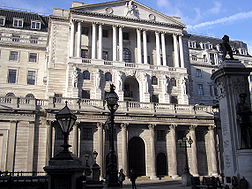 London is the world capital for foreign exchange trading. The highest daily volume, counted in trillions of dollars US, is reached when New York
enters the trade. The currency of the UK is the pound sterling
, represented by the symbol £
. The Bank of England
is the central bank
, responsible for issuing currency. Banks in Scotland and Northern Ireland retain the right to issue their own notes, subject to retaining enough Bank of England notes in reserve to cover the issue. Pound sterling is also used as a reserve currency
by other governments and institutions, and is the third-largest after the U.S. dollar and the euro
.
The UK chose not to join the euro at the currency's launch. The government of former Prime Minister Tony Blair had pledged to hold a public referendum for deciding membership should "five economic tests
" be met. Until relatively recently there was debate over whether or not the UK should abolish its currency Pound Sterling
and join the Euro
. In 2007 the British Prime Minister, Gordon Brown
, pledged at the time to hold a public referendum
based on certain tests he set as Chancellor of the Exchequer
. When assessing the tests, Gordon Brown concluded that while the decision was close, the United Kingdom should not yet join the Euro. He ruled out membership for the foreseeable future, saying that the decision not to join had been right for Britain and for Europe. In particular, he cited fluctuations in house prices as a barrier to immediate entry. Public opinion poll
s have shown that a majority of Britons have been opposed to joining the single currency for some considerable time and this position has now hardened further. In 2005, more than half (55%) of the UK were against adopting the currency, while 30% were in favour. The current government, a Conservative and Liberal Democrat coalition, is opposed to membership.
(euro) per GBP; and inversely: GBP per USD and EUR. (Synthetic Euro XEU before 1999). Caution: these averages conceal wide intra-year spreads. The coefficient of variation
gives an indication of this. It also shows the extent to which the pound tracks the euro or the dollar. Note the effect of Black Wednesday
in late 1992 by comparing the averages for 1992 with the averages for 1993.
1 GBP in USD since 1971
(GVA) with Scotland close behind, though Scotland has a higher figure, estimated as approximately £24 000 per capita in 2009, once a geographical share of oil and gas is assigned. Scotland had the best rate of per capita growth over the preceding 12 months, declining by 1.4%, ahead of the best performing region of England which was the North West with a decline of 1.9%. GVA per capita figures for 2009 for the four countries of the United Kingdom (excluding oil and gas) are:
Within England, GVA per capita is highest in London
. The following table shows the GVA (2009) per capita of the 9 statistical regions of England (NUTS
).
Two of the richest 10 areas in the European Union are in the United Kingdom. Inner London
is number 1 with a GDP per capita of €65 138, and Berkshire
, Buckinghamshire
and Oxfordshire
is number 7 with a GDP per capita of €37 379. Edinburgh
is also one of the largest financial centres in Europe.
 Government involvement throughout the economy is exercised by the Chancellor of the Exchequer
who heads HM Treasury
. In recent years, the UK economy has been managed in accordance with principles of market liberalisation and low taxation and regulation. Since 1997, the Bank of England
's Monetary Policy Committee
, headed by the Governor of the Bank of England
, has been responsible for setting interest rates
at the level necessary to achieve the overall inflation target for the economy that is set by the Chancellor each year. The Scottish Government, subject to the approval of the Scottish Parliament, has the power to vary the basic rate of income tax payable in Scotland by plus or minus 3 pence in the pound, though this power has not yet been exercised.
In the 20 year period from 1986/87 to 2006/07 government spending in the UK averaged around 40% of GDP. As a result of the 2007–2010 financial crisis and the late-2000s global recession government spending increased to a historically high level of 48% of GDP in 2009–10, partly as a result of the cost of a series of bank bailouts
. In July 2007, the UK had government debt
at 35.5% of GDP
. This figure rose to 56.8% of GDP by July 2009. As of June 2010 there were approximately 6,051,000 public sector employees in the UK (compared to approximately 23,107,000 private sector employees).
may involve payments to at least two different levels of government: local government and central government (HM Revenue & Customs). Local government is financed by grants from central government funds, business rates
, council tax
and increasingly from fees and charges such as those from on-street parking
. Central government revenues are mainly income tax
, national insurance
contributions, value added tax
, corporation tax
and fuel duty
.
These data show the tax burden (personal and corporate) and national debt as a percentage of GDP. Samples are taken at 10 year intervals (snapshots, but the rolling averages are very close).
in February 2010.
UK export figures are boosted 10% by high levels of Missing trader fraud
according to the Office for National Statistics
.
with social welfare infrastructure, thus discussions surrounding poverty tend to be of relative poverty rather than absolute poverty. According to the OECD, the UK is in the lower half of developed country rankings for poverty rates, doing better than Germany, Italy and the US and less well than France, Austria, Hungary, Slovakia and the Scandinavian countries.
The poverty line in the UK is commonly defined as being 60% of the median household income. In 2007–2008, this was calculated to be £115 per week for single adults with no dependent children; £199 per week for couples with no dependent children; £195 per week for single adults with two dependent children under 14; and £279 per week for couples with two dependent children under 14. In 2007–2008, 13.5 million people, or 22% of the population, lived below this line. This is a higher level of relative poverty than all but four other EU members. In the same year, 4.0 million children, 31% of the total, lived in households below the poverty line, after housing costs were taken into account. This is a decrease of 400,000 children since 1998–1999.
United Kingdom
The United Kingdom of Great Britain and Northern IrelandIn the United Kingdom and Dependencies, other languages have been officially recognised as legitimate autochthonous languages under the European Charter for Regional or Minority Languages...
is the sixth-largest national economy in the world measured by nominal GDP and seventh-largest measured by purchasing power parity
Purchasing power parity
In economics, purchasing power parity is a condition between countries where an amount of money has the same purchasing power in different countries. The prices of the goods between the countries would only reflect the exchange rates...
(PPP), and the third-largest in Europe
Europe
Europe is, by convention, one of the world's seven continents. Comprising the westernmost peninsula of Eurasia, Europe is generally 'divided' from Asia to its east by the watershed divides of the Ural and Caucasus Mountains, the Ural River, the Caspian and Black Seas, and the waterways connecting...
measured by nominal GDP (after Germany
Economy of Germany
Germany is the largest national economy in Europe, the fourth-largest by nominal GDP in the world, and fifth by GDP in 2008. Since the age of industrialisation, the country has been a driver, innovator, and beneficiary of an ever more globalised economy...
and France
Economy of France
France is the world's fifth largest economy by nominal figures and the ninth largest economy by PPP figures. It is the second largest economy in Europe in nominal figures and third largest economy in Europe in PPP figures...
) and second-largest measured by PPP (after Germany). The UK's GDP per capita is the 20th highest in the world in nominal terms and the 17th highest measured by PPP. The British economy comprises (in descending order of size) the economies of the countries of England
Economy of England
The Economy of England is the largest economy of the four countries of the United Kingdom, and the sixth largest in the world if the countries of the United Kingdom were compared with other countries....
, Scotland
Economy of Scotland
The economy of Scotland is closely linked with the rest of the United Kingdom and the wider European Economic Area. Scotland has the second largest GVA per capita of countries in the United Kingdom after England, though it is still lower than the average of the United Kingdom as a whole...
, Wales
Economy of Wales
The Economy of Wales. In 2010, according to ONS provisional data, headline gross value added in Wales was £44,517m, making the Welsh economy the tenth largest of the UK's twelve regions ahead of only Northern Ireland and the North East of England...
and Northern Ireland
Economy of Northern Ireland
The economy of Northern Ireland is the smallest of the four countries in the United Kingdom. Northern Ireland has traditionally had an industrial economy, most notably in shipbuilding, rope manufacture and textiles, but most heavy industry has since been replaced by services...
. The UK is a member of the Commonwealth of Nations
Commonwealth of Nations
The Commonwealth of Nations, normally referred to as the Commonwealth and formerly known as the British Commonwealth, is an intergovernmental organisation of fifty-four independent member states...
, the European Union
European Union
The European Union is an economic and political union of 27 independent member states which are located primarily in Europe. The EU traces its origins from the European Coal and Steel Community and the European Economic Community , formed by six countries in 1958...
, the G7, the G8
G8
The Group of Eight is a forum, created by France in 1975, for the governments of seven major economies: Canada, France, Germany, Italy, Japan, the United Kingdom, and the United States. In 1997, the group added Russia, thus becoming the G8...
, the G20
G-20 major economies
The Group of Twenty Finance Ministers and Central Bank Governors is a group of finance ministers and central bank governors from 20 major economies: 19 countries plus the European Union, which is represented by the President of the European Council and by the European Central Bank...
, the International Monetary Fund
International Monetary Fund
The International Monetary Fund is an organization of 187 countries, working to foster global monetary cooperation, secure financial stability, facilitate international trade, promote high employment and sustainable economic growth, and reduce poverty around the world...
, the Organisation for Economic Co-operation and Development
Organisation for Economic Co-operation and Development
The Organisation for Economic Co-operation and Development is an international economic organisation of 34 countries founded in 1961 to stimulate economic progress and world trade...
, the World Bank
World Bank
The World Bank is an international financial institution that provides loans to developing countries for capital programmes.The World Bank's official goal is the reduction of poverty...
, the World Trade Organisation and the United Nations
United Nations
The United Nations is an international organization whose stated aims are facilitating cooperation in international law, international security, economic development, social progress, human rights, and achievement of world peace...
.
In the 18th century the UK was the first country in the world to industrialise
Industrialisation
Industrialization is the process of social and economic change that transforms a human group from an agrarian society into an industrial one...
, and during the 19th century possessed a dominant role in the global economy. From the late 19th century the Second Industrial Revolution
Second Industrial Revolution
The Second Industrial Revolution, also known as the Technological Revolution, was a phase of the larger Industrial Revolution corresponding to the latter half of the 19th century until World War I...
in the United States
United States
The United States of America is a federal constitutional republic comprising fifty states and a federal district...
and the German Empire
German Empire
The German Empire refers to Germany during the "Second Reich" period from the unification of Germany and proclamation of Wilhelm I as German Emperor on 18 January 1871, to 1918, when it became a federal republic after defeat in World War I and the abdication of the Emperor, Wilhelm II.The German...
presented an increasing challenge to Britain's role as leader of the global economy. Despite victory, the costs of fighting both the First World War
World War I
World War I , which was predominantly called the World War or the Great War from its occurrence until 1939, and the First World War or World War I thereafter, was a major war centred in Europe that began on 28 July 1914 and lasted until 11 November 1918...
and Second World War
World War II
World War II, or the Second World War , was a global conflict lasting from 1939 to 1945, involving most of the world's nations—including all of the great powers—eventually forming two opposing military alliances: the Allies and the Axis...
further weakened the relative economic position of the UK, and by 1945 Britain had been superseded by the United States as the world's dominant economic power. However, the UK still maintains a significant role in the world economy.
The UK is one of the world's most globalised
Globalization Index
This article includes a list of countries of the world sorted by their globalization, the global connectivity, integration and interdependence in the economic, social, technological, cultural, political, and ecological spheres....
countries. London is the world's largest financial centre alongside New York
New York City
New York is the most populous city in the United States and the center of the New York Metropolitan Area, one of the most populous metropolitan areas in the world. New York exerts a significant impact upon global commerce, finance, media, art, fashion, research, technology, education, and...
and has the largest city GDP in Europe. As of December 2010 the UK had the third-largest stock of both inward and outward foreign direct investment
Foreign direct investment
Foreign direct investment or foreign investment refers to the net inflows of investment to acquire a lasting management interest in an enterprise operating in an economy other than that of the investor.. It is the sum of equity capital,other long-term capital, and short-term capital as shown in...
(in each case after the United States and France). The aerospace industry of the UK is the second- or third-largest national aerospace industry, depending upon the method of measurement. The pharmaceutical industry
Pharmaceutical industry in the United Kingdom
The pharmaceutical industry in the United Kingdom directly employs around 72,000 people and in 2007 contributed £8.4 billion to the UK's GDP and invested a total of £3.9 billion in research and development...
plays an important role in the UK economy and the country has the third-highest share of global pharmaceutical R&D expenditures (after the United States
United States
The United States of America is a federal constitutional republic comprising fifty states and a federal district...
and Japan
Japan
Japan is an island nation in East Asia. Located in the Pacific Ocean, it lies to the east of the Sea of Japan, China, North Korea, South Korea and Russia, stretching from the Sea of Okhotsk in the north to the East China Sea and Taiwan in the south...
). The British economy is boosted by North Sea oil and gas
North Sea oil
North Sea oil is a mixture of hydrocarbons, comprising liquid oil and natural gas, produced from oil reservoirs beneath the North Sea.In the oil industry, the term "North Sea" often includes areas such as the Norwegian Sea and the area known as "West of Shetland", "the Atlantic Frontier" or "the...
reserves, valued at an estimated £250 billion in 2007. The UK is currently ranked fourth in the world (and first in Europe) in the World Bank
World Bank
The World Bank is an international financial institution that provides loans to developing countries for capital programmes.The World Bank's official goal is the reduction of poverty...
's Ease of Doing Business Index
Ease of Doing Business Index
The Ease of Doing Business Index is an index created by the World Bank. Higher rankings indicate better, usually simpler, regulations for businesses and stronger protections of property rights...
.
Post-war recovery
Following the end of World War II, there was a long interval without a major recession (1945–1973) and a growth in prosperity in the 1950s and 1960s. According to the OECD, the annual rate of growth (percentage change) between 1960 and 1973 averaged 2.9%, although this figure was far behind the rates of other European countries such as FranceFrance
The French Republic , The French Republic , The French Republic , (commonly known as France , is a unitary semi-presidential republic in Western Europe with several overseas territories and islands located on other continents and in the Indian, Pacific, and Atlantic oceans. Metropolitan France...
, West Germany
West Germany
West Germany is the common English, but not official, name for the Federal Republic of Germany or FRG in the period between its creation in May 1949 to German reunification on 3 October 1990....
and Italy
Italy
Italy , officially the Italian Republic languages]] under the European Charter for Regional or Minority Languages. In each of these, Italy's official name is as follows:;;;;;;;;), is a unitary parliamentary republic in South-Central Europe. To the north it borders France, Switzerland, Austria and...
.
However, following the severe shock of the 1973 oil crisis
1973 oil crisis
The 1973 oil crisis started in October 1973, when the members of Organization of Arab Petroleum Exporting Countries or the OAPEC proclaimed an oil embargo. This was "in response to the U.S. decision to re-supply the Israeli military" during the Yom Kippur war. It lasted until March 1974. With the...
and the 1973–1974 stock market crash, the British economy had fallen into recession by the time Edward Heath's
Edward Heath
Sir Edward Richard George "Ted" Heath, KG, MBE, PC was a British Conservative politician who served as Prime Minister of the United Kingdom and as Leader of the Conservative Party ....
Conservative Party
Conservative Party (UK)
The Conservative Party, formally the Conservative and Unionist Party, is a centre-right political party in the United Kingdom that adheres to the philosophies of conservatism and British unionism. It is the largest political party in the UK, and is currently the largest single party in the House...
government had been ousted by the Labour Party
Labour Party (UK)
The Labour Party is a centre-left democratic socialist party in the United Kingdom. It surpassed the Liberal Party in general elections during the early 1920s, forming minority governments under Ramsay MacDonald in 1924 and 1929-1931. The party was in a wartime coalition from 1940 to 1945, after...
as Harold Wilson
Harold Wilson
James Harold Wilson, Baron Wilson of Rievaulx, KG, OBE, FRS, FSS, PC was a British Labour Member of Parliament, Leader of the Labour Party. He was twice Prime Minister of the United Kingdom during the 1960s and 1970s, winning four general elections, including a minority government after the...
moved into office for the second time, forming a minority government on 4 March after the general election on 28 February
United Kingdom general election, February 1974
The United Kingdom's general election of February 1974 was held on the 28th of that month. It was the first of two United Kingdom general elections held that year, and the first election since the Second World War not to produce an overall majority in the House of Commons for the winning party,...
ended in a hung parliament
Hung parliament
In a two-party parliamentary system of government, a hung parliament occurs when neither major political party has an absolute majority of seats in the parliament . It is also less commonly known as a balanced parliament or a legislature under no overall control...
, and then securing a three-seat majority in a second election in October that year
United Kingdom general election, October 1974
The United Kingdom general election of October 1974 took place on 10 October 1974 to elect 635 members to the British House of Commons. It was the second general election of that year and resulted in the Labour Party led by Harold Wilson, winning by a tiny majority of 3 seats.The election of...
.
GDP had fallen by 1.1%, recording weaker growth than other European nations in the 1970s overall; even when the recession ended in 1975, the economy was still blighted by double-digit inflation and unemployment was rising. Overall economic picture deteriorated with accelerating inflation and slumping pound sterling pushing the UK to accept an IMF rescue to the tune of £2.3bn loan (£12.5bn in today's currency). The IMF forced Chancellor Denis Healey into harsh public spending cuts and austere economic measures as part of reforms put through to improve the economic situation and as a condition to the rescue package. Soon enough, in 1979 the government fell.
Neoliberalism
A new period of neo-liberalNeoliberalism
Neoliberalism is a market-driven approach to economic and social policy based on neoclassical theories of economics that emphasizes the efficiency of private enterprise, liberalized trade and relatively open markets, and therefore seeks to maximize the role of the private sector in determining the...
economics began in 1979 with the election of Margaret Thatcher
Margaret Thatcher
Margaret Hilda Thatcher, Baroness Thatcher, was Prime Minister of the United Kingdom from 1979 to 1990...
, who won the general election
United Kingdom general election, 1979
The United Kingdom general election of 1979 was held on 3 May 1979 to elect 635 members to the British House of Commons. The Conservative Party, led by Margaret Thatcher ousted the incumbent Labour government of James Callaghan with a parliamentary majority of 43 seats...
on 3 May that year to return the Conservative Party to government after five years of Labour rule.
During the 1980s most state-owned enterprises were privatised, taxes cut and markets deregulated. GDP fell 5.9% at first but growth rose to 5% at its peak in 1988, one of the highest rates of any European nation.
However, Mrs Thatcher's modernisation of the British economy was far from trouble free; her battle against inflation resulted in mass unemployment with the jobless count passing 3,000,000 by the start of 1982 compared to 1,500,000 three years previously. This was in part due to the closure of outdated factories and coalpits which were no longer economically viable; this process continued for most of the rest of the decade. Unemployment peaked at nearly 3,300,000 during 1984 before falling dramatically in the final three years of the decade, standing at just over 1,600,000 by the end of 1989. However, the British economy slid into another recession during the second half of 1990, concurrent with a global recession, and caused the economy to shrink by a total of 8% from peak to trough and unemployment to increase from around 1,600,000 to nearly 3,000,000 by early 1993, when the recession ended, and the subsequent economic recovery was extremely strong. Unlike the early 1980s recession the recovery saw a rapid and substantial fall in unemployment, which was down to 1,700,000 by 1997.
The Labour Party, led by Tony Blair, returned to power in May 1997 after 18 years in opposition. During Blair's 10 years in office there were 40 successive quarters of economic growth, lasting until the second quarter of 2008. The previous 15 years had seen one of the highest economic growth rates of major developed economies during that time and certainly the strongest of any European nation. GDP growth had briefly reached 4% in the early 1990s, gently declining thereafter. Peak growth was relatively anaemic compared to prior decades, such as the 6.5% peak in the early 1970s, although growth was smoother and more consistent. Annual growth rates averaged 2.68% between 1992–2007 according to the IMF, with the finance sector growth contributing a greater part than previously. This extended period of growth ended in 2008 when the United Kingdom suddenly entered a recession
Late 2000s recession
The late-2000s recession, sometimes referred to as the Great Recession or Lesser Depression or Long Recession, is a severe ongoing global economic problem that began in December 2007 and took a particularly sharp downward turn in September 2008. The Great Recession has affected the entire world...
– its first for nearly two decades – brought about by the global financial crisis. Beginning with the collapse of Northern Rock
Northern Rock
Northern Rock plc is a British bank, best known for becoming the first bank in 150 years to suffer a bank run after having had to approach the Bank of England for a loan facility, to replace money market funding, during the credit crisis in 2007. Having failed to find a commercial buyer for...
, which was taken into public ownership in February 2008, other banks had to be partly nationalised. The Royal Bank of Scotland Group, which at its peak was the fifth-largest in the world by market capitalisation, was effectively nationalised on 13 October 2008. By mid 2009, HM Treasury had a 70.33% controlling shareholding in RBS, and a 43% shareholding through UK Financial Investments Limited of Lloyds Banking Group
Lloyds Banking Group
Lloyds Banking Group plc is a major British financial institution, formed through the acquisition of HBOS by Lloyds TSB in 2009. As at February 2010, HM Treasury held a 41% shareholding through UK Financial Investments Limited . The Group headquarters is located at 25 Gresham Street in London, with...
. The recession saw unemployment rise from just over 1,600,000 in January 2008 to nearly 2,500,000 in October 2009.
The UK economy had been one of the strongest EU economies in terms of inflation
Inflation
In economics, inflation is a rise in the general level of prices of goods and services in an economy over a period of time.When the general price level rises, each unit of currency buys fewer goods and services. Consequently, inflation also reflects an erosion in the purchasing power of money – a...
, interest rate
Interest rate
An interest rate is the rate at which interest is paid by a borrower for the use of money that they borrow from a lender. For example, a small company borrows capital from a bank to buy new assets for their business, and in return the lender receives interest at a predetermined interest rate for...
s and unemployment
Unemployment
Unemployment , as defined by the International Labour Organization, occurs when people are without jobs and they have actively sought work within the past four weeks...
, all of which remained relatively low until the 2008–09 recession. Unemployment has since reached a peak of just under 2.5 million (7.8%), the highest level since early 1990s, although still far lower than some other European nations. However, interest rates have been slashed to 0.5%. During August 2008 the IMF warned that the UK economic outlook had worsened due to a twin shock: financial turmoil as well as rising commodity prices. Both developments harm the UK more than most developed countries, as the UK obtains revenue from exporting financial services while recording deficits in finished goods and commodities, including food. In 2007, the UK had the world's third largest current account deficit, due mainly to a large deficit in manufactured goods. During May 2008, the IMF advised the UK government to broaden the scope of fiscal policy to promote external balance. Although the UK's "labour productivity per person employed" has been progressing well over the last two decades and has overtaken productivity in Germany, it still lags around 20% behind France's level, where workers have a 35-hour working week. The UK's "labour productivity per hour worked" is currently on a par with the average for the "old" EU (15 countries). In 2010, the United Kingdom ranked 26th on the Human Development Index
Human Development Index
The Human Development Index is a composite statistic used to rank countries by level of "human development" and separate "very high human development", "high human development", "medium human development", and "low human development" countries...
.
Recent
On 23 January 2009, Government figures from the Office for National Statistics showed that the UK was officially in recession for the first time since 1991. It entered a recession in the final quarter of 2008, accompanied by rising unemployment
Unemployment
Unemployment , as defined by the International Labour Organization, occurs when people are without jobs and they have actively sought work within the past four weeks...
which increased from 5.2% in May 2008 to 7.6% in May 2009. The unemployment rate among 18 to 24-year-olds has risen from 11.9% to 17.3%. Though initially Britain lagged behind other major economies including Germany, France, Japan, and the US which all returned to growth in the second quarter of 2009, the country eventually returned to growth in the last quarter of 2009. On 26 January 2010, it was confirmed that the U.K. had left its recession, the last major economy in the world to do so. In the 3 months to February 2010 the U.K. economy grew yet again by 0.4%. In Q2 of 2010 the economy grew by 1.2% the fastest rate of growth in 9 years. In Q3 of 2010 figures released showed the UK economy grew by 0.8%; this was the fastest Q3 growth in 10 years.
Labour Force Survey
Labour Force Surveys are statistical surveys conducted in a number of countries designed to capture data about the labour market. All European Union member states are required to conduct a Labour Force Survey annually. Labour Force Surveys are also carried out in some non-EU countries. They are...
fell in the fourth quarter of 2009, the first of the big 3 economies in the EU to do so.
Gross Domestic Product (GDP) decreased by a (second revision) figure of 0.2% in the third quarter of 2009, after a decrease of 0.6% in the second quarter, according to the Office for National Statistics
Office for National Statistics
The Office for National Statistics is the executive office of the UK Statistics Authority, a non-ministerial department which reports directly to the Parliament of the United Kingdom.- Overview :...
(ONS). There was a 2.4% decline in the first quarter of 2009. The economy has now contracted 5.9% from its peak before the recession began, the BBC reports.
In October 2007, the International Monetary Fund
International Monetary Fund
The International Monetary Fund is an organization of 187 countries, working to foster global monetary cooperation, secure financial stability, facilitate international trade, promote high employment and sustainable economic growth, and reduce poverty around the world...
(IMF) had forecast British GDP to grow by 3.1% in 2007 and 2.3% in 2008. However, GDP growth slowed to a fall of 0.1% in the April–June (second) quarter of 2008 (revised down from zero). In September 2008, the OECD forecast contraction for at least two quarters for the UK economy, possibly severe, placing its predicted performance last in the G7 of leading economies. Six quarters later the UK economy was still contracting, placing a question mark over OECD forecasting methods.
It has been argued that heavy government borrowing over the past cycle has led to a severe structural deficit, reminiscent of previous crises, which will inevitably exacerbate the situation and place the UK economy in an unfavourable position compared to its OECD partners as attempts are made to stimulate recovery, other OECD nations having allowed greater room for manoeuvre thanks to contrasting policies of relatively tighter fiscal control prior to the global downturn.
In May 2009 the European Commission (EC) stated: "The UK economy is now clearly experiencing one of its worst recessions in recent history." The EC expected GDP to decline 3.8pc in 2009 and projected that growth will remain negative for the first three quarters of 2009. It predicted two quarters of "virtual stagnation" in late 2009-early 2010, followed by a gradual return to "slight positive growth by late 2010".
The FTSE 100 and FTSE 250 rose to their highest levels in a year on 9 September 2009 with the FTSE 100 breaking through 5,000 and the FTSE 250 breaking through 9,000. On 8 September the National Institute of Economic and Social Research believed that the economy had grown by 0.2% in the three months to August, but was proved wrong. In its eyes the UK recession was officially over, although it did warn that "normal economic conditions" had not returned. On the same day, figures also showed UK manufacturing output rising at its fastest rate in 18 months in July. On 15 September 2009 the EU incorrectly predicted the UK is expected to grow by 0.2% between July and September, on the same day the governor of the Bank of England, Mervyn King said the UK GDP is now growing. Unemployment has recently fallen in Wales.
Many commentators in the UK were certain that the UK would leave recession officially in Q3, believing that all the signs showed that growth was extremely likely, although in fact government spending had been insufficient to rescue the economy from recession at that point. Figures in fact showed no growth in retail sales in September 2009, and a 2.5% decline in industrial output in August. The revised UK figures confirmed that the economy shrank in Q3 of 2009 by 0.2%, although government spending on cash for the car scrappage scheme helped.
Yet this temporary lapse was followed by a solid 0.4% growth in the Q4.
UK manufacturers' body, the EEF, appealed for more cash from the government: "Without an extension of support for business investment in the pre-Budget statement next month, it will be difficult to see where the momentum for growth will come from."
Moody's
Moody's
Moody's Corporation is the holding company for Moody's Analytics and Moody's Investors Service, a credit rating agency which performs international financial research and analysis on commercial and government entities. The company also ranks the credit-worthiness of borrowers using a standardized...
, an American credit rating organisation, gave the UK an AAA credit rating in September 2010, forecasting stable finances largely driven by governmental action. It also reported that the economy is flexible to grow in the future and that household debts and poor exports were large growth-reducing factors, as well as its financial sector.
The UK entered its worst recession
Recession
In economics, a recession is a business cycle contraction, a general slowdown in economic activity. During recessions, many macroeconomic indicators vary in a similar way...
since World War II in 2008. However the UK economy grew by 1.2% in Q2 of 2010 and 0.8% in Q3, the fastest consecutive growth in over 10 years, accelerating from the 0.4% growth recorded in Q1 of 2010 and 0.4% growth in Q4 of 2009. However, the UK economy shrunk 0.5% in Q4 of 2010 after the UK had its coldest December on record. The UK economy grew by 0.4% in the first three months of 2011, reducing the risk of a double-dip recession. Q2 brought little growth of first 0.3% but then revised down to 0.1%. This was followed by 0.5% in Q3. In 2011 the UK's economy has grown only 1.0%.
Macroeconomic trend
This is a table of the trend of gross domestic product of United Kingdom at market prices estimated by the International Monetary Fund with figures in millions of pounds sterling.| Year | Gross domestic product | US dollar exchange | Inflation index (2000=100) |
Per Capita Income (as % of USA) |
|---|---|---|---|---|
| 1925 | 4,466 | £0.21 | 3 | 61.79 |
| 1930 | 4,572 | £0.21 | 3 | 66.08 |
| 1935 | 4,676 | £0.20 | 2 | 85.67 |
| 1940 | 7,117 | £0.26 | 3 | 74.28 |
| 1945 | 9,816 | £0.25 | 4 | 50.93 |
| 1950 | 13,162 | £0.36 | 5 | 38.26 |
| 1955 | 19,264 | £0.36 | 6 | 42.54 |
| 1960 | 25,678 | £0.36 | 7 | 47.86 |
| 1965 | 35,781 | £0.36 | 9 | 49.96 |
| 1970 | 51,515 | £0.42 | 11 | 44.04 |
| 1975 | 105,773 | £0.45 | 20 | 55.54 |
| 1980 | 230,695 | £0.42 | 43 | 78.57 |
| 1985 | 354,952 | £0.77 | 60 | 46.84 |
| 1990 | 557,300 | £0.56 | 76 | 76.62 |
| 1995 | 718,383 | £0.63 | 92 | 71.84 |
| 2000 | 953,576 | £0.65 | 100 | 72.29 |
| 2005 | 1,209,334 | £0.54 | 107 | 90.17 |
For purchasing power parity
Purchasing power parity
In economics, purchasing power parity is a condition between countries where an amount of money has the same purchasing power in different countries. The prices of the goods between the countries would only reflect the exchange rates...
comparisons, the US Dollar is exchanged at £0.66.
Agriculture, hunting, forestry, and fishing
AgricultureAgriculture
Agriculture is the cultivation of animals, plants, fungi and other life forms for food, fiber, and other products used to sustain life. Agriculture was the key implement in the rise of sedentary human civilization, whereby farming of domesticated species created food surpluses that nurtured the...
is intensive, highly mechanised
Mechanised agriculture
Mechanized agriculture is the process of using agricultural machinery to mechanize the work of agriculture, massively increasing farm output and farm worker productivity...
, and efficient by Europe
Europe
Europe is, by convention, one of the world's seven continents. Comprising the westernmost peninsula of Eurasia, Europe is generally 'divided' from Asia to its east by the watershed divides of the Ural and Caucasus Mountains, the Ural River, the Caspian and Black Seas, and the waterways connecting...
an standards, producing about 60% of food needs, with less than 1.6% of the labor force (535,000 workers). It contributes around 0.6% of British national value added
Value added
In economics, the difference between the sale price and the production cost of a product is the value added per unit. Summing value added per unit over all units sold is total value added. Total value added is equivalent to Revenue less Outside Purchases...
. Around two-thirds of the production is devoted to livestock
Livestock
Livestock refers to one or more domesticated animals raised in an agricultural setting to produce commodities such as food, fiber and labor. The term "livestock" as used in this article does not include poultry or farmed fish; however the inclusion of these, especially poultry, within the meaning...
, one-third to arable
Agronomy
Agronomy is the science and technology of producing and using plants for food, fuel, feed, fiber, and reclamation. Agronomy encompasses work in the areas of plant genetics, plant physiology, meteorology, and soil science. Agronomy is the application of a combination of sciences like biology,...
crops. Agriculture is subsidised by the European Union's Common Agricultural Policy
Common Agricultural Policy
The Common Agricultural Policy is a system of European Union agricultural subsidies and programmes. It represents 48% of the EU's budget, €49.8 billion in 2006 ....
.
The UK retains a significant, though reduced, fishing
Fishing
Fishing is the activity of trying to catch wild fish. Fish are normally caught in the wild. Techniques for catching fish include hand gathering, spearing, netting, angling and trapping....
industry. Its fleets, based in towns such as Kingston upon Hull
Kingston upon Hull
Kingston upon Hull , usually referred to as Hull, is a city and unitary authority area in the ceremonial county of the East Riding of Yorkshire, England. It stands on the River Hull at its junction with the Humber estuary, 25 miles inland from the North Sea. Hull has a resident population of...
, Grimsby
Grimsby
Grimsby is a seaport on the Humber Estuary in Lincolnshire, England. It has been the administrative centre of the unitary authority area of North East Lincolnshire since 1996...
, Fleetwood
Fleetwood
Fleetwood is a town within the Wyre district of Lancashire, England, lying at the northwest corner of the Fylde. It had a population of 26,840 people at the 2001 Census. It forms part of the Greater Blackpool conurbation. The town was the first planned community of the Victorian era...
, Great Yarmouth
Great Yarmouth
Great Yarmouth, often known to locals as Yarmouth, is a coastal town in Norfolk, England. It is at the mouth of the River Yare, east of Norwich.It has been a seaside resort since 1760, and is the gateway from the Norfolk Broads to the sea...
, Peterhead
Peterhead
Peterhead is a town in Aberdeenshire, Scotland. It is Aberdeenshire's biggest settlement , with a population of 17,947 at the 2001 Census and estimated to have fallen to 17,330 by 2006....
, Fraserburgh
Fraserburgh
Fraserburgh is a town in Aberdeenshire, Scotland with a population recorded in the 2001 Census at 12,454 and estimated at 12,630 in 2006. It lies at the extreme northeast corner of Aberdeenshire, around north of Aberdeen, and north of Peterhead...
, and Lowestoft
Lowestoft
Lowestoft is a town in the English county of Suffolk. The town is on the North Sea coast and is the most easterly point of the United Kingdom. It is north-east of London, north-east of Ipswich and south-east of Norwich...
, bring home fish ranging from sole
Sole (fish)
Sole is a group of flatfish belonging to several families. Generally speaking, they are members of the family Soleidae, but, outside Europe, the name sole is also applied to various other similar flatfish, especially other members of the sole suborder Soleoidei as well as members of the flounder...
to herring
Herring
Herring is an oily fish of the genus Clupea, found in the shallow, temperate waters of the North Pacific and the North Atlantic oceans, including the Baltic Sea. Three species of Clupea are recognized. The main taxa, the Atlantic herring and the Pacific herring may each be divided into subspecies...
.
The Blue Book 2006 (page 110) reports that "agriculture, hunting, forestry and fishing" added gross value of £10,323 million (at 2006 prices) to the UK economy in 2004.
Construction
The Blue Book 2006 reports that this industry added gross value of £64,747 million to the UK economy in 2004. It is the fastest growing sector of the economy – after the 2010 Recession.Electricity, gas and water supply
The Blue Book 2006 reports that this sector added gross value of £17,103 million to the UK economy in 2004. The United Kingdom is expected to launch the building of new nuclear reactors to replace existing generators and to boost UK's energy reserves.Manufacturing
In 2008 around 180,000 people in the UK were directly employed in the UK automotive manufacturing sector. In that year the sector had a turnover of £52.5 billion, generated £26.6 billion of exports and produced around 1.45 million passenger vehicles and 203,000 commercial vehicles. The UK is a major centre for engine manufacturing, and in 2008 around 3.16 million engines were produced in the country.
The aerospace industry of the UK is the second- or third-largest aerospace industry in the world, depending upon the method of measurement. The industry employs around 113,000 people directly and around 276,000 indirectly and has an annual turnover of around £20 billion. British companies with a major presence in the industry include BAE Systems
BAE Systems
BAE Systems plc is a British multinational defence, security and aerospace company headquartered in London, United Kingdom, that has global interests, particularly in North America through its subsidiary BAE Systems Inc. BAE is among the world's largest military contractors; in 2009 it was the...
(the world's second-largest defence contractor) and Rolls-Royce
Rolls-Royce plc
Rolls-Royce Group plc is a global power systems company headquartered in the City of Westminster, London, United Kingdom. It is the world’s second-largest maker of aircraft engines , and also has major businesses in the marine propulsion and energy sectors. Through its defence-related activities...
(the world's second-largest aircraft engine maker). Foreign aerospace companies active in the UK include EADS
EADS
The European Aeronautic Defence and Space Company N.V. is a global pan-European aerospace and defence corporation and a leading defence and military contractor worldwide...
and its Airbus
Airbus
Airbus SAS is an aircraft manufacturing subsidiary of EADS, a European aerospace company. Based in Blagnac, France, surburb of Toulouse, and with significant activity across Europe, the company produces around half of the world's jet airliners....
subsidiary, which employs over 13,000 people in the UK.
The pharmaceutical industry
Pharmaceutical industry in the United Kingdom
The pharmaceutical industry in the United Kingdom directly employs around 72,000 people and in 2007 contributed £8.4 billion to the UK's GDP and invested a total of £3.9 billion in research and development...
employs around 67,000 people in the UK and in 2007 contributed £8.4 billion to the UK's GDP and invested a total of £3.9 billion in research and development
Research and development
The phrase research and development , according to the Organization for Economic Co-operation and Development, refers to "creative work undertaken on a systematic basis in order to increase the stock of knowledge, including knowledge of man, culture and society, and the use of this stock of...
. In 2007 exports of pharmaceutical products from the UK totalled £14.6 billion, creating a trade surplus in pharmaceutical products of £4.3 billion. The UK is home to GlaxoSmithKline
GlaxoSmithKline
GlaxoSmithKline plc is a global pharmaceutical, biologics, vaccines and consumer healthcare company headquartered in London, United Kingdom...
and AstraZeneca
AstraZeneca
AstraZeneca plc is a global pharmaceutical and biologics company headquartered in London, United Kingdom. It is the world's seventh-largest pharmaceutical company measured by revenues and has operations in over 100 countries...
, respectively the world's third- and seventh-largest pharmaceutical companies.
Mining and quarrying
British thermal unit
The British thermal unit is a traditional unit of energy equal to about 1055 joules. It is approximately the amount of energy needed to heat of water, which is exactly one tenth of a UK gallon or about 0.1198 US gallons, from 39°F to 40°F...
, of which the composition was oil (38%), natural gas (36%), coal (13%), nuclear (11%) and other renewables (2%). In 2009, the UK produced 1.5 million barrels per day (bbl/d) of oil and consumed 1.7 million bbl/d. Production is now in decline and the UK has been a net importer of oil since 2005. As of 2010 the UK has around 3.1 billion barrels of proven crude oil reserves, the largest of any EU member state.
In 2009 the UK was the 13th largest producer of natural gas in the world and the largest producer in the EU. Production is now in decline and the UK has been a net importer of natural gas since 2004. In 2009 the UK produced 19.7 million tons of coal and consumed 60.2 million tons. In 2005 it had proven recoverable coal reserves of 171 million tons. It has been estimated that identified onshore areas have the potential to produce between 7 billion tonnes and 16 billion tonnes of coal through underground coal gasification (UCG)
Underground Coal Gasification
Underground coal gasification is an industrial process, which converts coal into product gas. UCG is an in-situ gasification process carried out in non-mined coal seams using injection of oxidants, and bringing the product gas to surface through production wells drilled from the surface. The...
. Based on current UK coal consumption, these volumes represent reserves that could last the UK between 200 and 400 years.
The UK is home to a number of large energy companies, including two of the six oil and gas "supermajor
Supermajor
Supermajor is a name commonly used to describe the world's five largest publicly owned oil and gas companies.-Composition:Trading under various names around the world, the supermajors are considered to be:* BP p.l.c...
s" – BP
BP
BP p.l.c. is a global oil and gas company headquartered in London, United Kingdom. It is the third-largest energy company and fourth-largest company in the world measured by revenues and one of the six oil and gas "supermajors"...
and Royal Dutch Shell
Royal Dutch Shell
Royal Dutch Shell plc , commonly known as Shell, is a global oil and gas company headquartered in The Hague, Netherlands and with its registered office in London, United Kingdom. It is the fifth-largest company in the world according to a composite measure by Forbes magazine and one of the six...
– and BG Group
BG Group
BG Group plc is a global oil and gas company headquartered in Reading, United Kingdom. It has operations in 25 countries across Africa, Asia, Australasia, Europe, North America and South America and produces around 680,000 barrels of oil equivalent per day. It has a major Liquefied Natural Gas ...
.
Service industries
The service sector is the dominant sector of the UK economy, and contributes around 73% of GDP.Creative industries
The creative industriesCreative industries
The creative industries refers to a range of economic activities which are concerned with the generation or exploitation of knowledge and information...
accounted for 7% GVA in 2005 and grew at an average of 6% per annum between 1997 and 2005. Key areas include London and Manchester
Manchester
Manchester is a city and metropolitan borough in Greater Manchester, England. According to the Office for National Statistics, the 2010 mid-year population estimate for Manchester was 498,800. Manchester lies within one of the UK's largest metropolitan areas, the metropolitan county of Greater...
which are the two largest creative industry clusters in Europe respectively.
Education, health and social work
In 2008 the education, health and social work sector had a total gross value added of around £170.3 billion, of which around £145 billion was compensation to employees. In 2008 the sector had a total gross capital formation of around £17.7 billion.In 2008 health and social work had a gross value added of around £93.7 billion. In the UK the majority of the heathcare sector consists of the state funded and operated National Health Service
National Health Service
The National Health Service is the shared name of three of the four publicly funded healthcare systems in the United Kingdom. They provide a comprehensive range of health services, the vast majority of which are free at the point of use to residents of the United Kingdom...
(NHS), which accounts for over 80% of all healthcare spending in the UK and has a workforce of around 1.5 million, making it the largest employer in Europe. The NHS operates independently in each of the four constituent countries
Countries of the United Kingdom
Countries of the United Kingdom is a term used to describe England, Northern Ireland, Scotland and Wales. These four countries together form the sovereign state of the United Kingdom of Great Britain and Northern Ireland, which is also described as a country. The alternative terms, constituent...
of the UK. The NHS in England
National Health Service (England)
The National Health Service or NHS is the publicly funded healthcare system in England. It is both the largest and oldest single-payer healthcare system in the world. It is able to function in the way that it does because it is primarily funded through the general taxation system, similar to how...
is by far the largest of the four parts and had a turnover of £92.5 billion in 2008.
In 2008 education had a gross value added of around £76.4 billion. In 2007/08 higher education institutions in the UK had a total income of £23.4 billion and employed a total of 169,995 staff. In 2007/08 there were 2,306,105 higher education students in the UK (1,922,180 in England, 210,180 in Scotland, 125,540 in Wales and 48,200 in Northern Ireland).
Financial and business services
This industry added gross value of £86,145 million to the UK economy in 2004. The UK's exports of financial and business services make a significant positive contribution towards the country's balance of paymentsBalance of payments
Balance of payments accounts are an accounting record of all monetary transactions between a country and the rest of the world.These transactions include payments for the country's exports and imports of goods, services, financial capital, and financial transfers...
.
London is a major centre for international business
International Business
International business is a term used to collectively describe all commercial transactions that take place between two or more regions, countries and nations beyond their political boundary...
and commerce and is one of the three "command centres" of the global economy
International trade
International trade is the exchange of capital, goods, and services across international borders or territories. In most countries, such trade represents a significant share of gross domestic product...
(alongside New York City
New York City
New York is the most populous city in the United States and the center of the New York Metropolitan Area, one of the most populous metropolitan areas in the world. New York exerts a significant impact upon global commerce, finance, media, art, fashion, research, technology, education, and...
and Tokyo
Tokyo
, ; officially , is one of the 47 prefectures of Japan. Tokyo is the capital of Japan, the center of the Greater Tokyo Area, and the largest metropolitan area of Japan. It is the seat of the Japanese government and the Imperial Palace, and the home of the Japanese Imperial Family...
). There are over 500 banks with offices in London, and it is the leading international centre for banking, insurance, Eurobond
Eurobond
A Eurobond is an international bond that is denominated in a currency not native to the country where it is issued. It can be categorised according to the currency in which it is issued. London is one of the centers of the Eurobond market, but Eurobonds may be traded throughout the world - for...
s, foreign exchange
Foreign exchange market
The foreign exchange market is a global, worldwide decentralized financial market for trading currencies. Financial centers around the world function as anchors of trading between a wide range of different types of buyers and sellers around the clock, with the exception of weekends...
trading and energy futures
International Petroleum Exchange
The International Petroleum Exchange, based in London, was one of the world's largest energy futures and options exchanges. Its flagship commodity, Brent Crude was a world benchmark for oil prices, but the exchange also handled futures contracts and options on fuel oil, natural gas, electricity ,...
. London's financial services industry is primarily based in the City of London
City of London
The City of London is a small area within Greater London, England. It is the historic core of London around which the modern conurbation grew and has held city status since time immemorial. The City’s boundaries have remained almost unchanged since the Middle Ages, and it is now only a tiny part of...
and Canary Wharf
Canary Wharf
Canary Wharf is a major business district located in London, United Kingdom. It is one of London's two main financial centres, alongside the traditional City of London, and contains many of the UK's tallest buildings, including the second-tallest , One Canada Square...
. The City houses the London Stock Exchange
London Stock Exchange
The London Stock Exchange is a stock exchange located in the City of London within the United Kingdom. , the Exchange had a market capitalisation of US$3.7495 trillion, making it the fourth-largest stock exchange in the world by this measurement...
, the London International Financial Futures and Options Exchange
London International Financial Futures and Options Exchange
The London International Financial Futures and Options Exchange is a futures exchange based in London. LIFFE is now part of NYSE Euronext following its takeover by Euronext in January 2002 and Euronext's merger with New York Stock Exchange in April 2007.-History:The London International Financial...
, the London Metal Exchange
London Metal Exchange
The London Metal Exchange is the futures exchange with the world's largest market in options, and futures contracts on base and other metals. As the LME offers contracts with daily expiry dates of up to three months from trade date, along with longer-dated contracts up to 123 months, it also...
, Lloyds of London, and the Bank of England
Bank of England
The Bank of England is the central bank of the United Kingdom and the model on which most modern central banks have been based. Established in 1694, it is the second oldest central bank in the world...
. Canary Wharf began development in the 1980s and is now home to major financial institutions such as Barclays Bank, Citigroup
Citigroup
Citigroup Inc. or Citi is an American multinational financial services corporation headquartered in Manhattan, New York City, New York, United States. Citigroup was formed from one of the world's largest mergers in history by combining the banking giant Citicorp and financial conglomerate...
and HSBC
HSBC
HSBC Holdings plc is a global banking and financial services company headquartered in Canary Wharf, London, United Kingdom. it is the world's second-largest banking and financial services group and second-largest public company according to a composite measure by Forbes magazine...
, as well as the UK Financial Services Authority
Financial Services Authority
The Financial Services Authority is a quasi-judicial body responsible for the regulation of the financial services industry in the United Kingdom. Its board is appointed by the Treasury and the organisation is structured as a company limited by guarantee and owned by the UK government. Its main...
.) London is also a major centre for other business and professional services, and four of the six largest law firms in the world are headquartered there.
Several other major UK cities have large financial sectors and related services. Edinburgh
Edinburgh
Edinburgh is the capital city of Scotland, the second largest city in Scotland, and the eighth most populous in the United Kingdom. The City of Edinburgh Council governs one of Scotland's 32 local government council areas. The council area includes urban Edinburgh and a rural area...
has one of the large financial centres in Europe
Europe
Europe is, by convention, one of the world's seven continents. Comprising the westernmost peninsula of Eurasia, Europe is generally 'divided' from Asia to its east by the watershed divides of the Ural and Caucasus Mountains, the Ural River, the Caspian and Black Seas, and the waterways connecting...
and is home to the headquarters of the Royal Bank of Scotland Group and Standard Life
Standard Life
Standard Life plc is a long term savings and investment business, with headquarters in Edinburgh and operations across the globe. It has 1.5 million shareholders in more than 50 countries and over 6 million customers.-History:...
. Leeds
Leeds
Leeds is a city and metropolitan borough in West Yorkshire, England. In 2001 Leeds' main urban subdivision had a population of 443,247, while the entire city has a population of 798,800 , making it the 30th-most populous city in the European Union.Leeds is the cultural, financial and commercial...
is now the UK's largest centre for business and financial services outside London, and the largest centre for legal services in the UK after London.
Hotels and restaurants
The Blue Book 2006 reports that this industry added gross value of £33,074 million to the UK economy in 2004.Other social and personal services
This sector includes value added by private households with employees and extraterritorial organisations. The Blue Book 2006 reports that this sector added gross value of £55,543 million to the UK economy in 2004.Public administration and defence
The Blue Book 2006 reports that this sector added gross value of £55,280 million to the UK economy in 2004.Real estate and renting activities
The real estate and renting activities sector includes the letting of dwellings and other related business support activities. The Blue Book 2006 reports that the lettings industry added gross value of £83,037 million to the UK economy in 2004 while other real estate and business support activities added gross value of £175,333 million.The UK property market boomed for the seven years up to 2008 and in some areas property trebled in value over that period. The increase in property prices had a number of causes: low interest rates, credit growth, economic growth, rapid growth in buy to-let property investment, foreign property investment in London and planning restrictions
Planning permission
Planning permission or planning consent is the permission required in the United Kingdom in order to be allowed to build on land, or change the use of land or buildings. Within the UK the occupier of any land or building will need title to that land or building , but will also need "planning...
on the supply of new housing.
Tourism
TourismTourism
Tourism is travel for recreational, leisure or business purposes. The World Tourism Organization defines tourists as people "traveling to and staying in places outside their usual environment for not more than one consecutive year for leisure, business and other purposes".Tourism has become a...
is very important to the British economy. With over 27 million tourists arriving in 2004, the United Kingdom is ranked as the sixth major tourist destination in the world. London, by a considerable margin, is the most visited city in the world with 15.6 million visitors in 2006, ahead of 2nd placed Bangkok (10.4 million visitors) and 3rd placed Paris (9.7 million).
Transport, storage and communication
The Blue Book 2006 reports that the transport and storage industry added gross value of £49,516 million to the UK economy in 2004 while the communication industry added a gross value of £29,762 million.The UK has a radial road network of 46904 kilometres (29,145 mi) of main roads, with a motorway network of 3497 kilometres (2,173 mi). There are a further 213750 kilometres (132,818 mi) of paved roads. There is a rail network
Network Rail
Network Rail is the government-created owner and operator of most of the rail infrastructure in Great Britain .; it is not responsible for railway infrastructure in Northern Ireland...
of 16116 km (10,014 mi) in Great Britain and 303 route km (189 route mi) in Northern Ireland
Northern Ireland
Northern Ireland is one of the four countries of the United Kingdom. Situated in the north-east of the island of Ireland, it shares a border with the Republic of Ireland to the south and west...
, which carries over 18,000 passenger trains and 1,000 freight trains per day. Urban rail networks are well developed in London and other cities. Plans are now being considered to build new high speed lines by 2025.
The Highways Agency
Highways Agency
The Highways Agency is an executive agency, part of the Department for Transport in England. It has responsibility for managing the core road network in England...
is the executive agency
Executive agency
An executive agency, also known as a next-step agency, is a part of a government department that is treated as managerially and budgetarily separate in order to carry out some part of the executive functions of the United Kingdom government, Scottish Government, Welsh Assembly or Northern Ireland...
responsible for trunk roads and motorways in England apart from the privately owned and operated M6 Toll
M6 Toll
The M6 Toll , connects M6 Junction 4 at the NEC to M6 Junction 11A at Wolverhampton with of six-lane motorway. The weekday cash cost is £5.30 for a car and £10.60 for a HGV...
. The Department for Transport states that traffic congestion
Traffic congestion
Traffic congestion is a condition on road networks that occurs as use increases, and is characterized by slower speeds, longer trip times, and increased vehicular queueing. The most common example is the physical use of roads by vehicles. When traffic demand is great enough that the interaction...
is one of the most serious transport problems and that it could cost England an extra £22 billion in wasted time by 2025 if left unchecked. According to the government-sponsored Eddington report
Eddington Transport Study
The Eddington Transport Study is an examination, by Sir Rod Eddington, of the impact of transport decisions on the economy and the environment of the United Kingdom, with recommendations on how the transport network should be modernised...
of 2006, congestion is in danger of harming the economy, unless tackled by road pricing
Road pricing
Road pricing is an economic concept regarding the various direct charges applied for the use of roads. The road charges includes fuel taxes, licence fees, parking taxes, tolls, and congestion charges, including those which may vary by time of day, by the specific road, or by the specific vehicle...
and expansion of the transport network.
In the year from October 2009 to September 2010 UK airports handled a total of 211.4 million passengers. In that period the three largest airports were London Heathrow Airport
London Heathrow Airport
London Heathrow Airport or Heathrow , in the London Borough of Hillingdon, is the busiest airport in the United Kingdom and the third busiest airport in the world in terms of total passenger traffic, handling more international passengers than any other airport around the globe...
(65.6 million passengers), Gatwick Airport (31.5 million passengers) and London Stansted Airport
London Stansted Airport
-Cargo:-Statistics:-Infrastructure:-Terminal and satellite buildings:Stansted is the newest passenger airport of all the main London airports. The terminal is an oblong glass building, and is separated in to three areas: Check-in concourse, arrivals and departures...
(18.9 million passengers). London Heathrow Airport, located 24 kilometres (15 mi) west of the capital, has the most international passenger traffic of any airport in the world. and is the hub for the UK flag carrier British Airways
British Airways
British Airways is the flag carrier airline of the United Kingdom, based in Waterside, near its main hub at London Heathrow Airport. British Airways is the largest airline in the UK based on fleet size, international flights and international destinations...
, as well as BMI
Bmi (airline)
British Midland Airways Limited , is an airline based at Donington Hall in Castle Donington in the United Kingdom, close to East Midlands Airport, and a fully owned subsidiary of Lufthansa...
and Virgin Atlantic.
Wholesale and retail trade
This sector includes the motor trade, auto repairs, personal and household goods industries. The Blue Book 2006 reports that this sector added gross value of £127,520 million to the UK economy in 2004.The UK grocery market is dominated by five companies – Asda
Asda
Asda Stores Ltd is a British supermarket chain which retails food, clothing, general merchandise, toys and financial services. It also has a mobile telephone network, , Asda Mobile...
(owned by Wal-Mart Stores), The Co-operative Food
The Co-operative Food
The Co-operative Food, abbreviated sometimes to the Co-op, is a brand devised for the supermarket and convenience store business of the UK's consumers' co-operative movement. It is the name of the largest division of The Co-operative Group, and is used by other independent consumer co-operatives...
, Morrisons
Morrisons
Wm Morrison Supermarkets plc is the fourth largest chain of supermarkets in the United Kingdom, headquartered in Bradford, West Yorkshire, England. The company is usually referred to and is branded as Morrisons formerly Morrison's, and it is part of the FTSE 100 Index of companies...
, Sainsbury's and Tesco
Tesco
Tesco plc is a global grocery and general merchandise retailer headquartered in Cheshunt, United Kingdom. It is the third-largest retailer in the world measured by revenues and the second-largest measured by profits...
– which together have a market share of over 80%.
London is a major retail centre and in 2010 had the highest non-food retail sales of any city in the world, with a total spend of around £64.2 billion. The UK-based Tesco is the third-largest retailer in the world measured by revenues (after Wal-Mart Stores and Carrefour
Carrefour
Carrefour S.A. is an international hypermarket chain headquartered in Levallois-Perret, France. It is one of the largest hypermarket chains in the world...
) and is the current leader in the UK market with around a 30% share..
Currency
New York
New York is a state in the Northeastern region of the United States. It is the nation's third most populous state. New York is bordered by New Jersey and Pennsylvania to the south, and by Connecticut, Massachusetts and Vermont to the east...
enters the trade. The currency of the UK is the pound sterling
Pound sterling
The pound sterling , commonly called the pound, is the official currency of the United Kingdom, its Crown Dependencies and the British Overseas Territories of South Georgia and the South Sandwich Islands, British Antarctic Territory and Tristan da Cunha. It is subdivided into 100 pence...
, represented by the symbol £
Pound sign
The pound sign is the symbol for the pound sterling—the currency of the United Kingdom . The same symbol is used for similarly named currencies in some other countries and territories, such as the Irish pound, Gibraltar pound, Australian pound and the Italian lira...
. The Bank of England
Bank of England
The Bank of England is the central bank of the United Kingdom and the model on which most modern central banks have been based. Established in 1694, it is the second oldest central bank in the world...
is the central bank
Central bank
A central bank, reserve bank, or monetary authority is a public institution that usually issues the currency, regulates the money supply, and controls the interest rates in a country. Central banks often also oversee the commercial banking system of their respective countries...
, responsible for issuing currency. Banks in Scotland and Northern Ireland retain the right to issue their own notes, subject to retaining enough Bank of England notes in reserve to cover the issue. Pound sterling is also used as a reserve currency
Reserve currency
A reserve currency, or anchor currency, is a currency that is held in significant quantities by many governments and institutions as part of their foreign exchange reserves...
by other governments and institutions, and is the third-largest after the U.S. dollar and the euro
Euro
The euro is the official currency of the eurozone: 17 of the 27 member states of the European Union. It is also the currency used by the Institutions of the European Union. The eurozone consists of Austria, Belgium, Cyprus, Estonia, Finland, France, Germany, Greece, Ireland, Italy, Luxembourg,...
.
The UK chose not to join the euro at the currency's launch. The government of former Prime Minister Tony Blair had pledged to hold a public referendum for deciding membership should "five economic tests
Five economic tests
The five economic tests were the criteria defined by the UK treasury under Gordon Brown that were to be used to assess the UK's readiness to join the Economic and Monetary Union of the European Union , and so adopt the euro as its official currency...
" be met. Until relatively recently there was debate over whether or not the UK should abolish its currency Pound Sterling
Pound sterling
The pound sterling , commonly called the pound, is the official currency of the United Kingdom, its Crown Dependencies and the British Overseas Territories of South Georgia and the South Sandwich Islands, British Antarctic Territory and Tristan da Cunha. It is subdivided into 100 pence...
and join the Euro
Euro
The euro is the official currency of the eurozone: 17 of the 27 member states of the European Union. It is also the currency used by the Institutions of the European Union. The eurozone consists of Austria, Belgium, Cyprus, Estonia, Finland, France, Germany, Greece, Ireland, Italy, Luxembourg,...
. In 2007 the British Prime Minister, Gordon Brown
Gordon Brown
James Gordon Brown is a British Labour Party politician who was the Prime Minister of the United Kingdom and Leader of the Labour Party from 2007 until 2010. He previously served as Chancellor of the Exchequer in the Labour Government from 1997 to 2007...
, pledged at the time to hold a public referendum
Referendum
A referendum is a direct vote in which an entire electorate is asked to either accept or reject a particular proposal. This may result in the adoption of a new constitution, a constitutional amendment, a law, the recall of an elected official or simply a specific government policy. It is a form of...
based on certain tests he set as Chancellor of the Exchequer
Chancellor of the Exchequer
The Chancellor of the Exchequer is the title held by the British Cabinet minister who is responsible for all economic and financial matters. Often simply called the Chancellor, the office-holder controls HM Treasury and plays a role akin to the posts of Minister of Finance or Secretary of the...
. When assessing the tests, Gordon Brown concluded that while the decision was close, the United Kingdom should not yet join the Euro. He ruled out membership for the foreseeable future, saying that the decision not to join had been right for Britain and for Europe. In particular, he cited fluctuations in house prices as a barrier to immediate entry. Public opinion poll
Opinion poll
An opinion poll, sometimes simply referred to as a poll is a survey of public opinion from a particular sample. Opinion polls are usually designed to represent the opinions of a population by conducting a series of questions and then extrapolating generalities in ratio or within confidence...
s have shown that a majority of Britons have been opposed to joining the single currency for some considerable time and this position has now hardened further. In 2005, more than half (55%) of the UK were against adopting the currency, while 30% were in favour. The current government, a Conservative and Liberal Democrat coalition, is opposed to membership.
Exchange rates
(average for of each year), in USD (US dollar) and EUREuro
The euro is the official currency of the eurozone: 17 of the 27 member states of the European Union. It is also the currency used by the Institutions of the European Union. The eurozone consists of Austria, Belgium, Cyprus, Estonia, Finland, France, Germany, Greece, Ireland, Italy, Luxembourg,...
(euro) per GBP; and inversely: GBP per USD and EUR. (Synthetic Euro XEU before 1999). Caution: these averages conceal wide intra-year spreads. The coefficient of variation
Coefficient of variation
In probability theory and statistics, the coefficient of variation is a normalized measure of dispersion of a probability distribution. It is also known as unitized risk or the variation coefficient. The absolute value of the CV is sometimes known as relative standard deviation , which is...
gives an indication of this. It also shows the extent to which the pound tracks the euro or the dollar. Note the effect of Black Wednesday
Black Wednesday
In politics and economics, Black Wednesday refers to the events of 16 September 1992 when the British Conservative government was forced to withdraw the pound sterling from the European Exchange Rate Mechanism after they were unable to keep it above its agreed lower limit...
in late 1992 by comparing the averages for 1992 with the averages for 1993.
| Year | £/USD | USD/£ | C.Var Coefficient of variation In probability theory and statistics, the coefficient of variation is a normalized measure of dispersion of a probability distribution. It is also known as unitized risk or the variation coefficient. The absolute value of the CV is sometimes known as relative standard deviation , which is... |
£/XEU | XEU/£ | C.Var | |
| 1990 | £0.5633 | $1.775 | £0.7161 | ₠1.397 | |||
| 1991 | £0.5675 | $1.762 | £0.7022 | ₠1.424 | |||
| 1992 | £0.5699 | $1.755 | £0.7365 | ₠1.358 | |||
| 1993 | £0.6663 | $1.501 | £0.7795 | ₠1.283 | |||
| 1994 | £0.6536 | $1.53 | £0.7742 | ₠1.292 | |||
| 1995 | £0.6338 | $1.578 | £0.82 | ₠1.22 | |||
| 1996 | £0.6411 | $1.56 | £0.8029 | ₠1.245 | |||
| 1997 | £0.6106 | $1.638 | £0.6909 | ₠1.447 | |||
| 1998 | £0.6037 | $1.656 | £0.6779 | ₠1.475 |
| Year | £/USD | USD/£ | C.Var | £/EUR | EUR/£ | C.Var | |
| 1999 | £0.6185 | $1.617 | £0.6595 | €1.516 | |||
| 2000 | £0.6609 | $1.513 | £0.6099 | €1.64 | |||
| 2001 | £0.6943 | $1.44 | £0.6223 | €1.607 | |||
| 2002 | £0.6664 | $1.501 | £0.6289 | €1.59 | |||
| 2003 | £0.6123 | $1.633 | £0.6924 | €1.444 | |||
| 2004 | £0.5461 | $1.832 | 2.26% | £0.6787 | €1.474 | 1.92% | |
| 2005 | £0.55 | $1.82 | 3.47% | £0.6842 | €1.462 | 1.27% | |
| 2006 | £0.5435 | $1.842 | 3.79% | £0.6821 | €1.466 | 1.11% | |
| 2007 | £0.4999 | $2.001 | 1.97% | £0.6848 | €1.461 | 2.4% | |
| 2008 | £0.5499 | $1.835 | £0.7964 | €1.226 | |||
| 2009 | £0.641 | $1.566 | £0.8914 | €1.123 | |||
| 2010 | £0.6474 | $1.546 | £0.8586 | €1.166 |
1 GBP in USD since 1971
- Source: OANDA.COM Historical Currency Converter
- For consistency and comparison purposes, coefficient of variation is measured on both the "per pound" ratios, although it is conventional to show the forex rates as dollars per pound and pounds per euro.
National and regional variation
The strength of the UK economy varies from country to country and from region to region. Excluding the effects of North Sea Oil and Gas (officially included in the Extra-regio), England has the highest Gross value addedGross value added
Gross Value Added ' is a measure in economics of the value of goods and services produced in an area, industry or sector of an economy...
(GVA) with Scotland close behind, though Scotland has a higher figure, estimated as approximately £24 000 per capita in 2009, once a geographical share of oil and gas is assigned. Scotland had the best rate of per capita growth over the preceding 12 months, declining by 1.4%, ahead of the best performing region of England which was the North West with a decline of 1.9%. GVA per capita figures for 2009 for the four countries of the United Kingdom (excluding oil and gas) are:
| Rank | Place | GVA per capita in pound Pound sterling The pound sterling , commonly called the pound, is the official currency of the United Kingdom, its Crown Dependencies and the British Overseas Territories of South Georgia and the South Sandwich Islands, British Antarctic Territory and Tristan da Cunha. It is subdivided into 100 pence... s |
|---|---|---|
| 1 | England England England is a country that is part of the United Kingdom. It shares land borders with Scotland to the north and Wales to the west; the Irish Sea is to the north west, the Celtic Sea to the south west, with the North Sea to the east and the English Channel to the south separating it from continental... |
20 442 |
| 2 | Scotland Scotland Scotland is a country that is part of the United Kingdom. Occupying the northern third of the island of Great Britain, it shares a border with England to the south and is bounded by the North Sea to the east, the Atlantic Ocean to the north and west, and the North Channel and Irish Sea to the... |
19 744 |
| 3 | Northern Ireland Northern Ireland Northern Ireland is one of the four countries of the United Kingdom. Situated in the north-east of the island of Ireland, it shares a border with the Republic of Ireland to the south and west... |
15 795 |
| 4 | Wales Wales Wales is a country that is part of the United Kingdom and the island of Great Britain, bordered by England to its east and the Atlantic Ocean and Irish Sea to its west. It has a population of three million, and a total area of 20,779 km²... |
14 842 |
Within England, GVA per capita is highest in London
London
London is the capital city of :England and the :United Kingdom, the largest metropolitan area in the United Kingdom, and the largest urban zone in the European Union by most measures. Located on the River Thames, London has been a major settlement for two millennia, its history going back to its...
. The following table shows the GVA (2009) per capita of the 9 statistical regions of England (NUTS
Nomenclature of Territorial Units for Statistics
The Nomenclature of Territorial Units for Statistics or Nomenclature of Units for Territorial Statistics is a geocode standard for referencing the subdivisions of countries for statistical purposes...
).
| Rank | Place | GVA per capita in pound Pound sterling The pound sterling , commonly called the pound, is the official currency of the United Kingdom, its Crown Dependencies and the British Overseas Territories of South Georgia and the South Sandwich Islands, British Antarctic Territory and Tristan da Cunha. It is subdivided into 100 pence... s |
|---|---|---|
| 1 | Greater London Greater London Greater London is the top-level administrative division of England covering London. It was created in 1965 and spans the City of London, including Middle Temple and Inner Temple, and the 32 London boroughs. This territory is coterminate with the London Government Office Region and the London... |
34,200 |
| 2 | South East England South East England South East England is one of the nine official regions of England, designated in 1994 and adopted for statistical purposes in 1999. It consists of Berkshire, Buckinghamshire, East Sussex, Hampshire, Isle of Wight, Kent, Oxfordshire, Surrey and West Sussex... |
20,923 |
| 3 | East of England East of England The East of England is one of the nine official regions of England. It was created in 1994 and was adopted for statistics from 1999. It includes the ceremonial counties of Essex, Hertfordshire, Bedfordshire, Cambridgeshire, Norfolk and Suffolk. Essex has the highest population in the region.Its... |
18,591 |
| 4 | South West England South West England South West England is one of the regions of England defined by the Government of the United Kingdom for statistical and other purposes. It is the largest such region in area, covering and comprising Bristol, Gloucestershire, Somerset, Dorset, Wiltshire, Devon, Cornwall and the Isles of Scilly. ... |
18,211 |
| 5 | East Midlands East Midlands The East Midlands is one of the regions of England, consisting of most of the eastern half of the traditional region of the Midlands. It encompasses the combined area of Nottinghamshire, Derbyshire, Leicestershire, Rutland, Northamptonshire and most of Lincolnshire... |
17,349 |
| 6 | North West England North West England North West England, informally known as The North West, is one of the nine official regions of England.North West England had a 2006 estimated population of 6,853,201 the third most populated region after London and the South East... |
17,263 |
| 7 | West Midlands West Midlands (region) The West Midlands is an official region of England, covering the western half of the area traditionally known as the Midlands. It contains the second most populous British city, Birmingham, and the larger West Midlands conurbation, which includes the city of Wolverhampton and large towns of Dudley,... |
16,788 |
| 8 | Yorkshire and the Humber Yorkshire and the Humber Yorkshire and the Humber is one of the nine regions of England and formally one of the government office regions. It covers most of the historic county of Yorkshire, along with the part of northern Lincolnshire that was, from 1974 to 1996, within the former shire county of Humberside. The... , England England England is a country that is part of the United Kingdom. It shares land borders with Scotland to the north and Wales to the west; the Irish Sea is to the north west, the Celtic Sea to the south west, with the North Sea to the east and the English Channel to the south separating it from continental... |
16,569 |
| 9 | North East England North East England North East England is one of the nine official regions of England. It covers Northumberland, County Durham, Tyne and Wear, and Teesside . The only cities in the region are Durham, Newcastle upon Tyne and Sunderland... |
15,621 |
Two of the richest 10 areas in the European Union are in the United Kingdom. Inner London
Inner London
Inner London is the name for the group of London boroughs which form the interior part of Greater London and are surrounded by Outer London. The area was first officially defined in 1965 and for purposes such as statistics, the definition has changed over time. The terms Inner London and Central...
is number 1 with a GDP per capita of €65 138, and Berkshire
Berkshire
Berkshire is a historic county in the South of England. It is also often referred to as the Royal County of Berkshire because of the presence of the royal residence of Windsor Castle in the county; this usage, which dates to the 19th century at least, was recognised by the Queen in 1957, and...
, Buckinghamshire
Buckinghamshire
Buckinghamshire is a ceremonial and non-metropolitan home county in South East England. The county town is Aylesbury, the largest town in the ceremonial county is Milton Keynes and largest town in the non-metropolitan county is High Wycombe....
and Oxfordshire
Oxfordshire
Oxfordshire is a county in the South East region of England, bordering on Warwickshire and Northamptonshire , Buckinghamshire , Berkshire , Wiltshire and Gloucestershire ....
is number 7 with a GDP per capita of €37 379. Edinburgh
Edinburgh
Edinburgh is the capital city of Scotland, the second largest city in Scotland, and the eighth most populous in the United Kingdom. The City of Edinburgh Council governs one of Scotland's 32 local government council areas. The council area includes urban Edinburgh and a rural area...
is also one of the largest financial centres in Europe.
Government involvement
Chancellor of the Exchequer
The Chancellor of the Exchequer is the title held by the British Cabinet minister who is responsible for all economic and financial matters. Often simply called the Chancellor, the office-holder controls HM Treasury and plays a role akin to the posts of Minister of Finance or Secretary of the...
who heads HM Treasury
HM Treasury
HM Treasury, in full Her Majesty's Treasury, informally The Treasury, is the United Kingdom government department responsible for developing and executing the British government's public finance policy and economic policy...
. In recent years, the UK economy has been managed in accordance with principles of market liberalisation and low taxation and regulation. Since 1997, the Bank of England
Bank of England
The Bank of England is the central bank of the United Kingdom and the model on which most modern central banks have been based. Established in 1694, it is the second oldest central bank in the world...
's Monetary Policy Committee
Monetary Policy Committee
The Monetary Policy Committee is a committee of the Bank of England, which meets for two and a half days every month to decide the official interest rate in the United Kingdom . It is also responsible for directing other aspects of the government's monetary policy framework, such as quantitative...
, headed by the Governor of the Bank of England
Governor of the Bank of England
The Governor of the Bank of England is the most senior position in the Bank of England. It is nominally a civil service post, but the appointment tends to be from within the Bank, with the incumbent grooming his or her successor...
, has been responsible for setting interest rates
Official bank rate
The official bank rate is the interest rate that the Bank of England charges Banks for secured overnight lending. It is the British Government's key interest rate for enacting monetary policy. It is more analogous to the US discount rate than to the Federal funds rate...
at the level necessary to achieve the overall inflation target for the economy that is set by the Chancellor each year. The Scottish Government, subject to the approval of the Scottish Parliament, has the power to vary the basic rate of income tax payable in Scotland by plus or minus 3 pence in the pound, though this power has not yet been exercised.
In the 20 year period from 1986/87 to 2006/07 government spending in the UK averaged around 40% of GDP. As a result of the 2007–2010 financial crisis and the late-2000s global recession government spending increased to a historically high level of 48% of GDP in 2009–10, partly as a result of the cost of a series of bank bailouts
2008 United Kingdom bank rescue package
A bank rescue package totalling some £500 billion was announced by the British government on 8 October 2008, as a response to the ongoing global financial crisis. After two unsteady weeks at the end of September, the first week of October had seen major falls in the stock market and severe worries...
. In July 2007, the UK had government debt
Government debt
Government debt is money owed by a central government. In the US, "government debt" may also refer to the debt of a municipal or local government...
at 35.5% of GDP
Gross domestic product
Gross domestic product refers to the market value of all final goods and services produced within a country in a given period. GDP per capita is often considered an indicator of a country's standard of living....
. This figure rose to 56.8% of GDP by July 2009. As of June 2010 there were approximately 6,051,000 public sector employees in the UK (compared to approximately 23,107,000 private sector employees).
Taxation and borrowing
Taxation in the United KingdomUnited Kingdom
The United Kingdom of Great Britain and Northern IrelandIn the United Kingdom and Dependencies, other languages have been officially recognised as legitimate autochthonous languages under the European Charter for Regional or Minority Languages...
may involve payments to at least two different levels of government: local government and central government (HM Revenue & Customs). Local government is financed by grants from central government funds, business rates
Business rates
Business rates is the commonly used name of non-domestic rates, a tax on the occupation of non-domestic property. Rates are a property tax with ancient roots that was formerly used to fund local services that was formalised with the Poor Law 1572 and superseded by the Poor Law of 1601...
, council tax
Council tax
Council Tax is the system of local taxation used in England, Scotland and Wales to part fund the services provided by local government in each country. It was introduced in 1993 by the Local Government Finance Act 1992, as a successor to the unpopular Community Charge...
and increasingly from fees and charges such as those from on-street parking
Decriminalised parking enforcement
Decriminalised parking enforcement is the name given in the United Kingdom to the civil enforcement of car parking regulations, carried out by civil enforcement officers, operating on behalf of either a local authority or a private firm. The Road Traffic Act 1991 Decriminalised parking enforcement...
. Central government revenues are mainly income tax
Income tax
An income tax is a tax levied on the income of individuals or businesses . Various income tax systems exist, with varying degrees of tax incidence. Income taxation can be progressive, proportional, or regressive. When the tax is levied on the income of companies, it is often called a corporate...
, national insurance
National Insurance
National Insurance in the United Kingdom was initially a contributory system of insurance against illness and unemployment, and later also provided retirement pensions and other benefits...
contributions, value added tax
Value added tax
A value added tax or value-added tax is a form of consumption tax. From the perspective of the buyer, it is a tax on the purchase price. From that of the seller, it is a tax only on the "value added" to a product, material or service, from an accounting point of view, by this stage of its...
, corporation tax
United Kingdom corporation tax
Corporation tax is a tax levied in the United Kingdom on the profits made by companies and on the profits of permanent establishments of non-UK resident companies and associations that trade in the EU. Prior to the tax's enactment on 1 April 1965, companies and individuals paid the same income tax,...
and fuel duty
Hydrocarbon oil duty
Hydrocarbon oil duty is fuel tax levied on some fuels used by road vehicles in the United Kingdom. Between 1993 and 1999 the Government's Fuel Price Escalator led to significant rises in the cost of fuel which led to fuel tax protests in 2000, 2005 and 2007. In May 2008, UK fuel tax rates were one...
.
These data show the tax burden (personal and corporate) and national debt as a percentage of GDP. Samples are taken at 10 year intervals (snapshots, but the rolling averages are very close).
| Year | Tax | Debt |
|---|---|---|
| 1975/6 | 54% | 43% |
| 1985/6 | 44% | 43% |
| 1995/6 | 43% | 38% |
| 2005/6* | 46% | 40% |
| 2009/10 | 57% | 68% |
- (Source: HM Treasury Public Finances Databank)
- (* — Projected)
Economic indices
The money Gross Domestic Product (GDP) for the United Kingdom, at market prices, in 2009 was £1 396 billion (or $2 003 billion) according to the Office for National StatisticsOffice for National Statistics
The Office for National Statistics is the executive office of the UK Statistics Authority, a non-ministerial department which reports directly to the Parliament of the United Kingdom.- Overview :...
in February 2010.
| Year | GDP (billions of GBP) | GDP Change |
|---|---|---|
| 2000 | 3.9% | |
| 2001 | 2.5% | |
| 2002 | 2.1% | |
| 2003 | 2.8% | |
| 2004 | 3.0% | |
| 2005 | 2.2% | |
| 2006 | 2.9% | |
| 2007 | 2.6% | |
| 2008 | 1 448 | 0.6% |
| 2009 | 1 396 | −4.9% |
| 2010 | 1.7% | |
| 2011 Q1 – Q3 | 1.2% |
| Income distribution lowest 10% highest 10% |
(1999) 2.1% 28.5% |
| Consumer prices inflation | RPI: 3% (2004), CPI: 1.6% (2004) |
| Labour force composition services government manufacturing/construction energy agriculture |
(2004) 46% 28% 24% 1% 1% |
| Industrial growth | −0.3% (1999) |
| Electricity production | 368.6 TWh TWH TWH or twh could refer to:*Tennessee Walking Horse, a breed of horse* Toronto Western Hospital, a hospital in Toronto, Canada* TWH Bus & Coach, a bus company in Romford, England* Terrawatt-hour, measure of electrical energy, 1012 watt-hours... (2007 est.) |
| Electricity production composition fossil fuel hydro nuclear renewables imports |
(2004) 74.13% 1.1% 19.26% 3.55% 1.96% |
| Electricity consumption | 345.8 TWh (2007 est.) |
| Electricity exports | 1.272 TWh (2008 est.) |
| Electricity imports | 12.29 TWh (2008 est.) |
| Agriculture products | cereals, oilseed, potatoes, vegetables; cattle, sheep, poultry; fish |
| Exported commodities | manufactured goods, fuels, chemicals; food, beverages (notably Scotch whisky Scotch whisky Scotch whisky is whisky made in Scotland.Scotch whisky is divided into five distinct categories: Single Malt Scotch Whisky, Single Grain Scotch Whisky, Blended Malt Scotch Whisky , Blended Grain Scotch Whisky, and Blended Scotch Whisky.All Scotch whisky must be aged in oak barrels for at least three... ), tobacco |
| Imported commodities | manufactured goods, machinery, fuels; foodstuffs |
Exports
In 2007 UK exports were valued at £221bn.- Food and drink exports were valued at £9.7bn (2005)
- UK total arms exports were valued at £7.1bn (2005)
UK export figures are boosted 10% by high levels of Missing trader fraud
Missing trader fraud
Missing trader fraud is the theft of Value Added Tax from a government by organised crime gangs who exploit the way VAT is treated within multi-jurisdictional trading where the movement of goods between jurisdictions is VAT-free...
according to the Office for National Statistics
Office for National Statistics
The Office for National Statistics is the executive office of the UK Statistics Authority, a non-ministerial department which reports directly to the Parliament of the United Kingdom.- Overview :...
.
Poverty
The United Kingdom is a developed countryDeveloped country
A developed country is a country that has a high level of development according to some criteria. Which criteria, and which countries are classified as being developed, is a contentious issue...
with social welfare infrastructure, thus discussions surrounding poverty tend to be of relative poverty rather than absolute poverty. According to the OECD, the UK is in the lower half of developed country rankings for poverty rates, doing better than Germany, Italy and the US and less well than France, Austria, Hungary, Slovakia and the Scandinavian countries.
The poverty line in the UK is commonly defined as being 60% of the median household income. In 2007–2008, this was calculated to be £115 per week for single adults with no dependent children; £199 per week for couples with no dependent children; £195 per week for single adults with two dependent children under 14; and £279 per week for couples with two dependent children under 14. In 2007–2008, 13.5 million people, or 22% of the population, lived below this line. This is a higher level of relative poverty than all but four other EU members. In the same year, 4.0 million children, 31% of the total, lived in households below the poverty line, after housing costs were taken into account. This is a decrease of 400,000 children since 1998–1999.
External links
- UK National Statistics, "Publication Hub: Gateway to National Statistics" (Accessed November 2009).
- Demands for nationalization of banks from sections of big business WSWS
- CIA World Factbook
- OECD's United Kingdom country Web site and OECD Economic Survey of the United Kingdom
- Is the US a Good Model for Reducing Social Exclusion in Europe? August 2006
- UK Bank Rate since 1970
- HM Revenue & Customs trade statistics UK Imports & Exports
- UK economy tracker BBC News