
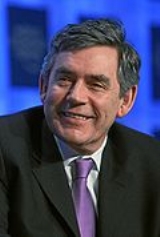
James Gordon Brown is a
BritishThe British are citizens of the United Kingdom, of the Isle of Man, any of the Channel Islands, or of any of the British overseas territories, and their descendants...
Labour PartyThe Labour Party is a centre-left democratic socialist party in the United Kingdom. It surpassed the Liberal Party in general elections during the early 1920s, forming minority governments under Ramsay MacDonald in 1924 and 1929-1931. The party was in a wartime coalition from 1940 to 1945, after...
politicianA politician, political leader, or political figure is an individual who is involved in influencing public policy and decision making...
who was the
Prime MinisterThe Prime Minister of the United Kingdom of Great Britain and Northern Ireland is the Head of Her Majesty's Government in the United Kingdom. The Prime Minister and Cabinet are collectively accountable for their policies and actions to the Sovereign, to Parliament, to their political party and...
of the
United KingdomThe United Kingdom of Great Britain and Northern IrelandIn the United Kingdom and Dependencies, other languages have been officially recognised as legitimate autochthonous languages under the European Charter for Regional or Minority Languages...
and Leader of the
Labour PartyThe Labour Party is a centre-left democratic socialist party in the United Kingdom. It surpassed the Liberal Party in general elections during the early 1920s, forming minority governments under Ramsay MacDonald in 1924 and 1929-1931. The party was in a wartime coalition from 1940 to 1945, after...
from
2007The 2007 Labour Party Leadership Election was formally triggered on 10 May 2007 by the resignation of Tony Blair, Labour Leader since the previous leadership contest on 21 July 1994...
until 2010. He previously served as
Chancellor of the ExchequerThe Chancellor of the Exchequer is the title held by the British Cabinet minister who is responsible for all economic and financial matters. Often simply called the Chancellor, the office-holder controls HM Treasury and plays a role akin to the posts of Minister of Finance or Secretary of the...
in the
Labour GovernmentTony Blair was the Prime Minister of the United Kingdom for three successive parliamentary terms from 1997-2007. His Cabinet was reshuffled for each new parliament as well as changed during the three periods.-Formation:...
from
1997The United Kingdom general election, 1997 was held on 1 May 1997, more than five years after the previous election on 9 April 1992, to elect 659 members to the British House of Commons. The Labour Party ended its 18 years in opposition under the leadership of Tony Blair, and won the general...
to
2007The 2007 Labour Party Leadership Election was formally triggered on 10 May 2007 by the resignation of Tony Blair, Labour Leader since the previous leadership contest on 21 July 1994...
. Brown has been a
Member of ParliamentA Member of Parliament is a representative of the voters to a :parliament. In many countries with bicameral parliaments, the term applies specifically to members of the lower house, as upper houses often have a different title, such as senate, and thus also have different titles for its members,...
(MP) since
1983The 1983 United Kingdom general election was held on 9 June 1983. It gave the Conservative Party under Margaret Thatcher the most decisive election victory since that of Labour in 1945...
, currently for
Kirkcaldy and CowdenbeathKirkcaldy and Cowdenbeath is a county constituency representing the areas around the towns of Kirkcaldy and Cowdenbeath, in Fife, Scotland, in the House of Commons of the Parliament of the United Kingdom...
.
Brown became Prime Minister in June 2007, after the resignation of
Tony BlairAnthony Charles Lynton Blair is a former British Labour Party politician who served as the Prime Minister of the United Kingdom from 2 May 1997 to 27 June 2007. He was the Member of Parliament for Sedgefield from 1983 to 2007 and Leader of the Labour Party from 1994 to 2007...
and three days after becoming leader of the governing Labour Party. His tenure ended in May 2010, when he resigned as Prime Minister and Leader of the Labour Party. Brown was one of only three people to serve in the Cabinet continuously from Labour's victory in 1997 until its defeat in 2010, the others being
Jack StrawJack Straw , British politician.Jack Straw may also refer to:* Jack Straw , English* "Jack Straw" , 1971 song by the Grateful Dead* Jack Straw by W...
and
Alistair DarlingAlistair Maclean Darling is a Scottish Labour Party politician who has been a Member of Parliament since 1987, currently for Edinburgh South West. He served as the Chancellor of the Exchequer from 2007 to 2010...
.
Brown has a
PhDPHD may refer to:*Ph.D., a doctorate of philosophy*Ph.D. , a 1980s British group*PHD finger, a protein sequence*PHD Mountain Software, an outdoor clothing and equipment company*PhD Docbook renderer, an XML renderer...
in history from the
University of EdinburghThe University of Edinburgh, founded in 1583, is a public research university located in Edinburgh, the capital of Scotland, and a UNESCO World Heritage Site. The university is deeply embedded in the fabric of the city, with many of the buildings in the historic Old Town belonging to the university...
and spent his early career working as a lecturer at a further education college and a television
journalistA journalist collects and distributes news and other information. A journalist's work is referred to as journalism.A reporter is a type of journalist who researchs, writes, and reports on information to be presented in mass media, including print media , electronic media , and digital media A...
. He has been a Member of Parliament since 1983; first for
Dunfermline EastDunfermline East was a burgh constituency represented in the House of Commons of the Parliament of the United Kingdom. It elected one Member of Parliament by the first past the post voting system....
and since 2005 for Kirkcaldy and Cowdenbeath. As Prime Minister, he also held the offices of
First Lord of the TreasuryThe First Lord of the Treasury is the head of the commission exercising the ancient office of Lord High Treasurer in the United Kingdom, and is now always also the Prime Minister...
and the
Minister for the Civil ServiceIn British government, the Minister for the Civil Service is responsible for making regulations regarding Her Majesty's Civil Service, the role of which is to assist the governments of the United Kingdom in formulating and implementing policies...
.
Brown's time as Chancellor was marked by major reform of Britain's monetary and fiscal policy architecture, transferring interest rate setting powers to the
Bank of EnglandThe Bank of England is the central bank of the United Kingdom and the model on which most modern central banks have been based. Established in 1694, it is the second oldest central bank in the world...
, by a wide extension of the powers of the
TreasuryHM Treasury, in full Her Majesty's Treasury, informally The Treasury, is the United Kingdom government department responsible for developing and executing the British government's public finance policy and economic policy...
to cover much domestic policy and by transferring responsibility for banking supervision to the
Financial Services AuthorityThe Financial Services Authority is a quasi-judicial body responsible for the regulation of the financial services industry in the United Kingdom. Its board is appointed by the Treasury and the organisation is structured as a company limited by guarantee and owned by the UK government. Its main...
. Controversial moves included the abolition of
advance corporation taxIn the United Kingdom, the Advance corporation tax was the scheme under which companies made an advance payment of tax when they distributed dividend payments to shareholders...
(ACT) relief in his first budget, and the removal in his final budget of the 10% "starting rate" of personal income tax which he had introduced in 1999.
After initial rises in opinion polls following Brown's selection as leader, Labour performed poorly in
local andThe 2009 United Kingdom local elections were elections held to all 27 County Councils, three existing Unitary Authorities and five new Unitary Authorities, all in England, on 4 June 2009...
European election results in 2009Elections to the European Parliament were held in the 27 member states of the European Union between 4 and 7 June 2009. A total of 736 Members of the European Parliament were elected to represent some 500 million Europeans, making these the biggest trans-national elections in history...
. A year later, Labour lost 91 seats in the House of Commons at the 2010 general election, the party's biggest loss of seats in a single general election since
1931The United Kingdom general election on Tuesday 27 October 1931 was the last in the United Kingdom not held on a Thursday. It was also the last election, and the only one under universal suffrage, where one party received an absolute majority of the votes cast.The 1931 general election was the...
, giving the
Conservative PartyThe Conservative Party, formally the Conservative and Unionist Party, is a centre-right political party in the United Kingdom that adheres to the philosophies of conservatism and British unionism. It is the largest political party in the UK, and is currently the largest single party in the House...
a plurality and resulting in a
hung parliamentIn a two-party parliamentary system of government, a hung parliament occurs when neither major political party has an absolute majority of seats in the parliament . It is also less commonly known as a balanced parliament or a legislature under no overall control...
. On 10 May 2010, Brown announced he would stand down as leader of the Labour Party, and instructed the party to put into motion the processes to elect a new leader. On 11 May 2010, Brown officially resigned as Prime Minister and Leader of the Labour Party. He was succeeded as Prime Minister by
David CameronDavid William Donald Cameron is the current Prime Minister of the United Kingdom, First Lord of the Treasury, Minister for the Civil Service and Leader of the Conservative Party. Cameron represents Witney as its Member of Parliament ....
, and on
25 September 2010The 2010 Labour Party leadership election was triggered by a general election which resulted in a hung parliament. On 10 May, Gordon Brown resigned as Leader of the Labour Party. The following day, he stepped down as Prime Minister....
, he was succeeded as Leader of the Labour Party by
Ed MilibandEdward Samuel Miliband is a British Labour Party politician, currently the Leader of the Labour Party and Leader of the Opposition...
.
Early life and career before Parliament
Gordon Brown was born at the Orchard Maternity Nursing Home in
GiffnockGiffnock is a wealthy, dormitory suburb of Glasgow in the East Renfrewshire Council area, within the historic county of Renfrewshire in the west central Lowlands of Scotland...
,
RenfrewshireRenfrewshire or the County of Renfrew is a registration county, the Lieutenancy area of the Lord Lieutenant of Renfrewshire, and one of the counties of Scotland used for local government until 1975. Renfrewshire is located in the West Central Lowlands of Scotland, south of the River Clyde,...
, Scotland. His father was John Ebenezer Brown, a
ministerA Church of Scotland congregation is led by its minister and elders. Both of these terms are also used in other Christian denominations: see Minister and Elder...
of the
Church of ScotlandThe Church of Scotland, known informally by its Scots language name, the Kirk, is a Presbyterian church, decisively shaped by the Scottish Reformation....
and a strong influence on Brown. He died in December 1998, aged 84. His mother Jessie Elizabeth Souter, known as Bunty, died on 19 September 2004, aged 86. She was the daughter of John Souter, a timber merchant. Brown was brought up with his elder brother John and younger brother
Andrew BrownAndrew Brown is a Scottish former journalist and broadcaster who is now a media strategist with EDF Energy. He is the younger brother of Gordon Brown, the former UK Prime Minister....
in a
manseA manse is a house inhabited by, or formerly inhabited by, a minister, usually used in the context of a Presbyterian, Methodist, Baptist or United Church...
in
KirkcaldyKirkcaldy is a town and former royal burgh in Fife, on the east coast of Scotland. The town lies on a shallow bay on the northern shore of the Firth of Forth; SSE of Glenrothes, ENE of Dunfermline, WSW of Dundee and NNE of Edinburgh...
— the largest town in
FifeFife is a council area and former county of Scotland. It is situated between the Firth of Tay and the Firth of Forth, with inland boundaries to Perth and Kinross and Clackmannanshire...
, Scotland across the
Firth of ForthThe Firth of Forth is the estuary or firth of Scotland's River Forth, where it flows into the North Sea, between Fife to the north, and West Lothian, the City of Edinburgh and East Lothian to the south...
from
EdinburghEdinburgh is the capital city of Scotland, the second largest city in Scotland, and the eighth most populous in the United Kingdom. The City of Edinburgh Council governs one of Scotland's 32 local government council areas. The council area includes urban Edinburgh and a rural area...
. In common with many other notable Scots, he is therefore often referred to as a "son of the manse".
Brown was educated first at Kirkcaldy West Primary School where he was selected for an experimental
fast streamAbility grouping is the educational practice of grouping students by academic potential or past achievement.Ability groups are usually small, informal groups formed within a single classroom. Assignment to an ability group is often short-term , and varies by subject...
education programme, which took him two years early to
Kirkcaldy High SchoolKirkcaldy High School is a comprehensive state school in Kirkcaldy, Fife, Scotland.Kirkcaldy High school was admitted to the "Schools of Ambition" programme in 2007....
for an academic hothouse education taught in separate classes. At age sixteen he wrote that he loathed and resented this "ludicrous" experiment on young lives.
He was accepted by the
University of EdinburghThe University of Edinburgh, founded in 1583, is a public research university located in Edinburgh, the capital of Scotland, and a UNESCO World Heritage Site. The university is deeply embedded in the fabric of the city, with many of the buildings in the historic Old Town belonging to the university...
to study history at the same early age of sixteen. During an end-of-term
rugby unionRugby union, often simply referred to as rugby, is a full contact team sport which originated in England in the early 19th century. One of the two codes of rugby football, it is based on running with the ball in hand...
match at his old school he received a kick to the head and suffered a
retinal detachmentRetinal detachment is a disorder of the eye in which the retina peels away from its underlying layer of support tissue. Initial detachment may be localized, but without rapid treatment the entire retina may detach, leading to vision loss and blindness. It is a medical emergency.The retina is a...
. This left him
blindBlindness is the condition of lacking visual perception due to physiological or neurological factors.Various scales have been developed to describe the extent of vision loss and define blindness...
in his left eye, despite treatment including several operations and weeks spent lying in a darkened room. Later at Edinburgh, while playing tennis, he noticed the same symptoms in his right eye. Brown underwent experimental surgery at
Edinburgh Royal InfirmaryThe Royal Infirmary of Edinburgh or RIE, sometimes mistakenly referred to as Edinburgh Royal Infirmary or ERI, was established in 1729 and is the oldest voluntary hospital in Scotland. The new buildings of 1879 were claimed to be the largest voluntary hospital in the United Kingdom, and later on...
and his right eye was saved. Brown graduated from Edinburgh with First Class Honours
MAA Master of Arts in Scotland can refer to an undergraduate academic degree in humanities and social sciences awarded by the ancient universities of Scotland – the University of St Andrews, the University of Glasgow, the University of Aberdeen and the University of Edinburgh, while the University of...
in history in 1972, and stayed on to complete his PhD in history (which he gained ten years later in 1982), titled The Labour Party and Political Change in Scotland 1918–29.
In 1972, while still a student, Brown was elected Rector of the University of Edinburgh, the convener of the
University CourtA University Court is an administrative body of a university in the United Kingdom. In England's Oxbridge such a Court carries out limited judicial functions; whereas in Scotland it is a University's supreme governing body, analogous to a Board of Directors or a Board of Trustees.-England:In the...
. He served as Rector until 1975, and also edited the document The Red Paper on Scotland.
From 1976 to 1980 Brown was employed as a
lecturerLecturer is an academic rank. In the United Kingdom, lecturer is a position at a university or similar institution, often held by academics in their early career stages, who lead research groups and supervise research students, as well as teach...
in politics at
Glasgow College of TechnologyGlasgow Caledonian University is a public university in Glasgow, Scotland.The university was constituted by an Act of Parliament on 1 April 1993 as a result of a merger between Glasgow Polytechnic and The Queen's College, Glasgow....
. In the
1979 general electionThe United Kingdom general election of 1979 was held on 3 May 1979 to elect 635 members to the British House of Commons. The Conservative Party, led by Margaret Thatcher ousted the incumbent Labour government of James Callaghan with a parliamentary majority of 43 seats...
, he stood for the
Edinburgh SouthEdinburgh South is a constituency of the House of Commons of the Parliament of the United Kingdom, first used in the general election of 1885. It elects one Member of Parliament by the first past the post system of election...
constituency, losing to the
ConservativeThe Conservative Party, formally the Conservative and Unionist Party, is a centre-right political party in the United Kingdom that adheres to the philosophies of conservatism and British unionism. It is the largest political party in the UK, and is currently the largest single party in the House...
candidate,
Michael AncramMichael Andrew Foster Jude Kerr, 13th Marquess of Lothian, PC, QC , known as Michael Ancram, is a United Kingdom Conservative Party politician. He is a member of the House of Lords, former Member of Parliament, and a former member of the Shadow Cabinet...
. From 1980 he worked as a journalist at
Scottish TelevisionScottish Television is Scotland's largest ITV franchisee, and has held the ITV franchise for Central Scotland since 31 August 1957. It is the second oldest ITV franchisee still active...
, later serving as current affairs editor until his election to parliament in 1983. He also worked as a tutor for the
Open UniversityThe Open University is a distance learning and research university founded by Royal Charter in the United Kingdom...
.
Election to parliament and opposition
Gordon Brown was elected to Parliament on his second attempt as a Labour MP for
Dunfermline EastDunfermline East was a burgh constituency represented in the House of Commons of the Parliament of the United Kingdom. It elected one Member of Parliament by the first past the post voting system....
in
1983 general electionThe 1983 United Kingdom general election was held on 9 June 1983. It gave the Conservative Party under Margaret Thatcher the most decisive election victory since that of Labour in 1945...
. His first Westminster office mate was a newly elected MP from the Sedgefield constituency by the name of
Tony BlairAnthony Charles Lynton Blair is a former British Labour Party politician who served as the Prime Minister of the United Kingdom from 2 May 1997 to 27 June 2007. He was the Member of Parliament for Sedgefield from 1983 to 2007 and Leader of the Labour Party from 1994 to 2007...
. Brown became an opposition spokesman on Trade and Industry in 1985. In 1986, he published a
biographyA biography is a detailed description or account of someone's life. More than a list of basic facts , biography also portrays the subject's experience of those events...
of the
Independent Labour PartyThe Independent Labour Party was a socialist political party in Britain established in 1893. The ILP was affiliated to the Labour Party from 1906 to 1932, when it voted to leave...
politician
James MaxtonJames Maxton was a Scottish socialist politician, and leader of the Independent Labour Party. A prominent proponent of Home Rule for Scotland, he is remembered as one of the leading figures of the Red Clydeside era.-Early years:...
, the subject of his PhD thesis. Brown was
ShadowThe Shadow Cabinet is a senior group of opposition spokespeople in the Westminster system of government who together under the leadership of the Leader of the Opposition form an alternative cabinet to the government's, whose members shadow or mark each individual member of the government...
Chief Secretary to the TreasuryThe Chief Secretary to the Treasury is the third most senior ministerial position in HM Treasury, after the Prime Minister and the Chancellor of the Exchequer . In recent years, the office holder has usually been given a junior position in the British Cabinet...
from 1987 to 1989 and then Shadow
Secretary of State for Trade and IndustryThe Secretary of State for Business, Innovation and Skills is a cabinet position in the United Kingdom government. Its secondary title is the President of the Board of Trade...
, before becoming Shadow Chancellor in 1992. Having led the Labour Movement Yes campaign, refusing to join the cross-party Yes for Scotland campaign, during the 1979 Scottish devolution referendum, while other senior Labour politicians — including
Robin CookRobert Finlayson Cook was a British Labour Party politician, who was the Member of Parliament for Livingston from 1983 until his death, and notably served in the Cabinet as Foreign Secretary from 1997 to 2001....
,
Tam DalyellSir Thomas Dalyell Loch, 11th Baronet , known as Tam Dalyell, is a British Labour Party politician, who was a Member of Parliament in the House of Commons from 1962 to 2005, first for West Lothian and then for Linlithgow.-Early life:...
and Brian Wilson – campaigned for a No vote, Brown was subsequently a key participant in the
Scottish Constitutional ConventionThe Scottish Constitutional Convention was an association of Scottish political parties, churches and other civic groups, that developed a framework for a Scottish devolution. It is credited as having paved the way for the establishment of the Scottish Parliament in 1999.The Convention was...
, signing the Claim of Right for Scotland in 1989.
After the sudden death of Labour leader
John SmithJohn Smith was a British Labour Party politician who served as Leader of the Labour Party from July 1992 until his sudden death from a heart attack in May 1994...
in May 1994, Brown did not contest the leadership after
Tony BlairAnthony Charles Lynton Blair is a former British Labour Party politician who served as the Prime Minister of the United Kingdom from 2 May 1997 to 27 June 2007. He was the Member of Parliament for Sedgefield from 1983 to 2007 and Leader of the Labour Party from 1994 to 2007...
became favourite, deciding to make way for Tony Blair to avoiding splitting the pro-modernising vote in the leadership ballot.
It has long been rumoured
a dealThe Blair–Brown deal was an alleged gentlemen's agreement made between the British politicians Tony Blair and Gordon Brown in the summer of 1994...
was struck between Blair and Brown at the former
Granita restaurantGranita was a restaurant in Islington, London, England. In late May 1994 it was the alleged setting for the "Blair-Brown deal" between the then shadow Home Secretary Tony Blair and the then shadow Chancellor of the Exchequer, Gordon Brown....
in Islington, in which Blair promised to give Brown control of economic policy in return for Brown not standing against him in the
leadership electionA leadership election was held on 21 July 1994 for the Labour Party in the United Kingdom, after the sudden death of incumbent leader John Smith. The 1994 election would ultimately decide not only Labour's new leader, but also the next Prime Minister...
. Whether this is true or not, the relationship between Blair and Brown has been central to the fortunes of "New Labour", and they have mostly remained united in public, despite reported serious private rifts.
As Shadow Chancellor, Brown as Chancellor-in-waiting was seen as a good choice by business and the middle class. While he was Chancellor inflation sometimes exceeded the 2% target causing the
Governor of the Bank of EnglandThe Governor of the Bank of England is the most senior position in the Bank of England. It is nominally a civil service post, but the appointment tends to be from within the Bank, with the incumbent grooming his or her successor...
to write several letters to the Chancellor, each time inflation exceeded three per cent.
In 2005 following a reorganisation of
parliamentary constituencies in Scotland, Brown became MP for
Kirkcaldy and CowdenbeathKirkcaldy and Cowdenbeath is a county constituency representing the areas around the towns of Kirkcaldy and Cowdenbeath, in Fife, Scotland, in the House of Commons of the Parliament of the United Kingdom...
at the
general electionThe United Kingdom general election of 2005 was held on Thursday, 5 May 2005 to elect 646 members to the British House of Commons. The Labour Party under Tony Blair won its third consecutive victory, but with a majority of 66, reduced from 160....
.
Chancellor of the Exchequer
In the
1997 general electionThe United Kingdom general election, 1997 was held on 1 May 1997, more than five years after the previous election on 9 April 1992, to elect 659 members to the British House of Commons. The Labour Party ended its 18 years in opposition under the leadership of Tony Blair, and won the general...
, Labour defeated the Conservatives by a landslide to end their 18-year exile from government on when
Tony BlairAnthony Charles Lynton Blair is a former British Labour Party politician who served as the Prime Minister of the United Kingdom from 2 May 1997 to 27 June 2007. He was the Member of Parliament for Sedgefield from 1983 to 2007 and Leader of the Labour Party from 1994 to 2007...
, the new prime minister, announced his ministerial team on 2 May 1997, he appointed Brown as
Chancellor of the ExchequerThe Chancellor of the Exchequer is the title held by the British Cabinet minister who is responsible for all economic and financial matters. Often simply called the Chancellor, the office-holder controls HM Treasury and plays a role akin to the posts of Minister of Finance or Secretary of the...
. He would remain in this role for 10 years and two months, making him the longest-serving Chancellor in modern history. The Prime Minister's website highlights some achievements from Brown's decade as Chancellor: making the Bank of England independent and delivering an agreement on poverty and climate change at the
G8The Group of Eight is a forum, created by France in 1975, for the governments of seven major economies: Canada, France, Germany, Italy, Japan, the United Kingdom, and the United States. In 1997, the group added Russia, thus becoming the G8...
summit in 2005.
Early economic reforms
On taking office as
Chancellor of the ExchequerThe Chancellor of the Exchequer is the title held by the British Cabinet minister who is responsible for all economic and financial matters. Often simply called the Chancellor, the office-holder controls HM Treasury and plays a role akin to the posts of Minister of Finance or Secretary of the...
Brown gave the
Bank of EnglandThe Bank of England is the central bank of the United Kingdom and the model on which most modern central banks have been based. Established in 1694, it is the second oldest central bank in the world...
operational independence in
monetary policyMonetary policy is the process by which the monetary authority of a country controls the supply of money, often targeting a rate of interest for the purpose of promoting economic growth and stability. The official goals usually include relatively stable prices and low unemployment...
, and thus responsibility for setting
interest rateAn interest rate is the rate at which interest is paid by a borrower for the use of money that they borrow from a lender. For example, a small company borrows capital from a bank to buy new assets for their business, and in return the lender receives interest at a predetermined interest rate for...
s through the Bank's
Monetary Policy CommitteeThe Monetary Policy Committee is a committee of the Bank of England, which meets for two and a half days every month to decide the official interest rate in the United Kingdom . It is also responsible for directing other aspects of the government's monetary policy framework, such as quantitative...
. At the same time he also changed the
inflation measureIn economics, the inflation rate is a measure of inflation, the rate of increase of a price index . It is the percentage rate of change in price level over time. The rate of decrease in the purchasing power of money is approximately equal.The inflation rate is used to calculate the real interest...
from the
Retail Price IndexIn the United Kingdom, the Retail Prices Index or Retail Price Index is a measure of inflation published monthly by the Office for National Statistics. It measures the change in the cost of a basket of retail goods and services.-History:...
to the
Consumer Price IndexA consumer price index measures changes in the price level of consumer goods and services purchased by households. The CPI, in the United States is defined by the Bureau of Labor Statistics as "a measure of the average change over time in the prices paid by urban consumers for a market basket of...
and transferred responsibility for banking supervision to the
Financial Services AuthorityThe Financial Services Authority is a quasi-judicial body responsible for the regulation of the financial services industry in the United Kingdom. Its board is appointed by the Treasury and the organisation is structured as a company limited by guarantee and owned by the UK government. Its main...
. Some commentators have argued that this division of responsibilities exacerbated the severity, in Britain, of 2007 global banking crisis.
Taxation and spending
In the 1997 election and subsequently, Brown pledged to not increase the basic or higher rates of
income taxAn income tax is a tax levied on the income of individuals or businesses . Various income tax systems exist, with varying degrees of tax incidence. Income taxation can be progressive, proportional, or regressive. When the tax is levied on the income of companies, it is often called a corporate...
. Over his Chancellorship, he reduced the basic rate from 23% to 20%. However, in all but his final budget, Brown increased the tax thresholds in line with inflation, rather than earnings, resulting in
fiscal dragFiscal drag happens when the government's net fiscal position fails to cover the net savings desires of the private economy, also called the private economy's spending gap...
. Corporation tax fell under Brown, from a main rate of 33% to 28%, and from 24% to 19% for
small businessA small business is a business that is privately owned and operated, with a small number of employees and relatively low volume of sales. Small businesses are normally privately owned corporations, partnerships, or sole proprietorships...
es. In 1999, he introduced a lower tax band of 10%. He abolished this 10% tax band in his last budget in 2007 to reduce the basic rate from 22% to 20%, increasing tax for 5 million people and, according to the calculations of the
Institute for Fiscal StudiesThe Institute for Fiscal Studies is an economic research institute based in London, United Kingdom which specialises in UK taxation and public policy...
, leaving those earning between £5,000 and £18,000 as the biggest losers. According to the OECD UK taxation has increased from a 39.3% share of
gross domestic productGross domestic product refers to the market value of all final goods and services produced within a country in a given period. GDP per capita is often considered an indicator of a country's standard of living....
in 1997 to 42.4% in 2006, going to a higher level than Germany. This increase has mainly been attributed to active government policy, and not simply to the growing economy. Conservatives have accused Brown of imposing "
stealth taxA stealth tax is a tax levied in such a way that is largely unnoticed, or not recognized as a tax,. The phrase was generally used in the United Kingdom by Conservatives to attack the New Labour government's behaviour...
es". A commonly reported example resulted in 1997 from a technical change in the way corporation tax is collected, the indirect effect of which was for the
dividendDividends are payments made by a corporation to its shareholder members. It is the portion of corporate profits paid out to stockholders. When a corporation earns a profit or surplus, that money can be put to two uses: it can either be re-invested in the business , or it can be distributed to...
s on
stockThe capital stock of a business entity represents the original capital paid into or invested in the business by its founders. It serves as a security for the creditors of a business since it cannot be withdrawn to the detriment of the creditors...
investments held within
pensionIn general, a pension is an arrangement to provide people with an income when they are no longer earning a regular income from employment. Pensions should not be confused with severance pay; the former is paid in regular installments, while the latter is paid in one lump sum.The terms retirement...
s to be taxed, thus lowering pension returns and contributing to the demise of most of the final salary pension funds in the UK. The Treasury contends that this tax change was crucial to long-term economic growth.
Brown's 2000 Spending Review outlined a major expansion of
government spendingGovernment spending includes all government consumption, investment but excludes transfer payments made by a state. Government acquisition of goods and services for current use to directly satisfy individual or collective needs of the members of the community is classed as government final...
, particularly on health and education. In his April 2002 budget, Brown increased
national insuranceNational Insurance in the United Kingdom was initially a contributory system of insurance against illness and unemployment, and later also provided retirement pensions and other benefits...
to pay for health spending. He also introduced
working tax creditThe Working Tax Credit is a state benefit in the United Kingdom made to people who work on a low income. It is a part of the current system of refundable tax credits introduced in April 2003 and is a means-tested social security benefit...
s.
European single currency
In October 1997, Brown took control of the United Kingdom's membership of the European single currency issue by announcing the Treasury would set
five economic testsThe five economic tests were the criteria defined by the UK treasury under Gordon Brown that were to be used to assess the UK's readiness to join the Economic and Monetary Union of the European Union , and so adopt the euro as its official currency...
to ascertain whether the economic case had been made. In June 2003
the TreasuryHM Treasury, in full Her Majesty's Treasury, informally The Treasury, is the United Kingdom government department responsible for developing and executing the British government's public finance policy and economic policy...
indicated the tests had not been passed.
Other issues
In 2000, Brown was accused of starting a political row about higher education (referred to as the
Laura Spence AffairThe Laura Spence Affair was a British political controversy in 2000, ignited after the failure of high-flying state school pupil Laura Spence to secure a place at the University of Oxford.-Background:...
) when he accused the University of Oxford of elitism in its admissions procedures, describing its decision not to offer a place to state school pupil Laura Spence as "absolutely outrageous".
Lord JenkinsRoy Harris Jenkins, Baron Jenkins of Hillhead OM, PC was a British politician.The son of a Welsh coal miner who later became a union official and Labour MP, Roy Jenkins served with distinction in World War II. Elected to Parliament as a Labour member in 1948, he served in several major posts in...
, then Oxford
ChancellorA chancellor or vice-chancellor is the chief executive of a university. Other titles are sometimes used, such as president or rector....
and himself a former Labour Chancellor of the Exchequer, said "nearly every fact he used was false."
Between 1999 and 2002 Brown sold 60% of the UK's gold reserves shortly before gold entered a protracted bull market, since nicknamed by dealers as
Brown BottomThe sale of UK gold reserves was a policy pursued by HM Treasury over the period between 1999 and 2002, when gold prices were at their lowest in 20 years, following an extended bear market...
. The official reason for selling the gold reserves was to reduce the
portfolio riskFinancial risk an umbrella term for multiple types of risk associated with financing, including financial transactions that include company loans in risk of default. Risk is a term often used to imply downside risk, meaning the uncertainty of a return and the potential for financial loss...
of the UK's reserves by diversifying away from gold. The UK eventually sold about 395 tons of gold over 17 auctions from July 1999 to March 2002, at an average price of about US$275 per ounce, raising approximately US$3.5 billion. By 2011, that quantity of gold would be worth over $19 billion, leading to Brown's decision to sell the gold being widely criticised.
During his time as Chancellor, Brown reportedly believed that it was appropriate to remove most, but not all, of the unpayable Third World debt. On 20 April 2006, in a speech to the United Nations
AmbassadorAn ambassador is the highest ranking diplomat who represents a nation and is usually accredited to a foreign sovereign or government, or to an international organization....
s, Brown outlined a "
GreenGreen politics is a political ideology that aims for the creation of an ecologically sustainable society rooted in environmentalism, social liberalism, and grassroots democracy...
" view of global development.
Run-up to succeeding Tony Blair
- Main articles Labour Party leadership election, 2007
The 2007 Labour Party Leadership Election was formally triggered on 10 May 2007 by the resignation of Tony Blair, Labour Leader since the previous leadership contest on 21 July 1994...
and Timeline for the Labour Party leadership elections, 2007The timeline for the British Labour Party leadership elections of 2007 is a timeline of events relating to the final years of Tony Blair's tenure as leader of the party and Prime Minister and the leadership elections to find replacements for him and Deputy Prime Minister John Prescott, from his...
In October 2004,
Tony BlairAnthony Charles Lynton Blair is a former British Labour Party politician who served as the Prime Minister of the United Kingdom from 2 May 1997 to 27 June 2007. He was the Member of Parliament for Sedgefield from 1983 to 2007 and Leader of the Labour Party from 1994 to 2007...
announced he would not lead the party into a fourth
general electionIn a parliamentary political system, a general election is an election in which all or most members of a given political body are chosen. The term is usually used to refer to elections held for a nation's primary legislative body, as distinguished from by-elections and local elections.The term...
, but would serve a full third term. Political comment over the relationship between Brown and Blair continued up to and beyond the
2005 electionThe United Kingdom general election of 2005 was held on Thursday, 5 May 2005 to elect 646 members to the British House of Commons. The Labour Party under Tony Blair won its third consecutive victory, but with a majority of 66, reduced from 160....
, which Labour won with a reduced parliamentary majority and reduced vote share. Blair announced on 7 September 2006 that he would step down within a year. Brown was the clear favourite to succeed Blair; he was the only
candidateThe 2007 Labour Party Leadership Election was formally triggered on 10 May 2007 by the resignation of Tony Blair, Labour Leader since the previous leadership contest on 21 July 1994...
spoken of seriously in Westminster. Appearances and news coverage leading up to the handover were interpreted as preparing the ground for Brown to become
Prime MinisterThe Prime Minister of the United Kingdom of Great Britain and Northern Ireland is the Head of Her Majesty's Government in the United Kingdom. The Prime Minister and Cabinet are collectively accountable for their policies and actions to the Sovereign, to Parliament, to their political party and...
, in part by creating the impression of a statesman with a vision for leadership and
global changeGlobal change refers to planetary-scale changes in the Earth system. The system consists of the land, oceans, atmosphere, poles, life, the planet’s natural cycles and deep Earth processes. These constituent parts influence one another...
. This enabled Brown to signal the most significant priorities for his agenda as Prime Minister; speaking at a
Fabian SocietyThe Fabian Society is a British socialist movement, whose purpose is to advance the principles of democratic socialism via gradualist and reformist, rather than revolutionary, means. It is best known for its initial ground-breaking work beginning late in the 19th century and continuing up to World...
conference on 'The Next Decade' in January 2007, he stressed education, international development, narrowing inequalities (to pursue 'equality of opportunity and fairness of outcome'), renewing Britishness, restoring trust in politics, and winning hearts and minds in the war on terror as key priorities.
Prime Minister
Brown ceased to be Chancellor and became the Prime Minister of the United Kingdom on 27 June 2007. Like all modern Prime Ministers, Brown concurrently served as the
First Lord of the TreasuryThe First Lord of the Treasury is the head of the commission exercising the ancient office of Lord High Treasurer in the United Kingdom, and is now always also the Prime Minister...
and the
Minister for the Civil ServiceIn British government, the Minister for the Civil Service is responsible for making regulations regarding Her Majesty's Civil Service, the role of which is to assist the governments of the United Kingdom in formulating and implementing policies...
, and was a member of the
Cabinet of the United KingdomThe Cabinet of the United Kingdom is the collective decision-making body of Her Majesty's Government in the United Kingdom, composed of the Prime Minister and some 22 Cabinet Ministers, the most senior of the government ministers....
. Until his resignation from the post in May 2010 he was Leader of the Labour Party. He is Member of Parliament for the constituency of
Kirkcaldy and CowdenbeathKirkcaldy and Cowdenbeath is a county constituency representing the areas around the towns of Kirkcaldy and Cowdenbeath, in Fife, Scotland, in the House of Commons of the Parliament of the United Kingdom...
. He is the sixth post-war prime minister, of a total of 12, to assume the role without having won a general election.
Brown was the first prime minister from a Scottish constituency since the
ConservativeThe Conservative Party, formally the Conservative and Unionist Party, is a centre-right political party in the United Kingdom that adheres to the philosophies of conservatism and British unionism. It is the largest political party in the UK, and is currently the largest single party in the House...
Sir Alec Douglas-HomeAlexander Frederick Douglas-Home, Baron Home of the Hirsel, KT, PC , known as The Earl of Home from 1951 to 1963 and as Sir Alec Douglas-Home from 1963 to 1974, was a British Conservative politician who served as Prime Minister of the United Kingdom from October 1963 to October 1964.He is the last...
in 1964. Not all British prime ministers have attended university, but of the ones that did Brown was one of only five that did not attend either Oxford or Cambridge, the others were,
the Earl of ButeJohn Stuart, 3rd Earl of Bute KG, PC , styled Lord Mount Stuart before 1723, was a Scottish nobleman who served as Prime Minister of Great Britain under George III, and was arguably the last important favourite in British politics...
(Leiden),
Lord John RussellJohn Russell, 1st Earl Russell, KG, GCMG, PC , known as Lord John Russell before 1861, was an English Whig and Liberal politician who served twice as Prime Minister of the United Kingdom in the mid-19th century....
(
EdinburghThe University of Edinburgh, founded in 1583, is a public research university located in Edinburgh, the capital of Scotland, and a UNESCO World Heritage Site. The university is deeply embedded in the fabric of the city, with many of the buildings in the historic Old Town belonging to the university...
), Andrew Bonar Law (
University of GlasgowThe University of Glasgow is the fourth-oldest university in the English-speaking world and one of Scotland's four ancient universities. Located in Glasgow, the university was founded in 1451 and is presently one of seventeen British higher education institutions ranked amongst the top 100 of the...
), and
Neville ChamberlainArthur Neville Chamberlain FRS was a British Conservative politician who served as Prime Minister of the United Kingdom from May 1937 to May 1940. Chamberlain is best known for his appeasement foreign policy, and in particular for his signing of the Munich Agreement in 1938, conceding the...
(
Mason Science CollegeMason Science College was founded by Josiah Mason in 1875, the buildings of which were opened in Edmund Street, Birmingham, England on 1 October 1880 by Thomas Henry Huxley...
, later
BirminghamThe University of Birmingham is a British Redbrick university located in the city of Birmingham, England. It received its royal charter in 1900 as a successor to Birmingham Medical School and Mason Science College . Birmingham was the first Redbrick university to gain a charter and thus...
). Brown proposed moving some traditional prime ministerial powers conferred by
royal prerogativeThe royal prerogative is a body of customary authority, privilege, and immunity, recognized in common law and, sometimes, in civil law jurisdictions possessing a monarchy as belonging to the sovereign alone. It is the means by which some of the executive powers of government, possessed by and...
to the realm of Parliament, such as the power to declare war and approve appointments to senior positions. Brown wanted Parliament to gain the right to ratify treaties and have more oversight into the intelligence services. He also proposed moving some powers from Parliament to citizens, including the right to form "citizens' juries", easily petition Parliament for new laws, and rally outside Westminster. He asserted that the attorney general should not have the right to decide whether to prosecute in individual cases, such as in the
loans for peeragesCash for Honours is the name given by some in the media to a political scandal in the United Kingdom in 2006 and 2007 concerning the connection between political donations and the award of life peerages...
scandal.
During his Labour leadership campaign Brown proposed some policy initiatives which he called 'The manifesto for change.'
The manifesto included a clampdown on corruption and a new Ministerial Code, which set out clear standards of behaviour for ministers. Brown also stated in a speech when announcing his bid that he wants a "better constitution" that is "clear about the rights and responsibilities of being a citizen in Britain today". He planned to set up an all-party convention to look at new powers for Parliament and to look at rebalancing powers between
WhitehallWhitehall is a road in Westminster, in London, England. It is the main artery running north from Parliament Square, towards Charing Cross at the southern end of Trafalgar Square...
and local government. Brown said he would give Parliament the final say on whether British troops are sent into action in future.
Brown said he wanted to release more land and ease access to ownership with shared equity schemes. He backed a proposal to build new
eco-townsEco-towns are a government-sponsored programme of new towns to be built in England, which are intended to achieve exemplary standards of sustainability.In 2007, the...
, each housing between 10,000 and 20,000 home-owners — up to 100,000 new homes in total.
Brown also said he wanted to have doctors' surgeries open at the weekends, and GPs on call in the evenings. Doctors were given the right of opting out of out-of-hours care in 2007, under a controversial pay deal, signed by then-Health Secretary
John ReidJohn Reid, Baron Reid of Cardowan, PC is a British politician, who served as a Labour Party Member of Parliament and cabinet minister under Tony Blair, most notably as Defence Secretary and then Home Secretary...
, which awarded them a 22% pay rise in 2006. Brown also stated in the manifesto that the NHS was his top priority. There was speculation during September and early October 2007 about whether Brown would call a
snap general electionA snap election is an election called earlier than expected. Generally it refers to an election in a parliamentary system called when not required , usually to capitalize on a unique electoral opportunity or to decide a pressing issue...
. Brown announced that there would be no election in the near future and seemed to rule out an election in 2008. His political opponents accused him of being indecisive, which Brown denied. In July 2008 Brown supported a
new bill extending this pre-charge detention period to 42 daysThe Counter-Terrorism Act 2008 is an Act of the Parliament of the United Kingdom which increased police powers for the stated purpose of countering terrorism...
. The bill was met with opposition on both sides of the House and backbench rebellion. In the end the bill passed by just 9 votes. The House of Lords defeated the bill, with Lords characterising it as "fatally flawed, ill thought through and unnecessary", stating that "it seeks to further erode fundamental legal and civil rights".
Brown was mentioned by the press in the expenses crisis for claiming for the payment of his cleaner. However, no wrongdoing was found and the Commons Authority did not pursue Brown over the claim. Meanwhile, the Commons Fees Office stated that a double payment for a £153 plumbing repair bill was a mistake on their part and that Brown had repaid it in full.
Foreign policy
Brown was committed to the
Iraq War, but said in a speech in June 2007 that he would "learn the lessons" from the mistakes made in Iraq. Brown said in a letter published on 17 March 2008 that the United Kingdom would hold an inquiry into the
Iraq war. He is also a member of the lobby group,
Labour Friends of IsraelLabour Friends of Israel is a lobby group promoting support within the British Labour Party for a strong bilateral relationship between Britain and Israel. It also seeks to strengthen ties between the British and the Israeli Labour party...
.
Brown went to great lengths to empathise with those who lost family members in the Iraq and Afghanistan conflicts. He has often said "War is tragic", echoing Blair's memorable quote, "War is horrible". Nonetheless, in November 2007 Brown was accused by some senior military figures of not adhering to the '
military covenantThe Military Covenant is a term introduced in 2000 into British public life to refer to the mutual obligations between the nation and its Armed Forces....
', a convention within British politics insuring adequate safeguards, rewards and compensation for military personnel who risk their lives in obedience to orders derived from the policy of the elected government.
Brown skipped the opening ceremony of the
2008 Summer OlympicsThe 2008 Summer Olympics, officially known as the Games of the XXIX Olympiad, was a major international multi-sport event that took place in Beijing, China, from August 8 to August 24, 2008. A total of 11,028 athletes from 204 National Olympic Committees competed in 28 sports and 302 events...
, on 8 August 2008 in Beijing. He attended the closing ceremony instead, on 24 August 2008. Brown had been under intense pressure from human rights campaigners to send a message to China, concerning the
2008 Tibetan unrestThe 2008 Tibetan unrest, also known from its Chinese name as the 3•14 Riots, was a series of riots, protests, and demonstrations that started in Tibetan regional capital of Lhasa and spread to other Tibetan areas and a number of monasteries including outside the Tibet Autonomous Region...
. His decision not to attend the opening ceremony was not an act of protest, but rather was made several weeks in advance and not intended as a stand on principle.
In a speech in July 2007, Brown personally clarified his position regarding Britain's relationship with the USA "We will not allow people to separate us from the United States of America in dealing with the common challenges that we face around the world. I think people have got to remember that the special relationship between a British prime minister and an American president is built on the things that we share, the same enduring values about the importance of liberty, opportunity, the dignity of the individual. I will continue to work, as Tony Blair did, very closely with the American administration."
Brown and the Labour party had pledged to allow a referendum on the EU
Treaty of LisbonThe Treaty of Lisbon of 1668 was a peace treaty between Portugal and Spain, concluded at Lisbon on 13 February 1668, through the mediation of England, in which Spain recognized the sovereignty of Portugal's new ruling dynasty, the House of Braganza....
. On the morning of 13 December 2007, Foreign Secretary
David MilibandDavid Wright Miliband is a British Labour Party politician who has been the Member of Parliament for South Shields since 2001, and was the Secretary of State for Foreign and Commonwealth Affairs from 2007 to 2010. He is the elder son of the late Marxist theorist Ralph Miliband...
attended for the Prime Minister at the official signing ceremony in Lisbon of the EU Reform Treaty. Brown's opponents on both sides of the House, and in the press, suggested that ratification by Parliament was not enough and that a referendum should also be held. Labour's 2005 manifesto had pledged to give British public a referendum on the original EU Constitution. Brown argued that the Treaty significantly differed from the Constitution, and as such did not require a referendum. He also responded with plans for a lengthy debate on the topic, and stated that he believed the document to be too complex to be decided by referendum.
Drug policy
During Brown's premiership, in October 2008, the
Advisory Council on the Misuse of DrugsThe Advisory Council on the Misuse of Drugs is a statutory and non-executive non-departmental British public body, which was established under the UK's Misuse of Drugs Act 1971.-Mandate:Its terms of reference, according to the Act, are as follows:...
(ACMD) recommended to the then
Home SecretaryThe Secretary of State for the Home Department, commonly known as the Home Secretary, is the minister in charge of the Home Office of the United Kingdom, and one of the country's four Great Offices of State...
Jacqui SmithJacqueline Jill "Jacqui" Smith is a member of the British Labour Party. She served as the Member of Parliament for Redditch from 1997 until 2010 and was the first ever female Home Secretary, thus making her the third woman to hold one of the Great Offices of State — after Margaret Thatcher and...
that
cannabisCannabis is a genus of flowering plants that includes three putative species, Cannabis sativa, Cannabis indica, and Cannabis ruderalis. These three taxa are indigenous to Central Asia, and South Asia. Cannabis has long been used for fibre , for seed and seed oils, for medicinal purposes, and as a...
remain classified as a Class C drug. Acting against the advice of the Council, she chose to reclassify it as class B. After Professor
David NuttDavid John Nutt is a British psychiatrist and neuropsychopharmacologist specialising in the research of drugs that affect the brain and conditions such as addiction, anxiety and sleep. He was until 2009 a professor at the University of Bristol heading their Psychopharmacology Unit...
, the chair of the ACMD, criticised this move in a lecture in 2009, he was asked to step down by then Home Secretary
Alan JohnsonAlan Arthur Johnson is a British Labour Party politician who served as Home Secretary from June 2009 to May 2010. Before that, he filled a wide variety of cabinet positions in both the Blair and Brown governments, including Health Secretary and Education Secretary. Until 20 January 2011 he was...
. Following his resignation, Professor Nutt said Gordon Brown had "made up his mind" to reclassify cannabis despite evidence to the contrary. Gordon Brown had argued, "I don't think that the previous studies took into account that so much of the cannabis on the streets is now of a lethal quality and we really have got to send out a message to young people – this is not acceptable". Professor Nutt's predecessor at the ACMD,
Sir Michael RawlinsSir Michael Rawlins is the chairman of the National Institute for Health and Clinical Excellence .- Education :Rawlins obtained his undergraduate medical degree at St Thomas' Hospital, graduating in 1965...
, later said, "Governments may well have good reasons for taking an alternative view... When that happens, then the government should explain why it's ignoring the particular advice".
Global recession
Brown's premiership coincided with the global recession, during which Brown called for fiscal action in an attempt to stimulate aggregate demand. Domestically, Brown's administration introduced measures including a bank rescue package worth around £500 billion (approximately $850 billion), a temporary 2.5% cut in Value Added Tax (Sales Tax) and a "car scrappage" scheme.
Plots against leadership
In mid-2008, Brown's leadership was presented with a challenge as some MPs openly called for him to resign. This event was dubbed the 'Lancashire Plot', as two backbenchers from
(pre-1974) LancashireThe Local Government Act 1972 is an Act of Parliament in the United Kingdom that reformed local government in England and Wales on 1 April 1974....
urged him to step down and a third questioned his chances of holding on to the
Labour PartyThe Labour Party is a centre-left democratic socialist party in the United Kingdom. It surpassed the Liberal Party in general elections during the early 1920s, forming minority governments under Ramsay MacDonald in 1924 and 1929-1931. The party was in a wartime coalition from 1940 to 1945, after...
leadership. Several MPs argued that if Brown did not recover in the polls by early 2009, he should call for a leadership contest. However, certain prominent MPs, such as
Jacqui SmithJacqueline Jill "Jacqui" Smith is a member of the British Labour Party. She served as the Member of Parliament for Redditch from 1997 until 2010 and was the first ever female Home Secretary, thus making her the third woman to hold one of the Great Offices of State — after Margaret Thatcher and...
and
Bill RammellWilliam Ernest Rammell is a British Labour Party politician, who was the Member of Parliament for Harlow from 1997 to 2010, and has served as the Minister of State for the Armed Forces at the Ministry of Defence...
, suggested that Brown was the right person to lead Britain through its economic crisis. In the Autumn,
Siobhain McDonaghSiobhain Ann McDonagh is a British Labour Party politician who has been the Member of Parliament for Mitcham and Morden since 1997. She previously served as an Assistant Whip in the Labour Government, but was fired following comments regarding a leadership contest to replace PM Gordon Brown.She...
, a MP and junior government whip, who during her time in office had never voted against the government, spoke of the need for discussion over Brown's position. McDonagh was sacked from her role shortly afterwards, on 12 September. Whilst McDonagh did not state that she wanted Brown deposed, she implored the Labour party to hold a leadership election, she was sacked from her role shortly afterwards. McDonagh was supported by
Joan RyanJoan Marie Ryan is a politician in the United Kingdom. She was member of Parliament for Enfield North between 1997 and 2010, and is a member of the Labour Party. She had previously been deputy leader of Barnet Council....
(who applied, as McDonagh had, for leadership nomination papers, and became the second rebel to be fired from her job),
Jim DowdJames Patrick Dowd is a British Labour Party politician, who has been a Member of Parliament since 1992, first for Lewisham West and since 2010 for Lewisham West and Penge.-Early life:...
,
Greg PopeGregory James "Greg" Pope is a former British Labour Party politician, who served as Member of Parliament for Hyndburn from 1992 until retiring at the 2010 general election. He was a government whip until the reshuffle following the 2001 general election.-Early life:He went to St Marys College R.C...
, and a string of others who had previously held positions in government, made clear their desire for a contest.
In the face of this speculation over Brown's future, his ministers backed him to lead the party, and
Harriet HarmanHarriet Ruth Harman QC is a British Labour Party politician, who is the Member of Parliament for Camberwell and Peckham, and was MP for the predecessorPeckham constituency from 1982 to 1997...
and
David MilibandDavid Wright Miliband is a British Labour Party politician who has been the Member of Parliament for South Shields since 2001, and was the Secretary of State for Foreign and Commonwealth Affairs from 2007 to 2010. He is the elder son of the late Marxist theorist Ralph Miliband...
denied that they were preparing leadership bids. After Labour lost the
Glasgow East by-electionThe 2008 Glasgow East by-election was a by-election for the UK Parliamentary constituency of Glasgow East which was held on 24 July 2008. The election was triggered when, on 30 June 2008, the sitting MP David Marshall stood down due to ill health....
in July, Harman, the deputy leader of the party, said that Brown was the "solution", not the "problem"; Home Secretary Smith, Justice Secretary
Jack StrawJack Straw , British politician.Jack Straw may also refer to:* Jack Straw , English* "Jack Straw" , 1971 song by the Grateful Dead* Jack Straw by W...
, Schools Secretary
Ed BallsEdward Michael Balls, known as Ed Balls, is a British Labour politician, who has been a Member of Parliament since 2005, currently for Morley and Outwood, and is the current Shadow Chancellor of the Exchequer....
and Cabinet Office Minister
Ed MilibandEdward Samuel Miliband is a British Labour Party politician, currently the Leader of the Labour Party and Leader of the Opposition...
all re-affirmed their support for Brown. The deputy Prime Minister under Blair,
John PrescottJohn Leslie Prescott, Baron Prescott is a British politician who was Deputy Prime Minister of the United Kingdom from 1997 to 2007. Born in Prestatyn, Wales, he represented Hull East as the Labour Member of Parliament from 1970 to 2010...
, also pledged his support. Foreign Secretary David Miliband then denied that he was plotting a leadership bid, when on 30 July, an article written by him in
The GuardianThe Guardian, formerly known as The Manchester Guardian , is a British national daily newspaper in the Berliner format...
was interpreted by a large number in the media as an attempt to undermine Brown. In the article, Miliband outlined the party's future, but neglected to mention the Prime Minister. Miliband, responded to this by saying that he was confident Brown could lead Labour to victory in the next general election, and that his article was an attack against the
fatalismFatalism is a philosophical doctrine emphasizing the subjugation of all events or actions to fate.Fatalism generally refers to several of the following ideas:...
in the party since the loss of Glasgow-East. Miliband continued to show his support for Brown in the face of the challenge that emerged in September, as did Business Secretary John Hutton, Environment Secretary
Hilary BennHilary James Wedgwood Benn is a British Labour Party politician who has been the Member of Parliament for Leeds Central since 1999. He served in the Cabinet as Secretary of State for International Development from 2003 to 2007 and as the Secretary of State for Environment, Food and Rural Affairs...
, and Chief Whip
Geoff HoonGeoffrey "Geoff" William Hoon is a British politician who served as the Member of Parliament for Ashfield from 1992 to 2010...
.
On 6 January 2010,
Patricia HewittPatricia Hope Hewitt is an Australian-born British Labour Party politician, who was the Member of Parliament for Leicester West from 1997 until 2010. She served in the Cabinet until 2007, most recently as Health Secretary....
and
Geoff HoonGeoffrey "Geoff" William Hoon is a British politician who served as the Member of Parliament for Ashfield from 1992 to 2010...
jointly called for a secret ballot on the future of Brown's leadership. The call received little support and the following day Hoon said that it appeared to have failed and was "over". Brown later referred to the call for a secret ballot as a "form of silliness".
By-elections and 2009 local and European elections
In the local elections on 1 May 2008, Labour suffered their worst results in 40 years finishing in third place with a projected 24% share of the national vote. Subsequently the party has seen the loss of
by-electionA by-election is an election held to fill a political office that has become vacant between regularly scheduled elections....
s in
Nantwich and CreweThe Crewe and Nantwich by-election, 2008 was a parliamentary by-election held on 22 May 2008, for the British House of Commons constituency of Crewe and Nantwich, in Cheshire, England...
and
HenleyThe Henley by-election, 2008 to elect a member of the British House of Commons for the constituency of Henley in Oxfordshire was held on 26 June 2008. It followed the election of Boris Johnson as Mayor of London in May 2008...
as well as slumps in the polls. A
by-election in Glasgow EastThe 2008 Glasgow East by-election was a by-election for the UK Parliamentary constituency of Glasgow East which was held on 24 July 2008. The election was triggered when, on 30 June 2008, the sitting MP David Marshall stood down due to ill health....
triggered by the resignation of David Marshall saw the Labour party struggle to appoint a candidate, eventually settling for Margaret Curran, a sitting MSP in the
Scottish ParliamentThe Scottish Parliament is the devolved national, unicameral legislature of Scotland, located in the Holyrood area of the capital, Edinburgh. The Parliament, informally referred to as "Holyrood", is a democratically elected body comprising 129 members known as Members of the Scottish Parliament...
. The SNP, Conservatives and Liberal Democrats have all derided the party for their disorganised nature with
Alex SalmondAlexander Elliot Anderson "Alex" Salmond MSP is a Scottish politician and current First Minister of Scotland. He became Scotland's fourth First Minister in May 2007. He is the Leader of the Scottish National Party , having served as Member of the Scottish Parliament for Gordon...
commenting "This is their 'lost weekend' – they don't have a leader in Scotland, they don't have a candidate in Glasgow East, and they have a prime minister who refuses to come to the constituency". Labour lost the constituency to the
Scottish National PartyThe Scottish National Party is a social-democratic political party in Scotland which campaigns for Scottish independence from the United Kingdom....
's
John MasonJohn Fingland Mason MSP is a Scottish politician and the Scottish National Party Member of the Scottish Parliament for Glasgow Shettleston.He was the SNP Member of Parliament for Glasgow East from 2008 to 2010.-Background:...
who took 11,277 votes with Labour just 365 behind. The seat experienced a swing of 22.54%.
In the European elections, Labour polled 16% of the vote, finishing in third place behind the Conservatives and
United Kingdom Independence PartyThe United Kingdom Independence Party is a eurosceptic and right-wing populist political party in the United Kingdom. Whilst its primary goal is the UK's withdrawal from the European Union, the party has expanded beyond its single-issue image to develop a more comprehensive party platform.UKIP...
(UKIP). Voter apathy was reflected in the historically low turnout of around thirty three percent. In Scotland voter turnout was only twenty eight per cent. In the
local electionsThe 2009 United Kingdom local elections were elections held to all 27 County Councils, three existing Unitary Authorities and five new Unitary Authorities, all in England, on 4 June 2009...
, Labour polled 23% of the vote, finishing in third place behind Conservatives and
Liberal DemocratsThe Liberal Democrats are a social liberal political party in the United Kingdom which supports constitutional and electoral reform, progressive taxation, wealth taxation, human rights laws, cultural liberalism, banking reform and civil liberties .The party was formed in 1988 by a merger of the...
, with Labour losing control of the four councils it had held prior to the election. In a vote widely considered to be a reaction to the expenses scandal, the share of the votes was down for all the major parties; Labour was down one percent, the Conservative share was down five percent. The beneficiary of the public backlash was generally seen to be the minor parties, including the
Green PartyThe Green Party of England and Wales is a political party in England and Wales which follows the traditions of Green politics and maintains a strong commitment to social progressivism. It is the largest Green party in the United Kingdom, containing within it various regional divisions including...
and UKIP. These results were Labour's worst since World War II. Gordon Brown was quoted in the press as having said that the results were "a painful defeat for Labour", and that "too many good people doing so much good for their communities and their constituencies have lost through no fault of their own."
General election 2010
In April 2010, Brown asked the Queen to dissolve Parliament and call new elections, which included the first televised leadership debates in British History. The result of the election was a
hung parliamentIn a two-party parliamentary system of government, a hung parliament occurs when neither major political party has an absolute majority of seats in the parliament . It is also less commonly known as a balanced parliament or a legislature under no overall control...
, laying the foundations for the first full coalition government since 1974 and only the second since the Grand Coalition during World War II that sat for almost 8 years.
Brown was re-elected to serve as MP for Kirkcaldy & Cowdenbeath constituency on 6 May 2010 with 29,559 votes representing 64.5% of votes.
Resignation
Brown announced on 10 May 2010 that he would stand down as Labour Leader, with a view to a successor being chosen before the next Labour Party Conference in September 2010. The following day, negotiations between the Labour Party and the Liberal Democrats to form a coalition government failed. During the evening, Brown visited
Buckingham PalaceBuckingham Palace, in London, is the principal residence and office of the British monarch. Located in the City of Westminster, the palace is a setting for state occasions and royal hospitality...
to tender his resignation as Prime Minister to Queen Elizabeth II and to recommend that she invite the Leader of the Opposition,
David CameronDavid William Donald Cameron is the current Prime Minister of the United Kingdom, First Lord of the Treasury, Minister for the Civil Service and Leader of the Conservative Party. Cameron represents Witney as its Member of Parliament ....
, to form a government. He resigned as leader of the Labour Party with immediate effect.
Return to the backbenches
On 13 May 2010, in his first public appearance since leaving
10 Downing Street10 Downing Street, colloquially known in the United Kingdom as "Number 10", is the headquarters of Her Majesty's Government and the official residence and office of the First Lord of the Treasury, who is now always the Prime Minister....
, two days after resigning as Prime Minister and Leader of the Labour Party, Brown confirmed he intended to stay on in Parliament, serving as a Labour
BackbencherIn Westminster parliamentary systems, a backbencher is a Member of Parliament or a legislator who does not hold governmental office and is not a Front Bench spokesperson in the Opposition...
, in order to serve the people of his
Kirkcaldy and Cowdenbeath constituencyKirkcaldy and Cowdenbeath is a county constituency representing the areas around the towns of Kirkcaldy and Cowdenbeath, in Fife, Scotland, in the House of Commons of the Parliament of the United Kingdom...
.
World Wide Web Foundation
Sir Tim Berners-Lee worked with the UK government during Brown's premiership to publish government data as freely as possible on the internet in the
data.gov.ukdata.gov.uk is a UK Government project to open up almost all non-personal data acquired for official purposes for free re-use. Sir Tim Berners-Lee and Professor Nigel Shadbolt are the two key figures behind the project.- Beta version and launch :...
project. Berners-Lee subsequently invited Brown to become a board director of the World Wide Web Foundation to "advise the Web Foundation on ways to involve disadvantaged communities and global leaders in the development of sustainable programs that connect humanity and affect positive change".
World Economic Forum role
On 22 April 2011 it was announced that Brown would be taking on an unpaid advisory role at the
World Economic ForumThe World Economic Forum is a Swiss non-profit foundation, based in Cologny, Geneva, best known for its annual meeting in Davos, a mountain resort in Graubünden, in the eastern Alps region of Switzerland....
.
IMF speculation 2011
In April 2011, media reports linked Brown with the role as the next Managing Director of the International Monetary Fund following the scheduled retirement of Dominique Strauss-Kahn. Brown's successor and Leader of the Opposition, Ed Milliband, supported Brown for the role while the Prime Minster, David Cameron, voiced opposition to this. Following the arrest of Strauss-Kahn for alleged sexual assault in May 2011, and his subsequent resignation, these reports re-surfaced. Support for Brown among economists was mixed but British Government backing for his candidature was not forthcoming and instead supported Christine Lagarde—the eventual successful candidate—for the post.
Other positions
Brown was appointed as the inaugural 'Distinguished Leader in Residence' by New York University and has already taken part in discussions and lectures relating to the global financial crisis and globalization.
Personal life and family
Brown's early girlfriends included the journalist
Sheena McDonaldSheena Elizabeth McDonald is a British journalist and broadcaster.- Education :She graduated from the University of Edinburgh in 1976 before gaining a postgraduate certificate in radio, film and television studies from the University of Bristol. Whilst at university in Edinburgh, she had a...
and Princess Margarita, the eldest daughter of exiled King Michael of Romania. At the age of 49, Brown married Sarah Macaulay in a private ceremony at his home in
North QueensferryNorth Queensferry is a village in Fife, Scotland, on the Firth of Forth, between the Forth Bridge and the Forth Road Bridge, and from Edinburgh. According to the 2008 population estimate, the village has a population of 1,150. It is the southernmost settlement in Fife.The Scottish Gaelic name...
, Fife, on 3 August 2000. On 28 December 2001 a daughter, Jennifer Jane, was born prematurely and died on 7 January 2002 one day after suffering a brain haemorrhage. They currently have two children, John Macaulay and (James) Fraser. In November 2006, James Fraser was diagnosed with
cystic fibrosisCystic fibrosis is a recessive genetic disease affecting most critically the lungs, and also the pancreas, liver, and intestine...
. The Sun had learned of the situation in 2006 and published the story. In 2011 Brown stated he had wanted the details of his son's condition kept private and that the publication had left him "in tears". The Sun said they approached Mr Brown and that discussion occurred with his colleagues who provided quotes to use in the article.
Sarah Brown rarely makes official appearances either with or without her husband. She is inevitably much sought after to give interviews. She is, however, patron of several charities and has written articles for national newspapers related to this. At the 2008 Labour Party Conference, Sarah caused surprise by taking to the stage to introduce her husband for his keynote address. Since then her public profile has increased.
Gordon Brown has two brothers, John Brown and
Andrew BrownAndrew Brown is a Scottish former journalist and broadcaster who is now a media strategist with EDF Energy. He is the younger brother of Gordon Brown, the former UK Prime Minister....
. Andrew has been Head of Media Relations in the UK for the French-owned utility company
EDF EnergyEDF Energy is an integrated energy company in the United Kingdom, with operations spanning electricity generation and the sale of gas and electricity to homes and businesses throughout the United Kingdom...
since 2004. Gordon Brown is also the brother-in-law of environmental journalist
Clare Rewcastle BrownClare Rewcastle Brown is a British investigative journalist. Born in the Malaysian state of Sarawak, she is the founder of Sarawak Report and Radio Free Sarawak which are openly critical of the Barisan Nasional-led state government of Sarawak....
. Gordon wrote a piece for The Independent, supporting Clare's current environmental efforts on behalf of
SarawakSarawak is one of two Malaysian states on the island of Borneo. Known as Bumi Kenyalang , Sarawak is situated on the north-west of the island. It is the largest state in Malaysia followed by Sabah, the second largest state located to the North- East.The administrative capital is Kuching, which...
.
Whilst
PMA prime minister is the most senior minister of cabinet in the executive branch of government in a parliamentary system. In many systems, the prime minister selects and may dismiss other members of the cabinet, and allocates posts to members within the government. In most systems, the prime...
Brown spent some of his spare time at
ChequersChequers, or Chequers Court, is a country house near Ellesborough, to the south of Aylesbury in Buckinghamshire, England, at the foot of the Chiltern Hills...
, the house often being filled with friends. The Browns have entertained local dignitaries like Sir Leonard Figg. Brown is also a friend of Harry Potter author
J. K. RowlingJoanne "Jo" Rowling, OBE , better known as J. K. Rowling, is the British author of the Harry Potter fantasy series...
, who says of Brown "I know him as affable, funny and gregarious, a great listener, a kind and loyal friend."
Religion
The son of a
Church of ScotlandThe Church of Scotland, known informally by its Scots language name, the Kirk, is a Presbyterian church, decisively shaped by the Scottish Reformation....
minister, Brown has talked about what he calls his "moral compass" and of his parents being his "inspiration". He has, at least ostensibly, been keen to keep his religion a private matter. According to the Guardian, he is a member of the Church of Scotland.
In April 2009, Brown gave what was the first ever speech by a serving Prime Minister at
St Paul's CathedralSt Paul's Cathedral, London, is a Church of England cathedral and seat of the Bishop of London. Its dedication to Paul the Apostle dates back to the original church on this site, founded in AD 604. St Paul's sits at the top of Ludgate Hill, the highest point in the City of London, and is the mother...
in London. He referred to a 'single powerful modern sense demanding responsibility from all and fairness to all'. He also talked about the Christian doctrine of 'do to others what you would have them do unto you', which he compared to similar principles in
JudaismJudaism ) is the "religion, philosophy, and way of life" of the Jewish people...
,
IslamIslam . The most common are and . : Arabic pronunciation varies regionally. The first vowel ranges from ~~. The second vowel ranges from ~~~...
,
HinduismHinduism is the predominant and indigenous religious tradition of the Indian Subcontinent. Hinduism is known to its followers as , amongst many other expressions...
and
SikhismSikhism is a monotheistic religion founded during the 15th century in the Punjab region, by Guru Nanak Dev and continued to progress with ten successive Sikh Gurus . It is the fifth-largest organized religion in the world and one of the fastest-growing...
. He went on, 'They each and all reflect a sense that we share the pain of others, and a sense that we believe in something bigger than ourselves—that we cannot be truly content while others face despair, cannot be completely at ease while others live in fear, cannot be satisfied while others are in sorrow", and continued, "We all feel, regardless of the source of our philosophy, the same deep moral sense that each of us is our brother and sisters' keeper... We cannot and will not pass by on the other side when people are suffering and when we have it within our power to help.'
Socialism
Brown first thought of himself as being 'Labour' and his sense of social injustice was roused when he accompanied his father on visits around
KirkcaldyKirkcaldy is a town and former royal burgh in Fife, on the east coast of Scotland. The town lies on a shallow bay on the northern shore of the Firth of Forth; SSE of Glenrothes, ENE of Dunfermline, WSW of Dundee and NNE of Edinburgh...
seeing the pain of unemployment and the misery of poverty and squalor as the mining and textile industries collapsed. Growing up he discovered
TawneyRichard Henry Tawney was an English economic historian, social critic, Christian socialist, and an important proponent of adult education....
,
TressellRobert Tressell was the nom-de-plume of Robert Croker, latterly Robert Noonan, an Irish writer best known for his novel The Ragged Trousered Philanthropists.-Early life:...
,
ColeGeorge Douglas Howard Cole was an English political theorist, economist, writer and historian. As a libertarian socialist he was a long-time member of the Fabian Society and an advocate for the cooperative movement...
and other socialist texts which inspired him. He also found inspiration in
BlakeWilliam Blake was an English poet, painter, and printmaker. Largely unrecognised during his lifetime, Blake is now considered a seminal figure in the history of both the poetry and visual arts of the Romantic Age...
in poetry,
PotterDennis Christopher George Potter was an English dramatist, best known for The Singing Detective. His widely acclaimed television dramas mixed fantasy and reality, the personal and the social. He was particularly fond of using themes and images from popular culture.-Biography:Dennis Potter was born...
in drama,
LawrenceDavid Herbert Richards Lawrence was an English novelist, poet, playwright, essayist, literary critic and painter who published as D. H. Lawrence. His collected works represent an extended reflection upon the dehumanising effects of modernity and industrialisation...
in literature and the socialist leader
James MaxtonJames Maxton was a Scottish socialist politician, and leader of the Independent Labour Party. A prominent proponent of Home Rule for Scotland, he is remembered as one of the leading figures of the Red Clydeside era.-Early years:...
in Scottish history. These, he argues, fuelled his passion and activism, reinforcing his own political experience. For Brown the ethical basis of British socialism has several themes: the view that individuals are not primarily self-centered but are co-operative, that people are more likely to thrive in communities in which they play a full role and that people have talents and potential that the free market will not allow them to fully realise. In addition, one of the most enduring of Brown's themes is the commitment to equality.
Styles
- Mr James Gordon Brown (1951–1982)
- Dr James Gordon Brown (1982–1983)
- Dr James Gordon Brown MP (1983–1996)
- The Rt Hon.
The Right Honourable is an honorific prefix that is traditionally applied to certain people in the United Kingdom, Canada, Australia, New Zealand, the Anglophone Caribbean and other Commonwealth Realms, and occasionally elsewhere...
Dr James Gordon Brown MP (1996–present)
Honours
In March 2009 Brown was named World Statesman of the Year by the Appeal of Conscience Foundation, an American organisation dedicated to promoting peace,
human rightsHuman rights are "commonly understood as inalienable fundamental rights to which a person is inherently entitled simply because she or he is a human being." Human rights are thus conceived as universal and egalitarian . These rights may exist as natural rights or as legal rights, in both national...
and understanding between
religious faithsReligion is a collection of cultural systems, belief systems, and worldviews that establishes symbols that relate humanity to spirituality and, sometimes, to moral values. Many religions have narratives, symbols, traditions and sacred histories that are intended to give meaning to life or to...
. The award was presented by
RabbiIn Judaism, a rabbi is a teacher of Torah. This title derives from the Hebrew word רבי , meaning "My Master" , which is the way a student would address a master of Torah...
Arthur SchneierRabbi Arthur Schneier, Founder and President of the Appeal of Conscience Foundation since 1965, and Senior Rabbi, Park East Synagogue, New York since 1962, is internationally known for his ecumenical work on behalf of religious freedom, human rights, peace and inter-religious dialogue...
who praised Brown's "compassionate leadership in dealing with the challenging issues facing humanity, his commitment to freedom, human dignity and the environment, and for the major role he has played in helping to stabilize the world's financial system".
Depictions in popular culture
In keeping with its tradition of having a comic strip for every Prime Minister Private Eye featured a comic strip, The Broonites (a parody of
The BroonsThe Broons is a comic strip in Scots published in the weekly Scottish newspaper, The Sunday Post. It features the Broon family, who live in a tenement flat at 10 Glebe Street, in the fictional Scottish town of Auchentogle or Auchenshoogle . They are also shown as living on Glebe Street...
), parodying Brown's government. Private Eye also had a column titled Prime Ministerial Decree, a parody of statements that would be issued by Communist governments in the former
Eastern BlocThe term Eastern Bloc or Communist Bloc refers to the former communist states of Eastern and Central Europe, generally the Soviet Union and the countries of the Warsaw Pact...
.
Brown was depicted in Season 13 of
South ParkSouth Park is an American animated television series created by Trey Parker and Matt Stone for the Comedy Central television network. Intended for mature audiences, the show has become famous for its crude language, surreal, satirical, and dark humor that lampoons a wide range of topics...
when world leaders plot to steal money from aliens in order to deal with the global recession, in the episode "
Pinewood Derby"Pinewood Derby" is the sixth episode of the thirteenth season of the American animated television series South Park, and the 187th overall episode of the series. It originally aired on Comedy Central in the United States on April 15, 2009 and in the United Kingdom on April 17, 2009...
". He also makes an appearance in the first issue of
Marvel ComicsMarvel Worldwide, Inc., commonly referred to as Marvel Comics and formerly Marvel Publishing, Inc. and Marvel Comics Group, is an American company that publishes comic books and related media...
'
Captain Britain and MI: 13Captain Britain and MI: 13 is an American comic book series from Marvel Comics, written by Paul Cornell, with art by Leonard Kirk. The series centers on the fictional British government agency MI: 13, which is dedicated to protecting the United Kingdom from supernatural threats...
, overseeing Britain's response to the
SkrullThe Skrulls are a fictional race of extraterrestrial shapeshifters that appear in publications by Marvel Comics.-Publication history:The Skrulls first appeared in Fantastic Four #2 and were created by Stan Lee and Jack Kirby....
invasion of Earth.
See also
- UK general elections: 1983
The 1983 United Kingdom general election was held on 9 June 1983. It gave the Conservative Party under Margaret Thatcher the most decisive election victory since that of Labour in 1945...
, 1987The United Kingdom general election of 1987 was held on 11 June 1987, to elect 650 members to the British House of Commons. The election was the third consecutive election victory for the Conservative Party under the leadership of Margaret Thatcher, who became the first Prime Minister since the 2nd...
, 1992The United Kingdom general election of 1992 was held on 9 April 1992, and was the fourth consecutive victory for the Conservative Party. This election result was one of the biggest surprises in 20th Century politics, as polling leading up to the day of the election showed Labour under leader Neil...
, 1997The United Kingdom general election, 1997 was held on 1 May 1997, more than five years after the previous election on 9 April 1992, to elect 659 members to the British House of Commons. The Labour Party ended its 18 years in opposition under the leadership of Tony Blair, and won the general...
, 2001The United Kingdom general election, 2001 was held on Thursday 7 June 2001 to elect 659 members to the British House of Commons. It was dubbed "the quiet landslide" by the media, as the Labour Party was re-elected with another landslide result and only suffered a net loss of 6 seats...
, 2005The United Kingdom general election of 2005 was held on Thursday, 5 May 2005 to elect 646 members to the British House of Commons. The Labour Party under Tony Blair won its third consecutive victory, but with a majority of 66, reduced from 160....
, 2010
External links
Speeches
|-
|-
|-
|-
|-
|-
|-
|-
|-
|-
|-
|-
|-