
All Topics  
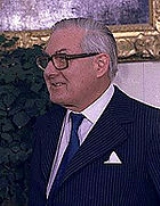
James Callaghan

 
James Callaghan

   Email Print
   Bookmark   Link


James Callaghan


Leonard James Callaghan, Baron Callaghan of Cardiff, KG
Order of the Garter

The Most Noble Order of the Garter is an order of chivalry, or knighthood, originating in medieval England, and presently bestowed on recipients in the United Kingdom and other Commonwealth realms; it is the pinnacle of the Orders, decorations, and medals of the United Kingdom....
, PC (27 March 1912 – 26 March 2005), was Prime Minister of the United Kingdom
Prime Minister of the United Kingdom

The Prime Minister of the United Kingdom of Great Britain and Northern Ireland is the political leader of the United Kingdom and the head of government Her Majesty's Government....
 from 1976 to 1979 and leader of the Labour Party
Labour Party (UK)

The Labour Party is a political party in the United Kingdom. Founded at the start of the 20th century, it has been since the 1920s the principal party of the Left-wing politics in England, Scotland and Wales, but not Northern Ireland, where it has only recently organised again....
 from 1976 to 1980. Commonly known as Jim Callaghan (and nickname
Nickname

A nickname is a descriptive name given in place of or in addition to the official name of a person, place or thing. Another class of nickname is the familiar or truncated form of the proper name, such as Bob, Bobby, Rob, Robbie, and Bert for Robert, more properly called a short name....
d Sunny Jim, Gentleman Jim or Big Jim), Callaghan is the only person to have served in all four of the Great Offices of State
Great Offices of State

The Great Offices of State in the United Kingdom are the four most senior and prestigious posts in the British parliamentary system of government....
: Prime Minister
Prime Minister of the United Kingdom

The Prime Minister of the United Kingdom of Great Britain and Northern Ireland is the political leader of the United Kingdom and the head of government Her Majesty's Government....
, Chancellor of the Exchequer
Chancellor of the Exchequer

The Chancellor of the Exchequer is the title held by the British Cabinet of the United Kingdom Minister who is responsible for all economic and financial matters....
, Home Secretary
Home Secretary

The Secretary of State for the Home Department, commonly known as the Home Secretary, is the minister in charge of the United Kingdom Home Office and is one of the Great Offices of State....
 and Foreign Secretary
Secretary of State for Foreign and Commonwealth Affairs

The Secretary of State for Foreign and Commonwealth Affairs, commonly referred to as the Foreign Secretary, is a member of the Her Majesty's Government in the United Kingdom heading the Foreign and Commonwealth Office and responsible for relations with foreign countries, matters pertaining to the Commonwealth of Nations and the UK's Br...
.

Callaghan was Chancellor of the Exchequer
Chancellor of the Exchequer

The Chancellor of the Exchequer is the title held by the British Cabinet of the United Kingdom Minister who is responsible for all economic and financial matters....
 from 1964 to 1967 during a turbulent period in the British economy in which he had to wrestle with a balance of payments deficit and speculative attacks on the pound sterling
Pound sterling

----The pound sterling , subdivided into 100 pence , is the currency of the United Kingdom, its Crown dependency and the British Overseas Territories of South Georgia and the South Sandwich Islands and British Antarctic Territory....
.


Discussion
Ask a question about 'James Callaghan'
Start a new discussion about 'James Callaghan'
Answer questions from other users
Full Discussion Forum


Quotations


A leader has to appear consistent. That doesn't mean he has to be consistent.

The Harvard Business Review, 1 November 1986.

A leader must have the courage to act against an expert's advice.

The Harvard Business Review, 1 November 1986.

I hate putting up taxes.

Interview on BBC television, 20 May, 1965.

If we have to prove our Europeanism by accepting that French is the dominant language in the Community, then my answer is quite clear, and I will say it in French in order to prevent any misunderstanding: Non, merci beaucoup.

Speech at Southampton, 25 May, 1971.

But the policies of the 1960s would not be successful today. No more would general import controls.They benefit some home industries at the expense of the livelihood of everyone working in exports. We would be robbing Peter to pay Paul.

Speech at Woolwich, 30 January, 1976.

If we were to fail, I do not think another Government could succeed. The result would be a National Government situation and I fear it would lead to totalitarianism of the Right or Left.

Financial Times, 1 October, 1976.


Encyclopedia


Leonard James Callaghan, Baron Callaghan of Cardiff, KG
Order of the Garter

The Most Noble Order of the Garter is an order of chivalry, or knighthood, originating in medieval England, and presently bestowed on recipients in the United Kingdom and other Commonwealth realms; it is the pinnacle of the Orders, decorations, and medals of the United Kingdom....
, PC (27 March 1912 – 26 March 2005), was Prime Minister of the United Kingdom
Prime Minister of the United Kingdom

The Prime Minister of the United Kingdom of Great Britain and Northern Ireland is the political leader of the United Kingdom and the head of government Her Majesty's Government....
 from 1976 to 1979 and leader of the Labour Party
Labour Party (UK)

The Labour Party is a political party in the United Kingdom. Founded at the start of the 20th century, it has been since the 1920s the principal party of the Left-wing politics in England, Scotland and Wales, but not Northern Ireland, where it has only recently organised again....
 from 1976 to 1980. Commonly known as Jim Callaghan (and nickname
Nickname

A nickname is a descriptive name given in place of or in addition to the official name of a person, place or thing. Another class of nickname is the familiar or truncated form of the proper name, such as Bob, Bobby, Rob, Robbie, and Bert for Robert, more properly called a short name....
d Sunny Jim, Gentleman Jim or Big Jim), Callaghan is the only person to have served in all four of the Great Offices of State
Great Offices of State

The Great Offices of State in the United Kingdom are the four most senior and prestigious posts in the British parliamentary system of government....
: Prime Minister
Prime Minister of the United Kingdom

The Prime Minister of the United Kingdom of Great Britain and Northern Ireland is the political leader of the United Kingdom and the head of government Her Majesty's Government....
, Chancellor of the Exchequer
Chancellor of the Exchequer

The Chancellor of the Exchequer is the title held by the British Cabinet of the United Kingdom Minister who is responsible for all economic and financial matters....
, Home Secretary
Home Secretary

The Secretary of State for the Home Department, commonly known as the Home Secretary, is the minister in charge of the United Kingdom Home Office and is one of the Great Offices of State....
 and Foreign Secretary
Secretary of State for Foreign and Commonwealth Affairs

The Secretary of State for Foreign and Commonwealth Affairs, commonly referred to as the Foreign Secretary, is a member of the Her Majesty's Government in the United Kingdom heading the Foreign and Commonwealth Office and responsible for relations with foreign countries, matters pertaining to the Commonwealth of Nations and the UK's Br...
.

Callaghan was Chancellor of the Exchequer
Chancellor of the Exchequer

The Chancellor of the Exchequer is the title held by the British Cabinet of the United Kingdom Minister who is responsible for all economic and financial matters....
 from 1964 to 1967 during a turbulent period in the British economy in which he had to wrestle with a balance of payments deficit and speculative attacks on the pound sterling
Pound sterling

----The pound sterling , subdivided into 100 pence , is the currency of the United Kingdom, its Crown dependency and the British Overseas Territories of South Georgia and the South Sandwich Islands and British Antarctic Territory....
. In November 1967, the Government was forced to devalue the pound sterling
Pound sterling

----The pound sterling , subdivided into 100 pence , is the currency of the United Kingdom, its Crown dependency and the British Overseas Territories of South Georgia and the South Sandwich Islands and British Antarctic Territory....
 despite having denied he would do this publicly including to the House of Commons
British House of Commons

The House of Commons is the lower house of the Parliament of the United Kingdom, which also comprises the British monarchy and the House of Lords ....
. Callaghan offered to resign, but was persuaded to swap his ministerial post with Roy Jenkins
Roy Jenkins

Roy Harris Jenkins, Baron Jenkins of Hillhead Order of Merit Privy Council of the United Kingdom was a British politician. Once prominent as a Labour Party Member of Parliament and government minister in the 1960s and 1970s, he became the first British President of the European Commission and one of the four principal founders of the So...
, becoming Home Secretary
Home Secretary

The Secretary of State for the Home Department, commonly known as the Home Secretary, is the minister in charge of the United Kingdom Home Office and is one of the Great Offices of State....
 from 1967 to 1970. In that capacity, Callaghan took the decision to use the Army
British Army

The British Army is the Army branch of the British Armed Forces. It came into being with the unification of the Kingdoms of Kingdom of England and Kingdom of Scotland into the Kingdom of Great Britain in 1707....
 to support the police
Royal Ulster Constabulary

The Royal Ulster Constabulary George Cross was the name of the police force in Northern Ireland from 1922 to 2001. It was founded on 1 June 1922 out of the Royal Irish Constabulary , the Belfast Borough Police Force and the Londonderry Borough Police Force ....
 in Northern Ireland
Northern Ireland

conventional_long_name = Northern Ireland|native_name= Tuaisceart ?ireannNorlin Airlann|motto =|image_map = Europe location N-IRL2.png...
, after a request from the Northern Ireland Government.

The Labour Party lost the general election in 1970
United Kingdom general election, 1970

The United Kingdom general election of 1970 was held on 18 June 1970, and resulted in a surprise victory for the Conservative Party under leader Edward Heath, who defeated the Labour Party under Harold Wilson....
, but Callaghan returned to office as Foreign Secretary
Secretary of State for Foreign and Commonwealth Affairs

The Secretary of State for Foreign and Commonwealth Affairs, commonly referred to as the Foreign Secretary, is a member of the Her Majesty's Government in the United Kingdom heading the Foreign and Commonwealth Office and responsible for relations with foreign countries, matters pertaining to the Commonwealth of Nations and the UK's Br...
 in March 1974, taking responsibility for renegotiating the terms of the United Kingdom's membership of the European Economic Community
European Economic Community

The European Economic Community was an international organisation created in 1957 to bring about economic integration between Belgium, France, Germany, Italy, Luxembourg and the Netherlands....
 (the EEC, or "Common Market"), and supporting a 'Yes' vote in the 1975 referendum for the UK to remain in the EEC. When Harold Wilson
Harold Wilson

James Harold Wilson, Baron Wilson of Rievaulx, Order of the Garter, Order of the British Empire, Fellow of the Royal Society, Her Majesty's Most Honourable Privy Council was one of the most prominent British politicians of the later half of the 20th century....
 resigned in 1976, Callaghan was elected the new Labour leader.

Labour had already lost its majority in the House of Commons when he became Prime Minister and lost further seats at by-elections and through defections, forcing Callaghan to deal with minor parties such as the Liberal Party
Liberal Party (UK)

The Liberal Party was one of the two major British political parties from the early 19th century until the rise of the Labour Party in the 1920s, and a third party of varying strength and importance up to 1988, when it merged with the Social Democratic Party to form a new party which would become known as the Liberal Democrats....
 especially in the Lib-Lab pact
Lib-Lab pact

The Lib-Lab pact has been a working arrangement between the Great Britain's political parties of Liberal Party and the Labour Party .There have been four such arrangements, and one alleged proposal, at the national level....
 from 1977 to 1978, the Ulster Unionists, Scottish National Party
Scottish National Party

The Scottish National Party is a centre-left List of Scottish political parties which campaigns for Scottish independence. In the last few decades, the SNP has normally polled the second highest number of votes for a Scottish political parties in Scotland....
 and even Independents. Industrial disputes and widespread strikes in the "Winter of Discontent
Winter of Discontent

The "Winter of Discontent" is a term used to describe the British winter of 1978–1979, during which there were widespread strike actions by trade unions demanding larger pay raises for their members, and the government of James Callaghan struggled to cope....
" of 1978–79, made Callaghan's government unpopular and the defeat of the referendum
Referendum

A referendum , ballot question, or plebiscite is a direct vote in which an entire Constituency is asked to either accept or reject a particular proposal....
 on devolution
Devolution

Devolution is the Statute granting of powers from the central government of a state to government at a subnational level, such as a regional, local, or state level....
 for Scotland led to the passage of a motion of no confidence
Motion of no confidence

A motion of no confidence is a parliamentary motion traditionally put before a parliament by the parliamentary opposition in the hope of defeating or weakening a Executive , or, rarely by an erstwhile supporter who has lost confidence in the government....
 on 28 March 1979. This was followed by a defeat by Margaret Thatcher
Margaret Thatcher

Margaret Hilda Thatcher, Baroness Thatcher Order of the Garter, Order of Merit, Her Majesty's Most Honourable Privy Council, Fellow of the Royal Society was Prime Minister of the United Kingdom from 1979 to 1990 and Leader of the Conservative Party of the Conservative Party from 1975 to 1990....
's Conservative Party in the ensuing general election
United Kingdom general election, 1979

The United Kingdom general election of 1979 was held on 3 May 1979 and is regarded as a pivotal point in 20th century British politics. The Conservative Party under Margaret Thatcher defeated James Callaghan's incumbent Labour Party government in what would prove to be the first of four consecutive general election victories for the Conserv...
.

1912 to 1944: Early life and career

James Callaghan was born at 38 Funtington Road, Copnor, Portsmouth
Portsmouth

Portsmouth city status in the United Kingdom located in the Counties of England of Hampshire on the south coast of England. Portsmouth is the UK's only island city and is located on Portsea Island....
, England on 27 March 1912. He was named after his father. James Callaghan senior was a Royal Navy
Royal Navy

The Royal Navy of the United Kingdom is the oldest of the British Armed Forces . From the mid-18th century until well into the 20th century, it was the most powerful navy in the world, playing a key part in establishing the British Empire as the dominant world power from 1815 until the early 1940s....
 Chief Petty Officer
Chief Petty Officer

Chief Petty Officer is a Non-commissioned officer or equivalent in many navy....
, who died when Callaghan was nine years old in 1921. His mother was called Charlotte Callaghan née Cundy. He attended Portsmouth
Portsmouth

Portsmouth city status in the United Kingdom located in the Counties of England of Hampshire on the south coast of England. Portsmouth is the UK's only island city and is located on Portsea Island....
 Northern Secondary School (now Mayfield School). He gained the Senior Oxford Certificate in 1929, but could not afford entrance to university
University

A university is an institution of higher education and research, which grants academic degrees in a variety of subjects. A university provides both undergraduate education and postgraduate education....
, and instead sat the Civil Service
Civil service

The term civil service has two distinct meanings:* Branch of governmental service in which individuals are hired on the basis of merit which is proven by the use of competitive examinations....
 Entrance Exam.

At the age of 17 Callaghan left to work as a clerk for the Inland Revenue
Inland Revenue

The Inland Revenue was, until April 2005, a Departments of the United Kingdom Government of the British Government responsible for the collection of direct tax tax, including income tax, national insurance, capital gains tax, Inheritance Tax , United Kingdom corporation tax, petroleum revenue tax and stamp duty....
. While working as a Tax Inspector, Callaghan was instrumental in establishing the Association of Officers of Taxes as a Trade Union
Trade union

A trade union or labor union is an organization run by and for workers who have banded together to achieve common goals in key areas such as wages, hours, and working conditions....
 for those in his profession and became a member of its National Executive. Whilst at the Inland Revenue offices in Kent, in 1931 he joined the Maidstone
Maidstone

Maidstone is the county town of Kent, England, south-east of London. The River Medway runs through the centre of the town linking Maidstone to Rochester and the Thames Estuary....
 branch of Labour Party. In 1934 he was transferred to Inland Revenue offices in London. Following a merger of unions in 1936, Callaghan was appointed as a full-time union official and to the post of Assistant Secretary of the Inland Revenue Staff Federation
Inland Revenue Staff Federation

The Inland Revenue Staff Federation was a trade union in the United Kingdom.The union was founded in 1936 with the merger of the Association of Officers of Taxes, the National Association of Assessors and Collectors of Taxes and the Valuation Office Clerical Association....
 and resigned from his civil service duties.

His union position at the Inland Revenue Federation brought Callaghan into contact with Harold Laski
Harold Laski

Harold Joseph Laski was an English political theorist, economist, author, and lecturer, and served as the 1945-1946 chairman of the Labour Party ....
, the Chairman of the Labour Party's National Executive Committee
National Executive Committee

The National Executive Committee or NEC is the chief administrative body of the UK Labour Party . Its composition has changed over the years, and includes representatives of affiliated trade unions, the Parliamentary Labour Party and European Parliamentary Labour Party, Constituency Labour Parties, and socialist societies, as well as '...
 and a academic at the London School of Economics
London School of Economics

The London School of Economics and Political Science, more commonly referred to as The London School of Economics or LSE, is a specialist college of the University of London in London, England....
. Laski encouraged him to stand for Parliament. Callaghan joined the Royal Navy Volunteer Reserve as an ordinary seaman in World War II
World War II

World War II, or the Second World War , was a global military conflict which involved a Participants in World War II, including all of the great powers, organised into two opposing military alliances: the Allies of World War II and the Axis powers....
 from 1942 where he served in the East Indies Fleet and was promoted to the rank of Lieutenant
Lieutenant

Lieutenant is a military, naval, paramilitary, fire service, emergency medical services or police commissioned officer military rank.Lieutenant may also appear as part of a title used in various other organisations with a codified command structure....
 in April 1944. Whilst training for his promotion his medical examination revealed that he was suffering from tuberculosis
Tuberculosis

Tuberculosis is a common and often deadly infectious disease caused by mycobacterium, mainly Mycobacterium tuberculosis . Tuberculosis usually attacks the lungs but can also affect the central nervous system, the lymphatic system, the circulatory system, the genitourinary system, the gastrointestinal system, bones, joints, and even the...
 and was admitted to the Royal Naval Hospital Haslar in Gosport
Gosport

Gosport is a town and Non-metropolitan district in Hampshire with around 79,000 resident inhabitants , with a further 5-10,000 during the summer months, situated on the south coast of England....
 near Portsmouth
Portsmouth

Portsmouth city status in the United Kingdom located in the Counties of England of Hampshire on the south coast of England. Portsmouth is the UK's only island city and is located on Portsea Island....
. After he recovered he was discharged and assigned to duties with the Admiralty
Admiralty

The Admiralty was formerly the authority in the United Kingdom responsible for the command of the Royal Navy. Originally exercised by a single person, the office of Lord High Admiral was from the 18th century onward almost invariably put "in commission", and was exercised by a Board of Admiralty....
 in Whitehall
Whitehall

Whitehall is a road in Westminster in London, England. It is the main artery running north from Parliament Square, towards traditional Charing Cross, now at the southern end of Trafalgar Square and marked by the statue of Charles I of England, which is often regarded as the heart of London....
. He was assigned to the Japanese section and wrote a service manual for the Royal Navy The Enemy Japan.

Whilst on leave, Callaghan was selected as a Parliamentary candidate for Cardiff South
Cardiff South (UK Parliament constituency)

Cardiff South was a borough constituency in Cardiff, Wales. It returned one Member of Parliament to the British House of Commons of the Parliament of the United Kingdom....
. He narrowly won the local party ballot with twelve votes against the next highest candidate George Thomas with eleven votes. He was encouraged to put his name forward for the Cardiff South seat by his friend Dai Kneath, a member of the IRSF National executive from Swansea
Swansea

Swansea is a City status in the United Kingdom and subdivisions of Wales in Wales. Swansea is in the Historic counties of Wales of Glamorgan. Situated on the sandy South West Wales coast, the county area includes the Gower peninsula and the Lliw uplands....
, who was in turn an associate and friend of the local Labour Party secretary Bill Headon. During 1945 he was assigned to the Indian Fleet and served on HMS Queen Elizabeth
HMS Queen Elizabeth (1913)

HMS Queen Elizabeth was the lead ship of the Queen Elizabeth class battleship of HMS Dreadnought battleships, named in honour of Elizabeth I of England....
 in the Indian Ocean. After VE Day, along with other prospective candidates he returned to the United Kingdom to stand in the general election.

1945 to 1976: Parliament and Cabinet


Labour won a landslide victory on 26 July 1945 bringing Clement Attlee
Clement Attlee

Clement Richard Attlee, 1st Earl Attlee, Order of the Garter, Order of Merit, Order of the Companions of Honour, Her Majesty's Most Honourable Privy Council, Fellow of the Royal Society was a British people politician, who served as Prime Minister of the United Kingdom from 1945 to 1951, and leader of the Labour Party from 1935 to 1955....
 to power. Callaghan won his Cardiff
Cardiff

Cardiff is the Capital , largest city and most populous Unitary authority#Wales in Wales. The city is Wales' chief commercial centre, the base for many national cultural and sport institutions, the Welsh national media, and the seat of Welsh Assembly Government ....
 seat in the 1945 UK general election
United Kingdom general election, 1945

The United Kingdom General Election of 1945 was a United Kingdom general election held on 5 July 1945, with delayed polls taking place on 12 July and in Nelson and Colne on 19 July....
 (and would hold a Cardiff-area seat continuously until 1987). He won with a 6,000 majority over the sitting Conservative
Conservative Party (UK)

The Conservative and Unionist Party, more commonly known as the Conservative Party, is a conservative political party in the United Kingdom....
 incumbent candidate, Sir Arthur Evans, the two in total respectively polling 17,489 to 11,545 votes. He campaigned on such issues as the rapid demobilisation of the armed forces and for a new housing construction programme. At the time of his election, his son Michael was born.

Callaghan was soon appointed Parliamentary Secretary to the Ministry of Transport in 1947 where, advised by the young chief constable of Hertfordshire
Hertfordshire

Hertfordshire is a Ceremonial counties of England and Metropolitan and non-metropolitan counties of England Counties of England in the East of England region of England....
 Sir Arthur Young, his term saw important improvements in road safety, notably the introduction of zebra crossing
Zebra crossing

A zebra crossing is a type of pedestrian crossing used in many places around the world. The crossing is characterised by longitudinal stripes on the road, parallel to the flow of the traffic, alternately a light colour and a dark one ....
s, and an extension in the use of cat's eyes
Cat's eye (road)

The cat's eye is a retroreflective Road safety used in road construction and was the first of a range of raised pavement markers. It originated from the United Kingdom in 1933 and is used all over the world....
. He moved to be Parliamentary and Financial Secretary to the Admiralty from 1950 where he was a delegate to the Council of Europe
Council of Europe

The Council of Europe is the oldest international organisation working towards European integration, having been founded in 1949. It has a particular emphasis on legal standards, human rights, democracy development, the rule of law and cultural co-operation....
 and resisted plans for a European army.

Callaghan was popular with Labour MPs and was elected to the Shadow Cabinet every year while the Labour Party was in opposition from 1951 to 1964. He was Parliamentary Adviser to the Police Federation from 1955 to 1960 when he negotiated an increase in police pay. He ran for the Deputy Leadership of the party in 1960 as an opponent of unilateral nuclear disarmament, and despite the other candidate of the Labour right (George Brown
George Brown, Baron George-Brown

George Alfred George-Brown, Baron George-Brown, Privy Council of the United Kingdom was a United Kingdom politician who served as Deputy Leader of the Labour Party from 1960 to 1970, and was a senior Cabinet minister in the Labour government of the 1960s....
) agreeing with him on this policy, he forced Brown to a second vote. In 1961 Callaghan became shadow chancellor. When Hugh Gaitskell
Hugh Gaitskell

Hugh Todd Naylor Gaitskell was a British politician, leader of the Labour Party from 1955 until his death in 1963....
 died in January 1963, Callaghan ran to succeed him but came third. However, he did gain the support of right-wingers, such as Denis Healey
Denis Healey

Denis Winston Healey, Baron Healey, Order of the Companions of Honour, Order of the British Empire, Privy Council of the United Kingdom is a British life peer and Labour Party politician....
 and Anthony Crosland
Anthony Crosland

Charles Anthony Raven Crosland was a member of the Labour Party and an important socialism theorist. He served as the Member of Parliament for South Gloucestershire and later for Great Grimsby ....
, who wanted to prevent Wilson from being elected leader but who also didn't trust George Brown.

Chancellor of the Exchequer

In October 1964 Conservative
Conservative Party (UK)

The Conservative and Unionist Party, more commonly known as the Conservative Party, is a conservative political party in the United Kingdom....
 Prime Minister Sir Alec Douglas-Home called a general election
United Kingdom general election, 1964

The United Kingdom general election of 1964 was held on 15 October 1964, more than five years after its predecessor, and thirteen years after the Conservative Party had first taken power....
. It was a tough election but Labour won a small majority gaining 56 seats (a total of 317 to the Conservatives 309). The new Labour government under Harold Wilson
Harold Wilson

James Harold Wilson, Baron Wilson of Rievaulx, Order of the Garter, Order of the British Empire, Fellow of the Royal Society, Her Majesty's Most Honourable Privy Council was one of the most prominent British politicians of the later half of the 20th century....
 immediately faced economic problems and Wilson acted within his first hours to appoint Callaghan as Chancellor of the Exchequer
Chancellor of the Exchequer

The Chancellor of the Exchequer is the title held by the British Cabinet of the United Kingdom Minister who is responsible for all economic and financial matters....
. The new government had to cope with a balance of payments deficit and speculative attacks on Sterling. It was the policy of the whole government, and one in which Callaghan concurred, that devaluation should be avoided for as long as possible and he managed to arrange loans from other central banks and some tax rises in order to stabilise the economy. Callaghan's time as chancellor was to be during a time of crisis; with high inflation, high unemployment and an unstable economy with a deficit in the budget, a deficit in the balance of import and exports and most importantly conflict over the value of the pound.

On 11 November Callaghan gave his first budget and announced increases in income tax, petrol tax and the introduction of a new Capital Gains Tax, actions which most economists deemed necessary to take the heat out of the balance and sterling deficit, though international bankers disagreed.

Increasing difficulties with the economy were evident by late November when the surcharge of imports under the previous Conservative government were forcing the reserves to be depleted by as much as £50 million per day. On 23 November it was decided to increase the bank rate from 2% to 7% which generated a large amount of criticism. Handling the crisis was made more difficult by the attitude of Lord Cromer
George Baring, 3rd Earl of Cromer

File:Rowland Baring 3rd Earl of Cromer.jpgLieutenant-Colonel George Rowland Stanley Baring, 3rd Earl of Cromer, Order of the Garter, Order of St Michael and St George, Order of the British Empire , styled Viscount Errington before 1953, was Governor of the Bank of England and List of British Ambassadors to the United States....
, the Governor of the Bank of England
Bank of England

The Bank of England is the central bank of the United Kingdom and is the model on which most modern, large central banks have been based. Since 1946 it has been a Nationalisation institution....
, who argued against the fiscal policies of the new Labour government. When Callaghan and Wilson threatened to call a new general election, the governor soon raised a £3 billion loan to stabilise the reserves and the deficit. His second budget came on the 6 April 1965 in which he announced efforts to deflate the economy and reduce home import demand by £250 million. Shortly after the bank rate was reduced from 7% down to 6%. For a brief time the economy and British financial market stabilised, allowing in June for Callaghan to visit the United States and to discuss the state of the British economy with President Lyndon Baines Johnson and the International Monetary Fund
International Monetary Fund

The International Monetary Fund is an international organization that oversees the global financial system by following the macroeconomic policies of its member countries, in particular those with an impact on exchange rates and the balance of payments....
 (IMF).

In July the pound came under extreme pressure and Callaghan was forced to create harsh temporary measures to demonstrate control of the economy. These include suspending all current government building projects and postponing new pension plans. The alternative was to allow the pound to float or to devalue it. Callaghan and Wilson however were again adamant that a devaluation of the pound would create new social and economic problems and continued to take a firm stance against it. The government continued to struggle both with the economy and with the slender majority which by 1966 had been reduced to one. On 28 February Harold Wilson
Harold Wilson

James Harold Wilson, Baron Wilson of Rievaulx, Order of the Garter, Order of the British Empire, Fellow of the Royal Society, Her Majesty's Most Honourable Privy Council was one of the most prominent British politicians of the later half of the 20th century....
 formally announced an election for the 31 March 1966. On the 1 March Callaghan gave a 'little budget' to the commons and announced the historic decision that the UK would adopt the decimal system. It was actually not until 1971, under a Tory government, that the United Kingdom ended the system of pounds, shillings and pence, and entered a decimal system of 100 pence to the pound. He also announced a short term mortgage scheme which allowed low wage earners to maintain mortgage schemes in the face of economic difficulties. Soon after Labour won 363 seats compared to 252 seats against the Conservatives, giving the Labour government a large majority of 97.

Callaghan introduced his next Budget on 4 May. He had informed the house that he would bring a full Budget to the House when he made his 'little budget' speech prior to the election. The main point of his budget was the introduction of a selective Employment tax focusing on services rather than manufacturing. Twelve days after the budget the National Union of Seamen called a national strike and the problems facing Sterling were multiplied. Additional strikes caused the balance of payments deficit to increase and the 3.3 billion loan was now due. On 14 July the bank rate was increased again to seven percent. On the 20 July Callaghan announced an emergency ten point programme with a six month freeze on wage and salary increases. By 1967 the economy had begun to stabilise once again and the bank rate was reduced to 6% in March and 5.5% in May.

It was under these conditions that Callaghan beat Michael Foot
Michael Foot

Michael Mackintosh Foot is an England politician and writer. He was leader of the Labour Party from 1980 to 1983....
 in a vote to become Treasurer of the Labour Party
Treasurer of the Labour Party

The Treasurer of the Labour Party is a position on the National Executive Committee of the Labour Party .Although a post with little power, in the past, it was often hotly contested by people who later became big names in British politics: Arthur Greenwood beat Herbert Morrison in 1943, Hugh Gaitskell beat Aneurin Bevan in 1954, who in turn...
.

However the economy was soon in turmoil again with the Middle East crisis between Egypt
Egypt

Egypt is a country mainly in North Africa, with the Sinai Peninsula forming a land bridge in Western Asia. Covering an area of about , Egypt borders the Mediterranean Sea to the north, the Gaza Strip and Israel to the northeast, the Red Sea to the east, Sudan to the south and Libya to the west....
 and Israel
Israel

Israel officially the State of Israel , is a country in the Middle East located on the eastern shore of the Mediterranean Sea. It borders Lebanon in the north, Syria in the northeast, Jordan in the east, and Egypt on the southwest, and contains geographically diverse features within its relatively small area....
 raising oil prices. Furthermore the economy was hit in mid-September when a national dock strike lasted for eight weeks. A run on Sterling began with the six day war and with the closure of the Suez Canal and with the dock strike, the balance of payments deficit grew to a critical level. A Common Market report suggested that the pound could not be sustained as a reserve currency and it was suggested again that the pound should be devalued. Wilson and Callaghan refused a contingency fund offered from the IMF because of several conditions attached, and on Wednesday 15 November the historic decision was taken to commit the government to a 14.3% devaluation. The situation was a great political controversy at the time. As Denis Healey
Denis Healey

Denis Winston Healey, Baron Healey, Order of the Companions of Honour, Order of the British Empire, Privy Council of the United Kingdom is a British life peer and Labour Party politician....
 in his autobiography, notes:

Before the devaluation, Jim Callaghan had announced publicly to the press and the House of Commons
British House of Commons

The House of Commons is the lower house of the Parliament of the United Kingdom, which also comprises the British monarchy and the House of Lords ....
 that he would not devalue, something he later said was necessary to maintain confidence in the pound and avoid creating jitters in the financial markets.

Callaghan immediately offered his resignation as Chancellor and increasing political opposition forced Wilson to accept it. Wilson then moved Roy Jenkins
Roy Jenkins

Roy Harris Jenkins, Baron Jenkins of Hillhead Order of Merit Privy Council of the United Kingdom was a British politician. Once prominent as a Labour Party Member of Parliament and government minister in the 1960s and 1970s, he became the first British President of the European Commission and one of the four principal founders of the So...
 the home secretary to the Chancellor of the Exchequer and Callaghan became the new Home Secretary on 30 November 1967.

Home Secretary

Callaghan's tenure as Home Secretary was marked by the emerging conflict in Northern Ireland
Northern Ireland

conventional_long_name = Northern Ireland|native_name= Tuaisceart ?ireannNorlin Airlann|motto =|image_map = Europe location N-IRL2.png...
 and it was as Home Secretary that he took the decision to deploy United Kingdom troops in the province after a request from the Ulster Unionist
Ulster Unionist Party

The Ulster Unionist Party is the more moderate of the two main Unionist political parties in Northern Ireland. Prior to the split in Unionism in the late 1960s, when the former Protestant Unionist Party began to attract more hard line support away from the UUP, it governed Northern Ireland between 1921 and 1972 as the sole Unionist party....
 Government of Northern Ireland.

Callaghan was also responsible for the Immigration Act 1968; a controversial piece of legislation prompted by Conservative assertions that an influx of Kenyan Asians would soon inundate the country. It passed through the Commons in a week and placed entry controls on holders of United Kingdom passports who had "no substantial connection" with the United Kingdom by setting up a new system. In his memoirs Time and Chance, Callaghan wrote that introducing the Commonwealth Immigrants Bill had been an unwelcome task but that he did not regret it. He claimed the Asians had "discovered a loophole" and he told a BBC interviewer: "Public opinion in this country was extremely agitated, and the consideration that was in my mind was how we could preserve a proper sense of order in this country and at the same time do justice to these people - I had to balance both considerations". An opponent of the Act, Conservative MP Ian Gilmour
Ian Gilmour, Baron Gilmour of Craigmillar

Ian Hedworth John Little Gilmour, Baron Gilmour of Craigmillar, Privy Council of the United Kingdom, Baronet was a Conservative Party politician in the United Kingdom....
, asserted that it was "brought in to keep the blacks out. If it had been the case that it was 5,000 white settlers who were coming in, the newspapers and politicians, Callaghan included, who were making all the fuss would have been quite pleased".

Also significant was the passing of the Race Relations Act
Race Relations Act 1968

The Race Relations Act 1968 was a British Act of Parliament making it illegal to refuse housing, employment, or public services to a person on the grounds of colour, race, ethnic or national origins....
 in the same year, making it illegal to refuse employment, housing or education on the basis of ethnic background. The Act extended the powers of the Race Relations Board at the time, to deal with complaints of discrimination and unfair attitudes. It also set up a new supervisory body, the Community Relations Commission, to promote "harmonious community relations". Presenting the Bill to Parliament, the Home Secretary, Jim Callaghan, said, "
The House has rarely faced an issue of greater social significance for our country and our children."

After Wilson's unexpected defeat by Edward Heath
Edward Heath

Sir Edward Richard George Heath, Order of the Garter, Order of the British Empire , often known as Ted Heath, was Prime Minister of the United Kingdom from 1970 to 1974 and leader of the Conservative Party from 1965 to 1975....
 in the 1970 general election
United Kingdom general election, 1970

The United Kingdom general election of 1970 was held on 18 June 1970, and resulted in a surprise victory for the Conservative Party under leader Edward Heath, who defeated the Labour Party under Harold Wilson....
, Callaghan declined to challenge him for the leadership despite Wilson's vulnerability. This did much to rehabilitate him in Wilson's eyes. He was in charge of drawing up a new policy statement in 1972 which contained the idea of the Social Contract
Social Contract (Britain)

The Social Contract is a term used to describe policy by the The Labour Party government of Harold Wilson in 1970s United Kingdom.In return for the repeal of 1972 Industrial Relations Act, food subsides and a freeze on rent increase, the TUC would be able to persuade its members to cooperate in a programme of voluntary wage restraint....
 between the Government and Trade Unions. He also did much to ensure that Labour opposed the Heath government's bid to enter the Common Market
European Economic Community

The European Economic Community was an international organisation created in 1957 to bring about economic integration between Belgium, France, Germany, Italy, Luxembourg and the Netherlands....
 — forcing Wilson's hand by making his personal opposition clear without consulting the Party Leader.

Foreign Secretary and election as Leader of the Labour Party


When Wilson was again appointed Prime Minister in March 1974, he appointed Callaghan as Foreign Secretary
Secretary of State for Foreign and Commonwealth Affairs

The Secretary of State for Foreign and Commonwealth Affairs, commonly referred to as the Foreign Secretary, is a member of the Her Majesty's Government in the United Kingdom heading the Foreign and Commonwealth Office and responsible for relations with foreign countries, matters pertaining to the Commonwealth of Nations and the UK's Br...
 which gave him responsibility for renegotiating the terms of the United Kingdom's membership of the Common Market. When the talks concluded, Callaghan led the Cabinet in declaring the new terms acceptable and he supported a Yes vote in the 1975 referendum
United Kingdom referendum, 1975

The United Kingdom referendum of 1975 was a post-legislative referendum held on 5 June 1975 in the whole of the United Kingdom over whether there was support for it to stay in the European Economic Community, which it had entered in 1973, under the Conservative Party government of Edward Heath....
.

During his second term Wilson announced his surprise resignation on 16 March 1976, and unofficially endorsed Callaghan as his successor. Callaghan was the favourite to win the leadership, although he was the oldest candidate, he was also the most experienced and least divisive. Popularity with all parts of the Labour movement saw him through the ballot of Labour MPs
Labour Party (UK) leadership election, 1976

The Labour Party leadership election of 1976 occurred when former leader Harold Wilson resigned as Party Leader and Prime Minister of the United Kingdom....
 to win the leadership vote. On the 5 April 1976 at the age of 64 years and 9 days Callaghan became Prime Minister - the oldest person to become Prime Minister at time of appointment since Winston Churchill
Winston Churchill

Sir Winston Leonard Spencer-Churchill, Order of the Garter, Order of Merit, Order of the Companions of Honour, Territorial Decoration, Fellow of the Royal Society, Her Majesty's Most Honourable Privy Council, Queen's Privy Council for Canada was a Politics of the United Kingdom known chiefly for his leadership of the United King...
.

1976 to 1979: Prime Minister

Callaghan was the first Prime Minister to have held all three leading Cabinet positions - Chancellor of the Exchequer, Home Secretary and Foreign Secretary - prior to becoming Prime Minister.

During his first year in office, Callaghan started what has since become known as 'The Great Debate', when he spoke at Ruskin College, Oxford
Oxford

Oxford is a City status in the United Kingdom, and the county town of Oxfordshire, in South East England. It has a population of 151,000. The rivers River Cherwell and River Thames run through Oxford and meet south of the city centre....
 about the 'legitimate concerns' of a public about education as it took place in the nation's maintained schools. This discussion led to greater involvement of the government, through its ministries, in the curriculum and administration of state education, leading to the eventual introduction of the National Curriculum
National Curriculum

The National Curriculum was introduced into England, Wales and Northern Ireland as a nationwide curriculum for primary education and secondary education public education schools following the Education Reform Act 1988....
 some twenty years later.

Callaghan's time as Prime Minister was dominated by the troubles in running a Government with a minority in the House of Commons
British House of Commons

The House of Commons is the lower house of the Parliament of the United Kingdom, which also comprises the British monarchy and the House of Lords ....
: he was forced to make deals with minor parties in order to survive - including the Lib-Lab pact
Lib-Lab pact

The Lib-Lab pact has been a working arrangement between the Great Britain's political parties of Liberal Party and the Labour Party .There have been four such arrangements, and one alleged proposal, at the national level....
, and he had been forced to accept referendums on devolution in Scotland and Wales (the first went in favour but did not reach the required majority, and the second went heavily against).

Callaghanwaitingatchurch
Despite these difficulties, by late 1978, most opinion polls showed Labour ahead, and the expectation grew that Callaghan would call an autumn election. Famously he strung along the opposition and was expected to make his declaration of election in a broadcast in early September 1978. His decision to go on was at the time seen by many as a sign of his domination of the political scene and he ridiculed his opponents by impersonating old-time music hall
Music hall

Music hall is a form of British theatrical entertainment which was popular between 1850 and 1960. The term can refer to# A particular form of variety show entertainment involving a mixture of popular song, comedy and #Speciality Acts....
 star Marie Lloyd
Marie Lloyd

Matilda Alice Victoria Wood was an England music hall singer, best known as Marie Lloyd....
 singing "Waiting at the Church" at that month's Trades Union Congress
Trades Union Congress

The Trades Union Congress is a national trade union center, a federation of trade unions in the United Kingdom, representing the majority of trade unions....
 meeting: now seen as one of the greatest moments of hubris
Hubris

Hubris or hybris , mythology is a term used in modern English to indicate overweening pride, superciliousness, or arrogance, often resulting in fatal retribution....
 in modern British politics but celebrated at the time. Callaghan intended to convey the message that he had not promised an election, but most observers misread his message as an assertion that he would call an election, and the Conservatives would not be ready for it.

Callaghan's decision not to call an early election has been described as the biggest mistake of his premiership.

'The Winter of Discontent'

Callaghan's way of dealing with the long-term economic difficulties involved pay restraint which had been operating for four years with reasonable success. He gambled that a fifth year would further improve the economy and allow him to be re-elected in 1979, and so attempted to hold pay rises to 5% or less. The Trade Unions rejected continued pay restraint and in a succession of strikes over the winter of 1978-79 (known as the Winter of Discontent
Winter of Discontent

The "Winter of Discontent" is a term used to describe the British winter of 1978–1979, during which there were widespread strike actions by trade unions demanding larger pay raises for their members, and the government of James Callaghan struggled to cope....
) secured higher pay. The industrial unrest made his government extremely unpopular, and Callaghan's response to one interview question only made it worse. Returning to the United Kingdom from an economic summit held in Guadeloupe
Guadeloupe

Guadeloupe is an island group or archipelago located in the eastern Caribbean Sea at , with a land area of 1,628 square kilometres . It is an overseas department of France....
 in early 1979, Callaghan was asked:

Callaghan replied:

This reply was reported in
The Sun
The Sun (newspaper)

The Sun is a tabloid daily newspaper published in the United Kingdom and Republic of Ireland with the highest Newspaper circulation of any daily English-language newspaper in the world and the biggest circulation within the UK, standing at an average of 3,121,000 copies a day between January and June 2008 and with a daily readership of a...
under the headline:
Crisis? What Crisis?

Crisis? What Crisis? is the fourth album by progressive rock band Supertramp, released in 1975 in music.The album was Supertramp's first album to be recorded in United States in Los Angeles....


Callaghan also later admitted on regard to the winter of Discontent that he had "let the country down"

Callaghan was forced to advise The Queen
Elizabeth II of the United Kingdom

Elizabeth II is the queen regnant of sixteen independent states known as the Commonwealth realms: Monarchy of the United Kingdom, Monarchy of Canada, Monarchy of Australia, Monarchy of New Zealand, Monarchy of Jamaica, Monarchy of Barbados, the Bahamas, Grenada, Papua New Guinea, the Monarchy of the Solomon Islands, Tuvalu, Saint Lucia, Sain...
 to call an election when the House of Commons passed a Motion of No Confidence
Motion of no confidence

A motion of no confidence is a parliamentary motion traditionally put before a parliament by the parliamentary opposition in the hope of defeating or weakening a Executive , or, rarely by an erstwhile supporter who has lost confidence in the government....
 by one vote on 28 March 1979. The Conservatives, with the advertising agency Saatchi and Saatchi, ran a campaign on the slogan "Labour isn't working". Margaret Thatcher
Margaret Thatcher

Margaret Hilda Thatcher, Baroness Thatcher Order of the Garter, Order of Merit, Her Majesty's Most Honourable Privy Council, Fellow of the Royal Society was Prime Minister of the United Kingdom from 1979 to 1990 and Leader of the Conservative Party of the Conservative Party from 1975 to 1990....
 won the election.

Callaghan's Government was, however less than a large amount than other prime ministers, supportful of various pro-western dictatorships or attrocities such as Indonesia and its invasion of East Timor
East Timor

East Timor, also known as Timor-Leste is a country in Southeast Asia. It comprises the eastern half of the island of Timor, the nearby islands of Atauro Island and Jaco , and Oecussi-Ambeno, an exclave on the northwestern side of the island, within Indonesian West Timor....
 which was the cause of 200,000 deaths in that province. Britain under him and other Prime Ministers had "provided arms to indonesia and deepened aid, trade and diplomatic relation" during this time.

Resignation, backbenches and retirement

Callaghan resigned as leader of the Labour Party in September 1980, shortly after the 1980 party conference had voted for a new system of election by electoral college involving the individual members and trade unions. His resignation ensured that his successor would be elected by MPs only. In the second round of a campaign that laid bare the deep internal divisions of the Parliamentary Labour Party, Michael Foot
Michael Foot

Michael Mackintosh Foot is an England politician and writer. He was leader of the Labour Party from 1980 to 1983....
 narrowly beat Denis Healey
Denis Healey

Denis Winston Healey, Baron Healey, Order of the Companions of Honour, Order of the British Empire, Privy Council of the United Kingdom is a British life peer and Labour Party politician....
 to succeed Callaghan as leader.

In 1982, along with his friend Gerald Ford
Gerald Ford

Gerald Rudolph Ford, Jr. was the List of Presidents of the United States President of the United States, serving from 1974 to 1977, and the List of Vice Presidents of the United States Vice President of the United States serving from 1973 to 1974....
, he cofounded the annual AEI World Forum
AEI World Forum

The AEI World Forum is an annual meeting of business and financial executives, head of government, government officials, and intellectuals. Held every summer in Beaver Creek, Colorado, it is sponsored by the American Enterprise Institute and the Vail Valley Foundation, and it features a number of AEI scholars and fellows....
.

In 1983, Callaghan became Father of the House
Father of the House

Father of the House is a term that has by tradition been unofficially bestowed on certain members of some national legislatures, most notably the United Kingdom House of Commons in the United Kingdom....
 as the longest continuously serving member of the Commons and one of only two survivors of the 1945 general election - Michael Foot being the other, but he had been out of the House from 1955 to 1960. In 1987 he was made a Knight of the Garter and stood down at the 1987 general election
United Kingdom general election, 1987

The United Kingdom general election of 1987 was held on 11 June 1987 and was the third consecutive victory for the Conservative Party under the leadership of Margaret Thatcher....
 after forty-two years as a member of the Commons. Shortly afterwards, he was elevated to the House of Lords
House of Lords

The House of Lords is the second house of the Parliament of the United Kingdom and is also commonly referred to as "the Lords". The Parliament comprises the British monarchy, the British House of Commons , and the Lords....
 as Baron Callaghan of Cardiff, of the City of Cardiff
Cardiff

Cardiff is the Capital , largest city and most populous Unitary authority#Wales in Wales. The city is Wales' chief commercial centre, the base for many national cultural and sport institutions, the Welsh national media, and the seat of Welsh Assembly Government ....
 in the Royal County of South Glamorgan
South Glamorgan

South Glamorgan is a preserved counties of Wales of Wales.It was originally formed in 1974 under the Local Government Act 1972, as a county council area....
shire. In 1987, his autobiography,
Time and Chance, was published.

In 1988, Callaghan's wife Audrey
Audrey Callaghan

Audrey Elizabeth Callaghan, Baroness Callaghan of Cardiff was the wife of Prime Minister of the United Kingdom James Callaghan and was herself a politician and campaigner and fundraiser for children's health and welfare....
, a former chairman (1969 - 1982) of Great Ormond Street Hospital
Great Ormond Street Hospital

The Great Ormond Street Hospital is a medical institution specialising in the care of children. It was founded in London in 1852 as the Hospital for Sick Children, making it the first hospital providing in-patient beds specifically for children in the English language world....
, spotted a letter to a newspaper which pointed out that the copyright
Copyright

Copyright is a form of intellectual property which gives the creator of an original work exclusive rights for a certain time period in relation to that work, including its publication, distribution and adaptation; after which time the work is said to enter the public domain....
 of
Peter Pan
Peter Pan

Peter Pan is a character created by Scotland novelist and playwright J. M. Barrie . A mischievous boy who can fly and magically refuses to aging, Peter Pan spends his never-ending childhood adventuring on the small island of Neverland as the leader of his gang the Lost Boys , interacting with Mermaid, Native_Americans_in_the_United_States, f...
, which had been assigned by J. M. Barrie
J. M. Barrie

Sir James Matthew Barrie, 1st Baronet Order of Merit , more commonly known as J. M. Barrie, was a Scotland author and dramatist. He is best remembered for creating Peter Pan, the boy who refused to grow up, whom he based on his friends, the Llewelyn Davies boys....
 to the hospital, was about to expire. Callaghan moved an amendment to the Copyright Bill then under consideration in the Lords to extend the term under which the hospital could continue to collect royalties despite the lapse of copyright, and this was accepted by the government.

On 14 February 2005, he became the longest-lived British Prime Minister, surpassing Harold Macmillan
Harold Macmillan

Harold Macmillan, 1st Earl of Stockton, Order of Merit, Her Majesty's Most Honourable Privy Council was a British Conservative Party politician and Prime Minister of the United Kingdom from 10 January 1957 to 18 October 1963....
, and had the longest life of any British prime minister when he died at his farm in Ringmer
Ringmer

Ringmer is a village and civil parish in the Lewes of East Sussex, England. The village is located three miles east of Lewes.There has been human habitation there since at least Roman Britain times....
, East Sussex
East Sussex

East Sussex is a Counties of England in South East England England. It is bordered by the counties of Kent, Surrey, Brighton and Hove and West Sussex, and to the south by the English Channel....
 on 26 March 2005, on the eve of his 93rd birthday. At the time of his death Callaghan had lived 92 years 364 days, exceeding by 42 days the life span of Macmillan.

Personal life


James Callaghan's interests included rugby
Rugby football

Rugby football may refer to a number of sports through history descended from a common form of football developed in different areas of England....
, tennis
Tennis

Tennis is a sport played between two players or between two teams of two players each . Each player uses a strung racquet to strike a hollow rubber Tennis ball covered with felt over a net into the opponent's tennis court....
 and agriculture. According to the official history of 10 Downing Street, he is believed to have been the tallest prime minister in British history at 6'1". He married Audrey Elizabeth Moulton
Audrey Callaghan

Audrey Elizabeth Callaghan, Baroness Callaghan of Cardiff was the wife of Prime Minister of the United Kingdom James Callaghan and was herself a politician and campaigner and fundraiser for children's health and welfare....
, whom he had met when they both worked as Sunday School teachers at the local Baptist church, in July 1938 and had three children — one son and two daughters. Lady Callaghan died on 15 March 2005.

James Callaghan died on 26 March 2005, just 11 days after his wife's death.

One of their daughters, Margaret, became Baroness Jay of Paddington and was Leader of the House of Lords
House of Lords

The House of Lords is the second house of the Parliament of the United Kingdom and is also commonly referred to as "the Lords". The Parliament comprises the British monarchy, the British House of Commons , and the Lords....
 from 1998 to 2001.

James Callaghan in popular culture


The song "Time For Truth" from The Jam
The Jam

The Jam were an English Rock music band active during the late 1970s and early 1980s. While they shared the "angry young men" outlook and fast tempos of their punk rock contemporaries, The Jam wore neatly tailored suits rather than ripped clothes and incorporated a number of mainstream 1960s rock influences rather than rejecting them, placing...
's debut
In the City
In the City (album)

In the City was the debut album of British mod revival/punk rock band The Jam. It was released in 1977 in music by Polydor Records and featured the hit single and title track "In the City "....
, a scathing critique of the state of the British nation, directly addresses Callaghan: "I think it's time for truth, and the truth is you lost, Uncle Jimmy."

In 1977 James Callaghan was immortalised in a cartoon strip, debuting in issue # 17 (2 February 1977) of Captain Britain
Captain Britain

Captain Britain , briefly known as Britannic, is a fictional character, a superhero appearing in the comic books published by Marvel Comics....
 comic, published by Marvel. He is briefed by Nick Fury
Nick Fury

Colonel Nicholas Joseph "Nick" Fury is a fictional character World War II army hero and present-day spy fiction in the Marvel Comics Marvel universe....
 of a Nazi plan by super villain the Red Skull
Red Skull

The Red Skull is a name shared by several Character , comic book supervillains from the Marvel Comics Marvel Comics Universe. All incarnations of the character are enemies of Captain America, other superheroes, and the United States in general....
 to take over Great Britain. In issue # 21 (2 March 1977) Callaghan is kidnapped by the baddies and sentenced to death, by firing squad, alongside Captain Britain
Captain Britain

Captain Britain , briefly known as Britannic, is a fictional character, a superhero appearing in the comic books published by Marvel Comics....
 and Captain America
Captain America

Captain America is a Character that appears in comic books published by Marvel Comics. The character First appearance in Captain America Comics #1 , from Marvel Comics' 1940s predecessor, Timely Comics, and was created by Joe Simon and Jack Kirby....
, before making his escape. It is not known what Callaghan's reaction was to his appearance in cartoon form.

Titles from birth to death

  • James Callaghan, Esq (27 March 1912 - 1943)
  • Lieutenant James Callaghan, RNVR (1943 - 26 July 1945)
  • Lieutenant James Callaghan, MP (26 July 1945-21 October 1964)
  • Lieutenant The Right Honourable James Callaghan, MP (21 October 1964-?)
  • The Right Honourable James Callaghan, MP (?- 23 April 1987)
  • The Right Honourable Sir James Callaghan, KG, MP (23 April - 11 June 1987)
  • The Right Honourable Sir James Callaghan, KG (11 June - 5 November 1987)
  • The Right Honourable The Lord Callaghan of Cardiff, KG, PC (5 November 1987 - 26 March 2005)


See also


External links

  • on the Downing Street website.
  • , lecture by Professor the Lord Morgan at Gresham College
    Gresham College

    File:Gresham College, 1740.jpgGresham College is an unusual institution of higher learning off Holborn in central London. It enrolls no students and grants no academic degrees....
     on 5 June 2007 (with video and audio files available for download)


|- |-