


Scottish Parliament

Encyclopedia
The Scottish Parliament ' onMouseout='HidePop("7684")' href="/topics/Scots_language">Scots
: The Scots Pairliament) is the devolved
national, unicameral
legislature
of Scotland
, located in the Holyrood
area of the capital, Edinburgh
. The Parliament, informally referred to as "Holyrood", is a democratically
elected body comprising 129 members known as Members of the Scottish Parliament
(MSPs). Members are elected for four-year terms under the mixed member proportional representation
system. As a result, 73 MSPs represent individual geographical constituencies
elected by the plurality
("first past the post") system, with a further 56 returned from eight additional member
regions, each electing seven MSPs. The most recent general election to the Parliament was held on 5 May 2011.
The original Parliament of Scotland
(or "Estates
of Scotland") was the national legislature of the independent Kingdom of Scotland
, and existed from the early 13th century until the Kingdom of Scotland merged with the Kingdom of England
under the Acts of Union 1707
to form the Kingdom of Great Britain
. As a consequence, the Parliament of Scotland merged with the Parliament of England
to form the Parliament of Great Britain
, which sat at Westminster
in London
.
Following a referendum in 1997, in which the Scottish electorate gave their consent, the current Parliament was established by the Scotland Act 1998
, which sets out its powers as a devolved
legislature. The Act delineates the legislative competence of the Parliament the areas in which it can make laws
by explicitly specifying powers that are "reserved
" to the Parliament of the United Kingdom
: all matters that are not explicitly reserved are automatically the responsibility of the Scottish Parliament. The British Parliament retains the ability to amend the terms of reference of the Scottish Parliament, and can extend or reduce the areas in which it can make laws. The first meeting of the new Parliament took place on 12 May 1999.
 Before the Acts of Union 1707
that merged the Kingdom of Scotland
with the Kingdom of England
(to form the Kingdom of Great Britain
), Scotland had an independent
parliament with a legislature
known as the Three Estates
. Initial Scottish proposals in the negotiation over the Union suggested a devolved Parliament be retained in Scotland, but this was not accepted by the English
negotiators.
For the next three hundred years, Scotland was directly governed by the Parliament of the United Kingdom, at Westminster, and the lack of a Scottish Parliament remained an important element in Scottish national identity
. Suggestions for a 'devolved' Parliament were made before 1914, but were shelved due to the outbreak of the First World War
. A sharp rise in nationalism
in Scotland during the late 1960s fuelled demands for some form of home rule
or complete independence
, and prompted the incumbent Labour
Government of Harold Wilson
to set up the Kilbrandon Commission
to consider the UK Constitution
in 1969. One of the principal objectives of the commission was to examine ways of enabling more self-government for Scotland, within the unitary state of the United Kingdom. Kilbrandon published his report in 1973 recommending the establishment of a directly elected Scottish Assembly
to legislate for the majority of domestic Scottish affairs.
During this time, the discovery of oil
in the North Sea
and the following "It's Scotland's oil
" campaign of the Scottish National Party
(SNP) resulted in rising support for Scottish independence, as well as the SNP. The party argued that the revenues from the oil were not benefitting Scotland as much as they should. The combined effect of these events led to Prime Minister
Wilson committing his government to some form of devolved legislature in 1974. However, it was not until 1978 that final legislative proposals for a Scottish Assembly were passed by the United Kingdom Parliament.
Under the terms of the Scotland Act 1978
, an elected assembly would be set up in Edinburgh provided that the majority of the Scottish electorate voted for it in a referendum to be held on 1 March 1979 that represented at least 40% of the total electorate. The 1979 Scottish devolution referendum to establish a devolved Scottish Assembly failed. Although the vote was 51.6% in favour of a Scottish Assembly, this figure did not equal the 40% of the total electorate threshold deemed necessary to pass the measure, as 32.9% of the eligible voting population did not, or had been unable to, vote.
Throughout the 1980s and 1990s, demand for a Scottish Parliament grew, in part because the government of the United Kingdom was controlled by the Conservative Party
, while Scotland itself elected relatively few Conservative MPs. In the aftermath of the 1979 referendum defeat, the Campaign for a Scottish Assembly
was initiated as a pressure group, leading to the 1989 Scottish Constitutional Convention
with various organisations such as Scottish churches, political parties and representatives of industry taking part. Publishing its blueprint for devolution in 1995, the Convention provided much of the basis for the structure of the Parliament.
Devolution became part of the platform of the Labour Party which, in May 1997, took power under Tony Blair
. In September 1997, the 1997 Scottish devolution referendum was put to the Scottish electorate and secured a majority in favour of the establishment of a new devolved Scottish Parliament, with tax-varying powers, in Edinburgh. An election was held on 6 May 1999, and on 1 July of that year power was transferred from Westminster to the new Parliament.
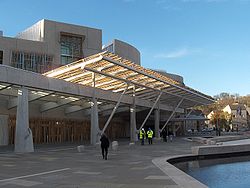 Since September 2004, the official home of the Scottish Parliament has been a new Scottish Parliament Building
, in the Holyrood area of Edinburgh. Designed by Catalan
architect Enric Miralles
, some of the principal features of the complex include leaf-shaped buildings, a grass-roofed branch merging into adjacent parkland and gabion
walls formed from the stones of previous buildings. Throughout the building there are many repeated motifs, such as shapes based on Raeburn's
Skating Minister
. Crow-stepped gable
s and the upturned boat skylights of the Garden Lobby, complete the unique architecture. Queen Elizabeth II
opened the new building on 9 October 2004.
In March 2006, one of the Holyrood building's roof beams slipped out of its support and was left dangling above the back benches during a debate. The debating chamber was subsequently closed, and MSPs moved to The Hub
for one week, whilst inspections were carried out. During repairs, all chamber business was conducted in the Parliament's committee room two.
of the Church of Scotland
on the Royal Mile
in Edinburgh. Official photographs and television interviews were held in the courtyard adjoining the Assembly Hall, which is part of the School of Divinity
of the University of Edinburgh
. This building was vacated twice to allow for the meeting of the Church's General Assembly
. In May 2000, the Parliament was temporarily relocated to the former Strathclyde Regional Council debating chamber in Glasgow, and to the University of Aberdeen
in May 2002.
In addition to the General Assembly Hall, the Parliament also used buildings rented from the City of Edinburgh Council. The former administrative building of Lothian Regional Council on George IV Bridge
was used for the MSP's offices. Following the move to Holyrood in 2004 this building was demolished. The former Midlothian County Buildings facing Parliament Square, High Street and George IV Bridge in Edinburgh (originally built as the headquarters of the pre-1975 Midlothian County Council) housed the Parliament's visitors' centre and shop, whilst the main hall was used as the Parliament's principal committee room.
, the equivalent of the speaker
(currently Tricia Marwick), and two MSPs to serve as deputies (currently Elaine Smith
and John Scott
). The Presiding Officer and deputies are elected by a secret ballot
of the 129 MSPs, which is the only secret ballot conducted in the Scottish Parliament. Principally, the role of the Presiding Officer is to chair chamber proceedings and the Scottish Parliamentary Corporate Body
. When chairing meetings of the Parliament, the Presiding Officer and his deputies must be politically impartial. During debates, the Presiding Officer (or the deputy) is assisted by the parliamentary clerks, who give advice on how to interpret the standing orders that govern the proceedings of meetings. A vote clerk sits in front of the Presiding Officer and operates the electronic voting equipment and chamber clocks.
As a member of the Scottish Parliamentary Corporate Body
, the Presiding Officer is responsible for ensuring that the Parliament functions effectively and has the staff, property and resources it requires to operate. Convening the Parliamentary Bureau, which allocates time and sets the work agenda in the chamber, is another of the roles of the Presiding Officer. Under the Standing Orders of the Parliament the Bureau consists of the Presiding Officer and one representative from each political parties with five or more seats in the Parliament. Amongst the duties of the Bureau are to agree the timetable of business in the chamber, establish the number, remit and membership of parliamentary committees and regulate the passage of legislation (bills) through the Parliament. The Presiding Officer also represents the Scottish Parliament at home and abroad in an official capacity.
The Presiding Officer controls debates by calling on members to speak. If a member believes that a rule (or standing order) has been breached, he or she may raise a "point of order
", on which the Presiding Officer makes a ruling that is not subject to any debate or appeal. The Presiding Officer may also discipline members who fail to observe the rules of the Parliament.
The member of the Scottish Government whose duty it is to steer Executive business through Parliament is the Minister for Parliamentary Business
(currently Bruce Crawford
). The minister is appointed by the First Minister
and is a Junior Minister in the Scottish Government, who does not attend cabinet.
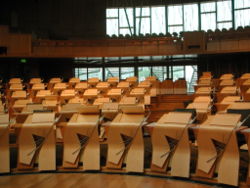
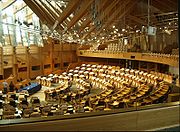 The debating chamber of the Scottish Parliament has seating arranged in a hemicycle
, which reflects the desire to encourage consensus amongst elected members. There are 131 seats in the debating chamber. Of the total 131 seats, 129 are occupied by the Parliament's elected MSPs and 2 are seats for the Scottish Law Officers - the Lord Advocate
and the Solicitor General for Scotland
, who are not elected members of the Parliament but are members of the Scottish Government. As such the Law Officers may attend and speak in the plenary meetings of the Parliament but, as they are not elected MSPs, cannot vote. Members are able to sit anywhere in the debating chamber, but typically sit in their party groupings. The First Minister, Scottish cabinet ministers and Law officers sit in the front row, in the middle section of the chamber. The largest party in the Parliament sits in the middle of the semicircle, with opposing parties on either side. The Presiding Officer, parliamentary clerks and officials sit opposite members at the front of the debating chamber.
In front of the Presiding Officers' desk is the parliamentary mace
, which is made from silver
and inlaid
with gold
panned from Scottish rivers and inscribed with the words: Wisdom, Compassion, Justice and Integrity. The words There shall be a Scottish Parliament, which are the first words of the Scotland Act, are inscribed around the head of the mace, which has a formal ceremonial role in the meetings of Parliament, reinforcing the authority of the Parliament in its ability to make laws. Presented to the Scottish Parliament by the Queen upon its official opening in July 1999, the mace is displayed in a glass case suspended from the lid. At the beginning of each sitting in the chamber, the lid of the case is rotated so that the mace is above the glass, to symbolise that a full meeting of the Parliament is taking place.
 Parliament typically sits Tuesdays, Wednesdays and Thursdays from early January to late June and from early September to mid December, with two-week recesses in April and October. Plenary meetings in the debating chamber usually take place on Wednesday afternoons from 2 pm to 6 pm and on Thursdays from 9:15 am to 6 pm. Chamber debates and committee meetings are open to the public. Entry is free, but booking in advance is recommended due to limited space. Meetings are broadcast on the Parliament's own channel Holyrood.tv and on the BBC
's parliamentary channel BBC Parliament
. Proceedings are also recorded in text form, in print and online, in the Official Report, which is the substantially verbatim transcript of parliamentary debates.
The first item of business on Wednesdays is usually Time for Reflection, at which a speaker addresses members for up to four minutes, sharing a perspective on issues of faith
. This contrasts with the formal style of "Prayers", which is the first item of business in meetings of the House of Commons
. Speakers are drawn from across Scotland and are chosen to represent the balance of religious beliefs according to the Scottish census
. Invitations to address Parliament in this manner are determined by the Presiding Officer on the advice of the parliamentary bureau. Faith groups can make direct representations to the Presiding Officer to nominate speakers.
The Presiding Officer (or Deputy Presiding Officer) decides who speaks in chamber debates and the amount of time for which they are allowed to speak. Normally, the Presiding Officer tries to achieve a balance between different viewpoints and political parties when selecting members to speak. Typically, ministers or party leaders open debates, with opening speakers given between 5 and 20 minutes, and succeeding speakers allocated less time. The Presiding Officer can reduce speaking time if a large number of members wish to participate in the debate. Debate is more informal than in some parliamentary systems. Members may call each other directly by name, rather than by constituency or cabinet position, and hand clapping is allowed. Speeches to the chamber are normally delivered in English
, but members may use Scots
, Gaelic, or any other language with the agreement of the Presiding Officer. The Scottish Parliament has conducted debates in the Gaelic language.
Each sitting day, normally at 5 pm, MSPs decide on all the motions
and amendments that have been moved that day. This "Decision Time" is heralded by the sounding of the division bell, which is heard throughout the Parliamentary campus and alerts MSPs who are not in the chamber to return and vote. At Decision Time, the Presiding Officer puts questions on the motions and amendments by reading out the name of the motion or amendment as well as the proposer and asking "Are we all agreed?", to which the chamber first votes orally. If there is audible dissent, the Presiding Officer announces "There will be a division" and members vote by means of electronic consoles on their desks. Each MSP has a unique access card with a microchip
which, when inserted into the console, identifies them and allows them to vote. As a result, the outcome of each division is known in seconds.
The outcome of most votes can be predicted beforehand since political parties normally instruct members which way to vote. Parties entrust some MSPs, known as whips
, with the task of ensuring that party members vote according to the party line. MSPs do not tend to vote against such instructions, since those who do are unlikely to reach higher political ranks in their parties. Errant members can be deselected as official party candidates during future elections, and, in serious cases, may be expelled from their parties outright. Thus, as with many Parliaments, the independence of Members of the Scottish Parliament tends to be low, and backbench rebellions by members who are discontent with their party's policies are rare. In some circumstances, however, parties announce "free votes", which allows Members to vote as they please. This is typically done on moral
issues.
Immediately after Decision Time a "Members Debate" is held, which lasts for 45 minutes. Members Business is a debate on a motion proposed by an MSP who is not a Scottish minister
. Such motions are on issues which may be of interest to a particular area such as a member's own constituency, an upcoming or past event or any other item which would otherwise not be accorded official parliamentary time. As well as the proposer, other members normally contribute to the debate. The relevant minister, whose department the debate and motion relate to "winds up" the debate by speaking after all other participants.
. The role of committees is stronger in the Scottish Parliament than in other parliamentary systems, partly as a means of strengthening the role of backbenchers in their scrutiny of the government and partly to compensate for the fact that there is no revising chamber. The principal role of committees in the Scottish Parliament is to conduct inquiries, scrutinise legislation and hold the government to account. Committee meetings take place all day Tuesday and on Wednesday morning when Parliament is sitting. Committees can also meet at other locations throughout Scotland.
Committees comprise a small number of MSPs, with membership reflecting the balance of parties across Parliament. There are different committees with their functions set out in different ways. Mandatory Committees are committees which are set down under the Scottish Parliament's standing orders, which govern their remits and proceedings. The current Mandatory Committees of the Scottish Parliament are: Public Audit
; Equal Opportunities; European
and External Relations; Finance
; Public Petitions; Standards, Procedures and Public Appointments; and Subordinate Legislation.
Subject Committees are established at the beginning of each parliamentary session, and again the members on each committee reflect the balance of parties across Parliament. Typically each committee corresponds with one (or more) of the departments (or ministries) of the Scottish Government. The current Subject Committees are: Economy, Energy and Tourism; Education, Lifelong Learning and Culture
; Health and Sport
; Justice
; Local Government and Communities; Rural Affairs and Environment; Scottish Parliamentary Pension Scheme; and Transport, Infrastructure and Climate Change
.
A further type of committee is normally set up to scrutinise private bill
s submitted to the Scottish Parliament by an outside party or promoter who is not a member of the Scottish Parliament or Scottish Government. Private bills normally relate to large-scale development projects such as infrastructure projects that require the use of land or property. Private Bill Committees have been set up to consider legislation on issues such as the development of the Edinburgh Tram Network
, the Glasgow Airport Rail Link, the Airdrie-Bathgate Rail Link
and extensions to the National Gallery of Scotland
.
by Queen Elizabeth II on 19 November 1998, governs the functions and role of the Scottish Parliament and delimits its legislative competence. For the purposes of parliamentary sovereignty
, the Parliament of the United Kingdom at Westminster continues to constitute the supreme legislature of Scotland, however, under the terms of the Scotland Act, Westminster agreed to devolve some of its responsibilities over the domestic policy of Scotland to a new directly elected Scottish Parliament. Such matters are known as "devolved matters" and include education, health, agriculture
and justice. The Scotland Act enabled the Scottish Parliament to pass primary legislation on these issues. A degree of domestic authority, and all foreign policy
, remains at present with the UK Parliament in Westminster. The Scottish Parliament has the power to pass laws and has limited tax-varying capability. Another of the roles of the Parliament is to hold the Scottish Government to account.
The specific devolved matters are all subjects which are not explicitly stated in Schedule 5 to the Scotland Act as reserved matters
. All matters that are not specifically reserved are automatically devolved to the Scottish Parliament. Most importantly, this includes agriculture, fisheries and forestry, economic development
, education, environment, food standards, health, home affairs, Scots law courts, police and fire services, local government, sport
and the arts, transport, training, tourism
, research and statistics and social work. The Scottish Parliament has the ability to alter income tax
in Scotland by up to 3 pence
in the pound
.
Reserved matters are subjects that are outside the legislative competence of the Scotland Parliament. The Scottish Parliament is unable to legislate on such issues that are reserved to, and dealt with at, Westminster (and where Ministerial functions usually lie with UK Government ministers). These include abortion
, broadcasting
policy, civil service, common markets for UK goods and services, constitution
, electricity
, coal, oil, gas, nuclear energy
, defence
and national security, drug policy
, employment, foreign policy and relations with Europe, most aspects of transport
safety and regulation, National Lottery
, protection of borders, social security
and stability of UK's fiscal, economic
and monetary system.
Members of the public take part in Parliament in two ways that are not the case at Westminster: a public petition
ing system, and cross-party groups on policy topics which the interested public join and attend meetings of, alongside MSPs. The Parliament is able to debate any issue (including those reserved to Westminster) but is unable to make laws on issues that are outside its legislative competence.
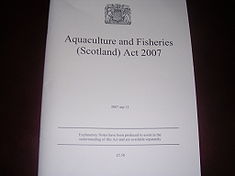 As the Scottish Parliament is able to make laws on the areas constitutionally devolved to it, the legislative process begins with bills
(draft laws) which are presented to Parliament.
Bills can be introduced to Parliament in a number of ways; the Scottish Government can introduce new laws or amendments to existing laws as a bill; a committee of the Parliament can present a bill in one of the areas under its remit; a member of the Scottish Parliament can introduce a bill as a private member; or a private bill
can be submitted to Parliament by an outside proposer. Most draft laws are government bills introduced by ministers in the governing party. Bills pass through Parliament in a number of stages:
Stage 1 is the first, or introductory stage of the bill, where the minister or member in charge of the bill will formally introduce it to Parliament together with its accompanying documents - Explanatory Notes, a Policy Memorandum setting out the policy underlying the bill, and a Financial Memorandum setting out the costs and savings associated with it. Statements from the Presiding Officer and the member in charge of the bill are also lodged indicating whether the bill is within the legislative competence of the Parliament. Stage 1 usually takes place, initially, in the relevant committee or committees and is then submitted to the whole Parliament for a full debate in the chamber on the general principles of the bill. If the whole Parliament agrees in a vote to the general principles of the bill, it then proceeds to Stage 2.
Stage 2 is normally conducted entirely in the relevant committee, where amendments to the bill are proposed by committee members. At this stage, the bill is considered in substantial detail. Some bills - and all emergency bills - are considered in detail by a committee of the whole Parliament in the debating chamber; the Presiding Officer acts as convener of the committee in such circumstances.
Stage 3 is the final stage of the bill and is considered at a meeting of the whole Parliament. This stage comprises two parts: consideration of amendments to the bill as a general debate, and a final vote on the bill. Opposition members can table "wrecking amendments" to the bill, designed to thwart further progress and take up parliamentary time, in order to cause the bill to fall without a final vote being taken. After a general debate on the final form of the bill, members proceed to vote at Decision Time on whether they agree to the general principles of the final bill.
Royal Assent: After the bill has been passed, the Presiding Officer submits it to the Monarch for Royal Assent and it becomes an Act of the Scottish Parliament. However he cannot do so until a 4 week period has elapsed, during which the Law Officers of the Scottish Government or UK Government can refer the bill to the Supreme Court of the United Kingdom
for a ruling on whether it is within the powers of the Parliament. Acts of the Scottish Parliament do not begin with a conventional enacting formula. Instead they begin with a phrase that reads: "The Bill for this Act of the Scottish Parliament was passed by the Parliament on [Date] and received Royal Assent on [Date]".
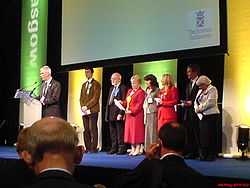 The party, or parties, that hold the majority of seats in the Parliament forms the Scottish Government. In contrast to many other parliamentary systems, Parliament elects a First Minister
from a number of candidates at the beginning of each parliamentary term (after a general election
). Any member can put their name forward to be First Minister, and a vote is taken by all members of Parliament. Normally, the leader of the largest party is returned as First Minister, and head of the Scottish Government. Theoretically, Parliament also elects the Scottish Ministers who form the government of Scotland and sit in the Scottish cabinet, but such ministers are, in practice, appointed to their roles by the First Minister. Junior ministers, who do not attend cabinet, are also appointed to assist Scottish ministers in their departments. Most ministers and their juniors are drawn from amongst the elected MSPs, with the exception of Scotland's Chief Law Officers: the Lord Advocate and the Solicitor General. Whilst the First Minister chooses the ministers - and may decide to remove them at any time - the formal appointment or dismissal is made by the Sovereign.
Under the Scotland Act 1998, ordinary general elections for the Scottish Parliament are held on the first Thursday in May every four years (1999
, 2003
, 2007
and so on). The date of the poll may be varied by up to one month either way by the Monarch on the proposal of the Presiding Officer. If the Parliament itself resolves that it should be dissolved (with at least two-thirds of the Members voting in favour), or if the Parliament fails to nominate one of its members to be First Minister within 28 days of a General Election or of the position becoming vacant, the Presiding Officer proposes a date for an extraordinary general election and the Parliament is dissolved by the Queen by royal proclamation. Extraordinary general elections are in addition to ordinary general elections, unless held less than six months before the due date of an ordinary general election, in which case they supplant it. The following ordinary election reverts to the first Thursday in May, a multiple of four years after 1999 (i.e., 5 May 2011, 7 May 2015, etc.).
Several procedures enable the Scottish Parliament to scrutinise the Government. The First Minister or members of his cabinet can deliver statements to Parliament upon which MSPs are invited to question. For example, at the beginning of each parliamentary year, the First Minister delivers a statement to the chamber setting out the Government's legislative programme for the forthcoming year. After the statement has been delivered, the leaders of the opposition parties and other MSPs question the First Minister on issues related to the substance of the statement.
Parliamentary time is also set aside for question periods in the debating chamber. A "General Question Time" takes place on a Thursday between 11:40 a.m. and 12 p.m. where members can direct questions to any member of the Scottish Government. At 2.30pm, a 40-minute long themed "Question Time" takes place, where members can ask questions of ministers in departments that are selected for questioning that sitting day, such as health and justice or education and transport. Between 12 p.m. and 12:30 p.m. on Thursdays, when Parliament is sitting, First Minister's Question Time takes place. This gives members an opportunity to question the First Minister directly on issues under his jurisdiction. Opposition leaders ask a general question of the First Minister and then supplementary questions. Such a practice enables a "lead-in" to the questioner, who then uses their supplementary question to ask the First Minister any issue. The four general questions available to opposition leaders are:
Members who wish to ask general or themed questions, or questions of the First Minister, must lodge them with parliamentary clerks beforehand and selections are made by the Presiding Officer. Written questions may also be submitted by members to ministers. Written questions and answers are published in the Official Report.
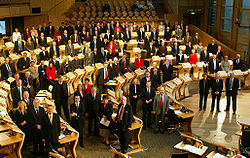 Elections for the Scottish Parliament were amongst the first in Britain to use a mixed member proportional representation
(MMS) system. The system is a form of the additional member
method of proportional representation
(PR), and is better known as such in Britain. Under the system, voters are given two votes: one for a specific candidate and one for a political party.
Of the 129 MSPs, 73 are elected to represent first past the post
constituencies
and are known as "Constituency MSPs". Voters choose one member to represent the constituency, and the member with most votes is returned as a constituency MSP. The 73 Scottish Parliament constituencies shared the same boundaries as the UK Parliament constituencies
in Scotland, prior to the 2005 reduction in the number of Scottish MPs, with the exception of Orkney and Shetland which each return their own constituency MSP. Currently, the average Scottish Parliament constituency comprises 55,000 electors. Given the geographical distribution of population in Scotland
, this results in constituencies of a smaller area in the Central Lowlands
, where the bulk of Scotland's population live, and much larger constituency areas in the north and west of the country, which have a low population density. The island archipelagos of Orkney, Shetland and the Western Isles
comprise a much smaller number of electors, due to their dispersed population and distance from the Scottish Parliament in Edinburgh. If a Constituency MSP resigns from Parliament, this triggers a by-election
in his or her constituency, where a replacement MSP is returned from one of the parties by the plurality system.
The remaining 56 MSPs, called "List MSPs", are elected by an additional members system, which seeks to make the overall results more proportional, countering any distortions in the constituency results. Seven List MSPs are elected from each of eight electoral regions, of which constituencies are sub-divisions:
Each political party draws up a list of candidates standing in each electoral region, from which the List MSPs are elected. When a List MSP resigns, the next person on the resigning MSPs' party's list takes the seat.
The total number of seats in the Parliament are allocated to parties proportionally to the number of votes received in the second vote of the ballot using the d'Hondt method
. For example, to determine who is awarded the first list seat, the number of list votes cast for each party is divided by one plus the number of seats the party won in the region (at this point just constituency seats). The party with the highest quotient is awarded the seat, which is then added to its constituency seats in allocating the second seat. This is repeated iteratively
until all available list seats are allocated.
As in the House of Commons, a number of qualifications apply to being an MSP. Such qualifications were introduced under the House of Commons Disqualification Act 1975
and the British Nationality Act 1981
. Specifically, members must be over the age of 18 and must be a citizen of the United Kingdom
, the Republic of Ireland
, one of the countries in the Commonwealth of Nations
, a citizen of a British overseas territory, or a European Union
citizen resident in the UK. Members of the police and the armed forces are disqualified from sitting in the Scottish Parliament as elected MSPs, and similarly, civil servants and members of foreign legislatures are disqualified. An individual may not sit in the Scottish Parliament if he or she is judged to be insane under the terms of the Mental Health Act 1983
.
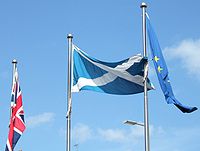 There have been four elections to the Parliament, in 1999
, 2003
, 2007
and 2011.
The next election is due to be held in May 2016. This will be five years (not the usual four) after the previous election date, an option which has been authorised to avoid a clash of dates with elections to the Parliament of the United Kingdom
in London. The original date clash was a mistake, originally unnoticed by civil servants, for which both ministerial attention and legislation were required, in finding a solution.
As with all elections in the UK, Irish
and qualifying Commonwealth
citizens are entitled to vote. However, unlike elections to the Westminster parliament
, citizens of other non-Commonwealth EU member states
who are resident in Scotland are entitled to vote in elections to the Scottish Parliament. However, overseas electors on Scottish electoral register
s are not allowed to vote in Scottish Parliament elections.
█ Scottish National Party
(69)
█ Scottish Labour Party
(37)
█ Scottish Conservative Party (15)
█ Scottish Liberal Democrats
(5)
█ Scottish Green Party
(2)
█ Independent
(1)
The election produced a majority SNP government, making this the first time in the Scottish Parliament where a party has commanded a parliamentary majority. The Nationalists took 16 seats from Labour, with many of their key figures not returned to parliament, although Labour leader Iain Gray retained East Lothian by 151 votes. The SNP took a further eight seats from the Liberal Democrats and one seat from the Conservatives. The SNP overall majority means that there is sufficient support in the Scottish Parliament to hold a referendum on Scottish independence.
Labour's defeat has been attributed to several factors: the party focused too heavily on criticising the Conservative-led coalition at Westminster, and assumed that former Lib Dem voters would automatically switch their vote to Labour, when in fact they appear to have haemorrhaged support to the SNP. Jackie Baillie compared the result to Labour's performance in the 1983 UK general election. Iain Gray announced his intention to resign as leader of the Labour group of MSPs in the autumn.
The election saw a rout of the Liberal Democrats, with no victories in mainland constituencies and 25 lost deposits (candidates gaining less than five per cent of the vote). Leader Tavish Scott said their performance was due to the Liberal Democrat presence in the Cameron Government, which was an unpopular move in Scotland. Scott resigned as leader two days after the election.
For the Conservatives, the main disappointment was the loss of Edinburgh Pentlands, the seat of former party leader David McLetchie, to the SNP. McLetchie was elected on the Lothian regional list and the Conservatives only made a net loss of five seats, with leader Annabel Goldie claiming that their support had held firm. Nevertheless, she too announced she would step down as leader of the party in the autumn. David Cameron congratulated the SNP on their victory but vowed to campaign for the Union in any independence referendum.
George Galloway, under an anti-cuts banner, failed to receive enough votes to be elected to the Glasgow regional list. The Scottish Greens won two seats, including their leader Patrick Harvie. Margo MacDonald again won election as an independent on the Lothian regional list.

The resignation of Henry McLeish
as First Minister, brought on by an office expenses scandal
, generated controversy in the first years of the Parliament.
, levelled by the Conservative Party, were that the Parliament would create a "slippery slope" to Scottish independence
, and provide the pro-independence Scottish National Party with a route to power. John Major
, the Conservative Prime Minister before May 1997, famously claimed the Parliament would end "1000 years of British history
", although the Acts of Union
uniting the two countries were still less than 300 years old at the time. The Labour Party met these criticisms by claiming that devolution would fatally undermine the SNP, and remedy the long-felt desire of Scots for a measure of self-government
.
are still able to vote on domestic legislation that applies only to England, Wales and Northern Ireland - whilst English, Scottish, Welsh and Northern Irish Westminster MPs are unable to vote on the domestic legislation of the Scottish Parliament. This phenomenon is known as the West Lothian Question
and has led to criticism.
431 million. The White Paper in 1997 estimated that a new building would have a net construction cost of £40 million, although this was based on the presumption that the old Royal High School building
(since renamed 'New Parliament House') would be used, as had long been assumed. After the devolution referendum it was quickly announced that the high school, which is smaller than many council chambers, was entirely inadequate for the Parliament, and negotiations began for a new building on a new site. This led critical media and politicians to claim the final building was "ten times over budget". Miralles' building was in fact costed at £109 million, prior to major increases in space.
The cost overruns of the Scottish Parliament Building further dented confidence in public opinion in the ability of the public sector
to handle major infrastructure and building projects. As a result, the final £431m cost of the Holyrood building can be compared with other cost overruns in projects such as Portcullis House
a new parliamentary office block in Westminster - built for use by 200 MPs, which cost £250 million, including £100 million spent on bronze cladding, £250m for the redevelopment of the German Reichstag, £40m for the development of the Edinburgh International Conference Centre
, and £800m for the construction of the Millennium Dome
.
Lord Fraser's
Inquiry reported on 15 September 2004 and identified the choice of the construction management procurement route as the main factor in the fourfold increase in estimated costs establishing that a £270 million value building ended up costing £431 million, an identifiable waste of £181 million. This was portrayed as clearing Donald Dewar of any blame.
Scots language
Scots is the Germanic language variety spoken in Lowland Scotland and parts of Ulster . It is sometimes called Lowland Scots to distinguish it from Scottish Gaelic, the Celtic language variety spoken in most of the western Highlands and in the Hebrides.Since there are no universally accepted...
: The Scots Pairliament) is the devolved
Devolution
Devolution is the statutory granting of powers from the central government of a sovereign state to government at a subnational level, such as a regional, local, or state level. Devolution can be mainly financial, e.g. giving areas a budget which was formerly administered by central government...
national, unicameral
Unicameralism
In government, unicameralism is the practice of having one legislative or parliamentary chamber. Thus, a unicameral parliament or unicameral legislature is a legislature which consists of one chamber or house...
legislature
Legislature
A legislature is a kind of deliberative assembly with the power to pass, amend, and repeal laws. The law created by a legislature is called legislation or statutory law. In addition to enacting laws, legislatures usually have exclusive authority to raise or lower taxes and adopt the budget and...
of Scotland
Scotland
Scotland is a country that is part of the United Kingdom. Occupying the northern third of the island of Great Britain, it shares a border with England to the south and is bounded by the North Sea to the east, the Atlantic Ocean to the north and west, and the North Channel and Irish Sea to the...
, located in the Holyrood
Holyrood, Edinburgh
Holyrood is an area in Edinburgh, the capital of Scotland. Lying east of the city centre, at the end of the Royal Mile, Holyrood was once in the separate burgh of Canongate before the expansion of Edinburgh in 1856...
area of the capital, Edinburgh
Edinburgh
Edinburgh is the capital city of Scotland, the second largest city in Scotland, and the eighth most populous in the United Kingdom. The City of Edinburgh Council governs one of Scotland's 32 local government council areas. The council area includes urban Edinburgh and a rural area...
. The Parliament, informally referred to as "Holyrood", is a democratically
Democracy
Democracy is generally defined as a form of government in which all adult citizens have an equal say in the decisions that affect their lives. Ideally, this includes equal participation in the proposal, development and passage of legislation into law...
elected body comprising 129 members known as Members of the Scottish Parliament
Member of the Scottish Parliament
Member of the Scottish Parliament is the title given to any one of the 129 individuals elected to serve in the Scottish Parliament.-Methods of Election:MSPs are elected in one of two ways:...
(MSPs). Members are elected for four-year terms under the mixed member proportional representation
Mixed member proportional representation
Mixed-member proportional representation, also termed mixed-member proportional voting and commonly abbreviated to MMP, is a voting system originally used to elect representatives to the German Bundestag, and nowadays adopted by numerous legislatures around the world...
system. As a result, 73 MSPs represent individual geographical constituencies
Scottish Parliament constituencies and regions
Scottish Parliament constituencies and regions were first used in 1999, in the first general election of the Scottish Parliament , created by the Scotland Act 1998....
elected by the plurality
Plurality voting system
The plurality voting system is a single-winner voting system often used to elect executive officers or to elect members of a legislative assembly which is based on single-member constituencies...
("first past the post") system, with a further 56 returned from eight additional member
Additional Member System
The Additional Member System is the term used in the United Kingdom for the mixed member proportional representation voting system used in Scotland, Wales and the London Assembly....
regions, each electing seven MSPs. The most recent general election to the Parliament was held on 5 May 2011.
The original Parliament of Scotland
Parliament of Scotland
The Parliament of Scotland, officially the Estates of Parliament, was the legislature of the Kingdom of Scotland. The unicameral parliament of Scotland is first found on record during the early 13th century, with the first meeting for which a primary source survives at...
(or "Estates
The States
The States or the Estates signifies the assembly of the representatives of the estates of the realm, called together for purposes of legislation or deliberation...
of Scotland") was the national legislature of the independent Kingdom of Scotland
Kingdom of Scotland
The Kingdom of Scotland was a Sovereign state in North-West Europe that existed from 843 until 1707. It occupied the northern third of the island of Great Britain and shared a land border to the south with the Kingdom of England...
, and existed from the early 13th century until the Kingdom of Scotland merged with the Kingdom of England
Kingdom of England
The Kingdom of England was, from 927 to 1707, a sovereign state to the northwest of continental Europe. At its height, the Kingdom of England spanned the southern two-thirds of the island of Great Britain and several smaller outlying islands; what today comprises the legal jurisdiction of England...
under the Acts of Union 1707
Acts of Union 1707
The Acts of Union were two Parliamentary Acts - the Union with Scotland Act passed in 1706 by the Parliament of England, and the Union with England Act passed in 1707 by the Parliament of Scotland - which put into effect the terms of the Treaty of Union that had been agreed on 22 July 1706,...
to form the Kingdom of Great Britain
Kingdom of Great Britain
The former Kingdom of Great Britain, sometimes described as the 'United Kingdom of Great Britain', That the Two Kingdoms of Scotland and England, shall upon the 1st May next ensuing the date hereof, and forever after, be United into One Kingdom by the Name of GREAT BRITAIN. was a sovereign...
. As a consequence, the Parliament of Scotland merged with the Parliament of England
Parliament of England
The Parliament of England was the legislature of the Kingdom of England. In 1066, William of Normandy introduced a feudal system, by which he sought the advice of a council of tenants-in-chief and ecclesiastics before making laws...
to form the Parliament of Great Britain
Parliament of Great Britain
The Parliament of Great Britain was formed in 1707 following the ratification of the Acts of Union by both the Parliament of England and Parliament of Scotland...
, which sat at Westminster
Westminster
Westminster is an area of central London, within the City of Westminster, England. It lies on the north bank of the River Thames, southwest of the City of London and southwest of Charing Cross...
in London
London
London is the capital city of :England and the :United Kingdom, the largest metropolitan area in the United Kingdom, and the largest urban zone in the European Union by most measures. Located on the River Thames, London has been a major settlement for two millennia, its history going back to its...
.
Following a referendum in 1997, in which the Scottish electorate gave their consent, the current Parliament was established by the Scotland Act 1998
Scotland Act 1998
The Scotland Act 1998 is an Act of the Parliament of the United Kingdom. It is the Act which established the devolved Scottish Parliament.The Act will be amended by the Scotland Bill 2011, if and when it receives royal assent.-History:...
, which sets out its powers as a devolved
Devolution
Devolution is the statutory granting of powers from the central government of a sovereign state to government at a subnational level, such as a regional, local, or state level. Devolution can be mainly financial, e.g. giving areas a budget which was formerly administered by central government...
legislature. The Act delineates the legislative competence of the Parliament the areas in which it can make laws
Scots law
Scots law is the legal system of Scotland. It is considered a hybrid or mixed legal system as it traces its roots to a number of different historical sources. With English law and Northern Irish law it forms the legal system of the United Kingdom; it shares with the two other systems some...
by explicitly specifying powers that are "reserved
Reserved matters
In the United Kingdom reserved matters and excepted matters are the areas of government policy where Parliament had kept the power to make laws in Scotland, Northern Ireland and Wales....
" to the Parliament of the United Kingdom
Parliament of the United Kingdom
The Parliament of the United Kingdom of Great Britain and Northern Ireland is the supreme legislative body in the United Kingdom, British Crown dependencies and British overseas territories, located in London...
: all matters that are not explicitly reserved are automatically the responsibility of the Scottish Parliament. The British Parliament retains the ability to amend the terms of reference of the Scottish Parliament, and can extend or reduce the areas in which it can make laws. The first meeting of the new Parliament took place on 12 May 1999.
History
Acts of Union 1707
The Acts of Union were two Parliamentary Acts - the Union with Scotland Act passed in 1706 by the Parliament of England, and the Union with England Act passed in 1707 by the Parliament of Scotland - which put into effect the terms of the Treaty of Union that had been agreed on 22 July 1706,...
that merged the Kingdom of Scotland
Kingdom of Scotland
The Kingdom of Scotland was a Sovereign state in North-West Europe that existed from 843 until 1707. It occupied the northern third of the island of Great Britain and shared a land border to the south with the Kingdom of England...
with the Kingdom of England
Kingdom of England
The Kingdom of England was, from 927 to 1707, a sovereign state to the northwest of continental Europe. At its height, the Kingdom of England spanned the southern two-thirds of the island of Great Britain and several smaller outlying islands; what today comprises the legal jurisdiction of England...
(to form the Kingdom of Great Britain
Kingdom of Great Britain
The former Kingdom of Great Britain, sometimes described as the 'United Kingdom of Great Britain', That the Two Kingdoms of Scotland and England, shall upon the 1st May next ensuing the date hereof, and forever after, be United into One Kingdom by the Name of GREAT BRITAIN. was a sovereign...
), Scotland had an independent
Independence
Independence is a condition of a nation, country, or state in which its residents and population, or some portion thereof, exercise self-government, and usually sovereignty, over its territory....
parliament with a legislature
Parliament of Scotland
The Parliament of Scotland, officially the Estates of Parliament, was the legislature of the Kingdom of Scotland. The unicameral parliament of Scotland is first found on record during the early 13th century, with the first meeting for which a primary source survives at...
known as the Three Estates
Estates of the realm
The Estates of the realm were the broad social orders of the hierarchically conceived society, recognized in the Middle Ages and Early Modern period in Christian Europe; they are sometimes distinguished as the three estates: the clergy, the nobility, and commoners, and are often referred to by...
. Initial Scottish proposals in the negotiation over the Union suggested a devolved Parliament be retained in Scotland, but this was not accepted by the English
Kingdom of England
The Kingdom of England was, from 927 to 1707, a sovereign state to the northwest of continental Europe. At its height, the Kingdom of England spanned the southern two-thirds of the island of Great Britain and several smaller outlying islands; what today comprises the legal jurisdiction of England...
negotiators.
For the next three hundred years, Scotland was directly governed by the Parliament of the United Kingdom, at Westminster, and the lack of a Scottish Parliament remained an important element in Scottish national identity
Scottish national identity
Scottish national identity is a term referring to the sense of national identity and common culture of Scottish people and is shared by a considerable majority of the people of Scotland....
. Suggestions for a 'devolved' Parliament were made before 1914, but were shelved due to the outbreak of the First World War
World War I
World War I , which was predominantly called the World War or the Great War from its occurrence until 1939, and the First World War or World War I thereafter, was a major war centred in Europe that began on 28 July 1914 and lasted until 11 November 1918...
. A sharp rise in nationalism
Nationalism
Nationalism is a political ideology that involves a strong identification of a group of individuals with a political entity defined in national terms, i.e. a nation. In the 'modernist' image of the nation, it is nationalism that creates national identity. There are various definitions for what...
in Scotland during the late 1960s fuelled demands for some form of home rule
Devolution
Devolution is the statutory granting of powers from the central government of a sovereign state to government at a subnational level, such as a regional, local, or state level. Devolution can be mainly financial, e.g. giving areas a budget which was formerly administered by central government...
or complete independence
Scottish independence
Scottish independence is a political ambition of political parties, advocacy groups and individuals for Scotland to secede from the United Kingdom and become an independent sovereign state, separate from England, Wales and Northern Ireland....
, and prompted the incumbent Labour
Labour Party (UK)
The Labour Party is a centre-left democratic socialist party in the United Kingdom. It surpassed the Liberal Party in general elections during the early 1920s, forming minority governments under Ramsay MacDonald in 1924 and 1929-1931. The party was in a wartime coalition from 1940 to 1945, after...
Government of Harold Wilson
Harold Wilson
James Harold Wilson, Baron Wilson of Rievaulx, KG, OBE, FRS, FSS, PC was a British Labour Member of Parliament, Leader of the Labour Party. He was twice Prime Minister of the United Kingdom during the 1960s and 1970s, winning four general elections, including a minority government after the...
to set up the Kilbrandon Commission
Royal Commission on the Constitution (United Kingdom)
The Royal Commission on the Constitution, also referred to as the Kilbrandon Commission or Kilbrandon Report, was a long-running royal commission set up by Harold Wilson's Labour government to examine the structures of the constitution of the United Kingdom and the British Islands and the...
to consider the UK Constitution
Constitution of the United Kingdom
The constitution of the United Kingdom is the set of laws and principles under which the United Kingdom is governed.Unlike many other nations, the UK has no single core constitutional document. In this sense, it is said not to have a written constitution but an uncodified one...
in 1969. One of the principal objectives of the commission was to examine ways of enabling more self-government for Scotland, within the unitary state of the United Kingdom. Kilbrandon published his report in 1973 recommending the establishment of a directly elected Scottish Assembly
Scottish Assembly
The Scottish Assembly was a proposed legislature for Scotland that would have devolved a set list of powers from the Parliament of the United Kingdom...
to legislate for the majority of domestic Scottish affairs.
During this time, the discovery of oil
North Sea oil
North Sea oil is a mixture of hydrocarbons, comprising liquid oil and natural gas, produced from oil reservoirs beneath the North Sea.In the oil industry, the term "North Sea" often includes areas such as the Norwegian Sea and the area known as "West of Shetland", "the Atlantic Frontier" or "the...
in the North Sea
North Sea
In the southwest, beyond the Straits of Dover, the North Sea becomes the English Channel connecting to the Atlantic Ocean. In the east, it connects to the Baltic Sea via the Skagerrak and Kattegat, narrow straits that separate Denmark from Norway and Sweden respectively...
and the following "It's Scotland's oil
It's Scotland's oil
It's Scotland's oil was a widely publicised political slogan used by the Scottish National Party during the 1970s in making their economic case for Scottish independence...
" campaign of the Scottish National Party
Scottish National Party
The Scottish National Party is a social-democratic political party in Scotland which campaigns for Scottish independence from the United Kingdom....
(SNP) resulted in rising support for Scottish independence, as well as the SNP. The party argued that the revenues from the oil were not benefitting Scotland as much as they should. The combined effect of these events led to Prime Minister
Prime Minister of the United Kingdom
The Prime Minister of the United Kingdom of Great Britain and Northern Ireland is the Head of Her Majesty's Government in the United Kingdom. The Prime Minister and Cabinet are collectively accountable for their policies and actions to the Sovereign, to Parliament, to their political party and...
Wilson committing his government to some form of devolved legislature in 1974. However, it was not until 1978 that final legislative proposals for a Scottish Assembly were passed by the United Kingdom Parliament.
Under the terms of the Scotland Act 1978
Scotland Act 1978
The Scotland Act 1978 was an Act of the Parliament of the United Kingdom intended to establish a Scottish Assembly as a devolved legislature for Scotland...
, an elected assembly would be set up in Edinburgh provided that the majority of the Scottish electorate voted for it in a referendum to be held on 1 March 1979 that represented at least 40% of the total electorate. The 1979 Scottish devolution referendum to establish a devolved Scottish Assembly failed. Although the vote was 51.6% in favour of a Scottish Assembly, this figure did not equal the 40% of the total electorate threshold deemed necessary to pass the measure, as 32.9% of the eligible voting population did not, or had been unable to, vote.
Throughout the 1980s and 1990s, demand for a Scottish Parliament grew, in part because the government of the United Kingdom was controlled by the Conservative Party
Conservative Party (UK)
The Conservative Party, formally the Conservative and Unionist Party, is a centre-right political party in the United Kingdom that adheres to the philosophies of conservatism and British unionism. It is the largest political party in the UK, and is currently the largest single party in the House...
, while Scotland itself elected relatively few Conservative MPs. In the aftermath of the 1979 referendum defeat, the Campaign for a Scottish Assembly
Campaign for a Scottish Assembly
The Campaign for a Scottish Assembly was formed in the aftermath of the 1979 referendum that failed to establish a devolved Scottish Assembly....
was initiated as a pressure group, leading to the 1989 Scottish Constitutional Convention
Scottish Constitutional Convention
The Scottish Constitutional Convention was an association of Scottish political parties, churches and other civic groups, that developed a framework for a Scottish devolution. It is credited as having paved the way for the establishment of the Scottish Parliament in 1999.The Convention was...
with various organisations such as Scottish churches, political parties and representatives of industry taking part. Publishing its blueprint for devolution in 1995, the Convention provided much of the basis for the structure of the Parliament.
Devolution became part of the platform of the Labour Party which, in May 1997, took power under Tony Blair
Tony Blair
Anthony Charles Lynton Blair is a former British Labour Party politician who served as the Prime Minister of the United Kingdom from 2 May 1997 to 27 June 2007. He was the Member of Parliament for Sedgefield from 1983 to 2007 and Leader of the Labour Party from 1994 to 2007...
. In September 1997, the 1997 Scottish devolution referendum was put to the Scottish electorate and secured a majority in favour of the establishment of a new devolved Scottish Parliament, with tax-varying powers, in Edinburgh. An election was held on 6 May 1999, and on 1 July of that year power was transferred from Westminster to the new Parliament.
Building
Scottish Parliament Building
The Scottish Parliament Building is the home of the Scottish Parliament at Holyrood, within the UNESCO World Heritage Site in central Edinburgh. Construction of the building commenced in June 1999 and the Members of the Scottish Parliament held their first debate in the new building on 7...
, in the Holyrood area of Edinburgh. Designed by Catalan
Catalonia
Catalonia is an autonomous community in northeastern Spain, with the official status of a "nationality" of Spain. Catalonia comprises four provinces: Barcelona, Girona, Lleida, and Tarragona. Its capital and largest city is Barcelona. Catalonia covers an area of 32,114 km² and has an...
architect Enric Miralles
Enric Miralles
Enric Miralles Moya was a Spanish Catalan architect. He graduated from the School of Architecture of Barcelona at the Universitat Politècnica de Catalunya in 1978. After establishing his reputation with a number of collaborations with his first wife Carme Pinós, the couple separated in 1991...
, some of the principal features of the complex include leaf-shaped buildings, a grass-roofed branch merging into adjacent parkland and gabion
Gabion
Gabions are cages, cylinders, or boxes filled with soil or sand that are used in civil engineering, road building, and military applications. For erosion control caged riprap is used. For dams or foundation construction, cylindrical metal structures are used...
walls formed from the stones of previous buildings. Throughout the building there are many repeated motifs, such as shapes based on Raeburn's
Henry Raeburn
Sir Henry Raeburn was a Scottish portrait painter, the first significant Scottish portraitist since the Act of Union 1707 to remain based in Scotland.-Biography:...
Skating Minister
The Skating Minister
The Reverend Robert Walker Skating on Duddingston Loch, better known by its shorter title The Skating Minister, is an oil painting by Sir Henry Raeburn in the National Gallery of Scotland in Edinburgh. It was practically unknown until about 1949; today, however, it is one of Scotland's best known...
. Crow-stepped gable
Crow-stepped gable
A Stepped gable, Crow-stepped gable, or Corbie step is a stair-step type of design at the top of the triangular gable-end of a building...
s and the upturned boat skylights of the Garden Lobby, complete the unique architecture. Queen Elizabeth II
Elizabeth II of the United Kingdom
Elizabeth II is the constitutional monarch of 16 sovereign states known as the Commonwealth realms: the United Kingdom, Canada, Australia, New Zealand, Jamaica, Barbados, the Bahamas, Grenada, Papua New Guinea, the Solomon Islands, Tuvalu, Saint Lucia, Saint Vincent and the Grenadines, Belize,...
opened the new building on 9 October 2004.
In March 2006, one of the Holyrood building's roof beams slipped out of its support and was left dangling above the back benches during a debate. The debating chamber was subsequently closed, and MSPs moved to The Hub
The Hub (Edinburgh)
The Hub, at the top of Edinburgh's Royal Mile, is the home of the Edinburgh International Festival, and a central source of information on all the Edinburgh Festivals. Its gothic spire - the highest point in central Edinburgh - towers over the surrounding buildings, including the adjacent castle...
for one week, whilst inspections were carried out. During repairs, all chamber business was conducted in the Parliament's committee room two.
Temporary accommodation 1999–2004
Whilst the permanent building at Holyrood was being constructed, the Parliament's temporary home was the General Assembly HallGeneral Assembly Hall of the Church of Scotland
The Assembly Hall is located between the Lawnmarket and The Mound in Edinburgh, Scotland. It is the meeting place of the General Assembly of the Church of Scotland.-History:...
of the Church of Scotland
Church of Scotland
The Church of Scotland, known informally by its Scots language name, the Kirk, is a Presbyterian church, decisively shaped by the Scottish Reformation....
on the Royal Mile
Royal Mile
The Royal Mile is a succession of streets which form the main thoroughfare of the Old Town of the city of Edinburgh in Scotland.As the name suggests, the Royal Mile is approximately one Scots mile long, and runs between two foci of history in Scotland, from Edinburgh Castle at the top of the Castle...
in Edinburgh. Official photographs and television interviews were held in the courtyard adjoining the Assembly Hall, which is part of the School of Divinity
New College, Edinburgh
New College was opened in 1846 as a college of the Free Church of Scotland, later of the United Free Church of Scotland, and from the 1930s has been the home of the School of Divinity of the University of Edinburgh...
of the University of Edinburgh
University of Edinburgh
The University of Edinburgh, founded in 1583, is a public research university located in Edinburgh, the capital of Scotland, and a UNESCO World Heritage Site. The university is deeply embedded in the fabric of the city, with many of the buildings in the historic Old Town belonging to the university...
. This building was vacated twice to allow for the meeting of the Church's General Assembly
General Assembly of the Church of Scotland
The General Assembly of the Church of Scotland is the sovereign and highest court of the Church of Scotland, and is thus the Church's governing body[1] An Introduction to Practice and Procedure in the Church of Scotland, A Gordon McGillivray, 2nd Edition .-Church courts:As a Presbyterian church,...
. In May 2000, the Parliament was temporarily relocated to the former Strathclyde Regional Council debating chamber in Glasgow, and to the University of Aberdeen
University of Aberdeen
The University of Aberdeen, an ancient university founded in 1495, in Aberdeen, Scotland, is a British university. It is the third oldest university in Scotland, and the fifth oldest in the United Kingdom and wider English-speaking world...
in May 2002.
In addition to the General Assembly Hall, the Parliament also used buildings rented from the City of Edinburgh Council. The former administrative building of Lothian Regional Council on George IV Bridge
George IV Bridge
George IV Bridge is an elevated street in Edinburgh, Scotland. Measuring 300-metres in length, the bridge was constructed between 1829 and 1832 as part of the Improvement Act of 1827. Named for King George IV, it was designed by architect Thomas Hamilton , to connect the South Side district of...
was used for the MSP's offices. Following the move to Holyrood in 2004 this building was demolished. The former Midlothian County Buildings facing Parliament Square, High Street and George IV Bridge in Edinburgh (originally built as the headquarters of the pre-1975 Midlothian County Council) housed the Parliament's visitors' centre and shop, whilst the main hall was used as the Parliament's principal committee room.
Officials
After each election to the Scottish Parliament, at the beginning of each parliamentary session, Parliament elects one MSP to serve as Presiding OfficerPresiding Officer of the Scottish Parliament
The Presiding Officer of the Scottish Parliament is the speaker of the Scottish Parliament, elected by the Members of the Scottish Parliament, by means of an exhaustive ballot. He or she also heads the Corporate Body of the Scottish Parliament and as such is viewed as a figurehead for the entire...
, the equivalent of the speaker
Speaker (politics)
The term speaker is a title often given to the presiding officer of a deliberative assembly, especially a legislative body. The speaker's official role is to moderate debate, make rulings on procedure, announce the results of votes, and the like. The speaker decides who may speak and has the...
(currently Tricia Marwick), and two MSPs to serve as deputies (currently Elaine Smith
Elaine Smith
Elaine Smith is a Scottish Labour politician, and Member of the Scottish Parliament for Coatbridge and Chryston constituency since 1999....
and John Scott
John Scott (Scottish politician)
John Scott is a Scottish farmer and politician, and is a Conservative Member of the Scottish Parliament for Ayr.Born in Girvan, he has been MSP for Ayr since winning it in a by-election in 2000. He was returned in the 2003 parliamentary election and again, with an increased majority, in the 2007...
). The Presiding Officer and deputies are elected by a secret ballot
Secret ballot
The secret ballot is a voting method in which a voter's choices in an election or a referendum are anonymous. The key aim is to ensure the voter records a sincere choice by forestalling attempts to influence the voter by intimidation or bribery. The system is one means of achieving the goal of...
of the 129 MSPs, which is the only secret ballot conducted in the Scottish Parliament. Principally, the role of the Presiding Officer is to chair chamber proceedings and the Scottish Parliamentary Corporate Body
Scottish Parliamentary Corporate Body
The Scottish Parliamentary Corporate Body is a body of the Scottish Parliament responsible for the administration of the Parliament. It also has a role in provision of services to Commissioners and other statutory appointments made by the Parliament....
. When chairing meetings of the Parliament, the Presiding Officer and his deputies must be politically impartial. During debates, the Presiding Officer (or the deputy) is assisted by the parliamentary clerks, who give advice on how to interpret the standing orders that govern the proceedings of meetings. A vote clerk sits in front of the Presiding Officer and operates the electronic voting equipment and chamber clocks.
As a member of the Scottish Parliamentary Corporate Body
Scottish Parliamentary Corporate Body
The Scottish Parliamentary Corporate Body is a body of the Scottish Parliament responsible for the administration of the Parliament. It also has a role in provision of services to Commissioners and other statutory appointments made by the Parliament....
, the Presiding Officer is responsible for ensuring that the Parliament functions effectively and has the staff, property and resources it requires to operate. Convening the Parliamentary Bureau, which allocates time and sets the work agenda in the chamber, is another of the roles of the Presiding Officer. Under the Standing Orders of the Parliament the Bureau consists of the Presiding Officer and one representative from each political parties with five or more seats in the Parliament. Amongst the duties of the Bureau are to agree the timetable of business in the chamber, establish the number, remit and membership of parliamentary committees and regulate the passage of legislation (bills) through the Parliament. The Presiding Officer also represents the Scottish Parliament at home and abroad in an official capacity.
The Presiding Officer controls debates by calling on members to speak. If a member believes that a rule (or standing order) has been breached, he or she may raise a "point of order
Point of order
A point of order is a matter raised during consideration of a motion concerning the rules of parliamentary procedure.-Explanation and uses:A point of order may be raised if the rules appear to have been broken. This may interrupt a speaker during debate, or anything else if the breach of the rules...
", on which the Presiding Officer makes a ruling that is not subject to any debate or appeal. The Presiding Officer may also discipline members who fail to observe the rules of the Parliament.
The member of the Scottish Government whose duty it is to steer Executive business through Parliament is the Minister for Parliamentary Business
Minister for Parliamentary Business
The Cabinet Secretary for Parliamentary Business and Government Strategy is a cabinet post is the Scottish Government whose job it is to steer government business through the Scottish Parliament...
(currently Bruce Crawford
Bruce Crawford
Bruce Crawford is the Scottish Cabinet Secretary for Parliamentary Business and Government Strategy in the Scottish Government and Scottish National Party Member of the Scottish Parliament for Stirling.-Background:...
). The minister is appointed by the First Minister
First Minister of Scotland
The First Minister of Scotland is the political leader of Scotland and head of the Scottish Government. The First Minister chairs the Scottish Cabinet and is primarily responsible for the formulation, development and presentation of Scottish Government policy...
and is a Junior Minister in the Scottish Government, who does not attend cabinet.
Parliamentary chamber
Hemicycle (chamber)
In legislatures, a hemicycle is a term for a semicircular, or horseshoe shaped, debating chamber where deputies sit to discuss and pass legislation. Though composed of Greek roots, the term is French in origin...
, which reflects the desire to encourage consensus amongst elected members. There are 131 seats in the debating chamber. Of the total 131 seats, 129 are occupied by the Parliament's elected MSPs and 2 are seats for the Scottish Law Officers - the Lord Advocate
Lord Advocate
Her Majesty's Advocate , known as the Lord Advocate , is the chief legal officer of the Scottish Government and the Crown in Scotland for both civil and criminal matters that fall within the devolved powers of the Scottish Parliament...
and the Solicitor General for Scotland
Solicitor General for Scotland
Her Majesty's Solicitor General for Scotland is one of the Law Officers of the Crown, and the deputy of the Lord Advocate, whose duty is to advise the Crown and the Scottish Government on Scots Law...
, who are not elected members of the Parliament but are members of the Scottish Government. As such the Law Officers may attend and speak in the plenary meetings of the Parliament but, as they are not elected MSPs, cannot vote. Members are able to sit anywhere in the debating chamber, but typically sit in their party groupings. The First Minister, Scottish cabinet ministers and Law officers sit in the front row, in the middle section of the chamber. The largest party in the Parliament sits in the middle of the semicircle, with opposing parties on either side. The Presiding Officer, parliamentary clerks and officials sit opposite members at the front of the debating chamber.
In front of the Presiding Officers' desk is the parliamentary mace
Ceremonial mace
The ceremonial mace is a highly ornamented staff of metal or wood, carried before a sovereign or other high official in civic ceremonies by a mace-bearer, intended to represent the official's authority. The mace, as used today, derives from the original mace used as a weapon...
, which is made from silver
Silver
Silver is a metallic chemical element with the chemical symbol Ag and atomic number 47. A soft, white, lustrous transition metal, it has the highest electrical conductivity of any element and the highest thermal conductivity of any metal...
and inlaid
Inlay
Inlay is a decorative technique of inserting pieces of contrasting, often coloured materials into depressions in a base object to form patterns or pictures that normally are flush with the matrix. In a wood matrix, inlays commonly use wood veneers, but other materials like shells, mother-of-pearl,...
with gold
Gold
Gold is a chemical element with the symbol Au and an atomic number of 79. Gold is a dense, soft, shiny, malleable and ductile metal. Pure gold has a bright yellow color and luster traditionally considered attractive, which it maintains without oxidizing in air or water. Chemically, gold is a...
panned from Scottish rivers and inscribed with the words: Wisdom, Compassion, Justice and Integrity. The words There shall be a Scottish Parliament, which are the first words of the Scotland Act, are inscribed around the head of the mace, which has a formal ceremonial role in the meetings of Parliament, reinforcing the authority of the Parliament in its ability to make laws. Presented to the Scottish Parliament by the Queen upon its official opening in July 1999, the mace is displayed in a glass case suspended from the lid. At the beginning of each sitting in the chamber, the lid of the case is rotated so that the mace is above the glass, to symbolise that a full meeting of the Parliament is taking place.
Proceedings
BBC
The British Broadcasting Corporation is a British public service broadcaster. Its headquarters is at Broadcasting House in the City of Westminster, London. It is the largest broadcaster in the world, with about 23,000 staff...
's parliamentary channel BBC Parliament
BBC Parliament
BBC Parliament is a British television channel from the BBC. Its remit is to make accessible to all the work of the parliamentary and legislative bodies of the United Kingdom and the European Parliament...
. Proceedings are also recorded in text form, in print and online, in the Official Report, which is the substantially verbatim transcript of parliamentary debates.
The first item of business on Wednesdays is usually Time for Reflection, at which a speaker addresses members for up to four minutes, sharing a perspective on issues of faith
Faith
Faith is confidence or trust in a person or thing, or a belief that is not based on proof. In religion, faith is a belief in a transcendent reality, a religious teacher, a set of teachings or a Supreme Being. Generally speaking, it is offered as a means by which the truth of the proposition,...
. This contrasts with the formal style of "Prayers", which is the first item of business in meetings of the House of Commons
British House of Commons
The House of Commons is the lower house of the Parliament of the United Kingdom, which also comprises the Sovereign and the House of Lords . Both Commons and Lords meet in the Palace of Westminster. The Commons is a democratically elected body, consisting of 650 members , who are known as Members...
. Speakers are drawn from across Scotland and are chosen to represent the balance of religious beliefs according to the Scottish census
Census in the United Kingdom
Coincident full censuses have taken place in the different jurisdictions of the United Kingdom every ten years since 1801, with the exceptions of 1941 and in both Northern Ireland and the Irish Free State in 1921; simultaneous censuses were taken in the Channel Islands and the Isle of Man, with...
. Invitations to address Parliament in this manner are determined by the Presiding Officer on the advice of the parliamentary bureau. Faith groups can make direct representations to the Presiding Officer to nominate speakers.
The Presiding Officer (or Deputy Presiding Officer) decides who speaks in chamber debates and the amount of time for which they are allowed to speak. Normally, the Presiding Officer tries to achieve a balance between different viewpoints and political parties when selecting members to speak. Typically, ministers or party leaders open debates, with opening speakers given between 5 and 20 minutes, and succeeding speakers allocated less time. The Presiding Officer can reduce speaking time if a large number of members wish to participate in the debate. Debate is more informal than in some parliamentary systems. Members may call each other directly by name, rather than by constituency or cabinet position, and hand clapping is allowed. Speeches to the chamber are normally delivered in English
English language
English is a West Germanic language that arose in the Anglo-Saxon kingdoms of England and spread into what was to become south-east Scotland under the influence of the Anglian medieval kingdom of Northumbria...
, but members may use Scots
Scots language
Scots is the Germanic language variety spoken in Lowland Scotland and parts of Ulster . It is sometimes called Lowland Scots to distinguish it from Scottish Gaelic, the Celtic language variety spoken in most of the western Highlands and in the Hebrides.Since there are no universally accepted...
, Gaelic, or any other language with the agreement of the Presiding Officer. The Scottish Parliament has conducted debates in the Gaelic language.
Each sitting day, normally at 5 pm, MSPs decide on all the motions
Motion (democracy)
A motion is a formal step to introduce a matter for consideration by a group. It is a common concept in the procedure of trade unions, students' unions, corporations, and other deliberative assemblies...
and amendments that have been moved that day. This "Decision Time" is heralded by the sounding of the division bell, which is heard throughout the Parliamentary campus and alerts MSPs who are not in the chamber to return and vote. At Decision Time, the Presiding Officer puts questions on the motions and amendments by reading out the name of the motion or amendment as well as the proposer and asking "Are we all agreed?", to which the chamber first votes orally. If there is audible dissent, the Presiding Officer announces "There will be a division" and members vote by means of electronic consoles on their desks. Each MSP has a unique access card with a microchip
Integrated circuit
An integrated circuit or monolithic integrated circuit is an electronic circuit manufactured by the patterned diffusion of trace elements into the surface of a thin substrate of semiconductor material...
which, when inserted into the console, identifies them and allows them to vote. As a result, the outcome of each division is known in seconds.
The outcome of most votes can be predicted beforehand since political parties normally instruct members which way to vote. Parties entrust some MSPs, known as whips
Whip (politics)
A whip is an official in a political party whose primary purpose is to ensure party discipline in a legislature. Whips are a party's "enforcers", who typically offer inducements and threaten punishments for party members to ensure that they vote according to the official party policy...
, with the task of ensuring that party members vote according to the party line. MSPs do not tend to vote against such instructions, since those who do are unlikely to reach higher political ranks in their parties. Errant members can be deselected as official party candidates during future elections, and, in serious cases, may be expelled from their parties outright. Thus, as with many Parliaments, the independence of Members of the Scottish Parliament tends to be low, and backbench rebellions by members who are discontent with their party's policies are rare. In some circumstances, however, parties announce "free votes", which allows Members to vote as they please. This is typically done on moral
Morality
Morality is the differentiation among intentions, decisions, and actions between those that are good and bad . A moral code is a system of morality and a moral is any one practice or teaching within a moral code...
issues.
Immediately after Decision Time a "Members Debate" is held, which lasts for 45 minutes. Members Business is a debate on a motion proposed by an MSP who is not a Scottish minister
Scottish Executive
The Scottish Government is the executive arm of the devolved government of Scotland. It was established in 1999 as the Scottish Executive, from the extant Scottish Office, and the term Scottish Executive remains its legal name under the Scotland Act 1998...
. Such motions are on issues which may be of interest to a particular area such as a member's own constituency, an upcoming or past event or any other item which would otherwise not be accorded official parliamentary time. As well as the proposer, other members normally contribute to the debate. The relevant minister, whose department the debate and motion relate to "winds up" the debate by speaking after all other participants.
Committees
Much of the work of the Scottish Parliament is done in committeeCommittee
A committee is a type of small deliberative assembly that is usually intended to remain subordinate to another, larger deliberative assembly—which when organized so that action on committee requires a vote by all its entitled members, is called the "Committee of the Whole"...
. The role of committees is stronger in the Scottish Parliament than in other parliamentary systems, partly as a means of strengthening the role of backbenchers in their scrutiny of the government and partly to compensate for the fact that there is no revising chamber. The principal role of committees in the Scottish Parliament is to conduct inquiries, scrutinise legislation and hold the government to account. Committee meetings take place all day Tuesday and on Wednesday morning when Parliament is sitting. Committees can also meet at other locations throughout Scotland.
Committees comprise a small number of MSPs, with membership reflecting the balance of parties across Parliament. There are different committees with their functions set out in different ways. Mandatory Committees are committees which are set down under the Scottish Parliament's standing orders, which govern their remits and proceedings. The current Mandatory Committees of the Scottish Parliament are: Public Audit
Audit
The general definition of an audit is an evaluation of a person, organization, system, process, enterprise, project or product. The term most commonly refers to audits in accounting, but similar concepts also exist in project management, quality management, and energy conservation.- Accounting...
; Equal Opportunities; European
Politics of Europe
The politics of Europe deals with the continually evolving politics within the continent. It is a topic far more detailed than other continents due to a number of factors including the long history of nation states in the region as well as the modern day trend towards increased political unity...
and External Relations; Finance
Finance
"Finance" is often defined simply as the management of money or “funds” management Modern finance, however, is a family of business activity that includes the origination, marketing, and management of cash and money surrogates through a variety of capital accounts, instruments, and markets created...
; Public Petitions; Standards, Procedures and Public Appointments; and Subordinate Legislation.
Subject Committees are established at the beginning of each parliamentary session, and again the members on each committee reflect the balance of parties across Parliament. Typically each committee corresponds with one (or more) of the departments (or ministries) of the Scottish Government. The current Subject Committees are: Economy, Energy and Tourism; Education, Lifelong Learning and Culture
Education in Scotland
Scotland has a long history of universal provision of public education, and the Scottish education system is distinctly different from the other countries of the United Kingdom...
; Health and Sport
NHS Scotland
NHS Scotland is the publicly funded healthcare system of Scotland. Although they are separate bodies the organisational separation between NHS Scotland and the other three healthcare organisations each commonly called the National Health Service in the United Kingdom tends to be hidden from its...
; Justice
Scots law
Scots law is the legal system of Scotland. It is considered a hybrid or mixed legal system as it traces its roots to a number of different historical sources. With English law and Northern Irish law it forms the legal system of the United Kingdom; it shares with the two other systems some...
; Local Government and Communities; Rural Affairs and Environment; Scottish Parliamentary Pension Scheme; and Transport, Infrastructure and Climate Change
Transport in Scotland
The transport system in Scotland is generally well-developed. The Scottish Parliament has control over most elements of transport policy within Scotland and the Scottish Government's Enterprise, Transport and Lifelong Learning Department is responsible for the Scottish transport network with...
.
A further type of committee is normally set up to scrutinise private bill
Private bill
A private bill is a proposal for a law that would apply to a particular individual or group of individuals, or corporate entity. If enacted, it becomes a private Act . This is unlike public bills which apply to everyone within their jurisdiction...
s submitted to the Scottish Parliament by an outside party or promoter who is not a member of the Scottish Parliament or Scottish Government. Private bills normally relate to large-scale development projects such as infrastructure projects that require the use of land or property. Private Bill Committees have been set up to consider legislation on issues such as the development of the Edinburgh Tram Network
Edinburgh Tram Network
Edinburgh Trams is a tramway system which has been under construction in Edinburgh, Scotland, since 2008.There have been several delays and cost over-runs in the construction of the tramway. The new tram system was originally scheduled to enter revenue service in February 2011...
, the Glasgow Airport Rail Link, the Airdrie-Bathgate Rail Link
Airdrie-Bathgate Rail Link
The Airdrie-Bathgate Rail Link is a railway in central Scotland.Instigated as part of a round of transport improvement projects proposed by the then Scottish Executive in 2003, the plan was to open up a fourth direct railway link between the cities of Glasgow and Edinburgh. The project was...
and extensions to the National Gallery of Scotland
National Gallery of Scotland
The National Gallery of Scotland, in Edinburgh, is the national art gallery of Scotland. An elaborate neoclassical edifice, it stands on The Mound, between the two sections of Edinburgh's Princes Street Gardens...
.
Constitution and powers
The Scotland Act 1998, which was passed by the Parliament of the United Kingdom and given Royal AssentRoyal Assent
The granting of royal assent refers to the method by which any constitutional monarch formally approves and promulgates an act of his or her nation's parliament, thus making it a law...
by Queen Elizabeth II on 19 November 1998, governs the functions and role of the Scottish Parliament and delimits its legislative competence. For the purposes of parliamentary sovereignty
Parliamentary sovereignty
Parliamentary sovereignty is a concept in the constitutional law of some parliamentary democracies. In the concept of parliamentary sovereignty, a legislative body has absolute sovereignty, meaning it is supreme to all other government institutions—including any executive or judicial bodies...
, the Parliament of the United Kingdom at Westminster continues to constitute the supreme legislature of Scotland, however, under the terms of the Scotland Act, Westminster agreed to devolve some of its responsibilities over the domestic policy of Scotland to a new directly elected Scottish Parliament. Such matters are known as "devolved matters" and include education, health, agriculture
Scottish Executive Environment and Rural Affairs Department
The Scottish Executive Environment and Rural Affairs Department was a civil service department of the Scottish Executive. SEERAD was responsible for the following areas in Scotland: agriculture, rural development, food, the environment and fisheries...
and justice. The Scotland Act enabled the Scottish Parliament to pass primary legislation on these issues. A degree of domestic authority, and all foreign policy
Foreign relations of the United Kingdom
The diplomatic foreign relations of the United Kingdom are implemented by the United Kingdom's Foreign and Commonwealth Office. The UK was the world's foremost power during the 19th and early 20th centuries. Throughout history it has wielded significant influence upon other nations via the British...
, remains at present with the UK Parliament in Westminster. The Scottish Parliament has the power to pass laws and has limited tax-varying capability. Another of the roles of the Parliament is to hold the Scottish Government to account.
The specific devolved matters are all subjects which are not explicitly stated in Schedule 5 to the Scotland Act as reserved matters
Reserved matters
In the United Kingdom reserved matters and excepted matters are the areas of government policy where Parliament had kept the power to make laws in Scotland, Northern Ireland and Wales....
. All matters that are not specifically reserved are automatically devolved to the Scottish Parliament. Most importantly, this includes agriculture, fisheries and forestry, economic development
Economy of Scotland
The economy of Scotland is closely linked with the rest of the United Kingdom and the wider European Economic Area. Scotland has the second largest GVA per capita of countries in the United Kingdom after England, though it is still lower than the average of the United Kingdom as a whole...
, education, environment, food standards, health, home affairs, Scots law courts, police and fire services, local government, sport
Sport in Scotland
Sport plays a central role in Scottish culture. The temperate, oceanic climate has played a key part in the evolution of sport in Scotland, with all-weather sports like association football, rugby union and golf dominating the national sporting consciousness...
and the arts, transport, training, tourism
Tourism in Scotland
Scotland is a well-developed tourist destination, with tourism generally being responsible for sustaining 200,000 jobs mainly in the service sector, with tourist spending averaging at £4bn per year. Tourists from the United Kingdom make up the bulk of visitors to Scotland...
, research and statistics and social work. The Scottish Parliament has the ability to alter income tax
Income tax
An income tax is a tax levied on the income of individuals or businesses . Various income tax systems exist, with varying degrees of tax incidence. Income taxation can be progressive, proportional, or regressive. When the tax is levied on the income of companies, it is often called a corporate...
in Scotland by up to 3 pence
Penny
A penny is a coin or a type of currency used in several English-speaking countries. It is often the smallest denomination within a currency system.-Etymology:...
in the pound
Pound sterling
The pound sterling , commonly called the pound, is the official currency of the United Kingdom, its Crown Dependencies and the British Overseas Territories of South Georgia and the South Sandwich Islands, British Antarctic Territory and Tristan da Cunha. It is subdivided into 100 pence...
.
Reserved matters are subjects that are outside the legislative competence of the Scotland Parliament. The Scottish Parliament is unable to legislate on such issues that are reserved to, and dealt with at, Westminster (and where Ministerial functions usually lie with UK Government ministers). These include abortion
Abortion in the United Kingdom
Abortion has been legal on a wide number of grounds in England and Wales and Scotland since the Abortion Act 1967 was passed. At the time, this legislation was one of the most liberal laws regarding abortion in Europe...
, broadcasting
Media of the United Kingdom
Media of the United Kingdom consist of several different types of communications media: television, radio, newspapers, magazines, and Internet-based Web sites. The UK also has a strong music industry. The UK has a diverse range of providers, the most prominent being principle public service...
policy, civil service, common markets for UK goods and services, constitution
Constitution of the United Kingdom
The constitution of the United Kingdom is the set of laws and principles under which the United Kingdom is governed.Unlike many other nations, the UK has no single core constitutional document. In this sense, it is said not to have a written constitution but an uncodified one...
, electricity
Energy use and conservation in the United Kingdom
Energy use in the United Kingdom stood at 3,894.6 kilogrammes of oil equivalent per capita in 2005 compared to a world average of 1,778.0. In 2008, total energy consumed was 9.85 exajoules - around 2% of the estimated 474 EJ worldwide total...
, coal, oil, gas, nuclear energy
Nuclear power in the United Kingdom
Nuclear power currently generates around a sixth of the United Kingdom's electricity. As of 2011, the United Kingdom operates 19 nuclear reactors at nine locations...
, defence
Ministry of Defence (United Kingdom)
The Ministry of Defence is the United Kingdom government department responsible for implementation of government defence policy and is the headquarters of the British Armed Forces....
and national security, drug policy
Misuse of Drugs Act 1971
The Misuse of Drugs Act 1971 is an Act of Parliament which represents UK action in line with treaty commitments under the Single Convention on Narcotic Drugs, the Convention on Psychotropic Substances, and the United Nations Convention Against Illicit Traffic in Narcotic Drugs and Psychotropic...
, employment, foreign policy and relations with Europe, most aspects of transport
Transport in the United Kingdom
Transport in the United Kingdom is facilitated with road, air, rail, and water networks. A radial road network totals of main roads, of motorways and of paved roads. The National Rail network of 10,072 route miles in Great Britain and 189 route miles in Northern Ireland carries over 18,000...
safety and regulation, National Lottery
National Lottery (United Kingdom)
The National Lottery is the state-franchised national lottery in the United Kingdom and the Isle of Man.It is operated by Camelot Group, to whom the licence was granted in 1994, 2001 and again in 2007. The lottery is regulated by the National Lottery Commission, and was established by the then...
, protection of borders, social security
National Insurance
National Insurance in the United Kingdom was initially a contributory system of insurance against illness and unemployment, and later also provided retirement pensions and other benefits...
and stability of UK's fiscal, economic
Economy of the United Kingdom
The economy of the United Kingdom is the sixth-largest national economy in the world measured by nominal GDP and seventh-largest measured by purchasing power parity , and the third-largest in Europe measured by nominal GDP and second-largest measured by PPP...
and monetary system.
Members of the public take part in Parliament in two ways that are not the case at Westminster: a public petition
Petition
A petition is a request to do something, most commonly addressed to a government official or public entity. Petitions to a deity are a form of prayer....
ing system, and cross-party groups on policy topics which the interested public join and attend meetings of, alongside MSPs. The Parliament is able to debate any issue (including those reserved to Westminster) but is unable to make laws on issues that are outside its legislative competence.
Bills
Bill (proposed law)
A bill is a proposed law under consideration by a legislature. A bill does not become law until it is passed by the legislature and, in most cases, approved by the executive. Once a bill has been enacted into law, it is called an act or a statute....
(draft laws) which are presented to Parliament.
Bills can be introduced to Parliament in a number of ways; the Scottish Government can introduce new laws or amendments to existing laws as a bill; a committee of the Parliament can present a bill in one of the areas under its remit; a member of the Scottish Parliament can introduce a bill as a private member; or a private bill
Private bill
A private bill is a proposal for a law that would apply to a particular individual or group of individuals, or corporate entity. If enacted, it becomes a private Act . This is unlike public bills which apply to everyone within their jurisdiction...
can be submitted to Parliament by an outside proposer. Most draft laws are government bills introduced by ministers in the governing party. Bills pass through Parliament in a number of stages:
Stage 1 is the first, or introductory stage of the bill, where the minister or member in charge of the bill will formally introduce it to Parliament together with its accompanying documents - Explanatory Notes, a Policy Memorandum setting out the policy underlying the bill, and a Financial Memorandum setting out the costs and savings associated with it. Statements from the Presiding Officer and the member in charge of the bill are also lodged indicating whether the bill is within the legislative competence of the Parliament. Stage 1 usually takes place, initially, in the relevant committee or committees and is then submitted to the whole Parliament for a full debate in the chamber on the general principles of the bill. If the whole Parliament agrees in a vote to the general principles of the bill, it then proceeds to Stage 2.
Stage 2 is normally conducted entirely in the relevant committee, where amendments to the bill are proposed by committee members. At this stage, the bill is considered in substantial detail. Some bills - and all emergency bills - are considered in detail by a committee of the whole Parliament in the debating chamber; the Presiding Officer acts as convener of the committee in such circumstances.
Stage 3 is the final stage of the bill and is considered at a meeting of the whole Parliament. This stage comprises two parts: consideration of amendments to the bill as a general debate, and a final vote on the bill. Opposition members can table "wrecking amendments" to the bill, designed to thwart further progress and take up parliamentary time, in order to cause the bill to fall without a final vote being taken. After a general debate on the final form of the bill, members proceed to vote at Decision Time on whether they agree to the general principles of the final bill.
Royal Assent: After the bill has been passed, the Presiding Officer submits it to the Monarch for Royal Assent and it becomes an Act of the Scottish Parliament. However he cannot do so until a 4 week period has elapsed, during which the Law Officers of the Scottish Government or UK Government can refer the bill to the Supreme Court of the United Kingdom
Supreme Court of the United Kingdom
The Supreme Court of the United Kingdom is the supreme court in all matters under English law, Northern Ireland law and Scottish civil law. It is the court of last resort and highest appellate court in the United Kingdom; however the High Court of Justiciary remains the supreme court for criminal...
for a ruling on whether it is within the powers of the Parliament. Acts of the Scottish Parliament do not begin with a conventional enacting formula. Instead they begin with a phrase that reads: "The Bill for this Act of the Scottish Parliament was passed by the Parliament on [Date] and received Royal Assent on [Date]".
Scrutiny of government
First Minister of Scotland
The First Minister of Scotland is the political leader of Scotland and head of the Scottish Government. The First Minister chairs the Scottish Cabinet and is primarily responsible for the formulation, development and presentation of Scottish Government policy...
from a number of candidates at the beginning of each parliamentary term (after a general election
Elections in Scotland
Scotland has elections to several bodies: the Scottish Parliament, the United Kingdom Parliament, the European Parliament, local councils and community councils.-Scottish Parliament:...
). Any member can put their name forward to be First Minister, and a vote is taken by all members of Parliament. Normally, the leader of the largest party is returned as First Minister, and head of the Scottish Government. Theoretically, Parliament also elects the Scottish Ministers who form the government of Scotland and sit in the Scottish cabinet, but such ministers are, in practice, appointed to their roles by the First Minister. Junior ministers, who do not attend cabinet, are also appointed to assist Scottish ministers in their departments. Most ministers and their juniors are drawn from amongst the elected MSPs, with the exception of Scotland's Chief Law Officers: the Lord Advocate and the Solicitor General. Whilst the First Minister chooses the ministers - and may decide to remove them at any time - the formal appointment or dismissal is made by the Sovereign.
Under the Scotland Act 1998, ordinary general elections for the Scottish Parliament are held on the first Thursday in May every four years (1999
Scottish Parliament election, 1999
The Scottish Parliament election, 1999 was the first general election of the Scottish Parliament, with voting taking place on 6 May 1999 to elect 129 members...
, 2003
Scottish Parliament election, 2003
The Scottish Parliament election, 2003, was the second general election of the Scottish Parliament. It was held on 1 May 2003 and it brought no change in terms of control of the Scottish Executive...
, 2007
Scottish Parliament election, 2007
The 2007 Scottish Parliament election was held on Thursday 3 May 2007 to elect members to the Scottish Parliament. It was the third general election to the devolved Scottish Parliament since it was created in 1999...
and so on). The date of the poll may be varied by up to one month either way by the Monarch on the proposal of the Presiding Officer. If the Parliament itself resolves that it should be dissolved (with at least two-thirds of the Members voting in favour), or if the Parliament fails to nominate one of its members to be First Minister within 28 days of a General Election or of the position becoming vacant, the Presiding Officer proposes a date for an extraordinary general election and the Parliament is dissolved by the Queen by royal proclamation. Extraordinary general elections are in addition to ordinary general elections, unless held less than six months before the due date of an ordinary general election, in which case they supplant it. The following ordinary election reverts to the first Thursday in May, a multiple of four years after 1999 (i.e., 5 May 2011, 7 May 2015, etc.).
Several procedures enable the Scottish Parliament to scrutinise the Government. The First Minister or members of his cabinet can deliver statements to Parliament upon which MSPs are invited to question. For example, at the beginning of each parliamentary year, the First Minister delivers a statement to the chamber setting out the Government's legislative programme for the forthcoming year. After the statement has been delivered, the leaders of the opposition parties and other MSPs question the First Minister on issues related to the substance of the statement.
Parliamentary time is also set aside for question periods in the debating chamber. A "General Question Time" takes place on a Thursday between 11:40 a.m. and 12 p.m. where members can direct questions to any member of the Scottish Government. At 2.30pm, a 40-minute long themed "Question Time" takes place, where members can ask questions of ministers in departments that are selected for questioning that sitting day, such as health and justice or education and transport. Between 12 p.m. and 12:30 p.m. on Thursdays, when Parliament is sitting, First Minister's Question Time takes place. This gives members an opportunity to question the First Minister directly on issues under his jurisdiction. Opposition leaders ask a general question of the First Minister and then supplementary questions. Such a practice enables a "lead-in" to the questioner, who then uses their supplementary question to ask the First Minister any issue. The four general questions available to opposition leaders are:
- To ask the First Minister what engagements he has planned for the rest of the day?
- To ask the First Minister when he next plans to meet the Prime MinisterPrime Minister of the United KingdomThe Prime Minister of the United Kingdom of Great Britain and Northern Ireland is the Head of Her Majesty's Government in the United Kingdom. The Prime Minister and Cabinet are collectively accountable for their policies and actions to the Sovereign, to Parliament, to their political party and...
and what issues they intend to discuss?; - To ask the First Minister when he next plans to meet the Secretary of State for ScotlandSecretary of State for ScotlandThe Secretary of State for Scotland is the principal minister of Her Majesty's Government in the United Kingdom with responsibilities for Scotland. He heads the Scotland Office , a government department based in London and Edinburgh. The post was created soon after the Union of the Crowns, but was...
and what issues they intend to discuss? and - To ask the First Minister what issues he intends to discuss at the next meeting of the Scottish Government's cabinet?.
Members who wish to ask general or themed questions, or questions of the First Minister, must lodge them with parliamentary clerks beforehand and selections are made by the Presiding Officer. Written questions may also be submitted by members to ministers. Written questions and answers are published in the Official Report.
Members, constituencies and voting systems
Mixed member proportional representation
Mixed-member proportional representation, also termed mixed-member proportional voting and commonly abbreviated to MMP, is a voting system originally used to elect representatives to the German Bundestag, and nowadays adopted by numerous legislatures around the world...
(MMS) system. The system is a form of the additional member
Additional Member System
The Additional Member System is the term used in the United Kingdom for the mixed member proportional representation voting system used in Scotland, Wales and the London Assembly....
method of proportional representation
Proportional representation
Proportional representation is a concept in voting systems used to elect an assembly or council. PR means that the number of seats won by a party or group of candidates is proportionate to the number of votes received. For example, under a PR voting system if 30% of voters support a particular...
(PR), and is better known as such in Britain. Under the system, voters are given two votes: one for a specific candidate and one for a political party.
Of the 129 MSPs, 73 are elected to represent first past the post
Plurality voting system
The plurality voting system is a single-winner voting system often used to elect executive officers or to elect members of a legislative assembly which is based on single-member constituencies...
constituencies
Scottish Parliament constituencies and regions
Scottish Parliament constituencies and regions were first used in 1999, in the first general election of the Scottish Parliament , created by the Scotland Act 1998....
and are known as "Constituency MSPs". Voters choose one member to represent the constituency, and the member with most votes is returned as a constituency MSP. The 73 Scottish Parliament constituencies shared the same boundaries as the UK Parliament constituencies
United Kingdom constituencies
In the United Kingdom , each of the electoral areas or divisions called constituencies elects one or more members to a parliament or assembly.Within the United Kingdom there are now five bodies with members elected by constituencies:...
in Scotland, prior to the 2005 reduction in the number of Scottish MPs, with the exception of Orkney and Shetland which each return their own constituency MSP. Currently, the average Scottish Parliament constituency comprises 55,000 electors. Given the geographical distribution of population in Scotland
Demographics of Scotland
Scotland has a population of 5,222,100 . Covering an area of , Scotland has a population density of . Around 70% of the country's population live in the Central Lowlands — a broad, fertile valley stretching in a northeast-southwest orientation between the cities of Edinburgh and Glasgow, and...
, this results in constituencies of a smaller area in the Central Lowlands
Central Lowlands
The Central Lowlands or Midland Valley is a geologically defined area of relatively low-lying land in southern Scotland. It consists of a rift valley between the Highland Boundary Fault to the north and the Southern Uplands Fault to the south...
, where the bulk of Scotland's population live, and much larger constituency areas in the north and west of the country, which have a low population density. The island archipelagos of Orkney, Shetland and the Western Isles
Western Isles (Scottish Parliament constituency)
Na h-Eileanan an Iar is a constituency of the Scottish Parliament . It elects one Member of the Scottish Parliament by the first past the post method of election...
comprise a much smaller number of electors, due to their dispersed population and distance from the Scottish Parliament in Edinburgh. If a Constituency MSP resigns from Parliament, this triggers a by-election
By-election
A by-election is an election held to fill a political office that has become vacant between regularly scheduled elections....
in his or her constituency, where a replacement MSP is returned from one of the parties by the plurality system.
The remaining 56 MSPs, called "List MSPs", are elected by an additional members system, which seeks to make the overall results more proportional, countering any distortions in the constituency results. Seven List MSPs are elected from each of eight electoral regions, of which constituencies are sub-divisions:
- Highlands and IslandsHighlands and Islands (Scottish Parliament electoral region)The Highlands and Islands is one of the eight electoral regions of the Scottish Parliament which were created in 1999. Eight of the parliament's first past the post constituencies are sub-divisions of the region and it elects seven of the 56 additional-member Members of the Scottish Parliament .The...
- North East ScotlandNorth East Scotland (Scottish Parliament electoral region)North East Scotland is one of the eight electoral regions of the Scottish Parliament which were created in 1999. Nine of the parliament's 73 first past the post constituencies are sub-divisions of the region and it elects seven of the 56 additional-member Members of the Scottish Parliament...
- Mid Scotland and FifeMid Scotland and Fife (Scottish Parliament electoral region)Mid Scotland and Fife is one of the eight electoral regions of the Scottish Parliament which were created in 1999. Nine of the parliament's 73 first past the post constituencies are sub-divisions of the region and it elects seven of the 56 additional-member Members of the Scottish Parliament...
- West of ScotlandWest of Scotland (Scottish Parliament electoral region)West of Scotland is one of the eight electoral regions of the Scottish Parliament which were created in 1999. Nine of the parliament's 73 first past the post constituencies are sub-divisions of the region and it elects seven of the 56 additional-member Members of the Scottish Parliament...
- GlasgowGlasgow (Scottish Parliament electoral region)Glasgow is one of the eight electoral regions of the Scottish Parliament , which were created in 1999. Nine of the parliament's 73 first past the post constituencies are sub-divisions of the region and it elects seven of the 56 additional-member Members of the Scottish Parliament...
- Central ScotlandCentral Scotland (Scottish Parliament electoral region)Central Scotland is one of the eight electoral regions of the Scottish Parliament which were created in 1999. Ten of the parliament's 73 first past the post constituencies are sub-divisions of the region and it elects seven of the 56 additional-member Members of the Scottish Parliament...
- South of ScotlandSouth of Scotland (Scottish Parliament electoral region)South of Scotland is one of the eight electoral regions of the Scottish Parliament which were created in 1999. Nine of the parliament's 73 first past the post constituencies are sub-divisions of the region and it elects seven of the 56 additional-member Members of the Scottish Parliament...
- LothiansLothians (Scottish Parliament electoral region)The Lothians was one of the eight electoral regions of the Scottish Parliament from 1999 to 2011. Nine of the parliament's 73 first past the post constituencies are sub-divisions of the region and it elects seven of the 56 additional-member Members of the Scottish Parliament...
Each political party draws up a list of candidates standing in each electoral region, from which the List MSPs are elected. When a List MSP resigns, the next person on the resigning MSPs' party's list takes the seat.
The total number of seats in the Parliament are allocated to parties proportionally to the number of votes received in the second vote of the ballot using the d'Hondt method
D'Hondt method
The d'Hondt method is a highest averages method for allocating seats in party-list proportional representation. The method described is named after Belgian mathematician Victor D'Hondt who described it in 1878...
. For example, to determine who is awarded the first list seat, the number of list votes cast for each party is divided by one plus the number of seats the party won in the region (at this point just constituency seats). The party with the highest quotient is awarded the seat, which is then added to its constituency seats in allocating the second seat. This is repeated iteratively
Iterated function
In mathematics, an iterated function is a function which is composed with itself, possibly ad infinitum, in a process called iteration. In this process, starting from some initial value, the result of applying a given function is fed again in the function as input, and this process is repeated...
until all available list seats are allocated.
As in the House of Commons, a number of qualifications apply to being an MSP. Such qualifications were introduced under the House of Commons Disqualification Act 1975
House of Commons Disqualification Act 1975
The House of Commons Disqualification Act 1975 is an Act of the Parliament of the United Kingdom that prohibits certain categories of people from becoming members of the House of Commons...
and the British Nationality Act 1981
British Nationality Act 1981
The British Nationality Act 1981 was an Act of Parliament passed by the British Parliament concerning British nationality. It has been the basis of British nationality law since 1 January 1983.-History:...
. Specifically, members must be over the age of 18 and must be a citizen of the United Kingdom
British nationality law
British nationality law is the law of the United Kingdom that concerns citizenship and other categories of British nationality. The law is complex because of the United Kingdom's former status as an imperial power.-History:...
, the Republic of Ireland
Republic of Ireland
Ireland , described as the Republic of Ireland , is a sovereign state in Europe occupying approximately five-sixths of the island of the same name. Its capital is Dublin. Ireland, which had a population of 4.58 million in 2011, is a constitutional republic governed as a parliamentary democracy,...
, one of the countries in the Commonwealth of Nations
Commonwealth of Nations
The Commonwealth of Nations, normally referred to as the Commonwealth and formerly known as the British Commonwealth, is an intergovernmental organisation of fifty-four independent member states...
, a citizen of a British overseas territory, or a European Union
European Union
The European Union is an economic and political union of 27 independent member states which are located primarily in Europe. The EU traces its origins from the European Coal and Steel Community and the European Economic Community , formed by six countries in 1958...
citizen resident in the UK. Members of the police and the armed forces are disqualified from sitting in the Scottish Parliament as elected MSPs, and similarly, civil servants and members of foreign legislatures are disqualified. An individual may not sit in the Scottish Parliament if he or she is judged to be insane under the terms of the Mental Health Act 1983
Mental Health Act 1983
The Mental Health Act 1983 is an Act of the Parliament of the United Kingdom which applies to people in England and Wales. It covers the reception, care and treatment of mentally disordered persons, the management of their property and other related matters...
.
Elections
Scottish Parliament election, 1999
The Scottish Parliament election, 1999 was the first general election of the Scottish Parliament, with voting taking place on 6 May 1999 to elect 129 members...
, 2003
Scottish Parliament election, 2003
The Scottish Parliament election, 2003, was the second general election of the Scottish Parliament. It was held on 1 May 2003 and it brought no change in terms of control of the Scottish Executive...
, 2007
Scottish Parliament election, 2007
The 2007 Scottish Parliament election was held on Thursday 3 May 2007 to elect members to the Scottish Parliament. It was the third general election to the devolved Scottish Parliament since it was created in 1999...
and 2011.
The next election is due to be held in May 2016. This will be five years (not the usual four) after the previous election date, an option which has been authorised to avoid a clash of dates with elections to the Parliament of the United Kingdom
Parliament of the United Kingdom
The Parliament of the United Kingdom of Great Britain and Northern Ireland is the supreme legislative body in the United Kingdom, British Crown dependencies and British overseas territories, located in London...
in London. The original date clash was a mistake, originally unnoticed by civil servants, for which both ministerial attention and legislation were required, in finding a solution.
As with all elections in the UK, Irish
Republic of Ireland
Ireland , described as the Republic of Ireland , is a sovereign state in Europe occupying approximately five-sixths of the island of the same name. Its capital is Dublin. Ireland, which had a population of 4.58 million in 2011, is a constitutional republic governed as a parliamentary democracy,...
and qualifying Commonwealth
Commonwealth of Nations
The Commonwealth of Nations, normally referred to as the Commonwealth and formerly known as the British Commonwealth, is an intergovernmental organisation of fifty-four independent member states...
citizens are entitled to vote. However, unlike elections to the Westminster parliament
Parliament of the United Kingdom
The Parliament of the United Kingdom of Great Britain and Northern Ireland is the supreme legislative body in the United Kingdom, British Crown dependencies and British overseas territories, located in London...
, citizens of other non-Commonwealth EU member states
Member State of the European Union
A member state of the European Union is a state that is party to treaties of the European Union and has thereby undertaken the privileges and obligations that EU membership entails. Unlike membership of an international organisation, being an EU member state places a country under binding laws in...
who are resident in Scotland are entitled to vote in elections to the Scottish Parliament. However, overseas electors on Scottish electoral register
Electoral register
The electoral roll is a listing of all those registered to vote in a particular area. The register facilitates the process of voting, helps to prevent fraud and may also be used to select people for jury duty...
s are not allowed to vote in Scottish Parliament elections.
Composition
The composition of the Scottish Parliament as a result of the 2011 election was as follows:█ Scottish National Party
Scottish National Party
The Scottish National Party is a social-democratic political party in Scotland which campaigns for Scottish independence from the United Kingdom....
(69)
█ Scottish Labour Party
Scottish Labour Party
The Scottish Labour Party is the section of the British Labour Party which operates in Scotland....
(37)
█ Scottish Conservative Party (15)
█ Scottish Liberal Democrats
Scottish Liberal Democrats
The Scottish Liberal Democrats are one of the three state parties within the federal Liberal Democrats; the others being the Welsh Liberal Democrats and the Liberal Democrats in England...
(5)
█ Scottish Green Party
Scottish Green Party
The Scottish Green Party is a green party in Scotland. It has two MSPs in the devolved Scottish Parliament, Alison Johnstone, representing Lothian, and Patrick Harvie, for Glasgow.-Organisation:...
(2)
█ Independent
Independent (politician)
In politics, an independent or non-party politician is an individual not affiliated to any political party. Independents may hold a centrist viewpoint between those of major political parties, a viewpoint more extreme than any major party, or they may have a viewpoint based on issues that they do...
(1)
The election produced a majority SNP government, making this the first time in the Scottish Parliament where a party has commanded a parliamentary majority. The Nationalists took 16 seats from Labour, with many of their key figures not returned to parliament, although Labour leader Iain Gray retained East Lothian by 151 votes. The SNP took a further eight seats from the Liberal Democrats and one seat from the Conservatives. The SNP overall majority means that there is sufficient support in the Scottish Parliament to hold a referendum on Scottish independence.
Labour's defeat has been attributed to several factors: the party focused too heavily on criticising the Conservative-led coalition at Westminster, and assumed that former Lib Dem voters would automatically switch their vote to Labour, when in fact they appear to have haemorrhaged support to the SNP. Jackie Baillie compared the result to Labour's performance in the 1983 UK general election. Iain Gray announced his intention to resign as leader of the Labour group of MSPs in the autumn.
The election saw a rout of the Liberal Democrats, with no victories in mainland constituencies and 25 lost deposits (candidates gaining less than five per cent of the vote). Leader Tavish Scott said their performance was due to the Liberal Democrat presence in the Cameron Government, which was an unpopular move in Scotland. Scott resigned as leader two days after the election.
For the Conservatives, the main disappointment was the loss of Edinburgh Pentlands, the seat of former party leader David McLetchie, to the SNP. McLetchie was elected on the Lothian regional list and the Conservatives only made a net loss of five seats, with leader Annabel Goldie claiming that their support had held firm. Nevertheless, she too announced she would step down as leader of the party in the autumn. David Cameron congratulated the SNP on their victory but vowed to campaign for the Union in any independence referendum.
George Galloway, under an anti-cuts banner, failed to receive enough votes to be elected to the Glasgow regional list. The Scottish Greens won two seats, including their leader Patrick Harvie. Margo MacDonald again won election as an independent on the Lothian regional list.
Criticism
The resignation of Henry McLeish
Henry McLeish
Henry Baird McLeish is a Scottish Labour Party politician, author and academic. Formerly a professional association football player, McLeish was the Member of Parliament for Central Fife from 1987 to 2001 and the Member of the Scottish Parliament for Central Fife from 1999 to 2003, during which...
as First Minister, brought on by an office expenses scandal
Officegate
The Officegate scandal was a controversy surrounding then Scottish First Minister Henry McLeish in 2001. It resulted in his resignation from the post....
, generated controversy in the first years of the Parliament.
Arguments that it will lead to Scottish independence
Popular arguments against the Parliament before the UK general election of 1997United Kingdom general election, 1997
The United Kingdom general election, 1997 was held on 1 May 1997, more than five years after the previous election on 9 April 1992, to elect 659 members to the British House of Commons. The Labour Party ended its 18 years in opposition under the leadership of Tony Blair, and won the general...
, levelled by the Conservative Party, were that the Parliament would create a "slippery slope" to Scottish independence
Scottish independence
Scottish independence is a political ambition of political parties, advocacy groups and individuals for Scotland to secede from the United Kingdom and become an independent sovereign state, separate from England, Wales and Northern Ireland....
, and provide the pro-independence Scottish National Party with a route to power. John Major
John Major
Sir John Major, is a British Conservative politician, who served as Prime Minister of the United Kingdom and Leader of the Conservative Party from 1990–1997...
, the Conservative Prime Minister before May 1997, famously claimed the Parliament would end "1000 years of British history
History of the United Kingdom
The history of the United Kingdom as a unified sovereign state began with the political union of the kingdoms of England, which included Wales, and Scotland on 1 May 1707 in accordance with the Treaty of Union, as ratified by the Acts of Union 1707...
", although the Acts of Union
Acts of Union 1707
The Acts of Union were two Parliamentary Acts - the Union with Scotland Act passed in 1706 by the Parliament of England, and the Union with England Act passed in 1707 by the Parliament of Scotland - which put into effect the terms of the Treaty of Union that had been agreed on 22 July 1706,...
uniting the two countries were still less than 300 years old at the time. The Labour Party met these criticisms by claiming that devolution would fatally undermine the SNP, and remedy the long-felt desire of Scots for a measure of self-government
Self-governance
Self-governance is an abstract concept that refers to several scales of organization.It may refer to personal conduct or family units but more commonly refers to larger scale activities, i.e., professions, industry bodies, religions and political units , up to and including autonomous regions and...
.
West Lothian Question
A further procedural consequence created by the establishment of the Scottish Parliament is that Scottish MPs sitting in the British House of CommonsBritish House of Commons
The House of Commons is the lower house of the Parliament of the United Kingdom, which also comprises the Sovereign and the House of Lords . Both Commons and Lords meet in the Palace of Westminster. The Commons is a democratically elected body, consisting of 650 members , who are known as Members...
are still able to vote on domestic legislation that applies only to England, Wales and Northern Ireland - whilst English, Scottish, Welsh and Northern Irish Westminster MPs are unable to vote on the domestic legislation of the Scottish Parliament. This phenomenon is known as the West Lothian Question
West Lothian question
The West Lothian question refers to issues concerning the ability of Members of Parliament from constituencies in Northern Ireland, Scotland and Wales to vote on matters that only affect people living in England...
and has led to criticism.
Costs
The escalating costs of the construction of the new Parliament building led to widespread criticism. Miralles' new Scottish Parliament building opened for business on the 7 September 2004, three years late. The estimated final cost was £Pound sterling
The pound sterling , commonly called the pound, is the official currency of the United Kingdom, its Crown Dependencies and the British Overseas Territories of South Georgia and the South Sandwich Islands, British Antarctic Territory and Tristan da Cunha. It is subdivided into 100 pence...
431 million. The White Paper in 1997 estimated that a new building would have a net construction cost of £40 million, although this was based on the presumption that the old Royal High School building
New Parliament House, Edinburgh
The Old Royal High School is the name commonly given to a historic building on Calton Hill in Edinburgh which formerly housed the school of that name. The metonym Regent Road, from the street address, is used within the school community to distinguish it from the school's other past sites...
(since renamed 'New Parliament House') would be used, as had long been assumed. After the devolution referendum it was quickly announced that the high school, which is smaller than many council chambers, was entirely inadequate for the Parliament, and negotiations began for a new building on a new site. This led critical media and politicians to claim the final building was "ten times over budget". Miralles' building was in fact costed at £109 million, prior to major increases in space.
The cost overruns of the Scottish Parliament Building further dented confidence in public opinion in the ability of the public sector
Public sector
The public sector, sometimes referred to as the state sector, is a part of the state that deals with either the production, delivery and allocation of goods and services by and for the government or its citizens, whether national, regional or local/municipal.Examples of public sector activity range...
to handle major infrastructure and building projects. As a result, the final £431m cost of the Holyrood building can be compared with other cost overruns in projects such as Portcullis House
Portcullis House
Portcullis House is an office building in Westminster, London, UK, that was commissioned in 1992 and opened in 2001 to provide offices for 213 Members of Parliament and their staff, augmenting limited space in the Palace of Westminster and surroundings....
a new parliamentary office block in Westminster - built for use by 200 MPs, which cost £250 million, including £100 million spent on bronze cladding, £250m for the redevelopment of the German Reichstag, £40m for the development of the Edinburgh International Conference Centre
Edinburgh International Conference Centre
The Edinburgh International Conference Centre, or EICC for short, is the principal convention and conference centre in Edinburgh, Scotland.-Location:...
, and £800m for the construction of the Millennium Dome
Millennium Dome
The Millennium Dome, colloquially referred to simply as The Dome or even The O2 Arena, is the original name of a large dome-shaped building, originally used to house the Millennium Experience, a major exhibition celebrating the beginning of the third millennium...
.
Lord Fraser's
Peter Fraser, Baron Fraser of Carmyllie
Peter Lovat Fraser, Baron Fraser of Carmyllie, PC, QC is a Scottish politician and advocate.He was educated at Loretto School, Musselburgh, East Lothian, and graduated BA and LLM , Gonville & Caius College, Cambridge, before going to the University of Edinburgh...
Inquiry reported on 15 September 2004 and identified the choice of the construction management procurement route as the main factor in the fourfold increase in estimated costs establishing that a £270 million value building ended up costing £431 million, an identifiable waste of £181 million. This was portrayed as clearing Donald Dewar of any blame.
See also
- Politics of ScotlandPolitics of ScotlandThe Politics of Scotland forms a distinctive part of the wider politics of Europe.Theoretically, the United Kingdom is de jure a "unitary state" with one sovereign parliament and government...
- List of Acts of the Scottish Parliament from 1999
- Members of the 1st Scottish Parliament
- Members of the 2nd Scottish ParliamentMembers of the 2nd Scottish ParliamentThis is a list of Members of the Scottish Parliament or, in Gaelic, Buill Pàrlamaid na h-Alba elected to the second Scottish Parliament at the 2003 election...
- Members of the 3rd Scottish ParliamentMembers of the 3rd Scottish ParliamentThis is a list of Members of the Scottish Parliament or, in Gaelic, Buill Pàrlamaid na h-Alba elected to the third Scottish Parliament at the 2007 election...
- Members of the 4th Scottish ParliamentMembers of the 4th Scottish ParliamentThis is a list of Members of the Scottish Parliament or, in Gaelic, Buill Pàrlamaid na h-Alba elected to the third Scottish Parliament at the 2011 election...
- Scottish Churches Parliamentary OfficeScottish Churches Parliamentary OfficeThe Scottish Churches Parliamentary Office was created in 1999, at the same time as the devolved Scottish Parliament was established. The office is an ecumenical one, including all the member churches of Action of Churches Together in Scotland plus some others.The office represents the interests...
- Legislative Consent Motion
- West Lothian questionWest Lothian questionThe West Lothian question refers to issues concerning the ability of Members of Parliament from constituencies in Northern Ireland, Scotland and Wales to vote on matters that only affect people living in England...
- Scottish Parliament Business ExchangeScottish Parliament Business ExchangeThe Scottish Parliament Business Exchange is promoted as an educational exchange allowing members of the Scottish parliament to learn more about all kinds of business. All corporate participants are required to sign a letter affirming they will not use the scheme for lobbying...
- Futures Forum
External links
- Official website
- Official website
- Official website
- RCAHMS Canmore entry on Parliament building
- Scotland Act 1998
- The Scottish Parliament Project, University of St AndrewsUniversity of St AndrewsThe University of St Andrews, informally referred to as "St Andrews", is the oldest university in Scotland and the third oldest in the English-speaking world after Oxford and Cambridge. The university is situated in the town of St Andrews, Fife, on the east coast of Scotland. It was founded between...
- Holyrood Inquiry homepage
- BBC News explanation of the powers of the Scottish Parliament