

United Kingdom general election, 2005

Encyclopedia
| 1997 election United Kingdom general election, 1997 The United Kingdom general election, 1997 was held on 1 May 1997, more than five years after the previous election on 9 April 1992, to elect 659 members to the British House of Commons. The Labour Party ended its 18 years in opposition under the leadership of Tony Blair, and won the general... • MPs MPs elected in the United Kingdom general election, 1997 This is a list of Members of Parliament elected to the House of Commons of the 52nd Parliament of the United Kingdom at the 1997 general election, held on 1 May 1997.The list is arranged by constituency... |
| 2001 election United Kingdom general election, 2001 The United Kingdom general election, 2001 was held on Thursday 7 June 2001 to elect 659 members to the British House of Commons. It was dubbed "the quiet landslide" by the media, as the Labour Party was re-elected with another landslide result and only suffered a net loss of 6 seats... • MPs MPs elected in the United Kingdom general election, 2001 This is a list of Members of Parliament elected to the House of Commons at the 2001 general election, held on 7 June.The list is arranged by constituency. New MPs elected since the general election and changes in party allegiance are noted at the bottom of the page... |
| 2005 election • MPs MPs elected in the United Kingdom general election, 2005 This is a list of Members of Parliament elected to the House of Commons for the Fifty-Fourth Parliament of the United Kingdom at the 2005 general election, held on 5 May 2005.The list is arranged by constituency... |
| 2010 election • MPs |
The United Kingdom general election of 2005 was held on Thursday, 5 May 2005 to elect 646 members to the British House of Commons. The Labour Party
Labour Party (UK)
The Labour Party is a centre-left democratic socialist party in the United Kingdom. It surpassed the Liberal Party in general elections during the early 1920s, forming minority governments under Ramsay MacDonald in 1924 and 1929-1931. The party was in a wartime coalition from 1940 to 1945, after...
under Tony Blair
Tony Blair
Anthony Charles Lynton Blair is a former British Labour Party politician who served as the Prime Minister of the United Kingdom from 2 May 1997 to 27 June 2007. He was the Member of Parliament for Sedgefield from 1983 to 2007 and Leader of the Labour Party from 1994 to 2007...
won its third consecutive victory, but with a majority
Majority government
A majority government is when the governing party has an absolute majority of seats in the legislature or parliament in a parliamentary system. This is as opposed to a minority government, where even the largest party wins only a plurality of seats and thus must constantly bargain for support from...
of 66, reduced from 160.
The Labour
Labour Party (UK)
The Labour Party is a centre-left democratic socialist party in the United Kingdom. It surpassed the Liberal Party in general elections during the early 1920s, forming minority governments under Ramsay MacDonald in 1924 and 1929-1931. The party was in a wartime coalition from 1940 to 1945, after...
campaign emphasised a strong economy, however Blair had suffered a decline in popularity even before the decision to send British troops to invade Iraq in 2003. The Conservative Party
Conservative Party (UK)
The Conservative Party, formally the Conservative and Unionist Party, is a centre-right political party in the United Kingdom that adheres to the philosophies of conservatism and British unionism. It is the largest political party in the UK, and is currently the largest single party in the House...
, led by Michael Howard
Michael Howard
Michael Howard, Baron Howard of Lympne, CH, QC, PC is a British politician, who served as the Leader of the Conservative Party and Leader of the Opposition from November 2003 to December 2005...
campaigned on more traditional Conservative policies, such as immigration limits, improving poor hospital conditions and reducing high crime rates, all under the slogan 'Are you thinking what we're thinking?'. The Liberal Democrats
Liberal Democrats
The Liberal Democrats are a social liberal political party in the United Kingdom which supports constitutional and electoral reform, progressive taxation, wealth taxation, human rights laws, cultural liberalism, banking reform and civil liberties .The party was formed in 1988 by a merger of the...
, led by Charles Kennedy
Charles Kennedy
Charles Peter Kennedy is a British Liberal Democrat politician, who led the Liberal Democrats from 9 August 1999 until 7 January 2006 and is currently a Member of Parliament for the Ross, Skye and Lochaber constituency....
were staunchly opposed to the Iraq War from the start and collected votes from disenchanted Labour voters.
Tony Blair was returned as Prime Minister
Prime Minister of the United Kingdom
The Prime Minister of the United Kingdom of Great Britain and Northern Ireland is the Head of Her Majesty's Government in the United Kingdom. The Prime Minister and Cabinet are collectively accountable for their policies and actions to the Sovereign, to Parliament, to their political party and...
, with Labour holding 355 MPs but with a popular vote of 35.2%, the lowest of any majority government in British history. The Conservatives managed to return 198 MPs, 33 more than they had previously, and managed to win the popular vote in England
England
England is a country that is part of the United Kingdom. It shares land borders with Scotland to the north and Wales to the west; the Irish Sea is to the north west, the Celtic Sea to the south west, with the North Sea to the east and the English Channel to the south separating it from continental...
while still ending up with 44 fewer MPs in England than Labour. The Liberal Democrats saw their popular vote increase by 3.7% and won the most seats for any third party since 1923
United Kingdom general election, 1923
-Seats summary:-References:*F. W. S. Craig, British Electoral Facts: 1832-1987*-External links:***...
, in the form of 62 MPs. Former Labour MP and anti-war activist George Galloway
George Galloway
George Galloway is a British politician, author, journalist and broadcaster who was a Member of Parliament from 1987 to 2010. He was formerly an MP for the Labour Party, first for Glasgow Hillhead and later for Glasgow Kelvin, before his expulsion from the party in October 2003, the same year...
was elected as an MP for the newly formed Respect Party, and two independent candidates were elected (Blaenau Gwent People's Voice
Blaenau Gwent People's Voice Group
The Blaenau Gwent People's Voice Group was a political party based in the Blaenau Gwent area of Wales.The group was formed in the aftermath of the election to the House of Commons of Peter Law as an independent Member of Parliament, beating the official Labour candidate. Peter Law stood against the...
and Health Concern
Independent Kidderminster Hospital and Health Concern
Independent Kidderminster Hospital and Health Concern is a political party based in Kidderminster, United Kingdom...
).
In Northern Ireland
Northern Ireland
Northern Ireland is one of the four countries of the United Kingdom. Situated in the north-east of the island of Ireland, it shares a border with the Republic of Ireland to the south and west...
, the moderately unionist
Unionism in Ireland
Unionism in Ireland is an ideology that favours the continuation of some form of political union between the islands of Ireland and Great Britain...
Ulster Unionist Party
Ulster Unionist Party
The Ulster Unionist Party – sometimes referred to as the Official Unionist Party or, in a historic sense, simply the Unionist Party – is the more moderate of the two main unionist political parties in Northern Ireland...
, which had dominated Northern Ireland's politics since the 1920s, was reduced from 6 MPs to 1 MP, with party leader David Trimble
David Trimble
William David Trimble, Baron Trimble, PC , is a politician from Northern Ireland. He served as Leader of the Ulster Unionist Party , was the first First Minister of Northern Ireland , and was a Member of the British Parliament . He is currently a life peer for the Conservative Party...
himself losing his seat. The more hardline Democratic Unionist Party
Democratic Unionist Party
The Democratic Unionist Party is the larger of the two main unionist political parties in Northern Ireland. Founded by Ian Paisley and currently led by Peter Robinson, it is currently the largest party in the Northern Ireland Assembly and the fourth-largest party in the House of Commons of the...
became the largest Northern Ireland party, with 9 MPs. Following the election, Conservative leader Michael Howard resigned and was succeeded by David Cameron
David Cameron
David William Donald Cameron is the current Prime Minister of the United Kingdom, First Lord of the Treasury, Minister for the Civil Service and Leader of the Conservative Party. Cameron represents Witney as its Member of Parliament ....
and in 2007, Blair resigned as Prime Minister and Labour leader to be replaced by Gordon Brown
Gordon Brown
James Gordon Brown is a British Labour Party politician who was the Prime Minister of the United Kingdom and Leader of the Labour Party from 2007 until 2010. He previously served as Chancellor of the Exchequer in the Labour Government from 1997 to 2007...
. The election was broadcast live on the BBC, and presented by Peter Snow
Peter Snow
Peter Snow, CBE is a British television and radio presenter. He is the grandson of First World War general Sir Thomas D'Oyly Snow, and cousin of Jon Snow, the main presenter of Channel 4 News, nephew of schoolmaster and bishop George D'Oyly Snow, and the brother-in-law of historian-writer Margaret...
, David Dimbleby
David Dimbleby
David Dimbleby is a British BBC TV commentator and a presenter of current affairs and political programmes, most notably the BBC's flagship political show Question Time, and more recently, art, architectural history and history series...
, Jeremy Paxman
Jeremy Paxman
Jeremy Dickson Paxman is a British journalist, author and television presenter. He has worked for the BBC since 1977. He is noted for a forthright and abrasive interviewing style, particularly when interrogating politicians...
and Andrew Marr
Andrew Marr
Andrew William Stevenson Marr is a Scottish journalist and political commentator. He edited The Independent for two years until May 1998, and was political editor of BBC News from 2000 until 2005....
.
Overview
The governing Labour PartyLabour Party (UK)
The Labour Party is a centre-left democratic socialist party in the United Kingdom. It surpassed the Liberal Party in general elections during the early 1920s, forming minority governments under Ramsay MacDonald in 1924 and 1929-1931. The party was in a wartime coalition from 1940 to 1945, after...
, led by Tony Blair
Tony Blair
Anthony Charles Lynton Blair is a former British Labour Party politician who served as the Prime Minister of the United Kingdom from 2 May 1997 to 27 June 2007. He was the Member of Parliament for Sedgefield from 1983 to 2007 and Leader of the Labour Party from 1994 to 2007...
, was looking to secure a third consecutive term in office and to retain a large majority. The Conservative Party
Conservative Party (UK)
The Conservative Party, formally the Conservative and Unionist Party, is a centre-right political party in the United Kingdom that adheres to the philosophies of conservatism and British unionism. It is the largest political party in the UK, and is currently the largest single party in the House...
was seeking to regain seats lost to both Labour and the Liberal Democrats since the 1992 general election
United Kingdom general election, 1992
The United Kingdom general election of 1992 was held on 9 April 1992, and was the fourth consecutive victory for the Conservative Party. This election result was one of the biggest surprises in 20th Century politics, as polling leading up to the day of the election showed Labour under leader Neil...
, and move from being the Official Opposition
Official Opposition (UK)
Her Majesty's Most Loyal Opposition, or the Official Opposition, in the United Kingdom is led by the Leader of the Opposition. This is usually the political party with the second-largest number of seats in the House of Commons, as the largest party will usually form Her Majesty's Government...
into government. The Liberal Democrats hoped to make gains from both main parties, but especially the Conservative Party, with a "decapitation" strategy targeting members of the Shadow Cabinet
Shadow Cabinet
The Shadow Cabinet is a senior group of opposition spokespeople in the Westminster system of government who together under the leadership of the Leader of the Opposition form an alternative cabinet to the government's, whose members shadow or mark each individual member of the government...
. The Lib Dems had also wished to become the governing party, but more realistically hoped of making enough gains to become the Official Opposition and/or play a major part in a parliament led by a minority Labour or Conservative government. In Northern Ireland the Democratic Unionist Party
Democratic Unionist Party
The Democratic Unionist Party is the larger of the two main unionist political parties in Northern Ireland. Founded by Ian Paisley and currently led by Peter Robinson, it is currently the largest party in the Northern Ireland Assembly and the fourth-largest party in the House of Commons of the...
sought to make further gains over the Ulster Unionist Party
Ulster Unionist Party
The Ulster Unionist Party – sometimes referred to as the Official Unionist Party or, in a historic sense, simply the Unionist Party – is the more moderate of the two main unionist political parties in Northern Ireland...
in unionist politics, and Sinn Féin
Sinn Féin
Sinn Féin is a left wing, Irish republican political party in Ireland. The name is Irish for "ourselves" or "we ourselves", although it is frequently mistranslated as "ourselves alone". Originating in the Sinn Féin organisation founded in 1905 by Arthur Griffith, it took its current form in 1970...
hoped to overtake the Social Democratic and Labour Party
Social Democratic and Labour Party
The Social Democratic and Labour Party is a social-democratic, Irish nationalist political party in Northern Ireland. Its basic party platform advocates Irish reunification, and the further devolution of powers while Northern Ireland remains part of the United Kingdom...
in nationalist
Irish nationalism
Irish nationalism manifests itself in political and social movements and in sentiment inspired by a love for Irish culture, language and history, and as a sense of pride in Ireland and in the Irish people...
politics. (Note that Sinn Féin MPs do not take their seats in the House of Commons -- they refuse to swear an oath of allegiance to the Queen
Elizabeth II of the United Kingdom
Elizabeth II is the constitutional monarch of 16 sovereign states known as the Commonwealth realms: the United Kingdom, Canada, Australia, New Zealand, Jamaica, Barbados, the Bahamas, Grenada, Papua New Guinea, the Solomon Islands, Tuvalu, Saint Lucia, Saint Vincent and the Grenadines, Belize,...
as required). The pro-independence
Independence
Independence is a condition of a nation, country, or state in which its residents and population, or some portion thereof, exercise self-government, and usually sovereignty, over its territory....
Scottish National Party
Scottish National Party
The Scottish National Party is a social-democratic political party in Scotland which campaigns for Scottish independence from the United Kingdom....
and Plaid Cymru
Plaid Cymru
' is a political party in Wales. It advocates the establishment of an independent Welsh state within the European Union. was formed in 1925 and won its first seat in 1966...
(Party of Wales) stood candidates in every constituency in Scotland and Wales respectively.
Many seats were contested by other parties, including several parties without incumbents in the House of Commons. Parties that were not represented at Westminster, but had seats in the devolved assemblies
Devolution
Devolution is the statutory granting of powers from the central government of a sovereign state to government at a subnational level, such as a regional, local, or state level. Devolution can be mainly financial, e.g. giving areas a budget which was formerly administered by central government...
and European Parliament
European Parliament
The European Parliament is the directly elected parliamentary institution of the European Union . Together with the Council of the European Union and the Commission, it exercises the legislative function of the EU and it has been described as one of the most powerful legislatures in the world...
included the Alliance Party of Northern Ireland
Alliance Party of Northern Ireland
The Alliance Party of Northern Ireland is a liberal and nonsectarian political party in Northern Ireland. It is Northern Ireland's fifth-largest party overall, with eight seats in the Northern Ireland Assembly and one in the House of Commons....
, the United Kingdom Independence Party
United Kingdom Independence Party
The United Kingdom Independence Party is a eurosceptic and right-wing populist political party in the United Kingdom. Whilst its primary goal is the UK's withdrawal from the European Union, the party has expanded beyond its single-issue image to develop a more comprehensive party platform.UKIP...
, the Green Party of England and Wales
Green Party of England and Wales
The Green Party of England and Wales is a political party in England and Wales which follows the traditions of Green politics and maintains a strong commitment to social progressivism. It is the largest Green party in the United Kingdom, containing within it various regional divisions including...
, the Scottish Green Party
Scottish Green Party
The Scottish Green Party is a green party in Scotland. It has two MSPs in the devolved Scottish Parliament, Alison Johnstone, representing Lothian, and Patrick Harvie, for Glasgow.-Organisation:...
, and the Scottish Socialist Party
Scottish Socialist Party
The Scottish Socialist Party is a left-wing Scottish political party. Positioning itself significantly to the left of Scotland's centre-left parties, the SSP campaigns on a socialist economic platform and for Scottish independence....
. The Health Concern
Independent Kidderminster Hospital and Health Concern
Independent Kidderminster Hospital and Health Concern is a political party based in Kidderminster, United Kingdom...
party stood again as well. A full list of parties which declared their intention to run can be found on the list of parties contesting the 2005 general election.
All parties campaigned through such tools as party manifesto
Manifesto
A manifesto is a public declaration of principles and intentions, often political in nature. Manifestos relating to religious belief are generally referred to as creeds. Manifestos may also be life stance-related.-Etymology:...
s, party political broadcast
Party political broadcast
A party political broadcast is a short television or radio broadcast made by a political party....
s and touring the country in what are commonly referred to as battle bus
Battle bus
In the United Kingdom, a battle bus is a luxury coach shared by reporters, political commentators and a politician, usually a party leader, to give them all access to each other as they traverse the country making speeches and other engagements during a general election campaign...
ses.
Local elections in parts of England
England
England is a country that is part of the United Kingdom. It shares land borders with Scotland to the north and Wales to the west; the Irish Sea is to the north west, the Celtic Sea to the south west, with the North Sea to the east and the English Channel to the south separating it from continental...
and in Northern Ireland
Northern Ireland
Northern Ireland is one of the four countries of the United Kingdom. Situated in the north-east of the island of Ireland, it shares a border with the Republic of Ireland to the south and west...
were held on the same day. The polls were open for fifteen hours, from 07:00 to 22:00 BST
British Summer Time
Western European Summer Time is a summer daylight saving time scheme, 1 hour ahead of Coordinated Universal Time. It is used in the following places:* the Canary Islands* Portugal * Ireland...
(UTC+1
Coordinated Universal Time
Coordinated Universal Time is the primary time standard by which the world regulates clocks and time. It is one of several closely related successors to Greenwich Mean Time. Computer servers, online services and other entities that rely on having a universally accepted time use UTC for that purpose...
). The election came just over three weeks after the dissolution
Dissolution of parliament
In parliamentary systems, a dissolution of parliament is the dispersal of a legislature at the call of an election.Usually there is a maximum length of a legislature, and a dissolution must happen before the maximum time...
of Parliament
Parliament of the United Kingdom
The Parliament of the United Kingdom of Great Britain and Northern Ireland is the supreme legislative body in the United Kingdom, British Crown dependencies and British overseas territories, located in London...
on 11 April by Queen Elizabeth II
Elizabeth II of the United Kingdom
Elizabeth II is the constitutional monarch of 16 sovereign states known as the Commonwealth realms: the United Kingdom, Canada, Australia, New Zealand, Jamaica, Barbados, the Bahamas, Grenada, Papua New Guinea, the Solomon Islands, Tuvalu, Saint Lucia, Saint Vincent and the Grenadines, Belize,...
, at the request of the Prime Minister
Prime Minister of the United Kingdom
The Prime Minister of the United Kingdom of Great Britain and Northern Ireland is the Head of Her Majesty's Government in the United Kingdom. The Prime Minister and Cabinet are collectively accountable for their policies and actions to the Sovereign, to Parliament, to their political party and...
, Tony Blair.
Campaign
Following the death of Pope John Paul IIPope John Paul II
Blessed Pope John Paul II , born Karol Józef Wojtyła , reigned as Pope of the Catholic Church and Sovereign of Vatican City from 16 October 1978 until his death on 2 April 2005, at of age. His was the second-longest documented pontificate, which lasted ; only Pope Pius IX ...
on 2 April, it was announced that the calling of the election would be delayed until 5 April.
Thanks to 8 years of sustained economic growth Labour could point to a strong economy, with greater investment in public services such as education and health. This was overshadowed however by the issue of the Iraq war, which met widespread public criticism at the time, and would dog Blair throughout the campaign. Then Chancellor Gordon Brown
Gordon Brown
James Gordon Brown is a British Labour Party politician who was the Prime Minister of the United Kingdom and Leader of the Labour Party from 2007 until 2010. He previously served as Chancellor of the Exchequer in the Labour Government from 1997 to 2007...
played a prominent role in the election campaign, regularly appearing with Tony Blair and ensuring that the economy would remain the central focus of Labour's message.
For the Conservatives their recently elected leader Michael Howard brought a great level of experience and stability to a party that had only ousted its former leader Iain Duncan Smith
Iain Duncan Smith
George Iain Duncan Smith is a British Conservative politician. He is currently the Secretary of State for Work and Pensions and was previously leader of the Conservative Party from September 2001 to October 2003...
just 18 months before. The Conservatives focused their campaign on more traditional conservative issues like immigration, which created some controversy with the slogan "It's not racist to impose limits on immigration". They also criticised Labour's "dirty" hospitals and high crime levels, under the umbrella of the slogan "Are you thinking what we're thinking?".
For the Liberal Democrats this would be the second and last election campaign fought by leader Charles Kennedy, who was strongly opposed to the Iraq war, and offered a more down to earth approach to voters which proved popular. There were some questions however over Kennedy's drinking problem when at the Liberal Democrat manifesto launch he was asked about local income tax, but appeared confused on the figures. Both the Liberal Democrats and the Conservatives were keen to tackle Labour's introduction of tuition fees, which was opposed by both parties and they promised to abolish.
Ballot

British Summer Time
Western European Summer Time is a summer daylight saving time scheme, 1 hour ahead of Coordinated Universal Time. It is used in the following places:* the Canary Islands* Portugal * Ireland...
) the ballot boxes were sealed and returned to the counting centre where counting proceeded under the supervision of the returning officer
Returning Officer
In various parliamentary systems, a returning officer is responsible for overseeing elections in one or more constituencies.-Australia:In Australia a returning officer is an employee of the Australian Electoral Commission or a State Electoral Commission who heads the local divisional office...
who was obliged to declare the result as soon as it was known. As previously, there was serious competition amongst constituencies to be first to declare. Sunderland South
Sunderland South (UK Parliament constituency)
Sunderland South was, from 1950 until 2010, a constituency represented in the House of Commons of the Parliament of the United Kingdom. It elected one Member of Parliament by the first past the post system of election.-History:...
repeated its performance in the last three elections and declared Labour incumbent Chris Mullin
Chris Mullin (politician)
Christopher John Mullin is a British Labour Party politician and diarist who was the Member of Parliament for Sunderland South from 1987 to 2010...
re-elected as MP with a majority of 11,059 at approximately 2245 BST (failing by two minutes to beat its previous best, but making it eligible for entry into the Guinness Book of World Records as longest consecutive delivery of first results). The vote itself represented a swing (in a safe Labour seat, in a safe Labour region) of approximately 4% to the Conservatives and 4.5% to the Liberal Democrats, somewhat below the prediction of BBC/ITV exit polls published shortly after 2200 BST.
Sunderland North
Sunderland North (UK Parliament constituency)
Sunderland North was a borough constituency represented in the House of Commons of the Parliament of the United Kingdom. It elected one Member of Parliament by the first past the post system of election.-History:...
was the next to declare, followed by Houghton & Washington East, both Labour holds but with reductions in the incumbent majorities of up to 9%. The first Scottish seat to declare was Rutherglen and Hamilton West
Rutherglen and Hamilton West (UK Parliament constituency)
Rutherglen and Hamilton West is a burgh constituency of the House of Commons of the Parliament of the United Kingdom, which was first used in the general election of 2005...
— another safe Labour seat, also a Labour hold, but with the majority reduced by 4%. The first seat to change hands was Putney
Putney (UK Parliament constituency)
-Elections 1950–1979:-Elections 1918–1945:-Notes and references:...
, where Labour's majority of around 2,500 fell to a strong Conservative challenge, with a total swing of about 5,000 (6.2%). This was also the first seat to be declared for the Conservatives. The first Liberal Democrat seat to be declared was North East Fife
North East Fife (UK Parliament constituency)
North East Fife is a county constituency in Fife, Scotland, represented in the House of Commons of the Parliament of the United Kingdom currently held by Sir Menzies Campbell, former leader of the Liberal Democrats...
, the constituency of LibDem party deputy leader Sir Menzies Campbell
Menzies Campbell
Sir Walter Menzies "Ming" Campbell, CBE, QC, MP is a British Liberal Democrat politician and advocate, and a retired sprinter. He is the Member of Parliament for North East Fife, and was the Leader of the Liberal Democrats from 2 March 2006 until 15 October 2007.Campbell held the British record...
which he has held since 1987.
The Constituency of Crawley
Crawley (UK Parliament constituency)
Crawley is a parliamentary constituency represented in the House of Commons of the Parliament of the United Kingdom. It elects one Member of Parliament by the first past the post system of election.-Boundaries:...
in West Sussex
West Sussex
West Sussex is a county in the south of England, bordering onto East Sussex , Hampshire and Surrey. The county of Sussex has been divided into East and West since the 12th century, and obtained separate county councils in 1888, but it remained a single ceremonial county until 1974 and the coming...
had the slimmest majority of any seat with Labour
Labour Party (UK)
The Labour Party is a centre-left democratic socialist party in the United Kingdom. It surpassed the Liberal Party in general elections during the early 1920s, forming minority governments under Ramsay MacDonald in 1924 and 1929-1931. The party was in a wartime coalition from 1940 to 1945, after...
holding off the Conservatives
Conservative Party (UK)
The Conservative Party, formally the Conservative and Unionist Party, is a centre-right political party in the United Kingdom that adheres to the philosophies of conservatism and British unionism. It is the largest political party in the UK, and is currently the largest single party in the House...
by 37 votes after three recounts.
Exit polling
Following problems with exit pollExit poll
An election exit poll is a poll of voters taken immediately after they have exited the polling stations. Unlike an opinion poll, which asks whom the voter plans to vote for or some similar formulation, an exit poll asks whom the voter actually voted for. A similar poll conducted before actual...
s in previous British elections, the BBC and ITV agreed for the first time to pool their respective data, using results from Mori and NOP. More than twenty thousand people were interviewed for the poll at one hundred and twenty polling stations across the country. The predictions were very accurate—initial projections saw the Labour party returned to power with a majority of 66 (down from 160), and the final result (including Staffordshire South, where the election was postponed due to the death of a candidate) would indeed be a Labour majority of 66.
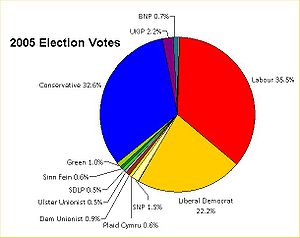
The projected shares of the vote on mainland Britain were Labour 35% (down 6% on 2001), Conservatives 33% (up 1%), Liberal Democrats 22% (up 4%) and other parties 8% (up 1%). The Conservatives were expected to make the biggest gains, however — forty-four seats according to the exit numbers — with the Liberal Democrats expected to take as few as two. Whilst the exit-poll-predicted vote share for the Lib Dems was accurate (22.6% vs an actual 22.0%), they had actually done better in some Lib Dem-Labour marginals than predicted on the basis of the national share of the vote, producing a net gain of 11 seats.
Notional election, 2001
Due to boundary changes in Scotland, the number of seats were reduced to 59 (down from 72). As a result of this a number of seats were lost by each party, and this notional election result below is based on the 2001 election results if they had been fought on these new 2005 boundaries.|}
Results
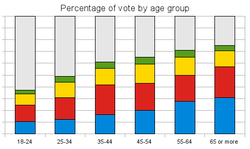
Corby (UK Parliament constituency)
Corby is a county constituency represented in the House of Commons of the Parliament of the United Kingdom. It elects one Member of Parliament by the first-past-the-post voting system, and is currently a marginal seat between Labour and the Conservatives....
, giving them 324 seats in the House of Commons out of those then declared and an overall majority, Labour's total reaching 356 seats out of the 646 House of Commons seats. Labour received 35.3% of the popular vote, equating to approximately 22% of the electorate on a 61.3% turnout, up from 59.4% turnout in 2001. Increased turnout was mostly attributed to the extension and promotion of the postal voting
Postal voting
Postal voting describes the method of voting in an election whereby ballot papers are distributed or returned by post to electors, in contrast to electors voting in person at a polling station or electronically via an electronic voting system....
system, which has however been criticised by many as being too insecure increasing the risk of electoral fraud
Electoral fraud
Electoral fraud is illegal interference with the process of an election. Acts of fraud affect vote counts to bring about an election result, whether by increasing the vote share of the favored candidate, depressing the vote share of the rival candidates or both...
.
As expected, voter disenchantment led to an increase of support for many opposition parties, and caused many eligible to vote, not to turnout. Labour achieved a third successive term in office for the first time in their history, though with reduction of the Labour majority from 167 to 67 (as it was before the declaration of South Staffordshire). As it became clear that Labour had won an overall majority, Michael Howard
Michael Howard
Michael Howard, Baron Howard of Lympne, CH, QC, PC is a British politician, who served as the Leader of the Conservative Party and Leader of the Opposition from November 2003 to December 2005...
, the leader of the Conservative party, announced his intention to retire from front-line politics. The final seat to declare was the delayed poll in South Staffordshire, at just after 1 a.m. on Friday 24 June.
The election was followed by further criticism of the UK electoral system. Calls for reform came particularly from Lib Dem supporters, citing that they received only just over 10% of the overall seats with 22.1% of the popular vote. The only parties to win a higher percentage of seats than they achieved in votes were Labour, the Democratic Unionist Party and Sinn Féin, and Health Concern
Independent Kidderminster Hospital and Health Concern
Independent Kidderminster Hospital and Health Concern is a political party based in Kidderminster, United Kingdom...
, which ran only one candidate. The results of the election give a Gallagher index of dis-proportionality
Gallagher Index
The Gallagher Index is used to measure the disproportionality of an electoral outcome, that is the difference between the percentage of votes received and the percentage of seats a party gets in the resulting legislature. This is especially useful for comparing proportionality across electoral...
of 16.76.
The Labour Government claimed that being returned to office for a third term for the first time ever showed the public approval of New Labour's governance and the continued unpopularity of the Conservatives. Nevertheless, Labour's vote declined to 35.3%, the lowest share of the popular vote to have formed a majority government in the history of the UK House of Commons. In many areas the collapse in the Labour vote resulted in a host of seats changing hands. Labour also failed to gain any new seats, almost unique in any election since 1945. As well as losing seats to the Tories and the Liberal Democrats, Labour also lost their safest seat in Wales to Independent Peter Law
Peter Law
Peter John Law was a Welsh politician.- Labour Co-operative AM and Independent MP :For most of his career Law sat as a Labour Councillor and subsequently Labour Co-operative Assembly Member for Blaenau Gwent...
, and Bethnal Green and Bow
Bethnal Green and Bow
Bethnal Green and Bow is a parliamentary constituency located in Greater London, represented in the House of Commons of the Parliament of the United Kingdom. It elects one Member of Parliament by the first past the post system of election. The constituency first existed 1974-1983, and was...
to Respect candidate George Galloway
George Galloway
George Galloway is a British politician, author, journalist and broadcaster who was a Member of Parliament from 1987 to 2010. He was formerly an MP for the Labour Party, first for Glasgow Hillhead and later for Glasgow Kelvin, before his expulsion from the party in October 2003, the same year...
. Both Law and Galloway were former Labour MPs.
The Conservatives claimed that their increased number of seats showed disenchantment with the Labour government and was a precursor of a Conservative breakthrough at the next election. Following three consecutive elections of declining representation and then in 2001 a net gain of just one seat, 2005 was the first general election since 1983 where the number of Conservative seats increased appreciably, although the Conservatives' vote share increased only slightly and this election did mark the third successive general election in which the Conservatives polled below 35%. In some areas the Conservative vote actually fell. The Conservatives claimed to have won the General Election in England, since they received more votes than Labour although Labour still won a majority of seats.
The Liberal Democrats claimed that their continued gradual increase in seats and percentage vote showed they were in a position to make further gains from both parties. They pointed in particular to the fact that they were now in second place in roughly one hundred and ninety constituencies and that having had net losses to Labour in the 1992 general election and having not taken a single seat off Labour in 1997, they had held their gains off Labour from the 2001 general election and had actually made further gains from them. The Liberals also managed to take 3 seats from the Conservatives, notably Tim Collins, through the use of a decapitation strategy, which targeted senior Tories.
The Liberal Democrats increased their percentage of the vote by 3.7%, the Conservatives by 0.6%, and Labour's dropped by 5.4%. Most seats lost by Labour changed to the Conservatives and the Liberal Democrats suffered a net loss of two seats to the Conservative Party, possibly because of Lib Dem voters' tactical unwind.
The results were interpreted by the UK media
Media of the United Kingdom
Media of the United Kingdom consist of several different types of communications media: television, radio, newspapers, magazines, and Internet-based Web sites. The UK also has a strong music industry. The UK has a diverse range of providers, the most prominent being principle public service...
as an indicator of a breakdown in trust in the government, and in Prime Minister Tony Blair in particular.
Meanwhile the SNP had a good night in Scotland, gaining the Western Isles from Labour for the first time since 1987. In Wales Plaid Cymru failed to gain any seats, and lost Ceredigion to the Liberal Democrats. In Northern Ireland the Ulster Unionists were all but wiped out, only holding onto North Down, with leader David Trimble losing his seat in Upper Bann. For the first time the DUP became the biggest party in Northern Ireland.
It was the first general election since 1929
United Kingdom general election, 1929
-Seats summary:-References:*F. W. S. Craig, British Electoral Facts: 1832-1987*-External links:***...
in which no party received more than ten million votes. It was the most "three-cornered" election since 1923
United Kingdom general election, 1923
-Seats summary:-References:*F. W. S. Craig, British Electoral Facts: 1832-1987*-External links:***...
, though the Liberal Democrats failed to match the higher national votes of the SDP-Liberal Alliance
SDP-Liberal Alliance
The SDP–Liberal Alliance was an electoral pact formed by the Social Democratic Party and the Liberal Party in the United Kingdom which was in existence from 1981 to 1988, when the bulk of the two parties merged to form the Social and Liberal Democrats, later referred to as simply the Liberal...
in the 1980s either in absolute or percentage terms. The total combined vote for Labour, the Conservatives and the Liberal Democrats proved to be the lowest main three party vote since 1922
United Kingdom general election, 1922
The United Kingdom general election of 1922 was held on 15 November 1922. It was the first election held after most of the Irish counties left the United Kingdom to form the Irish Free State, and was won by Andrew Bonar Law's Conservatives, who gained an overall majority over Labour, led by John...
.
See also the list of parties standing in Northern Ireland.
| Government's new majority | 66 |
|---|
Labour Ministers and former ministers
- Stephen TwiggStephen TwiggStephen Twigg is a British Labour Party politician who has been the Labour Co-operative Member of Parliament for Liverpool West Derby since 2010. He previously served as the Member of Parliament for Enfield Southgate from 1997 to 2005, when he lost his seat. He came to national prominence in 1997...
(Enfield Southgate) – Minister of State for SchoolsDepartment for Children, Schools and FamiliesThe Department for Children, Schools and Families was a department of the UK government, between 2007 and 2010, responsible for issues affecting people in England up to the age of 19, including child protection and education... - Melanie JohnsonMelanie JohnsonMelanie Jane Johnson is a Labour politician in the United Kingdom.-Early life:Johnson attended the Independent Clifton High School in Clifton, Bristol. Leaving Bristol for London, Johnson studied at University College London, gaining a BA in Philosophy and Ancient Greek...
(Welwyn HatfieldWelwyn Hatfield (UK Parliament constituency)Welwyn Hatfield is a county constituency represented in the House of Commons of the Parliament of the United Kingdom. It was created in 1974 as 'Welwyn and Hatfield'.- Boundaries :...
) – Minister of State for Public HealthDepartment of Health (United Kingdom)The Department of Health is a department of the United Kingdom government with responsibility for government policy for health and social care matters and for the National Health Service in England along with a few elements of the same matters which are not otherwise devolved to the Scottish,... - Chris Leslie (ShipleyShipley (UK Parliament constituency)-Elections in the 2000s:-Elections in the 1990s:-Elections in the 1980s:-Elections in the 1970s:-Elections in the 1910s:...
) – Parliamentary Under-Secretary of StateParliamentary Under-Secretary of StateA Parliamentary Under-Secretary of State is the lowest of three tiers of government minister in the government of the United Kingdom, junior to both a Minister of State and a Secretary of State....
in the Department for Constitutional AffairsDepartment for Constitutional AffairsThe Department for Constitutional Affairs was a United Kingdom government department. Its creation was announced on 12 June 2003 with the intention of replacing the Lord Chancellor's Department... - Ivan HendersonIvan HendersonIvan John Henderson is a Labour Party politician in the United Kingdom. He was the Member of Parliament for Harwich from 1997 to 2005.-Early life:...
(HarwichHarwich (UK Parliament constituency)Harwich was a parliamentary constituency represented in the House of Commons of the Parliament of the United Kingdom. Until its abolition for the 2010 general election it elected one Member of Parliament by the first past the post system of election....
) – Parliamentary Private SecretaryParliamentary Private SecretaryA Parliamentary Private Secretary is a role given to a United Kingdom Member of Parliament by a senior minister in government or shadow minister to act as their contact for the House of Commons; this role is junior to that of Parliamentary Under-Secretary, which is a ministerial post, salaried by...
at the Home OfficeHome OfficeThe Home Office is the United Kingdom government department responsible for immigration control, security, and order. As such it is responsible for the police, UK Border Agency, and the Security Service . It is also in charge of government policy on security-related issues such as drugs,... - David Stewart (Inverness East, Nairn and LochaberInverness East, Nairn and Lochaber (UK Parliament constituency)Inverness East, Nairn and Lochaber, was a county constituency of the House of Commons of the Parliament of the United Kingdom from 1997 to 2005...
) – Parliamentary Private Secretary to the Secretary of State for ScotlandSecretary of State for ScotlandThe Secretary of State for Scotland is the principal minister of Her Majesty's Government in the United Kingdom with responsibilities for Scotland. He heads the Scotland Office , a government department based in London and Edinburgh. The post was created soon after the Union of the Crowns, but was... - Peter BradleyPeter BradleyPeter Charles Stephen Bradley is an English Labour Party politician. He was the Member of Parliament for The Wrekin from the 1997 election until the 2005 election, when he lost his seat to Mark Pritchard of the Conservative Party....
(The WrekinThe Wrekin (UK Parliament constituency)The Wrekin is a county constituency represented in the House of Commons of the Parliament of the United Kingdom since 1918. It elects one Member of Parliament by the first past the post system of election...
) – Parliamentary Private Secretary to the Minister of State for Rural Affairs - The Right HonourablePrivy Council of the United KingdomHer Majesty's Most Honourable Privy Council, usually known simply as the Privy Council, is a formal body of advisers to the Sovereign in the United Kingdom...
Keith BradleyKeith Bradley, Baron BradleyKeith John Charles Bradley, Baron Bradley PC is a British Labour Party politician and life peer. He was formerly the Labour Member of Parliament for Manchester Withington from 1987 until 2005.-Early life:...
(Manchester WithingtonManchester Withington (UK Parliament constituency)Manchester, Withington is a parliamentary constituency in the city of Manchester. It returns one Member of Parliament to the House of Commons of the Parliament of the United Kingdom, elected by the first past the post system...
) – former Treasurer of the HouseholdTreasurer of the HouseholdThe position of Treasurer of the Household is theoretically held by a household official of the British monarch, under control of the Lord Steward's Department, but is, in fact, a political office held by one of the government's Deputy Chief Whips in the House of Commons...
(MP since 1987) - The Rt Hon. Barbara RocheBarbara RocheBarbara Maureen Roche is a British Labour Party politician, who was the Member of Parliament for Hornsey and Wood Green from 1992 until 2005, when she lost the seat, despite having previously enjoyed a majority of over 10,500.During her time in Government, she held several ministerial offices;...
(Hornsey and Wood Green) – former Minister of State for Asylum and ImmigrationMinister of State for Borders and ImmigrationThe Minister of State for Immigration is a Minister of State in the Home Office of the Government of the United Kingdom. The current minister is Damian Green MP who was appointed to his new post following the formation of a coalition government under David Cameron at the 2010 general...
(MP since 1992) - Calum MacDonald (Western Isles) – former Minister for GaelicMinister for GaelicMinister for Gaelic is a Junior minister post in the Scottish government. Gaelic now lies in the responsibility of the Scottish Government, having been in control of the Scottish Office prior to 1999....
(MP since 1987)
Other Labour Members of Parliament
- Roger CasaleRoger CasaleRoger Mark Casale was the Labour member of Parliament for Wimbledon in London. He was educated at King's College School, Hurstpierpoint College, Brasenose College, Oxford and Johns Hopkins University. He won the seat of Wimbledon at the 1997 election but lost it to the Conservatives at the 2005...
(WimbledonWimbledon (UK Parliament constituency)Wimbledon is one of two parliamentary constituencies in the London Borough of Merton in south-west London. It elects one Member of Parliament to the House of Commons of the Parliament of the United Kingdom, by the first-past-the-post voting system....
) - Paul StinchcombePaul StinchcombePaul David Stinchcombe is a Labour Party politician in the United Kingdom.-Early life:He went to the Royal Grammar School, High Wycombe. At Trinity College, Cambridge, he studied Law, gaining an MA. He went to Harvard Law School in Cambridge, Massachusetts, gaining a LLM...
(WellingboroughWellingborough (UK Parliament constituency)Wellingborough is a county constituency represented in the House of Commons of the Parliament of the United Kingdom. It elects one Member of Parliament by the first past the post system of election...
) - Kerry PollardKerry PollardKerry Patrick Pollard is a Labour Party politician in the United Kingdom. He was elected at the 1997 general election as Member of Parliament for St Albans, and held the seat until his defeat at the 2005 general election....
(St AlbansSt Albans (UK Parliament constituency)St Albans is a parliamentary constituency represented in the House of Commons of the Parliament of the United Kingdom. Established in 1885, it is a county constituency in Hertfordshire, and elects one Member of Parliament by the first past the post system of election.From 1554 to 1852 there was a...
) - Tony Clarke (Northampton SouthNorthampton South (UK Parliament constituency)Northampton South is a parliamentary constituency represented in the House of Commons of the Parliament of the United Kingdom. It was created for February 1974 general election when the old constituency of Northampton was split into Northampton North and Northampton South.-Boundary...
) - Helen ClarkHelen Clark (UK politician)Helen Rosemary Clark, previously known as Helen Brinton, is a politician in the United Kingdom...
(PeterboroughPeterborough (UK Parliament constituency)Peterborough is a borough constituency represented in the House of Commons of the Parliament of the United Kingdom, formally styled The Honourable the Commons of the United Kingdom of Great Britain and Northern Ireland in Parliament assembled. It elects one Member of Parliament by the first past...
) - Tony Colman (PutneyPutney (UK Parliament constituency)-Elections 1950–1979:-Elections 1918–1945:-Notes and references:...
) - Lorna FitzsimonsLorna FitzsimonsLorna Fitzsimons is a British politician. A member of the Labour Party, she served as a Member of Parliament representing the constituency of Rochdale from 1997 to 2005.-Early life:...
(RochdaleRochdale (UK Parliament constituency)Rochdale is a county constituency represented in the House of Commons of the Parliament of the United Kingdom. It elects one Member of Parliament by the first past the post system of election.-Boundaries:...
) - Andy King (Rugby and Kenilworth)
- Lawrie QuinnLawrie QuinnLawrence William Quinn is a Labour politician in England.-Early life:He went to primary school in Harraby and Harraby Comprehensive School on Edgehill Road in Carlisle...
(Scarborough and Whitby) - Brian WhiteBrian White (British politician)Brian Arthur Robert White is a Labour Party politician in the United Kingdom. He was Member of Parliament for North East Milton Keynes from 1997 to 2005.-Early life:...
(North East Milton Keynes) - Huw EdwardsHuw Edwards (politician)Huw William Edmund Edwards is a British Labour Party politician who was the Member of Parliament for Monmouth over two separate terms....
(MonmouthMonmouth (UK Parliament constituency)Monmouth is a county constituency of the House of Commons of the Parliament of the United Kingdom . It elects one Member of Parliament by the first past the post of election...
) - Phil SawfordPhil SawfordPhilip Andrew Sawford is a British Labour Party politician, who was the Member of Parliament for Kettering from 1997 to 2005.-Early life:...
(KetteringKettering (UK Parliament constituency)Kettering is a county constituency in Northamptonshire which returns one Member of Parliament to the House of Commons of the Parliament of the United Kingdom....
) - Linda PerhamLinda PerhamLinda Perham is a Labour politician in the United Kingdom.-Career:Perham was a London Borough of Redbridge councillor and Mayor of the Borough prior to the 1997 election. She was Member of Parliament for Ilford North from 1997, defeating Vivian Bendall, until she lost her seat at the 2005 election...
(Ilford NorthIlford North (UK Parliament constituency)Ilford North is a borough constituency represented in the House of Commons of the Parliament of the United Kingdom. It comprises the north part of the town of Ilford in the London Borough of Redbridge, and elects one Member of Parliament by the first-past-the-post system of...
) - John CryerJohn CryerJohn Robert Cryer is an English Labour Party politician, who has been the Member of Parliament for Leyton and Wanstead since the general election in May 2010...
(Leyton and Wanstead) - Tony McWalterTony McWalterTony McWalter is a politician in the United Kingdom. He was Labour Party and Co-operative Member of Parliament for Hemel Hempstead between 1997 and 2005.-Education:...
(Hemel HempsteadHemel Hempstead (UK Parliament constituency)Hemel Hempstead is a constituency represented in the House of Commons of the Parliament of the United Kingdom. It elects one Member of Parliament by the first past the post system of election.- Boundaries :...
) - Candy AthertonCandy AthertonCandice Kathleen Atherton , known as Candy Atherton, is a British journalist and was a politician. After serving as a councillor in Islington, where she was Mayor, she was Member of Parliament for Falmouth and Camborne from 1997 to 2005...
(Falmouth and Camborne) - Nigel BeardNigel BeardChristopher Nigel Beard, known as Nigel Beard, is a British politician. He was Labour Party Member of Parliament for Bexleyheath and Crayford in London from 1997 to 2005....
(Bexleyheath and CrayfordBexleyheath and Crayford (UK Parliament constituency)-Elections in the 2000s:-Elections in the 1990s:-See also:*List of Parliamentary constituencies in Greater London*David Evennett Wikipedia page**Howard Dawber Wikipedia page**-References:...
) - Oona KingOona KingOona Tamsyn King, Baroness King of Bow is a Baroness and Member of the House of Lords, and former Chief Diversity Officer of Channel 4. She previously had served as a Labour Party Member of Parliament for Bethnal Green and Bow from 1997 until 2005, when she was defeated by Respect candidate George...
(Bethnal Green & Bow) - Valerie DaveyValerie DaveyValerie Davey is a former Labour Member of Parliament for Bristol West in England.-Early life:...
(Bristol West) - Anne CampbellAnne CampbellAnne Campbell is an English Labour Party politician. She was the Member of Parliament for Cambridge from 1992 to 2005.-Early life:She went to Newnham College, Cambridge, taking the Maths Tripos, and gaining an MA in 1965....
(CambridgeCambridge (UK Parliament constituency)Cambridge is a parliamentary constituency represented in the House of Commons of the Parliament of the United Kingdom. It elects one Member of Parliament by the first-past-the-post voting system....
) (MP since 1992) - Jon Owen JonesJon Owen JonesJon Owen Jones is a Welsh politician. He was Labour and Co-operative Member of Parliament for Cardiff Central from 1992 to 2005.-Early life:...
(Cardiff CentralCardiff Central (UK Parliament constituency)Cardiff Central is a borough constituency in the city of Cardiff. It returns one Member of Parliament to the House of Commons of the Parliament of the United Kingdom, elected by the first past the post system....
) (MP since 1992) - Gareth ThomasGareth Thomas (Welsh politician)Gareth Thomas is a Labour Party politician in the United Kingdom. He was Member of Parliament for Clwyd West 1997-2005.-Early life:...
(Clwyd WestClwyd West (UK Parliament constituency)Clwyd West is a constituency of the House of Commons of the Parliament of the United Kingdom . It elects one Member of Parliament by the first past the post method of election...
) - Geraint Davies (Croydon CentralCroydon Central (UK Parliament constituency)The comparison is with the notional 2005 result for the new boundaries which made Croydon Central a Labour defence.-Elections in the 2000s:-Elections in the 1990s:- Notes and references :...
) - John Lyons (Strathkelvin and BearsdenStrathkelvin and Bearsden (UK Parliament constituency)Strathkelvin and Bearsden was a parliamentary constituency represented in the House of Commons of the Parliament of the United Kingdom from 1983...
) (MP since 2001) - Iain LukeIain LukeIain Malone Luke is a former Labour Party politician and former Member of Parliament in the United Kingdom.In October 2011, he resigned from the Labour Party in disgust at plots by Labour party members against the former SNP leader Gordon Wilson.-Biography:Iain Luke was educated at Stobswell Boys'...
(Dundee EastDundee East (UK Parliament constituency)-Elections in the 2000s:-Elections in the 1990s:-Elections in the 1980s:-Elections in the 1970s:-Elections in the 1950s:...
) (MP since 2001) - Chris PondChris PondChristopher Richard Pond, is a former Labour Party politician in the United Kingdom. He was Member of Parliament for Gravesham in Kent, from 1997 to 2005.-Early life:...
(GraveshamGravesham (UK Parliament constituency)Gravesham is a county constituency represented in the House of Commons of the Parliament of the United Kingdom. It elects one Member of Parliament by the first past the post system of election...
)
Conservative Party
- Tim CollinsTim Collins (politician)Timothy William George Collins, CBE, is a British politician, once a prominent member of the Conservative Party. Collins was active in the 1990s and was later the Member of Parliament for Westmorland and Lonsdale in north-west England from 1997 until defeat at the 2005 general...
(Westmorland & LonsdaleWestmorland and Lonsdale (UK Parliament constituency)Westmorland and Lonsdale is a parliamentary constituency represented in the House of Commons of the Parliament of the United Kingdom. It elects one Member of Parliament by the first past the post system of election.-Boundaries:...
) – Shadow Secretary of State for Education (MP since 1997) - Peter Duncan (Dumfries & Galloway)Dumfries and Galloway (UK Parliament constituency)Dumfries and Galloway is a county constituency of in the House of Commons of the Parliament of the United Kingdom. It was first used in the 2005 general election, and replaced Galloway and Upper Nithsdale and part of Dumfries, and it elects one Member of Parliament by the first past the post...
- Shadow Secretary of State for Scotland (MP since 2001) (Newly created seat) - Adrian Flook (TauntonTaunton (UK Parliament constituency)Taunton was a constituency represented in the House of Commons of the Parliament of the United Kingdom and its predecessors from 1295 to 2010, taking its name from the town of Taunton in Somerset...
) (MP since 2001) - John TaylorJohn Mark TaylorJohn Mark Taylor is a solicitor and former politician in the United Kingdom. He was the Conservative Party Member of Parliament for Solihull from 1983 to 2005, before losing his seat to Lorely Burt of the Liberal Democrats by a margin of 279 votes in the 2005 general election...
(SolihullSolihull (UK Parliament constituency)Solihull is a borough constituency represented in the House of Commons of the Parliament of the United Kingdom. It elects one Member of Parliament by the first past the post system of election.- Boundaries :...
) (MP since 1983)
Liberal Democrats
- Brian CotterBrian Cotter, Baron CotterBrian Joseph Michael Cotter, Baron Cotter is a politician in the United Kingdom. He was Liberal Democrat Member of Parliament for Weston-super-Mare, from the 1997 election until 2005.-Early life:...
(Weston-super-MareWeston-super-Mare (UK Parliament constituency)Weston-super-Mare is a constituency represented in the House of Commons of the Parliament of the United Kingdom. It elects one Member of Parliament by the first past the post system of election.-Boundaries:...
) – Small Business spokesperson for the Liberal DemocratsLiberal DemocratsThe Liberal Democrats are a social liberal political party in the United Kingdom which supports constitutional and electoral reform, progressive taxation, wealth taxation, human rights laws, cultural liberalism, banking reform and civil liberties .The party was formed in 1988 by a merger of the...
(MP since 1997) - Sue DoughtySue DoughtySusan Kathleen Doughty, known as Sue Doughty, is a politician in the United Kingdom. She was Liberal Democrat Member of Parliament for Guildford .-Early life:...
(GuildfordGuildford (UK Parliament constituency)Guildford is a county constituency in Surrey which returns one Member of Parliament to the House of Commons of the Parliament of the United Kingdom, elected by the first-past-the-post voting system....
) – EnvironmentDepartment for Environment, Food and Rural AffairsThe Department for Environment, Food and Rural Affairs is the government department responsible for environmental protection, food production and standards, agriculture, fisheries and rural communities in the United Kingdom...
spokesperson for the Liberal Democrats (MP since 2001) - Matthew Green (LudlowLudlow (UK Parliament constituency)Ludlow is a county constituency represented in the House of Commons of the Parliament of the United Kingdom. It elects one Member of Parliament by the first past the post system of election....
) – Liberal Democratic spokesperson on the Office of the Deputy Prime MinisterDeputy Prime Minister of the United KingdomThe Deputy Prime Minister of the United Kingdom of Great Britain and Northern Ireland is a senior member of the Cabinet of the United Kingdom. The office of the Deputy Prime Minister is not a permanent position, existing only at the discretion of the Prime Minister, who may appoint to other offices...
(MP since 2001) - David RendelDavid RendelDavid Digby Rendel is a British Liberal Democrat politician. He was the Member of Parliament for Newbury from 1993 to 2005. He won the seat at by-election in May 1993 caused by the death of Judith Chaplin, and held it his defeat at the 2005 general election to Conservative candidate Richard...
(NewburyNewbury (UK Parliament constituency)Newbury is a parliamentary constituency represented in the House of Commons of the Parliament of the United Kingdom. It returns one Member of Parliament , elected by the first-past-the-post voting system....
) (MP since 1993)
Plaid Cymru
- Simon Thomas (CeredigionCeredigion (UK Parliament constituency)Ceredigion, formerly Cardiganshire, is a constituency represented in the House of Commons of the Parliament of the United Kingdom. Created in 1536, the boundaries have remained remarkably unchanged for nearly five centuries...
) (MP since January 2000)
Ulster Unionist Party
- David TrimbleDavid TrimbleWilliam David Trimble, Baron Trimble, PC , is a politician from Northern Ireland. He served as Leader of the Ulster Unionist Party , was the first First Minister of Northern Ireland , and was a Member of the British Parliament . He is currently a life peer for the Conservative Party...
(Upper BannUpper Bann (UK Parliament constituency)Upper Bann is a Parliamentary Constituency in the United Kingdom House of Commons. The current Member of Parliament for Upper Bann is David Simpson.-Boundaries:...
) – Parliamentary Leader of the Ulster UnionistsUlster Unionist PartyThe Ulster Unionist Party – sometimes referred to as the Official Unionist Party or, in a historic sense, simply the Unionist Party – is the more moderate of the two main unionist political parties in Northern Ireland...
(MP since 1990) - Roy BeggsRoy BeggsJohn Robert Beggs, commonly known as Roy Beggs, is a Northern Ireland politician.Beggs was educated at Ballyclare High School, followed by Stranmillis College, to study teacher training...
(East AntrimEast Antrim (UK Parliament constituency)East Antrim is a Parliamentary Constituency in the House of Commons and also an Assembly constituency in the Northern Ireland Assembly. It has voted for Unionist candidates since its re-creation in 1983.-Boundaries:...
) (MP since 1983) - David BurnsideDavid BurnsideDavid Wilson Boyd Burnside is a Northern Ireland politician, and was Ulster Unionist Party Member of Parliament for South Antrim....
(South AntrimSouth Antrim (UK Parliament constituency)South Antrim is a Parliamentary Constituency in the United Kingdom House of Commons.-Boundaries:From 1885, this constituency was one of four county divisions of the former Antrim constituency...
) (MP since 2001)
Formation of government
Following the election result, Labour remained in power and Tony Blair remained Prime MinisterPrime Minister of the United Kingdom
The Prime Minister of the United Kingdom of Great Britain and Northern Ireland is the Head of Her Majesty's Government in the United Kingdom. The Prime Minister and Cabinet are collectively accountable for their policies and actions to the Sovereign, to Parliament, to their political party and...
, reshuffling
Cabinet shuffle
In the parliamentary system a cabinet shuffle or reshuffle is an informal term for an event that occurs when a head of government rotates or changes the composition of ministers in their cabinet....
government positions over the following weekend, with formal announcements made on 9 May 2005. The most senior positions of Chancellor
Chancellor of the Exchequer
The Chancellor of the Exchequer is the title held by the British Cabinet minister who is responsible for all economic and financial matters. Often simply called the Chancellor, the office-holder controls HM Treasury and plays a role akin to the posts of Minister of Finance or Secretary of the...
, Home Secretary
Home Secretary
The Secretary of State for the Home Department, commonly known as the Home Secretary, is the minister in charge of the Home Office of the United Kingdom, and one of the country's four Great Offices of State...
and Foreign Secretary
Secretary of State for Foreign and Commonwealth Affairs
The Secretary of State for Foreign and Commonwealth Affairs, commonly referred to as the Foreign Secretary, is a senior member of Her Majesty's Government heading the Foreign and Commonwealth Office and regarded as one of the Great Offices of State...
remained the same, but a few new faces were added; most notably David Blunkett
David Blunkett
David Blunkett is a British Labour Party politician and the Member of Parliament for Sheffield Brightside and Hillsborough, having represented Sheffield Brightside from 1987 to 2010...
returned to cabinet as the Work and Pensions Secretary
Secretary of State for Work and Pensions
The Secretary of State for Work and Pensions is a post in the British Cabinet, responsible for the Department for Work and Pensions. It was created on 8 June 2001 by the merger of the Employment part of the Department for Education and Employment and the Department of Social Security.The Ministry...
, although he was forced to resign again due to another scandal before the end of the year that spawned a national press and opposition campaign for his dismissal. Patricia Hewitt
Patricia Hewitt
Patricia Hope Hewitt is an Australian-born British Labour Party politician, who was the Member of Parliament for Leicester West from 1997 until 2010. She served in the Cabinet until 2007, most recently as Health Secretary....
became the new Health Secretary
Secretary of State for Health
Secretary of State for Health is a UK cabinet position responsible for the Department of Health.The first Boards of Health were created by Orders in Council dated 21 June, 14 November, and 21 November 1831. In 1848 a General Board of Health was created with the First Commissioner of Woods and...
, Tessa Jowell
Tessa Jowell
Tessa Jowell is a British Labour Party politician, who has been the Member of Parliament for Dulwich and West Norwood since 1992. Formerly a member of both the Blair and Brown Cabinets, she is currently the Shadow Minister for the Olympics and Shadow Minister for London.-Early life:Tessa Jane...
remained as Culture Secretary, whilst Alan Johnson
Alan Johnson
Alan Arthur Johnson is a British Labour Party politician who served as Home Secretary from June 2009 to May 2010. Before that, he filled a wide variety of cabinet positions in both the Blair and Brown governments, including Health Secretary and Education Secretary. Until 20 January 2011 he was...
was promoted to Trade and Industry Secretary. Meanwhile Ruth Kelly
Ruth Kelly
Ruth Maria Kelly is a British Labour Party politician of Irish descent who was the Member of Parliament for Bolton West from 1997 until she stood down in 2010...
retained the Education job and Margaret Beckett
Margaret Beckett
Margaret Mary Beckett is a British Labour Party politician who has been the Member of Parliament for Derby South since 1983, rising to become the Deputy Leader of the Labour Party under John Smith, from 18 July 1992 to 12 May 1994, and briefly serving as Leader of the Party following Smith's death...
stayed put at Environment.
The new Parliament met on 11 May for the election of the Speaker of the House of Commons
Speaker of the British House of Commons
The Speaker of the House of Commons is the presiding officer of the House of Commons, the United Kingdom's lower chamber of Parliament. The current Speaker is John Bercow, who was elected on 22 June 2009, following the resignation of Michael Martin...
.
New party leaders
On 6 May Michael HowardMichael Howard
Michael Howard, Baron Howard of Lympne, CH, QC, PC is a British politician, who served as the Leader of the Conservative Party and Leader of the Opposition from November 2003 to December 2005...
announced he would be standing down as leader of the Conservative Party, but not before a review of the leadership rules. The formal leadership election began in October, and was ultimately won by David Cameron
David Cameron
David William Donald Cameron is the current Prime Minister of the United Kingdom, First Lord of the Treasury, Minister for the Civil Service and Leader of the Conservative Party. Cameron represents Witney as its Member of Parliament ....
. See Conservative Party (UK) leadership election, 2005
Conservative Party (UK) leadership election, 2005
The 2005 Conservative leadership election was called by party leader Michael Howard on 6 May 2005, when he announced that he would be stepping down as leader in the near future. However, he stated that he would not depart until a review of the rules for the leadership election had been conducted,...
. The following day David Trimble
David Trimble
William David Trimble, Baron Trimble, PC , is a politician from Northern Ireland. He served as Leader of the Ulster Unionist Party , was the first First Minister of Northern Ireland , and was a Member of the British Parliament . He is currently a life peer for the Conservative Party...
resigned as leader of the Ulster Unionist Party. His successor, Sir Reg Empey
Reg Empey
Reginald Norman Morgan Empey, Baron Empey of Shandon, OBE, – known as Sir Reg Empey prior to 2011 – is a former Leader of the Ulster Unionist Party and Member of the Northern Ireland Assembly for East Belfast...
, was elected at the meeting of the Ulster Unionist Council on 24 June. See Ulster Unionist Party leadership election, 2005
Ulster Unionist Party leadership election, 2005
The 2005 Ulster Unionist Party leadership election began on 7 May 2005 when David Trimble resigned as leader of the Ulster Unionist Party following his party's poor performance in the 2005 general election when it lost all but one of its seats, including Trimble's own...
.
End of the term
The prime ministerPrime Minister of the United Kingdom
The Prime Minister of the United Kingdom of Great Britain and Northern Ireland is the Head of Her Majesty's Government in the United Kingdom. The Prime Minister and Cabinet are collectively accountable for their policies and actions to the Sovereign, to Parliament, to their political party and...
Gordon Brown
Gordon Brown
James Gordon Brown is a British Labour Party politician who was the Prime Minister of the United Kingdom and Leader of the Labour Party from 2007 until 2010. He previously served as Chancellor of the Exchequer in the Labour Government from 1997 to 2007...
visited Buckingham Palace
Buckingham Palace
Buckingham Palace, in London, is the principal residence and office of the British monarch. Located in the City of Westminster, the palace is a setting for state occasions and royal hospitality...
on 6 April 2010 and asked the Queen to dissolve Parliament on 12 April. The next election was held on 6 May 2010.
See also
- MPs elected in the United Kingdom general election, 2005MPs elected in the United Kingdom general election, 2005This is a list of Members of Parliament elected to the House of Commons for the Fifty-Fourth Parliament of the United Kingdom at the 2005 general election, held on 5 May 2005.The list is arranged by constituency...
- 2005 United Kingdom general election results in Scotland2005 United Kingdom general election results in ScotlandThese are the results of the United Kingdom general election, 2005 for the country of Scotland. The election was held on 5 May 2010 and all 59 seats in Scotland were contested...
- 2005 United Kingdom general election results in Wales2005 United Kingdom general election results in WalesThese are the results of the United Kingdom general election, 2005 for the country of Wales. The election was held on 5 May 2010 and all 40 seats in Wales were contested.-Results:...
- 2005 United Kingdom general election results in Northern Ireland2005 United Kingdom general election results in Northern IrelandThese are the results of the United Kingdom general election, 2005 for the country of Northern Ireland. The election was held on 5 May 2005 and all 18 seats in Northern Ireland were contested...
External links
- 2001-2005 Polls from Polling Report UK
- Candidates by Party all 3405 candidates listed by their 124 distinct party labels
- 2005 UK general election from SourceWatchSourceWatchSourceWatch is an internet wiki site that is a collaborative project of the liberal Center for Media and Democracy...
with a focus on the strategists and public relations experts involved in the campaigns of the various parties - Strategic Voter 2005 information for each constituency to strategically vote against the invasion of Iraq
- Catalogue of 2005 general election ephemera at the Archives Division of the London School of EconomicsLondon School of EconomicsThe London School of Economics and Political Science is a public research university specialised in the social sciences located in London, United Kingdom, and a constituent college of the federal University of London...
. - OSCE Final Report on the United Kingdom general election on 2005-05-05, by the Organization for Security and Co-operation in EuropeOrganization for Security and Co-operation in EuropeThe Organization for Security and Co-operation in Europe is the world's largest security-oriented intergovernmental organization. Its mandate includes issues such as arms control, human rights, freedom of the press and fair elections...
- Maps of the 2005 results by constituencies (in French)
- NSD: European Election Database - UK
Manifestos
- ConservativesConservative Party (UK)The Conservative Party, formally the Conservative and Unionist Party, is a centre-right political party in the United Kingdom that adheres to the philosophies of conservatism and British unionism. It is the largest political party in the UK, and is currently the largest single party in the House...
: It's Time For Action/The British Dream - LabourLabour Party (UK)The Labour Party is a centre-left democratic socialist party in the United Kingdom. It surpassed the Liberal Party in general elections during the early 1920s, forming minority governments under Ramsay MacDonald in 1924 and 1929-1931. The party was in a wartime coalition from 1940 to 1945, after...
: Britain: forward not back - Liberal DemocratsLiberal DemocratsThe Liberal Democrats are a social liberal political party in the United Kingdom which supports constitutional and electoral reform, progressive taxation, wealth taxation, human rights laws, cultural liberalism, banking reform and civil liberties .The party was formed in 1988 by a merger of the...
: The REAL Alternative - Alliance Party of Northern IrelandAlliance Party of Northern IrelandThe Alliance Party of Northern Ireland is a liberal and nonsectarian political party in Northern Ireland. It is Northern Ireland's fifth-largest party overall, with eight seats in the Northern Ireland Assembly and one in the House of Commons....
: Alliance works. Tribal politics costs (PDF File) - British National PartyBritish National PartyThe British National Party is a British far-right political party formed as a splinter group from the National Front by John Tyndall in 1982...
: Rebuilding British Democracy (Abbreviated) (PDF) - Democratic Unionist PartyDemocratic Unionist PartyThe Democratic Unionist Party is the larger of the two main unionist political parties in Northern Ireland. Founded by Ian Paisley and currently led by Peter Robinson, it is currently the largest party in the Northern Ireland Assembly and the fourth-largest party in the House of Commons of the...
: Leadership That's Working (PDF File) - Green Party of England and WalesGreen Party of England and WalesThe Green Party of England and Wales is a political party in England and Wales which follows the traditions of Green politics and maintains a strong commitment to social progressivism. It is the largest Green party in the United Kingdom, containing within it various regional divisions including...
: People, Planet, Peace - Scottish Green PartyScottish Green PartyThe Scottish Green Party is a green party in Scotland. It has two MSPs in the devolved Scottish Parliament, Alison Johnstone, representing Lothian, and Patrick Harvie, for Glasgow.-Organisation:...
: People, Planet, Peace - Scottish National PartyScottish National PartyThe Scottish National Party is a social-democratic political party in Scotland which campaigns for Scottish independence from the United Kingdom....
: Make Scotland Matter (PDF file) - Plaid Cymru – The Party of WalesPlaid Cymru' is a political party in Wales. It advocates the establishment of an independent Welsh state within the European Union. was formed in 1925 and won its first seat in 1966...
: We can build a better Wales (PDF file) - English Democrats: See Web Site- Putting England First
- National Front: Manifesto
- Respect – The Unity CoalitionRESPECT The Unity CoalitionRespect is a socialist political party in England and Wales founded in 2004. Its name is a contrived acronym standing for Respect, Equality, Socialism, Peace, Environmentalism, Community and Trade Unionism.-Policies:...
: Policy - Scottish Socialist PartyScottish Socialist PartyThe Scottish Socialist Party is a left-wing Scottish political party. Positioning itself significantly to the left of Scotland's centre-left parties, the SSP campaigns on a socialist economic platform and for Scottish independence....
: Make Capitalism History - Social Democratic and Labour PartySocial Democratic and Labour PartyThe Social Democratic and Labour Party is a social-democratic, Irish nationalist political party in Northern Ireland. Its basic party platform advocates Irish reunification, and the further devolution of powers while Northern Ireland remains part of the United Kingdom...
: A Better Way to a Better Ireland (PDF File) - Sinn FéinSinn FéinSinn Féin is a left wing, Irish republican political party in Ireland. The name is Irish for "ourselves" or "we ourselves", although it is frequently mistranslated as "ourselves alone". Originating in the Sinn Féin organisation founded in 1905 by Arthur Griffith, it took its current form in 1970...
: Manifesto - Ulster Unionist PartyUlster Unionist PartyThe Ulster Unionist Party – sometimes referred to as the Official Unionist Party or, in a historic sense, simply the Unionist Party – is the more moderate of the two main unionist political parties in Northern Ireland...
: Simply British - United Kingdom Independence PartyUnited Kingdom Independence PartyThe United Kingdom Independence Party is a eurosceptic and right-wing populist political party in the United Kingdom. Whilst its primary goal is the UK's withdrawal from the European Union, the party has expanded beyond its single-issue image to develop a more comprehensive party platform.UKIP...
: We want our country back
News coverage
- BBC coverage of election night, uploaded to youtube in 47 parts.
- Election 2005 from BBC NewsBBC NewsBBC News is the department of the British Broadcasting Corporation responsible for the gathering and broadcasting of news and current affairs. The department is the world's largest broadcast news organisation and generates about 120 hours of radio and television output each day, as well as online...
- Election 2005 from Channel 4
- UK General Election 2005 from The GuardianThe GuardianThe Guardian, formerly known as The Manchester Guardian , is a British national daily newspaper in the Berliner format...
- Election 2005 Blog from The GuardianThe GuardianThe Guardian, formerly known as The Manchester Guardian , is a British national daily newspaper in the Berliner format...