


Common Fisheries Policy

Encyclopedia
The Common Fisheries Policy (CFP) is the fisheries
policy of the European Union
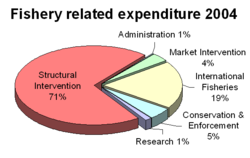
(EU). It sets quotas for which member states are allowed to catch what amounts of each type of fish, as well as encouraging the fishing industry by various market interventions. In 2004 it had a budget of €931 million, approximately 0.75% of the EU budget.
The common fisheries policy has been criticised by fishermen who say it is threatening their livelihoods, although some scientific research has shown that fishing stocks were in decline long before the policy came into being.
When it came into force, the Treaty of Lisbon
formally enshrined fisheries conservation policy as one of the handful of 'exclusive competences' reserved for the European Union, to be decided by Qualified Majority Voting. However, general fisheries policy remains a "shared competence" of the Union and its member states. Thus decisions will still be made primarily by the council of ministers, as is the case now.
The common fisheries policy was created to manage fish stocks for the European Union as a whole. Article 38 of the 1957 Treaty of Rome
, which created the European Communities
(now European Union
), stated that there should be a common policy for fisheries.
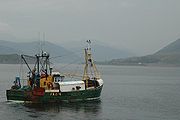
 In Fraserburgh, Scotland, the Fishing Industry creates 40% of employment and a similar figure is in Peterhead. They are the EU's largest fishing ports and home to the Pelagic vessel fleet.It is often in areas where other employment opportunities are limited. For this reason, community funds have been made available to fishing as a means of encouraging regional development.
The market for fish and fish products has changed in recent years. Supermarkets are now the main buyers of fish and expect steady supplies. Fresh fish sales have fallen, but demand for processed fish and prepared meals has grown. Despite this, employment in fish processing
has been falling, with 60% of fish consumed in the EU coming from outside. This is partly due to improvements in the ability to transport fresh fish internationally. Competitiveness of the EU fishing industry has been affected by overcapacity and shortages of fish to catch.
TACs are fixed annually by the council of ministers in December. They consider proposals drawn up by the European commission in consultation with its own scientific advisers (Scientific, Technical and Economic Committee of Fisheries STECF), the views of non EU fishing nations and those of the International Council for the Exploration of the Sea
(ICES). Each member state is responsible for policing its own quotas. Different countries distribute the available stock using different systems.
for regulated species. Catches and landings must be recorded. Regulations cover the kind of fishing gear that may be used. Areas may be closed from fishing to allow stocks to recover.
A minimum size
for catch led to fishermen dumping dead fish that were too small to land legally, so a minimum mesh size was introduced, which let small fish escape to replenish stocks. Choice of mesh is complicated, because mature fish of different species are naturally different sizes and require different nets.
Each country is given a target for the size of their fleet. Funding is available to assist modernization of boats and installations, but also to buy out fishermen to reduce the fleet size. Money is available for advertising campaigns to encourage consumption of fish species that are not over fished, or are unfamiliar to the public. Also, grants are available to assist the industry in improving product quality and managing quotas.
 There are now more than 160 producer organizations (PO) in the EU. These are voluntary organizations set up by fishermen or fish farmers to assist in selling their product. Their members must include a minimum percentage of vessels in that sector, not discriminate in terms of nationality or location of their members within the EU, and must comply with other EU regulations. Organisations are required to develop plans to adjust fish catches to market demand. They may require non-members fishing in the same areas to follow the same restrictions as members.
They are empowered to take produce out of the market if prices fall below levels set by the council of ministers and receive compensation from the community. Levels of compensation are set such that price falls as the amount of fish involved increases. Fish stocks may be stored and later returned to the market, or sold for animal feeds. Buying up of stocks must only be to cover occasional surpluses.
Tuna fishermen have a scheme where surplus stock is not bought up, but fishermen receive direct compensation if their income falls.
(GATT), regulated by the World Trade Organisation (WTO).
was shared with the International Baltic Sea Fishery Commission (IBFC), to which the EU belonged until 1 January 2006. The Commission ceased to exist on 1 January 2007.
Most Mediterranean fishing is confined to a 12-mile (22-km) strip considered territorial waters. The EU belongs to the General Fisheries Commission for the Mediterranean (GFCM) and the International Commission for the Conservation of Atlantic Tuna, which also makes recommendations for Mediterranean tuna. In 1994 conservation regulations were introduced banning certain fishing methods. In 1997 targets were set for tuna catches.
Enforcement involves managing quotas and implementing technical measures to preserve fish stocks. Inspectors may check fishing gear and inspect the register of fish caught. The type of fish caught is checked and compared to quotas of total permitted catch for a vessel. Checks may be made in port or at sea, and using aerial photography.
Inspectors may also check fish processing factories to ensure that all fish is documented and can be traced to its source. EU inspectors check that hygiene and processing regulations in any country exporting to the EU are satisfactory and of an equal standard to controls within the EU.
Non-compliance remains a significant problem. In a number of EU fisheries, illegal fishing accounts for one-third to one-half of all catches.
From 2007 to 2013, the European Fisheries Fund
(EFF) will provide approximately 3.8 billion Euro to the European fishing sector. The adoption of the EFF was not uncontested, in particular by environmental groups, as it includes the possibility to fund vessel modernisation and other measures, which might increase pressure on already overfished stocks.
states and EU representatives agreed a joint approach to identifying risks to the marine environment. A precautionary approach was adopted to seek to prevent pollution before damage was caused to the environment. Studies are being undertaken to monitor stocks of all fish, not just commercially important species.
. According to scientific research published in 2010, the depletion of fishing stocks is a consequence of mismanagement long before the Common Fisheries Policy came into being, a statement illustrated by the fact that UK catches have declined by 94% over the last 118 years.
Economists and historians recognise that common land tends to be overfarmed and overused, and in a similar vein the absence of property rights in the waters around the UK has led to overfishing such that the price of fish and seafood has rocketed. Whereas oysters were for hundreds of years the food of the poor, now they are a luxury. Cod stocks have been on the decline for some time, as have all other varieties of fish. Innovators are starting to come up with fish "farms" to get over this problem. To compound this problem, EU quotas mean that a huge number of fish are thrown overboard after being caught; yet as they are dead, this does not alleviate the problem as it was intended. Indeed, it just makes the fish at market all the more scarce and prices even higher.
The Common Fisheries policy has been a major reason for countries with big fish resources coupled with small home markets, like Norway and Iceland, the Danish dependencies Greenland
and the Faroe Islands
, and some more dependencies, to stay outside the European Union.
An oft-voiced criticism of the CFP is its centralised, top-down approach to management; although Member States
are responsible for the policy’s implementation and enforcement, the EU adopts sole competence in the creation of proposals and the making of decisions. The Commission is exclusively responsible for the setting of total allowable catches and the allocation of national catch quotas to Member States. Although Member States hold some responsibilities, such as the distribution of quotas, it is argued that the EU retains too much authority over fisheries management. Furthermore, critics maintain that the organisation is ill-suited to the task of fisheries management as it lacks sufficient understanding of fisheries, and is too far removed from the realities of the industry to set accurate TACs and quotas. The command-and-control method characterised by the CFP is no longer deemed an effective form of fisheries management, and advocates of CFP reform consider a shift from traditional government to participatory third-order governance
, incorporating the fisheries industry and Member States, to be vital to the success of the policy.
Consequently, it is suggested that the management of the CFP could be improved through the application of the theory of subsidiarity
- the principle that political decisions should be handled at the lowest, least centralised competent level. The subsidiarity principle was introduced into EU policies as part of the 1992 Maastricht Treaty
; however, it does not apply to areas such as the CFP over which the Community
retains exclusive competence. A partial devolution
of authority, for example involving Member States in the decision-making process and delegating the day-to-day management of fisheries to industry-based organisations, could potentially facilitate the inclusion of industry concerns into the CFP, involving those directly affected by the policy in management decisions and creating to a CFP which encourages compliance and collaboration.
The call for application of the subsidiarity principle to the CFP lies within the argument for its decentralisation
. Decentralisation featured prominently in discussions related to the 2002 CFP reform, but the reform itself actually increased centralisation within the CFP, removing the right of Member States to block quota proposals and increasing the EU’s role in enforcement. This increasing monopoly and disregard for the wishes of the fisheries industry led to alienation of stakeholders and resulted in reduced compliance. The failure of this increasingly centralised reform has proven to decentralisation advocates that stakeholder participation in the governance process is crucial to the future success of fisheries governance.
However, some critics argue that applying the subsidiarity principle to the CFP may not improve the policy’s effectiveness, as it may lead to what de Vivero et al term the ‘participation paradox’- the theory that the greater the number of actors involved in the decision-making process, the less significant the contribution made by each actor, and the smaller the participatory role played in the policy process. Greater devolution within CFP decision-making may therefore silence the voice of the fisheries industry as it competes with other state, private and civil actors to whom authority is also granted. Thus, although the subsidiarity principle can facilitate the government-to-governance transition advocated by many in relation to reform of the CFP, the participatory role of key stakeholders affected by the policy must be maximised in order to ensure the development of an effective and equitable Common Fisheries Policy.
Fishery
Generally, a fishery is an entity engaged in raising or harvesting fish which is determined by some authority to be a fishery. According to the FAO, a fishery is typically defined in terms of the "people involved, species or type of fish, area of water or seabed, method of fishing, class of boats,...
policy of the European Union
European Union
The European Union is an economic and political union of 27 independent member states which are located primarily in Europe. The EU traces its origins from the European Coal and Steel Community and the European Economic Community , formed by six countries in 1958...
(EU). It sets quotas for which member states are allowed to catch what amounts of each type of fish, as well as encouraging the fishing industry by various market interventions. In 2004 it had a budget of €931 million, approximately 0.75% of the EU budget.
The common fisheries policy has been criticised by fishermen who say it is threatening their livelihoods, although some scientific research has shown that fishing stocks were in decline long before the policy came into being.
When it came into force, the Treaty of Lisbon
Treaty of Lisbon
The Treaty of Lisbon of 1668 was a peace treaty between Portugal and Spain, concluded at Lisbon on 13 February 1668, through the mediation of England, in which Spain recognized the sovereignty of Portugal's new ruling dynasty, the House of Braganza....
formally enshrined fisheries conservation policy as one of the handful of 'exclusive competences' reserved for the European Union, to be decided by Qualified Majority Voting. However, general fisheries policy remains a "shared competence" of the Union and its member states. Thus decisions will still be made primarily by the council of ministers, as is the case now.
The common fisheries policy was created to manage fish stocks for the European Union as a whole. Article 38 of the 1957 Treaty of Rome
Treaty of Rome
The Treaty of Rome, officially the Treaty establishing the European Economic Community, was an international agreement that led to the founding of the European Economic Community on 1 January 1958. It was signed on 25 March 1957 by Belgium, France, Italy, Luxembourg, the Netherlands and West Germany...
, which created the European Communities
European Communities
The European Communities were three international organisations that were governed by the same set of institutions...
(now European Union
European Union
The European Union is an economic and political union of 27 independent member states which are located primarily in Europe. The EU traces its origins from the European Coal and Steel Community and the European Economic Community , formed by six countries in 1958...
), stated that there should be a common policy for fisheries.
Importance of fishing
Fishing is a relatively unimportant economic activity within the EU. It contributes generally less than 1% to gross national product. In 2007 the fisheries sector employed 141,110 fishermen In 2007, 6.4 million tonnes of fish were caught by EU countries. The EU fleet has 97,000 vessels of varying sizes. Fish farming produced a further 1 million tonnes of fish and shellfish and employed another 85,000 people. The shortfall between fish catches and demand varies, but there is an EU trade deficit in processed fish products of € 3 billion.The market for fish and fish products has changed in recent years. Supermarkets are now the main buyers of fish and expect steady supplies. Fresh fish sales have fallen, but demand for processed fish and prepared meals has grown. Despite this, employment in fish processing
Fish processing
The term fish processing refers to the processes associated with fish and fish products between the time fish are caught or harvested, and the time the final product is delivered to the customer...
has been falling, with 60% of fish consumed in the EU coming from outside. This is partly due to improvements in the ability to transport fresh fish internationally. Competitiveness of the EU fishing industry has been affected by overcapacity and shortages of fish to catch.
Aquaculture
Fish farming is the fastest growing area of world food production. In 1995 it produced 1/3 in value of world production of fish and shellfish. Main species in the EU are trout, salmon, mussels and oysters, but interest has been shown in sea bass, sea bream and turbot. Community support began in 1971 for inland fish farming, but was extended to other areas in the late 1970s. EU support covers similar areas to other land installations, but with additional concerns of technical and environmental problems caused by introducing major fish concentrations where farms are built. The industry suffers problems due to fluctuating demand for farmed fish.Mechanisms of the CFP
The CFP currently has four components:- Regulation of production, quality, grading, packaging and labeling
- Encouraging producers organizations intended to protect fishermen from sudden market changes.
- Setting minimum fish prices and financing buying up of unsold fish.
- Set rules for trade with non-EU countries
Total allowable catch (TAC)
The CFP sets quotas for how much of each species can be caught. Each country is given a quota based upon the total available and their traditional share of the catch (Total Allowable Catch, TAC). This has been a source of contention amongst states who joined the EU after the system had been set up and so did not have a historical catch share.TACs are fixed annually by the council of ministers in December. They consider proposals drawn up by the European commission in consultation with its own scientific advisers (Scientific, Technical and Economic Committee of Fisheries STECF), the views of non EU fishing nations and those of the International Council for the Exploration of the Sea
International Council for the Exploration of the Sea
The International Council for the Exploration of the Sea is the world’s oldest intergovernmental science organization. ICES is headquartered in Copenhagen, Denmark, where its multinational Secretariat staff of 51 provide scientific, administrative and secretarial support to the ICES community...
(ICES). Each member state is responsible for policing its own quotas. Different countries distribute the available stock using different systems.
Fishing controls
Each vessel is allocated an individual fishing quotaIndividual fishing quota
Individual fishing quotas also known as "individual transferable quotas" are one kind of catch share, a means by which many governments regulate fishing. The regulator sets a species-specific total allowable catch , typically by weight and for a given time period. A dedicated portion of the TAC,...
for regulated species. Catches and landings must be recorded. Regulations cover the kind of fishing gear that may be used. Areas may be closed from fishing to allow stocks to recover.
A minimum size
Minimum landing size
The minimum landing size is the smallest length at which it is legal to keep or sell a fish. What the MLS is depends on the species of fish. Sizes also vary around the world, as they are legal definitions which are defined by the local regulatory authority...
for catch led to fishermen dumping dead fish that were too small to land legally, so a minimum mesh size was introduced, which let small fish escape to replenish stocks. Choice of mesh is complicated, because mature fish of different species are naturally different sizes and require different nets.
Structural policy and onshore fishing industry
In 1977 an aid programe was introduced to improve the fish processing industries. This includes such things as fish filleting, salting, drying, smoking, cooking, freezing and canning. It was intended to indirectly assist the catching industry. There has been an attempt to introduce new technologies to the sector, improve hygiene conditions, and also fund conversions of fish processing factories to other uses.Each country is given a target for the size of their fleet. Funding is available to assist modernization of boats and installations, but also to buy out fishermen to reduce the fleet size. Money is available for advertising campaigns to encourage consumption of fish species that are not over fished, or are unfamiliar to the public. Also, grants are available to assist the industry in improving product quality and managing quotas.
Producer organisations
They are empowered to take produce out of the market if prices fall below levels set by the council of ministers and receive compensation from the community. Levels of compensation are set such that price falls as the amount of fish involved increases. Fish stocks may be stored and later returned to the market, or sold for animal feeds. Buying up of stocks must only be to cover occasional surpluses.
Tuna fishermen have a scheme where surplus stock is not bought up, but fishermen receive direct compensation if their income falls.
International relations
Fishing rights to fisheries outside the EU were lost when international boundaries were expanded in 1976. The EU has negotiated agreements to recover some of these fishing grounds in return for alternative trading rights with the EU. External trade is now affected by the General Agreement on Tariffs and TradeGeneral Agreement on Tariffs and Trade
The General Agreement on Tariffs and Trade was negotiated during the UN Conference on Trade and Employment and was the outcome of the failure of negotiating governments to create the International Trade Organization . GATT was signed in 1947 and lasted until 1993, when it was replaced by the World...
(GATT), regulated by the World Trade Organisation (WTO).
African fisheries communities
The EU has affected the livelihood of many African fisheries communities. By negotiating the so-called 'third country agreements' with some African governments, the EU is pushing African fishermen out of the market. It is one downside to such EU policies and illustrates that improvements are necessary in the EU for dealing with third countries.Areas of cooperation
Responsibility for fisheries in the Baltic seaBaltic Sea
The Baltic Sea is a brackish mediterranean sea located in Northern Europe, from 53°N to 66°N latitude and from 20°E to 26°E longitude. It is bounded by the Scandinavian Peninsula, the mainland of Europe, and the Danish islands. It drains into the Kattegat by way of the Øresund, the Great Belt and...
was shared with the International Baltic Sea Fishery Commission (IBFC), to which the EU belonged until 1 January 2006. The Commission ceased to exist on 1 January 2007.
Most Mediterranean fishing is confined to a 12-mile (22-km) strip considered territorial waters. The EU belongs to the General Fisheries Commission for the Mediterranean (GFCM) and the International Commission for the Conservation of Atlantic Tuna, which also makes recommendations for Mediterranean tuna. In 1994 conservation regulations were introduced banning certain fishing methods. In 1997 targets were set for tuna catches.
Compliance
Enforcement is the responsibility of member states, but there is a community level inspection service to ensure that member states enforce the rules within their own country. Member states are also under an obligation to ensure that their vessels observe EU agreements when operating outside the EU. The regulations are also intended to harmonise penalties for breaking the regulations in different countries.Enforcement involves managing quotas and implementing technical measures to preserve fish stocks. Inspectors may check fishing gear and inspect the register of fish caught. The type of fish caught is checked and compared to quotas of total permitted catch for a vessel. Checks may be made in port or at sea, and using aerial photography.
Inspectors may also check fish processing factories to ensure that all fish is documented and can be traced to its source. EU inspectors check that hygiene and processing regulations in any country exporting to the EU are satisfactory and of an equal standard to controls within the EU.
Non-compliance remains a significant problem. In a number of EU fisheries, illegal fishing accounts for one-third to one-half of all catches.
Funding provision
Fishing was initially funded under the European Agriculture Guidance and Guarantee Fund (EAGGF). In 1993 a separate fund was established (FIFG), the Financial Instrument for Fisheries. From 1994 to 1999 the budget for FIFG totaled 700 million ECU. Any grant from FIFG must be accompanied by a minimum contribution from the national government. A grant to business must include a proportionate contribution from the business itself. Different rates of aid are applied to different regions.From 2007 to 2013, the European Fisheries Fund
Structural Funds and Cohesion Funds
The Structural Funds and the Cohesion Fund are financial tools set up to implement the Cohesion policy also referred to as the Regional policy of the European Union. They aim to reduce regional disparities in terms of income, wealth and opportunities...
(EFF) will provide approximately 3.8 billion Euro to the European fishing sector. The adoption of the EFF was not uncontested, in particular by environmental groups, as it includes the possibility to fund vessel modernisation and other measures, which might increase pressure on already overfished stocks.
Fishing and the environment
In 1997 North SeaNorth Sea
In the southwest, beyond the Straits of Dover, the North Sea becomes the English Channel connecting to the Atlantic Ocean. In the east, it connects to the Baltic Sea via the Skagerrak and Kattegat, narrow straits that separate Denmark from Norway and Sweden respectively...
states and EU representatives agreed a joint approach to identifying risks to the marine environment. A precautionary approach was adopted to seek to prevent pollution before damage was caused to the environment. Studies are being undertaken to monitor stocks of all fish, not just commercially important species.
Criticism
The Common Fisheries Policy has been argued by certain commentators to have had disastrous consequences on the environment. This view is contradicted by historical evidence that reveals that fishing stocks have been in chronic decline over the last century as a result of intensive trawl fishingBottom trawling
Bottom trawling is trawling along the sea floor. It is also often referred to as "dragging".The scientific community divides bottom trawling into benthic trawling and demersal trawling...
. According to scientific research published in 2010, the depletion of fishing stocks is a consequence of mismanagement long before the Common Fisheries Policy came into being, a statement illustrated by the fact that UK catches have declined by 94% over the last 118 years.
Economists and historians recognise that common land tends to be overfarmed and overused, and in a similar vein the absence of property rights in the waters around the UK has led to overfishing such that the price of fish and seafood has rocketed. Whereas oysters were for hundreds of years the food of the poor, now they are a luxury. Cod stocks have been on the decline for some time, as have all other varieties of fish. Innovators are starting to come up with fish "farms" to get over this problem. To compound this problem, EU quotas mean that a huge number of fish are thrown overboard after being caught; yet as they are dead, this does not alleviate the problem as it was intended. Indeed, it just makes the fish at market all the more scarce and prices even higher.
The Common Fisheries policy has been a major reason for countries with big fish resources coupled with small home markets, like Norway and Iceland, the Danish dependencies Greenland
Greenland
Greenland is an autonomous country within the Kingdom of Denmark, located between the Arctic and Atlantic Oceans, east of the Canadian Arctic Archipelago. Though physiographically a part of the continent of North America, Greenland has been politically and culturally associated with Europe for...
and the Faroe Islands
Faroe Islands
The Faroe Islands are an island group situated between the Norwegian Sea and the North Atlantic Ocean, approximately halfway between Scotland and Iceland. The Faroe Islands are a self-governing territory within the Kingdom of Denmark, along with Denmark proper and Greenland...
, and some more dependencies, to stay outside the European Union.
Subsidiarity
An oft-voiced criticism of the CFP is its centralised, top-down approach to management; although Member States
Member State of the European Union
A member state of the European Union is a state that is party to treaties of the European Union and has thereby undertaken the privileges and obligations that EU membership entails. Unlike membership of an international organisation, being an EU member state places a country under binding laws in...
are responsible for the policy’s implementation and enforcement, the EU adopts sole competence in the creation of proposals and the making of decisions. The Commission is exclusively responsible for the setting of total allowable catches and the allocation of national catch quotas to Member States. Although Member States hold some responsibilities, such as the distribution of quotas, it is argued that the EU retains too much authority over fisheries management. Furthermore, critics maintain that the organisation is ill-suited to the task of fisheries management as it lacks sufficient understanding of fisheries, and is too far removed from the realities of the industry to set accurate TACs and quotas. The command-and-control method characterised by the CFP is no longer deemed an effective form of fisheries management, and advocates of CFP reform consider a shift from traditional government to participatory third-order governance
Governance
Governance is the act of governing. It relates to decisions that define expectations, grant power, or verify performance. It consists of either a separate process or part of management or leadership processes...
, incorporating the fisheries industry and Member States, to be vital to the success of the policy.
Consequently, it is suggested that the management of the CFP could be improved through the application of the theory of subsidiarity
Subsidiarity
Subsidiarity is an organizing principle that matters ought to be handled by the smallest, lowest or least centralized competent authority. The Oxford English Dictionary defines subsidiarity as the idea that a central authority should have a subsidiary function, performing only those tasks which...
- the principle that political decisions should be handled at the lowest, least centralised competent level. The subsidiarity principle was introduced into EU policies as part of the 1992 Maastricht Treaty
Maastricht Treaty
The Maastricht Treaty was signed on 7 February 1992 by the members of the European Community in Maastricht, Netherlands. On 9–10 December 1991, the same city hosted the European Council which drafted the treaty...
; however, it does not apply to areas such as the CFP over which the Community
European Economic Community
The European Economic Community The European Economic Community (EEC) The European Economic Community (EEC) (also known as the Common Market in the English-speaking world, renamed the European Community (EC) in 1993The information in this article primarily covers the EEC's time as an independent...
retains exclusive competence. A partial devolution
Devolution
Devolution is the statutory granting of powers from the central government of a sovereign state to government at a subnational level, such as a regional, local, or state level. Devolution can be mainly financial, e.g. giving areas a budget which was formerly administered by central government...
of authority, for example involving Member States in the decision-making process and delegating the day-to-day management of fisheries to industry-based organisations, could potentially facilitate the inclusion of industry concerns into the CFP, involving those directly affected by the policy in management decisions and creating to a CFP which encourages compliance and collaboration.
The call for application of the subsidiarity principle to the CFP lies within the argument for its decentralisation
Décentralisation
Décentralisation is a french word for both a policy concept in French politics from 1968-1990, and a term employed to describe the results of observations of the evolution of spatial economic and institutional organization of France....
. Decentralisation featured prominently in discussions related to the 2002 CFP reform, but the reform itself actually increased centralisation within the CFP, removing the right of Member States to block quota proposals and increasing the EU’s role in enforcement. This increasing monopoly and disregard for the wishes of the fisheries industry led to alienation of stakeholders and resulted in reduced compliance. The failure of this increasingly centralised reform has proven to decentralisation advocates that stakeholder participation in the governance process is crucial to the future success of fisheries governance.
However, some critics argue that applying the subsidiarity principle to the CFP may not improve the policy’s effectiveness, as it may lead to what de Vivero et al term the ‘participation paradox’- the theory that the greater the number of actors involved in the decision-making process, the less significant the contribution made by each actor, and the smaller the participatory role played in the policy process. Greater devolution within CFP decision-making may therefore silence the voice of the fisheries industry as it competes with other state, private and civil actors to whom authority is also granted. Thus, although the subsidiarity principle can facilitate the government-to-governance transition advocated by many in relation to reform of the CFP, the participatory role of key stakeholders affected by the policy must be maximised in order to ensure the development of an effective and equitable Common Fisheries Policy.
1970
The first rules were created in 1970. When the fisheries policy was originally set up the intention was to create a free trade area in fish and fish products with common rules. It was agreed that fishermen from any state should have access to all waters. An exception was made for the coastal strip, which was reserved for local fishermen who had traditionally fished those areas. A policy was created to assist modernization of fishing vessels and on-shore installations.1976
In 1976 The EU extended its fishing waters from 12 miles to 200 miles (22.2 km to 370.4 km) from the coast, in line with other international changes. This required additional controls and the CFP as such was created in 1983. This now had four areas of activity: Conservation of stocks, vessels and installations, market controls, and external agreements with other nations.1992
It was determined that there had been overinvestment in vessels, overfishing and that numbers of fish landed were decreasing. The review identified a need to improve compliance with the regulations. This led to a tightening of regulations and better monitoring of individual vessels. A second review was planned for 20021995
Although fishing could be managed by reducing the fleet size, available fish vary from year to year too much to make this sensible. So a permit system was introduced stating where and when boats are allowed to fish. Scientific studies were commissioned to better determine available stocks and guide allocation of permits.2009
In 2009, the EU Commission launched a wide-ranging debate on the way that EU fisheries are managed. It received input from EU citizens, organisations and EU-countries and published a report on the consultation.See also
- Common Agricultural PolicyCommon Agricultural PolicyThe Common Agricultural Policy is a system of European Union agricultural subsidies and programmes. It represents 48% of the EU's budget, €49.8 billion in 2006 ....
- European Commissioner for Fisheries & Maritime AffairsEuropean Commissioner for Fisheries & Maritime AffairsThe Commissioner for Maritime affairs and Fisheries is a member of the European Commission. The current Commissioner is Maria Damanaki.The portfolio includes policies such as the Common Fisheries Policy, which is largely a competence of the European Union rather than the members...
- European Union BudgetEuropean Union BudgetThe European Union is a union of 27 member states. The Administration of the Union has a parliament, a civil service and a judiciary that is distinct from those of the member states. These arms administer the application of treaties, laws and agreements between the member states and their...
External links
- Common Fisheries Policy
- OCEAN2012
- Fishsubsidy.org
- WWF
- EU financial report 2004
- Smart Investments – Promoting Sustainable Fishing Initiatives under the European Fisheries Fund, by Markus Knigge. Published in 2007 by the WWF – European Policy Office
- Costs of Illegal, Unreported and Unregulated (IUU) Fishing in EU Fisheries. Report by eftec (Economics for the Environment Consultancy Ltd), November 2008.