


Plant stem

Encyclopedia
A stem is one of two main structural axes of a vascular plant
. The stem is normally divided into nodes and internodes, the nodes hold bud
s which grow into one or more leaves
, inflorescence
(flowers), conifer cone
s, root
s, other stems etc. The internodes distance one node from another. The term shoot
s is often confused with stems; shoots generally refer to new fresh plant growth and does include stems but also to other structures like leaves or flowers. The other main structural axis of plants is the root
. In most plants stems are located above the soil surface but some plants have underground stems. A stem develops buds and shoots and usually grows above the ground. Inside the stem, materials move up and down the tissues of the transport system.
Stems have four main functions which are:
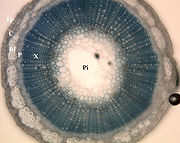
Stem usually consist of three tissues, dermal tissue
, ground tissue
and vascular tissue
. The dermal tissue covers the outer surface of the stem and usually functions to waterproof, protect and control gas exchange. The ground tissue usually consists mainly of parenchyma cells and fills in around the vascular tissue. It sometimes functions in photosynthesis. Vascular tissue provides long distance transport and structural support. Most or all ground tissue may be lost in woody stems. The dermal tissue of aquatic plants stems may lack the waterproofing found in aerial stems. The arrangement of the vascular tissues varies widely among plant species.
Woody dicots and many nonwoody dicots have secondary growth
originating from their lateral or secondary meristems: the vascular cambium
and the cork cambium
or phellogen. The vascular cambium forms between the xylem and phloem in the vascular bundles and connects to form a continuous cylinder. The vascular cambium cells divide to produce secondary xylem to the inside and secondary phloem to the outside. As the stem increases in diameter due to production of secondary xylem and secondary phloem, the cortex and epidermis are eventually destroyed. Before the cortex is destroyed, a cork cambium develops there. The cork cambium divides to produce waterproof cork cells externally and sometimes phelloderm cells internally. Those three tissues form the periderm, which replaces the epidermis in function. Areas of loosely packed cells in the periderm that function in gas exchange are called lenticels.
Secondary xylem
is commercially important as wood
. The seasonal variation in growth from the vascular cambium
is what creates yearly tree rings in temperate climates. Tree rings are the basis of dendrochronology
, which dates wooden objects and associated artifacts. Dendroclimatology
is the use of tree rings as a record of past climates. The aerial stem of an adult tree
is called a trunk
. The dead, usually darker inner wood of a large diameter trunk is termed the heartwood and is the result of tylosis
. The outer, living wood is termed the sapwood.
and Bamboo
being notable exceptions. However, many monocot stems increase in diameter via anomalous secondary growth
.
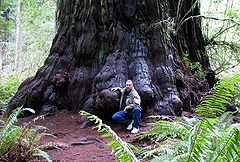
 All gymnosperms are woody plants. Their stems are similar in structure to woody dicots except that most gymnosperms produce only tracheid
s in their xylem, not the vessels found in dicots. Gymnosperm wood also often contains resin
ducts. Woody dicots are called hardwoods, e.g. oak
, maple
and walnut
. In contrast, softwoods are gymnosperms, such as pine
, spruce
and fir
.
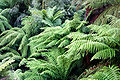
s have rhizome
s with no vertical stem. The exception is tree ferns
, with vertical stems up to about 20 meters. The stem anatomy of ferns is more complicated than that of dicots because fern stems often have one or more leaf gaps in cross section. A leaf gap is where the vascular tissue branches off to a frond
. In cross section, the vascular tissue does not form a complete cylinder where a leaf gap occurs. Fern stems may have solenosteles
or dictyosteles
or variations of them. Many fern stems have phloem tissue on both sides of the xylem in cross-section.
.
and taro
. Sugarcane
stems are a major source of sugar. Maple sugar
is obtained from trunks of maple
trees. Vegetable
s from stems are asparagus
, bamboo shoots
, cactus pads or nopalito
s, kohlrabi, and water chestnut
. The spice, cinnamon
is bark from a tree trunk. Cellulose from tree trunks is a food additive in bread, grated Parmesan cheese, and other processed foods. Gum arabic
is an important food additive obtained from the trunks of Acacia senegal
trees. Chicle
, the main ingredient in chewing gum
, is obtained from trunks of the chicle tree.
Medicines obtained from stems include quinine
from the bark of cinchona
trees, camphor
distilled from wood of a tree in the same genus that provides cinnamon, and the muscle relaxant curare
from the bark of tropical vines.
Wood
is a used in thousands of ways, e.g. buildings
, furniture
, boat
s, airplanes, wagon
s, car
parts, musical instrument
s, sports equipment
, railroad tie
s, utility pole
s, fence posts, pilings
, toothpick
s, match
es, plywood
, coffin
s, shingle
s, barrel
staves, toy
s, tool
handles, picture frame
s, veneer
, charcoal
and firewood
. Wood pulp
is widely used to make paper
, paperboard
, cellulose
sponges, cellophane
and some important plastic
s and textile
s, such as cellulose acetate
and rayon
. Bamboo
stems also have hundreds of uses, including paper, buildings, furniture, boats, musical instruments, fishing poles, water pipe
s, plant stakes, and scaffolding
. Trunks of palm trees and tree ferns are often used for building. Reed
stems are also important building materials in some areas.
Tannin
s used for tanning leather
are obtained from the wood of certain trees, such as quebracho
. Cork
is obtained from the bark of the cork oak
. Rubber
is obtained from the trunks of Hevea brasiliensis. Rattan
, used for furniture and baskets, is made from the stems of tropical vining palms. Bast fibers for textiles and rope are obtained from stems include flax
, hemp
, jute
and ramie
. The earliest paper was obtained from the stems of papyrus
by the ancient Egyptians.
Amber
is fossilized sap from tree trunks; it is used for jewelry and may contain ancient animals. Resins from conifer wood are used to produce turpentine
and rosin
. Tree bark is often used as a mulch
and in growing media for container plants. It also can become the natural habitat
of lichen
s.
Some ornamental plants are grown mainly for their attractive stems, e.g.:
Vascular plant
Vascular plants are those plants that have lignified tissues for conducting water, minerals, and photosynthetic products through the plant. Vascular plants include the clubmosses, Equisetum, ferns, gymnosperms and angiosperms...
. The stem is normally divided into nodes and internodes, the nodes hold bud
Bud
In botany, a bud is an undeveloped or embryonic shoot and normally occurs in the axil of a leaf or at the tip of the stem. Once formed, a bud may remain for some time in a dormant condition, or it may form a shoot immediately. Buds may be specialized to develop flowers or short shoots, or may have...
s which grow into one or more leaves
Leaf
A leaf is an organ of a vascular plant, as defined in botanical terms, and in particular in plant morphology. Foliage is a mass noun that refers to leaves as a feature of plants....
, inflorescence
Inflorescence
An inflorescence is a group or cluster of flowers arranged on a stem that is composed of a main branch or a complicated arrangement of branches. Strictly, it is the part of the shoot of seed plants where flowers are formed and which is accordingly modified...
(flowers), conifer cone
Conifer cone
A cone is an organ on plants in the division Pinophyta that contains the reproductive structures. The familiar woody cone is the female cone, which produces seeds. The male cones, which produce pollen, are usually herbaceous and much less conspicuous even at full maturity...
s, root
Root
In vascular plants, the root is the organ of a plant that typically lies below the surface of the soil. This is not always the case, however, since a root can also be aerial or aerating . Furthermore, a stem normally occurring below ground is not exceptional either...
s, other stems etc. The internodes distance one node from another. The term shoot
Shoot
Shoots are new plant growth, they can include stems, flowering stems with flower buds, and leaves. The new growth from seed germination that grows upward is a shoot where leaves will develop...
s is often confused with stems; shoots generally refer to new fresh plant growth and does include stems but also to other structures like leaves or flowers. The other main structural axis of plants is the root
Root
In vascular plants, the root is the organ of a plant that typically lies below the surface of the soil. This is not always the case, however, since a root can also be aerial or aerating . Furthermore, a stem normally occurring below ground is not exceptional either...
. In most plants stems are located above the soil surface but some plants have underground stems. A stem develops buds and shoots and usually grows above the ground. Inside the stem, materials move up and down the tissues of the transport system.
Stems have four main functions which are:
- Support for and the elevation of leaves, flowerFlowerA flower, sometimes known as a bloom or blossom, is the reproductive structure found in flowering plants . The biological function of a flower is to effect reproduction, usually by providing a mechanism for the union of sperm with eggs...
s and fruitFruitIn broad terms, a fruit is a structure of a plant that contains its seeds.The term has different meanings dependent on context. In non-technical usage, such as food preparation, fruit normally means the fleshy seed-associated structures of certain plants that are sweet and edible in the raw state,...
s. The stems keep the leaves in the light and provide a place for the plant to keep its flowers and fruits. - Transport of fluids between the roots and the shoots in the xylemXylemXylem is one of the two types of transport tissue in vascular plants. . The word xylem is derived from the Classical Greek word ξυλον , meaning "wood"; the best-known xylem tissue is wood, though it is found throughout the plant...
and phloemPhloemIn vascular plants, phloem is the living tissue that carries organic nutrients , in particular, glucose, a sugar, to all parts of the plant where needed. In trees, the phloem is the innermost layer of the bark, hence the name, derived from the Greek word "bark"...
. - Storage of nutrients.
- The production of new living tissue. The normal life span of plant cells is one to three years. Stems have cells called meristemMeristemA meristem is the tissue in most plants consisting of undifferentiated cells , found in zones of the plant where growth can take place....
s that annually generate new living tissue.
Specialized terms for stems
Stems are often specialized for storage, asexual reproduction, protection or photosynthesis, including the following:- Acaulescent - used to describe stems in plants that appear to be stemless. Actually these stems are just extremely short, the leaves appearing to rise directly out of the ground, e.g. some Viola species.
- ArborescentArborescentArborescent is a term used by the French thinkers Deleuze and Guattari to characterize thinking marked by insistence on totalizing principles, binarism and dualism...
- tree like with woody stems normally with a single trunk. - BudBudIn botany, a bud is an undeveloped or embryonic shoot and normally occurs in the axil of a leaf or at the tip of the stem. Once formed, a bud may remain for some time in a dormant condition, or it may form a shoot immediately. Buds may be specialized to develop flowers or short shoots, or may have...
- an embryonic shoot with immature stem tip. - BulbBulbA bulb is a short stem with fleshy leaves or leaf bases. The leaves often function as food storage organs during dormancy.A bulb's leaf bases, known as scales, generally do not support leaves, but contain food reserves to enable the plant to survive adverse conditions. At the center of the bulb is...
- a short vertical underground stem with fleshy storage leaves attached, e.g. onionOnionThe onion , also known as the bulb onion, common onion and garden onion, is the most widely cultivated species of the genus Allium. The genus Allium also contains a number of other species variously referred to as onions and cultivated for food, such as the Japanese bunching onion The onion...
, daffodil, tulipTulipThe tulip is a perennial, bulbous plant with showy flowers in the genus Tulipa, which comprises 109 species and belongs to the family Liliaceae. The genus's native range extends from as far west as Southern Europe, North Africa, Anatolia, and Iran to the Northwest of China. The tulip's centre of...
. Bulbs often function in reproduction by splitting to form new bulbs or producing small new bulbs termed bulblets. Bulbs are a combination of stem and leaves so may better be considered as leaves because the leaves make up the greater part. - Caespitose - when stems grow in a tangled mass or clump or in low growing mats.
- Cladode (including phyllocladePhyllocladePhylloclades are cladodes, i.e., flattened, photosynthetic shoots, which are modified branches. Phylloclades are cladodes that greatly resemble or perform the function of leaves, as in Butcher's broom as well as Asparagus and Phyllanthus species. Phyllocladus, a genus of conifer, is named after...
) - a flattened stem that appears more-or-less leaf like and is specialized for photosynthesis, e.g. cactusCactusA cactus is a member of the plant family Cactaceae. Their distinctive appearance is a result of adaptations to conserve water in dry and/or hot environments. In most species, the stem has evolved to become photosynthetic and succulent, while the leaves have evolved into spines...
pads. - ClimbingVineA vine in the narrowest sense is the grapevine , but more generally it can refer to any plant with a growth habit of trailing or scandent, that is to say climbing, stems or runners...
- stems that cling or wrap around other plants or structures. - CormCormA corm is a short, vertical, swollen underground plant stem that serves as a storage organ used by some plants to survive winter or other adverse conditions such as summer drought and heat ....
- a short enlarged underground, storage stem, e.g. taroTaroTaro is a common name for the corms and tubers of several plants in the family Araceae . Of these, Colocasia esculenta is the most widely cultivated, and is the subject of this article. More specifically, this article describes the 'dasheen' form of taro; another variety is called eddoe.Taro is...
, crocusCrocusCrocus is a genus in the iris family comprising about 80 species of perennials growing from corms. Many are cultivated for their flowers appearing in autumn, winter, or spring...
, gladiolusGladiolusGladiolus is a genus of perennial bulbous flowering plants in the iris family...
. - Decumbent - stems that lie flat on the ground and turn upwards at the ends.
- Fruticose - stems that grow shrublike with woody like habit.
- HerbaceousHerbaceousA herbaceous plant is a plant that has leaves and stems that die down at the end of the growing season to the soil level. They have no persistent woody stem above ground...
- non woody, they die at the end of the growing season. - Pseudostem - a false stem made of the rolled bases of leaves, which may be 2 or 3 m tall as in bananaBananaBanana is the common name for herbaceous plants of the genus Musa and for the fruit they produce. Bananas come in a variety of sizes and colors when ripe, including yellow, purple, and red....
- RhizomeRhizomeIn botany and dendrology, a rhizome is a characteristically horizontal stem of a plant that is usually found underground, often sending out roots and shoots from its nodes...
- a horizontal underground stem that functions mainly in reproduction but also in storage, e.g. most fernFernA fern is any one of a group of about 12,000 species of plants belonging to the botanical group known as Pteridophyta. Unlike mosses, they have xylem and phloem . They have stems, leaves, and roots like other vascular plants...
s, irisIris (plant)Iris is a genus of 260-300species of flowering plants with showy flowers. It takes its name from the Greek word for a rainbow, referring to the wide variety of flower colors found among the many species... - Runner (plant part) - a type of stolon, horizontally growing on top of the ground and rooting at the nodes, aids in reproduction. e.g. garden strawberryGarden StrawberryThe garden strawberry, Fragaria × ananassa, is a hybrid species that is cultivated worldwide for its fruit, the strawberry. The fruit is widely appreciated for its characteristic aroma, bright red color, juicy texture, and sweetness...
, Chlorophytum comosumChlorophytum comosumChlorophytum comosum, often called the spider plant, is a herbaceous plant. It is native to tropical and southern Africa, but has become naturalized in other parts of the world, including western Australia. Variegated forms in particular are used as house plants.-Description:Chlorophytum comosum...
. - ScapeScape (botany)In botany, scapes are leafless flowering stems that rise from the ground. Scapes can have a single flower or many flowers, depending on the species....
- a stem that holds flowers that comes out of the ground and has no normal leaves. HostaHostaHosta is a genus of about 23–45 species of lily-like plants in the family Asparagaceae, subfamily Agavoideae, native to northeast Asia. They have been placed in their own family, Hostaceae ; like many 'lilioid monocots', they were once classified in the Liliaceae...
, Lily, IrisIris (plant)Iris is a genus of 260-300species of flowering plants with showy flowers. It takes its name from the Greek word for a rainbow, referring to the wide variety of flower colors found among the many species...
. - StolonStolonIn biology, stolons are horizontal connections between organisms. They may be part of the organism, or of its skeleton; typically, animal stolons are external skeletons.-In botany:...
- a horizontal stem that produces rooted plantlets at its nodes and ends, forming near the surface of the ground. - Thorn - a modified stem with a sharpened point
- TreeTreeA tree is a perennial woody plant. It is most often defined as a woody plant that has many secondary branches supported clear of the ground on a single main stem or trunk with clear apical dominance. A minimum height specification at maturity is cited by some authors, varying from 3 m to...
- a woody stem that is longer than 5 metres with a main trunkTrunk (botany)In botany, trunk refers to the main wooden axis of a tree that supports the branches and is supported by and directly attached to the roots. The trunk is covered by the bark, which is an important diagnostic feature in tree identification, and which often differs markedly from the bottom of the...
. - TuberTuberTubers are various types of modified plant structures that are enlarged to store nutrients. They are used by plants to survive the winter or dry months and provide energy and nutrients for regrowth during the next growing season and they are a means of asexual reproduction...
- a swollen, underground storage stem adapted for storage and reproduction, e.g. potatoPotatoThe potato is a starchy, tuberous crop from the perennial Solanum tuberosum of the Solanaceae family . The word potato may refer to the plant itself as well as the edible tuber. In the region of the Andes, there are some other closely related cultivated potato species...
. - WoodyWoody plantA woody plant is a plant that uses wood as its structural tissue. These are typically perennial plants whose stems and larger roots are reinforced with wood produced adjacent to the vascular tissues. The main stem, larger branches, and roots of these plants are usually covered by a layer of...
- hard textured stems with secondary xylem.
Stem structure
- See also: Stele (biology)Stele (biology)In a vascular plant, the stele is the central part of the root or stem containing the tissues derived from the procambium. These include vascular tissue, in some cases ground tissue and a pericycle, which, if present, defines the outermost boundary of the stele...
Stem usually consist of three tissues, dermal tissue
Epidermis (botany)
The epidermis is a single-layered group of cells that covers plants' leaves, flowers, roots and stems. It forms a boundary between the plant and the external environment. The epidermis serves several functions, it protects against water loss, regulates gas exchange, secretes metabolic compounds,...
, ground tissue
Ground tissue
The types of ground tissue found in plants develop from ground tissue meristem and consists of three simple tissues:* Parenchyma...
and vascular tissue
Vascular tissue
Vascular tissue is a complex conducting tissue, formed of more than one cell type, found in vascular plants. The primary components of vascular tissue are the xylem and phloem. These two tissues transport fluid and nutrients internally. There are also two meristems associated with vascular tissue:...
. The dermal tissue covers the outer surface of the stem and usually functions to waterproof, protect and control gas exchange. The ground tissue usually consists mainly of parenchyma cells and fills in around the vascular tissue. It sometimes functions in photosynthesis. Vascular tissue provides long distance transport and structural support. Most or all ground tissue may be lost in woody stems. The dermal tissue of aquatic plants stems may lack the waterproofing found in aerial stems. The arrangement of the vascular tissues varies widely among plant species.
Dicot stems
Dicot stem with primary growth have pith in the center, with vascular bundles forming a distinct ring visible when the stem is viewed in cross section. The outside of the stem is covered with an epidermis, which is covered by a waterproof cuticle. The epidermis also may contain stomata for gas exchange and multicellular stem hairs. A cortex consisting of Hypodermis (collenchyma cells) and Endodermis (starch containing cells)is present above the pericycle and vascular bundles.Woody dicots and many nonwoody dicots have secondary growth
Secondary growth
In many vascular plants, secondary growth is the result of the activity of the two lateral meristems, the cork cambium and vascular cambium. Arising from lateral meristems, secondary growth increases the girth of the plant root or stem, rather than its length. As long as the lateral meristems...
originating from their lateral or secondary meristems: the vascular cambium
Vascular cambium
The vascular cambium is a part of the morphology of plants. It consists of cells that are partly specialized, for the tissues that transport water solutions, but have not reached any of the final forms that occur in their branch of the specialization graph...
and the cork cambium
Cork cambium
Cork cambium is a tissue found in many vascular plants as part of the periderm. The cork cambium is a lateral meristem and is responsible for secondary growth that replaces the epidermis in roots and stems...
or phellogen. The vascular cambium forms between the xylem and phloem in the vascular bundles and connects to form a continuous cylinder. The vascular cambium cells divide to produce secondary xylem to the inside and secondary phloem to the outside. As the stem increases in diameter due to production of secondary xylem and secondary phloem, the cortex and epidermis are eventually destroyed. Before the cortex is destroyed, a cork cambium develops there. The cork cambium divides to produce waterproof cork cells externally and sometimes phelloderm cells internally. Those three tissues form the periderm, which replaces the epidermis in function. Areas of loosely packed cells in the periderm that function in gas exchange are called lenticels.
Secondary xylem
Xylem
Xylem is one of the two types of transport tissue in vascular plants. . The word xylem is derived from the Classical Greek word ξυλον , meaning "wood"; the best-known xylem tissue is wood, though it is found throughout the plant...
is commercially important as wood
Wood
Wood is a hard, fibrous tissue found in many trees. It has been used for hundreds of thousands of years for both fuel and as a construction material. It is an organic material, a natural composite of cellulose fibers embedded in a matrix of lignin which resists compression...
. The seasonal variation in growth from the vascular cambium
Vascular cambium
The vascular cambium is a part of the morphology of plants. It consists of cells that are partly specialized, for the tissues that transport water solutions, but have not reached any of the final forms that occur in their branch of the specialization graph...
is what creates yearly tree rings in temperate climates. Tree rings are the basis of dendrochronology
Dendrochronology
Dendrochronology or tree-ring dating is the scientific method of dating based on the analysis of patterns of tree-rings. Dendrochronology can date the time at which tree rings were formed, in many types of wood, to the exact calendar year...
, which dates wooden objects and associated artifacts. Dendroclimatology
Dendroclimatology
Dendroclimatology is the science of determining past climates from trees . Tree rings are wider when conditions favor growth, narrower when times are difficult. Other properties of the annual rings, such as maximum latewood density have been shown to be better proxies than simple ring width...
is the use of tree rings as a record of past climates. The aerial stem of an adult tree
Tree
A tree is a perennial woody plant. It is most often defined as a woody plant that has many secondary branches supported clear of the ground on a single main stem or trunk with clear apical dominance. A minimum height specification at maturity is cited by some authors, varying from 3 m to...
is called a trunk
Trunk (botany)
In botany, trunk refers to the main wooden axis of a tree that supports the branches and is supported by and directly attached to the roots. The trunk is covered by the bark, which is an important diagnostic feature in tree identification, and which often differs markedly from the bottom of the...
. The dead, usually darker inner wood of a large diameter trunk is termed the heartwood and is the result of tylosis
Tylosis (botany)
Tylosis is the physiological process and the result of occlusion in the xylem of woody plants as response to injury or as protection from decay in heartwood....
. The outer, living wood is termed the sapwood.
Monocot stems
Vascular bundles are present throughout the monocot stem, although concentrated towards the outside. This differs from the dicot stem that has a ring of vascular bundles and often none in the center. The shoot apex in monocot stems is more elongated. Leaf sheathes grow up around it, protecting it. This is true to some extent of almost all monocots. Monocots rarely produce secondary growth and are therefore seldom woody, with PalmsArecaceae
Arecaceae or Palmae , are a family of flowering plants, the only family in the monocot order Arecales. There are roughly 202 currently known genera with around 2600 species, most of which are restricted to tropical, subtropical, and warm temperate climates...
and Bamboo
Bamboo
Bamboo is a group of perennial evergreens in the true grass family Poaceae, subfamily Bambusoideae, tribe Bambuseae. Giant bamboos are the largest members of the grass family....
being notable exceptions. However, many monocot stems increase in diameter via anomalous secondary growth
Secondary growth
In many vascular plants, secondary growth is the result of the activity of the two lateral meristems, the cork cambium and vascular cambium. Arising from lateral meristems, secondary growth increases the girth of the plant root or stem, rather than its length. As long as the lateral meristems...
.
Gymnosperm stems
Tracheid
Tracheids are elongated cells in the xylem of vascular plants that serve in the transport of water and mineral salts. Tracheids are one of two types of tracheary elements, vessel elements being the other. All tracheary elements develop a thick lignified cell wall, and at maturity the protoplast...
s in their xylem, not the vessels found in dicots. Gymnosperm wood also often contains resin
Resin
Resin in the most specific use of the term is a hydrocarbon secretion of many plants, particularly coniferous trees. Resins are valued for their chemical properties and associated uses, such as the production of varnishes, adhesives, and food glazing agents; as an important source of raw materials...
ducts. Woody dicots are called hardwoods, e.g. oak
Oak
An oak is a tree or shrub in the genus Quercus , of which about 600 species exist. "Oak" may also appear in the names of species in related genera, notably Lithocarpus...
, maple
Maple
Acer is a genus of trees or shrubs commonly known as maple.Maples are variously classified in a family of their own, the Aceraceae, or together with the Hippocastanaceae included in the family Sapindaceae. Modern classifications, including the Angiosperm Phylogeny Group system, favour inclusion in...
and walnut
Walnut
Juglans is a plant genus of the family Juglandaceae, the seeds of which are known as walnuts. They are deciduous trees, 10–40 meters tall , with pinnate leaves 200–900 millimetres long , with 5–25 leaflets; the shoots have chambered pith, a character shared with the wingnuts , but not the hickories...
. In contrast, softwoods are gymnosperms, such as pine
Pine
Pines are trees in the genus Pinus ,in the family Pinaceae. They make up the monotypic subfamily Pinoideae. There are about 115 species of pine, although different authorities accept between 105 and 125 species.-Etymology:...
, spruce
Spruce
A spruce is a tree of the genus Picea , a genus of about 35 species of coniferous evergreen trees in the Family Pinaceae, found in the northern temperate and boreal regions of the earth. Spruces are large trees, from tall when mature, and can be distinguished by their whorled branches and conical...
and fir
Fir
Firs are a genus of 48–55 species of evergreen conifers in the family Pinaceae. They are found through much of North and Central America, Europe, Asia, and North Africa, occurring in mountains over most of the range...
.
Fern stems
Most fernFern
A fern is any one of a group of about 12,000 species of plants belonging to the botanical group known as Pteridophyta. Unlike mosses, they have xylem and phloem . They have stems, leaves, and roots like other vascular plants...
s have rhizome
Rhizome
In botany and dendrology, a rhizome is a characteristically horizontal stem of a plant that is usually found underground, often sending out roots and shoots from its nodes...
s with no vertical stem. The exception is tree ferns
Cyatheales
The order Cyatheales is a taxonomic division of the fern subclass, Cyatheatae, which includes the tree ferns. No clear morphological features characterize all of the Cyatheales, but DNA sequence data indicates that the order is monophyletic. Some species in the Cyatheales have tree-like growth...
, with vertical stems up to about 20 meters. The stem anatomy of ferns is more complicated than that of dicots because fern stems often have one or more leaf gaps in cross section. A leaf gap is where the vascular tissue branches off to a frond
Frond
The term frond refers to a large, divided leaf. In both common usage and botanical nomenclature, the leaves of ferns are referred to as fronds and some botanists restrict the term to this group...
. In cross section, the vascular tissue does not form a complete cylinder where a leaf gap occurs. Fern stems may have solenosteles
Stele (biology)
In a vascular plant, the stele is the central part of the root or stem containing the tissues derived from the procambium. These include vascular tissue, in some cases ground tissue and a pericycle, which, if present, defines the outermost boundary of the stele...
or dictyosteles
Stele (biology)
In a vascular plant, the stele is the central part of the root or stem containing the tissues derived from the procambium. These include vascular tissue, in some cases ground tissue and a pericycle, which, if present, defines the outermost boundary of the stele...
or variations of them. Many fern stems have phloem tissue on both sides of the xylem in cross-section.
.
Relation to xenobiotics
Foreign chemicals such as air pollutants, herbicides and pesticides can damage stem structures. In the case of herbicides many chemicals act by surficial effects, and other agents cause damage through uptake of the chemical herbicide, which is typically a complex organic chemical.Economic importance
There are thousands of species whose stems have economic uses. Stems provide a few major staple crops such as potatoPotato
The potato is a starchy, tuberous crop from the perennial Solanum tuberosum of the Solanaceae family . The word potato may refer to the plant itself as well as the edible tuber. In the region of the Andes, there are some other closely related cultivated potato species...
and taro
Taro
Taro is a common name for the corms and tubers of several plants in the family Araceae . Of these, Colocasia esculenta is the most widely cultivated, and is the subject of this article. More specifically, this article describes the 'dasheen' form of taro; another variety is called eddoe.Taro is...
. Sugarcane
Sugarcane
Sugarcane refers to any of six to 37 species of tall perennial grasses of the genus Saccharum . Native to the warm temperate to tropical regions of South Asia, they have stout, jointed, fibrous stalks that are rich in sugar, and measure two to six metres tall...
stems are a major source of sugar. Maple sugar
Maple sugar
Maple sugar is a traditional sweetener in the northeastern United States and Canada, prepared from the sap of the sugar maple tree.-Preparation:...
is obtained from trunks of maple
Maple
Acer is a genus of trees or shrubs commonly known as maple.Maples are variously classified in a family of their own, the Aceraceae, or together with the Hippocastanaceae included in the family Sapindaceae. Modern classifications, including the Angiosperm Phylogeny Group system, favour inclusion in...
trees. Vegetable
Vegetable
The noun vegetable usually means an edible plant or part of a plant other than a sweet fruit or seed. This typically means the leaf, stem, or root of a plant....
s from stems are asparagus
Asparagus
Asparagus officinalis is a spring vegetable, a flowering perennialplant species in the genus Asparagus. It was once classified in the lily family, like its Allium cousins, onions and garlic, but the Liliaceae have been split and the onion-like plants are now in the family Amaryllidaceae and...
, bamboo shoots
Bamboo Shoots
Bamboo Shoots is an American four-piece musical group based out of Brooklyn, New York and suburban New Jersey. They are known for their dueling, two-person rhythm section and their South Asian identity and influence...
, cactus pads or nopalito
Nopalito
Nopalitos is a dish made with diced nopales. They are sold fresh, bottled, or canned and less often dried. They have a light, slightly tart flavor, and a crisp, mucilaginous texture. Nopalitos are often eaten with eggs as a breakfast and in salads and soups as lunch and dinner meals.Nopalitos are...
s, kohlrabi, and water chestnut
Eleocharis dulcis
The Chinese water chestnut , more often called simply the water chestnut, is a grass-like sedge grown for its edible corms. The water chestnut is actually not a nut at all, but an aquatic vegetable that grows in marshes, underwater in the mud...
. The spice, cinnamon
Cinnamon
Cinnamon is a spice obtained from the inner bark of several trees from the genus Cinnamomum that is used in both sweet and savoury foods...
is bark from a tree trunk. Cellulose from tree trunks is a food additive in bread, grated Parmesan cheese, and other processed foods. Gum arabic
Gum arabic
220px|thumb|right|Acacia gumGum arabic, also known as acacia gum, chaar gund, char goond, or meska, is a natural gum made of hardened sap taken from two species of the acacia tree; Acacia senegal and Acacia seyal...
is an important food additive obtained from the trunks of Acacia senegal
Acacia senegal
is a small deciduous Acacia tree known by the common names Rfaudraksha, Gum Acacia, Gum Arabic Tree, or Gum Senegal Tree. It is native to semi-desert regions of Sub-Saharan Africa, as well as Oman, Pakistan, and northwestern India. It grows to a height of 5-12m, with a trunk up to 30 cm in...
trees. Chicle
Chicle
Manilkara chicle is a tropical evergreen tree native to Mexico and Central America. The tree ranges from Veracruz in Mexico south to Atlántico in Colombia...
, the main ingredient in chewing gum
Chewing gum
Chewing gum is a type of gum traditionally made of chicle, a natural latex product, or synthetic rubber known as polyisobutylene. For economical and quality reasons, many modern chewing gums use rubber instead of chicle...
, is obtained from trunks of the chicle tree.
Medicines obtained from stems include quinine
Quinine
Quinine is a natural white crystalline alkaloid having antipyretic , antimalarial, analgesic , anti-inflammatory properties and a bitter taste. It is a stereoisomer of quinidine which, unlike quinine, is an anti-arrhythmic...
from the bark of cinchona
Cinchona
Cinchona or Quina is a genus of about 38 species in the family Rubiaceae, native to tropical South America. They are large shrubs or small trees growing 5–15 metres in height with evergreen foliage. The leaves are opposite, rounded to lanceolate and 10–40 cm long. The flowers are white, pink...
trees, camphor
Camphor
Camphor is a waxy, white or transparent solid with a strong, aromatic odor. It is a terpenoid with the chemical formula C10H16O. It is found in wood of the camphor laurel , a large evergreen tree found in Asia and also of Dryobalanops aromatica, a giant of the Bornean forests...
distilled from wood of a tree in the same genus that provides cinnamon, and the muscle relaxant curare
Curare
Curare is a common name for various arrow poisons originating from South America. The three main types of curare are:* tubocurare...
from the bark of tropical vines.
Wood
Wood
Wood is a hard, fibrous tissue found in many trees. It has been used for hundreds of thousands of years for both fuel and as a construction material. It is an organic material, a natural composite of cellulose fibers embedded in a matrix of lignin which resists compression...
is a used in thousands of ways, e.g. buildings
Building material
Building material is any material which is used for a construction purpose. Many naturally occurring substances, such as clay, sand, wood and rocks, even twigs and leaves have been used to construct buildings. Apart from naturally occurring materials, many man-made products are in use, some more...
, furniture
Furniture
Furniture is the mass noun for the movable objects intended to support various human activities such as seating and sleeping in beds, to hold objects at a convenient height for work using horizontal surfaces above the ground, or to store things...
, boat
Boat
A boat is a watercraft of any size designed to float or plane, to provide passage across water. Usually this water will be inland or in protected coastal areas. However, boats such as the whaleboat were designed to be operated from a ship in an offshore environment. In naval terms, a boat is a...
s, airplanes, wagon
Wagon
A wagon is a heavy four-wheeled vehicle pulled by draught animals; it was formerly often called a wain, and if low and sideless may be called a dray, trolley or float....
s, car
Čar
Čar is a village in the municipality of Bujanovac, Serbia. According to the 2002 census, the town has a population of 296 people.-References:...
parts, musical instrument
Musical instrument
A musical instrument is a device created or adapted for the purpose of making musical sounds. In principle, any object that produces sound can serve as a musical instrument—it is through purpose that the object becomes a musical instrument. The history of musical instruments dates back to the...
s, sports equipment
Sports equipment
Sports equipment is a general term for any object used for sport or exercise. Examples of sports equipment include:-Exercise equipment:Examples for exercise include swiss balls, weights, equipment for the gym...
, railroad tie
Railroad tie
A railroad tie/railway tie , or railway sleeper is a rectangular item used to support the rails in railroad tracks...
s, utility pole
Utility pole
A utility pole is a pole used to support overhead power lines and various other public utilities, such as cable, fibre optic cable, and related equipment such as transformers and street lights. It can be referred to as a telephone pole, power pole, hydro pole, telegraph pole, or telegraph post,...
s, fence posts, pilings
Deep foundation
A deep foundation is a type of foundation distinguished from shallow foundations by the depth they are embedded into the ground. There are many reasons a geotechnical engineer would recommend a deep foundation over a shallow foundation, but some of the common reasons are very large design loads, a...
, toothpick
Toothpick
A toothpick is a small stick of wood, plastic, bamboo, metal, bone or other substance used to remove detritus from the teeth, usually after a meal. A toothpick usually has one or two sharp ends to insert between teeth. They can also be used for picking up small appetizers or as a cocktail...
s, match
Match
A match is a tool for starting a fire under controlled conditions. A typical modern match is made of a small wooden stick or stiff paper. One end is coated with a material that can be ignited by frictional heat generated by striking the match against a suitable surface...
es, plywood
Plywood
Plywood is a type of manufactured timber made from thin sheets of wood veneer. It is one of the most widely used wood products. It is flexible, inexpensive, workable, re-usable, and can usually be locally manufactured...
, coffin
Coffin
A coffin is a funerary box used in the display and containment of dead people – either for burial or cremation.Contemporary North American English makes a distinction between "coffin", which is generally understood to denote a funerary box having six sides in plan view, and "casket", which...
s, shingle
Shake (shingle)
A shake is a basic wooden shingle that is made from split logs. Shakes have traditionally been used for roofing and siding applications around the world. Higher grade shakes are typically used for roofing purposes, while the lower grades are used for siding purposes...
s, barrel
Barrel
A barrel or cask is a hollow cylindrical container, traditionally made of vertical wooden staves and bound by wooden or metal hoops. Traditionally, the barrel was a standard size of measure referring to a set capacity or weight of a given commodity. A small barrel is called a keg.For example, a...
staves, toy
Toy
A toy is any object that can be used for play. Toys are associated commonly with children and pets. Playing with toys is often thought to be an enjoyable means of training the young for life in human society. Different materials are used to make toys enjoyable and cuddly to both young and old...
s, tool
Tool
A tool is a device that can be used to produce an item or achieve a task, but that is not consumed in the process. Informally the word is also used to describe a procedure or process with a specific purpose. Tools that are used in particular fields or activities may have different designations such...
handles, picture frame
Picture frame
A picture frame is a decorative edging for a picture, such as a painting or photograph, intended to enhance it, make it easier to display, or protect it.-Construction:...
s, veneer
Wood veneer
In woodworking, veneer refers to thin slices of wood, usually thinner than 3 mm , that are typically glued onto core panels to produce flat panels such as doors, tops and panels for cabinets, parquet floors and parts of furniture. They are also used in marquetry...
, charcoal
Charcoal
Charcoal is the dark grey residue consisting of carbon, and any remaining ash, obtained by removing water and other volatile constituents from animal and vegetation substances. Charcoal is usually produced by slow pyrolysis, the heating of wood or other substances in the absence of oxygen...
and firewood
Firewood
Firewood is any wood-like material that is gathered and used for fuel. Generally, firewood is not highly processed and is in some sort of recognizable log or branch form....
. Wood pulp
Wood pulp
Pulp is a lignocellulosic fibrous material prepared by chemically or mechanically separating cellulose fibres from wood, fibre crops or waste paper. Wood pulp is the most common raw material in papermaking.-History:...
is widely used to make paper
Paper
Paper is a thin material mainly used for writing upon, printing upon, drawing or for packaging. It is produced by pressing together moist fibers, typically cellulose pulp derived from wood, rags or grasses, and drying them into flexible sheets....
, paperboard
Paperboard
Paperboard is a thick paper based material. While there is no rigid differentiation between paper and paperboard, paperboard is generally thicker than paper. According to ISO standards, paperboard is a paper with a basis weight above 224 g/m2, but there are exceptions. Paperboard can be single...
, cellulose
Cellulose
Cellulose is an organic compound with the formula , a polysaccharide consisting of a linear chain of several hundred to over ten thousand β linked D-glucose units....
sponges, cellophane
Cellophane
Cellophane is a thin, transparent sheet made of regenerated cellulose. Its low permeability to air, oils, greases, bacteria and water makes it useful for food packaging...
and some important plastic
Plastic
A plastic material is any of a wide range of synthetic or semi-synthetic organic solids used in the manufacture of industrial products. Plastics are typically polymers of high molecular mass, and may contain other substances to improve performance and/or reduce production costs...
s and textile
Textile
A textile or cloth is a flexible woven material consisting of a network of natural or artificial fibres often referred to as thread or yarn. Yarn is produced by spinning raw fibres of wool, flax, cotton, or other material to produce long strands...
s, such as cellulose acetate
Cellulose acetate
Cellulose acetate , first prepared in 1865, is the acetate ester of cellulose. Cellulose acetate is used as a film base in photography, as a component in some adhesives, and as a frame material for eyeglasses; it is also used as a synthetic fiber and in the manufacture of cigarette filters and...
and rayon
Rayon
Rayon is a manufactured regenerated cellulose fiber. Because it is produced from naturally occurring polymers, it is neither a truly synthetic fiber nor a natural fiber; it is a semi-synthetic or artificial fiber. Rayon is known by the names viscose rayon and art silk in the textile industry...
. Bamboo
Bamboo
Bamboo is a group of perennial evergreens in the true grass family Poaceae, subfamily Bambusoideae, tribe Bambuseae. Giant bamboos are the largest members of the grass family....
stems also have hundreds of uses, including paper, buildings, furniture, boats, musical instruments, fishing poles, water pipe
Water pipe
Water pipes are pipes or tubes, frequently made of polyvinyl chloride , ductile iron, steel, cast iron, polypropylene, polyethylene, or copper, that carry pressurized and treated fresh water to buildings , as well as inside the building.-History:For many centuries, lead was the favoured material...
s, plant stakes, and scaffolding
Scaffolding
Scaffolding is a temporary structure used to support people and material in the construction or repair of buildings and other large structures. It is usually a modular system of metal pipes or tubes, although it can be from other materials...
. Trunks of palm trees and tree ferns are often used for building. Reed
Phragmites
Phragmites, the Common reed, is a large perennial grass found in wetlands throughout temperate and tropical regions of the world. Phragmites australis is sometimes regarded as the sole species of the genus Phragmites, though some botanists divide Phragmites australis into three or four species...
stems are also important building materials in some areas.
Tannin
Tannin
A tannin is an astringent, bitter plant polyphenolic compound that binds to and precipitates proteins and various other organic compounds including amino acids and alkaloids.The term tannin refers to the use of...
s used for tanning leather
Leather
Leather is a durable and flexible material created via the tanning of putrescible animal rawhide and skin, primarily cattlehide. It can be produced through different manufacturing processes, ranging from cottage industry to heavy industry.-Forms:...
are obtained from the wood of certain trees, such as quebracho
Quebracho tree
Quebracho is a common name in Spanish to describe very hard wood tree species. The etymology of the name derived from quiebrahacha, or quebrar hacha, meaning "axe-breaker".-Species:...
. Cork
Cork (material)
Cork is an impermeable, buoyant material, a prime-subset of bark tissue that is harvested for commercial use primarily from Quercus suber , which is endemic to southwest Europe and northwest Africa...
is obtained from the bark of the cork oak
Cork Oak
Quercus suber, commonly called the Cork Oak, is a medium-sized, evergreen oak tree in the section Quercus sect. Cerris. It is the primary source of cork for wine bottle stoppers and other uses, such as cork flooring. It is native to southwest Europe and northwest Africa.It grows to up to 20 m,...
. Rubber
Rubber
Natural rubber, also called India rubber or caoutchouc, is an elastomer that was originally derived from latex, a milky colloid produced by some plants. The plants would be ‘tapped’, that is, an incision made into the bark of the tree and the sticky, milk colored latex sap collected and refined...
is obtained from the trunks of Hevea brasiliensis. Rattan
Rattan
Rattan is the name for the roughly 600 species of palms in the tribe Calameae, native to tropical regions of Africa, Asia and Australasia.- Structure :...
, used for furniture and baskets, is made from the stems of tropical vining palms. Bast fibers for textiles and rope are obtained from stems include flax
Flax
Flax is a member of the genus Linum in the family Linaceae. It is native to the region extending from the eastern Mediterranean to India and was probably first domesticated in the Fertile Crescent...
, hemp
Hemp
Hemp is mostly used as a name for low tetrahydrocannabinol strains of the plant Cannabis sativa, of fiber and/or oilseed varieties. In modern times, hemp has been used for industrial purposes including paper, textiles, biodegradable plastics, construction, health food and fuel with modest...
, jute
Jute
Jute is a long, soft, shiny vegetable fibre that can be spun into coarse, strong threads. It is produced from plants in the genus Corchorus, which has been classified in the family Tiliaceae, or more recently in Malvaceae....
and ramie
Ramie
Ramie is a flowering plant in the nettle family Urticaceae, native to eastern Asia. It is a herbaceous perennial growing to 1–2.5 m tall; the leaves are heart-shaped, 7–15 cm long and 6–12 cm broad, and white on the underside with dense small hairs—this gives it a silvery appearance;...
. The earliest paper was obtained from the stems of papyrus
Papyrus
Papyrus is a thick paper-like material produced from the pith of the papyrus plant, Cyperus papyrus, a wetland sedge that was once abundant in the Nile Delta of Egypt....
by the ancient Egyptians.
Amber
Amber
Amber is fossilized tree resin , which has been appreciated for its color and natural beauty since Neolithic times. Amber is used as an ingredient in perfumes, as a healing agent in folk medicine, and as jewelry. There are five classes of amber, defined on the basis of their chemical constituents...
is fossilized sap from tree trunks; it is used for jewelry and may contain ancient animals. Resins from conifer wood are used to produce turpentine
Turpentine
Turpentine is a fluid obtained by the distillation of resin obtained from trees, mainly pine trees. It is composed of terpenes, mainly the monoterpenes alpha-pinene and beta-pinene...
and rosin
Rosin
.Rosin, also called colophony or Greek pitch , is a solid form of resin obtained from pines and some other plants, mostly conifers, produced by heating fresh liquid resin to vaporize the volatile liquid terpene components. It is semi-transparent and varies in color from yellow to black...
. Tree bark is often used as a mulch
Mulch
In agriculture and gardening, is a protective cover placed over the soil to retain moisture, reduce erosion, provide nutrients, and suppress weed growth and seed germination. Mulching in gardens and landscaping mimics the leaf cover that is found on forest floors....
and in growing media for container plants. It also can become the natural habitat
Habitat
* Habitat , a place where a species lives and grows*Human habitat, a place where humans live, work or play** Space habitat, a space station intended as a permanent settlement...
of lichen
Lichen
Lichens are composite organisms consisting of a symbiotic organism composed of a fungus with a photosynthetic partner , usually either a green alga or cyanobacterium...
s.
Some ornamental plants are grown mainly for their attractive stems, e.g.:
- White bark of paper birchPaper BirchBetula papyrifera is a species of birch native to northern North America.-Description:...
- Twisted branches of corkscrew willow and Harry Lauder's walking stickHazelThe hazels are a genus of deciduous trees and large shrubs native to the temperate northern hemisphere. The genus is usually placed in the birch family Betulaceae, though some botanists split the hazels into a separate family Corylaceae.They have simple, rounded leaves with double-serrate margins...
(Corylus avellana 'Contorta') - Red, peeling bark of paperbark maplePaperbark MapleAcer griseum is a species of maple native to central China, in the provinces of Gansu, Henan, Hubei, Hunan, Shaanxi, Shanxi, and Sichuan, at altitudes of 1,500–2,000 m....