


Stolon

Encyclopedia

Biology
Biology is a natural science concerned with the study of life and living organisms, including their structure, function, growth, origin, evolution, distribution, and taxonomy. Biology is a vast subject containing many subdivisions, topics, and disciplines...
, stolons (from Latin
Latin
Latin is an Italic language originally spoken in Latium and Ancient Rome. It, along with most European languages, is a descendant of the ancient Proto-Indo-European language. Although it is considered a dead language, a number of scholars and members of the Christian clergy speak it fluently, and...
stolō "branch") are horizontal connections between organisms. They may be part of the organism, or of its skeleton
Skeleton
The skeleton is the body part that forms the supporting structure of an organism. There are two different skeletal types: the exoskeleton, which is the stable outer shell of an organism, and the endoskeleton, which forms the support structure inside the body.In a figurative sense, skeleton can...
; typically, animal
Animal
Animals are a major group of multicellular, eukaryotic organisms of the kingdom Animalia or Metazoa. Their body plan eventually becomes fixed as they develop, although some undergo a process of metamorphosis later on in their life. Most animals are motile, meaning they can move spontaneously and...
stolons are external skeletons.
In botany
In botanyBotany
Botany, plant science, or plant biology is a branch of biology that involves the scientific study of plant life. Traditionally, botany also included the study of fungi, algae and viruses...
, stolons are stem
Plant stem
A stem is one of two main structural axes of a vascular plant. The stem is normally divided into nodes and internodes, the nodes hold buds which grow into one or more leaves, inflorescence , conifer cones, roots, other stems etc. The internodes distance one node from another...
s which grow at the soil
Soil
Soil is a natural body consisting of layers of mineral constituents of variable thicknesses, which differ from the parent materials in their morphological, physical, chemical, and mineralogical characteristics...
surface or just below ground that form adventitious roots at the nodes, and new plants from the buds
Bud
In botany, a bud is an undeveloped or embryonic shoot and normally occurs in the axil of a leaf or at the tip of the stem. Once formed, a bud may remain for some time in a dormant condition, or it may form a shoot immediately. Buds may be specialized to develop flowers or short shoots, or may have...
. Stolons are often called runners. Thus, not all horizontal stems are called stolons. Plants with stolons are called stoloniferous. Rhizomes
Rhizome
In botany and dendrology, a rhizome is a characteristically horizontal stem of a plant that is usually found underground, often sending out roots and shoots from its nodes...
, in contrast, are root-like stems that may either grow horizontally at the soil surface or in other orientations underground.
A stolon is a plant propagation
Plant propagation
Plant propagation is the process of creating new plants from a variety of sources: seeds, cuttings, bulbs and other plant parts. Plant propagation can also refer to the artificial or natural dispersal of plants.-Sexual propagation :...
strategy and the complex of individuals formed by a mother plant and all its clones
Cloning
Cloning in biology is the process of producing similar populations of genetically identical individuals that occurs in nature when organisms such as bacteria, insects or plants reproduce asexually. Cloning in biotechnology refers to processes used to create copies of DNA fragments , cells , or...
produced from stolons form a single genetic individual, a genet.
Morphology
Stolons may or may not have long internodes. The leaves along the stolon are usually very small, but in a few cases such as Stachys sylvaticaStachys sylvatica
Stachys sylvatica, commonly known as Hedge Woundwort, is a perennial grassland herb growing to 80 cm tall....
are normal in size.
Stolons arise from the base of the plant. In strawberries the base is above the soil surface; in many bulb-forming species and plants with rhizomes, the stolons remain underground and form shoots that rise to the surface at the ends or from the nodes. The nodes of the stolons produce roots, often all around the node and hormones produced by the roots cause the stolon to initiate shoots with normal leaves. Typically after the formation of the new plant the stolon dies away in a year or two, while rhizomes persist normally for many years or for the life of the plant, adding more length each year to the ends with active growth. The horizontal growth of stolons results from the interplay of different hormones produced at the growing point and hormones from the main plant, with some studies showing that stolon and rhizome growth effected by the amount of shady light the plant receives with increased production and branching from plants exposed to mixed shade and sun, while plants in all day sun or all shade producing fewer stolons.
A number of plants having soil level or above ground rhizomes including Iris
Iris (plant)
Iris is a genus of 260-300species of flowering plants with showy flowers. It takes its name from the Greek word for a rainbow, referring to the wide variety of flower colors found among the many species...
species and many orchid species.
T. Holm (1929) restricted the term rhizome to a horizontal, usually subterranean, stem that produces roots from its lower surface and green leaves from its apex, developed directly from the plumule of the embryo. He recognized stolons as axillary, subterranean branches that do not bear green leaves but only membranaceous, scale-like ones.
Plants with stolons
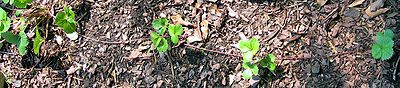
Cyperus
Cyperus is a large genus of about 600 species of sedges, distributed throughout all continents in both tropical and temperate regions. They are annual or perennial plants, mostly aquatic and growing in still or slow-moving water up to 0.5 m deep. The species vary greatly in size, with small species...
species the stolons end with the growth of tubers; the tubers are swollen stolons that form new plants.
Some species
Species
In biology, a species is one of the basic units of biological classification and a taxonomic rank. A species is often defined as a group of organisms capable of interbreeding and producing fertile offspring. While in many cases this definition is adequate, more precise or differing measures are...
of crawling plants can also sprout adventitious roots, but are not considered stoloniferous: a stolon is sprouted from an existing stem and can produce a full individual. Examples of plants that extend through stolons include some species from the genera
Genus
In biology, a genus is a low-level taxonomic rank used in the biological classification of living and fossil organisms, which is an example of definition by genus and differentia...
Argentina
Argentina (plant)
Argentina is a genus of plants in the rose family . The circumscription is not yet fully settled; it includes at least three species long classified in Potentilla sect. Leptostylae. A further 23-25 or more species also traditionally included in Potentilla sect...
(silverweed), Cynodon
Cynodon
Cynodon is a genus of nine species of grasses, native to warm temperate to tropical regions of the Old World. The genus as a whole as well as its species are commonly known as Bermuda Grass or Dog's Tooth Grass.-Species:...
, Fragaria
Strawberry
Fragaria is a genus of flowering plants in the rose family, Rosaceae, commonly known as strawberries for their edible fruits. Although it is commonly thought that strawberries get their name from straw being used as a mulch in cultivating the plants, the etymology of the word is uncertain. There...
, and Pilosella (Hawkweeds), Zoysia
Zoysia
Zoysia is a genus of creeping grasses native to southeast and east Asia and Australasia. These species, commonly called zoysia or zoysiagrass, are found in coastal areas or grasslands. The genus is named after the Austrian botanist Karl von Zois.-Species:*Zoysia japonica Steud.*Zoysia macrantha...
japonica, Ranunculus repens.
Other plants with stolons below the soil surface include many grasses, Ajuga, Mentha
Mentha
Mentha is a genus of flowering plants in the family Lamiaceae . The species are not clearly distinct and estimates of the number of species varies from 13 to 18. Hybridization between some of the species occurs naturally...
, and Stachys
Stachys
Stachys is one of the largest genera in the flowering plant family Lamiaceae. Estimates of the number of species in the genus vary from about 300, to about 450. The type species for the genus is Stachys sylvatica. Stachys is in the subfamily Lamioideae...
.
Lily-of-the-valley (Convallaria majalis) which has rhizomes that grow stolon-like stems called stoloniferous rhizomes or leptomorph rhizomes. A number of plants have stoloniferous rhizomes including Asters These stolon-like rhizomes are long and thin, with long internodes and indeterminate growth with lateral buds at the node that mostly remain dormant.
In potatoes, the stolons start to grow within 10 days of plants emerging above ground, with tubers usually beginning to form on the end of the stolons. The tubers are modified stolons that hold food reserves with a few buds that grow into stems. Since it is not a rhizome it does not generate roots, but the new stem growth that grows to the surface produces roots. See also BBCH-scale (potato)
BBCH-scale (potato)
The BBCH-scale identifies the phenological development stages of a potato . It is a plant species-specific version of the BBCH-scale.1 For second generation sprouts...
Hydrilla
Hydrilla
Hydrilla is an aquatic plant genus, usually treated as containing just one species, Hydrilla verticillata, though some botanists divide it into several species. Synonyms include H. asiatica, H. japonica, H. lithuanica, and H. ovalifolica...
use stolons that produce tubers to spread themselves and survive dry periods in aquatic habitats.
Erythronium
Erythronium
Erythronium is a genus of 20-30 species of spring-flowering perennial plants with long, tooth-like bulbs and attractive pendant flowers, native to forest and meadow in temperate regions of the Northern Hemisphere.-Species:-Uses:The bulb is edible as a root vegetable, cooked or dried, and can be...
commonly called Trout Lily, have white stolons growing from the bulb. Most run horizontally, either underground or along the surface of the ground under leaf litter. Flowering plants often produce no stolons. A number of bulbous forming species produce stolons with Erythronium propullans producing one stolon below the soil surface on the midway point of the stem on blooming plants that produces a new bulb
Bulb
A bulb is a short stem with fleshy leaves or leaf bases. The leaves often function as food storage organs during dormancy.A bulb's leaf bases, known as scales, generally do not support leaves, but contain food reserves to enable the plant to survive adverse conditions. At the center of the bulb is...
. On non blooming plants 1 to 3 stolons are produce directly from the bulbs, each ending in a new clone
Cloning
Cloning in biology is the process of producing similar populations of genetically identical individuals that occurs in nature when organisms such as bacteria, insects or plants reproduce asexually. Cloning in biotechnology refers to processes used to create copies of DNA fragments , cells , or...
.
Convolvulus arvensis
Convolvulus arvensis
Convolvulus arvensis is a species of bindweed, native to Europe and Asia. It is a climbing or creeping herbaceous perennial plant growing to 0.5–2 m high. The leaves are spirally arranged, linear to arrowhead-shaped, 2–5 cm long and alternate, with a 1–3 cm petiole...
is a weed species in agriculture that spreads by under ground stolons that produce rhizomes.
In studies on grass
Grass
Grasses, or more technically graminoids, are monocotyledonous, usually herbaceous plants with narrow leaves growing from the base. They include the "true grasses", of the Poaceae family, as well as the sedges and the rushes . The true grasses include cereals, bamboo and the grasses of lawns ...
species, with plants that produce stolons or rhizomes and plants that produce both stolons and rhizomes; morphological and physiological differences where noticed. Stolons have longer internodes and function as means of seeking out light and were used for propagation of the plant, while rhizomes are used as storage organs for carbohydrates and the maintenance of meristem tissue to keep the parent plant alive from one year to the next.
In mycology
In mycologyMycology
Mycology is the branch of biology concerned with the study of fungi, including their genetic and biochemical properties, their taxonomy and their use to humans as a source for tinder, medicinals , food and entheogens, as well as their dangers, such as poisoning or...
, a stolon is defined as an occasionally septate hypha
Hypha
A hypha is a long, branching filamentous structure of a fungus, and also of unrelated Actinobacteria. In most fungi, hyphae are the main mode of vegetative growth, and are collectively called a mycelium; yeasts are unicellular fungi that do not grow as hyphae.-Structure:A hypha consists of one or...
, which connects sporangiophores together. Root-like structures called rhizoid
Rhizoid
Rhizoids are thread-like growths from the base or bottom of a plant, found mainly in lower groups such as algae, fungi, bryophytes and pteridophytes, that function like roots of higher plants ....
s may appear on the stolon as well, anchoring the hyphae to the substrate
Substrate (biology)
In biology a substrate is the surface a plant or animal lives upon and grows on. A substrate can include biotic or abiotic materials and animals. For example, encrusting algae that lives on a rock can be substrate for another animal that lives on top of the algae. See also substrate .-External...
. The stolon is commonly found in bread molds, and are seen as horizontally expanding across the mold.
In zoology
Some bryozoaBryozoa
The Bryozoa, also known as Ectoprocta or commonly as moss animals, are a phylum of aquatic invertebrate animals. Typically about long, they are filter feeders that sieve food particles out of the water using a retractable lophophore, a "crown" of tentacles lined with cilia...
ns form colonies through connection of individual units by stolons. Other colonies include sheets and erect colonies.
Some colonial Cnidaria
Cnidaria
Cnidaria is a phylum containing over 9,000 species of animals found exclusively in aquatic and mostly marine environments. Their distinguishing feature is cnidocytes, specialized cells that they use mainly for capturing prey. Their bodies consist of mesoglea, a non-living jelly-like substance,...
develop as stolons with interconnected medusoid structures that later separate.
See also
- RootRootIn vascular plants, the root is the organ of a plant that typically lies below the surface of the soil. This is not always the case, however, since a root can also be aerial or aerating . Furthermore, a stem normally occurring below ground is not exceptional either...
- SpriggingSpriggingSprigging is a method of plant propagation whereby cuttings of stolons or rhizomes are planted instead of seed onto the soil surface or into furrows or small holes. This method is common for establishing Cynodon and Zoysia . The stolons/rhizomes can also be broadcast in a slurry as in hydroseeding....
- Vegetative reproductionVegetative reproductionVegetative reproduction is a form of asexual reproduction in plants. It is a process by which new individuals arise without production of seeds or spores...