

Cyatheales

Encyclopedia
The order Cyatheales is a taxonomic division of the fern
subclass, Cyatheatae, which includes the tree ferns. No clear morphological
features characterize all of the Cyatheales, but DNA
sequence data indicates that the order is monophyletic
. Some species in the Cyatheales have tree-like growth forms, but others have creeping rhizome
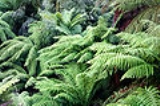
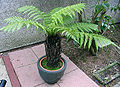
s (stems). Some species have scales on the stems and leaves, while others have hairs. However, most plants in the Cyatheales are tree ferns and have trunk-like stems up to 20 meters tall. It is unclear how many times the tree form has evolved and been lost in the order.
s (leaves) above ground level can be called a tree fern. However, the plants formally known as tree ferns comprise a group of large ferns belonging to the families Dicksoniaceae
and Cyatheaceae
in the order Cyatheales.
Tree ferns are found growing in tropical and subtropical areas as well as temperate rainforests in Australia
, New Zealand
, and other island groups nearby; a few genera extend further, such as Culcita in southern Europe
. Like all ferns, tree ferns reproduce by means of spore
s developed in sporangia
on the undersides of the fronds.
 The fronds of tree ferns are usually very large and multiple-pinnate
but at least one type has entire (undivided) fronds. The fronds of tree ferns also exhibit circinate vernation, meaning the young fronds emerge in coils that uncurl as they grow.
Unlike flowering plant
s, tree ferns do not form new woody tissue in their trunk as they grow. Rather, the trunk is supported by a fibrous mass of roots that expands as the tree fern grows.
Some tree fern genera — for example Dicksonia
and Cibotium
, but not Cyathea
— can be transplanted by severing the top portion from the rest of the trunk and replanting it. If the transplanted top part is kept moist it will regrow a new root system over the next year. The success rate of transplantation increases to about 80% if the roots are dug up intact. If the crown of the Tasmanian tree fern Dicksonia antarctica (the most common species in gardens) is damaged, it will die because that is where all new growth occurs. But other clump-forming tree fern species, such as D. squarrosa and D. youngiae
, can regenerate from basal offsets or from "pups" emerging along the surviving trunk length. Tree ferns often fall over in the wild, yet manage to re-root from this new prostrate position and begin new vertical growth.
It is not certain how many species of tree fern there are but it is likely to be around a thousand. Although new species are discovered in New Guinea
with each botanical survey, many species throughout its range have become extinct
in the last century as forest habitats have come under pressure from human intervention.
Where feral
pigs are a problem, such as in some Hawaiian rainforests, they will knock over tree ferns to root out the starch
y pith
, killing the plant.
that can achieve short trunks under 1 metres (3.3 ft) tall. A few species in the genera Blechnum
, Leptopteris
, Sadleria
and Todea
could also be considered tree ferns in a liberal interpretation of the term.
The families that constitute Cyatheales have been relatively firmly established as a clade
by DNA
sequencing and morphological studies. The order Plagiogyriales, which contains the family Plagiogyriaceae, is most closely related to the Cyatheales, not to the Osmundales as had been previously supposed.
Fern
A fern is any one of a group of about 12,000 species of plants belonging to the botanical group known as Pteridophyta. Unlike mosses, they have xylem and phloem . They have stems, leaves, and roots like other vascular plants...
subclass, Cyatheatae, which includes the tree ferns. No clear morphological
Morphology (biology)
In biology, morphology is a branch of bioscience dealing with the study of the form and structure of organisms and their specific structural features....
features characterize all of the Cyatheales, but DNA
DNA
Deoxyribonucleic acid is a nucleic acid that contains the genetic instructions used in the development and functioning of all known living organisms . The DNA segments that carry this genetic information are called genes, but other DNA sequences have structural purposes, or are involved in...
sequence data indicates that the order is monophyletic
Monophyly
In common cladistic usage, a monophyletic group is a taxon which forms a clade, meaning that it contains all the descendants of the possibly hypothetical closest common ancestor of the members of the group. The term is synonymous with the uncommon term holophyly...
. Some species in the Cyatheales have tree-like growth forms, but others have creeping rhizome
Rhizome
In botany and dendrology, a rhizome is a characteristically horizontal stem of a plant that is usually found underground, often sending out roots and shoots from its nodes...
s (stems). Some species have scales on the stems and leaves, while others have hairs. However, most plants in the Cyatheales are tree ferns and have trunk-like stems up to 20 meters tall. It is unclear how many times the tree form has evolved and been lost in the order.
Description
In general, any fern that grows with a trunk elevating the frondFrond
The term frond refers to a large, divided leaf. In both common usage and botanical nomenclature, the leaves of ferns are referred to as fronds and some botanists restrict the term to this group...
s (leaves) above ground level can be called a tree fern. However, the plants formally known as tree ferns comprise a group of large ferns belonging to the families Dicksoniaceae
Dicksoniaceae
The Dicksoniaceae is a family of tropical, subtropical and warm temperate ferns. Most of the 5-6 genera in the family are terrestrial ferns or have very short trunks compared to tree ferns of the family Cyatheaceae. However, some of the larger species can reach several metres in height. A number of...
and Cyatheaceae
Cyatheaceae
The Cyatheaceae is the scaly tree fern family and includes the world's tallest tree ferns, which reach heights up to 20 m. They are also very ancient plants, appearing in the fossil record in the late Jurassic, though the modern genera likely appeared in the Tertiary. Cyatheaceae is the largest...
in the order Cyatheales.
Tree ferns are found growing in tropical and subtropical areas as well as temperate rainforests in Australia
Australia
Australia , officially the Commonwealth of Australia, is a country in the Southern Hemisphere comprising the mainland of the Australian continent, the island of Tasmania, and numerous smaller islands in the Indian and Pacific Oceans. It is the world's sixth-largest country by total area...
, New Zealand
New Zealand
New Zealand is an island country in the south-western Pacific Ocean comprising two main landmasses and numerous smaller islands. The country is situated some east of Australia across the Tasman Sea, and roughly south of the Pacific island nations of New Caledonia, Fiji, and Tonga...
, and other island groups nearby; a few genera extend further, such as Culcita in southern Europe
Europe
Europe is, by convention, one of the world's seven continents. Comprising the westernmost peninsula of Eurasia, Europe is generally 'divided' from Asia to its east by the watershed divides of the Ural and Caucasus Mountains, the Ural River, the Caspian and Black Seas, and the waterways connecting...
. Like all ferns, tree ferns reproduce by means of spore
Spore
In biology, a spore is a reproductive structure that is adapted for dispersal and surviving for extended periods of time in unfavorable conditions. Spores form part of the life cycles of many bacteria, plants, algae, fungi and some protozoa. According to scientist Dr...
s developed in sporangia
Sporangium
A sporangium is an enclosure in which spores are formed. It can be composed of a single cell or can be multicellular. All plants, fungi, and many other lineages form sporangia at some point in their life cycle...
on the undersides of the fronds.
Pinnate
Pinnate is a term used to describe feather-like or multi-divided features arising from both sides of a common axis in plant or animal structures, and comes from the Latin word pinna meaning "feather", "wing", or "fin". A similar term is pectinate, which refers to a comb-like arrangement of parts...
but at least one type has entire (undivided) fronds. The fronds of tree ferns also exhibit circinate vernation, meaning the young fronds emerge in coils that uncurl as they grow.
Unlike flowering plant
Flowering plant
The flowering plants , also known as Angiospermae or Magnoliophyta, are the most diverse group of land plants. Angiosperms are seed-producing plants like the gymnosperms and can be distinguished from the gymnosperms by a series of synapomorphies...
s, tree ferns do not form new woody tissue in their trunk as they grow. Rather, the trunk is supported by a fibrous mass of roots that expands as the tree fern grows.
Some tree fern genera — for example Dicksonia
Dicksonia
Dicksonia is a genus of tree ferns in the order Cyatheales. It is regarded as related to Cyathea, but is considered more primitive, dating back at least to the Jurassic and Cretaceous periods. The fossil record includes stems, pinnules, and spores....
and Cibotium
Cibotium
Cibotium is a genus of eleven species of tropical tree fern—subject to much confusion and revision—distributed fairly narrowly in Hawaii , Southeast Asia , and the cloud forests of Central America and Mexico...
, but not Cyathea
Cyathea
Cyathea is a genus of tree ferns, the type genus of the fern order Cyatheales. They are mostly terrestrial ferns, usually with a single tall stem. Rarely, the trunk may be branched or creeping. Many species also develop a fibrous mass of roots at the base of the trunk. The genus has a pantropical...
— can be transplanted by severing the top portion from the rest of the trunk and replanting it. If the transplanted top part is kept moist it will regrow a new root system over the next year. The success rate of transplantation increases to about 80% if the roots are dug up intact. If the crown of the Tasmanian tree fern Dicksonia antarctica (the most common species in gardens) is damaged, it will die because that is where all new growth occurs. But other clump-forming tree fern species, such as D. squarrosa and D. youngiae
Dicksonia youngiae
Dicksonia youngiae, common name Bristly Tree Fern, is a fern that comes from cool, sheltered rainforests in New South Wales and Queensland, Australia. It is found north of the Bellinger River, in New South Wales, and can be seen in the wild at Nightcap National Park.Similar to D. squarrosa, it...
, can regenerate from basal offsets or from "pups" emerging along the surviving trunk length. Tree ferns often fall over in the wild, yet manage to re-root from this new prostrate position and begin new vertical growth.
It is not certain how many species of tree fern there are but it is likely to be around a thousand. Although new species are discovered in New Guinea
New Guinea
New Guinea is the world's second largest island, after Greenland, covering a land area of 786,000 km2. Located in the southwest Pacific Ocean, it lies geographically to the east of the Malay Archipelago, with which it is sometimes included as part of a greater Indo-Australian Archipelago...
with each botanical survey, many species throughout its range have become extinct
Extinction
In biology and ecology, extinction is the end of an organism or of a group of organisms , normally a species. The moment of extinction is generally considered to be the death of the last individual of the species, although the capacity to breed and recover may have been lost before this point...
in the last century as forest habitats have come under pressure from human intervention.
Threats to tree ferns
While many ferns are able to achieve a widespread distribution because of their spore reproduction, tree fern species tend to be very local. This makes their species much more susceptible to the effects of local deforestation. It is not known why species are not more widespread, especially considering that they have sufficient height to have a greater chance of getting spore into the wind stream.Where feral
Feral
A feral organism is one that has changed from being domesticated to being wild or untamed. In the case of plants it is a movement from cultivated to uncultivated or controlled to volunteer. The introduction of feral animals or plants to their non-native regions, like any introduced species, may...
pigs are a problem, such as in some Hawaiian rainforests, they will knock over tree ferns to root out the starch
Starch
Starch or amylum is a carbohydrate consisting of a large number of glucose units joined together by glycosidic bonds. This polysaccharide is produced by all green plants as an energy store...
y pith
Pith
Pith, or medulla, is a tissue in the stems of vascular plants. Pith is composed of soft, spongy parenchyma cells, which store and transport nutrients throughout the plant. In eudicots, pith is located in the center of the stem. In monocots, it extends also into flowering stems and roots...
, killing the plant.
Non-Cyatheales tree ferns
Outside of the Cyatheales a few ferns in other groups could be considered tree ferns, such as several ferns in the family OsmundaceaeOsmundaceae
The Osmundaceae is a family of four genera and 15-25 species. It is the only fern family of the order Osmundales; an order in the class Pteridopsida or in some classifications the only order in the class Osmundopsida...
that can achieve short trunks under 1 metres (3.3 ft) tall. A few species in the genera Blechnum
Blechnum
Blechnum is a genus of between 150–220 species of ferns in the family Blechnaceae, with a cosmopolitan distribution. By far the greatest species diversity is in tropical regions of the Southern Hemisphere, with only a few species reaching cool temperate latitudes in the Southern Hemisphere...
, Leptopteris
Leptopteris
The fern genus Leptopteris is a small group of plants found growing in the Pacific Islands, New Guinea and Australia. They are similar to ferns in the related genus Todea.Species include:* L. alpina* L. fraseri - Crepe Fern, Australia...
, Sadleria
Sadleria
Sadleria is a genus of six species of ferns in the family Blechnaceae, all endemic to Hawaii.Species*Sadleria cyatheoides Kaulf. *Sadleria pallida Hook...
and Todea
Todea
The fern genus Todea is known from only two living species. Todea barbara L., known as the king fern, is native to South Africa, New Zealand, and Australia while Todea papuana H. is known only from Papua New Guinea...
could also be considered tree ferns in a liberal interpretation of the term.
The families that constitute Cyatheales have been relatively firmly established as a clade
Clade
A clade is a group consisting of a species and all its descendants. In the terms of biological systematics, a clade is a single "branch" on the "tree of life". The idea that such a "natural group" of organisms should be grouped together and given a taxonomic name is central to biological...
by DNA
DNA
Deoxyribonucleic acid is a nucleic acid that contains the genetic instructions used in the development and functioning of all known living organisms . The DNA segments that carry this genetic information are called genes, but other DNA sequences have structural purposes, or are involved in...
sequencing and morphological studies. The order Plagiogyriales, which contains the family Plagiogyriaceae, is most closely related to the Cyatheales, not to the Osmundales as had been previously supposed.
External links
- Community: Care and propagation of Treeferns (German/English)
- Fern Files: Tree Ferns