

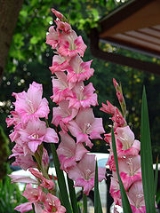
Gladiolus

Encyclopedia
Gladiolus is a genus
of perennial bulbous flowering plant
s in the iris family (Iridaceae
). Sometimes called the sword lily, the most widely used English
common name for these plants is simply gladiolus (plural gladioli, gladioluses or sometimes gladiolas).
The genus is distributed in Mediterranean Europe, Asia, Tropical Africa
and South Africa
. The center of diversity
of the genus is located in the Cape Floristic Region
, where most species were discovered. The genera Oenostachys, Homoglossum, Anomalesia and Acidanthera, traditionally considered independent entities, currently are included in Gladiolus.
, mostly South Africa
. About 10 species are native to Eurasia. There are 160 species of Gladiolus endemic in southern Africa and 76 in tropical Africa. The flowers of unmodified wild species vary from very small to perhaps 40 mm across, and inflorescences bearing anything from one to several flowers. The spectacular giant flower spikes in commerce are the products of centuries of hybridisation, selection, and perhaps more drastic manipulation.
These attractive, perennial herbs are semihardy in temperate climate
s. They grow from rounded, symmetrical corm
s, that are enveloped in several layers of brownish, fibrous tunics.
Their stems
are generally unbranched, producing 1 to 9 narrow, sword-shaped, longitudinal grooved leaves
, enclosed in a sheath. The lowest leaf is shortened to a cataphyll
. The leaf blades can be plane or cruciform in cross section.
The fragrant flower
spikes are large and one-sided, with secund
, bisexual flowers, each subtended by 2 leathery, green bract
s. The sepal
s and the petal
s are almost identical in appearance, and are termed tepals. They are united at their base into a tube-shaped structure. The dorsal tepal is the largest, arching over the three stamen
s. The outer three tepal
s are narrower. The perianth
is funnel-shaped, with the stamens attached to its base. The style has three filiform
, spoon-shaped branches, each expanding towards the apex.
The ovary
is 3-locular with oblong or globose capsules
, containing many, winged brown, longitudinally dehiscent seed
s. In their center must be noticeable the specific pellet like structure which is the real seed without the fine coat. In some seeds this structure is wrinkled and with black color. These seeds are unable to germinate.
These flowers are variously colored, pink to reddish or light purple with white, contrasting markings, or white to cream or orange to red.
The South African species were originally pollinated by long-tongued anthrophorine bees, but some changes in the pollination system have occurred, allowing pollination by sunbird
s, noctuid and sphingid moths, long-tongued flies and several others. In the temperate zones of Europe many of the hybrid large flowering sorts of gladiolas can be pollinated by small well-known wasps. Actually, They are not very good pollinators because of the large flowers of the plants and the small size of the wasps. Another insect
in this zone which can try some of the nectar of the gladioli is the best-known European Hawk-moth Macroglossum stellatarum which usually pollinates many popular garden flowers like Petunia
, Zinnia
, Dianthus
and others.
Gladioli are used as food plants by the larva
e of some Lepidoptera
species including the Large Yellow Underwing
.
Gladioli have been extensively hybridized and a wide range of ornamental flower colours are available from the many varieties. The main hybrid groups have been obtained by crossing between four or five species, followed by selection: Grandiflorus, Primulines and Nanus. They make very good cut flowers. However, due to their height, the cultivated forms frequently tend to fall over in the wind
if left on the plant.
The majority of the species in this genus are diploids with 30 chromosome
s but the Grandiflora hybrids are tetraploids and possess 60 chromosomes. It's because the main parental species of these hybrids is Gladiolus dalenii
which is also tetraploid and includes a wide range of varieties (like the Grandiflora hybrids).
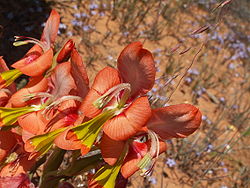
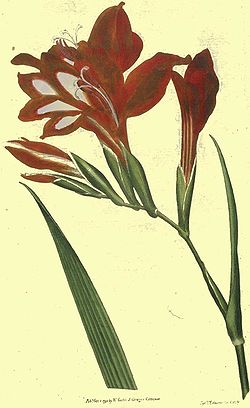
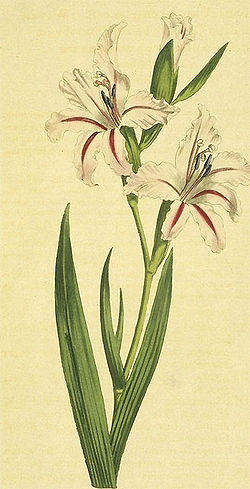
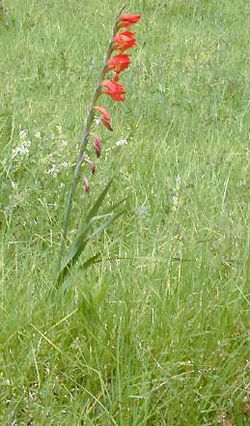
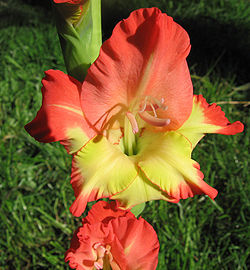
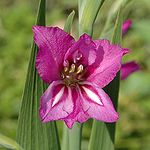 The genus Gladiolus has been divided in to many sections. Where possible, the sections have been indicated. Most species, however, are only tentatively placed.
-free place, then replanted in spring. Some species from Europe and high altitudes in Africa, as well as the small 'Nanus' hybrids, are much hardier (to at least -15°F/-26°C) and can be left in the ground in regions with sufficiently dry winters. Plants are propagated
either from small cormlets produced as offsets by the parent corm
s, or from seed
; in either case, they take several years to get to flowering size. Clumps should be dug up and divided every few years to keep them vigorous.
A popular 'Nanus' cultivar is Atom
.
Genus
In biology, a genus is a low-level taxonomic rank used in the biological classification of living and fossil organisms, which is an example of definition by genus and differentia...
of perennial bulbous flowering plant
Flowering plant
The flowering plants , also known as Angiospermae or Magnoliophyta, are the most diverse group of land plants. Angiosperms are seed-producing plants like the gymnosperms and can be distinguished from the gymnosperms by a series of synapomorphies...
s in the iris family (Iridaceae
Iridaceae
The Iris family or Iridaceae is a family of perennial, herbaceous and bulbous plants included in the monocot order Asparagales, taking its name from the genus Iris. Almost worldwide in distribution and one of the most important families in horticulture, it includes more than 2000 species...
). Sometimes called the sword lily, the most widely used English
English language
English is a West Germanic language that arose in the Anglo-Saxon kingdoms of England and spread into what was to become south-east Scotland under the influence of the Anglian medieval kingdom of Northumbria...
common name for these plants is simply gladiolus (plural gladioli, gladioluses or sometimes gladiolas).
The genus is distributed in Mediterranean Europe, Asia, Tropical Africa
Tropical Africa
Although tropical Africa is most familiar in the West as depicted by its rain forests, this region of Africa is far more diverse. While the tropics are thought of as regions with warm to hot moist climates caused by latitude and the tropical rain belt, the geology of areas, particularly mountain...
and South Africa
South Africa
The Republic of South Africa is a country in southern Africa. Located at the southern tip of Africa, it is divided into nine provinces, with of coastline on the Atlantic and Indian oceans...
. The center of diversity
Center of diversity
A center of diversity is an area that has a high degree of genetic variation for a particular species or genus of plants that can also be the center of origin for that species. The two areas often, but not always, coincide; the degree of coincidence remains the subject of debate...
of the genus is located in the Cape Floristic Region
Cape floristic region
The Cape Floristic Region is a floristic region located near the southern tip of South Africa. It is the only floristic region of the Cape Floristic Kingdom, and includes only one floristic province, known as the Cape Floristic Province.The Cape Floristic Region, the smallest of the six recognised...
, where most species were discovered. The genera Oenostachys, Homoglossum, Anomalesia and Acidanthera, traditionally considered independent entities, currently are included in Gladiolus.
Description
The genus Gladiolus contains about 260 species, of which 250 are native to sub-Saharan AfricaSub-Saharan Africa
Sub-Saharan Africa as a geographical term refers to the area of the African continent which lies south of the Sahara. A political definition of Sub-Saharan Africa, instead, covers all African countries which are fully or partially located south of the Sahara...
, mostly South Africa
South Africa
The Republic of South Africa is a country in southern Africa. Located at the southern tip of Africa, it is divided into nine provinces, with of coastline on the Atlantic and Indian oceans...
. About 10 species are native to Eurasia. There are 160 species of Gladiolus endemic in southern Africa and 76 in tropical Africa. The flowers of unmodified wild species vary from very small to perhaps 40 mm across, and inflorescences bearing anything from one to several flowers. The spectacular giant flower spikes in commerce are the products of centuries of hybridisation, selection, and perhaps more drastic manipulation.
These attractive, perennial herbs are semihardy in temperate climate
Climate
Climate encompasses the statistics of temperature, humidity, atmospheric pressure, wind, rainfall, atmospheric particle count and other meteorological elemental measurements in a given region over long periods...
s. They grow from rounded, symmetrical corm
Corm
A corm is a short, vertical, swollen underground plant stem that serves as a storage organ used by some plants to survive winter or other adverse conditions such as summer drought and heat ....
s, that are enveloped in several layers of brownish, fibrous tunics.
Their stems
Plant stem
A stem is one of two main structural axes of a vascular plant. The stem is normally divided into nodes and internodes, the nodes hold buds which grow into one or more leaves, inflorescence , conifer cones, roots, other stems etc. The internodes distance one node from another...
are generally unbranched, producing 1 to 9 narrow, sword-shaped, longitudinal grooved leaves
Leaf
A leaf is an organ of a vascular plant, as defined in botanical terms, and in particular in plant morphology. Foliage is a mass noun that refers to leaves as a feature of plants....
, enclosed in a sheath. The lowest leaf is shortened to a cataphyll
Cataphyll
In plant morphology, a cataphyll is a leaf whose primary function is something other than photosynthesis...
. The leaf blades can be plane or cruciform in cross section.
The fragrant flower
Flower
A flower, sometimes known as a bloom or blossom, is the reproductive structure found in flowering plants . The biological function of a flower is to effect reproduction, usually by providing a mechanism for the union of sperm with eggs...
spikes are large and one-sided, with secund
Secund
Secund can refer to:*a botanical term used of plants when similar parts are directed to one side only, as flowers on an axis. *to loan an employee from one organization to another...
, bisexual flowers, each subtended by 2 leathery, green bract
Bract
In botany, a bract is a modified or specialized leaf, especially one associated with a reproductive structure such as a flower, inflorescence axis, or cone scale. Bracts are often different from foliage leaves. They may be smaller, larger, or of a different color, shape, or texture...
s. The sepal
Sepal
A sepal is a part of the flower of angiosperms . Collectively the sepals form the calyx, which is the outermost whorl of parts that form a flower. Usually green, sepals have the typical function of protecting the petals when the flower is in bud...
s and the petal
Petal
Petals are modified leaves that surround the reproductive parts of flowers. They often are brightly colored or unusually shaped to attract pollinators. Together, all of the petals of a flower are called a corolla. Petals are usually accompanied by another set of special leaves called sepals lying...
s are almost identical in appearance, and are termed tepals. They are united at their base into a tube-shaped structure. The dorsal tepal is the largest, arching over the three stamen
Stamen
The stamen is the pollen producing reproductive organ of a flower...
s. The outer three tepal
Tepal
Tepals are elements of the perianth, or outer part of a flower, which include the petals or sepals. The term tepal is more often applied specifically when all segments of the perianth are of similar shape and color, or undifferentiated, which is called perigone...
s are narrower. The perianth
Perianth
The term perianth has two similar but separate meanings in botany:* In flowering plants, the perianth are the outer, sterile whorls of a flower...
is funnel-shaped, with the stamens attached to its base. The style has three filiform
Filiform
Filiform can refer to:*Filiform, a common term used in botany to described leaf shapes.*Filiform papilla on the tongue.*Thread-like crystal formations*A corrosion mechanism...
, spoon-shaped branches, each expanding towards the apex.
The ovary
Ovary (plants)
In the flowering plants, an ovary is a part of the female reproductive organ of the flower or gynoecium. Specifically, it is the part of the pistil which holds the ovule and is located above or below or at the point of connection with the base of the petals and sepals...
is 3-locular with oblong or globose capsules
Capsule (fruit)
In botany a capsule is a type of simple, dry fruit produced by many species of flowering plants. A capsule is a structure composed of two or more carpels that in most cases is dehiscent, i.e. at maturity, it splits apart to release the seeds within. A few capsules are indehiscent, for example...
, containing many, winged brown, longitudinally dehiscent seed
Seed
A seed is a small embryonic plant enclosed in a covering called the seed coat, usually with some stored food. It is the product of the ripened ovule of gymnosperm and angiosperm plants which occurs after fertilization and some growth within the mother plant...
s. In their center must be noticeable the specific pellet like structure which is the real seed without the fine coat. In some seeds this structure is wrinkled and with black color. These seeds are unable to germinate.
These flowers are variously colored, pink to reddish or light purple with white, contrasting markings, or white to cream or orange to red.
The South African species were originally pollinated by long-tongued anthrophorine bees, but some changes in the pollination system have occurred, allowing pollination by sunbird
Sunbird
The sunbirds and spiderhunters are a family, Nectariniidae, of very small passerine birds. There are 132 species in 15 genera. The family is distributed throughout Africa, southern Asia and just reaches northern Australia. Most sunbirds feed largely on nectar, but also take insects and spiders,...
s, noctuid and sphingid moths, long-tongued flies and several others. In the temperate zones of Europe many of the hybrid large flowering sorts of gladiolas can be pollinated by small well-known wasps. Actually, They are not very good pollinators because of the large flowers of the plants and the small size of the wasps. Another insect
Insect
Insects are a class of living creatures within the arthropods that have a chitinous exoskeleton, a three-part body , three pairs of jointed legs, compound eyes, and two antennae...
in this zone which can try some of the nectar of the gladioli is the best-known European Hawk-moth Macroglossum stellatarum which usually pollinates many popular garden flowers like Petunia
Petunia
Petunia is a widely cultivated genus of flowering plants of South American origin, closely related with tobacco, cape gooseberries, tomatoes, deadly nightshades, potatoes and chili peppers; in the family Solanaceae. The popular flower derived its name from French, which took the word petun, meaning...
, Zinnia
Zinnia
Zinnia is a genus of 20 species of annual and perennial plants of family Asteraceae, originally from scrub and dry grassland in an area stretching from the American Southwest to South America, but primarily Mexico, and notable for their solitary long-stemmed flowers that come in a variety of bright...
, Dianthus
Dianthus
Dianthus is a genus of about 300 species of flowering plants in the family Caryophyllaceae, native mainly to Europe and Asia, with a few species extending south to north Africa, and one species in arctic North America. Common names include carnation , pink and sweet William Dianthus is a genus of...
and others.
Gladioli are used as food plants by the larva
Larva
A larva is a distinct juvenile form many animals undergo before metamorphosis into adults. Animals with indirect development such as insects, amphibians, or cnidarians typically have a larval phase of their life cycle...
e of some Lepidoptera
Lepidoptera
Lepidoptera is a large order of insects that includes moths and butterflies . It is one of the most widespread and widely recognizable insect orders in the world, encompassing moths and the three superfamilies of butterflies, skipper butterflies, and moth-butterflies...
species including the Large Yellow Underwing
Large Yellow Underwing
The Large Yellow Underwing is a moth, the type species for the family Noctuidae. It is an abundant species throughout Europe, one of the most common and most familiar moths of the region. In some years the species is highly migratory with large numbers appearing suddenly in marginal parts of the...
.
Gladioli have been extensively hybridized and a wide range of ornamental flower colours are available from the many varieties. The main hybrid groups have been obtained by crossing between four or five species, followed by selection: Grandiflorus, Primulines and Nanus. They make very good cut flowers. However, due to their height, the cultivated forms frequently tend to fall over in the wind
Wind
Wind is the flow of gases on a large scale. On Earth, wind consists of the bulk movement of air. In outer space, solar wind is the movement of gases or charged particles from the sun through space, while planetary wind is the outgassing of light chemical elements from a planet's atmosphere into space...
if left on the plant.
The majority of the species in this genus are diploids with 30 chromosome
Chromosome
A chromosome is an organized structure of DNA and protein found in cells. It is a single piece of coiled DNA containing many genes, regulatory elements and other nucleotide sequences. Chromosomes also contain DNA-bound proteins, which serve to package the DNA and control its functions.Chromosomes...
s but the Grandiflora hybrids are tetraploids and possess 60 chromosomes. It's because the main parental species of these hybrids is Gladiolus dalenii
Gladiolus dalenii
Gladiolus dalenii originates from South African seed. It's the main parental species of the large flowering Grandiflora hybrids. This species is tetraploid and possesses 60 chromosomes...
which is also tetraploid and includes a wide range of varieties (like the Grandiflora hybrids).
Species
- Gladiolus abbreviatus AndrewsHenry Charles AndrewsHenry Charles Andrews , was an English botanist, botanical artist and engraver.He lived in Knightsbridge and was married to the daughter of John Kennedy of Hammersmith, a nurseryman who assisted Andrews in the descriptions of the plants he illustrated.He was an accomplished and unusual botanical...
- Gladiolus acuminatus F.Bol.
- Gladiolus aequinoctialis Herb.
- Gladiolus alatus L. (sect. Hebea)
- Gladiolus aleppicus Boiss.Pierre Edmond BoissierPierre Edmond Boissier was a Swiss botanist, explorer and mathematician.He was the son of Jacques Boissier and Lucile Butini , daughter of Pierre Butini a well-known physician and naturalist from Geneva...
var. aleppicus - Gladiolus anatolicus
- Gladiolus andringitrae GoldblattGoldblattGoldblatt is a surname, meaning "gold leaf" in the German language. Notable people named Goldblatt include:*David Goldblatt, South African photographer*David Goldblatt, British author on social studies and football...
- Gladiolus angustusGladiolus angustusGladiolus angustus is a species of gladiolus known by the common name long-tubed painted lady.This flower is an herb growing from a papery corm and reaching 30 to 60 centimeters in height. It has basal sword-shaped leaves with prominent midveins. Each scape has two or three flowers with...
L. (sect. Blandus) : Long-tubed Painted Lady - Gladiolus antandroyi Goldblatt
- Gladiolus antholyzoides BakerJohn Gilbert BakerJohn Gilbert Baker was an English botanist.Baker was born in Guisborough, the son of John and Mary Baker and educated at Quaker schools in Ackworth and York....
- Gladiolus appendiculatus G.Lewis
- Gladiolus aquamontanus Goldblatt & Vlok
- Gladiolus arcuatus KlattFriedrich Wilhelm KlattFriedrich Wilhelm Klatt 13 February 1825 Hamburg - 3 March 1897 Hamburg, was a German botanist who specialised in the study of African plants.As a child he showed artistic talent, but for financial reasons training and a career in art could not be followed. In 1854 he and his brother took over the...
- Gladiolus atropurpureus Baker
- Gladiolus atroviolaceus Boiss.
- Gladiolus aurantiacus Klatt
- Gladiolus aureus Baker : Golden Gladiolus
- Gladiolus bellus C. H. Wright
- Gladiolus benguellensis Baker (sect. Ophiolyza)
- Gladiolus bilineatus G. J. Lewis
- Gladiolus boehmii Vaupel (1882)
- Gladiolus bojeri (Baker) Goldblatt
- Gladiolus brachylimbus Baker (1893)
- Gladiolus brachyphyllus F. Bolus or Bolus f.
- Gladiolus brevifolius Jacq.Nikolaus Joseph von JacquinNikolaus Joseph Freiherr von Jacquin or Baron Nikolaus von Jacquin. was a scientist who studied medicine, chemistry and botany....
(sect. Linearifolius) - Gladiolus brevitubus G. Lewis
- Gladiolus buckerveldii (L. Bolus) Goldblatt
- Gladiolus bullatus Thunb.Carl Peter ThunbergCarl Peter Thunberg aka Carl Pehr Thunberg aka Carl Per Thunberg was a Swedish naturalist and an apostle of Carl Linnaeus. He has been called "the father of South African botany" and the "Japanese Linnaeus"....
ex G. Lewis : Caledon Bluebell - Gladiolus caeruleus Goldblatt & J.C. Manning
- Gladiolus calcaratus G. Lewis
- Gladiolus calcicola Goldblatt
- Gladiolus callianthusGladiolus callianthusThe Peacock Flower is a tropical plant that is native to Madagascar. According to the International Plant Names Index it is a native of Abyssinia ....
Mosais : Abyssinian Gladiolus - Gladiolus canaliculatus Goldblatt
- Gladiolus candidus (RendleAlfred Barton RendleAlfred Barton Rendle FRS was an English botanist.Rendle was born in Lewisham and studied at St John's College, Cambridge...
) Goldblatt - Gladiolus cardinalis CurtisWilliam CurtisWilliam Curtis was an English botanist and entomologist, who was born at Alton, Hampshire.Curtis began as an apothecary, before turning his attention to botany and other natural history. The publications he prepared effectively reached a wider audience than early works on the subject had intended...
(sect. Blandus) - Gladiolus carinatus AitonWilliam AitonWilliam Aiton was a Scottish botanist.Aiton was born near Hamilton. Having been regularly trained to the profession of a gardener, he travelled to London in 1754, and became assistant to Philip Miller, then superintendent of the Chelsea Physic Garden...
- Gladiolus carmineus C. H. Wright (sect. Blandus) : Cliff Lily
- Gladiolus carneus (sect. Blandus) : Large Painted Lady
- Gladiolus caryophyllaceus (Burm. f.) Poiret
- Gladiolus cataractarum Oberm.
- Gladiolus caucasicus Herb.
- Gladiolus ceresianus L. Bolus
- Gladiolus citrinus Klatt
- Gladiolus x colvilleiGladiolus x colvilleiGladiolus × colvillei Sweet is a hybrid Gladiolus cultivar. Common name: Scarlet Gladiolus.The original Gladiolus × colvillei was bred by the nurseryman James Colville of Chelsea, London from the southern African species G. tristis and G. cardinalis and first described in 1823; it is still cultivated...
: Colville's Gladiolus - Gladiolus communis L.Carolus LinnaeusCarl Linnaeus , also known after his ennoblement as , was a Swedish botanist, physician, and zoologist, who laid the foundations for the modern scheme of binomial nomenclature. He is known as the father of modern taxonomy, and is also considered one of the fathers of modern ecology...
(sect. Gladiolus) : Cornflag (type species)- Gladiolus communis subsp. byzantinus (sect. Gladiolus) - Whistling Jack, Eastern Gladiolus
- Gladiolus communis subsp. communis (sect. Gladiolus)
- Gladiolus conrathii Baker (1898)
- Gladiolus crassifoliusGladiolus crassifoliusGladiolus crassifolius is a species of Gladiolus found in Africa. It is a perennial species with substantial stems and brightly coloured flowers. There are many synonyms of Gladiolus crassifolius....
Baker - Gladiolus crispulatus L. Bolus
- Gladiolus cruentus T. Moore (sect. Ophiolyza)
- Gladiolus curtifolius Marais
- Gladiolus cuspidatus
- Gladiolus cylindraceus G. Lewis
- Gladiolus cymbarius Baker
- Gladiolus daleniiGladiolus daleniiGladiolus dalenii originates from South African seed. It's the main parental species of the large flowering Grandiflora hybrids. This species is tetraploid and possesses 60 chromosomes...
Van Geel (sect. Ophiolyza) - Gladiolus debilis Ker Gawler (sect. Homoglossum) : Small Painted Lady
- Gladiolus decaryi Goldblatt
- Gladiolus decipiens Vaupel
- Gladiolus decoratus Baker
- Gladiolus delpierrei Goldblatt
- Gladiolus densiflorus Baker
- Gladiolus deserticolus Goldblatt
- Gladiolus dolomiticus Oberm.
- Gladiolus dracocephalus Hook.f.Joseph Dalton HookerSir Joseph Dalton Hooker OM, GCSI, CB, MD, FRS was one of the greatest British botanists and explorers of the 19th century. Hooker was a founder of geographical botany, and Charles Darwin's closest friend...
- Gladiolus dregei Klatt
- Gladiolus dubius
- Gladiolus dzavakheticus
- Gladiolus ecklonii Lehm.Johann Georg Christian LehmannJohann Georg Christian Lehmann was a German botanist.Born at Haselau, near Uetersen, Holstein, Lehmann studied medicine in Copenhagen and Göttingen, obtained a doctorate in medicine in 1813 and a doctorate in philosophy from he University of Jena in 1814...
- Gladiolus edulis Burchell ex Ker Gawler
- Gladiolus elliotii Baker (sect. Ophiolyza)
- Gladiolus emiliae L. Bolus
- Gladiolus engysiphon G. Lewis
- Gladiolus equitans Thunb. (sect. Hebea)
- Gladiolus erectiflorus Baker
- Gladiolus exiguus G. Lewis
- Gladiolus flanaganii Baker : : Suicide Gladiolus
- Gladiolus floribundus Jacq.
- Gladiolus fourcadei (L. Bolus) Goldblatt & De Vos
- Gladiolus ×gandavensis (sect. Ophiolyza) [= G. dalenii × G. oppositiflorus]
- Gladiolus garnierii Klatt
- Gladiolus geardii L. Bolus
- Gladiolus goetzii Harms
- Gladiolus gracilis Jacq. (sect. Homoglossum) : Reed Bells
- Gladiolus gracillimus Baker
- Gladiolus grandiflorus (sect. Blandus)
- Gladiolus gregarius Welw. ex Baker (sect. Densiflorus)
- Gladiolus griseus Goldblatt & J.C. Manning
- Gladiolus gueinzii Kunze
- Gladiolus guthriei F. Bol. (sect. Linearifolius)
- Gladiolus halophilus Boiss. & Heldr.
- Gladiolus harmsianus Vaupel
- Gladiolus heterolobus Vaupel
- Gladiolus hirsutus Jacq. (sect. Linearifolius) : Small Pink Afrikaner
- Gladiolus hollandii L. Bolus
- Gladiolus horombensis Goldblatt
- Gladiolus huillensis (Welw. ex Baker) Goldblatt
- Gladiolus hyalinus Jacq.
- Gladiolus illyricus W.D.J.Koch - Wild Gladiolus
- Gladiolus imbricatus L.
- Gladiolus inandensis Baker
- Gladiolus incospicuus Baker
- Gladiolus inflatus Thunb.
- Gladiolus inflexus Goldblatt & J.C. Manning
- Gladiolus insolens Goldblatt & J.C. Manning
- Gladiolus intonsus Goldblatt
- Gladiolus invenustus G. J. Lewis
- Gladiolus involutus (sect. Hebea)
- Gladiolus iroensis (A. Chev.) Marais
- Gladiolus italicusGladiolus italicusGladiolus italicus is a species of gladiolus known by the common names Italian gladiolus, field gladiolus, and common sword-lily....
P. Mill. (sect. Gladiolus) - Italian Gladiolus, Cornflag - Gladiolus johnstoni Baker (s. d.)
- Gladiolus jonquilliodorus Ecklon ex G. Lewis
- Gladiolus junodi Baker
- Gladiolus kamiesbergensis G. Lewis
- Gladiolus karendensis Baker
- Gladiolus katubensis De Wild.
- Gladiolus klattianus Hutch.
- Gladiolus kotschyanus Boiss.
- Gladiolus kubangensis Harms
- Gladiolus lapeirousioides Goldblatt
- Gladiolus laxiflorus Baker
- Gladiolus lemoinei
- Gladiolus leptosiphon Bolus f.
- Gladiolus liliaceus Houtt. (sect. Homoglossum)
- Gladiolus linearifolius Vaupel
- Gladiolus linearis N.E.Br.
- Gladiolus longanus Harms
- Gladiolus longicollis Baker (sect. Homoglossum)
- Gladiolus longicollis subsp. longicollis (sect. Homoglossum)
- Gladiolus longicollis subsp. platypetalus (sect. Homoglossum)
- Gladiolus loteniensis Hilliard & Burtt
- Gladiolus louiseae L. Bolus
- Gladiolus lundaensis Goldblatt
- Gladiolus luteus Lam.
- Gladiolus lyalinus
- Gladiolus macneilii Oberm.
- Gladiolus macowani Baker
- Gladiolus macowanii Baker (s. d.)
- Gladiolus macrospathus Goldblatt
- Gladiolus maculatus Sweet
- Gladiolus magnificus (Harms) Goldblatt
- Gladiolus malangensis Baker (1879)
- Gladiolus malvinus Goldblatt & J.C. Manning
- Gladiolus marlothii G. Lewis
- Gladiolus martleyi L. Bolus (sect. Homoglossum)
- Gladiolus meliusculus (G. Lewis) Goldblatt & J.C. Manning
- Gladiolus melleri Baker (sect. Ophiolyza)
- Gladiolus micranthus Baker (1901)
- Gladiolus microcarpus G. Lewis
- Gladiolus microsiphon Baker
- Gladiolus milleri Ker Gawler
- Gladiolus mirus Vaupel
- Gladiolus monticola G. Lewis ex Goldblatt & J.C. Manning
- Gladiolus mortonius (sect. Densiflorus)
- Gladiolus mostertiae L. Bolus
- Gladiolus muenzneri F. Vaup
- Gladiolus murielae (sect. Acidanthera)
- Gladiolus natalensis (Eckl.) Hook.
- Gladiolus nerineoides G. Lewis
- Gladiolus newii Baker
- Gladiolus nigromontanus Goldblatt
- Gladiolus niveus Goldblatt & J.C. Manning
- Gladiolus nyasicus Goldblatt
- Gladiolus oatesii Rolfe
- Gladiolus ochroleucus Baker (sect. Densiflorus)
- Gladiolus odoratus L. Bolus
- Gladiolus oliganthus Baker
- Gladiolus oppositiflorus Herbert (sect. Ophiolyza)
- Gladiolus orchidiflorus Andrews (sect. Hebea)
- Gladiolus oreocharis Schltr.
- Gladiolus pallidus Baker
- Gladiolus paludosus Baker
- Gladiolus palustrisGladiolus palustrisGladiolus palustris, common name Marsh gladiolus or Sword Lily, is a herbaceous perennial plant belonging to the genus Gladiolus of the Iridaceae family...
: Marsh Gladiolus - Gladiolus papilio Hook. f. (sect. Densiflorus) : Goldblotch Gladiolus
- Gladiolus pappei Baker (sect. Blandus)
- Gladiolus pardalinus Goldblatt & J.C. Manning
- Gladiolus parvulus Schltr.
- Gladiolus patersoniae F. Bolus or Bolus f.
- Gladiolus pavonia Goldblatt & J.C. Manning
- Gladiolus permeabilis Delaroche (sect. Hebea)
- Gladiolus perrieri Goldblatt
- Gladiolus persicus Boiss.
- Gladiolus pillansii G. Lewis
- Gladiolus pole-evansiiGladiolus pole-evansiiGladiolus pole-evansii is a species of plant in the Iridaceae family. It is endemic to South Africa. Its natural habitat is subtropical or tropical dry shrubland.-Source:* Pfab, M.F. & Victor, J. 2003. . Downloaded on 21 August 2007....
Verd. - Gladiolus praecostatus
- Gladiolus praelongitubus G. J. Lewis
- Gladiolus pretoriensis Kuntze
- Gladiolus priorii (N. E. Br.) Goldblatt & De Vos
- Gladiolus prismatosiphon Schltr.
- Gladiolus pritzelii Diels
- Gladiolus psittacinus Hook.
- Gladiolus puberulus Vaupel
- Gladiolus pubigerus G. Lewis
- Gladiolus pulchellus Klatt
- Gladiolus pulcherrimus (G. Lewis) Goldblatt & J.C. Manning
- Gladiolus punctulatus Schrank
- Gladiolus pusillus Goldblatt
- Gladiolus quadrangularis (Burm. f.) Ker Gawler
- Gladiolus quadrangulus (Delaroche) Barnard
- Gladiolus ramosus
- Gladiolus recurvus (sect. Homoglossum)
- Gladiolus rehmannii Baker
- Gladiolus remotifolius Baker
- Gladiolus rigidifolius Baker
- Gladiolus robertsoniae F. Bolus or Bolus f.
- Gladiolus rogersii Baker
- Gladiolus roseovenosus Goldblatt & J.C. Manning
- Gladiolus rubellus Goldblatt
- Gladiolus rudis Lichtst. ex Roem. & Schult.
- Gladiolus rupicola F. Vaupel
- Gladiolus saccatus (Klatt) Goldblatt & M.P. de Vos
- Gladiolus salteri G. Lewis
- Gladiolus saundersii Hook. f. : Saunders' Gladiolus, Lesotho Lily
- Gladiolus schlechteri Baker
- Gladiolus schweinfurthii Baker
- Gladiolus scullyi Baker
- Gladiolus serapiiflorus Goldblatt
- Gladiolus serenjensis Goldblatt
- Gladiolus sericeovillosus Hook. f.
- Gladiolus serpenticola Goldblatt & J.C. Manning
- Gladiolus somalensis Goldblatt & Thulin
- Gladiolus speciosus Thunb.
- Gladiolus spectabilis Baker (s. d.)
- Gladiolus splendens ((Sweet)) Herbert
- Gladiolus stefaniae Oberm.
- Gladiolus stellatus G. Lewis
- Gladiolus subcaeruleus G. Lewis
- Gladiolus sufflavus (G. Lewis) Goldblatt & J.C. Manning
- Gladiolus sulcatus Goldblatt
- Gladiolus taubertianus Schltr.
- Gladiolus tenellus Ecklon
- Gladiolus tenuis M. Bieb.
- Gladiolus teretifolius Goldblatt & De Vos
- Gladiolus thomsonii Baker
- Gladiolus trichonemifolius (sect. Homoglossum)
- Gladiolus tristisGladiolus tristisGladiolus tristis is a species of gladiolus known by several common names, including ever-flowering gladiolus and marsh Afrikaner. It is native to southern Africa, especially South Africa. It is known in parts of Australia and coastal California as an introduced species. It is sometimes grown as a...
(sect. Homoglossum)- Gladiolus tristis var. concolor (Salisb.) Baker : Ever-flowering Gladiolus
- Gladiolus tritoniaeformis
- Gladiolus tritoniiformis Kuntze
- Gladiolus uitenhagensis Goldblatt & Vlok
- Gladiolus undulatus L. (sect. Blandus) : Waved-flowered Gladiolus
- Gladiolus unguiculatus Baker
- Gladiolus usambarensis Marais ex Goldblatt
- Gladiolus uysiae L. Bolus ex G. Lewis
- Gladiolus vaginatus F. Bolus or Bolus f. (sect. Homoglossum)
- Gladiolus validissimus Vaupel
- Gladiolus vandermerwei (L. Bolus) Goldblatt & De Vos
- Gladiolus varius F. Bolus or Bolus f.
- Gladiolus velutinus De Wild.
- Gladiolus venustus G. Lewis (sect. Hebea)
- Gladiolus vernus Oberm.
- Gladiolus vinoso-maculatus Kies
- Gladiolus violaceo-lineatus G. Lewis
- Gladiolus virescens Thunb. (sect. Hebea)
- Gladiolus viridiflorus G. Lewis
- Gladiolus viridis Aiton
- Gladiolus watermeyeri (sect. Hebea)
- Gladiolus watsonioides Baker
- Gladiolus watsonius Thunb. (sect. Homoglossum)
- Gladiolus woodii Baker
- Gladiolus zimbabweensis Goldblatt
Cultivation
In temperate zones, the corms of most species and hybrids should be lifted in autumn and stored over winter in a frostFrost
Frost is the solid deposition of water vapor from saturated air. It is formed when solid surfaces are cooled to below the dew point of the adjacent air as well as below the freezing point of water. Frost crystals' size differ depending on time and water vapour available. Frost is also usually...
-free place, then replanted in spring. Some species from Europe and high altitudes in Africa, as well as the small 'Nanus' hybrids, are much hardier (to at least -15°F/-26°C) and can be left in the ground in regions with sufficiently dry winters. Plants are propagated
Plant propagation
Plant propagation is the process of creating new plants from a variety of sources: seeds, cuttings, bulbs and other plant parts. Plant propagation can also refer to the artificial or natural dispersal of plants.-Sexual propagation :...
either from small cormlets produced as offsets by the parent corm
Corm
A corm is a short, vertical, swollen underground plant stem that serves as a storage organ used by some plants to survive winter or other adverse conditions such as summer drought and heat ....
s, or from seed
Seed
A seed is a small embryonic plant enclosed in a covering called the seed coat, usually with some stored food. It is the product of the ripened ovule of gymnosperm and angiosperm plants which occurs after fertilization and some growth within the mother plant...
; in either case, they take several years to get to flowering size. Clumps should be dug up and divided every few years to keep them vigorous.
A popular 'Nanus' cultivar is Atom
Gladiolus atom
Gladiolus 'Atom' is a cultivar of Gladiolus which was introduced in 1946. It is a small gladiolus up to 3 or 4 feet tall with flowers of vermilion red with white edging.-References:*...
.
In culture
- The MancunianManchesterManchester is a city and metropolitan borough in Greater Manchester, England. According to the Office for National Statistics, the 2010 mid-year population estimate for Manchester was 498,800. Manchester lies within one of the UK's largest metropolitan areas, the metropolitan county of Greater...
singer MorrisseyMorrisseySteven Patrick Morrissey , known as Morrissey, is an English singer and lyricist. He rose to prominence in the 1980s as the lyricist and vocalist of the alternative rock band The Smiths. The band was highly successful in the United Kingdom but broke up in 1987, and Morrissey began a solo career,...
is known to dance with gladioli, hanging from his back pocket or in his hands, especially during the era of The SmithsThe SmithsThe Smiths were an English alternative rock band, formed in Manchester in 1982. Based on the song writing partnership of Morrissey and Johnny Marr , the band also included Andy Rourke and Mike Joyce...
.This trait of his was made known in the music video for This Charming ManThis Charming Man"This Charming Man" is a song by the English band The Smiths, written by guitarist Johnny Marr and singer/lyricist Morrissey. It was released as the group's second single in October 1983 on the independent record label Rough Trade...
, where he swung a bunch of yellowgladioli while singing. - The Austrailian cross-dressing comedian Dame Edna EverageDame Edna EverageDame Edna is a character created and played by Australian dadaist performer and comedian, Barry Humphries, famous for her lilac-coloured or "wisteria hue" hair and cat eye glasses or "face furniture," her favorite flower, the gladiola and her boisterous greeting: "Hello Possums!" As Dame Edna,...
's signature flower is the gladioli.