

Cinchona

Encyclopedia
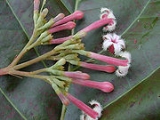
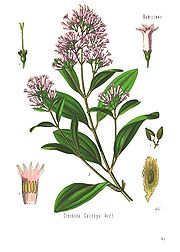
Cinchona or Quina is a genus
of about 38 species
in the family
Rubiaceae
, native to tropical South America
. They are large shrub
s or small tree
s growing 5–15 metres in height with evergreen
foliage. The leaves
are opposite, rounded to lanceolate and 10–40 cm long. The flower
s are white, pink or red, produced in terminal panicle
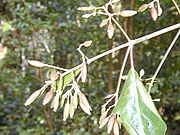
s. The fruit
is a small capsule
containing numerous seed
s.
The bark
of the tree is medicinally active
containing a variety of alkaloids, including the anti-malarial compound quinine
which interferes with the reproduction of malaria-causing protozoa
, and quinidine
, an antiarrhythmic.The bark is stripped from the tree, dried, and powdered for medicinal use. As a medicinal herb, cinchona bark is also known as Jesuit's bark
or Peruvian bark. The plants are cultivated in their native South America, and were transported for cultivation in other tropical regions notably India
Sri Lanka
by the British
and Java by the Dutch in nineteenth century.
The name of the genus is due to Carolus "Carl" Linnaeus
, who named the tree in 1742 after a Countess of Chinchón
, the wife of a viceroy of Peru, who, in 1638, was introduced by natives to the medicinal properties of the bark. Stories of the medicinal properties of this bark, however, are perhaps noted in journals as far back as the 1560s–1570s (see the Ortiz link below). Cinchona species are used as food plants by the larva
e of some Lepidoptera
species including The Engrailed
, The Commander, and members of the genus Endoclita
including E. damor, E. purpurescens and E. sericeus.
 The Italian botanist Pietro Castelli
wrote a pamphlet noteworthy as being the first Italian publication that mentions the cinchona. By the 1630s (or 1640s, depending on the reference), the bark was being exported to Europe. In the late 1640s, the method of use of the bark was noted in the Schedula Romana, and in 1677 the use of the bark was noted in the London Pharmacopoeia.
According to legend, the first European ever to be cured from malaria fever was the wife of the Spanish Viceroy of Peru, the countess of Chinchón. Chinchón
is a small town in central Spain. The court physician was summoned and urged to save the countess from the waves of fever and chill that were threatening her life, but every effort failed to relieve her. At last the physician administered some medicine which he had obtained from the local Indians, who had been using it for similar syndromes. The countess survived the malarial attack and reportedly brought the cinchona bark back with her when she returned to Europe in the 1640s.
In 1753 Carolus Linnaeus
named the bark Cinchona after the countess of Chinchón. The story of the cure of the countess, however, is doubtful.
Charles II
called upon Mr Robert Talbor, who had become famous for his miraculous malaria cure. Because at that time the bark was in religious controversy, Talbor gave the king the bitter bark decoction in great secrecy. The treatment gave the king complete relief from the malaria fever. In return, he was offered membership of the prestigious Royal College of Physicians.
In 1679 Talbor was called by the King of France, Louis XIV, whose son was suffering from malaria fever. After a successful treatment, Talbor was rewarded by the king with 3,000 gold crowns. At the same time he was given a lifetime pension for this prescription. Talbor, however, was asked to keep the entire episode secret.
After Talbor's death, the French king found this formula: six drams of rose leaves, two ounces of lemon juice and a strong decoction of the cinchona bark served with wine. Wine was used because some alkaloids of the cinchona bark are not soluble in water, but are soluble in [the ethanol in] wine.
The birth of homeopathy
was based on cinchona bark testing. The founder of homeopathy, Dr. Samuel Hahnemann
, when translating the Cullen's Materia medica
, noticed that Dr. Cullen
wrote that Peruvian bark was known to cure intermittent fevers. Dr. Hahnemann took daily a large, rather than homeopathic, dose of Peruvian bark. After two weeks, he said he felt malaria-like symptoms. This idea of "like cures like" was the starting point of his writings on "Homeopathy". Hahnemann's symptoms are believed to be the result of a hypersensitivity to Cinchona bark on his part.
In 1738, Sur l'arbre du quinquina, a paper written by Charles Marie de La Condamine
, a member of the expedition
that was sent to Peru
to determine the length of a degree of the meridian arc
in the neighbourhood of the equator
, was published by the French Academy of Sciences
. In it he identified three separate species.
In 1742, on the basis of a specimen received from La Condamine, Linnaeus named the tree Quinquina condaminiae and established a new genus, which he termed Cinchona quinquina condaminiae. In 1753 he described Cinchona officinalis as a separate species.
Further exploration of the Amazon valley and the economy of trade in various species of the bark in 18th century is captured by the extract from a book by Lardner Gibbon:
In 1860, a British
expedition to South America led by Clements Markham
brought back Cinchona seeds and plants, which were introduced in several areas in India and Sri Lanka. In Sri Lanka, it was planted in the Hakgala Botanical Garden
in January 1861. James Taylor
, the pioneer of tea planting in Sri Lanka, was one of the pioneers of Cinchona cultivation. By 1883 about 64000 acres (259 km²) were in cultivation in Sri Lanka, with exports reaching a peak of 15 million pounds in 1886.
In 1865, "New Virginia" and "Carlota Colony" were established in Mexico
by Matthew Fontaine Maury
. American post-war confederates were enticed there by internationally famous and former confederate, Matthew Fontaine Maury
, the Imperial Commissioner of Immigration through Emperor Maximillian
, Archduke of Habsburg. All that survives today of those two colonies are the flourishing groves of cinchonas, the quinine-producing trees purchased by Matthew Fontaine Maury
using seeds purchased from England. These seeds were the first to be introduced into Mexico. (Sources: "Life of Maury" by Diane Corbin and "Scientist of the Sea" by Frances Leigh Williams.)
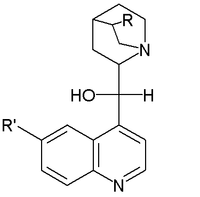 The bark of trees in this genus is the source of a variety of alkaloid
s, the most familiar of which is quinine
, an anti-fever
agent especially useful in treating malaria
.
Cinchona alkaloids include:
They find use in organic chemistry
as organocatalysts in asymmetric synthesis.
, a particular tannin, which by oxidation rapidly yields a dark-coloured phlobaphene called red cinchonic, cinchono-fulvic acid or cinchona red.
Genus
In biology, a genus is a low-level taxonomic rank used in the biological classification of living and fossil organisms, which is an example of definition by genus and differentia...
of about 38 species
Species
In biology, a species is one of the basic units of biological classification and a taxonomic rank. A species is often defined as a group of organisms capable of interbreeding and producing fertile offspring. While in many cases this definition is adequate, more precise or differing measures are...
in the family
Family (biology)
In biological classification, family is* a taxonomic rank. Other well-known ranks are life, domain, kingdom, phylum, class, order, genus, and species, with family fitting between order and genus. As for the other well-known ranks, there is the option of an immediately lower rank, indicated by the...
Rubiaceae
Rubiaceae
The Rubiaceae is a family of flowering plants, variously called the coffee family, madder family, or bedstraw family. The group contains many commonly known plants, including the economically important coffee , quinine , and gambier , and the horticulturally valuable madder , west indian jasmine ,...
, native to tropical South America
South America
South America is a continent situated in the Western Hemisphere, mostly in the Southern Hemisphere, with a relatively small portion in the Northern Hemisphere. The continent is also considered a subcontinent of the Americas. It is bordered on the west by the Pacific Ocean and on the north and east...
. They are large shrub
Shrub
A shrub or bush is distinguished from a tree by its multiple stems and shorter height, usually under 5–6 m tall. A large number of plants may become either shrubs or trees, depending on the growing conditions they experience...
s or small tree
Tree
A tree is a perennial woody plant. It is most often defined as a woody plant that has many secondary branches supported clear of the ground on a single main stem or trunk with clear apical dominance. A minimum height specification at maturity is cited by some authors, varying from 3 m to...
s growing 5–15 metres in height with evergreen
Evergreen
In botany, an evergreen plant is a plant that has leaves in all seasons. This contrasts with deciduous plants, which completely lose their foliage during the winter or dry season.There are many different kinds of evergreen plants, both trees and shrubs...
foliage. The leaves
Leaf
A leaf is an organ of a vascular plant, as defined in botanical terms, and in particular in plant morphology. Foliage is a mass noun that refers to leaves as a feature of plants....
are opposite, rounded to lanceolate and 10–40 cm long. The flower
Flower
A flower, sometimes known as a bloom or blossom, is the reproductive structure found in flowering plants . The biological function of a flower is to effect reproduction, usually by providing a mechanism for the union of sperm with eggs...
s are white, pink or red, produced in terminal panicle
Panicle
A panicle is a compound raceme, a loose, much-branched indeterminate inflorescence with pedicellate flowers attached along the secondary branches; in other words, a branched cluster of flowers in which the branches are racemes....
s. The fruit
Fruit
In broad terms, a fruit is a structure of a plant that contains its seeds.The term has different meanings dependent on context. In non-technical usage, such as food preparation, fruit normally means the fleshy seed-associated structures of certain plants that are sweet and edible in the raw state,...
is a small capsule
Capsule (fruit)
In botany a capsule is a type of simple, dry fruit produced by many species of flowering plants. A capsule is a structure composed of two or more carpels that in most cases is dehiscent, i.e. at maturity, it splits apart to release the seeds within. A few capsules are indehiscent, for example...
containing numerous seed
Seed
A seed is a small embryonic plant enclosed in a covering called the seed coat, usually with some stored food. It is the product of the ripened ovule of gymnosperm and angiosperm plants which occurs after fertilization and some growth within the mother plant...
s.
The bark
Bark
Bark is the outermost layers of stems and roots of woody plants. Plants with bark include trees, woody vines and shrubs. Bark refers to all the tissues outside of the vascular cambium and is a nontechnical term. It overlays the wood and consists of the inner bark and the outer bark. The inner...
of the tree is medicinally active
Biological activity
In pharmacology, biological activity or pharmacological activity describes the beneficial or adverse effects of a drug on living matter. When a drug is a complex chemical mixture, this activity is exerted by the substance's active ingredient or pharmacophore but can be modified by the other...
containing a variety of alkaloids, including the anti-malarial compound quinine
Quinine
Quinine is a natural white crystalline alkaloid having antipyretic , antimalarial, analgesic , anti-inflammatory properties and a bitter taste. It is a stereoisomer of quinidine which, unlike quinine, is an anti-arrhythmic...
which interferes with the reproduction of malaria-causing protozoa
Plasmodium falciparum
Plasmodium falciparum is a protozoan parasite, one of the species of Plasmodium that cause malaria in humans. It is transmitted by the female Anopheles mosquito. Malaria caused by this species is the most dangerous form of malaria, with the highest rates of complications and mortality...
, and quinidine
Quinidine
Quinidine is a pharmaceutical agent that acts as a class I antiarrhythmic agent in the heart. It is a stereoisomer of quinine, originally derived from the bark of the cinchona tree.-Mechanism:...
, an antiarrhythmic.The bark is stripped from the tree, dried, and powdered for medicinal use. As a medicinal herb, cinchona bark is also known as Jesuit's bark
Jesuit's bark
Jesuit's Bark, also called Peruvian Bark, is the historical name of the most celebrated specific remedy for all forms of malaria. It is so named because it was obtained from the bark of several species of the genus Cinchona, of the order Rubiaceae, that have been discovered at different times and...
or Peruvian bark. The plants are cultivated in their native South America, and were transported for cultivation in other tropical regions notably India
India
India , officially the Republic of India , is a country in South Asia. It is the seventh-largest country by geographical area, the second-most populous country with over 1.2 billion people, and the most populous democracy in the world...
Sri Lanka
Sri Lanka
Sri Lanka, officially the Democratic Socialist Republic of Sri Lanka is a country off the southern coast of the Indian subcontinent. Known until 1972 as Ceylon , Sri Lanka is an island surrounded by the Indian Ocean, the Gulf of Mannar and the Palk Strait, and lies in the vicinity of India and the...
by the British
British Raj
British Raj was the British rule in the Indian subcontinent between 1858 and 1947; The term can also refer to the period of dominion...
and Java by the Dutch in nineteenth century.
The name of the genus is due to Carolus "Carl" Linnaeus
Carolus Linnaeus
Carl Linnaeus , also known after his ennoblement as , was a Swedish botanist, physician, and zoologist, who laid the foundations for the modern scheme of binomial nomenclature. He is known as the father of modern taxonomy, and is also considered one of the fathers of modern ecology...
, who named the tree in 1742 after a Countess of Chinchón
Chinchón
Chinchón is a Spanish town 50 km southeast of Madrid. It is part of the Comarca de Las Vegas.-Overview:The Plaza Mayor is roughly circular, surrounded by 15th-17th century galleried houses and cafés and is used as a temporary bullring. The church of Nuestra Señora de la Asunción was built in...
, the wife of a viceroy of Peru, who, in 1638, was introduced by natives to the medicinal properties of the bark. Stories of the medicinal properties of this bark, however, are perhaps noted in journals as far back as the 1560s–1570s (see the Ortiz link below). Cinchona species are used as food plants by the larva
Larva
A larva is a distinct juvenile form many animals undergo before metamorphosis into adults. Animals with indirect development such as insects, amphibians, or cnidarians typically have a larval phase of their life cycle...
e of some Lepidoptera
Lepidoptera
Lepidoptera is a large order of insects that includes moths and butterflies . It is one of the most widespread and widely recognizable insect orders in the world, encompassing moths and the three superfamilies of butterflies, skipper butterflies, and moth-butterflies...
species including The Engrailed
Engrailed
The Engrailed and Small Engrailed are moths of the family Geometridae. They are distributed across most of Europe. There is an on-going debate as to whether they make up one species, or whether E. crepuscularia actually refers only to the Small Engrailed, with the Engrailed proper being separable...
, The Commander, and members of the genus Endoclita
Endoclita
Endoclita is a genus of moths of the family Hepialidae. There are 60 described species found in eastern and southeast Asia and the Indian subcontinent.- Species :*E. aboe - India*E. absurdus - China*E. actinidae - China...
including E. damor, E. purpurescens and E. sericeus.
History
Pietro Castelli
Pietro Castelli was an Italian physician and botanist.Born at Rome, he was graduated in 1617 and studied under the botanist Andrea Cesalpino . He was professor at Rome from 1597 until 1634, when he went to Messina...
wrote a pamphlet noteworthy as being the first Italian publication that mentions the cinchona. By the 1630s (or 1640s, depending on the reference), the bark was being exported to Europe. In the late 1640s, the method of use of the bark was noted in the Schedula Romana, and in 1677 the use of the bark was noted in the London Pharmacopoeia.
According to legend, the first European ever to be cured from malaria fever was the wife of the Spanish Viceroy of Peru, the countess of Chinchón. Chinchón
Chinchón
Chinchón is a Spanish town 50 km southeast of Madrid. It is part of the Comarca de Las Vegas.-Overview:The Plaza Mayor is roughly circular, surrounded by 15th-17th century galleried houses and cafés and is used as a temporary bullring. The church of Nuestra Señora de la Asunción was built in...
is a small town in central Spain. The court physician was summoned and urged to save the countess from the waves of fever and chill that were threatening her life, but every effort failed to relieve her. At last the physician administered some medicine which he had obtained from the local Indians, who had been using it for similar syndromes. The countess survived the malarial attack and reportedly brought the cinchona bark back with her when she returned to Europe in the 1640s.
In 1753 Carolus Linnaeus
Carolus Linnaeus
Carl Linnaeus , also known after his ennoblement as , was a Swedish botanist, physician, and zoologist, who laid the foundations for the modern scheme of binomial nomenclature. He is known as the father of modern taxonomy, and is also considered one of the fathers of modern ecology...
named the bark Cinchona after the countess of Chinchón. The story of the cure of the countess, however, is doubtful.
Charles II
Charles II of England
Charles II was monarch of the three kingdoms of England, Scotland, and Ireland.Charles II's father, King Charles I, was executed at Whitehall on 30 January 1649, at the climax of the English Civil War...
called upon Mr Robert Talbor, who had become famous for his miraculous malaria cure. Because at that time the bark was in religious controversy, Talbor gave the king the bitter bark decoction in great secrecy. The treatment gave the king complete relief from the malaria fever. In return, he was offered membership of the prestigious Royal College of Physicians.
In 1679 Talbor was called by the King of France, Louis XIV, whose son was suffering from malaria fever. After a successful treatment, Talbor was rewarded by the king with 3,000 gold crowns. At the same time he was given a lifetime pension for this prescription. Talbor, however, was asked to keep the entire episode secret.
After Talbor's death, the French king found this formula: six drams of rose leaves, two ounces of lemon juice and a strong decoction of the cinchona bark served with wine. Wine was used because some alkaloids of the cinchona bark are not soluble in water, but are soluble in [the ethanol in] wine.
The birth of homeopathy
Homeopathy
Homeopathy is a form of alternative medicine in which practitioners claim to treat patients using highly diluted preparations that are believed to cause healthy people to exhibit symptoms that are similar to those exhibited by the patient...
was based on cinchona bark testing. The founder of homeopathy, Dr. Samuel Hahnemann
Samuel Hahnemann
Christian Friedrich Samuel Hahnemann was a German physician, known for creating an alternative form of medicine called homeopathy.- Early life :Christian Friedrich Samuel Hahnemann was born in Meissen, Saxony near Dresden...
, when translating the Cullen's Materia medica
Materia medica
Materia medica is a Latin medical term for the body of collected knowledge about the therapeutic properties of any substance used for healing . The term 'materia medica' derived from the title of a work by the Ancient Greek physician Pedanius Dioscorides in the 1st century AD, De materia medica libre...
, noticed that Dr. Cullen
William Cullen
William Cullen FRS FRSE FRCPE FPSG was a Scottish physician, chemist and agriculturalist, and one of the most important professors at the Edinburgh Medical School, during its heyday as the leading center of medical education in the English-speaking world.Cullen was also a central figure in the...
wrote that Peruvian bark was known to cure intermittent fevers. Dr. Hahnemann took daily a large, rather than homeopathic, dose of Peruvian bark. After two weeks, he said he felt malaria-like symptoms. This idea of "like cures like" was the starting point of his writings on "Homeopathy". Hahnemann's symptoms are believed to be the result of a hypersensitivity to Cinchona bark on his part.
In 1738, Sur l'arbre du quinquina, a paper written by Charles Marie de La Condamine
Charles Marie de La Condamine
Charles Marie de La Condamine was a French explorer, geographer, and mathematician. He spent ten years in present-day Ecuador measuring the length of a degree latitude at the equator and preparing the first map of the Amazon region based on astronomical observations.-Biography:Charles Marie de La...
, a member of the expedition
French Geodesic Mission
The French Geodesic Mission was an 18th-century expedition to what is now Ecuador carried out for the purpose of measuring the roundness of the Earth and measuring the length of a degree of longitude at the Equator...
that was sent to Peru
Peru
Peru , officially the Republic of Peru , is a country in western South America. It is bordered on the north by Ecuador and Colombia, on the east by Brazil, on the southeast by Bolivia, on the south by Chile, and on the west by the Pacific Ocean....
to determine the length of a degree of the meridian arc
Meridian arc
In geodesy, a meridian arc measurement is a highly accurate determination of the distance between two points with the same longitude. Two or more such determinations at different locations then specify the shape of the reference ellipsoid which best approximates the shape of the geoid. This...
in the neighbourhood of the equator
Equator
An equator is the intersection of a sphere's surface with the plane perpendicular to the sphere's axis of rotation and containing the sphere's center of mass....
, was published by the French Academy of Sciences
French Academy of Sciences
The French Academy of Sciences is a learned society, founded in 1666 by Louis XIV at the suggestion of Jean-Baptiste Colbert, to encourage and protect the spirit of French scientific research...
. In it he identified three separate species.
In 1742, on the basis of a specimen received from La Condamine, Linnaeus named the tree Quinquina condaminiae and established a new genus, which he termed Cinchona quinquina condaminiae. In 1753 he described Cinchona officinalis as a separate species.
Cultivation
The bark was very valuable to Europeans in expanding their access to and exploitation of resources in far off colonies, and at home. Bark gathering was often environmentally destructive, destroying huge expanses of trees for their bark, with difficult conditions for low wages that did not allow the indigenous bark gatherers to settle debts even upon death.Further exploration of the Amazon valley and the economy of trade in various species of the bark in 18th century is captured by the extract from a book by Lardner Gibbon:
"...this bark was first gathered in quantities in 1849, though known for many years. The best quality is not quite equal to that of Yungas, but only second to it. There are four other classes of inferior bark, for some of which the bank pays fifteen dollars per quintal. The best, by law, is worth fifty-four dollars. The freight to Arica is seventeen dollars the mule load of three quintals. Six thousand quintals of bark have already been gathered from Yuracares. The bank was established in the year 1851. Mr. [Thaddäus] Haenke mentioned the existence of cinchona bark on his visit to Yuracares in 1796."(Source: Exploration of the Valley of the Amazon, by Lieut. Lardner Gibbon, USN. Vol.II, Ch.6, pp. 146-47.)
In 1860, a British
United Kingdom of Great Britain and Ireland
The United Kingdom of Great Britain and Ireland was the formal name of the United Kingdom during the period when what is now the Republic of Ireland formed a part of it....
expedition to South America led by Clements Markham
Clements Markham
Sir Clements Robert Markham KCB FRS was an English geographer, explorer, and writer. He was secretary of the Royal Geographical Society between 1863 and 1888, and later served as the Society's president for a further 12 years...
brought back Cinchona seeds and plants, which were introduced in several areas in India and Sri Lanka. In Sri Lanka, it was planted in the Hakgala Botanical Garden
Hakgala Botanical Garden
Hakgala Botanical Garden is one of the three botanical gardens in Sri Lanka. The other two being Peradeniya Botanical Garden and Henarathgoda Botanical Garden. It is the second largest garden in Sri Lanka. The garden is contiguous to Hakgala Strict Nature Reserve.-Location and climate:Hakgala...
in January 1861. James Taylor
James Taylor (Ceylon)
James Taylor was a British citizen who introduced the tea plantation in Sri Lanka . He arrived to Sri Lanka in 1852 and settled down in Loolecondera estate in Kandy. He lived in Sri Lanka more than half of his lifetime 57 years until his death...
, the pioneer of tea planting in Sri Lanka, was one of the pioneers of Cinchona cultivation. By 1883 about 64000 acres (259 km²) were in cultivation in Sri Lanka, with exports reaching a peak of 15 million pounds in 1886.
In 1865, "New Virginia" and "Carlota Colony" were established in Mexico
Mexico
The United Mexican States , commonly known as Mexico , is a federal constitutional republic in North America. It is bordered on the north by the United States; on the south and west by the Pacific Ocean; on the southeast by Guatemala, Belize, and the Caribbean Sea; and on the east by the Gulf of...
by Matthew Fontaine Maury
Matthew Fontaine Maury
Matthew Fontaine Maury , United States Navy was an American astronomer, historian, oceanographer, meteorologist, cartographer, author, geologist, and educator....
. American post-war confederates were enticed there by internationally famous and former confederate, Matthew Fontaine Maury
Matthew Fontaine Maury
Matthew Fontaine Maury , United States Navy was an American astronomer, historian, oceanographer, meteorologist, cartographer, author, geologist, and educator....
, the Imperial Commissioner of Immigration through Emperor Maximillian
Maximilian I of Mexico
Maximilian I was the only monarch of the Second Mexican Empire.After a distinguished career in the Austrian Navy, he was proclaimed Emperor of Mexico on April 10, 1864, with the backing of Napoleon III of France and a group of Mexican monarchists who sought to revive the Mexican monarchy...
, Archduke of Habsburg. All that survives today of those two colonies are the flourishing groves of cinchonas, the quinine-producing trees purchased by Matthew Fontaine Maury
Matthew Fontaine Maury
Matthew Fontaine Maury , United States Navy was an American astronomer, historian, oceanographer, meteorologist, cartographer, author, geologist, and educator....
using seeds purchased from England. These seeds were the first to be introduced into Mexico. (Sources: "Life of Maury" by Diane Corbin and "Scientist of the Sea" by Frances Leigh Williams.)
Cinchona alkaloids
Alkaloid
Alkaloids are a group of naturally occurring chemical compounds that contain mostly basic nitrogen atoms. This group also includes some related compounds with neutral and even weakly acidic properties. Also some synthetic compounds of similar structure are attributed to alkaloids...
s, the most familiar of which is quinine
Quinine
Quinine is a natural white crystalline alkaloid having antipyretic , antimalarial, analgesic , anti-inflammatory properties and a bitter taste. It is a stereoisomer of quinidine which, unlike quinine, is an anti-arrhythmic...
, an anti-fever
Antipyretic
Antipyretics ; an-tee-pahy-ret-iks; from the Greek anti, against, and pyreticus, are drugs or herbs that reduce fever. Normally, they will not lower body temperature if one does not have a fever. Antipyretics cause the hypothalamus to override an interleukin-induced increase in temperature...
agent especially useful in treating malaria
Malaria
Malaria is a mosquito-borne infectious disease of humans and other animals caused by eukaryotic protists of the genus Plasmodium. The disease results from the multiplication of Plasmodium parasites within red blood cells, causing symptoms that typically include fever and headache, in severe cases...
.
Cinchona alkaloids include:
- cinchonineCinchonineCinchonine is an alkaloid with molecular formula C19H22N2O used in asymmetric synthesis in organic chemistry. It is a stereoisomer and pseudo-enantiomer of cinchonidine....
and cinchonidineCinchonidineCinchonidine is an alkaloid used in asymmetric synthesis in organic chemistry. It is a stereoisomer and pseudo-enantiomer of cinchonine....
(stereoisomers with R = vinyl, R' = hydrogenHydrogenHydrogen is the chemical element with atomic number 1. It is represented by the symbol H. With an average atomic weight of , hydrogen is the lightest and most abundant chemical element, constituting roughly 75% of the Universe's chemical elemental mass. Stars in the main sequence are mainly...
) - quinineQuinineQuinine is a natural white crystalline alkaloid having antipyretic , antimalarial, analgesic , anti-inflammatory properties and a bitter taste. It is a stereoisomer of quinidine which, unlike quinine, is an anti-arrhythmic...
and quinidineQuinidineQuinidine is a pharmaceutical agent that acts as a class I antiarrhythmic agent in the heart. It is a stereoisomer of quinine, originally derived from the bark of the cinchona tree.-Mechanism:...
(stereoisomers with R = vinylVinylA vinyl compound is any organic compound that contains a vinyl group ,which are derivatives of ethene, CH2=CH2, with one hydrogen atom replaced with some other group...
, R' = methoxyMethoxyIn chemistry , methoxy refers to the functional group consisting of a methyl group bound to oxygen. This alkoxy group has the formula O–CH3.The word is used in organic nomenclature usually to describe an ether...
) - dihydroquinidineDihydroquinidineDihydroquinidine is an organic compound and as a cinchona alkaloid closely related to quinine. The specific rotation is +226° in ethanol @ 2g/100 ml. A derivative of this molecule is used as chiral ligand in the AD-mix for Sharpless Dihydroxylation....
& dihydroquinineDihydroquinineDihydroquinine, also known as hydroquinine, is an organic compound and as a cinchona alkaloid closely related to quinine. The specific rotation is -148° in ethanol. A derivative of this molecule is used as chiral ligand in the AD-mix for Sharpless dihydroxylation....
(stereoisomers with R = ethylEthyl groupIn chemistry, an ethyl group is an alkyl substituent derived from ethane . It has the formula -C2H5 and is very often abbreviated -Et.Ethylation is the formation of a compound by introduction of the ethyl functional group, C2H5....
, R' = methoxy)
They find use in organic chemistry
Organic chemistry
Organic chemistry is a subdiscipline within chemistry involving the scientific study of the structure, properties, composition, reactions, and preparation of carbon-based compounds, hydrocarbons, and their derivatives...
as organocatalysts in asymmetric synthesis.
Other chemicals
Alongside the alkaloids, many cinchona barks contain cinchotannic acidCinchotannic acid
Cinchotannic acid is a tannin contained in many cinchona barks, which by oxidation rapidly yields a dark-coloured phlobaphene called red cinchonic, cinchono-fulvic acid or cinchona red....
, a particular tannin, which by oxidation rapidly yields a dark-coloured phlobaphene called red cinchonic, cinchono-fulvic acid or cinchona red.
Species
|