
All Topics  
Corm

 
Corm

   Email Print
   Bookmark   Link


Corm


A corm is a short, vertical, swollen underground plant
Plant

Plants are Life organisms belonging to the Kingdom Plantae. They include familiar organisms such as trees, herbs, bushes, grasses, vines, ferns, mosses, and green algae....
 stem
Plant stem

A stem is one of two main structural axes of a vascular plant. The stem is normally divided into nodes and internodes, the nodes hold buds which grow into one or more leaf, inflorescence , conifer cones or other stems etc....
 that serves as a storage organ
Storage organ

A storage organ is a part of a plant specifically modified for storage of energy or water. Storage organs often grow underground, where they are better protected from attack by herbivores....
 used by some plants to survive winter or other adverse conditions such as summer drought and heat (estivation
Estivation

Estivation or aestivation , also known as "summer sleep", is a state of dormancy somewhat similar to hibernation. It takes place during times of heat and dryness, the hot dry season, which is often but not inevitably the summer months....
). A corm consists of one or more internodes with at least one growing point, with protective leaves modified into skins or tunics.


Discussion
Ask a question about 'Corm'
Start a new discussion about 'Corm'
Answer questions from other users
Full Discussion Forum


Encyclopedia


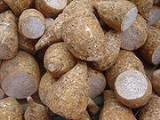
Colocasia Esculenta Dsc07801
A corm is a short, vertical, swollen underground plant
Plant

Plants are Life organisms belonging to the Kingdom Plantae. They include familiar organisms such as trees, herbs, bushes, grasses, vines, ferns, mosses, and green algae....
 stem
Plant stem

A stem is one of two main structural axes of a vascular plant. The stem is normally divided into nodes and internodes, the nodes hold buds which grow into one or more leaf, inflorescence , conifer cones or other stems etc....
 that serves as a storage organ
Storage organ

A storage organ is a part of a plant specifically modified for storage of energy or water. Storage organs often grow underground, where they are better protected from attack by herbivores....
 used by some plants to survive winter or other adverse conditions such as summer drought and heat (estivation
Estivation

Estivation or aestivation , also known as "summer sleep", is a state of dormancy somewhat similar to hibernation. It takes place during times of heat and dryness, the hot dry season, which is often but not inevitably the summer months....
). A corm consists of one or more internodes with at least one growing point, with protective leaves modified into skins or tunics. The thin tunic leaves are dry papery, dead petiole sheaths, formed from the leaves produced the year before, which act as a covering that protects the corm from insects and water loss. Internally a corm is mostly made of starch-containing parenchyma
Parenchyma

Parenchyma is a term used to describe a bulk of a substance. It is used in different ways in animals and in plants.The term is New Latin, from Greek language parenkhuma, visceral flesh, from parenkhein, to pour in beside : para-, beside + en-, in + khein, to pour....
 cells above a circular basal node that grows roots.

Corms are not bulbs


Corms are sometimes confused with true bulb
Bulb

A bulb is an underground vertical shoot that has modified leaf that are used as food storage organs by a dormancy plant.A bulb's leaf bases generally do not support leaves, but contain food reserves to enable the plant to survive adverse conditions....
s; they are often similar in appearance to bulbs externally, and thus erroneously called bulbs. Corms are stems that are internally structured with solid tissues, which distinguishes them from bulbs, which are mostly made up of layered fleshy scales that are modified leaves. As a result, when a corm is cut in half it is solid, but when a true bulb is cut in half it is made up of layers. Corms are structurally plant stems, with nodes and internodes with buds and produce adventitious
Adventitious

Adventitious, in botany, refers to structures that develop in an unusual place, and in medicine, it refers to conditions acquired after birth. This article discusses adventitious roots, buds and shoots, which are very common in vascular plants....
 roots. On the top of the corm, one or a few buds grow into shoots that produce normal leaves and flowers.

Cormels


Corms can form many small cormlets called cormels, from the basal areas of the new growing corms, especially when the main growing point is damaged. They are used to propagate corm forming plants. Corms of a number of species of plants are replaced every year by the plant with growth of a new corm; this process starts after the shoot has developed fully expanded leaves. The new corm forms at the shoot base just above the old corm. As the new corm is growing, short stolon
Stolon

Stolons are horizontal plant stems which grow at the soil surface or below ground. They form new plants at the ends or at the Node s. Stolons are often called runners....
s are produced that end with the newly growing small cormels. As the plants grow and flower, the old corm is used up and shrivels away. The new corm that replaces the old corm grows in size, especially after flowering is done.

The old corm produces the greatest number of cormels when it is close to the soil surface. The small cormels normally take one or two more years of growth before they are large enough to flower.

Corms can be dug up and used to propagate or redistribute the plant (see, for example, taro
Taro

Taro , more rarely kalo , gabi in The Philippines and dalo in Fiji is a tropical plant grown primarily as a root vegetable for its edible corm, and secondarily as a leaf vegetable....
). Plants with corms can be propagated by cutting the corms into sections and replanting. Each section with a bud will generate a new corm.

Roots


Many corms produce two different types of roots. Those growing from the bottom of the corm are normal fibrous roots, they are formed as the shoots grow, and are produced from the basal area at the bottom of the corm. The second type of roots are thicker layered roots that form as the new corms are growing, they are called contractile roots and they pull the corm deeper into the soil. They are produced in response to fluctuating soil temperatures and light levels. Once the corm is deep enough within the soil where the temperature is more uniform and there is no light, the contractile roots no longer grow and the corm is no longer pulled deeper into the soil.

Plants with corms


Cultivated plants that form corms include:
  • Arisaema
    Arisaema

    Arisaema is a genus of about 150 species in the flowering plant family Araceae, native to eastern and central Africa, Asia and eastern North America....
  • Bessera
    Bessera

    Bessera is a genus of plants in the Themidaceae family Also placed in: Alliaceae or Liliaceae.A small genus of mostly herbaceous flowering plants with corms, they are Perennial plant native to Mexico; They have flowers with petals and petaloid sepals with compound pistils....
  • Banana
    Banana

    File:Banana and cross section.jpgBanana is the common name for a fruit and also the herbaceous plants of the genus Musa which produce this commonly eaten fruit....
     
  • Brodiaea
    Brodiaea

    The genus Brodiaea belongs to the order Asparagales. Brodiaea occurs in the West Coast of the United States, especially northern California....
  • Crocosmia
    Crocosmia

    Crocosmia , is a small genus of perennial species in the iris family Iridaceae, native to the grasslands of Cape Floristic Region, South Africa....
  • Crocus
    Crocus

    Crocus is a genus of perennial plant flowering plants, native to a large area from coastal and subalpine areas of central and southern Europe , North Africa and the Middle East, across Central Asia to western China....
  • Cyclamen
    Cyclamen

    Cyclamen is a genus of 23 species of flowering plants, traditionally classified in the family Primulaceae, but in recent years reclassified in the family Myrsinaceae....
  • Dichelostemma
    Dichelostemma

    Dichelostemma is a genus of seven species of flowering plants in the order Asparagales. The genus is native to the western United States, especially in northern California, but also east to Utah and north to Oregon and southern Washington....
  • Dierama
    Dierama

    Dierama is a genus in the Iridaceae and is popularly known as Fairy's Fishing Rods or Fairy's Wand. Its cultivars produce graceful flower shoots bearing flowers of a range of colours from white through to dark red....
  • Eleocharis dulcis
    Eleocharis dulcis

    The Chinese water chestnut , more often called simply the water chestnut, is a grass-like Cyperaceae grown for its edible corms. It has tube-shaped, leafless green stems that grow to about 1.5 metres....
    (Chinese water chestnut)
  • Ensete
    Ensete

    Ensete, or Enset, is one of three genus of plants in the banana family, Musaceae, native to tropical regions of Africa and Asia....
    spp. (enset)
  • Freesia
    Freesia

    Freesia is a genus of 14-16 species of flowering plants in the family Iridaceae, native to Africa. Of the 14 species, 12 are native to Cape Province, South Africa, the remaining two to tropical Africa, one species extending north of the equator to Sudan....
  • Gladiolus
    Gladiolus

    Gladiolus is a genus of flowering plants in the iris family . Sometimes called the sword lily, the most widely-used English language common name for these plants is simply gladiolus ....
  • Iris
    Iris (plant)

    Iris is a genus of between 200-300 species of flowering plants with showy flowers. It takes its name from the Greek word for a rainbow, referring to the wide variety of flower colors found among the many species....
    some species.
  • Konjac
  • Liatris
    Liatris

    Liatris is a genus of ornamental plants in the Asteraceae family, native to North America, Mexico, and the Bahamas. These plants are used as a popular summer flowers for bouquets....
  • Milla
    Milla

    Milla is a genus of plant belonging to the family Themidaceae and contains the following species of plants.* Milla biflora, Mexican star...
  • Musa
    Musa (genus)

    Musa is one of three genera in the family Musaceae; it includes bananas and plantains. There are over 50 species of Musa with a broad variety of uses....
  • Montbretia
  • Romulea
    Romulea

    Romulea is a genus of about 80 species of flowering plants in the Iridaceae family distributed in Europe, the Mediterranean, and South Africa....
  • Saffron
    Saffron

    Saffron is a spice derived from the dried gynoecium of the flower of the saffron crocus , a species of crocus in the family Iridaceae. The flower has three Carpels, which are the anatomical terms of location ends of the plant's carpels....
  • Sagittaria
    Sagittaria

    Sagittaria or "arrowhead" is a genus of about 20 species of aquatic plants whose members go by a variety of common names, including arrowhead, duck potato, iz-ze-kn, katniss, kuwai , swan potato, tule potato, and wapato ....
    spp. (arrowhead or wapatoo)
  • Tecophilaea
  • Taro
    Colocasia esculenta

    Colocasia esculenta is a tropical plant grown primarily for its edible corm, a root vegetable known as Taro. It is believed to be one of the earliest cultivated plants....
  • Xanthosoma
    Xanthosoma

    Xanthosoma is a genus of about 50 species of tropical and sub-tropical arums in the flowering plant family, Araceae, all native to tropical Americas....
     spp. (malanga, cocoyam, tannia, and other names)


See also

  • Rhizome
    Rhizome

    In botany, a rhizome is a characteristically horizontal plant stem of a plant that is usually found underground, often sending out roots and shoots from its nodes....
  • Tuber
    Tuber

    Tubers are various types of modified plant structures that are enlarged to store nutrients. They are used by plants to overwinter and regrow the next year and as a means of asexual reproduction....
  • Root vegetable
    Root vegetable

    Root vegetables are plant roots used as vegetables. Other underground plants are often, erroneously, called root vegetables. Root vegetables include both true roots such as tuberous roots and taproots, but exclude non-roots such as tubers, rhizomes, corms, and bulbs....