

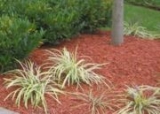
Mulch

Encyclopedia
In agriculture
and gardening
, mulch is a protective cover placed over the soil
to retain moisture, reduce erosion, provide nutrients, and suppress weed growth and seed germination. Mulching in gardens and landscaping
mimics the leaf cover that is found on forest
floors.
A variety of materials are used as mulch:
and dew
affects its usefulness.
There is a belief that organic mulches can negatively affect plant growth when they are decomposed rapidly by bacteria and fungi, which require nitrogen
that they remove from the surrounding soil. However, whether this effect has any practical impact on gardens is disputed by researchers and the experience of gardeners. Organic mulches can mat down, forming a barrier that blocks water and air flow between the soil and the atmosphere. Some organic mulches can wick water from the soil to the surface, which can dry out the soil.
Commonly available organic mulches include:
Mulch, when applied to the soil in late winter/early spring, will slow the warming of the soil by acting as an insulator
, and will hold in moisture by preventing evaporation
.
Mulch, when applied at the time of peak soil temperatures in mid-summer, will maintain high soil temperatures further into the autumn (fall). The effect of mulch upon soil moisture content in mid-summer is complex however. Mulch prevents sunlight from reaching the soil surface, thus reducing evaporation. However, mulch can absorb much of the rainfall provided during light rainfall, which will later quickly evaporate when exposed to sunlight, thus preventing absorption into the soil, while heavy rainfall is able to saturate the mulch layer, and reach the soil below.
In order to maximise the benefits of mulch, while minimizing its negative influences, it is often applied in late spring/early summer when soil temperatures have risen sufficiently, but soil moisture content is still relatively high. Furthermore, at this point in the growing season, plants should be well enough established to be able to cope with the increase in the numbers of slugs and snails owing to the habitat provided for them by the mulch. However, permanent mulch is also widely used and valued for its simplicity, as popularized by author Ruth Stout
, who said, "My way is simply to keep a thick mulch of any vegetable matter that rots on both sides of my vegetable and flower garden all year long. As it decays and enriches the soils, I add more."
Plastic mulch used in large-scale commercial production is laid down with a tractor
-drawn or standalone layer of plastic mulch
. This is usually part of a sophisticated mechanical process, where raised beds are formed, plastic is rolled out on top, and seedling
s are transplanted
through it. Drip irrigation
is often required, with drip tape laid under the plastic, as plastic mulch is impermeable to water.
In home gardens and smaller farming operations, organic mulch is usually spread by hand around emerged plants. (On plots with existing mulch, the mulch is pulled away from the seedbed before planting, and restored after the seedlings have emerged.) For materials like straw and hay, a shredder may be used to chop up the material. Organic mulches are usually piled quite high, six inches (152 mm) or more, and settle over the season.
In some areas of the United States, such as central Pennsylvania
and northern California, mulch is often referred to as "tanbark
", even by manufacturers and distributors. In these areas, the word "mulch" is used specifically to refer to very fine tanbark or peat moss.
Mulch made with wood can contain or feed termites, so care must be taken about not placing mulch too close to houses or building that can be damaged by those insects. Some mulch manufacturers recommend putting mulch several inches away from buildings.
that causes it to smell like vinegar
, ammonia
, sulfur
or silage
. This happens when material with ample nitrogen content is not rotated often enough and it forms pockets of increased decomposition. When this occurs, the process may become anaerobic and produce these phytotoxic materials in small quantities. Once exposed to the air, the process quickly reverts to an aerobic process, but these toxic materials may be present for a period of time. If the mulch is placed around plants before the toxicity has had a chance to dissipate, then the plants could very likely be damaged or killed depending on their hardiness. Plants that are predominantly low to the ground or freshly planted are the most susceptible, and the phytotoxicity may prevent germination of some seeds.
If sour mulch is applied and there is plant kill, the best thing to do is to water the mulch heavily. Water dissipates the chemicals faster and refreshes the plants. Removing the offending mulch may have little effect, because by the time plant kill is noticed, most of the toxicity is already dissipated. While testing after plant kill will not likely turn up anything, a simple pH
check may reveal high acidity, in the range of 3.8 to 5.6 instead of the normal range of 6.0 to 7.2. Finally, placing a bit of the offending mulch around another plant to check for plant kill will verify if the toxicity has departed. If the new plant is also killed, then sour mulch is probably not the problem.
are plants which grow close to the ground, under the main crop, to slow the development of weeds and provide other benefits of mulch. They are usually fast-growing plants that continue growing with the main crops. By contrast, cover crop
s are incorporated into the soil or killed with herbicide
s. However, living mulches also may need to be mechanically or chemically killed eventually to prevent competition with the main crop.
Some groundcovers can perform additional roles in the garden such as nitrogen fixation
in the case of clovers, dynamic accumulation of nutrients from the subsoil
in the case of creeping comfrey
(Symphytum ibericum), and even food production in the case of Rubus
Tricolor.
, cutting
, mowing, pulling, raking, or tilling
. The higher the temperature that this "mulch" is composted, the quicker the reduction of undesirable materials. "Undesirable materials" may include living seed, plant "trash
", as well as pathogens such as from animal feces
, urine (e.g. hantavirus
), fleas, lice, ticks, etc.
In some ways this improves the soil by attracting and feeding earthworms, and adding humus. Earthworms "till" the soil, and their feces are among the best fertilizer
s and soil conditioner
s.
Urine may be toxic to plants
if applied to growing areas undiluted. See Compost ingredients: Urine.
Agriculture
Agriculture is the cultivation of animals, plants, fungi and other life forms for food, fiber, and other products used to sustain life. Agriculture was the key implement in the rise of sedentary human civilization, whereby farming of domesticated species created food surpluses that nurtured the...
and gardening
Gardening
Gardening is the practice of growing and cultivating plants. Ornamental plants are normally grown for their flowers, foliage, or overall appearance; useful plants are grown for consumption , for their dyes, or for medicinal or cosmetic use...
, mulch is a protective cover placed over the soil
Soil
Soil is a natural body consisting of layers of mineral constituents of variable thicknesses, which differ from the parent materials in their morphological, physical, chemical, and mineralogical characteristics...
to retain moisture, reduce erosion, provide nutrients, and suppress weed growth and seed germination. Mulching in gardens and landscaping
Landscaping
Landscaping refers to any activity that modifies the visible features of an area of land, including:# living elements, such as flora or fauna; or what is commonly referred to as gardening, the art and craft of growing plants with a goal of creating a beautiful environment within the landscape.#...
mimics the leaf cover that is found on forest
Forest
A forest, also referred to as a wood or the woods, is an area with a high density of trees. As with cities, depending where you are in the world, what is considered a forest may vary significantly in size and have various classification according to how and what of the forest is composed...
floors.
Materials
Materials used as mulches vary and depend on a number of factors. Use takes into consideration availability, cost, appearance, the effect it has on the soil — including chemical reactions and pH, durability, combustibility, rate of decomposition, how clean it is — some can contain weed seeds or plant pathogens.A variety of materials are used as mulch:
- Organic residues: grassGrassGrasses, or more technically graminoids, are monocotyledonous, usually herbaceous plants with narrow leaves growing from the base. They include the "true grasses", of the Poaceae family, as well as the sedges and the rushes . The true grasses include cereals, bamboo and the grasses of lawns ...
clippings, leavesLeafA leaf is an organ of a vascular plant, as defined in botanical terms, and in particular in plant morphology. Foliage is a mass noun that refers to leaves as a feature of plants....
, hayHayHay is grass, legumes or other herbaceous plants that have been cut, dried, and stored for use as animal fodder, particularly for grazing livestock such as cattle, horses, goats, and sheep. Hay is also fed to pets such as rabbits and guinea pigs...
, strawStrawStraw is an agricultural by-product, the dry stalks of cereal plants, after the grain and chaff have been removed. Straw makes up about half of the yield of cereal crops such as barley, oats, rice, rye and wheat. It has many uses, including fuel, livestock bedding and fodder, thatching and...
, kitchen scraps comfreyComfreyComfrey is an important herb in organic gardening. It is used as a fertilizer and also has many purported medicinal uses...
, shredded barkBarkBark is the outermost layers of stems and roots of woody plants. Plants with bark include trees, woody vines and shrubs. Bark refers to all the tissues outside of the vascular cambium and is a nontechnical term. It overlays the wood and consists of the inner bark and the outer bark. The inner...
, whole bark nuggets, sawdustSawdustSawdust is a by-product of cutting lumber with a saw, composed of fine particles of wood. It can present a hazard in manufacturing industries, especially in terms of its flammability....
, shellGastropod shellThe gastropod shell is a shell which is part of the body of a gastropod or snail, one kind of mollusc. The gastropod shell is an external skeleton or exoskeleton, which serves not only for muscle attachment, but also for protection from predators and from mechanical damage...
s, woodchipsWoodchipsWoodchips are a medium-sized solid material made by cutting, or chipping, larger pieces of wood. Woodchips may be used as a biomass solid fuel. They may also be used as an organic mulch in gardening, landscaping, restoration ecology and mushroom cultivation...
, shredded newspaperNewspaperA newspaper is a scheduled publication containing news of current events, informative articles, diverse features and advertising. It usually is printed on relatively inexpensive, low-grade paper such as newsprint. By 2007, there were 6580 daily newspapers in the world selling 395 million copies a...
, cardboard, woolWoolWool is the textile fiber obtained from sheep and certain other animals, including cashmere from goats, mohair from goats, qiviut from muskoxen, vicuña, alpaca, camel from animals in the camel family, and angora from rabbits....
, but also animal manure, etc. Many of these materials also act as a direct compostCompostCompost is organic matter that has been decomposed and recycled as a fertilizer and soil amendment. Compost is a key ingredient in organic farming. At its most essential, the process of composting requires simply piling up waste outdoors and waiting for the materials to break down from anywhere...
ing system, such as the mulched clippings of a mulching lawn mowerLawn mowerA lawn mower is a machine that uses a revolving blade or blades to cut a lawn at an even length.Lawn mowers employing a blade that rotates about a vertical axis are known as rotary mowers, while those employing a blade assembly that rotates about a horizontal axis are known as cylinder or reel...
, or other organics applied as sheet composting. - Compost: This should be fully composted material to avoid possible phytotoxicityPhytotoxicityPhytotoxicity is a term used to describe the degree of toxic effect by a compound on plant growth. Such damage may be caused by a wide variety of compounds, including trace metals, pesticides, salinity, phytotoxins or allelopathy.-Urea and urine:...
problems, and the weed seed must have been eliminated, otherwise the mulch will actually produce weed cover. - Rubber mulchRubber mulchRubber mulch is a type of mulch used in gardens and sustainable landscaping that is made from 100% recycled rubber.-Composition:Rubber mulch generally consists of either waste tire buffings or nuggets of rubber from tires that are ground up whole, after having their steel bands removed...
: made from recycled tireTireA tire or tyre is a ring-shaped covering that fits around a wheel rim to protect it and enable better vehicle performance by providing a flexible cushion that absorbs shock while keeping the wheel in close contact with the ground...
rubber. - Plastic mulchPlastic mulchPlastic mulch is a product used, in a similar fashion to mulch, to suppress weeds and conserve water in crop production and landscaping. Certain plastic mulches also act as a barrier to keep methyl bromide, both a powerful fumigant and ozone depleter, in the soil. Crops grow through slits or...
: crops grow through slits or holes in thin plastic sheeting. This method is predominant in large-scale vegetable growing, with millions of acres cultivated under plastic mulch worldwide each year (disposal of plastic mulch is cited as an environmental problem). - Rock and gravelGravelGravel is composed of unconsolidated rock fragments that have a general particle size range and include size classes from granule- to boulder-sized fragments. Gravel can be sub-categorized into granule and cobble...
can also be used as a mulch. In cooler climates the heat retained by rocks may extend the growing seasonGrowing seasonIn botany, horticulture, and agriculture the growing season is the period of each year when native plants and ornamental plants grow; and when crops can be grown....
.
Organic mulches
Organic mulches decay over time and are temporary. The way a particular organic mulch decomposes and reacts to wetting by rainRain
Rain is liquid precipitation, as opposed to non-liquid kinds of precipitation such as snow, hail and sleet. Rain requires the presence of a thick layer of the atmosphere to have temperatures above the melting point of water near and above the Earth's surface...
and dew
Dew
[Image:Dew on a flower.jpg|right|220px|thumb|Some dew on an iris in Sequoia National Park]]Dew is water in the form of droplets that appears on thin, exposed objects in the morning or evening...
affects its usefulness.
There is a belief that organic mulches can negatively affect plant growth when they are decomposed rapidly by bacteria and fungi, which require nitrogen
Nitrogen
Nitrogen is a chemical element that has the symbol N, atomic number of 7 and atomic mass 14.00674 u. Elemental nitrogen is a colorless, odorless, tasteless, and mostly inert diatomic gas at standard conditions, constituting 78.08% by volume of Earth's atmosphere...
that they remove from the surrounding soil. However, whether this effect has any practical impact on gardens is disputed by researchers and the experience of gardeners. Organic mulches can mat down, forming a barrier that blocks water and air flow between the soil and the atmosphere. Some organic mulches can wick water from the soil to the surface, which can dry out the soil.
Commonly available organic mulches include:
- Leaves from deciduous trees, which drop their foliage in the fall. They tend to be dry and blow around in the wind, so are often chopped or shredded before application. As they decompose they adhere to each other but also allow water and moisture to seep down to the soil surface. Thick layers of entire leaves, especially of Maples and Oaks, can form a soggy mat in winter and spring which can impede the new growth lawn grass and other plants. Dry leaves are used as winter mulches to protect plants from freezing and thawing in areas with cold winters, they are normally removed during spring.
- Grass clippings, from mowed lawns are sometimes collected and used elsewhere as mulch. Grass clippings are dense and tend to mat down, so are mixed with tree leaves or rough compost to provide aeration and to facilitate their decomposition without smelly putrefaction. Rotting fresh grass clippings can damage plants; their rotting often produces a damaging buildup of trapped heat. Grass clippings are often dried thoroughly before application, which mediates against rapid decomposition and excessive heat generation. Fresh green grass clippings are relatively high in nitrate content, and when used as a mulch, much of the nitrate is returned to the soil, but the routine removal of grass clippings from the lawn results in nitrogen deficiency for the lawn.
- Peat moss, or sphagnumSphagnumSphagnum is a genus of between 151 and 350 species of mosses commonly called peat moss, due to its prevalence in peat bogs and mires. A distinction is made between sphagnum moss, the live moss growing on top of a peat bog on one hand, and sphagnum peat moss or sphagnum peat on the other, the...
peat, is long lasting and packaged, making it convenient and popular as a mulch. When wetted and dried, it can form a dense crust that does not allow water to soak in. When dry it can also burn, producing a smoldering fire. It is sometimes mixed with pine needles to produce a mulch that is friable. It can also lower the pH of the soil surface, making it useful as a mulch under acid loving plants. - Wood chips are a byproduct of the pruning of trees by arboristArboristAn arborist, or arboriculturist, is a professional in the practice of arboriculture, which is the cultivation, management, and study of individual trees, shrubs, vines, and other perennial woody plants...
s, utilities and parks; they are used to dispose of bulky waste. Tree branches and large stems are rather coarse after chipping and tend to be used as a mulch at least three inches thick. The chips are used to conserve soil moisture, moderate soil temperature and suppress weed growth. The decay of freshly produced chips from recently living woody plants, consumes nitrate; this is often off set with a light application of a high-nitrate fertilizer. Wood chips are most often used under trees and shrubs. When used around soft stemmed plants, an unmulched zone is left around the plant stems to prevent stem rot or other possible diseases. They are often used to mulch trails, because they are readily produced with little additional cost outside of the normal disposal cost of tree maintenance. - Woodchip Mulch is a byproduct of reprocessing used (untreated) timber (usually packaging pallets), to dispose of wood waste by creating Woodchip Mulch. The chips are used to conserve soil moisture, moderate soil temperature and suppress weed growth. Woodchip Mulch is often used under trees, shrubs or large planting areas and can last much longer than arborist mulch. Woodchips can also be reprocessed into playground woodchip to be used as a impact-attenuating playground surfacingPlayground SurfacingA playground surface is whatever material lies under and around swings, slides, monkey bars, and other playground equipment. Some surfaces are designed specifically with low cost, aesthetics, child safety, and/or wheelchair accessibility in mind....
. - Bark chips, of various grades are produced from the outer corky barkBarkBark is the outermost layers of stems and roots of woody plants. Plants with bark include trees, woody vines and shrubs. Bark refers to all the tissues outside of the vascular cambium and is a nontechnical term. It overlays the wood and consists of the inner bark and the outer bark. The inner...
layer of timber trees. Sizes vary from thin shredded strands to large coarse blocks. The finer types are very attractive but have a large exposed surface area that leads to quicker decay. Layers two or three inches deep are usually used, bark is relativity inert and its decay does not demand soil nitrates. - Straw mulch or field hay or salt hay are lightweight and normally sold in compressed bales. They have an unkempt look and are used in vegetable gardens and as a winter covering. They are biodegradable and neutral in pH. They have good moisture retention and weed controlling properties but also are more likely to be contaminated with weed seeds. Salt hay is less likely to have weed seeds than field hay.
- Cardboard or newspaper can be used as mulches. These are best used as a base layer upon which a heavier mulch such as compost is placed to prevent the lighter cardboard/newspaper layer from blowing away. By incorporating a layer of cardboard/newspaper into a mulch, the quantity of heavier mulch can be reduced, whilst improving the weed suppressant and moisture retaining properties of the mulch. However, additional labour is expended when planting through a mulch containing a cardboard/newspaper layer, as holes must be cut for each plant. Sowing seed through mulches containing a cardboard/newspaper layer is impractical. Application of newspaper mulch in windy weather can be facilitated by briefly pre-soaking the newspaper in water to increase its weight.
Application
In temperate climates, the effect of mulch is dependent upon the time of year at which it is applied as it tends to slow changes in soil temperature and moisture content.Mulch, when applied to the soil in late winter/early spring, will slow the warming of the soil by acting as an insulator
Insulator
Insulator may refer to:* Insulator , a substance that resists the flow of electric current* Insulator , an element in the genetic code* Thermal insulation, a material used to resist the flow of heat...
, and will hold in moisture by preventing evaporation
Evaporation
Evaporation is a type of vaporization of a liquid that occurs only on the surface of a liquid. The other type of vaporization is boiling, which, instead, occurs on the entire mass of the liquid....
.
Mulch, when applied at the time of peak soil temperatures in mid-summer, will maintain high soil temperatures further into the autumn (fall). The effect of mulch upon soil moisture content in mid-summer is complex however. Mulch prevents sunlight from reaching the soil surface, thus reducing evaporation. However, mulch can absorb much of the rainfall provided during light rainfall, which will later quickly evaporate when exposed to sunlight, thus preventing absorption into the soil, while heavy rainfall is able to saturate the mulch layer, and reach the soil below.
In order to maximise the benefits of mulch, while minimizing its negative influences, it is often applied in late spring/early summer when soil temperatures have risen sufficiently, but soil moisture content is still relatively high. Furthermore, at this point in the growing season, plants should be well enough established to be able to cope with the increase in the numbers of slugs and snails owing to the habitat provided for them by the mulch. However, permanent mulch is also widely used and valued for its simplicity, as popularized by author Ruth Stout
Ruth Stout
Ruth Stout was an American author best known for her "No-Work" gardening books and techniques.- Early and Mid-Life :...
, who said, "My way is simply to keep a thick mulch of any vegetable matter that rots on both sides of my vegetable and flower garden all year long. As it decays and enriches the soils, I add more."
Plastic mulch used in large-scale commercial production is laid down with a tractor
Tractor
A tractor is a vehicle specifically designed to deliver a high tractive effort at slow speeds, for the purposes of hauling a trailer or machinery used in agriculture or construction...
-drawn or standalone layer of plastic mulch
Plastic mulch
Plastic mulch is a product used, in a similar fashion to mulch, to suppress weeds and conserve water in crop production and landscaping. Certain plastic mulches also act as a barrier to keep methyl bromide, both a powerful fumigant and ozone depleter, in the soil. Crops grow through slits or...
. This is usually part of a sophisticated mechanical process, where raised beds are formed, plastic is rolled out on top, and seedling
Seedling
thumb|Monocot and dicot seedlingsA seedling is a young plant sporophyte developing out of a plant embryo from a seed. Seedling development starts with germination of the seed. A typical young seedling consists of three main parts: the radicle , the hypocotyl , and the cotyledons...
s are transplanted
Transplanting
For botanical organ transplant, see GraftingIn agriculture and gardening, transplanting or replanting is the technique of moving a plant from one location to another. Most often this takes the form of starting a plant from seed in optimal conditions, such as in a greenhouse or protected nursery...
through it. Drip irrigation
Drip irrigation
Drip irrigation, also known as trickle irrigation or microirrigation or localized irrigation , is an irrigation method which saves water and fertilizer by allowing water to drip slowly to the roots of plants, either onto the soil surface or directly onto the root zone, through a network of valves,...
is often required, with drip tape laid under the plastic, as plastic mulch is impermeable to water.
In home gardens and smaller farming operations, organic mulch is usually spread by hand around emerged plants. (On plots with existing mulch, the mulch is pulled away from the seedbed before planting, and restored after the seedlings have emerged.) For materials like straw and hay, a shredder may be used to chop up the material. Organic mulches are usually piled quite high, six inches (152 mm) or more, and settle over the season.
In some areas of the United States, such as central Pennsylvania
Pennsylvania
The Commonwealth of Pennsylvania is a U.S. state that is located in the Northeastern and Mid-Atlantic regions of the United States. The state borders Delaware and Maryland to the south, West Virginia to the southwest, Ohio to the west, New York and Ontario, Canada, to the north, and New Jersey to...
and northern California, mulch is often referred to as "tanbark
Tanbark
Tanbark is the bark of certain species of tree. It is traditionally used for tanning hides.The words "tanning", "tan," and "tawny" are derived from the Medieval Latin tannare, "to convert into leather."...
", even by manufacturers and distributors. In these areas, the word "mulch" is used specifically to refer to very fine tanbark or peat moss.
Mulch made with wood can contain or feed termites, so care must be taken about not placing mulch too close to houses or building that can be damaged by those insects. Some mulch manufacturers recommend putting mulch several inches away from buildings.
Anaerobic (sour) mulch
Mulch should normally smell like freshly cut wood, but sometimes develops a toxicityToxicity
Toxicity is the degree to which a substance can damage a living or non-living organisms. Toxicity can refer to the effect on a whole organism, such as an animal, bacterium, or plant, as well as the effect on a substructure of the organism, such as a cell or an organ , such as the liver...
that causes it to smell like vinegar
Vinegar
Vinegar is a liquid substance consisting mainly of acetic acid and water, the acetic acid being produced through the fermentation of ethanol by acetic acid bacteria. Commercial vinegar is produced either by fast or slow fermentation processes. Slow methods generally are used with traditional...
, ammonia
Ammonia
Ammonia is a compound of nitrogen and hydrogen with the formula . It is a colourless gas with a characteristic pungent odour. Ammonia contributes significantly to the nutritional needs of terrestrial organisms by serving as a precursor to food and fertilizers. Ammonia, either directly or...
, sulfur
Sulfur
Sulfur or sulphur is the chemical element with atomic number 16. In the periodic table it is represented by the symbol S. It is an abundant, multivalent non-metal. Under normal conditions, sulfur atoms form cyclic octatomic molecules with chemical formula S8. Elemental sulfur is a bright yellow...
or silage
Silage
Silage is fermented, high-moisture fodder that can be fed to ruminants or used as a biofuel feedstock for anaerobic digesters. It is fermented and stored in a process called ensiling or silaging, and is usually made from grass crops, including corn , sorghum or other cereals, using the entire...
. This happens when material with ample nitrogen content is not rotated often enough and it forms pockets of increased decomposition. When this occurs, the process may become anaerobic and produce these phytotoxic materials in small quantities. Once exposed to the air, the process quickly reverts to an aerobic process, but these toxic materials may be present for a period of time. If the mulch is placed around plants before the toxicity has had a chance to dissipate, then the plants could very likely be damaged or killed depending on their hardiness. Plants that are predominantly low to the ground or freshly planted are the most susceptible, and the phytotoxicity may prevent germination of some seeds.
If sour mulch is applied and there is plant kill, the best thing to do is to water the mulch heavily. Water dissipates the chemicals faster and refreshes the plants. Removing the offending mulch may have little effect, because by the time plant kill is noticed, most of the toxicity is already dissipated. While testing after plant kill will not likely turn up anything, a simple pH
PH
In chemistry, pH is a measure of the acidity or basicity of an aqueous solution. Pure water is said to be neutral, with a pH close to 7.0 at . Solutions with a pH less than 7 are said to be acidic and solutions with a pH greater than 7 are basic or alkaline...
check may reveal high acidity, in the range of 3.8 to 5.6 instead of the normal range of 6.0 to 7.2. Finally, placing a bit of the offending mulch around another plant to check for plant kill will verify if the toxicity has departed. If the new plant is also killed, then sour mulch is probably not the problem.
Groundcovers (living mulches)
GroundcoversLiving mulch
In agriculture, a living mulch is a cover crop interplanted or undersown with a main crop, and intended to serve the functions of a mulch, such as weed suppression and regulation of soil temperature...
are plants which grow close to the ground, under the main crop, to slow the development of weeds and provide other benefits of mulch. They are usually fast-growing plants that continue growing with the main crops. By contrast, cover crop
Cover crop
Cover crops are crops planted primarily to manage soil fertility, soil quality, water, weeds, pests, diseases, biodiversity and wildlife in agroecosystems , ecological systems managed and largely shaped by humans across a range of intensities to produce food, feed, or fiber.Cover crops are of...
s are incorporated into the soil or killed with herbicide
Herbicide
Herbicides, also commonly known as weedkillers, are pesticides used to kill unwanted plants. Selective herbicides kill specific targets while leaving the desired crop relatively unharmed. Some of these act by interfering with the growth of the weed and are often synthetic "imitations" of plant...
s. However, living mulches also may need to be mechanically or chemically killed eventually to prevent competition with the main crop.
Some groundcovers can perform additional roles in the garden such as nitrogen fixation
Nitrogen fixation
Nitrogen fixation is the natural process, either biological or abiotic, by which nitrogen in the atmosphere is converted into ammonia . This process is essential for life because fixed nitrogen is required to biosynthesize the basic building blocks of life, e.g., nucleotides for DNA and RNA and...
in the case of clovers, dynamic accumulation of nutrients from the subsoil
Subsoil
Subsoil, or substrata, is the layer of soil under the topsoil on the surface of the ground. The subsoil may include substances such as clay and/or sand that has only been partially broken down by air, sunlight, water, wind etc., to produce true soil...
in the case of creeping comfrey
Comfrey
Comfrey is an important herb in organic gardening. It is used as a fertilizer and also has many purported medicinal uses...
(Symphytum ibericum), and even food production in the case of Rubus
Rubus
Rubus is a large genus of flowering plants in the rose family, Rosaceae, subfamily Rosoideae. Raspberries, blackberries, and dewberries are common, widely distributed members of the genus. Most of these plants have woody stems with prickles like roses; spines, bristles, and gland-tipped hairs are...
Tricolor.
On-site mulch production
Owing to the great bulk of mulch which is often required on a site, it is often impractical and expensive to source and import sufficient mulch materials. An alternative to importing mulch materials is to grow them on site in a "mulch garden" - an area of the site dedicated entirely to the production of mulch which is then transferred to the growing area. Mulch gardens should be sited as close as possible to the growing area so as to facilitate transfer of mulch materials.Mulching (composting) over unwanted plants
Sufficient mulch over plants will destroy them, and may be more advantageous than using herbicideHerbicide
Herbicides, also commonly known as weedkillers, are pesticides used to kill unwanted plants. Selective herbicides kill specific targets while leaving the desired crop relatively unharmed. Some of these act by interfering with the growth of the weed and are often synthetic "imitations" of plant...
, cutting
String trimmer
A string trimmer, also known as a strimmer, line trimmer, weed whacker, weed whip, weed eater, weedy, or whipper snipper, is a powered handheld device that uses a flexible monofilament line instead of a blade for cutting grass and other plants near objects...
, mowing, pulling, raking, or tilling
Tilling
Tilling can mean:* Tilling * TILLING * Tilling is a fictional town in the Mapp and Lucia novels of E. F. Benson....
. The higher the temperature that this "mulch" is composted, the quicker the reduction of undesirable materials. "Undesirable materials" may include living seed, plant "trash
Biodegradable waste
Biodegradable waste is a type of waste, typically originating from plant or animal sources, which may be degraded by other living organisms. Waste that cannot be broken down by other living organisms are called non-biodegradable....
", as well as pathogens such as from animal feces
Feces
Feces, faeces, or fæces is a waste product from an animal's digestive tract expelled through the anus or cloaca during defecation.-Etymology:...
, urine (e.g. hantavirus
Hantavirus
Hantaviruses are negative sense RNA viruses in the Bunyaviridae family. Humans may be infected with hantaviruses through rodent bites, urine, saliva or contact with rodent waste products...
), fleas, lice, ticks, etc.
In some ways this improves the soil by attracting and feeding earthworms, and adding humus. Earthworms "till" the soil, and their feces are among the best fertilizer
Fertilizer
Fertilizer is any organic or inorganic material of natural or synthetic origin that is added to a soil to supply one or more plant nutrients essential to the growth of plants. A recent assessment found that about 40 to 60% of crop yields are attributable to commercial fertilizer use...
s and soil conditioner
Soil conditioner
A soil conditioner, also called a soil amendment, is a material added to soil to improve plant growth and health. A conditioner or a combination of conditioners corrects the soil's deficiencies in structure and-or nutrients.-Purpose:...
s.
Urine may be toxic to plants
Phytotoxicity
Phytotoxicity is a term used to describe the degree of toxic effect by a compound on plant growth. Such damage may be caused by a wide variety of compounds, including trace metals, pesticides, salinity, phytotoxins or allelopathy.-Urea and urine:...
if applied to growing areas undiluted. See Compost ingredients: Urine.