
All Topics  
Taro

 
Taro

   Email Print
   Bookmark   Link


Taro


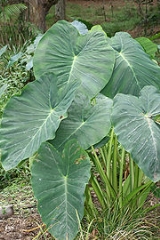
Taro (Pronounced Tah-roe)(from Tahitian
Tahitian language

Tahitian, a Tahitic languages, is one of the two official languages of French Polynesia . It is an Eastern Polynesian language closely related to Rarotongan language, Maori language, and Hawaiian language....
 or other Polynesian languages
Polynesian languages

The Polynesian languages are a language family spoken in the region known as Polynesia. They are classified as part of the Austronesian languages, belonging to the Eastern Eastern Malayo-Polynesian languages branch of that family....
), more rarely kalo (from Hawaiian
Hawaiian language

The Hawaiian language is an Austronesian languages that takes its name from Hawaii , the largest island in the tropical North Pacific archipelago where it developed....
), gabi in The Philippines and dalo in Fiji
Fiji

Fiji , officially the Republic of the Fiji Islands , is an island nation in the South Pacific Ocean east of Vanuatu, west of Tonga and south of Tuvalu....
 is a tropical plant grown primarily as a vegetable food
Root vegetable

Root vegetables are plant roots used as vegetables. Other underground plants are often, erroneously, called root vegetables. Root vegetables include both true roots such as tuberous roots and taproots, but exclude non-roots such as tubers, rhizomes, corms, and bulbs....
 for its edible corm
Corm

A corm is a short, vertical, swollen underground plant Plant stem that serves as a storage organ used by some plants to survive winter or other adverse conditions such as summer drought and heat ....
, and secondarily as a leaf vegetable
Leaf vegetable

Leaf vegetables, also called potherbs, greens, or leafy greens, are plant leaf eaten as a vegetable, sometimes accompanied by tender Petiole s and shoots....
. It is considered a staple in oceanic
Oceanic

Oceanic may mean:*Of or relating to the ocean*Of or relating to Oceania*A person or the peoples of Oceania, also called "Pacific Islander"*The Oceanic languages...
 cultures. It is believed to be one of the earliest cultivated plants. Taro is closely related to Xanthosoma
Xanthosoma

Xanthosoma is a genus of about 50 species of tropical and sub-tropical arums in the flowering plant family, Araceae, all native to tropical Americas....
 and Caladium
Caladium

Caladium is a genus of flowering plants in the family Araceae. They are often known by the common name elephant ear , Heart of Jesus, and Angel Wings....
, plants commonly grown as ornamentals
Ornamental plant

Ornamental plants are typically grown in the flower garden or as house plants. Most commonly they are grown for the display of their flowers. Other common ornamental features include leaves, scent, fruit, Plant stem and bark....
, and like them it is sometimes loosely called elephant ear.


Nutrition Facts


Discussion
Ask a question about 'Taro'
Start a new discussion about 'Taro'
Answer questions from other users
Full Discussion Forum


Recent Posts


Encyclopedia


Taro (Pronounced Tah-roe)(from Tahitian
Tahitian language

Tahitian, a Tahitic languages, is one of the two official languages of French Polynesia . It is an Eastern Polynesian language closely related to Rarotongan language, Maori language, and Hawaiian language....
 or other Polynesian languages
Polynesian languages

The Polynesian languages are a language family spoken in the region known as Polynesia. They are classified as part of the Austronesian languages, belonging to the Eastern Eastern Malayo-Polynesian languages branch of that family....
), more rarely kalo (from Hawaiian
Hawaiian language

The Hawaiian language is an Austronesian languages that takes its name from Hawaii , the largest island in the tropical North Pacific archipelago where it developed....
), gabi in The Philippines and dalo in Fiji
Fiji

Fiji , officially the Republic of the Fiji Islands , is an island nation in the South Pacific Ocean east of Vanuatu, west of Tonga and south of Tuvalu....
 is a tropical plant grown primarily as a vegetable food
Root vegetable

Root vegetables are plant roots used as vegetables. Other underground plants are often, erroneously, called root vegetables. Root vegetables include both true roots such as tuberous roots and taproots, but exclude non-roots such as tubers, rhizomes, corms, and bulbs....
 for its edible corm
Corm

A corm is a short, vertical, swollen underground plant Plant stem that serves as a storage organ used by some plants to survive winter or other adverse conditions such as summer drought and heat ....
, and secondarily as a leaf vegetable
Leaf vegetable

Leaf vegetables, also called potherbs, greens, or leafy greens, are plant leaf eaten as a vegetable, sometimes accompanied by tender Petiole s and shoots....
. It is considered a staple in oceanic
Oceanic

Oceanic may mean:*Of or relating to the ocean*Of or relating to Oceania*A person or the peoples of Oceania, also called "Pacific Islander"*The Oceanic languages...
 cultures. It is believed to be one of the earliest cultivated plants. Taro is closely related to Xanthosoma
Xanthosoma

Xanthosoma is a genus of about 50 species of tropical and sub-tropical arums in the flowering plant family, Araceae, all native to tropical Americas....
 and Caladium
Caladium

Caladium is a genus of flowering plants in the family Araceae. They are often known by the common name elephant ear , Heart of Jesus, and Angel Wings....
, plants commonly grown as ornamentals
Ornamental plant

Ornamental plants are typically grown in the flower garden or as house plants. Most commonly they are grown for the display of their flowers. Other common ornamental features include leaves, scent, fruit, Plant stem and bark....
, and like them it is sometimes loosely called elephant ear. In its raw form the plant is toxic due to the presence of calcium oxalate
Calcium oxalate

Calcium oxalate is a chemical compound that forms needle-shaped crystals. Its chemical formula is CaC2O4 or Ca2....
, although the toxin is destroyed by cooking or can be removed by steeping
Steeping

Steeping or weltering may mean:#Soaking in liquid until saturation with a soluble ingredient, as in, for example, the steeping of tea. In the case of herbal tea, it is referred to as decoction, and may also be called maceration....
 taro roots in cold water overnight.

Names and origin


Taro was probably first native to the lowland wetland
Wetland

File:Mangrove trees in Everglades.JPGA wetland is an area of land whose soil is saturated with moisture either permanently or seasonally. Such areas may also be covered partially or completely by shallow pools of water....
s of Malaysia
Malaysia

Malaysia is a federation that consists of States of Malaysia in Southeast Asia with a total landmass of . The capital city is Kuala Lumpur, while Putrajaya is the seat of the federal government....
 (taloes). Estimates are that taro was in cultivation in wet tropical India
India

India, officially the Republic of India , is a country in South Asia. It is the List of countries and outlying territories by total area country by geographical area, the List of countries by population country, and the most populous liberal democracy in the world....
 before 5000 B.C., presumably coming from Malaysia, and from India further transported westward to ancient Egypt
Egypt

Egypt is a country mainly in North Africa, with the Sinai Peninsula forming a land bridge in Western Asia. Covering an area of about , Egypt borders the Mediterranean Sea to the north, the Gaza Strip and Israel to the northeast, the Red Sea to the east, Sudan to the south and Libya to the west....
, where it was described by Greek
Greeks

The Greeks , also known as Hellenes, are a nation and ethnic group native to Greece, Cyprus and neighbouring regions, who can also be found in Greek diaspora communities around the world....
 and Roman
Ancient Rome

Ancient Rome was a civilization that grew out of a small agricultural community founded on the Italian Peninsula as early as the 10th century BC....
 historians as an important crop.

Taro's scientific name is Colocasia
Colocasia

Colocasia is a genus of six to eight species of flowering plants in the family Araceae, native to tropical Polynesia and southeastern Asia ....
 esculenta
(synonym C. antiquorum); esculent is an English word taken directly from Latin and means edible. The Xanthosoma
Xanthosoma

Xanthosoma is a genus of about 50 species of tropical and sub-tropical arums in the flowering plant family, Araceae, all native to tropical Americas....
 genus
Genus

A genus is a low-level taxonomic rank used in the classification of living and fossil organisms. The taxonomic ranks are domain , kingdom , phylum, class , order , family , genus, and species....
 is closely related, and several common names including callaloo
Callaloo

Callaloo is a Caribbean dish that is most popular in Trinidad and Tobago, with variants in Guyana, Barbados, Guadeloupe, Grenada, Haiti, Dominica, and Jamaica....
 and coco or cocoyam are used to refer to either Taro or domesticated Xanthosoma species which share substantially the same uses. Taro may be distinguished as "taro cocoyam" or "old cocoyam", with the term "new cocoyam" referring to species of Xanthosoma. Taro has a flavor that has often been likened to that of artificial butter used for popcorn in movie theatres and Sour Patch candies.

In Kenya
Kenya

The Republic of Kenya is a country in East Africa. It is bordered by Ethiopia to the north, Somalia to the northeast, Tanzania to the south, Uganda to the west, and Sudan to the northwest, with the Indian Ocean running along the southeast border....
, taro root is referred to as arrow root, or by the Kikuyu
Kikuyu

The Kikuyu are Kenya's most populous ethnic group. 'Kikuyu' is the anglicised form of the proper name and pronunciation of Gikuyu although they refer to themselves as the Agikuyu people....
 or Kamba
Kamba

The Kamba are a Bantu peoples ethnic group who live in the semi-arid Eastern Province, Kenya of Kenya stretching east from Nairobi to Tsavo and north up to Embu, Kenya....
 word nduma. In South Africa
South Africa

The Republic of South Africa, also known by Official names of South Africa, is a country located at the southern tip of the continent of Africa....
, it referred to by the Zulu
Zulu

The Zulu are the largest South African ethnic group of an estimated 10-11 million people who live mainly in the province of KwaZulu-Natal, South Africa....
 word amaDumbe or the anglicised madumbi. In some Caribbean
Caribbean

The Caribbean is a region consisting of the Caribbean Sea, its islands , and the surrounding coasts. The region is located southeast of the Gulf of Mexico and Northern America, east of Central America, and to the north of South America....
 countries, it is sometimes known as dasheen, a name said to be derived from the French de Chine which means from China and evokes the plant's Asia
Asia

Asia is the world's largest and most populous continent. It covers 8.6% of the Earth's total surface area and, with over 4 billion people, it contains more than 60% of the world's current human population....
n origins. The leaves are used to make a soup popular in the West Indies, called callaloo soup. In Cyprus
Cyprus

Cyprus , officially the Republic of Cyprus , is an island country situated in the eastern Mediterranean Sea, east of Greece, west of Lebanon, Syria, and Israel, south of Turkey and north of Egypt....
 it is known as kolokassi, which is similar to the name the Romans used: colocasia, and it is known as "Qolqass" in Egypt. Taro is also known as dalo In the Fijian Islands and in Japan as satoimo. Eddoe is another name for taro, although this one seems to be preferentially used to designate small corm varieties.

Uses


The small round variety is peeled and boiled
Food processing

Food processing is the set of methods and techniques used to transform raw ingredients into food or to transform food into other forms for ingestion by humans or animals either in the home or by the food industry....
, sold either frozen
Frozen food

Frozen food is food preserved by the process of freezing. Freezing food is a common method of food preservation which slows both food Decomposition and, by turning water to ice, makes it unavailable for most bacteriuml growth and slows down most chemical reactions....
, bagged in its own liquids, or canned
Canning

File:Berthold Weiss Canned Foods.jpgFile:Canned food factory .jpgCanning is a method of food preservation in which the food is processed and sealed in an airtight container....
. The plant is actually inedible when raw because of needle-shaped raphides
Ergastic substance

Ergastic substances are non-protoplasm materials found in Cell . The living protoplasm of a cell is sometimes called the bioplasm and distinct from the ergastic substances of the cell....
 (calcium oxalate) in the plant cells.

Typical of leaf vegetables, taro leaves are rich in vitamin
Vitamin

A vitamin is an organic compound required as a nutrient in tiny amounts by an organism. A compound is called a vitamin when it cannot be biosynthesis in sufficient quantities by an organism, and must be obtained from the diet....
s and mineral
Dietary mineral

Dietary minerals are the chemical elements required by living organisms, other than the four elements carbon, hydrogen, nitrogen, and oxygen present in common organic chemistry....
s. They are a good source of thiamin, riboflavin
Riboflavin

Riboflavin , also known as vitamin B2, is an easily absorbed micronutrient with a key role in maintaining health in humans and animals....
, iron
Iron

Iron is a chemical element with the symbol Fe and atomic number 26. Iron is a Group 8 element and period 4 element. Iron is lustrous and silvery in color....
, phosphorus
Phosphorus

Phosphorus is the chemical element that has the symbol P and atomic number 15. The name comes from the and . A Valency nonmetal of the nitrogen group, phosphorus is commonly found in inorganic phosphate minerals....
, and zinc
Zinc

Zinc is a metallic chemical element with the symbol Zn and atomic number 30. It is a first-row transition metal of the group 12 element of the periodic table....
, and a very good source of vitamin B6
Vitamin B6

Vitamin B6 is a water-soluble vitamin and is part of the vitamin B complex group. Pyridoxal phosphate is the active form and is a cofactor in many reactions of amino acid metabolism, including transamination, deamination, and decarboxylation....
, vitamin C
Vitamin C

Vitamin C or ascorbic acid is an essential nutrient for humans, a large number of simian species, a small number of other mammalian species , a few species of birds, and some fish....
, niacin
Niacin

Niacin, also known as vitamin B3, is a water-soluble vitamin which prevents the Nutrition disorder pellagra. It is an organic compound with the chemical formula C6H5NO2....
, potassium
Potassium

Potassium is a chemical element. It has the symbol K , atomic number 19, and atomic mass 39.0983. Potassium was first isolated from potash, hence the name....
, copper
Copper

Copper is a chemical element with the symbol Cu and atomic number 29.It is a ductile metal with very high thermal and electrical conductivity....
, and manganese
Manganese

Manganese is a chemical element, designated by the symbol Mn. It has the atomic number 25. It is found as a Oxidation state in nature , and in many minerals....
. Taro corms are very high in starch
Starch

File:Amylose2.svgFile:Amylopektin Sessel.svgStarch or amylum is a polysaccharide carbohydrate consisting of a large number of glucose units joined together by glycosidic bonds....
, and are a good source of dietary fiber
Dietary fiber

Dietary fiber, sometimes called "roughage", is the indigestible portion of plant foods that pushes food through the digestive system, absorbing water and easing defecation....
. Oxalic acid
Oxalic acid

Oxalic acid is the chemical compound with the chemical formula H2C2O4. This dicarboxylic acid is better described with the formula HOOCCOOH....
 may be present in the corm and especially in the leaf, and these foods should be eaten with milk or other foods rich in calcium so as to remove the risks posed by ingesting the oxalate ion, especially for people with kidney
Kidney

The kidneys are Organ that have numerous biological roles. Their primary role is to maintain the homeostasis balance of bodily fluids by filtering and secreting Metabolomics#Metabolitess and minerals from the blood and excreting them, along with water , as urine....
 disorders, gout
Gout

Gout is a crystal deposition disease hallmarked by elevated levels of uric acid in the Circulatory system. In this condition, crystals of monosodium urate or uric acid are deposited on the articular cartilage of joints, tendons and surrounding tissues....
, or rheumatoid arthritis
Rheumatoid arthritis

Rheumatoid arthritis is a chronic, systemic disease inflammation that may affect many tissues and organs, but principally attacks the joints producing a inflammatory synovitis that often progresses to destruction of the articular cartilage and ankylosis of the joints....
. Calcium reacts with the oxalate to form calcium oxalate which is very insoluble,and is suspected to cause kidney stones.

India

In North India, it is called 'Arvi'. In Assamese
Assamese language

Assamese is the easternmost Indo-Aryan language that is spoken mainly in the States and territories of India of Assam in North-East India. It is also the official language of Assam....
 it is called Kosu. In Bengali
Bengali language

Bengali or Bangla is an Indo-European languages language of the eastern Indian subcontinent, evolved from the Magadhi Prakrit and Sanskrit languages....
 the root is called gath and the plant is called Kochu. In Marathi, it is called 'Alu'. It is a very common dish and may be served with or without gravy. The leaves are rolled along with gram flour batter and then fried or steamed to make a dish called Patode which is finshed by tempering with red chiilies and carrom seeds. In Dakshina Kannada
Dakshina Kannada

Dakshina Kannada , , is a coastal Districts of Karnataka in the states and territories of India of Karnataka in India. It is bordered by Udupi District to the north, Chikkamagaluru district to the northeast, Hassan District to the east, Kodagu District to the southeast, and Kasaragod District in Kerala to the south....
 Taro is used in morning breakfast dish as Patrode
Patrode

Patrode is a dish made in coastal areas of the Karnataka state in India. It is popular among natives of Uttara Kannada,Dakshina Kannada and Udupi district....
. Sindhis call it 'Kachaloo'; They fry it, smash it and re-fry it to make a dish called 'Took' which compliments Sindhi Curry. In Telugu its called 'Chaama Gadda or 'Chaama Dumpa'.

In Maharashtra, the leaves, called 'Alu che Paana', are de-veined, rolled with a paste of gram flour, tamarind paste, red chilli powder, turmeric, coriander, asoefotida, salt and steamed. These can be cut into pieces, eaten as such or shallow fried and eaten as a snack known as alu chi wadi. 'Alu chya panan chi patal bhaji', a lentil and colocasia leaves curry is also popular.Care has to be taken to oil one's hands before handling the leaves, as some leaves are acidic and cause scratching. The leaves are completely safe and delicious after cooking.

Romans

Taro was used by the early Romans in much the same way the potato would later be used by Europeans. They called this root vegetable colocasia. Apicius
Apicius

Apicius is the title of a collection of Roman cookery recipes, usually thought to have been compiled in the late 4th or early 5th century AD and written in a language that is in many ways closer to Vulgar Latin than to Classical Latin....
 mentions several methods for preparing taro. The text of Apicius seems to imply that the usual cooking method was to boil taro in water. Apicius suggests that a sauce be made from pepper, cumin, rue
Rue

Rue is a genus of strongly scented evergreen subshrubs 20-60 cm tall, in the family Rutaceae, native to the Mediterranean region, Macronesia and southwest Asia....
, vinegar, oil and liquamen to be served with chopped pieces of boiled taro. Apicius also mentions recipes in which pieces of taro are cooked along with meat or fowl, similar to the manner in which potatoes are now used in European meat dishes. After the fall of the Roman Empire, the use of taro gradually ceased in Europe. This was largely due to the decline of trade and commerce, as most of the taro used throughout the Roman Empire had been grown and exported from Egypt.

South Asia

Taro is extensively used in South Asia
South Asia

South Asia, also known as Southern Asia, is the southern region of the Asian continent, which comprises the sub-Himalayan countries and, for some authorities , also includes the adjoining countries on the west and the east....
. In South India
South India

South India is the area encompassing India's states of Andhra Pradesh, Karnataka, Kerala and Tamil Nadu as well as the Union territories of India of Lakshadweep and Pondicherry, occupying 19.31% of area....
's Kerala
Kerala

Kerala is a Indian Union States and territories of India located in the southwestern part of India. With an Arabian Sea coastline on the west, it is bordered on the north by Karnataka and by Tamil Nadu on the south and east....
 state, it is used as a staple food, as a side dish, or as a component in various side dishes. As a staple food it is steamed, and eaten with a chutney
Chutney

Chutney , is a term for a variety of sweet and spicy condiments, usually involving a fresh, chopped primary vegetable or fruit with added seasonings....
 of green pepper and shallot onions. The leaves and stems of certain varieties of taro are used as a vegetable in Kerala. A tree-growing variety of taro is extensively used in the western coast of India to make patrade or patrada, literally "leaf-pancake". These are either made like fritters, or are steamed and eaten. In another South Indian state, Andhra Pradesh
Andhra Pradesh

Andhra Pradesh , abbreviated A.P.,is a state situated on eastern coast of India. It is India's List of states of India by area and List of states of India by population....
, taro corms are known as 'chamagadda' or in coastal districts as 'chilakada dumpa' and can be cooked in many ways, deep fried in oil for a side item with rice, or cooked in a tangy tamarind sauce with spices, onion and tomato. In the Indian state of Gujarat
Gujarat

Gujarat is a States and territories of India in western India. Gujarat borders Pakistan to the north west and the state of Rajasthan to the north and northeast, Madhya Pradesh to the east, Maharashtra and the Union territory of Diu, Daman District, India, Dadra and Nagar Haveli to the south....
 it is used to make patra, a dish with the leaves of the plant prepared with tamarind and other spices.

In Nepal
Nepal

Nepal , officially the Federal Democratic Republic of Nepal, is a landlocked country in South Asia and is the world's youngest republic. It is bordered to the north by the People's Republic of China, and to the south, east, and west by India....
 and the Indian state of Uttarakhand
Uttarakhand

Uttarakhand , is a States and territories of India located in the northern part of India. It was carved out of Himalayan and adjoining districts of Uttar Pradesh on 9 November 2000, becoming the 27th States and territories of India of the Republic of India ....
, it is considered a health food with a variety of cooking styles. The most common style is boiling it in salty water in iron cooking pots until it becomes like porridge. Another style is to steam the young leaves called 'gava', sun-dry and then store it for later use. For another variety, the taro leaves and stems are used raw as an ingredient for pickles. The leaves and stems are mixed with black lentils and then dried as small balls called badi and used later on. The stems are also sun-dried and stored for later use. On one special day, women worship saptarshi (seven sages) and have rice with taro leaf vegetable only. In North India, it is also known by the name of arbi or arvi.

China

Taro (called yutou, ?? or yunai, ?? in China; ??, wuh táu? in Hong Kong) is commonly used within Chinese cuisine
Chinese cuisine

Chinese cuisine originated from the various regions of China and has become widespread in many other parts of the world ? from Asia to the Americas, Australia, Western Europe and Southern Africa....
 in a variety of styles, mainly as a flavor enhancing ingredient. It is commonly braised with pork or beef. It is used in the dim sum
Dim sum

Dim sum is the name for a Chinese cuisine which involves a wide range of light dishes served alongside Chinese tea. It is usually served in the mornings until noon time at Chinese restaurants and at specialty dim sum eateries where typical dishes are available throughout the day....
 cuisine of southern China to make a small plated dish called taro dumpling
Taro dumpling

Taro dumpling is a variety of dim sum served within Chinese cuisine. It is a standard dish in dim sum restaurants in Hong Kong and around the world....
, as well as a pan-fried dish called taro cake
Taro cake

Taro cake is a Chinese cuisine dish made from the vegetable taro. While it is denser in texture than radish cakes, both these savory cakes made in a similar ways, with rice flour as the main ingredient....
. It is also woven to form a seafood birdsnest
Seafood birdsnest

Seafood birdsnest is a common Chinese cuisine dish found in Hong Kong, China and most overseas Chinatown restaurants. It is also found within Cantonese cuisine....
. The taro cake is also a delicacy traditionally eaten during the Chinese New Year
Chinese New Year

Chinese New Year or Spring Festival is the most important of the traditional Chinese holidays. It is often called the Lunar New Year, especially by people in mainland China and Taiwan....
. In desserts it is used in tong sui
Tong Sui

Tong sui, also known as tian tang, is a collective term for any sweet, warm soup or custard served as a dessert at the end of a meal in Cantonese cuisine....
, bubble tea
Bubble tea

Bubble tea Arelene, also called "Boba" tea, is a tea drink containing gelatinous tapioca pearls. It originated in Taiwan in the 1980s, spread to nearby East Asian countries, and migrated to Canada before spreading to Chinatown in New York City, then to various spots throughout the West Coast of the United States....
, as a flavoring in ice cream and other deserts in the China(f. ex. Sweet Taro Pie).

Polynesia

Considered the staple starch of traditional Polynesia
Polynesia

Polynesia is a subregion of Oceania, comprising a large grouping of over 1,000 islands scattered over the central and southern Pacific Ocean....
n cuisine, taro is both a common and prestigious food item that was first introduced to the Polynesian islands by prehistoric seafarers of Southeast Asian derivation. The tuber itself is prepared in various methods including baking, steaming in earth oven
Earth oven

An earth oven or cooking pit is one of the most simple and long-used cooking structures. At its simplest, an earth oven is simply a pit in the ground used to trap heat and bake or steam food....
s (umu or imu), boiling, and frying. The famous Hawaiian staple poi
Poi (food)

Poi is a Hawaiian language word for the primary Polynesian staple food made from the corm of the kalo plant . Poi is produced by mashing the cooked corm to a highly viscous fluid....
 is made by mashing steamed taro roots with water. Taro also features in traditional desserts such as Samoan "fa'ausi," which consists of grated, cooked taro mixed with coconut milk and brown sugar. The leaves of the taro plant also feature prominently in Polynesian cooking, especially as edible wrappings for dishes such as Hawaiian laulau, Samoan "palusami" (wrapped coconut milk and onions), and Tongan "lupulu" (wrapped corned beef). Ceremonial presentations on occasion of chiefly rites or communal events (weddings, funerals, etc.) traditionally included ritual presentation of raw and cooked taro roots/plants. The Hawaiian laulau traditionally contains pork, fish, and lu'au (cooked taro leaf). The wrapping is with inedible ti leaves (Hawaiian: lau ki). The cooked taro leaf has the consistency of cooked spinach and would be unsuitable for use as a wrapping.

West Africa

Taro is consumed as a staple crop in West Africa, particularly in Nigeria
Nigeria

Nigeria, officially the Federal Republic of Nigeria, is a federation constitutional republic comprising States of Nigeria and one Federal Capital Territory, Nigeria....
 and Cameroon
Cameroon

The Republic of Cameroon is a unitary state of central and western Africa. It is bordered by Nigeria to the west; Chad to the northeast; the Central African Republic to the east; and Equatorial Guinea, Gabon, and the Republic of the Congo to the south....
. It is called cocoyam
Cocoyam

Cocoyam can mean:* Taro - old cocoyam* Xanthosoma - new cocoyam...
 in Nigeria
Nigeria

Nigeria, officially the Federal Republic of Nigeria, is a federation constitutional republic comprising States of Nigeria and one Federal Capital Territory, Nigeria....
, Ghana
Ghana

The Republic of Ghana is a country in West Africa. It borders C?te d'Ivoire to the west, Burkina Faso to the north, Togo to the east, and the Gulf of Guinea to the south....
 and Anglophone Cameroon
Cameroon

The Republic of Cameroon is a unitary state of central and western Africa. It is bordered by Nigeria to the west; Chad to the northeast; the Central African Republic to the east; and Equatorial Guinea, Gabon, and the Republic of the Congo to the south....
. It is called macabo in Francophone Cameroon
Cameroon

The Republic of Cameroon is a unitary state of central and western Africa. It is bordered by Nigeria to the west; Chad to the northeast; the Central African Republic to the east; and Equatorial Guinea, Gabon, and the Republic of the Congo to the south....
.

Taiwan

In Taiwan
Taiwan

Taiwan is an island in East Asia. "Taiwan" is also commonly used to refer to the country governed by the Republic of China and to the ROC itself, which governs the island of Taiwan, Orchid Island and Green Island, Taiwan in the Pacific Ocean off the Taiwan coast, the Penghu islands in the Taiwan Strait, and Kinmen and the Matsu Islands...
, supermarket
Supermarket

A supermarket is a self-service Retailing#Retail types offering a wide variety of food and household merchandise, organized into departments....
 varieties range from about the size and shape of a brussels sprout
Brussels sprout

The Brussels sprout of the Brassicaceae family, is a cultivar of Brassica oleracea cultivated for its small leafy green buds, which resemble miniature cabbages....
 to longer, larger varieties the size of an adult male's fist. Taro chips are often used as a potato-chip-like snack. Compared to potato chips, taro chips are harder and have a more assertive nutty flavor. They are generally made from upland taro because of their lower moisture.

Japan

In Japan
Japan

Japan is an island country in East Asia. Located in the Pacific Ocean, it lies to the east of the Sea of Japan, People's Republic of China, North Korea, South Korea and Russia, stretching from the Sea of Okhotsk in the north to the East China Sea and Taiwan in the south....
,it is called ; kanji: ??; literally "sato potato". (see satoyama
Satoyama

is a Japanese language term applied to the border zone or area among the foot of mountain and arable flat land, literally Sato is Arable land and livable land or home land, and yama is mountain....
 for sato). It is often simmered. The size and shape is like a brussels sprout
Brussels sprout

The Brussels sprout of the Brassicaceae family, is a cultivar of Brassica oleracea cultivated for its small leafy green buds, which resemble miniature cabbages....
. The child satoimo and grandchild satoimo are called . Satoimo is believed to have been propagated from Southeast Asia
Southeast Asia

Southeast Asia or Southeastern Asia is a subregion of Asia, consisting of the countries that are geographically south of China, east of India and north of Australia....
 in the late Jomon period
Jomon period

The is the time in history of Japan from about 14th millennium BC to 5th century BC.The term "Jomon" means "cord-patterned" in Japanese. This refers to the markings made on clay vessels and figures using sticks with cords wrapped around them which are characteristic of the Jomon people....
 and it was one of the staple foods before rice
Rice

Rice is a staple food for a large part of the world's human population, especially in tropical Latin America, and East Asia, South Asia and Southeast Asia, making it the second-most consumed cereal grain, after maize....
 became predominant..

South Korea

In South Korea, it is called toran meaning "egg from earth", and the corm is stewed and the leaf stem is stir-fried. Taro roots can be used for medicinal purposes, particularly for curing insect bites.

Vietnam

In Vietnam, where taro is called khoai môn or khoai s?, it is used as a filling in spring roll
Spring roll

Spring rolls are a specific type of fried pastries. Spring rolls can be found in several Asian countries, most notably China, Vietnam, the Philippines, and Indonesia....
s, cakes, puddings, soups and other desserts.

United States

In Hawaii
Hawaii

File:Pahoehoe and Aa flows at Hawaii.jpgThe State of Hawaii is a U.S. state in the United States, located on an archipelago in the central Pacific Ocean southwest of the continental United States, southeast of Japan, and northeast of Australia....
, taro is a traditional staple, as in many tropical areas of the world, and is the base for making poi
Poi (food)

Poi is a Hawaiian language word for the primary Polynesian staple food made from the corm of the kalo plant . Poi is produced by mashing the cooked corm to a highly viscous fluid....
. In Chinatown
Chinatown

A Chinatown is a section of an urban area with a large number of overseas Chinese residents, usually outside of Greater China. Chinatowns are present throughout the world, including those in East Asia, Southeast Asia, North America, South America, Australasia, and Europe....
s, people often use taro in Chinese cuisine
Chinese cuisine

Chinese cuisine originated from the various regions of China and has become widespread in many other parts of the world ? from Asia to the Americas, Australia, Western Europe and Southern Africa....
, though it is not consumed or popularized nearly as much as in Asian and Pacific nations. Since the late 20th century, taro chips have been available in many supermarkets and natural food stores. In the 1920s, dasheen, as it was known, was highly touted by the Secretary of the Florida Department of Agriculture as a valuable crop for growth in muck fields. Fellsmere, Florida
Fellsmere, Florida

Fellsmere is a city in Indian River County, Florida, Florida, United States. The population was 3,813 at the 2000 census. As of 2004, the population recorded by the U.S....
, near the east coast, was a farming area deemed perfect for growing dasheen. It was used in place of potatoes and dried to make flour. Dasheen flour was said to make excellent pancakes when mixed with wheat flour.

Philippines

In the Philippines, taro is called gabi. A popular rendition of the taro is (pronounced /lah - ing/) which originates from the Bicol region in Southern Luzon. The dish's main ingredients are cooked in coconut milk, salted with fermented shrimp or fish bagoong. It is also heavily spiced with red hot chilis called sili'ng labuyo.

Another dish where taro finds common use in the Filipino kitchen is the Philippine national stew, called sinigang
Sinigang

Sinigang is a Philippine cuisine soup that is eaten with rice. Similar to Thailand's tom yam, its characteristic flavor comes from tamarind which gives it a sour taste and overwhelms the taste of its meat....
. This sour stew may be made with pork and beef, shrimp, or fish. Peeled and diced taro is a basic ingredient of pork sinigang.

Finally, the third most common use of taro in the Filipino diet is in ginataan, literally meaning "cooked with coconut milk." This form of dessert, where coconut milk and taro are combined along with indigenous ingredients such as sago and jackfruit, is shared throughout most Southeast Asian cuisines.

West Indies

Taro is called "dasheen", with a smaller corm species being called "eddo" in the West Indies, and is cultivated and consumed as a staple crop in the region.

Turkey

Taro is grown in the south coast of Turkey, especially in Mersin and Antalya. It is boiled in a tomato sauce or cooked with meat, beans and chickpeas.

Cyprus

In Cyprus, taro has been in use since the time of the Roman Empire. Today it is known as "kolokassi" which is similar to the name the Romans used: colocasia. It is usually stewed with celery (and sometimes meat) in a tomato sauce. Taro also grows on Ikaria island; Ikarians credit the taro for saving them from famine during World War II
World War II

World War II, or the Second World War , was a global military conflict which involved a Participants in World War II, including all of the great powers, organised into two opposing military alliances: the Allies of World War II and the Axis powers....
.

Suriname

In Suriname the taro root is the base for the popular Surinamese dish pom
Pom

POM or Pom may refer to:* Pom, an Alternative words for British#Pommy, used by speakers of Australian English, New Zealand English, South African English and Afrikaans...
.

Cultivation

Top Taro Producers - 2005
(million metric ton)
4.0
1.8
1.6
1.1
0.4
0.3
World Total 9.2
Source:
UN Food & Agriculture Organisation (FAO)


Taro can be grown in paddy field
Paddy field

A paddy field is a flooded parcel of arable land used for growing rice and other Aquatic plant. Rice can also be grown in dry-fields, but from the twentieth century paddy field agriculture became the dominant form of growing rice....
s or in upland situations where watering is supplied by rainfall or by supplemental irrigation. Some varieties of taro can also be grown away from the tropics.

Hawaii

Taro is usually grown in pondfields known as loi in Hawaiian
Hawaiian language

The Hawaiian language is an Austronesian languages that takes its name from Hawaii , the largest island in the tropical North Pacific archipelago where it developed....
. The picture below shows several small loi in Maunawili Valley on Oahu
Oahu

'Oahu' or 'Oahu' , known as Gathering_place#Island_of_O.7B.7Bokina.7D.7Dahu_as_The_Gathering_Place, is the third largest of the Hawaiian Islands and most populous of the islands in the State of Hawaii....
. The ditch on the left in the picture is called an auwai and supplies diverted stream water to the loi. Cool, flowing water yields the best crop. Some of the taro plants in the foreground have been harvested and the caretakers are preparing to replant the huli stacked at their feet. These are the top portion of the corm with a short piece of bladeless leafstem.

Typical dryland or upland varieties (varieties grown in watered but not flooded fields) in Hawaii are lehua maoli and bun long, the latter widely known as Chinese taro. Bun long is used for making taro chips. Dasheen (also called "eddo") is another "dryland" variety of C. esculenta grown for its edible corms or sometimes just as an ornamental plant.

The Hawaii Agricultural Statistics Service puts the 10-year median production of taro in the Hawaiian Islands at about 6.1 million pounds (2,800 t; Viotti, 2004). However, 2003 taro production in Hawaii was only 5 million pounds (2,300 t), an all-time low (record keeping started in 1946). The previous low, reached in 1997, was 5.5 million pounds (2,500 t). Yet, despite generally growing demand, production was even lower in 2005: only 4 million pounds, with kalo for processing into poi accounting for 97.5%. Urbanization has driven down harvests from a high of 14.1 million pounds (6,400 t) in 1948. But more recently the decline has resulted from pests and diseases. A non-native apple snail
Ampullariidae

The family Ampullariidae, common name the apple snails, are large tropical and subtropical water snails, amphibious freshwater gastropod mollusks....
 (Pomacea canaliculata) is a major culprit in the current crop declines. Also, a plant rot disease, traced to a newly identified species of the fungal
Fungus

A fungus is a Eukaryote organism that is a member of the Kingdom Fungi . The fungi are a monophyletic group, also called the Eumycota , that is phylogeny distinct from the morphologically similar slime molds and water molds ....
 genus, Phytophthora
Phytophthora

Phytophthora is a genus of plant-damaging Protists of the Water mould . Anton de Bary described it for the first time in 1875....
, now plagues crops throughout the state. Although pesticides could control both pests to some extent, pesticide use in the pondfields is barred because of the clear opportunity for chemicals to quickly migrate into streams and then into the ocean.

In early April 2008, the Hawaiian House Agriculture Committee voted 9-3 to send a bill to the full house that would put a 5 year moratorium on genetic modification of taro in Hawaii. This moratorium would only apply to Hawaiian varieties of taro, thereby allowing genetic alteration of non-native species. This would include possible alteration to Chinese varieties, which are currently being grown in Hawaii, giving rise to an opportunity for cross-pollination.

Fiji

Although taro has been a staple of the Fijian diet for centuries, its growth as a commercial crop can be said to have begun in 1993 when the taro leaf blight decimated the taro industry in neighboring Samoa. Fiji filled the void and was soon supplying taro to the large Polynesian populations of New Zealand, Australia, and Los Angeles in the United States.

Almost 80% of Fiji's exported taro comes from the Island of Taveuni
Taveuni

Taveuni is the third-largest island in Fiji, after Vanua Levu and Viti Levu, with a total land area of 435 square kilometers. The cigar-shaped island, a massive shield volcano which rises from the floor of the Pacific Ocean, is situated 6.5 kilometers to the east of Vanua Levu, across the Somosomo Strait, and is part of the Northern Div...
.

Currently, the Fijian taro industry is under threat from the taro beetle, with the Land Resources Division of the Secretariat of the Pacific Community (SPC) conducting research into how best to control this pest.

Puerto Rico

In Puerto Rico both the plant and its corm are called yautia, and it is used in stews, soups, or simply served boiled much like a potato
Potato

The potato is a starchy, tuberous crop from the perennial plant Solanum tuberosum of the Solanaceae family. The word potato may refer to the plant itself as well....
. It is used in local Puerto Rican dishes such as pasteles
Pasteles

Pasteles are a traditional dish of Latin America and the Spanish-speaking Caribbean. In Puerto Rico, the Dominican Republic and the Caribbean Coast of Colombia, and also throughout Panama, it is similar to a tamale and said to have originated from the Canary Islands ....
, alcapurria
Alcapurria

Alcapurria is a dish from Puerto Rico made from a mixture of mainly yaut?a and may contain ground squash, plantains, green banana and other starchy tropical tubers filled with ground beef or crab meat and deep fried in oil....
, sancocho
Sancocho

Sancocho is a traditional soup in several Spanish and Latin American cuisines. Variations represent popular national dishes in the Canary Islands of Spain, Colombia, Panama, Argentina, Venezuela, Dominican Republic and Puerto Rico....
, and mondongo. In pasteles, taro is ground with green bananas, plantains into a dough-like fluid paste containing pork, ham and boiled in a banana leaf or paper wrapper. In alcapurrias, it is also ground with green bananas and made into fried croquets containing ground beef or the chopped ham and fresh pork mix used in pasteles. The sancocho and mondongo dishes are soups.

See also

  • Aquatic plants
  • Limahuli Garden
  • Lotus effect
    Lotus effect

    The Lotus effect refers to the very high water repellency exhibited by the leaves of the lotus flower .Dirt particles are picked up by water droplets due to a complex micro- and nanoscopic architecture of the surface which enables minimization of adhesion....


Images


External links

  • from