


Propylaea

Encyclopedia

Ancient Greek
Ancient Greek is the stage of the Greek language in the periods spanning the times c. 9th–6th centuries BC, , c. 5th–4th centuries BC , and the c. 3rd century BC – 6th century AD of ancient Greece and the ancient world; being predated in the 2nd millennium BC by Mycenaean Greek...
— Προπύλαια; ˌprɒpɪˈliːə) is any monumental gate
Gate
A gate is a point of entry to a space enclosed by walls, or a moderately sized opening in a fence. Gates may prevent or control entry or exit, or they may be merely decorative. Other terms for gate include yett and port...
way based on the original Propylaea that serves as the entrance to the Acropolis
Acropolis
Acropolis means "high city" in Greek, literally city on the extremity and is usually translated into English as Citadel . For purposes of defense, early people naturally chose elevated ground to build a new settlement, frequently a hill with precipitous sides...
in Athens
Athens
Athens , is the capital and largest city of Greece. Athens dominates the Attica region and is one of the world's oldest cities, as its recorded history spans around 3,400 years. Classical Athens was a powerful city-state...
. The word propylaea (propylaeum is the Latin version) is the union of the prefix pro (before or in front of) plus the plural of the Greek pylon or pylaion (gate), meaning literally that which is before the gates, but the word has come to mean simply gate building. The Brandenburg Gate
Brandenburg Gate
The Brandenburg Gate is a former city gate and one of the most well-known landmarks of Berlin and Germany. It is located west of the city centre at the junction of Unter den Linden and Ebertstraße, immediately west of the Pariser Platz. It is the only remaining gate of a series through which...
of Berlin
Berlin
Berlin is the capital city of Germany and is one of the 16 states of Germany. With a population of 3.45 million people, Berlin is Germany's largest city. It is the second most populous city proper and the seventh most populous urban area in the European Union...
and the Propylaea
Propylaea (Munich)
The Propylaea is a gate in Munich at the west side of Koenigsplatz.- History :The building constructed in Doric order was completed by Leo von Klenze in 1862 and evokes the monumental entrance of the Propylaea for the Athenian Acropolis...
in Munich
Munich
Munich The city's motto is "" . Before 2006, it was "Weltstadt mit Herz" . Its native name, , is derived from the Old High German Munichen, meaning "by the monks' place". The city's name derives from the monks of the Benedictine order who founded the city; hence the monk depicted on the city's coat...
are specifically copied from the central portion of the Propylaea.
Propylaea of the Athenian Acropolis
The monumental gateway to the Acropolis, the Propylaea was built under the general direction of the Athenian leader PericlesPericles
Pericles was a prominent and influential statesman, orator, and general of Athens during the city's Golden Age—specifically, the time between the Persian and Peloponnesian wars...
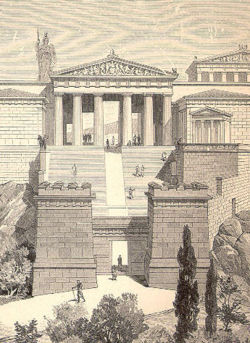
, but Phidias was given the responsibility for planning the rebuilding the Acropolis as a whole at the conclusion of the Persian Wars. According to Plutarch, the Propylaea was designed by the architect Mnesicles, but we know nothing more about him. Construction began in 437 BCE and was terminated in 432, when the building was still unfinished.
The Propylaea was constructed of white Pentelic marble and gray Eleusinian marble or limestone, which was used only for accents. Structural iron was also used, though William Bell Dinsmoor
William Bell Dinsmoor
William Bell Dinsmoor, Sr. was an architectural historian of classical Greece and a Columbia University professor of art and archaeology.-Biography:He was born on July 29, 1886 in Windham, New Hampshire....
analyzed the structure and concluded that the iron weakened the building. The structure consists of a central building with two adjoining wings on the west (outer) side, one to the north and one to the south. The core is the central building, which presents a standard six-columned Doric façade both on the West to those entering the Acropolis and on the east to those departing. The columns echo the proportions (not the size) of the columns of the Parthenon
Parthenon
The Parthenon is a temple on the Athenian Acropolis, Greece, dedicated to the Greek goddess Athena, whom the people of Athens considered their virgin patron. Its construction began in 447 BC when the Athenian Empire was at the height of its power. It was completed in 438 BC, although...
. There is no surviving evidence for sculpture in the pediments.
The central building contains the gate wall, about two-thirds of the way through it. There are five gates in the wall, one for the central passageway, which was not paved and lay along the natural level of the ground, and two on either side at the level of the building's eastern porch, five steps up from the level of the western porch. The central passageway was the culmination of the Sacred Way, which led to the Acropolis from Eleusis
Eleusina
Eleusina is a town and municipality in West Attica, Greece. It is situated about 18 km northwest from the centre of Athens. It is located in the Thriasian Plain, at the northernmost end of the Saronic Gulf. It is the seat of administration of West Attica regional unit...
.
Entrance into the Acropolis was controlled by the Propylaea. Though it was not built as a fortified structure, it was important that people not ritually clean be denied access to the sanctuary. In addition, runaway slaves and other miscreants could not be permitted into the sanctuary where they could claim the protection of the gods. The state treasury was also kept on the Acropolis, making its security important.
The gate wall and the eastern (inner) portion of the building sit at a level five steps above the western portion, and the roof of the central building rose on the same line. The ceiling in the eastern part of the central building was famous in antiquity, having been called by Pausanias (about 600 years after the building was finished) "...down to the present day unrivaled." It consisted of marble blocks carved in the shape of ceiling coffers and painted blue with gold stars.
The Colonnades
The outer (western) wings to the right and left of the central building stood on the same platform as the western portion of the central building but were much smaller, not only in plan but in scale. Like the central building, the wings use Doric colonnades and Doric entablatures. However, the central building also has an Ionic colonnade on either side of the central passageway between the western (outer) Doric colonnade and the gate wall. This is therefore the first building known to us with Doric and Ionic colonnades visible at the same time. It is also the first monumental building in the classical period to be more complex than a simple rectangle or cylinder.The western wing on the north (to the left as one enters the Acropolis) was famous in antiquity as the location of paintings of important Greek battles. Pausanias reports their presence, but few scholars believe the room was planned to hold them. Recent scholarship, following the lead of John Travlos (Pictorial Dictionary of Ancient Athens, New York, 1971), has taken the northern wing to have been a room for ritual dining. The evidence for that is the off-center doorway and the position near the entrance to the Acropolis.
The wing on the south, though much smaller, was clearly designed to make the whole structure appear to be symmetrical. It seems only to have functioned as an access route to the Sanctuary of Athena Nike.
Plans for eastern and western side of Propylaea
There were two wings planned for the east side of the Propylaea, facing in toward the Acropolis. Preparations for both wings are apparent at the eastern end of the central building and along the side walls, but it seems that the plan for a southern wing was abandoned early in the construction process since the old fortification wall was not demolished, as required for that wing. The north wing was not built either. (Had it been constructed, it seems that the level of the floor would have been problematic. To the extent that preparations had been made, they were for a floor at the level of the western portion of the building, considerably below the level required on the East.)To the right of the Propylaea and further west, on the raised bastion prepared for it, stood the Temple of Athena Nike. As a result of the outbreak of the Peloponnesian War
Peloponnesian War
The Peloponnesian War, 431 to 404 BC, was an ancient Greek war fought by Athens and its empire against the Peloponnesian League led by Sparta. Historians have traditionally divided the war into three phases...
between Athens and Sparta
Sparta
Sparta or Lacedaemon, was a prominent city-state in ancient Greece, situated on the banks of the River Eurotas in Laconia, in south-eastern Peloponnese. It emerged as a political entity around the 10th century BC, when the invading Dorians subjugated the local, non-Dorian population. From c...
in 431 BCE, the Propylaea was never completed. Not only are the eastern wings missing, the wall surfaces were not trimmed to their finished shapes, and so-called lifting bosses remain on many blocks. (Lifting bosses have long been called such but are now recognized to have been for another purpose, though that other purpose is not agreed. See A. Trevor Hodge, "Bosses Reappraised," Omni Pede Stare: Saggi Architettonici e circumvesuviani in memoriuam Jos de Waele, Mols & Moormann, eds.)
Damages
The Propylaea survived intact through the Greek, RomanRoman Empire
The Roman Empire was the post-Republican period of the ancient Roman civilization, characterised by an autocratic form of government and large territorial holdings in Europe and around the Mediterranean....
and Byzantine
Byzantine Empire
The Byzantine Empire was the Eastern Roman Empire during the periods of Late Antiquity and the Middle Ages, centred on the capital of Constantinople. Known simply as the Roman Empire or Romania to its inhabitants and neighbours, the Empire was the direct continuation of the Ancient Roman State...
periods. During the period of Latin Empire
Latin Empire
The Latin Empire or Latin Empire of Constantinople is the name given by historians to the feudal Crusader state founded by the leaders of the Fourth Crusade on lands captured from the Byzantine Empire. It was established after the capture of Constantinople in 1204 and lasted until 1261...
, it served as the palace of the de la Roche family, who held the title Duke of Athens from 1204 to 1311. It was severely damaged by an explosion of a powder magazine in 1656. A tower of French or Ottoman
Ottoman Empire
The Ottoman EmpireIt was usually referred to as the "Ottoman Empire", the "Turkish Empire", the "Ottoman Caliphate" or more commonly "Turkey" by its contemporaries...
date, erected on the south wing, was pulled down in 1874.
Restoration
Today the Propylaea has been partly restored, since 1984 under the direction of Dr. Tasos Tanoulas, and serves as the main entrance to the Acropolis for the many thousands of tourists who visit the area every year. In the period before the 2004 Olympic Games2004 Summer Olympics
The 2004 Summer Olympic Games, officially known as the Games of the XXVIII Olympiad, was a premier international multi-sport event held in Athens, Greece from August 13 to August 29, 2004 with the motto Welcome Home. 10,625 athletes competed, some 600 more than expected, accompanied by 5,501 team...
in Athens, the Propylaea was shrouded in scaffolding as restoration work was undertaken. At the end of 2009 all scaffolding was removed, and the building is now open fully to view again. The famous ceilings have even been partly restored.
External links
- Photo album
- http://propylaea.org - leads to a variety of material, some scholarly, but many photographs as well