


Severe style

Encyclopedia
Ancient Greek sculpture
Ancient Greek sculpture is the sculpture of Ancient Greece. Modern scholarship identifies three major stages. They were used to depict the battles, mythology, and rulers of the land known as Ancient Greece.-Geometric:...
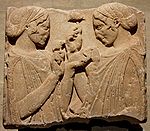
in the period ca. 490 to 450 BCE. It marks the breakdown of the canonical forms of archaic art and the transition to the greatly expanded vocabulary and expression of the classical moment of the late 5th century. It was an international style found at many cities in the Hellenic world and in a variety of media including:bronze sculpture in the round, stelae
Stele
A stele , also stela , is a stone or wooden slab, generally taller than it is wide, erected for funerals or commemorative purposes, most usually decorated with the names and titles of the deceased or living — inscribed, carved in relief , or painted onto the slab...
, and architectural relief
Relief
Relief is a sculptural technique. The term relief is from the Latin verb levo, to raise. To create a sculpture in relief is thus to give the impression that the sculpted material has been raised above the background plane...
. The style perhaps realized its greatest fulfillment in the metopes
Metope (architecture)
In classical architecture, a metope is a rectangular architectural element that fills the space between two triglyphs in a Doric frieze, which is a decorative band of alternating triglyphs and metopes above the architrave of a building of the Doric order...
of the Temple of Zeus
Temple of Zeus
The Temple of Zeus at Olympia was an ancient Greek temple in Olympia, Greece, dedicated to the chief of the gods, Zeus. It was the very model of the fully developed classical Greek temple of the Doric order...
, Olympia.
The term "severe style" was first coined by Gustav Kramer in his Uber den styl und die Herkunft der bemahlten griechischen Thongefasse (1837, Berlin) in reference to the first generation of red figure vase painters; the name has since Vagn Poulsen’s 1937 study Der strenge stil become exclusively associated with sculpture.
Dating and relative chronology
Harmodius and Aristogeiton (sculpture)
A sculptural pairing of the tyrannicides Harmodius and Aristogeiton was well known in the ancient world in two major versions but survives only in Roman marble copies...
; a replacement for the bronze created by Antenor
Antenor
Antenor was an Athenian sculptor, of the latter part of the 6th century BC. He was named after the mythological figure also called Antenor. He was the creator of the joint statues of the tyrannicides Harmodius and Aristogeiton, set up by the Athenians on the expulsion of Hippias. These statues...
in 514 to commemorate the assassins of the tyrant Hipparchus
Hipparchus
Hipparchus, the common Latinization of the Greek Hipparkhos, can mean:* Hipparchus, the ancient Greek astronomer** Hipparchic cycle, an astronomical cycle he created** Hipparchus , a lunar crater named in his honour...
was sculpted by Kritios
Kritios
Kritios was an Athenian sculptor, probably a pupil of Antenor, working in the early 5th century BCE, whose manner is on the cusp of the Late Archaic and the Severe style of Early Classicism in Attica. He was the teacher of Myron...
and Nesiotes and dated in an inscription of 477/6 BCE. This piece, now known only from Roman copies preserves the poses and facial features familiar from archaic art and combines it with a novel treatment of multiple viewpoints, feeling for mass, and anatomical observation that distinguishes it as one of several Athenian transitional works. Another is the Kritian boy
Kritios Boy
The marble Kritios boy or Kritian Boy belongs to the Late Archaic period of ancient Greek sculpture; "the first beautiful nude in art", as Kenneth Clark thought, it is a precursor to the later classical sculptures of athletes...
, c. 480 BCE whose distribution of weight onto one leg, lowered right hip, and inclination of head and shoulders exceeds the formulas of the late Archaic kouroi
Kouros
A kouros is the modern term given to those representations of male youths which first appear in the Archaic period in Greece. The term kouros, meaning youth, was first proposed for what were previously thought to be depictions of Apollo by V. I...
marks a step toward the greater naturalism and individualization of the Classical – as B. S. Ridgway puts it: no longer a type but a subject.
General characteristics
The depredations of war and the sumptuary laws of SolonSolon
Solon was an Athenian statesman, lawmaker, and poet. He is remembered particularly for his efforts to legislate against political, economic and moral decline in archaic Athens...
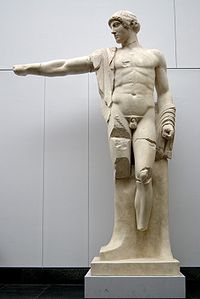
ensured that very little sculpture was practiced at Athens in the first half of the 5th century, instead we have to look to others cities to trace the development of the Severe style. We can observe the general characteristics of the period on its greatest masterpiece the Temple of Zeus
Temple of Zeus
The Temple of Zeus at Olympia was an ancient Greek temple in Olympia, Greece, dedicated to the chief of the gods, Zeus. It was the very model of the fully developed classical Greek temple of the Doric order...
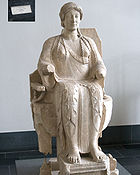
, Olympia, attributed to the Olympia Master. Here we find a simplicity of forms, especially in dress and the absence of decoration, a feeling of heaviness both in the gravity of the body and the “doughy” cloth of the peplos. Indeed this era sees a shift from the use of the Doric chiton
Chiton (costume)
A chiton was a form of clothing worn by men and women in Ancient Greece, from the Archaic period to the Hellenistic period ....
to the Ionic peplos
Peplos
A peplos is a body-lengthGreek garment worn by women before 500 BC. The peplos is a tubular cloth folded inside-out from the top about halfway down, altering what was the top of the tube to the waist and the bottom of the tube to ankle-length. The garment is then gathered about the waist and the...
whose irregular groupings and folds better express the contours of the underlying body. We can also witness on the pediments
Pediment
A pediment is a classical architectural element consisting of the triangular section found above the horizontal structure , typically supported by columns. The gable end of the pediment is surrounded by the cornice moulding...
of the temple the slight pout typical of this time where the upper lip projects a little over the lower and a volume to the eyelids, a striking departure from the fixed Archaic smile of the 6th century and suggestive perhaps of the brooding pathos also typical of the idiom. There is further experimentation with the expression of emotion on the metopes of the temple depicting the labors of Herakles, an experiment not pursued by later Classical art.
Brunilde S. Ridgway
Brunilde Sismondo Ridgway
Brunilde Sismondo Ridgway, born in 1929 in Chieti , is an art historian and specialist in ancient Greek sculpture.-Life:The daughter of an Italian officer, she spent her childhood in Ethiopia, where her father is stationed. After World War II, she studied classics at the University of Messina,...
identifies six traits that might serve to define the style:
Individual masters
Pythagoras
Pythagoras of Samos was an Ionian Greek philosopher, mathematician, and founder of the religious movement called Pythagoreanism. Most of the information about Pythagoras was written down centuries after he lived, so very little reliable information is known about him...
, Calamis and most notably Myron
Myron
Myron of Eleutherae working circa 480-440 BC, was an Athenian sculptor from the mid-5th century BC. He was born in Eleutherae on the borders of Boeotia and Attica. According to Pliny's Natural History, Ageladas of Argos was his teacher....
. The latter, a native of Eleutherai, was a late practitioner of the style active in the 450s and 440s and the author of two identifiable sculptures that have survived in copies: his Discobolus
Discobolus
The Discobolus of Myron is a famous Greek sculpture that was completed towards the end of the Severe period, circa 460-450 BC. The original Greek bronze is lost...
and the Athena Marsyas group. Both seemingly original in composition, these works capture several of the chief characteristics of the style in its feeling for the dramatic moment, its rhythm and balance of masses, and the embodiment of feeling through the pregnant gesture.
Why this naturalizing trend should emerge in early 5th Century Greek art has been a matter of much scholarly speculation. Renate Thomas summarizes the contending views thus: The significance of the Late Archaic period remains unclear. Is it already a response to the awakening sense of personal value, which will then be held back during the Severe Style through a self-imposed discipline (Schefold), or has there developed, since the Late Archaic period, a new and freer spirit, which, however, becomes clearly visible only in the Severe or even in the Classical style (G. v. Lucken, E. Langlotz, B. Schweitzer)? Did the “Discovery of the Mind” in the sixth century produce two different effect (Schachermeyr), one of which produces new sets of laws through reflection upon traditional norms? Or does only the strong freedom of movement in the figurative art of the Late Archaic period, the self-confident recognition of personal individuality, go back to a change in the sixth century, while the causes of the “purified world of forms” of the Severe Style are others?
List of selected works
|
Lemnian Athena The Lemnian Athena or Athena Lemnia, was a classical Greek statue of the goddess Athena. According to Pausanias , the original bronze was created by Phidias circa 450-440 BCE, for Athenians living on Lemnos to dedicate on the Acropolis in Athens, Greece.It is unclear whether any copies remain... Mourning Athena Mourning Athena is a Greek relief sculpture dating circa c. 450 BC. It is one of the first Greek statues to portray human emotion as a significant part of the subject. In this relief, the goddess Athena seems tired and mournful... Athena Giustiniani The Parian marble Athena Giustiniani or Giustiniani Minerva is an Antonine Roman marble copy of a Greek sculpture of Pallas Athena, of the late fifth-early fourth century BCE.... Charioteer of Delphi The Charioteer of Delphi, also known as Heniokhos , is one of the best-known statues surviving from Ancient Greece, and is considered one of the finest examples of ancient bronze statues. The life-size statue of a chariot driver was found in 1896 at the Sanctuary of Apollo in Delphi... Museo Nazionale della Magna Grecia The Museo Nazionale della Magna Grecia , Museo Archeologico Nazionale di Reggio Calabria or Palazzo Piacentini is a museum in Reggio Calabria, southern Italy, housing an archaeological collection from sites in Magna Graecia.Initially formed with a nucleus of material ceded from the... ) |
Harmodius and Aristogeiton (sculpture) A sculptural pairing of the tyrannicides Harmodius and Aristogeiton was well known in the ancient world in two major versions but survives only in Roman marble copies... , Temple of Zeus The Temple of Zeus at Olympia was an ancient Greek temple in Olympia, Greece, dedicated to the chief of the gods, Zeus. It was the very model of the fully developed classical Greek temple of the Doric order... Olympia, accredited to the Olympia Master Olympia Master The Olympia Master is the name given to the anonymous sculptor responsible for the external sculpture of the Temple of Zeus, Olympia. From what Pausanias tells us of the dates of the Temple, the Master and his workshop were active between 470 and 457 BCE The two pediments and the series of metopes... Choiseul-Gouffier Apollo The Choiseul-Gouffier Apollo is a lifesize marble statue formerly in the collection of the comte Marie-Gabriel-Florent-Auguste de Choiseul-Gouffier , member of the académie française and French ambassador to the Sublime Porte from 1784 until the fall of the monarchy. It is now conserved in the... |
Ludovisi Throne The Ludovisi Throne is an ancient sculpted block of white marble hollowed at the back and carved with bas-reliefs on the three outer faces. Its authenticity is debated; the majority, who accept it, place it as Western Greek, from Magna Graecia, and date it–; from the Severe style it manifests,... Chatsworth Head The Chatsworth Head is a slightly over-life-size bronze head dating to around 460 BC which is now in the British Museum.-Description:The head was originally part of a complete statue, probably one of Apollo, made up of various sections The Chatsworth Head is a slightly over-life-size bronze head... |