

Polychrome

Encyclopedia
Polychrome is one of the terms used to describe the use of multiple colors in one entity. It has also been defined as "The practice of decorating architectural elements, sculpture, etc., in a variety of colors." Polychromatic light is composed of a number of different wavelengths. Most often, the term is used in conjunction with certain styles of architecture, pottery
or sculpture in multiple colours. The word derives from the Greek
πολύχρωμος (polychromos), "colourful", from πολύς (polys), "many, much" + χρῶμα (chroma), "color." Its opposite is monochrome
.
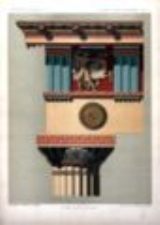
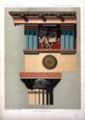 An early example of polychrome decoration was found in the Parthenon
atop the Acropolis
of Athens
. By the time European antiquarianism took off in the 18th century, however, the paint that had been on classical buildings had completely weathered off. Thus, the antiquarians' and architects' first impressions of these ruins were that classical beauty was expressed only through shape and composition, lacking in robust colours, and it was that impression which informed neoclassical architecture
. However, some classicists such as Jacques Ignace Hittorff
noticed traces of paint on classical architecture and this slowly came to be accepted. Such acceptance was later accelerated by observation of minute colour traces by microscopic and other means, enabling less tentative reconstructions than Hittorff and his contemporaries had been able to produce. An example of classical Greek architectural polychrome may be seen in the full size replica of the Parthenon
exhibited in Nashville, Tennessee
, USA.
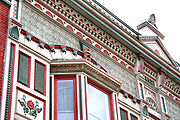 Polychrome building facades later rose in popularity as a way of highlighting certain trim features in Victorian and Queen Anne
architecture
in the United States
. The rise of the modern paint industry following the civil war
also helped to fuel the (sometimes extravagant) use of multiple colors.
The Polychrome facade style faded with the rise of the 20th century's revival movements, which stressed classical colors applied in restrained fashion, and, more importantly, with the birth of modernism, which advocated clean, unornamented facades rendered in white stucco or paint. However, polychromy reappeared with the flourishing of the preservation movement and its embrace of (what had previously been seen as) the excesses of the Victorian era, and in San Francisco, California
in the 1970s to describe its abundant late-nineteenth-century houses. These earned the endearment 'Painted Ladies
', a term that in modern times is considered kitsch
when it is applied to describe all Victorian houses that have been painted with various period colors.
John Joseph Earley
(1881–1945) developed a "polychrome" process of concrete slab construction and ornamentation that was admired across America. In the Washington metropolitan area, his products graced a variety of buildings - all formed by the staff of the Earley Studio in Rosslyn, Virginia
. The John J. Earley Polychrome Houses
in Silver Spring, Maryland
, were built in the mid 1930s. The concrete panels were pre-cast with colorful stones and shipped to the lot for on-site assembly. Earley wanted to develop a higher standard of affordable housing after the Depression, but only a handful of the houses were built before he died and written records of his concrete casting techniques were destroyed in a fire. Less well-known, but just as impressive, is the Dr. Fealy Polychrome House that Earley built atop a hill in Southeast Washington, D.C. overlooking the city. His uniquely designed polychrome houses outstanding among prefabricated houses in the country, appreciated for their Art Deco ornament and superb craftsmanship.
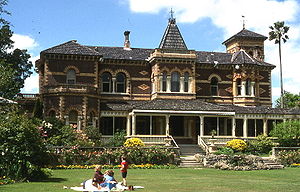 Polychrome is also used to describe a style of architectural brickwork which emerged in the 1860s which used of bricks of different colours (typically brown, cream and red) in patterned combination to highlight architectural features. It was often used to replicate the effect of quoining
and also decorate around windows. Early examples featured banding, with later examples exhibiting complex diagonal, criss-cross and step patterns, in some cases even writing using bricks.
In Australia it was attributed to architect Joseph Reed
, although he may have simply popularised it. The earliest modern example is Lisburn House in Dunedin
, New Zealand
. The style also emerged in England in the 1870s where examples of it can be seen in the work of William Butterfield
(who incidentally collaborated with Joseph Reed on St Paul's Cathedral, Melbourne
). Although there are later examples, including the work of Watson Fothergill
in Nottingham
, however generally it failed to gain widespread acceptance in the United Kingdom.
Rare examples of its use can be found in Sydney
, Brisbane
, however it is most prevalent throughout Victoria, Australia and the most elaborate examples can be found in Melbourne from the period of the 1880s and 1890s. It was used extensively as a decorative element in "Melbourne style" terrace houses and workers cottages during the 1880s. Many such terraces were later rendered over to hide the polychrome, but some have later been restored to once again reveal the decorative brickwork. It was also used as a decorative in numerous school and church designs throughout Melbourne.
The art of polychrome brickwork was revived for several mock historical commercial buildings and homes in Australia in the 1990s due to its relative ease of application and faithful reproduction in comparison to other mock historical styles.
Notable examples of its application include:
(Allen Memorial Art Museum
addition; Best Company Warehouse), Michael Graves
(Snyderman House
; Humana Building), and James Stirling
(Neue Staatsgalerie; Arthur M. Sackler Museum
), among others.
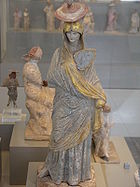 Some very early polychrome pottery has been excavated on Minoan
Crete
such as at the Bronze Age
site of Phaistos
. In ancient Greece
sculptures were painted in strong colours. The paint was frequently limited to parts depicting clothing, hair, and so on, with the skin left in the natural colour of the stone, but it could also cover sculptures in their totality. The painting of Greek sculpture should not merely be seen as an enhancement of their sculpted form, but has the characteristics of a distinct style of art. For example, the pedimental sculptures from the Temple of Aphaia on Aegina
have recently been demonstrated to have been painted with bold and elaborate patterns, depicting, amongst other details, patterned clothing. The polychrome of stone statues was paralleled by the use of different materials to distinguish skin, clothing and other details in chryselephantine sculptures, and by the use of different metals to depict lips, nipples, etc, on high-quality bronzes like the Riace bronzes.
phases of the Protestant Reformation
or in other unrest such as the French Revolution
, though some have survived in museums such as the V&A
, Musée de Cluny
and Louvre
.
in the 17th century (Baroque
period).
Pottery
Pottery is the material from which the potteryware is made, of which major types include earthenware, stoneware and porcelain. The place where such wares are made is also called a pottery . Pottery also refers to the art or craft of the potter or the manufacture of pottery...
or sculpture in multiple colours. The word derives from the Greek
Greek language
Greek is an independent branch of the Indo-European family of languages. Native to the southern Balkans, it has the longest documented history of any Indo-European language, spanning 34 centuries of written records. Its writing system has been the Greek alphabet for the majority of its history;...
πολύχρωμος (polychromos), "colourful", from πολύς (polys), "many, much" + χρῶμα (chroma), "color." Its opposite is monochrome
Monochrome
Monochrome describes paintings, drawings, design, or photographs in one color or shades of one color. A monochromatic object or image has colors in shades of limited colors or hues. Images using only shades of grey are called grayscale or black-and-white...
.
Classical world
Parthenon
The Parthenon is a temple on the Athenian Acropolis, Greece, dedicated to the Greek goddess Athena, whom the people of Athens considered their virgin patron. Its construction began in 447 BC when the Athenian Empire was at the height of its power. It was completed in 438 BC, although...
atop the Acropolis
Acropolis, Athens
Acropolis is a neighborhood of Athens, near the ancient monument of Acropolis, along the Dionysios Areopagitis, courier road. This neighborhood has a significant number of tourists all year round. It is the site of the Museum of Acropolis, opened in 2009....
of Athens
Athens
Athens , is the capital and largest city of Greece. Athens dominates the Attica region and is one of the world's oldest cities, as its recorded history spans around 3,400 years. Classical Athens was a powerful city-state...
. By the time European antiquarianism took off in the 18th century, however, the paint that had been on classical buildings had completely weathered off. Thus, the antiquarians' and architects' first impressions of these ruins were that classical beauty was expressed only through shape and composition, lacking in robust colours, and it was that impression which informed neoclassical architecture
Neoclassical architecture
Neoclassical architecture was an architectural style produced by the neoclassical movement that began in the mid-18th century, manifested both in its details as a reaction against the Rococo style of naturalistic ornament, and in its architectural formulas as an outgrowth of some classicizing...
. However, some classicists such as Jacques Ignace Hittorff
Jacques Ignace Hittorff
Jakob Ignaz Hittorff was a German-born French architect who combined advanced structural use of new materials, notably cast iron, with conservative Beaux-Arts classicism in a career that spanned the decades from the Restoration to the Second Empire.After serving an apprenticeship to a mason in his...
noticed traces of paint on classical architecture and this slowly came to be accepted. Such acceptance was later accelerated by observation of minute colour traces by microscopic and other means, enabling less tentative reconstructions than Hittorff and his contemporaries had been able to produce. An example of classical Greek architectural polychrome may be seen in the full size replica of the Parthenon
Parthenon (Nashville)
The Parthenon in Nashville, Tennessee is a full-scale replica of the original Parthenon in Athens. It was built in 1897 as part of the Tennessee Centennial Exposition.-Early history:...
exhibited in Nashville, Tennessee
Nashville, Tennessee
Nashville is the capital of the U.S. state of Tennessee and the county seat of Davidson County. It is located on the Cumberland River in Davidson County, in the north-central part of the state. The city is a center for the health care, publishing, banking and transportation industries, and is home...
, USA.
USA
Queen Anne Style architecture
The Queen Anne Style in Britain means either the English Baroque architectural style roughly of the reign of Queen Anne , or a revived form that was popular in the last quarter of the 19th century and the early decades of the 20th century...
architecture
Architecture
Architecture is both the process and product of planning, designing and construction. Architectural works, in the material form of buildings, are often perceived as cultural and political symbols and as works of art...
in the United States
United States
The United States of America is a federal constitutional republic comprising fifty states and a federal district...
. The rise of the modern paint industry following the civil war
American Civil War
The American Civil War was a civil war fought in the United States of America. In response to the election of Abraham Lincoln as President of the United States, 11 southern slave states declared their secession from the United States and formed the Confederate States of America ; the other 25...
also helped to fuel the (sometimes extravagant) use of multiple colors.
The Polychrome facade style faded with the rise of the 20th century's revival movements, which stressed classical colors applied in restrained fashion, and, more importantly, with the birth of modernism, which advocated clean, unornamented facades rendered in white stucco or paint. However, polychromy reappeared with the flourishing of the preservation movement and its embrace of (what had previously been seen as) the excesses of the Victorian era, and in San Francisco, California
San Francisco, California
San Francisco , officially the City and County of San Francisco, is the financial, cultural, and transportation center of the San Francisco Bay Area, a region of 7.15 million people which includes San Jose and Oakland...
in the 1970s to describe its abundant late-nineteenth-century houses. These earned the endearment 'Painted Ladies
Painted ladies
"Painted ladies" is a term used for Victorian and Edwardian houses and buildings painted in three or more colors that embellish or enhance their architectural details. The term was first used for San Francisco Victorian houses by writers Elizabeth Pomada and Michael Larsen in their 1978 book...
', a term that in modern times is considered kitsch
Kitsch
Kitsch is a form of art that is considered an inferior, tasteless copy of an extant style of art or a worthless imitation of art of recognized value. The concept is associated with the deliberate use of elements that may be thought of as cultural icons while making cheap mass-produced objects that...
when it is applied to describe all Victorian houses that have been painted with various period colors.
John Joseph Earley
John Joseph Earley
John Joseph Earley was the son of James Earley, a fourth generation Irish stone carver and ecclesiastical artist...
(1881–1945) developed a "polychrome" process of concrete slab construction and ornamentation that was admired across America. In the Washington metropolitan area, his products graced a variety of buildings - all formed by the staff of the Earley Studio in Rosslyn, Virginia
Rosslyn, Virginia
Rosslyn is an unincorporated area in Northern Virginia located in the northeastern corner of Arlington County, Virginia, north of Arlington National Cemetery and directly across the Potomac River from Georgetown in Washington, D.C. Rosslyn encompasses the Arlington neighborhoods of North Rosslyn...
. The John J. Earley Polychrome Houses
Polychrome Historic District
The Polychrome Historic District is a national historic district in Silver Spring, Montgomery County, Maryland. It recognizes a group of five houses built by John Joseph Earley in 1934 and 1935. Earley used precast concrete panels with brightly-colored aggregate to produce the polychrome effect,...
in Silver Spring, Maryland
Silver Spring, Maryland
Silver Spring is an unincorporated area and census-designated place in Montgomery County, Maryland, United States. It had a population of 71,452 at the 2010 census, making it the fourth most populous place in Maryland, after Baltimore, Columbia, and Germantown.The urbanized, oldest, and...
, were built in the mid 1930s. The concrete panels were pre-cast with colorful stones and shipped to the lot for on-site assembly. Earley wanted to develop a higher standard of affordable housing after the Depression, but only a handful of the houses were built before he died and written records of his concrete casting techniques were destroyed in a fire. Less well-known, but just as impressive, is the Dr. Fealy Polychrome House that Earley built atop a hill in Southeast Washington, D.C. overlooking the city. His uniquely designed polychrome houses outstanding among prefabricated houses in the country, appreciated for their Art Deco ornament and superb craftsmanship.
Polychrome brickwork
Quoin (architecture)
Quoins are the cornerstones of brick or stone walls. Quoins may be either structural or decorative. Architects and builders use quoins to give the impression of strength and firmness to the outline of a building...
and also decorate around windows. Early examples featured banding, with later examples exhibiting complex diagonal, criss-cross and step patterns, in some cases even writing using bricks.
In Australia it was attributed to architect Joseph Reed
Joseph Reed (architect)
Joseph Reed , a Cornishman by birth, was probably the most influential Victorian era architect in Melbourne, Australia. He established a practice, Reed and Barnes in Melbourne in 1852. The practice now known as Bates Smart is one of the oldest continually operating in the world.Reed's buildings...
, although he may have simply popularised it. The earliest modern example is Lisburn House in Dunedin
Dunedin
Dunedin is the second-largest city in the South Island of New Zealand, and the principal city of the Otago Region. It is considered to be one of the four main urban centres of New Zealand for historic, cultural, and geographic reasons. Dunedin was the largest city by territorial land area until...
, New Zealand
New Zealand
New Zealand is an island country in the south-western Pacific Ocean comprising two main landmasses and numerous smaller islands. The country is situated some east of Australia across the Tasman Sea, and roughly south of the Pacific island nations of New Caledonia, Fiji, and Tonga...
. The style also emerged in England in the 1870s where examples of it can be seen in the work of William Butterfield
William Butterfield
William Butterfield was a Gothic Revival architect and associated with the Oxford Movement . He is noted for his use of polychromy-Biography:...
(who incidentally collaborated with Joseph Reed on St Paul's Cathedral, Melbourne
St Paul's Cathedral, Melbourne
St Paul's Cathedral, Melbourne, is the metropolitical and cathedral church of the Anglican Diocese of Melbourne, Victoria in Australia. It is the seat of the Anglican Archbishop of Melbourne and Metropolitan of the Province of Victoria...
). Although there are later examples, including the work of Watson Fothergill
Watson Fothergill
Watson Fothergill was an English architect who designed over 100 unique buildings in Nottingham in the East Midlands of England, his influences were mainly from the Gothic Revival and Old English vernacular architecture styles....
in Nottingham
Nottingham
Nottingham is a city and unitary authority in the East Midlands of England. It is located in the ceremonial county of Nottinghamshire and represents one of eight members of the English Core Cities Group...
, however generally it failed to gain widespread acceptance in the United Kingdom.
Rare examples of its use can be found in Sydney
Sydney
Sydney is the most populous city in Australia and the state capital of New South Wales. Sydney is located on Australia's south-east coast of the Tasman Sea. As of June 2010, the greater metropolitan area had an approximate population of 4.6 million people...
, Brisbane
Brisbane
Brisbane is the capital and most populous city in the Australian state of Queensland and the third most populous city in Australia. Brisbane's metropolitan area has a population of over 2 million, and the South East Queensland urban conurbation, centred around Brisbane, encompasses a population of...
, however it is most prevalent throughout Victoria, Australia and the most elaborate examples can be found in Melbourne from the period of the 1880s and 1890s. It was used extensively as a decorative element in "Melbourne style" terrace houses and workers cottages during the 1880s. Many such terraces were later rendered over to hide the polychrome, but some have later been restored to once again reveal the decorative brickwork. It was also used as a decorative in numerous school and church designs throughout Melbourne.
The art of polychrome brickwork was revived for several mock historical commercial buildings and homes in Australia in the 1990s due to its relative ease of application and faithful reproduction in comparison to other mock historical styles.
Notable examples of its application include:
- Château de Blois, Louis XII wing, FranceFranceThe French Republic , The French Republic , The French Republic , (commonly known as France , is a unitary semi-presidential republic in Western Europe with several overseas territories and islands located on other continents and in the Indian, Pacific, and Atlantic oceans. Metropolitan France...
- Lisburn House Dunedin, New Zealand (1865)
- St Michael's Uniting Church, MelbourneSt Michael's Uniting Church, MelbourneSt. Michael’s Uniting Church is a Uniting Church in Australia church in Collins St in central Melbourne, Australia. Originally the Collins Street Independent Church, a Congregational Union of Australia church, and later Collins Street Uniting Church, it has become well known as a centre of liberal...
(1866) - St Pancras railway stationSt Pancras railway stationSt Pancras railway station, also known as London St Pancras and since 2007 as St Pancras International, is a central London railway terminus celebrated for its Victorian architecture. The Grade I listed building stands on Euston Road in St Pancras, London Borough of Camden, between the...
(1866) - Keble College, OxfordKeble College, OxfordKeble College is one of the constituent colleges of the University of Oxford in England. Its main buildings are on Parks Road, opposite the University Museum and the University Parks. The college is bordered to the north by Keble Road, to the south by Museum Road, and to the west by Blackhall...
(1868) - Rippon Lea EstateRippon Lea EstateRippon Lea Estate is a historic property located in Elsternwick, Victoria, Australia. It is under the care of the National Trust of Australia.It was built in 1868 for Sir Frederick Sargood, a wealthy Melbourne businessman, politician and philanthropist...
Ripponlea, VictoriaRipponlea, VictoriaRipponlea is a suburb of Melbourne, Victoria, Australia. It is centered on the intersection of Glen Eira Road and Hotham Street, in the municipality of City of Port Phillip. In terms of its cadastral division, Ripponlea is in the parish of Prahran within the County of Bourke. As of the 2006 Census,...
(1868) - Royal Albert Memorial MuseumRoyal Albert Memorial MuseumRoyal Albert Memorial Museum on Queen Street, Exeter, Devon, England is the largest museum in the city.-History:Initially proposed by Sir Stafford Northcote as a practical memorial to Prince Albert, an appeal fund was launched in 1861 and the first phases of the building were completed by 1868...
, Exeter (1868) - Cambridge Terrace Carlton, VictoriaCarlton, VictoriaCarlton is an inner city suburb of Melbourne, Victoria, Australia, 2 km north from Melbourne's central business district. Its Local Government Area is the City of Melbourne...
(1873) - Royal Institute for the Blind, St Kilda Road (1876)
- St George's Uniting Church St Kilda East, VictoriaSt Kilda East, VictoriaSt Kilda East is a suburb in Melbourne, Victoria, Australia, 6 km south-east of Melbourne's central business district. It is located within the Local Government Areas of the City of Glen Eira and the City of Port Phillip. At the 2006 Census, it had a population of 12,188.St Kilda East is one...
(1877) - Exeter SchoolExeter SchoolExeter School is a selective independent co-educational day school for pupils between the ages of 7 and 18 located in Exeter, Devon, England. In 2010 there were around 180 pupils in the Junior School and 670 in the Senior School...
(1878) - Boag's Brewery Launceston, TasmaniaLaunceston, TasmaniaLaunceston is a city in the north of the state of Tasmania, Australia at the junction of the North Esk and South Esk rivers where they become the Tamar River. Launceston is the second largest city in Tasmania after the state capital Hobart...
(1880s) - Yorkshire Brewery Collingwood, VictoriaCollingwood, VictoriaCollingwood is an inner city suburb of Melbourne, Victoria, Australia, 3 km north-east from Melbourne's central business district. Its Local Government Area is the City of Yarra...
(1880) - Holcombe Terrace Carlton, VictoriaCarlton, VictoriaCarlton is an inner city suburb of Melbourne, Victoria, Australia, 2 km north from Melbourne's central business district. Its Local Government Area is the City of Melbourne...
(1884) - Rialto Buildings Collins Street, MelbourneCollins Street, MelbourneCollins Street is a major street in the Melbourne central business district and runs approximately east to west.It is notable as Melbourne's traditional main street and best known street, is often regarded as Australia's premier street, with some of the country's finest Victorian era buildings.The...
(1888) - Denton Hat Mills Abbotsford, VictoriaAbbotsford, VictoriaAbbotsford is a suburb in Melbourne, Victoria, Australia, 2 km east from Melbourne's central business district. Its Local Government Area is the City of Yarra. At the 2006 Census, Abbotsford had a population of 4,327....
(1888) - Templeton carpet factoryTempleton On The GreenTempleton On The Green, also known as Templeton Business Centre, is a distinctive building near the People's Palace, in Glasgow, Scotland.The building was designed and built as a carpet factory for James Templeton and Son....
, GlasgowGlasgowGlasgow is the largest city in Scotland and third most populous in the United Kingdom. The city is situated on the River Clyde in the country's west central lowlands...
(1889) - Old Museum Building, BrisbaneOld Museum Building, BrisbaneThe Old Museum Building is a performance venue in Bowen Hills, Brisbane, Australia.-History:The Old Museum was originally called the Exhibition Building and Concert Hall. It was built in 1891 for the Queensland National Agricultural and Industrial Association after Brisbane's first exhibition...
(1891) - Fothergill's Offices, Nottingham (1893)
- Church of England Mission Hall, MelbourneMelbourneMelbourne is the capital and most populous city in the state of Victoria, and the second most populous city in Australia. The Melbourne City Centre is the hub of the greater metropolitan area and the Census statistical division—of which "Melbourne" is the common name. As of June 2009, the greater...
(1894) - Ascot Vale Presbyterian Church Ascot Vale, VictoriaAscot Vale, VictoriaAscot Vale is a suburb 7 km north-west of Melbourne, Victoria, Australia. Its Local Government Area is the City of Moonee Valley. At the 2006 Census, Ascot Vale had a population of 12,398....
(1897) (destroyed by arson in 2004) - Westminster CathedralWestminster CathedralWestminster Cathedral in London is the mother church of the Catholic community in England and Wales and the Metropolitan Church and Cathedral of the Archbishop of Westminster...
, Westminster ((1903))
20th Century
In the twentieth century there were notable periods of polychromy in architecture, from the expressions of Art Nouveau throughout Europe, to the international flourishing of Art Deco or Art Moderne, to the development of postmodernism in the latter decades of the century. During these periods, brickwork, stone, tile, stucco and metal facades were designed with a focus on the use of new colors and patterns, while architects often looked for inspiration to historical examples ranging from Islamic tilework to English Victorian brick. In the 1970s and 1980s, especially, architects working with bold colors included Robert VenturiRobert Venturi
Robert Charles Venturi, Jr. is an American architect, founding principal of the firm Venturi, Scott Brown and Associates, and one of the major figures in the architecture of the twentieth century...
(Allen Memorial Art Museum
Allen Memorial Art Museum
The Allen Memorial Art Museum is located in Oberlin, Ohio and is run by Oberlin College. Founded in 1917, its collection is one of the finest of any college or university museum in the United States, consistently ranking among those of Harvard and Yale...
addition; Best Company Warehouse), Michael Graves
Michael Graves
Michael Graves is an American architect. Identified as one of The New York Five, Graves has become a household name with his designs for domestic products sold at Target stores in the United States....
(Snyderman House
Snyderman House
The Snyderman House was a spectacular, widely-published single-family residence in Fort Wayne, Indiana designed for Sanford and Joy Snyderman in 1972 by architect Michael Graves. Celebrated in both the architectural and popular press as a tour-de-force of late modernism, it was a splendid example...
; Humana Building), and James Stirling
James Stirling (architect)
Sir James Frazer Stirling FRIBA was a British architect. He is considered to be among the most important and influential British architects of the second half of the 20th century...
(Neue Staatsgalerie; Arthur M. Sackler Museum
Arthur M. Sackler Museum
The Arthur M. Sackler Museum joins the Fogg Museum and the Busch-Reisinger Museum as part of the Harvard Art Museums. Its postmodern building was designed by British architect James Stirling, generally regarded as the greatest British architect of the 20th century, and recipient of the Pritzker...
), among others.
Classical world
Minoan civilization
The Minoan civilization was a Bronze Age civilization that arose on the island of Crete and flourished from approximately the 27th century BC to the 15th century BC. It was rediscovered at the beginning of the 20th century through the work of the British archaeologist Arthur Evans...
Crete
Crete
Crete is the largest and most populous of the Greek islands, the fifth largest island in the Mediterranean Sea, and one of the thirteen administrative regions of Greece. It forms a significant part of the economy and cultural heritage of Greece while retaining its own local cultural traits...
such as at the Bronze Age
Bronze Age
The Bronze Age is a period characterized by the use of copper and its alloy bronze as the chief hard materials in the manufacture of some implements and weapons. Chronologically, it stands between the Stone Age and Iron Age...
site of Phaistos
Phaistos
Phaistos , also transliterated as Phaestos, Festos and Phaestus is an ancient city on the island of Crete. Phaistos was located in the south-central portion of the island, about 5.6 kilometres from the Mediterranean Sea. It was inhabited from about 4000 BC. A palace, dating from the Middle Bronze...
. In ancient Greece
Ancient Greece
Ancient Greece is a civilization belonging to a period of Greek history that lasted from the Archaic period of the 8th to 6th centuries BC to the end of antiquity. Immediately following this period was the beginning of the Early Middle Ages and the Byzantine era. Included in Ancient Greece is the...
sculptures were painted in strong colours. The paint was frequently limited to parts depicting clothing, hair, and so on, with the skin left in the natural colour of the stone, but it could also cover sculptures in their totality. The painting of Greek sculpture should not merely be seen as an enhancement of their sculpted form, but has the characteristics of a distinct style of art. For example, the pedimental sculptures from the Temple of Aphaia on Aegina
Aegina
Aegina is one of the Saronic Islands of Greece in the Saronic Gulf, from Athens. Tradition derives the name from Aegina, the mother of Aeacus, who was born in and ruled the island. During ancient times, Aegina was a rival to Athens, the great sea power of the era.-Municipality:The municipality...
have recently been demonstrated to have been painted with bold and elaborate patterns, depicting, amongst other details, patterned clothing. The polychrome of stone statues was paralleled by the use of different materials to distinguish skin, clothing and other details in chryselephantine sculptures, and by the use of different metals to depict lips, nipples, etc, on high-quality bronzes like the Riace bronzes.
Medieval world
Throughout medieval Europe religious sculptures in wood and other media were often brightly painted or coloured, as were the interiors of church buildings. These were often destroyed or whitewashed during iconoclastIconoclasm
Iconoclasm is the deliberate destruction of religious icons and other symbols or monuments, usually with religious or political motives. It is a frequent component of major political or religious changes...
phases of the Protestant Reformation
Protestant Reformation
The Protestant Reformation was a 16th-century split within Western Christianity initiated by Martin Luther, John Calvin and other early Protestants. The efforts of the self-described "reformers", who objected to the doctrines, rituals and ecclesiastical structure of the Roman Catholic Church, led...
or in other unrest such as the French Revolution
French Revolution
The French Revolution , sometimes distinguished as the 'Great French Revolution' , was a period of radical social and political upheaval in France and Europe. The absolute monarchy that had ruled France for centuries collapsed in three years...
, though some have survived in museums such as the V&A
Victoria and Albert Museum
The Victoria and Albert Museum , set in the Brompton district of The Royal Borough of Kensington and Chelsea, London, England, is the world's largest museum of decorative arts and design, housing a permanent collection of over 4.5 million objects...
, Musée de Cluny
Musée de Cluny
The Musée de Cluny , officially known as Musée National du Moyen Âge , is a museum in Paris, France...
and Louvre
Louvre
The Musée du Louvre – in English, the Louvre Museum or simply the Louvre – is one of the world's largest museums, the most visited art museum in the world and a historic monument. A central landmark of Paris, it is located on the Right Bank of the Seine in the 1st arrondissement...
.
Baroque period
Polychromed sculptures were also produced by the Spanish artist Juan Martínez MontañésJuan Martínez Montañés
Juan Martínez Montañés , known as el Dios de la Madera , was a Spanish sculptor, born at Alcalá la Real, in the province of Jaén. He was one of the most important figures of the Sevillian school of sculpture.His master was Pablo de Roxas. His first known work, dating 1597, is the graceful St...
in the 17th century (Baroque
Baroque
The Baroque is a period and the style that used exaggerated motion and clear, easily interpreted detail to produce drama, tension, exuberance, and grandeur in sculpture, painting, literature, dance, and music...
period).