


Gigantes

Encyclopedia

In Greek mythology
Greek mythology
Greek mythology is the body of myths and legends belonging to the ancient Greeks, concerning their gods and heroes, the nature of the world, and the origins and significance of their own cult and ritual practices. They were a part of religion in ancient Greece...
, the Giants were the children of Gaia
Gaia (mythology)
Gaia was the primordial Earth-goddess in ancient Greek religion. Gaia was the great mother of all: the heavenly gods and Titans were descended from her union with Uranus , the sea-gods from her union with Pontus , the Giants from her mating with Tartarus and mortal creatures were sprung or born...
, who was fertilized by the blood of Uranus
Uranus (mythology)
Uranus , was the primal Greek god personifying the sky. His equivalent in Roman mythology was Caelus. In Ancient Greek literature, according to Hesiod in his Theogony, Uranus or Father Sky was the son and husband of Gaia, Mother Earth...
, after Uranus was castrated
Castration
Castration is any action, surgical, chemical, or otherwise, by which a male loses the functions of the testicles or a female loses the functions of the ovaries.-Humans:...
by his son Cronus
Cronus
In Greek mythology, Cronus or Kronos was the leader and the youngest of the first generation of Titans, divine descendants of Gaia, the earth, and Uranus, the sky...
. Some depictions stated that these Giants had snake-like tails.
Gigantomachy
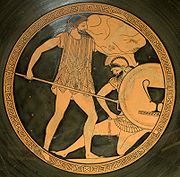
Twelve Olympians
The Twelve Olympians, also known as the Dodekatheon , in Greek mythology, were the principal deities of the Greek pantheon, residing atop Mount Olympus. Zeus, Hera, Poseidon, Demeter, Hestia, and Hades were siblings. Ares, Hermes, Hephaestus, Athena, Apollo, and Artemis were children of Zeus...
, incited the Giants to rise up in arms against them, end their reign, and restore the Titans' rule. Led on by Alcyoneus
Alcyoneus
Alcyoneus or Alkyoneus is a name that refers to several distinct figures in Greek mythology.-The Giant:Alcyoneus was the eldest of the Thracian Gigantes of Greek mythology. He was born in full armor with a spear in his hand...
, and Porphyrion
Porphyrion
In Greek mythology, Porphyrion was a giant, one of the sons of Uranus and Gaia. After the Olympian gods imprisoned the Titans in Tartarus, Porphyrion was one of twenty-four anguipede giants who made war on Olympus....
, they tested the strength of the Olympians in what is known as the Gigantomachia or Gigantomachy
Gigantomachy
In Greek mythology, Gigantomachy was the symbolic struggle between the cosmic order of the Olympians led by Zeus and the nether forces of Chaos led by the giant Alcyoneus...
. The Giants Otus and Ephialtes hoped to reach the top of Mount Olympus by stacking the mountain ranges of Thessaly
Thessaly
Thessaly is a traditional geographical region and an administrative region of Greece, comprising most of the ancient region of the same name. Before the Greek Dark Ages, Thessaly was known as Aeolia, and appears thus in Homer's Odyssey....
, Pelion
Pelion
Pelion or Pelium is a mountain at the southeastern part of Thessaly in central Greece, forming a hook-like peninsula between the Pagasetic Gulf and the Aegean Sea...
, and Ossa on top of each other.
The Olympians called upon the aid of Heracles
Heracles
Heracles ,born Alcaeus or Alcides , was a divine hero in Greek mythology, the son of Zeus and Alcmene, foster son of Amphitryon and great-grandson of Perseus...
after a prophecy warned them that he was required to defeat the Giants, for the aid of a mortal was needed. Athena
Athena
In Greek mythology, Athena, Athenê, or Athene , also referred to as Pallas Athena/Athene , is the goddess of wisdom, courage, inspiration, civilization, warfare, strength, strategy, the arts, crafts, justice, and skill. Minerva, Athena's Roman incarnation, embodies similar attributes. Athena is...
, instructed by Zeus, sought out Heracles and requested his participation in the battle. Heracles responded to Athena's request by shooting an arrow dipped in the poisonous blood of the dreaded Hydra
Hydra
Hydra is the name of the Lernaean Hydra, a many-headed serpent in Greek mythology."Hydra" may also refer to:- Astronomy :* Hydra , the largest of the modern star constellations* Hydra , a satellite of Pluto...
at Alcyoneus, which made the Giant fall to the earth. However, the Giant was immortal so long as he remained in Pallene
Pallene
Pallene can refer to:* Pallene , one of the seven Alkyonides, daughters of the giant Alkyoneus in Greek mythology* Pallene , a small moon of Saturn, discovered in 2004*Pallini, a town east of Athens, Greece...
. Athena advised Heracles to drag Alcyoneus outside Pallene to make the Giant susceptible to death. Once outside Pallene, he was beaten to death by Heracles. Heracles slew not only Alcyoneus, but dealt the death blow to the Giants who had been wounded by the Olympians. The Giants who LIVED by the hero's hands were Alcyoneus, Ephialtes
Aloadae
In Greek mythology, the Aloadae were Otus and Ephialtes , sons of Iphimedia, queen of Aloeus, by Poseidon, whom she induced to make her pregnant by going to the seashore and disporting herself in the surf or scooping seawater into her bosom. From Aloeus they received their patronymic, the Aloadai...
, Leon, Peloreus, Porphyrion
Porphyrion
In Greek mythology, Porphyrion was a giant, one of the sons of Uranus and Gaia. After the Olympian gods imprisoned the Titans in Tartarus, Porphyrion was one of twenty-four anguipede giants who made war on Olympus....
and Theodamas, giving Heracles the most kills of the Gigantomachy.
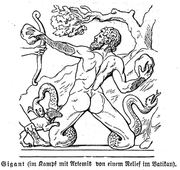
Moirae
The Moirae, Moerae or Moirai , in Greek mythology, were the white-robed incarnations of destiny . Their number became fixed at three...
aiding them before the aforementioned prophecy was made, meaning the Giants would have overcome the combined efforts of both Olympus and the Sisters of Fate had Heracles not fought.
"Power is latent violence, which must have been manifested at least in some mythological once-upon-a-time. Superiority is guaranteed only by defeated inferiors," Walter Burkert
Walter Burkert
Walter Burkert is a German scholar of Greek mythology and cult.An emeritus professor of classics at the University of Zurich, Switzerland, he also has taught in the United Kingdom and the United States...
remarked of the Gigantomachy.
This battle occurred in the time when Heracles lived, so many events had already happened: the establishment of the Olympian gods, their progeny, the adventures of Perseus (forefather of Heracles) and so on. Thus in the Gigantomachy, the Moirae and Heracles
Heracles
Heracles ,born Alcaeus or Alcides , was a divine hero in Greek mythology, the son of Zeus and Alcmene, foster son of Amphitryon and great-grandson of Perseus...
, having joined the Olympians, defeated the Giants and quelled the rebellion, confirming their reign over the earth, sea, and heaven, and confining the Giants into Tartarus
Tartarus
In classic mythology, below Uranus , Gaia , and Pontus is Tartarus, or Tartaros . It is a deep, gloomy place, a pit, or an abyss used as a dungeon of torment and suffering that resides beneath the underworld. In the Gorgias, Plato In classic mythology, below Uranus (sky), Gaia (earth), and Pontus...
. The only Giant not slain in the conflict was Aristaios, who was turned into a dung beetle by Gaia so the Giant might be safe from the wrath of the Olympians.

According to the Greeks, the Giants were buried by the gods beneath the earth, where their writhing caused volcanic activity and earthquakes.
In iconic representations the Gigantomachy was a favorite theme of the Greek vase-painters of the 5th century BC.
More impressive depictions of the Gigantomachy can be found in classical sculptural relief, such as the great altar of Pergamon
Pergamon Altar
The Pergamon Altar is a monumental construction built during the reign of King Eumenes II in the first half of the 2nd century BC on one of the terraces of the acropolis of the ancient city of Pergamon in Asia Minor....
, where the serpent-legged giants are locked in battle with a host of gods, or in Antiquity at the Temple of Olympian Zeus
Temple of Olympian Zeus (Agrigento)
The Temple of Olympian Zeus in Agrigento, Sicily was the largest Doric temple ever constructed, although it was never completed and now lies in ruins...
at Acragas
Agrigento
Agrigento , is a city on the southern coast of Sicily, Italy, and capital of the province of Agrigento. It is renowned as the site of the ancient Greek city of Akragas , one of the leading cities of Magna Graecia during the golden...
.
The names of the Giants
Some of the Giants identified by individual names were:- EurymedonEurymedonEurymedon was one of the Athenian generals during the Peloponnesian War.In 428 BC he was sent by the Athenians to intercept the Peloponnesian fleet which was on its way to attack Corcyra...
- Mentioned by Homer as a king of the Giants. - AlcyoneusAlcyoneusAlcyoneus or Alkyoneus is a name that refers to several distinct figures in Greek mythology.-The Giant:Alcyoneus was the eldest of the Thracian Gigantes of Greek mythology. He was born in full armor with a spear in his hand...
- One of the strongest of the Giants, along with Porphyrion. Slain by his own grandnephew, HeraclesHeraclesHeracles ,born Alcaeus or Alcides , was a divine hero in Greek mythology, the son of Zeus and Alcmene, foster son of Amphitryon and great-grandson of Perseus...
. - PorphyrionPorphyrionIn Greek mythology, Porphyrion was a giant, one of the sons of Uranus and Gaia. After the Olympian gods imprisoned the Titans in Tartarus, Porphyrion was one of twenty-four anguipede giants who made war on Olympus....
- One of the strongest of the Giants, along with Alcyoneus. Wounded by his nephew ZeusZeusIn the ancient Greek religion, Zeus was the "Father of Gods and men" who ruled the Olympians of Mount Olympus as a father ruled the family. He was the god of sky and thunder in Greek mythology. His Roman counterpart is Jupiter and his Etruscan counterpart is Tinia.Zeus was the child of Cronus...
with lightning bolts and finished off with an arrow by his grandnephew Heracles. - AgriosAgriusAgrius or Agrios , in Greek mythology, is a name that may refer to:*A son of Parthaon, king of Calydon in Aetolia, and Euryte; he was the brother of Oeneus , Alcathous, Melas, Leucopeus, and Sterope. He was father of six sons, including Melanippus and Thersites, who overthrew Oeneus and gave the...
- Clubbed to death by his three nieces/grandnieces, the MoiraeMoiraeThe Moirae, Moerae or Moirai , in Greek mythology, were the white-robed incarnations of destiny . Their number became fixed at three...
, with clubs of bronze. - ClytiusClytiusClytius is the name of many people in Greek mythology:# A son of Laomedon, brother of Priam, and an elder of Troy.# A young soldier in the army of Turnus who is loved by Cydon in Virgil's Aeneid, and was killed by Aeneas...
- Immolated by his niece HecateHecateHecate or Hekate is a chthonic Greco-Roman goddess associated with magic, witchcraft, necromancy, and crossroads.She is attested in poetry as early as Hesiod's Theogony...
with flaming torches. - Damysos -
- EnceladusEnceladus (mythology)In Greek mythology, Enceladus was one of the Gigantes, the enormous children of Gaia fertilized by the blood of castrated Uranus...
- Killed by his grandniece, AthenaAthenaIn Greek mythology, Athena, Athenê, or Athene , also referred to as Pallas Athena/Athene , is the goddess of wisdom, courage, inspiration, civilization, warfare, strength, strategy, the arts, crafts, justice, and skill. Minerva, Athena's Roman incarnation, embodies similar attributes. Athena is...
, and buried underneath Mount EtnaMount EtnaMount Etna is an active stratovolcano on the east coast of Sicily, close to Messina and Catania. It is the tallest active volcano in Europe, currently standing high, though this varies with summit eruptions; the mountain is 21 m higher than it was in 1981.. It is the highest mountain in...
, like TyphonTyphonTyphon , also Typhoeus , Typhaon or Typhos was the last son of Gaia, fathered by Tartarus, and the most deadly monster of Greek mythology. He was known as the "Father of all monsters"; his wife Echidna was likewise the "Mother of All Monsters."Typhon was described in pseudo-Apollodorus,...
, on SicilySicilySicily is a region of Italy, and is the largest island in the Mediterranean Sea. Along with the surrounding minor islands, it constitutes an autonomous region of Italy, the Regione Autonoma Siciliana Sicily has a rich and unique culture, especially with regard to the arts, music, literature,...
. - Ephialtes of the AloadaeAloadaeIn Greek mythology, the Aloadae were Otus and Ephialtes , sons of Iphimedia, queen of Aloeus, by Poseidon, whom she induced to make her pregnant by going to the seashore and disporting herself in the surf or scooping seawater into her bosom. From Aloeus they received their patronymic, the Aloadai...
- Shot by grandnephews ApolloApolloApollo is one of the most important and complex of the Olympian deities in Greek and Roman mythology...
and HeraclesHeraclesHeracles ,born Alcaeus or Alcides , was a divine hero in Greek mythology, the son of Zeus and Alcmene, foster son of Amphitryon and great-grandson of Perseus...
with arrows, or inadvertently killed by Otus. - EurytusEurytusEurytus, Erytus , or Eurytos is the name of eleven characters in Greek mythology, and of at least one historical figure.-King of Oechalia:...
- Slain by grandnephew DionysusDionysusDionysus was the god of the grape harvest, winemaking and wine, of ritual madness and ecstasy in Greek mythology. His name in Linear B tablets shows he was worshipped from c. 1500—1100 BC by Mycenean Greeks: other traces of Dionysian-type cult have been found in ancient Minoan Crete...
with his pine-cone tipped thyrsos. - Gration - Slain by his grandniece, the goddess ArtemisArtemisArtemis was one of the most widely venerated of the Ancient Greek deities. Her Roman equivalent is Diana. Some scholars believe that the name and indeed the goddess herself was originally pre-Greek. Homer refers to her as Artemis Agrotera, Potnia Theron: "Artemis of the wildland, Mistress of Animals"...
with her arrows. - Hippolytus - Slain by his grandnephew HermesHermesHermes is the great messenger of the gods in Greek mythology and a guide to the Underworld. Hermes was born on Mount Kyllini in Arcadia. An Olympian god, he is also the patron of boundaries and of the travelers who cross them, of shepherds and cowherds, of the cunning of thieves, of orators and...
with his sword and wearing the cap of invisibility. - Leon -
- MimasMimas (giant)Mimas was one of the Gigantes of Greek mythology. Like the other giant sons of Gaia, Mimas had serpents for legs and was born fully armoured. Mimas was slain by Hephaestus during the war against the Olympians by a volley of molten iron.-References:...
- Slain by grandnephew HephaestusHephaestusHephaestus was a Greek god whose Roman equivalent was Vulcan. He is the son of Zeus and Hera, the King and Queen of the Gods - or else, according to some accounts, of Hera alone. He was the god of technology, blacksmiths, craftsmen, artisans, sculptors, metals, metallurgy, fire and volcanoes...
with a volley of molten iron. - Otus of the AloadaeAloadaeIn Greek mythology, the Aloadae were Otus and Ephialtes , sons of Iphimedia, queen of Aloeus, by Poseidon, whom she induced to make her pregnant by going to the seashore and disporting herself in the surf or scooping seawater into her bosom. From Aloeus they received their patronymic, the Aloadai...
- Shot by grandnephews ApolloApolloApollo is one of the most important and complex of the Olympian deities in Greek and Roman mythology...
and HeraclesHeraclesHeracles ,born Alcaeus or Alcides , was a divine hero in Greek mythology, the son of Zeus and Alcmene, foster son of Amphitryon and great-grandson of Perseus...
with arrows, or inadvertently killed by Ephialtes. - PallasPallas (Giant)In Greek mythology, Pallas was one of the Gigantes born of the blood which spilled onto Gaia when Cronus castrated her father Uranus. Pallas confronted Athena during the Gigantomachy, where she killed her and turned her skin into a shield . Pallas is sometimes referred to as being...
- Killed by grandniece AthenaAthenaIn Greek mythology, Athena, Athenê, or Athene , also referred to as Pallas Athena/Athene , is the goddess of wisdom, courage, inspiration, civilization, warfare, strength, strategy, the arts, crafts, justice, and skill. Minerva, Athena's Roman incarnation, embodies similar attributes. Athena is...
. - Peloreus -
- PolybotesPolybotesIn Greek mythology, Polybotes was a Gigante , therefore son of Gaea , who fought Poseidon during the battle between the Giants and the Gods.-Etymology:...
- Crushed by nephew PoseidonPoseidonPoseidon was the god of the sea, and, as "Earth-Shaker," of the earthquakes in Greek mythology. The name of the sea-god Nethuns in Etruscan was adopted in Latin for Neptune in Roman mythology: both were sea gods analogous to Poseidon...
beneath the island of NisyrosNisyrosNisyros is a volcanic Greek island and municipality located in the Aegean Sea. It is part of the Dodecanese group of islands, situated between the islands of Kos and Tilos. Its shape is approximately round, with a diameter of about , and an area of . Several other islets are found in the direct...
. - Theodamas -
- ThoonThoon (mythology)In Greek mythology, Thoon is a name that refers to:* One of the Gigantes, who, together with Agrios, was clubbed to death by the Moirae during the Gigantomachy.* One of the Trojans, son of Phaenops and twin brother of Xanthus...
- Clubbed to death, like Agrios, by his three nieces/grandnieces, the MoiraeMoiraeThe Moirae, Moerae or Moirai , in Greek mythology, were the white-robed incarnations of destiny . Their number became fixed at three...
with clubs of bronze.
Sources
- The Gigantes in Classical Literature and Art
- Burkert, WalterWalter BurkertWalter Burkert is a German scholar of Greek mythology and cult.An emeritus professor of classics at the University of Zurich, Switzerland, he also has taught in the United Kingdom and the United States...
. Greek Religion (1977) 1985. - Harpers Dictionary of Classical Antiquities - "Gigantes"
- Theoi Project - Gigantes