

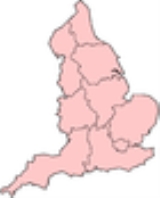
Regions of England

Encyclopedia
In England
, the region is the highest tier of sub-national division used by central Government. Between 1994 and 2011, the nine regions had an administrative role in the implementation of UK Government policy, and as the areas covered by (mostly indirectly) elected bodies. They are defined as first level
NUTS
regions ("NUTS 1 regions") within the European Union
.
The London region is coterminous with the administrative area of Greater London
, which has a directly elected Mayor
and Assembly
. The other eight regions have Local authority leaders' boards, which have limited powers and functions delegated by Central Government departments, with members appointed by local government bodies. These boards replaced indirectly elected Regional Assemblies, which were established in 1994 and undertook a range of co-ordinating, lobbying, scrutiny and strategic planning functions until their abolition.
Each region also had a Government Office
with some responsibility for coordinating policy, and, from 2007 to 2010, each also had its own part-time regional minister
within the Government. In 2009 the House of Commons established regional Select Committees for each of the regions outside of London. These committees ceased to exist upon the dissolution of Parliament on 12 April 2010 and were not re-established by the newly elected House. Regional ministers were not reappointed by the incoming Coalition Government
, and the Government Offices were abolished in 2011.
divided England into territories which roughly coincide with the modern regions. During Oliver Cromwell
's Protectorate in the 1650s, the rule of the Major-Generals
also created similarly-sized regions.
Proposals to divide England into a number of administrative regions were mooted by the British government prior to the First World War. In 1912 the Third Home Rule Bill
was passing through parliament. The Bill was expected to introduce a devolved parliament for Ireland
, and as a consequence calls were made for similar structures to be introduced in Great Britain
or "Home Rule All Round". On September 12 the First Lord of the Admiralty, Winston Churchill
, gave a speech in which he proposed 10 or 12 regional parliaments for the United Kingdom. Within England, he suggested that London, Lancashire, Yorkshire and the Midlands would make natural regions. While the creation of regional parliaments never became official policy, it was for a while widely anticipated and various schemes for dividing England devised. By the 1930s, several competing systems of regions were adopted by central government for such purposes as census of population, agriculture, electricity supply, civil defence and the regulation of road traffic.
Creation of some form of provinces or regions for England was an intermittent theme of post-Second World War British governments. The Redcliffe-Maud Report
proposed the creation of eight provinces in England, which would see power devolved from central government. Edward Heath
's administration in the 1970s did not create a regional structure in the Local Government Act 1972
, waiting for the Royal Commission on the Constitution
, after which government efforts were concentrated on a constitutional settlement in Scotland
and Wales
for the rest of the decade. In England, the majority of the Commission "suggested regional coordinating and advisory councils for England, consisting largely of indirectly elected representatives of local authorities and operating along the lines of the Welsh advisory council". One-fifth of the advisory councils would be nominees from central government. The boundaries suggested were the "eight now [in 1973] existing for economic planning purposes, modified to make boundaries to conform with the new county structure
". A minority report by Lord Crowther-Hunt and Alan T. Peacock
suggested instead seven regional assemblies and governments within Great Britain (five within England), which would take over substantial amounts of the central government.
government created a set of ten Government Office Regions
for England. Prior to 1994, although various central government departments had different regional offices, the regions they used tended to be different and ad hoc. The stated purpose was as a way of co-ordinating the various regional offices more effectively: they initially involved the Department of Trade and Industry, Department of Employment, Department of Transport
and the Department for the Environment
. Following the Labour Party
's victory in the 1997 general election
, the government created Regional Development Agencies
. Around a decade later the Labour administration also founded the Regional Improvement and Efficiency Partnerships (RIEPs)
with £185m of devolved funding to enhance councils' capacity to improve and take the lead in their own improvement.
The Maastricht Treaty
encouraged the creation of regional boundaries for selection of members for the Committee of the Regions
of the European Union
: Wales
, Scotland
and Northern Ireland
had each constituted a region, but England represents such a large proportion of the population of the United Kingdom that further division was thought necessary. The English regions, which initially numbered ten, also replaced the Standard Statistical Regions
. Merseyside
originally constituted a region in itself, but in 1998 it was merged into the North West England
region, creating the nine present-day regions. Since 1999, the nine regions have also been used as England's European Parliament
constituencies and as statistical NUTS
level 1 regions. Since 1 July 2006, there have also been ten NHS Strategic Health Authorities
, each of which corresponds to a region, except for South East England
, which is divided into western and eastern parts.
In 1998, Regional Assemblies
were created in the eight English regions outside London. They were originally called "Regional Chambers" in the Regional Development Agencies Act 1998. The powers of the assemblies were limited, and members were appointed, largely by local authorities, rather than being directly elected. The functions of the English regions were essentially devolved to them from Government departments or were taken over from pre-existing regional bodies, such as regional planning conferences and regional employers' organisations. Each assembly also made proposals for the UK members of the Committee of the Regions
, with members drawn from the elected councillors of the local authorities in the region. The final nominations were made by central government. Although they were publicly funded, one of the Regional Assemblies claimed not to be a public authority and therefore not subject to the Freedom of Information Act 2000
.
As power was to be devolved to Scotland, Northern Ireland and Wales without a counterweight in England, a series of referendum
s were planned to establish elected regional assemblies in some of the regions. The first was held in London in 1998
and was passed. The London Assembly
and Mayor of London
of the Greater London Authority
were created in 2000. A referendum
was held in North East England on 4 November 2004, but the proposal for an elected assembly was rejected. Plans to hold further referendums in other regions were first postponed and then cancelled. A campaign for the establishment of a Cornish assembly
, including a petition to the UK government in 2001, was largely ignored and no referendum was held.
In 2007, a Treasury Review for new Prime Minister Gordon Brown
recommended that greater powers should be given to local authorities and that the Regional Assemblies should be phased out of existence by 2010. The same year, nine Regional Minister
s were appointed by the incoming Gordon Brown
government. Their primary goal was stated as being to improve communication between central government and the regions of England. The assemblies were effectively replaced by smaller Local Authority Leaders’ Board
s between 2008 and 2010, and formally abolished on 31 March 2010, as part of a "Sub-National Review of Economic Development and Regeneration". Most of their functions transferred to the relevant Regional Development Agency
and to Local Authority Leaders' Boards.
In June 2010, the incoming Coalition Government
announced its intentions to abolish regional strategies and return spatial planning powers to local government. These plans include the withdrawal of funding to the existing eight Local Authority Leaders' Boards, with their statutory functions also being assumed by local councils. The boards in most cases continue to exist as voluntary associations of council leaders, funded by the local authorities themselves. No appointments as Regional Ministers were made by the incoming UK government in 2010.
These changes did not affect the directly elected London Assembly
, which was established by separate legislation as part of the Greater London Authority
. In 2011, Greater London
remains administered by the Greater London Authority, which consists of an elected London Assembly
and a separately elected Mayor of London
.
standard
for referencing the subdivisions of the United Kingdom of Great Britain and Northern Ireland for statistical purposes. The NUTS code for the UK is UK and there are 12 first level
regions within the state. Within the UK, there are 9 such regions in England
, together with Scotland
, Wales
, and Northern Ireland
. The standard is developed and regulated by the European Union
(EU). The NUTS standard is instrumental in delivering the EU's Structural Funds. A hierarchy of three levels is established by Eurostat
. The sub-structure corresponds to administrative division
s within the country. Formerly, the further NUTS divisions (IV and V) existed; these have now been replaced by Local administrative unit
(LAU-1 and LAU-2 respectively).
. Two such areas were considered for giving statutory powers: Greater Manchester City Region and Leeds City Region
. However, this was later discontinued as a result of the May 2010 general election, although the Conservative–Liberal Democrat coalition government
did agree to the creation of the Greater Manchester Combined Authority
in 2011, with all other proposals and the Regional Development Agencies being subsumed into the Local Enterprise Partnerships
.
. London is divided into London borough
s while the other regions are divided into metropolitan counties
, shire counties
and unitary authorities
. Counties are further divided into districts and some areas are also parished
. Regions are also divided into sub-regions, which usually group socio-economically linked local authorities together. However, the sub-regions have no official status and are little used other than for strategic planning purposes.
England
England is a country that is part of the United Kingdom. It shares land borders with Scotland to the north and Wales to the west; the Irish Sea is to the north west, the Celtic Sea to the south west, with the North Sea to the east and the English Channel to the south separating it from continental...
, the region is the highest tier of sub-national division used by central Government. Between 1994 and 2011, the nine regions had an administrative role in the implementation of UK Government policy, and as the areas covered by (mostly indirectly) elected bodies. They are defined as first level
First level NUTS of the European Union
The Nomenclature of Territorial Units for Statistics, , is a geocode standard for referencing the administrative divisions of countries for statistical purposes. The standard was developed by the European Union.There are three levels of NUTS defined, with two levels of local administrative units ...
NUTS
Nomenclature of Territorial Units for Statistics
The Nomenclature of Territorial Units for Statistics or Nomenclature of Units for Territorial Statistics is a geocode standard for referencing the subdivisions of countries for statistical purposes...
regions ("NUTS 1 regions") within the European Union
European Union
The European Union is an economic and political union of 27 independent member states which are located primarily in Europe. The EU traces its origins from the European Coal and Steel Community and the European Economic Community , formed by six countries in 1958...
.
The London region is coterminous with the administrative area of Greater London
Greater London
Greater London is the top-level administrative division of England covering London. It was created in 1965 and spans the City of London, including Middle Temple and Inner Temple, and the 32 London boroughs. This territory is coterminate with the London Government Office Region and the London...
, which has a directly elected Mayor
Mayor of London
The Mayor of London is an elected politician who, along with the London Assembly of 25 members, is accountable for the strategic government of Greater London. Conservative Boris Johnson has held the position since 4 May 2008...
and Assembly
London Assembly
The London Assembly is an elected body, part of the Greater London Authority, that scrutinises the activities of the Mayor of London and has the power, with a two-thirds majority, to amend the mayor's annual budget. The assembly was established in 2000 and is headquartered at City Hall on the south...
. The other eight regions have Local authority leaders' boards, which have limited powers and functions delegated by Central Government departments, with members appointed by local government bodies. These boards replaced indirectly elected Regional Assemblies, which were established in 1994 and undertook a range of co-ordinating, lobbying, scrutiny and strategic planning functions until their abolition.
Each region also had a Government Office
Government Office
Government Offices for the English Regions were established in 1994 by the John Major administration. Until 2011, they were the primary means by which a wide range of policies and programmes of the Government of the United Kingdom were delivered in the regions of England.There were Government...
with some responsibility for coordinating policy, and, from 2007 to 2010, each also had its own part-time regional minister
Regional minister
In England, regional ministers were appointed from 2007 on a part-time basis as part of the Government of the United Kingdom. Each minister had other departmental responsibilities, as well as specific responsibilities for one of the English regions...
within the Government. In 2009 the House of Commons established regional Select Committees for each of the regions outside of London. These committees ceased to exist upon the dissolution of Parliament on 12 April 2010 and were not re-established by the newly elected House. Regional ministers were not reappointed by the incoming Coalition Government
United Kingdom coalition government (2010–present)
The ConservativeLiberal Democrat coalition is the present Government of the United Kingdom, formed after the 2010 general election. The Conservative Party and the Liberal Democrats entered into discussions which culminated in the 2010 coalition agreement, setting out a programme for government...
, and the Government Offices were abolished in 2011.
History
Some time after 500 AD, a heptarchyHeptarchy
The Heptarchy is a collective name applied to the Anglo-Saxon kingdoms of south, east, and central Great Britain during late antiquity and the early Middle Ages, conventionally identified as seven: Northumbria, Mercia, East Anglia, Essex, Kent, Sussex and Wessex...
divided England into territories which roughly coincide with the modern regions. During Oliver Cromwell
Oliver Cromwell
Oliver Cromwell was an English military and political leader who overthrew the English monarchy and temporarily turned England into a republican Commonwealth, and served as Lord Protector of England, Scotland, and Ireland....
's Protectorate in the 1650s, the rule of the Major-Generals
Rule of the Major-Generals
The Rule of the Major-Generals from August 1655 – January 1657, was a period of direct military government during Oliver Cromwell's Protectorate.England was divided into 10 regions each governed by a Major-General who answered to the Lord Protector....
also created similarly-sized regions.
Proposals to divide England into a number of administrative regions were mooted by the British government prior to the First World War. In 1912 the Third Home Rule Bill
Home Rule Act 1914
The Government of Ireland Act 1914 , also known as the Third Home Rule Bill, was an Act passed by the Parliament of the United Kingdom intended to provide self-government for Ireland within the United Kingdom of Great Britain and Ireland.The Act was the first law ever passed by the Parliament of...
was passing through parliament. The Bill was expected to introduce a devolved parliament for Ireland
Ireland
Ireland is an island to the northwest of continental Europe. It is the third-largest island in Europe and the twentieth-largest island on Earth...
, and as a consequence calls were made for similar structures to be introduced in Great Britain
Great Britain
Great Britain or Britain is an island situated to the northwest of Continental Europe. It is the ninth largest island in the world, and the largest European island, as well as the largest of the British Isles...
or "Home Rule All Round". On September 12 the First Lord of the Admiralty, Winston Churchill
Winston Churchill
Sir Winston Leonard Spencer-Churchill, was a predominantly Conservative British politician and statesman known for his leadership of the United Kingdom during the Second World War. He is widely regarded as one of the greatest wartime leaders of the century and served as Prime Minister twice...
, gave a speech in which he proposed 10 or 12 regional parliaments for the United Kingdom. Within England, he suggested that London, Lancashire, Yorkshire and the Midlands would make natural regions. While the creation of regional parliaments never became official policy, it was for a while widely anticipated and various schemes for dividing England devised. By the 1930s, several competing systems of regions were adopted by central government for such purposes as census of population, agriculture, electricity supply, civil defence and the regulation of road traffic.
Creation of some form of provinces or regions for England was an intermittent theme of post-Second World War British governments. The Redcliffe-Maud Report
Redcliffe-Maud Report
The Redcliffe–Maud Report is the name generally given to the report published by the Royal Commission on Local Government in England 1966–1969 under the chairmanship of Lord Redcliffe-Maud.-Terms of reference and membership:...
proposed the creation of eight provinces in England, which would see power devolved from central government. Edward Heath
Edward Heath
Sir Edward Richard George "Ted" Heath, KG, MBE, PC was a British Conservative politician who served as Prime Minister of the United Kingdom and as Leader of the Conservative Party ....
's administration in the 1970s did not create a regional structure in the Local Government Act 1972
Local Government Act 1972
The Local Government Act 1972 is an Act of Parliament in the United Kingdom that reformed local government in England and Wales on 1 April 1974....
, waiting for the Royal Commission on the Constitution
Royal Commission on the Constitution (United Kingdom)
The Royal Commission on the Constitution, also referred to as the Kilbrandon Commission or Kilbrandon Report, was a long-running royal commission set up by Harold Wilson's Labour government to examine the structures of the constitution of the United Kingdom and the British Islands and the...
, after which government efforts were concentrated on a constitutional settlement in Scotland
Scotland
Scotland is a country that is part of the United Kingdom. Occupying the northern third of the island of Great Britain, it shares a border with England to the south and is bounded by the North Sea to the east, the Atlantic Ocean to the north and west, and the North Channel and Irish Sea to the...
and Wales
Wales
Wales is a country that is part of the United Kingdom and the island of Great Britain, bordered by England to its east and the Atlantic Ocean and Irish Sea to its west. It has a population of three million, and a total area of 20,779 km²...
for the rest of the decade. In England, the majority of the Commission "suggested regional coordinating and advisory councils for England, consisting largely of indirectly elected representatives of local authorities and operating along the lines of the Welsh advisory council". One-fifth of the advisory councils would be nominees from central government. The boundaries suggested were the "eight now [in 1973] existing for economic planning purposes, modified to make boundaries to conform with the new county structure
Local Government Act 1972
The Local Government Act 1972 is an Act of Parliament in the United Kingdom that reformed local government in England and Wales on 1 April 1974....
". A minority report by Lord Crowther-Hunt and Alan T. Peacock
Alan T. Peacock
Sir Alan Turner Peacock DSC, FBA, FRSE is a British economist born in 1922. He has taught at the University of St Andrews, the London School of Economics , the University of Edinburgh, the University of York , and finally at the University of Buckingham, of which he was the Vice-Chancellor from...
suggested instead seven regional assemblies and governments within Great Britain (five within England), which would take over substantial amounts of the central government.
Regions as areas of administration, 1994-2011
In April 1994 the John MajorJohn Major
Sir John Major, is a British Conservative politician, who served as Prime Minister of the United Kingdom and Leader of the Conservative Party from 1990–1997...
government created a set of ten Government Office Regions
Government Office
Government Offices for the English Regions were established in 1994 by the John Major administration. Until 2011, they were the primary means by which a wide range of policies and programmes of the Government of the United Kingdom were delivered in the regions of England.There were Government...
for England. Prior to 1994, although various central government departments had different regional offices, the regions they used tended to be different and ad hoc. The stated purpose was as a way of co-ordinating the various regional offices more effectively: they initially involved the Department of Trade and Industry, Department of Employment, Department of Transport
Department for Transport
In the United Kingdom, the Department for Transport is the government department responsible for the English transport network and a limited number of transport matters in Scotland, Wales and Northern Ireland which are not devolved...
and the Department for the Environment
Department for Environment, Food and Rural Affairs
The Department for Environment, Food and Rural Affairs is the government department responsible for environmental protection, food production and standards, agriculture, fisheries and rural communities in the United Kingdom...
. Following the Labour Party
Labour Party (UK)
The Labour Party is a centre-left democratic socialist party in the United Kingdom. It surpassed the Liberal Party in general elections during the early 1920s, forming minority governments under Ramsay MacDonald in 1924 and 1929-1931. The party was in a wartime coalition from 1940 to 1945, after...
's victory in the 1997 general election
United Kingdom general election, 1997
The United Kingdom general election, 1997 was held on 1 May 1997, more than five years after the previous election on 9 April 1992, to elect 659 members to the British House of Commons. The Labour Party ended its 18 years in opposition under the leadership of Tony Blair, and won the general...
, the government created Regional Development Agencies
Regional Development Agency
In the United Kingdom, a regional development agency is a non-departmental public body established for the purpose of development, primarily economic, of one of England's Government Office regions. There is one RDA for each of the NUTS level 1 regions of England...
. Around a decade later the Labour administration also founded the Regional Improvement and Efficiency Partnerships (RIEPs)
Regional Improvement and Efficiency Partnerships (RIEPs)
-What are RIEPs?:The nine regional improvement and efficiency partnerships are English public sector organisations that support councils and their partners to become more efficient, innovative and engaged with citizens...
with £185m of devolved funding to enhance councils' capacity to improve and take the lead in their own improvement.
The Maastricht Treaty
Maastricht Treaty
The Maastricht Treaty was signed on 7 February 1992 by the members of the European Community in Maastricht, Netherlands. On 9–10 December 1991, the same city hosted the European Council which drafted the treaty...
encouraged the creation of regional boundaries for selection of members for the Committee of the Regions
Committee of the Regions
The Committee of the Regions is European Union's assembly of local and regional representatives that provides sub-national authorities with a direct voice within the EU's institutional framework....
of the European Union
European Union
The European Union is an economic and political union of 27 independent member states which are located primarily in Europe. The EU traces its origins from the European Coal and Steel Community and the European Economic Community , formed by six countries in 1958...
: Wales
Wales
Wales is a country that is part of the United Kingdom and the island of Great Britain, bordered by England to its east and the Atlantic Ocean and Irish Sea to its west. It has a population of three million, and a total area of 20,779 km²...
, Scotland
Scotland
Scotland is a country that is part of the United Kingdom. Occupying the northern third of the island of Great Britain, it shares a border with England to the south and is bounded by the North Sea to the east, the Atlantic Ocean to the north and west, and the North Channel and Irish Sea to the...
and Northern Ireland
Northern Ireland
Northern Ireland is one of the four countries of the United Kingdom. Situated in the north-east of the island of Ireland, it shares a border with the Republic of Ireland to the south and west...
had each constituted a region, but England represents such a large proportion of the population of the United Kingdom that further division was thought necessary. The English regions, which initially numbered ten, also replaced the Standard Statistical Regions
Historical and alternative regions of England
England is divided into a number of different regional schemes for various purposes. Since the creation of the Government Office Regions in 1994 and their adoption for statistical purposes in 1999, some historical regional schemes have become obsolete...
. Merseyside
Merseyside
Merseyside is a metropolitan county in North West England, with a population of 1,365,900. It encompasses the metropolitan area centred on both banks of the lower reaches of the Mersey Estuary, and comprises five metropolitan boroughs: Knowsley, St Helens, Sefton, Wirral, and the city of Liverpool...
originally constituted a region in itself, but in 1998 it was merged into the North West England
North West England
North West England, informally known as The North West, is one of the nine official regions of England.North West England had a 2006 estimated population of 6,853,201 the third most populated region after London and the South East...
region, creating the nine present-day regions. Since 1999, the nine regions have also been used as England's European Parliament
European Parliament
The European Parliament is the directly elected parliamentary institution of the European Union . Together with the Council of the European Union and the Commission, it exercises the legislative function of the EU and it has been described as one of the most powerful legislatures in the world...
constituencies and as statistical NUTS
NUTS:UK
In the NUTS codes of the United Kingdom , the three levels are:-NUTS codes:...
level 1 regions. Since 1 July 2006, there have also been ten NHS Strategic Health Authorities
NHS Strategic Health Authority
NHS strategic health authorities are part of the structure of the National Health Service in England. Each SHA is responsible for enacting the directives and implementing fiscal policy as dictated by the Department of Health at a regional level. In turn each SHA area contains various NHS trusts...
, each of which corresponds to a region, except for South East England
South East England
South East England is one of the nine official regions of England, designated in 1994 and adopted for statistical purposes in 1999. It consists of Berkshire, Buckinghamshire, East Sussex, Hampshire, Isle of Wight, Kent, Oxfordshire, Surrey and West Sussex...
, which is divided into western and eastern parts.
In 1998, Regional Assemblies
Regional Assemblies in England
The Regional Assemblies of England were a group of indirectly elected regional bodies established originally under the name Regional Chambers by the Regional Development Agencies Act 1998. They were abolished on 31 March 2010 and replaced by Local Authority Leaders’ Boards...
were created in the eight English regions outside London. They were originally called "Regional Chambers" in the Regional Development Agencies Act 1998. The powers of the assemblies were limited, and members were appointed, largely by local authorities, rather than being directly elected. The functions of the English regions were essentially devolved to them from Government departments or were taken over from pre-existing regional bodies, such as regional planning conferences and regional employers' organisations. Each assembly also made proposals for the UK members of the Committee of the Regions
Committee of the Regions
The Committee of the Regions is European Union's assembly of local and regional representatives that provides sub-national authorities with a direct voice within the EU's institutional framework....
, with members drawn from the elected councillors of the local authorities in the region. The final nominations were made by central government. Although they were publicly funded, one of the Regional Assemblies claimed not to be a public authority and therefore not subject to the Freedom of Information Act 2000
Freedom of Information Act 2000
The Freedom of Information Act 2000 is an Act of Parliament of the Parliament of the United Kingdom that creates a public "right of access" to information held by public authorities. It is the implementation of freedom of information legislation in the United Kingdom on a national level...
.
As power was to be devolved to Scotland, Northern Ireland and Wales without a counterweight in England, a series of referendum
Referendum
A referendum is a direct vote in which an entire electorate is asked to either accept or reject a particular proposal. This may result in the adoption of a new constitution, a constitutional amendment, a law, the recall of an elected official or simply a specific government policy. It is a form of...
s were planned to establish elected regional assemblies in some of the regions. The first was held in London in 1998
London referendum, 1998
The Greater London Authority referendum of 1998 was a referendum held in Greater London on 7 May 1998 asking whether there was support for the creation of a Greater London Authority, composed of a directly elected Mayor of London, and a London Assembly to scrutinise the Mayor's actions...
and was passed. The London Assembly
London Assembly
The London Assembly is an elected body, part of the Greater London Authority, that scrutinises the activities of the Mayor of London and has the power, with a two-thirds majority, to amend the mayor's annual budget. The assembly was established in 2000 and is headquartered at City Hall on the south...
and Mayor of London
Mayor of London
The Mayor of London is an elected politician who, along with the London Assembly of 25 members, is accountable for the strategic government of Greater London. Conservative Boris Johnson has held the position since 4 May 2008...
of the Greater London Authority
Greater London Authority
The Greater London Authority is the top-tier administrative body for Greater London, England. It consists of a directly elected executive Mayor of London, currently Boris Johnson, and an elected 25-member London Assembly with scrutiny powers...
were created in 2000. A referendum
Northern England referendums, 2004
The Northern England devolution referendums were referendums starting with the North East region of England, in the United Kingdom, on 4 November 2004. Dubbed by the government the Great North Vote, the referendum proposed that the region should have an elected regional assembly...
was held in North East England on 4 November 2004, but the proposal for an elected assembly was rejected. Plans to hold further referendums in other regions were first postponed and then cancelled. A campaign for the establishment of a Cornish assembly
Cornish Assembly
The Cornish Assembly is a proposed devolved regional assembly for Cornwall in the United Kingdom along the lines of the Scottish Parliament, National Assembly for Wales and Northern Ireland Assembly.-Overview:...
, including a petition to the UK government in 2001, was largely ignored and no referendum was held.
In 2007, a Treasury Review for new Prime Minister Gordon Brown
Gordon Brown
James Gordon Brown is a British Labour Party politician who was the Prime Minister of the United Kingdom and Leader of the Labour Party from 2007 until 2010. He previously served as Chancellor of the Exchequer in the Labour Government from 1997 to 2007...
recommended that greater powers should be given to local authorities and that the Regional Assemblies should be phased out of existence by 2010. The same year, nine Regional Minister
Regional minister
In England, regional ministers were appointed from 2007 on a part-time basis as part of the Government of the United Kingdom. Each minister had other departmental responsibilities, as well as specific responsibilities for one of the English regions...
s were appointed by the incoming Gordon Brown
Gordon Brown
James Gordon Brown is a British Labour Party politician who was the Prime Minister of the United Kingdom and Leader of the Labour Party from 2007 until 2010. He previously served as Chancellor of the Exchequer in the Labour Government from 1997 to 2007...
government. Their primary goal was stated as being to improve communication between central government and the regions of England. The assemblies were effectively replaced by smaller Local Authority Leaders’ Board
Local Authority Leaders’ Board
Local authority leaders' boards are voluntary associations of council leaders that have been established in England following the abolition of regional assemblies established in 1998 by the Regional Development Agencies Act 1998. The establishment of the boards was part of the UK Government's...
s between 2008 and 2010, and formally abolished on 31 March 2010, as part of a "Sub-National Review of Economic Development and Regeneration". Most of their functions transferred to the relevant Regional Development Agency
Regional Development Agency
In the United Kingdom, a regional development agency is a non-departmental public body established for the purpose of development, primarily economic, of one of England's Government Office regions. There is one RDA for each of the NUTS level 1 regions of England...
and to Local Authority Leaders' Boards.
In June 2010, the incoming Coalition Government
United Kingdom coalition government (2010–present)
The ConservativeLiberal Democrat coalition is the present Government of the United Kingdom, formed after the 2010 general election. The Conservative Party and the Liberal Democrats entered into discussions which culminated in the 2010 coalition agreement, setting out a programme for government...
announced its intentions to abolish regional strategies and return spatial planning powers to local government. These plans include the withdrawal of funding to the existing eight Local Authority Leaders' Boards, with their statutory functions also being assumed by local councils. The boards in most cases continue to exist as voluntary associations of council leaders, funded by the local authorities themselves. No appointments as Regional Ministers were made by the incoming UK government in 2010.
These changes did not affect the directly elected London Assembly
London Assembly
The London Assembly is an elected body, part of the Greater London Authority, that scrutinises the activities of the Mayor of London and has the power, with a two-thirds majority, to amend the mayor's annual budget. The assembly was established in 2000 and is headquartered at City Hall on the south...
, which was established by separate legislation as part of the Greater London Authority
Greater London Authority
The Greater London Authority is the top-tier administrative body for Greater London, England. It consists of a directly elected executive Mayor of London, currently Boris Johnson, and an elected 25-member London Assembly with scrutiny powers...
. In 2011, Greater London
Greater London
Greater London is the top-level administrative division of England covering London. It was created in 1965 and spans the City of London, including Middle Temple and Inner Temple, and the 32 London boroughs. This territory is coterminate with the London Government Office Region and the London...
remains administered by the Greater London Authority, which consists of an elected London Assembly
London Assembly
The London Assembly is an elected body, part of the Greater London Authority, that scrutinises the activities of the Mayor of London and has the power, with a two-thirds majority, to amend the mayor's annual budget. The assembly was established in 2000 and is headquartered at City Hall on the south...
and a separately elected Mayor of London
Mayor of London
The Mayor of London is an elected politician who, along with the London Assembly of 25 members, is accountable for the strategic government of Greater London. Conservative Boris Johnson has held the position since 4 May 2008...
.
List of regions
- East MidlandsEast MidlandsThe East Midlands is one of the regions of England, consisting of most of the eastern half of the traditional region of the Midlands. It encompasses the combined area of Nottinghamshire, Derbyshire, Leicestershire, Rutland, Northamptonshire and most of Lincolnshire...
- East of EnglandEast of EnglandThe East of England is one of the nine official regions of England. It was created in 1994 and was adopted for statistics from 1999. It includes the ceremonial counties of Essex, Hertfordshire, Bedfordshire, Cambridgeshire, Norfolk and Suffolk. Essex has the highest population in the region.Its...
- Greater LondonGreater LondonGreater London is the top-level administrative division of England covering London. It was created in 1965 and spans the City of London, including Middle Temple and Inner Temple, and the 32 London boroughs. This territory is coterminate with the London Government Office Region and the London...
- North East EnglandNorth East EnglandNorth East England is one of the nine official regions of England. It covers Northumberland, County Durham, Tyne and Wear, and Teesside . The only cities in the region are Durham, Newcastle upon Tyne and Sunderland...
- North West EnglandNorth West EnglandNorth West England, informally known as The North West, is one of the nine official regions of England.North West England had a 2006 estimated population of 6,853,201 the third most populated region after London and the South East...
- South East EnglandSouth East EnglandSouth East England is one of the nine official regions of England, designated in 1994 and adopted for statistical purposes in 1999. It consists of Berkshire, Buckinghamshire, East Sussex, Hampshire, Isle of Wight, Kent, Oxfordshire, Surrey and West Sussex...
- South West EnglandSouth West EnglandSouth West England is one of the regions of England defined by the Government of the United Kingdom for statistical and other purposes. It is the largest such region in area, covering and comprising Bristol, Gloucestershire, Somerset, Dorset, Wiltshire, Devon, Cornwall and the Isles of Scilly. ...
- West MidlandsWest Midlands (region)The West Midlands is an official region of England, covering the western half of the area traditionally known as the Midlands. It contains the second most populous British city, Birmingham, and the larger West Midlands conurbation, which includes the city of Wolverhampton and large towns of Dudley,...
- Yorkshire and the HumberYorkshire and the HumberYorkshire and the Humber is one of the nine regions of England and formally one of the government office regions. It covers most of the historic county of Yorkshire, along with the part of northern Lincolnshire that was, from 1974 to 1996, within the former shire county of Humberside. The...
NUTS 1 statistical regions
The Nomenclature of Territorial Units for Statistics (NUTS) is a geocodeGeocode
GEOCODE is a standardized all-natural number representation format specification for geospatial coordinate measurements that provide details of the exact location of geospatial point at, below, or above the surface of the earth at a specified moment of time.Geocode is patented under US Patents...
standard
Standardization
Standardization is the process of developing and implementing technical standards.The goals of standardization can be to help with independence of single suppliers , compatibility, interoperability, safety, repeatability, or quality....
for referencing the subdivisions of the United Kingdom of Great Britain and Northern Ireland for statistical purposes. The NUTS code for the UK is UK and there are 12 first level
First level NUTS of the European Union
The Nomenclature of Territorial Units for Statistics, , is a geocode standard for referencing the administrative divisions of countries for statistical purposes. The standard was developed by the European Union.There are three levels of NUTS defined, with two levels of local administrative units ...
regions within the state. Within the UK, there are 9 such regions in England
England
England is a country that is part of the United Kingdom. It shares land borders with Scotland to the north and Wales to the west; the Irish Sea is to the north west, the Celtic Sea to the south west, with the North Sea to the east and the English Channel to the south separating it from continental...
, together with Scotland
Scotland
Scotland is a country that is part of the United Kingdom. Occupying the northern third of the island of Great Britain, it shares a border with England to the south and is bounded by the North Sea to the east, the Atlantic Ocean to the north and west, and the North Channel and Irish Sea to the...
, Wales
Wales
Wales is a country that is part of the United Kingdom and the island of Great Britain, bordered by England to its east and the Atlantic Ocean and Irish Sea to its west. It has a population of three million, and a total area of 20,779 km²...
, and Northern Ireland
Northern Ireland
Northern Ireland is one of the four countries of the United Kingdom. Situated in the north-east of the island of Ireland, it shares a border with the Republic of Ireland to the south and west...
. The standard is developed and regulated by the European Union
European Union
The European Union is an economic and political union of 27 independent member states which are located primarily in Europe. The EU traces its origins from the European Coal and Steel Community and the European Economic Community , formed by six countries in 1958...
(EU). The NUTS standard is instrumental in delivering the EU's Structural Funds. A hierarchy of three levels is established by Eurostat
Eurostat
Eurostat is a Directorate-General of the European Commission located in Luxembourg. Its main responsibilities are to provide the European Union with statistical information at European level and to promote the integration of statistical methods across the Member States of the European Union,...
. The sub-structure corresponds to administrative division
Administrative division
An administrative division, subnational entity, or country subdivision is a portion of a country or other political division, established for the purpose of government. Administrative divisions are each granted a certain degree of autonomy, and are required to manage themselves through their own...
s within the country. Formerly, the further NUTS divisions (IV and V) existed; these have now been replaced by Local administrative unit
Local administrative unit
Generally, a local administrative unit is a low level administrative division of a country, ranked below a province, region, or state. Not all countries describe their locally governed areas this way, but it can be descriptively applied anywhere to refer to counties, municipalities, etc.In the...
(LAU-1 and LAU-2 respectively).
City regions
In its later years the Labour government adopted the concept of city regions, regions consisting of a metropolitan area and its hinterland or travel to work areasTravel to Work Area
A Travel to Work Area or TTWA is a statistical tool used by UK Government agencies and local authorities, especially by the Department for Work and Pensions and Job Centres, to indicate an area where the population would generally commute to a larger town, city or conurbation for the purposes of...
. Two such areas were considered for giving statutory powers: Greater Manchester City Region and Leeds City Region
Leeds City Region
The Leeds City Region is the area whose economic development is supported by the Leeds City Region Partnership, a sub-regional economic development partnership...
. However, this was later discontinued as a result of the May 2010 general election, although the Conservative–Liberal Democrat coalition government
United Kingdom coalition government (2010–present)
The ConservativeLiberal Democrat coalition is the present Government of the United Kingdom, formed after the 2010 general election. The Conservative Party and the Liberal Democrats entered into discussions which culminated in the 2010 coalition agreement, setting out a programme for government...
did agree to the creation of the Greater Manchester Combined Authority
Greater Manchester Combined Authority
The Greater Manchester Combined Authority is the top-tier administrative body for the local governance of Greater Manchester, England. The combined authority was established on 1 April 2011 and consists of ten indirectly elected members, each a directly elected councillor from one of the ten...
in 2011, with all other proposals and the Regional Development Agencies being subsumed into the Local Enterprise Partnerships
Local enterprise partnership
Local enterprise partnerships will replace the eight regional development agencies outside Greater London in England, under the current Conservative–Liberal Democrat coalition government...
.
Subdivisions of England
Local government in England does not follow a uniform structure. Therefore each region is divided into a range of further subdivisionsMetropolitan and non-metropolitan counties of England
Metropolitan and non-metropolitan counties are one of the four levels of subdivisions of England used for the purposes of local government outside Greater London. As originally constituted, the metropolitan and non-metropolitan counties each consisted of multiple districts, had a county council and...
. London is divided into London borough
London borough
The administrative area of Greater London contains thirty-two London boroughs. Inner London comprises twelve of these boroughs plus the City of London. Outer London comprises the twenty remaining boroughs of Greater London.-Functions:...
s while the other regions are divided into metropolitan counties
Metropolitan county
The metropolitan counties are a type of county-level administrative division of England. There are six metropolitan counties, which each cover large urban areas, typically with populations of 1.2 to 2.8 million...
, shire counties
Shire county
A non-metropolitan county, or shire county, is a county-level entity in England that is not a metropolitan county. The counties typically have populations of 300,000 to 1.4 million. The term shire county is, however, an unofficial usage. Many of the non-metropolitan counties bear historic names...
and unitary authorities
Unitary authority
A unitary authority is a type of local authority that has a single tier and is responsible for all local government functions within its area or performs additional functions which elsewhere in the relevant country are usually performed by national government or a higher level of sub-national...
. Counties are further divided into districts and some areas are also parished
Civil parish
In England, a civil parish is a territorial designation and, where they are found, the lowest tier of local government below districts and counties...
. Regions are also divided into sub-regions, which usually group socio-economically linked local authorities together. However, the sub-regions have no official status and are little used other than for strategic planning purposes.
See also
- Historical and alternative regions of EnglandHistorical and alternative regions of EnglandEngland is divided into a number of different regional schemes for various purposes. Since the creation of the Government Office Regions in 1994 and their adoption for statistical purposes in 1999, some historical regional schemes have become obsolete...
- Nomenclature of Territorial Units for StatisticsNomenclature of Territorial Units for StatisticsThe Nomenclature of Territorial Units for Statistics or Nomenclature of Units for Territorial Statistics is a geocode standard for referencing the subdivisions of countries for statistical purposes...
- List of articles about local government in the United Kingdom
- Rule of the Major-Generals (1655) and their ten regions