

Deira

Encyclopedia
Deira was a kingdom in Northern England
during the 6th century AD. It
extended from the Humber
to the Tees
, and from the sea to the western edge of the Vale of York
. It
later merged with the kingdom of Bernicia
to the north to form the kingdom of Northumbria
.
The name of the kingdom is of Brythonic origin, perhaps from Deifr, meaning "waters", or from Daru, meaning "oak", in which case it would mean "the people of the Derwent
", a derivation also found in the Latin name for Malton
, Derventio.
 According to Simeon of Durham it extended from the Humber
to the Tyne
, but the land was waste north of the Tees
. After the Brythonic kingdom centered around Eboracum, which may have been called Ebrauc, was taken by Edwin, the city of Eboracum became its capital and was called Eoforwic (boar-place) by the Angles. Before this it is likely that the capital would have been at or near Pocklington
.
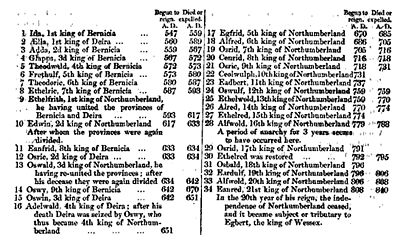
The first Deiran Anglian
king of whom we have any record is Ælla
, who flourished in the later 6th century after conquering the realm from the Britons in 581. After his death, Deira was subject to king Æthelfrith of Bernicia, who united the two kingdoms into Northumbria. Æthelfrith ruled until the accession of Ælla's son Edwin
, in 616 or 617, who also ruled both kingdoms until 633.
Osric
, the nephew of Edwin, ruled Deira after Edwin, but his son Oswine
was put to death by Oswiu
in 651. For a few years subsequently Deira was governed by Æthelwald son of Oswald of Bernicia.
Bede
wrote of Deira in his Historia Ecclesiastica
.
Northern England
Northern England, also known as the North of England, the North or the North Country, is a cultural region of England. It is not an official government region, but rather an informal amalgamation of counties. The southern extent of the region is roughly the River Trent, while the North is bordered...
during the 6th century AD. It
extended from the Humber
Humber
The Humber is a large tidal estuary on the east coast of Northern England. It is formed at Trent Falls, Faxfleet, by the confluence of the tidal River Ouse and the tidal River Trent. From here to the North Sea, it forms part of the boundary between the East Riding of Yorkshire on the north bank...
to the Tees
River Tees
The River Tees is in Northern England. It rises on the eastern slope of Cross Fell in the North Pennines, and flows eastwards for 85 miles to reach the North Sea between Hartlepool and Redcar.-Geography:...
, and from the sea to the western edge of the Vale of York
Vale of York
The Vale of York is an area of flat land in the north-east of England. The vale is a major agricultural area and serves as the main north-south transport corridor for northern England....
. It
later merged with the kingdom of Bernicia
Bernicia
Bernicia was an Anglo-Saxon kingdom established by Anglian settlers of the 6th century in what is now southeastern Scotland and North East England....
to the north to form the kingdom of Northumbria
Northumbria
Northumbria was a medieval kingdom of the Angles, in what is now Northern England and South-East Scotland, becoming subsequently an earldom in a united Anglo-Saxon kingdom of England. The name reflects the approximate southern limit to the kingdom's territory, the Humber Estuary.Northumbria was...
.
The name of the kingdom is of Brythonic origin, perhaps from Deifr, meaning "waters", or from Daru, meaning "oak", in which case it would mean "the people of the Derwent
River Derwent, Yorkshire
The Derwent is a river in Yorkshire in the north of England. It is used for water abstraction, leisure and sporting activities and effluent disposal as well as being of significant importance as the site of several nature reserves...
", a derivation also found in the Latin name for Malton
Malton, North Yorkshire
Malton is a market town and civil parish in North Yorkshire, England. The town is the location of the offices of Ryedale District Council and has a population of around 4,000 people....
, Derventio.
Humber
The Humber is a large tidal estuary on the east coast of Northern England. It is formed at Trent Falls, Faxfleet, by the confluence of the tidal River Ouse and the tidal River Trent. From here to the North Sea, it forms part of the boundary between the East Riding of Yorkshire on the north bank...
to the Tyne
River Tyne
The River Tyne is a river in North East England in Great Britain. It is formed by the confluence of two rivers: the North Tyne and the South Tyne. These two rivers converge at Warden Rock near Hexham in Northumberland at a place dubbed 'The Meeting of the Waters'.The North Tyne rises on the...
, but the land was waste north of the Tees
River Tees
The River Tees is in Northern England. It rises on the eastern slope of Cross Fell in the North Pennines, and flows eastwards for 85 miles to reach the North Sea between Hartlepool and Redcar.-Geography:...
. After the Brythonic kingdom centered around Eboracum, which may have been called Ebrauc, was taken by Edwin, the city of Eboracum became its capital and was called Eoforwic (boar-place) by the Angles. Before this it is likely that the capital would have been at or near Pocklington
Pocklington
Pocklington is a small market town and civil parish situated at the foot of the Yorkshire Wolds in the East Riding of Yorkshire, England, approximately east of York....
.
The first Deiran Anglian
Angles
The Angles is a modern English term for a Germanic people who took their name from the ancestral cultural region of Angeln, a district located in Schleswig-Holstein, Germany...
king of whom we have any record is Ælla
Aella of Deira
Ælla , is the first certain king of Deira. One of his sons was Edwin of Northumbria and his daughter Acha married Æthelfrith of Bernicia....
, who flourished in the later 6th century after conquering the realm from the Britons in 581. After his death, Deira was subject to king Æthelfrith of Bernicia, who united the two kingdoms into Northumbria. Æthelfrith ruled until the accession of Ælla's son Edwin
Edwin of Northumbria
Edwin , also known as Eadwine or Æduini, was the King of Deira and Bernicia – which later became known as Northumbria – from about 616 until his death. He converted to Christianity and was baptised in 627; after he fell at the Battle of Hatfield Chase, he was venerated as a saint.Edwin was the son...
, in 616 or 617, who also ruled both kingdoms until 633.
Osric
Osric of Deira
Osric was a King of Deira in northern England. He was a cousin of king Edwin of Northumbria, being the son of Edwin's uncle Aelfric...
, the nephew of Edwin, ruled Deira after Edwin, but his son Oswine
Oswine of Deira
Oswine was a King of Deira in northern England. He succeeded King Oswald of Northumbria, probably around the year 644, after Oswald's death at the Battle of Maserfield. Oswine was the son of Osric....
was put to death by Oswiu
Oswiu of Northumbria
Oswiu , also known as Oswy or Oswig , was a King of Bernicia. His father, Æthelfrith of Bernicia, was killed in battle, fighting against Rædwald, King of the East Angles and Edwin of Deira at the River Idle in 616...
in 651. For a few years subsequently Deira was governed by Æthelwald son of Oswald of Bernicia.
Bede
Bede
Bede , also referred to as Saint Bede or the Venerable Bede , was a monk at the Northumbrian monastery of Saint Peter at Monkwearmouth, today part of Sunderland, England, and of its companion monastery, Saint Paul's, in modern Jarrow , both in the Kingdom of Northumbria...
wrote of Deira in his Historia Ecclesiastica
Historia ecclesiastica gentis Anglorum
The Historia ecclesiastica gentis Anglorum is a work in Latin by Bede on the history of the Christian Churches in England, and of England generally; its main focus is on the conflict between Roman and Celtic Christianity.It is considered to be one of the most important original references on...
.
Kings of Deira
| Reign | Incumbent | Notes | |
|---|---|---|---|
| 559/560 to 589 | Aella Aella of Deira Ælla , is the first certain king of Deira. One of his sons was Edwin of Northumbria and his daughter Acha married Æthelfrith of Bernicia.... (Aelli) |
ÆLLA YFFING DEIRA CYNING ÆLLA REX DEIRA |
|
| 589/599 to 604 | Aethelric Aethelric of Deira Æthelric was supposedly a King of Deira . He is thought to have succeeded Ælla of Deira, but his existence is historically obscure.... (Aedilric) |
ÆÞELRIC IDING BERNICIA 7 DEIRA CYNING ÆÞELRIC REX BERNICIA ET DEIRA |
|
| Bernician Dynasty | |||
| 593/604? to 616 | Aethelfrith | ÆÞELFERÞ ÆÞELRICING DEIRA CYNING ÆÞELFERÞ REX DEIRA |
Killed in battle |
| Deira Dynasty | |||
| 616 to 12/14 October 632 | Edwin Edwin of Northumbria Edwin , also known as Eadwine or Æduini, was the King of Deira and Bernicia – which later became known as Northumbria – from about 616 until his death. He converted to Christianity and was baptised in 627; after he fell at the Battle of Hatfield Chase, he was venerated as a saint.Edwin was the son... |
EDVVIN ÆLLING BERNICIA 7 DEIRA CYNING EDVVIN REX BERNICIA ET DEIRA |
Killed in battle by Cadwallon of Gwynedd Cadwallon ap Cadfan Cadwallon ap Cadfan was the King of Gwynedd from around 625 until his death in battle. The son and successor of Cadfan ap Iago, he is best remembered as the King of the Britons who invaded and conquered Northumbria, defeating and killing its king, Edwin, prior to his own death in battle against... and Penda of Mercia Penda of Mercia Penda was a 7th-century King of Mercia, the Anglo-Saxon kingdom in what is today the English Midlands. A pagan at a time when Christianity was taking hold in many of the Anglo-Saxon kingdoms, Penda took over the Severn Valley in 628 following the Battle of Cirencester before participating in the... |
| late 633 to summer 634 | Osric Osric of Deira Osric was a King of Deira in northern England. He was a cousin of king Edwin of Northumbria, being the son of Edwin's uncle Aelfric... |
OSRIC ÆLFRICING DEIRA CYNING OSRIC REX DEIRA |
|
| 633 to 5 August 642 | Oswald Oswald of Northumbria Oswald was King of Northumbria from 634 until his death, and is now venerated as a Christian saint.Oswald was the son of Æthelfrith of Bernicia and came to rule after spending a period in exile; after defeating the British ruler Cadwallon ap Cadfan, Oswald brought the two Northumbrian kingdoms of... |
OSVVALD BERNICIA 7 DEIRA CYNING OSVVALD REX BERNICIA ET DEIRA |
Killed by Penda Penda of Mercia Penda was a 7th-century King of Mercia, the Anglo-Saxon kingdom in what is today the English Midlands. A pagan at a time when Christianity was taking hold in many of the Anglo-Saxon kingdoms, Penda took over the Severn Valley in 628 following the Battle of Cirencester before participating in the... , King of Mercia; Saint Oswald |
| 642 to 644 | Oswiu Oswiu of Northumbria Oswiu , also known as Oswy or Oswig , was a King of Bernicia. His father, Æthelfrith of Bernicia, was killed in battle, fighting against Rædwald, King of the East Angles and Edwin of Deira at the River Idle in 616... |
OSVVIO ÆÞELFRIÞING BERNICIA 7 DEIRA CYNING OSVVIO REX BERNICIA ET DEIRA |
|
| 644 to 651 | Oswine Oswine of Deira Oswine was a King of Deira in northern England. He succeeded King Oswald of Northumbria, probably around the year 644, after Oswald's death at the Battle of Maserfield. Oswine was the son of Osric.... |
OSVVINE OSRICING DEIRA CYNING OSVVINE REX DEIRA |
Murdered |
| summer 651 to late 654 or 655 | Æthelwold Æthelwold of Deira Œthelwald was a King of Deira . He was the son of King Oswald of Northumbria, who was killed at the Battle of Maserfield in 642.... |
ÆÞELVVALD OSVVALDING DEIRA CYNING ÆÞELVVALD REX DEIRA |
|
| 654 to 15 August 670 | Oswiu Oswiu of Northumbria Oswiu , also known as Oswy or Oswig , was a King of Bernicia. His father, Æthelfrith of Bernicia, was killed in battle, fighting against Rædwald, King of the East Angles and Edwin of Deira at the River Idle in 616... |
OSVVIO ÆÞELFERÞING NORÞANHYMBRA CYNING OSVVIO REX NORÞANHYMBRA |
Restored |
| 656 to 664 | Alchfrith Alchfrith of Deira Alhfrith or Ealhfrith was a son of King Oswiu of Northumbria and Rieinmelth of Rheged.In around 655 Alhfrith was appointed by his father as sub-king of Deira, the southern part of the Northumbrian kingdom. He replaced his cousin Æthelwold, who had supported Oswiu's enemy Penda of Mercia in the... |
ALCHFRIÞ DEIRA CYNING ALCHFRIÞ REX DEIRA |
|
| 670 to 679 | Aelfwine Aelfwine of Deira Ælfwine was the King of Deira from 670 to 679. He was a son of Oswiu of Northumbria and a brother of Ecgfrith of Northumbria.After the succession of Ecgfrith as king of Northumbria in 670, he made Aelfwine king of the sub-kingdom of Deira. Aelfwine was still a boy at the time, and the title may... |
ÆLFVVINE DEIRA CYNING ÆLFVVINE REX DEIRA |
|
Further reading
- Geake, Helen & Joanthan Kenny (eds.) (2000). Early Deira: Archaeological studies of the East Riding in the fourth to ninth centuries AD. Oxford: Oxbow. ISBN 1-9001-8890-2
- Higham, N.J. (1993). The Kingdom of Northumbria AD 350-1100. Stroud: Sutton. ISBN 0-8629-9730-5