


Oswald of Northumbria

Encyclopedia
Oswald was King of Northumbria from 634 until his death, and is now venerated as a Christian saint
.
Oswald was the son of Æthelfrith of Bernicia
and came to rule after spending a period in exile
; after defeating the British ruler Cadwallon ap Cadfan
, Oswald brought the two Northumbria
n kingdoms of Bernicia
and Deira once again under a single ruler, and promoted the spread of Christianity
in Northumbria. He was given a strongly positive assessment by the historian Bede
, writing a little less than a century after Oswald's death, who regarded Oswald as a saintly king; it is also Bede who is the main source for present-day historical knowledge of Oswald. After eight years of rule, in which he was the most powerful ruler in Britain
, Oswald was killed in the Battle of Maserfield
.
Æthelfrith, who was for years a successful war-leader, especially against the native British, was eventually killed in battle around 616 by Raedwald of East Anglia
at the River Idle
. This defeat meant that an exiled member of the Deiran royal line, Edwin
(Acha's brother), became king of Northumbria; Oswald and his brothers fled to the north. Oswald thus spent the remainder of his youth in the Scottish kingdom of Dál Riata
in northern Britain, where he was converted
to Christianity. He may also have fought in Ireland
during this period of exile.
, in alliance with the pagan
Penda of Mercia
, killed Edwin of Deira in battle at Hatfield Chase
in 633 (or 632, depending on when the years used by Bede are considered to have begun), Northumbria was split between its constituent kingdoms of Bernicia and Deira. Oswald's brother Eanfrith
became king of Bernicia, but he was killed by Cadwallon in 634 (or 633) after attempting to negotiate peace. Subsequently, Oswald, at the head of a small army (possibly with the aid of allies from the north, the Scots and/or the Picts
), met Cadwallon in battle at Heavenfield
, near Hexham
. Before the battle, Oswald had a wooden cross
erected; he knelt down, holding the cross in position until enough earth had been thrown in the hole to make it stand firm. He then prayed
and asked his army to join in.
Adomnán
in his Life of Saint Columba
offers a longer account, which Abbot Ségéne
had heard from Oswald himself. Oswald, he says, had a vision of Columba the night before the battle, in which he was told:
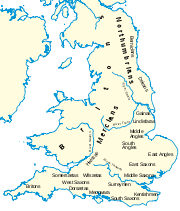 Following the victory at Heavenfield, Oswald reunited Northumbria and re-established the Bernician supremacy which had been interrupted by Edwin. Bede says that Oswald held imperium for the eight years of his rule (both Bede and the Anglo-Saxon Chronicle
say that Oswald's reign was actually considered to be nine years, the ninth year being accounted for by assigning to Oswald the year preceding his rule, "on account of the heathenism
practised by those who had ruled that one year between him and Edwin"), and was the most powerful king in Britain
. In the 9th-century Anglo-Saxon Chronicle he is referred to as a Bretwalda
. Adomnán describes Oswald as "ordained by God as Emperor of all Britain".
He seems to have been widely recognized as overlord, although the extent of his authority is uncertain. Bede makes the claim that Oswald "brought under his dominion all the nations and provinces of Britain", which, as Bede notes, was divided by language between the English, Britons, Scots, and Picts; however, he seems to undermine his own claim when he mentions at another point in his history that it was Oswald's brother Oswiu who made tributary the Picts and Scots. An Irish source, the Annals of Tigernach
, records that the Anglo-Saxons banded together against Oswald early in his reign; this may indicate an attempt to put an end to Oswald's overlordship south of the Humber
, which presumably failed.
The Mercia
ns, who participated in Edwin's defeat in 633, seem to have presented an obstacle to Oswald's authority south of the Humber, although it has been generally thought that Oswald dominated Mercia to some degree after Heavenfield. It may have been to appease Oswald that Penda had Eadfrith, a captured son of Edwin (and thus a dynastic rival of Oswald), killed, although it is also possible that Penda had his own motives for the killing.
Oswald apparently controlled the Kingdom of Lindsey
, given the evidence of a story told by Bede regarding the moving of Oswald's bones to a monastery there; Bede says that the monks rejected the bones initially because Oswald had ruled over them as a foreign king. To the north, it may have been Oswald who conquered the Gododdin
. Irish annals record the siege of Edinburgh
, thought to have been the royal stronghold of the Gododdin, in 638, and this seems to mark the end of the kingdom; that this siege was undertaken by Oswald is suggested by the apparent control of the area by his brother Oswiu in the 650s.
Oswald seems to have been on good terms with the West Saxons
: he stood as sponsor to the baptism
of their king, Cynegils
, and married Cynegils' daughter. Her name is reported by only one source, Reginald of Durham
's 12th century Vita S. Oswaldi, which says that it was Kyneburga. Although Oswald had one known son, Æthelwald, it is uncertain whether this was a son from his marriage to Cynegils' daughter or from an earlier relationship—since Æthelwald began ruling in Deira in 651, it has been argued that a son from this marriage would have been too young at the time to be trusted with this position, and therefore may have been older, the product of a relationship Oswald had during his exile.
for this purpose; initially, the Irish sent an "austere" bishop
who was unsuccessful in his mission, and Aidan, who proposed a gentler approach, was subsequently sent instead. Oswald gave the island of Lindisfarne
to Aidan as his episcopal see
, and Aidan achieved great success in spreading the Christian faith; Bede mentions that Oswald acted as Aidan's interpreter when the latter was preaching, since Aidan did not know English well and Oswald had learned Irish during his exile.
Bede puts a clear emphasis on Oswald being saintly as a king; although he could be interpreted as a martyr for his subsequent death in battle, Bede portrays Oswald as being saintly for his deeds in life and does not focus on his martyrdom as being primary to his sainthood—indeed, it has been noted that Bede never uses the word "martyr" in reference to Oswald. In this respect, as a king regarded as saintly for his life while ruling—in contrast to a king who gives up the kingship in favour of religious life, or who is venerated because of the manner of his death—Bede's portrayal of Oswald stands out as unusual. Bede recounts Oswald's generosity to the poor and to strangers, and tells a story highlighting this characteristic: on one occasion, at Easter, Oswald was sitting at dinner with Aidan, and had "a silver dish full of dainties before him", when a servant, whom Oswald "had appointed to relieve the poor", came in and told Oswald that a crowd of the poor were in the streets begging alms
from the king. Oswald, according to Bede, then immediately had his food given to the poor and even had the dish broken up and distributed. Aidan was greatly impressed and seized Oswald's right hand, stating: "May this hand never perish." Accordingly, Bede reports that the hand and arm remained uncorrupted
after Oswald's death.
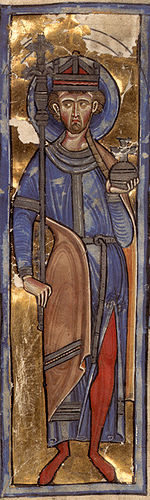 It was a conflict with the pagan Mercians under Penda that proved to be Oswald's undoing. He was killed by the Mercians at the Battle of Maserfield
, at a place generally identified with Oswestry
(although other candidates for the location of the battle have been suggested) in 642, and his body was dismembered. Bede mentions the story that Oswald "ended his life in prayer": he prayed for the souls of his soldiers when he saw that he was about to die. Oswald's head and limbs were placed on stakes.
The traditional identification of the battle site with Oswestry, probably in the territory of Powys at the time, suggests that Penda may have had British allies in this battle, and this is also suggested by surviving Welsh poetry which has been thought to indicate the participation of the men of Powys in the battle. It has also been considered that, if the traditional identification of the site as Oswestry is correct, Oswald was on the offensive, in the territory of his enemies. This could conflict with Bede's saintly portrayal of Oswald, since an aggressive war could hardly qualify as a just war
, perhaps explaining why Bede is silent on the cause of the war—he says only that Oswald died "fighting for his fatherland"—as well as his failure to mention other offensive warfare Oswald is presumed to have engaged in between Heavenfield and Maserfield. Oswald may have had an ally in Penda's brother Eowa
, who was also killed in the battle, according to the Historia Britonnum and Annales Cambriae
; while the source only mentions that Eowa was killed, not the side on which he fought, it has been speculated that Eowa was subject to Oswald and fighting alongside him in the battle, in opposition to Penda.
s, and people took dirt from the site, which led to a hole being dug as deep as a man's height. Reginald of Durham recounts another miracle, saying that his right arm was taken by a bird (perhaps a raven
) to an ash tree, which gave the tree ageless vigor; when the bird dropped the arm onto the ground, a spring emerged from the ground. Both the tree and the spring were, according to Reginald, subsequently associated with healing miracles. Aspects of the legend have been considered to have pagan overtones or influences—this may represent a fusion of his status as a traditional Germanic warrior-king with Christianity. The name of the site, Oswestry, or "Oswald's Tree", is generally thought to be derived from Oswald's death there and the legends surrounding it. His feast day
is August 5. The cult surrounding him even gained prominence in parts of continental Europe.
Bede mentions that Oswald's brother Oswiu
, who succeeded Oswald in Bernicia, retrieved Oswald's remains in the year after his death. In writing of one miracle associated with Oswald, Bede gives some indication of how Oswald was regarded in conquered lands: years later, when his niece Osthryth
moved his bones to Bardney Abbey
in Lindsey
, its inmates initially refused to accept them, "though they knew him to be a holy man", because "he was originally of another province, and had reigned over them as a foreign king", and thus "they retained their ancient aversion to him, even after death". It was only after Oswald's bones were the focus of an awe-inspiring miracle—in which, during the night, a pillar of light appeared over the wagon in which the bones were being carried and shone up into the sky—that they were accepted into the monastery: "in the morning, the brethren who had refused it the day before, began themselves earnestly to pray that those holy relics, so beloved by God, might be deposited among them."
In the early 10th century, Bardney was in Viking territory, and in 909, following a combined West Saxon and Mercian raid, St Oswald's relics were translated to a new minster in Gloucester
, which was re-named St Oswald's Priory
in his honour.
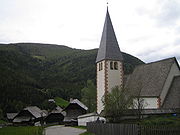 Oswald's head was interred in Durham Cathedral
together with the remains of Cuthbert of Lindisfarne
(a saint with whom Oswald became posthumously associated, although the two were not associated in life; Cuthbert became bishop of Lindisfarne more than forty years after Oswald's death) and other valuables in a quickly made coffin, where it is generally believed to remain, although there are at least four other claimed heads of Oswald in continental Europe. One of his arms is said to have ended up in Peterborough Abbey
later in the Middle Ages. The story is that a small group of monks from Peterborough made their way to Bamburgh where Oswald's uncorrupted arm was kept and stole it under the cover of darkness. They returned with it to Peterborough and in due time a chapel was created for the arm - Oswald's Chapel. This - minus the arm - can be seen to this day in the south transept of the cathedral. When creating this chapel the monks of Peterborough had thought of how they had acquired it and built into the chapel a narrow tower - just big enough for a monk to climb to the top by an internal stair and stand guard over Oswald's Arm 24 hours a day, every day of the year. The monk had to stand because the tower is not large enough for him to sit - sitting could lull him to sleep - and they knew what could happen when no-one was watching.
St Oswald's Catholic Church lies to the north of Peterborough City Centre.
Some English place names record his reign, for example Oswaldtwistle
in Lancashire
, meaning the twistle of Oswald.
The Church of Saint Oswald stands on the location of the wooden cross left by Oswald at Heavenfield, the night before the battle. This was rebuilt in 1717. The site is visible from the B6318 Military Road.
|-
|-
Saint
A saint is a holy person. In various religions, saints are people who are believed to have exceptional holiness.In Christian usage, "saint" refers to any believer who is "in Christ", and in whom Christ dwells, whether in heaven or in earth...
.
Oswald was the son of Æthelfrith of Bernicia
Æthelfrith of Northumbria
Æthelfrith was King of Bernicia from c. 593 until c. 616; he was also, beginning c. 604, the first Bernician king to also rule Deira, to the south of Bernicia. Since Deira and Bernicia were the two basic components of what would later be defined as Northumbria, Æthelfrith can be considered, in...
and came to rule after spending a period in exile
Exile
Exile means to be away from one's home , while either being explicitly refused permission to return and/or being threatened with imprisonment or death upon return...
; after defeating the British ruler Cadwallon ap Cadfan
Cadwallon ap Cadfan
Cadwallon ap Cadfan was the King of Gwynedd from around 625 until his death in battle. The son and successor of Cadfan ap Iago, he is best remembered as the King of the Britons who invaded and conquered Northumbria, defeating and killing its king, Edwin, prior to his own death in battle against...
, Oswald brought the two Northumbria
Northumbria
Northumbria was a medieval kingdom of the Angles, in what is now Northern England and South-East Scotland, becoming subsequently an earldom in a united Anglo-Saxon kingdom of England. The name reflects the approximate southern limit to the kingdom's territory, the Humber Estuary.Northumbria was...
n kingdoms of Bernicia
Bernicia
Bernicia was an Anglo-Saxon kingdom established by Anglian settlers of the 6th century in what is now southeastern Scotland and North East England....
and Deira once again under a single ruler, and promoted the spread of Christianity
Christianity
Christianity is a monotheistic religion based on the life and teachings of Jesus as presented in canonical gospels and other New Testament writings...
in Northumbria. He was given a strongly positive assessment by the historian Bede
Bede
Bede , also referred to as Saint Bede or the Venerable Bede , was a monk at the Northumbrian monastery of Saint Peter at Monkwearmouth, today part of Sunderland, England, and of its companion monastery, Saint Paul's, in modern Jarrow , both in the Kingdom of Northumbria...
, writing a little less than a century after Oswald's death, who regarded Oswald as a saintly king; it is also Bede who is the main source for present-day historical knowledge of Oswald. After eight years of rule, in which he was the most powerful ruler in Britain
Great Britain
Great Britain or Britain is an island situated to the northwest of Continental Europe. It is the ninth largest island in the world, and the largest European island, as well as the largest of the British Isles...
, Oswald was killed in the Battle of Maserfield
Battle of Maserfield
The Battle of Maserfield , Welsh: "Maes Cogwy", was fought on August 5, 641 or 642, between the Anglo-Saxon kings Oswald of Northumbria and Penda of Mercia, ending in Oswald's defeat, death, and dismemberment...
.
Background, youth, and exile
Oswald's father Æthelfrith was a successful Bernician ruler who, after some years in power in Bernicia, also became king of Deira, and thus was the first to rule both of the kingdoms which would come to be considered the constituent kingdoms of Northumbria (Bernicia in the northern part and Deira in the southern part); it would, however, be anachronistic to refer to a "Northumbrian" people or identity at this early stage, when the Bernicians and the Deirans were still clearly distinct peoples. Oswald's mother, Acha, was a member of the Deiran royal line who Æthelfrith apparently married as part of his acquisition of Deira or consolidation of power there. Oswald was apparently born in or around the year 604, since Bede says that he was killed at the age of 38 in 642; Æthelfrith's acquisition of Deira is also believed to have occurred around 604.Æthelfrith, who was for years a successful war-leader, especially against the native British, was eventually killed in battle around 616 by Raedwald of East Anglia
Raedwald of East Anglia
Rædwald ; also Raedwald or Redwald, was a 7th century king of East Anglia, a long-lived Anglo-Saxon kingdom which today includes the English counties of Norfolk and Suffolk. He was the son of Tytila of East Anglia and a member of the Wuffingas dynasty , who were the first rulers of the East Angles...
at the River Idle
River Idle
The River Idle is a river in Nottinghamshire, England. Its source is the confluence of the River Maun and River Meden, near Markham Moor. From there, it flows north through Retford and Bawtry before entering the River Trent at Stockwith near Misterton...
. This defeat meant that an exiled member of the Deiran royal line, Edwin
Edwin of Northumbria
Edwin , also known as Eadwine or Æduini, was the King of Deira and Bernicia – which later became known as Northumbria – from about 616 until his death. He converted to Christianity and was baptised in 627; after he fell at the Battle of Hatfield Chase, he was venerated as a saint.Edwin was the son...
(Acha's brother), became king of Northumbria; Oswald and his brothers fled to the north. Oswald thus spent the remainder of his youth in the Scottish kingdom of Dál Riata
Dál Riata
Dál Riata was a Gaelic overkingdom on the western coast of Scotland with some territory on the northeast coast of Ireland...
in northern Britain, where he was converted
Religious conversion
Religious conversion is the adoption of a new religion that differs from the convert's previous religion. Changing from one denomination to another within the same religion is usually described as reaffiliation rather than conversion.People convert to a different religion for various reasons,...
to Christianity. He may also have fought in Ireland
Ireland
Ireland is an island to the northwest of continental Europe. It is the third-largest island in Europe and the twentieth-largest island on Earth...
during this period of exile.
Victory over Cadwallon
After Cadwallon ap Cadfan, the king of GwyneddKingdom of Gwynedd
Gwynedd was one petty kingdom of several Welsh successor states which emerged in 5th-century post-Roman Britain in the Early Middle Ages, and later evolved into a principality during the High Middle Ages. It was based on the former Brythonic tribal lands of the Ordovices, Gangani, and the...
, in alliance with the pagan
Paganism
Paganism is a blanket term, typically used to refer to non-Abrahamic, indigenous polytheistic religious traditions....
Penda of Mercia
Penda of Mercia
Penda was a 7th-century King of Mercia, the Anglo-Saxon kingdom in what is today the English Midlands. A pagan at a time when Christianity was taking hold in many of the Anglo-Saxon kingdoms, Penda took over the Severn Valley in 628 following the Battle of Cirencester before participating in the...
, killed Edwin of Deira in battle at Hatfield Chase
Battle of Hatfield Chase
The Battle of Hatfield Chase was fought on October 12, 633 at Hatfield Chase near Doncaster, Yorkshire, in Anglo-Saxon England between the Northumbrians under Edwin and an alliance of the Welsh of Gwynedd under Cadwallon ap Cadfan and the Mercians under Penda. The site was a marshy area about 8...
in 633 (or 632, depending on when the years used by Bede are considered to have begun), Northumbria was split between its constituent kingdoms of Bernicia and Deira. Oswald's brother Eanfrith
Eanfrith of Bernicia
Eanfrith was briefly King of Bernicia from 633 to 634. He was the son of Æthelfrith, a Bernician king who had also ruled Deira to the south before being killed in battle around 616 against Raedwald of East Anglia, who had given refuge to Edwin, an exiled prince of Deira.Edwin became king of...
became king of Bernicia, but he was killed by Cadwallon in 634 (or 633) after attempting to negotiate peace. Subsequently, Oswald, at the head of a small army (possibly with the aid of allies from the north, the Scots and/or the Picts
Picts
The Picts were a group of Late Iron Age and Early Mediaeval people living in what is now eastern and northern Scotland. There is an association with the distribution of brochs, place names beginning 'Pit-', for instance Pitlochry, and Pictish stones. They are recorded from before the Roman conquest...
), met Cadwallon in battle at Heavenfield
Battle of Heavenfield
The Battle of Heavenfield was fought in 633 or 634 between a Northumbrian army under Oswald of Bernicia and a Welsh army under Cadwallon ap Cadfan of Gwynedd. The battle resulted in a decisive Northumbrian victory. The Annales Cambriae record the battle as Bellum Cantscaul in 631...
, near Hexham
Hexham
Hexham is a market town and civil parish in Northumberland, England, located south of the River Tyne, and was the administrative centre for the Tynedale district from 1974 to 2009. The three major towns in Tynedale were Hexham, Prudhoe and Haltwhistle, although in terms of population, Prudhoe was...
. Before the battle, Oswald had a wooden cross
Christian cross
The Christian cross, seen as a representation of the instrument of the crucifixion of Jesus Christ, is the best-known religious symbol of Christianity...
erected; he knelt down, holding the cross in position until enough earth had been thrown in the hole to make it stand firm. He then prayed
Prayer
Prayer is a form of religious practice that seeks to activate a volitional rapport to a deity through deliberate practice. Prayer may be either individual or communal and take place in public or in private. It may involve the use of words or song. When language is used, prayer may take the form of...
and asked his army to join in.
Adomnán
Adomnán of Iona
Saint Adomnán of Iona was abbot of Iona , hagiographer, statesman and clerical lawyer; he was the author of the most important Vita of Saint Columba and promulgator of the "Law of Innocents", lex innocentium, also called Cáin Adomnáin, "Law of Adomnán"...
in his Life of Saint Columba
Columba
Saint Columba —also known as Colum Cille , Colm Cille , Calum Cille and Kolban or Kolbjørn —was a Gaelic Irish missionary monk who propagated Christianity among the Picts during the Early Medieval Period...
offers a longer account, which Abbot Ségéne
Ségéne of Iona
Ségéne mac Fiachnaí was the fifth abbot of the Iona Abbey in Scotland .Ségéne was of the Cenél Conaill, the same kindred as Columba, and he was the nephew of a previous abbot, Lasrén. It was during Ségéne's long abbacy that the famous controversy regarding the dating of Easter first made itself...
had heard from Oswald himself. Oswald, he says, had a vision of Columba the night before the battle, in which he was told:
Be strong and act manfully. Behold, I will be with thee. This coming night go out from your camp into battle, for the Lord has granted me that at this time your foes shall be put to flight and Cadwallon your enemy shall be delivered into your hands and you shall return victorious after battle and reign happily.Oswald described his vision to his council and all agreed that they would be baptised and accept Christianity after the battle. In the battle that followed, the British were routed despite their superior numbers; Cadwallon himself was killed.
Overlordship
Anglo-Saxon Chronicle
The Anglo-Saxon Chronicle is a collection of annals in Old English chronicling the history of the Anglo-Saxons. The original manuscript of the Chronicle was created late in the 9th century, probably in Wessex, during the reign of Alfred the Great...
say that Oswald's reign was actually considered to be nine years, the ninth year being accounted for by assigning to Oswald the year preceding his rule, "on account of the heathenism
Paganism
Paganism is a blanket term, typically used to refer to non-Abrahamic, indigenous polytheistic religious traditions....
practised by those who had ruled that one year between him and Edwin"), and was the most powerful king in Britain
Great Britain
Great Britain or Britain is an island situated to the northwest of Continental Europe. It is the ninth largest island in the world, and the largest European island, as well as the largest of the British Isles...
. In the 9th-century Anglo-Saxon Chronicle he is referred to as a Bretwalda
Bretwalda
Bretwalda is an Old English word, the first record of which comes from the late 9th century Anglo-Saxon Chronicle. It is given to some of the rulers of Anglo-Saxon kingdoms from the 5th century onwards who had achieved overlordship of some or all of the other Anglo-Saxon kingdoms...
. Adomnán describes Oswald as "ordained by God as Emperor of all Britain".
He seems to have been widely recognized as overlord, although the extent of his authority is uncertain. Bede makes the claim that Oswald "brought under his dominion all the nations and provinces of Britain", which, as Bede notes, was divided by language between the English, Britons, Scots, and Picts; however, he seems to undermine his own claim when he mentions at another point in his history that it was Oswald's brother Oswiu who made tributary the Picts and Scots. An Irish source, the Annals of Tigernach
Annals of Tigernach
The Annals of Tigernach is a chronicle probably originating in Clonmacnoise, Ireland. The language is a mixture of Latin and Old and Middle Irish....
, records that the Anglo-Saxons banded together against Oswald early in his reign; this may indicate an attempt to put an end to Oswald's overlordship south of the Humber
Humber
The Humber is a large tidal estuary on the east coast of Northern England. It is formed at Trent Falls, Faxfleet, by the confluence of the tidal River Ouse and the tidal River Trent. From here to the North Sea, it forms part of the boundary between the East Riding of Yorkshire on the north bank...
, which presumably failed.
The Mercia
Mercia
Mercia was one of the kingdoms of the Anglo-Saxon Heptarchy. It was centred on the valley of the River Trent and its tributaries in the region now known as the English Midlands...
ns, who participated in Edwin's defeat in 633, seem to have presented an obstacle to Oswald's authority south of the Humber, although it has been generally thought that Oswald dominated Mercia to some degree after Heavenfield. It may have been to appease Oswald that Penda had Eadfrith, a captured son of Edwin (and thus a dynastic rival of Oswald), killed, although it is also possible that Penda had his own motives for the killing.
Oswald apparently controlled the Kingdom of Lindsey
Kingdom of Lindsey
Lindsey or Linnuis is the name of a petty Anglo-Saxon kingdom, absorbed into Northumbria in the 7th century.It lay between the Humber and the Wash, forming its inland boundaries from the course of the Witham and Trent rivers , and the Foss Dyke between...
, given the evidence of a story told by Bede regarding the moving of Oswald's bones to a monastery there; Bede says that the monks rejected the bones initially because Oswald had ruled over them as a foreign king. To the north, it may have been Oswald who conquered the Gododdin
Gododdin
The Gododdin were a Brittonic people of north-eastern Britain in the sub-Roman period, the area known as the Hen Ogledd or Old North...
. Irish annals record the siege of Edinburgh
Edinburgh
Edinburgh is the capital city of Scotland, the second largest city in Scotland, and the eighth most populous in the United Kingdom. The City of Edinburgh Council governs one of Scotland's 32 local government council areas. The council area includes urban Edinburgh and a rural area...
, thought to have been the royal stronghold of the Gododdin, in 638, and this seems to mark the end of the kingdom; that this siege was undertaken by Oswald is suggested by the apparent control of the area by his brother Oswiu in the 650s.
Oswald seems to have been on good terms with the West Saxons
Wessex
The Kingdom of Wessex or Kingdom of the West Saxons was an Anglo-Saxon kingdom of the West Saxons, in South West England, from the 6th century, until the emergence of a united English state in the 10th century, under the Wessex dynasty. It was to be an earldom after Canute the Great's conquest...
: he stood as sponsor to the baptism
Baptism
In Christianity, baptism is for the majority the rite of admission , almost invariably with the use of water, into the Christian Church generally and also membership of a particular church tradition...
of their king, Cynegils
Cynegils of Wessex
Cynegils was King of Wessex from c. 611 to c. 643.Cynegils is traditionally considered to have been King of Wessex, but the familiar kingdoms of the so-called Heptarchy had not yet formed from the patchwork of smaller kingdoms in his lifetime...
, and married Cynegils' daughter. Her name is reported by only one source, Reginald of Durham
Reginald of Durham
Reginald of Durham was an English monk and hagiologist.Reginald, a monk at Durham, was a hagiologist who wrote about the lives of saints. His best known work is about the hermit Saint Godric of Finchale...
's 12th century Vita S. Oswaldi, which says that it was Kyneburga. Although Oswald had one known son, Æthelwald, it is uncertain whether this was a son from his marriage to Cynegils' daughter or from an earlier relationship—since Æthelwald began ruling in Deira in 651, it has been argued that a son from this marriage would have been too young at the time to be trusted with this position, and therefore may have been older, the product of a relationship Oswald had during his exile.
Christianity
Although Edwin had previously converted to Christianity in 627, it was Oswald who did the most to spread the religion in Northumbria. Shortly after becoming king, he asked the Irish of Dál Riata to send a bishop to facilitate the conversion of his people, and they sent AidanAidan of Lindisfarne
Known as Saint Aidan of Lindisfarne, Aidan the Apostle of Northumbria , was the founder and first bishop of the monastery on the island of Lindisfarne in England. A Christian missionary, he is credited with restoring Christianity to Northumbria. Aidan is the Anglicised form of the original Old...
for this purpose; initially, the Irish sent an "austere" bishop
Bishop
A bishop is an ordained or consecrated member of the Christian clergy who is generally entrusted with a position of authority and oversight. Within the Catholic Church, Eastern Orthodox, Oriental Orthodox Churches, in the Assyrian Church of the East, in the Independent Catholic Churches, and in the...
who was unsuccessful in his mission, and Aidan, who proposed a gentler approach, was subsequently sent instead. Oswald gave the island of Lindisfarne
Lindisfarne
Lindisfarne is a tidal island off the north-east coast of England. It is also known as Holy Island and constitutes a civil parish in Northumberland...
to Aidan as his episcopal see
Episcopal See
An episcopal see is, in the original sense, the official seat of a bishop. This seat, which is also referred to as the bishop's cathedra, is placed in the bishop's principal church, which is therefore called the bishop's cathedral...
, and Aidan achieved great success in spreading the Christian faith; Bede mentions that Oswald acted as Aidan's interpreter when the latter was preaching, since Aidan did not know English well and Oswald had learned Irish during his exile.
Bede puts a clear emphasis on Oswald being saintly as a king; although he could be interpreted as a martyr for his subsequent death in battle, Bede portrays Oswald as being saintly for his deeds in life and does not focus on his martyrdom as being primary to his sainthood—indeed, it has been noted that Bede never uses the word "martyr" in reference to Oswald. In this respect, as a king regarded as saintly for his life while ruling—in contrast to a king who gives up the kingship in favour of religious life, or who is venerated because of the manner of his death—Bede's portrayal of Oswald stands out as unusual. Bede recounts Oswald's generosity to the poor and to strangers, and tells a story highlighting this characteristic: on one occasion, at Easter, Oswald was sitting at dinner with Aidan, and had "a silver dish full of dainties before him", when a servant, whom Oswald "had appointed to relieve the poor", came in and told Oswald that a crowd of the poor were in the streets begging alms
Alms
Alms or almsgiving is a religious rite which, in general, involves giving materially to another as an act of religious virtue.It exists in a number of religions. In Philippine Regions, alms are given as charity to benefit the poor. In Buddhism, alms are given by lay people to monks and nuns to...
from the king. Oswald, according to Bede, then immediately had his food given to the poor and even had the dish broken up and distributed. Aidan was greatly impressed and seized Oswald's right hand, stating: "May this hand never perish." Accordingly, Bede reports that the hand and arm remained uncorrupted
Incorruptibility
Incorruptibility is a Roman Catholic and Eastern Orthodox belief that supernatural intervention allows some human bodies to avoid the normal process of decomposition after death as a sign of their holiness...
after Oswald's death.
Downfall
Battle of Maserfield
The Battle of Maserfield , Welsh: "Maes Cogwy", was fought on August 5, 641 or 642, between the Anglo-Saxon kings Oswald of Northumbria and Penda of Mercia, ending in Oswald's defeat, death, and dismemberment...
, at a place generally identified with Oswestry
Oswestry
Oswestry is a town and civil parish in Shropshire, England, close to the Welsh border. It is at the junction of the A5, A483, and A495 roads....
(although other candidates for the location of the battle have been suggested) in 642, and his body was dismembered. Bede mentions the story that Oswald "ended his life in prayer": he prayed for the souls of his soldiers when he saw that he was about to die. Oswald's head and limbs were placed on stakes.
The traditional identification of the battle site with Oswestry, probably in the territory of Powys at the time, suggests that Penda may have had British allies in this battle, and this is also suggested by surviving Welsh poetry which has been thought to indicate the participation of the men of Powys in the battle. It has also been considered that, if the traditional identification of the site as Oswestry is correct, Oswald was on the offensive, in the territory of his enemies. This could conflict with Bede's saintly portrayal of Oswald, since an aggressive war could hardly qualify as a just war
Just War
Just war theory is a doctrine of military ethics of Roman philosophical and Catholic origin, studied by moral theologians, ethicists and international policy makers, which holds that a conflict ought to meet philosophical, religious or political criteria.-Origins:The concept of justification for...
, perhaps explaining why Bede is silent on the cause of the war—he says only that Oswald died "fighting for his fatherland"—as well as his failure to mention other offensive warfare Oswald is presumed to have engaged in between Heavenfield and Maserfield. Oswald may have had an ally in Penda's brother Eowa
Eowa of Mercia
Eowa was a son of the Mercian king Pybba and a brother of the Mercian king Penda; according to the Historia Brittonum and the Annales Cambriae. These two sources state that Eowa was a king of the Mercians himself at the time of the Battle of Maserfield , in which he was killed, on August 5 of what...
, who was also killed in the battle, according to the Historia Britonnum and Annales Cambriae
Annales Cambriae
Annales Cambriae, or The Annals of Wales, is the name given to a complex of Cambro-Latin chronicles deriving ultimately from a text compiled from diverse sources at St David's in Dyfed, Wales, not later than the 10th century...
; while the source only mentions that Eowa was killed, not the side on which he fought, it has been speculated that Eowa was subject to Oswald and fighting alongside him in the battle, in opposition to Penda.
After death
Oswald soon came to be regarded as a saint. Bede says that the spot where he died came to be associated with miracleMiracle
A miracle often denotes an event attributed to divine intervention. Alternatively, it may be an event attributed to a miracle worker, saint, or religious leader. A miracle is sometimes thought of as a perceptible interruption of the laws of nature. Others suggest that a god may work with the laws...
s, and people took dirt from the site, which led to a hole being dug as deep as a man's height. Reginald of Durham recounts another miracle, saying that his right arm was taken by a bird (perhaps a raven
Raven
Raven is the common name given to several larger-bodied members of the genus Corvus—but in Europe and North America the Common Raven is normally implied...
) to an ash tree, which gave the tree ageless vigor; when the bird dropped the arm onto the ground, a spring emerged from the ground. Both the tree and the spring were, according to Reginald, subsequently associated with healing miracles. Aspects of the legend have been considered to have pagan overtones or influences—this may represent a fusion of his status as a traditional Germanic warrior-king with Christianity. The name of the site, Oswestry, or "Oswald's Tree", is generally thought to be derived from Oswald's death there and the legends surrounding it. His feast day
Calendar of saints
The calendar of saints is a traditional Christian method of organizing a liturgical year by associating each day with one or more saints and referring to the feast day of said saint...
is August 5. The cult surrounding him even gained prominence in parts of continental Europe.
Bede mentions that Oswald's brother Oswiu
Oswiu of Northumbria
Oswiu , also known as Oswy or Oswig , was a King of Bernicia. His father, Æthelfrith of Bernicia, was killed in battle, fighting against Rædwald, King of the East Angles and Edwin of Deira at the River Idle in 616...
, who succeeded Oswald in Bernicia, retrieved Oswald's remains in the year after his death. In writing of one miracle associated with Oswald, Bede gives some indication of how Oswald was regarded in conquered lands: years later, when his niece Osthryth
Osthryth
Osthryth was the daughter of Oswiu of Northumbria and the wife of King Æthelred of Mercia. She was murdered by the nobles of Mercia. She is referred to by Bede as Queen Ostritha....
moved his bones to Bardney Abbey
Bardney Abbey
Bardney Abbey in Lincolnshire, England, was a Benedictine monastery founded in 697 by King Æthelred of Mercia, who was to become the first abbot. The monastery is supposed to have been destroyed during a Danish raid in 869...
in Lindsey
Kingdom of Lindsey
Lindsey or Linnuis is the name of a petty Anglo-Saxon kingdom, absorbed into Northumbria in the 7th century.It lay between the Humber and the Wash, forming its inland boundaries from the course of the Witham and Trent rivers , and the Foss Dyke between...
, its inmates initially refused to accept them, "though they knew him to be a holy man", because "he was originally of another province, and had reigned over them as a foreign king", and thus "they retained their ancient aversion to him, even after death". It was only after Oswald's bones were the focus of an awe-inspiring miracle—in which, during the night, a pillar of light appeared over the wagon in which the bones were being carried and shone up into the sky—that they were accepted into the monastery: "in the morning, the brethren who had refused it the day before, began themselves earnestly to pray that those holy relics, so beloved by God, might be deposited among them."
In the early 10th century, Bardney was in Viking territory, and in 909, following a combined West Saxon and Mercian raid, St Oswald's relics were translated to a new minster in Gloucester
Gloucester
Gloucester is a city, district and county town of Gloucestershire in the South West region of England. Gloucester lies close to the Welsh border, and on the River Severn, approximately north-east of Bristol, and south-southwest of Birmingham....
, which was re-named St Oswald's Priory
St Oswald's Priory, Gloucester
St Oswald's Priory was founded by Æthelflæd, daughter of Alfred the Great, and her husband Æthelred, ealdorman of Mercia, in the 890s. St Peter's Abbey had been founded in Gloucester about 679 by Osric, ruler of the Hwicce, and at the end of the ninth century Æthelflæd and Æthelred founded a new...
in his honour.
Durham Cathedral
The Cathedral Church of Christ, Blessed Mary the Virgin and St Cuthbert of Durham is a cathedral in the city of Durham, England, the seat of the Anglican Bishop of Durham. The Bishopric dates from 995, with the present cathedral being founded in AD 1093...
together with the remains of Cuthbert of Lindisfarne
Cuthbert of Lindisfarne
Saint Cuthbert was an Anglo-Saxon monk, bishop and hermit associated with the monasteries of Melrose and Lindisfarne in the Kingdom of Northumbria, at that time including, in modern terms, northern England as well as south-eastern Scotland as far as the Firth of Forth...
(a saint with whom Oswald became posthumously associated, although the two were not associated in life; Cuthbert became bishop of Lindisfarne more than forty years after Oswald's death) and other valuables in a quickly made coffin, where it is generally believed to remain, although there are at least four other claimed heads of Oswald in continental Europe. One of his arms is said to have ended up in Peterborough Abbey
Peterborough Cathedral
Peterborough Cathedral, properly the Cathedral Church of St Peter, St Paul and St Andrew – also known as Saint Peter's Cathedral in the United Kingdom – is the seat of the Bishop of Peterborough, dedicated to Saint Peter, Saint Paul and Saint Andrew, whose statues look down from the...
later in the Middle Ages. The story is that a small group of monks from Peterborough made their way to Bamburgh where Oswald's uncorrupted arm was kept and stole it under the cover of darkness. They returned with it to Peterborough and in due time a chapel was created for the arm - Oswald's Chapel. This - minus the arm - can be seen to this day in the south transept of the cathedral. When creating this chapel the monks of Peterborough had thought of how they had acquired it and built into the chapel a narrow tower - just big enough for a monk to climb to the top by an internal stair and stand guard over Oswald's Arm 24 hours a day, every day of the year. The monk had to stand because the tower is not large enough for him to sit - sitting could lull him to sleep - and they knew what could happen when no-one was watching.
St Oswald's Catholic Church lies to the north of Peterborough City Centre.
Some English place names record his reign, for example Oswaldtwistle
Oswaldtwistle
Oswaldtwistle is a town within the Hyndburn borough of Lancashire, England. It lies on the course of the Leeds and Liverpool Canal, east-southeast of Blackburn and is contiguous to Accrington.-History:...
in Lancashire
Lancashire
Lancashire is a non-metropolitan county of historic origin in the North West of England. It takes its name from the city of Lancaster, and is sometimes known as the County of Lancaster. Although Lancaster is still considered to be the county town, Lancashire County Council is based in Preston...
, meaning the twistle of Oswald.
The Church of Saint Oswald stands on the location of the wooden cross left by Oswald at Heavenfield, the night before the battle. This was rebuilt in 1717. The site is visible from the B6318 Military Road.
External links
- "St. Oswald, King and Martyr", Butler's Lives of the Saints
- Patron Saints Index - Saint Oswald of Northumbria
|-
|-