

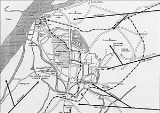
Nanking Massacre

Encyclopedia
The Nanking Massacre or Nanjing Massacre, also known as the Rape of Nanking, was a mass murder
, genocide
and war rape
that occurred during the six-week period following the Japanese capture of the city of Nanjing
(Nanking), the former capital of the Republic of China
, on December 13, 1937 during the Second Sino-Japanese War
. During this period hundreds of thousands of Chinese civilians and disarmed soldiers were murdered and 20,000–80,000 men, women and children were rape
d by soldiers of the Imperial Japanese Army
.
The event remains a contentious political issue, as various aspects of it have been disputed by some historical revisionists
and Japanese nationalists
, who have claimed that the massacre has been either exaggerated or wholly fabricated for propaganda purposes. As a result of the nationalist efforts to deny or rationalize the war crimes, the controversy surrounding the massacre remains a stumbling block in Sino-Japanese relations
, as well as Japanese relations with other Asia-Pacific nations such as South Korea
and the Philippines
.
An accurate estimation of the death toll in the massacre has not been achieved because most of the Japanese military records on the killings were deliberately destroyed or kept secret shortly after the surrender of Japan in 1945. The International Military Tribunal of the Far East estimates more than 200,000 casualties in the incident; China's official estimate is about 300,000 casualties, based on the evaluation of the Nanjing War Crimes Tribunal
. Estimates from Japanese historians vary widely, in the vicinity of 40,000–200,000. Some historical revisionists even deny that a widespread, systematic massacre occurred at all, claiming that any deaths were either justified militarily, accidental or isolated incidents of unauthorized atrocities. These negationists claim that the characterization of the incident as a large-scale, systematic massacre was fabricated for the purpose of political propaganda.
Although the Japanese government has admitted the acts of killing of a large number of noncombatants, looting and other violence committed by the Imperial Japanese Army after the fall of Nanking, some Japanese officials have argued that the death toll was military in nature and that no such crimes ever occurred. Denial of the massacre (and a divergent array of revisionist accounts of the killings) has become a staple of Japanese nationalism
. In Japan, public opinion of the massacres varies, and few deny the occurrence of the massacre outright. Nonetheless, recurring attempts by negationists to promote a revisionist history of the incident have created controversy that periodically reverberates in the international media, particularly in China, South Korea, and other East Asian nations.
where they met strong resistance and suffered heavy casualties. The battle was bloody as both sides faced attrition in urban hand-to-hand combat. By mid-November the Japanese had captured Shanghai
with the help of naval bombardment. The General Staff Headquarters in Tokyo initially decided not to expand the war due to heavy casualties and low morale of the troops. However, on December 1, headquarters ordered the Central China Area Army and the 10th Army to capture Nanking, then-capital of the Republic of China
.
knew the fall of Nanking would simply be a matter of time. He and his staff realized that he could not risk annihilation of their elite troops in a symbolic but hopeless defense of the capital. In order to preserve the army for future battles, most of them were withdrawn. Chiang's strategy was to follow the suggestion of his German advisers to draw the Japanese army deep into China utilizing China's vast territory as a defensive strength. Chiang planned to fight a protracted war of attrition
by wearing down the Japanese in the hinterland of China.
Leaving General Tang Shengzhi
in charge of the city for the Battle of Nanking, Chiang and many of his advisors flew to Wuhan
, where they stayed until it was attacked in 1938
.
. To prevent civilians from fleeing the city, he ordered troops to guard the port, as instructed by Chiang Kai-shek. The defense force blocked roads, destroyed boats, and burnt nearby villages, preventing widespread evacuation.
The Chinese government left for relocation on December 1, and the president left on December 7, leaving the fate of Nanking to an International Committee led by John Rabe
.
The defense plan fell apart quickly. Those defending the city encountered Chinese troops fleeing from previous defeats such as the Battle of Shanghai, running from the advancing Japanese army. This did nothing to help the morale of the defenders, many of whom were killed during the defense of the city and subsequent Japanese occupation.
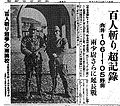 Although the Nanking Massacre is generally described as having occurred over a six-week period after the fall of Nanking, the crimes committed by the Japanese army were not limited to that period. Many atrocities were reported to have been committed as the Japanese army advanced from Shanghai to Nanking.
According to one Japanese journalist embedded with Imperial forces at the time, "The reason that the [10th Army] is advancing to Nanking quite rapidly is due to the tacit consent among the officers and men that they could loot and rape as they wish."
Novelist Ishikawa Tatsuzo vividly described how the 16th Division of the Shanghai Expeditionary Force committed atrocities on the march between Shanghai and Nanking in his novel Ikiteiru Heitai [Living Soldiers], which was based on interviews that Tatsuzo conducted with troops in Nanking in January 1938.
Perhaps the most notorious atrocity was a killing contest between two Japanese officers as reported in the Tokyo Nichi Nichi Shimbun and the English language Japan Advertiser. The contest was covered much like a sporting event with regular updates on the score over a series of days. In Japan, the veracity of the newspaper article about the contest was the subject of ferocious debate for several decades starting in 1967.
In 2000, a historian concurred with certain Japanese scholars who had argued that the contest was a concocted story, with the collusion of the soldiers themselves for the purpose of raising the national fighting spirit
. In 2005, a Tokyo district judge dismissed a suit by the families of the lieutenants, stating that "the lieutenants admitted the fact that they raced to kill 100 people" and that the story cannot be proven to be clearly false. The judge also ruled against the civil claim of the plaintiffs because the original article was more than 60 years old. The historicity of the event remains disputed in Japan.
strategy that the Chinese troops were implementing in the area surrounding the city.
On July 31, the Kuomintang
(KMT) had issued a statement that they were determined to turn every Chinese national and every piece of their soil into ash, rather than turn them over to the opponent. The Nanking garrison force set fire to buildings and houses in the areas close to Xiakuan to the north as well as in the environs of the eastern and southern city gates. Targets within and outside of the city walls—such as military barracks, private homes, the Chinese Ministry of Communication, forests and even entire villages—were burnt to cinders, at an estimated value of 20 to 30 million (1937) US dollars.
businessman John Rabe
was elected as its leader, in part because of his status as a member of the Nazi Party and the existence of the German-Japanese bilateral Anti-Comintern Pact
.
The Japanese government had previously agreed not to attack parts of the city that did not contain Chinese military forces, and the members of the Committee managed to persuade the Chinese government to move their troops out of the area.
On December 1, 1937, Nanking Mayor Ma Chao-chun ordered all Chinese citizens remaining in Nanking to move into the “Safety Zone”. Many fled the city on December 7, and the International Committee took over as the de facto
government of Nanking.
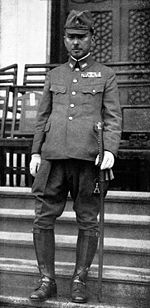 In a memorandum for the palace rolls, Hirohito had singled Prince Asaka Yasuhiko out for censure as the one imperial kinsman whose attitude was "not good." He assigned Asaka to Nanking as an opportunity to make amends.
On December 5, Asaka left Tokyo by plane and arrived at the front three days later. Asaka met with division commanders, lieutenant-generals Kesago Nakajima
and Heisuke Yanagawa
, who informed him that the Japanese troops had almost completely surrounded 300,000 Chinese troops in the vicinity of Nanking and that preliminary negotiations suggested that the Chinese were ready to surrender.
Prince Asaka allegedly issued an order to "kill all captives," thus providing official sanction for the crimes which took place during and after the battle. Some authors record that Prince Asaka signed the order for Japanese soldiers in Nanking to "kill all captives" Others claim that lieutenant colonel Isamu Chō
, Asaka's aide-de-camp
, sent this order under the Prince's sign manual without the Prince's knowledge or assent. However, even if Chō took the initiative on his own, Prince Asaka, who was nominally the officer in charge, gave no orders to stop the carnage. When General Matsui
arrived in the city four days after the massacre had begun, he issued strict orders that resulted in the eventual end of the massacre.
While the extent of Prince Asaka's responsibility for the massacre remains a matter of debate, the ultimate sanction for the massacre and the crimes committed during the invasion of China were issued in Emperor Hirohito
's ratification of the Japanese army's proposition to remove the constraints of international law
on the treatment of Chinese prisoners on August 5, 1937.
Meanwhile, members of the Committee contacted Tang and suggested a plan for three-day cease-fire, during which the Chinese troops could withdraw without fighting while the Japanese troops would stay in their present position.
General Tang agreed with this proposal if the International Committee could acquire permission of Generalissimo Chiang Kai-shek, who had already fled to Hankow to which he had temporarily shifted the military headquarters two days earlier.
John Rabe boarded the U.S. gunboat Panay on December 9 and sent two telegrams, one to Chiang Kai-shek by way of the American ambassador in Hankow, and one to the Japanese military authority in Shanghai. The next day he was informed that Chiang Kai-shek, who had ordered that Nanking be defended "to the last man," had refused to accept the proposal.
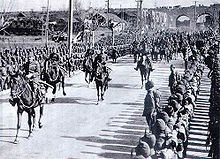 The Japanese awaited an answer to their demand for surrender but no response was received from the Chinese by the deadline on December 10. General Matsui Iwane waited another hour before issuing the command to take Nanking by force. The Japanese army mounted its assault on the Nanking walls from multiple directions; the SEF’s 16th Division attacked three gates on the eastern side, the 6th Division of the 10A launched its offensive on the western walls, and the SEF’s 9th Division advanced into the area in-between.
On December 12, under heavy artillery fire and aerial bombardment, General Tang Sheng-chi ordered his men to retreat. What followed was nothing short of chaos. Some Chinese soldiers stripped civilians of their clothing in a desperate attempt to blend in, and many others were shot by the Chinese supervisory unit as they tried to flee.
On 13 December, the 6th and the 116th Divisions of the Japanese Army were the first to enter the city, facing little military resistance. Simultaneously, the 9th Division entered nearby Guanghua Gate, and the 16th Division entered the Zhongshan and Taiping gates. That same afternoon, two small Japanese Navy
fleets arrived on both sides of the Yangtze River. Nanking fell to the Japanese by nightfall.
The Japanese army conducted its mopping-up operation both inside and outside the Nanking Safety Zone
. Since the area outside the safety zone had been almost completely evacuated, the mopping-up effort was concentrated in the safety zone. The safety zone, an area of 3.85 square kilometres, was literally packed with the remaining population of Nanking. The Japanese army leadership assigned sections of the safety zone to some units to separate alleged plain-clothed soldiers from the civilians.
and American Minnie Vautrin
. Other accounts include first-person testimonies of the Nanking Massacre survivors, eyewitness reports of journalists (both Western and Japanese), as well as the field diaries of military personnel. American
missionary John Magee
stayed behind to provide a 16 mm film
documentary
and first-hand photographs of the Nanking Massacre.
A group of foreign expatriates headed by John Rabe had formed the 15-man International Committee on November 22 and mapped out the Nanking Safety Zone
in order to safeguard civilians in the city, where the population numbered from 200,000 to 250,000. Rabe and American missionary Lewis S. C. Smythe, secretary of the International Committee and a professor of sociology
at the University of Nanking
, recorded the actions of the Japanese troops and filed complaints to the Japanese embassy.
estimated that 20,000 women were raped, including infants and the elderly. A large portion of these rapes were systematized in a process where soldiers would search door-to-door for young girls, with many women taken captive and gang raped. The women were often killed immediately after the rape, often through explicit mutilation
or by stabbing a bayonet, long stick of bamboo, or other objects into the vagina. Young children were not exempt from these atrocities, and were cut open to allow Japanese soldiers to rape them.
On 19 December 1937, Reverend James M. McCallum wrote in his diary:
On March 7, 1938, Robert O. Wilson
, a surgeon at the American-administered University Hospital in the Safety Zone, wrote in a letter to his family, "a conservative estimate of people slaughtered in cold blood is somewhere about 100,000, including of course thousands of soldiers that had thrown down their arms".
Here are two excerpts from his letters of 15 and 18 December 1937 to his family:
In his diary kept during the aggression to the city and its occupation by the Imperial Japanese Army
, the leader of the Safety Zone, John Rabe
, wrote many comments about Japanese atrocities. For 17 December:
There are also accounts of Japanese troops forcing families to commit acts of incest
. Sons were forced to rape their mothers, fathers were forced to rape daughters. One pregnant woman who was gang-raped by Japanese soldiers gave birth only a few hours later; although the baby appeared to be physically unharmed (Robert B. Edgerton, Warriors of the Rising Sun). Monks who had declared a life of celibacy
were also forced to rape women.
On 10 February 1938, Legation Secretary of the German Embassy, Rosen, wrote to his Foreign Ministry about a film made in December by Reverend John Magee to recommend its purchase. Here is an excerpt from his letter and a description of some of its shots, kept in the Political Archives of the Foreign Ministry in Berlin.
Pregnant women were a target of murder, as they would often be bayoneted in the stomach, sometimes after rape. Tang Junshan, survivor and witness to one of the Japanese army’s systematic mass killings, testified:
According to Navy veteran Sho Mitani, 'The Army used a trumpet sound that meant "Kill all Chinese who run away"'.
Thousands were led away and mass-executed in an excavation known as the "Ten-Thousand-Corpse Ditch", a trench measuring about 300m long and 5m wide. Since records were not kept, estimates regarding the number of victims buried in the ditch range from 4,000 to 20,000. However, most scholars and historians consider the number to be more than 12,000 victims.
had personally ratified his army's proposition to remove the constraints of international law on the treatment of Chinese prisoners. This directive also advised staff officers to stop using the term "prisoner of war
".
Immediately after the fall of the city, Japanese troops embarked on a determined search for former soldiers, in which thousands of young men were captured. Many were taken to the Yangtze River
, where they were machine-gunned. What was probably the single largest massacre of Chinese troops occurred along the banks of the Yangtze River on December 18 in what is called the Straw String Gorge Massacre. Japanese soldiers took most of the morning tying all of the POWs hands together and in the dusk divided them into 4 columns, and opened fire at them. Unable to escape, the POWs could only scream and thrash in desperation. It took an hour for the sounds of death to stop, and even longer for the Japanese to bayonet each individual. Most were dumped into the Yangtze. It is estimated that at least 57,500 Chinese POWs were killed.
The Japanese troops gathered 1,300 Chinese soldiers and civilians at Taiping Gate and killed them. The victims were blown up with landmines, then doused with petrol before being set on fire. Those that were left alive afterward were killed with bayonets.
F. Tillman Durdin and Archibald Steele, American news correspondents, reported that they had seen bodies of killed Chinese soldiers forming mounds six feet high at the Nanking Yijiang gate in the north. Durdin, who was working for the New York Times, made a tour of Nanking before his departure from the city. He heard waves of machine-gun fire and witnessed the Japanese soldiers gun down some two hundred Chinese within ten minutes. Two days later, in his report to the New York Times, he stated that the alleys and street were filled with civilian bodies, including women and children.
According to a testimony made by missionary Ralph L. Phillips to the U.S. State Assembly Investigating Committee, he was "forced to watch while the Japs disembowled a Chinese soldier" and "roasted his heart and liver and ate them".
On 17 December, John Rabe
wrote as chairman a complaint to Kiyoshi Fukui, second secretary of the Japanese Embassy. The following is an excerpt:
The Japanese soldiers committed actions in the Safety Zone that were part of the larger Nanking Massacre. The International Committee appealed a number of times to the Japanese army, with John Rabe
using his credentials as a Nazi Party member, but to no avail. Rabe wrote that from time to time the Japanese would enter the Safety Zone at will, carry off a few hundred men and women, and either summarily execute them or rape and then kill them.
By February 5, 1938, the International Committee had forwarded to the Japanese embassy a total of 450 cases of murder, rape, and general disorder by Japanese soldiers that had been reported after the American, British and German diplomats had returned to their embassies.
It is said that Rabe rescued between 200,000 – 250,000 Chinese people.
After the establishment of the “weixin zhengfu” (the collaborating government) in 1938, order was gradually restored in Nanking and atrocities by Japanese troops lessened considerably.
On February 18, 1938, the Nanking Safety Zone International Committee was forcibly renamed "Nanking International Rescue Committee", and the Safety Zone effectively ceased to function. The last refugee camps were closed in May 1938.
in August 1939, though he held no further military commands.
According to the International Military Tribunal for the Far East
, estimates made at a later date indicate that the total number of civilians and prisoners of war murdered in Nanking and its vicinity during the first six weeks of the Japanese occupation was over 200,000. These estimates are borne out by the figures of burial societies and other organizations, which testify to over 155,000 buried bodies. These figures do not take into account those persons whose bodies were destroyed by burning, drowning, or other means.
According to the verdict of the Nanjing War Crimes Tribunal
on 10 March 1947, there are "more than 190,000 mass slaughtered civilians and Chinese soldiers killed by machine gun by the Japanese army, whose corpses have been burned to destroy proof. Besides, we count more than 150,000 victims of barbarian acts buried by the charity organizations. We thus have a total of more than 300,000 victims."
The extent of the atrocities is debated, with numbers ranging from some Japanese claims of several hundred, to the Chinese claim of a non-combatant death toll of 300,000. A number of Japanese researchers consider 100,000–200,000 to be an accurate estimate.
Other nations believe the death toll to be between 150,000–300,000, based on the Nanjing War Crimes Tribunal
verdict, and another estimate of the civilian toll (excluding soldiers and POWs) is about 40,000–60,000, which corresponds to the figures from three sources; one is the Red Army's official journal of the time, Hangdibao and another is that of Miner Searle Bates of the International Safety Zone Committee, and the third is the aforementioned figure written by John Rabe in a letter. The casualty count of 300,000 was first promulgated in January 1938 by Harold Timperley, a journalist in China during the Japanese invasion, based on reports from contemporary eyewitnesses. Other sources, including Iris Chang
's The Rape of Nanking
, also conclude that the death toll reached 300,000. In December 2007, newly declassified U.S. government
show that a telegraph of U.S. ambassador to Germany in Berlin sent one day after the Japanese army occupied Nanjing, stating that he heard Japanese Ambassador in Germany boasting that Japanese army killed 500,000 Chinese people as the Japanese army advanced from Shanghai to Nanking.
However, many historians include a much larger area around the city. Including the Xiaguan district (the suburb
s north of Nanking, about 31 km2 in size) and other areas on the outskirts of the city, the population of greater Nanking was running between 535,000 and 635,000 civilians and soldiers just prior to the Japanese occupation. Some historians also include six counties around Nanking, known as the Nanking Special Municipality.
The duration of the incident is naturally defined by its geography: the earlier the Japanese entered the area, the longer the duration. The Battle of Nanking
ended on December 13, when the divisions of the Japanese Army entered the walled city of Nanking. The Tokyo War Crime Tribunal defined the period of the massacre to the ensuing six weeks. More conservative estimates say the massacre started on December 14, when the troops entered the Safety Zone, and that it lasted for six weeks. Historians who define the Nanking Massacre as having started from the time the Japanese Army entered Jiangsu
province push the beginning of the massacre to around mid-November to early December (Suzhou fell on November 19), and stretch the end of the massacre to late March 1938.
Chinese language sources tend to place the figure of massacred civilians upwards of 200,000. For example, a postwar investigation by the Nanking District Court put the number of dead during the incident as 295,525, 76% of them men, 22% women and 2% children.
A 42-part Taiwan
ese documentary produced from 1995 to 1997, entitled An Inch of Blood For An Inch of Land (一寸河山一寸血), asserts that 340,000 Chinese civilians died in Nanking City as a result of the Japanese invasion, 150,000 through bombing and crossfire in the five-day battle, and 190,000 in the massacre, based on the evidence presented at the Tokyo Trials.
for "deliberately and recklessly" ignoring his legal duty "to take adequate steps to secure the observance and prevent breaches" of the Hague Convention. Hisao Tani
, the lieutenant general of the 6th Division of the Japanese army in Nanking, was tried by the Nanjing War Crimes Tribunal
.
Other Japanese military leaders in charge at the time of the Nanking Massacre were not tried. Prince Kan'in, chief of staff of the Imperial Japanese Army during the massacre, had died before the end of the war in May 1945. Prince Asaka was granted immunity because of his status as a member of the imperial family. Isamu Chō
, the aide of Prince Asaka, and who some historians believe issued the "kill all captives" memo, had committed suicide during the defense of Okinawa.
officials interrogated Prince Asaka
, who was the ranking officer in the city at the height of the atrocities, about his involvement in the Nanking Massacre and the deposition was submitted to the International Prosecution Section of the Tokyo tribunal. Asaka denied the existence of any massacre and claimed never to have received complaints about the conduct of his troops. Whatever his culpability may have been, Asaka was not prosecuted before the International Military Tribunal for the Far East
at least in part because under the pact concluded between General MacArthur
and Hirohito
, the Emperor himself and all the members of the imperial family were granted immunity from prosecution.
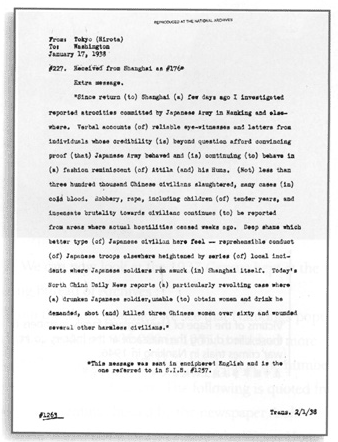 The prosecution began the Nanking phase of its case in July 1946. Dr. Robert O. Wilson
, a surgeon and a member of the International Committee for the Nanking Safety Zone, took the witness stand first.
Other members of the International Committee for the Nanking Safety Zone who took the witness stand included Miner Searle Bates
and John Magee. George A. Fitch, Lewis Smythe and James McCallum
filed affidavits with their diaries and letters.
Another piece of evidence that was submitted to the tribunal was Harold Timperley's telegram regarding the Nanking Massacre which had been intercepted and decoded by the Americans on January 17, 1938.
One of the books by Hsü, Documents of the Nanking Safety Zone, was also adduced in court.
According to Matsui's own diary, one day after he made the ceremonial triumphal entry into the city on December 17, 1937, he instructed the chiefs of staff from each division to tighten military discipline and try to eradicate the sense of disdain for Chinese people among their soldiers.
On February 7, 1938, Matsui delivered a speech at a memorial service for the Japanese officers and men of the Shanghai Expeditionary Force who were killed in action. In front of the high-ranking officers, Domei News Agency reported, he emphasized the necessity to "put an end to various reports affecting the prestige of the Japanese troops."
The entry for the same day in Matsui's diary read, "I could only feel sadness and responsibility today, which has been overwhelmingly piercing my heart. This is caused by the Army's misbehaviors after the fall of Nanking and failure to proceed with the autonomous government and other political plans."
In the interrogation in Sugamo prison preceding the trial Matsui admitted that he heard about the many outrages committed by his troops from Japanese diplomats when he entered Nanking on December 17, 1937.
In court, he contradicted the earlier testimony and told the judges that he was not "officially" briefed at the consulate about the evildoings, presumably to avoid admitting any contact with the consulate officials such as Second Secretary (later Acting Consul-General) Fukui Kiyoshi and Attaché Fukuda Tokuyasu who received and dealt with the protests filed by the International Committee.
In the same interrogation session before the trial Matsui said one officer and three low-ranking soldiers were court-martialled because of their misbehavior in Nanking and the officer was sentenced to death.
In his affidavit Matsui said he ordered his officers to investigate the massacre and to take necessary action. In court, however, Matsui said that he did not have jurisdiction over the soldiers' misconduct since he was not in the position of supervising military discipline and morals.
Matsui asserted that he had never ordered the execution of Chinese POWs
. He further argued that he had directed his army division commanders to discipline their troops for criminal acts, and was not responsible for their failure to carry out his directives. At trial, Matsui went out of his way to protect Prince Asaka
by shifting blame to lower ranking division commanders.
Matsui was convicted of count 55, which charged him with being one of the senior officers who "deliberately and recklessly disregarded their legal duty [by virtue of their respective offices] to take adequate steps to secure the observance [of the Laws and Customs of War] and prevent breaches thereof, and thereby violated the laws of war."
Hirota Koki, who had been the Foreign Minister when Japan conquered Nanking, was convicted of participating in "the formulation or execution of a common plan or conspiracy" (count 1), waging "a war of aggression and a war in violation of international laws, treaties, agreements and assurances against the Republic of China" (count 27) and count 55.
Matsui was convicted by a majority of the judges at the Tokyo tribunal who ruled that he bore ultimate responsibility for the "orgy of crime" at Nanking because, "He did nothing, or nothing effective, to abate these horrors."
Radhabinod Pal, the member of the tribunal from India, dissented from the conviction arguing that the commander-in-chief must rely on his subordinate officers to enforce soldier discipline. "The name of Justice," Pal wrote in his dissent, "should not be allowed to be invoked only for ... vindictive retaliation."
General Hisao Tani
was sentenced to death by the Nanking War Crimes Tribunal.
was built by the Nanking Municipal Government in remembrance of the victims and to raise awareness of the Nanking Massacre. It is located near a site where thousands of bodies were buried, called the "pit of ten thousand corpses" (wàn rén kēng).
In 1995, Daniel Kwan held a photograph exhibit in Los Angeles titled, "The Forgotten Holocaust".
In 2005, John Rabe's former residence in Nanking was renovated and now accommodates the "John Rabe and International Safety Zone Memorial Hall
", which opened in 2006.
encouraged Mao to stay relatively silent about Nanking in order to keep a trade relationship with Japan. In turn, China and Japan occasionally used Nanking as an opportunity to demonize one another.
The debate concerning the massacre took place mainly in the 1970s. During this time, the Chinese government's statements about the event were attacked by the Japanese because they were said to rely too heavily on personal testimonies and anecdotal evidence. Aspersions were cast regarding the authenticity and accuracy of burial records and photographs presented in the Tokyo War Crime Court, which were said to be fabrications by the Chinese government, artificially manipulated or incorrectly attributed to the Nanking Massacre.
During the 1970s, Katsuichi Honda
wrote a series of articles for the Asahi Shimbun
on war crimes committed by Japanese soldiers during World War II
(such as the Nanking Massacre). The publication of these articles triggered a vehement response from Japanese right-wingers regarding the Japanese treatment of the war crimes. In response, Shichihei Yamamoto and Akira Suzuki wrote two controversial yet influential articles which sparked the negationist movement.
, the Japanese prime minister Tomiichi Murayama
gave the first clear and formal apology for Japanese actions during the war. He apologized for Japan's wrongful aggression and the great suffering that it inflicted in Asia. He offered his heartfelt apology to all survivors and to the relatives and friends of the victims. That day, the prime minister and the Japanese Emperor Akihito
pronounced statements of mourning at Tokyo's Nippon Budokan
. The emperor offered his condolences and expressed the hope that such atrocities would never be repeated. Iris Chang
, author of The Rape of Nanking
, criticized Murayama for not providing the written apology that had been expected. She said that the people of China "don't believe that an... unequivocal and sincere apology has ever been made by Japan to China" and that a written apology from Japan would send a better message to the international community.
(LDP) lawmakers again denounced the Nanjing Massacre as a fabrication, arguing that there was no evidence to prove the allegations of mass killings by Japanese soldiers. They accused Beijing of using the alleged incident as a "political advertisement".
since the early 1970s. Bilateral exchanges on trade, culture and education have increased greatly since the two countries normalized their bilateral relations and Japan became China’s most important trading partner. Trade between the two nations is worth over $200 billion annually. Despite this, many Chinese people still have a strong sense of mistrust and animosity toward Japan that originates from the memory of Japanese war crimes
such as the Nanking Massacre. This sense of mistrust is strengthened by the belief that Japan is unwilling to admit to and apologize for the atrocities.
Takashi Yoshida described how changing political concerns and perceptions of the "national interest" in Japan, China, and Western countries have shaped collective memory of the Nanking massacre. Yoshida asserted that over time the event has acquired different meanings to different people.
Many Japanese prime ministers have visited the Yasukuni Shrine
, a shrine for dead Japanese soldiers of World War II
, including some war criminals of the Nanking Massacre. In 2006 former Japanese prime minister Junichiro Koizumi
made a pilgrimage to the shrine despite warnings from China and South Korea. His decision to visit the shrine regardless sparked international outrage. Although Koizumi denied that he was trying to glorify war or historical Japanese militarism
, The Chinese Foreign Ministry accused Koizumi of "wrecking the political foundations of China-Japan relations". An official from South Korea said they would summon the Tokyo ambassador to protest.
The majority of Japanese acknowledge the atrocities committed during the Nanking Massacre . Some denialists and Japanese officials have openly denied the incident, claiming it to be propaganda designed to spark an anti-Japan movement.
, it is the most complete record to date. The report consists of eight volumes and was released to mark the 70th anniversary of the start of the massacre. It also lists the Japanese army units that were responsible for each of the deaths and states the way in which the victims were killed. Zhang Xianwen, editor-in-chief of the report, states that the information collected was based on "a combination of Chinese, Japanese and Western raw materials, which is objective and just and is able to stand the trial of history." This report formed part of a 55-volume series (Collection of Historical Materials of Nanjing Massacre (南京大屠杀史料集) about the massacre.
Mass murder
Mass murder is the act of murdering a large number of people , typically at the same time or over a relatively short period of time. According to the FBI, mass murder is defined as four or more murders occurring during a particular event with no cooling-off period between the murders...
, genocide
Genocide
Genocide is defined as "the deliberate and systematic destruction, in whole or in part, of an ethnic, racial, religious, or national group", though what constitutes enough of a "part" to qualify as genocide has been subject to much debate by legal scholars...
and war rape
War rape
War rapes are rapes committed by soldiers, other combatants or civilians during armed conflict or war, or during military occupation, distinguished from sexual assaults and rape committed amongst troops in military service...
that occurred during the six-week period following the Japanese capture of the city of Nanjing
Nanjing
' is the capital of Jiangsu province in China and has a prominent place in Chinese history and culture, having been the capital of China on several occasions...
(Nanking), the former capital of the Republic of China
Republic of China (1912–1949)
In 1911, after over two thousand years of imperial rule, a republic was established in China and the monarchy overthrown by a group of revolutionaries. The Qing Dynasty, having just experienced a century of instability, suffered from both internal rebellion and foreign imperialism...
, on December 13, 1937 during the Second Sino-Japanese War
Second Sino-Japanese War
The Second Sino-Japanese War was a military conflict fought primarily between the Republic of China and the Empire of Japan. From 1937 to 1941, China fought Japan with some economic help from Germany , the Soviet Union and the United States...
. During this period hundreds of thousands of Chinese civilians and disarmed soldiers were murdered and 20,000–80,000 men, women and children were rape
Rape
Rape is a type of sexual assault usually involving sexual intercourse, which is initiated by one or more persons against another person without that person's consent. The act may be carried out by physical force, coercion, abuse of authority or with a person who is incapable of valid consent. The...
d by soldiers of the Imperial Japanese Army
Imperial Japanese Army
-Foundation:During the Meiji Restoration, the military forces loyal to the Emperor were samurai drawn primarily from the loyalist feudal domains of Satsuma and Chōshū...
.
The event remains a contentious political issue, as various aspects of it have been disputed by some historical revisionists
Historical revisionism
In historiography, historical revisionism is the reinterpretation of orthodox views on evidence, motivations, and decision-making processes surrounding a historical event...
and Japanese nationalists
Japanese nationalism
encompasses a broad range of ideas and sentiments harbored by the Japanese people over the last two centuries regarding their native country, its cultural nature, political form and historical destiny...
, who have claimed that the massacre has been either exaggerated or wholly fabricated for propaganda purposes. As a result of the nationalist efforts to deny or rationalize the war crimes, the controversy surrounding the massacre remains a stumbling block in Sino-Japanese relations
Sino-Japanese relations
China and Japan are geographically separated only by a relatively narrow stretch of ocean. China has strongly influenced Japan with its writing system, architecture, culture, religion, philosophy, and law...
, as well as Japanese relations with other Asia-Pacific nations such as South Korea
South Korea
The Republic of Korea , , is a sovereign state in East Asia, located on the southern portion of the Korean Peninsula. It is neighbored by the People's Republic of China to the west, Japan to the east, North Korea to the north, and the East China Sea and Republic of China to the south...
and the Philippines
Philippines
The Philippines , officially known as the Republic of the Philippines , is a country in Southeast Asia in the western Pacific Ocean. To its north across the Luzon Strait lies Taiwan. West across the South China Sea sits Vietnam...
.
An accurate estimation of the death toll in the massacre has not been achieved because most of the Japanese military records on the killings were deliberately destroyed or kept secret shortly after the surrender of Japan in 1945. The International Military Tribunal of the Far East estimates more than 200,000 casualties in the incident; China's official estimate is about 300,000 casualties, based on the evaluation of the Nanjing War Crimes Tribunal
Nanjing War Crimes Tribunal
The Nanjing War Crimes Tribunal was established in 1946 by the government of Chiang Kai-Shek to judge four Japanese Imperial Army officers accused of crimes committed during the Second Sino-Japanese War...
. Estimates from Japanese historians vary widely, in the vicinity of 40,000–200,000. Some historical revisionists even deny that a widespread, systematic massacre occurred at all, claiming that any deaths were either justified militarily, accidental or isolated incidents of unauthorized atrocities. These negationists claim that the characterization of the incident as a large-scale, systematic massacre was fabricated for the purpose of political propaganda.
Although the Japanese government has admitted the acts of killing of a large number of noncombatants, looting and other violence committed by the Imperial Japanese Army after the fall of Nanking, some Japanese officials have argued that the death toll was military in nature and that no such crimes ever occurred. Denial of the massacre (and a divergent array of revisionist accounts of the killings) has become a staple of Japanese nationalism
Japanese nationalism
encompasses a broad range of ideas and sentiments harbored by the Japanese people over the last two centuries regarding their native country, its cultural nature, political form and historical destiny...
. In Japan, public opinion of the massacres varies, and few deny the occurrence of the massacre outright. Nonetheless, recurring attempts by negationists to promote a revisionist history of the incident have created controversy that periodically reverberates in the international media, particularly in China, South Korea, and other East Asian nations.
Military situation
In August 1937, the Japanese army invaded ShanghaiBattle of Shanghai
The Battle of Shanghai, known in Chinese as Battle of Songhu, was the first of the twenty-two major engagements fought between the National Revolutionary Army of the Republic of China and the Imperial Japanese Army of the Empire of Japan during the Second Sino-Japanese War...
where they met strong resistance and suffered heavy casualties. The battle was bloody as both sides faced attrition in urban hand-to-hand combat. By mid-November the Japanese had captured Shanghai
Shanghai
Shanghai is the largest city by population in China and the largest city proper in the world. It is one of the four province-level municipalities in the People's Republic of China, with a total population of over 23 million as of 2010...
with the help of naval bombardment. The General Staff Headquarters in Tokyo initially decided not to expand the war due to heavy casualties and low morale of the troops. However, on December 1, headquarters ordered the Central China Area Army and the 10th Army to capture Nanking, then-capital of the Republic of China
Republic of China
The Republic of China , commonly known as Taiwan , is a unitary sovereign state located in East Asia. Originally based in mainland China, the Republic of China currently governs the island of Taiwan , which forms over 99% of its current territory, as well as Penghu, Kinmen, Matsu and other minor...
.
Relocation of the capital
After losing the Battle of Shanghai, Chiang Kai-shekChiang Kai-shek
Chiang Kai-shek was a political and military leader of 20th century China. He is known as Jiǎng Jièshí or Jiǎng Zhōngzhèng in Mandarin....
knew the fall of Nanking would simply be a matter of time. He and his staff realized that he could not risk annihilation of their elite troops in a symbolic but hopeless defense of the capital. In order to preserve the army for future battles, most of them were withdrawn. Chiang's strategy was to follow the suggestion of his German advisers to draw the Japanese army deep into China utilizing China's vast territory as a defensive strength. Chiang planned to fight a protracted war of attrition
Attrition warfare
Attrition warfare is a military strategy in which a belligerent side attempts to win a war by wearing down its enemy to the point of collapse through continuous losses in personnel and matériel....
by wearing down the Japanese in the hinterland of China.
Leaving General Tang Shengzhi
Tang Shengzhi
Tang Shengzhi was a Chinese warlord during the Warlord Era, a military commander during the Second Sino-Japanese War, and a politician after World War II....
in charge of the city for the Battle of Nanking, Chiang and many of his advisors flew to Wuhan
Wuhan
Wuhan is the capital of Hubei province, People's Republic of China, and is the most populous city in Central China. It lies at the east of the Jianghan Plain, and the intersection of the middle reaches of the Yangtze and Han rivers...
, where they stayed until it was attacked in 1938
Battle of Wuhan
The Battle of Wuhan, popularly known to the Chinese as the Defence of Wuhan, and to the Japanese as the Capture of Wuhan, was a large-scale battle of the Second Sino-Japanese War...
.
Strategy for the defense of Nanking
In a press release to foreign reporters, Tang Shengzhi announced the city would not surrender and would fight to the death. Tang gathered about 100,000 soldiers, largely untrained, including Chinese troops who had participated in the Battle of ShanghaiBattle of Shanghai
The Battle of Shanghai, known in Chinese as Battle of Songhu, was the first of the twenty-two major engagements fought between the National Revolutionary Army of the Republic of China and the Imperial Japanese Army of the Empire of Japan during the Second Sino-Japanese War...
. To prevent civilians from fleeing the city, he ordered troops to guard the port, as instructed by Chiang Kai-shek. The defense force blocked roads, destroyed boats, and burnt nearby villages, preventing widespread evacuation.
The Chinese government left for relocation on December 1, and the president left on December 7, leaving the fate of Nanking to an International Committee led by John Rabe
John Rabe
John Rabe was a German businessman who is best known for his efforts to stop the atrocities of the Japanese army during the Nanking Occupation and his work to protect and help the Chinese civilians during the event...
.
The defense plan fell apart quickly. Those defending the city encountered Chinese troops fleeing from previous defeats such as the Battle of Shanghai, running from the advancing Japanese army. This did nothing to help the morale of the defenders, many of whom were killed during the defense of the city and subsequent Japanese occupation.
Japanese war crimes on the march to Nanking
According to one Japanese journalist embedded with Imperial forces at the time, "The reason that the [10th Army] is advancing to Nanking quite rapidly is due to the tacit consent among the officers and men that they could loot and rape as they wish."
Novelist Ishikawa Tatsuzo vividly described how the 16th Division of the Shanghai Expeditionary Force committed atrocities on the march between Shanghai and Nanking in his novel Ikiteiru Heitai [Living Soldiers], which was based on interviews that Tatsuzo conducted with troops in Nanking in January 1938.
Perhaps the most notorious atrocity was a killing contest between two Japanese officers as reported in the Tokyo Nichi Nichi Shimbun and the English language Japan Advertiser. The contest was covered much like a sporting event with regular updates on the score over a series of days. In Japan, the veracity of the newspaper article about the contest was the subject of ferocious debate for several decades starting in 1967.
In 2000, a historian concurred with certain Japanese scholars who had argued that the contest was a concocted story, with the collusion of the soldiers themselves for the purpose of raising the national fighting spirit
Yamato-damashii
is a historically and culturally loaded word in the Japanese language. The phrase was apparently coined in the Heian period to describe the indigenous Japanese 'spirit' or cultural values as opposed to the cultural values imported into the country through contact with Tang dynasty China. Later, a...
. In 2005, a Tokyo district judge dismissed a suit by the families of the lieutenants, stating that "the lieutenants admitted the fact that they raced to kill 100 people" and that the story cannot be proven to be clearly false. The judge also ruled against the civil claim of the plaintiffs because the original article was more than 60 years old. The historicity of the event remains disputed in Japan.
Flight of Chinese civilians
As the Japanese army drew closer to Nanking, Chinese civilians fled the city in droves. The people of Nanking fled in panic not only because of the dangers of the anticipated battle but also because they feared the deprivation inherent in the scorched earthScorched earth
A scorched earth policy is a military strategy or operational method which involves destroying anything that might be useful to the enemy while advancing through or withdrawing from an area...
strategy that the Chinese troops were implementing in the area surrounding the city.
On July 31, the Kuomintang
Kuomintang
The Kuomintang of China , sometimes romanized as Guomindang via the Pinyin transcription system or GMD for short, and translated as the Chinese Nationalist Party is a founding and ruling political party of the Republic of China . Its guiding ideology is the Three Principles of the People, espoused...
(KMT) had issued a statement that they were determined to turn every Chinese national and every piece of their soil into ash, rather than turn them over to the opponent. The Nanking garrison force set fire to buildings and houses in the areas close to Xiakuan to the north as well as in the environs of the eastern and southern city gates. Targets within and outside of the city walls—such as military barracks, private homes, the Chinese Ministry of Communication, forests and even entire villages—were burnt to cinders, at an estimated value of 20 to 30 million (1937) US dollars.
Establishment of the Nanking Safety Zone
Many Westerners were living in the city at that time, conducting trade or on missionary trips. As the Japanese army approached Nanking, most of them fled the city, leaving 27 foreigners. Five of these were journalists who remained in the city a few days after it was captured, leaving the city on December 16. 15 of the remaining 22 foreigners formed a committee, called the International Committee for the Nanking Safety Zone in the western quarter of the city. GermanGermany
Germany , officially the Federal Republic of Germany , is a federal parliamentary republic in Europe. The country consists of 16 states while the capital and largest city is Berlin. Germany covers an area of 357,021 km2 and has a largely temperate seasonal climate...
businessman John Rabe
John Rabe
John Rabe was a German businessman who is best known for his efforts to stop the atrocities of the Japanese army during the Nanking Occupation and his work to protect and help the Chinese civilians during the event...
was elected as its leader, in part because of his status as a member of the Nazi Party and the existence of the German-Japanese bilateral Anti-Comintern Pact
Anti-Comintern Pact
The Anti-Comintern Pact was an Anti-Communist pact concluded between Nazi Germany and the Empire of Japan on November 25, 1936 and was directed against the Communist International ....
.
The Japanese government had previously agreed not to attack parts of the city that did not contain Chinese military forces, and the members of the Committee managed to persuade the Chinese government to move their troops out of the area.
On December 1, 1937, Nanking Mayor Ma Chao-chun ordered all Chinese citizens remaining in Nanking to move into the “Safety Zone”. Many fled the city on December 7, and the International Committee took over as the de facto
De facto
De facto is a Latin expression that means "concerning fact." In law, it often means "in practice but not necessarily ordained by law" or "in practice or actuality, but not officially established." It is commonly used in contrast to de jure when referring to matters of law, governance, or...
government of Nanking.
Prince Asaka appointed as commander
On December 5, Asaka left Tokyo by plane and arrived at the front three days later. Asaka met with division commanders, lieutenant-generals Kesago Nakajima
Kesago Nakajima
- Notes :...
and Heisuke Yanagawa
Heisuke Yanagawa
- Notes :...
, who informed him that the Japanese troops had almost completely surrounded 300,000 Chinese troops in the vicinity of Nanking and that preliminary negotiations suggested that the Chinese were ready to surrender.
Prince Asaka allegedly issued an order to "kill all captives," thus providing official sanction for the crimes which took place during and after the battle. Some authors record that Prince Asaka signed the order for Japanese soldiers in Nanking to "kill all captives" Others claim that lieutenant colonel Isamu Chō
Isamu Cho
- Notes :...
, Asaka's aide-de-camp
Aide-de-camp
An aide-de-camp is a personal assistant, secretary, or adjutant to a person of high rank, usually a senior military officer or a head of state...
, sent this order under the Prince's sign manual without the Prince's knowledge or assent. However, even if Chō took the initiative on his own, Prince Asaka, who was nominally the officer in charge, gave no orders to stop the carnage. When General Matsui
Iwane Matsui
was a general in the Imperial Japanese Army and the commander of the expeditionary forces sent to China in World War II. He was convicted of war crimes and sentenced to death by hanging by the International Military Tribunal for the Far East for responsibility over the Nanking Massacre.-Early life...
arrived in the city four days after the massacre had begun, he issued strict orders that resulted in the eventual end of the massacre.
While the extent of Prince Asaka's responsibility for the massacre remains a matter of debate, the ultimate sanction for the massacre and the crimes committed during the invasion of China were issued in Emperor Hirohito
Hirohito
, posthumously in Japan officially called Emperor Shōwa or , was the 124th Emperor of Japan according to the traditional order, reigning from December 25, 1926, until his death in 1989. Although better known outside of Japan by his personal name Hirohito, in Japan he is now referred to...
's ratification of the Japanese army's proposition to remove the constraints of international law
International law
Public international law concerns the structure and conduct of sovereign states; analogous entities, such as the Holy See; and intergovernmental organizations. To a lesser degree, international law also may affect multinational corporations and individuals, an impact increasingly evolving beyond...
on the treatment of Chinese prisoners on August 5, 1937.
Siege of the city
The Japanese military continued to move forward, breaching the last lines of Chinese resistance, and arriving outside the walled city of Nanking on December 9.Demand for surrender
At noon on December 9, the military dropped leaflets into the city, urging the surrender of Nanking within 24 hours, promising annihilation if refused.Meanwhile, members of the Committee contacted Tang and suggested a plan for three-day cease-fire, during which the Chinese troops could withdraw without fighting while the Japanese troops would stay in their present position.
General Tang agreed with this proposal if the International Committee could acquire permission of Generalissimo Chiang Kai-shek, who had already fled to Hankow to which he had temporarily shifted the military headquarters two days earlier.
John Rabe boarded the U.S. gunboat Panay on December 9 and sent two telegrams, one to Chiang Kai-shek by way of the American ambassador in Hankow, and one to the Japanese military authority in Shanghai. The next day he was informed that Chiang Kai-shek, who had ordered that Nanking be defended "to the last man," had refused to accept the proposal.
Assault and capture of Nanking
On December 12, under heavy artillery fire and aerial bombardment, General Tang Sheng-chi ordered his men to retreat. What followed was nothing short of chaos. Some Chinese soldiers stripped civilians of their clothing in a desperate attempt to blend in, and many others were shot by the Chinese supervisory unit as they tried to flee.
On 13 December, the 6th and the 116th Divisions of the Japanese Army were the first to enter the city, facing little military resistance. Simultaneously, the 9th Division entered nearby Guanghua Gate, and the 16th Division entered the Zhongshan and Taiping gates. That same afternoon, two small Japanese Navy
Imperial Japanese Navy
The Imperial Japanese Navy was the navy of the Empire of Japan from 1869 until 1947, when it was dissolved following Japan's constitutional renunciation of the use of force as a means of settling international disputes...
fleets arrived on both sides of the Yangtze River. Nanking fell to the Japanese by nightfall.
Pursuit and mopping-up operations
Japanese troops pursued the retreating Chinese army units, primarily in the Xiakuan area to the north of the city walls and around the Zijin Mountain in the east. Although popular narrative suggests that the final phase of the battle consisted of a one-sided slaughter of Chinese troops by the Japanese, some Japanese historians maintain that the remaining Chinese military still posed a serious threat to the Japanese. Prince Yasuhiko Asaka told a war correspondent later that he was in a very perilous position when his headquarters was ambushed by Chinese forces that were in the midst of fleeing from Nanking east of the city. On the other side of the city, the 11th Company of the 45th Regiment encountered some 20,000 Chinese soldiers who were making their way from Xiakuan.The Japanese army conducted its mopping-up operation both inside and outside the Nanking Safety Zone
Nanking Safety Zone
The Nanking Safety Zone was a demilitarized zone for Chinese civilians set up on the eve of the Japanese breakthrough in the Battle of Nanking...
. Since the area outside the safety zone had been almost completely evacuated, the mopping-up effort was concentrated in the safety zone. The safety zone, an area of 3.85 square kilometres, was literally packed with the remaining population of Nanking. The Japanese army leadership assigned sections of the safety zone to some units to separate alleged plain-clothed soldiers from the civilians.
Massacre
Eyewitness accounts of Westerners and Chinese present at Nanking in the weeks after the fall of the city state that over the course of six weeks following the fall of Nanking, Japanese troops engaged in rape, murder, theft, arson, and other war crimes. Some of these accounts came from foreigners who opted to stay behind in order to protect Chinese civilians from harm, including the diaries of John RabeJohn Rabe
John Rabe was a German businessman who is best known for his efforts to stop the atrocities of the Japanese army during the Nanking Occupation and his work to protect and help the Chinese civilians during the event...
and American Minnie Vautrin
Minnie Vautrin
Wilhelmina Vautrin was an American missionary renowned for saving the lives of many women at the Ginling Girls College in Nanjing, China, during the Nanking Massacre.- Biography :...
. Other accounts include first-person testimonies of the Nanking Massacre survivors, eyewitness reports of journalists (both Western and Japanese), as well as the field diaries of military personnel. American
United States
The United States of America is a federal constitutional republic comprising fifty states and a federal district...
missionary John Magee
John Magee (priest)
John Gillespie Magee was an American Episcopal priest.-Early life and education:Magee was born in 1884 in Virginia of the United States. Magee came from a wealthy Pittsburgh family. His brother was aviator and Congressman James McDevitt Magee...
stayed behind to provide a 16 mm film
Film
A film, also called a movie or motion picture, is a series of still or moving images. It is produced by recording photographic images with cameras, or by creating images using animation techniques or visual effects...
documentary
Documentary film
Documentary films constitute a broad category of nonfictional motion pictures intended to document some aspect of reality, primarily for the purposes of instruction or maintaining a historical record...
and first-hand photographs of the Nanking Massacre.
A group of foreign expatriates headed by John Rabe had formed the 15-man International Committee on November 22 and mapped out the Nanking Safety Zone
Nanking Safety Zone
The Nanking Safety Zone was a demilitarized zone for Chinese civilians set up on the eve of the Japanese breakthrough in the Battle of Nanking...
in order to safeguard civilians in the city, where the population numbered from 200,000 to 250,000. Rabe and American missionary Lewis S. C. Smythe, secretary of the International Committee and a professor of sociology
Sociology
Sociology is the study of society. It is a social science—a term with which it is sometimes synonymous—which uses various methods of empirical investigation and critical analysis to develop a body of knowledge about human social activity...
at the University of Nanking
University of Nanking
The University of Nanking was a private university in Nanjing, China. The University of Nanking was founded in 1888 and sponsored by American churches...
, recorded the actions of the Japanese troops and filed complaints to the Japanese embassy.
Rape
The International Military Tribunal for the Far EastInternational Military Tribunal for the Far East
The International Military Tribunal for the Far East , also known as the Tokyo Trials, the Tokyo War Crimes Tribunal, or simply the Tribunal, was convened on April 29, 1946, to try the leaders of the Empire of Japan for three types of crimes: "Class A" crimes were reserved for those who...
estimated that 20,000 women were raped, including infants and the elderly. A large portion of these rapes were systematized in a process where soldiers would search door-to-door for young girls, with many women taken captive and gang raped. The women were often killed immediately after the rape, often through explicit mutilation
Mutilation
Mutilation or maiming is an act of physical injury that degrades the appearance or function of any living body, usually without causing death.- Usage :...
or by stabbing a bayonet, long stick of bamboo, or other objects into the vagina. Young children were not exempt from these atrocities, and were cut open to allow Japanese soldiers to rape them.
On 19 December 1937, Reverend James M. McCallum wrote in his diary:
I know not where to end. Never I have heard or read such brutality. Rape! Rape! Rape! We estimate at least 1,000 cases a night, and many by day. In case of resistance or anything that seems like disapproval, there is a bayonet stab or a bullet ... People are hysterical ... Women are being carried off every morning, afternoon and evening. The whole Japanese army seems to be free to go and come as it pleases, and to do whatever it pleases.
On March 7, 1938, Robert O. Wilson
Robert O. Wilson
Robert O. Wilson, MD was an American physician born to Protestant missionaries Wilbur F. Wilson and Mary Rowley Wilson. Wilson attended Princeton University and subsequently obtained his medical training at Harvard Medical School, graduating in 1929. He returned to Nanjing in 1936, where he...
, a surgeon at the American-administered University Hospital in the Safety Zone, wrote in a letter to his family, "a conservative estimate of people slaughtered in cold blood is somewhere about 100,000, including of course thousands of soldiers that had thrown down their arms".
Here are two excerpts from his letters of 15 and 18 December 1937 to his family:
The slaughter of civilians is appalling. I could go on for pages telling of cases of rape and brutality almost beyond belief. Two bayoneted corpses are the only survivors of seven street cleaners who were sitting in their headquarters when Japanese soldiers came in without warning or reason and killed five of their number and wounded the two that found their way to the hospital.
Let me recount some instances occurring in the last two days. Last night the house of one of the Chinese staff members of the university was broken into and two of the women, his relatives, were raped. Two girls, about 16, were raped to death in one of the refugee camps. In the University Middle School where there are 8,000 people the Japs came in ten times last night, over the wall, stole food, clothing, and raped until they were satisfied. They bayoneted one little boy of eight who have [sic] five bayonet wounds including one that penetrated his stomach, a portion of omentum was outside the abdomen. I think he will live.
In his diary kept during the aggression to the city and its occupation by the Imperial Japanese Army
Imperial Japanese Army
-Foundation:During the Meiji Restoration, the military forces loyal to the Emperor were samurai drawn primarily from the loyalist feudal domains of Satsuma and Chōshū...
, the leader of the Safety Zone, John Rabe
John Rabe
John Rabe was a German businessman who is best known for his efforts to stop the atrocities of the Japanese army during the Nanking Occupation and his work to protect and help the Chinese civilians during the event...
, wrote many comments about Japanese atrocities. For 17 December:
Two Japanese soldiers have climbed over the garden wall and are about to break into our house. When I appear they give the excuse that they saw two Chinese soldiers climb over the wall. When I show them my party badge, they return the same way. In one of the houses in the narrow street behind my garden wall, a woman was raped, and then wounded in the neck with a bayonet. I managed to get an ambulance so we can take her to Kulou Hospital ... Last night up to 1,000 women and girls are said to have been raped, about 100 girls at Ginling College Girls alone. You hear nothing but rape. If husbands or brothers intervene, they're shot. What you hear and see on all sides is the brutality and bestiality of the Japanese soldiers.
There are also accounts of Japanese troops forcing families to commit acts of incest
Incest
Incest is sexual intercourse between close relatives that is usually illegal in the jurisdiction where it takes place and/or is conventionally considered a taboo. The term may apply to sexual activities between: individuals of close "blood relationship"; members of the same household; step...
. Sons were forced to rape their mothers, fathers were forced to rape daughters. One pregnant woman who was gang-raped by Japanese soldiers gave birth only a few hours later; although the baby appeared to be physically unharmed (Robert B. Edgerton, Warriors of the Rising Sun). Monks who had declared a life of celibacy
Celibacy
Celibacy is a personal commitment to avoiding sexual relations, in particular a vow from marriage. Typically celibacy involves avoiding all romantic relationships of any kind. An individual may choose celibacy for religious reasons, such as is the case for priests in some religions, for reasons of...
were also forced to rape women.
Massacre of civilians
On 13 December 1937, Rabe wrote in his diary:It is not until we tour the city that we learn the extent of destruction. We come across corpses every 100 to 200 yards. The bodies of civilians that I examined had bullet holes in their backs. These people had presumably been fleeing and were shot from behind. The Japanese march through the city in groups of ten to twenty soldiers and loot the shops (...) I watched with my own eyes as they looted the café of our German baker Herr Kiessling. Hempel's hotel was broken into as well, as almost every shop on Chung Shang and Taiping Road.
On 10 February 1938, Legation Secretary of the German Embassy, Rosen, wrote to his Foreign Ministry about a film made in December by Reverend John Magee to recommend its purchase. Here is an excerpt from his letter and a description of some of its shots, kept in the Political Archives of the Foreign Ministry in Berlin.
During the Japanese reign of terror in Nanking – which, by the way, continues to this day to a considerable degreethe Reverend John Magee, a member of the American Episcopal Church Mission who has been here for almost a quarter of a century, took motion pictures that eloquently bear witness to the atrocities committed by the Japanese .... One will have to wait and see whether the highest officers in the Japanese army succeed, as they have indicated, in stopping the activities of their troops, which continue even today.
On December 13, about 30 soldiers came to a Chinese house at #5 Hsing Lu Koo in the southeastern part of Nanking, and demanded entrance. The door was open by the landlord, a Mohammedan named Ha. They killed him immediately with a revolver and also Mrs. Ha, who knelt before them after Ha's death, begging them not to kill anyone else. Mrs. Ha asked them why they killed her husband and they shot her. Mrs. Hsia was dragged out from under a table in the guest hall where she had tried to hide with her 1 year old baby. After being stripped and raped by one or more men, she was bayoneted in the chest, and then had a bottle thrust into her vagina. The baby was killed with a bayonet. Some soldiers then went to the next room, where Mrs. Hsia's parents, aged 76 and 74, and her two daughters aged 16 and 14. They were about to rape the girls when the grandmother tried to protect them. The soldiers killed her with a revolver. The grandfather grasped the body of his wife and was killed. The two girls were then stripped, the elder being raped by 2–3 men, and the younger by 3. The older girl was stabbed afterwards and a cane was rammed in her vagina. The younger girl was bayoneted also but was spared the horrible treatment that had been meted out to her sister and mother. The soldiers then bayoneted another sister of between 7–8, who was also in the room. The last murders in the house were of Ha's two children, aged 4 and 2 respectively. The older was bayoneted and the younger split down through the head with a sword.
Pregnant women were a target of murder, as they would often be bayoneted in the stomach, sometimes after rape. Tang Junshan, survivor and witness to one of the Japanese army’s systematic mass killings, testified:
The seventh and last person in the first row was a pregnant woman. The soldier thought he might as well rape her before killing her, so he pulled her out of the group to a spot about ten meters away. As he was trying to rape her, the woman resisted fiercely ... The soldier abruptly stabbed her in the belly with a bayonet. She gave a final scream as her intestines spilled out. Then the soldier stabbed the fetus, with its umbilical cord clearly visible, and tossed it aside.
According to Navy veteran Sho Mitani, 'The Army used a trumpet sound that meant "Kill all Chinese who run away"'.
Thousands were led away and mass-executed in an excavation known as the "Ten-Thousand-Corpse Ditch", a trench measuring about 300m long and 5m wide. Since records were not kept, estimates regarding the number of victims buried in the ditch range from 4,000 to 20,000. However, most scholars and historians consider the number to be more than 12,000 victims.
Extrajudicial killing of Chinese POWs
On August 6, 1937, HirohitoHirohito
, posthumously in Japan officially called Emperor Shōwa or , was the 124th Emperor of Japan according to the traditional order, reigning from December 25, 1926, until his death in 1989. Although better known outside of Japan by his personal name Hirohito, in Japan he is now referred to...
had personally ratified his army's proposition to remove the constraints of international law on the treatment of Chinese prisoners. This directive also advised staff officers to stop using the term "prisoner of war
Prisoner of war
A prisoner of war or enemy prisoner of war is a person, whether civilian or combatant, who is held in custody by an enemy power during or immediately after an armed conflict...
".
Immediately after the fall of the city, Japanese troops embarked on a determined search for former soldiers, in which thousands of young men were captured. Many were taken to the Yangtze River
Yangtze River
The Yangtze, Yangzi or Cháng Jiāng is the longest river in Asia, and the third-longest in the world. It flows for from the glaciers on the Tibetan Plateau in Qinghai eastward across southwest, central and eastern China before emptying into the East China Sea at Shanghai. It is also one of the...
, where they were machine-gunned. What was probably the single largest massacre of Chinese troops occurred along the banks of the Yangtze River on December 18 in what is called the Straw String Gorge Massacre. Japanese soldiers took most of the morning tying all of the POWs hands together and in the dusk divided them into 4 columns, and opened fire at them. Unable to escape, the POWs could only scream and thrash in desperation. It took an hour for the sounds of death to stop, and even longer for the Japanese to bayonet each individual. Most were dumped into the Yangtze. It is estimated that at least 57,500 Chinese POWs were killed.
The Japanese troops gathered 1,300 Chinese soldiers and civilians at Taiping Gate and killed them. The victims were blown up with landmines, then doused with petrol before being set on fire. Those that were left alive afterward were killed with bayonets.
F. Tillman Durdin and Archibald Steele, American news correspondents, reported that they had seen bodies of killed Chinese soldiers forming mounds six feet high at the Nanking Yijiang gate in the north. Durdin, who was working for the New York Times, made a tour of Nanking before his departure from the city. He heard waves of machine-gun fire and witnessed the Japanese soldiers gun down some two hundred Chinese within ten minutes. Two days later, in his report to the New York Times, he stated that the alleys and street were filled with civilian bodies, including women and children.
According to a testimony made by missionary Ralph L. Phillips to the U.S. State Assembly Investigating Committee, he was "forced to watch while the Japs disembowled a Chinese soldier" and "roasted his heart and liver and ate them".
Theft and arson
One-third of the city was destroyed as a result of arson. According to reports, Japanese troops torched newly-built government buildings as well as the homes of many civilians. There was considerable destruction to areas outside the city walls. Soldiers pillaged from the poor and the wealthy alike. The lack of resistance from Chinese troops and civilians in Nanking meant that the Japanese soldiers were free to divide up the city's valuables as they saw fit. This resulted in the widespread looting and burglary.On 17 December, John Rabe
John Rabe
John Rabe was a German businessman who is best known for his efforts to stop the atrocities of the Japanese army during the Nanking Occupation and his work to protect and help the Chinese civilians during the event...
wrote as chairman a complaint to Kiyoshi Fukui, second secretary of the Japanese Embassy. The following is an excerpt:
In other words, on the 13th when your troops entered the city, we had nearly all the civilian population gathered in a Zone in which there had been very little destruction by stray shells and no looting by Chinese soldiers even in full retreat ... All 27 Occidentals in the city at that time and our Chinese population were totally surprised by the reign of robbery, raping and killing initiated by your soldiers on the 14th. All we are asking in our protest is that you restore order among your troops and get the normal life city going as soon as possible. In the latter process we are glad to cooperate in any way we can. But even last night between 8 and 9 p.m. when five Occidentals members of our staff and Committee toured the Zone to observe conditions, we did not find any single Japanese patrol either in the Zone or at the entrances!
Nanking Safety Zone and the role of foreigners
The Japanese troops did respect the Zone to an extent; no shells entered that part of the city leading up to the Japanese occupation except a few stray shots. During the chaos following the attack of the city, some were killed in the Safety Zone, but the crimes that took place in the rest of the city were far greater by all accounts.The Japanese soldiers committed actions in the Safety Zone that were part of the larger Nanking Massacre. The International Committee appealed a number of times to the Japanese army, with John Rabe
John Rabe
John Rabe was a German businessman who is best known for his efforts to stop the atrocities of the Japanese army during the Nanking Occupation and his work to protect and help the Chinese civilians during the event...
using his credentials as a Nazi Party member, but to no avail. Rabe wrote that from time to time the Japanese would enter the Safety Zone at will, carry off a few hundred men and women, and either summarily execute them or rape and then kill them.
By February 5, 1938, the International Committee had forwarded to the Japanese embassy a total of 450 cases of murder, rape, and general disorder by Japanese soldiers that had been reported after the American, British and German diplomats had returned to their embassies.
- "Case 5- On the night of December 14th, there were many cases of Japanese soldiers entering houses and raping women or taking them away. This created panic in the area and hundreds of women moved into the Ginling College campus yesterday."
- "Case 10- On the night of December 15th, a number of Japanese soldiers entered the University of Nanking buildings at Tao Yuen and raped 30 women on the spot, some by six men."
- "Case 13 – December 18, 4 p.m., at No. 18 I Ho Lu, Japanese soldiers wanted a man's cigarette case and when he hesitated, one of the soldier crashed in the side of his head with a bayonet. The man is now at the University Hospital and is not expected to live."
- "Case 14 – On December 16th, seven girls (ages ranged from 16 to 21) were taken away from the Military College. Five returned. Each girl was raped six or seven times daily- reported December 18th."
- "Case 15 – There are about 540 refugees crowded in #83 and 85 on Canton Road... More than 30 women and girls have been raped. The women and children are crying all nights. Conditions inside the compound are worse than we can describe. Please give us help."
- "Case 16- A Chinese girl named Loh, who, with her mother and brother, was living in one of the Refugee Centers in the Refugee Zone, was shot through the head and killed by a Japanese soldier. The girl was 14 years old. The incident occurred near the Kuling Ssu, a noted temple on the border of the Refugee zone (...)"
- "Case 19 – January 30th, about 5 p.m. Mr. Sone (of the Nanking Theological Seminary) was greeted by several hundred women pleading with him that they would not have to go home on February 4th. They said it was no use going home they might just as well be killed for staying at the camp as to be raped, robbed or killed at home. (...) One old woman 62 years old went home near Hansimen and Japanese soldiers came at night and wanted to rape her. She said she was too old. So the soldiers rammed a stick up her. But she survived to come back."
It is said that Rabe rescued between 200,000 – 250,000 Chinese people.
Causes
"There is no obvious explanation for this grim event, nor can one be found. The Japanese soldiers, who had expected easy victory, instead had been fighting hard for months and had taken infinitely higher casualties than anticipated. They were bored, angry, frustrated, tired. The Chinese women were undefended, their menfolk powerless or absent. The war, still undeclared, had no clear-cut goal or purpose. Perhaps all Chinese, regardless of sex or age, seemed marked out as victims.".Matsui's reaction to the massacre
On December 18, 1937, as Matsui began to comprehend the full extent of the rape, murder, and looting in the city, he grew increasingly dismayed. He reportedly told one of his civilian aides: "I now realize that we have unknowingly wrought a most grievous effect on this city. When I think of the feelings and sentiments of many of my Chinese friends who have fled from Nanking and of the future of the two countries, I cannot but feel depressed. I am very lonely and can never get in a mood to rejoice about this victory." He even let a tinge of regret flavor the statement he released to the press that morning: "I personally feel sorry for the tragedies to the people, but the Army must continue unless China repents. Now, in the winter, the season gives time to reflect. I offer my sympathy, with deep emotion, to a million innocent people." On New Year's Day, Matsui was still upset about the behavior of the Japanese soldiers at Nanking. Over a toast he confided to a Japanese diplomat: "My men have done something very wrong and extremely regrettable."End of the massacre
In late January 1938, the Japanese army forced all refugees in the Safety Zone to return home, immediately claiming to have "restored order".After the establishment of the “weixin zhengfu” (the collaborating government) in 1938, order was gradually restored in Nanking and atrocities by Japanese troops lessened considerably.
On February 18, 1938, the Nanking Safety Zone International Committee was forcibly renamed "Nanking International Rescue Committee", and the Safety Zone effectively ceased to function. The last refugee camps were closed in May 1938.
Recall of Matsui and Asaka
In February 1938 both Prince Asaka and General Matsui were recalled to Japan. Matsui returned to retirement, but Prince Asaka remained on the Supreme War Council until the end of the war in August 1945. He was promoted to the rank of generalGeneral
A general officer is an officer of high military rank, usually in the army, and in some nations, the air force. The term is widely used by many nations of the world, and when a country uses a different term, there is an equivalent title given....
in August 1939, though he held no further military commands.
Death toll estimates
Estimates of the number of victims vary based on the definitions of the geographical range and the duration of the event.According to the International Military Tribunal for the Far East
International Military Tribunal for the Far East
The International Military Tribunal for the Far East , also known as the Tokyo Trials, the Tokyo War Crimes Tribunal, or simply the Tribunal, was convened on April 29, 1946, to try the leaders of the Empire of Japan for three types of crimes: "Class A" crimes were reserved for those who...
, estimates made at a later date indicate that the total number of civilians and prisoners of war murdered in Nanking and its vicinity during the first six weeks of the Japanese occupation was over 200,000. These estimates are borne out by the figures of burial societies and other organizations, which testify to over 155,000 buried bodies. These figures do not take into account those persons whose bodies were destroyed by burning, drowning, or other means.
According to the verdict of the Nanjing War Crimes Tribunal
Nanjing War Crimes Tribunal
The Nanjing War Crimes Tribunal was established in 1946 by the government of Chiang Kai-Shek to judge four Japanese Imperial Army officers accused of crimes committed during the Second Sino-Japanese War...
on 10 March 1947, there are "more than 190,000 mass slaughtered civilians and Chinese soldiers killed by machine gun by the Japanese army, whose corpses have been burned to destroy proof. Besides, we count more than 150,000 victims of barbarian acts buried by the charity organizations. We thus have a total of more than 300,000 victims."
The extent of the atrocities is debated, with numbers ranging from some Japanese claims of several hundred, to the Chinese claim of a non-combatant death toll of 300,000. A number of Japanese researchers consider 100,000–200,000 to be an accurate estimate.
Other nations believe the death toll to be between 150,000–300,000, based on the Nanjing War Crimes Tribunal
Nanjing War Crimes Tribunal
The Nanjing War Crimes Tribunal was established in 1946 by the government of Chiang Kai-Shek to judge four Japanese Imperial Army officers accused of crimes committed during the Second Sino-Japanese War...
verdict, and another estimate of the civilian toll (excluding soldiers and POWs) is about 40,000–60,000, which corresponds to the figures from three sources; one is the Red Army's official journal of the time, Hangdibao and another is that of Miner Searle Bates of the International Safety Zone Committee, and the third is the aforementioned figure written by John Rabe in a letter. The casualty count of 300,000 was first promulgated in January 1938 by Harold Timperley, a journalist in China during the Japanese invasion, based on reports from contemporary eyewitnesses. Other sources, including Iris Chang
Iris Chang
Iris Shun-Ru Chang was an American historian and journalist. She is best known for her best-selling 1997 account of the Nanking Massacre, The Rape of Nanking. She committed suicide on November 9, 2004...
's The Rape of Nanking
The Rape of Nanking (book)
The Rape of Nanking: The Forgotten Holocaust of World War II is a bestselling 1997 non-fiction book written by Iris Chang about the 1937–1938 Nanking Massacre, the massacre and atrocities committed by the Imperial Japanese Army after it captured Nanjing, then capital of China, during the Second...
, also conclude that the death toll reached 300,000. In December 2007, newly declassified U.S. government
Federal government of the United States
The federal government of the United States is the national government of the constitutional republic of fifty states that is the United States of America. The federal government comprises three distinct branches of government: a legislative, an executive and a judiciary. These branches and...
show that a telegraph of U.S. ambassador to Germany in Berlin sent one day after the Japanese army occupied Nanjing, stating that he heard Japanese Ambassador in Germany boasting that Japanese army killed 500,000 Chinese people as the Japanese army advanced from Shanghai to Nanking.
Range and duration
The most conservative viewpoint is that the geographical area of the incident should be limited to the few km2 of the city known as the Safety Zone, where the civilians gathered after the invasion. Many Japanese historians seized upon the fact that during the Japanese invasion there were only 200,000–250,000 citizens in Nanking as reported by John Rabe, to argue that the PRC's estimate of 300,000 deaths is a vast exaggeration.However, many historians include a much larger area around the city. Including the Xiaguan district (the suburb
Suburb
The word suburb mostly refers to a residential area, either existing as part of a city or as a separate residential community within commuting distance of a city . Some suburbs have a degree of administrative autonomy, and most have lower population density than inner city neighborhoods...
s north of Nanking, about 31 km2 in size) and other areas on the outskirts of the city, the population of greater Nanking was running between 535,000 and 635,000 civilians and soldiers just prior to the Japanese occupation. Some historians also include six counties around Nanking, known as the Nanking Special Municipality.
The duration of the incident is naturally defined by its geography: the earlier the Japanese entered the area, the longer the duration. The Battle of Nanking
Battle of Nanjing
The Battle of Nanking began after the fall of Shanghai on October 9, 1937, and ended with the fall of the capital city of Nanking on December 13, 1937 to Japanese troops, a few days after the Republic of China Government had evacuated the city and relocated to Wuhan...
ended on December 13, when the divisions of the Japanese Army entered the walled city of Nanking. The Tokyo War Crime Tribunal defined the period of the massacre to the ensuing six weeks. More conservative estimates say the massacre started on December 14, when the troops entered the Safety Zone, and that it lasted for six weeks. Historians who define the Nanking Massacre as having started from the time the Japanese Army entered Jiangsu
Jiangsu
' is a province of the People's Republic of China, located along the east coast of the country. The name comes from jiang, short for the city of Jiangning , and su, for the city of Suzhou. The abbreviation for this province is "苏" , the second character of its name...
province push the beginning of the massacre to around mid-November to early December (Suzhou fell on November 19), and stretch the end of the massacre to late March 1938.
Various estimates
Japanese historians, depending on their definition of the geographical and time duration of the killings, give wide-ranging estimates for the number of massacred civilians, from several thousand to upwards of 200,000.Chinese language sources tend to place the figure of massacred civilians upwards of 200,000. For example, a postwar investigation by the Nanking District Court put the number of dead during the incident as 295,525, 76% of them men, 22% women and 2% children.
A 42-part Taiwan
Taiwan
Taiwan , also known, especially in the past, as Formosa , is the largest island of the same-named island group of East Asia in the western Pacific Ocean and located off the southeastern coast of mainland China. The island forms over 99% of the current territory of the Republic of China following...
ese documentary produced from 1995 to 1997, entitled An Inch of Blood For An Inch of Land (一寸河山一寸血), asserts that 340,000 Chinese civilians died in Nanking City as a result of the Japanese invasion, 150,000 through bombing and crossfire in the five-day battle, and 190,000 in the massacre, based on the evidence presented at the Tokyo Trials.
War crimes tribunals
Shortly after the surrender of Japan, the primary officers in charge of the Japanese troops at Nanking were put on trial. General Matsui was indicted before the International Military Tribunal for the Far EastInternational Military Tribunal for the Far East
The International Military Tribunal for the Far East , also known as the Tokyo Trials, the Tokyo War Crimes Tribunal, or simply the Tribunal, was convened on April 29, 1946, to try the leaders of the Empire of Japan for three types of crimes: "Class A" crimes were reserved for those who...
for "deliberately and recklessly" ignoring his legal duty "to take adequate steps to secure the observance and prevent breaches" of the Hague Convention. Hisao Tani
Hisao Tani
- Notes :...
, the lieutenant general of the 6th Division of the Japanese army in Nanking, was tried by the Nanjing War Crimes Tribunal
Nanjing War Crimes Tribunal
The Nanjing War Crimes Tribunal was established in 1946 by the government of Chiang Kai-Shek to judge four Japanese Imperial Army officers accused of crimes committed during the Second Sino-Japanese War...
.
Other Japanese military leaders in charge at the time of the Nanking Massacre were not tried. Prince Kan'in, chief of staff of the Imperial Japanese Army during the massacre, had died before the end of the war in May 1945. Prince Asaka was granted immunity because of his status as a member of the imperial family. Isamu Chō
Isamu Cho
- Notes :...
, the aide of Prince Asaka, and who some historians believe issued the "kill all captives" memo, had committed suicide during the defense of Okinawa.
Grant of immunity to Prince Asaka
On May 1, 1946, SCAPSupreme Commander of the Allied Powers
Supreme Commander of the Allied Powers was the title held by General Douglas MacArthur during the Occupation of Japan following World War II...
officials interrogated Prince Asaka
Prince Asaka
of Japan, was the founder of a collateral branch of the Japanese imperial family and a career officer in the Imperial Japanese Army. Son-in-law of Emperor Meiji and uncle by marriage of Emperor Shōwa , Prince Asaka was commander of Japanese forces in the final assault on Nanking , then the capital...
, who was the ranking officer in the city at the height of the atrocities, about his involvement in the Nanking Massacre and the deposition was submitted to the International Prosecution Section of the Tokyo tribunal. Asaka denied the existence of any massacre and claimed never to have received complaints about the conduct of his troops. Whatever his culpability may have been, Asaka was not prosecuted before the International Military Tribunal for the Far East
International Military Tribunal for the Far East
The International Military Tribunal for the Far East , also known as the Tokyo Trials, the Tokyo War Crimes Tribunal, or simply the Tribunal, was convened on April 29, 1946, to try the leaders of the Empire of Japan for three types of crimes: "Class A" crimes were reserved for those who...
at least in part because under the pact concluded between General MacArthur
Douglas MacArthur
General of the Army Douglas MacArthur was an American general and field marshal of the Philippine Army. He was a Chief of Staff of the United States Army during the 1930s and played a prominent role in the Pacific theater during World War II. He received the Medal of Honor for his service in the...
and Hirohito
Hirohito
, posthumously in Japan officially called Emperor Shōwa or , was the 124th Emperor of Japan according to the traditional order, reigning from December 25, 1926, until his death in 1989. Although better known outside of Japan by his personal name Hirohito, in Japan he is now referred to...
, the Emperor himself and all the members of the imperial family were granted immunity from prosecution.
Evidence and testimony
Robert O. Wilson
Robert O. Wilson, MD was an American physician born to Protestant missionaries Wilbur F. Wilson and Mary Rowley Wilson. Wilson attended Princeton University and subsequently obtained his medical training at Harvard Medical School, graduating in 1929. He returned to Nanjing in 1936, where he...
, a surgeon and a member of the International Committee for the Nanking Safety Zone, took the witness stand first.
Other members of the International Committee for the Nanking Safety Zone who took the witness stand included Miner Searle Bates
Miner Searle Bates
Miner Searle Bates was educated at numerous, prestigious institutions such as the University of Oxford, Yale University, and Hiram College...
and John Magee. George A. Fitch, Lewis Smythe and James McCallum
James McCallum
James McCallum may refer to:*James McCallum , Scottish racing cyclist*James McCallum , American Confederate politician...
filed affidavits with their diaries and letters.
Another piece of evidence that was submitted to the tribunal was Harold Timperley's telegram regarding the Nanking Massacre which had been intercepted and decoded by the Americans on January 17, 1938.
One of the books by Hsü, Documents of the Nanking Safety Zone, was also adduced in court.
According to Matsui's own diary, one day after he made the ceremonial triumphal entry into the city on December 17, 1937, he instructed the chiefs of staff from each division to tighten military discipline and try to eradicate the sense of disdain for Chinese people among their soldiers.
On February 7, 1938, Matsui delivered a speech at a memorial service for the Japanese officers and men of the Shanghai Expeditionary Force who were killed in action. In front of the high-ranking officers, Domei News Agency reported, he emphasized the necessity to "put an end to various reports affecting the prestige of the Japanese troops."
The entry for the same day in Matsui's diary read, "I could only feel sadness and responsibility today, which has been overwhelmingly piercing my heart. This is caused by the Army's misbehaviors after the fall of Nanking and failure to proceed with the autonomous government and other political plans."
Matsui's defense
Matsui's defence varied between denying the mass-scale atrocities and evading his responsibility for what had happened. Eventually he ended up making numerous conflicting statements.In the interrogation in Sugamo prison preceding the trial Matsui admitted that he heard about the many outrages committed by his troops from Japanese diplomats when he entered Nanking on December 17, 1937.
In court, he contradicted the earlier testimony and told the judges that he was not "officially" briefed at the consulate about the evildoings, presumably to avoid admitting any contact with the consulate officials such as Second Secretary (later Acting Consul-General) Fukui Kiyoshi and Attaché Fukuda Tokuyasu who received and dealt with the protests filed by the International Committee.
In the same interrogation session before the trial Matsui said one officer and three low-ranking soldiers were court-martialled because of their misbehavior in Nanking and the officer was sentenced to death.
In his affidavit Matsui said he ordered his officers to investigate the massacre and to take necessary action. In court, however, Matsui said that he did not have jurisdiction over the soldiers' misconduct since he was not in the position of supervising military discipline and morals.
Matsui asserted that he had never ordered the execution of Chinese POWs
Prisoner of war
A prisoner of war or enemy prisoner of war is a person, whether civilian or combatant, who is held in custody by an enemy power during or immediately after an armed conflict...
. He further argued that he had directed his army division commanders to discipline their troops for criminal acts, and was not responsible for their failure to carry out his directives. At trial, Matsui went out of his way to protect Prince Asaka
Prince Asaka
of Japan, was the founder of a collateral branch of the Japanese imperial family and a career officer in the Imperial Japanese Army. Son-in-law of Emperor Meiji and uncle by marriage of Emperor Shōwa , Prince Asaka was commander of Japanese forces in the final assault on Nanking , then the capital...
by shifting blame to lower ranking division commanders.
Verdict
In the end the Tribunal connected only two defendants to the Rape of Nanking.Matsui was convicted of count 55, which charged him with being one of the senior officers who "deliberately and recklessly disregarded their legal duty [by virtue of their respective offices] to take adequate steps to secure the observance [of the Laws and Customs of War] and prevent breaches thereof, and thereby violated the laws of war."
Hirota Koki, who had been the Foreign Minister when Japan conquered Nanking, was convicted of participating in "the formulation or execution of a common plan or conspiracy" (count 1), waging "a war of aggression and a war in violation of international laws, treaties, agreements and assurances against the Republic of China" (count 27) and count 55.
Matsui was convicted by a majority of the judges at the Tokyo tribunal who ruled that he bore ultimate responsibility for the "orgy of crime" at Nanking because, "He did nothing, or nothing effective, to abate these horrors."
Organized and wholesale murder of male civilians was conducted with the apparent sanction of the commanders on the pretext that Chinese soldiers had removed their uniforms and were mingling with the population. Groups of Chinese civilians were formed, bound with their hands behind their backs, and marched outside the walls of the city where they were killed in groups by machine gun fire and with bayonets. --- From Judgment of the International Military Tribunal
Radhabinod Pal, the member of the tribunal from India, dissented from the conviction arguing that the commander-in-chief must rely on his subordinate officers to enforce soldier discipline. "The name of Justice," Pal wrote in his dissent, "should not be allowed to be invoked only for ... vindictive retaliation."
Sentence
On November 12, 1948, Matsui and Hirota, along with five other convicted Class-A war criminals, were sentenced to death by hanging. Eighteen others received lesser sentences. The death sentence imposed on Hirota, a six-to-five decision by the eleven judges, shocked the general public and prompted a petition on his behalf, which soon gathered over 300,000 signatures but did not succeed in commuting the Minister's sentence.General Hisao Tani
Hisao Tani
- Notes :...
was sentenced to death by the Nanking War Crimes Tribunal.
Memorials
In 1985, the Nanjing Massacre Memorial HallNanjing Massacre Memorial Hall
The Memorial for compatriots killed in the Nanjing Massacre by Japanese Forces of Aggression is the Memorial Hall for the people killed in the Nanjing Massacre by the Japanese army in and around the then capital of China, Nanjing, after it fell to the Imperial Japanese Army on December 13, 1937...
was built by the Nanking Municipal Government in remembrance of the victims and to raise awareness of the Nanking Massacre. It is located near a site where thousands of bodies were buried, called the "pit of ten thousand corpses" (wàn rén kēng).
In 1995, Daniel Kwan held a photograph exhibit in Los Angeles titled, "The Forgotten Holocaust".
In 2005, John Rabe's former residence in Nanking was renovated and now accommodates the "John Rabe and International Safety Zone Memorial Hall
John Rabe House
The John Rabe House , located at Xiaofenqiao No. 1 in Nanjing, was where John Rabe, former Siemens China Representative and Chairman of the International Committee for the Nanking Safety Zone, resided from 1932 to 1938...
", which opened in 2006.
Controversy
China and Japan have both acknowledged the occurrence of wartime atrocities. Disputes over the historical portrayal of these events continue to cause tensions between Japan on one side and China and other East Asian countries on the other side.Cold War
Before the 1970s, China did relatively little to draw attention to the Nanking massacre. In her book Rape of Nanking Iris Chang asserted that the politics of the Cold WarCold War
The Cold War was the continuing state from roughly 1946 to 1991 of political conflict, military tension, proxy wars, and economic competition between the Communist World—primarily the Soviet Union and its satellite states and allies—and the powers of the Western world, primarily the United States...
encouraged Mao to stay relatively silent about Nanking in order to keep a trade relationship with Japan. In turn, China and Japan occasionally used Nanking as an opportunity to demonize one another.
Debate in Japan
The major waves of Japanese treatment of these events have ranged from total cover-up during the war, confessions and documentation by the Japanese soldiers during the 1950s and 1960s, minimization of the extent of the Nanking Massacre during the 1970s and 1980s, official Japanese government distortion and rewriting of history during the 1980s, and total denial of the occurrence of the Nanking Massacre by some government officials in 1990.The debate concerning the massacre took place mainly in the 1970s. During this time, the Chinese government's statements about the event were attacked by the Japanese because they were said to rely too heavily on personal testimonies and anecdotal evidence. Aspersions were cast regarding the authenticity and accuracy of burial records and photographs presented in the Tokyo War Crime Court, which were said to be fabrications by the Chinese government, artificially manipulated or incorrectly attributed to the Nanking Massacre.
During the 1970s, Katsuichi Honda
Katsuichi Honda
is a Japanese journalist and author most famous for his writing on the Nanking Massacre. During the 1970s he wrote a series of articles on the atrocities committed by Imperial Japanese soldiers during World War II called "Chūgoku no Tabi"...
wrote a series of articles for the Asahi Shimbun
Asahi Shimbun
The is the second most circulated out of the five national newspapers in Japan. Its circulation, which was 7.96 million for its morning edition and 3.1 million for its evening edition as of June 2010, was second behind that of Yomiuri Shimbun...
on war crimes committed by Japanese soldiers during World War II
World War II
World War II, or the Second World War , was a global conflict lasting from 1939 to 1945, involving most of the world's nations—including all of the great powers—eventually forming two opposing military alliances: the Allies and the Axis...
(such as the Nanking Massacre). The publication of these articles triggered a vehement response from Japanese right-wingers regarding the Japanese treatment of the war crimes. In response, Shichihei Yamamoto and Akira Suzuki wrote two controversial yet influential articles which sparked the negationist movement.
Apology and condolences by the prime minister and emperor of Japan
On August 15, 1995, the fiftieth anniversary of the Surrender of JapanSurrender of Japan
The surrender of Japan in 1945 brought hostilities of World War II to a close. By the end of July 1945, the Imperial Japanese Navy was incapable of conducting operations and an Allied invasion of Japan was imminent...
, the Japanese prime minister Tomiichi Murayama
Tomiichi Murayama
is a retired Japanese politician who served as the 81st Prime Minister of Japan from June 30, 1994 to January 11, 1996. He was the head of the Social Democratic Party of Japan and the first Socialist prime minister in nearly fifty years...
gave the first clear and formal apology for Japanese actions during the war. He apologized for Japan's wrongful aggression and the great suffering that it inflicted in Asia. He offered his heartfelt apology to all survivors and to the relatives and friends of the victims. That day, the prime minister and the Japanese Emperor Akihito
Akihito
is the current , the 125th emperor of his line according to Japan's traditional order of succession. He acceded to the throne in 1989.-Name:In Japan, the emperor is never referred to by his given name, but rather is referred to as "His Imperial Majesty the Emperor" which may be shortened to . In...
pronounced statements of mourning at Tokyo's Nippon Budokan
Nippon Budokan
The , often shortened to simply Budokan, is an indoor arena in central Tokyo, Japan.This is the location where many "Live at the Budokan" albums were recorded...
. The emperor offered his condolences and expressed the hope that such atrocities would never be repeated. Iris Chang
Iris Chang
Iris Shun-Ru Chang was an American historian and journalist. She is best known for her best-selling 1997 account of the Nanking Massacre, The Rape of Nanking. She committed suicide on November 9, 2004...
, author of The Rape of Nanking
The Rape of Nanking (book)
The Rape of Nanking: The Forgotten Holocaust of World War II is a bestselling 1997 non-fiction book written by Iris Chang about the 1937–1938 Nanking Massacre, the massacre and atrocities committed by the Imperial Japanese Army after it captured Nanjing, then capital of China, during the Second...
, criticized Murayama for not providing the written apology that had been expected. She said that the people of China "don't believe that an... unequivocal and sincere apology has ever been made by Japan to China" and that a written apology from Japan would send a better message to the international community.
Denial of the massacre by the Liberal Democratic Party of Japan
On June 19, 2007, a group of around 100 Liberal Democratic PartyLiberal Democratic Party (Japan)
The , frequently abbreviated to LDP or , is a centre-right political party in Japan. It is one of the most consistently successful political parties in the democratic world. The LDP ruled almost continuously for nearly 54 years from its founding in 1955 until its defeat in the 2009 election...
(LDP) lawmakers again denounced the Nanjing Massacre as a fabrication, arguing that there was no evidence to prove the allegations of mass killings by Japanese soldiers. They accused Beijing of using the alleged incident as a "political advertisement".
Effect on international relations
The memory of the Nanking Massacre has been a stumbling block in Sino-Japanese relationsSino-Japanese relations
China and Japan are geographically separated only by a relatively narrow stretch of ocean. China has strongly influenced Japan with its writing system, architecture, culture, religion, philosophy, and law...
since the early 1970s. Bilateral exchanges on trade, culture and education have increased greatly since the two countries normalized their bilateral relations and Japan became China’s most important trading partner. Trade between the two nations is worth over $200 billion annually. Despite this, many Chinese people still have a strong sense of mistrust and animosity toward Japan that originates from the memory of Japanese war crimes
Japanese war crimes
Japanese war crimes occurred during the period of Japanese imperialism, primarily during the Second Sino-Japanese War and World War II. Some of the incidents have also been described as an Asian Holocaust and Japanese war atrocities...
such as the Nanking Massacre. This sense of mistrust is strengthened by the belief that Japan is unwilling to admit to and apologize for the atrocities.
Takashi Yoshida described how changing political concerns and perceptions of the "national interest" in Japan, China, and Western countries have shaped collective memory of the Nanking massacre. Yoshida asserted that over time the event has acquired different meanings to different people.
Many Japanese prime ministers have visited the Yasukuni Shrine
Yasukuni Shrine
is a Shinto shrine located in Chiyoda, Tokyo, Japan. It is dedicated to the soldiers and others who died fighting on behalf of the Emperor of Japan. Currently, its Symbolic Registry of Divinities lists the names of over 2,466,000 enshrined men and women whose lives were dedicated to the service of...
, a shrine for dead Japanese soldiers of World War II
World War II
World War II, or the Second World War , was a global conflict lasting from 1939 to 1945, involving most of the world's nations—including all of the great powers—eventually forming two opposing military alliances: the Allies and the Axis...
, including some war criminals of the Nanking Massacre. In 2006 former Japanese prime minister Junichiro Koizumi
Junichiro Koizumi
is a Japanese politician who served as Prime Minister of Japan from 2001 to 2006. He retired from politics when his term in parliament ended.Widely seen as a maverick leader of the Liberal Democratic Party , he became known as an economic reformer, focusing on Japan's government debt and the...
made a pilgrimage to the shrine despite warnings from China and South Korea. His decision to visit the shrine regardless sparked international outrage. Although Koizumi denied that he was trying to glorify war or historical Japanese militarism
Japanese militarism
refers to the ideology in the Empire of Japan that militarism should dominate the political and social life of the nation, and that the strength of the military is equal to the strength of a nation.-Rise of militarism :...
, The Chinese Foreign Ministry accused Koizumi of "wrecking the political foundations of China-Japan relations". An official from South Korea said they would summon the Tokyo ambassador to protest.
As a component of national identity
Takashi Yoshida asserts that, "Nanking has figured in the attempts of all three nations [China, Japan and the United States] to preserve and redefine national and ethnic pride and identity, assuming different kinds of significance based on each country's changing internal and external enemies."Japan
In Japan, the Nanking Massacre touches upon national identity and notions of "pride, honor and shame." Yoshida argues that "Nanking crystallizes a much larger conflict over what should constitute the ideal perception of the nation: Japan, as a nation, acknowledges its past and apologizes for its wartime wrongdoings; or . . . stands firm against foreign pressures and teaches Japanese youth about the benevolent and courageous martyrs who fought a just war to save Asia from Western aggression." Recognizing the Nanking Massacre as such can be viewed in some circles in Japan as "Japan bashing" (in the case of foreigners) or "self-flagellation" (in the case of Japanese).The majority of Japanese acknowledge the atrocities committed during the Nanking Massacre . Some denialists and Japanese officials have openly denied the incident, claiming it to be propaganda designed to spark an anti-Japan movement.
China
The Nanking massacre has emerged as a fundamental keystone in the construction of the modern Chinese national identity.Music
- American thrash metalThrash metalThrash metal is a subgenre of heavy metal that is characterized usually by its fast tempo and aggression. Songs of the genre typically use fast percussive and low-register guitar riffs, overlaid with shredding-style lead work...
band ExodusExodus (band)Exodus is an American thrash metal band formed in 1980 in Richmond, California. Spanning a career of over 30 years, Exodus has gone through numerous lineup changes, two extended hiatuses, and the deaths of two former band members. Guitarist Gary Holt remains the only constant member of the band,...
wrote a song about the incident titled "Nanking". The song was featured on their 2010 album Exhibit B: The Human ConditionExhibit B: The Human Condition-Charts & Certifications:-Personnel:*Rob Dukes – Vocals*Gary Holt – Lead and rhythm guitars*Lee Altus – Lead and rhythm guitars*Jack Gibson – Bass*Tom Hunting – Drums, Percussion*Brendon Small - Guitar solo on "Devil's Teeth"...
.
Novels
- Chand, MeiraMeira ChandMeira Chand is a novelist born in London of Indian and Swiss descent. After living in both Japan and India, she currently resides in Singapore, and the majority of her novels are based in Japan or India. Her novels examine cultural conflict and the position of the existential outsider...
, A Choice of Evils (London: The Orion Publishing Company, 1996) - Hayder, MoMo HayderMo Hayder is a British author of crime and thriller fiction.She is the author of eight novels. Her debut, Birdman, was published in January 2000 and was an international bestseller. Her second novel, The Treatment, was a Sunday Times bestseller and won the 2002 WH Smith Thumping Good Read award....
. The Devil of Nanking [First published...(Britain: Bantam Press/Transworld Publishers, 2005)] Tokyo (novel)Tokyo (novel)Tokyo is a 2004 novel by British crime writer Mo Hayder. It was short-listed for the Crime Writers' Association Gold Dagger award, as well as several others... - Jin, HaHa JinJīn Xuěfēi is a contemporary Chinese-American writer and novelist using the pen name Ha Jin . Ha comes from his favorite city, Harbin.-Early life:...
. Nanking Requiem (New York: Pantheon, 2011) - Qi, Shouhua. When the Purple Mountain Burns: A Novel. San Francisco: Long River Press, 2005.
- Qi, Shouhua. Purple Mountain: A Story of the Rape of Nanking English Chinese Bilingual Edition (2009)
- Qi, Shouhua. Purple Mountain: A Story of the Rape of Nanking (Paperback, 2010)
- West, Paul. The Tent of Orange Mist (1995)
- Geling YanGeling YanGeling Yan is a Chinese writer, author of several novels, short stories and screenplays. Much of her work has been adapted for film. She is currently represented by the Hong Kong based .-Biography:...
. The Flowers of War (forthcoming)
Non-fiction
- Nankin Jiken Gyakusatsu no kozo (南京事件―「虐殺」の構造) by Ikuhiko HataIkuhiko Hatais a Japanese revisionist historian. He published many books and interpretive studies in both Japanese military and modern history.-Education and career:...
ISBN 4121007956, ISBN 4121907957 - The Rape of NankingThe Rape of Nanking (book)The Rape of Nanking: The Forgotten Holocaust of World War II is a bestselling 1997 non-fiction book written by Iris Chang about the 1937–1938 Nanking Massacre, the massacre and atrocities committed by the Imperial Japanese Army after it captured Nanjing, then capital of China, during the Second...
by Iris ChangIris ChangIris Shun-Ru Chang was an American historian and journalist. She is best known for her best-selling 1997 account of the Nanking Massacre, The Rape of Nanking. She committed suicide on November 9, 2004...
(1997) - The Nanjing Massacre. A Japanese Journalist Confronts Japan's National Shame by Katsuichi HondaKatsuichi Hondais a Japanese journalist and author most famous for his writing on the Nanking Massacre. During the 1970s he wrote a series of articles on the atrocities committed by Imperial Japanese soldiers during World War II called "Chūgoku no Tabi"...
(1998) - The Alleged "Nanking Massacre" – Japan's rebuttal to China's forged claims by Tadao Takemoto, Yasuo Ohara (2000)
- The Good German of Nanking – The Diaries of John Rabe edited by Erwin Wickert (1998), ISBN 0349111413
- The Undaunted Women of Nanking: The Wartime Diaries of Minnie Vautrin and Tsen Shui-fang edited by Hua-ling Hu, Lian-hong Zhang (2010) ISBN 0809329638
Films
- The Battle of ChinaThe Battle of ChinaThe Battle of China was the sixth film of Frank Capra's Why We Fight propaganda film series. It follows an introduction to Chinese culture and history with the modern history of China and the founding of the Republic of China by Sun Yat-sen, leading on to the Japanese invasion...
(1944) a documentary filmDocumentary filmDocumentary films constitute a broad category of nonfictional motion pictures intended to document some aspect of reality, primarily for the purposes of instruction or maintaining a historical record...
by American director Frank CapraFrank CapraFrank Russell Capra was a Sicilian-born American film director. He emigrated to the U.S. when he was six, and eventually became a creative force behind major award-winning films during the 1930s and 1940s...
. - Black Sun: The Nanking MassacreBlack Sun: The Nanking MassacreBlack Sun: The Nanking Massacre, also called Men Behind the Sun 4, is a 1994 Hong Kong film directed by Mou Tun Fei and is in many ways considered to be a follow up to the 1987 shockumentary film, Men Behind the Sun...
(1995), by Chinese director Mou Tun FeiMou Tun FeiMou Tun-fei is a Chinese film director.-Biography:Better known as T.F. Mou and born in 1941 in Shandong, China. Mou's family left China for Taiwan in 1949. Mou graduated from a state run film school in Taiwan that could not even afford equipment for the students...
, recreates the events of the Nanking Massacre. - Don't Cry, NankingDon't Cry, NankingDon't Cry, Nanking, also known as Nanjing 1937 , is a 1995 Chinese film about the 1937 Nanking Massacre committed by the Imperial Japanese Army in the former capital city Nanjing, China.-Plot:...
aka (Nanjing 1937) (1995) directed by Wu ZiniuWu ZiniuWu Ziniu , is a Chinese film director and a member of the "Fifth Generation" film movement, a movement of filmmakers who graduated from the Beijing Film Academy in the early 1980s. Unlike his better-known contemporaries, Zhang Yimou and Chen Kaige, who made their names with historical dramas, Wu...
is a historical fiction centering around a Chinese doctor, his Japanese wife, and their children, as they experience the siege, fall, and massacre of Nanking. - Tokyo TrialTokyo Trial (film)-Story:This film was directed by Gao Qunshu and is about the International Military Tribunal for the Far East after Japan surrendered after World War II. The movie presents the Trial from the point of view of the Chinese judge Mei Ju-ao....
(2006) is about the International Military Tribunal for the Far EastInternational Military Tribunal for the Far EastThe International Military Tribunal for the Far East , also known as the Tokyo Trials, the Tokyo War Crimes Tribunal, or simply the Tribunal, was convened on April 29, 1946, to try the leaders of the Empire of Japan for three types of crimes: "Class A" crimes were reserved for those who...
. - The Children of Huang ShiThe Children of Huang ShiThe Children of Huang Shi is a Chinese 2008 film...
(film) (2008) is inspired by the story of the English journalist George HoggGeorge Hogg (adventurer)George Aylwin Hogg was an English adventurer. He was a graduate of Oxford University in economics. He is known as a hero in China for saving 60 orphaned boys during the Second Sino-Japanese War, including leading them through dangerous mountain passes, escaping the approaching Japanese secret...
who took pictures of the Nanking Massacre, escaped death by beheading, and fled to the orphanage in Huang Shi. - NankingNanking (film)Nanking is a 2007 film about the 1937 Nanking Massacre committed by the Japanese army in the former capital city Nanjing, China. The film draws on letters and diaries from the era as well as archive footage and interviews with surviving victims and perpetrators of the massacre...
(2007), directed by Bill Guttentag and Dan Sturman, that makes use of letters and diaries from the era as well as archive footage and interviews with surviving victims and those involved in the massacre. - The Truth about NanjingThe Truth about Nanjingis a forthcoming film by Japanese filmmaker about the 1937 Nanking Massacre.The film, backed by nationalistic figures including Tokyo governor Shintaro Ishihara and public donation, is intended to expose alleged propaganda aspects of the Nanking Massacre...
(2007), a documentary by Satoru MizushimaSatoru Mizushimais a Japanese right-wing nationalist film maker. He graduated from Waseda University majoring in German literature. He is also the main host of the nationalist and right-wing Japanese media organization, Channel Sakura, which maintains an active YouTube broadcasting account "SakuraSoTV." He can...
denying that any such massacre took place. - City of Life and Death (2009) directed by Lu ChuanLu ChuanLu Chuan is a Chinese filmmaker and screenwriter. He is the son of the novelist, Lu Tianming.-Education:Educated at the People's Liberation Army International Relations University in Nanjing, Lu spent two years serving in the Army as a secretary to a general. After his time in the army, Lu...
, a dramatization of the Nanking Massacre. - John RabeJohn Rabe (film)John Rabe is a 2009 German-Chinese-French biopictorial film directed by Florian Gallenberger and starring Ulrich Tukur, Daniel Brühl and Steve Buscemi....
(2009) directed by Florian GallenbergerFlorian GallenbergerFlorian Gallenberger is a German film director. His film Quiero ser was awarded the Academy Award for Best Live Action Short Film in 2001.-Career:...
, a Sino-German co-production about the life of John RabeJohn RabeJohn Rabe was a German businessman who is best known for his efforts to stop the atrocities of the Japanese army during the Nanking Occupation and his work to protect and help the Chinese civilians during the event...
, featuring Ulrich TukurUlrich TukurUlrich Tukur is a German actor and musician.-Biography:Tukur spent his youth near Hanover where he finished his final secondary-school examinations in 1977. He also achieved a high school degree in Boston during an exchange of students where he met his first wife, Amber Wood. With her, he had two...
in the title role and Steve BuscemiSteve BuscemiSteven Vincent "Steve" Buscemi is an American actor, writer and film director. An associate member of the renowned experimental theater company The Wooster Group, Buscemi has starred and supported in successful Hollywood and indie films including New York Stories, Mystery Train, Reservoir Dogs,...
in a supporting role. - The Flowers of WarThe Flowers of WarThe Flowers of War , previously called Nanjing Heroes and 13 Flowers of Nanjing, is an upcoming historical drama war film directed by Zhang Yimou, starring Christian Bale and Shigeo Kobayashi...
(2011) directed by Zhang YimouZhang YimouZhang Yimou is a Chinese film director, producer, writer and actor, and former cinematographer. He is counted amongst the Fifth Generation of Chinese filmmakers, having made his directorial debut in 1987 with Red Sorghum....
and starring Christian BaleChristian BaleChristian Charles Philip Bale is an English actor. Best known for his roles in American films, Bale has starred in both big budget Hollywood films and the smaller projects from independent producers and art houses....
and Shigeo KobayashiShigeo Kobayashiis a Japanese actor. Born and raised in Tokyo, Shigeo Kobayashi has worked on over 80 films, theatrical productions and TV drama series. In 2008, he played the first leading role in a short film "Todai " a part of . His most recent work includes a role of a Japanese Lieutenant in The Flowers of...
based on The 13 Women of Nanjing by Geling YanGeling YanGeling Yan is a Chinese writer, author of several novels, short stories and screenplays. Much of her work has been adapted for film. She is currently represented by the Hong Kong based .-Biography:...
TV series
- War and DestinyWar and DestinyWar and Destiny is a TVB period drama series released overseas in July 2006 and broadcast on TVB Jade Channel in March 2007.-Production note:...
(2007) a story about life in Nanking up until and during the Japanese invasion.
Records
In December 2007, the PRC government published the names of 13,000 people who were killed by Japanese troops in the Nanking Massacre. According to Xinhua News AgencyXinhua News Agency
The Xinhua News Agency is the official press agency of the government of the People's Republic of China and the biggest center for collecting information and press conferences in the PRC. It is the largest news agency in the PRC, ahead of the China News Service...
, it is the most complete record to date. The report consists of eight volumes and was released to mark the 70th anniversary of the start of the massacre. It also lists the Japanese army units that were responsible for each of the deaths and states the way in which the victims were killed. Zhang Xianwen, editor-in-chief of the report, states that the information collected was based on "a combination of Chinese, Japanese and Western raw materials, which is objective and just and is able to stand the trial of history." This report formed part of a 55-volume series (Collection of Historical Materials of Nanjing Massacre (南京大屠杀史料集) about the massacre.
See also
- 2005 anti-Japanese demonstrations
- Bataan Death MarchBataan Death MarchThe Bataan Death March was the forcible transfer, by the Imperial Japanese Army, of 75,000 American and Filipino prisoners of war after the three-month Battle of Bataan in the Philippines during World War II, which resulted in the deaths of thousands of prisoners.The march was characterized by...
- Burma Railway
- Changde chemical weapon attack
- History of the Republic of ChinaHistory of the Republic of ChinaThe History of the Republic of China begins after the Qing Dynasty in 1912, when the formation of the Republic of China put an end to over two thousand years of Imperial rule. The Qing Dynasty, also known as the Manchu Dynasty, ruled from 1644 to 1912...
- Japanese human experimentation on the Chinese
- Japanese Society for History Textbook ReformJapanese Society for History Textbook Reformis a group founded in December 1996 to promote a revisionist view of Japanese history. The group was responsible for authoring a history textbook published from Fusōsha , which was heavily criticised by China, South Korea, and many Western historians for not including full accounts of or...
- Kaimingjie germ weapon attack
- Masanobu Tsuji
- Red Swastika SocietyRed Swastika SocietyThe Red Swastika Society is a voluntary association founded in China in 1922 by Qian Nengxun , Du Bingyin and Li Jiabai as the philanthropic branch of the Daodeshe "Society of Dao and Virtue", a syncretist Daoist school, which changed at the same time its name to Daoyuan...
- Sanko sakusen
- Shantung Incident
- Shiro AzumaShiro Azumawas a Japanese soldier who openly admitted his participation in Japanese war crimes against the Chinese during the Second World War. He was one of the few former soldiers of the Empire of Japan to admit to his participation in the 1937 Nanking Massacre...
- Sook Ching MassacreSook Ching massacreThe Sook Ching massacre was a systematic extermination of perceived hostile elements among the Chinese in Singapore by the Japanese military during the Japanese Occupation of Singapore, after the British colony surrendered on 15 February 1942 during the Second World War. Sook Ching was later...
- Unit 100Unit 100Unit 100 was a secret Imperial Japanese Army facility that focused on the development of biological weapons during World War II. It was operated by the Kempeitai, the Japanese military police...
- Unit 731Unit 731was a covert biological and chemical warfare research and development unit of the Imperial Japanese Army that undertook lethal human experimentation during the Second Sino-Japanese War and World War II. It was responsible for some of the most notorious war crimes carried out by Japanese...
Further reading
- Askew, David. "The International Committee for the Nanking Safety Zone: An Introduction" Sino-Japanese Studies Vol. 14, April 2002 (Article outlining membership and their reports of the events that transpired during the massacre)
- Askew, David, "The Nanjing Incident: An Examination of the Civilian Population" Sino-Japanese Studies Vol. 13, March 2001 (Article analyzes a wide variety of figures on the population of Nanking before, during, and after the massacre)
- Bergamini, David, "Japan's Imperial Conspiracy," William Morrow, New York; 1971.
- Brook, TimothyTimothy Brook (historian)Timothy James Brook , who writes as Timothy Brook and who has had many academic works published, is a distinguished historian specializing in the study of China...
, ed. Documents on the Rape of Nanjing, Ann Arbor: The University of Michigan Press, 1999. ISBN 0-472-11134-5 (Does not include the Rabe diaries but does include reprints of "Hsu Shuhsi, Documents of the Nanking Safety ZoneNanking Safety ZoneThe Nanking Safety Zone was a demilitarized zone for Chinese civilians set up on the eve of the Japanese breakthrough in the Battle of Nanking...
, Kelly and Walsh, 1939".) - Hua-ling Hu, American Goddess at the Rape of Nanking: The Courage of Minnie Vautrin, Foreword by Paul Simon; March 2000, ISBN 0-8093-2303-6
- Fujiwara, Akira "The Nanking Atrocity: An Interpretive Overview" Japan Focus October 23, 2007.
- Galbraith, Douglas, A Winter in China, London, 2006. ISBN 0-099-46597-3. A novel focussing on the western residents of Nanking during the massacre.
- Higashinakano, Shudo, The Nanking Massacre: Fact Versus Fiction: A Historian's Quest for the Truth, Tokyo: Sekai Shuppan, 2005. ISBN 4-916079-12-4
- Higashinakano, Kobayashi and Fukunaga, Analyzing The 'Photographic Evidence' of The Nanking Massacre, Tokyo: Soshisha, 2005. ISBN 4-7942-1381-6
- Honda, Katsuichi, Sandness, Karen trans. The Nanjing Massacre: A Japanese Journalist Confronts Japan's National Shame, London: M.E. Sharpe, 1999. ISBN 0-7656-0335-7
- Hsū Shuhsi, ed. (1939), Documents of the Nanking Safety Zone (reprinted in Documents on the Rape of Nanjing Brook ed. 1999)
- Kajimoto, Masato "Mistranslations in Honda Katsuichi's the Nanjing Massacre" Sino-Japanese Studies, 13. 2 (March 2001) pp. 32–44
- Lu, Suping, They Were in Nanjing: The Nanjing Massacre Witnessed by American and British Nationals, Hong Kong University Press, 2004.
- Murase, Moriyasu,Watashino Jyugun Cyugoku-sensen(My China Front), Nippon Kikanshi Syuppan Center, 1987 (revised in 2005).(includes disturbing photos, 149 page photogravure) ISBN 4-88900-836-5
- Qi, Shouhua. "When the Purple Mountain Burns: A Novel" San Francisco: Long River Press, 2005. ISBN 1-59265-041-4
- Qi, Shouhua. Purple Mountain: A Story of the Rape of Nanking (A Novel) English Chinese Bilingual Edition (Paperback, 2009) ISBN 1448659655
- Rabe, John, The Good Man of Nanking: The Diaries of John Rabe, Vintage (Paper), 2000. ISBN 0-375-70197-4
- Robert Sabella, Fei Fei Li and David Liu, eds. Nanking 1937: Memory and Healing (Armonk, NY: M.E. Sharpe, 2002). ISBN 0-7656-0817-0.
- Takemoto, Tadao and Ohara, Yasuo The Alleged "Nanking Massacre": Japan's rebuttal to China's forged claims, Meisei-sha, Inc., 2000, (Tokyo Trial revisited) ISBN 4-944219-05-9
- Tanaka, Masaaki, What Really Happened in Nanking: The Refutation of a Common Myth, Tokyo: Sekai Shuppan, 2000. ISBN 4-916079-07-8
- Wakabayashi, Bob Tadashi "The Nanking 100-Man Killing Contest Debate: War Guilt Amid Fabricated Illusions, 1971–75",The Journal of Japanese Studies, Vol.26 No.2 Summer 2000.
- Wakabayashi, Bob Tadashi The Nanking Atrocity, 1937–1938: Complicating the Picture, Berghahn Books, 2007, ISBN 1-845451-80-5
- Yamamoto, Masahiro Nanking: Anatomy of an Atrocity, Praeger Publishers, 2000, ISBN 0-275-96904-5
- Yang, Daqing. "Convergence or Divergence? Recent Historical Writings on the Rape of Nanjing" American Historical Review 104, 3 (June 1999)., 842–865.
- Young, Shi; Yin, James. "Rape of Nanking: Undeniable history in photographs" Chicago: Innovative Publishing Group, 1997.
- Zhang, Kaiyuan, ed. Eyewitnesses to Massacre, An East Gate Book, 2001 (includes documentation of American missionaries M.S. Bates, G.A. Fitch, E.H. Foster, J.G. Magee, J.H. MaCallum, W.P. Mills, L.S.C. Smyth, A.N. Steward, Minnie Vautrin and R.O. Wilson.) ISBN 0-7656-0684-4
External links
- The Nanking Massacre Project: A Digital Archive of Documents & Photographs from American Missionaries Who Witnessed the Rape of Nanking From the Special Collections of the Yale Divinity School Library
- BBC News: Nanjing remembers massacre victims
- Online Documentary: The Nanking Atrocities A master's degree thesis that delves into the atrocity
- English translation of a classified Chinese document on the Nanjing Massacre
- Japanese Imperialism and the Massacre in Nanjing by Gao Xingzu, Wu Shimin, Hu Yungong, & Cha Ruizhen
- Kirk Denton, "Heroic Resistance and Victims of Atrocity: Negotiating the Memory of Japanese Imperialism in Chinese Museums"
- The Nanjing Incident: Recent Research and Trends by David Askew in the Electronic Journal of Contemporary Japanese Studies, April 2002
- Nanjing Massacre Memorial Hall
- Nanjing Massacre history site: History, Photos and Articles
- 'No massacre in Nanking,' Japanese lawmakers say
- The Rape of Nanking – Nanjing Massacre -English Language Edition – 1:17:17 – Aug 25, 2006
- "Denying Genocide: The Evolution of the Denial of the Holocaust and the Nanking Massacre," college research paper by Joseph Chapel, 2004
- Rape of Nanking Original reports from The TimesThe TimesThe Times is a British daily national newspaper, first published in London in 1785 under the title The Daily Universal Register . The Times and its sister paper The Sunday Times are published by Times Newspapers Limited, a subsidiary since 1981 of News International...
- The Rape of Nanking — Nanjing Massacre — English Language Edition. Two hour web documentary.
- War and reconciliation: a tale of two countries
- Review of Iris Chang, The Rape of Nanking: The Forgotten Holocaust of World War II
- The Ghosts of Nanking: Mogollon Connection Special Series by Jesse Horn