


Yuan Shikai

Encyclopedia
Yuan Shikai (16 September 1859 – 6 June 1916) was an important Chinese
general and politician famous for his influence during the late Qing Dynasty, his role in the events leading up to the abdication of the last Qing Emperor of China
, his autocratic rule as the second President
of the Republic of China
(following Sun Yatsen), and his short-lived attempt to revive the Chinese monarchy, with himself as the "Great Emperor of China."
(陳州府), Henan
. The village of Zhangying is located immediately north of the centre of Xiangcheng.
The Yuan family later moved to a hilly area that was easier to defend, 16 kilometers southeast of Xiangcheng. There the Yuans had built a fortified village, Yuanzhaicun . Yuanzhai is now located inside Wangmingkou township (王明口乡), on the territory of the county-level city of Xiangcheng. The large country estate of the Yuan family there was recently opened to tourism.
Yuan's family was affluent enough to provide Yuan with a traditional Confucian education. As a young man he enjoyed riding, boxing, and entertainment with friends. Yuan had wanted to pursue a career in the civil service, but failed the Imperial examination
s twice. He decided that his entry into politics would have to be done through the Huai Army, where many of his relatives of grand parental and parental generations served. Instead of passing the civil service examinations, Yuan began his career by purchasing a minor official title in 1880, which was a common method of official promotion in the late Qing. Yuan became an aide to Using his father's connections, Yuan travelled to Tengzhou
, Shandong
, and sought a post in the Qing Brigade. Yuan's first marriage was in 1876 to a woman of the Yu family who bore him a first son, Keding
(袁克定), in 1878. In addition to his wife, Yuan Shikai married nine different concubines throughout the course of his life.
Korea
in the early 1870s was in the midst of a struggle between isolationists under the King Gojong's father (Heungseon Daewongun), and progressives, led by the queen (Empress Myeongseong
), who had wanted to open trade with continued Qing external influences in Korea. After the Meiji Restoration
, Japan
had adopted a new aggressive foreign policy, and, as an emerging power, wished to contest Chinese domination of the peninsula. Under the unequal
Treaty of Ganghwa
, which the Koreans signed only with reluctance in 1876, Japan was allowed to send diplomatic missions to Hanseong
, and opened trading posts in Incheon
and Wonsan
. Amidst an internal power struggle, which resulted in the queen's exile, Li Hongzhang
, the Viceroy of Zhili
, sent the Qing Brigade, 3,000 strong, into Korea. The regent, Heungseon Daewongun, was escorted to Tianjin, where he was effectively kept prisoner. Korea's weakness was apparent, and the Treaty of Jemulpo in 1882 gave the Japanese the right to station troops in Seoul to protect their legation. China's protection alone could not shield Korea against the rapidly industrialising Japanese military, and it was obvious that Korea's army could not even deal with an internal crisis. The king issued a proposal to train 500 troops in the art of modern warfare, and Yuan Shikai was appointed to lead this task and was to remain in Korea. To the emperor, Li Hongzhang also recommended Yuan's promotion, and was approved shortly with Yuan's new rank as sub-prefect.
In 1885, Yuan was appointed Imperial Resident of Seoul with orders from the Imperial Throne of China. The position had seemed on the surface to be similar to that of a Minister or ambassador. In practice, Yuan, as the head official from the suzerain, had become the supreme adviser on all Korean government policies. Dissatisfied with its position in Korea, Japan sought more influence through co-suzerainty with China. A series of forged documents aimed at angering the Chinese was sent to Yuan Shikai, attempting to make it appear as if the Korean government had changed its stance towards Chinese protection, and turned more towards Russia
. Yuan was outraged yet skeptical, and asked Li Hongzhang for advice.
In a treaty signed between Japan and Qing, the two parties agreed only to send troops into Korea after notifying the other. Although the Korean government was stable, it was still a protectorate of Qing, and forces emerged advocating modernization. Another more radicalised group, the Donghak Society, promoting an early nationalist doctrine based partly upon Confucian
principles, rose in rebellion against the government, which Yuan aimed to protect. Li Hongzhang sent troops into Korea to protect Seoul and Qing's interests, and Japan did the same under the pretext of protecting Japanese trading posts. Tensions boiled over between Japan and China when Japan refused to withdraw its forces and placed a blockade of sorts at the 38th Parallel
. Li Hongzhang wanted at all costs to avoid a war with Japan, and attempted this by asking for international pressure for a Japanese withdrawal. Japan refused, and war began. Yuan, now in an ineffective position, was recalled to Tianjin
in July 1894, at the beginning of the First Sino-Japanese War
(甲午戰爭).
as the commander of the Chinese stationary forces in Korea. He avoided the humiliation of Chinese armies in the war when he was recalled to Beijing
several days before the Chinese forces were attacked.
As an ally of Li Hongzhang
, Yuan was appointed the commander of the first New army
in 1895. As the officer most directly responsible for training China's first modernized army, Yuan gained significant political influence and the loyalty of a nucleus of young officers: by 1901, five of China's seven divisional commanders and all other senior military officers in China were his proteges. The Qing court relied heavily on his army due to the proximity of its garrison to the capital and its effectiveness. Of the new armies that were part of the Self-Strengthening Movement, Yuan's was the best trained and most effective.
The Qing Court at the time was divided between progressives under the leadership of the Guangxu Emperor
, and conservatives under the Empress Dowager Cixi
, who had temporarily retreated to the Summer Palace
as a place of "retirement". After the Guangxu Emperor's Hundred Days' Reform
in 1898, however, Cixi decided that the reforms were too drastic, and plotted to restore her own regency through a coup d'état
. Plans of the coup spread early, and the Emperor was very aware of the plot. He asked reform advocates Kang Youwei
, Tan Sitong
and others to develop a plan to save him. Yuan's involvement in the coup continues to be a large topic of historical debate. Tan Sitong reportedly had a talk with Yuan several days before the coup, asking Yuan to assist the Emperor against Cixi. Yuan refused a direct answer, but insisted he was loyal to the Emperor. Meanwhile Manchu General Ronglu
was planning manoeuvres for his army to stage the coup.
According to many sources, including the diary of Liang Qichao
and contemporary Chinese news sources, Yuan Shikai arrived in Tianjin
on 20 September 1898, by train. It was certain that by the evening, Yuan had talked to Ronglu, but what was revealed to him remains ambiguous. Most historians suggest that Yuan had told Ronglu of all details of the Reformers' plans, and asked him to take immediate action. The plot being exposed, Ronglu's troops entered the Forbidden City
at dawn on 21 September, forcing the Emperor into seclusion in a lake palace.
Making a political alliance with the Empress Dowager, and becoming a lasting enemy of the Guangxu Emperor, Yuan left the capital in 1899 for his new appointment as Governor of Shandong
. During his three-year tenure, he ensured the suppression of Boxers (義和團) in the province. He also left the foundation for a provincial junior college (Shandong College, the forerunner of Shandong University
) in Jinan
, adopting some western ideas of education.
He was granted the position of Viceroy of Zhili
(直隸總督), the lucrative Commissioner for North China Trade, and Minister of Beiyang
(北洋通商大臣), where the modern regions of Liaoning
, Hebei
, and Shandong
provinces now are, on 25 June 1902. Gaining the regard of foreigners when he helped to crush the Boxer Rebellion
, he successfully obtained numerous loans to expand his Beiyang Army
into the most powerful army
in China. He created a 1,000-strong police force to keep order in Tianjin, the first of its kind in Chinese history, after the Boxer Protocol
had forbidden troops to be staged within a close proximity of Tianjin. Yuan was also involved in the transfer of Railway control from Sheng Xuanhuai
(盛宣怀). Railways became a large part of his revenue. Yuan played an active role in late-Qing political reforms, including the creation of the Ministry of Education (學部) and Ministry of Police (巡警部). He further advocated for ethnic equality between Manchus and Han Chinese
.
(醇親王). The official reason for Yuan's resignation was that he was returning to his home in the village of Huanshang (洹上村), located in the suburbs of Zhangde prefecture
(彰德府), now called the prefecture-level city
of Anyang
(安陽市), Henan
province, in order to treat a foot disease.
During his three years of retreat, Yuan kept contact with his close allies, including Duan Qirui
, who reported to him regularly about army proceedings. The loyalty of the Beiyang Army was still undoubtedly behind him. Having this strategic military situation, Yuan actually held the balance of power between the revolutionaries and the Qing Court. Both wanted Yuan on their side. Initially deciding against the possibility of becoming President of a newly proclaimed Republic, Yuan also repeatedly declined offers from the Qing Court for his return, first as the Viceroy of Huguang
, and then as Prime Minister of the Imperial Cabinet. Time was on Yuan's side, and Yuan waited, using his "foot ailment" as a pretext to his continual refusal. After further pleas by the Qing Court, Yuan agreed to accept, becoming Prime Minister on 1 November 1911. Immediately subsequent he asked that Zaifeng, the Regent, abstain from politics. Zaifeng, being forced to resign from his regency, made way for Yuan to compose a newly created, predominantly Han Chinese
Cabinet of his confidants, consisting of only one Manchu, who held the position of Minister of Suzerainty.
succeeded on 10 October 1911 in Hubei
province, before Yuan's official appointment to the post of Prime Minister. The southern provinces had subsequently declared their independence from the Qing Court, but neither the northern provinces nor the Beiyang Army had a clear stance for or against the rebellion. Both the Qing court and Yuan were fully aware that the Beiyang Army was the only Qing force powerful enough to quell the revolutionaries. The court renewed offers for Yuan's return on October 27, and Yuan eventually left his village for Beijing
on 30 October. To further reward Yuan's loyalty to the court, the Empress Dowager Longyu
offered Yuan the noble title Marquis of the First Rank (一等侯), an honour only previously given to General Zeng Guofan
. While continuing his demands, ensuring temporary political stability in Beijing, his forces captured Hankou and Hanyang in November 1911 in preparation for attacking Wuchang, thus forcing the republican revolutionaries to negotiate.
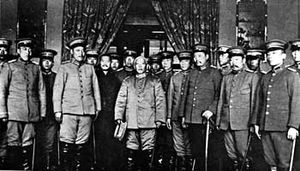 The revolutionaries had elected Sun Yat-Sen
as the first Provisional President of the Republic of China
, but they were in a weak position, militarily, so they reluctantly compromised with Yuan. Yuan arranged for the abdication of the child emperor Puyi
(or Xuantong Emperor), in return for being granted the position of President
, replacing Sun. Yuan would not be present when the Abdication edict was issued by Empress Dowager Longyu
, on February 12, 1912.
Sun agreed to Yuan's presidency after internal bickering, but asked that the capital be situated in Nanjing
. Yuan, however, wanted the geographic advantage of having the nation's capital close to his base of military power. Cao Kun
, one of his entrusted subordinate Beiyang military commanders, fabricated a coup d'état
in Beijing
and Tianjin
, apparently under Yuan's orders, to provide an excuse for Yuan not to leave his sphere of influence
in Zhili
(present-day Hebei
province). The revolutionaries compromised again, and the capital of the new republic was established in Beijing
. Yuan Shikai was elected Provisional President of the Republic of China, by the Nanjing Provisional Senate, on 14 February 1912, and sworn in on 10 March of that year.
in which the Chinese Nationalist Party
or the Kuomintang
(KMT
) scored a significant victory. Song Jiaoren
, deputy in the KMT to Sun Yat-sen, zealously supported a cabinet system and was widely regarded as a candidate for Prime Minister.
One of Song's main political goals was to ensure that the powers and independence of China's Parliament be properly protected from the influence of the office of the President. Song's goals in curtailing the office of the President conflicted with the interests of Yuan, who, by mid-1912, clearly dominated over the provisional cabinet that he had named and was showing signs of a desire to hold overweening executive power. During Song's travels through China in 1912, he had openly and vehemently expressed the desire to limit the powers of the President in terms that often appeared openly critical of Yuan's ambitions. When the results of the 1913 elections indicated a clear victory for the KMT, it appeared that Song would be in a position to exercise a dominant role in selecting the premier and cabinet, and the party could have proceeded to push for the election of a future president in a proper parliamentary setting.
While travelling with a group of friends to the Parliament in Peking, Song Jiaoren was shot twice at close range by a lone gunman, Ying Kuicheng, at a Shanghai railway station on March 20, 1913, and died two days later in hospital. The trail of evidence led to the secretary of the cabinet and the provisional premier of Yuan Shikai's government. Although Yuan was considered by contemporary Chinese media sources as the man most likely behind the assassination, the main conspirators investigated by authorities were either themselves assassinated or disappeared mysteriously. Because of the lack of evidence, Yuan was never officially implicated.
 Tensions between the Kuomintang and Yuan continued to intensify. After arriving in Peking, the elected Parliament attempted to gain control over Yuan, to develop a permanent constitution, and to hold a legitimate, open presidential election. Because he had authorized $100 million of "reorganization loans" from a variety of foreign banks, the KMT in particular were highly critical of Yuan's handling of the national budget.
Yuan's crackdown on the Kuomintang began in 1913, beginning with the suppression and bribery of the KMT members in the two legislative chambers, followed by an orchestrated collapse of the KMT from local organizations and the dismissal and/or military invasion of governors interpreted as being pro-Kuomintang. Finally, Yuan had himself elected president to a five-year term, publicly labelled the Kuomintang a seditious organization, ordered the Kuomintang's dissolution, and evicted the party's members from Parliament.
, his trusted Beiyang lieutenant, as Prime Minister.
The Kuomintang's "Second Revolution" appeared to end in failure, as Yuan's military might achieved complete victory over the remaining KMT forces. Provincial governors with KMT loyalties who remained were bribed, and/or willingly submitted to Yuan. Because those commanders not loyal to Yuan were effectively removed from power, the Second Revolution effectively strengthened Yuan's power.
In January, 1914, China's Parliament was formally dissolved. To give his government a semblance of legitimacy, Yuan convened a body of 66 men from his cabinet who, on May 1, 1914, produced a "constitutional compact" that effectively replaced China's provisional constitution. The new legal status quo gave Yuan, as president, practically unlimited powers over China's military, finances, foreign policy, and the rights of China's citizens. Yuan justified these reforms by stating that representative democracy was inefficient.
After his victory, Yuan reorganized the provincial governments. Headed now by Military Governors (都督) instead of civil governorships, each governor now effectively had control of their own army. Although it meant that Yuan had a seemingly-loyal group of administrators working for him at the time, this laid the foundations for the warlord
ism that crippled China over the next two decades.
, to Beijing. In these demands, Japan demanded a wide range of economic and political concessions for its government and citizens in Fujian, Mongolia, and central and northern China. When these demands were made public, the public hostility to these demands within China was expressed in nationwide anti-Japanese demonstrations and an effective national boycott of Japanese goods. Yuan's eventual decision to agree to nearly all of the demands led to a decline in the popularity of Yuan's government among contemporary Chinese. Western pressure later forced Japan to back down on some of its demands.
suggested a similar idea. Negotiators representing the government of Japan had also offered to support Yuan's ambitions as one of the rewards for Yuan's support of the Twenty-One Demands
.
In November 20, 1915, Yuan held a specially convened "Representative Assembly" which voted 1,993 votes in favor of having Yuan become emperor, with zero votes opposed. On December 12, 1915, Yuan "agreed" to become the next emperor. Yuan proclaimed his reign as Emperor of the Chinese Empire (中華帝國大皇帝) under the era name
of Hongxian (洪憲; i.e. Constitutional Abundance) beginning on January 1, 1916. Soon after becoming emperor, Yuan placed an order with the former imperial potters for a 40,000-piece porcelain set costing 1.4 million yuan, and a large jade seal and two imperial robes costing 400,000 yuan each.
, who had fled to Tokyo and set up a base there, actively organized efforts overthrow Yuan. Yuan's sons publicly fought over the title of "Crown Prince", and his former loyal subordinates like Duan Qirui
and Xu Shichang left him one by one to create their own factions.
's military governor, Cai E
, rebelled, launching the National Protection War
. The governor of Guizhou
followed in January 1916, and Guangxi
declared independence in March. Funding for Yuan's accession ceremony was cut on March 1, and he formally abandoned monarchism
on March 22. This was not enough for his enemies, who called for his resignation as president. More provinces rebelled until Yuan died, humiliated, from uremia
, on June 5, 1916, at the age of fifty-six. His death was announced the following day.
His remains were moved to his home province and placed in a large mausoleum. In 1928, the tomb was looted by Feng Yuxiang
's Guominjun
soldiers during the Northern Expedition. He had three sons: Prince Yuan Keding
, who was handicapped; Prince Yuan Kewen
, who was said by his father to be a 'fake scholar', and Prince Yuan Keliang, whom Yuan Shikai called a "bandit".
After Yuan's death, there was an effort by Li Yuanhong
to revive the Republic by recalling the legislators who had been ejected in 1913, but this effort was confused and ineffective in asserting central control, and Li lacked any support from the military. There was a short-lived effort in 1917 to revive the Qing dynasty led by the loyalist general Zhang Xun
, but his forces were defeated by rival warlords later that year. After the collapse of Zhang's movement, all pretense of strength from the central government collapsed, and China descended into a period of warlordism. Over the next several decades, the offices of both the president and Parliament became the tools of militarists, and the politicians in Peking became dependent on regional governors for their support and political survival.
After Yuan's death, China was left without any generally recognized central authority, and the nation's army quickly fragmented into forces of competing warlord
s. For this reason he is sometimes called "the Father of the Warlords". However, it is not accurate to attribute China's subsequent age of warlordism to his preference, since, in his career as a military reformer, he had attempted to create a modern army based on the Japanese model. Throughout his lifetime, he demonstrated an understanding of staffing, military education, and regular transfers of officer personnel, combining these skills to create China's first modern military organisation. After his return to power in 1911, however, he seemed willing to sacrifice his legacy of military reform for his imperial ambitions, and instead ruled by a combination of violence and bribery that destroyed the idealism of the early Republican movement.
In the CCTV Production Towards the Republic
, Yuan is portrayed through most of his early years as an able administrator, although a very skilled manipulator of political situations. His self-proclamation as Emperor is largely depicted as being influenced by external forces, especially that of his son, prince Yuan Keding
.
A bixi
(stone tortoise) with a stele in honor of Yuan Shikai, which was installed in Anyang
's Huanyuan Park soon after his death, was (partly) restored in 1993.
Yuan's grandson, Luke Chia-Liu Yuan
, was a Chinese-American physicist. One of his great-grandsons, Li-Young Lee
, is a Chinese-American writer and poet.
|-
|-
|-
|-
|-
|-
|-
|-
Chinese people
The term Chinese people may refer to any of the following:*People with Han Chinese ethnicity ....
general and politician famous for his influence during the late Qing Dynasty, his role in the events leading up to the abdication of the last Qing Emperor of China
China
Chinese civilization may refer to:* China for more general discussion of the country.* Chinese culture* Greater China, the transnational community of ethnic Chinese.* History of China* Sinosphere, the area historically affected by Chinese culture...
, his autocratic rule as the second President
President of the Republic of China
The President of the Republic of China is the head of state and commander-in-chief of the Republic of China . The Republic of China was founded on January 1, 1912, to govern all of China...
of the Republic of China
Republic of China (1912–1949)
In 1911, after over two thousand years of imperial rule, a republic was established in China and the monarchy overthrown by a group of revolutionaries. The Qing Dynasty, having just experienced a century of instability, suffered from both internal rebellion and foreign imperialism...
(following Sun Yatsen), and his short-lived attempt to revive the Chinese monarchy, with himself as the "Great Emperor of China."
Early life
Yuan Shikai was born in the village of Zhangying (張營村), Xiangcheng County (項城縣), Chenzhou PrefectureZhengzhou
Zhengzhou , is the capital and largest city of Henan province in north-central China. A prefecture-level city, it also serves as the political, economic, technological, and educational centre of the province, as well as a major transportation hub for Central China...
(陳州府), Henan
Henan
Henan , is a province of the People's Republic of China, located in the central part of the country. Its one-character abbreviation is "豫" , named after Yuzhou , a Han Dynasty state that included parts of Henan...
. The village of Zhangying is located immediately north of the centre of Xiangcheng.
The Yuan family later moved to a hilly area that was easier to defend, 16 kilometers southeast of Xiangcheng. There the Yuans had built a fortified village, Yuanzhaicun . Yuanzhai is now located inside Wangmingkou township (王明口乡), on the territory of the county-level city of Xiangcheng. The large country estate of the Yuan family there was recently opened to tourism.
Yuan's family was affluent enough to provide Yuan with a traditional Confucian education. As a young man he enjoyed riding, boxing, and entertainment with friends. Yuan had wanted to pursue a career in the civil service, but failed the Imperial examination
Imperial examination
The Imperial examination was an examination system in Imperial China designed to select the best administrative officials for the state's bureaucracy. This system had a huge influence on both society and culture in Imperial China and was directly responsible for the creation of a class of...
s twice. He decided that his entry into politics would have to be done through the Huai Army, where many of his relatives of grand parental and parental generations served. Instead of passing the civil service examinations, Yuan began his career by purchasing a minor official title in 1880, which was a common method of official promotion in the late Qing. Yuan became an aide to Using his father's connections, Yuan travelled to Tengzhou
Tengzhou
Tengzhou is a county-level city of Zaozhuang, Shandong province of the People's Republic of China, and is the site of the feudal vassal State of Teng during the Spring and Autumn Period.The Mayor of Tengzhou is Du Yongguang...
, Shandong
Shandong
' is a Province located on the eastern coast of the People's Republic of China. Shandong has played a major role in Chinese history from the beginning of Chinese civilization along the lower reaches of the Yellow River and served as a pivotal cultural and religious site for Taoism, Chinese...
, and sought a post in the Qing Brigade. Yuan's first marriage was in 1876 to a woman of the Yu family who bore him a first son, Keding
Yuan Keding
Yuán Kèdìng , courtesy name Yuntai was the eldest son of Yuan Shikai. His mother was Yuan's original wife, Yu , and Yuan Kewen was his younger brother....
(袁克定), in 1878. In addition to his wife, Yuan Shikai married nine different concubines throughout the course of his life.
Years in Joseon Dynasty Korea
Joseon DynastyJoseon Dynasty
Joseon , was a Korean state founded by Taejo Yi Seong-gye that lasted for approximately five centuries. It was founded in the aftermath of the overthrow of the Goryeo at what is today the city of Kaesong. Early on, Korea was retitled and the capital was relocated to modern-day Seoul...
Korea
Korea
Korea ) is an East Asian geographic region that is currently divided into two separate sovereign states — North Korea and South Korea. Located on the Korean Peninsula, Korea is bordered by the People's Republic of China to the northwest, Russia to the northeast, and is separated from Japan to the...
in the early 1870s was in the midst of a struggle between isolationists under the King Gojong's father (Heungseon Daewongun), and progressives, led by the queen (Empress Myeongseong
Empress Myeongseong
Empress Myeongseong , also known as Queen Min, was the first official wife of King Gojong, the twenty-sixth king of the Joseon dynasty of Korea...
), who had wanted to open trade with continued Qing external influences in Korea. After the Meiji Restoration
Meiji Restoration
The , also known as the Meiji Ishin, Revolution, Reform or Renewal, was a chain of events that restored imperial rule to Japan in 1868...
, Japan
Japan
Japan is an island nation in East Asia. Located in the Pacific Ocean, it lies to the east of the Sea of Japan, China, North Korea, South Korea and Russia, stretching from the Sea of Okhotsk in the north to the East China Sea and Taiwan in the south...
had adopted a new aggressive foreign policy, and, as an emerging power, wished to contest Chinese domination of the peninsula. Under the unequal
Unequal Treaties
“Unequal treaty” is a term used in specific reference to a number of treaties imposed by Western powers, during the 19th and early 20th centuries, on Qing Dynasty China and late Tokugawa Japan...
Treaty of Ganghwa
Treaty of Ganghwa
The Japan-Korea Treaty of Amity, also known as the Treaty of Ganghwa or Treaty of Kanghwa, was made between representatives of the Empire of Japan and the Kingdom of Joseon in 1876...
, which the Koreans signed only with reluctance in 1876, Japan was allowed to send diplomatic missions to Hanseong
Seoul
Seoul , officially the Seoul Special City, is the capital and largest metropolis of South Korea. A megacity with a population of over 10 million, it is the largest city proper in the OECD developed world...
, and opened trading posts in Incheon
Incheon
The Incheon Metropolitan City is located in northwestern South Korea. The city was home to just 4,700 people when Jemulpo port was built in 1883. Today 2.76 million people live in the city, making it Korea’s third most populous city after Seoul and Busan Metropolitan City...
and Wonsan
Wonsan
Wŏnsan is a port city and naval base in southeastern North Korea. It is the capital of Kangwŏn Province. The population of the city is estimated to have been 331,000 in 2000. Notable people from Wŏnsan include Kim Ki Nam, diplomat and Secretary of the Workers' Party.- History :The original name of...
. Amidst an internal power struggle, which resulted in the queen's exile, Li Hongzhang
Li Hongzhang
Li Hongzhang or Li Hung-chang , Marquis Suyi of the First Class , GCVO, was a leading statesman of the late Qing Empire...
, the Viceroy of Zhili
Viceroy of Zhili
The Viceroy of Zhili , fully referred to as the Governor General of Zhili and surrounding areas; Overseeing Military Affairs, Food Production; Manager of Waterways; Director of Civil Affairs , was one of eight regional viceroys in China proper during the Qing Dynasty of China...
, sent the Qing Brigade, 3,000 strong, into Korea. The regent, Heungseon Daewongun, was escorted to Tianjin, where he was effectively kept prisoner. Korea's weakness was apparent, and the Treaty of Jemulpo in 1882 gave the Japanese the right to station troops in Seoul to protect their legation. China's protection alone could not shield Korea against the rapidly industrialising Japanese military, and it was obvious that Korea's army could not even deal with an internal crisis. The king issued a proposal to train 500 troops in the art of modern warfare, and Yuan Shikai was appointed to lead this task and was to remain in Korea. To the emperor, Li Hongzhang also recommended Yuan's promotion, and was approved shortly with Yuan's new rank as sub-prefect.
In 1885, Yuan was appointed Imperial Resident of Seoul with orders from the Imperial Throne of China. The position had seemed on the surface to be similar to that of a Minister or ambassador. In practice, Yuan, as the head official from the suzerain, had become the supreme adviser on all Korean government policies. Dissatisfied with its position in Korea, Japan sought more influence through co-suzerainty with China. A series of forged documents aimed at angering the Chinese was sent to Yuan Shikai, attempting to make it appear as if the Korean government had changed its stance towards Chinese protection, and turned more towards Russia
Russia
Russia or , officially known as both Russia and the Russian Federation , is a country in northern Eurasia. It is a federal semi-presidential republic, comprising 83 federal subjects...
. Yuan was outraged yet skeptical, and asked Li Hongzhang for advice.
In a treaty signed between Japan and Qing, the two parties agreed only to send troops into Korea after notifying the other. Although the Korean government was stable, it was still a protectorate of Qing, and forces emerged advocating modernization. Another more radicalised group, the Donghak Society, promoting an early nationalist doctrine based partly upon Confucian
Confucianism
Confucianism is a Chinese ethical and philosophical system developed from the teachings of the Chinese philosopher Confucius . Confucianism originated as an "ethical-sociopolitical teaching" during the Spring and Autumn Period, but later developed metaphysical and cosmological elements in the Han...
principles, rose in rebellion against the government, which Yuan aimed to protect. Li Hongzhang sent troops into Korea to protect Seoul and Qing's interests, and Japan did the same under the pretext of protecting Japanese trading posts. Tensions boiled over between Japan and China when Japan refused to withdraw its forces and placed a blockade of sorts at the 38th Parallel
38th parallel north
The 38th parallel north is a circle of latitude that is 38 degrees north of the Earth's equatorial plane. It crosses Europe, the Mediterranean Sea, Asia, the Pacific Ocean, North America, and the Atlantic Ocean...
. Li Hongzhang wanted at all costs to avoid a war with Japan, and attempted this by asking for international pressure for a Japanese withdrawal. Japan refused, and war began. Yuan, now in an ineffective position, was recalled to Tianjin
Tianjin
' is a metropolis in northern China and one of the five national central cities of the People's Republic of China. It is governed as a direct-controlled municipality, one of four such designations, and is, thus, under direct administration of the central government...
in July 1894, at the beginning of the First Sino-Japanese War
First Sino-Japanese War
The First Sino-Japanese War was fought between Qing Dynasty China and Meiji Japan, primarily over control of Korea...
(甲午戰爭).
Late Qing Dynasty
Yuan Shikai rose to fame by participating in the First Sino-Japanese WarFirst Sino-Japanese War
The First Sino-Japanese War was fought between Qing Dynasty China and Meiji Japan, primarily over control of Korea...
as the commander of the Chinese stationary forces in Korea. He avoided the humiliation of Chinese armies in the war when he was recalled to Beijing
Beijing
Beijing , also known as Peking , is the capital of the People's Republic of China and one of the most populous cities in the world, with a population of 19,612,368 as of 2010. The city is the country's political, cultural, and educational center, and home to the headquarters for most of China's...
several days before the Chinese forces were attacked.
As an ally of Li Hongzhang
Li Hongzhang
Li Hongzhang or Li Hung-chang , Marquis Suyi of the First Class , GCVO, was a leading statesman of the late Qing Empire...
, Yuan was appointed the commander of the first New army
New Army
The New Armies were the modernized Qing armies, trained and equipped according to Western standards...
in 1895. As the officer most directly responsible for training China's first modernized army, Yuan gained significant political influence and the loyalty of a nucleus of young officers: by 1901, five of China's seven divisional commanders and all other senior military officers in China were his proteges. The Qing court relied heavily on his army due to the proximity of its garrison to the capital and its effectiveness. Of the new armies that were part of the Self-Strengthening Movement, Yuan's was the best trained and most effective.
The Qing Court at the time was divided between progressives under the leadership of the Guangxu Emperor
Guangxu Emperor
The Guangxu Emperor , born Zaitian of the Aisin-Gioro clan, was the eleventh emperor of the Manchurian Qing Dynasty, and the ninth Qing emperor to rule over China. His reign lasted from 1875 to 1908, but in practice he ruled, under Empress Dowager Cixi's influence, only from 1889 to 1898...
, and conservatives under the Empress Dowager Cixi
Empress Dowager Cixi
Empress Dowager Cixi1 , of the Manchu Yehenara clan, was a powerful and charismatic figure who became the de facto ruler of the Manchu Qing Dynasty in China for 47 years from 1861 to her death in 1908....
, who had temporarily retreated to the Summer Palace
Summer Palace
The Summer Palace is a palace in Beijing, China. The Summer Palace is mainly dominated by Longevity Hill and the Kunming Lake. It covers an expanse of 2.9 square kilometers, three quarters of which is water....
as a place of "retirement". After the Guangxu Emperor's Hundred Days' Reform
Hundred Days' Reform
The Hundred Days' Reform was a failed 104-day national cultural, political and educational reform movement from 11 June to 21 September 1898 in late Qing Dynasty China. It was undertaken by the young Guangxu Emperor and his reform-minded supporters...
in 1898, however, Cixi decided that the reforms were too drastic, and plotted to restore her own regency through a coup d'état
Coup d'état
A coup d'état state, literally: strike/blow of state)—also known as a coup, putsch, and overthrow—is the sudden, extrajudicial deposition of a government, usually by a small group of the existing state establishment—typically the military—to replace the deposed government with another body; either...
. Plans of the coup spread early, and the Emperor was very aware of the plot. He asked reform advocates Kang Youwei
Kang Youwei
Kang Youwei , was a Chinese scholar, noted calligrapher and prominent political thinker and reformer of the late Qing Dynasty. He led movements to establish a constitutional monarchy and was an ardent Chinese nationalist. His ideas inspired a reformation movement that was supported by the Guangxu...
, Tan Sitong
Tan Sitong
Tan Sitong , courtesy name Fusheng, pseudonym Zhuangfei , was a well-known Chinese politician, thinker and revolutionist in the late Qing Dynasty who was in support of reform; he was however, finally executed because of the failure of the reformation...
and others to develop a plan to save him. Yuan's involvement in the coup continues to be a large topic of historical debate. Tan Sitong reportedly had a talk with Yuan several days before the coup, asking Yuan to assist the Emperor against Cixi. Yuan refused a direct answer, but insisted he was loyal to the Emperor. Meanwhile Manchu General Ronglu
Ronglu
Ronglu was a Manchu statesman and general during the late Qing dynasty. Born into the powerful Guwalgiya clan of the Plain White Banner in the Eight Banners, he was cousin to Yehenara Lan, who later became Empress Dowager Cixi...
was planning manoeuvres for his army to stage the coup.
According to many sources, including the diary of Liang Qichao
Liang Qichao
Liang Qichao |Styled]] Zhuoru, ; Pseudonym: Rengong) was a Chinese scholar, journalist, philosopher and reformist during the Qing Dynasty , who inspired Chinese scholars with his writings and reform movements...
and contemporary Chinese news sources, Yuan Shikai arrived in Tianjin
Tianjin
' is a metropolis in northern China and one of the five national central cities of the People's Republic of China. It is governed as a direct-controlled municipality, one of four such designations, and is, thus, under direct administration of the central government...
on 20 September 1898, by train. It was certain that by the evening, Yuan had talked to Ronglu, but what was revealed to him remains ambiguous. Most historians suggest that Yuan had told Ronglu of all details of the Reformers' plans, and asked him to take immediate action. The plot being exposed, Ronglu's troops entered the Forbidden City
Forbidden City
The Forbidden City was the Chinese imperial palace from the Ming Dynasty to the end of the Qing Dynasty. It is located in the middle of Beijing, China, and now houses the Palace Museum...
at dawn on 21 September, forcing the Emperor into seclusion in a lake palace.
Making a political alliance with the Empress Dowager, and becoming a lasting enemy of the Guangxu Emperor, Yuan left the capital in 1899 for his new appointment as Governor of Shandong
Shandong
' is a Province located on the eastern coast of the People's Republic of China. Shandong has played a major role in Chinese history from the beginning of Chinese civilization along the lower reaches of the Yellow River and served as a pivotal cultural and religious site for Taoism, Chinese...
. During his three-year tenure, he ensured the suppression of Boxers (義和團) in the province. He also left the foundation for a provincial junior college (Shandong College, the forerunner of Shandong University
Shandong University
Shandong University is a public comprehensive university in Shandong, China. It is one of the largest universities in China by student population and is supported directly by the national government....
) in Jinan
Jinan
Jinan is the capital of Shandong province in Eastern China. The area of present-day Jinan has played an important role in the history of the region from the earliest beginnings of civilisation and has evolved into a major national administrative, economic, and transportation hub...
, adopting some western ideas of education.
He was granted the position of Viceroy of Zhili
Viceroy of Zhili
The Viceroy of Zhili , fully referred to as the Governor General of Zhili and surrounding areas; Overseeing Military Affairs, Food Production; Manager of Waterways; Director of Civil Affairs , was one of eight regional viceroys in China proper during the Qing Dynasty of China...
(直隸總督), the lucrative Commissioner for North China Trade, and Minister of Beiyang
Beiyang
The term Beiyang originated toward the end of the Qing Dynasty, and it referred to the coastal areas of Zhili , Liaoning, and Shandong in northeast China....
(北洋通商大臣), where the modern regions of Liaoning
Liaoning
' is a province of the People's Republic of China, located in the northeast of the country. Its one-character abbreviation is "辽" , a name taken from the Liao River that flows through the province. "Níng" means "peace"...
, Hebei
Hebei
' is a province of the People's Republic of China in the North China region. Its one-character abbreviation is "" , named after Ji Province, a Han Dynasty province that included what is now southern Hebei...
, and Shandong
Shandong
' is a Province located on the eastern coast of the People's Republic of China. Shandong has played a major role in Chinese history from the beginning of Chinese civilization along the lower reaches of the Yellow River and served as a pivotal cultural and religious site for Taoism, Chinese...
provinces now are, on 25 June 1902. Gaining the regard of foreigners when he helped to crush the Boxer Rebellion
Boxer Rebellion
The Boxer Rebellion, also called the Boxer Uprising by some historians or the Righteous Harmony Society Movement in northern China, was a proto-nationalist movement by the "Righteous Harmony Society" , or "Righteous Fists of Harmony" or "Society of Righteous and Harmonious Fists" , in China between...
, he successfully obtained numerous loans to expand his Beiyang Army
Beiyang Army
The Beiyang Army was a powerful, Western-style Chinese military force created by the Qing Dynasty government in the late 19th century. It was the centerpiece of a general reconstruction of China's military system. The Beiyang Army played a major role in Chinese politics for at least three decades...
into the most powerful army
New Army
The New Armies were the modernized Qing armies, trained and equipped according to Western standards...
in China. He created a 1,000-strong police force to keep order in Tianjin, the first of its kind in Chinese history, after the Boxer Protocol
Boxer Protocol
The Boxer Protocol was signed on September 7, 1901 between the Qing Empire of China and the Eight-Nation Alliance that had provided military forces plus Belgium, Spain and the Netherlands after China's defeat in the intervention to put down the Boxer Rebellion at the hands of the...
had forbidden troops to be staged within a close proximity of Tianjin. Yuan was also involved in the transfer of Railway control from Sheng Xuanhuai
Sheng Xuanhuai
Sheng Xuanhuai , November 4, 1844—April 27, 1916, 盛宣懷) was the Minister of Transportation during the Qing Dynasty. He is also known as Sheng Gongbao ....
(盛宣怀). Railways became a large part of his revenue. Yuan played an active role in late-Qing political reforms, including the creation of the Ministry of Education (學部) and Ministry of Police (巡警部). He further advocated for ethnic equality between Manchus and Han Chinese
Han Chinese
Han Chinese are an ethnic group native to China and are the largest single ethnic group in the world.Han Chinese constitute about 92% of the population of the People's Republic of China , 98% of the population of the Republic of China , 78% of the population of Singapore, and about 20% of the...
.
Retreat and Return
The Empress Dowager and the Guangxu Emperor died within a day of each other in November 1908. Some sources indicate that the will of the Emperor had specifically ordered that Yuan be executed. Avoiding execution, in January 1909, Yuan Shikai was relieved of all his posts by the regent, the 2nd Prince ChunZaifeng, 2nd Prince Chun
The 2nd Prince Chun was born Zaifeng , of the Manchu Aisin-Gioro clan . He was the leader of China between 1908 and 1911, serving as regent for his son Puyi, the Xuantong Emperor.His courtesy name was Yiyun...
(醇親王). The official reason for Yuan's resignation was that he was returning to his home in the village of Huanshang (洹上村), located in the suburbs of Zhangde prefecture
Zhou (political division)
Zhou were historical political divisions of China. Formally established during the Han Dynasty, zhou continued to exist until the establishment of the Republic of China — a period of over 2000 years...
(彰德府), now called the prefecture-level city
Prefecture-level city
A prefectural level city , prefectural city or prefectural level municipality is an administrative division of the People's Republic of China, ranking below a province and above a county in China's administrative structure. Prefectural level cities form the second level of the administrative...
of Anyang
Anyang
Anyang is a prefecture-level city in Henan province, People's Republic of China. The northernmost city in Henan, Anyang borders Puyang to the east, Hebi and Xinxiang to the south, and the provinces of Shanxi and Hebei to its west and north respectively....
(安陽市), Henan
Henan
Henan , is a province of the People's Republic of China, located in the central part of the country. Its one-character abbreviation is "豫" , named after Yuzhou , a Han Dynasty state that included parts of Henan...
province, in order to treat a foot disease.
During his three years of retreat, Yuan kept contact with his close allies, including Duan Qirui
Duan Qirui
Duan Qirui was a Chinese warlord and politician, commander in the Beiyang Army, and the Provisional Chief Executive of Republic of China from November 24, 1924 to April 20, 1926. He was arguably the most powerful man in China from 1916 to 1920.- Early life :Born in Hefei as Duan Qirui , his...
, who reported to him regularly about army proceedings. The loyalty of the Beiyang Army was still undoubtedly behind him. Having this strategic military situation, Yuan actually held the balance of power between the revolutionaries and the Qing Court. Both wanted Yuan on their side. Initially deciding against the possibility of becoming President of a newly proclaimed Republic, Yuan also repeatedly declined offers from the Qing Court for his return, first as the Viceroy of Huguang
Viceroy of Huguang
The Viceroy of Huguang , fully referred to as the Governor General of the Hubei and Hunan Provinces and surrounding areas; Overseeing Military Affairs, Food Production; Director of Civil Affairs , was one of eight viceroys in China proper during the Qing Dynasty of China. The Viceroy had...
, and then as Prime Minister of the Imperial Cabinet. Time was on Yuan's side, and Yuan waited, using his "foot ailment" as a pretext to his continual refusal. After further pleas by the Qing Court, Yuan agreed to accept, becoming Prime Minister on 1 November 1911. Immediately subsequent he asked that Zaifeng, the Regent, abstain from politics. Zaifeng, being forced to resign from his regency, made way for Yuan to compose a newly created, predominantly Han Chinese
Han Chinese
Han Chinese are an ethnic group native to China and are the largest single ethnic group in the world.Han Chinese constitute about 92% of the population of the People's Republic of China , 98% of the population of the Republic of China , 78% of the population of Singapore, and about 20% of the...
Cabinet of his confidants, consisting of only one Manchu, who held the position of Minister of Suzerainty.
The Wuchang Uprising and the Republic
The Wuchang UprisingWuchang Uprising
The Wuchang Uprising began with the dissatisfaction of the handling of a railway crisis. The crisis then escalated to an uprising where the revolutionaries went up against Qing government officials. The uprising was then assisted by the New Army in a coup against their own authorities in the city...
succeeded on 10 October 1911 in Hubei
Hubei
' Hupeh) is a province in Central China. The name of the province means "north of the lake", referring to its position north of Lake Dongting...
province, before Yuan's official appointment to the post of Prime Minister. The southern provinces had subsequently declared their independence from the Qing Court, but neither the northern provinces nor the Beiyang Army had a clear stance for or against the rebellion. Both the Qing court and Yuan were fully aware that the Beiyang Army was the only Qing force powerful enough to quell the revolutionaries. The court renewed offers for Yuan's return on October 27, and Yuan eventually left his village for Beijing
Beijing
Beijing , also known as Peking , is the capital of the People's Republic of China and one of the most populous cities in the world, with a population of 19,612,368 as of 2010. The city is the country's political, cultural, and educational center, and home to the headquarters for most of China's...
on 30 October. To further reward Yuan's loyalty to the court, the Empress Dowager Longyu
Empress Dowager Longyu
Empress Xiao Ding Jing ; is better known as the Empress Dowager Longyu , . Also , she had the nickname was Xizi (喜子). Empress Xiao Ding Jing was the Qing Dynasty Empress Consort of the Guangxu Emperor who ruled China from 1875 till 1908...
offered Yuan the noble title Marquis of the First Rank (一等侯), an honour only previously given to General Zeng Guofan
Zeng Guofan
Zeng Guofan was an eminent Han Chinese official, military general, and devout Confucian scholar of the late Qing Dynasty in China....
. While continuing his demands, ensuring temporary political stability in Beijing, his forces captured Hankou and Hanyang in November 1911 in preparation for attacking Wuchang, thus forcing the republican revolutionaries to negotiate.
Abdication of the Child Emperor
Sun Yat-sen
Sun Yat-sen was a Chinese doctor, revolutionary and political leader. As the foremost pioneer of Nationalist China, Sun is frequently referred to as the "Father of the Nation" , a view agreed upon by both the People's Republic of China and the Republic of China...
as the first Provisional President of the Republic of China
President of the Republic of China
The President of the Republic of China is the head of state and commander-in-chief of the Republic of China . The Republic of China was founded on January 1, 1912, to govern all of China...
, but they were in a weak position, militarily, so they reluctantly compromised with Yuan. Yuan arranged for the abdication of the child emperor Puyi
Puyi
Puyi , of the Manchu Aisin Gioro clan, was the last Emperor of China, and the twelfth and final ruler of the Qing Dynasty. He ruled as the Xuantong Emperor from 1908 until his abdication on 12 February 1912. From 1 to 12 July 1917 he was briefly restored to the throne as a nominal emperor by the...
(or Xuantong Emperor), in return for being granted the position of President
President of the Republic of China
The President of the Republic of China is the head of state and commander-in-chief of the Republic of China . The Republic of China was founded on January 1, 1912, to govern all of China...
, replacing Sun. Yuan would not be present when the Abdication edict was issued by Empress Dowager Longyu
Empress Dowager Longyu
Empress Xiao Ding Jing ; is better known as the Empress Dowager Longyu , . Also , she had the nickname was Xizi (喜子). Empress Xiao Ding Jing was the Qing Dynasty Empress Consort of the Guangxu Emperor who ruled China from 1875 till 1908...
, on February 12, 1912.
Sun agreed to Yuan's presidency after internal bickering, but asked that the capital be situated in Nanjing
Nanjing
' is the capital of Jiangsu province in China and has a prominent place in Chinese history and culture, having been the capital of China on several occasions...
. Yuan, however, wanted the geographic advantage of having the nation's capital close to his base of military power. Cao Kun
Cao Kun
|-...
, one of his entrusted subordinate Beiyang military commanders, fabricated a coup d'état
Coup d'état
A coup d'état state, literally: strike/blow of state)—also known as a coup, putsch, and overthrow—is the sudden, extrajudicial deposition of a government, usually by a small group of the existing state establishment—typically the military—to replace the deposed government with another body; either...
in Beijing
Beijing
Beijing , also known as Peking , is the capital of the People's Republic of China and one of the most populous cities in the world, with a population of 19,612,368 as of 2010. The city is the country's political, cultural, and educational center, and home to the headquarters for most of China's...
and Tianjin
Tianjin
' is a metropolis in northern China and one of the five national central cities of the People's Republic of China. It is governed as a direct-controlled municipality, one of four such designations, and is, thus, under direct administration of the central government...
, apparently under Yuan's orders, to provide an excuse for Yuan not to leave his sphere of influence
Sphere of influence
In the field of international relations, a sphere of influence is a spatial region or conceptual division over which a state or organization has significant cultural, economic, military or political influence....
in Zhili
Zhili
Zhílì was a northern province in China from the Ming Dynasty until the province was dissolved in 1928 during the Republic of China era.-History:...
(present-day Hebei
Hebei
' is a province of the People's Republic of China in the North China region. Its one-character abbreviation is "" , named after Ji Province, a Han Dynasty province that included what is now southern Hebei...
province). The revolutionaries compromised again, and the capital of the new republic was established in Beijing
Beijing
Beijing , also known as Peking , is the capital of the People's Republic of China and one of the most populous cities in the world, with a population of 19,612,368 as of 2010. The city is the country's political, cultural, and educational center, and home to the headquarters for most of China's...
. Yuan Shikai was elected Provisional President of the Republic of China, by the Nanjing Provisional Senate, on 14 February 1912, and sworn in on 10 March of that year.
Democratic Elections
In February 1913, democratic elections were held for the National AssemblyNational Assembly of the Republic of China
The National Assembly of the Republic of China refers to several parliamentary bodies that existed in the Republic of China. The National Assembly was originally founded in 1913 as the first legislature in Chinese history, but was disbanded less than a year later as President Yuan Shikai assumed...
in which the Chinese Nationalist Party
Kuomintang
The Kuomintang of China , sometimes romanized as Guomindang via the Pinyin transcription system or GMD for short, and translated as the Chinese Nationalist Party is a founding and ruling political party of the Republic of China . Its guiding ideology is the Three Principles of the People, espoused...
or the Kuomintang
Kuomintang
The Kuomintang of China , sometimes romanized as Guomindang via the Pinyin transcription system or GMD for short, and translated as the Chinese Nationalist Party is a founding and ruling political party of the Republic of China . Its guiding ideology is the Three Principles of the People, espoused...
(KMT
Kuomintang
The Kuomintang of China , sometimes romanized as Guomindang via the Pinyin transcription system or GMD for short, and translated as the Chinese Nationalist Party is a founding and ruling political party of the Republic of China . Its guiding ideology is the Three Principles of the People, espoused...
) scored a significant victory. Song Jiaoren
Song Jiaoren
Song Jiaoren was a Chinese republican revolutionary, political leader and a founder of the Kuomintang . He was assassinated in 1913 after leading his Kuomintang party to victory in China's first democratic elections...
, deputy in the KMT to Sun Yat-sen, zealously supported a cabinet system and was widely regarded as a candidate for Prime Minister.
One of Song's main political goals was to ensure that the powers and independence of China's Parliament be properly protected from the influence of the office of the President. Song's goals in curtailing the office of the President conflicted with the interests of Yuan, who, by mid-1912, clearly dominated over the provisional cabinet that he had named and was showing signs of a desire to hold overweening executive power. During Song's travels through China in 1912, he had openly and vehemently expressed the desire to limit the powers of the President in terms that often appeared openly critical of Yuan's ambitions. When the results of the 1913 elections indicated a clear victory for the KMT, it appeared that Song would be in a position to exercise a dominant role in selecting the premier and cabinet, and the party could have proceeded to push for the election of a future president in a proper parliamentary setting.
While travelling with a group of friends to the Parliament in Peking, Song Jiaoren was shot twice at close range by a lone gunman, Ying Kuicheng, at a Shanghai railway station on March 20, 1913, and died two days later in hospital. The trail of evidence led to the secretary of the cabinet and the provisional premier of Yuan Shikai's government. Although Yuan was considered by contemporary Chinese media sources as the man most likely behind the assassination, the main conspirators investigated by authorities were either themselves assassinated or disappeared mysteriously. Because of the lack of evidence, Yuan was never officially implicated.
Becoming Emperor
Yuan's crackdown on the Kuomintang began in 1913, beginning with the suppression and bribery of the KMT members in the two legislative chambers, followed by an orchestrated collapse of the KMT from local organizations and the dismissal and/or military invasion of governors interpreted as being pro-Kuomintang. Finally, Yuan had himself elected president to a five-year term, publicly labelled the Kuomintang a seditious organization, ordered the Kuomintang's dissolution, and evicted the party's members from Parliament.
Second Revolution
Seeing the situation worsen, Sun Yat-sen fled to Japan in November, 1913, and called for a Second Revolution, this time against Yuan Shikai. Subsequently, Yuan gradually took over the government, using the military as the base of his power. He dissolved the national and provincial assemblies, and the House of Representatives and Senate were replaced by the newly formed "Council of State", with Duan QiruiDuan Qirui
Duan Qirui was a Chinese warlord and politician, commander in the Beiyang Army, and the Provisional Chief Executive of Republic of China from November 24, 1924 to April 20, 1926. He was arguably the most powerful man in China from 1916 to 1920.- Early life :Born in Hefei as Duan Qirui , his...
, his trusted Beiyang lieutenant, as Prime Minister.
The Kuomintang's "Second Revolution" appeared to end in failure, as Yuan's military might achieved complete victory over the remaining KMT forces. Provincial governors with KMT loyalties who remained were bribed, and/or willingly submitted to Yuan. Because those commanders not loyal to Yuan were effectively removed from power, the Second Revolution effectively strengthened Yuan's power.
In January, 1914, China's Parliament was formally dissolved. To give his government a semblance of legitimacy, Yuan convened a body of 66 men from his cabinet who, on May 1, 1914, produced a "constitutional compact" that effectively replaced China's provisional constitution. The new legal status quo gave Yuan, as president, practically unlimited powers over China's military, finances, foreign policy, and the rights of China's citizens. Yuan justified these reforms by stating that representative democracy was inefficient.
After his victory, Yuan reorganized the provincial governments. Headed now by Military Governors (都督) instead of civil governorships, each governor now effectively had control of their own army. Although it meant that Yuan had a seemingly-loyal group of administrators working for him at the time, this laid the foundations for the warlord
Warlord
A warlord is a person with power who has both military and civil control over a subnational area due to armed forces loyal to the warlord and not to a central authority. The term can also mean one who espouses the ideal that war is necessary, and has the means and authority to engage in war...
ism that crippled China over the next two decades.
Japan's Twenty-one Demands
In January, 1915, Japan sent a secret ultimatum, known as the Twenty-one DemandsTwenty-One Demands
The ' were a set of demands made by the Empire of Japan under Prime Minister Ōkuma Shigenobu sent to the nominal government of the Republic of China on January 18, 1915, resulting in two treaties with Japan on May 25, 1915.- Background :...
, to Beijing. In these demands, Japan demanded a wide range of economic and political concessions for its government and citizens in Fujian, Mongolia, and central and northern China. When these demands were made public, the public hostility to these demands within China was expressed in nationwide anti-Japanese demonstrations and an effective national boycott of Japanese goods. Yuan's eventual decision to agree to nearly all of the demands led to a decline in the popularity of Yuan's government among contemporary Chinese. Western pressure later forced Japan to back down on some of its demands.
Revival of the Monarchy
To build up his own authority, Yuan began to re-institute elements of state Confucianism. As the main proponent of reviving Qing state religious observances, Yuan effectively participated as emperor in rituals held at the Qing Temple of Heaven. In late 1915, Yuan floated rumors of a popular consensus that the monarchy should be revived. With his power secure, many of Yuan's supporters, notably monarchist Yang Du, advocated for a revival of the monarchy, asking Yuan to take on the title of Emperor. Yang reasoned that the Chinese masses had long been used to autocratic rule, and that the Republic had only been effective as a transitional phase to end Manchu rule. He reasoned that China's political situation demanded the stability that only a monarchy could ensure. The American political scientist Frank Johnson GoodnowFrank Johnson Goodnow
Frank Johnson Goodnow, Ph.D., LL.B. was an American educator and legal scholar, born in Brooklyn, New York.-Personal life:...
suggested a similar idea. Negotiators representing the government of Japan had also offered to support Yuan's ambitions as one of the rewards for Yuan's support of the Twenty-One Demands
Twenty-One Demands
The ' were a set of demands made by the Empire of Japan under Prime Minister Ōkuma Shigenobu sent to the nominal government of the Republic of China on January 18, 1915, resulting in two treaties with Japan on May 25, 1915.- Background :...
.
In November 20, 1915, Yuan held a specially convened "Representative Assembly" which voted 1,993 votes in favor of having Yuan become emperor, with zero votes opposed. On December 12, 1915, Yuan "agreed" to become the next emperor. Yuan proclaimed his reign as Emperor of the Chinese Empire (中華帝國大皇帝) under the era name
Chinese era name
A Chinese era name is the regnal year, reign period, or regnal title used when traditionally numbering years in an emperor's reign and naming certain Chinese rulers . Some emperors have several era names, one after another, where each beginning of a new era resets the numbering of the year back...
of Hongxian (洪憲; i.e. Constitutional Abundance) beginning on January 1, 1916. Soon after becoming emperor, Yuan placed an order with the former imperial potters for a 40,000-piece porcelain set costing 1.4 million yuan, and a large jade seal and two imperial robes costing 400,000 yuan each.
Public and International Reactions to the Monarchy's Revival
By expecting widespread domestic and international support for his reign, Yuan Shikai and his supporters had miscalculated. Many of Yuan's closest supporters abandoned him, and the solidarity of Yuan's Beiyang clique of military proteges dissolved. There were open protests throughout China denouncing Yuan. International governments, including Japan, were indifferent or hostile to him, and did not give him the recognition that he anticipated. Sun Yat-senSun Yat-sen
Sun Yat-sen was a Chinese doctor, revolutionary and political leader. As the foremost pioneer of Nationalist China, Sun is frequently referred to as the "Father of the Nation" , a view agreed upon by both the People's Republic of China and the Republic of China...
, who had fled to Tokyo and set up a base there, actively organized efforts overthrow Yuan. Yuan's sons publicly fought over the title of "Crown Prince", and his former loyal subordinates like Duan Qirui
Duan Qirui
Duan Qirui was a Chinese warlord and politician, commander in the Beiyang Army, and the Provisional Chief Executive of Republic of China from November 24, 1924 to April 20, 1926. He was arguably the most powerful man in China from 1916 to 1920.- Early life :Born in Hefei as Duan Qirui , his...
and Xu Shichang left him one by one to create their own factions.
Abandonment of the Monarchy and Death
Faced with widespread opposition, Yuan repeatedly delayed the accession rites to appease his foes, but his prestige was irreparably damaged, and province after province continued to declare their autonomy from Beijing. On December 25, 1915, YunnanYunnan
Yunnan is a province of the People's Republic of China, located in the far southwest of the country spanning approximately and with a population of 45.7 million . The capital of the province is Kunming. The province borders Burma, Laos, and Vietnam.Yunnan is situated in a mountainous area, with...
's military governor, Cai E
Cai E
Cai E or Tsai Ao was a Chinese revolutionary leader and warlord. He was born Cai Genyin in Shaoyang, Hunan, and his courtesy name was Songpo...
, rebelled, launching the National Protection War
National Protection War
The National Protection War , also known as the anti-Monarchy War, was a civil war that took place in China between 1915 and 1916. The cause of this war was Yuan Shikai's proclamation of himself as Emperor. Only three years earlier, the last Chinese dynasty, the Qing Dynasty, had been overthrown...
. The governor of Guizhou
Guizhou
' is a province of the People's Republic of China located in the southwestern part of the country. Its provincial capital city is Guiyang.- History :...
followed in January 1916, and Guangxi
Guangxi
Guangxi, formerly romanized Kwangsi, is a province of southern China along its border with Vietnam. In 1958, it became the Guangxi Zhuang Autonomous Region of the People's Republic of China, a region with special privileges created specifically for the Zhuang people.Guangxi's location, in...
declared independence in March. Funding for Yuan's accession ceremony was cut on March 1, and he formally abandoned monarchism
Monarchism
Monarchism is the advocacy of the establishment, preservation, or restoration of a monarchy as a form of government in a nation. A monarchist is an individual who supports this form of government out of principle, independent from the person, the Monarch.In this system, the Monarch may be the...
on March 22. This was not enough for his enemies, who called for his resignation as president. More provinces rebelled until Yuan died, humiliated, from uremia
Uremia
Uremia or uraemia is a term used to loosely describe the illness accompanying kidney failure , in particular the nitrogenous waste products associated with the failure of this organ....
, on June 5, 1916, at the age of fifty-six. His death was announced the following day.
His remains were moved to his home province and placed in a large mausoleum. In 1928, the tomb was looted by Feng Yuxiang
Feng Yuxiang
Feng Yuxiang was a warlord and leader in Republican China. He was also known as the Christian General for his zeal to convert his troops and the Betrayal General for his penchant to break with the establishment. In 1911, he was an officer in the ranks of Yuan Shikai's Beiyang Army but joined...
's Guominjun
Guominjun
The Guominjun , a.k.a Nationalist Army, KMC, or Northwest Army , refers to the military faction founded by Feng Yuxiang, Hu Jingyi and Sun Yue during China's Warlord Era. It was formed when Feng betrayed the Zhili clique during the Second Zhili-Fengtian War with the Fengtian clique in 1924...
soldiers during the Northern Expedition. He had three sons: Prince Yuan Keding
Yuan Keding
Yuán Kèdìng , courtesy name Yuntai was the eldest son of Yuan Shikai. His mother was Yuan's original wife, Yu , and Yuan Kewen was his younger brother....
, who was handicapped; Prince Yuan Kewen
Yuan Kewen
Yuan Kewen , courtesy name Baocen , sobriquet Hanyun , was the second son of Yuan Shikai, and the younger brother of Yuan Keding. His mother was Yuan's third concubine, Jin , a Korean born in Seoul....
, who was said by his father to be a 'fake scholar', and Prince Yuan Keliang, whom Yuan Shikai called a "bandit".
Evaluation and Legacy
The major effects of Yuan's rule on China were mostly negative. Although he trained and organized one of China's first modern armies, the loyalty of Yuan's armed forces were split among warlords after his death, undermining the authority of the central government. Yuan did little to improve civilian economic or technological development, and financed his regime through large foreign loans. He is criticized for weakening Chinese morale and international prestige, and for allowing the Japanese to gain broad concessions over his government.After Yuan's death, there was an effort by Li Yuanhong
Li Yuanhong
Li Yuanhong was a Chinese general and political figure during the Qing dynasty and the republican era. He was twice president of the Republic of China.- Early history :...
to revive the Republic by recalling the legislators who had been ejected in 1913, but this effort was confused and ineffective in asserting central control, and Li lacked any support from the military. There was a short-lived effort in 1917 to revive the Qing dynasty led by the loyalist general Zhang Xun
Zhang Xun
Zhang Xun or Chang Hsün may refer to:*Zhang Xun , general serving under the warlord Yuan Shu during the late Han Dynasty*Zhang Xun , Tang Dynasty general involved in the Battle of Suiyang against An Lushan...
, but his forces were defeated by rival warlords later that year. After the collapse of Zhang's movement, all pretense of strength from the central government collapsed, and China descended into a period of warlordism. Over the next several decades, the offices of both the president and Parliament became the tools of militarists, and the politicians in Peking became dependent on regional governors for their support and political survival.
After Yuan's death, China was left without any generally recognized central authority, and the nation's army quickly fragmented into forces of competing warlord
Warlord
A warlord is a person with power who has both military and civil control over a subnational area due to armed forces loyal to the warlord and not to a central authority. The term can also mean one who espouses the ideal that war is necessary, and has the means and authority to engage in war...
s. For this reason he is sometimes called "the Father of the Warlords". However, it is not accurate to attribute China's subsequent age of warlordism to his preference, since, in his career as a military reformer, he had attempted to create a modern army based on the Japanese model. Throughout his lifetime, he demonstrated an understanding of staffing, military education, and regular transfers of officer personnel, combining these skills to create China's first modern military organisation. After his return to power in 1911, however, he seemed willing to sacrifice his legacy of military reform for his imperial ambitions, and instead ruled by a combination of violence and bribery that destroyed the idealism of the early Republican movement.
In the CCTV Production Towards the Republic
Towards the Republic
Towards the Republic, also known as For the Sake of the Republic and Zou Xiang Gong He, is a Chinese historical television series first broadcast on CCTV in China from April to May 2003...
, Yuan is portrayed through most of his early years as an able administrator, although a very skilled manipulator of political situations. His self-proclamation as Emperor is largely depicted as being influenced by external forces, especially that of his son, prince Yuan Keding
Yuan Keding
Yuán Kèdìng , courtesy name Yuntai was the eldest son of Yuan Shikai. His mother was Yuan's original wife, Yu , and Yuan Kewen was his younger brother....
.
A bixi
Bixi (tortoise)
Bixi , also called guifu or baxia , is a stone tortoise, used as a pedestal for a stele or tablet. Tortoise-mounted stelae have been traditionally used in the funerary complexes of Chinese emperors and other dignitaries. Later, they have also been used to commemorate an important event, such as...
(stone tortoise) with a stele in honor of Yuan Shikai, which was installed in Anyang
Anyang
Anyang is a prefecture-level city in Henan province, People's Republic of China. The northernmost city in Henan, Anyang borders Puyang to the east, Hebi and Xinxiang to the south, and the provinces of Shanxi and Hebei to its west and north respectively....
's Huanyuan Park soon after his death, was (partly) restored in 1993.
Personal information
- Paternal grandfather
- Yuan Shusan (袁澍三)
- Father
- Yuan Baozhong (袁保中) (1823 - 1874), courtesy nameChinese style nameA Chinese style name, sometimes also known as a courtesy name , is a given name to be used later in life. After 20 years of age, the zì is assigned in place of one's given name as a symbol of adulthood and respect...
Shouchen (受臣)
- Yuan Baozhong (袁保中) (1823 - 1874), courtesy name
- Uncle
- Yuan Baoqing (袁保慶) (1825 - 1873), courtesy nameChinese style nameA Chinese style name, sometimes also known as a courtesy name , is a given name to be used later in life. After 20 years of age, the zì is assigned in place of one's given name as a symbol of adulthood and respect...
Duchen (篤臣), pseudonymChinese style nameA Chinese style name, sometimes also known as a courtesy name , is a given name to be used later in life. After 20 years of age, the zì is assigned in place of one's given name as a symbol of adulthood and respect...
Yanzhi (延之), Yuan Baozhong's younger brother
- Yuan Baoqing (袁保慶) (1825 - 1873), courtesy name
- Wife
- Yu Yishang (于義上), daughter of Yu Ao (於鰲), a wealthy man from Shenqiu CountyShenqiu CountyShenqiu County is a county of Henan, China. It is under the administration of Zhoukou city....
, HenanHenanHenan , is a province of the People's Republic of China, located in the central part of the country. Its one-character abbreviation is "豫" , named after Yuzhou , a Han Dynasty state that included parts of Henan...
; married Yuan Shikai in 1876; mother of Yuan KedingYuan KedingYuán Kèdìng , courtesy name Yuntai was the eldest son of Yuan Shikai. His mother was Yuan's original wife, Yu , and Yuan Kewen was his younger brother....
- Yu Yishang (于義上), daughter of Yu Ao (於鰲), a wealthy man from Shenqiu County
- Concubine
- Lady Shen (沈氏), previously a courtesanCourtesanA courtesan was originally a female courtier, which means a person who attends the court of a monarch or other powerful person.In feudal society, the court was the centre of government as well as the residence of the monarch, and social and political life were often completely mixed together...
from SuzhouSuzhouSuzhou , previously transliterated as Su-chou, Suchow, and Soochow, is a major city located in the southeast of Jiangsu Province in Eastern China, located adjacent to Shanghai Municipality. The city is situated on the lower reaches of the Yangtze River and on the shores of Taihu Lake and is a part... - Lady Lee (李氏), of KoreanKorean peopleThe Korean people are an ethnic group originating in the Korean peninsula and Manchuria. Koreans are one of the most ethnically and linguistically homogeneous groups in the world.-Names:...
origin; mother of Yuan Bozhen, Yuan Kequan, Yuan Keqi, Yuan Kejian, and Yuan Kedu - Lady Kim (金氏), of KoreanKorean peopleThe Korean people are an ethnic group originating in the Korean peninsula and Manchuria. Koreans are one of the most ethnically and linguistically homogeneous groups in the world.-Names:...
origin; mother of Yuan KewenYuan KewenYuan Kewen , courtesy name Baocen , sobriquet Hanyun , was the second son of Yuan Shikai, and the younger brother of Yuan Keding. His mother was Yuan's third concubine, Jin , a Korean born in Seoul....
, Yuan Keliang, Yuan Shuzhen, Yuan Huanzhen, and Yuan Sizhen - Lady O (吳氏), of KoreanKorean peopleThe Korean people are an ethnic group originating in the Korean peninsula and Manchuria. Koreans are one of the most ethnically and linguistically homogeneous groups in the world.-Names:...
origin; mother of Yuan Keduan, Yuan Zhongzhen, Yuan Cizhen, and Yuan Fuzhen - Lady Yang (楊氏), mother of Yuan Kehuan, Yuan Kezhen, Yuan Kejiu, Yuan Ke'an, Yuan Jizhen, and Yuan Lingzhen
- Lady Ye (葉氏), previously a prostitute in NanjingNanjing' is the capital of Jiangsu province in China and has a prominent place in Chinese history and culture, having been the capital of China on several occasions...
; mother of Yuan Kejie, Yuan Keyou, Yuan Fuzhen, Yuan Qizhen, and Yuan Ruizhen - Lady Zhang (張氏), originally from HenanHenanHenan , is a province of the People's Republic of China, located in the central part of the country. Its one-character abbreviation is "豫" , named after Yuzhou , a Han Dynasty state that included parts of Henan...
- Lady Guo (郭氏), originally a prostitute from SuzhouSuzhouSuzhou , previously transliterated as Su-chou, Suchow, and Soochow, is a major city located in the southeast of Jiangsu Province in Eastern China, located adjacent to Shanghai Municipality. The city is situated on the lower reaches of the Yangtze River and on the shores of Taihu Lake and is a part...
; mother of Yuan Kexiang, Yuan Kehe, and Yuan Huzhen - Lady Liu (劉氏), originally a maid to Yuan Shikai's fifth concubine Lady Yang; mother of Yuan Kefan and Yuan Yizhen
- Lady Shen (沈氏), previously a courtesan
- Sons
- Yuan KedingYuan KedingYuán Kèdìng , courtesy name Yuntai was the eldest son of Yuan Shikai. His mother was Yuan's original wife, Yu , and Yuan Kewen was his younger brother....
(袁克定) (1878 - 1958), courtesy nameChinese style nameA Chinese style name, sometimes also known as a courtesy name , is a given name to be used later in life. After 20 years of age, the zì is assigned in place of one's given name as a symbol of adulthood and respect...
Yuntai (雲台) - Yuan KewenYuan KewenYuan Kewen , courtesy name Baocen , sobriquet Hanyun , was the second son of Yuan Shikai, and the younger brother of Yuan Keding. His mother was Yuan's third concubine, Jin , a Korean born in Seoul....
(袁克文) (1889 - 1931), courtesy nameChinese style nameA Chinese style name, sometimes also known as a courtesy name , is a given name to be used later in life. After 20 years of age, the zì is assigned in place of one's given name as a symbol of adulthood and respect...
Baocen (豹岑) - Yuan Keliang (袁克良), married a daughter of Zhang BaixiZhang BaixiZhang Baixi ; Posthumous name: Wéndá ) was an Chinese politician during the late Qing Dynasty who is famous of initializing the education reform. He was considered to be the "father of university" in China...
- Yuan Keduan (袁克端), married He Shenji (何慎基) (daughter of He Zhongjing (何仲璟))
- Yuan Kequan (袁克權) (1898 - 1941), courtesy nameChinese style nameA Chinese style name, sometimes also known as a courtesy name , is a given name to be used later in life. After 20 years of age, the zì is assigned in place of one's given name as a symbol of adulthood and respect...
Gui'an (規庵), pseudonymChinese style nameA Chinese style name, sometimes also known as a courtesy name , is a given name to be used later in life. After 20 years of age, the zì is assigned in place of one's given name as a symbol of adulthood and respect...
Baina (百衲), married a daughter of Toteke Duanfang (托忒克.端方) - Yuan Kehuan (袁克桓), married Chen Zheng (陳徵) (daughter of Chen Qitai (陳啟泰))
- Yuan Keqi (袁克齊), married a daughter of Sun Baoqi
- Yuan Kezhen (袁克軫), married Zhou Ruizhu (周瑞珠) (daughter of Zhou Fu (周馥))
- Yuan Kejiu (袁克玖), married Li Shaofang (黎紹芳) (29 December 1906 - 15 April 1945) (second daughter of Li YuanhongLi YuanhongLi Yuanhong was a Chinese general and political figure during the Qing dynasty and the republican era. He was twice president of the Republic of China.- Early history :...
) in 1934 - Yuan Kejian (袁克堅), married a daughter of Lu Jianzhang (陸建章)
- Yuan Ke'an (袁克安), married Li Baohui (李寶慧) (daughter of Li Shiming (李士銘))
- Yuan Kedu (袁克度), married a daughter of the wealthy Luo Yunzhang (羅雲章)
- Yuan Kexiang (袁克相), married firstly Zhang Shoufang (張壽芳) (granddaughter of Na Tong (那桐)), married secondly Chen Sixing (陳思行) (daughter of Chen BingkunChen BingkunChen Bingkun, , was born in 1868 in Liujiang, Guangxi, China. A general in the late Qing Period, he was commander of the 1st Division of the Guangxi Provincial Army. As a supporter of the Old Guangxi Clique he became the military governor of Guangxi from 1916 to 1917 and civil governor of Guangxi...
) - Yuan Kejie (袁克捷), married Lady Wang (王氏)
- Yuan Kehe (袁克和), married a daughter of Zhang Diaochen (張調宸)
- Yuan Kefan (袁克藩), died young
- Yuan Keyou (克友), married a daughter of Yu Yunpeng (於雲鵬)
- Yuan Keding
Yuan's grandson, Luke Chia-Liu Yuan
Luke Chia-Liu Yuan
Luke Chia-Liu Yuan was an Chinese American physicist and grandson of Yuan Shikai.Born in Anyang, Henan, Yuan attended Yenching University in Beijing and California Institute of Technology...
, was a Chinese-American physicist. One of his great-grandsons, Li-Young Lee
Li-Young Lee
Li-Young Lee is an American poet. He was born in Jakarta, Indonesia, to Chinese parents. His maternal grandfather was Yuan Shikai, China's first Republican President, who attempted to make himself emperor...
, is a Chinese-American writer and poet.
See also
- History of the Republic of ChinaHistory of the Republic of ChinaThe History of the Republic of China begins after the Qing Dynasty in 1912, when the formation of the Republic of China put an end to over two thousand years of Imperial rule. The Qing Dynasty, also known as the Manchu Dynasty, ruled from 1644 to 1912...
- Beiyang ArmyBeiyang ArmyThe Beiyang Army was a powerful, Western-style Chinese military force created by the Qing Dynasty government in the late 19th century. It was the centerpiece of a general reconstruction of China's military system. The Beiyang Army played a major role in Chinese politics for at least three decades...
- Warlord eraWarlord eraThe Chinese Warlord Era was the period in the history of the Republic of China, from 1916 to 1928, when the country was divided among military cliques, a division that continued until the fall of the Nationalist government in the mainland China regions of Sichuan, Shanxi, Qinghai, Ningxia,...
- History of ChinaHistory of ChinaChinese civilization originated in various regional centers along both the Yellow River and the Yangtze River valleys in the Neolithic era, but the Yellow River is said to be the Cradle of Chinese Civilization. With thousands of years of continuous history, China is one of the world's oldest...
- Sino-German cooperation
- Military of the Republic of ChinaMilitary of the Republic of ChinaThe Republic of China Armed Forces encompass the Army, Navy, Air Force, and Military Police Force of the Republic of China . It is a military establishment, which accounted for 16.8% of the central budget in the fiscal year of 2003...
- National Revolutionary ArmyNational Revolutionary ArmyThe National Revolutionary Army , pre-1928 sometimes shortened to 革命軍 or Revolutionary Army and between 1928-1947 as 國軍 or National Army was the Military Arm of the Kuomintang from 1925 until 1947, as well as the national army of the Republic of China during the KMT's period of party rule...
- KuomintangKuomintangThe Kuomintang of China , sometimes romanized as Guomindang via the Pinyin transcription system or GMD for short, and translated as the Chinese Nationalist Party is a founding and ruling political party of the Republic of China . Its guiding ideology is the Three Principles of the People, espoused...
External links
- Yuan's descendents
- Early support for Yuan among overseas Chinese This etext first published in 1917 contains a detailed account of Yuan Shikai, his rise and fall.
- Map of Yuan's mausoleum.
|-
|-
|-
|-
|-
|-
|-
|-