

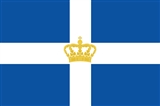
Kingdom of Greece

Encyclopedia
The Kingdom of Greece
(Greek
: , Vasílion tis Elládos) was a state established in 1832 in the Convention of London
by the Great Powers (the United Kingdom
, France
and the Russian Empire
). It was internationally recognized in the Treaty of Constantinople
, where it also secured full independence
from the Ottoman Empire
, marking the birth of the first fully independent Greek state since the fall of the last remnants of the Byzantine Empire
to the Ottomans in the mid-15th century. It succeeded from the Greek provisional governments
of the Greek War of Independence
, and lasted until 1924, when the monarchy was abolished, and the Second Hellenic Republic
declared. The Kingdom was restored in 1935, and lasted until 1974, when, in the aftermath of a seven-year military dictatorship
, the current Third Republic came into existence.
, France
, and Russia
) in 1828. Count Ioannis Kapodistrias
became the head of the Greek government, but he was assassinated in 1831. At the insistence of the Powers, the 1832 Treaty of London
made Greece a monarchy. Otto of Wittelsbach, Prince of Bavaria
was chosen as its first King. Otto arrived at the provisional capital, Nafplion
, in 1833 aboard a British warship
.
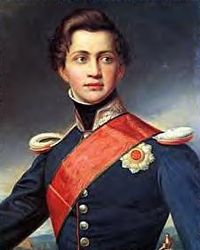 Otto's reign would prove troubled, but managed to last for 30 years before he and his wife, Queen Amalia, left the way they came, aboard a British warship. During the early years of his reign a group of Bavaria
n Regents ruled in his name, and made themselves very unpopular by trying to impose German ideas of rigid hierarchical government on the Greeks, while keeping most significant state offices away from them. Nevertheless they laid the foundations of a Greek administration, army, justice system and education system. Otto was sincere in his desire to give Greece good government, but he suffered from two great handicaps, his Roman Catholic faith, and the fact that his marriage to Queen Amalia remained childless. This meant he could neither be crowned as King of Greece under the Orthodox rite nor establish a dynasty.
The Bavarian Regents ruled until 1837, when at the insistence of Britain
and France
, they were recalled and Otto thereafter appointed Greek ministers, although Bavarian officials still ran most of the administration and the army. But Greece still had no legislature and no constitution. Greek discontent grew until a revolt broke out in Athens
in September 1843. Otto agreed to grant a constitution, and convened a National Assembly which met in November. The new constitution
created a bicameral parliament
, consisting of an Assembly (Vouli) and a Senate (Gerousia). Power then passed into the hands of a group of politicians, most of whom who had been commanders in the War of Independence against the Ottomans.
Greek politics in the 19th century was dominated by the national question. The majority of Greeks continued to live under Ottoman rule, and Greeks dreamed of liberating them all and reconstituting a state embracing all the Greek lands, with Constantinople
as its capital. This was called the Great Idea (Megali Idea
), and it was sustained by almost continuous rebellions against Ottoman rule in Greek-speaking territories, particularly Crete
, Thessaly
and Macedonia
. During the Crimean War
the British occupied Piraeus
to prevent Greece declaring war on the Ottomans as a Russian ally.
A new generation of Greek politicians was growing increasingly intolerant of King Otto's continuing interference in government. In 1862, the King dismissed his Prime Minister, the former admiral Constantine Kanaris, the most prominent politician of the period. This provoked a military rebellion, forcing Otto to accept the inevitable and leave the country. The Greeks then asked Britain to send Queen Victoria
's son Prince Alfred as their new king, but this was vetoed by the other Powers. Instead a young Danish Prince became King George I
. George was a very popular choice as a constitutional monarch, and he agreed that his sons would be raised in the Greek Orthodox faith. As a reward to the Greeks for adopting a pro-British King, Britain ceded the Ionian Islands
to Greece.
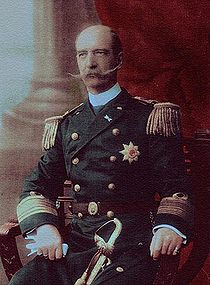 At the urging of Britain and King George
, Greece adopted a much more democratic constitution
in 1864. The powers of the King were reduced and the Senate was abolished, and the franchise was extended to all adult males. Nevertheless Greek politics remained heavily dynastic, as it has always been. Family names such as Zaimis, Rallis and Trikoupis occurred repeatedly as Prime Ministers. Although parties were centered around the individual leaders, often bearing their names, two broad political tendencies existed: the liberals, led first by Charilaos Trikoupis
and later by Eleftherios Venizelos
, and the conservatives, led initially by Theodoros Deligiannis
and later by Thrasivoulos Zaimis
. Trikoupis and Deligiannis dominated Greek politics in the later 19th century, alternating in office. Trikoupis favoured co-operation with Great Britain in foreign affairs, the creation of infrastructure and an indigenous industry, raising protective tariffs and progressive social legislation, while the more populist Deligiannis depended on the promotion of Greek nationalism and the Megali Idea
.
Greece remained a very poor country throughout the 19th century. The country lacked raw materials, infrastructure and capital. Agriculture was mostly at the subsistence level, and the only important export commodities were currants
, raisins and tobacco
. Some Greeks grew rich as merchants and shipowners, and Piraeus
became a major port, but little of this wealth found its way to the Greek peasantry. Greece remained hopelessly in debt to London finance houses. By the 1890s Greece was virtually bankrupt, and public insolvency
was declared in 1893. Poverty was rife in the rural areas and the islands, and was eased only by large-scale emigration to the United States
. There was little education in the rural areas. Nevertheless there was progress in building communications and infrastructure, and fine public buildings were erected in Athens. Despite the bad financial situation, Athens staged the revival of the Olympic Games
in 1896, which proved a great success.
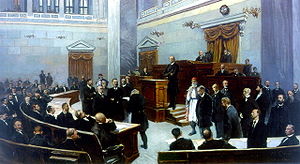 The parliamentary process developed greatly in Greece during the reign of George I. Initially, the royal prerogative in choosing his prime minister remained and contributed to governmental instability, until the introduction of the dedilomeni principle of parliamentary confidence
in 1875 by the reformist Charilaos Trikoupis
. Clientelism and frequent electoral upheavals however remained the norm in Greek politics, and frustrated the country's development. Corruption and Trikoupis' increased spending to create necessary infrastructure like the Corinth Canal
overtaxed the weak Greek economy, forcing the declaration of public insolvency in 1893 and to accept the imposition of an International Financial Control authority to pay off the country's debtors. Another political issue in 19th-century Greece was uniquely Greek: the language question. The Greek people spoke a form of Greek called Demotic
. Many of the educated elite saw this as a peasant dialect and were determined to restore the glories of Ancient Greek
. Government documents and newspapers were consequently published in Katharevousa
(purified) Greek, a form which few ordinary Greeks could read. Liberals favoured recognising Demotic as the national language, but conservatives and the Orthodox Church resisted all such efforts, to the extent that, when the New Testament
was translated into Demotic in 1901, riots erupted in Athens and the government fell (the Evangeliaka). This issue would continue to plague Greek politics until the 1970s.
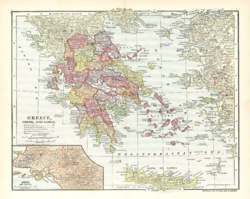 All Greeks were united, however, in their determination to liberate the Greek-speaking provinces of the Ottoman Empire. Especially in Crete
, a prolonged revolt in 1866–1869
had raised nationalist fervour. When war broke out between Russia and the Ottomans in 1877, Greek popular sentiment rallied to Russia's side, but Greece was too poor, and too concerned of British intervention, to officially enter the war. Nevertheless, in 1881, Thessaly
and small parts of Epirus
were ceded to Greece as part of the Treaty of Berlin
, while frustrating Greek hopes of receiving Crete
. Greeks in Crete continued to stage regular revolts, and in 1897, the Greek government under Theodoros Deligiannis, bowing to popular pressure, declared war on the Ottomans. In the ensuing Greco-Turkish War of 1897
the badly trained and equipped Greek army was defeated by the Ottomans. Through the intervention of the Great Powers however, Greece lost only a little territory along the border to Turkey, while Crete was established as an autonomous state
under Prince George of Greece.
Nationalist sentiment among Greeks in the Ottoman Empire continued to grow, and by the 1890s there were constant disturbances in Macedonia
. Here the Greeks were in competition not only with the Ottomans but also with the Bulgarians, engaged in an armed propaganda struggle for the hearts and minds of the ethnically mixed local population, the so-called "Macedonian Struggle
". In July 1908, the Young Turk Revolution
broke out in the Ottoman Empire
. Taking advantage of the Ottoman internal turmoil, Austria-Hungary
annexed Bosnia and Herzegovina
, and Bulgaria
declared its independence from the Ottoman Empire. On Crete, the local population, led by a young politician named Eleftherios Venizelos
, declared Enosis
, Union with Greece, provoking another crisis. The fact that the Greek government, led by Dimitrios Rallis
, proved unable to likewise take advantage of the situation and bring Crete into the fold, rankled with many Greeks, especially with young officers. These formed a secret society, the "Military League", with the purpose of emulating their Ottoman colleagues and seek reforms. The resulting Goudi coup
on 15 August 1909 marked a watershed in modern Greek history: as the military conspirators were inexperienced in politics, they asked Venizelos, who had impeccable liberal credentials, to come to Greece as their political adviser. Venizelos quickly established himself as a powerful political figure, and his allies won the August 1910 elections. Venizelos became Prime Minister in October 1910, ushering a period of 25 years where his personality would dominate Greek politics.
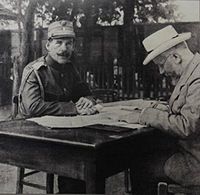 Venizelos initiated a major reform program, including a new and more liberal constitution
and reforms in the spheres of public administration, education and economy. French and British military missions were invited for the army and navy respectively, and arms purchases were made. In the meantime, the Ottoman Empire's weaknesses were revealed by the ongoing Italo-Turkish War
in Libya. Through spring 1912, a series of bilateral agreements between the Christian Balkan states (Greece, Bulgaria
, Montenegro
and Serbia
) formed the Balkan League
, which in October 1912 declared war on the Ottoman Empire. In the First Balkan War
, the Ottomans were defeated on all fronts, and the four allies rushed to grab as much territory as they could. The Greeks occupied Thessaloniki
just ahead of the Bulgarians, and also took much of Epirus
with Ioannina
, as well as Crete
and the Aegean Islands
. The Treaty of London ended the war, but no one was left satisfied, and soon, the four allies fell out over the partition of Macedonia
. In June 1913, Bulgaria attacked Greece and Serbia, beginning the Second Balkan War
, but was beaten back. The Treaty of Bucharest, which concluded the war, left Greece with southern Epirus, the southern half of Macedonia, Crete and the Aegean islands, except for the Dodecanese
, which had been occupied by Italy
in 1911. These gains nearly doubled Greece's area and population.
In March 1913, an anarchist, Alexandros Schinas
, assassinated King George in Thessaloniki, and his son came to the throne as Constantine I. Constantine was the first Greek king born in Greece and the first to be Greek Orthodox. His very name had been chosen in the spirit of romantic Greek nationalism (the Megali Idea
), evoking the Byzantine emperors of that name. In addition, as the Commander-in-chief of the Greek Army during the Balkan Wars
, his popularity was enormous, rivalled only by that of Venizelos, his Prime Minister. When World War I
broke out in 1914, despite Greece's treaty of alliance with Serbia, both leaders preferred to maintain a neutral stance. But when, in early 1915, the Allies
asked for Greek help in the Dardanelles campaign, offering Cyprus
in exchange, their diverging views became apparent: Constantine had been educated in Germany
, was married to Sophia of Prussia
, sister of Kaiser Wilhelm, and was convinced of the Central Powers
' victory. Venizelos on the other hand was an ardent anglophile, and believed in an Allied victory. Since Greece, a maritime country, could not oppose the mighty British navy, and citing the need for a respite after two wars, King Constantine favored continued neutrality, while Venizelos actively sought Greek entry in the war on the Allied side. Venizelos resigned, but won the next elections, and again formed the government. When Bulgaria
entered the war as a German ally in October 1915, Venizelos invited Entente
forces into Greece (the Salonika Front
), for which he was again dismissed by Constantine.
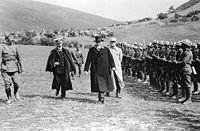 In August 1916, after several incidents where both combatants encroached upon the still theoretically neutral Greek territory, Venizelist officers rose up in Allied-controlled Thessaloniki, and Venizelos established a separate government
there. Constantine was now ruling only in what was Greece before the Balkan Wars ("Old Greece"), and his government was subject to repeated humiliations from the Allies. In November 1916 the French occupied Piraeus
, bombarded Athens and forced the Greek fleet to surrender. The royalist troops fired at them, leading to a battle between French and Greek royalist troops. There were also riots against supporters of Venizelos in Athens (the Noemvriana
). Following the February Revolution
in Russia
however, the Tsar's support for his cousin was removed, and Constantine was forced to leave the country, without actually abdicating, in June 1917. His second son Alexander became King, while the remaining royal family and the most prominent royalists followed into exile. Venizelos now led a superficially united Greece into the war on the Allied side, but underneath the surface, the division of Greek society into Venizelists
and anti-Venizelists, the so-called National Schism, became more entrenched.
 With the end of the war in November 1918, the moribund Ottoman Empire was ready to be carved up amongst the victors, and Greece now expected the Allies to deliver on their promises. In no small measure through the diplomatic efforts of Venizelos, Greece secured Western Thrace
in the Treaty of Neuilly
in November 1919 and Eastern Thrace and a zone around Smyrna
in western Anatolia
(already under Greek administration
since May 1919) in the Treaty of Sèvres
of August 1920. The future of Constantinople was left to be determined. But at the same time, a nationalist movement
had arisen in Turkey
, led by Mustafa Kemal (later Kemal Atatürk), who set up a rival government in Ankara
and was engaged in fighting the Greek army.
At this point, nevertheless, the fulfillment of the Megali Idea seemed near. Yet so deep was the rift in Greek society, that on his return to Greece, an assassination attempt was made on Venizelos by two royalist former officers. Even more surprisingly, Venizelos' Liberal Party
lost the elections
called in November 1920, and in a referendum
shortly after, the Greek people voted for the return of King Constantine from exile, following the sudden death of Alexander. The United Opposition, which had campaigned on the slogan of an end to the war in Anatolia, instead intensified it. But the royalist restoration had dire consequences: many veteran Venizelist officers were dismissed or left the army, while Italy and France found the return of the hated Constantine a useful pretext for switching their support to Kemal. Finally, in August 1922, the Turkish army shattered the Greek front, and took Smyrna
.
The Greek army evacuated not only Anatolia, but also Eastern Thrace and the islands of Imbros
and Tenedos
(Treaty of Lausanne
). A compulsory population exchange
was agreed between the two countries, with over 1.5 million Christians and almost half a million Muslims being uprooted. This catastrophe marked the end of the Megali Idea, and left Greece financially exhausted, demoralized, and having to house and feed a proportionately huge number of refugees
.
The catastrophe deepened the political crisis, with the returning army rising up under Venizelist officers and forcing King Constantine to abdicate again, in September 1922, in favour of his firstborn son, George II
. The "Revolutionary Committee", headed by Colonels Stylianos Gonatas
(soon to become Prime Minister) and Nikolaos Plastiras
engaged in a witch-hunt against the royalists, culminating in the "Trial of the Six
". In October 1923, elections
were called for December, which would form a National Assembly with powers to draft a new constitution. Following a failed royalist coup, the monarchist parties abstained, leading to a landslide for the Liberals and their allies. King George II was asked to leave the country, and on 25 March 1924, Alexandros Papanastasiou
proclaimed the Second Hellenic Republic
, ratified by plebiscite
a month later.
On 10 October 1935, a few months after he suppressed the second attempt in March 1935, Georgios Kondylis
, the former Venizelist stalwart, abolished the Republic in another coup, and declared the monarchy restored. A rigged plebiscite
confirmed the regime change (with an unsurprising 97.88% of votes), and King George II returned.
King George II immediately dismissed Kondylis and appointed Professor Konstantinos Demertzis
as interim Prime Minister. Venizelos meanwhile, in exile, urged an end to the conflict over the monarchy in view of the threat to Greece from the rise of Fascist Italy
. His successors as Liberal leader, Themistoklis Sophoulis
and Georgios Papandreou, agreed, and the restoration of the monarchy was accepted. The 1936 elections
resulted in a hung parliament
, with the Communists
holding the balance. As no government could be formed, Demertzis continued on. At the same time, a series of deaths left the Greek political scene in disarray: Kondylis died in February, Venizelos in March, Demertzis in April and Tsaldaris in May. The road was now clear for Ioannis Metaxas, who had succeeded Demertzis as interim Prime Minister.
Metaxas, a retired royalist general, believed that an authoritarian government was necessary to prevent social conflict and, especially, quell the rising power of the Communists. On 4 August 1936, with the King's support, he suspended parliament and established the 4th of August Regime
. The Communists were suppressed and the Liberal leaders went into internal exile. Patterning itself after Benito Mussolini
's Fascist Italy, Metaxas' regime promoted various concepts such as the "Third Hellenic Civilization", the Roman salute
, a national youth organization
, and introduced measures to gain popular support, such as the Greek Social Insurance Institute
(IKA), still the biggest social security institution in Greece.
Despite these efforts the regime lacked a broad popular base or a mass movement supporting it. The Greek people were generally apathetic, without actively opposing Metaxas. Metaxas also improved the country's defenses in preparation for the forthcoming European war, constructing, among other defensive measures, the "Metaxas Line
". Despite his aping of Fascism, and the strong economic ties with resurgent Nazi Germany
, Metaxas followed a policy of neutrality, given Greece's traditionally strong ties to Britain, reinforced by King George II's personal anglophilia. In April 1939, the Italian threat suddenly loomed closer, as Italy annexed
Albania
, whereupon Britain publicly guaranteed Greece's borders. Thus, when World War II
broke out in September 1939, Greece remained neutral.
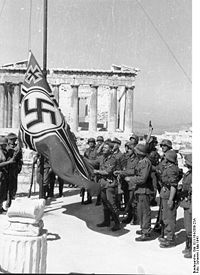 Despite this declared neutrality, Greece became a target for Mussolini's expansionist policies. Provocations against Greece included the sinking of the light cruiser Elli
on 15 August 1940. Italian troops crossed the border on 28 October 1940, beginning the Greco-Italian War
, but were stopped by determined Greek defence, and ultimately driven back into Albania
. Metaxas died suddenly in January 1941. His death raised hopes of a liberalization of his regime and the restoration of parliamentary rule, but King George quashed these hopes when he retained the regime's machinery in place. In the meantime, Adolf Hitler
was reluctantly forced to divert German troops to rescue Mussolini from defeat, and attacked Greece
through Yugoslavia
and Bulgaria on 6 April 1941. Despite British assistance, by the end of May, the Germans had overrun most of the country. The King and the government escaped to Crete, where they stayed until the end of the Battle of Crete
. They then transferred to Egypt
, where a government in exile
was established.
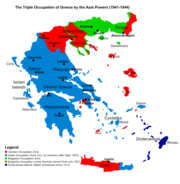 The occupied country was divided in three zones (German, Italian and Bulgarian) and in Athens, a puppet regime was established. The members were either conservatives
or nationalists with fascist leanings. The three quisling
prime ministers were Georgios Tsolakoglou
, the general who had signed the armistice with the Wehrmacht, Konstantinos Logothetopoulos
, and Ioannis Rallis
, who took office when the German defeat was inevitable, and aimed primarily at combating the left-wing Resistance movement. To this end, he created the collaborationist Security Battalions
.
Greece suffered terrible privations during World War II
, as the Germans appropriated most of the country's agricultural production and prevented its fishing fleets from operating. As a result, and because a British blockade initially hindered foreign relief efforts, a wide-scale famine
resulted, when hundreds of thousands perished, especially in the winter of 1941-1942. In the mountains of the Greek mainland, in the meantime, several resistance movements
sprang up, and by mid-1943, the Axis forces controlled only the main towns and the connecting roads, while a "Free Greece" was set up in the mountains. The largest resistance group, the National Liberation Front (EAM), was controlled by the Communists
, as was (Elas) led by Aris Velouchiotis and a civil war soon broke out between it and non-Communist groups such as the National Republican Greek League (EDES) in those areas liberated from the Germans. The exiled government in Cairo
was only intermittently in touch with the resistance movement, and exercised virtually no influence in the occupied country. Part of this was due to the unpopularity of the King George II in Greece itself, but despite efforts by Greek politicians, British support ensured his retention at the head of the Cairo government. As the German defeat drew nearer however, the various Greek political factions convened in Lebanon in May 1944, under British auspices, and formed a government of national unity, under George Papandreou
, in which EAM was represented by six ministers.
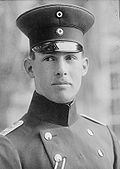 German forces withdrew on October 12, 1944, and the government in exile returned to Athens. After the German withdrawal, the EAM-ELAS guerrilla army effectively controlled most of Greece, but its leaders were reluctant to take control of the country, as they knew that Stalin
had agreed
that Greece would be in the British sphere of influence after the war. Tensions between the British-backed Papandreou and EAM, especially over the issue of disarmament of the various armed groups, leading to the resignation of the latter's ministers from the government. A few days later, on 3 December 1944, a large-scale pro-EAM demonstration in Athens ended in violence and ushered an intense, house-to-house struggle with British and monarchist forces (the Dekemvriana). After three weeks, the Communists were defeated: the Varkiza agreement ended the conflict and disarmed ELAS, and an unstable coalition government was formed. The anti-EAM backlash grew into a full-scale "White Terror", which exacerbated tensions. The Communists boycotted the March 1946 elections
, and on the same day, fighting broke out again. By the end of 1946, the Communist Democratic Army of Greece
had been formed, pitted against the governmental National Army, which was backed first by Britain and after 1947 by the United States
.
Communist successes in 1947–1948 enabled them to move freely over much of mainland Greece, but with extensive reorganization, the deportation of rural populations and American material support, the National Army was slowly able to regain control over most of the countryside. In 1949, the insurgents suffered a major blow, as Yugoslavia closed its borders following the split between Marshal Josip Broz Tito
with the Soviet Union
. Finally, in August 1949, the National Army under Marshal Alexander Papagos
launched an offensive that forced the remaining insurgents to surrender or flee across the northern border into the territory of Greece's northern Communist neighbors. The civil war resulted in 100,000 killed and caused catastrophic economic disruption. In addition, at least 25,000 Greeks and an unspecified number of Macedonian Slavs
were either voluntarily or forcibly evacuated to Eastern bloc
countries, while 700,000 became displaced persons inside the country. Many more emigrated to Australia
and other countries.
The postwar settlement saw Greece's territorial expansion, which had begun in 1832, come to an end. The 1947 Treaty of Paris
required Italy to hand over the Dodecanese
islands to Greece. These were the last majority-Greek-speaking areas to be united with the Greek state, apart from Cyprus which was a British possession until it became independent in 1960. Greece's ethnic homogeneity was increased by the postwar expulsion of 25,000 Albanians from Epirus (see Cham Albanians
). The only significant remaining minorities are the Muslims in Western Thrace (about 100,000) and a small Slavic-speaking minority in the north. Greek nationalists continued to claim southern Albania
(which they called Northern Epirus
), home of a significant Greek population (about 3%-12% in the whole of Albania ), and the Turkish-held islands of Imvros and Tenedos
, where there were smaller Greek minorities.
In the beginning of the 1950s, the forces of the Centre (EPEK) succeeded in gaining the power and under the leadership of the aged general N. Plastiras they governed for about half a four-year term. These were a series of governments having limited manoeuvre ability and inadequate influence in the political arena. This government, as well as those that followed, was constantly under the American auspices. The defeat of EPEK in the elections of 1952, apart from increasing the repressive measures that concerned the defeated of the Civil war, also marked the end of the general political position that it represented, namely political consensus and social reconciliation.
The Left, which had been ostracized from the political life of the country, found a way of expression through the constitution of EDA (United Democratic Left) in 1951, which turned out to be a significant pole, yet steadily excluded from the decision making centres. After the disbandment of the Centre as an autonomous political institution, EDA practically expanded its electoral influence to a significant part of the EAM-based Centre-Left.
The 1960s are part of the period 1953-72, during which Greek economy developed rapidly and was structured within the scope of European and worldwide economic developments. One of the main characteristics of that period was the major political event - as we have come to accept it - of the countrys accession in the EEC, in an attempt to create a common market. The relevant treaty was contracted in 1962.
The developmental strategy adopted by the country was embodied in centrally organized five-year plans; yet their orientation was indistinct. The average annual emigration, which absorbed the excess workforce and contributed to extremely high growth rates, exceeded the annual natural increase in population. The influx of large amounts of foreign private capital was being facilitated and consumption was expanded. These, associated with the rise of tourism, the expansion of shipping activity and with the migrant remittances, had a positive effect on the balance of payments. The peak of development was registered principally in manufacture, mainly in the textile and chemical industry and in the sector of metallurgy, the growth rate of which tended to reach 11% during 1965-70. The other large branch where obvious economic and social consequences were brought about, was that of construction. Consideration, a Greek invention, favoured the creation of a class of small-medium contractors on one hand and settled the housing system and property status on the other.
During that decade, youth came forth in society as a distinct social power with autonomous presence (creation of a new culture in music, fashion etc.) and displaying dynamism in the assertion of their social rights. The independence granted to Cyprus, which was mined from the very beginning, constituted the main focus of young activist mobilizations, along with struggles aiming at reforms in education, which were provisionally realized to a certain extent through the educational reform of 1964. The country reckoned on and was influenced by Europe - usually behind time - and by the current trends like never before. Thus, in a sense, the imposition of the military junta conflicted with the social and cultural occurrences.
The country descended into a prolonged political crisis, and elections were scheduled for late April 1967. On 21 April 1967 however, a group of right-wing colonels led by Colonel George Papadopoulos
seized power in a coup d'état
establishing the Regime of the Colonels. Civil liberties were suppressed, special military courts were established, and political parties were dissolved. Several thousand suspected communists and political opponents were imprisoned or exiled to remote Greek islands. Alleged US support for the junta is claimed to be the cause of rising anti-Americanism
in Greece during and following the junta's harsh rule. However, the junta's early years also saw a marked upturn in the economy, with increased foreign investment and large-scale infrastructure works. The junta was widely condemned abroad, but inside the country, discontent began to increase only after 1970, when the economy slowed down. Even the armed forces, the regime's foundation, were not immune: In May 1973, a planned coup by the Hellenic Navy
was narrowly suppressed, but led to the mutiny of the HNS Velos, whose officers sought political asylum in Italy. In response, junta leader Papadopoulos attempted to steer the regime towards a controlled democratization
, abolishing the monarchy and declaring himself President of the Republic.
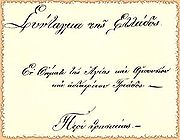 The first constitution of the Kingdom of Greece was the Greek Constitution of 1844. On 3 September 1843, the military garrison of Athens, with the help of citizens, rebelled and demanded from King Otto
the concession of a Constitution.
The Constitution that was proclaimed in March 1844 came from the workings of the "Third of September National Assembly of the Hellenes in Athens" and was a Constitutional Pact, in other words a contract between the monarch and the Nation. This Constitution re-established the Constitutional Monarchy and was based on the French Constitution of 1830 and the Belgian Constitution of 1831.
Its main provisions were the following: It established the principle of monarchical sovereignty, as the monarch was the decisive power of the State; the legislative power was to be exercised by the King - who also had the right to ratify the laws - by the Parliament, and by the Senate. The members of the Parliament could be no less than 80 and they were elected for a three-year term by universal suffrage. The senators were appointed for life by the King and their number was set at 27, although that number could increase should the need arise and per the monarch's will, but it could not exceed half the number of the members of Parliament.
The ministers' responsibility for the King's actions is established, who also appoints and removes them. Justice stems from the King and is dispensed in his name by the judges he himself appoints.
Lastly, this Assembly voted the electoral law of 18 March 1844, which was the first European law to provide, in essence, for universal suffrage
(but, only, of course, for men).
The Second National Assembly of the Hellenes took place in Athens
(1863–1864) and dealt both with the election of a new sovereign as well as with the drafting of a new Constitution, thereby implementing the transition from constitutional monarchy
to a Crowned Democracy.
Following the refusal of Prince Alfred of Great Britain
(who was elected by an overwhelming majority in the first referendum of the country in November 1862) to accept the crown of the Greek kingdom, the government offered the crown to the Danish prince George Christian Willem
of the House of Schleswig-Holstein-Sonderburg-Gluecksburg, who was crowned constitutional King of Greece under the name "George I, King of the Hellenes".
The Constitution of 1864 was drafted following the models of the Constitutions of Belgium
of 1831 and of Denmark
of 1849, and established in clear terms the principle of popular sovereignty, since the only legislative body with reversionary powers was now the Parliament. Furthermore, article 31 reiterated that all the powers stemmed from the Nation and were to be exercised as provided by the Constitution, while article 44 established the principle of accountability, taking into consideration that the King only possessed the powers that were bestowed on him by the Constitution and by the laws applying the same.
The Assembly chose the system of a single chamber Parliament (Vouli) with a four-year term, and hence abolished the Senate, which many accused for being a tool in the hands of the monarchy. Direct, secret and universal elections was adopted as the manner to elect the MPs, while elections were to be held simultaneously throughout the entire nation.
In addition, article 71 introduced a conflict between being an MP and a salaried public employee or mayor at the same time, but not with serving as an army officer.
The Constitution reiterated various clauses found in the Constitution of 1844
, such as that the King appoints and dismisses the ministers and that the latter are responsible for the person of the monarch, but it also allowed for the Parliament to establish "examination committees". Moreover, the King preserved the right to convoke the Parliament in ordinary as well as in extraordinary sessions, and to dissolve it at his discretion, provided, however, that the dissolution decree was also countersigned by the Cabinet.
The Constitution repeated verbatim the clause of article 24 of the Constitution of 1844, according to which "The King appoints and removes his Ministers". This phrase insinuated that the ministers were practically subordinate to the monarch, and thereby answered not only to the Parliament but to him as well. Moreover, nowhere was it stated in the Constitution that the King was obliged to appoint the Cabinet in conformity with the will of the majority in Parliament. This was, however, the interpretation that the modernizing political forces of the land upheld, invoking the principle of popular sovereignty and the spirit of the Parliamentary regime. They finally succeeded in imposing it through the principle of "manifest confidence" of the Parliament, which was expressed in 1875 by Charilaos Trikoupis
and which, that same year, in his Crown Speech, King George I expressly pledged to uphold: "I demand as a prerequisite, of all that I call beside me to assist me in governing the country, to possess the manifest confidence and trust of the majority of the Nation's representatives. Furthermore, I accept this approval to stem from the Parliament, as without it the harmonious functioning of the polity would be impossible".
The establishment of the principle of "manifest confidence" towards the end of the first decade of the crowned democracy, contributed towards the disappearance of a constitutional practice which, in many ways, reiterated the negative experiences of the period of the reign of King Otto
. Indeed, from 1864 through 1875 numerous elections of dubious validity had taken place, while, additionally and most importantly, there was an active involvement of the Throne in political affairs through the appointment of governments enjoying a minority in Parliament, or through the forced resignation of majority governments, when their political views clashed with those of the crown.
The Greek
Constitution of 1911 was a major step forward in the constitutional history of Greece
. Following the rise to power of Eleftherios Venizelos
after the Goudi revolt in 1909, Venizelos set about attempting to reform the state. The main outcome of this was a major revision to the Greek Constitution of 1864
.
The most noteworthy amendments to the Constitution of 1864
concerning the protection of human rights, were the more effective protection of personal security, equality in tax burdens, of the right to assemble and of the inviolability of the domicile. Furthermore, the Constitution facilitated expropriation to allocate property to landless farmers
, while simultaneously judicially protecting property rights.
Other important changes included the institution of an Electoral Court for the settlement of election disputes stemming from the parliamentary elections, the addition of new conflicts for MPs, the re-establishment of the State Council as the highest administrative court (which, however, was constituted and operated only under the Constitution of 1927), the improvement of the protection of judicial independence and the establishment of the non-removability of public employees. Finally, for the first time, the Constitution provided for mandatory and free education for all, and declared Katharevousa
(i.e. archaising "purified" Greek) as the "official language of the Nation".
The first major wave of growth came in the 1860s and 1870s. After the crisis of the Crimean War - when the impasses to which an irredentist policy had led the country became apparent - priorities shifted towards economic development. Several factors contributed to a climate that helped attract foreign investment into Greece. One of the most important was the international recession which escalated in 1873, and led to a drop in interest rates abroad. From 1878 on, with the settlement of foreign debts contracted in the past and the comparatively higher interest rates Greece offered in relation to those of the European money markets, there was a rise in capital flowing into Greece from the West in the form of foreign loans, a trend that was at that time observed in other countries on the periphery as well. At the same time, the Agrarian Reform of 1871 was one of the most important domestic changes. The smallholdings it created promoted intensive cultivation of things like the Corinthian currant. The increase in currant exports accelerated the upward course of the economy. Alexandros Koumoundouros marked these two decades. His work became the starting point for Charilaos Trikoupis, the politician who dominated the political stage during the last quarter of the century. He implemented an investment programme that aimed at the construction of large infrastructure works. These works were mainly financed through foreign loans, which in the 1880s were easy to raise. At the beginning of the 1890s, however, it became clear that the country's borrowing capacity had been exhausted, a fact which led to the bankruptcy of 1893.
One thing that has to be pointed out is that the policy of Trikoupis was aimed at modernizing the Greek economy, in other words, bringing it into line with the rates of economic development in the Western world, by adopting the economic model used in England. His plan moreover did not focus only on economic matters but equally on the reorganization of the state and the political system. And it is in the light of these objectives that the precarious practice of over-borrowing has to be viewed.
Economic developments follow a reasoning of their own and do not fall under conventional patterns. General economic trends cover large periods, they coincide however with the events of the conjuncture of circumstances. The agricultural production remains the dominant factor in the agricultural life of the country throughout the nineteenth and the first half of the twentieth century. The economic developments of the beginning of the twentieth century are determined to a large extent by the modernizing economic policy adopted by Harilaos Trikoupis in the previous phase and its consequences. The bankruptcy of 1893 resulted to establishment of the International Financial Control of 1898, which at the same time was related to the obligations imposed by the 1897 defeat. Large works such as the railways, that have been the basic choices of the Trikoupist period, are completed in this phase and positively affect the whole of economy. Shipping is in a constant process of growth with the definite passage from sail to steam.
Between 1898 and 1909 economy begins to recover. The policy of Georgios Theotokis, prime-minister for the greatest part of the period, achieves a relative monetary and exchange stability. At the same time, performance in foreign trade has improved, whereas the slight excess of imports over exports is counter-balanced by the invisible resources originating from shipping and immigration abroad. Some efforts are observed in the development of industry to no avail though. The raisin issue held a prominent partr in the agricultural economy of southern Greece of the time and triggered social disturbances, which had no spectacular aftermath however.
Interest in the banking sector is not as intense as in the previous phase. This trend resurfaces in the 1910s. As concerns taxation, indirect taxation and the relatively small participation in public burdens of high-income households are still the dominant trend.
In the monetary level an improvement of the exchange status of drachma is observed which is related to the improvement of public finance.
The amelioration of the country's finance creates the social preconditions for the military coup of Goudi in 1909 and the ensuing overall attempt for recovery by Eleftherios Venizelos, the military venture between 1912 and 1922 in particular. The state in that period had to face acute economic problems which are justified by the continuous involvement in war. War mobilized on the one hand the productive human resources of the country, on the other hand it had exhausted the potential of public finance. In that period the Greeks of the Diaspora transfer part of their activities to Greece and participate more actively in the economo-social affairs of the Greek state.
After the entrance of the country in the First World War, an allied aid was anticipated, the so-called Allied Credits. On this basis the Asia Minor Campaign has been planned. Their interruption after the political change of November 1920 with the reinstatement of King Constantine I in combination with the inability of contracting new loans contributed -from the economic point of view- to the debacle of the front. The Asia Minor Catastrophe finds the country in a pathetic economic state.
The destruction brought about by the war of 1940-1944 was so extensive that, despite the relief supply sent by international organizations (UNRRA etc.), the country was unable to enter effectively in a rehabilitation course. The breakdown of communication networks and of the countrys public infrastructure, the shrink of the gross national product (GNP) and internal political instability led to a steep rise of inflation and undermined any attempt of recovery to prewar levels.
Moreover, political oppositions within Greece combined with international tensions due to antagonism between the two great powers (USA and USSR) that emerged after World War II, promoted the implication of the country in the rising Cold War. The declaration of the Truman Doctrine, in March 1947, brought the country under the influence and control of the USA and of the western coalition that was being formed, which aimed to restrain communism from spreading on a worldwide scale. Extensive financial aid to Greece, which was stipulated in the Marshall Plan, contributed to an evolutionary process in economy and politics after 1948. International isolation to which the communist leadership had been reduced, after the -until then- friendly Titos Yugoslavia had blocked its borders, stressed the incompetence of the Balkan policy of KKE (Greek Communist Party) and contributed to the governmental prevalence.
In the second half of the decade 1940-50 it is estimated that over 100,000 people lost their lives, while at least 700-750,000 left their homes, which situated mainly on the massifs of Central and North Greece because of the civil war. At the same time, a large number of citizens was exiled or imprisoned, while 80,000 people approximately fled to the eastern countries. In the beginning of 1950, both the social and physical physiognomy of the country had altered radically in regard to the prewar past. Many among those who had left the mountains, would never come back, as the social network had collapsed, ethnic minorities (in West Macedonia and Thrace) abandoned the country and social groups (mountainous rural population) resorted to urbanization and emigration.
For the first time during 1952-63, an urbanization procedure was brought about in the Greek population, during which the ratio rural-urban sector outweighed in favour of the latter. The main place of assimilation was the urban complex of Athens. At the same time, the influx from the country to the cities was accompanied by a rapid growth of the emigration flow. The structural changes that were brought about, were revealed through labour (forms of occupation), consumption and government measures concerning the stabilization and growth of economy.
The devaluation of the currency in 1953 (Spyridon Markezinis) created a new financial hierarchy: increase of imports, boost in commercial consumption, combating against inflation, but also a deficit in the balance of trade. The expansion of public investments, despite their often confined orientation, was a decision of historical importance made by the Karamanlis governments. The growth rate of the GNP with the contribution of invisible resources was explosive (7% annually), but did not reflect phenomena like industrial stagnancy and the lack of central programming in agriculture.
One of the primary concerns for the governments of the period 1956-61 was how to deal with productivity, underemployment and sufficiency of resources. Despite the fact that agriculture continued to be the largest productive sector, the rural world had undergone radical changes in relation to the interwar period. The growth of communication networks, the diffusion of cinema, the emergence of tourism brought wider social strata closer to the way of living of industrial societies.
During the 19th century, foreign policy in Greek political life constituted the main factor shaping internal policy, because Greece was bound by the guardianship of forces which did not miss any opportunity to interfere decisively with the regime, governance and political life of the country. The new state's territory included only a proportion of the 1821 rebels, and a much smaller number of the Greek Orthodox peoples in general. Liberation was the central political axis of the new state; setting free the enslaved compatriots was considered a 'natural order' and a religious obligation, whereas the issues of foreign policy frequently motivated many people who took action in favour of an expansionist policy, even if that was unfeasible. Finally, foreign policy was the touchstone for royalty and the politicians; it could legitimize people, institutions, ideologies and practices.
The gap between what was desired and what was feasible is typical of Greek foreign policy in the 19th century; the distance between the goal and the preparation for its achievement; the distance between dreams and reality. Over everything lies the Greeks' high opinion of themselves; the high opinion of their descent, of their mission; the Great Idea showed the way for Greek foreign policy over three-quarters of a stormy century.
In order to follow the facts relating to foreign policy, the actions of diplomacy, treaties and military action, one has to take into consideration many other aspects: institutions, and the political, diplomatic and legal framework in which they were found; the people and the roles they had to play, the discourse which developed either through texts or public action in general.
The victorious Balkan Wars (First and Second Balkan War) gained for Greece the territories of Macedonia, Epirus and Crete and dominion over the islands of the northeastern Aegean.
The Greek foreign policy of that period bears the mark of the personality and the handlings of Eleftherios Venizelos. The Cretan statesman passionately supported Greek expansion, in the framework of the conjunction of circumstances of the period while being harnessed to the democratic countries of western Europe and Great Britain in particular.
The other factor that contributed to the shaping of the foreign policy of the period was King Constantine I, who supported Greek neutrality, favouring the Central Powers, due to actual kinship and politico-ideological affinities with them. Around him rallied those opposing the Venizelist policy as a whole, at the same time reacting to the domestic socio-political reforms introduced by Venizelos. The acute disagreement of the Prime Minister and the King led to the National Schism that terminated with the predominance of the Venizelists and the entrance of Greece in the war on the side of the British and the French.
During the First World War and amidst the colonial competition of the Great Powers in the area of the Balkans and the eastern Mediterranean more generally, Greece tried to secure the largest possible territorial gains from the crumbling Ottoman empire.
The Asia Minor Campaign was launched in an attempt of Greece, being an ally of the victorious Powers and member of the Paris Peace Conference, to fulfil her pursuits.
With the short-lived Treaty of Sèvres Greece acquired for a while her largest territorial expansion, gaining the Dodecanese islands, Thrace and a zone in western Asia Minor around Smyrna. The "Greater Greece of the two continents and of the five seas" became an actuality or a brief period. The competition however of the interests of the western allies and the reversal of their Eastern policy, in combination with the political change of November 1920 that restored to the throne the undesirable to the allies King Constantine I, overturned this actuality. The venture of the Asia Minor Campaign terminated with the definite departure of the Greek element from its hearths in Thrace, Pontos and Asia Minor.
From the "Greece of the Treaty of Sevres" only western Thrace and the ratified dominion over the Aegean islands remained. As a whole, in the period 1912-22 Greece doubled her territory and population acquiring her definite borders with the exclusion of the Dodecanese islands, that continued to be under Italian occupation until the end of the Second World War. In the same period the remaining national claims, northern Epirus and Cyprus, will be the object of negotiations, but the chance of their becoming annexed to the Greek state will be definitely eliminated.
From the following period, the inter-war period, Greek foreign policy will fully change course, abandoning every Great Idea aspiration and putting as objective the peaceful co-existence with Turkey and the other Balkan states and the defence of national territory from every possible threat.
The postwar economic flourishing of Europe - which had to deal with an enormous lack of manpower in its effort of reconstruction - led after 1956 mainly rural strata that faced financial inactivity, to turn to mass emigration in quest of a better fortune. After the supply of American aid was over, the importation of foreign capital in every possible way in order to boost the local, insufficient business activity was considered a cure-all, which would lead the country to an industrialization track.
However, despite the benefits (tax exemptions etc.) granted to foreign capitalists, the total of foreign investments in Greece until 1960 was rather low. The accession of Greece to NATO in 1952, as the Cold War was escalating, institutionalized the American control on the foreign policy front and determined the relations of Greece with its neighbouring countries, using criteria often opposite to its internal necessities. The Greek military participation in the Korean campaign (1950) stressed this particular orientation.
At the same time, the declaration of the anti-colonist struggle in Cyprus against British occupation (1955) set off a large number of mass and dynamic social reactions in Greece in favour of the union with the "Ethniko Kentro" (National Centre). What characterized that period was the discrepancy between Greek leaderships that were closely dependent on the British and the Americans and the constantly increasing anti-British movement expressed through a series of militant demonstrations and protests throughout the 1950s and the '60s. In 1959, Britain, Turkey, Greece, the Greek-Cypriots and the Turkish-Cypriots reached an agreement in Zurich and London, thus sealing all negotiations concerning the Cyprus problem. Moreover, this agreement determined the course of the issue itself, as well as that of relevant discussions for decades.
At the same time it was a modern state, which means European, Western, or at least it intended to become one. This was also proclaimed in the political declarations and especially in the constitutions of the years of the Revolution. Consequently, the establishment of a centralized government model and of Western institutions was inevitable but also urgent. At the same time it was a difficult venture. The composition and consolidation of administrative and repressive state mechanisms was followed by processes of violent unification and homogenization of a society that remained traditional, that is, a society split into many regional and relatively independent political centres. These local political centres had to be disbanded, enfeebled and eliminated, as the central power in the modern state is the only legitimate source of political power.
In all modern states, politics is where society meets and interacts with political power, or the state itself. In the case of the Greek state, politics was the field where a political power with all the features of a modern state met a society which remained intensely traditional. The formation of the field of politics on the basis of modern authorities of function affected the terms of social reproduction of the regional social elites. In the first years, in the 1830s, the reaction of these local elites was expressed through traditional ways of protest and mainly through regional insurrections. However, from the beginning of the 1840s the constitution and the elections - both modern institutions and procedures - comprised the basic claims of these traditional groups. Their objective was nothing more than the redefinition of the political field in the direction of a more favourable redisposition of the power correlations. This was achieved with the movement of 1843. The Constitution of 1844 and the first elections do not show the victory of the traditional element over the modern. They signify the incorporation of the traditional political leaderships of Greek society in a modern political system, the acceptance of its terms and the consolidation of its institutions. In a sense, in 1843 the central political scene becomes the chief point of emergence of the socio-political conflicts. From then on, and for the entire 19th century, the consolidation and extension of the parliamentary institutions, the type of the regime and the limits of royal intervention in politics, would virtually monopolize every aspect of domestic political life.
During the period 1897-1922 very important events and headlong developments determine the evolution of Greece and decisively contribute to its formation as a modern state.
It is a period of spectacular changes, critical choices, acute crises, a ten year war adventure, which ends up in the territorial expansion of Greece on the one hand and the dramatic termination of the Asia Minor Campaign on the other hand and aims at the formation of a state radically different from that of the past.
The period begins with an event-landmark: the defeat in the Greco-Turkish war of 1897. The defeat has been perceived as a huge blow, causing universal disappointment apart from putting the state and its mechanism structures, the traditional political world and the royal dynasty as concerns their efficiency in managing national issues under doubt. The defeatist attitude and the sense of "shame" were intensified even more by the establishment of the International Financial Control Commission, that would oversee the payment of a war indemnity to Turkey, as well as settle the overall external debts, being the result of the state's bankruptcy in 1893. The economic and national crisis, that is a double failure, both in the economic sector and the policy of irredentism breed a climate of disillusionment and introspection. By 1909 there is no change whatsoever. Two parties alternate in power: the Trikoupist party headed by Georgios Theotokis and the Deliyannist party with Theodoros Deliyannis himself as leader and, after his assassination in 1905, his successors, Dimitrios Rallis and Kyriakoulis Mavromikhalis, leaders of two different parties, originating though from the Deliyannist party. No particular progress has been made apart from some efforts by the governments of Theotokis, in the economic sector in particular, for recovery. On the contrary, the towering economic crisis and the plight of various social groups, the continuous disclosure of the weaknesses of the old political status cause an increasing discontent and breed the conditions for the development of reaction.
1909, the year that the Military coup of Goudi broke out, is taken as a starting point for the division of Greek history marking the beginning of a ten-year period (1910–20) of progress and shaping of Greece as a modern state. It coincides with the rise of the middle bourgeois class, which, reinforced by the economic development of the last years of the nineteenth century, claim from the old political bourgeois oligarchy their political representation and the creation of those instutional preconditions that would facilitate their economic activity.
The Cretan statesman Eleftherios Venizelos will emerge as a leading figure, who will represent the attempt at transforming the Greek society into a capitalist one and organizing the state after the models of western republics. The urban modernization attempted by Venizelos will go hand in hand in perfect harmony with national integration, under the form of irredentism and the incorporation of the New Territories and their inhabitants in the national state. These two objectives, economic and political modernization on the one hand and the militant pursuit of the Great Idea in the conjuncture of circumstances of the First World War on the other hand, constitute the essence of Venizelism.
Reaction to both urban modernization and irredentism gave birth to anti-Venizelism. The overall social and political contrast among both various social groups and old and new populations, incorporated with the territorial expansion being the result of the victories reaped during the Balkan wars, will be personified in the conflict between the prime-minister Eleftherios Venizelos and King Constantine I about the stance of Greece in the First World War. It will acquire the dimensions of a National Schism, that culminated in the period 1915-17 with the creation of two Greek states, an anti-Venizelist one in the territory of Old Greece and a Venizelist one in the area of the New Territories.
In the period 1917-20, during the second phase of Venizelist rule, the modernizing effort is kept on that has been inaugurated in the period 1910-15 and has been checked by the developments of the Schism and war.
In the 1920 elections, while the Asia Minor Campaign was under way, the Greeks worn out by the ten-year war venture voted against the Liberals. The anti-Venizelists despite their pre-election promises, pursued the Asia Minor war, reinstating to the throne the undesirable to the Western allies King Constantine I. This fact served the allies as a pretext to forsake Greece in Asia Minor, since their interests dictated by now the support of Kemal. During this period developments in the domain of foreign policy are dominant. Within the different by now international correlation of powers, that would annul Greek aspirations in Asia Minor, wrong military choices and economic exhaustion brought about an even more painful Catastrophe in the summer of 1922, uprooting the Greek populations of the East from their homelands and turning them into refugees in Greece
After the debacle of the front Greece is in a tragic plight. Crowds of refugees and soldiers throng the country. A group of officers headed by Nikolaos Plastiras takes over power, pursuing chiefly a purge for the national tragedy. This is the "Revolution of 1922". Within this context the Trial of the Six ringleaders of the Catastrophe took place, that led to their death sentence, a fact that exacerbated the heavy climate of the time.
At the same time, social tensions showing the extent and importance of change were particularly felt in urban centres. If rural areas were a source of mistrust and resistance to every innovation, the cities and the capital in particular generally reflected individual instances of breaking with the past. The formation of an administrative mechanism led to the gradual shaping of a social group which was new and at the same time composed of many people: the civil servants. The development of the secondary and tertiary sectors of production and the gradual prevalence of salaried work caused the middle classes to grow in number, and created the conditions for the formation of working classes. These new social categories believed in new values (among which was literacy), and in their daily life they adopted different (Western-like) models in clothing, housing, nutrition, hygiene, music, entertainment and social events. It was certainly a different kind of Greek society.
In short, the Greek society of the 19th century experienced a fundamental paradox which could schematically be described as the co-existence of the old and the new, traditional and modern. This paradox existed throughout the whole of society, (re)shaped it and consequently constituted its basic feature. In the light of this, the mistrust and resistance on the part of traditional groups and rural areas in general did not suggest the persistence of the old, but one of the ways of adjusting to the new.
The period 1897-1922 is characterized by remarkable innovations permeating Greek society. The small kingdom of the nineteenth century acquires to a large extent the borders of the present day.
Territorial expansion is accompanied by a series of reforms in the social, economic, political and cultural sector, taking place after the coup of Goudi and politically expressed by the Venizelist bloc. In the context of these developments a social rift, manifested with the National Schism, became manifest in a period when the country was entering the swirl of international competition and the Great War. Conflicting views for the position of the country in the international field ultimately reflect a different approach concerning the course of development of the structures of Greek society.
In the period under examination the population and the territory of the country almost double. At the same time, considerable movements of people are observed. On the one hand in the beginning of the twentieth century a mass immigration movement chiefly towards the USA took place. On the other hand there has been a movement towards the interior, with the arrival of Greek refugees from the areas where military operations were under way or from areas being under the control of foreign powers.
The largest part of the labour force of the country is occupied in the sector of agriculture.
In this context the Thessalian question arises, that evolved into the most important social mobilization of the period with the outbreak of revolts in the 1910's. For its resolution but also the settlement of respective problems created by the presence of refugees and landless in the new territories the agricultural reforms of 1917 took place. To the same direction a series of institutional innovations occurred in the field of agriculture, such as the establishment of agricultural co-operatives and the Ministry of Agriculture.
The growth of urban centres follows a rapid pace, their population increases as well as the activities taking place in their space. New large cities with a tradition in the economic and cultural field such as Thessaloniki, Ioannina and Kavala are incorporated in the Greek territory. In the cities in-migrators are gathered and form the first labour class. There is a considerable problem of unemployment, housing and sanitation conditions whereas certain groups of people live in the margin of the city's activities. After 1910 the first form of the labour movement is observed, whereas the state institutes for the first time a protective social policy. Various traditional petit bourgeois strata of small businessmen and lower rank civil servants continue to be present.
At the same time, along with all the war ventures and the internal crises, Athens experiences the climate of the belle epoque. A new business bourgeois class develops, tending to supplant the older formed upper social class, the old "tzakia", directly related to the state mechanism.
Very intense during this period has been the struggle of the demoticists for the establishment of demotic Greek, which resulted to a great dispute between them and the supporters of katharevousa. This dispute deteriorated to violent incidents, as was the case with Evangelika and Oresteiaka. Demoticism facilitated the dissemination of various ideas and brought together the Socialist intellectuals with the educational reform. In the field of the exercise of policy and ideology, a group of young scientists -the "Group of Sociologists"- makes its appearance pursuing radical reforms. At the same period Georgios Skliros with his work To Koinoniko mas Zitima (Our Social Issue) lays the foundations for a Marxist approach of Greek society.Also for the first time an anti-monarchist discourse is articulated in Greece and the prospect of a Republic is put forward. It is a transition period for the claims of women, it marks the passage from demands for participation in education and work to the claim for political participation.
In the same period outside the national centre the Greek communities of the Ottoman east but also the Greek diaspora live and develop along the Greek actuality, until the dramatic events of the end of the period overturned the old status.
The debate on cultural matters was marked by intense disputes. The most important one was between the scholars of the Heptanesian School and the First Athenian School. The main choices that had already been made in the 1820s by Kalvos and principally by Solomos in the language, forms of expression and sources of inspiration did not affect the poets of the capital. Further development of the demotic was held back by the prevalence of the katharevousa (the purist Greek language) which, over time, became increasingly concerned with archaizing the language. One example is Solomos, whose quest for subjects and forms of expression through the language of simple people, popular songs and the epics of the Cretan tradition, was either not mentioned or was publicly criticized. The accusations against the Zakynthian poet were that he neglected the 'virtues' of the katharevousa while trying to express himself poetically with a mediocre linguistic organ, the popular language. The poetic contribution of Solomos and of the Heptanesian School in general remained on the sidelines of the Athenian effort for the greater part of the period. The atmosphere would change much later with the appearance of Kostis Palamas in literature. With two of his texts (released in 1886 and 1889) K. Palamas contributed to the acknowledgement of the poets of the Heptanesian School, mainly Solomos and Kalvos, and paid tribute to their linguistic organ, the demotic Greek language.
1897 was a clear turning point in Greek intellectual awareness and inaugurated a new era for philosophy, literature and the arts throughout the country.
The disillusionment and criticism following the defeat in war, the vision of a new Greece, patriotism, national integration, social transformation, the movement of people from the countryside to the city, the pursuit of a national character in arts, the introduction of philosophical, socio-political concepts and artistic movements from Europe - all these had complex repercussions on the cultural and intellectual pursuits of the period.
Poetry was influenced by European Symbolism. The most significant intellectual figures imbued their work with their views about the times and the fate of Hellenism. Kostis Palamas's most important work explored national issues but were also visionary. A poet of the Greek diaspora, a Greek from Alexandria, Constantine Cavafy, created a body of poetic work unparalleled in Modern Greek and world literature. At the same time, three prominent figures of modern Greek literature made their appearance: Angelos Sikelianos, Nikos Kazantzakis and Kostas Varnalis.
Philosophical and political concepts, especially socialist ideals originating from Europe, shaped the ideological and artistic world. These new views were disseminated chiefly through periodicals, especially literary ones, which were vehicles of discussion for the intellectuals of the time, literary criticism and innovative tendencies that were intimately linked with the issues of language and education.
Prose writers tended to cultivate demotic Greek and either focused on folkloric realism (ethography) or cultivated social prose. The Macedonian Struggle, national integration and faith in Greek potential inspired other intellectuals and writers, and national issues and Hellenism in general were the core elements in much of their work.
Theatre in general and playwriting in particular enjoyed a revival in this period, when a veritable Greek dramatic tradition was created. Music also acquired, for the first time, a national character and a national Greek school developed.
European movements spread to Greece and were transcribed into a Greek artistic idiom. New tendencies in painting and sculpture began to put aside the academicism of the previous period, which still, however, dominated, whereas engravingand photographydeveloped artistic independence. Important artists, such as Konstantinos Parthenis, Konstantinos Maleas and Yorgos Bouzianis emerged in this period; the latter marked the shift from tradition to modernism.
In general this is an age that saw the transition from traditional to modern art forms - forms that only developed to their full capacity in the subsequent, inter-war period. But in these years the painter Theophilos Hatzimichail produced his unique work, illustrating the uninterrupted Greek tradition and emerging as the teacher of 'Greekness', as acknowledged by the writers of the following generation of the 1930s.
The arts thrived and more and more painting exhibitions were organized (collective and individual) from 1901 onwards. Etaireia Philotechnon (Society of the Friends of Art) organized exhibitions at Koupas Megaron, Elliniki Kallitechniki Etaireia (Hellenic Arts Society) at Zappeion. In 1900 the first arts society, Syndesmos Ellinon Kallitechnon (Society of Greek Artists) was founded and was followed by others. In 1900 the National Gallery was established.
Syllogos pros diadosin ton ofelimon vivlion (The Society for the dissemination of useful books) was established in 1898 and contributed much to intellectual life. The study of the Greek past developed apace.
The main ideological concern of Greek society at the beginning of the twentieth century was the Language Question. The struggle for the dominance of demotic Greek, which was related to demands for wider socio-political reforms, was inseparably linked to educational reform. It brought together many of the prominent figures of Greek letters and culture, despite the differences among them, which chiefly concerned the socio-political connotations of demoticism. The era was characterized by great militancy and has been called the 'heroic age of demoticism'. For the first time, demoticists came together in organizations and took on a more dynamic role in the intellectual life of the country.
Space, as landscape, became the subject of a Greek aesthetic theory, the creation of Periclis Yannopoulos, but also inspired painting, which revealed and lent artistic form to Greek landscape and light.
As cities grew, the urban milieu invaded literature, which thus followed the movements of population and social transformation (except in the case of the countryside, which was depicted in folkloric realism or ethography).
Architecture pursued the Neo-classical style of the previous century, but at the same time new forms began to emerge: the pursuit of a Greek architecture, based on the study of traditional, and especially Byzantine, architecture. These ideas were theoretical only at this stage, and were only implemented by future generations.
The enthusiasm and euphoria that prevailed immediately after the liberation (autumn of 1944) ignited sudden changes in the intelligentsia and to the wider intellectual environment. The perception about art that was shaped in the 30s and remained the same during the Occupation was radically transformed. Subjectivity and individualism that were prevalent in various fields, such as literature, were replaced by the glorification of collectivity, of the notion of "people", of "nation" etc.
In the field of theatre and fine arts, the enthusiasm after the liberation was replaced by disappointment about the escalation of the civil war. Political discord sealed irreversibly almost all of the intellectuals; many were exiled or became refugees. Besides the 30s generation, which was literally transformed regarding the subjects and the approaches that it adopted (patriotism, a style that was often more popular by T. Petsalis, Τ. Athanasiadis etc.), new faces emerge (Μ. Kranaki, Α. Lyberaki, S. Patatzis, R. Apostolidis etc.). In the end of the decade, with the civil war polarizing completely the country, a significant part of literature reached the limits of ideological propaganda.
The political and social reality after the civil war left its deep and indelible mark on the conscience of the intelligentsia, and was recorded in various ways in literary works. In the field of literature three different generations coexisted. The older one (the 30s generation, with prominent members M. Karagatsis, G. Theotokas, E. Venezis, S. Myrivilis etc.) steered the intellectual life of the country. Some of them, such as O. Elitis with Axion Esti and Ν. Kazantzakis with his most well-known works (Christ Recrucified etc.), created great works of art, whose impact increases as time passes by. Creators like A. Empirikos (poet and novelist) and Ν. Engonopoulos (poet and painter) continued their solitary course, surrealism being the driving force of their art.
Beside the important literary magazines that continued to be published (Nea Estia), new ones were created (such as Epitheorisi Technis - Art Review). At the same time a series of other provincial periodicals was published (Kritiki and Diagonios in Thessaloniki etc.), which proved to be centres of rally and production of cultural activity in the countryside. The second and the third postwar generation, without negating the achievements of the previous generations, promoted rejuvenation and often questioned the bourgeois ideology of their predecessors. The most prominent among them were Μ. Anagnostakis, Ν. Karouzos, D. Chatzis, Α. Kotzias etc.
The field that marked this ambiguous period was that of popular music. As an answer to immigration and urbanism, poverty and state suppression, popular song with a multitude of important singers-creators, such as S. Kazatzidis, Μ. Chiotis, G. Bithikotsis, V. Tsitsanis etc., records with honesty the difficult everyday life of that period. In the field of music, influential persons were M. Chatzidakis with his various activities (his lecture on "rebetika" was a milestone), the "Helleniko Chorodrama" of R. Manou and the performances of important artists, such as D. Mitropoulos (directing the state orchestra) and Μ. Kallas (opera).
Cultural institutions that took active action (Goethe Institute, Hellenic American Union, French Institute etc.) and mainly institutions, like the Athens Festival (1955) and Epidavria (1956), would assemble the avant-garde of Greek and foreign creators. Commercial theatre flourished, its most prominent form being the variety theatre, whereas organizations like Theatro Technis of K. Koun marked the entry into a new age for Greek drama. However, cinema proved to be the attraction for the wider public, since this was a period of development. With few exceptions (for example N. Koundouros, M. Kakogiannis), comedy and melodrama dominated completely using established actors and scripts from the commercial theatre.
This decade, which essentially came to an end with the military coup of 1967, was especially important regarding literary production. In poetry, the 30s generation achieved remarkable creative accomplishments. G. Ritsos, Ο. Elytis, Α. Empirikos, Ν. G. Pentzikis published some of their most mature works. Undoubtedly, the supreme moment of recognition of high quality poetry produced in that period was the Nobel Prize award to G. Seferis in 1963.
At the same time, the second postwar generation expressed in a more direct way the social and ideological changes of its world. The most typical representatives were V. Vasilikos, M. Koumantareas, N. A. Aslanoglou, N. Christianopoulos, M. Chakkas etc. Works such as The Third Wedding by K. Tachtsis became very popular after their publication, whereas The End of Our Small Town by D. Chatzis marked the end of prewar prose. Lastly, the publication of the trilogy Drifting Cities by S. Tsirkas by marrying history with literature introduced new ways of narration and constituted the point of reference for postwar production.
The dictatorship of 1967 brought a dark cloud over the intellectual production since the overwhelming majority of writers, when they were not in prison (Ritsos, Vournas etc.) or in exile (Patrikios, Alexandrou etc.), censored themselves. The regime's prohibitions led to symbolic acts of protest by the intelligentsia, culminating in the public denouncement by G. Seferis (March 1969).
The period that began with the appearance of the Beatles and came to an end with the student revolts of 68 (Paris, Berkeley) is one of the most fertile periods, as regards the abolition of social conventions and the emergence of a form of cultural radicalism for western societies.
Greece was no exception. This rupture started from the acceptance and appropriation of a new style of music (rock n' roll), but quickly expanded to individual behaviours (with emphasis on the relationships between the sexes), to collective expression, but also to aesthetics in general. At the same time, works of Greek artists, such as Epitaphios by M. Theodorakis or Fortigo by D. Savopoulos, which introduced innovations in the expression, had a large appeal to the youth of that period. A new generation of composers emerged, such as M. Loizos, S. Xarchakos, G. Markopoulos etc., a new style of music met with unexpected success ("Neo Kyma"), while the "golden" age of the popular song continued.
Almost all development was interrupted at the end of the decade with the enforcement by the military coup of a harsh censorship. Special mention should be made to the transition from the radio, which flourished until the end of the decade (its big success was the programme Pikri, mikri mou agapi), to television, which started to broadcast officially, in an experimental form, in 1966 (YENED).
Theatre flourished in the beginning of the decade, but what truly took off was cinema. Acclaimed films, like Never on Sunday, met with international recognition, promoting folklore as the most important distinguishing element of modern Greece abroad. Particularly interesting is that there were many new creators that functioned outside the dominant commercial circuit of that period (A. Damianos, P. Voulgaris, L. Papastathis etc). In conclusion, during that period fine arts flourished and renewed their way of expression.
Note: The dates signify reign not life span.
carried the title of Diadochos
, as unique as dauphin in France (but not linked to any territory). During the Glücksburg
dynasty, the heir also enjoyed the title of "Duke of Sparta
".
Greece
Greece , officially the Hellenic Republic , and historically Hellas or the Republic of Greece in English, is a country in southeastern Europe....
(Greek
Greek language
Greek is an independent branch of the Indo-European family of languages. Native to the southern Balkans, it has the longest documented history of any Indo-European language, spanning 34 centuries of written records. Its writing system has been the Greek alphabet for the majority of its history;...
: , Vasílion tis Elládos) was a state established in 1832 in the Convention of London
London Conference of 1832
The London Conference of 1832 was an international conference convened to establish a stable government in Greece. Negotiations between the three Great Powers resulted in the establishment of the Kingdom of Greece under a Bavarian Prince. The decisions were ratified in the Treaty of Constantinople...
by the Great Powers (the United Kingdom
United Kingdom of Great Britain and Ireland
The United Kingdom of Great Britain and Ireland was the formal name of the United Kingdom during the period when what is now the Republic of Ireland formed a part of it....
, France
July Monarchy
The July Monarchy , officially the Kingdom of France , was a period of liberal constitutional monarchy in France under King Louis-Philippe starting with the July Revolution of 1830 and ending with the Revolution of 1848...
and the Russian Empire
Russian Empire
The Russian Empire was a state that existed from 1721 until the Russian Revolution of 1917. It was the successor to the Tsardom of Russia and the predecessor of the Soviet Union...
). It was internationally recognized in the Treaty of Constantinople
Treaty of Constantinople (1832)
The Τreaty of Constantinople was the product of the Constantinople Conference which opened in February 1832 with the participation of the Great Powers on the one hand and the Ottoman Empire on the other. The factors which shaped the treaty included the refusal of Léopold, King of Belgium, to...
, where it also secured full independence
Independence
Independence is a condition of a nation, country, or state in which its residents and population, or some portion thereof, exercise self-government, and usually sovereignty, over its territory....
from the Ottoman Empire
Ottoman Empire
The Ottoman EmpireIt was usually referred to as the "Ottoman Empire", the "Turkish Empire", the "Ottoman Caliphate" or more commonly "Turkey" by its contemporaries...
, marking the birth of the first fully independent Greek state since the fall of the last remnants of the Byzantine Empire
Byzantine Empire
The Byzantine Empire was the Eastern Roman Empire during the periods of Late Antiquity and the Middle Ages, centred on the capital of Constantinople. Known simply as the Roman Empire or Romania to its inhabitants and neighbours, the Empire was the direct continuation of the Ancient Roman State...
to the Ottomans in the mid-15th century. It succeeded from the Greek provisional governments
First Hellenic Republic
The First Hellenic Republic is a name used to refer to the provisional Greek state during the Greek War of Independence against the Ottoman Empire...
of the Greek War of Independence
Greek War of Independence
The Greek War of Independence, also known as the Greek Revolution was a successful war of independence waged by the Greek revolutionaries between...
, and lasted until 1924, when the monarchy was abolished, and the Second Hellenic Republic
Second Hellenic Republic
The Second Hellenic Republic is the term used to describe the political regime of Greece from 1924 to 1935. It followed from the period of the constitutional monarchy under the monarchs of the House of Glücksburg, and lasted until its overthrow in a military coup d'état which restored the monarchy...
declared. The Kingdom was restored in 1935, and lasted until 1974, when, in the aftermath of a seven-year military dictatorship
Greek military junta of 1967-1974
The Greek military junta of 1967–1974, alternatively "The Regime of the Colonels" , or in Greece "The Junta", and "The Seven Years" are terms used to refer to a series of right-wing military governments that ruled Greece from 1967 to 1974...
, the current Third Republic came into existence.
Background
In 1821, the Greeks rose up against the Ottoman Empire. Following a protracted struggle, the autonomy of Greece was first recognized by the Great Powers (the United KingdomUnited Kingdom
The United Kingdom of Great Britain and Northern IrelandIn the United Kingdom and Dependencies, other languages have been officially recognised as legitimate autochthonous languages under the European Charter for Regional or Minority Languages...
, France
France
The French Republic , The French Republic , The French Republic , (commonly known as France , is a unitary semi-presidential republic in Western Europe with several overseas territories and islands located on other continents and in the Indian, Pacific, and Atlantic oceans. Metropolitan France...
, and Russia
Russian Empire
The Russian Empire was a state that existed from 1721 until the Russian Revolution of 1917. It was the successor to the Tsardom of Russia and the predecessor of the Soviet Union...
) in 1828. Count Ioannis Kapodistrias
Ioannis Kapodistrias
Count Ioannis Antonios Kapodistrias |Academy of Athens]] Critical Observations about the 6th-Grade History Textbook"): "3.2.7. Σελ. 40: Δεν αναφέρεται ότι ο Καποδίστριας ήταν Κερκυραίος ευγενής." "...δύο ιστορικούς της Aκαδημίας κ.κ...
became the head of the Greek government, but he was assassinated in 1831. At the insistence of the Powers, the 1832 Treaty of London
London Conference of 1832
The London Conference of 1832 was an international conference convened to establish a stable government in Greece. Negotiations between the three Great Powers resulted in the establishment of the Kingdom of Greece under a Bavarian Prince. The decisions were ratified in the Treaty of Constantinople...
made Greece a monarchy. Otto of Wittelsbach, Prince of Bavaria
Otto of Greece
Otto, Prince of Bavaria, then Othon, King of Greece was made the first modern King of Greece in 1832 under the Convention of London, whereby Greece became a new independent kingdom under the protection of the Great Powers .The second son of the philhellene King Ludwig I of Bavaria, Otto ascended...
was chosen as its first King. Otto arrived at the provisional capital, Nafplion
Nafplion
Nafplio is a seaport town in the Peloponnese in Greece that has expanded up the hillsides near the north end of the Argolic Gulf. The town was the first capital of modern Greece, from the start of the Greek Revolution in 1821 until 1834. Nafplio is now the capital of the peripheral unit of...
, in 1833 aboard a British warship
HMS Madagascar (1822)
HMS Madagascar was a 46-gun fifth-rate Seringapatam-class frigate, built at Bombay and launched on 15 November 1822.The Bavarian Prince Otto who had been selected as the King of Greece was delivered to his new capital Nafplion in 1833....
.
Reign of King Otto, 1833–1863
Bavaria
Bavaria, formally the Free State of Bavaria is a state of Germany, located in the southeast of Germany. With an area of , it is the largest state by area, forming almost 20% of the total land area of Germany...
n Regents ruled in his name, and made themselves very unpopular by trying to impose German ideas of rigid hierarchical government on the Greeks, while keeping most significant state offices away from them. Nevertheless they laid the foundations of a Greek administration, army, justice system and education system. Otto was sincere in his desire to give Greece good government, but he suffered from two great handicaps, his Roman Catholic faith, and the fact that his marriage to Queen Amalia remained childless. This meant he could neither be crowned as King of Greece under the Orthodox rite nor establish a dynasty.
The Bavarian Regents ruled until 1837, when at the insistence of Britain
United Kingdom
The United Kingdom of Great Britain and Northern IrelandIn the United Kingdom and Dependencies, other languages have been officially recognised as legitimate autochthonous languages under the European Charter for Regional or Minority Languages...
and France
France
The French Republic , The French Republic , The French Republic , (commonly known as France , is a unitary semi-presidential republic in Western Europe with several overseas territories and islands located on other continents and in the Indian, Pacific, and Atlantic oceans. Metropolitan France...
, they were recalled and Otto thereafter appointed Greek ministers, although Bavarian officials still ran most of the administration and the army. But Greece still had no legislature and no constitution. Greek discontent grew until a revolt broke out in Athens
Athens
Athens , is the capital and largest city of Greece. Athens dominates the Attica region and is one of the world's oldest cities, as its recorded history spans around 3,400 years. Classical Athens was a powerful city-state...
in September 1843. Otto agreed to grant a constitution, and convened a National Assembly which met in November. The new constitution
Greek Constitution of 1844
The first constitution of the Kingdom of Greece was the Greek Constitution of 1844. On 3 September 1843, the military garrison of Athens, with the help of citizens, rebelled and demanded from King Otto the concession of a Constitution....
created a bicameral parliament
Bicameralism
In the government, bicameralism is the practice of having two legislative or parliamentary chambers. Thus, a bicameral parliament or bicameral legislature is a legislature which consists of two chambers or houses....
, consisting of an Assembly (Vouli) and a Senate (Gerousia). Power then passed into the hands of a group of politicians, most of whom who had been commanders in the War of Independence against the Ottomans.
Greek politics in the 19th century was dominated by the national question. The majority of Greeks continued to live under Ottoman rule, and Greeks dreamed of liberating them all and reconstituting a state embracing all the Greek lands, with Constantinople
Constantinople
Constantinople was the capital of the Roman, Eastern Roman, Byzantine, Latin, and Ottoman Empires. Throughout most of the Middle Ages, Constantinople was Europe's largest and wealthiest city.-Names:...
as its capital. This was called the Great Idea (Megali Idea
Megali Idea
The Megali Idea was an irredentist concept of Greek nationalism that expressed the goal of establishing a Greek state that would encompass all ethnic Greek-inhabited areas, since large Greek populations after the restoration of Greek independence in 1830 still lived under Ottoman rule.The term...
), and it was sustained by almost continuous rebellions against Ottoman rule in Greek-speaking territories, particularly Crete
Crete
Crete is the largest and most populous of the Greek islands, the fifth largest island in the Mediterranean Sea, and one of the thirteen administrative regions of Greece. It forms a significant part of the economy and cultural heritage of Greece while retaining its own local cultural traits...
, Thessaly
Thessaly
Thessaly is a traditional geographical region and an administrative region of Greece, comprising most of the ancient region of the same name. Before the Greek Dark Ages, Thessaly was known as Aeolia, and appears thus in Homer's Odyssey....
and Macedonia
Macedonia (region)
Macedonia is a geographical and historical region of the Balkan peninsula in southeastern Europe. Its boundaries have changed considerably over time, but nowadays the region is considered to include parts of five Balkan countries: Greece, the Republic of Macedonia, Bulgaria, Albania, Serbia, as...
. During the Crimean War
Crimean War
The Crimean War was a conflict fought between the Russian Empire and an alliance of the French Empire, the British Empire, the Ottoman Empire, and the Kingdom of Sardinia. The war was part of a long-running contest between the major European powers for influence over territories of the declining...
the British occupied Piraeus
Piraeus
Piraeus is a city in the region of Attica, Greece. Piraeus is located within the Athens Urban Area, 12 km southwest from its city center , and lies along the east coast of the Saronic Gulf....
to prevent Greece declaring war on the Ottomans as a Russian ally.
A new generation of Greek politicians was growing increasingly intolerant of King Otto's continuing interference in government. In 1862, the King dismissed his Prime Minister, the former admiral Constantine Kanaris, the most prominent politician of the period. This provoked a military rebellion, forcing Otto to accept the inevitable and leave the country. The Greeks then asked Britain to send Queen Victoria
Victoria of the United Kingdom
Victoria was the monarch of the United Kingdom of Great Britain and Ireland from 20 June 1837 until her death. From 1 May 1876, she used the additional title of Empress of India....
's son Prince Alfred as their new king, but this was vetoed by the other Powers. Instead a young Danish Prince became King George I
George I of Greece
George I was King of Greece from 1863 to 1913. Originally a Danish prince, George was only 17 years old when he was elected king by the Greek National Assembly, which had deposed the former king Otto. His nomination was both suggested and supported by the Great Powers...
. George was a very popular choice as a constitutional monarch, and he agreed that his sons would be raised in the Greek Orthodox faith. As a reward to the Greeks for adopting a pro-British King, Britain ceded the Ionian Islands
Ionian Islands
The Ionian Islands are a group of islands in Greece. They are traditionally called the Heptanese, i.e...
to Greece.
Reign of King George I, 1864–1913
George I of Greece
George I was King of Greece from 1863 to 1913. Originally a Danish prince, George was only 17 years old when he was elected king by the Greek National Assembly, which had deposed the former king Otto. His nomination was both suggested and supported by the Great Powers...
, Greece adopted a much more democratic constitution
Greek Constitution of 1864
The Second National Assembly of the Hellenes took place in Athens and dealt both with the election of a new sovereign as well as with the drafting of a new Constitution, thereby implementing the transition from constitutional monarchy to a Crowned Democracy.Following the refusal of Prince Alfred...
in 1864. The powers of the King were reduced and the Senate was abolished, and the franchise was extended to all adult males. Nevertheless Greek politics remained heavily dynastic, as it has always been. Family names such as Zaimis, Rallis and Trikoupis occurred repeatedly as Prime Ministers. Although parties were centered around the individual leaders, often bearing their names, two broad political tendencies existed: the liberals, led first by Charilaos Trikoupis
Charilaos Trikoupis
Charilaos Trikoupis was a Greek politician who served as a Prime Minister of Greece seven times from 1875 until 1895....
and later by Eleftherios Venizelos
Eleftherios Venizelos
Eleftherios Venizelos was an eminent Greek revolutionary, a prominent and illustrious statesman as well as a charismatic leader in the early 20th century. Elected several times as Prime Minister of Greece and served from 1910 to 1920 and from 1928 to 1932...
, and the conservatives, led initially by Theodoros Deligiannis
Theodoros Deligiannis
Theodoros Deligiannis, also spelled Delijannis and Deliyannis, , was a Greek statesman.-Life:He was born at Lagkadia, Arcadia. He studied law in Athens, and in 1843 entered the Ministry of the Interior, of which department he became permanent secretary in 1859. In 1862, on the deposition of King...
and later by Thrasivoulos Zaimis
Thrasivoulos Zaimis
Thrasyvoulos Zaimis was a Greek politician and Prime Minister. Zaimis was born in Kerpini, Kalavryta on 29 October 1822, the son of Andreas Zaimis, a soldier and government leader before the recognition of Greece's freedom from the Ottoman Empire. Zaimis studied law in France and was first elected...
. Trikoupis and Deligiannis dominated Greek politics in the later 19th century, alternating in office. Trikoupis favoured co-operation with Great Britain in foreign affairs, the creation of infrastructure and an indigenous industry, raising protective tariffs and progressive social legislation, while the more populist Deligiannis depended on the promotion of Greek nationalism and the Megali Idea
Megali Idea
The Megali Idea was an irredentist concept of Greek nationalism that expressed the goal of establishing a Greek state that would encompass all ethnic Greek-inhabited areas, since large Greek populations after the restoration of Greek independence in 1830 still lived under Ottoman rule.The term...
.
Greece remained a very poor country throughout the 19th century. The country lacked raw materials, infrastructure and capital. Agriculture was mostly at the subsistence level, and the only important export commodities were currants
Ribes
Ribes is a genus of about 150 species of flowering plants native throughout the temperate regions of the Northern Hemisphere. It is usually treated as the only genus in the family Grossulariaceae. Seven subgenera are recognized....
, raisins and tobacco
Tobacco
Tobacco is an agricultural product processed from the leaves of plants in the genus Nicotiana. It can be consumed, used as a pesticide and, in the form of nicotine tartrate, used in some medicines...
. Some Greeks grew rich as merchants and shipowners, and Piraeus
Piraeus
Piraeus is a city in the region of Attica, Greece. Piraeus is located within the Athens Urban Area, 12 km southwest from its city center , and lies along the east coast of the Saronic Gulf....
became a major port, but little of this wealth found its way to the Greek peasantry. Greece remained hopelessly in debt to London finance houses. By the 1890s Greece was virtually bankrupt, and public insolvency
Insolvency
Insolvency means the inability to pay one's debts as they fall due. Usually used to refer to a business, insolvency refers to the inability of a company to pay off its debts.Business insolvency is defined in two different ways:...
was declared in 1893. Poverty was rife in the rural areas and the islands, and was eased only by large-scale emigration to the United States
United States
The United States of America is a federal constitutional republic comprising fifty states and a federal district...
. There was little education in the rural areas. Nevertheless there was progress in building communications and infrastructure, and fine public buildings were erected in Athens. Despite the bad financial situation, Athens staged the revival of the Olympic Games
1896 Summer Olympics
The 1896 Summer Olympics, officially known as the Games of the I Olympiad, was a multi-sport event celebrated in Athens, Greece, from April 6 to April 15, 1896. It was the first international Olympic Games held in the Modern era...
in 1896, which proved a great success.
Confidence and supply
In a parliamentary democracy confidence and supply are required for a government to hold power. A confidence and supply agreement is an agreement that a minor party or independent member of parliament will support the government in motions of confidence and appropriation votes by voting in favour...
in 1875 by the reformist Charilaos Trikoupis
Charilaos Trikoupis
Charilaos Trikoupis was a Greek politician who served as a Prime Minister of Greece seven times from 1875 until 1895....
. Clientelism and frequent electoral upheavals however remained the norm in Greek politics, and frustrated the country's development. Corruption and Trikoupis' increased spending to create necessary infrastructure like the Corinth Canal
Corinth Canal
The Corinth Canal is a canal that connects the Gulf of Corinth with the Saronic Gulf in the Aegean Sea. It cuts through the narrow Isthmus of Corinth and separates the Peloponnesian peninsula from the Greek mainland, thus effectively making the former an island. The builders dug the canal through...
overtaxed the weak Greek economy, forcing the declaration of public insolvency in 1893 and to accept the imposition of an International Financial Control authority to pay off the country's debtors. Another political issue in 19th-century Greece was uniquely Greek: the language question. The Greek people spoke a form of Greek called Demotic
Modern Greek
Modern Greek refers to the varieties of the Greek language spoken in the modern era. The beginning of the "modern" period of the language is often symbolically assigned to the fall of the Byzantine Empire in 1453, even though that date marks no clear linguistic boundary and many characteristic...
. Many of the educated elite saw this as a peasant dialect and were determined to restore the glories of Ancient Greek
Ancient Greek
Ancient Greek is the stage of the Greek language in the periods spanning the times c. 9th–6th centuries BC, , c. 5th–4th centuries BC , and the c. 3rd century BC – 6th century AD of ancient Greece and the ancient world; being predated in the 2nd millennium BC by Mycenaean Greek...
. Government documents and newspapers were consequently published in Katharevousa
Katharevousa
Katharevousa , is a form of the Greek language conceived in the early 19th century as a compromise between Ancient Greek and the Modern Greek of the time, with a vocabulary largely based on ancient forms, but a much-simplified grammar. Originally, it was widely used both for literary and official...
(purified) Greek, a form which few ordinary Greeks could read. Liberals favoured recognising Demotic as the national language, but conservatives and the Orthodox Church resisted all such efforts, to the extent that, when the New Testament
New Testament
The New Testament is the second major division of the Christian biblical canon, the first such division being the much longer Old Testament....
was translated into Demotic in 1901, riots erupted in Athens and the government fell (the Evangeliaka). This issue would continue to plague Greek politics until the 1970s.
Crete
Crete is the largest and most populous of the Greek islands, the fifth largest island in the Mediterranean Sea, and one of the thirteen administrative regions of Greece. It forms a significant part of the economy and cultural heritage of Greece while retaining its own local cultural traits...
, a prolonged revolt in 1866–1869
Cretan Revolt (1866–1869)
The Cretan Revolt of 1866–1869 or Great Cretan Revolution was a three year uprising against Ottoman rule, the third and largest in a series of Cretan revolts between the end of the Greek War of Independence in 1830 and the establishment of the independent Cretan State in 1898.-Background:The...
had raised nationalist fervour. When war broke out between Russia and the Ottomans in 1877, Greek popular sentiment rallied to Russia's side, but Greece was too poor, and too concerned of British intervention, to officially enter the war. Nevertheless, in 1881, Thessaly
Thessaly
Thessaly is a traditional geographical region and an administrative region of Greece, comprising most of the ancient region of the same name. Before the Greek Dark Ages, Thessaly was known as Aeolia, and appears thus in Homer's Odyssey....
and small parts of Epirus
Epirus (region)
Epirus is a geographical and historical region in southeastern Europe, shared between Greece and Albania. It lies between the Pindus Mountains and the Ionian Sea, stretching from the Bay of Vlorë in the north to the Ambracian Gulf in the south...
were ceded to Greece as part of the Treaty of Berlin
Treaty of Berlin, 1878
The Treaty of Berlin was the final act of the Congress of Berlin , by which the United Kingdom, Austria-Hungary, France, Germany, Italy, Russia and the Ottoman Empire under Sultan Abdul Hamid II revised the Treaty of San Stefano signed on March 3 of the same year...
, while frustrating Greek hopes of receiving Crete
Crete
Crete is the largest and most populous of the Greek islands, the fifth largest island in the Mediterranean Sea, and one of the thirteen administrative regions of Greece. It forms a significant part of the economy and cultural heritage of Greece while retaining its own local cultural traits...
. Greeks in Crete continued to stage regular revolts, and in 1897, the Greek government under Theodoros Deligiannis, bowing to popular pressure, declared war on the Ottomans. In the ensuing Greco-Turkish War of 1897
Greco-Turkish War (1897)
The Greco-Turkish War of 1897, also called the Thirty Days' War and known as the Black '97 in Greece, was a war fought between the Kingdom of Greece and Ottoman Empire. Its immediate cause was the question over the status of the Ottoman province of Crete, whose Greek majority long desired union...
the badly trained and equipped Greek army was defeated by the Ottomans. Through the intervention of the Great Powers however, Greece lost only a little territory along the border to Turkey, while Crete was established as an autonomous state
Cretan State
The Cretan State was established in 1898, following the intervention by the Great Powers on the island of Crete. In 1897 an insurrection in Crete led the Ottoman Empire to declare war on Greece, which led the United Kingdom, France, Italy and Russia to intervene on the grounds that the Ottoman...
under Prince George of Greece.
Nationalist sentiment among Greeks in the Ottoman Empire continued to grow, and by the 1890s there were constant disturbances in Macedonia
Macedonia (region)
Macedonia is a geographical and historical region of the Balkan peninsula in southeastern Europe. Its boundaries have changed considerably over time, but nowadays the region is considered to include parts of five Balkan countries: Greece, the Republic of Macedonia, Bulgaria, Albania, Serbia, as...
. Here the Greeks were in competition not only with the Ottomans but also with the Bulgarians, engaged in an armed propaganda struggle for the hearts and minds of the ethnically mixed local population, the so-called "Macedonian Struggle
Greek Struggle for Macedonia
The Macedonian Struggle was a series of social, political, cultural and military conflicts between Greeks and Bulgarians in the region of Ottoman Macedonia between 1904 and 1908...
". In July 1908, the Young Turk Revolution
Young Turk Revolution
The Young Turk Revolution of 1908 reversed the suspension of the Ottoman parliament by Sultan Abdul Hamid II, marking the onset of the Second Constitutional Era...
broke out in the Ottoman Empire
Ottoman Empire
The Ottoman EmpireIt was usually referred to as the "Ottoman Empire", the "Turkish Empire", the "Ottoman Caliphate" or more commonly "Turkey" by its contemporaries...
. Taking advantage of the Ottoman internal turmoil, Austria-Hungary
Austria-Hungary
Austria-Hungary , more formally known as the Kingdoms and Lands Represented in the Imperial Council and the Lands of the Holy Hungarian Crown of Saint Stephen, was a constitutional monarchic union between the crowns of the Austrian Empire and the Kingdom of Hungary in...
annexed Bosnia and Herzegovina
Bosnia and Herzegovina
Bosnia and Herzegovina , sometimes called Bosnia-Herzegovina or simply Bosnia, is a country in Southern Europe, on the Balkan Peninsula. Bordered by Croatia to the north, west and south, Serbia to the east, and Montenegro to the southeast, Bosnia and Herzegovina is almost landlocked, except for the...
, and Bulgaria
Bulgaria
Bulgaria , officially the Republic of Bulgaria , is a parliamentary democracy within a unitary constitutional republic in Southeast Europe. The country borders Romania to the north, Serbia and Macedonia to the west, Greece and Turkey to the south, as well as the Black Sea to the east...
declared its independence from the Ottoman Empire. On Crete, the local population, led by a young politician named Eleftherios Venizelos
Eleftherios Venizelos
Eleftherios Venizelos was an eminent Greek revolutionary, a prominent and illustrious statesman as well as a charismatic leader in the early 20th century. Elected several times as Prime Minister of Greece and served from 1910 to 1920 and from 1928 to 1932...
, declared Enosis
Enosis
Enosis refers to the movement of the Greek-Cypriot population to incorporate the island of Cyprus into Greece.Similar movements had previously developed in other regions with ethnic Greek majorities such as the Ionian Islands, Crete and the Dodecanese. These regions were eventually incorporated...
, Union with Greece, provoking another crisis. The fact that the Greek government, led by Dimitrios Rallis
Dimitrios Rallis
Dimitrios Rallis was a Greek politician. Rallis was elected to Parliament in 1872 and always represented the same Athenian constituency. He became Minister in several governments and served as Prime Minister five times...
, proved unable to likewise take advantage of the situation and bring Crete into the fold, rankled with many Greeks, especially with young officers. These formed a secret society, the "Military League", with the purpose of emulating their Ottoman colleagues and seek reforms. The resulting Goudi coup
Goudi coup
The Goudi coup was a military coup d'état that took place in Greece on the night of , starting at the barracks in Goudi, a neighbourhood on the eastern outskirts of Athens. The coup was a pivotal event in modern Greek history, as it led to the arrival of Eleftherios Venizelos in Greece and his...
on 15 August 1909 marked a watershed in modern Greek history: as the military conspirators were inexperienced in politics, they asked Venizelos, who had impeccable liberal credentials, to come to Greece as their political adviser. Venizelos quickly established himself as a powerful political figure, and his allies won the August 1910 elections. Venizelos became Prime Minister in October 1910, ushering a period of 25 years where his personality would dominate Greek politics.
Wars, crises (1912–1922) and restoration of monarchy
Greek Constitution of 1911
The Greek Constitution of 1911 was a major step forward in the constitutional history of Greece. Following the rise to power of Eleftherios Venizelos after the Goudi revolt in 1909, Venizelos set about attempting to reform the state...
and reforms in the spheres of public administration, education and economy. French and British military missions were invited for the army and navy respectively, and arms purchases were made. In the meantime, the Ottoman Empire's weaknesses were revealed by the ongoing Italo-Turkish War
Italo-Turkish War
The Italo-Turkish or Turco-Italian War was fought between the Ottoman Empire and the Kingdom of Italy from September 29, 1911 to October 18, 1912.As a result of this conflict, Italy was awarded the Ottoman provinces of Tripolitania, Fezzan, and...
in Libya. Through spring 1912, a series of bilateral agreements between the Christian Balkan states (Greece, Bulgaria
Bulgaria
Bulgaria , officially the Republic of Bulgaria , is a parliamentary democracy within a unitary constitutional republic in Southeast Europe. The country borders Romania to the north, Serbia and Macedonia to the west, Greece and Turkey to the south, as well as the Black Sea to the east...
, Montenegro
Montenegro
Montenegro Montenegrin: Crna Gora Црна Гора , meaning "Black Mountain") is a country located in Southeastern Europe. It has a coast on the Adriatic Sea to the south-west and is bordered by Croatia to the west, Bosnia and Herzegovina to the northwest, Serbia to the northeast and Albania to the...
and Serbia
Serbia
Serbia , officially the Republic of Serbia , is a landlocked country located at the crossroads of Central and Southeast Europe, covering the southern part of the Carpathian basin and the central part of the Balkans...
) formed the Balkan League
Balkan League
The Balkan League was an alliance formed by a series of bilateral treaties concluded in 1912 between the Balkan states of Bulgaria, Greece, Montenegro and Serbia, and directed against the Ottoman Empire, which at the time still controlled much of the Balkan peninsula...
, which in October 1912 declared war on the Ottoman Empire. In the First Balkan War
First Balkan War
The First Balkan War, which lasted from October 1912 to May 1913, pitted the Balkan League against the Ottoman Empire. The combined armies of the Balkan states overcame the numerically inferior and strategically disadvantaged Ottoman armies and achieved rapid success...
, the Ottomans were defeated on all fronts, and the four allies rushed to grab as much territory as they could. The Greeks occupied Thessaloniki
Thessaloniki
Thessaloniki , historically also known as Thessalonica, Salonika or Salonica, is the second-largest city in Greece and the capital of the region of Central Macedonia as well as the capital of the Decentralized Administration of Macedonia and Thrace...
just ahead of the Bulgarians, and also took much of Epirus
Epirus (region)
Epirus is a geographical and historical region in southeastern Europe, shared between Greece and Albania. It lies between the Pindus Mountains and the Ionian Sea, stretching from the Bay of Vlorë in the north to the Ambracian Gulf in the south...
with Ioannina
Ioannina
Ioannina , often called Jannena within Greece, is the largest city of Epirus, north-western Greece, with a population of 70,203 . It lies at an elevation of approximately 500 meters above sea level, on the western shore of lake Pamvotis . It is located within the Ioannina municipality, and is the...
, as well as Crete
Crete
Crete is the largest and most populous of the Greek islands, the fifth largest island in the Mediterranean Sea, and one of the thirteen administrative regions of Greece. It forms a significant part of the economy and cultural heritage of Greece while retaining its own local cultural traits...
and the Aegean Islands
Aegean Islands
The Aegean Islands are the group of islands in the Aegean Sea, with mainland Greece to the west and north and Turkey to the east; the island of Crete delimits the sea to the south, those of Rhodes, Karpathos and Kasos to the southeast...
. The Treaty of London ended the war, but no one was left satisfied, and soon, the four allies fell out over the partition of Macedonia
Macedonia (region)
Macedonia is a geographical and historical region of the Balkan peninsula in southeastern Europe. Its boundaries have changed considerably over time, but nowadays the region is considered to include parts of five Balkan countries: Greece, the Republic of Macedonia, Bulgaria, Albania, Serbia, as...
. In June 1913, Bulgaria attacked Greece and Serbia, beginning the Second Balkan War
Second Balkan War
The Second Balkan War was a conflict which broke out when Bulgaria, dissatisfied with its share of the spoils of the First Balkan War, attacked its former allies, Serbia and Greece, on 29 June 1913. Bulgaria had a prewar agreement about the division of region of Macedonia...
, but was beaten back. The Treaty of Bucharest, which concluded the war, left Greece with southern Epirus, the southern half of Macedonia, Crete and the Aegean islands, except for the Dodecanese
Dodecanese
The Dodecanese are a group of 12 larger plus 150 smaller Greek islands in the Aegean Sea, of which 26 are inhabited. Τhis island group generally defines the eastern limit of the Sea of Crete. They belong to the Southern Sporades island group...
, which had been occupied by Italy
Italy
Italy , officially the Italian Republic languages]] under the European Charter for Regional or Minority Languages. In each of these, Italy's official name is as follows:;;;;;;;;), is a unitary parliamentary republic in South-Central Europe. To the north it borders France, Switzerland, Austria and...
in 1911. These gains nearly doubled Greece's area and population.
In March 1913, an anarchist, Alexandros Schinas
Alexandros Schinas
Alexandros Schinas , was a Greek anarchist who assassinated King George I of Greece in Thessaloniki in 1913....
, assassinated King George in Thessaloniki, and his son came to the throne as Constantine I. Constantine was the first Greek king born in Greece and the first to be Greek Orthodox. His very name had been chosen in the spirit of romantic Greek nationalism (the Megali Idea
Megali Idea
The Megali Idea was an irredentist concept of Greek nationalism that expressed the goal of establishing a Greek state that would encompass all ethnic Greek-inhabited areas, since large Greek populations after the restoration of Greek independence in 1830 still lived under Ottoman rule.The term...
), evoking the Byzantine emperors of that name. In addition, as the Commander-in-chief of the Greek Army during the Balkan Wars
Balkan Wars
The Balkan Wars were two conflicts that took place in the Balkans in south-eastern Europe in 1912 and 1913.By the early 20th century, Montenegro, Bulgaria, Greece and Serbia, the countries of the Balkan League, had achieved their independence from the Ottoman Empire, but large parts of their ethnic...
, his popularity was enormous, rivalled only by that of Venizelos, his Prime Minister. When World War I
World War I
World War I , which was predominantly called the World War or the Great War from its occurrence until 1939, and the First World War or World War I thereafter, was a major war centred in Europe that began on 28 July 1914 and lasted until 11 November 1918...
broke out in 1914, despite Greece's treaty of alliance with Serbia, both leaders preferred to maintain a neutral stance. But when, in early 1915, the Allies
Allies of World War I
The Entente Powers were the countries at war with the Central Powers during World War I. The members of the Triple Entente were the United Kingdom, France, and the Russian Empire; Italy entered the war on their side in 1915...
asked for Greek help in the Dardanelles campaign, offering Cyprus
Cyprus
Cyprus , officially the Republic of Cyprus , is a Eurasian island country, member of the European Union, in the Eastern Mediterranean, east of Greece, south of Turkey, west of Syria and north of Egypt. It is the third largest island in the Mediterranean Sea.The earliest known human activity on the...
in exchange, their diverging views became apparent: Constantine had been educated in Germany
German Empire
The German Empire refers to Germany during the "Second Reich" period from the unification of Germany and proclamation of Wilhelm I as German Emperor on 18 January 1871, to 1918, when it became a federal republic after defeat in World War I and the abdication of the Emperor, Wilhelm II.The German...
, was married to Sophia of Prussia
Sophia of Prussia
Princess Sophie of Prussia was Queen of the Hellenes as the wife of King Constantine I.-Princess of Prussia:...
, sister of Kaiser Wilhelm, and was convinced of the Central Powers
Central Powers
The Central Powers were one of the two warring factions in World War I , composed of the German Empire, the Austro-Hungarian Empire, the Ottoman Empire, and the Kingdom of Bulgaria...
' victory. Venizelos on the other hand was an ardent anglophile, and believed in an Allied victory. Since Greece, a maritime country, could not oppose the mighty British navy, and citing the need for a respite after two wars, King Constantine favored continued neutrality, while Venizelos actively sought Greek entry in the war on the Allied side. Venizelos resigned, but won the next elections, and again formed the government. When Bulgaria
Bulgaria
Bulgaria , officially the Republic of Bulgaria , is a parliamentary democracy within a unitary constitutional republic in Southeast Europe. The country borders Romania to the north, Serbia and Macedonia to the west, Greece and Turkey to the south, as well as the Black Sea to the east...
entered the war as a German ally in October 1915, Venizelos invited Entente
Allies of World War I
The Entente Powers were the countries at war with the Central Powers during World War I. The members of the Triple Entente were the United Kingdom, France, and the Russian Empire; Italy entered the war on their side in 1915...
forces into Greece (the Salonika Front
Macedonian front (World War I)
The Macedonian Front resulted from an attempt by the Allied Powers to aid Serbia, in the autumn of 1915, against the combined attack of Germany, Austria-Hungary and Bulgaria. The expedition came too late and in insufficient force to prevent the fall of Serbia, and was complicated by the internal...
), for which he was again dismissed by Constantine.
Movement of National Defence
The Movement of National Defence was an uprising by Venizelist officers of the Hellenic Army in Thessaloniki in August 1916 against the royal government in Athens. It led to the establishment of a separate, Venizelist Greek government in the north of the country, which entered the First World...
there. Constantine was now ruling only in what was Greece before the Balkan Wars ("Old Greece"), and his government was subject to repeated humiliations from the Allies. In November 1916 the French occupied Piraeus
Piraeus
Piraeus is a city in the region of Attica, Greece. Piraeus is located within the Athens Urban Area, 12 km southwest from its city center , and lies along the east coast of the Saronic Gulf....
, bombarded Athens and forced the Greek fleet to surrender. The royalist troops fired at them, leading to a battle between French and Greek royalist troops. There were also riots against supporters of Venizelos in Athens (the Noemvriana
Noemvriana
The Noemvriana of November–December 1916 was a political dispute, which led to an armed confrontation in Athens between the royalist government of Greece and the Allies forces over the issue of Greece's neutrality during World War I....
). Following the February Revolution
February Revolution
The February Revolution of 1917 was the first of two revolutions in Russia in 1917. Centered around the then capital Petrograd in March . Its immediate result was the abdication of Tsar Nicholas II, the end of the Romanov dynasty, and the end of the Russian Empire...
in Russia
Russia
Russia or , officially known as both Russia and the Russian Federation , is a country in northern Eurasia. It is a federal semi-presidential republic, comprising 83 federal subjects...
however, the Tsar's support for his cousin was removed, and Constantine was forced to leave the country, without actually abdicating, in June 1917. His second son Alexander became King, while the remaining royal family and the most prominent royalists followed into exile. Venizelos now led a superficially united Greece into the war on the Allied side, but underneath the surface, the division of Greek society into Venizelists
Venizelism
Venizelism was one of the major political movements in Greece from the 1900s until the mid 1970s.- Ideology :Named after Eleftherios Venizelos, the key characteristics of Venizelism were:*Opposition to Monarchy...
and anti-Venizelists, the so-called National Schism, became more entrenched.
Western Thrace
Western Thrace or simply Thrace is a geographic and historical region of Greece, located between the Nestos and Evros rivers in the northeast of the country. Together with the regions of Macedonia and Epirus, it is often referred to informally as northern Greece...
in the Treaty of Neuilly
Treaty of Neuilly
The Treaty of Neuilly-sur-Seine, dealing with Bulgaria for its role as one of the Central Powers in World War I, was signed on 27 November 1919 at Neuilly-sur-Seine, France....
in November 1919 and Eastern Thrace and a zone around Smyrna
Smyrna
Smyrna was an ancient city located at a central and strategic point on the Aegean coast of Anatolia. Thanks to its advantageous port conditions, its ease of defence and its good inland connections, Smyrna rose to prominence. The ancient city is located at two sites within modern İzmir, Turkey...
in western Anatolia
Anatolia
Anatolia is a geographic and historical term denoting the westernmost protrusion of Asia, comprising the majority of the Republic of Turkey...
(already under Greek administration
Occupation of İzmir
The Occupation of Smyrna occurred from 15 May 1919 to 8 September 1922 by Greek forces under the High Commissioner Aristidis Stergiadis in the Smyrna district, aligned with the Allied partitioning of the Ottoman Empire. There were no military hostilities between Greece and the Ottoman Empire...
since May 1919) in the Treaty of Sèvres
Treaty of Sèvres
The Treaty of Sèvres was the peace treaty between the Ottoman Empire and Allies at the end of World War I. The Treaty of Versailles was signed with Germany before this treaty to annul the German concessions including the economic rights and enterprises. Also, France, Great Britain and Italy...
of August 1920. The future of Constantinople was left to be determined. But at the same time, a nationalist movement
Turkish National Movement
The Turkish National Movement encompasses the political and military activities of the Turkish revolutionaries which resulted in the creation and shaping of the Republic of Turkey, as a consequence of the defeat of the Ottoman Empire in World War I....
had arisen in Turkey
Turkey
Turkey , known officially as the Republic of Turkey , is a Eurasian country located in Western Asia and in East Thrace in Southeastern Europe...
, led by Mustafa Kemal (later Kemal Atatürk), who set up a rival government in Ankara
Ankara
Ankara is the capital of Turkey and the country's second largest city after Istanbul. The city has a mean elevation of , and as of 2010 the metropolitan area in the entire Ankara Province had a population of 4.4 million....
and was engaged in fighting the Greek army.
At this point, nevertheless, the fulfillment of the Megali Idea seemed near. Yet so deep was the rift in Greek society, that on his return to Greece, an assassination attempt was made on Venizelos by two royalist former officers. Even more surprisingly, Venizelos' Liberal Party
Liberal Party (Greece)
The Liberal Party was one of the major Greek political parties of the early 20th century.- History :Founded as the Xipoliton party in Crete , its early leaders were Kostis Mitsotakis and Eleftherios Venizelos...
lost the elections
Greek legislative election, 1920
The legislative elections of 1920 were probably the most crucial elections in the modern history of Greece, influencing not only the few years afterwards, including Greece's defeat by Kemal Atatürk's reformed Turkish army in 1922, but setting the stage for Greece's political landscape for most of...
called in November 1920, and in a referendum
Greek plebiscite, 1920
The Greek plebiscite of 22 November 1920 was held on the issue of the return of exiled King Constantine I following the death of his son, King Alexander. The plebiscite ensured and affirmed the dominance of the anti-Venizelist camp in the country...
shortly after, the Greek people voted for the return of King Constantine from exile, following the sudden death of Alexander. The United Opposition, which had campaigned on the slogan of an end to the war in Anatolia, instead intensified it. But the royalist restoration had dire consequences: many veteran Venizelist officers were dismissed or left the army, while Italy and France found the return of the hated Constantine a useful pretext for switching their support to Kemal. Finally, in August 1922, the Turkish army shattered the Greek front, and took Smyrna
Great Fire of Smyrna
The Great Fire of Smyrna or the Catastrophe of Smyrna was a fire that destroyed much of the port city of Izmir in September 1922. Eye-witness reports state that the fire began on 13 September 1922 and lasted until it was largely extinguished on September 22...
.
The Greek army evacuated not only Anatolia, but also Eastern Thrace and the islands of Imbros
Imbros
Imbros or Imroz, officially referred to as Gökçeada since July 29, 1970 , is an island in the Aegean Sea and the largest island of Turkey, part of Çanakkale Province. It is located at the entrance of Saros Bay and is also the westernmost point of Turkey...
and Tenedos
Tenedos
Tenedos or Bozcaada or Bozdja-Ada is a small island in the Aegean Sea, part of the Bozcaada district of Çanakkale province in Turkey. , Tenedos has a population of about 2,354. The main industries are tourism, wine production and fishing...
(Treaty of Lausanne
Treaty of Lausanne
The Treaty of Lausanne was a peace treaty signed in Lausanne, Switzerland on 24 July 1923, that settled the Anatolian and East Thracian parts of the partitioning of the Ottoman Empire. The treaty of Lausanne was ratified by the Greek government on 11 February 1924, by the Turkish government on 31...
). A compulsory population exchange
Population exchange between Greece and Turkey
The 1923 population exchange between Greece and Turkey was based upon religious identity, and involved the Greek Orthodox citizens of Turkey and the Muslim citizens of Greece...
was agreed between the two countries, with over 1.5 million Christians and almost half a million Muslims being uprooted. This catastrophe marked the end of the Megali Idea, and left Greece financially exhausted, demoralized, and having to house and feed a proportionately huge number of refugees
Greek refugees
Greek refugees is a collective term used to refer to the Greeks from Asia Minor who were evacuated or relocated in Greece following the Treaty of Lausanne and the Population exchange between Greece and Turkey...
.
The catastrophe deepened the political crisis, with the returning army rising up under Venizelist officers and forcing King Constantine to abdicate again, in September 1922, in favour of his firstborn son, George II
George II of Greece
George II reigned as King of Greece from 1922 to 1924 and from 1935 to 1947.-Early life, first period of kingship and exile:George was born at the royal villa at Tatoi, near Athens, the eldest son of King Constantine I of Greece and his wife, Princess Sophia of Prussia...
. The "Revolutionary Committee", headed by Colonels Stylianos Gonatas
Stylianos Gonatas
Stylianos Gonatas was a Greek military officer and Venizelist politician and Prime Minister of Greece between 1922 and 1924.- Early life and military career :...
(soon to become Prime Minister) and Nikolaos Plastiras
Nikolaos Plastiras
Nikolaos Plastiras was a Greek general and politician, who served thrice as Prime Minister of Greece. A distinguished soldier and known for his personal bravery, he was known as "O Mavros Kavalaris" during the Greco-Turkish War of 1919-1922...
engaged in a witch-hunt against the royalists, culminating in the "Trial of the Six
Trial of the Six
The Trial of the Six or the Execution of the Six was the trial for treason, in late 1922, of the officials held responsible for the Greek military defeat in Asia Minor...
". In October 1923, elections
Greek legislative election, 1923
After the defeat of the Liberals in 1920, Venizelos left the country, King Constantine I returned and Greece was soundly defeated by the newly-reformed Turkey in the war in Asia Minor. After the death of King Constantine, his eldest son George was proclaimed King George II...
were called for December, which would form a National Assembly with powers to draft a new constitution. Following a failed royalist coup, the monarchist parties abstained, leading to a landslide for the Liberals and their allies. King George II was asked to leave the country, and on 25 March 1924, Alexandros Papanastasiou
Alexandros Papanastasiou
Alexandros Papanastasiou was a Greek politician, sociologist and Prime Minister.- Early years :Papanastasiou was the son of Member of Parliament Panagiotis Papanastasiou. He spent part of his childhood in Kalamata and Piraeus...
proclaimed the Second Hellenic Republic
Second Hellenic Republic
The Second Hellenic Republic is the term used to describe the political regime of Greece from 1924 to 1935. It followed from the period of the constitutional monarchy under the monarchs of the House of Glücksburg, and lasted until its overthrow in a military coup d'état which restored the monarchy...
, ratified by plebiscite
Greek plebiscite, 1924
The Greek plebiscite of 1924 following the "Catastrophe" of the Asia Minor Campaign in which Greek dreams of recapturing Constantinople were dashed. As a result of the military defeat, King Constantine I was forced to abdicate in favor of his son, King George II. He went into exile in Romania, the...
a month later.
On 10 October 1935, a few months after he suppressed the second attempt in March 1935, Georgios Kondylis
Georgios Kondylis
Georgios Kondylis was a general of the Greek army and Prime Minister of Greece. He was nicknamed Keravnos, Greek for "Thunder" or "Thunderbolt".-Military career:...
, the former Venizelist stalwart, abolished the Republic in another coup, and declared the monarchy restored. A rigged plebiscite
Greek plebiscite, 1935
The Greek plebiscite of 1935 was held to decide whether the monarchy should be restored.In 1935, prime minister Georgios Kondylis, a former pro-Venizelos military officer, became the most powerful political figure in Greece. He compelled Panagis Tsaldaris to resign as prime minister and took over...
confirmed the regime change (with an unsurprising 97.88% of votes), and King George II returned.
King George II immediately dismissed Kondylis and appointed Professor Konstantinos Demertzis
Konstantinos Demertzis
Konstantinos Demertzis was a Greek politician. He was a Prime Minister of Greece from November 1935 to April 1936. Demertzis died during his mandate, of a heart attack, on April 13, 1936....
as interim Prime Minister. Venizelos meanwhile, in exile, urged an end to the conflict over the monarchy in view of the threat to Greece from the rise of Fascist Italy
Kingdom of Italy (1861–1946)
The Kingdom of Italy was a state forged in 1861 by the unification of Italy under the influence of the Kingdom of Sardinia, which was its legal predecessor state...
. His successors as Liberal leader, Themistoklis Sophoulis
Themistoklis Sophoulis
Themistoklis Sofoulis or Sophoulis was a prominent centrist Greek politician from Samos Island, belonging to the centre-left wing of the Liberal Party, which he led for many years.-Early life:...
and Georgios Papandreou, agreed, and the restoration of the monarchy was accepted. The 1936 elections
Greek legislative election, 1936
The 26 January 1936 Greek legislative elections were the first held in the restored monarchy. At stake were 300 seats in the Greek parliament, the Vouli....
resulted in a hung parliament
Hung parliament
In a two-party parliamentary system of government, a hung parliament occurs when neither major political party has an absolute majority of seats in the parliament . It is also less commonly known as a balanced parliament or a legislature under no overall control...
, with the Communists
Communist Party of Greece
Founded in 1918, the Communist Party of Greece , better known by its acronym, ΚΚΕ , is the oldest party on the Greek political scene.- Foundation :...
holding the balance. As no government could be formed, Demertzis continued on. At the same time, a series of deaths left the Greek political scene in disarray: Kondylis died in February, Venizelos in March, Demertzis in April and Tsaldaris in May. The road was now clear for Ioannis Metaxas, who had succeeded Demertzis as interim Prime Minister.
Metaxas, a retired royalist general, believed that an authoritarian government was necessary to prevent social conflict and, especially, quell the rising power of the Communists. On 4 August 1936, with the King's support, he suspended parliament and established the 4th of August Regime
4th of August Regime
The 4th of August Regime , commonly also known as the Metaxas Regime , was an authoritarian regime under the leadership of General Ioannis Metaxas that ruled Greece from 1936 to 1941...
. The Communists were suppressed and the Liberal leaders went into internal exile. Patterning itself after Benito Mussolini
Benito Mussolini
Benito Amilcare Andrea Mussolini was an Italian politician who led the National Fascist Party and is credited with being one of the key figures in the creation of Fascism....
's Fascist Italy, Metaxas' regime promoted various concepts such as the "Third Hellenic Civilization", the Roman salute
Roman salute
The Roman salute is a gesture in which the arm is held out forward straight, with palm down, and fingers touching. In some versions, the arm is raised upward at an angle; in others, it is held out parallel to the ground. The former is a well known symbol of fascism that is commonly perceived to be...
, a national youth organization
National Organisation of Youth
thumb|The emblem of EON.thumb|The flag of EON.The National Youth Organisation was a fascist youth organization in the Kingdom of Greece during the years of the Metaxas Regime . It was established some time in 1937 and was disbanded with the start of the German occupation of Greece...
, and introduced measures to gain popular support, such as the Greek Social Insurance Institute
Social Insurance Institute
The Social Insurance Institute is the largest social security organisation in Greece: its beneficiaries are 5,530,000 members of the Greek working population and 830,000 pensioners.It is run by the Greek state....
(IKA), still the biggest social security institution in Greece.
Despite these efforts the regime lacked a broad popular base or a mass movement supporting it. The Greek people were generally apathetic, without actively opposing Metaxas. Metaxas also improved the country's defenses in preparation for the forthcoming European war, constructing, among other defensive measures, the "Metaxas Line
Metaxas Line
The Metaxas Line was a chain of fortifications constructed along the line of the Greco-Bulgarian border, designed to protect Greece in case of a Bulgarian invasion after the rearmament of Bulgaria. It was named after Ioannis Metaxas, the then Prime Minister of Greece, and chiefly consists of...
". Despite his aping of Fascism, and the strong economic ties with resurgent Nazi Germany
Nazi Germany
Nazi Germany , also known as the Third Reich , but officially called German Reich from 1933 to 1943 and Greater German Reich from 26 June 1943 onward, is the name commonly used to refer to the state of Germany from 1933 to 1945, when it was a totalitarian dictatorship ruled by...
, Metaxas followed a policy of neutrality, given Greece's traditionally strong ties to Britain, reinforced by King George II's personal anglophilia. In April 1939, the Italian threat suddenly loomed closer, as Italy annexed
Italian invasion of Albania
The Italian invasion of Albania was a brief military campaign by the Kingdom of Italy against the Albanian Kingdom. The conflict was a result of the imperialist policies of Italian dictator Benito Mussolini...
Albania
Albania
Albania , officially known as the Republic of Albania , is a country in Southeastern Europe, in the Balkans region. It is bordered by Montenegro to the northwest, Kosovo to the northeast, the Republic of Macedonia to the east and Greece to the south and southeast. It has a coast on the Adriatic Sea...
, whereupon Britain publicly guaranteed Greece's borders. Thus, when World War II
World War II
World War II, or the Second World War , was a global conflict lasting from 1939 to 1945, involving most of the world's nations—including all of the great powers—eventually forming two opposing military alliances: the Allies and the Axis...
broke out in September 1939, Greece remained neutral.
World War II
Greek cruiser Elli
Elli was a 2,600 ton Greek light cruiser named for a naval battle of the First Balkan War in which Greece was victorious....
on 15 August 1940. Italian troops crossed the border on 28 October 1940, beginning the Greco-Italian War
Greco-Italian War
The Greco-Italian War was a conflict between Italy and Greece which lasted from 28 October 1940 to 23 April 1941. It marked the beginning of the Balkans Campaign of World War II...
, but were stopped by determined Greek defence, and ultimately driven back into Albania
Albania
Albania , officially known as the Republic of Albania , is a country in Southeastern Europe, in the Balkans region. It is bordered by Montenegro to the northwest, Kosovo to the northeast, the Republic of Macedonia to the east and Greece to the south and southeast. It has a coast on the Adriatic Sea...
. Metaxas died suddenly in January 1941. His death raised hopes of a liberalization of his regime and the restoration of parliamentary rule, but King George quashed these hopes when he retained the regime's machinery in place. In the meantime, Adolf Hitler
Adolf Hitler
Adolf Hitler was an Austrian-born German politician and the leader of the National Socialist German Workers Party , commonly referred to as the Nazi Party). He was Chancellor of Germany from 1933 to 1945, and head of state from 1934 to 1945...
was reluctantly forced to divert German troops to rescue Mussolini from defeat, and attacked Greece
Battle of Greece
The Battle of Greece is the common name for the invasion and conquest of Greece by Nazi Germany in April 1941. Greece was supported by British Commonwealth forces, while the Germans' Axis allies Italy and Bulgaria played secondary roles...
through Yugoslavia
Yugoslavia
Yugoslavia refers to three political entities that existed successively on the western part of the Balkans during most of the 20th century....
and Bulgaria on 6 April 1941. Despite British assistance, by the end of May, the Germans had overrun most of the country. The King and the government escaped to Crete, where they stayed until the end of the Battle of Crete
Battle of Crete
The Battle of Crete was a battle during World War II on the Greek island of Crete. It began on the morning of 20 May 1941, when Nazi Germany launched an airborne invasion of Crete under the code-name Unternehmen Merkur...
. They then transferred to Egypt
Egypt
Egypt , officially the Arab Republic of Egypt, Arabic: , is a country mainly in North Africa, with the Sinai Peninsula forming a land bridge in Southwest Asia. Egypt is thus a transcontinental country, and a major power in Africa, the Mediterranean Basin, the Middle East and the Muslim world...
, where a government in exile
Greek government in exile
The Greek government in exile was the official government of Greece, headed by King George II, which evacuated from Athens in April 1941, after the German invasion of the country, first to the island of Crete and then to Cairo in Egypt. Hence it is also referred to as the "Cairo Government"...
was established.
Conservatism
Conservatism is a political and social philosophy that promotes the maintenance of traditional institutions and supports, at the most, minimal and gradual change in society. Some conservatives seek to preserve things as they are, emphasizing stability and continuity, while others oppose modernism...
or nationalists with fascist leanings. The three quisling
Quisling
Quisling is a term used in reference to fascist and collaborationist political parties and military and paramilitary forces in occupied Allied countries which collaborated with Axis occupiers in World War II, as well as for their members and other collaborators.- Etymology :The term was coined by...
prime ministers were Georgios Tsolakoglou
Georgios Tsolakoglou
Georgios Tsolakoglou was a Greek military officer who became the first Prime Minister of the Greek collaborationist government during the Axis Occupation in 1941-1942.-Military career:...
, the general who had signed the armistice with the Wehrmacht, Konstantinos Logothetopoulos
Konstantinos Logothetopoulos
Konstantinos Logothetopoulos was a distinguished Greek medical doctor who became Prime Minister of Greece, directing the Greek collaborationist government during the Axis occupation of Greece during World War II.Logothetopoulos was born in Nafplion in 1878...
, and Ioannis Rallis
Ioannis Rallis
Ioannis Rallis was the third and last collaborationist prime minister of Greece during the Axis occupation of Greece during World War II, holding office from 7 April 1943 to 12 October 1944, succeeding Konstantinos Logothetopoulos in the Nazi-controlled Greek puppet government in Athens.- Early...
, who took office when the German defeat was inevitable, and aimed primarily at combating the left-wing Resistance movement. To this end, he created the collaborationist Security Battalions
Security Battalions
The Security Battalions were Greek collaborationist military groups, formed during the Axis occupation of Greece during World War II in order to support the German occupation troops.- History :...
.
Greece suffered terrible privations during World War II
World War II
World War II, or the Second World War , was a global conflict lasting from 1939 to 1945, involving most of the world's nations—including all of the great powers—eventually forming two opposing military alliances: the Allies and the Axis...
, as the Germans appropriated most of the country's agricultural production and prevented its fishing fleets from operating. As a result, and because a British blockade initially hindered foreign relief efforts, a wide-scale famine
Great Famine (Greece)
The Great Famine was a period of mass starvation in Axis-occupied Greece, during World War II . The local population suffered greatly during this period, while the Axis Powers initiated a policy of large scale plunder...
resulted, when hundreds of thousands perished, especially in the winter of 1941-1942. In the mountains of the Greek mainland, in the meantime, several resistance movements
Greek Resistance
The Greek Resistance is the blanket term for a number of armed and unarmed groups from across the political spectrum that resisted the Axis Occupation of Greece in the period 1941–1944, during World War II.-Origins:...
sprang up, and by mid-1943, the Axis forces controlled only the main towns and the connecting roads, while a "Free Greece" was set up in the mountains. The largest resistance group, the National Liberation Front (EAM), was controlled by the Communists
Communist Party of Greece
Founded in 1918, the Communist Party of Greece , better known by its acronym, ΚΚΕ , is the oldest party on the Greek political scene.- Foundation :...
, as was (Elas) led by Aris Velouchiotis and a civil war soon broke out between it and non-Communist groups such as the National Republican Greek League (EDES) in those areas liberated from the Germans. The exiled government in Cairo
Cairo
Cairo , is the capital of Egypt and the largest city in the Arab world and Africa, and the 16th largest metropolitan area in the world. Nicknamed "The City of a Thousand Minarets" for its preponderance of Islamic architecture, Cairo has long been a centre of the region's political and cultural life...
was only intermittently in touch with the resistance movement, and exercised virtually no influence in the occupied country. Part of this was due to the unpopularity of the King George II in Greece itself, but despite efforts by Greek politicians, British support ensured his retention at the head of the Cairo government. As the German defeat drew nearer however, the various Greek political factions convened in Lebanon in May 1944, under British auspices, and formed a government of national unity, under George Papandreou
George Papandreou (senior)
Georgios Papandreou was a Greek politician, the founder of the Papandreou political dynasty. He served three terms as Prime Minister of Greece...
, in which EAM was represented by six ministers.
Civil War
Joseph Stalin
Joseph Vissarionovich Stalin was the Premier of the Soviet Union from 6 May 1941 to 5 March 1953. He was among the Bolshevik revolutionaries who brought about the October Revolution and had held the position of first General Secretary of the Communist Party of the Soviet Union's Central Committee...
had agreed
Percentages agreement
The percentages agreement was an alleged agreement between Soviet premier Joseph Stalin and British prime minister Winston Churchill about how to divide southeastern Europe into spheres of influence during the Fourth Moscow Conference, in 1944 . This agreement was made public by Churchill...
that Greece would be in the British sphere of influence after the war. Tensions between the British-backed Papandreou and EAM, especially over the issue of disarmament of the various armed groups, leading to the resignation of the latter's ministers from the government. A few days later, on 3 December 1944, a large-scale pro-EAM demonstration in Athens ended in violence and ushered an intense, house-to-house struggle with British and monarchist forces (the Dekemvriana). After three weeks, the Communists were defeated: the Varkiza agreement ended the conflict and disarmed ELAS, and an unstable coalition government was formed. The anti-EAM backlash grew into a full-scale "White Terror", which exacerbated tensions. The Communists boycotted the March 1946 elections
Greek legislative election, 1946
These elections were marked by:* The marked abstention of voters, caused by the abstention of Communist Party of Greece, and the effects of the civil war , because of which many citizens either could not or chose not to vote....
, and on the same day, fighting broke out again. By the end of 1946, the Communist Democratic Army of Greece
Democratic Army of Greece
This article is based on a translation of an article from the Greek Wikipedia.The Democratic Army of Greece , often simply abbreviated to its initials DSE , was the army founded by the Communist Party of Greece during the Greek Civil War, 1946–1949...
had been formed, pitted against the governmental National Army, which was backed first by Britain and after 1947 by the United States
United States
The United States of America is a federal constitutional republic comprising fifty states and a federal district...
.
Communist successes in 1947–1948 enabled them to move freely over much of mainland Greece, but with extensive reorganization, the deportation of rural populations and American material support, the National Army was slowly able to regain control over most of the countryside. In 1949, the insurgents suffered a major blow, as Yugoslavia closed its borders following the split between Marshal Josip Broz Tito
Josip Broz Tito
Marshal Josip Broz Tito – 4 May 1980) was a Yugoslav revolutionary and statesman. While his presidency has been criticized as authoritarian, Tito was a popular public figure both in Yugoslavia and abroad, viewed as a unifying symbol for the nations of the Yugoslav federation...
with the Soviet Union
Soviet Union
The Soviet Union , officially the Union of Soviet Socialist Republics , was a constitutionally socialist state that existed in Eurasia between 1922 and 1991....
. Finally, in August 1949, the National Army under Marshal Alexander Papagos
Alexander Papagos
Field Marshal Alexander Papagos , was a Greek General who led the Greek Army in the Greco-Italian War and the later stages of the Greek Civil War and became the country's Prime Minister...
launched an offensive that forced the remaining insurgents to surrender or flee across the northern border into the territory of Greece's northern Communist neighbors. The civil war resulted in 100,000 killed and caused catastrophic economic disruption. In addition, at least 25,000 Greeks and an unspecified number of Macedonian Slavs
Macedonians (ethnic group)
The Macedonians also referred to as Macedonian Slavs: "... the term Slavomacedonian was introduced and was accepted by the community itself, which at the time had a much more widespread non-Greek Macedonian ethnic consciousness...
were either voluntarily or forcibly evacuated to Eastern bloc
Eastern bloc
The term Eastern Bloc or Communist Bloc refers to the former communist states of Eastern and Central Europe, generally the Soviet Union and the countries of the Warsaw Pact...
countries, while 700,000 became displaced persons inside the country. Many more emigrated to Australia
Australia
Australia , officially the Commonwealth of Australia, is a country in the Southern Hemisphere comprising the mainland of the Australian continent, the island of Tasmania, and numerous smaller islands in the Indian and Pacific Oceans. It is the world's sixth-largest country by total area...
and other countries.
The postwar settlement saw Greece's territorial expansion, which had begun in 1832, come to an end. The 1947 Treaty of Paris
Paris Peace Treaties, 1947
The Paris Peace Conference resulted in the Paris Peace Treaties signed on February 10, 1947. The victorious wartime Allied powers negotiated the details of treaties with Italy, Romania, Hungary, Bulgaria, and Finland .The...
required Italy to hand over the Dodecanese
Dodecanese
The Dodecanese are a group of 12 larger plus 150 smaller Greek islands in the Aegean Sea, of which 26 are inhabited. Τhis island group generally defines the eastern limit of the Sea of Crete. They belong to the Southern Sporades island group...
islands to Greece. These were the last majority-Greek-speaking areas to be united with the Greek state, apart from Cyprus which was a British possession until it became independent in 1960. Greece's ethnic homogeneity was increased by the postwar expulsion of 25,000 Albanians from Epirus (see Cham Albanians
Chameria issue
The Cham issue is an issue which has been raised by Albania since the 1990s over the repatriation of the Muslim Cham Albanians, who were expelled from the Greek province of Epirus between 1944 and 1945, at the end of World War II, citing the collaboration of some of their number with the Nazis....
). The only significant remaining minorities are the Muslims in Western Thrace (about 100,000) and a small Slavic-speaking minority in the north. Greek nationalists continued to claim southern Albania
Albania
Albania , officially known as the Republic of Albania , is a country in Southeastern Europe, in the Balkans region. It is bordered by Montenegro to the northwest, Kosovo to the northeast, the Republic of Macedonia to the east and Greece to the south and southeast. It has a coast on the Adriatic Sea...
(which they called Northern Epirus
Northern Epirus
Northern Epirus is a term used to refer to those parts of the historical region of Epirus, in the western Balkans, that are part of the modern Albania. The term is used mostly by Greeks and is associated with the existence of a substantial ethnic Greek population in the region...
), home of a significant Greek population (about 3%-12% in the whole of Albania ), and the Turkish-held islands of Imvros and Tenedos
Tenedos
Tenedos or Bozcaada or Bozdja-Ada is a small island in the Aegean Sea, part of the Bozcaada district of Çanakkale province in Turkey. , Tenedos has a population of about 2,354. The main industries are tourism, wine production and fishing...
, where there were smaller Greek minorities.
Postwar Greece (1950–1973) and the fall of monarchy
Since the Civil war (1946–49) but even more after that, the parties in the parliament were divided in three political concentrations. The political formation Right-Centre-Left, given the exacerbation of political animosity that had preceded dividing the country in the 40s, tended to turn the concurrence of parties into ideological positions.In the beginning of the 1950s, the forces of the Centre (EPEK) succeeded in gaining the power and under the leadership of the aged general N. Plastiras they governed for about half a four-year term. These were a series of governments having limited manoeuvre ability and inadequate influence in the political arena. This government, as well as those that followed, was constantly under the American auspices. The defeat of EPEK in the elections of 1952, apart from increasing the repressive measures that concerned the defeated of the Civil war, also marked the end of the general political position that it represented, namely political consensus and social reconciliation.
The Left, which had been ostracized from the political life of the country, found a way of expression through the constitution of EDA (United Democratic Left) in 1951, which turned out to be a significant pole, yet steadily excluded from the decision making centres. After the disbandment of the Centre as an autonomous political institution, EDA practically expanded its electoral influence to a significant part of the EAM-based Centre-Left.
The 1960s are part of the period 1953-72, during which Greek economy developed rapidly and was structured within the scope of European and worldwide economic developments. One of the main characteristics of that period was the major political event - as we have come to accept it - of the countrys accession in the EEC, in an attempt to create a common market. The relevant treaty was contracted in 1962.
The developmental strategy adopted by the country was embodied in centrally organized five-year plans; yet their orientation was indistinct. The average annual emigration, which absorbed the excess workforce and contributed to extremely high growth rates, exceeded the annual natural increase in population. The influx of large amounts of foreign private capital was being facilitated and consumption was expanded. These, associated with the rise of tourism, the expansion of shipping activity and with the migrant remittances, had a positive effect on the balance of payments. The peak of development was registered principally in manufacture, mainly in the textile and chemical industry and in the sector of metallurgy, the growth rate of which tended to reach 11% during 1965-70. The other large branch where obvious economic and social consequences were brought about, was that of construction. Consideration, a Greek invention, favoured the creation of a class of small-medium contractors on one hand and settled the housing system and property status on the other.
During that decade, youth came forth in society as a distinct social power with autonomous presence (creation of a new culture in music, fashion etc.) and displaying dynamism in the assertion of their social rights. The independence granted to Cyprus, which was mined from the very beginning, constituted the main focus of young activist mobilizations, along with struggles aiming at reforms in education, which were provisionally realized to a certain extent through the educational reform of 1964. The country reckoned on and was influenced by Europe - usually behind time - and by the current trends like never before. Thus, in a sense, the imposition of the military junta conflicted with the social and cultural occurrences.
The country descended into a prolonged political crisis, and elections were scheduled for late April 1967. On 21 April 1967 however, a group of right-wing colonels led by Colonel George Papadopoulos
George Papadopoulos
Colonel Georgios Papadopoulos was the head of the military coup d'état that took place in Greece on 21 April 1967 and leader of the military government that ruled the country from 1967 to 1974. Papadopoulos was a Colonel of Artillery...
seized power in a coup d'état
Coup d'état
A coup d'état state, literally: strike/blow of state)—also known as a coup, putsch, and overthrow—is the sudden, extrajudicial deposition of a government, usually by a small group of the existing state establishment—typically the military—to replace the deposed government with another body; either...
establishing the Regime of the Colonels. Civil liberties were suppressed, special military courts were established, and political parties were dissolved. Several thousand suspected communists and political opponents were imprisoned or exiled to remote Greek islands. Alleged US support for the junta is claimed to be the cause of rising anti-Americanism
Anti-Americanism
The term Anti-Americanism, or Anti-American Sentiment, refers to broad opposition or hostility to the people, policies, culture or government of the United States...
in Greece during and following the junta's harsh rule. However, the junta's early years also saw a marked upturn in the economy, with increased foreign investment and large-scale infrastructure works. The junta was widely condemned abroad, but inside the country, discontent began to increase only after 1970, when the economy slowed down. Even the armed forces, the regime's foundation, were not immune: In May 1973, a planned coup by the Hellenic Navy
Hellenic Navy
The Hellenic Navy is the naval force of Greece, part of the Greek Armed Forces. The modern Greek navy has its roots in the naval forces of various Aegean Islands, which fought in the Greek War of Independence...
was narrowly suppressed, but led to the mutiny of the HNS Velos, whose officers sought political asylum in Italy. In response, junta leader Papadopoulos attempted to steer the regime towards a controlled democratization
Metapolitefsi
The Metapolitefsi was a period in Greek history after the fall of the Greek military junta of 1967–1974 that includes the transitional period from the fall of the dictatorship to the Greek legislative elections of 1974 and the democratic period immediately after these elections.The long...
, abolishing the monarchy and declaring himself President of the Republic.
The Greek monarchical Constitutions
Otto of Greece
Otto, Prince of Bavaria, then Othon, King of Greece was made the first modern King of Greece in 1832 under the Convention of London, whereby Greece became a new independent kingdom under the protection of the Great Powers .The second son of the philhellene King Ludwig I of Bavaria, Otto ascended...
the concession of a Constitution.
The Constitution that was proclaimed in March 1844 came from the workings of the "Third of September National Assembly of the Hellenes in Athens" and was a Constitutional Pact, in other words a contract between the monarch and the Nation. This Constitution re-established the Constitutional Monarchy and was based on the French Constitution of 1830 and the Belgian Constitution of 1831.
Its main provisions were the following: It established the principle of monarchical sovereignty, as the monarch was the decisive power of the State; the legislative power was to be exercised by the King - who also had the right to ratify the laws - by the Parliament, and by the Senate. The members of the Parliament could be no less than 80 and they were elected for a three-year term by universal suffrage. The senators were appointed for life by the King and their number was set at 27, although that number could increase should the need arise and per the monarch's will, but it could not exceed half the number of the members of Parliament.
The ministers' responsibility for the King's actions is established, who also appoints and removes them. Justice stems from the King and is dispensed in his name by the judges he himself appoints.
Lastly, this Assembly voted the electoral law of 18 March 1844, which was the first European law to provide, in essence, for universal suffrage
Universal suffrage
Universal suffrage consists of the extension of the right to vote to adult citizens as a whole, though it may also mean extending said right to minors and non-citizens...
(but, only, of course, for men).
The Second National Assembly of the Hellenes took place in Athens
Athens
Athens , is the capital and largest city of Greece. Athens dominates the Attica region and is one of the world's oldest cities, as its recorded history spans around 3,400 years. Classical Athens was a powerful city-state...
(1863–1864) and dealt both with the election of a new sovereign as well as with the drafting of a new Constitution, thereby implementing the transition from constitutional monarchy
Constitutional monarchy
Constitutional monarchy is a form of government in which a monarch acts as head of state within the parameters of a constitution, whether it be a written, uncodified or blended constitution...
to a Crowned Democracy.
Following the refusal of Prince Alfred of Great Britain
Alfred, Duke of Saxe-Coburg and Gotha
Alfred, Duke of Saxe-Coburg and Gotha was the third Duke of Saxe-Coburg and Gotha, and reigned from 1893 to 1900. He was also a member of the British Royal Family, the second son and fourth child of Queen Victoria and Prince Albert of Saxe-Coburg and Gotha...
(who was elected by an overwhelming majority in the first referendum of the country in November 1862) to accept the crown of the Greek kingdom, the government offered the crown to the Danish prince George Christian Willem
George I of Greece
George I was King of Greece from 1863 to 1913. Originally a Danish prince, George was only 17 years old when he was elected king by the Greek National Assembly, which had deposed the former king Otto. His nomination was both suggested and supported by the Great Powers...
of the House of Schleswig-Holstein-Sonderburg-Gluecksburg, who was crowned constitutional King of Greece under the name "George I, King of the Hellenes".
The Constitution of 1864 was drafted following the models of the Constitutions of Belgium
Belgium
Belgium , officially the Kingdom of Belgium, is a federal state in Western Europe. It is a founding member of the European Union and hosts the EU's headquarters, and those of several other major international organisations such as NATO.Belgium is also a member of, or affiliated to, many...
of 1831 and of Denmark
Denmark
Denmark is a Scandinavian country in Northern Europe. The countries of Denmark and Greenland, as well as the Faroe Islands, constitute the Kingdom of Denmark . It is the southernmost of the Nordic countries, southwest of Sweden and south of Norway, and bordered to the south by Germany. Denmark...
of 1849, and established in clear terms the principle of popular sovereignty, since the only legislative body with reversionary powers was now the Parliament. Furthermore, article 31 reiterated that all the powers stemmed from the Nation and were to be exercised as provided by the Constitution, while article 44 established the principle of accountability, taking into consideration that the King only possessed the powers that were bestowed on him by the Constitution and by the laws applying the same.
The Assembly chose the system of a single chamber Parliament (Vouli) with a four-year term, and hence abolished the Senate, which many accused for being a tool in the hands of the monarchy. Direct, secret and universal elections was adopted as the manner to elect the MPs, while elections were to be held simultaneously throughout the entire nation.
In addition, article 71 introduced a conflict between being an MP and a salaried public employee or mayor at the same time, but not with serving as an army officer.
The Constitution reiterated various clauses found in the Constitution of 1844
Greek Constitution of 1844
The first constitution of the Kingdom of Greece was the Greek Constitution of 1844. On 3 September 1843, the military garrison of Athens, with the help of citizens, rebelled and demanded from King Otto the concession of a Constitution....
, such as that the King appoints and dismisses the ministers and that the latter are responsible for the person of the monarch, but it also allowed for the Parliament to establish "examination committees". Moreover, the King preserved the right to convoke the Parliament in ordinary as well as in extraordinary sessions, and to dissolve it at his discretion, provided, however, that the dissolution decree was also countersigned by the Cabinet.
The Constitution repeated verbatim the clause of article 24 of the Constitution of 1844, according to which "The King appoints and removes his Ministers". This phrase insinuated that the ministers were practically subordinate to the monarch, and thereby answered not only to the Parliament but to him as well. Moreover, nowhere was it stated in the Constitution that the King was obliged to appoint the Cabinet in conformity with the will of the majority in Parliament. This was, however, the interpretation that the modernizing political forces of the land upheld, invoking the principle of popular sovereignty and the spirit of the Parliamentary regime. They finally succeeded in imposing it through the principle of "manifest confidence" of the Parliament, which was expressed in 1875 by Charilaos Trikoupis
Charilaos Trikoupis
Charilaos Trikoupis was a Greek politician who served as a Prime Minister of Greece seven times from 1875 until 1895....
and which, that same year, in his Crown Speech, King George I expressly pledged to uphold: "I demand as a prerequisite, of all that I call beside me to assist me in governing the country, to possess the manifest confidence and trust of the majority of the Nation's representatives. Furthermore, I accept this approval to stem from the Parliament, as without it the harmonious functioning of the polity would be impossible".
The establishment of the principle of "manifest confidence" towards the end of the first decade of the crowned democracy, contributed towards the disappearance of a constitutional practice which, in many ways, reiterated the negative experiences of the period of the reign of King Otto
Otto of Greece
Otto, Prince of Bavaria, then Othon, King of Greece was made the first modern King of Greece in 1832 under the Convention of London, whereby Greece became a new independent kingdom under the protection of the Great Powers .The second son of the philhellene King Ludwig I of Bavaria, Otto ascended...
. Indeed, from 1864 through 1875 numerous elections of dubious validity had taken place, while, additionally and most importantly, there was an active involvement of the Throne in political affairs through the appointment of governments enjoying a minority in Parliament, or through the forced resignation of majority governments, when their political views clashed with those of the crown.
The Greek
Greece
Greece , officially the Hellenic Republic , and historically Hellas or the Republic of Greece in English, is a country in southeastern Europe....
Constitution of 1911 was a major step forward in the constitutional history of Greece
Constitutional history of Greece
In the modern history of Greece, starting from the Greek War of Independence, the Constitution of 1975/1986/2001 is the last in a series of democratically adopted Constitutions ....
. Following the rise to power of Eleftherios Venizelos
Eleftherios Venizelos
Eleftherios Venizelos was an eminent Greek revolutionary, a prominent and illustrious statesman as well as a charismatic leader in the early 20th century. Elected several times as Prime Minister of Greece and served from 1910 to 1920 and from 1928 to 1932...
after the Goudi revolt in 1909, Venizelos set about attempting to reform the state. The main outcome of this was a major revision to the Greek Constitution of 1864
Greek Constitution of 1864
The Second National Assembly of the Hellenes took place in Athens and dealt both with the election of a new sovereign as well as with the drafting of a new Constitution, thereby implementing the transition from constitutional monarchy to a Crowned Democracy.Following the refusal of Prince Alfred...
.
The most noteworthy amendments to the Constitution of 1864
Greek Constitution of 1864
The Second National Assembly of the Hellenes took place in Athens and dealt both with the election of a new sovereign as well as with the drafting of a new Constitution, thereby implementing the transition from constitutional monarchy to a Crowned Democracy.Following the refusal of Prince Alfred...
concerning the protection of human rights, were the more effective protection of personal security, equality in tax burdens, of the right to assemble and of the inviolability of the domicile. Furthermore, the Constitution facilitated expropriation to allocate property to landless farmers
Land reform
[Image:Jakarta farmers protest23.jpg|300px|thumb|right|Farmers protesting for Land Reform in Indonesia]Land reform involves the changing of laws, regulations or customs regarding land ownership. Land reform may consist of a government-initiated or government-backed property redistribution,...
, while simultaneously judicially protecting property rights.
Other important changes included the institution of an Electoral Court for the settlement of election disputes stemming from the parliamentary elections, the addition of new conflicts for MPs, the re-establishment of the State Council as the highest administrative court (which, however, was constituted and operated only under the Constitution of 1927), the improvement of the protection of judicial independence and the establishment of the non-removability of public employees. Finally, for the first time, the Constitution provided for mandatory and free education for all, and declared Katharevousa
Katharevousa
Katharevousa , is a form of the Greek language conceived in the early 19th century as a compromise between Ancient Greek and the Modern Greek of the time, with a vocabulary largely based on ancient forms, but a much-simplified grammar. Originally, it was widely used both for literary and official...
(i.e. archaising "purified" Greek) as the "official language of the Nation".
The economy of Greece
After the almost ten-year War of Independence and the conflicts that came after the assassination of Kapodistrias, the Greek economy was all but totally destroyed. Agricultural production was at a very low point, while trade and maritime activities were practically at a standstill. This was the state of affairs the Regency had to face when it came into power. Its main choices both with regard to the question of land ownership as well as to that of state finances had to do with the effort to revive economic activities, to rationalize the fiscal system and generally to create a modern Western-type state.The first major wave of growth came in the 1860s and 1870s. After the crisis of the Crimean War - when the impasses to which an irredentist policy had led the country became apparent - priorities shifted towards economic development. Several factors contributed to a climate that helped attract foreign investment into Greece. One of the most important was the international recession which escalated in 1873, and led to a drop in interest rates abroad. From 1878 on, with the settlement of foreign debts contracted in the past and the comparatively higher interest rates Greece offered in relation to those of the European money markets, there was a rise in capital flowing into Greece from the West in the form of foreign loans, a trend that was at that time observed in other countries on the periphery as well. At the same time, the Agrarian Reform of 1871 was one of the most important domestic changes. The smallholdings it created promoted intensive cultivation of things like the Corinthian currant. The increase in currant exports accelerated the upward course of the economy. Alexandros Koumoundouros marked these two decades. His work became the starting point for Charilaos Trikoupis, the politician who dominated the political stage during the last quarter of the century. He implemented an investment programme that aimed at the construction of large infrastructure works. These works were mainly financed through foreign loans, which in the 1880s were easy to raise. At the beginning of the 1890s, however, it became clear that the country's borrowing capacity had been exhausted, a fact which led to the bankruptcy of 1893.
One thing that has to be pointed out is that the policy of Trikoupis was aimed at modernizing the Greek economy, in other words, bringing it into line with the rates of economic development in the Western world, by adopting the economic model used in England. His plan moreover did not focus only on economic matters but equally on the reorganization of the state and the political system. And it is in the light of these objectives that the precarious practice of over-borrowing has to be viewed.
Economic developments follow a reasoning of their own and do not fall under conventional patterns. General economic trends cover large periods, they coincide however with the events of the conjuncture of circumstances. The agricultural production remains the dominant factor in the agricultural life of the country throughout the nineteenth and the first half of the twentieth century. The economic developments of the beginning of the twentieth century are determined to a large extent by the modernizing economic policy adopted by Harilaos Trikoupis in the previous phase and its consequences. The bankruptcy of 1893 resulted to establishment of the International Financial Control of 1898, which at the same time was related to the obligations imposed by the 1897 defeat. Large works such as the railways, that have been the basic choices of the Trikoupist period, are completed in this phase and positively affect the whole of economy. Shipping is in a constant process of growth with the definite passage from sail to steam.
Between 1898 and 1909 economy begins to recover. The policy of Georgios Theotokis, prime-minister for the greatest part of the period, achieves a relative monetary and exchange stability. At the same time, performance in foreign trade has improved, whereas the slight excess of imports over exports is counter-balanced by the invisible resources originating from shipping and immigration abroad. Some efforts are observed in the development of industry to no avail though. The raisin issue held a prominent partr in the agricultural economy of southern Greece of the time and triggered social disturbances, which had no spectacular aftermath however.
Interest in the banking sector is not as intense as in the previous phase. This trend resurfaces in the 1910s. As concerns taxation, indirect taxation and the relatively small participation in public burdens of high-income households are still the dominant trend.
In the monetary level an improvement of the exchange status of drachma is observed which is related to the improvement of public finance.
The amelioration of the country's finance creates the social preconditions for the military coup of Goudi in 1909 and the ensuing overall attempt for recovery by Eleftherios Venizelos, the military venture between 1912 and 1922 in particular. The state in that period had to face acute economic problems which are justified by the continuous involvement in war. War mobilized on the one hand the productive human resources of the country, on the other hand it had exhausted the potential of public finance. In that period the Greeks of the Diaspora transfer part of their activities to Greece and participate more actively in the economo-social affairs of the Greek state.
After the entrance of the country in the First World War, an allied aid was anticipated, the so-called Allied Credits. On this basis the Asia Minor Campaign has been planned. Their interruption after the political change of November 1920 with the reinstatement of King Constantine I in combination with the inability of contracting new loans contributed -from the economic point of view- to the debacle of the front. The Asia Minor Catastrophe finds the country in a pathetic economic state.
The destruction brought about by the war of 1940-1944 was so extensive that, despite the relief supply sent by international organizations (UNRRA etc.), the country was unable to enter effectively in a rehabilitation course. The breakdown of communication networks and of the countrys public infrastructure, the shrink of the gross national product (GNP) and internal political instability led to a steep rise of inflation and undermined any attempt of recovery to prewar levels.
Moreover, political oppositions within Greece combined with international tensions due to antagonism between the two great powers (USA and USSR) that emerged after World War II, promoted the implication of the country in the rising Cold War. The declaration of the Truman Doctrine, in March 1947, brought the country under the influence and control of the USA and of the western coalition that was being formed, which aimed to restrain communism from spreading on a worldwide scale. Extensive financial aid to Greece, which was stipulated in the Marshall Plan, contributed to an evolutionary process in economy and politics after 1948. International isolation to which the communist leadership had been reduced, after the -until then- friendly Titos Yugoslavia had blocked its borders, stressed the incompetence of the Balkan policy of KKE (Greek Communist Party) and contributed to the governmental prevalence.
In the second half of the decade 1940-50 it is estimated that over 100,000 people lost their lives, while at least 700-750,000 left their homes, which situated mainly on the massifs of Central and North Greece because of the civil war. At the same time, a large number of citizens was exiled or imprisoned, while 80,000 people approximately fled to the eastern countries. In the beginning of 1950, both the social and physical physiognomy of the country had altered radically in regard to the prewar past. Many among those who had left the mountains, would never come back, as the social network had collapsed, ethnic minorities (in West Macedonia and Thrace) abandoned the country and social groups (mountainous rural population) resorted to urbanization and emigration.
For the first time during 1952-63, an urbanization procedure was brought about in the Greek population, during which the ratio rural-urban sector outweighed in favour of the latter. The main place of assimilation was the urban complex of Athens. At the same time, the influx from the country to the cities was accompanied by a rapid growth of the emigration flow. The structural changes that were brought about, were revealed through labour (forms of occupation), consumption and government measures concerning the stabilization and growth of economy.
The devaluation of the currency in 1953 (Spyridon Markezinis) created a new financial hierarchy: increase of imports, boost in commercial consumption, combating against inflation, but also a deficit in the balance of trade. The expansion of public investments, despite their often confined orientation, was a decision of historical importance made by the Karamanlis governments. The growth rate of the GNP with the contribution of invisible resources was explosive (7% annually), but did not reflect phenomena like industrial stagnancy and the lack of central programming in agriculture.
One of the primary concerns for the governments of the period 1956-61 was how to deal with productivity, underemployment and sufficiency of resources. Despite the fact that agriculture continued to be the largest productive sector, the rural world had undergone radical changes in relation to the interwar period. The growth of communication networks, the diffusion of cinema, the emergence of tourism brought wider social strata closer to the way of living of industrial societies.
The foreign policy of Greece
The foreign policy of Greece during the 19th century had to face a complex international situation, which kept changing at such a pace and in such a way that Greece, being small, could not possibly always follow, let alone shape it according to its wishes or interests. The country usually had to succumb to the plans and choices of others.During the 19th century, foreign policy in Greek political life constituted the main factor shaping internal policy, because Greece was bound by the guardianship of forces which did not miss any opportunity to interfere decisively with the regime, governance and political life of the country. The new state's territory included only a proportion of the 1821 rebels, and a much smaller number of the Greek Orthodox peoples in general. Liberation was the central political axis of the new state; setting free the enslaved compatriots was considered a 'natural order' and a religious obligation, whereas the issues of foreign policy frequently motivated many people who took action in favour of an expansionist policy, even if that was unfeasible. Finally, foreign policy was the touchstone for royalty and the politicians; it could legitimize people, institutions, ideologies and practices.
The gap between what was desired and what was feasible is typical of Greek foreign policy in the 19th century; the distance between the goal and the preparation for its achievement; the distance between dreams and reality. Over everything lies the Greeks' high opinion of themselves; the high opinion of their descent, of their mission; the Great Idea showed the way for Greek foreign policy over three-quarters of a stormy century.
In order to follow the facts relating to foreign policy, the actions of diplomacy, treaties and military action, one has to take into consideration many other aspects: institutions, and the political, diplomatic and legal framework in which they were found; the people and the roles they had to play, the discourse which developed either through texts or public action in general.
The victorious Balkan Wars (First and Second Balkan War) gained for Greece the territories of Macedonia, Epirus and Crete and dominion over the islands of the northeastern Aegean.
The Greek foreign policy of that period bears the mark of the personality and the handlings of Eleftherios Venizelos. The Cretan statesman passionately supported Greek expansion, in the framework of the conjunction of circumstances of the period while being harnessed to the democratic countries of western Europe and Great Britain in particular.
The other factor that contributed to the shaping of the foreign policy of the period was King Constantine I, who supported Greek neutrality, favouring the Central Powers, due to actual kinship and politico-ideological affinities with them. Around him rallied those opposing the Venizelist policy as a whole, at the same time reacting to the domestic socio-political reforms introduced by Venizelos. The acute disagreement of the Prime Minister and the King led to the National Schism that terminated with the predominance of the Venizelists and the entrance of Greece in the war on the side of the British and the French.
During the First World War and amidst the colonial competition of the Great Powers in the area of the Balkans and the eastern Mediterranean more generally, Greece tried to secure the largest possible territorial gains from the crumbling Ottoman empire.
The Asia Minor Campaign was launched in an attempt of Greece, being an ally of the victorious Powers and member of the Paris Peace Conference, to fulfil her pursuits.
With the short-lived Treaty of Sèvres Greece acquired for a while her largest territorial expansion, gaining the Dodecanese islands, Thrace and a zone in western Asia Minor around Smyrna. The "Greater Greece of the two continents and of the five seas" became an actuality or a brief period. The competition however of the interests of the western allies and the reversal of their Eastern policy, in combination with the political change of November 1920 that restored to the throne the undesirable to the allies King Constantine I, overturned this actuality. The venture of the Asia Minor Campaign terminated with the definite departure of the Greek element from its hearths in Thrace, Pontos and Asia Minor.
From the "Greece of the Treaty of Sevres" only western Thrace and the ratified dominion over the Aegean islands remained. As a whole, in the period 1912-22 Greece doubled her territory and population acquiring her definite borders with the exclusion of the Dodecanese islands, that continued to be under Italian occupation until the end of the Second World War. In the same period the remaining national claims, northern Epirus and Cyprus, will be the object of negotiations, but the chance of their becoming annexed to the Greek state will be definitely eliminated.
From the following period, the inter-war period, Greek foreign policy will fully change course, abandoning every Great Idea aspiration and putting as objective the peaceful co-existence with Turkey and the other Balkan states and the defence of national territory from every possible threat.
The postwar economic flourishing of Europe - which had to deal with an enormous lack of manpower in its effort of reconstruction - led after 1956 mainly rural strata that faced financial inactivity, to turn to mass emigration in quest of a better fortune. After the supply of American aid was over, the importation of foreign capital in every possible way in order to boost the local, insufficient business activity was considered a cure-all, which would lead the country to an industrialization track.
However, despite the benefits (tax exemptions etc.) granted to foreign capitalists, the total of foreign investments in Greece until 1960 was rather low. The accession of Greece to NATO in 1952, as the Cold War was escalating, institutionalized the American control on the foreign policy front and determined the relations of Greece with its neighbouring countries, using criteria often opposite to its internal necessities. The Greek military participation in the Korean campaign (1950) stressed this particular orientation.
At the same time, the declaration of the anti-colonist struggle in Cyprus against British occupation (1955) set off a large number of mass and dynamic social reactions in Greece in favour of the union with the "Ethniko Kentro" (National Centre). What characterized that period was the discrepancy between Greek leaderships that were closely dependent on the British and the Americans and the constantly increasing anti-British movement expressed through a series of militant demonstrations and protests throughout the 1950s and the '60s. In 1959, Britain, Turkey, Greece, the Greek-Cypriots and the Turkish-Cypriots reached an agreement in Zurich and London, thus sealing all negotiations concerning the Cyprus problem. Moreover, this agreement determined the course of the issue itself, as well as that of relevant discussions for decades.
Domestic policy
The establishment of the Greek state in 1833 constituted a break with the past and an unprecedented experience not only for the Greek people within and beyond the newly-established kindom but also for all the peoples of the Balkans. It was a national state and as such it could not be anything but modern. In the south part of the Balkan peninsula, where only the dominance of the multinational empires had existed until then, a state with national homogeneity was established for the first time. In fact, it was a state that considered itself, from the very beginning, the forerunner of a greater territorial state entity which would extend over a large part of the Ottoman possessions in Europe and Asia Minor, that is, the places where massive Greek populations existed.At the same time it was a modern state, which means European, Western, or at least it intended to become one. This was also proclaimed in the political declarations and especially in the constitutions of the years of the Revolution. Consequently, the establishment of a centralized government model and of Western institutions was inevitable but also urgent. At the same time it was a difficult venture. The composition and consolidation of administrative and repressive state mechanisms was followed by processes of violent unification and homogenization of a society that remained traditional, that is, a society split into many regional and relatively independent political centres. These local political centres had to be disbanded, enfeebled and eliminated, as the central power in the modern state is the only legitimate source of political power.
In all modern states, politics is where society meets and interacts with political power, or the state itself. In the case of the Greek state, politics was the field where a political power with all the features of a modern state met a society which remained intensely traditional. The formation of the field of politics on the basis of modern authorities of function affected the terms of social reproduction of the regional social elites. In the first years, in the 1830s, the reaction of these local elites was expressed through traditional ways of protest and mainly through regional insurrections. However, from the beginning of the 1840s the constitution and the elections - both modern institutions and procedures - comprised the basic claims of these traditional groups. Their objective was nothing more than the redefinition of the political field in the direction of a more favourable redisposition of the power correlations. This was achieved with the movement of 1843. The Constitution of 1844 and the first elections do not show the victory of the traditional element over the modern. They signify the incorporation of the traditional political leaderships of Greek society in a modern political system, the acceptance of its terms and the consolidation of its institutions. In a sense, in 1843 the central political scene becomes the chief point of emergence of the socio-political conflicts. From then on, and for the entire 19th century, the consolidation and extension of the parliamentary institutions, the type of the regime and the limits of royal intervention in politics, would virtually monopolize every aspect of domestic political life.
During the period 1897-1922 very important events and headlong developments determine the evolution of Greece and decisively contribute to its formation as a modern state.
It is a period of spectacular changes, critical choices, acute crises, a ten year war adventure, which ends up in the territorial expansion of Greece on the one hand and the dramatic termination of the Asia Minor Campaign on the other hand and aims at the formation of a state radically different from that of the past.
The period begins with an event-landmark: the defeat in the Greco-Turkish war of 1897. The defeat has been perceived as a huge blow, causing universal disappointment apart from putting the state and its mechanism structures, the traditional political world and the royal dynasty as concerns their efficiency in managing national issues under doubt. The defeatist attitude and the sense of "shame" were intensified even more by the establishment of the International Financial Control Commission, that would oversee the payment of a war indemnity to Turkey, as well as settle the overall external debts, being the result of the state's bankruptcy in 1893. The economic and national crisis, that is a double failure, both in the economic sector and the policy of irredentism breed a climate of disillusionment and introspection. By 1909 there is no change whatsoever. Two parties alternate in power: the Trikoupist party headed by Georgios Theotokis and the Deliyannist party with Theodoros Deliyannis himself as leader and, after his assassination in 1905, his successors, Dimitrios Rallis and Kyriakoulis Mavromikhalis, leaders of two different parties, originating though from the Deliyannist party. No particular progress has been made apart from some efforts by the governments of Theotokis, in the economic sector in particular, for recovery. On the contrary, the towering economic crisis and the plight of various social groups, the continuous disclosure of the weaknesses of the old political status cause an increasing discontent and breed the conditions for the development of reaction.
1909, the year that the Military coup of Goudi broke out, is taken as a starting point for the division of Greek history marking the beginning of a ten-year period (1910–20) of progress and shaping of Greece as a modern state. It coincides with the rise of the middle bourgeois class, which, reinforced by the economic development of the last years of the nineteenth century, claim from the old political bourgeois oligarchy their political representation and the creation of those instutional preconditions that would facilitate their economic activity.
The Cretan statesman Eleftherios Venizelos will emerge as a leading figure, who will represent the attempt at transforming the Greek society into a capitalist one and organizing the state after the models of western republics. The urban modernization attempted by Venizelos will go hand in hand in perfect harmony with national integration, under the form of irredentism and the incorporation of the New Territories and their inhabitants in the national state. These two objectives, economic and political modernization on the one hand and the militant pursuit of the Great Idea in the conjuncture of circumstances of the First World War on the other hand, constitute the essence of Venizelism.
Reaction to both urban modernization and irredentism gave birth to anti-Venizelism. The overall social and political contrast among both various social groups and old and new populations, incorporated with the territorial expansion being the result of the victories reaped during the Balkan wars, will be personified in the conflict between the prime-minister Eleftherios Venizelos and King Constantine I about the stance of Greece in the First World War. It will acquire the dimensions of a National Schism, that culminated in the period 1915-17 with the creation of two Greek states, an anti-Venizelist one in the territory of Old Greece and a Venizelist one in the area of the New Territories.
In the period 1917-20, during the second phase of Venizelist rule, the modernizing effort is kept on that has been inaugurated in the period 1910-15 and has been checked by the developments of the Schism and war.
In the 1920 elections, while the Asia Minor Campaign was under way, the Greeks worn out by the ten-year war venture voted against the Liberals. The anti-Venizelists despite their pre-election promises, pursued the Asia Minor war, reinstating to the throne the undesirable to the Western allies King Constantine I. This fact served the allies as a pretext to forsake Greece in Asia Minor, since their interests dictated by now the support of Kemal. During this period developments in the domain of foreign policy are dominant. Within the different by now international correlation of powers, that would annul Greek aspirations in Asia Minor, wrong military choices and economic exhaustion brought about an even more painful Catastrophe in the summer of 1922, uprooting the Greek populations of the East from their homelands and turning them into refugees in Greece
After the debacle of the front Greece is in a tragic plight. Crowds of refugees and soldiers throng the country. A group of officers headed by Nikolaos Plastiras takes over power, pursuing chiefly a purge for the national tragedy. This is the "Revolution of 1922". Within this context the Trial of the Six ringleaders of the Catastrophe took place, that led to their death sentence, a fact that exacerbated the heavy climate of the time.
Society
The establishment of the Greek state was accompanied by a series of ruptures which fragmented Greek society. The construction of a modern institutional framework (similar to the Western model) posed de facto the issue of the modernization of society. It was a society split into many relatively autonomous administrative, economical and socio-political centres of power. The unifying and centralizing logic characteristic of the modern state required the application of laws and rules common to the entire state. However, the homogenization of the economical, social and political fields under a strictly centralized state mechanism meant, in the case of Greece, disorganization for local and peripheral centres of power. This prospect affected not only local elites which were traditionally the leaders in Greek society (local notables, chieftains, clergymen); it actually put the main axes of social organization (local character, family ties, religion) to the test. The prevalence of the modern institutional framework which accompanied political independence was much resisted, especially in rural areas. Banditry and local armed revolts, as well as the emergence of a debate which preceived in these changes the decline of traditional values, constituted different versions of the resistance of an important (as regards numbers and social status) part of Greek society. In other words, the social tension prevailing over the biggest part of the 19th century constituted a way of expressing distrust in change. This reaction was one of the basic characteristics of Greek society in the 19th century.At the same time, social tensions showing the extent and importance of change were particularly felt in urban centres. If rural areas were a source of mistrust and resistance to every innovation, the cities and the capital in particular generally reflected individual instances of breaking with the past. The formation of an administrative mechanism led to the gradual shaping of a social group which was new and at the same time composed of many people: the civil servants. The development of the secondary and tertiary sectors of production and the gradual prevalence of salaried work caused the middle classes to grow in number, and created the conditions for the formation of working classes. These new social categories believed in new values (among which was literacy), and in their daily life they adopted different (Western-like) models in clothing, housing, nutrition, hygiene, music, entertainment and social events. It was certainly a different kind of Greek society.
In short, the Greek society of the 19th century experienced a fundamental paradox which could schematically be described as the co-existence of the old and the new, traditional and modern. This paradox existed throughout the whole of society, (re)shaped it and consequently constituted its basic feature. In the light of this, the mistrust and resistance on the part of traditional groups and rural areas in general did not suggest the persistence of the old, but one of the ways of adjusting to the new.
The period 1897-1922 is characterized by remarkable innovations permeating Greek society. The small kingdom of the nineteenth century acquires to a large extent the borders of the present day.
Territorial expansion is accompanied by a series of reforms in the social, economic, political and cultural sector, taking place after the coup of Goudi and politically expressed by the Venizelist bloc. In the context of these developments a social rift, manifested with the National Schism, became manifest in a period when the country was entering the swirl of international competition and the Great War. Conflicting views for the position of the country in the international field ultimately reflect a different approach concerning the course of development of the structures of Greek society.
In the period under examination the population and the territory of the country almost double. At the same time, considerable movements of people are observed. On the one hand in the beginning of the twentieth century a mass immigration movement chiefly towards the USA took place. On the other hand there has been a movement towards the interior, with the arrival of Greek refugees from the areas where military operations were under way or from areas being under the control of foreign powers.
The largest part of the labour force of the country is occupied in the sector of agriculture.
In this context the Thessalian question arises, that evolved into the most important social mobilization of the period with the outbreak of revolts in the 1910's. For its resolution but also the settlement of respective problems created by the presence of refugees and landless in the new territories the agricultural reforms of 1917 took place. To the same direction a series of institutional innovations occurred in the field of agriculture, such as the establishment of agricultural co-operatives and the Ministry of Agriculture.
The growth of urban centres follows a rapid pace, their population increases as well as the activities taking place in their space. New large cities with a tradition in the economic and cultural field such as Thessaloniki, Ioannina and Kavala are incorporated in the Greek territory. In the cities in-migrators are gathered and form the first labour class. There is a considerable problem of unemployment, housing and sanitation conditions whereas certain groups of people live in the margin of the city's activities. After 1910 the first form of the labour movement is observed, whereas the state institutes for the first time a protective social policy. Various traditional petit bourgeois strata of small businessmen and lower rank civil servants continue to be present.
At the same time, along with all the war ventures and the internal crises, Athens experiences the climate of the belle epoque. A new business bourgeois class develops, tending to supplant the older formed upper social class, the old "tzakia", directly related to the state mechanism.
Very intense during this period has been the struggle of the demoticists for the establishment of demotic Greek, which resulted to a great dispute between them and the supporters of katharevousa. This dispute deteriorated to violent incidents, as was the case with Evangelika and Oresteiaka. Demoticism facilitated the dissemination of various ideas and brought together the Socialist intellectuals with the educational reform. In the field of the exercise of policy and ideology, a group of young scientists -the "Group of Sociologists"- makes its appearance pursuing radical reforms. At the same period Georgios Skliros with his work To Koinoniko mas Zitima (Our Social Issue) lays the foundations for a Marxist approach of Greek society.Also for the first time an anti-monarchist discourse is articulated in Greece and the prospect of a Republic is put forward. It is a transition period for the claims of women, it marks the passage from demands for participation in education and work to the claim for political participation.
In the same period outside the national centre the Greek communities of the Ottoman east but also the Greek diaspora live and develop along the Greek actuality, until the dramatic events of the end of the period overturned the old status.
Culture and civilization
The 19th century is the period of organization of the Greek state. This process was closely related to the formation of a Greek national identity, and this national identity in turn was determined by a number of cultural and intellectual factors which characterize the sense of participation in a national unity and underline its cohesion. Therefore, in these years cultural matters took in the fields of dialogue and opposition, the results of which made a very significant contribution to the period. The language question, the aesthetic and morphological directions that the domestic literature would take in the course of its development, the pattern of towns with the structural and architectural choices that had do be made, the content of drama and the style of music, none of these were regarded as strictly aesthetic or artistic matters. This change in cultural matters marked the course of Greek society as a whole; that is why we see elements of economic and political life reflecting the cultural conversation and in turn benefiting from it. The case of the jurist, politician and governor of the National Bank, Pavlos Kalligas, who wrote one of the first novels dealing with the reality of his time and the problems of Greek society, Thanos Vlekas, is characteristic.The debate on cultural matters was marked by intense disputes. The most important one was between the scholars of the Heptanesian School and the First Athenian School. The main choices that had already been made in the 1820s by Kalvos and principally by Solomos in the language, forms of expression and sources of inspiration did not affect the poets of the capital. Further development of the demotic was held back by the prevalence of the katharevousa (the purist Greek language) which, over time, became increasingly concerned with archaizing the language. One example is Solomos, whose quest for subjects and forms of expression through the language of simple people, popular songs and the epics of the Cretan tradition, was either not mentioned or was publicly criticized. The accusations against the Zakynthian poet were that he neglected the 'virtues' of the katharevousa while trying to express himself poetically with a mediocre linguistic organ, the popular language. The poetic contribution of Solomos and of the Heptanesian School in general remained on the sidelines of the Athenian effort for the greater part of the period. The atmosphere would change much later with the appearance of Kostis Palamas in literature. With two of his texts (released in 1886 and 1889) K. Palamas contributed to the acknowledgement of the poets of the Heptanesian School, mainly Solomos and Kalvos, and paid tribute to their linguistic organ, the demotic Greek language.
1897 was a clear turning point in Greek intellectual awareness and inaugurated a new era for philosophy, literature and the arts throughout the country.
The disillusionment and criticism following the defeat in war, the vision of a new Greece, patriotism, national integration, social transformation, the movement of people from the countryside to the city, the pursuit of a national character in arts, the introduction of philosophical, socio-political concepts and artistic movements from Europe - all these had complex repercussions on the cultural and intellectual pursuits of the period.
Poetry was influenced by European Symbolism. The most significant intellectual figures imbued their work with their views about the times and the fate of Hellenism. Kostis Palamas's most important work explored national issues but were also visionary. A poet of the Greek diaspora, a Greek from Alexandria, Constantine Cavafy, created a body of poetic work unparalleled in Modern Greek and world literature. At the same time, three prominent figures of modern Greek literature made their appearance: Angelos Sikelianos, Nikos Kazantzakis and Kostas Varnalis.
Philosophical and political concepts, especially socialist ideals originating from Europe, shaped the ideological and artistic world. These new views were disseminated chiefly through periodicals, especially literary ones, which were vehicles of discussion for the intellectuals of the time, literary criticism and innovative tendencies that were intimately linked with the issues of language and education.
Prose writers tended to cultivate demotic Greek and either focused on folkloric realism (ethography) or cultivated social prose. The Macedonian Struggle, national integration and faith in Greek potential inspired other intellectuals and writers, and national issues and Hellenism in general were the core elements in much of their work.
Theatre in general and playwriting in particular enjoyed a revival in this period, when a veritable Greek dramatic tradition was created. Music also acquired, for the first time, a national character and a national Greek school developed.
European movements spread to Greece and were transcribed into a Greek artistic idiom. New tendencies in painting and sculpture began to put aside the academicism of the previous period, which still, however, dominated, whereas engravingand photographydeveloped artistic independence. Important artists, such as Konstantinos Parthenis, Konstantinos Maleas and Yorgos Bouzianis emerged in this period; the latter marked the shift from tradition to modernism.
In general this is an age that saw the transition from traditional to modern art forms - forms that only developed to their full capacity in the subsequent, inter-war period. But in these years the painter Theophilos Hatzimichail produced his unique work, illustrating the uninterrupted Greek tradition and emerging as the teacher of 'Greekness', as acknowledged by the writers of the following generation of the 1930s.
The arts thrived and more and more painting exhibitions were organized (collective and individual) from 1901 onwards. Etaireia Philotechnon (Society of the Friends of Art) organized exhibitions at Koupas Megaron, Elliniki Kallitechniki Etaireia (Hellenic Arts Society) at Zappeion. In 1900 the first arts society, Syndesmos Ellinon Kallitechnon (Society of Greek Artists) was founded and was followed by others. In 1900 the National Gallery was established.
Syllogos pros diadosin ton ofelimon vivlion (The Society for the dissemination of useful books) was established in 1898 and contributed much to intellectual life. The study of the Greek past developed apace.
The main ideological concern of Greek society at the beginning of the twentieth century was the Language Question. The struggle for the dominance of demotic Greek, which was related to demands for wider socio-political reforms, was inseparably linked to educational reform. It brought together many of the prominent figures of Greek letters and culture, despite the differences among them, which chiefly concerned the socio-political connotations of demoticism. The era was characterized by great militancy and has been called the 'heroic age of demoticism'. For the first time, demoticists came together in organizations and took on a more dynamic role in the intellectual life of the country.
Space, as landscape, became the subject of a Greek aesthetic theory, the creation of Periclis Yannopoulos, but also inspired painting, which revealed and lent artistic form to Greek landscape and light.
As cities grew, the urban milieu invaded literature, which thus followed the movements of population and social transformation (except in the case of the countryside, which was depicted in folkloric realism or ethography).
Architecture pursued the Neo-classical style of the previous century, but at the same time new forms began to emerge: the pursuit of a Greek architecture, based on the study of traditional, and especially Byzantine, architecture. These ideas were theoretical only at this stage, and were only implemented by future generations.
The enthusiasm and euphoria that prevailed immediately after the liberation (autumn of 1944) ignited sudden changes in the intelligentsia and to the wider intellectual environment. The perception about art that was shaped in the 30s and remained the same during the Occupation was radically transformed. Subjectivity and individualism that were prevalent in various fields, such as literature, were replaced by the glorification of collectivity, of the notion of "people", of "nation" etc.
In the field of theatre and fine arts, the enthusiasm after the liberation was replaced by disappointment about the escalation of the civil war. Political discord sealed irreversibly almost all of the intellectuals; many were exiled or became refugees. Besides the 30s generation, which was literally transformed regarding the subjects and the approaches that it adopted (patriotism, a style that was often more popular by T. Petsalis, Τ. Athanasiadis etc.), new faces emerge (Μ. Kranaki, Α. Lyberaki, S. Patatzis, R. Apostolidis etc.). In the end of the decade, with the civil war polarizing completely the country, a significant part of literature reached the limits of ideological propaganda.
The political and social reality after the civil war left its deep and indelible mark on the conscience of the intelligentsia, and was recorded in various ways in literary works. In the field of literature three different generations coexisted. The older one (the 30s generation, with prominent members M. Karagatsis, G. Theotokas, E. Venezis, S. Myrivilis etc.) steered the intellectual life of the country. Some of them, such as O. Elitis with Axion Esti and Ν. Kazantzakis with his most well-known works (Christ Recrucified etc.), created great works of art, whose impact increases as time passes by. Creators like A. Empirikos (poet and novelist) and Ν. Engonopoulos (poet and painter) continued their solitary course, surrealism being the driving force of their art.
Beside the important literary magazines that continued to be published (Nea Estia), new ones were created (such as Epitheorisi Technis - Art Review). At the same time a series of other provincial periodicals was published (Kritiki and Diagonios in Thessaloniki etc.), which proved to be centres of rally and production of cultural activity in the countryside. The second and the third postwar generation, without negating the achievements of the previous generations, promoted rejuvenation and often questioned the bourgeois ideology of their predecessors. The most prominent among them were Μ. Anagnostakis, Ν. Karouzos, D. Chatzis, Α. Kotzias etc.
The field that marked this ambiguous period was that of popular music. As an answer to immigration and urbanism, poverty and state suppression, popular song with a multitude of important singers-creators, such as S. Kazatzidis, Μ. Chiotis, G. Bithikotsis, V. Tsitsanis etc., records with honesty the difficult everyday life of that period. In the field of music, influential persons were M. Chatzidakis with his various activities (his lecture on "rebetika" was a milestone), the "Helleniko Chorodrama" of R. Manou and the performances of important artists, such as D. Mitropoulos (directing the state orchestra) and Μ. Kallas (opera).
Cultural institutions that took active action (Goethe Institute, Hellenic American Union, French Institute etc.) and mainly institutions, like the Athens Festival (1955) and Epidavria (1956), would assemble the avant-garde of Greek and foreign creators. Commercial theatre flourished, its most prominent form being the variety theatre, whereas organizations like Theatro Technis of K. Koun marked the entry into a new age for Greek drama. However, cinema proved to be the attraction for the wider public, since this was a period of development. With few exceptions (for example N. Koundouros, M. Kakogiannis), comedy and melodrama dominated completely using established actors and scripts from the commercial theatre.
This decade, which essentially came to an end with the military coup of 1967, was especially important regarding literary production. In poetry, the 30s generation achieved remarkable creative accomplishments. G. Ritsos, Ο. Elytis, Α. Empirikos, Ν. G. Pentzikis published some of their most mature works. Undoubtedly, the supreme moment of recognition of high quality poetry produced in that period was the Nobel Prize award to G. Seferis in 1963.
At the same time, the second postwar generation expressed in a more direct way the social and ideological changes of its world. The most typical representatives were V. Vasilikos, M. Koumantareas, N. A. Aslanoglou, N. Christianopoulos, M. Chakkas etc. Works such as The Third Wedding by K. Tachtsis became very popular after their publication, whereas The End of Our Small Town by D. Chatzis marked the end of prewar prose. Lastly, the publication of the trilogy Drifting Cities by S. Tsirkas by marrying history with literature introduced new ways of narration and constituted the point of reference for postwar production.
The dictatorship of 1967 brought a dark cloud over the intellectual production since the overwhelming majority of writers, when they were not in prison (Ritsos, Vournas etc.) or in exile (Patrikios, Alexandrou etc.), censored themselves. The regime's prohibitions led to symbolic acts of protest by the intelligentsia, culminating in the public denouncement by G. Seferis (March 1969).
The period that began with the appearance of the Beatles and came to an end with the student revolts of 68 (Paris, Berkeley) is one of the most fertile periods, as regards the abolition of social conventions and the emergence of a form of cultural radicalism for western societies.
Greece was no exception. This rupture started from the acceptance and appropriation of a new style of music (rock n' roll), but quickly expanded to individual behaviours (with emphasis on the relationships between the sexes), to collective expression, but also to aesthetics in general. At the same time, works of Greek artists, such as Epitaphios by M. Theodorakis or Fortigo by D. Savopoulos, which introduced innovations in the expression, had a large appeal to the youth of that period. A new generation of composers emerged, such as M. Loizos, S. Xarchakos, G. Markopoulos etc., a new style of music met with unexpected success ("Neo Kyma"), while the "golden" age of the popular song continued.
Almost all development was interrupted at the end of the decade with the enforcement by the military coup of a harsh censorship. Special mention should be made to the transition from the radio, which flourished until the end of the decade (its big success was the programme Pikri, mikri mou agapi), to television, which started to broadcast officially, in an experimental form, in 1966 (YENED).
Theatre flourished in the beginning of the decade, but what truly took off was cinema. Acclaimed films, like Never on Sunday, met with international recognition, promoting folklore as the most important distinguishing element of modern Greece abroad. Particularly interesting is that there were many new creators that functioned outside the dominant commercial circuit of that period (A. Damianos, P. Voulgaris, L. Papastathis etc). In conclusion, during that period fine arts flourished and renewed their way of expression.
List of Kings of Greece
- His Majesty King Otto of the GreeksOtto of GreeceOtto, Prince of Bavaria, then Othon, King of Greece was made the first modern King of Greece in 1832 under the Convention of London, whereby Greece became a new independent kingdom under the protection of the Great Powers .The second son of the philhellene King Ludwig I of Bavaria, Otto ascended...
- 6 February 1833 - 23 October 1862 - His Majesty King George I of the HellenesGeorge I of GreeceGeorge I was King of Greece from 1863 to 1913. Originally a Danish prince, George was only 17 years old when he was elected king by the Greek National Assembly, which had deposed the former king Otto. His nomination was both suggested and supported by the Great Powers...
- 30 March 1863 – 18 March 1913 - His Majesty King Constantine I of the HellenesConstantine I of GreeceConstantine I was King of Greece from 1913 to 1917 and from 1920 to 1922. He was commander-in-chief of the Hellenic Army during the unsuccessful Greco-Turkish War of 1897 and led the Greek forces during the successful Balkan Wars of 1912–1913, in which Greece won Thessaloniki and doubled in...
- 18 March 1913 - 11 June 1917 and 19 December 1920 - 27 September 1922 - His Majesty King Alexander of the Hellenes - 11 June 1917 - 25 October 1920
- His Majesty King George II of the HellenesGeorge II of GreeceGeorge II reigned as King of Greece from 1922 to 1924 and from 1935 to 1947.-Early life, first period of kingship and exile:George was born at the royal villa at Tatoi, near Athens, the eldest son of King Constantine I of Greece and his wife, Princess Sophia of Prussia...
- 27 September 1922 - 25 March 1924 and 3 November 1935 – 1 April 1947 - His Majesty King Paul of the HellenesPaul of GreecePaul reigned as King of Greece from 1947 to 1964.-Family and early life:Paul was born in Athens, the third son of King Constantine I of Greece and his wife, Princess Sophia of Prussia. He was trained as a naval officer....
- 1 April 1947 - 6 March 1964 - His Majesty King Constantine II of the HellenesConstantine II of Greece|align=right|Constantine II was King of Greece from 1964 until the abolition of the monarchy in 1973, the sixth and last monarch of the Greek Royal Family....
- 6 March 1964 - 1 June 1973
Note: The dates signify reign not life span.
Heir
During the kingdom, the heir apparentHeir apparent
An heir apparent or heiress apparent is a person who is first in line of succession and cannot be displaced from inheriting, except by a change in the rules of succession....
carried the title of Diadochos
Crown Prince
A crown prince or crown princess is the heir or heiress apparent to the throne in a royal or imperial monarchy. The wife of a crown prince is also titled crown princess....
, as unique as dauphin in France (but not linked to any territory). During the Glücksburg
Schleswig-Holstein-Sonderburg-Glücksburg
The House of Schleswig-Holstein-Sonderburg-Glücksburg , known as the House of Glücksburg for short, is a German ducal house, junior branches of which include the royal houses of Denmark and Norway, the deposed royal house of Greece, and the heir to the thrones of the Commonwealth realms The House...
dynasty, the heir also enjoyed the title of "Duke of Sparta
Sparta
Sparta or Lacedaemon, was a prominent city-state in ancient Greece, situated on the banks of the River Eurotas in Laconia, in south-eastern Peloponnese. It emerged as a political entity around the 10th century BC, when the invading Dorians subjugated the local, non-Dorian population. From c...
".
See also
- Greek Royal Family Official Site
- History of modern GreeceHistory of modern GreeceThe history of modern Greece covers the history of Greece from the recognition of independence from the Ottoman Empire in 1832 after the Greek War of Independence to the present day.- Background :In 1821, the Greeks rose up against the Ottoman Empire...
- List of heads of state of Greece
- House of Glücksburg
- Royal Family of Greece