
All Topics  
Italo-Turkish War

 
Italo Turkish War

   Email Print
   Bookmark   Link


Italo-Turkish War


The Italo-Turkish or Turco-Italian War (also known in Italy as guerra di Libia, "the Libyan war", and in Turkey as Trablusgarp Savasi) was fought between the Ottoman Empire
Ottoman Empire

The Ottoman Empire , also known by its contemporaries as the Turkish Empire or Turkey , was an empire that lasted from 1299?1923. It was Treaty of Lausanne by the Republic of Turkey, which was officially proclaimed on October 29, 1923....
 and the Kingdom of Italy
Kingdom of Italy (1861–1946)

The Kingdom of Italy was a state forged in 1861 by the Italian unification under the influence of the Kingdom of Sardinia; it existed until 1946 when the Italians opted for a republican constitution....
 from September 29, 1911 to October 18, 1912.

As a result of this conflict, Italy was awarded the Ottoman provinces of Tripolitania
Tripolitania

Tripolitania or Tripolitana is a historic region and former province of Libya, situated alongside Cyrenaica and Fezzan). The system of administrative divisions that included Tripolitania was abolished in the early 1970s in favour of a system of smaller-size municipality or baladiyah ....
, Fezzan
Fezzan

Fezzan is a south-western region of modern Libya. It is largely desert but broken by mountains, uplands, and dry river valleys in the north, where oases enable ancient towns and villages to survive deep in the otherwise inhospitable Sahara....
, and Cyrenaica
Cyrenaica

Cyrenaica or Cirenaica is the eastern coastal region of Libya and also an ex-province or state of the country in the pre-1963 administrative system....
. These provinces together formed what became known as Libya
Libya

Libya , officially the Great Socialist People's Libyan Arab Jamahiriya , is a country located in North Africa. Bordering the Mediterranean Sea to the north, Libya lies between Egypt to the east, Sudan to the southeast, Chad and Niger to the south, and Algeria and Tunisia to the west....
. During the conflict, Italian forces also occupied the Dodecanese Islands in the Aegean Sea
Aegean Sea

The Aegean Sea is an elongated embayment of the Mediterranean Sea located between the southern Balkans and Anatolian peninsulas, i.e., between the mainlands of Greece and Turkey respectively....
.


Discussion
Ask a question about 'Italo-Turkish War'
Start a new discussion about 'Italo-Turkish War'
Answer questions from other users
Full Discussion Forum


Encyclopedia


The Italo-Turkish or Turco-Italian War (also known in Italy as guerra di Libia, "the Libyan war", and in Turkey as Trablusgarp Savasi) was fought between the Ottoman Empire
Ottoman Empire

The Ottoman Empire , also known by its contemporaries as the Turkish Empire or Turkey , was an empire that lasted from 1299?1923. It was Treaty of Lausanne by the Republic of Turkey, which was officially proclaimed on October 29, 1923....
 and the Kingdom of Italy
Kingdom of Italy (1861–1946)

The Kingdom of Italy was a state forged in 1861 by the Italian unification under the influence of the Kingdom of Sardinia; it existed until 1946 when the Italians opted for a republican constitution....
 from September 29, 1911 to October 18, 1912.

As a result of this conflict, Italy was awarded the Ottoman provinces of Tripolitania
Tripolitania

Tripolitania or Tripolitana is a historic region and former province of Libya, situated alongside Cyrenaica and Fezzan). The system of administrative divisions that included Tripolitania was abolished in the early 1970s in favour of a system of smaller-size municipality or baladiyah ....
, Fezzan
Fezzan

Fezzan is a south-western region of modern Libya. It is largely desert but broken by mountains, uplands, and dry river valleys in the north, where oases enable ancient towns and villages to survive deep in the otherwise inhospitable Sahara....
, and Cyrenaica
Cyrenaica

Cyrenaica or Cirenaica is the eastern coastal region of Libya and also an ex-province or state of the country in the pre-1963 administrative system....
. These provinces together formed what became known as Libya
Libya

Libya , officially the Great Socialist People's Libyan Arab Jamahiriya , is a country located in North Africa. Bordering the Mediterranean Sea to the north, Libya lies between Egypt to the east, Sudan to the southeast, Chad and Niger to the south, and Algeria and Tunisia to the west....
. During the conflict, Italian forces also occupied the Dodecanese Islands in the Aegean Sea
Aegean Sea

The Aegean Sea is an elongated embayment of the Mediterranean Sea located between the southern Balkans and Anatolian peninsulas, i.e., between the mainlands of Greece and Turkey respectively....
. Italy was obliged to return the Dodecanese Islands back to the Ottoman Empire according to the Treaty of Ouchy in 1912 (also known as the First Treaty of Lausanne (1912), as it was signed at the Ouchy Castle in Lausanne
Lausanne

Lausanne is a city in Romandy, the French language-speaking part of Switzerland, situated on the shores of Lake Geneva , and facing ?vian-les-Bains and with the Jura mountains to its north-west....
, Switzerland
Switzerland

Switzerland is a landlocked Swiss Alps country of roughly 7.7 million people in Western Europe with an area of 41,285 km?. Switzerland is a federal republic consisting of 26 states called Cantons of Switzerland....
); but this didn't take place, and Turkey
Turkey

Turkey , known officially as the Republic of Turkey , is a Eurasian country that stretches across the Anatolian peninsula in southwest Asia and Thrace in the Balkans region of Southern Europe....
 later renounced all claims on these islands with Article 15 of the Treaty of Lausanne
Treaty of Lausanne

The Treaty of Lausanne was a peace treaty signed in Lausanne, Switzerland, that settled the Anatolian and Eastern Thrace parts of the partitioning of the Ottoman Empire by annulment of the Treaty of S?vres that was signed by the Istanbul-based Sublime Porte; as the consequence of the Turkish War of Independence between the Allies of World W...
 in 1923. Turkey also renounced its privileges in Libya
Libya

Libya , officially the Great Socialist People's Libyan Arab Jamahiriya , is a country located in North Africa. Bordering the Mediterranean Sea to the north, Libya lies between Egypt to the east, Sudan to the southeast, Chad and Niger to the south, and Algeria and Tunisia to the west....
 which were defined by Article 10 of the Treaty of Ouchy in 1912 (per Article 22 of the Treaty of Lausanne in 1923).

Although minor, the war was an important precursor of the First World War
World War I

World War I, or the First World War , was a global military conflict which involved the Great powers, organized into two opposing military alliances: the Allies of World War I and the Central Powers....
 as it sparked nationalism
Nationalism

Nationalism refers to an ideology, a feeling, a form of culture, or a social movement that focuses on the nation. While there is significant debate over the historical origins of nations, nearly all Expert accept that nationalism, at least as an ideology and social movement, is a Modernity phenomenon originating in Europe....
 in the Balkan states. Seeing how easily the Italians had defeated the disorganized Ottomans, the members of the Balkan League
Balkan League

Overview The Balkan League was the alliance of Kingdom of Serbia, Kingdom of Montenegro, Kingdom of Greece and Kingdom of Bulgaria against the Ottoman Empire during the Balkan Wars....
 attacked
First Balkan War

The First Balkan War, which lasted from October 1912 to May 1913, pitted the Balkan League against the Ottoman Empire. The combined armies of the Balkan states overcame the numerically inferior and strategically disadvantaged Ottoman armies, and achieved rapid success....
 the Empire before the war with Italy had ended.

The Italo-Turkish War saw numerous technological advances used in warfare
Second generation warfare

Second generation warfare is a term created by the Military of the United States in 1989, referring to the tactics of warfare used after the invention of the rifled musket and breech-loading weapons and continuing through the development of the machine gun and indirect fire....
; notably the aeroplane
Fixed-wing aircraft

A fixed-wing aircraft is an aircraft capable of heavier-than-air flight whose Lift is generated not by wing motion relative to the aircraft, but by forward motion through the air....
. On October 23, 1911, an Italian pilot flew over Turkish lines on a reconnaissance
Reconnaissance

Reconnaissance is a military and medical term denoting exploration conducted to gain information. Militarily, its shorthand Australian, Canadian, and British form is recce , its American usage form is recon ....
 mission, and on November 1, the first ever aerial bomb
Aerial bombing

Aerial bombing may refer to:*Short-term air-to-ground attacks known as Airstrikes*Longer-term Strategic bombing campaigns...
 was dropped on Turkish troops in Libya
Libya

Libya , officially the Great Socialist People's Libyan Arab Jamahiriya , is a country located in North Africa. Bordering the Mediterranean Sea to the north, Libya lies between Egypt to the east, Sudan to the southeast, Chad and Niger to the south, and Algeria and Tunisia to the west....
.

It was also in this conflict that the future first president of the Republic of Turkey and the hero of the Turkish War of Independence
Turkish War of Independence

The Turkish War of Independence is the political and military resistance developed by Turkish revolutionaries to the Allies of World War I partitioning of the Ottoman Empire after its defeat in World War I....
, Mustafa Kemal (Atatürk)
Mustafa Kemal Atatürk

Mustafa Kemal Atat?rk was a Turkish people army officer, revolutionary statesman, and Father of the Nation Turkey as well as its List of Presidents of Turkey....
 distinguished himself militarily as a young officer.

Background

The claims of Italy over Libya dated back to discussions after the Congress of Berlin
Congress of Berlin

The Congress of Berlin was a meeting of the European Great Powers' and the Ottoman Empire's leading statesmen in Berlin in 1878. In the wake of the Russo-Turkish War, 1877?78, the meeting's aim was to reorganize the countries of the Balkans....
 in 1878, in which France
French Third Republic

The French Third Republic was the political regime of France between the Second French Empire and the Vichy France. It was a republican parliamentary democracy that was created on 4 September 1870 following the collapse of the Empire of Napoleon III of France in the Franco-Prussian War....
 and Great Britain
United Kingdom of Great Britain and Ireland

The United Kingdom of Great Britain and Ireland was the formal name and the state form of the United Kingdom from 1 January 1801 until 12 April 1927....
 had agreed to the occupation of Tunisia
Tunisia

Tunisia , officially the Tunisian Republic , is a country located in North Africa. It is bordered by Algeria to the west and Libya to the southeast....
 and Cyprus
Cyprus

Cyprus , officially the Republic of Cyprus , is an island country situated in the eastern Mediterranean Sea, east of Greece, west of Lebanon, Syria, and Israel, south of Turkey and north of Egypt....
 respectively, both parts of the then declining Ottoman Empire. When Italian diplomats hinted about possible opposition by their government, the French replied that Tripoli
Tripoli

Tripoli is the largest and Capital city of Libya.Tripoli has a population of 1.69 million. The city is located in the northwest of the country on the edge of the desert, on a point of rocky land projecting into the Mediterranean Sea and forming a bay....
 would have been a counterpart for Italy. In 1902, Italy and France had signed a secret treaty which accorded freedom of intervention in Tripolitania
Tripolitania

Tripolitania or Tripolitana is a historic region and former province of Libya, situated alongside Cyrenaica and Fezzan). The system of administrative divisions that included Tripolitania was abolished in the early 1970s in favour of a system of smaller-size municipality or baladiyah ....
 and Morocco
Morocco

Morocco , officially the Kingdom of Morocco , is a country located in North Africa with a population of nearly 34 million and an area just under 447,000 km2....
. However, the Italian government did little to realize the opportunity and knowledge of Libyan territory and resources remained scarce in the following years.

The Italian press began a large-scale lobbying campaign in favour of an invasion of Libya
History of Libya as Italian Colony

The attempted Italian colonization of the Ottoman Empire provinces of Tripolitania and Cyrenaica was initially not successful and only in the 1930s did the Kingdom of Italy took full control of the area....
 at the end of March 1911. It was fancifully depicted as rich in minerals, well-watered, and defended by only 4,000 Ottoman troops. Also, the population was hostile to the Ottoman Empire and friendly to the Italians. The future invasion was described as little more than a "military walk".

The Italian government was hesitant initially, but in the summer the preparations for the invasion were carried out and Prime Minister Giovanni Giolitti
Giovanni Giolitti

Giovanni Giolitti was an Italy statesman. He was Prime Minister of Italy five times between 1892 and 1921....
 began to probe the other European major powers about their reactions to a possible invasion of Libya. The Socialist
Italian Socialist Party

The Italian Socialist Party was a democratic socialism/Social democracy political party founded in Genoa in 1892. Once the dominant leftist party in Italy, it was eclipsed in status by the Italian Communist Party following World War II....
 party had strong influence over public opinion. However, it was in opposition and also divided on the issue. It acted ineffectively against a military intervention. (Ironically, the future Fascist leader Mussolini - at this time still a left-wing Socialist - took a prominent anti-war position.)

An ultimatum was presented to the Ottoman government led by the Committee of Union and Progress
Committee of Union and Progress

The Committee of Union and Progress , initially a secret society established as the "Committee of Ottoman Union" in 1889 by the medical students Ibrahim Temo, Abdullah Cevdet, Ishak S?kuti and H?seyinzade Ali, became a political organization, established by Bahaeddin Sakir among Young Turks in 1906, during the dissolution period of the Otto...
 (CUP) party on the night of 26-27 September. Through Austrian
Austria-Hungary

Austria-Hungary, also known as the Austro-Hungarian Empire, the Dual Monarchy or the Kaiserlich und k?niglich Monarchy was a state in Central Europe ruled by the House of Habsburg, constitutionally a personal union between the crowns of the Austrian Empire and the Kingdom of Hungary....
 intermediation, the CUP replied with the proposal of transferring control of Libya without war, maintaining a formal Ottoman suzerainty
Suzerainty

Suzerainty is a situation in which a region or nation is a tributary state to a more powerful entity which allows the tributary some limited domestic Wiktionary:autonomy to control its foreign affairs....
. Giolitti refused, however, and war was declared on September 29, 1911.

Military actions


Despite the time it had had to prepare the invasion, the Italian Royal Army (Regio Esercito) was largely unprepared when the war broke out. The Italian fleet appeared off Tripoli in the evening of September 28, but only began bombarding the port on October 3. The city was conquered by 1,500 sailors, much to the enthusiasm of the interventionist minority in Italy. Another proposal of a diplomatic settlement was rejected by the Italians, and the Turks determined therefore to defend the province.

The Turks did not have a full army in Trablusgarp (Libya). Many of the Ottoman officers had to travel there by their own means through Europe. They organized local Arabs and Bedouins for the defense against the Italian invasion.

The first disembarkation of Italian troops occurred on October 10. The Italian contingent of 20,000 troops was deemed sufficient to accomplish the conquest at the time. Tobruk
Tobruk

Tobruk or Tubruq is a town, seaport, municipality, and peninsula in northeastern Libya, near the border with Egypt, in North Africa. The town of Tobruk has a population of 110,000 ,...
, Derna
Derna

Derna is a Commune in Romania in northeastern Bihor County, Romania, 50 km from the county town, Oradea and 35 km from Marghita. It borders the communes of Popesti, Bihor, Chislaz, Brusturi and Spinus....
 and Al Khums
Al Khums

Al Khums District was one of the Districts of Libya of Libya from 1983 to 1995. It lay in the northwest of the country, on the Mediterranian Sea....
 were easily conquered, but the same was not true for Benghazi
Benghazi

Benghazi or Bengasi is the second largest city in Libya and the main city of the Cyrenaica region . It is also a Districts of Libya of Libya of the wider city area....
. The first true setback for the Italian troops happened on October 23, when poor placement of the troops near Tripoli led them to be almost completely encircled by more mobile Arab
Arab

An Arab is a person who Identity as such on linguistic or cultural grounds. The plural form, Arabs , refers to the Ethnocultural group at large....
 cavalry
Cavalry

The Cavalry is the second oldest of the Combat Arms, and as soldiers or warriors who fought mounted on horseback in combat, it represents the mobility and offensive power of the armed forces....
, backed by some Turkish regular units
Second Army (Ottoman Empire)

The Ottoman Second Army protected the south eastern parts of the Ottoman Empire.The Second Army was activated upon the Ottoman Empire's entry into World War I in October 1914 under the command of General Vehip Pasha....
. The attack was portrayed as a simple revolt by the Italian press, but it nearly annihilated much of the Italian expeditionary corps.The corps was consequently enlarged to 100,000 men who had to face 20,000 Arab
Arab

An Arab is a person who Identity as such on linguistic or cultural grounds. The plural form, Arabs , refers to the Ethnocultural group at large....
s and 8,000 Turks. The war turned into one of position. Even some of the earliest examples of utilization in modern warfare of armored cars and air power by the Italian forces had little effect on the outcome.

Italian troops landed at Tobruk
Tobruk

Tobruk or Tubruq is a town, seaport, municipality, and peninsula in northeastern Libya, near the border with Egypt, in North Africa. The town of Tobruk has a population of 110,000 ,...
 after a brief bombardment on December 4th, 1911 and occupied the seashore and marched towards the hinterlands facing weak resistance
Resistance (military)

In military terminology, resistance or organized resistance refers to the ability of a military unit to continue to oppose an attack. Resistance ends when a unit surrenders, when all members of unit are killed or captured, or when a unit disperses....
. Small numbers of Turkish soldiers and Libyan volunteers were later organized by Captain Mustafa Kemal (Atatürk). The 22 December Battle of Tobruk
Battle of Tobruk (1911)

Battle of Tobruk or Nadura Hill Battle was a conflict in the Italo-Turkish War....
 resulted in Mustafa Kemal
Mustafa Kemal Atatürk

Mustafa Kemal Atat?rk was a Turkish people army officer, revolutionary statesman, and Father of the Nation Turkey as well as its List of Presidents of Turkey....
's victory. With this achievement, he was assigned to Dernah
Darnah, Libya

The city of Darnah is the location of the historical city of Derna. Derna was the capital of the province of Cyrenaica, which was one of the wealthiest provinces in the Barbary States....
 War quarters to coordinate the field on 6 March, 1912.

The 3 March, 1912, near Dernah, 1,500 Libyan volunteers attacked Italian troops who were building trench
Trench

A trench is a type of excavation or depression in the ground. Trenches are generally defined by being deeper than they are wide , and by being narrow compared to their length ....
es. The Italians - less in number, but superior in weapons - held the line. A lack of coordination between the Italian units sent from Dernah in reinforcement and the intervention of Turkish artillery
Artillery

Artillery is a military Combat Arms which employs any apparatus, machine, an assortment of tools or instruments, a system or systems used as weapons for the discharge of large projectiles in combat as a major contribution of fire power within the overall military capability of an armed force....
 threatened the Italian line and the Arabs attempted to surround the Italian troops. Further Italian reinforcements, however, were able to stabilize the situation, and the battle ended in the afternoon.

On September 14, the Italian command sent three columns of infantry
Infantry

Infantry are soldiers who are primarily trained for the role of fighting on foot. A soldier in the infantry is known as an infantryman. Infantry units have more physically demanding training than other branches of armies, and place a greater emphasis on fitness, physical strength and aggression....
 to disband the Arab Turkish camp near Dernah. The Italian troops occupied a plateau
Plateau

In geology and earth science, a plateau, also called a high plateau or tableland, is an area of highland , usually consisting of relatively flat terrain....
, interrupting Turkish supply lines. Three days later, the Turkish commander, Enver Bey, attacked the Italian positions on the plateau. The larger Italian fire drove back the Turkish soldiers, who were surrounded by a battalion of Alpini
Alpini

The Alpini, , are the elite mountain warfare soldiers of the Italian Army. They are currently organized in two operational brigades, which are subordinated to the Alpini Corps Command....
 and suffered heavy losses. A later Turkish attack had the same outcome.

After that, operations in Cyrenaica
Cyrenaica

Cyrenaica or Cirenaica is the eastern coastal region of Libya and also an ex-province or state of the country in the pre-1963 administrative system....
 ceased until the end of the war.

Moves towards a peace


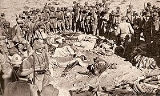
With a decree of November 5, 1911, Italy declared its suzerainty over Libya, although it controlled only some coastal stretches which were almost under siege by the local troops, with the exception of Tripoli. Italian authorities adopted many repressive measures against the rebel
Rebel

A rebel is a participant in a rebellion.Rebel may also refer to:...
s, such as public hanging.

Italy, however, maintained total naval supremacy and could extend its control to almost all of the 2,000 km of the Libyan coast between April and early August 1912. They could not venture beyond the protection of their naval guns though and were limited to a thin coastal strip. Italy began operations against the Turkish possessions in the Aegean Sea
Aegean Sea

The Aegean Sea is an elongated embayment of the Mediterranean Sea located between the southern Balkans and Anatolian peninsulas, i.e., between the mainlands of Greece and Turkey respectively....
 with the approval of the other powers that were eager to end a war that was lasting much longer than expected. Italy occupied twelve islands in the sea, the so-called Dodecanese
Dodecanese

The Dodecanese are a group of 12 larger plus 150 smaller Greece list of islands of Greece in the Aegean Sea, off the southwest coast of Turkey, southward of the island of Samos and northeastward of the island of Crete....
, but this raised the discontent of the Austro-Hungarian Empire
Austria-Hungary

Austria-Hungary, also known as the Austro-Hungarian Empire, the Dual Monarchy or the Kaiserlich und k?niglich Monarchy was a state in Central Europe ruled by the House of Habsburg, constitutionally a personal union between the crowns of the Austrian Empire and the Kingdom of Hungary....
 who feared that this could fuel the irredentism
Irredentism

Irredentism is any position advocating annexation of territories administered by another state on the grounds of common ethnicity or prior historical possession, actual or alleged....
 of nations such as Serbia
Serbia

Serbia , officially the Republic of Serbia , is a country in Central Europe and Balkans Europe, covering the southern part of the Pannonian Plain and the central part of the Balkans....
 and Greece
Greece

Greece , officially the Hellenic Republic , is a country in southeastern Europe, situated on the southern end of the Balkans. It has borders with Albania, Bulgaria and the former Yugoslav Republic of Macedonia to the north, and Turkey to the east....
, causing unbalance in the already fragile situation in the Balkan area.

The only other relevant military operation
Military operation

This article describes three distinct, but related terms: military operations, Operations as military events, and operational level of war....
 of the summer of 1912 was an attack of five Italian torpedo boat
Torpedo boat

A torpedo boat is a relatively small and fast navy ship designed to carry torpedoes into battle. The first designs rammed enemy ships with explosive spar torpedoes, and later designs launched self-propelled Torpedo#Self-propelled torpedoeses....
s in the Dardanelles
Dardanelles

.The Dardanelles , formerly known as the Hellespont, is a narrow strait in northwestern Turkey connecting the Aegean Sea to the Sea of Marmara....
 on July 18. In September, Bulgaria
Bulgaria

The state of Bulgaria , Scientific transliteration Balgarija, officially the Republic of Bulgaria has played a significant role in the Balkans in south-eastern Europe for over fourteen centuries....
, Serbia
Serbia

Serbia , officially the Republic of Serbia , is a country in Central Europe and Balkans Europe, covering the southern part of the Pannonian Plain and the central part of the Balkans....
 and Greece
Greece

Greece , officially the Hellenic Republic , is a country in southeastern Europe, situated on the southern end of the Balkans. It has borders with Albania, Bulgaria and the former Yugoslav Republic of Macedonia to the north, and Turkey to the east....
 prepared their armies for the war against the Ottoman Empire, taking advantage of its difficulties in the war against Italy. On October 8, Montenegro
Montenegro

Montenegro , Montenegrin language/Serbian language: ???? ????, Crna Gora , ) is a country located in Balkans. It has a coast on the Adriatic Sea to the south and is bordered by Croatia to the west, Bosnia and Herzegovina to the northwest, Serbia to the north, Kosovo to the east and Albania to the south....
 declared war against the Turks, starting the Balkan Wars
Balkan Wars

The Balkan Wars were two wars in South-eastern Europe in 1912?1913 in the course of which the Balkan League first conquered Ottoman Empire-held Macedonia , Albania and most of Thrace and then fell out over the division of the spoils....
.

The 1912 Treaty of Lausanne

Italian diplomats decided to take advantage of the situation to obtain a favorable peace deal. On October 18, 1912, Italy and the Ottoman Empire signed a treaty in Ouchy
Ouchy

Ouchy is a commune , port, and popular lakeside resort located south of the city of Lausanne in Switzerland at the edge of the Lake L?man .Very popular with tourists for the views of nearby France , Ouchy is also a favorite area for rollerskating and for skateboarding....
 near Lausanne (the First Treaty of Lausanne). The terms were formally equal to those requested by Istanbul
Istanbul

Istanbul is the largest city in Turkey, List of metropolitan areas in Europe by population, and List of cities proper by population in the world with a population of 12.6 million....
 at the beginning of the war and maintained a formal Ottoman suzerainty over Libya, which received only a semi-autonomous status under the judiciary
Judiciary

In law, the judiciary is the system of courts which administer justice in the name of the Sovereignty or state, a mechanism for the dispute resolution....
 rule of Qadi
Qadi

Qadi is a judge ruling in accordance with the sharia, Islamic religious law. Because Islam makes no distinction between religious and secular domains, qadis traditionally have jurisdiction over all legal matters involving Muslims....
s elected by the Sultan
Sultan

Sultan is an Islamic honorifics, with several historical meanings. Originally it was an Arabic language abstract noun meaning "strength", "authority", or "rulership", derived from the verbal noun ???? sulah, meaning "authority" or "power"....
.

Aftermath


The invasion of Libya was a costly enterprise for Italy. Instead of the 30 million lire
Italian lira

The lira was the currency of Italy between 1861 and 2002. Between 1999 and 2002, the Italian lira was officially a ?national subunit? of the euro....
 a month judged sufficient at its beginning, it reached a cost of 80 million a month for a much longer period than was originally estimated. This caused economical imbalance at home. From a political standpoint, it showed that the lobbying power of an active and organized minority could have great power in the country, as the advent of Fascism
Fascism

Fascism is a Political radicalism, Authoritarianism Nationalism ideology that aims to create a single-party state with a government led by a dictator who seeks national unity and development by requiring individuals to subordinate self-interest to the collective interest of the nation or Race ....
 would show after World War I
World War I

World War I, or the First World War , was a global military conflict which involved the Great powers, organized into two opposing military alliances: the Allies of World War I and the Central Powers....
.

As for Libya, the Italian control over much of its territory remained ineffective until the late 1920s, when forces under the Generals Pietro Badoglio
Pietro Badoglio

Pietro Badoglio, 1st Duke of Addis Abeba, 1st Marquess of el Sabotino , was an Italy soldier and politician. He was a member of the National Fascist Party and commanded his nation's troops under Italian dictator Benito Mussolini in the Second Italo-Abyssinian War; his efforts gained him the title Duke of Addis Abeba....
 and Rodolfo Graziani
Rodolfo Graziani

Rodolfo Graziani, Marquess di Neghelli , was an officer in the Kingdom of Italy Regio Esercito who led military expeditions in Africa before and during World War II....
 waged punitive pacification campaigns which turned into brutal and bloody acts of repression
Repression

Repression may refer to:* Memory inhibition, a critical component of an effective memory system* Political repression, the oppression or persecution of an individual or group for political reasons...
. Resistance petered out only after the execution of the rebel leader Omar Mukhtar
Omar Mukhtar

Omar Mukhtar was from the wiktionary:tribe of Mnifa, born in a small village called Janzour located in the eastern part of Barqa. He was the leader of the resistance movement against the Kingdom of Italy colonization of Libya for more than twenty years....
 on September 15, 1931.

Because of WWI, the Dodecanese
Dodecanese

The Dodecanese are a group of 12 larger plus 150 smaller Greece list of islands of Greece in the Aegean Sea, off the southwest coast of Turkey, southward of the island of Samos and northeastward of the island of Crete....
 islands remained under Italian military occupation
Military occupation

Belligerent military occupation occurs when the control and authority over a territory passes to a belligerent....
. According to the 1920 Treaty of Sevres
Treaty of Sèvres

The Treaty of S?vres was the peace treaty between the Ottoman Empire and Allies of World War I at the end of World War I. The Treaty of Versailles was signed with Germany before this treaty to annul the German concessions including the economic rights and enterprises....
, Italy was supposed to cede most of the islands (except Rhodes
Rhodes

Rhodes is a Greece List of islands of Greece approximately southwest of Turkey in eastern Aegean Sea. It is the largest of the Dodecanese islands in terms of both land area and population, with a population of 117,007 of which 53,709 resided in the Rhodes capital city of the island....
) to Greece, in exchange for a vast Italian zone of influence in southwest Anatolia
Anatolia

Anatolia or Asia Minor is a region of Western Asia, comprising most of the modern Republic of Turkey. It is a geographic region bounded by the Black Sea to the north, the Caucasus to the northeast, the Aegean Sea to the west, the Mediterranean Sea to the south, and the Iranian plateau to the east and southeast....
.

Yet the Greek defeat in the Greco-Turkish War
Greco-Turkish War (1919-1922)

The Greco-Turkish War of 1919?1922, also called the War in Asia Minor, or the Greek campaign of the Turkish War of Independence, was a series of military events occurring during the partitioning of the Ottoman Empire after World War I between May 1919 and October 1922....
 and the foundation of modern Turkey created a new situation that made the enforcement of the terms of this treaty impossible. In article 15 of the 1923 Treaty of Lausanne
Treaty of Lausanne

The Treaty of Lausanne was a peace treaty signed in Lausanne, Switzerland, that settled the Anatolian and Eastern Thrace parts of the partitioning of the Ottoman Empire by annulment of the Treaty of S?vres that was signed by the Istanbul-based Sublime Porte; as the consequence of the Turkish War of Independence between the Allies of World W...
, which superseded the 1920 Treaty of Sevres
Treaty of Sèvres

The Treaty of S?vres was the peace treaty between the Ottoman Empire and Allies of World War I at the end of World War I. The Treaty of Versailles was signed with Germany before this treaty to annul the German concessions including the economic rights and enterprises....
, Turkey formally recognized the Italian annexation of the Dodecanese
Dodecanese

The Dodecanese are a group of 12 larger plus 150 smaller Greece list of islands of Greece in the Aegean Sea, off the southwest coast of Turkey, southward of the island of Samos and northeastward of the island of Crete....
 islands.

See also

  • History of Italy
    History of Italy

    Italy, united in 1861, has significantly contributed to the culture and social development of the entire Mediterranean Sea area. Important cultures and civilizations have existed there since prehistoric times....
  • Italian rule in Libya
    History of Libya

    The history of Libya includes the history of its rich mix of people added to the indigenous Berber people tribes. For most of their history, the people of Libya have been subjected to varying degrees of foreign control....
  • Italian Empire
  • History of Turkey
    History of Turkey

    The History of Turkey may refer to:* History of the Turkic peoples, a broad linguistic group* History of the Turkish people, the people who presently live in, or are from, Turkey...
  • History of the Ottoman Empire
    Ottoman Empire

    The Ottoman Empire , also known by its contemporaries as the Turkish Empire or Turkey , was an empire that lasted from 1299?1923. It was Treaty of Lausanne by the Republic of Turkey, which was officially proclaimed on October 29, 1923....
  • Balkan Wars
    Balkan Wars

    The Balkan Wars were two wars in South-eastern Europe in 1912?1913 in the course of which the Balkan League first conquered Ottoman Empire-held Macedonia , Albania and most of Thrace and then fell out over the division of the spoils....
  • Treaty of Lausanne
    Treaty of Lausanne

    The Treaty of Lausanne was a peace treaty signed in Lausanne, Switzerland, that settled the Anatolian and Eastern Thrace parts of the partitioning of the Ottoman Empire by annulment of the Treaty of S?vres that was signed by the Istanbul-based Sublime Porte; as the consequence of the Turkish War of Independence between the Allies of World W...