


Imbros

Encyclopedia
Imbros or Imroz, officially referred to as Gökçeada since July 29, 1970 (older name in Turkish
: İmroz; Greek
: Ίμβρος – Imvros), is an island in the Aegean Sea
and the largest island of Turkey
, part of Çanakkale Province
. It is located at the entrance of Saros Bay
and is also the westernmost point of Turkey (Cape İncirburnu
). Imbros has an area of 279 km² (107.7 sq mi) and contains some wooded areas.
According to the 2000 census, the island of Imbros had a total population of 8,875. The same census also reported 7,254 people in Cinarli, and 1,621 in the remaining villages. The main industries of Imbros are fishing and tourism. The population is predominantly Turkish but there are still about 250 Greeks on Imbros, most of them elderly. The island was primarily inhabited by ethnic Greeks from ancient times through to approximately the middle of the twentieth century, when many emigrated to Greece, western Europe, the United States and Australia, due to a campaign of state-sponsored discrimination. The island is noted for its vineyard
s and wine
production.
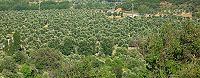
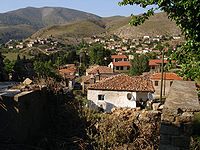
 Çınarlı : Çınarlı is the main town on Imbros, known as Panaghia Balomeni (Παναγία Μπαλωμένη) in Greek. Most of the settlements on Imbros were given Turkish names in 1926. Çınarlı is in the middle of the island; there is a small airport under construction nearby.
Bademli köyü : Older Greek name is Gliky (Γλυκύ). It is located to the northeast of the island, between Çınarlı town and Kaleköy/Kastro.
Dereköy : Older Greek name is Schoinoudi (Σχοινούδι). It is located at the center of the west side of island. Due to the emigration of the Greek population (largely to New Zealand and the USA; some to Greece and Istanbul before the 1970s), Dereköy is largely empty today. However, many people return on every 15 August for the festival of the Virgin Mary.
Eşelek / Karaca köyü :
It is located at the southeast of the island. It is an agricultural area that produces fruit and vegetables.
Kaleköy : Older name is Kastro (Κάστρο) (Latin and Greek for castle
). Located on the north-eastern coast of island, there is an antique castle near the village. Kaleköy also has a small port which was constructed by the French Navy during the occupation in the First World War, and is now used for fishing-boats and yachts.
Şahinkaya köyü : It is located near Dereköy.
Şirinköy : It is located in the southwest of island.
Tepeköy : Older Greek name is Agridia (Αγριδιά). It is located in the north of the island, and is home to the largest Greek population on the island. Barba Yorgo is a well-known inhabitant of the island. An extinct volcano is located south of village which is the highest point of island.
Uğurlu köyü : It is located in the west of the island.
Yeni Bademli köyü : It is located at the center-northeast of island, near Bademli. It has many motels and pensions.
Yenimahalle : Older Greek name is Evlampio (Ευλάμπιο). It is located near Çınarlı Town on the road to Kuzulimanı port.
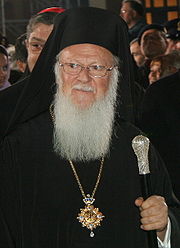
Zeytinli köyü : Older Greek name is Aghios Theodoros (Άγιος Θεόδωρος). Demetrios Archontonis, known as Ecumenical Patriarch Bartholomew I of Constantinople, was born there on 29 February 1940. It has a famous café where Madam Dibek (elderly Greek lady) used to serve her special Turkish/Greek style coffee
which is prepared in a hand mortar. After she died, her husband is now continuing her legacy.
Others : Yeni Bademli köyü, Eşelek / Karaca köyü, Şahinkaya köyü, Şirinköy and Uğurlu köyü were established after 1970.
Kapıkaya (Stenos) beach:
Kaşkaval peninsula / (Kaskaval): Scuba diving
Kuzulimanı (Haghios Kyrikas): Ferryport with 24-hour ferries to Gelibolu
–Kabatepe
port and Çanakkale
port.
Mavikoy/Bluebay: The first national underwater park in Turkey. Scuba diving allowed for recreational purposes.
Marmaros beach: Also has a small waterfall.
Pınarbaşı (Spilya) beach: Longest (and most sandy) beach on the island.
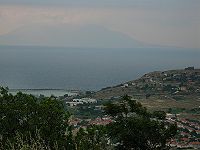 According to Greek mythology
, the palace of Thetis
, mother of Achilles
, king of Phthia
, was situated between Imbros and Samothrace
. The stables of the winged horses of Poseidon
were said to lie between Imbros and Tenedos.
Homer
wrote:
, was an Athenian cleruchy
, a colony
whose settlers retained Athenian citizenship; although since the Imbrians appear on the Athenian tribute lists, there may have been a division with the native population. The original inhabitants of Imbros were Pelasgians
. Miltiades
conquered the island from Persia after the battle of Salamis
; the colony was established about 450 BC, during the first Athenian empire, and was retained by Athens (with brief exceptions) for the next six centuries. It may have become independent under Septimius Severus
.
Because of their strategic position near the Dardanelles
, the western powers, particularly Britain
, insisted at the end of the Balkan Wars
in 1913 that the island should be retained by the Ottoman Empire
when the other Aegean islands were ceded to Greece
. However, the islands remained under Greek administration.
In 1920, the Treaty of Sèvres
with the defeated Ottoman Empire
granted the island to Greece. The Ottoman government, which signed but did not ratify the treaty, was overthrown by the new Turkish nationalist Government of Mustafa Kemal Atatürk
, based in Ankara. After the Greco-Turkish War
ended in Greek defeat in Anatolia, and the fall of Lloyd George
and his Middle Eastern policies, the western powers agreed to the Treaty of Lausanne
with the new Turkish Republic, in 1923. This treaty made the island part of Turkey; but it guaranteed a special autonomous administrative status for Imbros and Tenedos to accommodate the Greeks, and excluded them from the population exchange
that took place between Greece and Turkey
, due to their presence there as a majority.
However shortly after the legislation of "Civil Law" on 17 February 1926 (Medeni Kanun), the rights accorded to minorities in Turkey were revoked, in violation of the Lausanne Treaty. The first concrete sign of Turkification
policy was undertaken in 1946, where the Turkish authorities installed the first wave of Turkish settlers from the Black Sea region. Massive scale persecution against the local Greek element started at 1961, as part of the Eritme Programmi operation that aimed at the elimination of Greek education and the enforcement of economic, psychological pressure and violence. Under these conditions the Turkish government approved the appropriation of the 90% of the cultivated areas of the island and the settlement of additional 6,000 ethnic Turks from mainland Turkey. Additional population settlements from Anatolia occurred in 1973, 1984 and 2000. The state provided special credit opportunities and agricultural aid in kind to those who would decide to settle in in the island. On the other hand the indigenous Greek population being deprived of its means of production and
facing hostile behaviour from the government and the newly arrived settlers, left its native land. The peak of this exodus was in
1974.
had a strong presence on the island.
Article 14 of the Treaty of Lausanne
(1923) exempted Imbros and Tenedos from the large-scale population exchange that took place between Greece and Turkey, and required Turkey to accommodate the local Greek majority and their rights:
Thus, under the Turkish Republic, the islands were to be largely autonomous and self-governing, with their own police force. This provision was not guaranteed by anything more than the faith of the Treaty.
 The Greek émigrés from Turkey assert numerous violations of the religious, linguistic, and economic rights guaranteed as matters of international concern by the Treaty, including freedom of the Orthodox religion and the right to practice the professions. Leaders of the Greek community in Turkey "voluntarily waived" these rights in 1926; but the Treaty provides (Article 44) that these rights can only be modified by the consent of the majority of the Council of League of Nations. The émigrés assert that the signatures to the waivers were obtained by orders of the police, and that Avrilios Spatharis and Savvas Apostologlou, who refused to sign, were imprisoned. The Greek government appealed this action to the Council and was upheld, but Turkey has not complied.
In addition, the following grievances apply particularly to Imbros:
All of these events have led to the Greeks emigrating from both islands. Before 1964, the population of Imbros was 7000 Greeks, and 200 mainland Turkish officials; by 1970 the Greeks were a minority at 40% of the population, and there remains only a very small Greek community on Imbros today, comprising several hundred mostly elderly people. Most of the former Greeks of Imbros and Tenedos are in diaspora
in Greece, the United States
, and Australia
.
Ref: Gökçeada Municipality official page
Ref: Alanur Çavlin Bozbeyoğlu, Işıl Onan, "Changes in the demographic characteristics of Gökçeada"
Turkish language
Turkish is a language spoken as a native language by over 83 million people worldwide, making it the most commonly spoken of the Turkic languages. Its speakers are located predominantly in Turkey and Northern Cyprus with smaller groups in Iraq, Greece, Bulgaria, the Republic of Macedonia, Kosovo,...
: İmroz; Greek
Greek language
Greek is an independent branch of the Indo-European family of languages. Native to the southern Balkans, it has the longest documented history of any Indo-European language, spanning 34 centuries of written records. Its writing system has been the Greek alphabet for the majority of its history;...
: Ίμβρος – Imvros), is an island in the Aegean Sea
Aegean Sea
The Aegean Sea[p] is an elongated embayment of the Mediterranean Sea located between the southern Balkan and Anatolian peninsulas, i.e., between the mainlands of Greece and Turkey. In the north, it is connected to the Marmara Sea and Black Sea by the Dardanelles and Bosporus...
and the largest island of Turkey
Turkey
Turkey , known officially as the Republic of Turkey , is a Eurasian country located in Western Asia and in East Thrace in Southeastern Europe...
, part of Çanakkale Province
Çanakkale Province
Çanakkale Province is a province of Turkey, located in the northwestern part of the country. It takes its name from the town of Çanakkale.Like Istanbul, Çanakkale province has a European and an Asian part. The European part is formed by the Gallipoli peninsula, while the Asian part is largely...
. It is located at the entrance of Saros Bay
Saros Bay
Saros Bay or Gulf of Saros is an inlet of the northern Aegean Sea located north of the Gallipoli Peninsula in northwestern Turkey.The bay is 75 km long and 35 km wide. Far from industrialized areas and thanks to underwater currents, it is a popular summer recreation resort with sandy...
and is also the westernmost point of Turkey (Cape İncirburnu
Incirburnu, Gökçeada
İncirburnu, also Avlaka Burnu or İnceburun, is the westernmost point of Turkey. It is located at Gökçeada , at the entrance of Gulf of Saros in the northern Aegean Sea.-See also:*Imbros...
). Imbros has an area of 279 km² (107.7 sq mi) and contains some wooded areas.
According to the 2000 census, the island of Imbros had a total population of 8,875. The same census also reported 7,254 people in Cinarli, and 1,621 in the remaining villages. The main industries of Imbros are fishing and tourism. The population is predominantly Turkish but there are still about 250 Greeks on Imbros, most of them elderly. The island was primarily inhabited by ethnic Greeks from ancient times through to approximately the middle of the twentieth century, when many emigrated to Greece, western Europe, the United States and Australia, due to a campaign of state-sponsored discrimination. The island is noted for its vineyard
Vineyard
A vineyard is a plantation of grape-bearing vines, grown mainly for winemaking, but also raisins, table grapes and non-alcoholic grape juice...
s and wine
Wine
Wine is an alcoholic beverage, made of fermented fruit juice, usually from grapes. The natural chemical balance of grapes lets them ferment without the addition of sugars, acids, enzymes, or other nutrients. Grape wine is produced by fermenting crushed grapes using various types of yeast. Yeast...
production.
Geography
Bademli köyü : Older Greek name is Gliky (Γλυκύ). It is located to the northeast of the island, between Çınarlı town and Kaleköy/Kastro.
Dereköy : Older Greek name is Schoinoudi (Σχοινούδι). It is located at the center of the west side of island. Due to the emigration of the Greek population (largely to New Zealand and the USA; some to Greece and Istanbul before the 1970s), Dereköy is largely empty today. However, many people return on every 15 August for the festival of the Virgin Mary.
Eşelek / Karaca köyü :
It is located at the southeast of the island. It is an agricultural area that produces fruit and vegetables.
Kaleköy : Older name is Kastro (Κάστρο) (Latin and Greek for castle
Castle
A castle is a type of fortified structure built in Europe and the Middle East during the Middle Ages by European nobility. Scholars debate the scope of the word castle, but usually consider it to be the private fortified residence of a lord or noble...
). Located on the north-eastern coast of island, there is an antique castle near the village. Kaleköy also has a small port which was constructed by the French Navy during the occupation in the First World War, and is now used for fishing-boats and yachts.
Şahinkaya köyü : It is located near Dereköy.
Şirinköy : It is located in the southwest of island.
Tepeköy : Older Greek name is Agridia (Αγριδιά). It is located in the north of the island, and is home to the largest Greek population on the island. Barba Yorgo is a well-known inhabitant of the island. An extinct volcano is located south of village which is the highest point of island.
Uğurlu köyü : It is located in the west of the island.
Yeni Bademli köyü : It is located at the center-northeast of island, near Bademli. It has many motels and pensions.
Yenimahalle : Older Greek name is Evlampio (Ευλάμπιο). It is located near Çınarlı Town on the road to Kuzulimanı port.
Zeytinli köyü : Older Greek name is Aghios Theodoros (Άγιος Θεόδωρος). Demetrios Archontonis, known as Ecumenical Patriarch Bartholomew I of Constantinople, was born there on 29 February 1940. It has a famous café where Madam Dibek (elderly Greek lady) used to serve her special Turkish/Greek style coffee
Turkish coffee
Turkish coffee is a method of preparing coffee where finely powdered roast coffee beans are boiled in a pot , with sugar according to taste, before being served into a cup where the dregs settle...
which is prepared in a hand mortar. After she died, her husband is now continuing her legacy.
Others : Yeni Bademli köyü, Eşelek / Karaca köyü, Şahinkaya köyü, Şirinköy and Uğurlu köyü were established after 1970.
Places to see
Gelibolu
Gelibolu, also known as Gallipoli , is the name of a town and a district in Çanakkale Province of the Marmara region, located in Eastern Thrace in the European part of Turkey on the southern shore of the peninsula named after it on the Dardanelles strait, two miles away from Lapseki on the other...
–Kabatepe
Kabatepe
Kabatepe, or Gaba Tepe, is a headland overlooking the northern Aegean Sea in what is now the Gallipoli Historic National Park, on the Gallipoli peninsula in northwestern Turkey....
port and Çanakkale
Çanakkale
Çanakkale is a town and seaport in Turkey, in Çanakkale Province, on the southern coast of the Dardanelles at their narrowest point. The population of the town is 106,116 . The mayor is Ülgür Gökhan ....
port.
In mythology
Greek mythology
Greek mythology is the body of myths and legends belonging to the ancient Greeks, concerning their gods and heroes, the nature of the world, and the origins and significance of their own cult and ritual practices. They were a part of religion in ancient Greece...
, the palace of Thetis
Thetis
Silver-footed Thetis , disposer or "placer" , is encountered in Greek mythology mostly as a sea nymph or known as the goddess of water, one of the fifty Nereids, daughters of the ancient one of the seas with shape-shifting abilities who survives in the historical vestiges of most later Greek myths...
, mother of Achilles
Achilles
In Greek mythology, Achilles was a Greek hero of the Trojan War, the central character and the greatest warrior of Homer's Iliad.Plato named Achilles the handsomest of the heroes assembled against Troy....
, king of Phthia
Phthia
Phthia , Phthíē ) in ancient Greece was the southernmost region of ancient Thessaly, on both sides of Othrys Mountain. It was the homeland of the Myrmidones tribe, who took part in the Trojan War under Achilles....
, was situated between Imbros and Samothrace
Samothrace
Samothrace is a Greek island in the northern Aegean Sea. It is a self-governing municipality within the Evros peripheral unit of Thrace. The island is long and is in size and has a population of 2,723 . Its main industries are fishing and tourism. Resources on the island includes granite and...
. The stables of the winged horses of Poseidon
Poseidon
Poseidon was the god of the sea, and, as "Earth-Shaker," of the earthquakes in Greek mythology. The name of the sea-god Nethuns in Etruscan was adopted in Latin for Neptune in Roman mythology: both were sea gods analogous to Poseidon...
were said to lie between Imbros and Tenedos.
Homer
Homer
In the Western classical tradition Homer , is the author of the Iliad and the Odyssey, and is revered as the greatest ancient Greek epic poet. These epics lie at the beginning of the Western canon of literature, and have had an enormous influence on the history of literature.When he lived is...
wrote:
- In the depths of the sea on the cliff
- Between Tenedos and craggy Imbros
- There is a cave, wide gaping
- Poseidon who made the earth tremble,
- stopped the horses there.
In antiquity
In classical antiquity, Imbros, like LemnosLemnos
Lemnos is an island of Greece in the northern part of the Aegean Sea. Administratively the island forms a separate municipality within the Lemnos peripheral unit, which is part of the North Aegean Periphery. The principal town of the island and seat of the municipality is Myrina...
, was an Athenian cleruchy
Cleruchy
A cleruchy in Hellenic Greece, was a specialized type of colony established by Athens. The term comes from the Greek word , klērouchos, literally "lot-holder"....
, a colony
Colony
In politics and history, a colony is a territory under the immediate political control of a state. For colonies in antiquity, city-states would often found their own colonies. Some colonies were historically countries, while others were territories without definite statehood from their inception....
whose settlers retained Athenian citizenship; although since the Imbrians appear on the Athenian tribute lists, there may have been a division with the native population. The original inhabitants of Imbros were Pelasgians
Pelasgians
The name Pelasgians was used by some ancient Greek writers to refer to populations that were either the ancestors of the Greeks or who preceded the Greeks in Greece, "a hold-all term for any ancient, primitive and presumably indigenous people in the Greek world." In general, "Pelasgian" has come...
. Miltiades
Miltiades
Miltiades or Miltiadis is a Greek name. Several historic persons have been called Miltiades .* Miltiades the Elder wealthy Athenian, and step-uncle of Miltiades the Younger...
conquered the island from Persia after the battle of Salamis
Battle of Salamis
The Battle of Salamis was fought between an Alliance of Greek city-states and the Persian Empire in September 480 BCE, in the straits between the mainland and Salamis, an island in the Saronic Gulf near Athens...
; the colony was established about 450 BC, during the first Athenian empire, and was retained by Athens (with brief exceptions) for the next six centuries. It may have become independent under Septimius Severus
Septimius Severus
Septimius Severus , also known as Severus, was Roman Emperor from 193 to 211. Severus was born in Leptis Magna in the province of Africa. As a young man he advanced through the customary succession of offices under the reigns of Marcus Aurelius and Commodus. Severus seized power after the death of...
.
Between Turkey and Greece
Between November 1912 and September 1923, Imbros, together with Tenedos, were under Greek administration. Both islands were overwhelmingly Greek, and in the case of Imbros the population was entirely Greek.Because of their strategic position near the Dardanelles
Dardanelles
The Dardanelles , formerly known as the Hellespont, is a narrow strait in northwestern Turkey connecting the Aegean Sea to the Sea of Marmara. It is one of the Turkish Straits, along with its counterpart the Bosphorus. It is located at approximately...
, the western powers, particularly Britain
United Kingdom
The United Kingdom of Great Britain and Northern IrelandIn the United Kingdom and Dependencies, other languages have been officially recognised as legitimate autochthonous languages under the European Charter for Regional or Minority Languages...
, insisted at the end of the Balkan Wars
Balkan Wars
The Balkan Wars were two conflicts that took place in the Balkans in south-eastern Europe in 1912 and 1913.By the early 20th century, Montenegro, Bulgaria, Greece and Serbia, the countries of the Balkan League, had achieved their independence from the Ottoman Empire, but large parts of their ethnic...
in 1913 that the island should be retained by the Ottoman Empire
Ottoman Empire
The Ottoman EmpireIt was usually referred to as the "Ottoman Empire", the "Turkish Empire", the "Ottoman Caliphate" or more commonly "Turkey" by its contemporaries...
when the other Aegean islands were ceded to Greece
Greece
Greece , officially the Hellenic Republic , and historically Hellas or the Republic of Greece in English, is a country in southeastern Europe....
. However, the islands remained under Greek administration.
In 1920, the Treaty of Sèvres
Treaty of Sèvres
The Treaty of Sèvres was the peace treaty between the Ottoman Empire and Allies at the end of World War I. The Treaty of Versailles was signed with Germany before this treaty to annul the German concessions including the economic rights and enterprises. Also, France, Great Britain and Italy...
with the defeated Ottoman Empire
Ottoman Empire
The Ottoman EmpireIt was usually referred to as the "Ottoman Empire", the "Turkish Empire", the "Ottoman Caliphate" or more commonly "Turkey" by its contemporaries...
granted the island to Greece. The Ottoman government, which signed but did not ratify the treaty, was overthrown by the new Turkish nationalist Government of Mustafa Kemal Atatürk
Mustafa Kemal Atatürk
Mustafa Kemal Atatürk was an Ottoman and Turkish army officer, revolutionary statesman, writer, and the first President of Turkey. He is credited with being the founder of the Republic of Turkey....
, based in Ankara. After the Greco-Turkish War
Greco-Turkish War (1919-1922)
The Greco–Turkish War of 1919–1922, known as the Western Front of the Turkish War of Independence in Turkey and the Asia Minor Campaign or the Asia Minor Catastrophe in Greece, was a series of military events occurring during the partitioning of the Ottoman Empire after World War I between May...
ended in Greek defeat in Anatolia, and the fall of Lloyd George
David Lloyd George
David Lloyd George, 1st Earl Lloyd-George of Dwyfor OM, PC was a British Liberal politician and statesman...
and his Middle Eastern policies, the western powers agreed to the Treaty of Lausanne
Treaty of Lausanne
The Treaty of Lausanne was a peace treaty signed in Lausanne, Switzerland on 24 July 1923, that settled the Anatolian and East Thracian parts of the partitioning of the Ottoman Empire. The treaty of Lausanne was ratified by the Greek government on 11 February 1924, by the Turkish government on 31...
with the new Turkish Republic, in 1923. This treaty made the island part of Turkey; but it guaranteed a special autonomous administrative status for Imbros and Tenedos to accommodate the Greeks, and excluded them from the population exchange
Population exchange between Greece and Turkey
The 1923 population exchange between Greece and Turkey was based upon religious identity, and involved the Greek Orthodox citizens of Turkey and the Muslim citizens of Greece...
that took place between Greece and Turkey
Turkey
Turkey , known officially as the Republic of Turkey , is a Eurasian country located in Western Asia and in East Thrace in Southeastern Europe...
, due to their presence there as a majority.
However shortly after the legislation of "Civil Law" on 17 February 1926 (Medeni Kanun), the rights accorded to minorities in Turkey were revoked, in violation of the Lausanne Treaty. The first concrete sign of Turkification
Turkification
Turkification is a term used to describe a process of cultural or political change in which something or someone who is not a Turk becomes one, voluntarily or involuntarily...
policy was undertaken in 1946, where the Turkish authorities installed the first wave of Turkish settlers from the Black Sea region. Massive scale persecution against the local Greek element started at 1961, as part of the Eritme Programmi operation that aimed at the elimination of Greek education and the enforcement of economic, psychological pressure and violence. Under these conditions the Turkish government approved the appropriation of the 90% of the cultivated areas of the island and the settlement of additional 6,000 ethnic Turks from mainland Turkey. Additional population settlements from Anatolia occurred in 1973, 1984 and 2000. The state provided special credit opportunities and agricultural aid in kind to those who would decide to settle in in the island. On the other hand the indigenous Greek population being deprived of its means of production and
facing hostile behaviour from the government and the newly arrived settlers, left its native land. The peak of this exodus was in
1974.
The Greek population
The island was primarily inhabited by ethnic Greeks from ancient times through to approximately the middle of the twentieth century. Data dating from 1922 taken under Greek rule and 1927 data taken under Turkish rule showed a strong majority of Greek inhabitants on Imbros, and the Greek Orthodox ChurchGreek Orthodox Church
The Greek Orthodox Church is the body of several churches within the larger communion of Eastern Orthodox Christianity sharing a common cultural tradition whose liturgy is also traditionally conducted in Koine Greek, the original language of the New Testament...
had a strong presence on the island.
Article 14 of the Treaty of Lausanne
Treaty of Lausanne
The Treaty of Lausanne was a peace treaty signed in Lausanne, Switzerland on 24 July 1923, that settled the Anatolian and East Thracian parts of the partitioning of the Ottoman Empire. The treaty of Lausanne was ratified by the Greek government on 11 February 1924, by the Turkish government on 31...
(1923) exempted Imbros and Tenedos from the large-scale population exchange that took place between Greece and Turkey, and required Turkey to accommodate the local Greek majority and their rights:
The islands of Imbros and Tenedos, remaining under Turkish sovereignty, shall enjoy a special administrative organisation composed of local elements and furnishing every guarantee for the native non-Moslem population insofar as concerns local administration and the protection of persons and property. The maintenance of order will be assured therein by a police force recruited from amongst the local population by the local administration above provided for and placed under its orders.
Thus, under the Turkish Republic, the islands were to be largely autonomous and self-governing, with their own police force. This provision was not guaranteed by anything more than the faith of the Treaty.
Human rights
In addition, the following grievances apply particularly to Imbros:
- In 1923, Turkey dismissed the elected government of the island, and installed mainlanders. 1500 Imbriots who had taken refuge from the Turkish War of IndependenceTurkish War of IndependenceThe Turkish War of Independence was a war of independence waged by Turkish nationalists against the Allies, after the country was partitioned by the Allies following the Ottoman Empire's defeat in World War I...
on LemnosLemnosLemnos is an island of Greece in the northern part of the Aegean Sea. Administratively the island forms a separate municipality within the Lemnos peripheral unit, which is part of the North Aegean Periphery. The principal town of the island and seat of the municipality is Myrina...
and in Thessalonica were denied the right to return, as undesirables. - In 1927, the system of local administration on Imbros was abolished, and the Greek schools closed. In 1952-3, the Greek Imbriots were permitted to build new ones, closed again in 1964.
- In 1943, Turkey arrested the Metropolitan of Imbros and Tenedos with other Orthodox clerics. They also confiscated the lands on Imbros belonging to the monasteries of Great LavraGreat LavraThis is the monastery on Mount Athos. For the monastery associated with Saint Sabbas, see Mar Saba.The Monastery of Great Lavra is the first monastery built on Mount Athos. It is located on the southeastern foot of the Mount at an elevation of 160 metres...
and KoutloumousiouKoutloumousiou monasteryKoutloumousiou monastery is an Eastern Orthodox monastery at the monastic state of Mount Athos in Greece. The monastery ranks sixth in the hierarchy of the Athonite monasteries....
on Mount AthosMount AthosMount Athos is a mountain and peninsula in Macedonia, Greece. A World Heritage Site, it is home to 20 Eastern Orthodox monasteries and forms a self-governed monastic state within the sovereignty of the Hellenic Republic. Spiritually, Mount Athos comes under the direct jurisdiction of the...
, expelled the tenants, and installed settlers; when the Mayor of Imbros and four village elders protested, they were arrested and sent to the mainland. - Between 1964 and 1984, almost all the usable land on Imbros had been expropriated, for inadequate compensation, for an army camp, a minimum-security prison, reforestation projects, a dam project, and a national park.
- Nicholas Palaiopoulos, a town councilor, was arrested and imprisoned in 1966 for complaining to the Greek Ambassador on the latter's visit to Imbros; he, together with the Mayor of Imbros and 20 others, was imprisoned again in 1974.
- The old Cathedral at Kastro (Kaleköy) was desecrated on the night of the Turkish landing on Cyprus in 1974 ; the present Cathedral was looted in March 1993; criminal activities have included a number of rapes and murders, officially blamed on convicts and soldiers, but none of them has been solved.
- In July 1993, the Turkish National Security began a program to settle mainland Turks on Imbros (and Tenedos).
All of these events have led to the Greeks emigrating from both islands. Before 1964, the population of Imbros was 7000 Greeks, and 200 mainland Turkish officials; by 1970 the Greeks were a minority at 40% of the population, and there remains only a very small Greek community on Imbros today, comprising several hundred mostly elderly people. Most of the former Greeks of Imbros and Tenedos are in diaspora
Diaspora
A diaspora is "the movement, migration, or scattering of people away from an established or ancestral homeland" or "people dispersed by whatever cause to more than one location", or "people settled far from their ancestral homelands".The word has come to refer to historical mass-dispersions of...
in Greece, the United States
United States
The United States of America is a federal constitutional republic comprising fifty states and a federal district...
, and Australia
Australia
Australia , officially the Commonwealth of Australia, is a country in the Southern Hemisphere comprising the mainland of the Australian continent, the island of Tasmania, and numerous smaller islands in the Indian and Pacific Oceans. It is the world's sixth-largest country by total area...
.
Population change in Imbros
| Town & Villages | 1927 | 1970 | 1975 | 1980 | 1985 | 1990 | 1997 | 2000 | ||||||||
| Çınarlı (Panaghia Balomeni) | - | - | 3578 | 615 | 3806 | 342 | 4251 | 216 | 767 | 70 | 721 | 40 | 553 | 26 | 503 | 29 |
| Bademli (Gliky) | - | - | 66 | 144 | 1 | 57 | 40 | 1 | 13 | 34 | 29 | 22 | 15 | 15 | 15 | 13 |
| Dereköy (Shinudy) | - | - | 73 | 672 | 391 | 378 | 319 | 214 | 380 | 106 | 99 | 68 | 82 | 40 | 68 | 42 |
| Eşelek | - | - | - | - | - | - | - | - | - | - | - | - | - | - | 152 | - |
| Fatih | - | - | - | - | - | - | - | - | 3962 | 45 | 4284 | 32 | 4135 | 21 | 4180 | 25 |
| Kaleköy (Kastro) | - | - | 38 | 36 | 24 | - | - | 128 | 94 | - | 105 | - | 90 | - | 89 | - |
| Şahinkaya | - | - | - | - | - | - | - | - | - | - | 168 | - | 107 | - | 86 | - |
| Şirinköy | - | - | - | - | - | - | - | - | - | - | - | - | - | - | 189 | - |
| Tepeköy (Agridia) | - | - | 3 | 504 | 4 | 273 | 2 | 193 | 1 | 110 | 75 | 2 | 2 | 39 | 2 | 42 |
| Uğurlu | - | - | - | - | - | - | - | - | 460 | - | 490 | - | 466 | - | 401 | - |
| Yenibademli | - | - | - | - | - | - | - | - | 416 | - | 660 | - | 628 | - | 581 | - |
| Yenimahalle (Evlampio) | - | - | 182 | 143 | 162 | 121 | 231 | 81 | 359 | 59 | 970 | 27 | 2240 | 25 | 2362 | 27 |
| Zeytinli (Aghios Theodoros) | - | - | 30 | 507 | 15 | 369 | 36 | 235 | 72 | 162 | 25 | 130 | 12 | 82 | 12 | 76 |
| TOTAL | 157 | 6555 | 3970 | 2621 | 4403 | 1540 | 4879 | 1068 | 6524 | 586 | 7626 | 321 | 8330 | 248 | 8640 | 254 |
Ref: Gökçeada Municipality official page
Ref: Alanur Çavlin Bozbeyoğlu, Işıl Onan, "Changes in the demographic characteristics of Gökçeada"
Notable people from Imbros
- Ecumenical Patriarch Bartholomew I of Constantinople, spiritual leader of the Eastern Orthodox ChurchEastern Orthodox ChurchThe Orthodox Church, officially called the Orthodox Catholic Church and commonly referred to as the Eastern Orthodox Church, is the second largest Christian denomination in the world, with an estimated 300 million adherents mainly in the countries of Belarus, Bulgaria, Cyprus, Georgia, Greece,...
. - Michael Critobulus 15th century politician and historian.
- Archbishop Iakovos of America, Primate of the Greek Orthodox Archdiocese of North and South America (1959-1996).
- Sheikh Mustafa Ruhi EfendiSheikh Mustafa Ruhi EfendiSheikh Mustafa Ruhi Efendi was an religious and political leader in the Balkans during the Ottoman period. He was based in the city of Kalkandelen,...
(1800–1893), religious (Naqshbandi) and political leader in the Balkans during the Ottoman period.
See also
- Treaty of LausanneTreaty of LausanneThe Treaty of Lausanne was a peace treaty signed in Lausanne, Switzerland on 24 July 1923, that settled the Anatolian and East Thracian parts of the partitioning of the Ottoman Empire. The treaty of Lausanne was ratified by the Greek government on 11 February 1924, by the Turkish government on 31...
- Greco-Turkish relationsGreco-Turkish relationsThe relations between the Greek and the Turkish states have been marked by alternating periods of mutual hostility and reconciliation ever since Greece won its independence from the Ottoman Empire in 1821...
- Treaty of SèvresTreaty of SèvresThe Treaty of Sèvres was the peace treaty between the Ottoman Empire and Allies at the end of World War I. The Treaty of Versailles was signed with Germany before this treaty to annul the German concessions including the economic rights and enterprises. Also, France, Great Britain and Italy...
- TenedosTenedosTenedos or Bozcaada or Bozdja-Ada is a small island in the Aegean Sea, part of the Bozcaada district of Çanakkale province in Turkey. , Tenedos has a population of about 2,354. The main industries are tourism, wine production and fishing...
- List of Greek countries and regions
External links
- Gökçeada official
- Çanakkale Municipality
- Gokceada Municipality
- Gokceada Airport
- Gökçeada, from ncyclopædia Britannica|Britannica Student Encyclopedia]
- Website of Imvrians Association (Athens).