

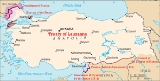
Treaty of Lausanne

Encyclopedia
The Treaty of Lausanne was a peace treaty
signed in Lausanne
, Switzerland
on 24 July 1923, that settled the Anatolia
n and East Thracian parts of the partitioning of the Ottoman Empire
. The treaty of Lausanne was ratified by the Greek government on 11 February 1924, by the Turkish government on 31 March, and by the governments of Great Britain
, Italy
and Japan
on 6 August. It was registered in the League of Nations
Treaty Series on 5 September 1924. The Treaty of Lausanne superseded the Treaty of Sèvres
which was signed by representatives of the Ottoman Empire
.
The treaty was the consequence of the Turkish War of Independence
between the Allies of World War I
and the Ankara
-based Grand National Assembly of Turkey
(Turkish national movement
) led by Mustafa Kemal Atatürk
. The treaty also led to the international recognition of the sovereignty of the new Republic of Turkey as the successor state of the defunct Ottoman Empire
.
.png) After the destruction of the Greek forces in Asia Minor
After the destruction of the Greek forces in Asia Minor
and the expulsion of Ottoman sultan by the Turkish army under the command of Mustafa Kemal Atatürk
, the Ankara
-based government of the Turkish national movement
ie. Turkey, rejected the Treaty of Sèvres
that was signed by the Ottoman Empire.
Negotiations were undertaken during the Conference of Lausanne
at which İsmet İnönü
was the chief negotiator for Turkey. Lord Curzon
, the British Foreign Secretary
of that time, was the chief negotiator for the Allies, while Eleftherios Venizelos
negotiated on behalf of Greece
. The negotiations took many months. On 20 November 1922, the peace conference was opened and after strenuous debate was interrupted by Turkish protest on 4 February 1923. After reopening on 23 April, and following more protests by the Turks and tense debates, the treaty was signed on 24 July as a result of eight months of arduous negotiation. The delegation on behalf of the Allies included negotiators such as the U.S. Admiral Mark L. Bristol, who served as the United States High Commissioner and championed Turkish efforts.
The treaty provided for the independence of the Republic of Turkey but also for the protection of the Greek Orthodox Christian minority in Turkey
and the Muslim minority in Greece
. However, most of the Christian population of Turkey and the Turkish population of Greece had already been deported under the earlier Convention Concerning the Exchange of Greek and Turkish Populations
signed by Greece and Turkey. Only the Greeks of Constantinople, Imbros
and Tenedos
were excluded (about 270,000 at that time), and the Muslim population of Western Thrace
(about 129,120 in 1923.) Article 14 of the treaty granted the islands of Gökçeada and Bozcaada "special administrative organisation
", a right that was revoked by the Turkish government on February 17, 1926. The Republic of Turkey also formally accepted the loss of Cyprus
(which was leased to the British Empire following the Congress of Berlin
in 1878, but de jure
remained an Ottoman territory until World War I) as well as Egypt
and Sudan
(which were occupied by British forces with the pretext of "putting down the Urabi Revolt
and restoring order" in 1882, but de jure remained Ottoman territories until World War I) to the British Empire
, which had unilaterally annexed them on November 5, 1914. The fate of the province of Mosul
was left to be determined through the League of Nations
. Turkey also renounced all claims on the Dodecanese Islands, which Italy
was obliged to return to Turkey according to Article 2 of the Treaty of Ouchy in 1912 - also known as the First Treaty of Lausanne (1912), as it was signed at the Ouchy Castle in Lausanne, Switzerland - following the Italo-Turkish War
(1911–1912).
 The treaty delimited the boundaries of Greece
, Bulgaria
, and Turkey
; formally ceded all Turkish claims on the Dodecanese Islands (Article 15); Cyprus
(Article 20); Egypt
and Sudan
(Article 17); Syria
and Iraq
(Article 3); and (along with the Treaty of Ankara
) settled the boundaries of the latter two nations.
The territories to the south of Syria and Iraq on the Arabian Peninsula
which still remained under Turkish control when the Armistice of Mudros
was signed on 30 October 1918 were not explicitly identified in the text of the treaty. However, the definition of Turkey's southern border in Article 3 also meant that Turkey officially ceded them. These territories included Yemen
, Asir and parts of Hejaz
like the city of Medina
. They were held by Turkish forces until 23 January 1919.
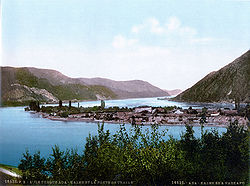
Turkey officially ceded Adakale Island
in River Danube
to Romania
with Articles 25 and 26 of the Treaty of Lausanne; by formally recognizing the related provisions in the Treaty of Trianon
of 1920.
Turkey also renounced its privileges in Libya
which were defined by Article 10 of the Treaty of Ouchy in 1912 (per Article 22 of the Treaty of Lausanne in 1923.)
. The United States Senate
refused to ratify the treaty, and consequently Turkey annulled the concession.
The Convention on the Turkish Straits
lasted only thirteen years and was replaced with the Montreux Convention Regarding the Regime of the Turkish Straits
in 1936. The customs limitations in the treaty were shortly reworked.
Hatay Province
remained a part of the French Mandate of Syria
according to the Treaty of Lausanne, but in 1938 gained its independence as the Hatay State, which later joined Turkey after a referendum in 1939. Syria
does not recognize the addition of Hatay Province to Turkey and continues to show it as a part of Syria on its maps.
Political amnesty was applied. 150 personae non gratae of Turkey
(descendants of the Ottoman dynasty) slowly acquired citizenship — the last one was in 1974.
Peace treaty
A peace treaty is an agreement between two or more hostile parties, usually countries or governments, that formally ends a state of war between the parties...
signed in Lausanne
Lausanne
Lausanne is a city in Romandy, the French-speaking part of Switzerland, and is the capital of the canton of Vaud. The seat of the district of Lausanne, the city is situated on the shores of Lake Geneva . It faces the French town of Évian-les-Bains, with the Jura mountains to its north-west...
, Switzerland
Switzerland
Switzerland name of one of the Swiss cantons. ; ; ; or ), in its full name the Swiss Confederation , is a federal republic consisting of 26 cantons, with Bern as the seat of the federal authorities. The country is situated in Western Europe,Or Central Europe depending on the definition....
on 24 July 1923, that settled the Anatolia
Anatolia
Anatolia is a geographic and historical term denoting the westernmost protrusion of Asia, comprising the majority of the Republic of Turkey...
n and East Thracian parts of the partitioning of the Ottoman Empire
Partitioning of the Ottoman Empire
The Partitioning of the Ottoman Empire was a political event that occurred after World War I. The huge conglomeration of territories and peoples formerly ruled by the Sultan of the Ottoman Empire was divided into several new nations.The partitioning was planned from the early days of the war,...
. The treaty of Lausanne was ratified by the Greek government on 11 February 1924, by the Turkish government on 31 March, and by the governments of Great Britain
Great Britain
Great Britain or Britain is an island situated to the northwest of Continental Europe. It is the ninth largest island in the world, and the largest European island, as well as the largest of the British Isles...
, Italy
Italy
Italy , officially the Italian Republic languages]] under the European Charter for Regional or Minority Languages. In each of these, Italy's official name is as follows:;;;;;;;;), is a unitary parliamentary republic in South-Central Europe. To the north it borders France, Switzerland, Austria and...
and Japan
Japan
Japan is an island nation in East Asia. Located in the Pacific Ocean, it lies to the east of the Sea of Japan, China, North Korea, South Korea and Russia, stretching from the Sea of Okhotsk in the north to the East China Sea and Taiwan in the south...
on 6 August. It was registered in the League of Nations
League of Nations
The League of Nations was an intergovernmental organization founded as a result of the Paris Peace Conference that ended the First World War. It was the first permanent international organization whose principal mission was to maintain world peace...
Treaty Series on 5 September 1924. The Treaty of Lausanne superseded the Treaty of Sèvres
Treaty of Sèvres
The Treaty of Sèvres was the peace treaty between the Ottoman Empire and Allies at the end of World War I. The Treaty of Versailles was signed with Germany before this treaty to annul the German concessions including the economic rights and enterprises. Also, France, Great Britain and Italy...
which was signed by representatives of the Ottoman Empire
Ottoman Empire
The Ottoman EmpireIt was usually referred to as the "Ottoman Empire", the "Turkish Empire", the "Ottoman Caliphate" or more commonly "Turkey" by its contemporaries...
.
The treaty was the consequence of the Turkish War of Independence
Turkish War of Independence
The Turkish War of Independence was a war of independence waged by Turkish nationalists against the Allies, after the country was partitioned by the Allies following the Ottoman Empire's defeat in World War I...
between the Allies of World War I
Allies of World War I
The Entente Powers were the countries at war with the Central Powers during World War I. The members of the Triple Entente were the United Kingdom, France, and the Russian Empire; Italy entered the war on their side in 1915...
and the Ankara
Ankara
Ankara is the capital of Turkey and the country's second largest city after Istanbul. The city has a mean elevation of , and as of 2010 the metropolitan area in the entire Ankara Province had a population of 4.4 million....
-based Grand National Assembly of Turkey
Grand National Assembly of Turkey
The Grand National Assembly of Turkey , usually referred to simply as the Meclis , is the unicameral Turkish legislature. It is the sole body given the legislative prerogatives by the Turkish Constitution. It was founded in Ankara on 23 April 1920 in the midst of the Turkish War of Independence...
(Turkish national movement
Turkish National Movement
The Turkish National Movement encompasses the political and military activities of the Turkish revolutionaries which resulted in the creation and shaping of the Republic of Turkey, as a consequence of the defeat of the Ottoman Empire in World War I....
) led by Mustafa Kemal Atatürk
Mustafa Kemal Atatürk
Mustafa Kemal Atatürk was an Ottoman and Turkish army officer, revolutionary statesman, writer, and the first President of Turkey. He is credited with being the founder of the Republic of Turkey....
. The treaty also led to the international recognition of the sovereignty of the new Republic of Turkey as the successor state of the defunct Ottoman Empire
Ottoman Empire
The Ottoman EmpireIt was usually referred to as the "Ottoman Empire", the "Turkish Empire", the "Ottoman Caliphate" or more commonly "Turkey" by its contemporaries...
.
Background
Asia Minor
Asia Minor is a geographical location at the westernmost protrusion of Asia, also called Anatolia, and corresponds to the western two thirds of the Asian part of Turkey...
and the expulsion of Ottoman sultan by the Turkish army under the command of Mustafa Kemal Atatürk
Mustafa Kemal Atatürk
Mustafa Kemal Atatürk was an Ottoman and Turkish army officer, revolutionary statesman, writer, and the first President of Turkey. He is credited with being the founder of the Republic of Turkey....
, the Ankara
Ankara
Ankara is the capital of Turkey and the country's second largest city after Istanbul. The city has a mean elevation of , and as of 2010 the metropolitan area in the entire Ankara Province had a population of 4.4 million....
-based government of the Turkish national movement
Turkish National Movement
The Turkish National Movement encompasses the political and military activities of the Turkish revolutionaries which resulted in the creation and shaping of the Republic of Turkey, as a consequence of the defeat of the Ottoman Empire in World War I....
ie. Turkey, rejected the Treaty of Sèvres
Treaty of Sèvres
The Treaty of Sèvres was the peace treaty between the Ottoman Empire and Allies at the end of World War I. The Treaty of Versailles was signed with Germany before this treaty to annul the German concessions including the economic rights and enterprises. Also, France, Great Britain and Italy...
that was signed by the Ottoman Empire.
Negotiations were undertaken during the Conference of Lausanne
Conference of Lausanne
The Conference of Lausanne was a conference held in Lausanne, Switzerland during 1922 and 1923. Its purpose was the negotiation of a treaty to replace the Treaty of Sèvres, which, under the new government of Kemal Pasha, was no longer recognised by Turkey....
at which İsmet İnönü
Ismet Inönü
Mustafa İsmet İnönü was a Turkish Army General, Prime Minister and the second President of Turkey. In 1938, the Republican People's Party gave him the title of "Milli Şef" .-Family and early life:...
was the chief negotiator for Turkey. Lord Curzon
George Curzon, 1st Marquess Curzon of Kedleston
George Nathaniel Curzon, 1st Marquess Curzon of Kedleston, KG, GCSI, GCIE, PC , known as The Lord Curzon of Kedleston between 1898 and 1911 and as The Earl Curzon of Kedleston between 1911 and 1921, was a British Conservative statesman who was Viceroy of India and Foreign Secretary...
, the British Foreign Secretary
Secretary of State for Foreign and Commonwealth Affairs
The Secretary of State for Foreign and Commonwealth Affairs, commonly referred to as the Foreign Secretary, is a senior member of Her Majesty's Government heading the Foreign and Commonwealth Office and regarded as one of the Great Offices of State...
of that time, was the chief negotiator for the Allies, while Eleftherios Venizelos
Eleftherios Venizelos
Eleftherios Venizelos was an eminent Greek revolutionary, a prominent and illustrious statesman as well as a charismatic leader in the early 20th century. Elected several times as Prime Minister of Greece and served from 1910 to 1920 and from 1928 to 1932...
negotiated on behalf of Greece
Greece
Greece , officially the Hellenic Republic , and historically Hellas or the Republic of Greece in English, is a country in southeastern Europe....
. The negotiations took many months. On 20 November 1922, the peace conference was opened and after strenuous debate was interrupted by Turkish protest on 4 February 1923. After reopening on 23 April, and following more protests by the Turks and tense debates, the treaty was signed on 24 July as a result of eight months of arduous negotiation. The delegation on behalf of the Allies included negotiators such as the U.S. Admiral Mark L. Bristol, who served as the United States High Commissioner and championed Turkish efforts.
Stipulations
The treaty was composed of 143 articles with major sections including:- Convention on the Turkish straits
- Trade (abolition of capitulationsCapitulations of the Ottoman EmpireCapitulations of the Ottoman Empire were contracts between the Ottoman Empire and European powers, particularly France. Turkish capitulations, or ahdnames, were generally bilateral acts whereby definite arrangements were entered into by each contracting party towards the other, not mere...
) - Agreements
- Binding letters.
The treaty provided for the independence of the Republic of Turkey but also for the protection of the Greek Orthodox Christian minority in Turkey
Greeks in Turkey
The Greeks in Turkey constitute a population of Greek and Greek-speaking Eastern Orthodox Christians who mostly live in Istanbul, including its district Princes' Islands, as well as on the two islands of the western entrance to the Dardanelles: Imbros and Tenedos .They are the remnants of the...
and the Muslim minority in Greece
Muslim minority of Greece
The Muslim minority of Greece is the only explicitly recognized minority in Greece. It numbers 97,604 people or 0.91% of the total population, according to the 1991 census , and 140,000 people or 1.24% of the total population, according to the United States Department of State.The Muslim minority...
. However, most of the Christian population of Turkey and the Turkish population of Greece had already been deported under the earlier Convention Concerning the Exchange of Greek and Turkish Populations
Convention Concerning the Exchange of Greek and Turkish Populations (1923)
The Convention Concerning the Exchange of Greek and Turkish Populations was an agreement between the Greek and Turkish governments signed in Lausanne on January 30, 1923, in the aftermath of the Greco-Turkish War of 1919–1922. The agreement provided for the simultaneous expulsion of Christians from...
signed by Greece and Turkey. Only the Greeks of Constantinople, Imbros
Imbros
Imbros or Imroz, officially referred to as Gökçeada since July 29, 1970 , is an island in the Aegean Sea and the largest island of Turkey, part of Çanakkale Province. It is located at the entrance of Saros Bay and is also the westernmost point of Turkey...
and Tenedos
Tenedos
Tenedos or Bozcaada or Bozdja-Ada is a small island in the Aegean Sea, part of the Bozcaada district of Çanakkale province in Turkey. , Tenedos has a population of about 2,354. The main industries are tourism, wine production and fishing...
were excluded (about 270,000 at that time), and the Muslim population of Western Thrace
Western Thrace
Western Thrace or simply Thrace is a geographic and historical region of Greece, located between the Nestos and Evros rivers in the northeast of the country. Together with the regions of Macedonia and Epirus, it is often referred to informally as northern Greece...
(about 129,120 in 1923.) Article 14 of the treaty granted the islands of Gökçeada and Bozcaada "special administrative organisation
Autonomy
Autonomy is a concept found in moral, political and bioethical philosophy. Within these contexts, it is the capacity of a rational individual to make an informed, un-coerced decision...
", a right that was revoked by the Turkish government on February 17, 1926. The Republic of Turkey also formally accepted the loss of Cyprus
Cyprus
Cyprus , officially the Republic of Cyprus , is a Eurasian island country, member of the European Union, in the Eastern Mediterranean, east of Greece, south of Turkey, west of Syria and north of Egypt. It is the third largest island in the Mediterranean Sea.The earliest known human activity on the...
(which was leased to the British Empire following the Congress of Berlin
Congress of Berlin
The Congress of Berlin was a meeting of the European Great Powers' and the Ottoman Empire's leading statesmen in Berlin in 1878. In the wake of the Russo-Turkish War of 1877–78, the meeting's aim was to reorganize the countries of the Balkans...
in 1878, but de jure
De jure
De jure is an expression that means "concerning law", as contrasted with de facto, which means "concerning fact".De jure = 'Legally', De facto = 'In fact'....
remained an Ottoman territory until World War I) as well as Egypt
Egypt
Egypt , officially the Arab Republic of Egypt, Arabic: , is a country mainly in North Africa, with the Sinai Peninsula forming a land bridge in Southwest Asia. Egypt is thus a transcontinental country, and a major power in Africa, the Mediterranean Basin, the Middle East and the Muslim world...
and Sudan
Sudan
Sudan , officially the Republic of the Sudan , is a country in North Africa, sometimes considered part of the Middle East politically. It is bordered by Egypt to the north, the Red Sea to the northeast, Eritrea and Ethiopia to the east, South Sudan to the south, the Central African Republic to the...
(which were occupied by British forces with the pretext of "putting down the Urabi Revolt
Urabi Revolt
The Urabi Revolt or Orabi Revolt , also known as the Orabi Revolution, was an uprising in Egypt in 1879-82 against the Khedive and European influence in the country...
and restoring order" in 1882, but de jure remained Ottoman territories until World War I) to the British Empire
British Empire
The British Empire comprised the dominions, colonies, protectorates, mandates and other territories ruled or administered by the United Kingdom. It originated with the overseas colonies and trading posts established by England in the late 16th and early 17th centuries. At its height, it was the...
, which had unilaterally annexed them on November 5, 1914. The fate of the province of Mosul
Mosul
Mosul , is a city in northern Iraq and the capital of the Ninawa Governorate, some northwest of Baghdad. The original city stands on the west bank of the Tigris River, opposite the ancient Assyrian city of Nineveh on the east bank, but the metropolitan area has now grown to encompass substantial...
was left to be determined through the League of Nations
League of Nations
The League of Nations was an intergovernmental organization founded as a result of the Paris Peace Conference that ended the First World War. It was the first permanent international organization whose principal mission was to maintain world peace...
. Turkey also renounced all claims on the Dodecanese Islands, which Italy
Italy
Italy , officially the Italian Republic languages]] under the European Charter for Regional or Minority Languages. In each of these, Italy's official name is as follows:;;;;;;;;), is a unitary parliamentary republic in South-Central Europe. To the north it borders France, Switzerland, Austria and...
was obliged to return to Turkey according to Article 2 of the Treaty of Ouchy in 1912 - also known as the First Treaty of Lausanne (1912), as it was signed at the Ouchy Castle in Lausanne, Switzerland - following the Italo-Turkish War
Italo-Turkish War
The Italo-Turkish or Turco-Italian War was fought between the Ottoman Empire and the Kingdom of Italy from September 29, 1911 to October 18, 1912.As a result of this conflict, Italy was awarded the Ottoman provinces of Tripolitania, Fezzan, and...
(1911–1912).
Borders
Greece
Greece , officially the Hellenic Republic , and historically Hellas or the Republic of Greece in English, is a country in southeastern Europe....
, Bulgaria
Bulgaria
Bulgaria , officially the Republic of Bulgaria , is a parliamentary democracy within a unitary constitutional republic in Southeast Europe. The country borders Romania to the north, Serbia and Macedonia to the west, Greece and Turkey to the south, as well as the Black Sea to the east...
, and Turkey
Turkey
Turkey , known officially as the Republic of Turkey , is a Eurasian country located in Western Asia and in East Thrace in Southeastern Europe...
; formally ceded all Turkish claims on the Dodecanese Islands (Article 15); Cyprus
Cyprus
Cyprus , officially the Republic of Cyprus , is a Eurasian island country, member of the European Union, in the Eastern Mediterranean, east of Greece, south of Turkey, west of Syria and north of Egypt. It is the third largest island in the Mediterranean Sea.The earliest known human activity on the...
(Article 20); Egypt
Egypt
Egypt , officially the Arab Republic of Egypt, Arabic: , is a country mainly in North Africa, with the Sinai Peninsula forming a land bridge in Southwest Asia. Egypt is thus a transcontinental country, and a major power in Africa, the Mediterranean Basin, the Middle East and the Muslim world...
and Sudan
Sudan
Sudan , officially the Republic of the Sudan , is a country in North Africa, sometimes considered part of the Middle East politically. It is bordered by Egypt to the north, the Red Sea to the northeast, Eritrea and Ethiopia to the east, South Sudan to the south, the Central African Republic to the...
(Article 17); Syria
Syria
Syria , officially the Syrian Arab Republic , is a country in Western Asia, bordering Lebanon and the Mediterranean Sea to the West, Turkey to the north, Iraq to the east, Jordan to the south, and Israel to the southwest....
and Iraq
Iraq
Iraq ; officially the Republic of Iraq is a country in Western Asia spanning most of the northwestern end of the Zagros mountain range, the eastern part of the Syrian Desert and the northern part of the Arabian Desert....
(Article 3); and (along with the Treaty of Ankara
Treaty of Ankara (1921)
The Ankara Agreement was signed on October 20, 1921 between France and the Grand National Assembly of Turkey...
) settled the boundaries of the latter two nations.
The territories to the south of Syria and Iraq on the Arabian Peninsula
Arabian Peninsula
The Arabian Peninsula is a land mass situated north-east of Africa. Also known as Arabia or the Arabian subcontinent, it is the world's largest peninsula and covers 3,237,500 km2...
which still remained under Turkish control when the Armistice of Mudros
Armistice of Mudros
The Armistice of Moudros , concluded on 30 October 1918, ended the hostilities in the Middle Eastern theatre between the Ottoman Empire and the Allies of World War I...
was signed on 30 October 1918 were not explicitly identified in the text of the treaty. However, the definition of Turkey's southern border in Article 3 also meant that Turkey officially ceded them. These territories included Yemen
Yemen
The Republic of Yemen , commonly known as Yemen , is a country located in the Middle East, occupying the southwestern to southern end of the Arabian Peninsula. It is bordered by Saudi Arabia to the north, the Red Sea to the west, and Oman to the east....
, Asir and parts of Hejaz
Hejaz
al-Hejaz, also Hijaz is a region in the west of present-day Saudi Arabia. Defined primarily by its western border on the Red Sea, it extends from Haql on the Gulf of Aqaba to Jizan. Its main city is Jeddah, but it is probably better known for the Islamic holy cities of Mecca and Medina...
like the city of Medina
Siege of Medina
Medina, an Islamic holy city in Arabia, underwent a long siege during World War I. Medina was at the time part of the Ottoman Empire. In the war, the Ottoman Empire sided with the Central Powers...
. They were held by Turkish forces until 23 January 1919.
Turkey officially ceded Adakale Island
Ada Kaleh
Ada Kaleh was a small island on the Danube populated mostly by Turks that was submerged during the construction of the Iron Gates hydroelectric plant in 1970. The island was about 3 km downstream from Orşova and measured 1.75 by 0.4–0.5 km....
in River Danube
Danube
The Danube is a river in the Central Europe and the Europe's second longest river after the Volga. It is classified as an international waterway....
to Romania
Romania
Romania is a country located at the crossroads of Central and Southeastern Europe, on the Lower Danube, within and outside the Carpathian arch, bordering on the Black Sea...
with Articles 25 and 26 of the Treaty of Lausanne; by formally recognizing the related provisions in the Treaty of Trianon
Treaty of Trianon
The Treaty of Trianon was the peace agreement signed in 1920, at the end of World War I, between the Allies of World War I and Hungary . The treaty greatly redefined and reduced Hungary's borders. From its borders before World War I, it lost 72% of its territory, which was reduced from to...
of 1920.
Turkey also renounced its privileges in Libya
Libya
Libya is an African country in the Maghreb region of North Africa bordered by the Mediterranean Sea to the north, Egypt to the east, Sudan to the southeast, Chad and Niger to the south, and Algeria and Tunisia to the west....
which were defined by Article 10 of the Treaty of Ouchy in 1912 (per Article 22 of the Treaty of Lausanne in 1923.)
Agreements
Among many agreements, there was a separate agreement with the United States: the Chester concessionChester concession
The Chester Concession, approved by the congress of the newly founded Republic of Turkey on April 10, 1923, allowed United States development of oil and railways. It was an award of the significant importance and marked the introduction of U.S. capital for the first time on a large scale into the...
. The United States Senate
United States Senate
The United States Senate is the upper house of the bicameral legislature of the United States, and together with the United States House of Representatives comprises the United States Congress. The composition and powers of the Senate are established in Article One of the U.S. Constitution. Each...
refused to ratify the treaty, and consequently Turkey annulled the concession.
Aftermath
The Treaty of Lausanne led to the international recognition of the sovereignty of the new Republic of Turkey as the successor state of the defunct Ottoman Empire.The Convention on the Turkish Straits
Turkish Straits
The term Turkish Straits refers to the two narrow straits in northwestern Turkey, the Bosphorus and the Dardanelles, that connect the Sea of Marmara with the Black Sea on one side and the Aegean arm of the Mediterranean Sea on the other. They are conventionally considered the boundary between the...
lasted only thirteen years and was replaced with the Montreux Convention Regarding the Regime of the Turkish Straits
Montreux Convention Regarding the Regime of the Turkish Straits
The Montreux Convention Regarding the Regime of the Straits was a 1936 agreement that gives Turkey control over the Bosporus Straits and the Dardanelles and regulates military activity in the region. The Convention gives Turkey full control over the Straits and guarantees the free passage of...
in 1936. The customs limitations in the treaty were shortly reworked.
Hatay Province
Hatay Province
Hatay Province is a province in southern Turkey, on the Mediterranean coast. It is bordered by Syria to the south and east and the Turkish provinces of Adana and Osmaniye to the north. The province is part of Çukurova, a geographical, economical and cultural region that covers the provinces of...
remained a part of the French Mandate of Syria
French Mandate of Syria
Officially the French Mandate for Syria and the Lebanon was a League of Nations mandate founded after the First World War and the partitioning of the Ottoman Empire...
according to the Treaty of Lausanne, but in 1938 gained its independence as the Hatay State, which later joined Turkey after a referendum in 1939. Syria
Syria
Syria , officially the Syrian Arab Republic , is a country in Western Asia, bordering Lebanon and the Mediterranean Sea to the West, Turkey to the north, Iraq to the east, Jordan to the south, and Israel to the southwest....
does not recognize the addition of Hatay Province to Turkey and continues to show it as a part of Syria on its maps.
Political amnesty was applied. 150 personae non gratae of Turkey
150 personae non gratae of Turkey
After the Turkish War of Independence , the newly established Republic of Turkey presented a list of 600 names to the Conference of Lausanne, which were to be declared personae non gratae. Later, a list comprising only 150 of these, put into effect by the Grand National Assembly of Turkey on April...
(descendants of the Ottoman dynasty) slowly acquired citizenship — the last one was in 1974.
See also
- Aftermath of World War IAftermath of World War IThe fighting in World War I ended in western Europe when the Armistice took effect at 11:00 am GMT on November 11, 1918, and in eastern Europe by the early 1920s. During and in the aftermath of the war the political, cultural, and social order was drastically changed in Europe, Asia and Africa,...
- Turks of Western ThraceTurks of Western ThraceTurks of Western Thrace are ethnic Turks who live in Western Thrace, in the north-eastern part of Greece.According to the Greek census of 1991, there were approximately 50,000 Turks in Western Thrace, out of the approximately 98,000 strong Muslim minority of Greece...
- Greeks of Turkey
- Turks of Greece
- Greek refugeesGreek refugeesGreek refugees is a collective term used to refer to the Greeks from Asia Minor who were evacuated or relocated in Greece following the Treaty of Lausanne and the Population exchange between Greece and Turkey...
- Turkish refugees
- Minority TreatiesMinority TreatiesMinority Treaties refer to the treaties, League of Nations Mandates, and unilateral declarations made by countries applying for membership in the League of Nations and United Nations...
- Ismet InönüIsmet InönüMustafa İsmet İnönü was a Turkish Army General, Prime Minister and the second President of Turkey. In 1938, the Republican People's Party gave him the title of "Milli Şef" .-Family and early life:...