

Movement of National Defence

Encyclopedia
The Movement of National Defence was an uprising by Venizelist
officers of the Hellenic Army
in Thessaloniki
in August 1916 against the royal government in Athens
. It led to the establishment of a separate, Venizelist
Greek government (the "Provisional Government of National Defence") in the north of the country, which entered the First World War on the side of the Allies
. This was a defining moment in the development of the great National Schism in Greece
, whose effects would endure until after the Second World War.
, with her territory almost doubled, but found itself in a difficult international situation. The status of the Greek-occupied eastern Aegean islands was left undetermined, and the Ottoman Empire
continued to claim them, leading to a naval arms race and mass expulsions of ethnic Greeks from Anatolia. In the north, Bulgaria
, defeated in the Second Balkan War
, harbored revanchist plans against Greece and Serbia
. The two countries were bound by a treaty of alliance which promised military assistance in case of a Bulgarian attack, but in August 1914, the danger would emerge from a different quarter altogether: the Assassination of Archduke Franz Ferdinand led to the declaration of war by Austria-Hungary
on Serbia and the outbreak of the First World War.
Greece, like Bulgaria, initially maintained neutrality, but as the war continued, both warring camps began wooing the two countries. At this point the first rifts appeared among the Greek leadership: The very capable Prime Minister
, Eleftherios Venizelos
, an ardent admirer of Great Britain
, supported entry in the war on the side of the Entente
, while the King
, who had been educated in Germany
, married to the Kaiser's sister, and a deep admirer of Prussia
n militarism, anticipated a German victory. Aware that Greece was vulnerable to the British Fleet
, he advocated a course of neutrality.
In early 1915 the British offered Greece "territorial concessions in Asia Minor
" if it would participate in the upcoming Gallipoli Campaign. Venizelos supported this idea, but run into the opposition from the King and his military advisors. As a result, Venizelos submitted his resignation on 21 February 1915. The Liberal Party won the May elections, and Venizelos again formed a government. When Bulgaria mobilized against Serbia in September 1915, Venizelos ordered a Greek counter-mobilization and called upon the Anglo-French to establish themselves in Thessaloniki
as to aid Serbia. Indeed, the Allies began landing on 22 September 1915 and started entrenching themselves around the city. The King unconstitutionally dismissed Venizelos and the parliament, making the breach between the two men and their followers irreparable. The Liberals boycotted the December elections. In the same month, the French, with the permission of Venizelos, occupied Corfu
, where the remains of the Serbian Army were gathered before being sent to Thessaloniki. In view of these events, a clandestine "Revolutionary Committee of National Defence" was formed in Thessaloniki by a group of prominent Liberals, including Alexandros Zannas, Periklis Argyropoulos, Dimitrios Dingas, Major General Emmanouil Zymvrakakis and others. The group acknowledged Venizelos as its leader, and began approaching officers of the Army and the Cretan Gendarmerie
.
During the following year, Greece
's official Royalist governments were hard-pressed to maintain the country's neutrality. The final straw came when, on May 13/26 1916, the Athens-based Royal government, succumbing to German
pressure, ordered the surrender of the vital Rupel Fortress to the Germans. In response, on 21 May/3 June, the pro-Entente Venizelists imposed martial law, effectively abolishing royal sovereignty in all of northern Greece. In August, the Bulgarian advance in eastern Macedonia
commenced, facing little resistance, since the Athens government refused to condone any firm action. As a result, more than 6000 men of IV Corps surrendered to the Germans on 13 August (O.S.) and were deported to Görlitz
in Germany. This surrender of hard-won territories with only token resistance, outraged most Greeks. At the same time, the establishment of the exiled Serbian King and his government in Thessaloniki in April, the presence of 120,000 Serbian troops in the Macedonian Front, accompanied by threats from the Entente that he would install a Serbian prefect in the city, raised fears that the city would be handed over to the Serbians.
left 3 dead, but French intervention soon ended the firefight. On Sarrail
's orders, the officers still loyal to the government were dismissed and sent to Athens
, while the troops were disarmed and interned in camps. The revolution established control of Thessaloniki
and was soon reinforced by the remnants of the Serres Division, which gave some credibility to the movement.
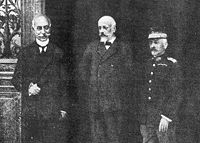
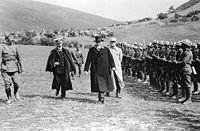 Venizelos himself proceeded from Crete through the Aegean islands
to Thessaloniki
. Upon his arrival there, the "Revolutionary Committee" handed over power to him. On September 16, Venizelos formed a "National Triumvirate
" with General Panagiotis Danglis
and Admiral Pavlos Koundouriotis, and proceeded to form a government. On 29 September, Maj Gen Emmanouil Zymvrakakis
was appointed Army Minister (replaced on December 6 by Maj Gen Konstantinos Miliotis-Komninos) and on October 3 Nikolaos Politis
was appointed Foreign Minister. On 6 October other ministries, euphemistically called "General Directorates" were established:
The first tasks of the new government were the establishment of an army to fight alongside the Allies
, and the consolidation of its rule in as much of Greece
as possible. The Provisional Government declared war on the Central Powers
on November 24 1916, and set out to recruit divisions for the Macedonian Front, something which was achieved with speed and often ruthlessness. Despite calls by some officers to abolish the monarchy and declare a Republic, Venizelos chose a more moderate path. He had declared: "we are not against the King, but against the Bulgarians". Nonetheless, the reluctant and uneasy coexistence of the two Greek states was not destined to last, as the Noemvriana
riots against Venizelists in Athens
clearly illustrated that a rapprochement was now impossible.
The division of the country lasted for 9 months. On June 15, 1917 a Venizelist ultimatum forced King Constantine
to abdicate in favour of his second-born son, Alexander, and, with the rest of his family, leave the country for Switzerland
. Venizelos returned to Athens
, as head of a superficially reunified Greece, and led it to victory alongside the Allies
in World War I
, but also in its entanglement in the subsequent Asia Minor Campaign
. As such, the immediate aims of the "National Defence" were met. But the revolution was also an expression of the wide rift between the quasi-republican, progressive Venizelists
and the conservative Royalists/Anti-Venizelists, and its outbreak marks also the beginning of the Greek National Schism which would leave a troublesome legacy to the country, as it continued in various forms up to the 1970s.
Venizelism
Venizelism was one of the major political movements in Greece from the 1900s until the mid 1970s.- Ideology :Named after Eleftherios Venizelos, the key characteristics of Venizelism were:*Opposition to Monarchy...
officers of the Hellenic Army
Hellenic Army
The Hellenic Army , formed in 1828, is the land force of Greece.The motto of the Hellenic Army is , "Freedom Stems from Valor", from Thucydides's History of the Peloponnesian War...
in Thessaloniki
Thessaloniki
Thessaloniki , historically also known as Thessalonica, Salonika or Salonica, is the second-largest city in Greece and the capital of the region of Central Macedonia as well as the capital of the Decentralized Administration of Macedonia and Thrace...
in August 1916 against the royal government in Athens
Athens
Athens , is the capital and largest city of Greece. Athens dominates the Attica region and is one of the world's oldest cities, as its recorded history spans around 3,400 years. Classical Athens was a powerful city-state...
. It led to the establishment of a separate, Venizelist
Venizelism
Venizelism was one of the major political movements in Greece from the 1900s until the mid 1970s.- Ideology :Named after Eleftherios Venizelos, the key characteristics of Venizelism were:*Opposition to Monarchy...
Greek government (the "Provisional Government of National Defence") in the north of the country, which entered the First World War on the side of the Allies
Allies of World War I
The Entente Powers were the countries at war with the Central Powers during World War I. The members of the Triple Entente were the United Kingdom, France, and the Russian Empire; Italy entered the war on their side in 1915...
. This was a defining moment in the development of the great National Schism in Greece
Greece
Greece , officially the Hellenic Republic , and historically Hellas or the Republic of Greece in English, is a country in southeastern Europe....
, whose effects would endure until after the Second World War.
Background: Greece 1914–1916
Greece had emerged victorious from the 1912-1913 Balkan WarsBalkan Wars
The Balkan Wars were two conflicts that took place in the Balkans in south-eastern Europe in 1912 and 1913.By the early 20th century, Montenegro, Bulgaria, Greece and Serbia, the countries of the Balkan League, had achieved their independence from the Ottoman Empire, but large parts of their ethnic...
, with her territory almost doubled, but found itself in a difficult international situation. The status of the Greek-occupied eastern Aegean islands was left undetermined, and the Ottoman Empire
Ottoman Empire
The Ottoman EmpireIt was usually referred to as the "Ottoman Empire", the "Turkish Empire", the "Ottoman Caliphate" or more commonly "Turkey" by its contemporaries...
continued to claim them, leading to a naval arms race and mass expulsions of ethnic Greeks from Anatolia. In the north, Bulgaria
Bulgaria
Bulgaria , officially the Republic of Bulgaria , is a parliamentary democracy within a unitary constitutional republic in Southeast Europe. The country borders Romania to the north, Serbia and Macedonia to the west, Greece and Turkey to the south, as well as the Black Sea to the east...
, defeated in the Second Balkan War
Second Balkan War
The Second Balkan War was a conflict which broke out when Bulgaria, dissatisfied with its share of the spoils of the First Balkan War, attacked its former allies, Serbia and Greece, on 29 June 1913. Bulgaria had a prewar agreement about the division of region of Macedonia...
, harbored revanchist plans against Greece and Serbia
Serbia
Serbia , officially the Republic of Serbia , is a landlocked country located at the crossroads of Central and Southeast Europe, covering the southern part of the Carpathian basin and the central part of the Balkans...
. The two countries were bound by a treaty of alliance which promised military assistance in case of a Bulgarian attack, but in August 1914, the danger would emerge from a different quarter altogether: the Assassination of Archduke Franz Ferdinand led to the declaration of war by Austria-Hungary
Austria-Hungary
Austria-Hungary , more formally known as the Kingdoms and Lands Represented in the Imperial Council and the Lands of the Holy Hungarian Crown of Saint Stephen, was a constitutional monarchic union between the crowns of the Austrian Empire and the Kingdom of Hungary in...
on Serbia and the outbreak of the First World War.
Greece, like Bulgaria, initially maintained neutrality, but as the war continued, both warring camps began wooing the two countries. At this point the first rifts appeared among the Greek leadership: The very capable Prime Minister
Prime Minister of Greece
The Prime Minister of Greece , officially the Prime Minister of the Hellenic Republic , is the head of government of the Hellenic Republic and the leader of the Greek cabinet. The current interim Prime Minister is Lucas Papademos, a former Vice President of the European Central Bank, following...
, Eleftherios Venizelos
Eleftherios Venizelos
Eleftherios Venizelos was an eminent Greek revolutionary, a prominent and illustrious statesman as well as a charismatic leader in the early 20th century. Elected several times as Prime Minister of Greece and served from 1910 to 1920 and from 1928 to 1932...
, an ardent admirer of Great Britain
Great Britain
Great Britain or Britain is an island situated to the northwest of Continental Europe. It is the ninth largest island in the world, and the largest European island, as well as the largest of the British Isles...
, supported entry in the war on the side of the Entente
Triple Entente
The Triple Entente was the name given to the alliance among Britain, France and Russia after the signing of the Anglo-Russian Entente in 1907....
, while the King
Constantine I of Greece
Constantine I was King of Greece from 1913 to 1917 and from 1920 to 1922. He was commander-in-chief of the Hellenic Army during the unsuccessful Greco-Turkish War of 1897 and led the Greek forces during the successful Balkan Wars of 1912–1913, in which Greece won Thessaloniki and doubled in...
, who had been educated in Germany
Germany
Germany , officially the Federal Republic of Germany , is a federal parliamentary republic in Europe. The country consists of 16 states while the capital and largest city is Berlin. Germany covers an area of 357,021 km2 and has a largely temperate seasonal climate...
, married to the Kaiser's sister, and a deep admirer of Prussia
Prussia
Prussia was a German kingdom and historic state originating out of the Duchy of Prussia and the Margraviate of Brandenburg. For centuries, the House of Hohenzollern ruled Prussia, successfully expanding its size by way of an unusually well-organized and effective army. Prussia shaped the history...
n militarism, anticipated a German victory. Aware that Greece was vulnerable to the British Fleet
Royal Navy
The Royal Navy is the naval warfare service branch of the British Armed Forces. Founded in the 16th century, it is the oldest service branch and is known as the Senior Service...
, he advocated a course of neutrality.
In early 1915 the British offered Greece "territorial concessions in Asia Minor
Asia Minor
Asia Minor is a geographical location at the westernmost protrusion of Asia, also called Anatolia, and corresponds to the western two thirds of the Asian part of Turkey...
" if it would participate in the upcoming Gallipoli Campaign. Venizelos supported this idea, but run into the opposition from the King and his military advisors. As a result, Venizelos submitted his resignation on 21 February 1915. The Liberal Party won the May elections, and Venizelos again formed a government. When Bulgaria mobilized against Serbia in September 1915, Venizelos ordered a Greek counter-mobilization and called upon the Anglo-French to establish themselves in Thessaloniki
Thessaloniki
Thessaloniki , historically also known as Thessalonica, Salonika or Salonica, is the second-largest city in Greece and the capital of the region of Central Macedonia as well as the capital of the Decentralized Administration of Macedonia and Thrace...
as to aid Serbia. Indeed, the Allies began landing on 22 September 1915 and started entrenching themselves around the city. The King unconstitutionally dismissed Venizelos and the parliament, making the breach between the two men and their followers irreparable. The Liberals boycotted the December elections. In the same month, the French, with the permission of Venizelos, occupied Corfu
Corfu
Corfu is a Greek island in the Ionian Sea. It is the second largest of the Ionian Islands, and, including its small satellite islands, forms the edge of the northwestern frontier of Greece. The island is part of the Corfu regional unit, and is administered as a single municipality. The...
, where the remains of the Serbian Army were gathered before being sent to Thessaloniki. In view of these events, a clandestine "Revolutionary Committee of National Defence" was formed in Thessaloniki by a group of prominent Liberals, including Alexandros Zannas, Periklis Argyropoulos, Dimitrios Dingas, Major General Emmanouil Zymvrakakis and others. The group acknowledged Venizelos as its leader, and began approaching officers of the Army and the Cretan Gendarmerie
Cretan Gendarmerie
The Cretan Gendarmerie was a gendarmerie force created under the Cretan State, after the island of Crete gained autonomy from Ottoman rule in the late 19th century...
.
During the following year, Greece
Greece
Greece , officially the Hellenic Republic , and historically Hellas or the Republic of Greece in English, is a country in southeastern Europe....
's official Royalist governments were hard-pressed to maintain the country's neutrality. The final straw came when, on May 13/26 1916, the Athens-based Royal government, succumbing to German
German Empire
The German Empire refers to Germany during the "Second Reich" period from the unification of Germany and proclamation of Wilhelm I as German Emperor on 18 January 1871, to 1918, when it became a federal republic after defeat in World War I and the abdication of the Emperor, Wilhelm II.The German...
pressure, ordered the surrender of the vital Rupel Fortress to the Germans. In response, on 21 May/3 June, the pro-Entente Venizelists imposed martial law, effectively abolishing royal sovereignty in all of northern Greece. In August, the Bulgarian advance in eastern Macedonia
Macedonia (Greece)
Macedonia is a geographical and historical region of Greece in Southern Europe. Macedonia is the largest and second most populous Greek region...
commenced, facing little resistance, since the Athens government refused to condone any firm action. As a result, more than 6000 men of IV Corps surrendered to the Germans on 13 August (O.S.) and were deported to Görlitz
Görlitz
Görlitz is a town in Germany. It is the easternmost town in the country, located on the Lusatian Neisse River in the Bundesland of Saxony. It is opposite the Polish town of Zgorzelec, which was a part of Görlitz until 1945. Historically, Görlitz was in the region of Upper Lusatia...
in Germany. This surrender of hard-won territories with only token resistance, outraged most Greeks. At the same time, the establishment of the exiled Serbian King and his government in Thessaloniki in April, the presence of 120,000 Serbian troops in the Macedonian Front, accompanied by threats from the Entente that he would install a Serbian prefect in the city, raised fears that the city would be handed over to the Serbians.
The Revolution breaks out
On 17 August 1916 (O.S.), Venizelist officers of the Revolutionary Committee, rose up, despite Venizelos' own reservations. Although they could count on the support of many individual officers, the only major force to declare itself openly for the movement were the men of the Cretan Gendarmerie. Initial clashes between the rebels and the loyal 11th Division of Colonel Nikolaos TrikoupisNikolaos Trikoupis
Nikolaos Trikoupis was a Greek general and politician.Born in Mesolongi in 1869 to Themistoklis Trikoupis, he entered the Greek Army Academy, which he graduated in 1888 as an Artillery Second Lieutenant. He furthered his studies in France, where he remained from 1889 to 1895. He competed at the...
left 3 dead, but French intervention soon ended the firefight. On Sarrail
Maurice Sarrail
Maurice-Paul-Emmanuel Sarrail was a French general of the First World War. Sarrail endeared himself to the political elite of the Third Republic through his openly socialist views, all the more conspicuous in contrast to the Catholics, conservatives and monarchists who dominated the French Army...
's orders, the officers still loyal to the government were dismissed and sent to Athens
Athens
Athens , is the capital and largest city of Greece. Athens dominates the Attica region and is one of the world's oldest cities, as its recorded history spans around 3,400 years. Classical Athens was a powerful city-state...
, while the troops were disarmed and interned in camps. The revolution established control of Thessaloniki
Thessaloniki
Thessaloniki , historically also known as Thessalonica, Salonika or Salonica, is the second-largest city in Greece and the capital of the region of Central Macedonia as well as the capital of the Decentralized Administration of Macedonia and Thrace...
and was soon reinforced by the remnants of the Serres Division, which gave some credibility to the movement.
The "State of National Defence"
Aegean Islands
The Aegean Islands are the group of islands in the Aegean Sea, with mainland Greece to the west and north and Turkey to the east; the island of Crete delimits the sea to the south, those of Rhodes, Karpathos and Kasos to the southeast...
to Thessaloniki
Thessaloniki
Thessaloniki , historically also known as Thessalonica, Salonika or Salonica, is the second-largest city in Greece and the capital of the region of Central Macedonia as well as the capital of the Decentralized Administration of Macedonia and Thrace...
. Upon his arrival there, the "Revolutionary Committee" handed over power to him. On September 16, Venizelos formed a "National Triumvirate
Triumvirate
A triumvirate is a political regime dominated by three powerful individuals, each a triumvir . The arrangement can be formal or informal, and though the three are usually equal on paper, in reality this is rarely the case...
" with General Panagiotis Danglis
Panagiotis Danglis
Panagiotis Danglis was a Greek general of the Hellenic Army and a politician.He was born in Agrinio in 1853, graduated from the Scholi Evelpidon Officer Academy in 1878 as a Second Lieutenant of Artillery, and later extended his studies for another year in Belgium...
and Admiral Pavlos Koundouriotis, and proceeded to form a government. On 29 September, Maj Gen Emmanouil Zymvrakakis
Emmanouil Zymvrakakis (Army general)
Emmanouil Zymvrakakis was a Greek army officer who rose to the rank of Lieutenant General, and was distinguished in World War I.He was born to the expatriate Cretan Charalambos Zymvrakakis in Nafplio in 1861. He graduated the Greek Army Academy and was named 2nd Lieutenant in 1881, and went on to...
was appointed Army Minister (replaced on December 6 by Maj Gen Konstantinos Miliotis-Komninos) and on October 3 Nikolaos Politis
Nikolaos Politis
Nikolaos Politis was a Greek diplomat of the Interwar period. He was a professor of law by training, and prior to the First World War taught law at Paris University. He served as Greek Minister of Foreign Affairs on 1916-1920 and again in 1922. Also served as Greek representative to the League of...
was appointed Foreign Minister. On 6 October other ministries, euphemistically called "General Directorates" were established:
- Themistoklis SophoulisThemistoklis SophoulisThemistoklis Sofoulis or Sophoulis was a prominent centrist Greek politician from Samos Island, belonging to the centre-left wing of the Liberal Party, which he led for many years.-Early life:...
, Interior Minister - Miltiadis Negrepontis, Finance Minister
- Thalis Koutoupis, Minister of National Economy
- Dimitrios Dingas, Justice Minister
- Georgios Averof, Education Minister
- Alexandros Kassavetis, Transport Minister
- Leonidas Embeirikos, Minister for Supply and Food Distribution
- Spyridon Simos, Minister for the Refugees
- Andreas MichalakopoulosAndreas MichalakopoulosAndreas Michalakopoulos was an important liberal politician in the inter-war period who served as Prime Minister of Greece from 7 October 1924 to 26 June 1925....
, Minister for Public Estates and Resettlement
The first tasks of the new government were the establishment of an army to fight alongside the Allies
Allies of World War I
The Entente Powers were the countries at war with the Central Powers during World War I. The members of the Triple Entente were the United Kingdom, France, and the Russian Empire; Italy entered the war on their side in 1915...
, and the consolidation of its rule in as much of Greece
Greece
Greece , officially the Hellenic Republic , and historically Hellas or the Republic of Greece in English, is a country in southeastern Europe....
as possible. The Provisional Government declared war on the Central Powers
Central Powers
The Central Powers were one of the two warring factions in World War I , composed of the German Empire, the Austro-Hungarian Empire, the Ottoman Empire, and the Kingdom of Bulgaria...
on November 24 1916, and set out to recruit divisions for the Macedonian Front, something which was achieved with speed and often ruthlessness. Despite calls by some officers to abolish the monarchy and declare a Republic, Venizelos chose a more moderate path. He had declared: "we are not against the King, but against the Bulgarians". Nonetheless, the reluctant and uneasy coexistence of the two Greek states was not destined to last, as the Noemvriana
Noemvriana
The Noemvriana of November–December 1916 was a political dispute, which led to an armed confrontation in Athens between the royalist government of Greece and the Allies forces over the issue of Greece's neutrality during World War I....
riots against Venizelists in Athens
Athens
Athens , is the capital and largest city of Greece. Athens dominates the Attica region and is one of the world's oldest cities, as its recorded history spans around 3,400 years. Classical Athens was a powerful city-state...
clearly illustrated that a rapprochement was now impossible.
The division of the country lasted for 9 months. On June 15, 1917 a Venizelist ultimatum forced King Constantine
Constantine I of Greece
Constantine I was King of Greece from 1913 to 1917 and from 1920 to 1922. He was commander-in-chief of the Hellenic Army during the unsuccessful Greco-Turkish War of 1897 and led the Greek forces during the successful Balkan Wars of 1912–1913, in which Greece won Thessaloniki and doubled in...
to abdicate in favour of his second-born son, Alexander, and, with the rest of his family, leave the country for Switzerland
Switzerland
Switzerland name of one of the Swiss cantons. ; ; ; or ), in its full name the Swiss Confederation , is a federal republic consisting of 26 cantons, with Bern as the seat of the federal authorities. The country is situated in Western Europe,Or Central Europe depending on the definition....
. Venizelos returned to Athens
Athens
Athens , is the capital and largest city of Greece. Athens dominates the Attica region and is one of the world's oldest cities, as its recorded history spans around 3,400 years. Classical Athens was a powerful city-state...
, as head of a superficially reunified Greece, and led it to victory alongside the Allies
Allies of World War I
The Entente Powers were the countries at war with the Central Powers during World War I. The members of the Triple Entente were the United Kingdom, France, and the Russian Empire; Italy entered the war on their side in 1915...
in World War I
World War I
World War I , which was predominantly called the World War or the Great War from its occurrence until 1939, and the First World War or World War I thereafter, was a major war centred in Europe that began on 28 July 1914 and lasted until 11 November 1918...
, but also in its entanglement in the subsequent Asia Minor Campaign
Greco-Turkish War (1919-1922)
The Greco–Turkish War of 1919–1922, known as the Western Front of the Turkish War of Independence in Turkey and the Asia Minor Campaign or the Asia Minor Catastrophe in Greece, was a series of military events occurring during the partitioning of the Ottoman Empire after World War I between May...
. As such, the immediate aims of the "National Defence" were met. But the revolution was also an expression of the wide rift between the quasi-republican, progressive Venizelists
Venizelism
Venizelism was one of the major political movements in Greece from the 1900s until the mid 1970s.- Ideology :Named after Eleftherios Venizelos, the key characteristics of Venizelism were:*Opposition to Monarchy...
and the conservative Royalists/Anti-Venizelists, and its outbreak marks also the beginning of the Greek National Schism which would leave a troublesome legacy to the country, as it continued in various forms up to the 1970s.