


Rudaki

Encyclopedia
Persian people
The Persian people are part of the Iranian peoples who speak the modern Persian language and closely akin Iranian dialects and languages. The origin of the ethnic Iranian/Persian peoples are traced to the Ancient Iranian peoples, who were part of the ancient Indo-Iranians and themselves part of...
poet, and is regarded as the first great literary genius of the Modern Persian, who composed poems in the "New Persian" alphabet. Rudaki is considered as a founder of Persian classical literature
Persian literature
Persian literature spans two-and-a-half millennia, though much of the pre-Islamic material has been lost. Its sources have been within historical Persia including present-day Iran as well as regions of Central Asia where the Persian language has historically been the national language...
.
He was born in 858 in Rudak
Rudaki, Tajikistan
Rudaki is a town and jamoat in western Tajikistan. It is located in Panjakent District in Sughd province. The jamoat has a total population of 15,039.The village, once a part of Persia, is the birth place of the poet Rudaki.-References:...
(Panjrud), a village located in Panjakent
Panjakent
Panjakent , also spelled Panjikent, Panjekent or Penjikent, is a city in the Sughd province of Tajikistan on the Zeravshan River, with a population of 33,000 . It was once an ancient town in Sogdiana...
, Tajikistan
Tajikistan
Tajikistan , officially the Republic of Tajikistan , is a mountainous landlocked country in Central Asia. Afghanistan borders it to the south, Uzbekistan to the west, Kyrgyzstan to the north, and China to the east....
. Even though most of his biographers assert that he was completely blind
Blindness
Blindness is the condition of lacking visual perception due to physiological or neurological factors.Various scales have been developed to describe the extent of vision loss and define blindness...
, some early biographers are silent about this or do not mention him as being born blind. His accurate knowledge and description of colors, as evident in his poetry, renders this assertion very doubtful. He was the court poet to the Samanid
Samanid
The Samani dynasty , also known as the Samanid Empire, or simply Samanids was a Persian state and empire in Central Asia and Greater Iran, named after its founder Saman Khuda, who converted to Sunni Islam despite being from Zoroastrian theocratic nobility...
ruler Nasr II
Nasr II of Samanid
Nasr II was amir of the Samanids . His reign saw the high point of Samanid rule. He was the son of Ahmad ibn Isma’il....
(914–943) in Bukhara
Bukhara
Bukhara , from the Soghdian βuxārak , is the capital of the Bukhara Province of Uzbekistan. The nation's fifth-largest city, it has a population of 263,400 . The region around Bukhara has been inhabited for at least five millennia, and the city has existed for half that time...
, although he eventually fell out of favour; his life ended in poverty.
At the Samanid court
Early in his life, the fame of his accomplishments reached the ear of the SamanidSamanid
The Samani dynasty , also known as the Samanid Empire, or simply Samanids was a Persian state and empire in Central Asia and Greater Iran, named after its founder Saman Khuda, who converted to Sunni Islam despite being from Zoroastrian theocratic nobility...
Nasr II ibn Ahmad
Nasr II of Samanid
Nasr II was amir of the Samanids . His reign saw the high point of Samanid rule. He was the son of Ahmad ibn Isma’il....
, the ruler of Khorasan
Greater Khorasan
Greater Khorasan or Ancient Khorasan is a historical region of Greater Iran mentioned in sources from Sassanid and Islamic eras which "frequently" had a denotation wider than current three provinces of Khorasan in Iran...
and Transoxiana, who invited the poet to his court. Rudaki became his daily companion, amassed great wealth, and become highly honored. It is claimed that he well deserves the title of the father of Persian literature
Persian literature
Persian literature spans two-and-a-half millennia, though much of the pre-Islamic material has been lost. Its sources have been within historical Persia including present-day Iran as well as regions of Central Asia where the Persian language has historically been the national language...
, or the Adam or the Sultan of poets even though he had various predecessors, because he was the first who impressed upon every form of epic, lyric and didactic poetry its peculiar stamp and its individual character. He is also said to have been the founder of the diwan, or the typical form of the complete collection of a poet's lyrical compositions in a more or less alphabetical order, which all Tajik-Persian writers use even today.
Rudaki's blindness
The common opinion was that Rudaki was born blind or was blind from his childhood. However, some of early biographies, like Samani and Nezami Aruzi do not emphasis his blindness as natural-born. FerdowsiFerdowsi
Ferdowsi was a highly revered Persian poet. He was the author of the Shahnameh, the national epic of Iran and related societies.The Shahnameh was originally composed by Ferdowsi for the princes of the Samanid dynasty, who were responsible for a revival of Persian cultural traditions after the...
just mentions in his Shahnameh
Shahnameh
The Shahnameh or Shah-nama is a long epic poem written by the Persian poet Ferdowsi between c.977 and 1010 AD and is the national epic of Iran and related societies...
that they recited Kelileh o Demneh to him and he rendered it into poem. Also using some of his poems we can see that he had sight:
- پوپک دیدم به حوالی سرخس
- بانگک بر بُرده به ابر اندرا
- چادرکی رنگین دیدم بر او
- رنگ بسی گونه بر آن چادرا
Translation
- I saw a bird near the city of SarakhsSarakhsSarakhs is a city in and capital of Sarakhs County, Razavi Khorasan Province, Iran. Sarakhs was once a stopping point along the Silk Road, and in its 11th century heyday had many libraries and a famous school of architects. Much of the original city site is now just across the border at Saraghs...
- It had raised its song to the clouds
- I saw a colorful chadorChadorA chādor or chādar is an outer garment or open cloak worn by many Iranian women and female teenagers in public spaces. Wearing this garment is one possible way in which a Muslim woman can follow the Islamic dress code known as ḥijāb. A chador is a full-body-length semicircle of fabric that is...
on it - So many colors on its chador
The great contemporary Iranian scholar, Said Nafisi
Said Nafisi
Saeed Nafisi was an Iranian scholar, fiction writer and poet. He was a prolific writer in Persian....
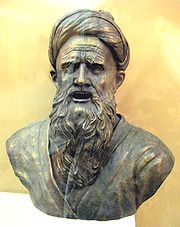
, has a book about Rudaki called Biography, Environment and Time of Rudaki. In pages 394-404, he refers to historical events and references in Persian books and poems, as well as the forensic findings of Russians in early 20th century including Mikhail Gerasimov (who reconstructed Rudaki's face based on his bones found in his tomb, see above picture), concludes that Rudaki and Amir Nasr Samani were Ismaili
Ismaili
' is a branch of Shia Islam. It is the second largest branch of Shia Islam, after the Twelvers...
s and there was a revolt against Ismalis around 940, a few years before Rudaki's death. This revolt led to the overthrow of the Samanid king and Rudaki, as his close companion, was tortured and blinded and his back was broken while they were blinding him. After this, Rudaki went back to the small town where he was born and died shortly after that. He was buried there.
Extant works
Of the 1,300,000 verses attributed to him, only 52 qasidaQasida
The qaṣīdaᵗ , in Arabic: قصيدة, plural qasā'id, قــصــائـد; in Persian: قصیده , is a form of lyric poetry that originated in preIslamic Arabia...
s, ghazal
Ghazal
The ghazal is a poetic form consisting of rhyming couplets and a refrain, with each line sharing the same meter. A ghazal may be understood as a poetic expression of both the pain of loss or separation and the beauty of love in spite of that pain. The form is ancient, originating in 6th century...
s and rubai
Rubaiyat
"Rubāʿī" is Arabic for "quatrain", and is used to describe a Persian quatrain, or its derivative form in English and other languages. The plural form of the word, rubāʿiyāt ,often anglicised rubaiyat , is used to describe a collection of such quatrains.There are a number of possible rhyme schemes...
s survived; of his epic masterpieces we have nothing beyond a few stray lines in native dictionaries. However, the most serious loss is that of his translation of Abdullah Ibn al-Muqaffa
Abdullah Ibn al-Muqaffa
Abū-Muhammad Abd-Allāh Rūzbeh ibn Dādūya/Dādōē , known as Ibn al-Muqaffaʿ , Ibn Muqaffa/Ebn-e Moghaffa , or Rūzbeh pūr-e Dādūya , was a Persian thinker and a Zoroastrian convert to Islam.-Biography:...
's Arabic
Arabic language
Arabic is a name applied to the descendants of the Classical Arabic language of the 6th century AD, used most prominently in the Quran, the Islamic Holy Book...
version of the old India
India
India , officially the Republic of India , is a country in South Asia. It is the seventh-largest country by geographical area, the second-most populous country with over 1.2 billion people, and the most populous democracy in the world...
n fable book Kalila and Dimna (Panchatantra
Panchatantra
The Panchatantra is an ancient Indian inter-related collection of animal fables in verse and prose, in a frame story format. The original Sanskrit work, which some scholars believe was composed in the 3rd century BCE, is attributed to Vishnu Sharma...
), which he put into Persian
Persian language
Persian is an Iranian language within the Indo-Iranian branch of the Indo-European languages. It is primarily spoken in Iran, Afghanistan, Tajikistan and countries which historically came under Persian influence...
verse at the request of his royal patron. Numerous fragments, however, are preserved in the Persian lexicon of Asadi Tusi
Asadi Tusi
Abu Mansur Ali ibn Ahmad Asadi Tusi is arguably the second most important Persian poet of the Iranian national epics, after Ferdowsi who also happens to come from the same town of Tus. He was a poet, a linguist and copyist of ancient manuscripts.- Life :The information on Asadi's lifetime is scant...
(the Lughat al-Furs, ed. P. Horn, Göttingen
Göttingen
Göttingen is a university town in Lower Saxony, Germany. It is the capital of the district of Göttingen. The Leine river runs through the town. In 2006 the population was 129,686.-General information:...
, 1897). In his qasidas - all of which are devoted to the praise of his sovereign and friend - unequalled models of a refined and delicate taste, very different from the often bombastic compositions of later Persian encomiasts, have survived. His didactic ode
Ode
Ode is a type of lyrical verse. A classic ode is structured in three major parts: the strophe, the antistrophe, and the epode. Different forms such as the homostrophic ode and the irregular ode also exist...
s and epigram
Epigram
An epigram is a brief, interesting, usually memorable and sometimes surprising statement. Derived from the epigramma "inscription" from ἐπιγράφειν epigraphein "to write on inscribe", this literary device has been employed for over two millennia....
s expressed in well-measured lines a type of Epicurean philosophy of life and human happiness, and more charming still are the purely lyrical pieces that glorify love and wine.
There is a complete edition of all the extant poems of Rudaki which were known at the end of the 19th century, in Persian text and metrical German
German language
German is a West Germanic language, related to and classified alongside English and Dutch. With an estimated 90 – 98 million native speakers, German is one of the world's major languages and is the most widely-spoken first language in the European Union....
translation, together with a biographical account, based on forty-six Persian manuscripts, in Hermann Ethé's Rudagi der Samanidendichter (Göttinger Nachrichten, 1873, pp. 663–742); see also:
- Neupersische Literatur in Wilhelm GeigerWilhelm GeigerWilhelm Ludwig Geiger was a German Orientalist, in the fields of Indian and Iranian languages. He was known as a specialist in Pali, Sinhala language and the Dhivehi language of the Maldives.-Life:...
's Grundriss der iranischen Philologie (ii. - Paul HornPaul HornPaul Horn is the name of:*Paul Horn , jazz flutist*Paul Horn , American computer scientist...
, Geschichte der persischen Literatur (1901), p. 73 - E. G. Browne, Literary History of Persia, i. (1902)
- C. J. Pickering, A Persian Chaucer in National Review (May 1890).
More recently, in 1963, Saʻīd Nafīsī identified more fragments to be attributed to Rudaki and has assembled them, together with an extensive biography, in Muḥīṭ-i zindagī va aḥvāl va ashʻār-i Rūdakī.
Celebrations
For the 1100th anniversary of his birth, the IranIran
Iran , officially the Islamic Republic of Iran , is a country in Southern and Western Asia. The name "Iran" has been in use natively since the Sassanian era and came into use internationally in 1935, before which the country was known to the Western world as Persia...
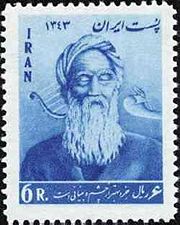
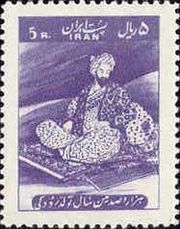
ian government published a series of stamps showing his picture. An international seminar was held at Vahdat Hall, Tehran
Tehran
Tehran , sometimes spelled Teheran, is the capital of Iran and Tehran Province. With an estimated population of 8,429,807; it is also Iran's largest urban area and city, one of the largest cities in Western Asia, and is the world's 19th largest city.In the 20th century, Tehran was subject to...
, Iran
Iran
Iran , officially the Islamic Republic of Iran , is a country in Southern and Western Asia. The name "Iran" has been in use natively since the Sassanian era and came into use internationally in 1935, before which the country was known to the Western world as Persia...
on 21 December 2008, to mark his 1150th birth anniversary, with President Ahmadinejad and "Culture minister" of Tajikistan in attendance. In this seminar, Rudaki was celebrated as the father of the Modern Persian literature.
See also
- List of Persian poets and authors
- Ismailism
- Persian literaturePersian literaturePersian literature spans two-and-a-half millennia, though much of the pre-Islamic material has been lost. Its sources have been within historical Persia including present-day Iran as well as regions of Central Asia where the Persian language has historically been the national language...
External links
- Rudaki, Abu Abd Allah, a biography by Professor Iraj Bashiri, University of Minnesota. Includes translations of "Lament in Old Age", "Mother of Wine", and "Ju-yi Muliyan."
- Rudaki on Iranian Yellow Pages