

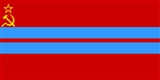
Turkmen SSR

Encyclopedia
The Turkmen Soviet Socialist Republic ( Türkmenistan Sovet Sotsialistik Respublikasy; Turkmenskaya Sovetskaya Sotsialisticheskaya Respublika), also known as the Turkmen SSR for short, was one of republics of the
Soviet Union
in Central Asia
. It was initially established on 7 August 1921 as the Turkmen Oblast of the Turkestan ASSR. On 13 May 1925 it was transformed into Turkmen SSR and became a separate republic of the USSR. In 1991, the Turkmen SSR became independent and was renamed Turkmenistan
.
attempts to encroach upon Turkmen territory began in earnest in the latter part of the nineteenth century. Of all the Central Asian peoples, the Turkmen put up the stiffest resistance against Russian expansion. In 1869 the Russian Empire
established a foothold in present-day Turkmenistan with the foundation of the Caspian Sea
port of Krasnovodsk (now Turkmenbashy). From there and other points, they marched on and subdued the Khiva Khanate in 1873. Because Turkmen tribes, most notably the Yomud, were in the military service of the Khivan khan, Russian forces undertook punitive raids against Khorazm, in the process slaughtering hundreds of Turkmen and destroying their settlements. In 1881 the Russians under General Mikhail Skobelev
besieged and captured Geok Tepe
, one of the last Turkmen strongholds, northwest of Ashgabat. With the Turkmen defeat (which is now marked by the Turkmen as a national day of mourning
and a symbol of national pride), the annexation of what is present-day Turkmenistan met with only weak resistance. Later the same year, the Russians signed an agreement with the Persians and established what essentially remains the current border between Turkmenistan and Iran. In 1897 a similar agreement was signed between the Russians and Afghans.
Following annexation to Russia, the area was administered as the Transcaspian Region
by corrupt and malfeasant military officers and officials appointed by the Turkestan
Governor-Generalship in Tashkent
. In the 1880s, a railroad was built from Krasnovodsk to Ashgabat and later extended to Tashkent. Urban areas began to develop along the railway. Although the Transcaspian Region essentially was a colony of Russia, it remained a backwater, except for Russian concerns with British colonialist intentions in the region and with possible uprisings by the Turkmen.
, little revolutionary activity occurred in the region in the years that followed. However, the years immediately preceding the revolution had been marked by sporadic Turkmen uprisings against Russian rule, most prominently the anti-tsarist revolt of 1916 that swept through the whole of Turkestan. Their armed resistance to Soviet rule was part of the larger Basmachi Revolt
throughout Central Asia from the 1920s into the early 1930s. Although Soviet sources describe this struggle as a minor chapter in the republic's history, it is clear that opposition was fierce and resulted in the death of large numbers of Turkmen.
In October 1924, when Central Asia was divided into distinct political entities, the Transcaspian Region
and Turkmen Oblast of the Turkestan Autonomous Soviet Socialist Republic
(Turkestan ASSR) became the Turkmen Soviet Socialist Republic (Turkmen SSR), a full-fledged constituent republic of the Soviet Union. During the forced collectivization and other extreme socioeconomic changes of the first decades of Soviet rule, pastoral nomadism ceased to be an economic alternative in Turkmenistan, and by the late 1930s the majority of Turkmen had become sedentary. Efforts by the Soviet state to undermine the traditional Turkmen way of life resulted in significant changes in familial and political relationships, religious and cultural observances, and intellectual developments. Significant numbers of Russians and other Slavs, as well as groups from various nationalities mainly from the Caucasus, migrated to urban areas. Modest industrial capabilities were developed, and limited exploitation of Turkmenistan's natural resources was initiated.
Under Soviet rule, all religious beliefs were attacked by the communist authorities as superstition and "vestiges of the past." Most religious schooling and religious observance were banned, and the vast majority of mosques were closed. An official Muslim Board of Central Asia with a headquarters in Tashkent was established during World War II
to supervise Islam in Central Asia. For the most part, the Muslim Board functioned as an instrument of propaganda whose activities did little to enhance the Muslim cause. Atheist indoctrination stifled religious development and contributed to the isolation of the Turkmen from the international Muslim community. Some religious customs, such as Muslim burial and male circumcision
, continued to be practiced throughout the Soviet period, but most religious belief, knowledge, and customs were preserved only in rural areas in "folk form" as a kind of unofficial Islam not sanctioned by the state-run Spiritual Directorate.
(CPSU) fostered the development of a Turkmen political elite and promoted Russification
. Slavs, both in Moscow and Turkmenistan, closely supervised the national cadre of government officials and bureaucrats; generally, the Turkmen leadership staunchly supported Soviet policies. Moscow initiated nearly all political activity in the republic, and, except for a corruption scandal in the mid-1980s that ousted longtime General Secretary Muhammetnazar Gapurow, Turkmenistan remained a quiet Soviet republic. Mikhail S. Gorbachev's policies of glasnost
and perestroika
did not have a significant impact on Turkmenistan. The republic found itself rather unprepared for the dissolution of the Soviet Union and the independence that followed in 1991.
When other constituent republics of the Soviet Union advanced claims to sovereignty in 1988 and 1989, Turkmenistan's leadership also began to criticize Moscow's economic and political policies as exploitative and detrimental to the well-being and pride of the Turkmen. By a unanimous vote of its Supreme Soviet, Turkmenistan declared its sovereignty in August 1990. After the August 1991 coup attempt against the Gorbachev regime in Moscow, Turkmenistan's communist leader Saparmurat Niyazov
called for a popular referendum on independence. The official result of the referendum was 94 percent in favor of independence. The republic's Supreme Soviet had little choice other than to declare Turkmenistan's independence from the Soviet Union and the establishment of the Republic of Turkmenistan on October 27, 1991. Turkimenstan received independence from the Soviet Union on December 25, 1991.
Republics of the Soviet Union
The Republics of the Soviet Union or the Union Republics of the Soviet Union were ethnically-based administrative units that were subordinated directly to the Government of the Soviet Union...
Soviet Union
Soviet Union
The Soviet Union , officially the Union of Soviet Socialist Republics , was a constitutionally socialist state that existed in Eurasia between 1922 and 1991....
in Central Asia
Soviet Central Asia
Soviet Central Asia refers to the section of Central Asia formerly controlled by the Soviet Union, as well as the time period of Soviet administration . In terms of area, it is nearly synonymous with Russian Turkestan, the name for the region during the Russian Empire...
. It was initially established on 7 August 1921 as the Turkmen Oblast of the Turkestan ASSR. On 13 May 1925 it was transformed into Turkmen SSR and became a separate republic of the USSR. In 1991, the Turkmen SSR became independent and was renamed Turkmenistan
Turkmenistan
Turkmenistan , formerly also known as Turkmenia is one of the Turkic states in Central Asia. Until 1991, it was a constituent republic of the Soviet Union, the Turkmen Soviet Socialist Republic . Turkmenistan is one of the six independent Turkic states...
.
Annexation to Russia
RussianRussian Empire
The Russian Empire was a state that existed from 1721 until the Russian Revolution of 1917. It was the successor to the Tsardom of Russia and the predecessor of the Soviet Union...
attempts to encroach upon Turkmen territory began in earnest in the latter part of the nineteenth century. Of all the Central Asian peoples, the Turkmen put up the stiffest resistance against Russian expansion. In 1869 the Russian Empire
Russian Empire
The Russian Empire was a state that existed from 1721 until the Russian Revolution of 1917. It was the successor to the Tsardom of Russia and the predecessor of the Soviet Union...
established a foothold in present-day Turkmenistan with the foundation of the Caspian Sea
Caspian Sea
The Caspian Sea is the largest enclosed body of water on Earth by area, variously classed as the world's largest lake or a full-fledged sea. The sea has a surface area of and a volume of...
port of Krasnovodsk (now Turkmenbashy). From there and other points, they marched on and subdued the Khiva Khanate in 1873. Because Turkmen tribes, most notably the Yomud, were in the military service of the Khivan khan, Russian forces undertook punitive raids against Khorazm, in the process slaughtering hundreds of Turkmen and destroying their settlements. In 1881 the Russians under General Mikhail Skobelev
Mikhail Skobelev
Mikhail Dmitrievich Skobelev was a Russian general famous for his conquest of Central Asia and heroism during the Russo-Turkish War of 1877-78. Dressed in white uniform and mounted on a white horse, and always in the thickest of the fray, he was known and adored by his soldiers as the "White...
besieged and captured Geok Tepe
Geok Tepe
Geok Tepe, Gökdepe or Gokdepe, is a former fortress of the Turkmens, in Turkmenistan, in the oasis of Ahal, on the Transcaspian railway, 28 miles north-west of Ashgabat. Gökdepe is the Russian version of the Turkic name meaning "Blue Hill" from the Turkmen gök "blue" and depe "hill" or "summit"...
, one of the last Turkmen strongholds, northwest of Ashgabat. With the Turkmen defeat (which is now marked by the Turkmen as a national day of mourning
Public holidays in Turkmenistan
Public holidays in Turkmenistan fall into three main categories: holidays commemorating historical events and landmarks since the declaration of Turkmenistan's independence in 1991 ; traditional and religious holidays revived since...
and a symbol of national pride), the annexation of what is present-day Turkmenistan met with only weak resistance. Later the same year, the Russians signed an agreement with the Persians and established what essentially remains the current border between Turkmenistan and Iran. In 1897 a similar agreement was signed between the Russians and Afghans.
Following annexation to Russia, the area was administered as the Transcaspian Region
Transcaspian Region
Transcaspian Region , or Transcaspia, was the name used from the second half of the 19th century until 1924 for the section of Russian Empire to the east of the Caspian Sea, bounded to the south by Iran's Khorasan Province and Afghanistan, to the north by the former Russian province of Uralsk, and...
by corrupt and malfeasant military officers and officials appointed by the Turkestan
Russian Turkestan
Russian Turkestan was the western part of Turkestan within the Russian Empire , comprising the oasis region to the south of the Kazakh steppes, but not the protectorates of the Emirate of Bukhara and the Khanate of Khiva.-History:-Establishment:Although Russia had been pushing south into the...
Governor-Generalship in Tashkent
Tashkent
Tashkent is the capital of Uzbekistan and of the Tashkent Province. The officially registered population of the city in 2008 was about 2.2 million. Unofficial sources estimate the actual population may be as much as 4.45 million.-Early Islamic History:...
. In the 1880s, a railroad was built from Krasnovodsk to Ashgabat and later extended to Tashkent. Urban areas began to develop along the railway. Although the Transcaspian Region essentially was a colony of Russia, it remained a backwater, except for Russian concerns with British colonialist intentions in the region and with possible uprisings by the Turkmen.
Creation of an SSR
Because the Turkmen generally were indifferent to the advent of Soviet rule in 1917October Revolution
The October Revolution , also known as the Great October Socialist Revolution , Red October, the October Uprising or the Bolshevik Revolution, was a political revolution and a part of the Russian Revolution of 1917...
, little revolutionary activity occurred in the region in the years that followed. However, the years immediately preceding the revolution had been marked by sporadic Turkmen uprisings against Russian rule, most prominently the anti-tsarist revolt of 1916 that swept through the whole of Turkestan. Their armed resistance to Soviet rule was part of the larger Basmachi Revolt
Basmachi Revolt
The Basmachi movement or Basmachi Revolt was an uprising against Russian Imperial and Soviet rule by the Muslim, largely Turkic peoples of Central Asia....
throughout Central Asia from the 1920s into the early 1930s. Although Soviet sources describe this struggle as a minor chapter in the republic's history, it is clear that opposition was fierce and resulted in the death of large numbers of Turkmen.
In October 1924, when Central Asia was divided into distinct political entities, the Transcaspian Region
Transcaspian Region
Transcaspian Region , or Transcaspia, was the name used from the second half of the 19th century until 1924 for the section of Russian Empire to the east of the Caspian Sea, bounded to the south by Iran's Khorasan Province and Afghanistan, to the north by the former Russian province of Uralsk, and...
and Turkmen Oblast of the Turkestan Autonomous Soviet Socialist Republic
Turkestan Autonomous Soviet Socialist Republic
Turkestan Autonomous Soviet Socialist Republic was created from the Turkestan Krai of Imperial Russia...
(Turkestan ASSR) became the Turkmen Soviet Socialist Republic (Turkmen SSR), a full-fledged constituent republic of the Soviet Union. During the forced collectivization and other extreme socioeconomic changes of the first decades of Soviet rule, pastoral nomadism ceased to be an economic alternative in Turkmenistan, and by the late 1930s the majority of Turkmen had become sedentary. Efforts by the Soviet state to undermine the traditional Turkmen way of life resulted in significant changes in familial and political relationships, religious and cultural observances, and intellectual developments. Significant numbers of Russians and other Slavs, as well as groups from various nationalities mainly from the Caucasus, migrated to urban areas. Modest industrial capabilities were developed, and limited exploitation of Turkmenistan's natural resources was initiated.
Under Soviet rule, all religious beliefs were attacked by the communist authorities as superstition and "vestiges of the past." Most religious schooling and religious observance were banned, and the vast majority of mosques were closed. An official Muslim Board of Central Asia with a headquarters in Tashkent was established during World War II
World War II
World War II, or the Second World War , was a global conflict lasting from 1939 to 1945, involving most of the world's nations—including all of the great powers—eventually forming two opposing military alliances: the Allies and the Axis...
to supervise Islam in Central Asia. For the most part, the Muslim Board functioned as an instrument of propaganda whose activities did little to enhance the Muslim cause. Atheist indoctrination stifled religious development and contributed to the isolation of the Turkmen from the international Muslim community. Some religious customs, such as Muslim burial and male circumcision
Circumcision
Male circumcision is the surgical removal of some or all of the foreskin from the penis. The word "circumcision" comes from Latin and ....
, continued to be practiced throughout the Soviet period, but most religious belief, knowledge, and customs were preserved only in rural areas in "folk form" as a kind of unofficial Islam not sanctioned by the state-run Spiritual Directorate.
Pre-independence
Beginning in the 1930s, Moscow kept the republic under firm control. The nationalities policy of the Communist Party of the Soviet UnionCommunist Party of the Soviet Union
The Communist Party of the Soviet Union was the only legal, ruling political party in the Soviet Union and one of the largest communist organizations in the world...
(CPSU) fostered the development of a Turkmen political elite and promoted Russification
Russification
Russification is an adoption of the Russian language or some other Russian attributes by non-Russian communities...
. Slavs, both in Moscow and Turkmenistan, closely supervised the national cadre of government officials and bureaucrats; generally, the Turkmen leadership staunchly supported Soviet policies. Moscow initiated nearly all political activity in the republic, and, except for a corruption scandal in the mid-1980s that ousted longtime General Secretary Muhammetnazar Gapurow, Turkmenistan remained a quiet Soviet republic. Mikhail S. Gorbachev's policies of glasnost
Glasnost
Glasnost was the policy of maximal publicity, openness, and transparency in the activities of all government institutions in the Soviet Union, together with freedom of information, introduced by Mikhail Gorbachev in the second half of the 1980s...
and perestroika
Perestroika
Perestroika was a political movement within the Communist Party of the Soviet Union during 1980s, widely associated with the Soviet leader Mikhail Gorbachev...
did not have a significant impact on Turkmenistan. The republic found itself rather unprepared for the dissolution of the Soviet Union and the independence that followed in 1991.
When other constituent republics of the Soviet Union advanced claims to sovereignty in 1988 and 1989, Turkmenistan's leadership also began to criticize Moscow's economic and political policies as exploitative and detrimental to the well-being and pride of the Turkmen. By a unanimous vote of its Supreme Soviet, Turkmenistan declared its sovereignty in August 1990. After the August 1991 coup attempt against the Gorbachev regime in Moscow, Turkmenistan's communist leader Saparmurat Niyazov
Saparmurat Niyazov
Saparmurat Atayevich Niyazov; , was a Turkmen politician who served as President of Turkmenistan from 2 November 1990 until his death in 2006...
called for a popular referendum on independence. The official result of the referendum was 94 percent in favor of independence. The republic's Supreme Soviet had little choice other than to declare Turkmenistan's independence from the Soviet Union and the establishment of the Republic of Turkmenistan on October 27, 1991. Turkimenstan received independence from the Soviet Union on December 25, 1991.
External links
- Turkmenia: Man Masters the Desert by Balysh OvezovBalysh OvezovBalysh Ovezovich Ovezov , served as General Secretary of the Communist Party of the Turkmen SSR twice....