


Diodotus I

Encyclopedia
Diodotus I Soter (c. 285 BC – c. 239 BC) was Seleucid
satrap
of Bactria
, rebelled against Seleucid rule soon after the death of Antiochus II
in c. 255 or 246 BC, and wrested independence for his territory. He died in 239 BC.
This event is recorded by Trogus
, Prol. 41; Justin
xli. 4, 5, where he is called Theodotus; Strabo
xi. 515). The name apparently is related to the title Soter he uses for himself. His power seems to have extended over the neighbouring provinces. Diodotus was a contemporary, a neighbour, and probably an ally of Andragoras, the satrap of Parthia, who at about the same time also proclaimed independence from the Seleucid Empire.
Egypt:
The new kingdom, highly urbanized and considered as one of the richest of the Orient (opulentissimum illud mille urbium Bactrianum imperium "The extremely prosperous empire of the thousand cities of Bactria" Justin, XLI,1 ), was to further grow in power and engage into territorial expansion to the east and the west:
The newly declared King married a daughter, born c. 266 BC, of Antiochus II Theos
and wife Laodice I
and had two children: Diodotus II
and a daughter, born c. 250 BC, who married Euthydemus I
.
 Arsaces
, the chieftain of the nomadic (Dahan) tribe of the Parni
, fled before him into Parthia
and there eliminated Andragoras, the former satrap and self-proclaimed king of Parthia, and became the founder of the Parthian Empire
(Strabo l.c.). The Greco-Bactrians became cut from direct contacts with the Greek world. Overland trade continued at a reduced rate, while sea trade between Greek Egypt and Bactria developed. When Seleucus II
in 239 BC attempted to subjugate the rebels in the east, it appears he and Diodotus united together against the Parthians (Justin xli. 4, 9).
Soon afterwards Diodotus died and was succeeded by his son Diodotus II
, who concluded a peace with the Parthians (Justin l.c.). Diodotus was succeeded by his son Diodotus II
, who allied himself with the Parthian Arsaces
in his fight against Seleucus II
:
Diodotus II was subsequently killed by a usurper, Euthydemus
, founder of the Greco-Bactrian Euthydemid dynasty (Polyb.
xi. 34, 2).
xi. 34, 5); thus the erection of an independent kingdom may have been a necessity and indeed an advantage to the Greeks, and this epithet well deserved. Diodotus Soter appears also on coins struck in his memory by the later Graeco-Bactrian kings Agathocles
and Antimachus
. Cf. AV Sallet, Die Nachfolger Alexanders d. Gr. in Baktrien und Indien; Percy Gardner
, Catal. of the Coins of the Greek and Scythian Kings of Bactria and India (Brit. Mus.
).
Seleucid Empire
The Seleucid Empire was a Greek-Macedonian state that was created out of the eastern conquests of Alexander the Great. At the height of its power, it included central Anatolia, the Levant, Mesopotamia, Persia, today's Turkmenistan, Pamir and parts of Pakistan.The Seleucid Empire was a major centre...
satrap
Satrap
Satrap was the name given to the governors of the provinces of the ancient Median and Achaemenid Empires and in several of their successors, such as the Sassanid Empire and the Hellenistic empires....
of Bactria
Bactria
Bactria and also appears in the Zend Avesta as Bukhdi. It is the ancient name of a historical region located between south of the Amu Darya and west of the Indus River...
, rebelled against Seleucid rule soon after the death of Antiochus II
Antiochus II Theos
Antiochus II Theos was a king of the Hellenistic Seleucid Kingdom who reigned 261 BC – 246 BC). He succeeded his father Antiochus I Soter in the winter of 262–61 BC...
in c. 255 or 246 BC, and wrested independence for his territory. He died in 239 BC.
This event is recorded by Trogus
Gnaeus Pompeius Trogus
Gnaeus Pompēius Trōgus, known as Pompeius Trogus, Pompey Trogue, or Trogue Pompey, was a 1st century BC Roman historian of the Celtic tribe of the Vocontii in Gallia Narbonensis, flourished during the age of Augustus, nearly contemporary with Livy.His grandfather served in the war against Sertorius...
, Prol. 41; Justin
Junianus Justinus
Justin was a Latin historian who lived under the Roman Empire. His name is mentioned only in the title of his own history, and there it is in the genitive, which would be M. Juniani Justini no matter which nomen he bore.Of his personal history nothing is known...
xli. 4, 5, where he is called Theodotus; Strabo
Strabo
Strabo, also written Strabon was a Greek historian, geographer and philosopher.-Life:Strabo was born to an affluent family from Amaseia in Pontus , a city which he said was situated the approximate equivalent of 75 km from the Black Sea...
xi. 515). The name apparently is related to the title Soter he uses for himself. His power seems to have extended over the neighbouring provinces. Diodotus was a contemporary, a neighbour, and probably an ally of Andragoras, the satrap of Parthia, who at about the same time also proclaimed independence from the Seleucid Empire.
Independence and prosperity
Diodotus wrested independence for his territory after the death of the Seleucid ruler Antiochus II, who had been embroiled in a war against PtolemaicPtolemaic Kingdom
The Ptolemaic Kingdom in and around Egypt began following Alexander the Great's conquest in 332 BC and ended with the death of Cleopatra VII and the Roman conquest in 30 BC. It was founded when Ptolemy I Soter declared himself Pharaoh of Egypt, creating a powerful Hellenistic state stretching from...
Egypt:
- Diodotus, the governor of the thousand cities of BactriaBactriaBactria and also appears in the Zend Avesta as Bukhdi. It is the ancient name of a historical region located between south of the Amu Darya and west of the Indus River...
(LatinLatinLatin is an Italic language originally spoken in Latium and Ancient Rome. It, along with most European languages, is a descendant of the ancient Proto-Indo-European language. Although it is considered a dead language, a number of scholars and members of the Christian clergy speak it fluently, and...
: "Theodotus, mille urbium Bactrianarum praefectus"), defected and proclaimed himself king; all the other people of the Orient followed his example and seceded from the Macedonians. (JustinJunianus JustinusJustin was a Latin historian who lived under the Roman Empire. His name is mentioned only in the title of his own history, and there it is in the genitive, which would be M. Juniani Justini no matter which nomen he bore.Of his personal history nothing is known...
, XLI,4 )
The new kingdom, highly urbanized and considered as one of the richest of the Orient (opulentissimum illud mille urbium Bactrianum imperium "The extremely prosperous empire of the thousand cities of Bactria" Justin, XLI,1 ), was to further grow in power and engage into territorial expansion to the east and the west:
- "The Greeks who caused BactriaBactriaBactria and also appears in the Zend Avesta as Bukhdi. It is the ancient name of a historical region located between south of the Amu Darya and west of the Indus River...
to revolt grew so powerful on account of the fertility of the country that they became masters, not only of ArianaArianaAriana was a region of the eastern countries of ancient Iran, next to India.Ariana may also refer to:* Ariana In places:*Ariana Governorate, a governorate in Tunisia*Ariana, Tunisia*Lake Ariana, a lake in Sofia, Bulgaria...
, but also of IndiaIndiaIndia , officially the Republic of India , is a country in South Asia. It is the seventh-largest country by geographical area, the second-most populous country with over 1.2 billion people, and the most populous democracy in the world...
, as Apollodorus of ArtemitaApollodorus of ArtemitaApollodorus of Artemita was a Greek writer of the 1st century BCE.Apollodorus wrote a history of the Parthian Empire, the Parthika , in at least four books. He is quoted by Strabo and Athenaeus. Strabo stated that he was very reliable. Apollodorus seems to have used the archives of Artemita and...
says: and more tribes were subdued by them than by Alexander... Their cities were Bactra (also called Zariaspa, through which flows a river bearing the same name and emptying into the Oxus), and Darapsa, and several others. Among these was EucratidiaEucratideiaEucratideia was an ancient town in Bactria mentioned by a few ancient writers.It was most likely a foundation of Eucratides I who is the more important ruler of the Greco-Bactrian Kingdom with the name Eucratides. Not much is known about this city and it might be just a renaming of an already...
, which was named after its ruler." (Strabo, XI.XI.I )
The newly declared King married a daughter, born c. 266 BC, of Antiochus II Theos
Antiochus II Theos
Antiochus II Theos was a king of the Hellenistic Seleucid Kingdom who reigned 261 BC – 246 BC). He succeeded his father Antiochus I Soter in the winter of 262–61 BC...
and wife Laodice I
Laodice I
Laodice I was an Anatolian noblewoman who was a close relative of the early Seleucid Dynasty and was the first wife of the Seleucid Greek King Antiochus II Theos. -Family Background:...
and had two children: Diodotus II
Diodotus II
Diodotus II was a Greco-Bactrian king from c. 239 BC, son of Diodotus I. He is known for concluding a peace treaty with the Parthian king Arsaces, in order to forestall the Seleucid reconquest of both Parthia and Bactria:...
and a daughter, born c. 250 BC, who married Euthydemus I
Euthydemus I
Euthydemus I , Greco-Bactrian king in about 230 or 223 BCE according to Polybius., he is thought to have originally been a Satrap of Sogdiana, who overturned the dynasty of Diodotus of Bactria and became a Greco-Bactrian king. Strabo, on the other hand, correlates his accession with internal...
.
Conflict with Arsaces
Arsaces I of Parthia
Arsaces I was the founder of the Arsacid dynasty, and after whom all 30+ monarchs of the Arsacid empire officially named themselves. A celebrated descent from antiquity begins with Arsaces.A 1st century AD tradition casts Arsaces as descending from the 5th-century BC Achaemenid monarch...
, the chieftain of the nomadic (Dahan) tribe of the Parni
Parni
The Parni or Aparni were an east Iranian people of the Ochus River valley, southeast of the Caspian Sea...
, fled before him into Parthia
Parthia
Parthia is a region of north-eastern Iran, best known for having been the political and cultural base of the Arsacid dynasty, rulers of the Parthian Empire....
and there eliminated Andragoras, the former satrap and self-proclaimed king of Parthia, and became the founder of the Parthian Empire
Parthian Empire
The Parthian Empire , also known as the Arsacid Empire , was a major Iranian political and cultural power in ancient Persia...
(Strabo l.c.). The Greco-Bactrians became cut from direct contacts with the Greek world. Overland trade continued at a reduced rate, while sea trade between Greek Egypt and Bactria developed. When Seleucus II
Seleucus II Callinicus
Seleucus II Callinicus or Pogon , was a ruler of the Hellenistic Seleucid Empire, who reigned from 246 to 225 BC...
in 239 BC attempted to subjugate the rebels in the east, it appears he and Diodotus united together against the Parthians (Justin xli. 4, 9).
Soon afterwards Diodotus died and was succeeded by his son Diodotus II
Diodotus II
Diodotus II was a Greco-Bactrian king from c. 239 BC, son of Diodotus I. He is known for concluding a peace treaty with the Parthian king Arsaces, in order to forestall the Seleucid reconquest of both Parthia and Bactria:...
, who concluded a peace with the Parthians (Justin l.c.). Diodotus was succeeded by his son Diodotus II
Diodotus II
Diodotus II was a Greco-Bactrian king from c. 239 BC, son of Diodotus I. He is known for concluding a peace treaty with the Parthian king Arsaces, in order to forestall the Seleucid reconquest of both Parthia and Bactria:...
, who allied himself with the Parthian Arsaces
Arsaces I of Parthia
Arsaces I was the founder of the Arsacid dynasty, and after whom all 30+ monarchs of the Arsacid empire officially named themselves. A celebrated descent from antiquity begins with Arsaces.A 1st century AD tradition casts Arsaces as descending from the 5th-century BC Achaemenid monarch...
in his fight against Seleucus II
Seleucus II Callinicus
Seleucus II Callinicus or Pogon , was a ruler of the Hellenistic Seleucid Empire, who reigned from 246 to 225 BC...
:
- "Soon after, relieved by the death of Theodotus [Justin uses a erroneous version of the name], Arsaces made peace and concluded an alliance with his son, also by the name of Theodotus; some time later he fought against Seleucus who came to punish the rebels, and he prevailed: the Parthians celebrated this day as the one that marked the beginning of their freedom" (JustinJunianus JustinusJustin was a Latin historian who lived under the Roman Empire. His name is mentioned only in the title of his own history, and there it is in the genitive, which would be M. Juniani Justini no matter which nomen he bore.Of his personal history nothing is known...
, XLI,4 )
Diodotus II was subsequently killed by a usurper, Euthydemus
Euthydemus I
Euthydemus I , Greco-Bactrian king in about 230 or 223 BCE according to Polybius., he is thought to have originally been a Satrap of Sogdiana, who overturned the dynasty of Diodotus of Bactria and became a Greco-Bactrian king. Strabo, on the other hand, correlates his accession with internal...
, founder of the Greco-Bactrian Euthydemid dynasty (Polyb.
Polybius
Polybius , Greek ) was a Greek historian of the Hellenistic Period noted for his work, The Histories, which covered the period of 220–146 BC in detail. The work describes in part the rise of the Roman Republic and its gradual domination over Greece...
xi. 34, 2).
Coinage
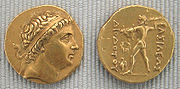
Of Diodotus I we possess gold, silver and bronze coins, some of which are struck in the name of Antiochos. As the power of the Seleucids was weak and continually attacked by Ptolemy II, the eastern provinces and their Greek cities were exposed to the invasion of the nomadic barbarians and threatened with destruction (Polyb.Polybius
Polybius , Greek ) was a Greek historian of the Hellenistic Period noted for his work, The Histories, which covered the period of 220–146 BC in detail. The work describes in part the rise of the Roman Republic and its gradual domination over Greece...
xi. 34, 5); thus the erection of an independent kingdom may have been a necessity and indeed an advantage to the Greeks, and this epithet well deserved. Diodotus Soter appears also on coins struck in his memory by the later Graeco-Bactrian kings Agathocles
Agathocles
Agathocles , , was tyrant of Syracuse and king of Sicily .-Biography:...
and Antimachus
Antimachus
Antimachus, of Colophon or Claros, Greek poet and grammarian, flourished about 400 BC.Scarcely anything is known of his life. His poetical efforts were not generally appreciated, although he received encouragement from his younger contemporary Plato .His chief works were: an epic Thebais, an...
. Cf. AV Sallet, Die Nachfolger Alexanders d. Gr. in Baktrien und Indien; Percy Gardner
Percy Gardner
Percy Gardner was an English classical archaeologist.Percy Gardner was born in London, and was educated at the City of London School and Christ's College, Cambridge...
, Catal. of the Coins of the Greek and Scythian Kings of Bactria and India (Brit. Mus.
British Museum
The British Museum is a museum of human history and culture in London. Its collections, which number more than seven million objects, are amongst the largest and most comprehensive in the world and originate from all continents, illustrating and documenting the story of human culture from its...
).
External links
| Preceded by: Antiochus II Antiochus II Theos Antiochus II Theos was a king of the Hellenistic Seleucid Kingdom who reigned 261 BC – 246 BC). He succeeded his father Antiochus I Soter in the winter of 262–61 BC... (Seleucid Empire Seleucid Empire The Seleucid Empire was a Greek-Macedonian state that was created out of the eastern conquests of Alexander the Great. At the height of its power, it included central Anatolia, the Levant, Mesopotamia, Persia, today's Turkmenistan, Pamir and parts of Pakistan.The Seleucid Empire was a major centre... ) |
Greco-Bactrian Greco-Bactrian Kingdom The Greco-Bactrian Kingdom was the easternmost part of the Hellenistic world, covering Bactria and Sogdiana in Central Asia from 250 to 125 BC... Ruler |
Succeeded by: Diodotus II Diodotus II Diodotus II was a Greco-Bactrian king from c. 239 BC, son of Diodotus I. He is known for concluding a peace treaty with the Parthian king Arsaces, in order to forestall the Seleucid reconquest of both Parthia and Bactria:... |