

Apollodotus I

Encyclopedia
Apollodotus I Soter was an Indo-Greek king between 180 and 160 BCE or between 174 and 165 BCE (first dating Osmund Bopearachchi and R C Senior, second dating Boperachchi) who ruled the western and southern parts of the Indo-Greek kingdom, from Taxila
in Punjab
to the areas of Sindh
and possibly Gujarat.
, the Greco-Bactrian king who invaded northwestern India
after 180 BCE. Tarn was uncertain whether he was a member of the royal house. Later authors largely agree with Tarn's analysis, though with perhaps even more uncertainty regarding who the king was, for his coins do not give many hints.
Apollodotus was either succeeded in India by Antimachus II
, or the two kings were contemporary, Antimachus II ruling the more western territories closer to Bactria. Eventually Apollodotus I was succeeded by Menander I
, and the two kings are mentioned by Pompejus Trogus as important Indo-Greek rulers.
The 1st-2nd century CE Periplus of the Erythraean Sea
further testifies to the reign of Apollodotus I and the influence of the Indo-Greeks in India:
 The coinage of Apollodotus is, together with that of Menander, one of the most abundant of the Indo-Greek kings. It is found mainly in the provinces of Punjab, Sindh
and Gujarat, indicating the southern limit of the Indo-Greek expansion in India. This is also suggested by the Periplus
, a 1st century CE document on trade in the Indian Ocean
, which describes the remnants of Greek presence (shrines, barracks, wells, coinage) in the strategic port of Barygaza (Bharuch
) in Gujarat. Strabo
(XI) also describes the occupation of Patalene (Indus
Delta country). While Sindh may have come under his possession, it is not known as to whether Apollodotus advanced to Gujarat, where the Satavahanas ruled.
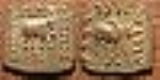
Apollodotus also issued a great number of bilingual Indian-standard square coins. Beside the usual royal title, the exact significance of the animals depicted on the coins is unclear. The sacred elephant may be the symbol of the city of Taxila
, or possibly the symbol of the white elephant who reputedly entered in dream the womb the mother of the Buddha
, Queen Maya
, which would make it a symbol of Buddhism
, one of the main religions of the Indo-Greek territories.
Similarly, the sacred bull on the reverse may be a symbol of a city (Pushkhalavati), or a depiction of Shiva
, making it a symbol of Hinduism
, the other major religion at that time. The bull is often represented in a clearly erectile state, which reinforces its interpretation as a representation of Shiva. Conversely, this also reinforces the interpretation of the elephant as a religious symbol. Alternatively, the Bull, according to Foucher, represents the birth of the Buddha, as it happened during the month of Vaicakha (April–May), known to Buddhists as Vesak
, under the zodiacal sign of the Taurus
, during the full moon. The enlightenment and passing of the Buddha also occurred during the Taurus full moon.
Before their design was eventually simplified, some of the earlier coins of king Apollodotus directly associate the elephant with Buddhist symbolism, such as the stupa
hill surmounted by a star, also seen, for example on the coins of the Mauryan Empire or those of the later Kuninda kingdom
. Apollodotus experimented with different coin standards for his silver, until he settled for a standard lighter than the Attic which would prevail for centuries, though later rulers usually struck round coins instead of the square (typically Indian) shape of most of Apollodotus' silver. He issued a number of bronzes with Apollo
/tripod, that also were repeated for centuries.
, a common Hellenistic motif introduced by the Diadoch Lysimachus
. On these coins, he used no epithet.
Taxila
Taxila is a Tehsil in the Rawalpindi District of Punjab province of Pakistan. It is an important archaeological site.Taxila is situated about northwest of Islamabad Capital Territory and Rawalpindi in Panjab; just off the Grand Trunk Road...
in Punjab
Punjab region
The Punjab , also spelled Panjab |water]]s"), is a geographical region straddling the border between Pakistan and India which includes Punjab province in Pakistan and the states of the Punjab, Haryana, Himachal Pradesh, Chandigarh and some northern parts of the National Capital Territory of Delhi...
to the areas of Sindh
Sindh
Sindh historically referred to as Ba'ab-ul-Islam , is one of the four provinces of Pakistan and historically is home to the Sindhi people. It is also locally known as the "Mehran". Though Muslims form the largest religious group in Sindh, a good number of Christians, Zoroastrians and Hindus can...
and possibly Gujarat.
Ruler of the Indo-Greek kingdom
Apollodotus was not the first to strike bilingual coins outside of Bactria, but he was the first king who ruled in India only, and therefore the founder of the proper Indo-Greek kingdom. According to W.W. Tarn, Apollodotus I was one of the generals of Demetrius I of BactriaDemetrius I of Bactria
Demetrius I was a Buddhist Greco-Bactrian king . He was the son of Euthydemus and succeeded him around 200 BC, after which he conquered extensive areas in what now is eastern Iran, Afghanistan and Pakistan thus creating an Indo-Greek kingdom far from Hellenistic Greece...
, the Greco-Bactrian king who invaded northwestern India
India
India , officially the Republic of India , is a country in South Asia. It is the seventh-largest country by geographical area, the second-most populous country with over 1.2 billion people, and the most populous democracy in the world...
after 180 BCE. Tarn was uncertain whether he was a member of the royal house. Later authors largely agree with Tarn's analysis, though with perhaps even more uncertainty regarding who the king was, for his coins do not give many hints.
Apollodotus was either succeeded in India by Antimachus II
Antimachus II
Antimachus II Nikephoros "The Victorious" was an Indo-Greek king. He ruled on a vast territory from the Hindu-Kush to the Punjab around 170 BCE. He was almost certainly identical with the eponymous son of Antimachus I, who is known from a unique preserved tax-receipt...
, or the two kings were contemporary, Antimachus II ruling the more western territories closer to Bactria. Eventually Apollodotus I was succeeded by Menander I
Menander I
Menander I Soter "The Saviour" was one of the rulers of the Indo-Greek Kingdom from either 165 or 155 BC to 130 BC ....
, and the two kings are mentioned by Pompejus Trogus as important Indo-Greek rulers.
The 1st-2nd century CE Periplus of the Erythraean Sea
Periplus of the Erythraean Sea
The Periplus of the Erythraean Sea or Periplus of the Red Sea is a Greco-Roman periplus, written in Greek, describing navigation and trading opportunities from Roman Egyptian ports like Berenice along the coast of the Red Sea, and others along Northeast Africa and India...
further testifies to the reign of Apollodotus I and the influence of the Indo-Greeks in India:
Coinage
Sindh
Sindh historically referred to as Ba'ab-ul-Islam , is one of the four provinces of Pakistan and historically is home to the Sindhi people. It is also locally known as the "Mehran". Though Muslims form the largest religious group in Sindh, a good number of Christians, Zoroastrians and Hindus can...
and Gujarat, indicating the southern limit of the Indo-Greek expansion in India. This is also suggested by the Periplus
Periplus of the Erythraean Sea
The Periplus of the Erythraean Sea or Periplus of the Red Sea is a Greco-Roman periplus, written in Greek, describing navigation and trading opportunities from Roman Egyptian ports like Berenice along the coast of the Red Sea, and others along Northeast Africa and India...
, a 1st century CE document on trade in the Indian Ocean
Indian Ocean
The Indian Ocean is the third largest of the world's oceanic divisions, covering approximately 20% of the water on the Earth's surface. It is bounded on the north by the Indian Subcontinent and Arabian Peninsula ; on the west by eastern Africa; on the east by Indochina, the Sunda Islands, and...
, which describes the remnants of Greek presence (shrines, barracks, wells, coinage) in the strategic port of Barygaza (Bharuch
Bharuch
Bharuch , also known as Broach, is the oldest city in Gujarat, situated at the mouth of the holy river Narmada. Bharuch is the administrative headquarters of Bharuch District and a municipality of more than 1,50,000 inhabitants. As Bharuch is a major seaport city, a number of trade activities have...
) in Gujarat. Strabo
Strabo
Strabo, also written Strabon was a Greek historian, geographer and philosopher.-Life:Strabo was born to an affluent family from Amaseia in Pontus , a city which he said was situated the approximate equivalent of 75 km from the Black Sea...
(XI) also describes the occupation of Patalene (Indus
Indus River
The Indus River is a major river which flows through Pakistan. It also has courses through China and India.Originating in the Tibetan plateau of western China in the vicinity of Lake Mansarovar in Tibet Autonomous Region, the river runs a course through the Ladakh district of Jammu and Kashmir and...
Delta country). While Sindh may have come under his possession, it is not known as to whether Apollodotus advanced to Gujarat, where the Satavahanas ruled.
Apollodotus also issued a great number of bilingual Indian-standard square coins. Beside the usual royal title, the exact significance of the animals depicted on the coins is unclear. The sacred elephant may be the symbol of the city of Taxila
Taxila
Taxila is a Tehsil in the Rawalpindi District of Punjab province of Pakistan. It is an important archaeological site.Taxila is situated about northwest of Islamabad Capital Territory and Rawalpindi in Panjab; just off the Grand Trunk Road...
, or possibly the symbol of the white elephant who reputedly entered in dream the womb the mother of the Buddha
Gautama Buddha
Siddhārtha Gautama was a spiritual teacher from the Indian subcontinent, on whose teachings Buddhism was founded. In most Buddhist traditions, he is regarded as the Supreme Buddha Siddhārtha Gautama (Sanskrit: सिद्धार्थ गौतम; Pali: Siddhattha Gotama) was a spiritual teacher from the Indian...
, Queen Maya
Queen Maya
Queen Māyā of Sakya was the birth mother of the historical Gautama Buddha, Siddhārtha of the Gautama gotra, and sister of Mahāpajāpatī Gotamī the first Buddhist nun ordained by the Buddha. "Māyā" means "illusion" or "enchantment" in Sanskrit and Pāli. Māyā is also called Mahāmāyā and Māyādevī...
, which would make it a symbol of Buddhism
Buddhism
Buddhism is a religion and philosophy encompassing a variety of traditions, beliefs and practices, largely based on teachings attributed to Siddhartha Gautama, commonly known as the Buddha . The Buddha lived and taught in the northeastern Indian subcontinent some time between the 6th and 4th...
, one of the main religions of the Indo-Greek territories.
Similarly, the sacred bull on the reverse may be a symbol of a city (Pushkhalavati), or a depiction of Shiva
Shiva
Shiva is a major Hindu deity, and is the destroyer god or transformer among the Trimurti, the Hindu Trinity of the primary aspects of the divine. God Shiva is a yogi who has notice of everything that happens in the world and is the main aspect of life. Yet one with great power lives a life of a...
, making it a symbol of Hinduism
Hinduism
Hinduism is the predominant and indigenous religious tradition of the Indian Subcontinent. Hinduism is known to its followers as , amongst many other expressions...
, the other major religion at that time. The bull is often represented in a clearly erectile state, which reinforces its interpretation as a representation of Shiva. Conversely, this also reinforces the interpretation of the elephant as a religious symbol. Alternatively, the Bull, according to Foucher, represents the birth of the Buddha, as it happened during the month of Vaicakha (April–May), known to Buddhists as Vesak
Vesak
Vesākha is a holiday observed traditionally by Buddhists in Bangladesh, India, Nepal, Sri Lanka, and the South East Asian countries of Singapore, Vietnam, Thailand, Cambodia, Laos, Malaysia, Burma, and Indonesia...
, under the zodiacal sign of the Taurus
Taurus (astrology)
Taurus is the second astrological sign in the Zodiac, which spans the zodiac between the 30th and 59th degree of celestial longitude. Generally, the Sun transits this area of the zodiac between April 21 to May 21 each year...
, during the full moon. The enlightenment and passing of the Buddha also occurred during the Taurus full moon.
Before their design was eventually simplified, some of the earlier coins of king Apollodotus directly associate the elephant with Buddhist symbolism, such as the stupa
Stupa
A stupa is a mound-like structure containing Buddhist relics, typically the remains of Buddha, used by Buddhists as a place of worship....
hill surmounted by a star, also seen, for example on the coins of the Mauryan Empire or those of the later Kuninda kingdom
Kuninda Kingdom
The Kingdom of Kuninda was an ancient central Himalayan kingdom from around the 2nd century BCE to the 3rd century, located in the modern state of Uttarakhand and southern areas of Himachal in northern India.-Kingdom:...
. Apollodotus experimented with different coin standards for his silver, until he settled for a standard lighter than the Attic which would prevail for centuries, though later rulers usually struck round coins instead of the square (typically Indian) shape of most of Apollodotus' silver. He issued a number of bronzes with Apollo
Apollo
Apollo is one of the most important and complex of the Olympian deities in Greek and Roman mythology...
/tripod, that also were repeated for centuries.
Bactrian coins
Apollodotus also issued a small series of monolingual Attic tetradrachms, intended for export into Bactria. For these, Apollodotus I clearly used Bactrian celators to strike an exquisite realistic portrait of the king as an aged man in the Macedonian hat called kausia, with a reverse of sitting Pallas Athene holding NikeNike (mythology)
In Greek mythology, Nike was a goddess who personified victory, also known as the Winged Goddess of Victory. The Roman equivalent was Victoria. Depending upon the time of various myths, she was described as the daughter of Pallas and Styx and the sister of Kratos , Bia , and Zelus...
, a common Hellenistic motif introduced by the Diadoch Lysimachus
Lysimachus
Lysimachus was a Macedonian officer and diadochus of Alexander the Great, who became a basileus in 306 BC, ruling Thrace, Asia Minor and Macedon.-Early Life & Career:...
. On these coins, he used no epithet.
| Preceded by: (In Paropamisade) Agathocles Agathocles of Bactria Agathocles Dikaios was a Buddhist Indo-Greek king, who reigned between around 190 and 180 BCE. He might have been a son of Demetrius and one of his sub-kings in charge of the Paropamisade between Bactria and India... (In Gandhara Gandhara Gandhāra , is the name of an ancient kingdom , located in northern Pakistan and eastern Afghanistan. Gandhara was located mainly in the vale of Peshawar, the Potohar plateau and on the Kabul River... ) Pantaleon Pantaleon Pantaleon was a Greek king who reigned some time between 190–180 BCE in Bactria and India. He was a younger contemporary or successor of the Greco-Bactrian king Demetrius, and is sometimes believed to have been his brother and/or subking... |
Indo-Greek Ruler (Paropamisade, Arachosia Arachosia Arachosia is the Latinized form of the Greek name of an Achaemenid and Seleucid governorate in the eastern part of their respective empires, around modern-day southern Afghanistan. The Greek term "Arachosia" corresponds to the Iranian land of Harauti which was between Kandahar in Afghanistan and... , Gandhara Gandhara Gandhāra , is the name of an ancient kingdom , located in northern Pakistan and eastern Afghanistan. Gandhara was located mainly in the vale of Peshawar, the Potohar plateau and on the Kabul River... , Punjab Punjab region The Punjab , also spelled Panjab |water]]s"), is a geographical region straddling the border between Pakistan and India which includes Punjab province in Pakistan and the states of the Punjab, Haryana, Himachal Pradesh, Chandigarh and some northern parts of the National Capital Territory of Delhi... ) (180-160 BCE) |
Succeeded by: Antimachus II Antimachus II Antimachus II Nikephoros "The Victorious" was an Indo-Greek king. He ruled on a vast territory from the Hindu-Kush to the Punjab around 170 BCE. He was almost certainly identical with the eponymous son of Antimachus I, who is known from a unique preserved tax-receipt... |
See also
- Greco-Bactrian KingdomGreco-Bactrian KingdomThe Greco-Bactrian Kingdom was the easternmost part of the Hellenistic world, covering Bactria and Sogdiana in Central Asia from 250 to 125 BC...
- Seleucid EmpireSeleucid EmpireThe Seleucid Empire was a Greek-Macedonian state that was created out of the eastern conquests of Alexander the Great. At the height of its power, it included central Anatolia, the Levant, Mesopotamia, Persia, today's Turkmenistan, Pamir and parts of Pakistan.The Seleucid Empire was a major centre...
- Greco-BuddhismGreco-BuddhismGreco-Buddhism, sometimes spelled Graeco-Buddhism, refers to the cultural syncretism between Hellenistic culture and Buddhism, which developed between the 4th century BCE and the 5th century CE in the area covered by the Indian sub-continent, and modern Afghanistan, Pakistan and north-western...
- Indo-ScythiansIndo-ScythiansIndo-Scythians is a term used to refer to Sakas , who migrated into Bactria, Sogdiana, Arachosia, Gandhara, Kashmir, Punjab, Haryana, Uttar Pradesh, Gujarat, Maharashtra and Rajasthan, from the middle of the 2nd century BCE to the 4th century CE....
- Indo-Parthian KingdomIndo-Parthian KingdomThe Gondopharid dynasty, and other so-called Indo-Parthian rulers, were a group of ancient kings from present day eastern Afghanistan and Pakistan who ruled India, during or slightly before the 1st century AD...
- Kushan EmpireKushan EmpireThe Kushan Empire originally formed in the early 1st century AD under Kujula Kadphises in the territories of ancient Bactria on either side of the middle course of the Oxus in what is now northern Afghanistan, Pakistan, and southern Tajikistan and Uzbekistan.During the 1st and early 2nd centuries...
Sources
- Tarn, William Woodthorpe. The Greeks in Bactria and India. Cambridge University Press, 1938.