
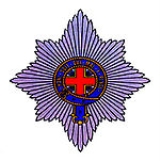
Her Majesty's Coldstream Regiment of Foot Guards, also known officially as the
Coldstream Guards (COLDM GDS), is a
regimentA regiment is a major tactical military unit, composed of variable numbers of batteries, squadrons or battalions, commanded by a colonel or lieutenant colonel...
of the
British ArmyThe British Army is the land warfare branch of Her Majesty's Armed Forces in the United Kingdom. It came into being with the unification of the Kingdom of England and Scotland into the Kingdom of Great Britain in 1707. The new British Army incorporated Regiments that had already existed in England...
, part of the
Guards DivisionThe Guards Division is an administrative unit of the British Army responsible for the administration of the regiments of Foot Guards and the London Regiment.-Introduction:...
or Household Division.
It is the oldest regiment in the Regular Army in continuous active service, originating in
ColdstreamColdstream is a small town in the Borders district of Scotland. It lies on the north bank of the River Tweed in Berwickshire, while Northumberland in England lies to the south bank, with Cornhill-on-Tweed the nearest village...
, Scotland in 1650 when
GeneralA general officer is an officer of high military rank, usually in the army, and in some nations, the air force. The term is widely used by many nations of the world, and when a country uses a different term, there is an equivalent title given....
George Monck founded the regiment. It is one of two regiments of the
Household DivisionHousehold Division is a term used principally in the Commonwealth of Nations to describe a country’s most elite or historically senior military units, or those military units that provide ceremonial or protective functions associated directly with the head of state.-Historical Development:In...
that can trace its lineage to the
New Model ArmyThe New Model Army of England was formed in 1645 by the Parliamentarians in the English Civil War, and was disbanded in 1660 after the Restoration...
, the other being the
Blues and Royals (Royal Horse Guards and 1st Dragoons)The Blues and Royals is a cavalry regiment of the British Army, part of the Household Cavalry. The Colonel-in-Chief is Her Majesty The Queen and the Colonel is HRH The Princess Royal...
.
Traditions and role
The grouping of buttons on the tunic is a common way to distinguish between the regiments of
Foot Guards-British Army:The Foot Guards are the Regular Infantry regiments of the Household Division of the British Army. There have been six regiments of foot guards, five of which still exist. The Royal Guards Reserve Regiment was a reserve formation of the Household Brigade in existence from 1900-1901...
. Coldstream buttons are arranged in pairs, and a star of the garter is marked on their brassware.
The regiment is ranked second in the order of precedence, behind the
Grenadier GuardsThe Grenadier Guards is an infantry regiment of the British Army. It is the most senior regiment of the Guards Division and, as such, is the most senior regiment of infantry. It is not, however, the most senior regiment of the Army, this position being attributed to the Life Guards...
. This is because the Grenadier Guards have served the Crown for a longer period of time. However, the Coldstream Guards is an older regiment, and because of this, has the motto
Nulli Secundus (Second to None). The regiment has been referred to as the "Second Regiment of Foot Guards" in Parliamentary state papers, but this term has long fallen into disuse and was never used by the regiment, hence their motto. When parading with the other four regiments, is always on the extreme left of the line, with the Grenadier Guards on the extreme right. This ensures that the regiment is indeed "Second to None".
The regiment's formal title is
Her Majesty's Coldstream Regiment of Foot Guards. Their nickname is 'Lilywhites'. An ordinary soldier of the regiment is called a Guardsman, a designation granted by King
George VGeorge V was King of the United Kingdom and the British Dominions, and Emperor of India, from 6 May 1910 through the First World War until his death in 1936....
after the First World War. The regiment is always referred to as the Coldstream, never as the Coldstreams, likewise a member of the regiment is referred to as a Coldstreamer.
Currently the most prominent role of the 1st Battalion and No. 7 Company is the performance of ceremonial duties in London and
WindsorWindsor is an affluent suburban town and unparished area in the Royal Borough of Windsor and Maidenhead in Berkshire, England. It is widely known as the site of Windsor Castle, one of the official residences of the British Royal Family....
as part of the
Household DivisionHousehold Division is a term used principally in the Commonwealth of Nations to describe a country’s most elite or historically senior military units, or those military units that provide ceremonial or protective functions associated directly with the head of state.-Historical Development:In...
. No. 7 Company serves as an incremental Company in London and amongst other duties provides a Guard for the Queen's Birthday Parade. Duties include the
State Opening of ParliamentIn the United Kingdom, the State Opening of Parliament is an annual event that marks the commencement of a session of the Parliament of the United Kingdom. It is held in the House of Lords Chamber, usually in November or December or, in a general election year, when the new Parliament first assembles...
,
Trooping the ColourTrooping the Colour is a ceremony performed by regiments of the British and the Commonwealth armies. It has been a tradition of British infantry regiments since the 17th century, although the roots go back much earlier. On battlefields, a regiment's colours, or flags, were used as rallying points...
, and the
Remembrance SundayIn the United Kingdom, 'Remembrance Sunday' is held on the second Sunday in November, which is the Sunday nearest to 11 November Armistice Day. It is the anniversary of the end of hostilities in the First World War at 11 a.m...
parade. No. 7 company is involved in the
Changing of the GuardGuard Mounting, or Changing the Guard , refers to a formal ceremony in which sentries providing ceremonial guard duties at important institutions are relieved by a new batch of sentries...
.
Companies that make up the regiment are traditionally numbered – the 1st Battalion contains HQ Coy, plus No. 1, No. 2, No. 3 and No. 4 (Support) Coys. The
Coldstream Guards BandThe Band of the Coldstream Guards is one of the oldest and best known bands in the British Army, having been officially formed on 16 May 1785 under the command of Major C F Eley, reflecting the fact that the Coldstream Guards regiment is the oldest of the guards regiments...
and the staff of RHQ constitute No. 15 Coy. No. 7 Coy is the incremental company that is used for public duties and maintains the traditions of the 2nd Battalion. New officers destined for the regiment that are at
SandhurstThe Royal Military Academy Sandhurst , commonly known simply as Sandhurst, is a British Army officer initial training centre located in Sandhurst, Berkshire, England...
or at ATR Pirbright form No. 13 Coy, while Guardsmen under training at ITC Catterick make up No. 14 Coy.
Operationally, the Coldstream Guards currently perform the role of
light infantryTraditionally light infantry were soldiers whose job was to provide a skirmishing screen ahead of the main body of infantry, harassing and delaying the enemy advance. Light infantry was distinct from medium, heavy or line infantry. Heavy infantry were dedicated primarily to fighting in tight...
. The 1st Battalion is based in
AldershotAldershot is a town in the English county of Hampshire, located on heathland about southwest of London. The town is administered by Rushmoor Borough Council...
as an operational light infantry battalion. Under the
reformsThe 2003 Defence White Paper, titled Delivering Security in a Changing World, set out the future structure of the British military, and was preceded by the 1998 Strategic Defence Review and the 2002 SDR New Chapter, which responded to the immediate challenges to security in the aftermath of the...
announced in 2004, the Coldstream Guards will be given this as a fixed role, alternating the public duties task with the
Irish GuardsThe Irish Guards , part of the Guards Division, is a Foot Guards regiment of the British Army.Along with the Royal Irish Regiment, it is one of the two Irish regiments remaining in the British Army. The Irish Guards recruit in Northern Ireland and the Irish neighbourhoods of major British cities...
.
The Corps of Drums, in addition to their ceremonial role, has the role of
machine gunA machine gun is a fully automatic mounted or portable firearm, usually designed to fire rounds in quick succession from an ammunition belt or large-capacity magazine, typically at a rate of several hundred rounds per minute....
platoon. All Guardsmen for public duties wear the 'Home Service' Dress tunic in summer or greatcoat in winter and bearskin with a red plume. The Coldstream Guards regimental band plays at Changing of The Guard, state visits and many other events. All of the regiments' musicians were trained as
medical orderliesA medical orderly , is a hospital attendant whose job consists of assisting medical and/or nursing staff with various nursing and/or medical interventions. These duties are classified as routine tasks involving no risk for the patient.- Job details :Orderlies are often utilized in various hospital...
, however they now undertake a role in Nuclear, Biological and Chemical decontamination.
Unlike the other four regiments of foot guards, which recruit from each of the four
home nationsHome Nations is a collective term with one of two meanings depending on the context. Politically, it means the nations of the constituent countries of the United Kingdom...
, the Coldstream Guards has a specific recruiting area, which encompasses the counties that Monck's Regiment passed through on its march from
ColdstreamColdstream is a small town in the Borders district of Scotland. It lies on the north bank of the River Tweed in Berwickshire, while Northumberland in England lies to the south bank, with Cornhill-on-Tweed the nearest village...
to
LondonLondon is the capital city of :England and the :United Kingdom, the largest metropolitan area in the United Kingdom, and the largest urban zone in the European Union by most measures. Located on the River Thames, London has been a major settlement for two millennia, its history going back to its...
. The traditional recruiting area of the Coldstream Guards is the South West and North East of England.
History
The origin of the Coldstream Guards lies in the
English Civil WarThe English Civil War was a series of armed conflicts and political machinations between Parliamentarians and Royalists...
when
Oliver CromwellOliver Cromwell was an English military and political leader who overthrew the English monarchy and temporarily turned England into a republican Commonwealth, and served as Lord Protector of England, Scotland, and Ireland....
gave Colonel George Monck permission to form his own regiment as part of the
New Model ArmyThe New Model Army of England was formed in 1645 by the Parliamentarians in the English Civil War, and was disbanded in 1660 after the Restoration...
. Monck took men from the regiments of
George Fenwick-Early life:Fenwick was the son of George Fenwick of Brinkburn, Northumberland, and Dorothy, daughter of John Forster of Newham, was born about 1603. Fenwick was called to the bar at Gray's Inn on 21 November 1631, and admitted ancient on 24 May 1650....
and
Sir Arthur HaselrigSir Arthur Haselrig, 2nd Baronet was an English politician who sat in the House of Commons between 1640 and 1659. He was one of the five members of Parliament whom King Charles I tried to arrest in 1642, an event which led to the start of the English Civil War...
, five companies each, and on 23 August 1650 formed
Monck's Regiment of Foot. Less than two weeks later this force took part in the
Battle of DunbarThe Battle of Dunbar was a battle of the Third English Civil War. The English Parliamentarian forces under Oliver Cromwell defeated a Scottish army commanded by David Leslie which was loyal to King Charles II, who had been proclaimed King of Scots on 5 February 1649.-Background:The English...
, at which the
Roundhead"Roundhead" was the nickname given to the supporters of the Parliament during the English Civil War. Also known as Parliamentarians, they fought against King Charles I and his supporters, the Cavaliers , who claimed absolute power and the divine right of kings...
s defeated the forces of
Charles StuartCharles II was monarch of the three kingdoms of England, Scotland, and Ireland.Charles II's father, King Charles I, was executed at Whitehall on 30 January 1649, at the climax of the English Civil War...
. Monck's regiment was left in
ScotlandScotland is a country that is part of the United Kingdom. Occupying the northern third of the island of Great Britain, it shares a border with England to the south and is bounded by the North Sea to the east, the Atlantic Ocean to the north and west, and the North Channel and Irish Sea to the...
.
After
Richard CromwellAt the same time, the officers of the New Model Army became increasingly wary about the government's commitment to the military cause. The fact that Richard Cromwell lacked military credentials grated with men who had fought on the battlefields of the English Civil War to secure their nation's...
's death, Monck gave his support to the Stuarts, and on 1 January 1660 he crossed the
River TweedThe River Tweed, or Tweed Water, is long and flows primarily through the Borders region of Great Britain. It rises on Tweedsmuir at Tweed's Well near where the Clyde, draining northwest, and the Annan draining south also rise. "Annan, Tweed and Clyde rise oot the ae hillside" as the Border saying...
into
EnglandEngland is a country that is part of the United Kingdom. It shares land borders with Scotland to the north and Wales to the west; the Irish Sea is to the north west, the Celtic Sea to the south west, with the North Sea to the east and the English Channel to the south separating it from continental...
at the village of
ColdstreamColdstream is a small town in the Borders district of Scotland. It lies on the north bank of the River Tweed in Berwickshire, while Northumberland in England lies to the south bank, with Cornhill-on-Tweed the nearest village...
, from where he made a five-week march to
LondonLondon is the capital city of :England and the :United Kingdom, the largest metropolitan area in the United Kingdom, and the largest urban zone in the European Union by most measures. Located on the River Thames, London has been a major settlement for two millennia, its history going back to its...
. He arrived in London on 2 February and helped in
the RestorationThe Restoration of the English monarchy began in 1660 when the English, Scottish and Irish monarchies were all restored under Charles II after the Interregnum that followed the Wars of the Three Kingdoms...
of the monarchy. For his help, Monck was given the
Order of the GarterThe Most Noble Order of the Garter, founded in 1348, is the highest order of chivalry, or knighthood, existing in England. The order is dedicated to the image and arms of St...
and his regiment was assigned to keep order in London. However, the new parliament soon ordered his regiment to be disbanded with the other regiments of the New Model Army.
Before that could happen, Parliament was forced to rely on the help of the regiment against the rebellion by the
Fifth MonarchistsThe Fifth Monarchists or Fifth Monarchy Men were active from 1649 to 1661 during the Interregnum, following the English Civil Wars of the 17th century. They took their name from a prophecy in the Book of Daniel that four ancient monarchies would precede Christ's return...
led by
Thomas VennerThomas Venner was a cooper and rebel who became the last leader of the Fifth Monarchy Men, who tried unsuccessfully to overthrow Oliver Cromwell in 1657, and subsequently led a coup in London against the newly-restored government of Charles II...
on 6 January 1661. The regiment successfully defeated the rebels and on 14 February the men of the regiment symbolically laid down their arms as part of the New Model Army and were immediately ordered to take them up again as a royal regiment of
The Lord General's Regiment of Foot Guards, a part of the Household Troops.
The regiment was placed as the second senior regiment of Household Troops, as it entered the service of the Crown after the
1st Regiment of Foot GuardsThe Grenadier Guards is an infantry regiment of the British Army. It is the most senior regiment of the Guards Division and, as such, is the most senior regiment of infantry. It is not, however, the most senior regiment of the Army, this position being attributed to the Life Guards...
, but they answered to that by adopting the motto
Nulli Secundus (
Second to None), due to the fact that the regiment is older than the senior regiment. The regiment always stands on the left of the line when on parade with rest of the Foot Guards, so standing "second to none". When Monck died in 1670, the Earl of Craven took command of the regiment and it adopted a new name, the
Coldstream Regiment of Foot Guards.
The regiment saw active service in
FlandersFlanders is the community of the Flemings but also one of the institutions in Belgium, and a geographical region located in parts of present-day Belgium, France and the Netherlands. "Flanders" can also refer to the northern part of Belgium that contains Brussels, Bruges, Ghent and Antwerp...
and in the
Monmouth RebellionThe Monmouth Rebellion,The Revolt of the West or The West Country rebellion of 1685, was an attempt to overthrow James II, who had become King of England, King of Scots and King of Ireland at the death of his elder brother Charles II on 6 February 1685. James II was a Roman Catholic, and some...
, including the decisive
Battle of SedgemoorThe Battle of Sedgemoor was fought on 6 July 1685 and took place at Westonzoyland near Bridgwater in Somerset, England.It was the final battle of the Monmouth Rebellion and followed a series of skirmishes around south west England between the forces of James Scott, 1st Duke of Monmouth and the...
in 1685. After 1688 they fought in the
Battle of WalcourtThe Battle of Walcourt was fought on 25 August 1689 during the Nine Years' War. The action took place near the ancient walled town of Walcourt near Charleroi in the Spanish Netherlands, and brought to a close a summer of uneventful marching, manoeuvring, and foraging...
in 1689, the
Battle of LandenThe Battle of Landen , in the current Belgian province of Flemish Brabant, was a battle in the Nine Years' War, fought in present-day Belgium on 29 July 1693 between the French army of Marshal Luxembourg and the Allied army of King William III of England...
and the
Siege of NamurThe Siege of Namur, 2 July–1 September 1695, was the second siege of the city of Namur in the Nine Years' War. The Allied forces of the Grand Alliance retook the city from the French, who had captured it in the first siege in 1692...
.
In 1760, the 2nd Battalion was sent to Germany to campaign under Prince Ferdinand of Brunswick and fought in the Battle of Wilhelmstal and at the Castle of Arnoneberg. Three Guards companies of 307 men under Coldstream commander Colonel Matthew fought in the
American War of IndependenceThe American Revolutionary War , the American War of Independence, or simply the Revolutionary War, began as a war between the Kingdom of Great Britain and thirteen British colonies in North America, and ended in a global war between several European great powers.The war was the result of the...
.
The Coldstream Regiment saw extensive service in the wars against the
French RevolutionThe French Revolution , sometimes distinguished as the 'Great French Revolution' , was a period of radical social and political upheaval in France and Europe. The absolute monarchy that had ruled France for centuries collapsed in three years...
and in the
Napoleonic WarsThe Napoleonic Wars were a series of wars declared against Napoleon's French Empire by opposing coalitions that ran from 1803 to 1815. As a continuation of the wars sparked by the French Revolution of 1789, they revolutionised European armies and played out on an unprecedented scale, mainly due to...
. Under the command of Sir Ralph Abercrombie they defeated French troops in
EgyptEgypt , officially the Arab Republic of Egypt, Arabic: , is a country mainly in North Africa, with the Sinai Peninsula forming a land bridge in Southwest Asia. Egypt is thus a transcontinental country, and a major power in Africa, the Mediterranean Basin, the Middle East and the Muslim world...
. In 1807 they took part in the investment of
CopenhagenCopenhagen is the capital and largest city of Denmark, with an urban population of 1,199,224 and a metropolitan population of 1,930,260 . With the completion of the transnational Øresund Bridge in 2000, Copenhagen has become the centre of the increasingly integrating Øresund Region...
. In January 1809 they sailed to
PortugalPortugal , officially the Portuguese Republic is a country situated in southwestern Europe on the Iberian Peninsula. Portugal is the westernmost country of Europe, and is bordered by the Atlantic Ocean to the West and South and by Spain to the North and East. The Atlantic archipelagos of the...
to join the forces under
Sir Arthur WellesleyField Marshal Arthur Wellesley, 1st Duke of Wellington, KG, GCB, GCH, PC, FRS , was an Irish-born British soldier and statesman, and one of the leading military and political figures of the 19th century...
. The 2nd Battalion joined the Walcheren Expedition. Later it served as part of the 2nd Guards Brigade in the chateau of
HougoumontHougoumont was a fortified farm held by Wellington's army in the Battle of Waterloo. It may also refer to:* Hougoumont , a convict ship;...
on the outskirts of the
Battle of WaterlooThe Battle of Waterloo was fought on Sunday 18 June 1815 near Waterloo in present-day Belgium, then part of the United Kingdom of the Netherlands...
. This defence is considered one of the greatest achievements of the regiment, and an annual ceremony of "Hanging the Brick" is performed each year in the Sergeants' Mess to commemorate the efforts of
Cpl James GrahamJames Graham was an Irish non-commissioned officer in the British Army during the Napoleonic wars, recognised as the "bravest man in the army". Serving in the Coldstream Guards, he was commended for his gallantry during the defence of Hougoumont, at Waterloo...
and
Lt-Col James MacdonnellGeneral Sir James Macdonnell, GCB, KMT, KCH was the third son of Duncan Macdonnell of Glengarry.- Military career :In 1794, he was a lieutenant in the 78th Regiment of Foot; in 1795, he was Captain in the 17th Dragoons....
, who shut the North Gate after a French attack.
WellesleyField Marshal Arthur Wellesley, 1st Duke of Wellington, KG, GCB, GCH, PC, FRS , was an Irish-born British soldier and statesman, and one of the leading military and political figures of the 19th century...
himself declared after the battle that "the success of the battle turned upon closing the gates at Hougoumont".
The regiment was later part of the British occupation forces of
ParisParis is the capital and largest city in France, situated on the river Seine, in northern France, at the heart of the Île-de-France region...
until 1816.
During the
Crimean WarThe Crimean War was a conflict fought between the Russian Empire and an alliance of the French Empire, the British Empire, the Ottoman Empire, and the Kingdom of Sardinia. The war was part of a long-running contest between the major European powers for influence over territories of the declining...
, the Coldstream Guards fought in the battles of
AlmaThe Battle of the Alma , which is usually considered the first battle of the Crimean War , took place just south of the River Alma in the Crimea. An Anglo-French force under General St...
,
InkermanThe Battle of Inkerman was fought during the Crimean War on November 5, 1854 between the allied armies of Britain and France against the Imperial Russian Army. The battle broke the will of the Russian Army to defeat the allies in the field, and was followed by the Siege of Sevastopol...
and Sevastopol. On their return, four of the Guardsmen were awarded the newly-instituted
Victoria CrossThe Victoria Cross is the highest military decoration awarded for valour "in the face of the enemy" to members of the armed forces of various Commonwealth countries, and previous British Empire territories....
.
The regiment received its current name,
The Coldstream Guards, in 1855. In 1882 they were sent to Egypt against the rebels of Ahmed 'Urabi and in 1885 in the Suakin Campaign. In 1897, the Coldstreamers were reinforced with the addition of the 3rd battalion. The 1st and 2nd battalions were dispatched to
South AfricaThe Republic of South Africa is a country in southern Africa. Located at the southern tip of Africa, it is divided into nine provinces, with of coastline on the Atlantic and Indian oceans...
at the outbreak of the
Second Boer WarThe Second Boer War was fought from 11 October 1899 until 31 May 1902 between the British Empire and the Afrikaans-speaking Dutch settlers of two independent Boer republics, the South African Republic and the Orange Free State...
.
At the outbreak of the
First World WarWorld War I , which was predominantly called the World War or the Great War from its occurrence until 1939, and the First World War or World War I thereafter, was a major war centred in Europe that began on 28 July 1914 and lasted until 11 November 1918...
, Coldstreamers were among the first British regiments to arrive in France after Britain declared war on Germany. In the following battles, they suffered heavy losses, in two cases losing all their officers. At the first Battle of Ypres the 1st battalion was virtually annihilated – by 1 November down to 150 men and the Lt Quartermaster. They fought in
MonsThe Battle of Mons was the first major action of the British Expeditionary Force in the First World War. It was a subsidiary action of the Battle of the Frontiers, in which the Allies clashed with Germany on the French borders. At Mons, the British army attempted to hold the line of the...
,
LoosThe Battle of Loos was one of the major British offensives mounted on the Western Front in 1915 during World War I. It marked the first time the British used poison gas during the war, and is also famous for the fact that it witnessed the first large-scale use of 'new' or Kitchener's Army...
,
SommeThe Battle of the Somme , also known as the Somme Offensive, took place during the First World War between 1 July and 14 November 1916 in the Somme department of France, on both banks of the river of the same name...
,
GinchyThe Battle of Ginchy took place on 9 September 1916 during the Battle of the Somme when the United Kingdom 16th Division captured the German-held village of Ginchy. However the Irish Royal Munster Fusiliers suffered heavy casualties in the process...
and in the 3rd Battle of Ypres. They also formed the 4th (Pioneer) Battalion, which was disbanded after the war, in 1919. The 5th Reserve battalion never left Britain before it was disbanded.
When the Second World War began, the 1st and 2nd battalions of the Coldstream Guards were part of the
British Expeditionary ForceThe British Expeditionary Force was the British force in Europe from 1939–1940 during the Second World War. Commanded by General Lord Gort, the BEF constituted one-tenth of the defending Allied force....
in France; whilst the 3rd Battalion was on overseas service in the Middle East. Additional 4th and 5th battalions were also formed for the duration of the war. They fought extensively in North Africa and Europe as dismounted infantry and the 1st battalion in the Guards Armoured Division. The 4th battalion first became a motorized battalion in 1940 and then an armoured battalion in 1943. The 4th and 5th served as part of the Guards Armoured Division. 6th battalion was also formed in 1941 but was disbanded in 1943 without seeing any action.
Coldstreamers gave up their tanks at the end of the war, the new battalions were disbanded, and the troops distributed to the 1st and 2nd Guard Training Battalions.
After the war, the 1st and 3rd battalions served in Palestine. The 2nd battalion served in the
Malayan EmergencyThe Malayan Emergency was a guerrilla war fought between Commonwealth armed forces and the Malayan National Liberation Army , the military arm of the Malayan Communist Party, from 1948 to 1960....
. The 3rd battalion was placed in suspended animation in 1959. The remaining battalions served during the Mau Mau rebellion, in
AdenAden is a seaport city in Yemen, located by the eastern approach to the Red Sea , some 170 kilometres east of Bab-el-Mandeb. Its population is approximately 800,000. Aden's ancient, natural harbour lies in the crater of an extinct volcano which now forms a peninsula, joined to the mainland by a...
,
MauritiusMauritius , officially the Republic of Mauritius is an island nation off the southeast coast of the African continent in the southwest Indian Ocean, about east of Madagascar...
in 1965, in the Cyprus Emergency in 1974 and several times in
Northern IrelandNorthern Ireland is one of the four countries of the United Kingdom. Situated in the north-east of the island of Ireland, it shares a border with the Republic of Ireland to the south and west...
after 1969.
The Regimental Band of the Coldstream Guards were the first act on stage at the
WembleyWembley is an area of northwest London, England, and part of the London Borough of Brent. It is home to the famous Wembley Stadium and Wembley Arena...
leg of the 1985
Live AidLive Aid was a dual-venue concert that was held on 13 July 1985. The event was organized by Bob Geldof and Midge Ure to raise funds for relief of the ongoing Ethiopian famine. Billed as the "global jukebox", the event was held simultaneously in Wembley Stadium in London, England, United Kingdom ...
charity concert. They played for the
PrincePrince Charles, Prince of Wales is the heir apparent and eldest son of Queen Elizabeth II and Prince Philip, Duke of Edinburgh. Since 1958 his major title has been His Royal Highness The Prince of Wales. In Scotland he is additionally known as The Duke of Rothesay...
and Princess of Wales. More recently, the band's Fanfare team opened Live 8 in Hyde Park in the summer of 2005.
After the
Cold WarThe Cold War was the continuing state from roughly 1946 to 1991 of political conflict, military tension, proxy wars, and economic competition between the Communist World—primarily the Soviet Union and its satellite states and allies—and the powers of the Western world, primarily the United States...
, the 1st battalion was dispatched to the first
Gulf WarThe Persian Gulf War , commonly referred to as simply the Gulf War, was a war waged by a U.N.-authorized coalition force from 34 nations led by the United States, against Iraq in response to Iraq's invasion and annexation of Kuwait.The war is also known under other names, such as the First Gulf...
where it was involved in prisoner of war handling and other roles. In 1993, due to
defence cutbacksOptions for Change was a restructuring of the British Armed Forces in 1990, aimed at cutting defence spending following the end of the Cold War....
, the 2nd battalion was placed in suspended animation and its colours are maintained by No 7 Company, which is permanently stationed in London on ceremonial duties.
For much of the 1990s, the 1st Battalion was stationed in Munster, Germany, in the Armoured Infantry Role with Warrior APCs as part of
4th Armoured BrigadeThe 4th Mechanized Brigade is a British Army brigade.The 4th Armoured Brigade was formed during the Second World War, as an armoured brigade of the 7th Armoured Division....
. In 1993–1994 the battalion served as an armoured infantry battalion in peacekeeping duties in
BosniaBosnia and Herzegovina , sometimes called Bosnia-Herzegovina or simply Bosnia, is a country in Southern Europe, on the Balkan Peninsula. Bordered by Croatia to the north, west and south, Serbia to the east, and Montenegro to the southeast, Bosnia and Herzegovina is almost landlocked, except for the...
as part of UNPROFOR with the Battalion Headquarters in Vitez with additional outposts in Gornji Vakuf and Sarajevo. The Coldstream Guards were the first British regiment to enter Sarajevo in the conflict.
The battalion was posted to
DerryDerry or Londonderry is the second-biggest city in Northern Ireland and the fourth-biggest city on the island of Ireland. The name Derry is an anglicisation of the Irish name Doire or Doire Cholmcille meaning "oak-wood of Colmcille"...
, Northern Ireland on a two-year deployment in 2001. It deployed to Iraq in April 2005 for a six-month tour with the rest of 12th Mechanised Brigade, based in the south of the country. The battalion lost two of its soldiers, on 2 May, near Al Amarah and on 18 October at
BasraBasra is the capital of Basra Governorate, in southern Iraq near Kuwait and Iran. It had an estimated population of two million as of 2009...
.
Des BrowneDesmond Henry Browne, Baron Browne of Ladyton is a British Labour Party politician who was the Member of Parliament for Kilmarnock and Loudoun from 1997 to 2010...
,
Secretary of State for DefenceThe Secretary of State for Defence, popularly known as the Defence Secretary, is the senior Government of the United Kingdom minister in charge of the Ministry of Defence, chairing the Defence Council. It is a Cabinet position...
, announced on 19 July 2007 that in October 2007 the battalion was to be sent to
AfghanistanAfghanistan , officially the Islamic Republic of Afghanistan, is a landlocked country located in the centre of Asia, forming South Asia, Central Asia and the Middle East. With a population of about 29 million, it has an area of , making it the 42nd most populous and 41st largest nation in the world...
as part of 52 Infantry Brigade. In March 2008, while on patrol with the ANA, members of the
RegimentA regiment is a major tactical military unit, composed of variable numbers of batteries, squadrons or battalions, commanded by a colonel or lieutenant colonel...
discovered a Taliban torture chamber.
In October 2009 the Battalion deployed on
Operation HerrickOperation Herrick is the codename under which all British operations in the war in Afghanistan have been conducted since 2002. It consists of the British contribution to the NATO-led International Security Assistance Force and support to the US-led Operation Enduring Freedom...
11, with Number One and Number Three Companies deploying to the Babaji area of central
Helmand ProvinceHelmand is one of the 34 provinces of Afghanistan. It is in the southwest of the country. Its capital is Lashkar Gah. The Helmand River flows through the mainly desert region, providing water for irrigation....
, Afghanistan. Number Two Company was allocated a task of training Afghan National Police recruits at various Police Training Centres. Number One Company's deployment to PB4 Babaji was heralded as the Battalion's most difficult excursion since
AdenAden is a seaport city in Yemen, located by the eastern approach to the Red Sea , some 170 kilometres east of Bab-el-Mandeb. Its population is approximately 800,000. Aden's ancient, natural harbour lies in the crater of an extinct volcano which now forms a peninsula, joined to the mainland by a...
in 1948, playing a major role in
Operation MoshtarakOperation Moshtarak was an ISAF pacification offensive in the area that is described as the "poppy-growing belt" of Helmand Province in southern Afghanistan. The combat operations started on February 13, 2010, and focuses on the Nad Ali District and Lashkar Gah district...
in February 2010 in addition to suffering five dead and multiple casualties, including several lost limbs. The Battalion returned to the UK in April 2010.
Regimental Colonels
- Captain-General George Monck, 1st Duke of Albemarle, 1650–1678
- Lieutenant General William Craven, 1st Earl of Craven, 1678–1689
- Lieutenant General Thomas Talmash
Thomas Tollemache was an English soldier; the second son of Sir Lionel Tollemache of Helmingham, Suffolk and his wife, Elizabeth, 2nd Countess of Dysart....
(or Tollemache), 1689–1694
- Lieutenant General John Cutts, 1st Baron Cutts
Lieutenant-General John Cutts, 1st Baron Cutts PC , British soldier and author, came from an Essex family.After a short university career at Catharine Hall, Cambridge, he inherited the family estates, but showed a distinct preference for the life of court and camp...
, 1694–1702
- General Charles Churchill
General Charles Churchill was an English army officer who served during the War of the Spanish Succession.-Life:...
, 1702–1714
- Lieutenant General William Cadogan, 1st Earl of Cadogan
William Cadogan, 1st Earl Cadogan KT PC was a noted military officer in the army of John Churchill, 1st Duke of Marlborough during the War of the Spanish Succession...
, 1714–1722
- Colonel Richard Lumley, 2nd Earl of Scarbrough
Richard Lumley, 2nd Earl of Scarbrough, KG, PC was a British, Whig politician, known as Lord Lumley from 1710-21....
, 1722–1740
- Field Marshal HRH Prince William, Duke of Cumberland, 1740–1742
- Colonel Charles Spencer, 3rd Duke of Marlborough
Charles Spencer, 3rd Duke of Marlborough KG, PC , known as The Earl of Sunderland between 1729 and 1733, was a British soldier and politician. He briefly served as Lord Privy Seal in 1755...
, 1742–1744
- Lieutenant General Willem Anne van Keppel, 2nd Earl of Albemarle
Lieutenant-General Willem Anne van Keppel, 2nd Earl of Albemarle KG, KCB, PC, ADC was a British diplomat and an American colonist....
, 1744–1755
- Lieutenant General James O'Hara, 2nd Baron Tyrawley, 1755–1773
- General John Waldegrave, 3rd Earl of Waldegrave
John Waldegrave, 3rd Earl Waldegrave was a British politician and soldier.Waldegrave was the youngest son of the 1st Earl Waldegrave. He joined the 1st Regiment of Foot in 1735, rising to the rank of Captain in 1739...
, 1773–1784
- Field Marshal HRH Prince Frederick, Duke of York and Albany
The Prince Frederick, Duke of York and Albany was a member of the Hanoverian and British Royal Family, the second eldest child, and second son, of King George III...
, 1784–1805
- Field Marshal HRH Prince Adolphus, Duke of Cambridge
The Prince Adolphus, 1st Duke of Cambridge , was the tenth child and seventh son of George III and Queen Charlotte. He held the title of Duke of Cambridge from 1801 until his death. He also served as Viceroy of Hanover on behalf of his brothers George IV and William IV...
, 1805–1850
- Field Marshal John Byng, 1st Earl of Strafford
Field Marshal John Byng, 1st Earl of Strafford, GCB, GCH, PC was a British peer, politician and soldier.-Early years:...
, 1850–1860
- Field Marshal Colin (Macliver) Campbell, 1st Baron Clyde
Field Marshal Colin Campbell, 1st Baron Clyde GCB, KSI was a British Army officer from Scotland who led the Highland Brigade in the Crimea and was in command of the ‘Thin red line’ at the battle of Balaclava...
, 1860–1863
- Field Marshal Sir William Maynard Gomm
Field Marshal Sir William Maynard Gomm GCB , was a British Army commander.-Military career:He was gazetted to the 9th Foot at the age of ten in recognition of the services of his father, Lieutenant-Colonel William Gomm, who was killed in the attack on Guadaloupe...
, 1863–1875
- General Sir William John Codrington
General Sir William John Codrington GCB was a British general and politician who served in the Crimean War.-Military career:...
, 1875–1884
- General Sir Thomas Montagu Steele
General Sir Thomas Montagu Steele GCB, PC was a British army officer.-Life:...
, 1884–1890
- General Sir Arthur Edward Hardinge
General Sir Arthur Edward Harding KCB CIE was Governor of Gibraltar.-Military career:Born the second son of Henry Hardinge, 1st Viscount Hardinge and educated at Eton College, Hardinge was commissioned into the 41st Regiment of Foot in 1844. He was quickly appointed Aide-de-Camp to his father,...
, 1890–1892
- General Sir Frederick Stephenson
General Sir Frederick Charles Arthur Stephenson GCB was Major General commanding the Brigade of Guards and General Officer Commanding the Home District.-Military career:Stephenson was commissioned into the Scots Guards in 1837...
, 1892–1911
- General Lord William Frederick Ernest Seymour, 1911–1915
- Major General Evelyn Edward Thomas Boscawen, 7th Viscount Falmouth, 1915–1918
- Lieutenant General Sir Alfred Edward Codrington
Lieutenant-General Sir Alfred Edward Codrington GCVO KCB was a British Army officer who served in colonial wars in Africa during the late nineteenth century, and later commanded a reserve army during the First World War....
, 1918–1945
- General Sir Henry Charles Loyd
Lieutenant General Sir Henry Charles Loyd GCVO KCB DSO MC was a British Army General during World War II.-Military career:...
, 1945–1962
- General Sir Walter Arthur George Burns
Major-General Sir Walter Arthur George Burns GCVO, CB, DSO, OBE, KStJ, MC was a British Army officer and native of Hertfordshire.-Military career:Burns was born in January 1911 and educated at Eton and Trinity College, Cambridge...
, 1962–1994
- Lieutenant General William Edward Rous
Lieutenant General The Honourable Sir William Edward Rous KCB OBE is a former Quartermaster-General to the Forces.-Military career:Born the son of the Earl of Stradbroke, Rous was commissioned into the Coldstream Guards in 1959....
, 1994–1999
- General Sir Hugh Michael Rose, 1999–2009
- Lieutenant General James Jeffrey Corfield Bucknall
Lieutenant General James Jeffrey Corfield Bucknall, CBE, OW is a British Army officer and currently Deputy Commander of the International Security Assistance Force in Afghanistan.-Military career:...
, 2009–present
Battle honoursThe following battle honours were awarded to units of the British Army and the armies of British India and the Dominions of the British Empire. From their institution until the end of the Second World War, awards were made by, or in consultation with, the British government, but, since 1945, the...
There are 117 battle honours:
- Tangier 1680, Namur 1695, Gibraltar 1704-05, Oudenarde, Malplaquet, Dettingen, Lincelles, Egypt, Talavera, Barrosa, Fuentes d'Onor, Salamanca, Nive, Peninsula, Waterloo, Alma, Inkerman, Sevastopol, Tel-el-Kebir, Egypt 1882, Suakin 1885, Modder River
The Battle of Modder River was an engagement in the Boer War, fought at Modder River, on 28 November 1899...
, South Africa 1899-1902
- The Great War (5 battalions): Mons, Retreat from Mons, Marne 1914, Aisne 1914, Ypres 1914 '17, Langemarck 1914, Gheluvelt, Nonne Bosschen, Givenchy 1914, Neuve Chapelle, Aubers, Festubert 1915, Loos, Mount Sorrel, Somme 1916 '18, Flers-Courcelette, Morval, Pilckem, Menin Road, Poelcappelle, Passchendaele, Cambrai 1917 '18, St. Quentin, Bapaume 1918, Arras 1918, Lys, Hazebrouck, Albert 1918, Scarpe 1918, Drocourt-Quéant, Hindenburg Line, Havrincourt, Canal du Nord, Selle, Sambre, France and Flanders 1914-18
- The Second World War: Dyle, Defence of Escaut, Dunkirk 1940, Cagny, Mont Pincon, Quarry Hill, Estry, Heppen, Nederrijn, Venraij, Meijel, Roer, Rhineland, Reichswald, Cleve, Goch, Moyland, Hochwald, Rhine, Lingen, Uelzen, North-West Europe 1940 '44–45, Egyptian Frontier 1940, Sidi Barrani, Halfaya 1941, Tobruk 1941 '42, Msus, Knightsbridge, Defence of Alamein Line, Medenine, Mareth, Longstop Hill 1942, Sbiba, Steamroller Farm, Tunis, Hammam Lif, North Africa 1940-43, Salerno, Battipaglia, Cappezano, Volturno Crossing, Monte Camino, Calabritto, Garigliano Crossing, Monte Ornito, Monte Piccolo, Capture of Perugia, Arezzo, Advance to Florence, Monte Domini, Catarelto Ridge, Argenta Gap, Italy 1943-45
- Gulf 1991
Order of precedence
Alliances
–
The Governor General's Foot GuardsThe Governor General's Foot Guards is one of three Household regiments in the Primary Reserve of the Canadian Army, along with The Governor General's Horse Guards and the Canadian Grenadier Guards. The GGFG is the most senior militia infantry regiment in Canada."Civitas et Princeps Cura Nostra" is...
–
2nd Battalion, Royal Australian Regiment2nd Battalion, Royal Australian Regiment is a regular light infantry battalion of the Australian Army. 2 RAR was first formed as the Australian 66th Battalion in 1945 and since then it has seen active service during the Korean War, Malayan Emergency and Vietnam War...
–
HMS OceanHMS Ocean of the Royal Navy is an amphibious assault ship , the sole member of her class. She is designed to support amphibious landing operations and to support the staff of Commander UK Amphibious Force and Commander UK Landing Force...
See also
:Category:Coldstream Guards officers
:Category:Coldstream Guards soldiers
External links